




Abstract
This paper investigates the effects of the asset-based community development (ABCD) approach, thus, local resources, asset mobilization, and citizens’ participation on rural poverty alleviation in the northern part of Ghana by employing the moderating role of government policies. A total of five hundred fifty (550) questionnaires were administered in three (3) regions of the northern part of Ghana (Upper West, Upper East, and Northern); however, five hundred twenty-two (522) accurately filled responses were retrieved and used for the analysis. More robust structural equation modeling techniques are used to uncover accurate and reliable results. The results prove that local resources, asset mobilization, and citizen participation boost rural poverty alleviation. Also, the moderation role of government policies between asset mobilization and rural poverty alleviation is positive and significant. However, the moderation role of government policies on local resources and rural poverty alleviation nexus, and citizens’ participation and rural poverty alleviation nexus are statistically insignificant. Based on the study’s findings, policy recommendations applicable in Ghana and other developing regions have been proposed.
Plain Language Summary
Purpose: This study investigates the effects of the asset-based community development (ABCD) approach, thus, local resources, asset mobilization, and citizens’ participation on rural poverty alleviation in the northern part of Ghana by employing the moderating role of government policies. Methods: The study adopted the convenient sampling technique to obtain data from 550 respondents. The Statistical Package for Social Sciences (SPSS) v. 23 and Structural Equation Modelling (SEM) via SmartPLS v. 3 were used to evaluate the proposed relationships based on the data obtained. Conclusion: We found that local resources, asset mobilization and citizens’ participation all had significant positive effects on rural poverty alleviation. Also the moderation role of government policies between asset mobilization and rural poverty alleviation. However, the moderation role of government policies between local resources and citizens’ participation were statistically insignificant. Implications: Local government agencies located in these regions as well as non-governmental organizations, donor organizations, individual philanthropists etc, interested in promoting the ABCD concept in Ghana and other developing countries should enact policies that can promote the identification of local resources, efficient asset mobilization and effective participations of citizens in decision making processes toward rural poverty alleviation.
Keywords
Introduction
Poverty has long been recognized as a significant global issue that undermines nations, communities, and families (Coudouel et al., 2002; Yin et al., 2021). Therefore, various organizations, government bodies, individuals, and private organizations assert that decisive actions must be taken to tackle this issue (Lazarus, 2008). According to the World Bank, all countries must seek to eradicate severe poverty by 2030 (WDI, 2018). This objective is founded on the assumption that severe poverty must be eliminated within a generation and global prosperity must be promoted (Kabanda, 2018; WDI, 2018). Thus, poverty alleviation is a top priority for world leaders and a topic of discussion for scholars and policymakers. Cook (2006) and Li et al. (2016) posited that India and China had achieved great success in decreasing severe rural poverty in Southern and Eastern Asia, respectively, between 1990 and 2015, lowering it from 61% to 4%, thus efficiently driving sustainable development goal (SDG) number one. Likewise, the World Bank affirmed that global poverty rate (measured by the percentage of people living on less than $1.90 per day) has dropped from about 36% in 1990 to about 10% in 2019, representing a 72% reduction in poverty. These outcomes demonstrate that considerable work has been done in alleviating poverty and continues to be done worldwide (Cruz et al., 2015; Heilig et al., 2006).
Even though global extreme poverty rates have dropped in the last two decades, certain regions have not seen a proportional improvement. Specifically, Sub-Saharan African countries’ poverty rates are among the highest in the world. According to the World Bank, as of 2019, about 41% of the population in the region lived below the international poverty line of $1.90 per day. Ghana, a Sub-Saharan African country, is making significant efforts to alleviate rural and urban poverty. The World Bank reported that the country’s poverty fell from 51.7% in 1992 to 21.9% in 2019. This poverty reduction can be attributed to a combination of factors, including economic growth, government programs targeted at poverty reduction, and improved access to education and healthcare. However, poverty in Ghana remains a significant issue, particularly in rural areas where the poverty rate is higher than in urban areas. Additionally, there are disparities in poverty rates among different ethnic and regional groups, with poverty rates being highest among the northern regions and ethnic minority groups. The Ghana Statistical Service reports that poverty is primarily a problem in rural areas, with 23.4% of the population living below the poverty line in 2016/2017, with the northern regions having the highest poverty rates (GSS, 2018). As a result, the government has implemented several policies and programs to reduce poverty and promote economic growth, such as the Ghana Poverty Reduction Strategy (GPRS I & II), which aims to increase access to basic services and improve the living conditions of the poor and other programs that provide support for small and medium-sized enterprises (SMEs), individual entrepreneurs and farmers (Selase and Lu, 2018). Similarly, in the last few decades, the country has recorded high inflows of international, national and local donor organizations and non-governmental organizations (NGOs), with the majority of them operating in the northern parts of the country where poverty is predominant (Forkuor and Korah, 2023). Although the national poverty rate has declined significantly in the last two decades owing to efforts of governments and these donor organizations, poverty still remains comparatively high in the northern areas, and there is still much to be done to improve the people’s standard of living. This is an unsettling situation that requires prompt actions from stakeholders.
In achieving a “world free of hunger and poverty,” most countries have focused mainly on using their internal resources for development (Cruz et al. (2015). Although there are instances where external resources may be necessary for rural poverty alleviation, the way to sustainable development always comes from the inside of an individual or community (Nel, 2018). Therefore, in seeking effective strategies that focus on alleviating rural poverty from within and are applicable to all types of communities, Kretzmann and McKnight (1993) proposed the Assets-based Community Development (ABCD) approach. The ABCD is a community-building approach that focuses on identifying and utilizing the strengths, resources, and capabilities of individuals and organizations within a community rather than focusing solely on addressing deficits or problems. This approach is based on the idea that every community has assets that can be used to create positive changes rather than relying solely on external resources or solutions. Also, this approach is grounded in the belief that community members are the experts in their community and are best equipped to identify and address the issues they face. As a result, Boodram (2019) asserted that many developmental agencies and academicians believe the ABCD approach is an effective grass-roots approach for development and poverty alleviation in urban and rural areas. Likewise, Fuchs et al. (2019) posited that the ABCD approach focuses on identifying the usefulness of local resources, mobilizing them and involving citizens in the transformation processes for sustainable development and rural poverty alleviation.
The connection between the ABCD approach and poverty alleviation has been an essential topic of discussion among scholars and policymakers; however, no broad consensus has emerged. First, Wu and Pearce (2014) applied the ABCD approach to tourism development and rural poverty alleviation in Lhasa, Tibet. Through inductive focus group discussions and questionnaires, the researchers found that adopting the ABCD approach to poverty alleviation is practicable. Also, Rout et al. (2017) employed a qualitative research approach to investigate the ABCD approach’s effect on rural poverty alleviation in Jaunsar-Bawar, India. The outcome of their study postulated that the approach has a significant impact on poverty alleviation in the region and therefore recommended its usage in similar geographical settings. Likewise, Ssewamala et al. (2010) assessed the ABCD approach and poverty alleviation nexus in South Africa. The researchers found that the approach has a significant impact on poverty alleviation and therefore urged development actors to implement this approach when dealing with poverty alleviation in marginalized areas. However, other studies have disapproved of the ABCD approach as an effective tool for poverty alleviation. MacLeod and Emejulu (2014) investigated whether the ABCD approach is appropriate for realizing community poverty alleviation in Scotland and found that implementing the ABCD does not lead to poverty alleviation. Also, Maclure (2022) researched the ABCD approach and poverty alleviation nexus and suggested that the approach does not significantly affect rural poverty alleviation for communities that embraced it. The contradicting findings on the nexus between the ABCD approach and poverty alleviation are due to differences in study design, variations in context, limited sample size, confounding variables, biases etc. These contradictory findings indicate that more research is needed to fully understand this relationship.
Governments continually play significant roles in promoting locally-based poverty alleviation programs in rural and urban communities. This is done by fostering sustainable development policies and providing social amenities to improve living standards in impoverished regions (Mullen, 2019). Kumi (2020), through the use of semi-structured interviews, sought views from government officials on governmental policies and their impact on poverty alleviation. The research outcome suggested that government policies play significant roles when implementing poverty alleviation programs and projects within rural and urban communities. Further research conducted by Vasstrøm and Normann (2019) found that government policies significantly regulated resources intended for poverty alleviation in rural and urban centers. Government policies are used as a moderator in this research because they can directly impact the economic and social well-being of individuals and communities and, therefore, can play a significant role in reducing poverty. These policies can include programs and initiatives that provide financial assistance, education and job training, affordable housing, and access to healthcare. Additionally, government policies can also influence the broader economic conditions that can exacerbate or alleviate poverty, such as tax policies, regulations on business and industry, and trade agreements.
Considering the above discussions, the current research aims to assess the impact of the ABCD approach on rural poverty alleviation in Ghana by employing the moderating role of government policies. The increasing rate of poverty in the northern parts of Ghana and the need to find lasting solutions to bridge the poverty gap in this region to be at par with the southern part of the country serves as our motivation to carry out this current study. However, no studies have been conducted in Ghana to assess the effectiveness of the ABCD approach on rural poverty alleviation, as revealed by the literature. Therefore, this study fills the afore-stated gap by exploring the relationship between the ABCD approach and rural poverty alleviation in Ghana to inform policymakers of the need to adopt the approach or otherwise. Also, the existing literature has revealed that no studies have introduced a moderating variable when assessing these relationships. Thus, this study aims to fill this knowledge gap by introducing a moderator in the study model to determine if the current outcomes will differ from previous results. By examining variables such as local resources, asset mobilization, citizens’ participation, government policies and rural poverty alleviation, the study contributes to the present body of knowledge in the following ways: First, this study contributes to the extant literature on the ABCD approach and its significance in alleviating rural poverty. Second, introducing a moderating variable represents a significant contribution to the literature since previous studies ignored the moderating role of government policies in the relationship between ABCD components and rural poverty alleviation. Third, in line with Mwakulilah (2016), who used a quantitative approach in examining the ABCD components and poverty alleviation in Kenya, this current study is among the first to use a quantitative research approach to assess these relationships in the Ghanaian context. This method is preferred over the qualitative approach because, in general, it is more trustworthy when dealing with a bigger sample size, it controls bias, and the final results are based on sample sizes that are reflective of the study population (Sürücü & MaslakÇI, 2020).
This current study holds immense significance, and its value cannot be underestimated. This research will assist policymakers in Ghana and other developing countries in formulating and implementing effective grass-root programs that will improve the quality of life of deprived rural communities globally. Again, this study will help form policies and practices that will enhance collective social cohesion for sustainable development at community levels and the country as a whole. Also, the research findings will provide useful information to international, national, and local community development actors on how to effectively and efficiently harness communities’ internal resources to improve the economic well-being of citizens in Ghana as well as in other developing countries. The findings will enhance their forecasting, decision-making processes, planning, allocation, mobilization and utilization of local resources to support and improve rural livelihoods. Last, this research will propel and encourage Africa and other developing continents to embrace the ABCD approach, which mainly focuses on building communities from the inside at their full capacities.
The remaining part of the study is arranged as follows: Current literature that supports the study is reviewed in the next section. Materials and methods employed for the analysis come next. The results section captures the study’s findings, while the final section presents the discussion of findings, conclusions and policy recommendations.
Literature Review
Overview of the ABCD Approach
According to Kretzmann and McKnight (1993), the ABCD approach is developed to recognize individuals’ and communities’ local resources, such as skills, capabilities, and natural resources, which can be transformed into useful economic assets. Several studies show that the ABCD approach represents a reasonable option for the government as a means of development aid, especially in civil society groups. Some of the approach’s benefits and functions are that they are good for reaching and mobilizing rural areas and helping to control and encourage the poor to improve their living standards. Today, rural poverty alleviation can be achieved in Africa when local communities are empowered through this approach (Ssewamala et al., 2010). The ABCD approach, a “bottom-up” method, is more effective for community empowerment and poverty alleviation, as McKnight (2017) posited. Through restructuring and involvement, the ABCD method allows individuals to identify their challenges and come up with cooperative solutions. Ife and Tesoriero (2006) postulated that individuals and groups must identify their potential, techniques for achieving self-sufficiency, and strategies to use that potential as a foundation for their wealth creation. Local governments and development actors working to alleviate all types of poverty in our society must mobilize and motivate citizens to become self-reliant and participate in development projects. Therefore, the ABCD approach aids communities in recognizing their local resources, organizing those resources, and being active in the decision-making process in their efforts to alleviate poverty.
The Link Between Local Resources and Rural Poverty Alleviation
Many scholars have revealed that rural communities address the poverty crisis with only a small percentage of their total capacity. Research conducted by Chinyowa et al. (2016) based on the ABCD approach concluded that local resources’ availability is a recipe for poverty alleviation in rural and urban centers. The researchers again pointed out that recognizing individual strengths, talents, and assets inspires positive action, leading to poverty alleviation. Alrefaei et al. (2022) also investigated the connection between community local resources, such as community associations and their impact on rural poverty alleviation in India. The outcome of their study showed a positive and significant relationship between the two variables. Again, Fuimaono (2012) examined local resources’ effects on alleviating poverty in two different communities. The outcome suggested that communities that harnessed their local resources experienced poverty alleviation over a decade. As Kretzmann and McKnight (1993) posited, the skills and capabilities of community members have also been described as local resources. For this reason, Mosavel et al. (2018) also investigated the relationship between local resources and poverty alleviation. Their study’s outcome postulated that local resources, such as the individual’s skills and capabilities, positively affect rural poverty alleviation. Furthermore, Agyeman et al. (2019) investigated the link between local resources, such as protected areas, on poverty alleviation in southern Ghana. The outcome of their research revealed that the presence of community local resources enhanced livelihoods through poverty alleviation in the study area. Grounded on the above literature, we hypothesize that:
The Link Between Assets Mobilization and Rural Poverty Alleviation
Mullen (2019) defined asset mobilization as the process of collecting, preparing, and unifying resources and putting them to use to achieve a sustainable livelihood outcome. The ABCD approach is a set of ideologies that include identifying and developing resources in both the individual and community spheres to achieve economic gains, according to McKnight (2017). Many researchers have identified the usefulness of mobilization assets for rural poverty alleviation. For instance, Goodman et al. (2018) examined the strength of mobilizing assets such as skills and capacities driven by development actions for poverty alleviation. Their research outcome revealed that asset mobilization for community development eventually alleviates rural poverty. Additionally, Kalikoski et al. (2019) examined the relationship between asset mobilization at the community level and rural poverty alleviation in many rural and developing communities, and their outcome revealed a positive and significant association between the two parameters. Last, Lutchman (2006) investigated the need for asset mobilization for poverty alleviation based on the ABCD concept. The study results suggested that communities that can organize their resources and put them to economic use can alleviate themselves from poverty as opposed to communities that cannot. Based on the above literature, we suggest that:
The Link Between Citizens’ Participation and Rural Poverty Alleviation
The dominant focus of asset-based community-driven approaches is transferring power from outside development agencies to inside community development actors (McKnight, 2017). According to Yeboah-Assiamah et al. (2014), citizens use pressure and campaigns to influence policymaking procedures in certain jurisdictions. To this end, rural community members always have a keen interest in poverty alleviation programs that affect their livelihoods and communities. Studies such as Francis and James (2003) investigated the impact community participation in development programs has on poverty alleviation. The researchers found that direct involvement in development programs brings control closer to the people, thereby fostering sustainable development that positively impacts poverty alleviation in rural communities. Furthermore, Oshionebo (2018) suggested that reliable communication channels that foster inclusion and provide training and workshops for citizens to participate in poverty alleviation programs must be promoted. According to the researchers, these channels include un-deviated service provision and agenda-setting, which bring welfare issues close to appropriate decision-makers. Also, Tantoh et al. (2021) investigated the connection amid citizens’ participation and rural poverty alleviation and disclosed that the active participation of citizens in decision-making processes and implementations of community livelihood programs is a recipe for rural poverty alleviation. The above literature suggests an optimistic association between citizens’ participation and poverty alleviation. Therefore, we hypothesize that:
The Moderation Role of Government Policies Between Local Resources and Rural Poverty Alleviation
Bringing governance to rural areas is crucial for alleviating poverty, as it enables people to access development opportunities at their doorstep. According to Assagaf et al. (2019), local governments should ensure the proper handling and distribution of local resources to communities based on each community’s capacities. Also, there should be cooperation between local government and other development actors regarding the formulation and implementation of policies and regulations to manage the community’s natural resources for economic growth and development. For this reason, Lowe et al. (2019) investigated government support in Korea’s poverty alleviation programs. The researchers found that the government’s policy intervention in promoting local resources fostered growth, leading to poverty alleviation in rural coastal areas. In another research, Umanailo et al. (2019) accounted for how governmental policies regarding citizens’ welfare in terms of local resource usage have significantly impacted rural poverty alleviation in Indonesia. Also, Assagaf et al. (2019) suggested that governments must formulate and implement policies and regulations that identify, mobilize, and involve citizens in local resource management for rural poverty alleviation. Based on the above submissions, we hypothesize that:
The Moderation Role of Government Policies Between Assets Mobilization and Rural Poverty Alleviation
Community asset mobilization by governmental organizations for sustainable development is of paramount interest to developing and developed economies. A study conducted by Zhan and Santos-Paulino (2021) focused on the mobilization of resources to mitigate the constraints faced by developing countries during the COVID-19 pandemic. The researchers outlined that asset mobilization moderated by government policies can promote effective, equal and equitable allocation of resources within affected communities as opposed to communities that do not have government policy interventions. Additionally, Che (2018) conducted research in the northwest region of Cameroon regarding community asset mobilization for rural poverty alleviation. The researchers suggested that government policies that promote rural poverty alleviation through asset mobilization should be encouraged. Also, Singh and Chudasama (2020) studied the link between asset mobilization and poverty alleviation in India and affirmed that government policies that enhance the mobilization of assets and capacities contribute to poverty alleviation in the study area. Therefore, we hypothesize that:
The Moderation Role of Government Policies Between Citizens’ Participation and Rural Poverty Alleviation
Citizens participating in the decision-making process of programs that affect their well-being is very crucial so far as rural poverty alleviation is concerned. Thus, seeking the opinions and views of beneficiaries before carrying out developmental programs and projects by development actors is as essential as carrying out the projects. Also, Behnke et al. (2017) conducted research in Ghana, Kenya and Zambia to establish the effectiveness of citizens’ participation in decision-making about managing local water resources. Their research revealed that community water supply could effectively be managed if community members are allowed to partake in decision-making processes of rural water system management. The researchers recommended that local governments and other development actors need to directly include community members in developmental projects and programs as this will ensure the sustainability of such programs even if external aids are withdrawn (Behnke et al., 2017). Again, Arkorful et al. (2021) investigated the importance of decentralization by local governments for poverty alleviation. The researchers assert that a crucial channel must be created to improve public access to participate in decision-making processes of local governments. Although many developing countries in Africa are yet to embrace the concept of citizens participation in developmental programs, effective policies and practices should be implemented to encourage it as it brings about accountability and transparency. Based on the above literature, we hypothesize that:
The Conceptual Framework
The conceptual framework of this study, based on the reviewed literature, is depicted in Figure 1.

The conceptual framework.
Materials and Methods
Research Design
This study used a quantitative approach to evaluate data and test hypotheses. This approach is considered appropriate because it is more objective and reliable than qualitative research, and it is easier to replicate and validate the results of quantitative studies. This approach also yields findings that actually represent the research population.
Study’s Location
The study is undertaken in the northern part of Ghana. The northern part of Ghana comprised three administrative regions (Northern, Upper East and Upper West) before forming two additional regions after 2018. The data available on poverty trends by the Ghana Statistical GSS (2018)’s report shows that the three northern parts of Ghana have high poverty incidence rates against the national poverty rate. Figure 2 depicts the regional and national poverty incidence rates, and the outcome affirmed that the three northern regions of Ghana have consistently had the highest poverty rates from 2005 to 2017 compared to the other seven regions and the national average. This means that poverty has steadily been on the rise in the northern part of Ghana and, thus, justifiable for its selection as the research area for this current research.

Ghana’s national and regional poverty incidence rates.
Data and Sampling Technique
Primary data is utilized in this study by administering questionnaires, and data were obtained from five hundred fifty (550) beneficiaries of any locally based poverty alleviation programs in six deprived districts of the three northern regions of Ghana. We used a convenience sampling technique to administer the questionnaires, selecting participants who were readily available and willing to participate in the study. A total of two-hundred fifty (250) questionnaires were distributed in Bole and East Gonja districts of the Northern region, one hundred seventy (170) to Builsa South and Bongo districts of the Upper East region and one hundred and thirty (130) to Wa East and Wa West districts of the Upper West region. The difference in the number of questionnaires distributed among the regions stems from the fact that the Northern Region has the largest populace size, followed by Upper East and Upper West regions, according to the 2010 Population and Housing Census Report (GSS, 2013). Also, these six districts were strategically selected because, according to the Ghana Poverty Mapping Report in 2015 (GSS, 2015), they are the most deprived districts in the selected regions. The indicators selected are the aspects of development that the people in the regions are most deprived of but have community local resources that can be turned into economic and livelihood assets if properly managed (Bathuure et al., 2020).
Data Collection Instruments
Data were obtained from the respondents through face-to-face interviews with the help of close-ended questionnaires. Two research assistants from each region were employed to ascertain data from the respondents. Respondents who could answer the questionnaire independently were allowed to do so and returned them immediately after completion. For the respondents who could not read and write, the research assistants read and explained the questions to them in their local dialect and also assisted them in selecting the appropriate responses. Subsequently, all 550 questionnaires were retrieved, but only five hundred twenty-two (522) responses were deemed accurate to test the proposed relationships. According to Hair et al. (2012), a sample size above 100 is statistically good for analysis using the structural equation modeling technique. Hence, a sample size of 522 met this standard for a robust outcome.
Measuring the Variables
To measure the study’s model, a set of questionnaires measuring five constructs are adapted from various sources. The five constructs employed are; local resources, assets mobilization, and citizens’ participation as independent variables; rural poverty alleviation as the dependent variable and government policies as the moderating variable. Local resource availability is measured using five (5) items suggested by Mathie and Cunningham (2003), Kretzmann and McKnight (1993) and Mwakulilah (2016). All five items for local resources obtained a Cronbach alpha of .885. Also, asset mobilization is measured with five (5) items adapted from Mathie and Cunningham (2003), Kretzmann and McKnight (1993) and Mwakulilah (2016). The five items obtained a Cronbach alpha of 0.841. Further, Citizens’ participation is measured using five (5) items, adapted from Mathie and Cunningham (2003), Kretzmann and McKnight (1993) and Mwakulilah (2016), with a Cronbach alpha of 0.772. Subsequently, rural poverty alleviation is measured with five (5) items adapted from Alkire and Foster (2011) and Desai (1984). All five items of rural poverty alleviation provided a Cronbach alpha of 0.799. Last, government policies is also measured with five (5) items adapted from Jacob and Peter King (2019). The five items of government policies obtained a Cronbach alpha of 0.825. The items are measured on a 5-point Likert scale ranging from 1 to 5, where 1 represents strongly disagree, 2 represents disagree, 3 represents neither agree nor disagree, 4 represents agree, and 5 represents strongly agree.
Common Method Bias
In primary data analysis, common method bias is a sort of measurement mistake that occurs when the same technique is used to gather data for numerous variables, resulting in a correlation between those variables. This can occur because the method used to collect data may influence the responses given or because respondents may be more likely to provide socially desirable responses when answering multiple questions using the same method. Therefore, considering common method bias issues and controlling for them helps ensure that the conclusions drawn from primary data studies are accurate and valid. The current study performed a full collinearity assessment, as Kock (2015) suggested, to address common method bias issues, and the outcome is presented in Table 3. Also, Harman’s single-factor test is applied, and the first-factor variance is 28.72%, less than the threshold of 50%, suggesting no common method bias issues with the study model (Saxena et al., 2022).
Ethical Consideration
Before the study was conducted, the researchers submitted a written introductory letter to community leaders in the selected areas to seek permission to conduct the survey with the community members. Also, respondents were given individual sheets containing the explanation of the purpose of the study as well as seeking for their informed consent to be part of the research. Also, respondents were assured of the confidentiality of their responses and that their participation in the survey was purely voluntary and are not legally obliged to respond to the questions. The researchers obtain approval and consent before administering the questionnaires to the respondents.
Data Analysis
The data from the paper questionnaires are entered into an excel spreadsheet enabling an easier transfer to the research tools used for the analysis. At the initial stage, robustness tests are performed to ensure the validity and reliability of the dataset. The demographic features of the respondents are determined using SPSS version 23.0. The study’s measurement and structural models are analyzed using Partial Least Squares (PLS) SmartPLS version 3.0 software. The construct reliability and validity tests, multi-collinearity tests, and discriminant validity tests that comprised the measurement model assessments investigated the reliability and validity of the dataset. In contrast, the structural model tests followed, which include hypotheses testing and predictive relevance of the research model. Because Structural Equation Modeling (SEM) does not permit data to breach the criteria of normality, a normality check is also conducted.
Empirical Results
Descriptive Statistics
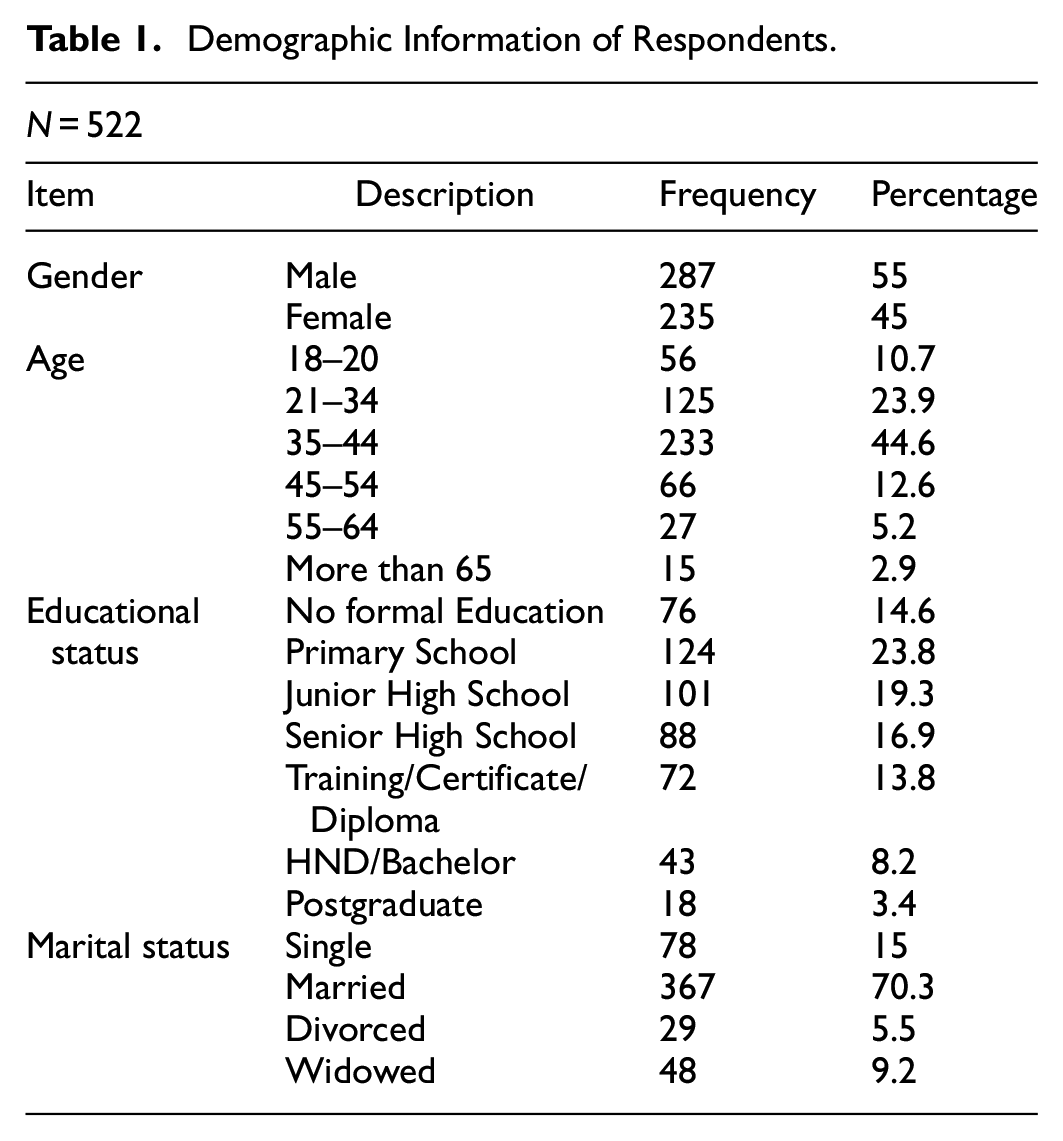
The descriptive analysis covering the respondents’ demographic information is presented in Table 1. Starting with the gender ratio, male respondents constituted 55% of the sample, while female respondents constituted the remaining 45%. With regards to age, 10.7 % of the total respondents are under 21 years of age, 23.9% are between the ages of 21 and 34, 44.6% are between the ages of 35 and 44, 12.6% are between the ages of 45 and 54, and 5.2% are between the ages of 55 and 64 whilst the least percentage which is 2.9 represented ages above 65 years. With educational level, 14.6% of the total respondents had no formal education, and 23.8% reached the primary level. 19.3% attained Junior High school education, whereas 16.9% attained senior high school level. 13.8% have achieved training/ certificate/diploma, while 8.2% have HND/bachelor’s degree and last, postgraduate level attainment bearing the least value of 3.4%. This shows that averagely, the respondents are educated people; thus, most of them could read and write. Last, 70.3% of respondents are married, 15% are single, 9.2% are widowed, whereas 5.5, the least percentage share, are divorced.
Demographic Information of Respondents.
Measurement Model Assessment
The gathered data are subjected to internal consistency reliability, convergent validity, and discriminant validity evaluations. The factor loadings, average variance extracted (AVE), composite reliability (CR), and Cronbach’s alpha (CA) for each construct and survey question are calculated following Hair et al. (2016)’s suggestions, which are presented in Table 2.
Construct Reliability and Validity.

Note. RPA = rural poverty alleviation; LR = local resources; AM = asset mobilization; CP = citizens participation; GP = government policies; CR = composite reliability; AVE = average variance extracted; CA = Cronbach Alpha.
Reliability and Validity Test Results
The factor loadings, Cronbach alpha, composite reliability, and average variance extracted are used to assess the model’s convergent validity. Table 2 shows that all of the item’s factor loadings are more than the 0.6 threshold value proposed by Chin et al. (2008). The average variance extracted also met the minimum edge figure of 0.5 (Hair et al., 2016). Cronbach alpha figures, which measure the internal consistency of the constructs, are higher than the acceptable figure of .70 suggested by Hair et al. (2016). Last, composite reliability, which assesses the reliability of the individual constructs, also met the least edge figure of .7 proposed by Hair et al. (2016). Figure 3 displays the factor loadings of each construct.

SEM-PLS estimation model for direct and moderation paths.
Collinearity and Common Method Bias Test Results
Table 3 displays the collinearity values of the constructs investigated using VIF. The values obtained for all constructs are less than the cutoff value of 5 proposed by Kim (2016) and Kock (2015), showing that there is no collinearity issue with the model, validating the findings of Ahakwa (2023), Ahakwa et al. (2023), Ahakwa, Yang, Agba Tackie, Afotey Odai, and Asamany (2021), Ahakwa, Yang, Agba Tackie, and Bankole (2021), Tackie et al. (2022a), Atingabili et al. (2021), and Chen et al. (2022). Also, Kock (2015) postulated that if the VIF values for all constructs are below 3.3, then the model is free from common method bias issues. The outcome displayed in Table 3 affirms that our study model is devoid of these issues.
Collinearity Evaluation (VIF)—Outer VIF Figures.

Note. VIF = represents variance inflation factor; RPA = rural poverty alleviation; LR = local resources; AM = asset mobilization; CP = citizens’ participation; GP = government policies.
Discriminant Validity Test Results
To establish discriminant validity, which refers to the extent to which the variables do not duplicate themselves with another variable, is represented by minimum coefficient values amid the concerned variable and the other variables. Table 4 reveals that each construct’s AVE square root (diagonal values) is larger than its corresponding coefficient, indicating robust discriminant validity (Fornell and Larcker, 1981). Henseler et al. (2015) also proposed another criterion for evaluating discriminant validity called the Heterotrait-Monotrait (HTMT) ratio. The researchers asserted that the HTMT is more reliable than Fornell-Larcker’s criterion. According to Henseler et al. (2015), discriminant validity issues arise when the HTMT value exceeds 0.85. As shown in Table 5, the discriminant validity values for all constructs are lower than the HTMT cutoff value of 0.85. Subsequently, the outcomes of both criteria specify that the data is free from discriminant validity problems, supporting those of Ahakwa, Yang, Agba Tackie, and Atingabili (2021), Ofori et al. (2023), Korankye et al. (2021), Odai et al. (2021), and Quagraine et al. (2021).
Discriminant Validity (Fornell-Larcker criterion).

Note. Values on the diagonal (bolded) are the AVE’s square root, while the off-diagonals are correlations.
Discriminant Validity (Heterotrait-Monotrait (HTMT) Criterion).


Note. Shaded boxes are the standard reporting format for the HTMT procedure.
The Structural Model’s Result
Predictive Relevance Test Results
The structural model is assessed using path coefficient (β) and accompanying t-statistics via the 5,000 resamples bootstrapping postulated by Hair et al. (2016). Additionally, the predictive relevance (Q2), R2, RMSE, and effect size (f2) are assessed to ascertain the research model’s relevancy (see Table 6), as proposed by Hair et al. (2016). From the outcome, local resources, asset mobilization and citizens’ participation explained 81.9% of the total variance in rural poverty alleviation; thus, R2 = .819, which is more than the 0.26 limit recommended by Cohen (1988) suggests that the study’s model is relevant and robust. Also, a Q2 value lesser than 0, according to Cohen (1988), means the model lacks predictive relevance. Therefore, this study’s Q2 value of 0.526, in addition to the RMSE value of 0.283, depicts the relevancy and robustness of the research model, confirming the studies by Tackie et al. (2020), Tackie et al. (2022b), Ying et al. (2021), and Ahakwa, Yang, Agba Tackie, Afotey Odai, and Dartey (2021).
Predictive relevance test results.

Note. RMSE = root mean square error.
Direct Relationships Test Results
Table 7 depicts the results of the direct paths amid the exogenous and endogenous variables, thus H1, H2, and H3. From Table 7, local resources positively and significantly impact rural poverty alleviation (β = .365, t-statistics = 3.587, p < .01), and asset mobilization positively and significantly affects rural poverty alleviation (β = .189, t-statistics = 3.587, p < .01). Also, citizens’ participation positively and significantly boosts rural poverty alleviation (β = .164, t-statistics = 5.063, p < .01). Therefore, H1, H2, and H3 are accepted (see Table 7).
Direct paths test results.
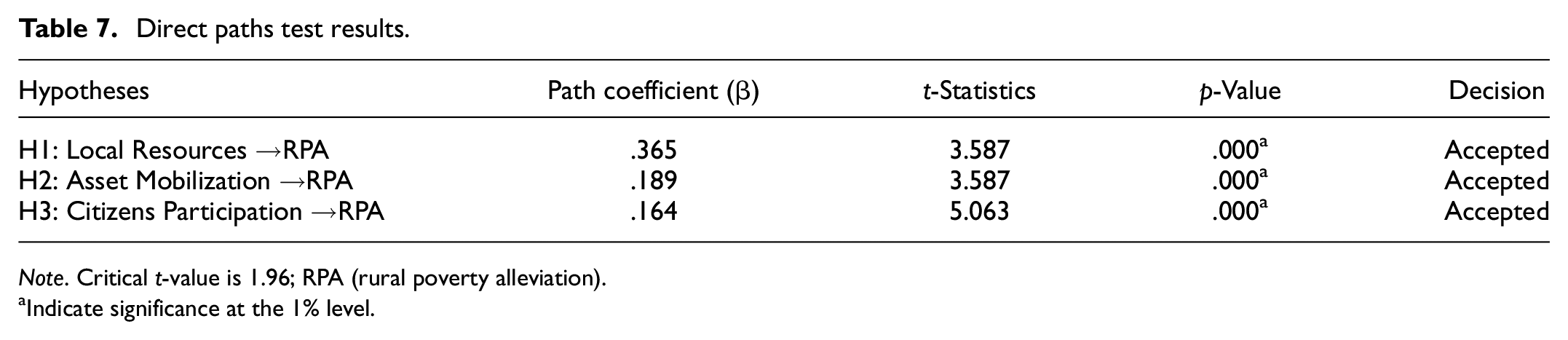
Note. Critical t-value is 1.96; RPA (rural poverty alleviation).
Indicate significance at the 1% level.
Indirect Paths Test Results
Table 8 shows that government policies insignificantly moderate the link amid local resources and rural poverty alleviation at (β = .053; t-statistics = 1.019; p-value = 0.308, p < .05). In testing H4b, Table 8 shows government policies significantly moderate the relationship between asset mobilization and rural poverty alleviation (β = .142, t-statistics = 2.600, p-value .009; p < .05). Measuring the last hypothesis, thus H4c, government policies insignificantly moderate the connection between citizens’ participation and rural poverty alleviation (β = .034, t-statistics = .877, p-value .381; p < .05). Therefore, H4c and H4a are unsupported, but H4b is supported. The results for the moderation effects are further depicted in Figure 3, where the red-shaded circles show the unacceptable moderation effects of H4a and H4c. However, the green shaded circle represents the acceptance of the moderating role of government policies amid asset mobilization and rural poverty alleviation; thus, H4b.
Moderation paths.

Note. RPA = rural poverty alleviation; LR = local resources; AM = asset mobilization; CP = citizens participation; GP = government policies.
Refers to significance at 1% level; critical t-value is 1.96.
Figure 4 demonstrates that the linear connection between asset mobilization and rural poverty alleviation strengthens when government policies are high. The finding shows that government policies strengthen the relationship between asset mobilization and rural poverty alleviation, confirming H4b.

Simple slope analysis for the significant moderation effect.
Effect Size Test Results
Cohen (1988)’s f2 is used to quantify the effect of the independent variables on the dependent variable with the results presented in Table 9. The estimated values of 0.02, 0.15, and 0.35 reflect the determination’s weak, medium, and strong coefficients, as posited by Cohen (1988). Subsequently, Table 9 depicts that local resources, asset mobilization and citizens’ participation had f2 values of 0.042, 0.129, and 0.095, respectively, signifying medium effects on rural poverty alleviation. Meanwhile, the moderation role of government policies between local resources and rural poverty alleviation, asset mobilization and rural poverty alleviation had weak f2 values of 0.027 and 0.021, accordingly. In contrast, the moderation role of government policies between citizens’ participation and rural poverty alleviation had a medium value of 0.032. Overall, the study’s model total effect size is characterized as medium.
The effect size test results.

Note. RPA = rural poverty alleviation; LR = local resources; AM = asset mobilization; CP = citizens participation; GP = government policies.
Discussions
The results reveal that local resource leads to rural poverty alleviation. The result means that as local resources increase, rural poverty alleviation also increases. This outcome is not startling since rural communities that are endowed with local resources such as arable lands, natural vegetation, livestock, mineral resources, rivers, rocks, and community members’ skills and competence can mobilize these resources to improve livelihoods, thereby alleviating poverty as opposed to communities with no such resources but constantly rely on external resources for support. This result supports Chinyowa et al. (2016), Fuimaono (2012), Mosavel et al. (2018), and Mwakulilah (2016), who found that local resource availability has a significant positive effect on rural poverty alleviation.
Also, asset mobilization leads to rural poverty alleviation. This outcome suggests that rural poverty alleviation increases as asset mobilization increases. This is attainable because organizing physical resources, talents, and skills, strengthening the local economy, and disseminating accurate and timely information would enable community members to achieve the aim of eliminating rural poverty on a communal basis rather than on an individual basis. This finding supports Goodman et al. (2018), Singh and Chudasama (2020), and Lutchman (2006), who found that asset mobilization leads to rural poverty alleviation.
Again, citizens’ participation has a positive and significant connection with rural poverty alleviation. This outcome means a unit rise in citizens’ participation will result in a corresponding rise in rural poverty alleviation. The outcome is not unusual; after all, when citizens are directly involved in programs and projects that affect their lives positively, they tend to give in their best because they are the direct beneficiaries. Citizens’ participation in rural poverty alleviation programs also ensures the trustworthiness and sustainability of these programs, even if external aids cease. This outcome supports studies undertaken by Yeboah-Assiamah et al. (2014), Francis and James (2003), and Oshionebo (2018), who found that citizens’ participation in poverty alleviation programs leads to rural poverty alleviation. However, studies by MacLeod and Emejulu (2014), and Maclure (2022), found that the citizens participating in developmental programs cannot serve as an engine through which rural poverty alleviation can be achieved, thus, disproving the current study’s findings.
Furthermore, government policies insignificantly moderated local resources and rural poverty alleviation. This means that an increase in government policies does not lead to a corresponding increase in local resource availability and rural poverty alleviation nexus. This outcome is possible given that several government policies geared toward rural poverty alleviation have failed over the years due to bureaucracy, inadequate funding, and corruption by government officials, among others. Also, most of these government policies geared toward rural poverty alleviation are politicized to the extent that policies that will benefit only party members see the light of the day. This outcome supports the studies undertaken by Crook (2003) and Li (2014), who found that government policies are ineffective and inefficient in coordinating local resources for rural poverty alleviation. However, this finding contradicts Lowe et al. (2019) and Umanailo et al. (2019), who found that government policies positively harmonize local resources for rural poverty alleviation.
Also, government policies positively and significantly moderate the connection between asset mobilization and rural poverty alleviation. This outcome suggests that a unit rise in government policies will increase asset mobilization and rural poverty alleviation nexus. This result is highly possible since community asset mobilization driven by government policies for sustainable development is of paramount interest to developing and developed countries. This is because government policies are instrumental in mobilizing resources and funds to invest in SDG and the private sector. The outcome supports studies by Zhan and Santos-Paulino (2021) and Che (2018) but refutes studies by Oyeranti and Olayiwola (2005) and Hatta et al. (2013), who found many challenges associated with government policies serving as a driving force between asset mobilization and citizens’ participation.
Last, government policies insignificantly moderate the correlation between citizens’ participation and rural poverty alleviation. The outcome suggests that an upsurge in government policies does not positively affect citizens’ participation and rural poverty alleviation nexus. Local government agencies carrying out rural poverty alleviation programs often do not give the beneficiaries a chance to contribute to the decision-making process on how to develop their communities. They avoid community interference to avoid deviating from the government’s main policy agenda. This outcome supports studies conducted by Blakeley (2010), Fung (2015) and Ghose (2005), who found that government policies do not effectively moderate the connection between citizens’ participation and rural poverty alleviation. Nonetheless, other researchers found that government policies can effectively and efficiently moderate the relationship between citizens’ participation and rural poverty alleviation (Arkorful et al., 2021; Behnke et al., 2017).
Conclusion
This study explores the effect of the ABCD components, thus, local resources, assets mobilization and citizens’ participation, on rural poverty alleviation while using government policies as a moderator. The study’s measurement model is tested using the average variance extracted, Cronbach Alpha, composite reliability and validity tests following the SEM SmartPLS analytical procedures. The test results show that the measurement model is sufficiently robust to carry out the structural model’s test. Again, the collinearity test reveals that the research’s model has no collinearity and common method bias issues. To analyze the structural model, the predictive relevance (R2), Q2, RMSE, and effect size (f2) of the proposed study model are tested, and the outcome affirms the relevancy and robustness of the study model. The results obtained for the direct paths show that all the relationships are significant and positive, supporting Hypotheses 1, 2, and 3. Also, the moderation role of government policies in local resources and rural poverty alleviation nexus is insignificant, therefore not supporting Hypothesis 4a. However, the moderation role of government policies amid asset mobilization and rural poverty alleviation nexus is positively significant, supporting Hypothesis 4b. Nonetheless, the moderation role of government policies on citizens’ participation and rural poverty alleviation nexus is insignificant and does not support Hypothesis 4c. Based on these outcomes, the following policy recommendations are proposed.
Policy Recommendations
Local resource availability and asset mobilization lead to rural poverty alleviation. Most rural communities in northern Ghana have unlimited and untapped natural resource deposits such as mineral resources, vegetation, vast land, wildlife, water resources, solar, and the human capacities needed to mobilize these resources for economic gains. As policy recommendations, local government agencies located in these regions and other non-governmental organizations (NGOs, donor organizations, individual philanthropists etc.) interested in promoting the ABCD concept in northern Ghana should enact policies that can promote the identification and efficient utilization of local resources. This can be done by effectively allocating funds and expertise to identify, mobilize and find efficient and effective ways of extracting and processing these local resources sustainably to benefit community members and the environment. When this happens, rural living standards will increase, contributing to rural poverty alleviation.
It is well documented in the literature that the northern regions of Ghana have lower literacy rates than the rest of the country. As an outcome, rural community members often lack the adequate skills and expertise to mobilize and utilize their local resources. As such, stakeholders should allocate more resources to the educational sector of these regions to be at par with their neighboring regions. When this occurs, human capital development in the fields of financial management, business development, and technical and vocational skills needed for community members to turn their local resources into economic assets with little or no external assistance will be achieved over time. Consequently, as more people are educated, they are able to increase their livelihoods in a sustainable manner, improve their health, and lower their overall poverty levels. In addition, authorities in the northern regions of Ghana should encourage community ownership and management of assets, including the promotion of collective ownership of land, water resources, and community infrastructure, to ensure equal and equitable access to these local resources in order to raise the living standards of all community members at large. Also, authorities and other stakeholders should encourage public-private partnerships to bring together the resources and expertise of both the public and private sectors to support asset mobilization in rural communities. Last, sustainable use of local resources should be promoted to help maintain and improve productivity and reduce environmental degradation and the undesirable consequences of climate change.
Also, citizens’ participation in developmental programs leads to rural poverty alleviation. As a policy recommendation, a participatory approach to rural poverty alleviation should be encouraged by local government agencies, NGOs, philanthropists’ groups and other donor organizations working toward poverty alleviation in the northern part of Ghana. This can be done by directly involving community members in every aspect of poverty alleviation programs and projects spanning from the decision-making process to the final project implementation processes, based on the ideologies of the ABCD approach. Giving citizens a voice in decision-making can help ensure that policies and programs are responsive to their needs and priorities. Also, social inclusion should be promoted and encouraged. This can be achieved through inclusive programs to ensure the full participation of marginalized groups such as women, youths, and ethnic minorities in decision-making processes and implementation stages. Moreover, authorities should foster collaboration and networking among rural citizens to share information, resources, and best practices and to learn from each other’s experiences.
Last, government policies significantly moderated the relationship between asset mobilization and rural poverty alleviation. Therefore, there is a need for local government agencies to collectively work together with community members by bringing out policies that will foster the mobilization of community resources for economic benefits. This can bring about the sustainability of rural poverty alleviation programs because, naturally, people tend to give more effort when directly involved in events that positively affect their lives. Again, local government agencies in northern Ghana should support community-based micro-finance institutions to create credit and other financial services for local community members to expand and grow their economic ventures. Last, the local government agencies, NGOs and other donor organizations in these areas should rollout or support policies and programs allowing low-income families to access basic services, such as clean water supply, sanitation, health care, education, and good road networks and transportation.
Footnotes
Authors’ Contribution
Evelyn Agba Tackie, Yaying Xu, and Isaac Ahakwa: Conceptualization, writing-original draft preparation, data curation, formal analysis, investigation, methodology, project administration, software, validation, visualization, writing review, and editing. Hao Chen: Supervision, Funding acquisition, project administration, resources, validation, writing review, and editing. All the authors have read and approved the submission of this article.
Declaration of Conflicting Interests
The author(s) declared no potential conflicts of interest with respect to the research, authorship, and/or publication of this article.
Funding
The author(s) disclosed receipt of the following financial support for the research, authorship, and/or publication of this article: This work was supported by the National Social Science Foundation of China (18BGL255).

Data Availability Statement
Data sharing not applicable to this article as no datasets were generated or analyzed during the current study.