




Abstract
Transformational leadership has been studied as an essential trait for nurse leaders in the past; however, there is a dearth of studies on interpersonal leadership which is a combined construct of transformational leadership and interactional justice. The main objective of this article was to examine the relationship between interpersonal leadership and task performance. A cross-sectional research design was adopted for this study. 700 questionnaires were circulated among nurses from 14 major hospitals across the country. Out of these, 336 nurses replied. The final usable sample size was 283 full-time nurses, out of which 91.8% were female. The online and paper-based instruments were floated twice, at different timings with different cover letters to avoid common method bias. Nurses perceive that interpersonal leadership can significantly enhance their task performance. Similarly the study also found significant mediation of work engagement in the positive relationship between interpersonal leadership and task performance. Moreover, there was no significant difference between public and private sector nurses about interpersonal leadership and its relationship with work engagement and task performance. Interpersonal leadership has been found as significantly and positively effective toward work engagement and task performance of nurses working both in public and private sector hospitals. The results establish that by adopting the interpersonal leadership style, a nurse leader can enhance the work engagement of her followers. The study suggests that interpersonal leadership should be adopted as a total concept in nurse management to achieve better results in terms of work engagement and task performance.
Keywords
Introduction
Interpersonal leadership (IL) is a relatively new term in the leadership literature, which has emerged as a higher order concept of transformational leadership (TL) combining characteristics of TL and interactional justice (IJ) (Hansen et al., 2014). TL and IJ both are considered strong motivational tools for employee performance. Therefore, the leaders possessing these qualities are blessed with strong motivational abilities that positively influence their followers toward their vision for the future (Hansen et al., 2014).
Previously, research has indicated a positive relationship between TL and employees’ performance through IJ. Some studies have also considered the importance of IJ as a mediator or moderator toward organizational performance and effectiveness. For instance, Carter et al. (2014) established the relationship between TL and organizational citizenship behavior through IJ. Similarly, Gillet et al. (2013) linked TL with the quality of work-life and engagement through IJ. Recently, Singhry (2018) has also studied the mediating effect of organizational justice in the relationship between TL and employee job satisfaction and found a positive effect. These studies suggest that combining the two concepts (TL and IJ) can be helpful for administrators to effectively resolve multiple employees’ related issues. They also assume the relationship between the two concepts as useful in raising the employees’ level of achievement, growth, intellectual ability, working life, and service delivery. IL, which is a combination of TL and IJ, can provide a useful framework for the managers to exercise and expect better results in terms of engagement and performance from employees. However, despite its significance, the concept of IL has not been studied in detail, especially in the context of nurses’ work engagement (WE) and task performance (TP).
Extensive research is available suggesting a positive relationship between TL and employee WE (Ghadi et al., 2013; Kopperud et al., 2014; Mahmood et al., 2019; Mozammel & Haan, 2016; Prochazka et al., 2017). Similarly, some researchers have also discussed its direct or indirect relationship with TP of employees (Bacha, 2014; Chi & Pan, 2012; Liang & Chi, 2013). On the other hand, very few researchers have specifically discussed the role of organizational justice in engagement and task or contextual performance (Ghosh et al., 2014; He et al., 2014). However, no study could be found on the integrated role of IJ and TL toward WE or TP. Therefore, this study was designed to fill the gap and achieve three main objectives. Primarily, this study investigates the relationship between IL (a combined concept of TL and IJ) and TP of nurses. Second, it establishes the path between IL and TP through WE. Third, the comparison between public and private sector nurses was conducted to find out any sector-specific differences.
WE involves high levels of personal investment in tasks (Newton et al., 2020) and mainly comprises enthusiasm, involvement, meaningfulness, and energy (Chaudhary & Akhouri, 2019; Costantini et al., 2017; Liu et al., 2019; Mostafa et al., 2020; Newton et al., 2020). The concept of WE was initially introduced by Kahn (1990), who presented it as a combination of the ideas of Maslow (1954) and Alderfer (1969). According to him, the engagement theory postulates that people require self-expression and self-employment in their work lives (Costantini et al., 2017; Frey, 2019; Tamta & Rao, 2017). From the nursing point of view, the ethical consideration of professional nurses supports individual responsibility for WE in professional practice. Thus, engagement at work is an inbuilt feature of nurses’ job demand (Keyko et al., 2016).
TL theory has evolved to describe four dimensions of leader behavior: individualized consideration (treats each follower on an individual basis), intellectual stimulation (risk-taker and encourage creativity), inspirational motivation (visionary), and idealized influence (role model). These leaders are admired, respected, and trusted because of their consideration of the needs of others over their personal needs (Liang & Chi, 2013). According to Poghosyan and Bernhardt (2018), transformational leaders provide constructive feedback to their followers, convince them to exhibit extra effort, and encourage them to think creatively about complex problems. More importantly, they inculcate selflessness among the followers. In response, followers contribute more positively toward collective organizational goals and scarify their personal interests for the organization. As a result, they tend to behave in ways that facilitate high levels of TP (Jyoti & Bhau, 2015; Perko et al., 2016; Stroud, 2016; Yi et al., 2019). This kind of supporting leadership becomes even more significant for health care and nurse leaders. It has been found very effective in finding creative solutions to nursing-specific challenges like shift work or emergency calls which may negatively affect their WE otherwise (Gillet et al., 2013). Cummings et al. (2018) conclude that relational and TL has particular implications for health care and nurses. It becomes even more critical for them to display relational skills, concern for their employees and encourage collaborative working to achieve preferred future for themselves, their employees, their patients, and organizations simultaneously.
However, the researchers have been trying to explore TL in terms of its behavioral characteristics and consequences since its introduction (Andersen, 2015; Lin et al., 2019). However, the process as to how transformational leaders influence and followers react to their specific behaviors needs further investigation (Choi et al., 2016, 2017; Fischer, 2016). Similarly, research also acknowledges the influential role of leaders in developing perception of justice among their followers but fails to explain the process as to how the leader performs this role (Rinfret et al., 2018). Some studies (Carter et al., 2014; Deschamps et al., 2016) have also indicated a high level of correlation between the perception of IJ and TL and suggested a detailed investigation in this regard. Research has indicated that the creation of a justice climate in an organization is among the basic responsibilities of a leader, which may foster autonomy, responsibility, and motivation among the followers. Weng et al. (2015) reiterate that nurses are subject to highly risky and demanding jobs directly related to patients’ health. Therefore, they are required to ensure a high quality of caring services, for which TL, perception of justice, and WE are equally important. This study has hypothesized that a positive perception of justice among employees acts as an important psychological mechanism in the process of TL. Therefore, the primary focus remains on the theoretical integration of literature pertaining to the two concepts from the nursing perspective.
Carter et al. (2014) conclude that TL can be an effective means of demonstrating interactional fairness. They also indicated the gap for studying the relationships from different perspectives including relevant moderators or mediators to understand the concept in greater detail. Some researchers have acknowledged the importance of justice for a transformational leader in different ways and suggested that effective TL leads to a positive perception of justice among the followers, which ultimately enhances employees’ and organizational outcomes (Deschamps et al., 2016; Gillet et al., 2013). As indicated earlier, research has extensively discussed the linkages between TL with employees’ WE, performance, commitment, and so on; however, none except Hansen et al. (2014) have discussed its role along with IJ and suggested studying its enhanced role for other employee and organization-related outcomes. Although in another study, Perko et al. (2016) have found that TL leads to an enhanced level of IJ at the individual level which ultimately leads to enhanced citizenship behavior; however, they had not combined it as a part of IL. They also suggested seeking further insight into this relationship in different structural and cultural contexts. Therefore, the aim of this study was to fill the knowledge gap in the existing literature by exploring the effectiveness of IL in terms of its employee’s related outcomes like engagement, and TP among nurses of public and private sector hospitals of Pakistan.
Literature Review
Modern research revolves around exploring and understanding the mechanism as to how the leadership/supervisor’s transformational behavior influences subordinates (Buil et al., 2019; Holten et al., 2018; Patiar & Wang, 2016). In other words, researchers have started examining the mediation mechanisms which may possess the potential to explain the phenomenon toward employees’ in-role and extra-role performance (Fernet et al., 2015; Pan & Lin, 2015). The proponents of social exchange theory (SET; Wang et al., 2012) opine that subordinates will be more likely to respond by their feelings through in-role and extra-role performance behaviors when they perceive that their leaders attend them fairly on an individual basis positively through their continuing interactions. This kind of interpersonal treatment is known as IJ. Leaders directly affect their subordinates’ daily life with positive attitudes and interactions based on justice and equity (Ambrose et al., 2015; Li et al., 2017; Meyer et al., 2018; Van Knippenberg & Hogg, 2018).
Although early researchers (like Burns, 1978) had included justice as an integral part of effective TL, the majority of later research on the topic ignored it to some extent. However, some modern researchers (Dang & Pham, 2020; Deschamps et al., 2016; Giddens, 2018) have acknowledged the importance of IJ as a natural outcome of leadership influence. Leaders are the role models who give priority to their organizational or followers’ concerns over their self-interest and build loyalty and devotion among them (Long et al., 2016; Shin et al., 2015; Sun et al., 2017). They build trust and certainty about the authenticity of their visions among the followers. In response, their followers react and accept the change initiatives and are more likely to perform their high-risk tasks. This type of initiative induces a sense of energy and sacrifice among the followers to perform more effectively beyond their self-interest and contribute in a better way toward bigger organizational objectives (Sousa & van Dierendonck, 2017).
TL is also linked to WE through individualized consideration which demonstrates that leaders pay special attention to each subordinate. They show care for employees’ individual differences and effectively look after their growth and achievement-related needs (Freeborough & Patterson, 2016; Jeong et al., 2016; Pourbarkhordari et al., 2016). This trait of TL is embedded in SET (Blau, 1968) developed on the premise of subjective cost–benefit analysis and the comparison of alternatives. Schmitt et al. (2016) add that if a leader provides important personal resources to followers (care, consideration, respect, etc.), they more likely perceive the workplace as supportive. Resultantly, it helps to create a sense of obligation among the followers to reciprocate positively in terms of engagement and performance (Breevaart et al., 2014; Xu et al., 2016).
Research Framework and Hypotheses
TL, in particular, has been regarded as a useful approach for understanding employees’ attitudes, behaviors, and performance (e.g., Ribeiro et al., 2018). It is typically conceptualized as influencing subordinates by broadening and elevating followers’ goals and providing them with the confidence to perform beyond expectations specified in the implicit or explicit exchange agreement (Azim et al., 2019; Fok-Yew, 2015; Ho, 2016). Other researchers have also found a positive effect of TL on employee TP (Bacha & Walker, 2013; Chi & Pan, 2012; Liang & Chi, 2013). On the other hand, leaders demonstrate powerful relational behaviors when practicing interpersonal and informational justice (parts of IJ), both of which convey respect, empathy, and care for the followers (Cho & Dansereau, 2010; Loosemore & Lim, 2016; Xu et al., 2016). As discussed earlier, previous research has not explicitly studied the relationship between IL and TP; however, the link has been established at several places between the perception of fairness and TL on the individual or collective basis. Based on the above literature, it can be concluded that IL enhances employee TP, and this could be assessed in the Pakistani nursing context as well. Therefore, the first hypothesis states:
TL emphasizes a relationship-based performance which includes ethical practices, cooperation, healthy competition, and an unselfish approach toward goal attainment (Kiarie et al., 2017; Kim et al., 2018). Previous studies have explored the association between TL and employees’ engagement at work. Several research findings in the area of TL have shown that leaders who articulate a powerful vision have a positive effect on the employee attitude, providing them role clarity, and facilitation (Anderson & Sun, 2017; Cope & Murray, 2017; Pradhan & Pradhan, 2016). One key attribute of a transformational leader is the ability to display self-sacrificial behaviors for the organization (Arnold et al., 2016; Choi et al., 2017). Many studies suggest that transformational leaders’ self-sacrificial behaviors influence followers so much that they copy them (Cavazotte et al., 2013; Chen et al., 2016; Pradhan & Pradhan, 2016). As indicated by Zdaniuk and Bobocel (2013) when leaders demonstrate genuine concern for their subordinates, they enable themselves to create a strong leader–follower relationship and help in improving their sense of belongingness with the organization. As a result, the employees devote themselves and put their best effort into their work. Therefore, this study also proposes that:
Researchers have conceptualized WE in multiple ways; however, a majority of them agree that it is a positive psychological state characterized by energy, investment, and psychological presence (Crawford et al., 2010; Rothbard & Patil, 2011; Sonnentag, 2017). In other words, it is a combination of vigor, dedication, and absorption at work, enabling the employee to express his or her active self in his or her TP. Importantly, it is not a stable state but constantly changing to improve the performance of employees at work, which is more obvious in the ways they perform (Byrne et al., 2016, 2017; Diehl & Wyrick, 2015). Sonnentag (2017) indicates that task-specific WE is not entirely dependent on the availability of resources. In fact, the available resources with the potential to influence the course of action for an engagement at the workplace can act as a catalyst. Therefore, it is an established fact that a higher level of WE enhances the TP of nurses. The third hypothesis is developed as:
Plenty of research is available on the relationship between TL and WE; however, no study is found in the context of IL. Buil et al. (2019) find that WE along with identification and proactive personality mediates the relationship between TL and (in-role and extra-role) performance. Hassan et al. (2018) also discovered a significant mediation of WE between the same variables. Duțu and Butucescu (2019) indicate that TL has a significant impact on employee WE; however, they have also included psychological empowerment as a mediator in the relationship and suggested to include organizational justice as another probable mediator. On the other hand, some researchers have found a positive relationship between organizational justice and employee WE (Haynie et al., 2017; Panatik et al., 2017; Yean, 2016) as well as performance (Kalay, 2016). Still, no study could be found that has investigated IJ and TL as a combined construct leading to employee performance through WE. Therefore, this research assumes a significant mediation of WE in the relationship between IL and TP of nurses in both private and public sector hospitals of Pakistan, for which the following hypothesis is developed:
The cultural differences between the public and private sector organizations can have significant effects on employees and should be considered while studying any related concept (Bysted & Hansen, 2015; Hsieh, 2016). Especially in the context of Pakistani hospitals, there exists a big divide between the two cultures (Khawaja, 2017; Parveen et al., 2016). Therefore, the work behaviors, leadership styles, engagement level, and performance of nurses in these organizations may differ from each other. Hence, this study incorporates the perceptions of both sectors and proposes the last hypothesis as:
Figure 1 depicts the model of the study.

Model of study.
Research Methodology
This study was cross-sectional, where the data were collected from a single source during the period between June and December 2018. A survey questionnaire was floated in 14 major hospitals (seven public and seven private) located in seven capital cities of Pakistan, including Islamabad (the federal capital), Lahore (Punjab), Karachi (Sindh), Peshawar (Khyber Pakhtunkhwa), Quetta (Balochistan), Muzaffarabad (Azad Jammu Kashmir), and Gilgit (Gilgit Baltistan). The hospitals with the highest number of beds were selected from each city and equal numbers of nurses (50) from each hospital were approached to participate in the study. Data were collected through two separate online questionnaires. The first questionnaire contained items about IL. Similarly, the scales of WE and TP were floated in the second questionnaire. However, this technique was not very useful as several respondents from distant cities responded to only one questionnaire and did not reply to the second one despite several reminders. Therefore, a paper-based approach was used where questionnaires were sent by mails or through focal persons in different cities. The respondents were given the option to include their contact numbers and email addresses, which most of them provided for future contacts. Moreover, they were also given assurance that the data provided by them would solely be used for academic purposes and treated as privileged information. Overall, 700 questionnaires were distributed among the nurses. Out of these, 330 completed or partially completed questionnaires were received back (47% response rate). A total of 48 responses were incomplete and therefore excluded from the final analyses. The remaining 283 responses (152 Public and 131 Private) were complete in all respects and used for further analyses.
Measurement and Scaling
IL
IL in the context of this study was taken as a measure of qualities of TL among the hospital managers who also practiced the IJ in their dealings with hospital nurses. TL was assessed using Rafferty and Griffin’s (2004) 15-item scale as done by Hansen et al. (2014). Sample items include “Says things that make employees proud to be a part of this organization.” IJ perceptions were assessed using the six-item scale from Hansen et al. (2014) measure of justice. Sample items include “Treated you with respect?” and “Communicated details in a timely manner?”. A 7-point Likert-type scale, as recommended in these studies, was used to obtain the perception of respondents against these items (1 = strongly disagree to 7 = strongly agree). On the whole, the 21 items scale used by Hansen et al. (2014) was adopted.
WE
WE was taken as a mediator in this study and represented the extent to which the nurses feel themselves intrinsically involved and motivated toward their job. WE was measured using a 17-item Utrecht Work Engagement Scale developed by Schaufeli and Bakker (2004). The sample items included “At my work, to me, my job is challenging; . . . My job inspires me,” and so on.
TP
TP was the outcome variable in this study and explained the extent to which the nurses perform their assigned tasks. It was measured through a 17-item scale developed by Van Dyne and LePine (1998). Sample items include “At my work I meet performance expectations” and so on. All items were measured on a scale ranging from 1, strongly disagree, to 7, strongly agree.
Overall, there were 55 items included in two separate questionnaires, used for data collection. The first one comprised 21 items about IL (TL: 15; IJ: 6). Similarly, the second questionnaire comprised 34 items about WE (17 items) and TP (17 items).
Results and Analyses
Demographics
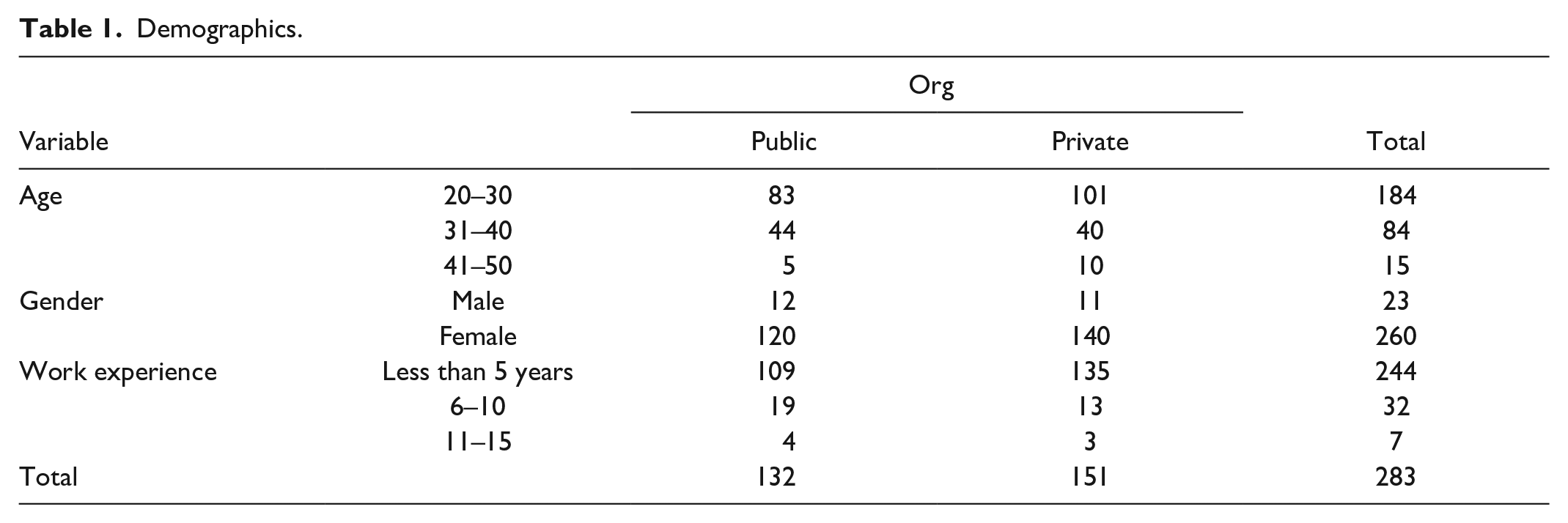
The respondents for this study represented different groups in terms of gender, age, and work experience. Most (91%) of the respondents were female. Male nurses (9%) were also made part of the sample to represent their minority in the nursing profession in Pakistan. A total of 94% of nurses had work experience between 1 and 5 years and only seven of them were representing the group with the higher work experience (more than 11 years). On the whole, 65% of the respondents belonged to the age group between 20 and 30 years, 29% between 30 and 40 years, and remaining were above 40 years of age (Table 1).
Demographics.
Common Method Bias
As indicated by Meier and O’Toole (2013), self-reported responses like that in this study could have common method bias (CMB), particularly when researchers link subjective performance measures to self-reported management practices. In our case, it was attempted that the respondents could give their opinions about the existing practices. The items were asked as to what extent certain practices took place in their organizations instead of asking as to what did they perceive about these practices. It was important to avoid their subjective understanding of the concepts about the study. Moreover, two separate questionnaires were presented to them at different times following the precautionary measures given by Podsakoff et al. (2003), which helped contain the self-reported bias to a minimum. Data were checked for CMB through the Common Marker variable method (Podsakoff et al., 2003). The results indicated a good fit to the data (CMIN = 5,399.446, Df = 1,476, p = .00, CMIN/Df = 3.658, comparative fit index [CFI] = 0.954, Tucker–Lewis index [TLI] = 0.952, root mean square error of approximation [RMSEA] = 0.036, RMR = 0.021). Moreover, the difference in standardized correlations between substantive latent variables for both models (with and without common factor) varied negligibly (mean difference = 0.06). These results demonstrated that the respondents were able to understand and differentiate between substantive variables. Therefore, it can be safely inferred that the data collected for this study did not show a significant amount of CMB.
Validity and Reliability Analyses
The measures used in this study were adapted and had gone through validity and reliability processes by previous researchers. However, as these tools were used in different contexts and combinations, confirmatory factor analysis (CFA) was conducted for revalidation of these instruments. Table 2 contains the results of two CFA (first and second order) models (Figure 2).
Model Fit Indices.

Note. TLI = Tucker–Lewis index; CFI = comparative fit index; RMSEA = root mean square error of approximation; CFA = confirmatory factor analysis; SEM = structural equation modeling; CMIN/DF = minimum discrepancy per degree of freedom; RMR = root mean square residual; IFI = incremental fit index.

Confirmatory factor analysis (CFA) (IL-WE-TP).
Initially, the first-order confirmatory factor analyses (CFA) were conducted but the model fitness was not satisfactory. Therefore, one item from TP (TP16 < 0.5) was removed that exhibited low factor loading (Field, 2013). The new model comprised 54 items and exhibited better fitness. However, the correlation and covariance between TL and IJ were very strong (r = .71; covariance = 0.72). Therefore, a second-order CFA model was developed in which IJ and TL were shown as dimensions of IL. As shown in Table 2, the fit indices (CMIN = 4,027.483; p = .00, RMR = 0.037 TLI = 0.955; CFI = 0.955; IFI = 0.938; RMSEA = 0.036 < 0.05) comply with the desired criteria for fitness of model (Awang et al., 2015; Hair et al., 2014). Therefore, the same second-order model was used for further analyses. Data were further tested for the convergent and discriminant validities measured through composite reliability (CR), average variance explained (AVE), maximum shared squared variance (MSV), and average shared squared variance (ASV), calculated in AMOS and statistical tools package in MS Excel 2007 (Figure 2; Table 3). The values of CR (Min = 0.818, Max = 0.960) were found greater than the threshold value of 0.70; hence, the data qualified the conditions for reliability. Similarly, the value of AVE for each variable was found as more than the required value of 0.5. Moreover, the value of CR was greater than AVE (Min = 0.507, Max = 0.691) as required for the convergent validity of data. The values of MSV (Min = 0.394, Max = 0.524) were also smaller than AVE and conformed to the conditions for the discriminant validity of data. The results indicated that data qualified the conditions for reliability and validity and was good for further statistical analyses.
Validity and Reliability Analyses.

Note. CR = composite reliability; AVE = average variance explained; MSV = maximum shared variance; IJ = interactional justice; WE = work engagement; TP = task performance; TL = transformational leadership; IL = interpersonal leadership.
Mediation Analyses
It was a comparative study where the type of organization was taken as a fixed factor for comparison. Therefore, six different models (direct and indirect models for each group) were developed and tested in AMOS (Composite N = 283, Public N = 131, Private N = 152). Table 2 also indicates the values of fit indices for composite structural equation modeling (SEM) models (direct and indirect) as satisfactory (Awang et al., 2015; Hair et al., 2014). Table 4 contains the results of direct and indirect (composite model) impacts of IL on WE and TP for which second-order SEM analyses were conducted. All the relationships in this model were found positive and significant (IL-TP: β = .792, p < .01; IL-WEL: β = .689, p<.01; WE-TP: β = .371, p < .01). These results validate all the assumptions for mediation as defined by Baron and Kenny (1986). The indirect impact of IL on TP (β = .211, p = .02 < .05) was also significant; however, the values reduced in the second case and indicated complimentary mediation of WE in the relationship between IL and TP (Figure 3). The results were further verified through bootstrapping and found significance (p = .01 < .05) (Preacher & Hayes, 2004). The results suggest that WE significantly mediates the relationship between IL and TP. In other words, IL enhances the TPs of nurses through WE.
Model Estimates.

Note. The figures in bold and single underline represent path
p < 0.001.
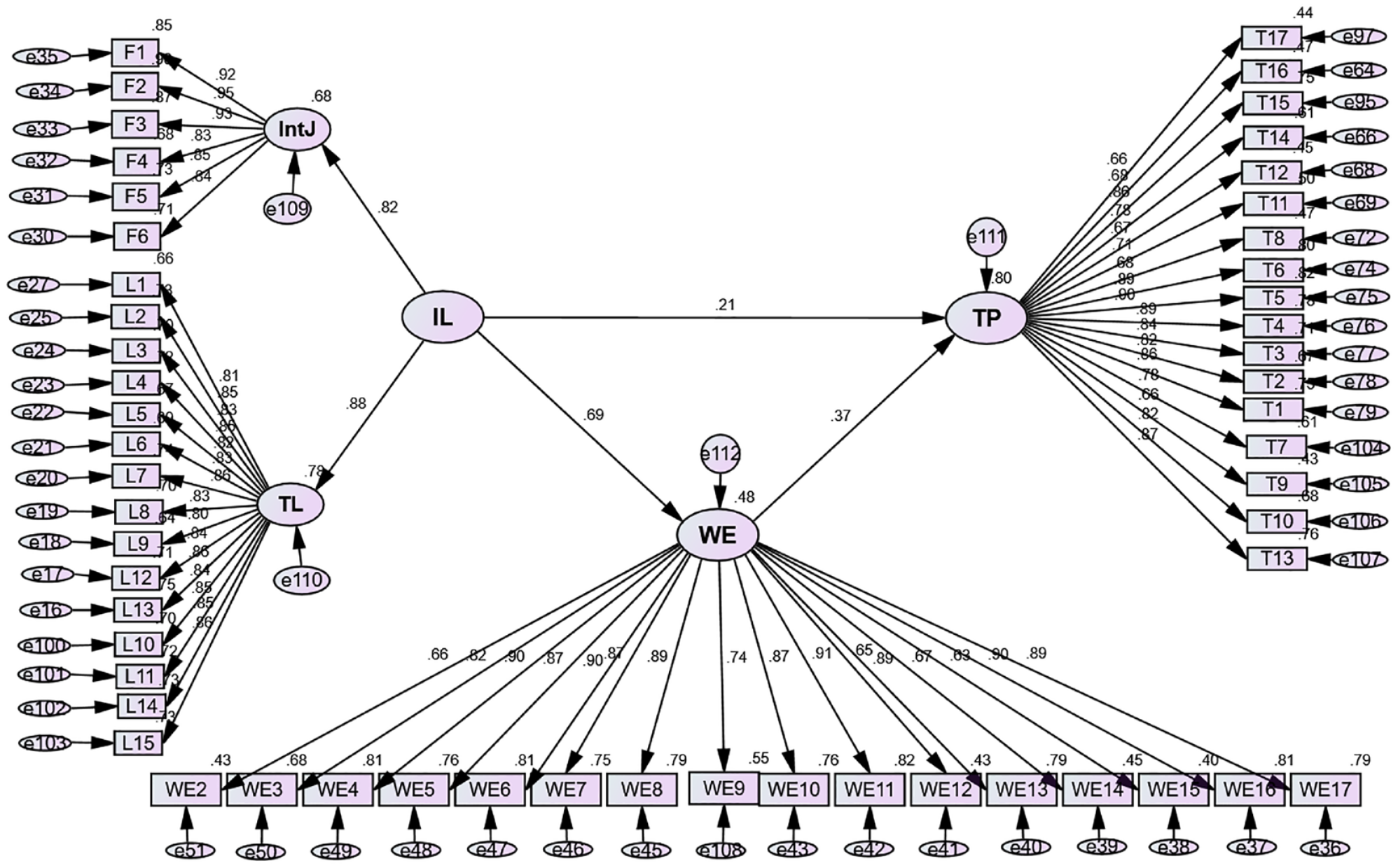
Indirect composite model (IL-WE-TP).
Group Analyses
Table 4 also reflects the results of direct and indirect models (Public) and indicates significant relationships in both cases. Similar to the previous case, the relationship between IL and WE (β = .784, p < .001) as well as WE and TP were positive and significant (β = .701, p = .000 < .001). Moreover, both the direct (β = .588, p < .001) and indirect (β = .364, p < .001) relationships between IL and TP were also positive and significant. However, the values reduced in the second case (Baron & Kenny, 1986) and indicate complimentary mediation of WE in the relationship which was confirmed through bootstrapping (p = .000 < .001; upper bound = 0.615, lower bound = 0.993; 95% CI). Similar to the composite and public sector models, the data of the private sector hospitals also depicted significant and positive relationships (IL-TP: β = .591, p = < .001; IL-WE-TP: β: .377, p < .001; upper bound = .171, lower bound = .103; 95% CI) and significant mediation (p = .004 < .05). To check if the two nursing groups (Public and Private) were different from each other, chi-square difference test was also conducted in AMOS for each of the direct and indirect models. The results indicated no significant difference between the two groups (chi-square difference for direct model = 38.127, df difference = 39, p = .510; chi-square difference for indirect model = 69.52, df difference = 55, p = .090). In other words, public and private sector nurses responded in the same way to the survey about IL, WE, and TP and there were no significant differences in this regard.
Discussion
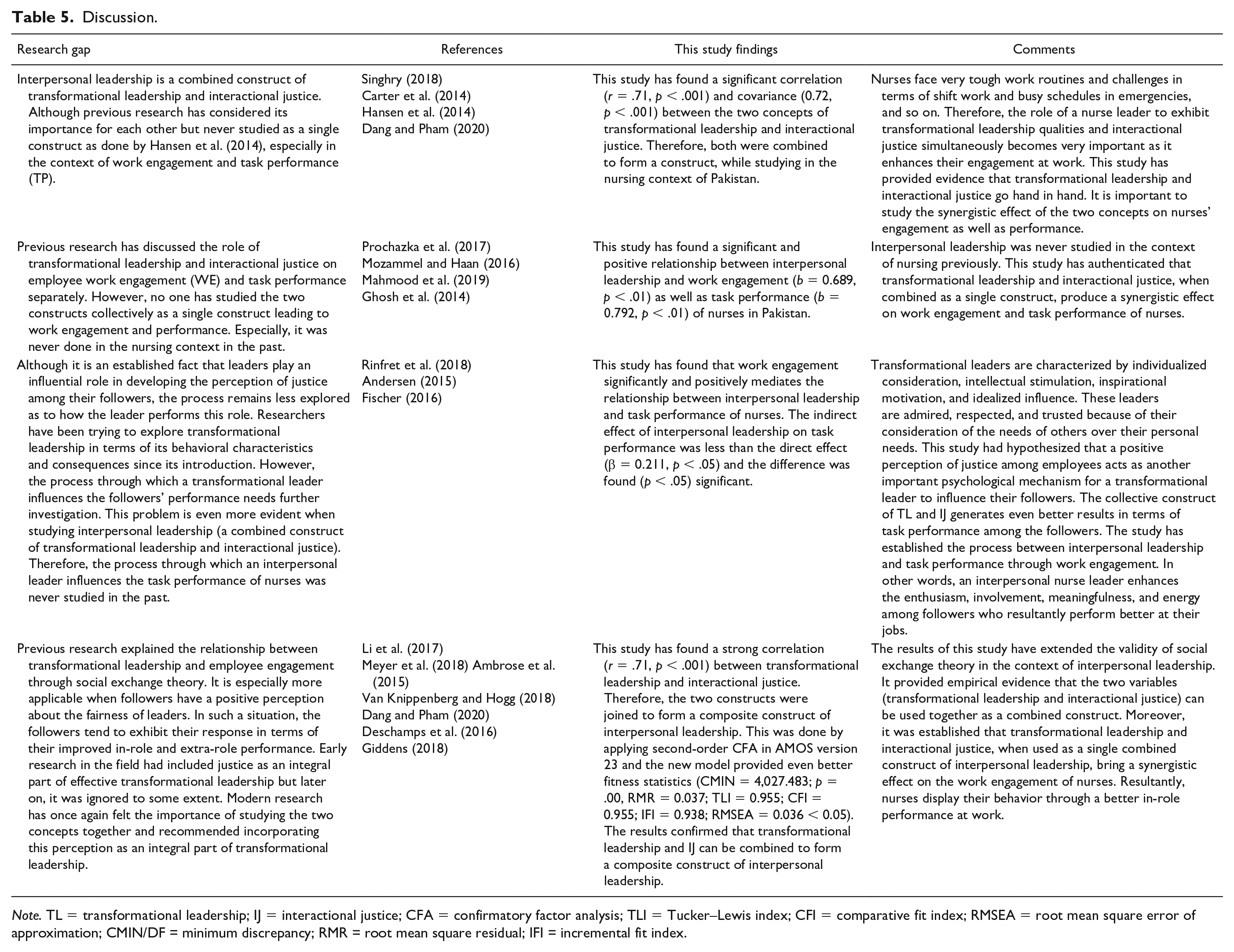
As indicated by Hansen et al. (2014), IL is a newer term and has not been studied in the context of TP in the past. This study demonstrated significant relationships among IL, WE, and TP. Previously, researchers have studied IJ, TL, WE, and TP and found positive relationships; however, none has taken it collectively as done in this study. Ghadi et al. (2013) found positive and significant impact (b = 0.21, p < .001) of TL on WE in a study conducted in Australia. Similarly, in another study by Song et al. (2012), WE was taken as a mediator in the relationship between TL and organizational knowledge creation practices. The study found a significant and positive impact of TL on WE (b = 0.54, p < .01). Lately, in a study by Besieux et al. (2018), the theory was re-endorsed as TL was found to have a significant impact on WE (b = 0.48, p < .01). On the other hand, IJ has also been found as a significant influencer toward enhancing employee motivation and engagement (Agarwal, 2014; Ghosh et al., 2014).
Saks and Gruman (2014) discuss the phenomenon in the context of SET that suggests a reciprocal link between employees and the organization. When employees have a positive perception of justice in the organization, they are more likely to be better involved in their work and are more engaged. From the nursing point of view, employee engagement and TP both become even more important as their work involves human health and life-related issues (Enwereuzor et al., 2018). Previously researchers have studied its relationship with TL (Enwereuzor et al., 2018; Hayati et al., 2014; Salanova et al., 2011) and found positive associations. Gillet et al. (2013) studied three constructs simultaneously. They took IJ as a mediator in the relationship between TL and WE and found positive associations in all the cases. However, none has studied IJ and TL as parts of IL leading to WE and TP of nurses as done in this study for both private and public sector hospitals of Pakistan.
Some researchers have studied the mediating role of WE in the context of TL, however with multiple outcome variables like quality of ideas, quantity of ideas, persistence (Kovjanic et al., 2013), service climate (Kopperud et al., 2014), and proactive work behavior (Schmitt et al., 2016). The most relevant study in this context was done by Christian et al. (2011) where they found significant mediation of WE in the relationship between TL and TP. Lamm et al. (2016) found three main functions of interpersonal leaders namely, supporting, motivating, and developing their followers. They conceptualized these functions of interpersonal leaders from previous literature and left the empirical investigation of their framework for future research. This study has investigated a different domain of IL by including IJ as another dimension of IL. However, the supporting, motivational, and developmental functions of IL are left for future studies. Although no specific reference similar to this research was found to compare the public and private health sector organizations, Al-Husseini and Elbeltagi (2016) also found no difference between private and public sector organizations (higher education) of Iraq, in terms of the relationship between TL and innovation, which is another dimension of employee performance. Moreover, the presented model is indigenous and is a true contribution to the leadership and engagement literature. Detailed discussion is included in Table 5.
Discussion.
Note. TL = transformational leadership; IJ = interactional justice; CFA = confirmatory factor analysis; TLI = Tucker–Lewis index; CFI = comparative fit index; RMSEA = root mean square error of approximation; CMIN/DF = minimum discrepancy; RMR = root mean square residual; IFI = incremental fit index.
Implications
This study has extended the validity of IL theory presented by Hansen et al. (2014) in the Pakistani nursing context. The model presented by this study has not been studied in the past. Previous research has focused on TL and IJ on individual bases. In very few cases, these were used as a mediator; however, none has studied it as a composite construct (IL) and established its linkages with WE and TP as done by this study. This is a true contribution of this research in nursing leadership literature. The study has also extended the validity of SET which postulates that socially acceptable behaviors of management or leadership (especially in terms of IJ) enhance employees’ WE at work which leads to enhanced employee performance. On the whole, there were five hypotheses developed for this study. Out of which four were accepted as IL was found to have a significantly positive impact on WE and TP (H1, H2, and H3). Moreover, a significant mediation of WE was found in the relationship between IL and TP (H4) that establishes the path between two variables. However, no significant differences among the practices of private and public sector health organizations were found in terms of IL leading to enhanced engagement and TP. Therefore, the last hypothesis (H5) was rejected. The research has useful implications for hospital management and recommends that the perception of IL significantly enhances the engagement and TP of nurses. Therefore, it is suggested that nurse managers should adopt an IL style to make their subordinates more comfortable with them and become more productive toward high-quality patient care. For this purpose, hospitals may arrange management development programs for the nurse leaders to become more interpersonal in terms of their management style, as it is directly linked to enhancing their followers’ engagement and TP at work. Such programs may include training in leadership and communication skills. In this regard, nurse leaders may be encouraged to learn to become role models for the followers by treating them on an equitable basis, taking risks, boosting creativity, inspiring and motivating, and instilling a perception of justice through respectful and participative communication.
Research Limitations and Future Directions
This study has tried to incorporate the response from across the country which has its own strengths and weaknesses. The response rate was fairly low and the overall sample size was small (N = 283). Future research may consider overcoming this deficiency. However, the representation of all the provinces of the country was ensured which enhances the generalizability of the study across the country. Moreover, the model developed in the study can be replicated with other related outcomes like contextual performance (Charlton & Eschleman, 2019; Hansen et al., 2014), employee innovation (Khan & Khan, 2019; Weng et al., 2015), and mediators like person-job fit (Charlton & Eschleman, 2019), meaningful work, and trust in leadership (Khattak et al., 2020). This study was based on perceptions of nurses about their leaders and their performance. Such a perception could be biased. Therefore, in the future, the researchers can adopt a dyadic study design to incorporate dual responses from employees and their leaders simultaneously. A dyadic research design can help the researchers to investigate the relationship among variables more objectively. This study has studied the engagement function of an interpersonal leader. Future researchers can also explore the functions of an interpersonal leader in terms of supporting, motivating, and developing the followers (Lamm et al., 2016; Thibault et al., 2019). In addition, the model has focused on nurses’ related outcomes only. Future research can extend the model and incorporate the organizational outcomes as well like health unit, organizational effectiveness, performance, and so on (Tang, 2019).
Conclusion
The study is an extension of the IL model presented by Hansen et al. (2014) and is linked to WE and TP. IL as a new leadership concept was found significant and positively related to WE and TP in all three cases (Composite model, Public, Private). Moreover, significant mediation of WE occurred in the relationship between IL and TP in three different models. The comparative analyses indicated that there were no statistically significant differences among the groups in terms of the relationships among IL, WE, and TP.
Footnotes
Declaration of Conflicting Interests
The author(s) declared no potential conflicts of interest with respect to the research, authorship, and/or publication of this article.
Funding
The author(s) received no financial support for the research, authorship, and/or publication of this article.
