




Abstract
Research in both public administration and place development has identified a need to develop more participatory approaches to governing cities and regions. Scholars have identified place branding as one of several potential policy instruments to enable more participatory place development. Recently, academics working in diverse disciplines, including political studies, public administration, and regional development have suggested that an alternative, bottom-up, more participatory approach to place branding could be employed. Such an interdisciplinary approach would use iterative communication exchanges within a network of diverse stakeholders including residents to better foster stakeholder participation, contribute to sustainable development, and deliver substantive social justice and increased citizen satisfaction. Building on this research and using an exploratory, qualitative, case-study methodology, our aim was to observe and analyze such interactions and communicative exchanges in practice. Drawing on the experience of the Australian state of Tasmania, we studied stakeholder reactions to the participatory place branding approach. We found that although participants were initially skeptical and identified many barriers to implementing participatory place branding, they simultaneously became excited by its possibilities and able to identify how many of the barriers could be transcended.
Keywords
Introduction
Public sector reforms in the 1980s and 1990s resulted in critical changes in public sector governance and a redefinition of the primary role of government as service provider, funder, and regulator (Lane, 2000). The embrace of the New Public Management first by the United Kingdom, followed by United States, Australasia and then Europe in the 1990s has been widely commented on as the adoption of more business-like national, state, and local governmental structures and operations by employing corporatization, privatization, and contracting out to provide the services previously delivered in-house (O’Faircheallaigh et al., 1999). Driven by a real as well as perceived “fiscal crisis of the state” in an era of globalization and the rise of the “competition state” (Cerny, 1997), governments looked to business for advice on how to deliver goods and services to citizens increasing interpolated as “customers,” “clients,” and “consumers.” As the critical political economy literature notes, there was a dramatic shift in the role of the state from one that protected citizens from external economic competition via various forms of trade, investment and worker protectionism to one that sought to make national, state, and local places “competitive” and “open for business” in an increasingly integrated global economy (Harvey, 2007).
One dimension of this new emphasis on competitiveness, rather neglected in the governance literature, is the increasing emphasis public administrators place on consciously and systematically promoting, marketing, and branding cities, regions, states, and nations. One popular form this takes is the slogans on car number plates in Australia: Northern Territory as “Outback Australia,” Tasmania as first “The Natural State” and then rebranded as “Explore the Possibilities,” and Victoria as “The Education State.” Indeed, the more one reflects on it, the more one becomes aware of just how “branded” cities, states, and countries are and how problematic many of the governance processes are that sit behind the public face of a place promotion campaign (Henninger et al., 2016). Where did these number plate logos come from? How was it that Australia ended up with the “Where the bloody hell are you?” campaign slogan that was subsequently described as a “rolled, gold” place branding disaster? (Sydney Morning Herald [SMH], 2008; Winter & Gallon, 2008).
One answer is that public administrators have overly focused their place branding efforts on attracting external investment, residents, talent, and visitors to their place (Eshuis et al., 2014; Therkelsen et al., 2010) to the detriment of the local community (Kavaratzis, 2012). Local communities may let this happen because place branding has the appearance of being a superficial, technical, low-stakes exercise with few consequences for the local population beyond lampooning the subsequent, often vacuous, brand slogans. Returning to the Australian context, we can find examples of this in the depiction of Brisbane, the capital of the Australian state of Queensland, as Australia’s new world city, or the outback city of Dubbo as Indulge in Dubbo, or the Gold Coast’s Gold Coast—Full Stop. Yet both scholars and practitioners have now cautioned us that marketing exercises often exert important real-world effects and shape not only external and internal expectations but also the distribution of resources, ultimately with consequences for the economic, environmental, and social development of places. The governance effects of branding are captured in the following comment by a former tourism and development office of the City of Newcastle, in the state of New South Wales on the proposed new brand Newcastle—City of Opportunity: “It’s not going to change the whole city centre overnight, but it’s the mortar behind the bricks. We can build things, but unless people want to work together, the bricks are simply a pile” (Simon McArthur, quoted in Crommelin, 2013, p. 7). Place branding scholars, such as Houghton and Stevens (2011), have not only similarly argued the importance of stakeholder engagement to the success of city branding strategies, but that a more innovative and democratic approach is needed for doing so.
Given its potential role in orchestrating interests, there is an increased acknowledgment of the need to foster broader and deeper stakeholder engagement and shift to more participatory place branding practices than currently. This paper builds on existing scholarly discussion on the relational nature and interactive formation of place brands and the need for more participatory approaches to place branding (Kavaratzis & Kalandides, 2015; Sihlongonyane, 2015). Research on the nature of stakeholder interactions in place branding processes, their perceptions and levels of participation (Arnstein, 1969), their engagement, and the inherent power dynamics embedded in the process is, however, still scarce (Kavaratzis & Hatch, 2019). Typically, case studies or surveys have studied the perceptions of specific stakeholders. For instance, Braun et al. (2013) study the views of residents; Klijn et al. (2012) and Noronha et al. (2017), practitioners; Cleave et al. (2016) and Cleave et al. (2019), industry; and Cerdá-Bertomeu and Sarabia-Sanchez (2016), public administrators. Since stakeholder interactions in place branding processes are, we argue, based on communicative exchanges (Zenker & Braun, 2010; Ripoll González & Lester, 2018) in highly complex and politicized place environments, we believe that to better understand such exchanges, stakeholder power-relations and dynamics must be observed in action. This paper therefore embraces a twofold objective: (a) to revisit the governance models underpinning place branding toward more participatory practices and (b) to assist with practice by reflecting on stakeholder perceptions of an alternative participatory governance model for place branding.
In this paper, we draw on qualitative data from a case study we carried out in Australia’s southern island state of Tasmania to understand interactive patterns and governance arrangements underlying Tasmania’s place branding process and test the potential for a more participatory and inclusive approach to branding the state. This exploration will also inform further the development of place branding as a participatory governance approach to managing and developing places.
Employing an innovative action research methodology combining participatory action research (PAR) and the method of sociological intervention (SI), the core research questions addressed in this paper are as follows:
What are the impediments and opportunities for the development of more participatory approaches to branding places?
Would existing place-branding stakeholders be willing to engage in the more participatory approach increasingly being promoted in some place branding literature (e.g., Eshuis et al., 2014; Karavatzis et al., 2017; Kavaratzis & Kalandides, 2015).
We theorized that many participants would identify significant hurdles to practicing participatory place branding linked to the “quintessential difficulty” that “a brand image suitable for one group of stakeholders (business investors for instance) may be inappropriate for others (e.g., pre-existing residents)” (Bennett & Savani, 2003, p. 75), and that this perception would block a move to more participatory processes. While the results initially confirmed this view, we were surprised to observe that the actual discussion of the impediments to participatory place branding by stakeholders began to generate interest and a degree of momentum toward more integrated, participatory approaches. We thus conclude that participatory place branding may in fact prove more feasible than initially perceived if relevant actors can be brought together in forums to discuss and debate options.
The paper is structured as follows: in the next section, we review the limits of the conventional approach to place branding, emphasizing the lack of stakeholder engagement and present the alternative, participatory (or inclusive) approach. In section “Place Branding in Tasmania,” we outline Tasmania’s place branding arrangements, identify the key actors, and provide an account of our PAR/SI methodology. In the subsequent section, we present findings from the interviews and focus groups we conducted that saw many stakeholders reflect separately and jointly on both approaches and evaluate the impediments and opportunities to operationalizing a participatory approach. This section is followed by a discussion and a short conclusion where we argue in favor of participatory place branding noting how the PAR/SI methodology we adopted could be a vehicle for surfacing implementation barriers while encouraging strategies designed to overcome them.
Conventional and Participatory Approaches to Place Branding
For the past 25 years, governments have increasingly resorted to marketing and corporate branding principles to support economic revitalization and place development policy (Moilanen & Rainisto, 2009). Influenced by business logic, public administrators have employed a top-down approach to branding places in the same way as companies brand themselves and their products, an approach many argue is based on short- to medium-term thinking, narrow bottom-line measurement frames, and limited and controlled stakeholder engagement (Bennett & Savani, 2003; Houghton & Stevens, 2011; Van Ham, 2008). Indeed, engagement has often resulted in stakeholders’ paying “lip service” to a strategic branding process that has otherwise been devised behind closed doors (Kavaratzis, 2012, p. 8). Despite the dominant logic of competition with the place branding discourse, a few scholars have argued in favor of a simultaneous focus on cooperation and competition or “co-opetition” (Nalebuff & Brandenburger, 1996 in Pasquinelli, 2013). This literature emphasizes stakeholder interdependence and the need for a degree of cooperation in the pursuit of common interests.
In Australia, evidence of the top-down approach is everywhere. Destination branding organizations such as Tourism Australia develop marketing campaigns to attract tourists, often with limited success or even resulting in failure. For instance, Tourism Australia’s 2006 destination marketing campaign “Where the bloody hell are you?, although applauded by marketers (Hudson & Ritchie, 2008; The Age, 2007), faced controversy by consumers around the world, was banned in the United Kingdom, and was subsequently described by former Australian Prime Minister Kevin Rudd as a “rolled gold disaster” (British Broadcasting Corporation [BBC], 2006). Studies investigating other destination branding campaigns, such as Victoria’s High Country (Wheeler et al., 2010), illustrate the shortcomings of narrowly framed, short-term, place branding processes, including the lack of proper success measurement frameworks, and argue for more organic, long-term and inclusive approaches. Crockett and Woods (2004) provide an analysis of components of the latter in their account of Western Australia’s destination branding campaign which extended from consumer-research to fostering Public–Private partnerships beyond tourism to create a more encompassing, and thus more successful, state brand.
The interdisciplinary academic literature on place branding, which draws from the fields of cultural studies, geography, place development, planning, politics, public administration, public diplomacy, and sociology, among others, has emphasized the many constraints arising from the application of corporate branding concepts to ever-changing, multi-stakeholder place entities (see, for instance, comprehensive state-of-the-art reviews by Lucarelli and Berg, 2011; and Vuignier, 2017). A difficulty noted in the literature is the conceptualization of places as marketable static objects to which “selling” techniques can be applied given their images, identities, and reputations are being constantly and collectively (re-)imagined, (re-)negotiated, and (re-)projected (Richardson & Jensen, 2003). It is argued that place brands are the sums of internal and external perceptions of place, constructs that go well beyond marketing logos and slogans, and even transcend the products, services, and experiences they deliver (Medway & Warnaby, 2014). From this perspective, place brands are grounded in powerful and plural place identities, with a co-created “sense of place” (Campelo et al., 2013) emerging from diverse actors’ exchanges of meaning in an increasingly networked society brought about by the Information and Communication Technologies revolution (Castells, 2011).
To these concerns can be added others linked to social movement counter-branding, the commodification of place, and its culture (Kaneva & Popescu, 2011) all leading to a “suppressing (albeit unintentionally), [of] a place’s eclecticism and natural distinctiveness” (Medway & Warnaby, 2014, p. 164) and a deepening of conflict around the politics of place. For instance, the above-mentioned “Where the bloody hell are you” campaign by Tourism Australia employed stereotypes based on indigenous cultures (Pomering & White, 2011) that simultaneously failed to meet consumer demand. Such attempts may also generate unrealistic and incompatible expectations with those of indigenous and non-indigenous stakeholders who are actively engaged in the use of place branding as a tool for both place promotion and governance for community development. As Akbar and Higgins-Desboilles (2018, pp. 24–25) note, a critical discussion of the existing place branding paradigm can contribute to better place management and governance, but necessarily needs to engage with issues of “power, voice, representation and agency” and provide “radically new ways of understanding, managing and even overturning” practices.
The conventional top-down approach to branding places has been linked to a neoliberal agenda that legitimizes strategic decision-making by government and business elites (Kavaratzis & Kalandides, 2015; Pasquinelli, 2010). The approach has been viewed as serving specific interests (Colomb, 2011), subject to power struggles (Govers & Go, 2009, p. 17), and marked by a perceived lack of engagement of civil society (Eshuis et al., 2014) and other non-traditional place branding stakeholders. If, however, place identities are co-created and place brands are “networks of associations” (Zenker & Braun, 2010, p. 5) that is cultural and social constructs (Campelo, 2017) that must be built and governed with the community through “a process of dialogue and collaboration between all those that have a stake” (Bianchini & Ghilardi, 2007, p. 283), then practices will need to change.
Emphasizing the multi-actor complexity and politics of place, scholars have argued for more attention to be placed on the role of place branding in public management (Noronha et al., 2017; Wæraas et al., 2015) and have attempted to reconceptualize place brands as public brands and assets (Lucarelli & Giovanardi, 2016) that distinguish one place from others by triggering positive associations (Eshuis & Klijn, 2012, p. 19). In fact, as public brands, place brands also have the potential to influence perceptions of residents through emotions (Eshuis et al., 2014). Despite these features, public administrators have long neglected the implications of promotional marketing campaigns based on a brand for a place and its implications in terms of the organizational identity of government (Zavattaro, 2013). Place brands as public brands are even more subject to contestation and counter branding and are often defined by a place’s societal and political struggles (Karens et al., 2016).
These concerns have prompted some place branding researchers to see place branding as a governance tool in its own right (Eshuis & Klijn, 2012; Laws et al., 2011). This shift has been accompanied by the changing perception of public administrators from managers to stewards and facilitators of partnerships: that is, as meta-governors (Bell & Hindmoor, 2009; Jessop, 2003). In the participatory approach, place brands are conceptualized as public brands that are supported by public, private, and civil society sectors (Cerdá-Bertomeu & Sarabia-Sanchez, 2016), the corollary being that they require public (democratic) governance and participation for legitimacy (Braun et al., 2013; Go & Govers, 2012). As Massey (1994) states, places are “absolutely not static. If places can be conceptualised in terms of the social interactions which they tie together, then it is also the case that these interactions themselves are not motionless things, frozen in time. They are processes” (p. 147). Therefore, participatory place branding requires careful coordination of stakeholder interests toward long-term shared goals and more flexible structures.
This new conceptualization of place branding implies that what underpins the development of a positive reputation of a place is a common community vision that encompasses diverse strategic interventions aimed not only at spatial development and marketing of mainstream attractions but also the promotion of social justice, subcultures, and authenticity, among others. Consequently, scholars have been calling for greater integration of place branding with other policy activities (Eshuis et al., 2013; Zenker & Erfgen, 2014) and the development of more inclusive, bottom-up, and participatory governance approaches (Kavaratzis, 2012) that enable greater stakeholder engagement (Zenker & Petersen, 2014).
In this alternative literature, place brands have been conceptualized as multi-layered entities or collective sums of the cultural and social particularities of place stakeholders (Kislali et al., 2016), as networks of associations about place, and as a “multidimensional construct, consisting of functional, emotional, relational and strategic elements that collectively generate a unique set of associations in the public mind” (Aaker, 1996, p. 68). Unlike the corporate branding of products, place brand ownership is shared by multiple stakeholders (Boisen et al., 2011), which inserts debates about authority and legitimacy into what becomes a “politics” of place branding (Clegg & Kornberger, 2010; Govers & Go, 2009; Ooi, 2011).
The implication for public administrators of the alternative, more inclusive, approach is the need to develop multi-layered engagement strategies to encourage collective place branding based on broader, more holistic, models of participation and especially, local community involvement. In practice, this implies the enhancement of networked approaches to developing place identities and alternative forms of governance (Kooiman, 2003; Scharpf, 1993) suitable to the complex political-democratic processes underlying place development (Wæraas et al., 2015). This has generated an intense debate in the literature about who the legitimate stakeholders in place branding processes are (Andersson & Ekman, 2009; Anholt, 2006; Govers & Go, 2009) and how exactly one might shift from linear top-down strategic communication to two-way “circular and interactive models” of production and management of meaning about a place. In short, scholarly debate on effective place branding practices has emphasized the need for a renewed discussion on the governance arrangements that underpin place branding: on the organizational structures and models of engagement required to secure it in practice (Klijn et al., 2012). Our interdisciplinary research aimed to investigate whether and to what degree it might be possible to implement a more participatory approach to place branding in the specific context of the State of Tasmania, Australia.
Place Branding in Tasmania
To better understand whether and how a shift to a more participatory approach to place branding could occur, we investigated its feasibility in Tasmania, Australia’s furthest south and only island state whose relationship to the mainland can be described by the following quotation: That’s Tasmania, the island down the bottom that’s sometimes left off the map, the one we joke about giving to New Zealand but the Kiwis don’t want it because they play odd football, the one that you reach by time travel going back half a century, Australia’s perennial basket case, the place that shouldn’t really be a state at all with its 12 often-troublesome senators for a population smaller than the Gold Coast’s. (Pascoe, 2016, emphasis added)
1
Pascoe’s account reflects on Tasmania’s “deficit” identity, marked by a brutal colonial past and portrayed as a welfare-dependent and poor society lacking entrepreneurial spirit in need of being rescued despite—or sometimes because of—its world heritage areas, outstanding natural assets, and liveliness of its cities and communities which, in addition to superb local food, laid-back living, and great accessibility for residents adds significantly to its established tourism potential. Although economically connected to the mainland and the wider world, its otherwise insular nature has contributed to a parochialism of the politics of place evidenced by the rivalry between its two main cities and economic centers, Launceston and Hobart, resulting in what is referred to colloquially as the “North-South divide” (Hollingsworth, 2016).
Following numerous rather ad hoc policies to develop and manage the image and reputation of the state, the Tasmanian Government created Tourism Tasmania (TT) in 1996 as a government-industry development body that is now the state’s tourism-marketing agency in charge of developing a destination brand, tourism campaigns, and public relations to increase visitation under the Tasmanian Visitor Economy Strategy (T21, 2015). TT’s aim is to contribute to the island’s economic development by highlighting “the spectacularly pristine land and sea environment with a rich cultural heritage and a world-class food and wine offering” (TT, 2015). Subsequently, Tasmania formally commenced place branding with the formation of the Brand Tasmania Council (BTC) in 1999, a government-funded, multi-industry body whose aim was to achieve strong alignment of message and reduce competition and conflict toward a stronger state brand (BTC, 2014). BTC’s Council, as the custodian of the Tasmanian Master Brand, oversees promoting living, working, learning, and doing business in the state by highlighting the high quality of the island’s produce, life, and environment. Following a review of Tasmania’s Brand conducted in 2017 and consisting in a series of interviews to more than 200 randomly selected Tasmanians, the Department of Premier and Cabinet (DPAC) replaced the BTC with Brand Tasmania under the Brand Tasmania Act 2018. The role of this rebadged statutory authority is to be “a client-service organisation empowering Tasmanians to tell their story” (Brand Tasmania, 2019, p. 3), the specific aims being “to maximise brand promotion, collaboration and management.” According to DPAC’s website: This next exciting phase for our Tasmanian Brand will see the new authority turning up the spotlight that’s already shining on our people, place, produce and products. This will attract increased talent, trade, investment and visitors to our State, which will strengthen our economy and provide new exciting opportunities for all Tasmanians. (DPAC, 2018)
Beyond these public-sector attempts to brand the state, Tasmania’s brand identity has been influenced by diverse private sector interests from the Federal Group’s (who coined their own “Pure Tasmania” brand), Tasmania’s largest private sector hotel, catering and casino employer, to David Walsh’s Museum of Old and New Art colloquially known as MONA, a controversial museum about death and sex, now one of Australia’s top tourism attraction. Less formally, Tasmania’s “brand” has also been marked by the numerous environmental battles fought at home and abroad to protect Tasmania’s wilderness from exploitation given these have been widely reported in the national and even international media (Gale, 2013; McGaurr et al., 2015).
Despite DPAC’s and Brand Tasmania’s new rhetoric on the need for increased collaboration with stakeholders, Tasmania’s current place branding processes are still marked by the fragmentation between public and private sector branding and a lack of engagement with civil society and have failed to build on earlier attempts to foster community involvement, such as the Tasmanian Together process (Crowley & Coffey, 2007). It is in this broader context that we investigated the potential of a participatory approach to place branding using a combined PAR and SI design or PAR/SI (Dubet & Wieviorka, 1996; Karlsen, 1991; Ripoll González & Gale, 2020 Touraine, 2000; Yin, 2003).
Research Approach and Methods
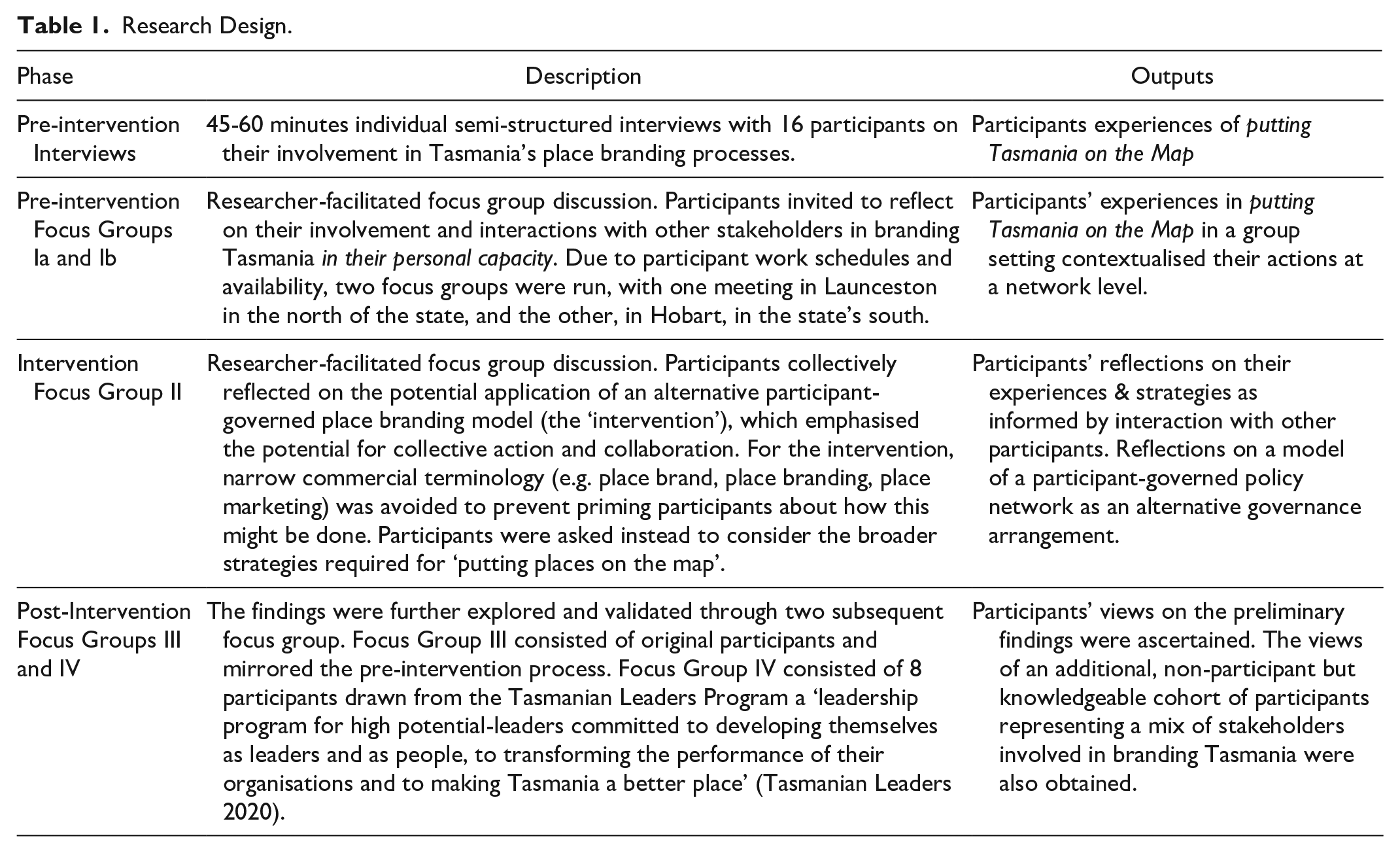
A total of 24 participants representing stakeholders formally and informally engaged in branding the Tasmanian State from government, business, and civil society participated in in-depth interviews and a series of focus groups between August 2014 and June 2016. Participants represented a mix of backgrounds ranging from tourism, business, arts and cultural industries, government, politics, farming, education, and communications (for extended details on the rationale underpinning the choice of combining PAR principles and the method of SI, see Ripoll González & Gale, 2020). The case study followed a before/intervention/after methodology where participants were invited to join a research process adapted from the method of SI aimed at observing communicative interactions and identity creation in dynamic groups, and involving the following phases (see Table 1 below).
Research Design.
Data Analysis
In the “before” phase of the project, participants discussed their place branding practices and approaches and identified a series of impediments to implementing a more participatory approach to “putting Tasmania on the map.” These included impediments specific to the Tasmanian context such as the perceived North-South divide between the northern cities of Launceston and Burnie (the North) and the capital city of Hobart (the South). The significance of this contextual impediment is that all issues related to branding Tasmania are filtered through this lens leading proponents in one region to be suspicious of proposals benefiting the other. Participants also identified cultural impediments linked to a generalized lack of collaboration across public, private, and voluntary sectors, and a deference in the Tasmanian community to the state government, which was expected to take responsibility for formulating and implementing policy. A final category of impediments was identified as structural and included a hierarchical and rigid governance system, multiple and fragmented stakeholders, and a political cycle that was short-term compared to the 10- to 20-year requirements of place branding.
During the “intervention phase,” participants were presented with a short description of an example of alternative participant-governed network, based on a model posited by Provan and Kenis (2008). Under the model, putting places on the map would be governed by the network members themselves with no separate and unique governance entity. The purpose of the SI was to spark discussion about potential of alternative participatory arrangements to address the impediments for collaboration identified in previous phases of the research. While the focus group discussions initially dwelt on the range and severity of the impediments to operationalizing a participatory model, the benefits of working in a more participative way toward a common goal were subsequently recognized. The potential of new, collaborative and adaptive governance models to deal with complex issues was acknowledged, especially its capacity to address the dynamism of place identities. Participants concluded that a competitive ethos led to isolated initiatives, increased the risk of failure and lacked effectiveness, and that alternative, more participatory forms of governance would better accommodate the complex features of emergent place branding networks.
When discussing how to operationalize this alternative governance models, however, participants outlined many challenges that recalled the earlier list of impediments and related to low levels of interaction and communication between stakeholders, a lack of expertise and understanding of the policy process, power struggles reflecting differences in stakeholder interests, and bureaucratic gatekeeping practices in the public sector that hindered rather than facilitated participation. Three key concerns were identified as potentially preventing the required participatory approach: stakeholder fragmentation, community disengagement, and elite gatekeeping. Each is further discussed below and illustrated with quotations from our participants.
Stakeholder Fragmentation
A key issue identified by our participants was the high degree of fragmentation in Tasmania across and within the public and private sector groups with a stake in place branding. One participant noted the operational implications of this fragmentation: One of the most evident things from the discussions was a complete lack of perspective with other partners. We can back the Council, and we can back the Government, but unless you understand what they have to get done to get you what you want, you are going to get frustrated just by not understanding what your partners want or can do. (Participant 7, Focus Group I)
Another, focused on its feasibility, added, Trying to see how a governance model could come from the stakeholders themselves and not be imposed on them from the [outside] Committee, I find it extraordinarily hard to imagine that it would work. In my heart, I want it to, that kind of utopian vision where everybody would just mark down strengths and weaknesses, you know all of that and would just work. But I really suspect that with all of the challenges of running each of those individual small businesses that it wouldn’t. (Participant 3, Focus Group II)
A third participant highlighted how fragmentation was perhaps a greater problem in the relatively small, provincial Tasmanian context compared to the experience of those engaging in place branding in large places: You just said you think it is an advantage that we are small. Do you think it is also a challenge? [ . . . ] My experience of living in smaller places is hard because everyone has a much broader group of stakeholders. Like to bring one representative from every group that feel that have a part in expressing us and making us seen and desirable island, it would be a couple hundred people. A lot of people are involved in it. Whereas if you went to bigger places, like NYC, you’ll have 8 agencies who will all be sending one person because they have the ownership to drive what New York is. It doesn’t seem that Tasmania has ever agreed who our lead agents are. (Participant 6, Focus Group II)
Stakeholder Disengagement
Another significant impediment to participatory place branding was a keen sense that many potential stakeholders lacked interest or confidence in consultation processes. One participant stated, [T]he big discrepancy for me comes with lack of confidence. With lack of confidence there’s a lack of autonomy; or if people have their autonomy taken away from them then they have a lack of confidence. [. . .] It also harbours that real apathy/resentment, getting back to sort of the political stuff at the moment. Which is that people are just opting out, just not turning on the news at the moment. You don’t read the newspaper, you don’t want to know about it because you don’t have any power. (Participant 2, Focus Group III)
In addition to a lack of interest in participating due to a perceived lack of power, another participant highlighted the impact of past consultative processes where people had participated to no evident effect: I think there are a lot of people out there who have learned either that the system doesn’t work or that the system doesn’t welcome them. And as a result, they have no confidence to actually engage with that system. (Participant 9, Focus Group II)
Uneven Power Relations
Perhaps most importantly, some thought that uneven power relations among stakeholders was a big barrier to a participatory approach. As one participant put it, From the state perspective, I end up with a lot of questions around how achievable it [participatory place branding] is. Given the fact that government comes into it and the entrenched perception that government is in charge. (Participant 11, Focus Group II)
Another participant highlighted the importance of getting different groups on side in relation to any place branding efforts: I’m not wealthy person, I kind of just make things happen. So, you need to sort of convince people to come with you along the way. The power rests with the gatekeepers and you’ll spend more time and more energy trying to convince one or two people in the room than you will trying to convince the other eight or ten. (Participant 9, Focus Group IV)
In summary, what emerged from the interviews and focus group discussions was that, despite public managers’ in principle support for greater collaboration and participation, they considered there to be significant difficulties in ceding control of the strategic branding process. Although collaborative networks have the potential to support more effective place branding processes, officials doubted the feasibility of shifting their practices to enable collaboration and adopt the meta-governance role of a “facilitator” and feared the process would not result in effective action due to “leaderless-ness” (Agranoff, 2006, 2012). These concerns are further illustrated in the extended extract below from an interaction in Focus Group IV:
You actually do need leaders. [. . .] that can be a small group of leaders, it doesn’t have to be just one person. But you need people who really do take on responsibility and if they need support, then you build support around them. A lot of the time projects often start to flounder because accountability is diffuse. There’s nothing to rally behind.
And that’s a big issue with government that don’t want to be accountable and its risk covers everything and takes a long time because you have to make sure that you stick to your service delivery and don’t get out of the books too much.
Yes, and that comes back to [. . .] who appoints someone as a leader and how do you bring leaders together to be that I guess more powerful force? Like who facilitates that or whether they just come across each other and work together. Does someone decide that they’re a leader and therefore they’re going to nominate themselves? I thought that was interesting, the experts nominate themselves.
You don’t really need to nominate anyone when you really know who’s actually creating collaboration.
And leadership isn’t a title it’s an action.
Yes, that’s right.
The same tension is present when participants discussed the benefits of a participatory approach including the capacity to capitalize on group resources and knowledge leading to increased communicative reach, enhanced innovation, reduced conflict, and acceptance of the dynamism of place identities. For this to be realized in the Tasmanian context, however, implied that those in government needed to reassess their role. As one participant put it, That comes back to the role of government . . . amplifying good things that are happening already, telling the story and providing extra resourcing. Helping out but not picking winners. It’s about finding communities and cultures and leaders who are willing to put an enormous amount of time and energy into doing something. And then supporting them and helping them to navigate the system and that sort of thing. Often it works in reverse to that. Projects get announced and then they look for the people to help drive them. (Participant 9, Focus Group IV)
In the next section, the findings are discussed considering existing theory and practice.
Discussion
As they progressed through the three phases of the intervention, participants came to the realization that top-down government management did not necessarily imply responding exclusively to market-led place development imperatives and could also support social goals through more participatory governance modes (Deakin & Allwinkle, 2007). Place managers and administrators began to appreciate the benefits of multi-stakeholder network models and in this sense the intervention provided a space for them to “rethink” their positions, roles, and power and the potential of a participatory model to increase efficiency. At the very least, public managers participating in the interventions recognized the importance of a networked approach to dealing with today’s communicative hyper-rapidity and the potential risks it poses to a place’s image or reputation through antagonistic media campaigns or negative popular sentiment. Similarly, the research confirms the need for place branding agencies to consider places (in this case, a region) as political institutions and to better understand their power dynamics.
Participants agreed that a common vision is key to developing a clear position and an effective communication strategy. The intervention helped stakeholders figure out what arrangements and conditions would be required to ensure they could effectively share resources to co-create such a common vision. It also provided a dynamic platform for dialogue where participants representing the different stakeholders involved in place branding could “reimagine” the terms of their engagement toward an aspirational common place identity, and the nature of their support during the implementation phase. Despite their role as co-producers of meaning about place (Kavaratzis & Hatch, 2013), the case study confirms the acute lack of interactive, communicative involvement (Bennett & Savani, 2003). In practice, by operationalizing this methodology into a practical tool to effect a networked approach to stakeholder engagement and transitioning the role of Brand Tasmania to a meta-governing “facilitator” following its current vision could represent an opportunity to develop more holistic approaches to managing the “elusive” process of branding of the state (Kavaratzis & Hatch, 2019), including increased resilience and readiness to face crises and threats to the Tasmanian brand.
The intervention also highlighted the impossibility of developing a one-size-fits-all approach due to the rich political, cultural, and social context of place, and its links to the dynamic and organic process of place identity formation (Zenker & Braun, 2017). This confirms public managers understanding that every branding effort occurs in place-specific circumstances, confronts diverse opportunities and threats, and must reinvent itself in the light of changing resources and perceptions of success (Henninger et al., 2016). The findings are suggestive of how a transfer of power from government, or a shift to a facilitator role, could empower stakeholders and the wider community to fulfill their sense of purpose. Such newly developed or adapted meta-governance arrangements will be required to support more participatory and meaningful approaches stakeholder engagement in decision-making for place branding (Eshuis et al., 2014).
This case study has highlighted the very political nature of place branding. Beyond bringing to light hierarchies and top-down approaches, it has unraveled opportunities and new terms for engagement. Participants supported the principle that by sharing the process of place brand (co-)creation, not only could they fine tune their approaches to their own benefit but also could collectively craft a network that could better respond in times of crisis or take advantage of great opportunities should they arise. Thus, in practice, a shift toward shared models of expertise and decision-making is not only desirable, but necessary (Zenker & Erfgen, 2014).
Finally, place branding as a governance process affects not only the economic, but also the social, political, and environmental aspects of place. Interestingly, during the intervention, participants had a chance to consider all these aspects of place in a more holistic manner, in part due to the wider representation of concerns in the room, which links to the recent management literature on the importance of board diversity—gender, age, and ethnicity—in promoting corporate social responsibility and sustainability (e.g., Ben-Amar et al., 2017; Rao & Tilt, 2016). The potential for a more participatory approach to bring a more sustainable approach to development could be further explored in this sense.
Conclusion
Place branding is no longer considered a government-only affair and providing a participatory framework for interaction is critical to the success of place branding processes and hence effective place development. Having proven the positive influence and necessity to involve citizens in planning and development, scholars are left with the challenge of developing alternative governance arrangements to facilitate inclusive and participatory practices (Eshuis et al., 2014). This paper contributes to the debates on participatory governance for regional development and place branding as a governance process, the twofold objective being to review conventional and alternative theories of place branding and the governance models that underpin them and to assist with practice by reflecting on stakeholder perceptions of a participatory model in an Australian context (Kerr et al., 2012; McGaurr et al., 2015; Ripoll González, 2017; Wheeler et al., 2010). Regarding the first objective, we provided a review and critique of conventional technical-economic hierarchical approaches to place branding and presented the emerging literature on the topic that calls for a much more engaged and participatory approach since “places are not products” in any meaningfully social ontology. We illustrated this approach with the handful of cases drawn from the Australian context to highlight the relevance of this research for public administrators engaged in place branding.
Regarding our second objective, we outlined the findings of a Tasmanian case study illustrating that moving to a participatory approach to place branding is fraught with difficulties, notably linked to stakeholder fragmentation, civil society disengagement, and uneven power relations. Beyond highlighting the potential of greater stakeholder engagement in place branding to have a positive impact (Klijn et al., 2012), we also illustrated the worth of combining PAR and SI as a methodology to operationalize participatory stakeholder engagement. Despite the list of impediments revealed by our participatory intervention methodology, ironically in bringing participants together to reflect on the situation, the approach fostered elements of the very participatory practices required to transcend existing approaches (Stubbs & Warnaby, 2015). We observed a shift in participants’ attitudes from reservations about participating to increased levels of engagement and self-criticism and the emergence of a degree of problem-solving and “can-do” attitudes directed toward agreeing a common purpose. Thus, one path toward participatory place branding may be to engage the wider community of stakeholders in a systematic reflection of current and possible alternative practices. In any event, place brands are governed by a strategic network of actors (Eshuis & Klijn, 2012) whose interactions are subject to conflict, particular interests and power relations (Bellini et al., 2010; Bennett & Savani, 2003; Colomb, 2011; Houghton & Stevens, 2011; Pasquinelli, 2014). We agree with the emerging literature that developing a network structure of governance under shared leadership that is inclusive of public, private, and civil society actors is required to develop collaboration, increase trust, and reduce costs, disagreement, and contestation (Deakin & Allwinkle, 2007; Houghton & Stevens, 2011). A participatory intervention may be one strategy place managers and public administrators could adopt to make this happen.
Furthermore, this research contributes to scholarly debate in the field of regional studies, since it provides a participatory framework for smaller or less developed regions to emerge and effectively compete or co-opete (see Pasquinelli, 2013) with major urban centers and regions. Beyond impediments to the practice of participatory place branding, such as parochialism, self-interest, and power relations, a participatory intervention approach enables stakeholders to be more reflexive about their own and others’ practices and receptive to negotiating the barriers to their effective interaction and communication. Therefore, we propose that public officials interested in exploring more participatory approaches to place branding for place development, not only at a regional level, may find our intervention methodology a useful place to start as it simultaneously recognizes the implementation difficulties while fostering the collaborative will to overcome them.
There is no one-size-fits-all formula for place branding, and we therefore acknowledge the particularities of the case study, Tasmania being an insular territory with specific socio-economic constraints and marked by bitter recent environmental battles for protection of its pristine wilderness. Despite the particularities of the Tasmanian case, the combination of PAR and SI to study place branding’s potential as a governance arrangement has not only proven the suitability and value of the methodology, but also its potential to being developed into a governance tool for sustainable regional development. Therefore, we propose that further research should compare and expand the findings of this case study to other regions internationally and longitudinally. If would also be of value to explore other action research methodologies, particularly those used in sociology and communications research, to shed further light on the dynamics of stakeholder involvement in place branding processes in action. Finally, further investigations should move beyond the Western context to explore the proposed arrangements in the global South.
Footnotes
Acknowledgements
We would like to thank all the participants in this research for taking time out of their very busy schedules to contribute so enthusiastically in interviews and focus groups; and the anonymous reviewers for their invaluable feedback which has substantially strengthened the presentation of our argument.
Declaration of Conflicting Interests
The author(s) declared no potential conflicts of interest with respect to the research, authorship, and/or publication of this article.
Funding
The author(s) received no financial support for the research, authorship, and/or publication of this article.
