




Abstract
The theory of self-organized criticality (SOC) is applicable for explaining powerful surges of protest activity on social media. The objects of study were two protest clusters. The first was a set of Facebook groups that promoted the impeachment of the Brazilian president Dilma Rousseff. The second was a set of groups on the social network Vkontakte that provided support for anti-government rallies in Armenia, referred to as Electric Yerevan. Numerous groups in the examined clusters were functioning in SOC mode during certain periods. Those clusters were able to generate information avalanches—seemingly spontaneous, powerful surges of creation, transmission, and reproduction of information. The facts are presented that supported the assumptions that SOC effects in social networks are associated with mass actions on the streets, including violence. The observations of SOC make it possible to reveal certain periods when the course of a sociopolitical system is least stable.
Introduction
The causes and mechanisms of contemporary protests are one of the most mysterious subjects in political science. Such events have none of the classic revolutionary characteristics well known in modern history. In current rebellions, there lack sufficient reasons like extreme impoverishment of the masses as a result of world wars or global economic crises. Instead, there are surges of social activity without extensive preparation, quick self-organization, a disproportion between causes and consequences, institution collapses, poor controllability, and unpredictability of results. Such rebellions emerge as if from nothing. However, there definitely should be certain reasons and mechanisms behind them, which we believe can be partially explained by referring to the theory of self-organized criticality (SOC).
Current protest movements are unfolding and being reflected on social media. Social networks not only represent political moods but also establish them, as social networks provide favorable environments for social self-organization and social manipulation.
Online activity shows some nonlinear effects explained by SOC theory. It is social networks where quick and multiple feedback loops (through reposts and other instruments) are formed, which are responsible for the growth of imbalances. In networks, there is unlimited microlevel communication of actors, which can generate macrosystem effects.
The goal of the study is to reveal and to describe facts that could support or disprove the assumption about the influence of SOC effects on network activity and street protests.
We assumed that pink noise (attribute of SOC) in social media and mass protests on the streets could be related.
The presence of a significant number of groups functioning in the SOC mode increases the possibility of emergence of so-called information avalanches. Such avalanches, in particular, represent a very rapid increase in the number of reposts.
The avalanche is able to fill significant, theoretically the whole, information space with a certain message. And for a while, websites generating the avalanche become the dominant source of information in a certain segment of the web.
Thus, not only an information trend arises, but a unified information environment as well—an ideal situation for social manipulations as well as for provoking people into action in the real world. The sociopolitical behavior of the people connected to this web segment is likely to be strongly influenced by the information avalanche.
The identification of pink noise allows identification of virtual groups that are in prerevolutionary mode and are capable of provoking real social consequences.
Objectives
To achieve the goal of this study, the following questions and objectives were set:
Does SOC occur in online groups? Does SOC relate to contemporary mass protests? To answer these questions, we compared the emergence of pink noise in social networks with actual political events (quiet periods, street riots, etc.). This helped to determine/clarify the qualitative meaning of pink noise.
Is it possible to perceive activity of online groups as harbingers of information avalanches and, possibly, street protests? To answer, we compared the dynamics of online activity of protest networks with the emergence of pink noise.
Objects and Definitions
We focused on a network of Facebook groups that supported, including mass street actions, the impeachment of Brazil’s President Dilma Rousseff. The entire studied period was from January 1, 2015–August 31, 2016. Dilma Rusef was accused of corruption and of violating Brazil’s constitution. The opposition has regularly organized mass protests since the spring of 2015. In late August 2016, the Senate ousted the president. The key events related to the impeachment took place in April–May 2016, although the procedure took a longer time. The protest movement was generally initiated, organized, and gathered supporters via Facebook.
The second object was a protest network composed of Vkontakte groups. This network provided information and organizational support to rallies against the government of Armenia. These events were initiated by a hike in electricity rates and are known as Electric Yerevan. The rebels, along with economic demands, added appeals for the resignation of the government, accused of corruption. Street riots and demonstrators clashing with the police occurred in several cities in June and July 2015. Partial government concessions regarding economics and the police’s use of force contributed to the protest movement’s decline and defeat by the end of the summer of 2015. We studied the period between September 31, 2014, and September 31, 2015. Due to the fact that there was significantly less data on the Armenian case, we consider this object as supplementary.
According to Statista.com, Brazil had 71.9 million active users of Facebook in 2017 (https://www.statista.com/statistics/244936/number-of-facebook-users-in-brazil/) out of a total population of 209.3 million. Makag.ru reported that in early 2016, Armenia had 0.55 million users of Vkontakte, out of a total population of 2.97 million (https://makag.ru/2016/01/25/kolichestvo-polzovateley-zaregistrirovannyh-vkontakte-po-stranam.html).
In the modern world, there are a number of protest movements combining virtual self-organization and street action. We chose Brazilian and Armenian episodes for comparative purposes. We sought to observe general patterns in the events that occurred in different parts of the world and on different social networks. However, the events in Brazil and Armenia had typological similarities. In both cases, there were street demonstrations against government corruption and abuse of power. The protest movements, which were legal only to a certain extent and in some cases provoked violence, put colossal pressure on the political process. In both Brazil and Armenia, rioters demonstrated a high level of political mobilization and self-organization. However, the events under review also had quite a number of differences, in terms of the number of rioters and the outcomes of the protests. This combination of similarities and differences between the two episodes makes it possible for us to identify whether there are any general characteristics of protest networks, independent of the specific political disputes and the parameters of internet platforms.
We use the term “protests” as defined in the article by Earl et al. (2010): “ . . . Protest is an on- or offline opportunity to engage in structured, political, collective action” (Earl et al., 2010, p. 442).
According to the purposes of this study, a protest network is defined as a set of groups connected by reflexivity. A group is defined here as a collection of people interacting within a public group/page on a social network. In the network literature, the term “node” is usually used, but we sought to emphasize the fact that we are exploring not just an element of the network structure, but some sense of social community.
Reflexivity is defined herein as the group members’ ability: first, to comprehend content; second, to share and multiply the content within the original group and in other groups; and, third, to react to the content, that is, to change one’s behavior according to the content influence. In particular, information designed to provoke political actions is transferred through reflexivity channels.
Reflexivity is a property that allows people and groups to quickly form feedbacks, receive responses, spread information, build new relationships, and create new groups. Reflexivity provides the system under study with those essential characteristics that allow the SOC effects to manifest themselves.
The elementary, and fundamental, act of reflection in a network is a repost. By clicking, a person disseminates the information message, which he or she has come across, with the people he or she is connected to on the social network. Numerous reposts increase the networking impact of the message and, consequently, of the public group wherein it was posted. Compared with other types of network activity (such as likes), we believe a repost to be the most representative marker of the process in which information is perceived and distributed repeatedly. Through reposts, users and groups become channels of information.
The protest networks studied were composed of single groups. We used numerical series that were the number of daily reposts of all messages posted within the group. We believe that such numerical series carry heuristically valuable information about the group’s type and the character of its activity.
Approaches
Any system generates numerous signals, which reveal the system’s current state or outcomes. An example of a signal could be a record of changes in the system properties over a period of time (such as a river breathing) or a line of the events generated by the system (such as the volume of monthly transactions on the stock exchange over a few years).
One type of such a signal—pink noise—is central to SOC theory. Pink noise manifests itself in a variety of diverse processes such as the flooding of the Nile, the scintillation of quasars, human brain activity, stock market fluctuations, traffic congestion dynamics, earthquakes (Bak, 1996), and many others. Pink noise has been found to be connected with an odd property of some systems, namely the ability to balance on the brink of disaster for a relatively long time. We have taken a first step toward explaining protest movements, which are drastically changing the political landscape in the world today, through the ideas of SOC theory.
SOC can emerge in integrated systems consisting of numerous interrelated elements and containing causal loops. In self-organized critical systems (SC-systems), any event—even local, short-term, and minor—can initiate the cause-and-effect chains, which do not fade away fast enough and, therefore, are capable of overtaking the entire system. Such microevents are usually simple, while the micro-behavior of the system is complex. Complexity is generated by simple events, yet it cannot be reduced to their sum.
Due to the presence of feedback loops, some chains can be amplified, while others are reduced to different extents. Oscillations of various magnitudes occur in the system. Therefore, the main parameters of SC-systems vary as pink noise (1/f− noise), which is an attribute of SOC. Pink noise (Figure 1A) is a process that consists of peaks and troughs, each including lesser peaks and troughs, which in turn are composed of even lesser peaks and troughs, and so on. Pink noise is a fractal process for each segment that is similar to the whole, albeit on a smaller scale (Mandelbrot, 1982). Other markers of SOC are power-law distributions in the results of systems work.

Specimen and spectrogram of (A) pink noise and (B) white noise.
One of the founders of the theory of SOC, P. Bak (1996), describes pink noise as the following: There are features of all sizes: rapid variations over minutes, and slow variations over years . . . The signal can be seen as a superposition of bumps of all sizes; it looks like a mountain landscape in time, rather than space. The signal can, equivalently, be seen as a superposition of periodic signals of all frequencies. This is another way of stating that there are features at all time scales. Just as Norway has fjords of all sizes, a 1/f signal has bumps of all durations. (pp. 21–22)
SC-systems tend to have avalanches—rapid and significant deviations from main parameters, up to the point of escalating into infinity. In real social and physical systems, pink noise is, therefore, considered the harbinger of catastrophes leading to fast and radical transformations. It could be a social explosion, an earthquake, a mass extinction of animals, or a huge traffic jam. However, some SC-systems exist in the SOC state for quite a long time, as they have specific mechanisms to ensure stability.
The theory of SOC pretends to give a universal explanation of pink noise and other effects associated with criticality. Pink noise and, afterwards, avalanches occur in response to microlevel processes, which may be started by weak and short-term initiating impulses. These could be external influences or accidental events. The complex structure of an integrated system prevents initial impulses from fading away. A set of interacting elements of the system cannot reach equilibrium.
The processes leading to an avalanche stay obscured from the external observer for long time periods. The avalanche is prompted by ordinary, quite usual, factors that have not previously caused any catastrophic consequences for a long time. This is why the avalanche occurs unexpectedly, without any evident harbingers. It looks like a violation of proportionality between causes and consequences.
Being a dynamic equilibrium, critical state is similar to a time-stretched bifurcation point. At first sight, it seems strange, because at the bifurcation point even minor impacts quickly lead the control parameter out of the critical value. However, it turns out that certain systems, due to their inherent characteristics and external circumstances, are capable of self-adjusting the control parameter properly, that is, to self-organize into a critical state. This is due to confluence of two processes, the buildup of tension and relaxation (Podlazov, 2001).
There are quite a number of SC-systems found both in physical and social reality. Specific manifestations of pink noise can be described via the notion of “punctuated equilibrium.” Malinetskii (2014) writes, This phenomenon is observed in the process of biological evolution and functioning of both social and technical systems. There is a typical situation wherein nothing has happened for a long period of time, and then rapid changes profoundly alter the system, the time for revolutions comes; and yet this, of course, doesn’t downplay numerous minor events, which we just do not notice. (p. 39).
As pink noise can be accurately calculated, it can serve as a convenient indicator for diagnostics of systems. There is a possibility to detect systems that are on the verge of an avalanche. In addition, the identification of pink noise in a given signal makes it possible to develop interpretations based on the theory of SOC.
Although pink noise contains a number of random events, it has a long-term pattern (long-term memory) and differs from absolutely chaotic white noise (Figure 1B). Zhukov et al. (2016, 2017) managed to show, based on concrete historical examples, that a change in signal type/color is a marker for finding the moment and direction of social system transformation.
The basic heuristic metaphor for SOC is a pile of sand. We modified this image somewhat by placing the heap on an L-shaped stand (Figure 2).

Stabile (A), chaotic (B), and critical (C) states of sand.
When the stand is tilted slightly to the left, the sand will not fall off (Figure 2A), thus the pile is in a relatively stable state. If the influx of sand grains from above is small, it will not significantly affect the system in a short period of time. If the experimenter tilts the stand too much (Figure 2B), the pile will enter a chaotic state and fall off the stand. In this case, adding a few grains of sand on top will also not matter over a short period of time.
The critical state (Figure 2C) exists on the border between chaos and order. As grains of sand are added on top of a pile, the slope of the pile will get steeper, and the control parameter will reach its critical value.
After a period of time of adding more grains of sand, an avalanche will occur—a landslide that will carry away a very large area of or even the whole slope. However, due to an inflow of sand, the slope will gradually increase again and then the sand will eventually fall off again. Thus, the system itself maintains a critical (or almost critical) slope angle. This alternation of landslides of different sizes is a series of events called pink noise.
An avalanche, like any other landslide, is initiated by just one grain of sand. Of course, this is not any exceptional grain of sand. It plays a significant role only because the whole system was in a critical condition. When the average slope angle is close to critical, potentially unstable areas (areas with a very large local inclination) are almost a connected cluster. In such a situation, one weak impact is enough for the whole system to start behaving as a whole and crumble synchronously.
P. Bak (1996) describes “life in the sandpile world”: Most of the time things are completely calm around him [a certain observer], and it might appear to him that he is actually living in a stable equilibrium world, where nature is in balance. However every now and then his quiet life is interrupted by a punctuation—a burst of activity where grains of sand keep tumbling around him. There will be bursts of all sizes. He might be tempted to believe that he is dealing with a local phenomenon since he can relate the activity that he observes to the dynamical rules of the sand toppling around him. But he is not; the local punctuation that he observes is an integrated part of a global cooperative phenomenon . . . The sandpile goes from one configuration to another, not gradually, but by means of catastrophic avalanches. Because of the power law statistics, most of the topplings are associated with the large avalanches. The much more frequent small avalanches do not add up to much . . . Things happen by revolutions, not gradually, precisely because dynamical systems are poised at the critical scare. Self-organized criticality is nature’s way of making enormous transformations over short rime scales. (pp. 60–61)
What is the heuristic value of the SOC theory in relation to social phenomena? Unlike many competing interpretative schemes, the theory does not require “big reasons” for the occurrence of “big consequences.” Outbreaks of network activity or street rage can occur in a social environment that just yesterday seemed completely inert. The SOC theory can refocus researchers’ attention from the search for immediate causes to the identification of the subjects’ states that generate events. And here an important advantage of the theory is manifest: it describes well the tools by means of which one can mathematically and, at the same time, rather simply identify avalanche-prone states.
Literature Review
Integration of SOC ideas into different (including social) sciences has been supported by Turcotte (1999), Turcotte and Rundle (2002), Buchanan (2000), Brunk (2001, 2002a, 2002b), Malinetskii (2014), and Borodkin (2005). In his article “Why Do Societies Collapse?,” Brunk (2002b) states, I advance a theory of the collapse of societies that is based on self-organized criticality, which is a nonlinear process that produces sudden shifts and fractal patterns in historical time series. More generally, I conjecture that weak, self-organized criticality is ubiquitous in human systems. If this conjecture is correct, it would not only explain the source of total societal collapses but the pattern of most other sorts of human calamities and even the frequency distribution of many mundane day-to-day events. (p. 195)
In another article, Brunk (2002a) raises questions on the nature of sudden social transformations throughout history: Why do distributions of historical data almost always contain a few extreme events that seem to have had a different cause from all the rest? Why do so many of our “lessons of history” fail to predict important future events? As people, organizations and nations become increasingly sensitive to each other’s behavior, trivial occurrences sometimes propagate into sudden changes. Such events are unpredictable because in the self-organized criticality environment that characterizes human history, the magnitude of a cause often is unrelated to the magnitude of its effect. (p. 25)
In theoretical and review papers (Andergassen et al., 2006; Frigg, 2003; Mathews et al., 1999; Pinto et al., 2012), one can find numerous claims that the theory of SOC is applicable and heuristically productive in social science disciplines. Kron and Grund (2009) attempted to substantiate the philosophical thesis that contemporary society has, on the whole, the attributes of critical condition.
SOC is observed in market performances. Yet, outside econometrics there are few papers reporting evidence of the presence of SOC in social and political processes, and even fewer works are devoted to SOC in social networks.
One of the first successful attempts to identify SOC in social reality was the paper examining wars by Roberts and Turcotte (1998). Power laws in the history of wars were also studied by Cederman (2003). Biggs (2005) revealed power laws in socioeconomic conflicts in Chicago and Paris in the late 19th century. Power law in the distribution of violent events in Iraq, Afghanistan, and Northern Ireland was shown in the paper by Picoli et al. (2014). Shimada and Koyama (2015) studied the dynamics of electoral preferences in Japan and showed that the presence of SOC effects can indicate a system’s readiness for social transformation. Thietart (2016) identified that SOC effects are present in activities of a large corporation. Tadić et al. (2017) convincingly showed the presence of SOC in the dynamics of online communities and also suggested an explanation for the mechanism of criticality in social environments. SOC effects quite often occur in agent-based models (Sneppen et al., 1995).
The debate around the degree of impact of social media on protest activities and politics in general has produced a wide range of opinions. The more conservative paradigm is built around the opinion that the internet is nothing but a new space for the manifestation of traditional (non-virtual) social and political collisions, and that, although the significance and specifics of this space are undeniable, network effects deal with trends that arise offline.
Thus, Brym et al. (2014) suggest that the role of social media in the social protests in Egypt in 2011 should not be overestimated. On the contrary, they point to what they argue are more significant factors of the revolution, such as “embeddedness of protesters in pre-existing networks of civic associations. Such factors were more important than Twitter, Facebook, news websites . . .” (Brym et al., 2014, p. 286).
Lynch (2011) and Zhuo et al. (2011) also believe that social, economic, and political factors were the main drivers of the Arab spring, although both papers point out that Facebook and Twitter contributed to protest sentiments in the long term. A comprehensive review by Farrell (2012) concludes that, at this point, there are not enough data to determine whether the internet is a significant or an insignificant factor when it comes to political shifts in Egypt and Tunisia. Nevertheless, Farrell acknowledges that information technologies are having an increasingly greater impact. The authors of another review arrived at a similar conclusion: “The internal structures of social movements and communities, too, are increasingly coshaped by the web-based technical possibilities” (Dolata & Schrape, 2016, p. 12).
Boulianne (2019) emphasizes that the impact of the media on politics depends on the political context and varies significantly from one country to another.
Several works demonstrate how networking has played an important, if not a crucial, role in protests, affecting the most sensitive points of the political process, even if there is a relatively low proportion of social media users among the protesters (as was the case with the Arab spring, for instance). Social media play a central role in the buildup of infrastructure for anti-regime activity and dissidence (della Porta & Mattoni, 2014), shape the protest group identity (Khazraee & Novak, 2018; Mundt et al., 2018), and create an alternative habitat for the young generation: “In a repressive society, there are dangers that each person fearfully thinks that he or she stands alone. Social media helped to build a sense of community and minimize this feeling of isolation” (Zhuo et al., 2011).
Hsiao (2018) shows how social media have a particularly strong influence on the decisions made by digital natives. In their case, social media play the role of a new mobilization structure. Clarke and Kocak (2018) demonstrate, using the example of the uprising in Egypt in 2011, how social media played an important role during the first stages of mobilization in the protest movement. It was through social media that the first movers initiated the revolutionary cascades.
Some studies (Howard & Hussain, 2013) tend to view online processes and, notably, social media, as not just a significant but also a dominant factor in modern-day protest movements. These conclusions raise the question of the nature of political processes, which has been drastically transformed by the new information technologies. Thus, Karatzogianni has come up with the concept of digital activism, claiming that virtual practices are becoming the most important for realizing revolutionary intentions (Karatzogianni, 2015, p. 57).
The logical evolution of such reasoning is the assumption that real political events may be born from a virtual reality, with no particular social, economic, or other objective preconditions. Convulsions in the media space are not a reflection of political upheavals, but a source. Some researchers find this idea appealing, even though it has been widely criticized on the grounds that there is insufficient empirical evidence for it. It appears that its popularity is driven by the pursuit of an explanation of numerous nonlinear effects in modern political processes, such as the disparity between causes and consequences.
Methods and Materials
Pink Noise Identification
Pink noise can be identified using spectral analysis of a time series. If there is a power law trend in the spectrogram of the power spectral density, the power law exponent allows definition of the series/process/signal as pink or red noise or to hypothesize the presence of white noise. In Formula (1) for the power trend, f is frequency, S is power, and α is the power law exponent:

If α ≈ 1, then the signal is considered pink noise. If α ≈ 2, then it is red. If α ≈ 0, then the signal is, probably, white noise, although further procedures are required for its accurate identification. Bak reported that the power of α for pink noise can take any value between 0 and 2 (Bak, 1996, p. 22). Obviously, closer to the limits of this range, pink noise smoothly turns into white or red.
We conducted spectral analysis in the “Spectral (Fourier) analysis” module of Statistica software, using the following settings: “pad length to power of 2/yes,” “taper/no,” “subtract mean/yes,” and “detrend/yes.”
The reliability of the trend and, therefore, representativeness of α was determined by R2. The closer the value of R2 to 1, the more accurate the trend approximates data.
To identify social transformation by a change in the color of noise, in the easiest case it is only necessary to compare the values of α of two different time (and approximately equal in duration) subperiods of the same process. The technique used to identify pink noise has poor accuracy when applied to very short subperiods. From our previous works (Zhukov & Lyamin, 2015), the error is only slightly above zero with 90 to 100 data points. We use the same fractions in this study. It is possible to analyze unrestrictedly longer fractions, but this makes it more difficult to identify rapid changes.
Plotting Network Clusters
We reconstructed the fragments of the social networks comprised of the protest groups bound together by reflexivity.
In the Brazilian case, to reveal the bonds of reflexivity we took into consideration group recommendations in the section “Pages liked by this page.”
At the ground level, the group that the protest network being mapped had started from, the active anti-president group Vem Pra Rua Brasil was chosen. We mapped four levels, except for a regional tree of Curitiba, which had been deduced only to the third level. The mapping was completed as of May 31, 2017. Only sociopolitical groups or other types of pages that were relevant to politics and social problems were considered as nodes.
The network cluster (Table A1 of the Appendix) visualization was generated using Gephi software and can be seen in Figure 3. Certainly, this is only a fragment of a larger network structure. Still, we believe that it is representative as it includes many groups of different types.

Cluster of anti-presidential protest networks on Facebook, Brazil, 2015–2016.
In the Armenian case, to reveal the bonds of reflexivity between Vkontakte groups, we took into consideration the number of common members in each pair of groups. The cluster included the sociopolitical groups bound together by no less than 500 common members (Figure 4). All the groups are listed in Table A5 of the Appendix. The ground level was the Armenian Revolutionary Federation (club71768293). The network was mapped as of September 1, 2017.
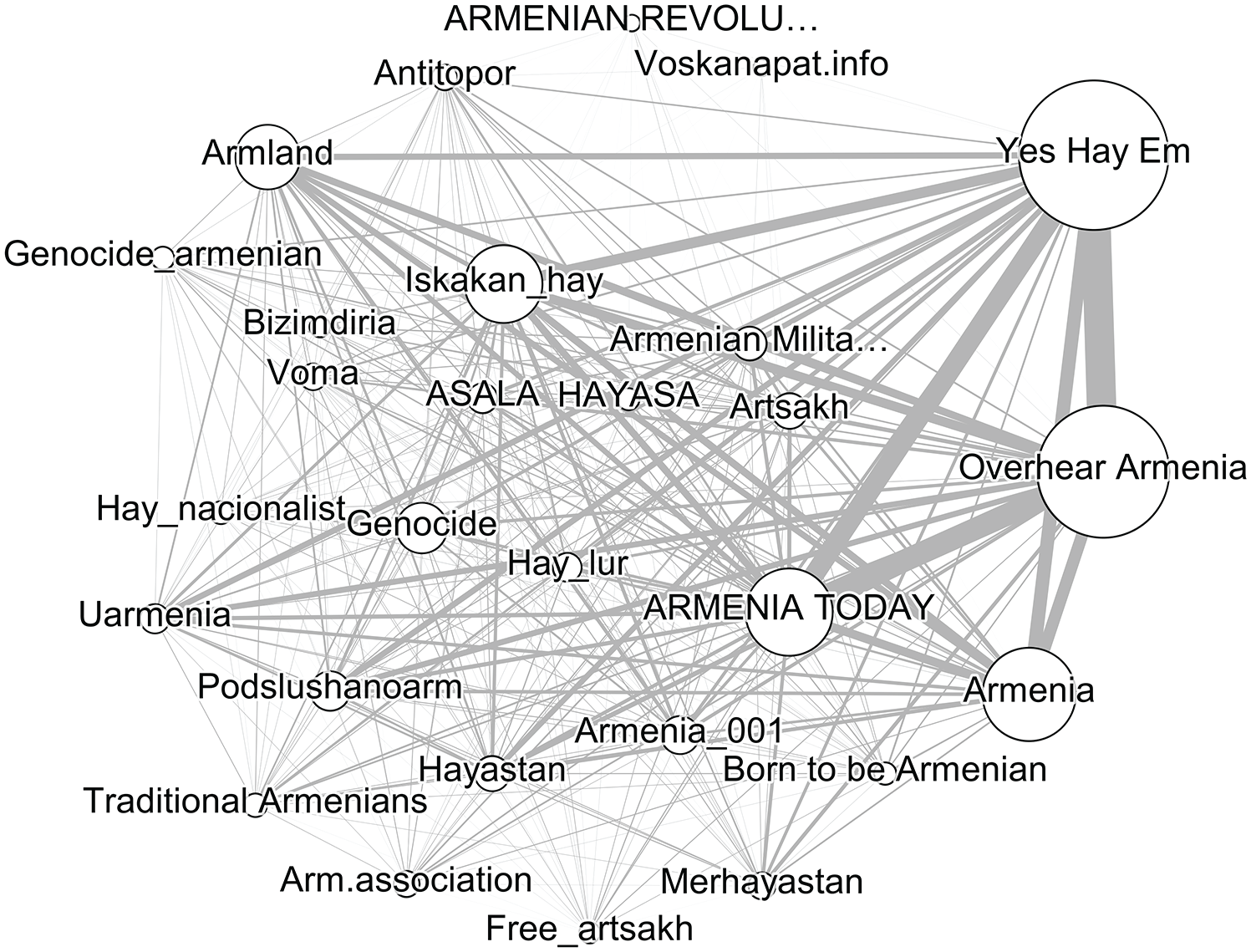
Cluster of Electric Yerevan protest networks on Vkontakte, Armenia, 2015–2016.
A full description of both Brazilian and Armenian protest clusters is available online in MS Access, and Gephi (http://ineternum.ru/wp-content/uploads/access-Brazil.zip; http://ineternum.ru/wp-content/uploads/gephi-Brazil.zip; http://ineternum.ru/wp-content/uploads/access-Armenia.zip: http://ineternum.ru/wp-content/uploads/gephi-Armenia.zip).
Initial Data
For each group, numerical series were obtained containing the number of reposts for each day of the period under consideration. The total daily number of reposts of all messages posted within the group was taken into consideration. These numerical series were generated using the popsters.ru service and are available online: the Brazilian case (http://ineternum.ru/wp-content/uploads/nodes___ishodniki_rezultati.xlsx) and the Armenian case (http://ineternum.ru/wp-content/uploads/em-ishodniki.xlsx). These data were used for testing pink noise identification.
In the initial data, there were insignificant gaps, which were filled by mathematical reconstruction.
Brazil: Results
Pink Noise Identification in 2015–2016
The total period between January 1, 2015, and August 31, 2016, was divided into six consecutive subperiods of 100 days (the last subperiod had 109 days): (I) January 1, 2015–April 10, 2015; (II) April 11, 2015–July 19, 2015; (III) July 20, 2015–October 27, 2015; (IV) October 28, 2015–February 4, 2016; (V) February 5, 2016–May 14, 2016; and (VI) May 15, 2016–August 31, 2016.
Numerical series of each subperiod were applied to spectral analysis, on the basis of which the values of α and R2 were obtained. The complete results are available online at http://ineternum.ru/wp-content/uploads/nodes___ishodniki_rezultati.xlsx.
As we deal with statistical regularities, some deviation of R2 from 1 does not indicate unsatisfactory representativeness of the trend. Figure 5 shows ordering on spectrogram B, a trend is clearly observed. This typical example offers the hope that relatively low values of R2 do not always interfere with the interpretation of α value. 1

The spectrograph of repost activity of Facebook groups during subperiod (V) February 5, 2016–May 14, 2016: (A) Terra (α = .2; R2 = .081), (B) Movimento Brasil Livre (α = .62; R2 = .464), and (C) Estadão (α = .71; R2 = .646).
Tables A2 and A3 in the Appendix contain α and R2 values of selected groups that showed behavior close to pink noise during at least a single subperiod. Figure 6 shows the state of the entire protest network during the six subperiods.
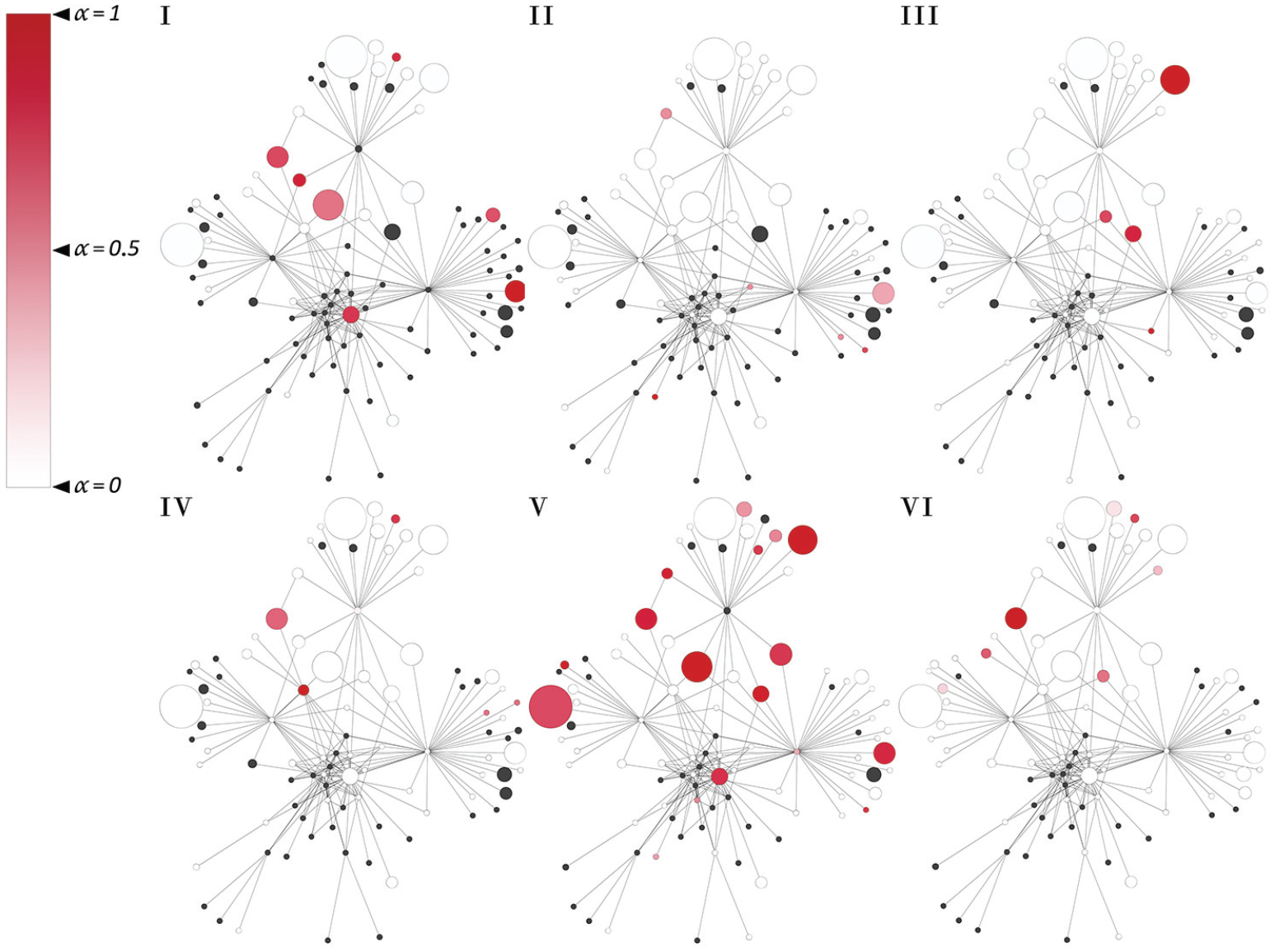
Pink noise in the network during subperiods I–VI, Brazil.
We compared the intensity of protests on the streets with a change in the number of online groups whose behavior may show pink noise. Figure 7 represents the mass nature of street riots, according to the police. The data source is a geoinformation resource supported by the media company Globo (Mapa Das Manifestações No Brasil, http://especiais.g1.globo.com/politica/mapa-manifestacoes-no-brasil/13-03-2015/).

The number of participants in the protests against Dilma Rousseff and Michel Temer (according to the police).
The emergence of numerous sources of pink noise during subperiods (I) January 1, 2015–April 10, 2015 and (V) February 5, 2016–May 14, 2016 coincides with the largest, multimillion, anti-presidential rallies in March 2015 and 2016. The key events of the impeachment proceedings also took place during subperiod V, namely in April–May 2016. In April 17, the Lower House initiated the procedure and on May 12 the Senate upheld the decision and voted the president out of office for the duration of the proceedings.
The opposition initiated mass rallies several times during 2015–2016, yet only those that were multimillion coincided with the emergence of pink noise in networks.
Avalanche on March 17, 2016
The demonstrations on March 13 gathered about 3.6 million people and was the most numerous street protest against Dilma Rousseff. However, we believe the climax of network activity did not coincide with the protests on March 13. An avalanche in the networks took place a few days later.
We calculated total daily reposts in all the groups included in the studied protest cluster. The dynamics of online activity, as seen in Figure 8, clearly point to an avalanche on March 17.
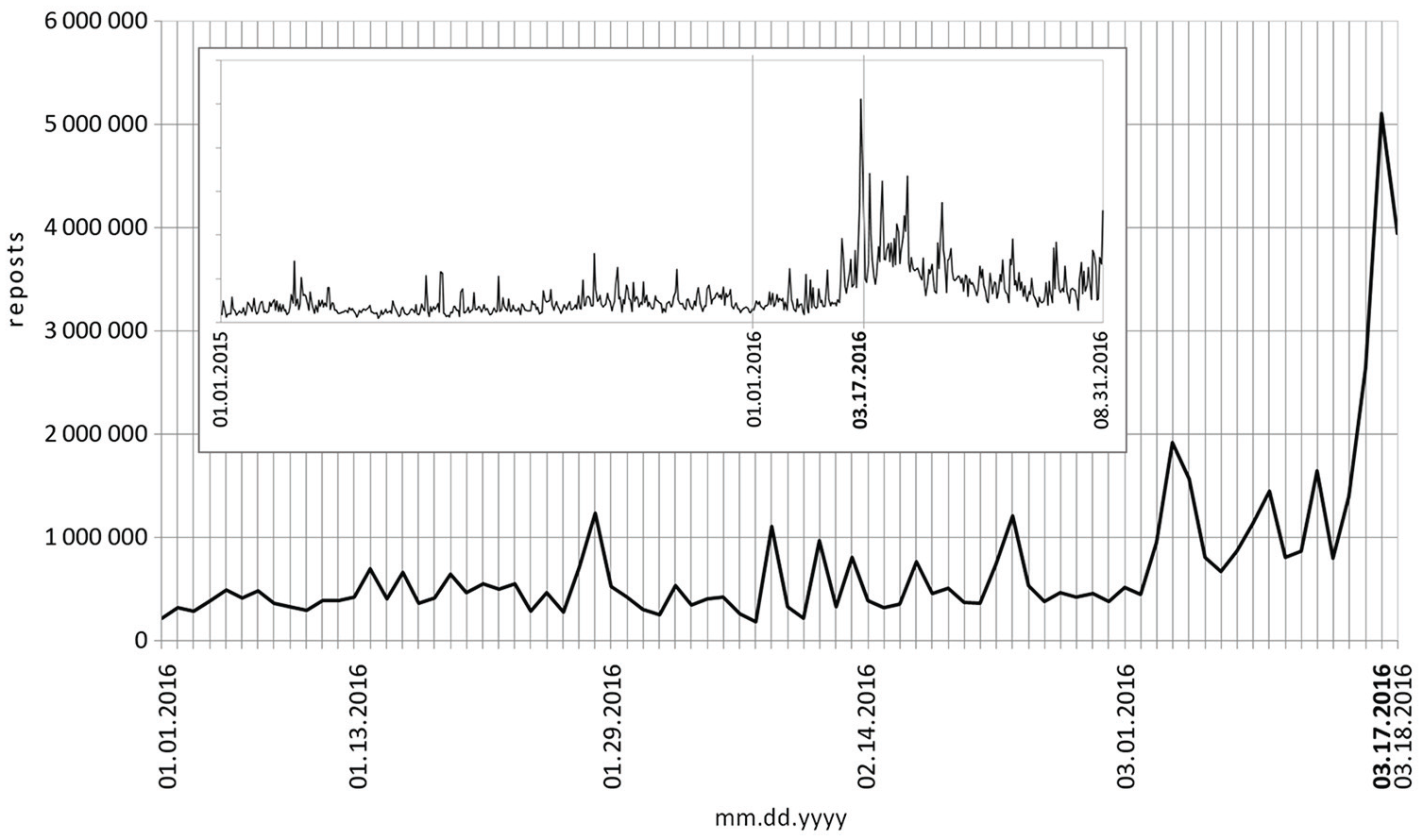
The dynamics of total reposts of the protest network on Facebook, Brazil.
The rise in the number of reposts from March 14, 2016, can be described as explosive. Figure 8 shows that it was the beginning of the greatest surge over a period of more than 1.5 years. And on March 17, the rise was extraordinarily huge, even relative to the previous days.
Such a surge of activity could be caused by some exceptional factor, but it could also be an avalanche in the sense of SOC. To ensure that it was an avalanche, it is necessary to show that this surge was happening against a background of pink noise.
Several days from March 13 to 19 were a heuristically valuable object for us. Network activity during that time should be examined at a higher resolution. As it is not possible for us to perform spectral analysis of an unsubstantial number of data points, we studied those days as part of a few longer time periods. To do so, we took three shifted subperiods of 90 days, which ended on March 13, March 16, and March 19, respectively: (Ib) December 15, 2015–March 13, 2016; (IIb) December 18, 2015–March 16, 2016; and (IIIb) December 21, 2015–March 19, 2016. The results of calculations of α and R2 values for all the groups during these three subperiods are available online at http://ineternum.ru/wp-content/uploads/nodes___ishodniki_rezultati.xlsx.
Table A4 in the Appendix and Figure 9 show the state of the protest network during these three subperiods.
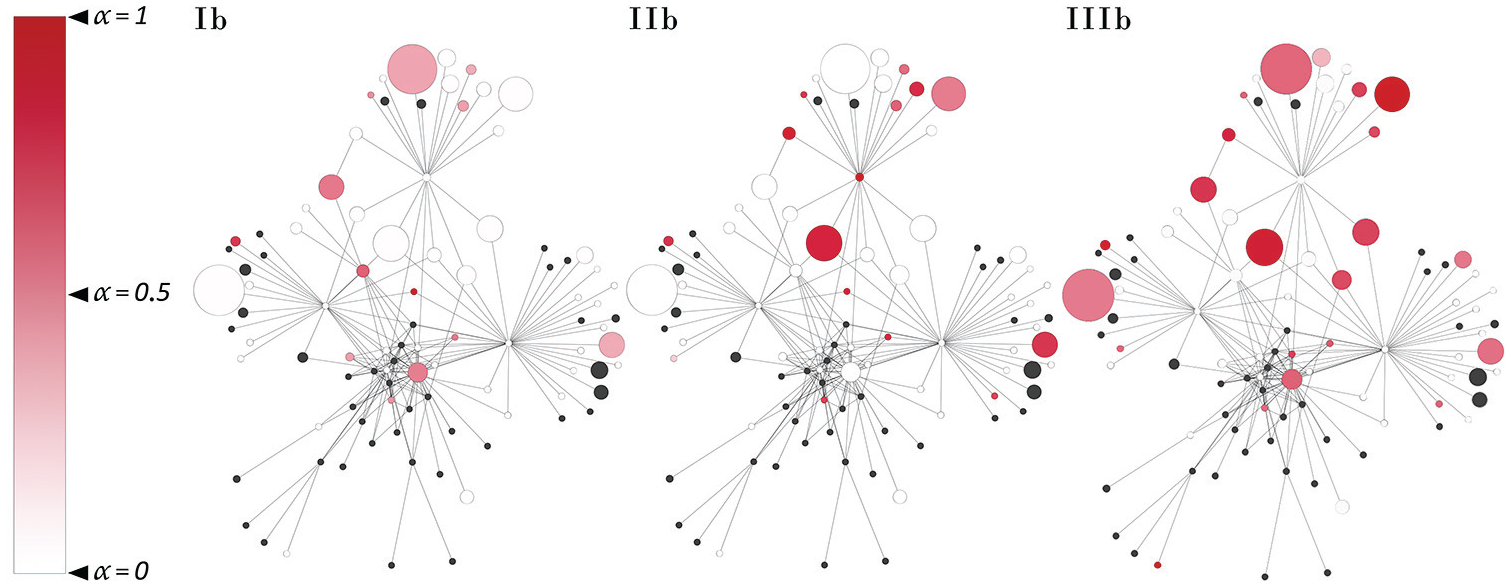
Pink noise in the network during Ib–IIIb subperiods, Brazil.
Figure 9 shows an increase in the number of groups functioning in SOC mode. 2 Moreover, during subperiod IIIb pink noise is present almost in all segments of the network. This observation supports the conclusion that the avalanche of March 17 was a manifestation of the inherent system transformation potential of groups, rather than a mere reaction of the crowd, either angry or surprised by some dramatic event. This conclusion does not deny the presence of some information newsbreak. Yet it could be anything, because it is merely a trigger.
Brazil: Discussion
An avalanche occurred a few days after the mass rallies lead by the opposition. We assume that the preparation of the opposition for the events on March 13 fueled network activity. But the network mainly reacted by 17, not 13 March.
The organizational plans of the opposition did not coincide with the dynamics of SOC. But did the avalanche itself, without any relation to the opposition’s plans, result in non-virtual political consequences? Did it actually prompt people to some sorts of action, other than clicking Like and Repost?
On March 18, Dilma Rousseff supporters rallied at the same time as the president’s opponents, who also took to the streets. And the opponents protested spontaneously, despite the parties’ intentions and without a protest permit from local government authorities. The police reported only 5,000 people participating in such demonstrations. That, we assume, was the net result of the network avalanche, which prompted people to take to the streets after rallies planned by the opposition were over.
At first sight, 5,000 is a small number. Network self-organization seemed to have a poor result, relative to organized multimillion party rallies. Yet there is a qualitative difference between protests on March 18 and peace rallies and demonstrations on March 13. There were numerous acts of violence committed by the activists on March 18. They obstructed roads, shut down shops, and beat opponents as well as passers-by while the police used water cannons (Sources: http://g1.globo.com/sao-paulo/noticia/2016/03/tropa-de-choque-chega-para-retirar-manifestantes-que-interditam-paulista.html; http://g1.globo.com/mato-grosso/noticia/2016/03/manifestantes-fecham-rodovias-em-mt-para-protestar-contra-o-governo.html; http://g1.globo.com/mato-grosso-do-sul/noticia/2016/03/comercio-baixa-portas-por-1-hora-em-protesto-em-campo-grande.html; http://g1.globo.com/mato-grosso-do-sul/noticia/2016/03/manifestantes-contra-governo-fecham-divisa-de-ms-com-sp-em-tres-lagoas.html; http://g1.globo.com/mato-grosso-do-sul/noticia/2016/03/manifestantes-fecham-avenida-de-campo-grande-em-frente-ao-mpf.html; http://g1.globo.com/rs/rio-grande-do-sul/noticia/2016/03/manifestantes-fazem-protesto-contra-dilma-e-lula-em-porto-alegre.html; http://g1.globo.com/rs/rio-grande-do-sul/noticia/2016/03/manifestantes-pro-impeachment-passam-noite-em-barracas-no-rs.html). A geographical scope of the protests is worth mentioning, too: despite the small number of participants, the protests took place in 31 locations (A source: Mapa das manifestações contra Dilma, March 18, 2016 http://especiais.g1.globo.com/politica/mapa-manifestacoes-no-brasil/18-03-2016/contra/).
If it was policy as usual on March 13, on March 18 the police were reporting “revolutionary acts.” Although few people took to the streets, it was the result of clearly observed SOC effects. And such effects can quickly and easily expand.
Armenia: Results
Three subperiods were identified in the entire studied period: (Ic) September 30, 2014–January 31, 2015; (IIc) February 1, 2015–May 31, 2015; and (IIIc) June 1, 2015–September 30, 2015. Table A6 in the Appendix contains the values of α and R2 for each group included in the protest cluster.
Lyamin (2017) have established the chronology of Electric Yerevan, according to media reports. Based on this data, the intensity of protest events (see Figure 10) was calculated.
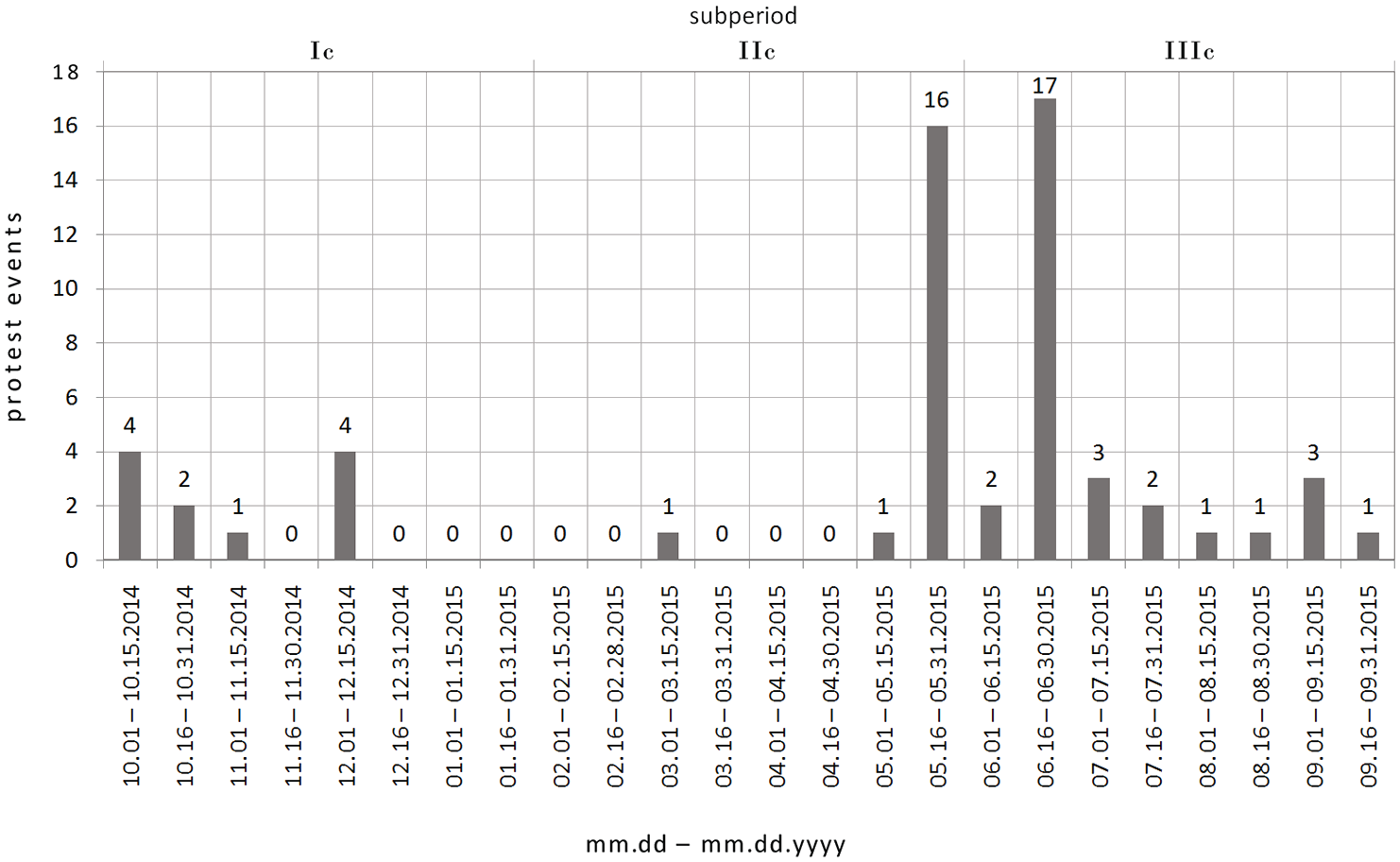
The number of protest events in Armenia before and during Electric Yerevan.
Figure 11 shows the total dynamics of protest cluster reposts; the surge of online activity, which occurred on April 24, 2015, can be observed.
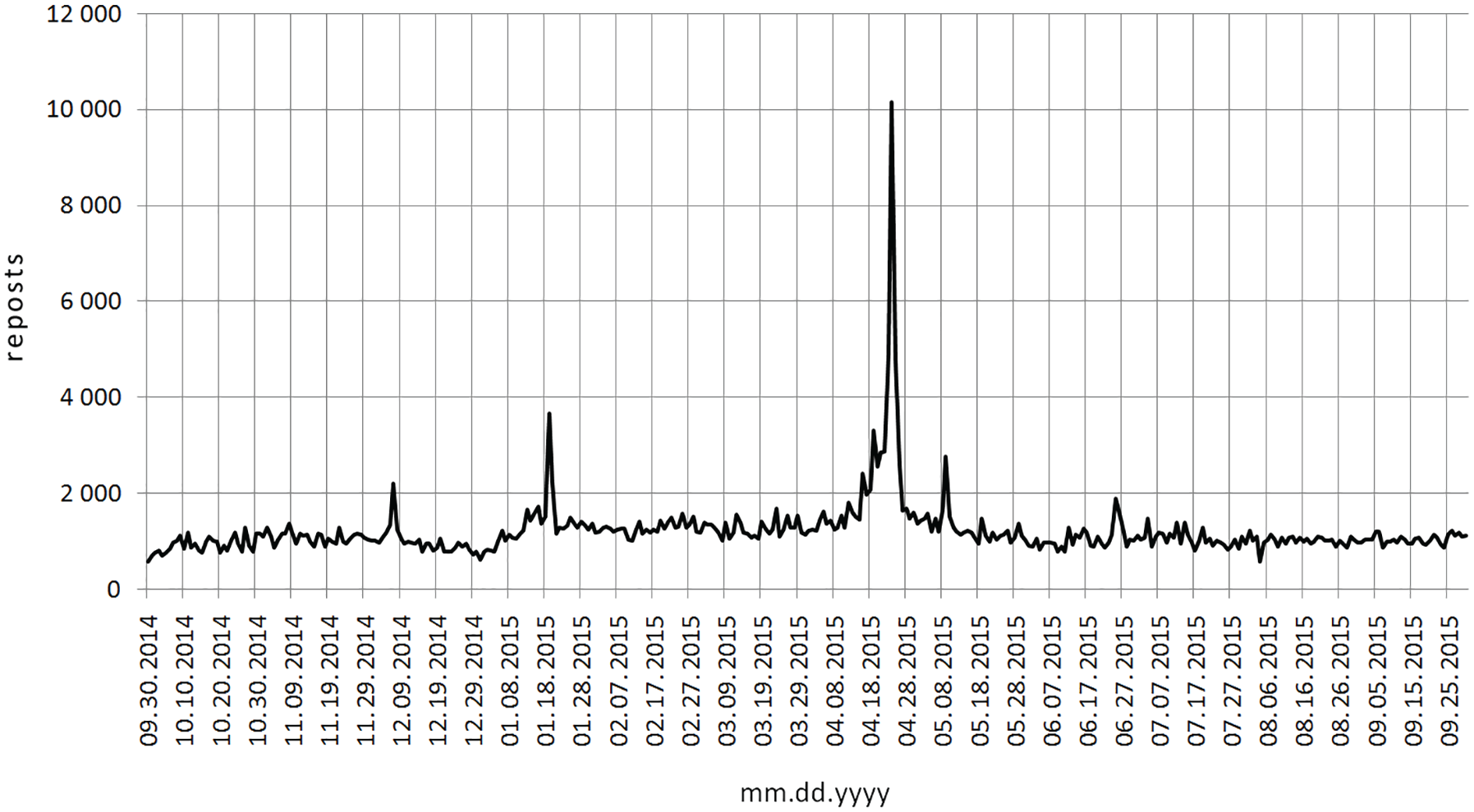
The dynamics of Electric Yerevan total reposts among protest networks on Vkontakte, Armenia.
Figure 12 shows the state of the network during different subperiods.

Pink noise in the network during subperiods Ib–IIIb, Armenia.
Armenia: Discussion
During the first subperiod, pink noise was identified in several groups; during the second one, pink noise was confidently identified in the vast majority of groups (Figure 12). During the first subperiod, the problem of a hike in electricity rates was in the public eye. It was this problem that became the pretext for setting up the anti-government protest movement.
Although the second period was initially poor in political and virtual events, it ended with an avalanche of reposts (Figure 11) and, a few weeks later, massive protest rallies. The third subperiod was the time of decline in the protest movement.
SOC in networks, thus, were accompanying Electric Yerevan. Groups in the Electric Yerevan protest network were connected with each other by extremely close and numerous connections. Perhaps, this was why a major part of the groups almost simultaneously started to generate pink noise during the second subperiod, and simultaneously demobilized during the third subperiod. The last subperiod was characterized by relatively high street activity (in comparison with the second one), yet chaotic behavior prevailed in the network. Indeed, during the third subperiod, the protest activity—despite its external effectiveness—was declining; and the Electric Yerevan movement, in fact, lost its chance to undermine the political regime.
Conclusion
The obtained results give an opportunity to make certain statements, which, however, require further development and additional comparisons with empirical data.
Dynamic series of reposts are a convenient object for testing online groups for identification of pink noise as an attribute of SOC. A repost, an elementary act of reflection, indicates that information has been acquired and reflected/shared. Network clusters, bound to each other by reflexivity, include groups that react to each other’s opinions, estimations, and appeals. Reflexivity forms numerous information channels and feedback loops. That is what allows us to refer to social groups as such a system type that is capable of demonstrating SOC.
We have confirmed that pink noise is observed in repost activity in both cases—in the online groups supporting the anti-presidential campaign in Brazil and during Electric Yerevan in Armenia. Mass street protests were taking place against the background of pink noise in repost activity. The occurrence and disappearance of pink noise correlated with the periods of preparation, peaks, and demobilization of the protest movement on the streets.
These observations support the assumptions that, in many cases, network components of contemporary protest movements function in the SOC mode. Undoubtedly, SOC in the network is characteristic not only by protest activities. However, we may expect that it is critical online activity that has a chance to occupy the streets and turn into a significant political phenomenon.
It is known that pink noise may be a harbinger of avalanches. According to the theory of SOC, an avalanche is a manifestation of inherent system potential for collapses or radical qualitative transformations. Even if the avalanche is initiated by some extraordinary factors, they remain only newsbreaks. As anything can become such a newsbreak, their emergence is inevitable as soon as the system is ready for the avalanche. The studied protest networks, both in Brazil and Armenia, had inherent characteristics for generating information avalanches—rapid and massive surges of creation, transmission, and reproduction/copying of information.
In addition, for Brazil we found the confirmation that online network avalanches can provoke street protests. Groups in the SOC mode can play the role of drivers behind the people taking to the streets. Perhaps significant political events contributed to the protest mobilization as a whole. However, as we tried to show, specific informational avalanches and bursts of social activity in Subperiod V could be caused by political irritants, regardless of their objective significance and organizational efforts of the opposition. In modern societies, a variety of political irritants are, in fact, always present. Yet networks do not always show pink noise and are not always ready to react explosively to informational occasions.
We made a number of assumptions explaining the mechanisms of the influence of online avalanches on the mass behavior of people in the real world. Calls-to-action reposts create an information pressure. However, if it increases slowly, people can obviously adapt to it. In this case, people have time to think over the network message, to harbor laziness or just to sympathize with counterpropaganda.
To provoke certain actions, the rapid increase of information pressure is needed. Moreover, unrestricted reposts of a message lead to filling of some network segments with homogeneous content. A person connected to such a network may be under the impression that everyone around perceives the reality, considers it, and defines it the same way, as well as acts the same way. Thus, the person is likely to demonstrate crowd behavior, even though he or she is completely alone on the computer.
It has been shown in both cases that there is an opportunity to diagnose the state of SOC in a protest network. Obviously, in certain cases one can predict the possibility of an avalanche emergence, although without specifying its exact date. Thus, observations of pink noise on the web allow determination of certain periods when the course of a sociopolitical system is least stable. These are types of time-stretched bifurcation points.
We believe that tracing the routes of distributing SOC effects in network structures is a heuristically promising method. This can help identify groups that generate pink noise and, presumably, transmit the state of SOC across the network. It is highly likely that the content of the protest messages and the network topology may influence the emergence and propagation of SOC effects. To confirm pink waves with evidence, we need to analyze rather large network clusters, where the strength of reflexive connections can be measured. This is not the case with the Brazilian cluster, but the Armenian one meets these requirements to a certain extent. Unfortunately, this cluster is close to a clique, which is a structure where everyone is connected with everyone. In this case, the highest number of groups begins to generate pink noise almost simultaneously, making it difficult to trace the hypothetical pink waves and their distribution patterns. Nevertheless, we believe this is a very promising field of research, which can provide us with valuable insights.
Advocates of a more conservative stance on the impact of social media on politics have a theory that social media is a factor of moods, rather than actions, and, therefore, that social media have more influence on sympathetic onlookers and not on those who directly participate in the events. We cannot but agree that the line between protest moods and protest actions may seem very thin, but it can be very difficult to cross.
Our stance is that street riots are not a direct reflection of social media moods. The internet is not always a decisive factor in protest movements, and sometimes it is not their main driver. However, in some cases, we can assume that protests are enabled by the need to let off steam and relieve social and psychological tension, and that this is provoked by very large-scale media avalanches.
Our study backs up the assumption that protest networks are not a mere reflection of protest needs and intentions that are motivated by real-life social, economic, and political factors. The social media environment generates numerous nonlinear effects, as a result of which collective virtual action may arise unexpectedly even for its immediate participants and initiators, and may even be at odds with their initial goals.
The debate around the level of impact of information technologies on politics is more than a conversation about the weight of the ruling factors: it is an argument about the nature of modern-day protests—both virtual and offline. Part of this argument is an implicit question—are the traditional (offline) political foundations still relevant, or are social media able to tear down the reality, and inflate virtual phenomena to a global scale?
In terms of SOC theory, the two statements are not contradictory. Virtual events can sometimes act as a tumbler, which switches normally running processes to extraordinary modes, when avalanches may start unexpectedly and for no apparent reason. This does not change the fact that, in most cases, the virtual world remains the space of opinions and not action.
Footnotes
Appendix
The Values of α and R2 for Selected Vkontakte Groups, Armenia.

| (Ic) September 30, 2014–January 31, 2015 |
(IIc) February 1, 2015–May 31, 2015 |
(IIIc) June 1, 2015–September 30, 2015 |
||||
|---|---|---|---|---|---|---|
| Shortcut | α | R 2 | α | R 2 | α | R 2 |
| Armenia | .52 | .336 | .48 | .441 | .37 | .298 |
| Antitopor | .32 | .165 | .23 | .105 | .70 | .459 |
| Arm.association | .36 | .186 | .18 | .103 | .28 | .139 |
| Armenia_001 | −.09 | .020 | .49 | .438 | .16 | .083 |
| ARMENIA TODAY | .86 | .558 | .99 | .783 | .20 | .079 |
| Armenian Milita . . . | .64 | .493 | .51 | .357 | .64 | .523 |
| Armland | .36 | .247 | .44 | .333 | .40 | .162 |
| Artsakh | .20 | .087 | .05 | .007 | .22 | .140 |
| Bizimdiria | .12 | .078 | .13 | .033 | .73 | .541 |
| Born to be Armenian | .32 | .286 | 1.22 | .700 | .23 | .151 |
| ARMENIAN REVOLU . . . | .14 | .026 | .97 | .526 | .69 | .529 |
| Free_artsakh | .40 | .272 | .27 | .153 | ||
| Genocide | .30 | .294 | 1.29 | .878 | .27 | .189 |
| Genocide_armenian | .97 | .700 | .59 | .524 | ||
| Hay_lur | .83 | .683 | .55 | .664 | .07 | .022 |
| Hay_nacionalist | .43 | .303 | .28 | .184 | .51 | .500 |
| HAYASA | .57 | .406 | .44 | .463 | 1.36 | .750 |
| Hayastan | .70 | .621 | .84 | .626 | .15 | .034 |
| Iskakan_hay | .14 | .030 | 1.06 | .787 | .03 | .002 |
| Merhayastan | .60 | .518 | −.27 | .179 | ||
| ASALA | .03 | .003 | .48 | .521 | .27 | .147 |
| Overhear Armenia | .66 | .546 | 1.08 | .721 | .08 | .015 |
| Podslushanoarm | .75 | .577 | .69 | .487 | ||
| Traditional Armenians | .47 | .408 | .41 | .389 | .15 | .038 |
| Uarmenia | .25 | .120 | 1.20 | .772 | .35 | .353 |
| Voma | .40 | .455 | .26 | .127 | .09 | .036 |
| Voskanapat.info | .35 | .201 | .08 | .020 | −.002 | .001 |
| Yes Hay Em | .48 | .426 | .88 | .732 | .30 | .142 |
Note. Full names and URLs of groups are presented in Table A4.
Acknowledgements
The authors are grateful to three anonymous reviewers, whose remarks and advice made it possible to improve this article and outline promising avenues of research.
Declaration of Conflicting Interests
The author(s) declared no potential conflicts of interest with respect to the research, authorship, and/or publication of this article.
Funding
The author(s) disclosed receipt of the following financial support for the research, authorship, and/or publication of this article: The study was carried out with the financial support of the Russian Foundation for Basic Research, project No. 17-06-00082а “Application of the theory of self-organized criticality for the investigation and modeling of social systems and historical processes.”
