




Abstract
Social media marketing is considered an integral part of the today’s marketing plans alongside the conventional tools. Social media’s practical application has changed the way of communication between organizations and consumers. In particular, the dynamics of interactions have been diversified in the Chinese technological cross-cultural environment. Foreigners are increasing in China and influencing the business markets. The reason for writing this article is to investigate the effects of the English language as a moderator on the viability of social media measurements and empirically test the electronic customer involvement regarding likes and comments that define the dedication and commitment. This research has analyzed the responses of 287 foreigners. The response was taken through online questionnaires distributed on a random sampling basis to social media users. Empirical research was performed by using SmartPLS3 for analysis to observe the relationships. The resultant role represents that all determinants are not similarly suitable, and are much diversified, in the context of China for the step-up of electronic customer involvement. More particularly, social media advertisement characteristics are more effective in the enhancement of electronic customers’ involvement than advertisement contents. Moreover, the use of the English language is significantly affecting the electronic customer involvement level. Tencent corporation and social media marketers should use this research to make new advertisement plans for further marketing purpose as it will guide them on how to create an innovative advertisement that will positively reap the cross-cultural environment.
Keywords
Introduction
In this modern era of technology, the rapid proliferation of social media (SM) is influencing the consumers’ behavior and compelling firms to utilize SM platforms for their marketing activities to achieve the desired outcomes. Today’s human is an SM savvy being as this figure reached up to 2.62 billion people of the planet (Statista, 2019). The number of SM users is increasing, as well as the demand for new SM sites. So the advertisements on SM, whether web-based or mobile-based, are expanding continuously. More than half of the SM users are getting addicted to following branded advertisements through SM (Hutchinson, 2015). The expanding interest in SM marketing is to upgrade the intuitive association with consumers. For achieving this goal, organizations are utilizing various plans like online blogs, electronic word of mouth (eWOM), micro online blogs, SM, and mobile marketing tools (Khan et al., 2016). The buying behavior of consumers is getting more dynamic. Every day, consumers have been interacting with several new SM applications. The most prevalent SM applications around the world, as of January 2017, are WhatsApp, Facebook, WeChat, and Skype, respectively, based on monthly active users who are in millions, and the money spent on SM advertisements is estimated at around US$41 billion (Statista., 2017).
Advancement in the technology of the internet and smartphones availability have made us SM worms. The Chinese nation is highly SM addictive as its users reached up to 673.5 million in 2018 and is predicted to rise around 800 million until 2023 (Statista, 2019). In China, WeChat is the most significant SM application explicitly attracting the young generation of the current era (Lien & Cao, 2014). WeChat became the fifth most prominent SM application by having 1,083 million users as of January 2019 (Statista, 2019). More than 61% of WeChat users check their WeChat moments first as they open the app and more than 34% of users use WeChat for more than 4 hours every day (X. Zhang et al., 2017). WeChat is not just an SM application or platform. It is not only assisting the financial transactions in China but also facilitating online buying activities, such as airline and train tickets, movie tickets, shopping of goods, hotel booking, public services, and much more. According to Statista (2019) reports, more than 54% of WeChat users spend 10 to 30 min following the official brands’ accounts. This behavior of WeChat users opened up many doors for Tencent Corporation and SM advertisers as they can access millions of users. So Tencent Corporation started WeChat moments advertisement (WMA) marketing tool (see Figure 1).

WeChat moments advertisement specimen.
Each year, business corporations are spending millions of dollars on SM advertising. The estimated cost per mille (CPM) and cost per click (CPC) are US$6.52 and US$0.21, respectively, in 2018 (Statista, 2019). Every single click for the advertisers is indispensable. So it would be necessary for the advertising firms to choose the best available SM application to reap the benefits as the spending is enormous. WeChat (Weixin or “微信”) was launched in 2011 by the Tencent Corporation. It is the most popular and populated SM application in China and attraction for the advertising firms, so the present study is focusing mainly on this application. It has a friend circle called “WeChat Moments” where users can post texts, pictures, videos, or any other informative blogs. WeChat moments is just like a Facebook page but only visible to the account holder’s friends and restricted to the others. Considering it as a hindrance for marketing, Tencent Corporation recently released an advertisement function in which any brand can publish their advertisement on the account holder’s private WeChat moments (clickz.com, 2019). That advertisement would be visible to all the users of the WeChat; users can like or comment on this advertisement (see Figure 1). So there is a need to investigate the significance of advertisement elements/dimensions (contents and characteristics) on WeChat application to provide some valuable guidelines for firms that are interested in posting their advertisements on WeChat moments.
This planet has become a global village due to technological developments. The culture of nations has become more diversified than it was ever before. China is an excellent example of rapid foreign penetration and cultural change. Many of the business organizations in China are working globally. Marketing managers are paying more attention to an understanding of cross-cultural phenomena while designing any marketing campaign specifically for SM as their users are more culturally diversified (Chu & Choi, 2011). Language is crucial for communication and advertising firms need to put stress in which language they need to communicate according to their target customers. The language barrier is an issue in providing desired customer satisfaction (Tabari et al., 2016). Usunier et al. (2005) considered the English language specifically, while talking about marketing in a cross-cultural environment, as it is the global language of business and trade.
Although the advertisers in China need to communicate in the Chinese language, the phenomena of foreigners and diverse cultures are also present there. Over a million foreigners are living in China for study, jobs, and other reasons. Around 63 million foreigners visited China in 2018 for business, trade, and tourism (discoverchina.com, 2019). More than 600,000 people are working in China (china-briefing.com, 2010) and more than 489,000 students are living in china for study reasons (monitor.icef.com, 2017). Also, the foreign WeChat users are in millions and increasing with every passing day (Statista, 2019). The majority of them are not familiar with the Chinese language and face many difficulties in their routine matters, whether related to shopping, trading, using any public service, or information seeking. So it has become crucial for firms to know and understand the need to use the English language in their SM advertisements as the target market may include foreigners. Such a significant move can facilitate both foreign and local consumers. Not only can it increase the reach of business messages, but also it will help firms in enhancing the electronic customer involvement (ECI), favorable purchase intentions, and sales volume of firms.
The study has two major contributions to the current literature. First, this research mainly focused on empirically investigating the WMA elements. These elements are essential for an SM advertisement popularity in terms of likes and comments (specific to WMA posted by the company) that eventually represent ECI by applying the stimulus organism response (SOR) model. Earlier research distinguished that language affects customers’ decision-making process and information search (Mangold & Smith, 2012). So the second contribution is that this article will investigate the moderating effect of the English language on the adequacy of SM measurements and experimentally test ECI in terms of likes and comments of WMA stimuli. Overall, the current research will answer two fundamental questions:
Related Studies
SOR Model
The SOR model serves as the theoretical underpinning that supports the research model presented in the current study. The SOR model posits that certain characteristics of an environment or stimuli evoke the inner states of the consumers, which drive them to engage in certain behaviors as a response (Jacoby, 2002; Mehrabian & Russell, 1974). This study proposes that WMA elements (characteristics and contents) be the stimuli to which consumers respond in WeChat SM application. Consumers’ interactions with these WMA elements act as an organism whereby the ECI in terms of likes and comments is the response. The SOR model was initially developed in the context of the retail industry. The servicescape, including cleanliness, design factors, and signs, act as stimuli that influence consumers’ inner states, which subsequently stimulate certain types of behaviors. Later, it was applied in the context of e-retailing (Eroglu et al., 2003; Jiang et al., 2010; Sautter et al., 2004). The stimuli characteristics of ecommerce environment and organism refer to consumers’ cognitive and emotional inner states. The response refers to the negative or positive consumers’ behaviors, such as positive word-of-mouth, customer loyalty, online communication in ecommerce, and commitment (Sano, 2014; Sautter et al., 2004; Seo & Park, 2018). For example, using the SOR model, H. Zhang et al. (2014) examined the influence of various technological features of a social commerce website, including perceived interactivity, perceived personalization and perceived sociability of consumers’ virtual customer experiences, and subsequent intention to request and share commercial information. Similarly, Animesh et al. (2011) investigated how technological features of virtual worlds affect users’ virtual experiences and their subsequent virtual purchase behavior as predicated on the SOR model. Hence, the SOR model is the appropriate theoretical underpinning that supports the research model in this study as shown in Figure 2.

Study model.
SM Advertisement Elements
Currently, various researchers have directed research on SM variables and content analysis and given points of interest in content dimensions and SM platforms used (De Vries et al., 2012). Companies are utilizing involvement dimensions to look into their activities on SM. However, the measurement is still a challenge (Moorman et al., 2015). Some researchers have elaborated on how we can increase ECI on SM platforms (Ashley & Tuten, 2015; Yang et al., 2016). No research is available that highlights the effectiveness of contents with regard to the effectiveness of the English language as a moderator in the cross-cultural environment. That is why, in the present situation, an opportunity is found to measure the effectiveness of WMA dimensions concerning the English language being a communication medium in the cross-cultural environment (King et al., 2014). De Vries et al. (2012) elaborated on the SM advertisement elements that brought e-consumer loyalty. We agreed by and large that SM advertisement contents (entertainment and information) and advertisement characteristics (interactivity and vividness) are identifiers of ECI in terms of the number of likes and comments.
Advertisement Characteristics
According to different researchers, advertisement characteristics consist of two dimensions: advertisement vividness and advertisement interactivity (De Vries et al., 2012). Often, vividness is mistakenly considered as interactivity in communication messages (Rafaeli, 1988; Steuer, 1992). However, both elements or characteristics are quite different from each other. On one hand, vividness is different from interactiveness on the capacity of two-way communication; some types of communications are highly vivid, such as in magazine and TV messages, but these are not interactive because of the element of one-way communication. On the other hand, interactive ads are different from vivid types of communication because of high interaction in communication. Similarly, some types of communication are highly interactive, but such types have low vividness. For instance, email and newsgroup communications have fluctuating levels of interactivity but are very low in vividness. The former is a part of a one-on-one communication, and second is a group communication (one on many).
Vividness
Vividness represents the depth and breadth of a communication message; the quality and resolution of message presentation in advertisements is known as depth, and the cues, sensory dimensions, and senses presented in the advertisement message are known as the breath (such as graphics and colors combination; Steuer, 1992). Advertisement stimulus richness is referred to as vividness (Daft & Lengel, 1986). An advertisement has high notability if it has vividness attributes. Advertisement diversity is associated with vividness content, which will enhance customer senses for a response (Steuer, 1992). Vividness in any advertisement could be generated by adding up pictures, colors, and lively animations (Goldfarb & Tucker, 2011; Goodrich, 2011). Any change in the advertisement vividness can affect the customer response (Coyle & Thorson, 2001). Cho (1999) proved by a test that advertisement likeness has a positive relationship with the vividness and that click-through rates of an advertisement related explicitly to vividness (Lohtia et al., 2003). We suggest that more vivid advertisements will get a more positive response from the WeChat users in terms of likes and comments.
The combination of vividness and interactiveness represent the characteristics of the advertisement. Cho (1999) argued that highly vivid advertisements generate effective results in the form of gaining intentions, involving the audience to click the advertisement, and enhancing the rates (Lohtia et al., 2003). Various researchers have investigated the higher level of the vividness of advertisement characteristics, which proved to be highly effective in enhancing the consumer attitude and involvement toward advertisements on websites (Coyle & Thorson, 2001; Fortin & Dholakia, 2005). The vividness of an advertisement always leads to gain a more significant and positive consumer attitude regarding the post of a brand and ultimately enhances the ECI toward the advertisement. Such a positive attitude always compels the customers to get involved in liking and commenting on the brand posts on SM (De Vries et al., 2012).
Interactivity
The rapid growth of SM networking and websites has created considerable hype about new interactive means of communication. Nowadays, interactivity has become a buzzword; this term is being used loosely and has various distinctive meanings among people. The lack of a precise definition of the concept is creating difficulties for those researchers who are interested in studying this area more efficiently (Fortin & Dholakia, 2005). Interactivity can communicate as to how much content and the type of advertisement can impact SM users (Steuer, 1992). More specifically speaking, Liu and Shrum (2002) say interactivity is how much at least two communication parties can follow up on each other on the communication medium and on the messages and how much such impacts are synchronized. Interactivity is portrayed as many-to-many communication as it is the communication between customer and customer, company and the customer, and customer and the company (Goldfarb & Tucker, 2011). Researchers revealed that interactivity is positively related to customer involvement (Coyle & Thorson, 2001). The fundamental purpose of any brand’s SM advertisement stimuli is to create responses from the visitors such as liking and commenting on the post. That is why the current study assumes that more interactivity creates more responses from the WeChat users.
Multiple studies have researched the interactivity level of a stimulus. Researchers have given the impression that indicates a feeble effect of interactivity on people’s cognition and learning (Bailey, 1993; Fortin & Dholakia, 2005). While taking into account the effects of advertising on persuasion in the process of customer involvement, Petty et al.’s (1983) elaboration likelihood model (ELM) is predominantly most appropriate in such a situation as customer involvement is probably affected by interactivity. Moreover, Fortin and Dholakia (2005) demonstrated that interactiveness of an advertisement leads to more fans’ involvement toward clicking the link of the advertisement. Even the highly interactive advertisements and posts of the brands compelled and dedicated their fans or customers for answering. As the aim of advertisements or posts on SM is to motivate the customers to get involved in reacting toward those advertisements in the form of liking and commenting, it is expected that the higher level of interactivity will always generate greater ECI.
Researchers revealed that interactivity is positively related to customer involvement (Coyle & Thorson, 2001). As the vividness and interactivity of ads can yield more effectiveness to the contents of the advertisements and provide the opportunity to deliver the message more effectively to consumers, it is probably to influence customers’ degree of involvement directly through an advertisement (Zaichkowsky, 1994). Based on the above arguments, the study proposed the following hypothesis:
Advertisement Contents
Many different researchers defined that advertisement contents consist of two dimensions, namely, Information and entertainment (De Vries et al., 2012).
Information
One of the most compelling reasons for joining any SM is to gain information (Lin & Lu, 2011). According to Dholakia et al. (2004), individuals join SM to share their thoughts and emotions in the virtual groups and contribute to SM groups with their knowledge (Park et al., 2009). Individuals like to interact with advertisements, which demonstrate their influence on information (Muntinga et al., 2011). Moreover, SM users participate more in the brand advertisements that contain information about the brand and its products. In the previous research, it is proved that users give more positive responses to informative brand posts on SM (Taylor et al., 2011). Hence, after understanding the above literature, we can state that an WMA that provides information will engage WeChat users in a better way.
The information-seeking behavior of users is one of the crucial reasons to visit SM networking websites (Lin & Lu, 2011), to participate in online communities (Dholakia et al., 2004), and contribute to SM groups (Park et al., 2009), which ultimately enhances the involvement of customers in SM activities. In addition, the information-seeking behavior of people always utilizes the contents of a brand’s advertisement, which leads to more involvement (Muntinga et al., 2011). Hence, if the SM advertisement contains the desired information for customers about a particular brand, then it enhances the motivation level to participate, or the level of involvement, and ultimately, the content’s objective is met. Furthermore, Taylor et al. (2011) investigated that informative posts on SM networks tend to gain positive audience attitudes, which shows their involvement. Therefore, in a comparison between informative and uninformative brand advertisements on SM sites, brand fans or customers might have a higher level of involvement and a positive attitude toward the former.
Entertainment
Researchers found that entertainment is also an essential purpose behind individuals to join SM platforms (Cheung et al., 2011; Lin & Lu, 2011). The entertaining way of brand advertisements impacts users to chug, comment, and contribute (Muntinga et al., 2011). Viewers are more attracted to humorous advertisements (Belch & Belch, 2003), and entertaining advertisements create a more positive response from them (Taylor et al., 2011). Hence, we suggest that entertaining material supports and arouses WeChat users to react and participate. In this way, entertaining contents pull in more ECI.
Moreover, Muntinga et al. (2011) demonstrated that entertaining content always leads to getting people or customers involved in consuming and contributing to brand posts. Consumers do perceive SM advertisements containing entertaining content as cool, exciting, fun, and flashy, which creates a positive attitude among customers (Taylor et al., 2011). They gain significant involvement in an advertisement and a positive attitude for brand and also generate the desired outcome for the website (Raney et al., 2003). Hence, if the advertisement posted on SM is considered to be entertaining by customers, it will enhance the motivation level among consumers to participate and get involved in content. Therefore, brand fans or consumers may have a higher level of involvement and have a positive attitude toward the advertisement that contains entertaining elements as compared with unentertaining advertisement on SM. Thus, such types of advertisements generate a higher level of popularity among customers and also get desired outcomes. Information and entertainment are highly significant characteristics of SM advertisements. Hence, it is proved that the SM advertisement contents could generate positive influence on ECI. Based on such arguments, the study proposed the following hypothesis.
English Language (as a Cross-Cultural Medium of Communication)
The English language is the most commonly used worldwide. Almost every nation is using the English language as a second language medium of communication. It is also facilitating people around the globe to interact with each other, share, understand, and cooperate through a common international language to establish the concept of diversity in cross-culture settings. According to Kroeber and Kluckhohn (1952), language is the medium of communication. In a diversified cultural setting, language could be a hindrance to a growing business. Companies are working on creating multilingual marketing solutions to overcome the language issues. It will enable customers to choose the language they understand (Czinkota & Ronkainen, 1996). Worldwide, mostly business, commerce, and management education are taught in the English language, so it is a joining force between business communications dealings globally (Charlesworth, 2008). Moreover, Tam et al. (2014) also highlighted that language obstructions are indeed the most challenging issues. In some cases, companies refuse to serve customers if they realize there is a language obstruction. Hence, the language barrier is an issue in providing desired customer satisfaction to the consumers (Tabari et al., 2016).
In support of the English language, considering its importance, Usunier et al. (2005) considered the English language imperative while talking about marketing in a cross-cultural environment, as it is the global language of business and trade. Furthermore, literature and information searches point to the most powerful brands being known due to stable linkages with English language contents and English subsidiaries, formed by non-natives of the English language. So in china’s diversified cultural settings, it is very much essential to know whether the use of the English language will bring more ECI for SM ads or not. The current study has taken the English language as a moderator on WMA contents to know its viability. If Chinese marketers use the English language while making their SM ads for globally renowned brands, it will bring more enhanced ECI for that SM ad. The literature already confirms the moderating role of the English language for improved understanding of the content presented (I.-J. Chen & Chang, 2011). So the current study proposed as follows.
The investigating results proved as predicted that the moderating role of the English language in advertisement contents generates positive results among people. It proves the significant influence of the English language in a presentation mode of advertisement content on the cognitive behavior of customers and enhances their involvement level significantly in learning and understanding the contents of brand advertisements (I.-J. Chen & Chang, 2011). Such a moderating effect of the English language reminds us to design the advertisement contents carefully while using the text aid because it might enhance customers’ involvement level in understanding the advertisement contents and will generate desired results for SM brand advertisements. The results of the study of I.-J. Chen and Chang (2011) have proved that the moderating role of using the English language in the presentation of advertisement contents can increase ECI to a higher level among customers toward SM advertisements. Therefore, using the English language in designing the SM brand advertisements helps to significantly increase the ECI level in understanding the contents. So based on these arguments, the current study also proposed the following hypothesis for further investigation.
Model
The study model has been described (see Figure 2).
Method
Sample and Procedures
The data have been collected from foreign WeChat users, currently residing in China’s different cities, especially the northeastern part. The ratio of respondents mostly consists of university students; it was based on the concept that respondents to the questionnaire with higher education would have much awareness about the research concepts (Özfer Özçelik & Ucar, 2008). A detailed self-administered questionnaire was developed by using “Wen Juan Xing,” an online questionnaire development and data collection site. Thereafter, the questionnaire was spread through WeChat SM application to collect data regarding the independent, dependent, and moderating variables. The questionnaire was distributed to respondents using the snowball and convenient sampling technique. The questionnaire was distributed through the WeChat app in a way that one person can only fill it once. The first question was about nationality, so if any Chinese filled it up (by mistake), it could be identified and excluded from the analysis. In total, 287 usable responses were obtained from foreigners during January and February 2019.
Measurement
All the items and scales have been adapted from previous literature and books. Vividness was measured as (No, Low, Medium, High). All other items were measured using 5-point Likert-type scales as (strongly disagree, disagree, neutral, agree, strongly agree); strongly disagree = 1 and strongly agree = 5. A structured questionnaire consisting of 26 items was developed and distributed to gather the responses from respondents. (Ahn & Ferle, 2008; Burns & Lutz, 2006; Coyle & Thorson, 2001; De Vries et al., 2012; Dillman et al., 2014; Fortin & Dholakia, 2005; Khan et al., 2016; Krosnick & Fabrigar, 1997; Verhagen et al., 2011; Zhao & Lu, 2012)
Statistical Analysis Techniques
The hypothesis of the current model has been tested using SEM (structural equation modeling) approach through SmartPLS3 software. In this study, we have followed the two-step approach, as suggested by Anderson and Gerbing (1988). Before examining the structural model, the measurement model of the study was tested and evaluated. Exploratory factor analysis (EFA) and confirmatory factor analysis (CFA) were performed to develop the construct validity of the measurement model (Li et al., 2020). After verifying construct validity, a structural model was examined to test the hypotheses and model fit.
Results and Discussion
Demographic and Social Application Usage Data
In Table 1, demographic characteristics of the sample are given, which show a high diversity of respondents in terms of age, study level, Chinese language proficiency, and the reason to use SM apps given by the foreigners residing in China. The total sample size was n = 287.
Demographic Characteristics.

The respondents’ age ranged from below 20 years to above 35 years, and the majority of the respondents (270 respondents, almost 94%) were below 35 years, representing the younger generation. The educational level of 88% of the respondents ranged from undergraduate to PhD. Most respondents consist of having just an average knowledge of the Chinese language as around 63.37% of the respondents fall under this category. It shows that they have basic knowledge about the Chinese language. When the respondents were asked why they use SM apps, three reasons were mostly chosen by them, namely, to get information, for entertainment, and to make new friends (response frequency 236, 177, and 160, respectively; see Table 1).
The Measurement Model Results
Overall, it can be defined that it is the measurement model that has proved adequate reliability, convergent, discriminant validity, and model fit of the current study (see Tables 2 and 3). To check the discriminant validity and common method bias, there are many measures suggested by expert statisticians and researchers, The Fornell–Larcker Criterion is a very well-known and authentic measure among the measures of discriminant validity and common method bias. Content validity is measured by factor loading of items of the constructs and convergent validity is evaluated by average variance extracted.
Constructs, Items, Factor Loads, Cronbach’s Alpha, CR, AVE.
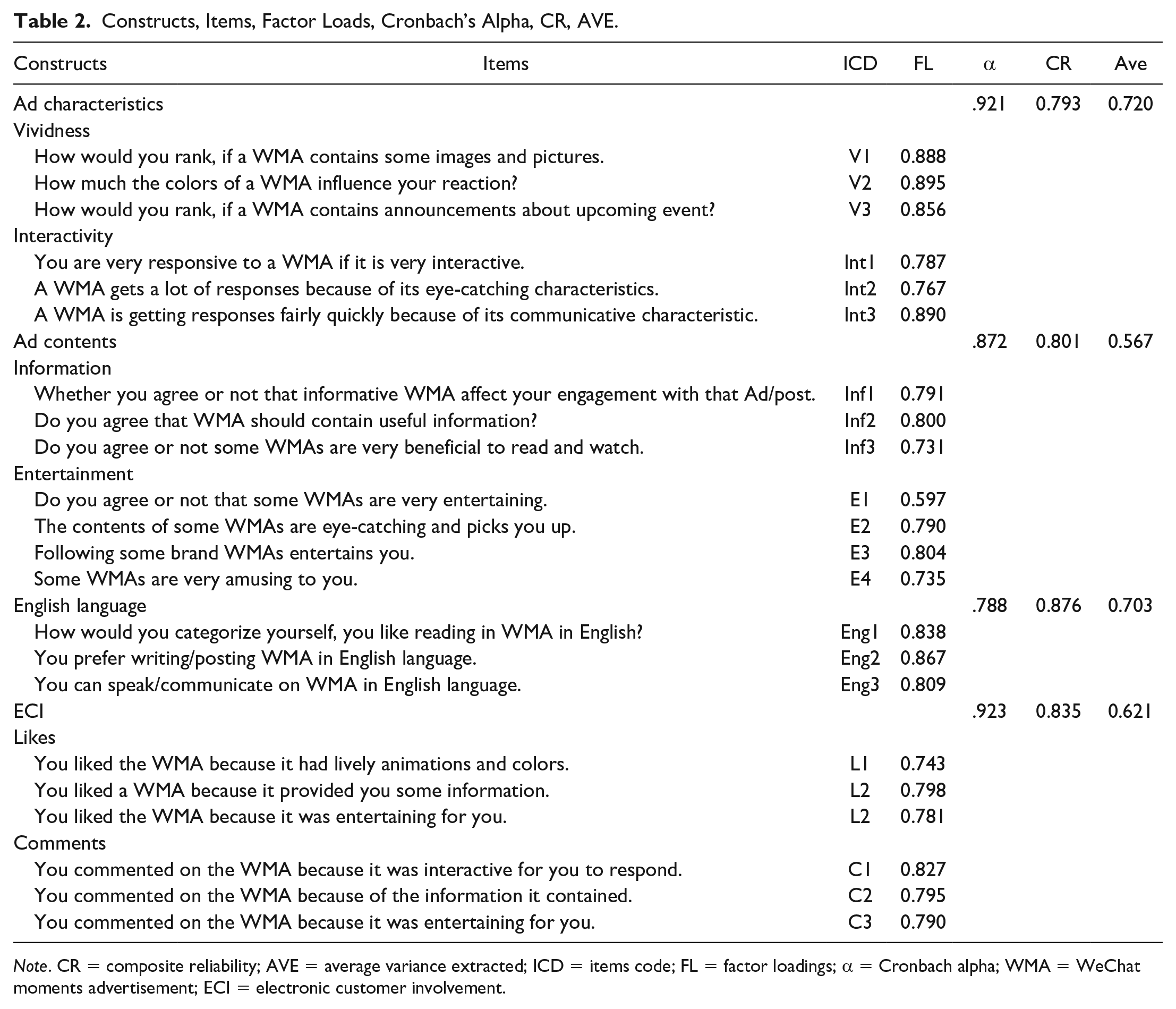
Note. CR = composite reliability; AVE = average variance extracted; ICD = items code; FL = factor loadings; α = Cronbach alpha; WMA = WeChat moments advertisement; ECI = electronic customer involvement.
Discriminant Validity and Model Fit.

Note. ECI = electronic customer involvement; SRMR = standardized root mean square residual; NFI = normed fit index.
Discriminant validity is defined by Fornell and Larcker (1981) as to how the constructs are different by each other in the context of the same model. Table 3 illustrates the results of the Fornell–Larcker criterion of all constructs. All the values are according to norms. The first value in each column is higher than other interconstruct correlations, hence proving the discriminant validity of constructs of this study. Another robust measure to evaluate the discriminant validity has been devised by Henseler and Sarstedt (2013), which is an HTMT correlation. HTMT is based on Monte Carlo simulation and values should be below the threshold value of 0.90. Table 3 also illustrates the values of the HTMT correlations, and the highest value is 0.818, which confirms the adequate discriminant validity of constructs and reflects the acceptable quality of the measurement model.
Content validity is confirmed through the factor loading of different items. Factor loading makes sure that the questions of the construct are going to measure what is intended to be measured and related to that particular construct (Chin, 1998; Hair et al., 2011). The following table consists of factor loadings of different constructs and internal reliability, convergent validity and composite reliability, and average variance extracted. The reliability of the item can be used to confirm the convergent validity of the constructs. The reliability of items consists of Cronbach’s alpha coefficients, composite reliability, and average variance extracted. Results shown in Table 2 illustrate the values of Cronbach’s alpha, composite reliability, and average variance extracted; Cronbach’s alpha values are above the standard value as suggested by Nunnally and Bernstein (1994). Composite reliability values for all constructs are higher than the standard norm as suggested by Hair et al. (2011). Factor loadings of all the constructs and related dimensions are fulfilling the criteria of 0.60, as suggested by the Hulland (1999), and factor loadings below 0.4 must be dropped from the measurement. Convergent validity of constructs were measured by AVE and values accepted above the threshold value of 0.50, as suggested by Bagozzi and Yi (1988) and Hair et al. (2011); AVE values of the constructs of this surpassed the standard norm therefore confirming the convergent validity of constructs.
SRMR value less than 0.10 is considered a good fit (Henseler et al., 2014; Hu et al., 1998); current research’s SRMR value is 0.091, so representing a good model fit. NFI is defined as 1 minus the χ² value of the proposed model divided by the χ² values of the null model. Consequently, the NFI results in values between 0 and 1. The closer the NFI to 1, the better the fit (Lohmöller, 1990). The NFI value is 0.632, representing a good fit.
The Structural Model Results
The measurement model of this study has been confirmed by the positive results related to validity and reliability, so the next stage was to run the structural model of the study by testing the hypotheses of the study. Figure 3 shows the causal linkages between variables of the structural model. The results shown in the Table 4 represents that the effect of WMA characteristics and contents on the ECI in terms of likes and comments of an ad is positively and significantly supported (β = .548, p > .000; and β = .205, p > .000). The study is supporting H1 and H2.

Path coefficient Results.
Straight and Moderating Hypotheses and Path Coefficients.
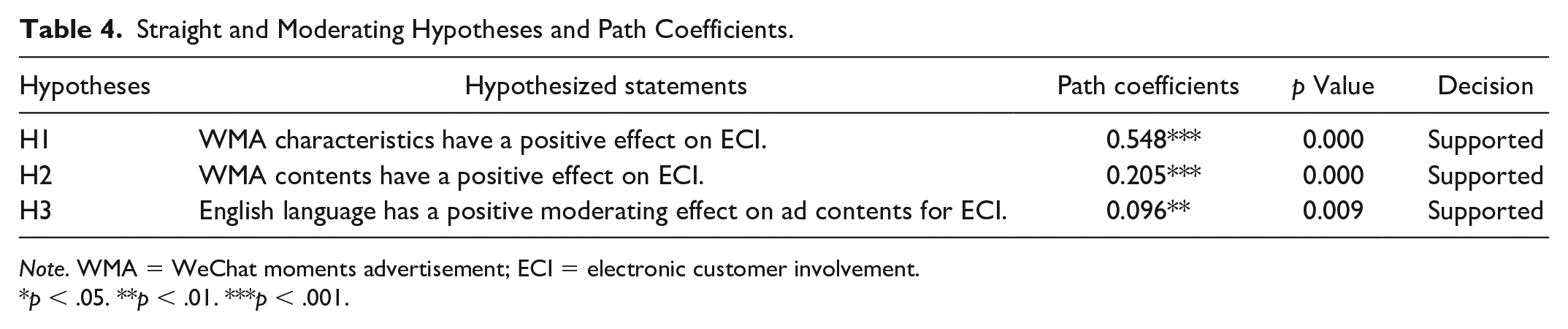
Note. WMA = WeChat moments advertisement; ECI = electronic customer involvement.
p < .05. **p < .01. ***p < .001.
This study was conducted in China, where Chinese SM marketers use only the Chinese language in making their advertisements. With the recent developments, China had made this country a global village where foreigners are influencing the business trends. Hence, English language was taken as a moderator to assess its impact on user involvement of SM. Table 4 depicts the results that the effect of the English language as a moderator between WMA contents and ECI is positively significant, with indicators (β = .096, p < .009) that show that the English language has a positive and significant moderating effect between both. Hence H3 is supported as postulated in this study.
Discussion
SM advertisers and Tencent Corporation can get direction from this research by choosing the right elements while making WMAs get the maximum benefit from it. This study explains that all the ad metrics are not similarly important to increase ECI in terms of likes and comments. In the context of China, WMA characteristics, vividness, and interactivity aspects are more important than WMA contents, information, and entertainment for enhancing the user involvement, as results suggest to us. Furthermore, it elaborates and validates the moderating role of the English language on WMA contents for users’ involvement. The study revealed that around 94% of SM users are below 35 years of age. While choosing the youngster segment of the population, the marketing managers have a massive chunk of this market through the WMAs option because this entire segment is using WeChat with very high frequency. This group is also a little familiar with the Chinese language and culture. The use of the English language to some extent in WMAs will be more beneficial for the response rate. We feel that WMA contents and characteristics can increase the number of likes and comments on the advertisements because SM users want to express their response and the only way to express it is through likes and comments on the post (Cvijikj & Michahelles, 2013; De Vries et al., 2012; Luarn et al., 2015). Moreover, foreigners will communicate in the English language as their Chinese language knowledge is average or just so-so. It is an intuitive understanding because SM users can respond to WMAs only by posting comments.
WMA characteristics
The results of the current study proposed that WMA characteristics are highly influential for ECI. The current finding is supported by the previously available literature of SM marketing. China is a colorful country. People like colorful ads in China, as can be seen everywhere. This culture is also affecting the foreigners residing in China. This finding is also providing insights for the Tencent Corporation and SM marketers that they must enhance the WMA characteristics for grabbing ECI. Most of the users, as they are youngsters, like lively animations and communicating behavior of the posted WMAs.
WMA contents
Analysis of the study revealed that WMA contents are also significantly affecting the ECI that has been proved by many studies previously. Information and entertainment provided in the WMAs attract the SM users to post likes and comments as most of the users belong to a young age group, so the entertainment and information should be more related to them to grab high user involvement.
Theoretical and Managerial Implications
Theoretical Implications
The research confirms the suitability of the SOR model to explain the effect of WMAs on ECI in terms of likes and comments. First, the findings of the research showed that WMAs have a significant positive impact on the ECI, consistent with previously available literature (Ismail, 2017). Effective SM marketing activities indisputably can lead to various positive outcomes (S.-C. Chen & Lin, 2019; Ismail, 2017). However, the relationship is not a direct one, propagating that WMA elements are the stimuli that will evoke the inner states of consumers, which will subsequently trigger the desired response from them. It is evidenced by the findings of this research that when consumers incline positively toward the WMAs posted by the brands, they are most likely to have a positive advertisement experience, creating positive internal consumer responses toward the WMAs. Building strong ECI is crucial for every brand. Building a strong, appealing WMA with higher ECI will enhance this effect further into perceived brand quality, actual purchase behavior, or brand loyalty (Buil et al., 2013). The moderating effect of the English language is also validated by the current study, indicating that users want the use of the English language in WMAs: whether this usage could be low as to make WMAs understandable for the foreign consumers. The moderation effect of the English language for the enhancement of ECI is an essential finding in the SOR model.
Managerial Implications
Universities in China have a significant opportunity to post their admissions and course details through WMAs as most of the population using WeChat are youngsters with proper education levels. The e-course providers also can get benefit from this as, through WeChat, they can access most of the population residing either in rural or urban areas. In the same way, libraries can go for it and also put the links for membership and online access. Another insight is for kindergarten institutions as they can access each kid because young parents must use the WeChat SM app. Entertainment is a strong element of SM advertisements. The film industry can post their current and upcoming movie advertisements to get maximum user involvement. Cinemas can insert the releasing dates and show timings in their theaters of current and upcoming movies. The music industry does have a big chunk for marketing their albums. In the same way, KTV (Karaoke), clubs, and bars could market their events and offers as their message will reach up to millions of users. Events and party organizers can also have their part in that. Providing the links for other SM apps like Facebook, WhatsApp, and Weibo (being the most common among foreigners) will be very beneficial as users like to use other SM applications and also like to make new friends. It will get the maximum results in this cross-cultural era.
Information is also one of the compelling contents of the WMAs. News providers, information blog writers and posters, political posts, and also scientific posts will be perfect for posting at the WeChat moments. News can be spread very easily and quickly through the WMA function. CPC can spread their political thoughts to a maximum number of people, and the English language will ease this message to be understood by the foreigners. Rules and laws related to the foreigners can also be informed to the targeted population of foreigners through WMAs. New SM applications companies can market their products through WMAs by putting up their links that can be assessed within no time. The study brought out that foreigners like to use different SM applications and to interact with new friends. Dating and Community applications can reap this fruit by advertising their products. According to the study, mostly youngsters use WeChat. Moreover, gaming is one of the most prominent hobbies of youngsters. Online games, strategy games, community games, social games (cards, majiang), physical games, and beach games apps and events can get a big chunk of youngsters and also have an opportunity to show and prevail Chinese culture to foreigners.
Overall, we can conclude that WMA characteristics, vividness and interactivity, and WMA contents, information, and entertainment are essential for increasing the ECI. We can also infer that advertisement characteristics become a point of parity in the context of China so must be contained by each SM advertisement for keeping the ECI. Moreover, foreigners are learning and adapting to the Chinese language and culture very quickly. That is why the English language, to some extent, should be used to reap the benefits of ECI in terms of likes and comments.
Limitations and Future Work
Restrictions
This study is limited to the cross-cultural environment of China and to defining the English language impact of foreigners living in different cities of China. It could not be generalized to regions outside Chinese markets. Due to the limited resources and limited time available for the research, the respondents are mostly university students who are studying in different cities of China. This research is more general and has described the effect of English language on SM users and their involvement in WMA, but does not state that positive consumer involvement will lead to enhancing financial benefit. Our research contributes advanced knowledge about the ebb and flow routine with regard to online networking encouragement. Especially, SM consumer involvement, with moderating effect of the English language, would lead to some fruitful future aspects of research. Our research described the usage of SM in general and is not specific to any brand or industry. We have not considered the friendship element between SM users. The dynamic side of SM is also a significant factor that may affect ad metrics.
Future Work
This research can be vast by adding up more WMA options (not interested or report function) as only those concerned have been chosen. Future research ought to be directed by applying various other motives to assess how SM users react to different advertisement measurements. Besides this, they can reveal the critical culture and many other components that effect WMA involvement. Future writing may enhance our discoveries about measurement dimensions that improve brand-related metrics and the moderating impact of many different aspects of cross-culture.
Footnotes
Declaration of Conflicting Interests
The author(s) declared no potential conflicts of interest with respect to the research, authorship, and/or publication of this article.
Funding
The author(s) received no financial support for the research, authorship, and/or publication of this article.
