



Abstract
Supervisor BLM is referred to as a unidimensional frame of mind that revolves around the attainment of bottom-line outcomes; this mentality is commonly found in today’s organizations. The question arises: Does this phenomenon affect the psychological states of employees who are working with supervisors with high BLM? Moreover, how can the detrimental effects of the same can be diminished? Guided by these questions, we draw the Stimulus-Organism-Response and the Cognitive Relational model to understand the effects of supervisor BLM. Using the data collected from 219 employees working in real estate companies in Pakistan, we found that supervisor BLM causes the perception of job insecurity in employees, which leads to workplace jealousy. we further found that the indirect relation between supervisor BLM and workplace jealousy via job insecurity was weaker for employees reporting a higher level of resilience. Our findings indicate that managers need to be cautious about bottom-line mentality because it may lead to adverse organizational outcomes. Moreover, limitations and future research areas have been discussed in detail.
Introduction
In today’s competitive business world, where the rivalry and struggle amongst organizations is getting intense daily, business leaders are more inclined toward financial gains than other important considerations (Greenbaum et al., 2023). This phenomenon is called bottom-line mentality, which is defined as “one-dimensional thinking that involves securing bottom-line outcomes to the neglect of competing priorities” (Greenbaum et al., 2012, p. 344). Bottom-line outcomes commonly include financial gains (e.g., profit) and competing priorities that are neglected to meet the bottom-line outcomes may include moral and social values, employee considerations, quality of work, or concern for justice (Greenbaum et al., 2012; Wolfe, 1988). Focusing on the bottom line is not detrimental, but it gets problematic when other important considerations are ignored (Barsky, 2008). Several high-profile scandals indicate that exclusive focus on bottom-line outcomes may lead to unfavorable outcomes (Greenbaum et al., 2020). Researchers have demonstrated BLM as a negative phenomenon that can lead to dysfunctional outcomes (Lin et al., 2022). Researchers have devoted extensive efforts to examining the drawbacks associated with BLM. However, further examination is required to understand why BLM may lead to dysfunctional outcomes (Babalola, Greenbaum, et al., 2020). There also remains a lack of understanding regarding the resources that can alleviate the detrimental effects of supervisor BLM (Xie et al., 2022). From the viewpoint of both practitioners and researchers, it is critical to identify other negative outcomes of supervisor BLM and also single out the mechanisms, which may lead to these negative outcomes. Identification of such mechanisms may serve as a potential objective for workplace interventions. Although a number of studies have examined the negative outcomes associated with supervisor BLM, to date, workplace jealousy has not been studied as an outcome of supervisor BLM. In response to these research calls, current research extends the empirical research on BLM by examining the mediating role of perceived job insecurity in relation to supervisor’s BLM and workplace jealousy and also the moderating role of resilience in mitigating the indirect impact of supervisor BLM through job insecurity on workplace jealousy.
Generally, jealousy is the fear of losing a valued relationship with another person because of a real or imagined rival for that person’s attention (DeSteno & Salovey, 1996). According to Vecchio (2000, p. 162), jealousy in workplace settings involves three parties, including “the focal employee, the rival, and the valued target person.” Relationships at work play a significant role in employee functioning. Right people equipped with the right resources can have a vital impact on employees’ outcomes which include job satisfaction, promotion chances, and individual performance (Morrison, 2002). In an organizational context, a threat to a valued relationship can lead to a staggering protective drive in the form of workplace jealousy (Andiappan & Dufour, 2020). Jealousy is an apprehension of losing a valuable relationship because of a real or perceived rival for the person’s attention (DeSteno & Salovey, 1996; Salovey & Rodin, 1984). Numerous events or situations can spark the apprehension of losing a valued relationship in organizational settings (Bani-Melhem et al., 2023). Jealousy can surface due to a potential threat to a valued relationship because of a real or perceived rival.
Jealousy has been a research topic in many fields, from economics (Wang & Zou, 2014) to psychology (Kristjánsson, 2016; Ramachandran & Jalal, 2017) and has also been studied in social emotions research (DeSteno, 2009; Hareli & Parkinson, 2008) in past two decades. Researchers have mainly explored the antecedents and outcomes of jealousy in family and romantic relationships (Attridge, 2013; Buss, 2018; Theiss & Solomon, 2006), however, it has received little attention in management research (Andiappan & Dufour, 2020). Past studies have indicated many negative outcomes associated with workplace jealousy which are detrimental for not only the rival but also to the jealous individual and the organization they are working for (Cohen-Charash & Mueller, 2007; Dogan & Vecchio, 2001; Dunn & Schweitzer, 2004; Gino & Pierce, 2009; Günalan & Ceylan, 2014; Tai et al., 2012; Thompson et al., 2018; Y.-D. Wang & Sung, 2016). Workplace jealousy can also cause a decline in actor’s performance and work quality due to cognitive and emotional distraction caused by experiencing jealousy (Dogan & Vecchio, 2001). According to Andiappan and Dufour (2020), it is pivotal to study workplace jealousy because it can negatively impact the three parties involved (the actor, the valued partner, and the rival) simultaneously and can result in negative outcomes for the organization (Mohd Shamsudin et al., 2023). Therefore, there is a need to examine the factors that can cause workplace jealousy. This research seeks to examine the causal relationship between supervisor BLM and workplace jealousy. In the current study, we also focus on job insecurity, which may explain the association between supervisor BLM and workplace jealousy.
Job insecurity is defined as, the “subjective perceived and undesired possibility to lose the present job in the future, as well as the fear or worries related to this possibility of job loss.” (Vander Elst et al., 2014, p. 365). Job insecurity has been identified as a significant workplace stressor, which has been linked with poor mental and physical health, impaired attitudes toward the job and the organization (Sverke et al., 2002). Job insecurity is also found to be associated with elevated levels of counter-productive work behaviors and impaired task and contextual performance (Sverke et al., 2019). Several factors can cause job insecurity, and the concern for positive financial outcomes, that is, supervisor BLM, can be one of the factors that may make the employees feel insecure about their jobs. Supervisor BLM sends signals to the employees that only winners will secure their position in the organization. Therefore, employees may perceive their colleagues as their rivals and may start competing with them to obtain recognition and rewards (Babalola, Ren, et al., 2020). According to Zhang et al. (2023), failure to meet the bottom-line outcomes may result in loss of internal competition and may lead to job insecurity among employees. Uncertainty is a prevailing feature of job insecurity and can lead to negative emotions at work as the employees might view their colleagues as competitors and rivals who can harm their reputation in the eyes of the supervisor.
Since job insecurity has been characterized as a workplace stressor that may lead to detrimental outcomes for employees, coworkers, and the organization (Sverke et al., 2002), therefore, this study intends to find out how the negative impact of job insecurity (workplace jealousy for this study) which supervisor BLM may cause be reduced. Given the uncertainty in the workplace, researchers have acclaimed resilience as an elemental copying competency (Shoss et al., 2018). Researchers have demonstrated that resilient individuals seek out the positive elements in the situation, look for creative solutions, and focus on the recovery caused by the adversity they are facing. Therefore, they are less likely to experience the prevalent negative responses of job insecurity (Tugade & Fredrickson, 2007). Researchers have identified resilience as an effective individual characteristic that aids individuals to withstand or rebound under challenging circumstances (Mitchell et al., 2019). Resilience equips individuals with the capability to maintain a cool head and heart to deal with demanding, stressful, and uncertain circumstances (Waugh et al., 2011); it is considered an often neglected but highly effective personal resource for stress experiences (Smith et al., 2010). Research has found that resilience can buffer the negative impact of job insecurity on work-related attitudes, physical and mental health, and also performance (Hartmann et al., 2020). Shoss et al. (2018) has also examined the moderating role of resilience in buffering the negative impact of job insecurity on burnout and counterproductive work behavior.
Drawing on SOR theory (Jacoby, 2002), this research suggests that a supervisor’s BLM can act as a stimulus, leading to a perception of job insecurity amongst the subordinates (organism), and the employees might start feeling jealous of each other (response). According to Ong et al. (2006) resilience plays a significant role in buffering the negative responses to stressors. Drawing on Lazarus and Folkman’s (1984) and Lazarus’s (1991) Using a cognitive relational model of stress, this study investigates the moderating role of resilience that may buffer the negative impact of job insecurity on workplace jealousy and also the indirect effect of supervisor BLM on workplace jealousy due to job insecurity.
The current research makes several notable contributions to the literature surrounding supervisor BLM and workplace jealousy. First, this research provides evidence of the association between supervisor BLM and workplace jealousy. Second, this research has identified job insecurity as a mechanism through which supervisor BLM is associated with workplace jealousy. Third, the current study identifies resilience as a moderator that can buffer the indirect relationship between supervisor BLM and workplace jealousy through job insecurity. Fourth, the research model is underpinned by SOR theory, which has not been applied in BLM-related research to date.
Theoretical Background and Hypotheses Development
Stimulus-Organism-Response Model (S-O-R Model)
The S-O-R model is based on the stimulus-response theory developed by Woodworth (1929). Stimulus-response theory explains the behaviors of individuals in response to external stimuli. Further theoretical extension was done by Mehrabian and Russell (1974). This theory received criticism and was accused of oversimplifying the reasons behind the behaviors and ignoring the mental states of the individuals. Jacoby (2002) proposed an improved model, termed as S-O-R theory; the researcher incorporated the concept of organism between the stimulus and response. This element reflected the cognitive and affective states preceding the behavior. According to the S-O-R model, external cues usually from the environment, act as stimuli, which can impact the cognitions and emotions of individuals, and these internal factors can further drive those individuals toward a response (K. Z. K. Zhang & Benyoucef, 2016). The S-O-R framework explains stimuli as environmental cues that galvanize individuals’ emotional and cognitive states (Song et al., 2021). Organism refers to the affective and cognitive states of individuals, such as feelings, experiences, and perceptions (Shah et al., 2020), and finally, the model defines response as individuals’ behavior based upon their affective and cognitive states (Ming et al., 2021). The response can also be effective (Walsh et al., 2011).
Based on SOR model, this study suggests that a supervisor’s BLM may act as an external environmental stimulus that may signal the significance of superior performance, where only winners are rewarded. Perception of such mentality can device a stressful and competitive atmosphere at workplace, setting the foundation for emotional and cognitive tranformations therefore, such environmental cues may trigger the cognitive state of perceived job insecurity. Because of the bottom-line mentality of the supervisors the employees may feel that their position is insecure in the organization and they may lose their job at any moment. Such instability may make the employees feel that the only way to survive in the organization is to out-perform their co-workers, employees may perceive their colleagues as rivals for resources, recognition and stability which may foster a response in the form of workplace jealousy.
Cognitive-Relational Model of Stress
According to cognitive relational theory, the appraisal process plays a vital role in shaping both coping and strain reactions. In this process, individuals consider the significance of the situation in comparison with their coping capacity (Lazarus, 1991, 1993). There is a reciprocal relationship between coping and appraisal such that specific appraisal patterns provoke the use of certain strategies, and the perception of threat is enhanced to the degree to which individuals perceive their inability to cope (Lazarus & Folkman, 1984). According to coping researchers, individuals have certain dispositional tendencies to respond to threats in a certain manner along with specific coping strategies (Beutler et al., 2003). Stressful and ambiguous situations like job insecurity are likely to bring out certain dispositional tendencies to respond to the threat (Shoss et al., 2018). The strategies for coping in a resilient way can be taught. These strategies become a reflex response with practice and usage of these strategies (Reivich et al., 2011). Therefore, this study examines the moderating role of resilience in buffering the positive association between job insecurity and workplace jealousy.
According to cognitive relational theory there are two primary processes that explains the response to a stressor: primary appraisal and secondary appraisal. In primary appraisal individuals evaluate the situation as irrelevant, threat or challenge. For this study, job insecurity may be appraised as a potential threat to employees’ stability and well-being. In secondary appraisal individuals evaluate the resources they possess to cope up with the perceived threat. Resilience is the ability of individuals to effectively adapt, cope and recover from the adversity of stress. It affects how individuals appraise and respond to the stressful situations. The individuals with higher levels of resilience may appraise job insecurity as less threatening and they may view it as challenge and resilience as a coping mechanism may mitigate the emotional spillover from job insecurity to workplace jealousy. Drawing on the S-O-R model and cognitive relational model of stress, we propose a model in which the indirect effect of supervisor BLM on workplace jealousy via job insecurity is conditional on the level of employee resilience which is defined as a tendency to “cope with stress in a highly adaptive manner” (Sinclair & Wallston, 2004, p. 94).
Supervisor’s BLM, Job Insecurity and Workplace Jealousy
Supervisors possessing BLM prioritize bottom-line outcomes over other competing factors and signal a competitive approach at work, where employees believe that there can be only one winner (Greenbaum et al., 2012). Employees working with supervisors with BLM are found to undermine co-workers (Greenbaum et al., 2012), engage in workplace cheating behavior (Farasat et al., 2021), unethical pro-leader behavior (Mesdaghinia et al., 2019) and unethical pro-organizational behavior (Babalola et al., 2021) and also work withdrawal behavior (Tan, Yuan, et al., 2024). Employees working with supervisors possessing BLM have shown reduced engagement in OCB toward colleagues (Eissa et al., 2019). Perception of top management’s BLM is associated with increased customer-directed unethical behavior (Babalola, Greenbaum, et al., 2020). BLM is found to hamper the performance of individual employees (Quade et al., 2020) and may also affect team performance (Lin et al., 2022). According to Wu and Shen (2024), supervisor BLM can impair employee creativity by weakening their passionate motivation at work. Employees working with supervisors possessing BLM may feel threatened by other coworkers (Eissa et al., 2020) and engage in knowledge-hiding behavior (Zhang et al., 2021) and also, such employees do not engage in pro-environmental behavior (Ren et al., 2024). A recent study has found that supervisor BLM can cause employee presenteeism due to fear of missing out (Tan, Yang, et al., 2024). Wan et al. (2021) have reported that leaders’ BLM causes emotional exhaustion among employees, which further leads to silence at work. For supervisors possessing BLM, the only way to win is to work harder and strive toward the attainment of bottom-line targets more than anything else (Babalola et al., 2021; Wolfe, 1988). These social cues may ignite the perception of a competitive climate in a way that winning is linked to achieving better performance as compared to co-workers (Babalola, Ren, et al., 2020). An excessive focus on bottom-line outcomes demonstrates resource scarcity in a particular work setting, which directs workers to compete with their co-workers for accolades at the workplace (Bonner et al., 2017). Furthermore, employees who perceive that their supervisor exclusively and intensely focuses on bottom-line outcomes may feel that it is acceptable to compete with co-workers to obtain rewards and recognition. In this regard, the winners, in the eyes of the supervisor, will be the ones who are going to secure their positions in the organization. In contrast, the losers may risk their positions in the organization (Babalola, Ren, et al., 2020). Therefore, such a mentality possessed by supervisors may stimulate the perception of job insecurity in employees. BLM of the supervisors makes the employees feel stressed and worried about their jobs (Shoss, 2017). The reason behind these negative emotions of the employees is supervisors' stronger concern toward bottom-line outcomes compared to employees’ well-being (Quade et al., 2020). Failing to meet the expectations of the supervisor enhances the chances of demotion, displacement, and termination (Mitchell et al., 2019), which leads to the feeling of job insecurity among the employees (Zhang et al., 2023). According to Wang et al. (2020), when employees experience abusive behavior from their supervisor, they re-construct their cognition to adapt to the situation. The result could be a loss of the sense of belongingness. Also, the result could be a loss of a sense of belongingness, and the employees may perceive such behavior as distrust and betrayal by the supervisor, job insecurity among employees. Bottom-line mentality signals a zero-sum mindset, where only winners will be rewarded (Babalola, Ren, et al., 2020). Such cues may trigger the perception of job insecurity because the employees may view bottom-line outcomes as a stressor, which may make the employees feel that they might lose their jobs if they are unable to meet the bottom-line expectations of the supervisor. Past studies have found supervisor BLM as a predecessor of a number of adverse outcomes for both employees and the organizations (Greenbaum et al., 2023). Based on these arguments and in line with the S-O-R model theory, we suggest that supervisor BLM is a stimulus that may trigger the perception of job insecurity in employees. Therefore, we hypothesize,
Research has established supervisor BLM as a determinant of many negative work and non-work related outcomes (Babalola, Ren, et al., 2020; Greenbaum et al., 2012; Mesdaghinia et al., 2019), Employees working with supervisors possessing BLM, tend to consider bottom-line as supreme importance and therefore they tend to achieve the bottom-line with a high level of competitiveness as if it is a game to be won (Callahan, 2007). Supervisor BLM signals a win-lose mentality, where only winners will be rewarded. Therefore, employees start viewing other co-workers as their opponents. For them, the only way to win is to make others lose. Thus, they feel threatened by other co-workers (Greenbaum et al., 2012). According to Callahan (2007) the problem with reaching the bottom-line is that any other person in the organization who has the potential to impede bottom-line success may be considered as an opponent. Wolfe (1988) has also noted that BLMs have the potential to foster rivalry among the members of the organization. Workplace jealousy may arise between co-workers who are eagerly competing to gain the attention of the supervisors (Andiappan & Dufour, 2020) and supervisors possessing BLM signals that winners will be the ones who will be approaching bottom-line outcomes (Eissa et al., 2020). Therefore, coworkers appear to be a potential threat to the relationship between employees and their supervisors. Muise et al. (2009) have suggested that constant reminders of a threat to a relationship increase jealous tendencies and an organization is a place where employees see their rivals daily; therefore, there is a greater probability that the feeling of jealousy gets intense because of daily interactions amongst the employees who are competing for the achievement of common goal, that is, the bottom-line outcomes. Thus, workplace jealousy may arise because of the rivalry and insecurity of the relationship between employees and supervisors because of their co-workers. S-O-R model also suggests that negative environmental cues may lead to a negative response, which is a coping mechanism to secure oneself from the adverse effects of such negative signals. Therefore, this study suggests that supervisor BLM acts as a harmful environmental stimulus, which may signal a competitive climate where everyone competes against each other to become the winner and hence may give rise to feelings of jealousy for each other. Based on these arguments we hypothesize,
Job insecurity is referred as a perception of an employee regarding the threat of losing the job in the near future (De Witte et al., 2015). Job insecurity is a well-documented stressor that causes negative outcomes for employees (Klug et al., 2024). Job insecurity serves as a threat to the continuity and stability of the jobs of the employees (Shoss, 2017). Job insecurity has been found to impact work-related attitudes and behaviors (Kundi et al., 2021; Peltokorpi & Allen, 2024). Research has demonstrated that job insecurity can cause stress (Shoss, 2017), anxiety, and emotional exhaustion (Darvishmotevali et al., 2017; Wang et al., 2018) and may also impact the general health of employees (Alcover et al., 2022). Job insecurity is also found to affect the health and psychological well-being of employees (De Witte et al., 2015). Workplace jealousy is an emotional response triggered by a third party (usually co-workers) in one’s relationship at the workplace. It is reasonable to predict an emotional response from employees when they experience uncertainty about their jobs. Such emotional responses might hinder cooperation and relationship-building among employees. The employees might start perceiving their co-workers as the stronger task, social, and relational performers and might consider them as their rivals who might undermine their position in the organization (Sollitto & Kelly, 2023). Job insecurity generates negative workplace emotions such as and fear and also causes a decline in organizational trust (Richter & Näswall, 2019). Furthermore, many are trapped in the cyclical process of job insecurity (Kalleberg, 2018), and employees are reluctant to form good relationships with their coworkers when they begin to experience the feeling of job insecurity (Minnotte & Varud, 2020). Under conditions where employees are insecure about their jobs, it becomes harder to trust and form supportive relationships with co-workers, and social withdrawal may become common (Menéndez-Espina et al., 2019). Past studies have suggested that job insecurity may lead to deteriorated relationships among co-workers (Minnotte & Varud, 2020). Scholars have also demonstrated that employees might respond to job insecurity by competing with their co-workers (Hassard & Morris, 2018). In a situation where employees are insecure about their jobs, workplace jealousy might arise because of rivalry among the employees and co-workers relating to supervisors, and jealousy is relationally based (Andiappan & Dufour, 2020). The S-O-R model also suggests that the psychological state of employees determines their response to particular environmental conditions. Employees who are apprehensive about losing their jobs might consider their coworkers as rivals which may give rise to workplace jealousy among them. Based on these arguments we hypothesize,
Researchers have called for more research into which moderators and mediators may shape how employee outcomes are affected by supervisor BLM (Babalola, Ren, et al., 2020; Greenbaum et al., 2012). Against this backdrop, this study used the S-O-R model to examine the mediating role of job insecurity between supervisor BLM and workplace jealousy. According to the S-O-R model, some environmental cues aggravate the cognitive and emotional state of employees, which further impacts their response (Shah et al., 2020). According to a review study by Shoss (2017, p. 17), the author has stated that environmental factors predict job insecurity by “creating threat and/or stimulating perception of threat.” The author has further mentioned that job insecurity in response might worsen social attitudes against other co-workers in the organization. Previous researchers have already established that supervisor BLM is the antecedent of many adverse work-related outcomes, including competitive psychological climate (Babalola, Ren, et al., 2020), co-worker social undermining (Greenbaum et al., 2012), employee unethical behavior (Bonner et al., 2017). Supervisor BLM signals a win-lose environment within the organization where only the winners will be rewarded (Mesdaghinia et al., 2019), which might make the employees feel that their jobs are endangered. The negative emotions that come with job insecurity may breed rivalry among co-workers, as previous researchers have already suggested that job insecurity can eat away the social fabric at workplace (Pedulla, 2013; Sverke et al., 2002; Van Den Brande et al., 2017) and the result could be workplace jealousy. S-O-R model also suggests that environmental stimulus (in the form of supervisor BLM for this research) may drive the state of internal organism (job insecurity for this research). The apprehension of job insecurity might make the employees think that somehow their co-workers are the main culprit behind this insecurity which can trigger negative emotional response in the form of workplace jealousy among the employees. Based on these arguments and in line with S-O-R model, we hypothesize,
Moderating Role of Resilience
Research on stress has identified resilience as an impactful individual characteristic of the stress process. It is referred to as a tendency for employees to adapt and cope with stress, loss, hardship, or adversity (Smith et al., 2008). A higher level of resilience is linked to more adaptive coping strategies in the face of specific negative environmental conditions (Geschke et al., 2024). Resilience equips an individual with the capability to bounce back from a difficult situation along with the ability to navigate stressful experiences in a positive direction (Hartmann et al., 2022; Mitchell et al., 2019). The cognitive, relational theory proposes that the appraisal process plays a significant role in regulating both coping and strain reactions. In this process, employees consider the connotation of the situation compared to their coping ability (Lazarus, 1991). According to coping researchers, appraisal focus strategies are more effective when the individuals perceive the stressor as incontrollable (Armstrong-Stassen & Templer, 2005). Additionally, conditions that are ambiguous, complex, and relevant to the individual, such as job insecurity, are amenable to reappraisal (Shoss et al., 2018). This study expects resilience to buffer the negative impact of job insecurity on workplace jealousy resilience implicates reappraising threats and searching for opportunities within threats. Resilient employees look for meaning in negative situations and believe that there is a positive to be found even in most negative conditions (Troy et al., 2023). The capability to experience and harness positive emotions enables employees to demonstrate flexibility and adaptability in such negative situations (Shepherd & Williams, 2020). Resilient employees are equipped with the ability to employ social and other personal resources to withstand threats, thus charging favorable appraisals of coping ability and lesser negative reactions to stressors (Youssef & Luthans, 2007).
Researchers have found that such capabilities enable resilient employees to cope with large-scale downsizing and other change conditions or turbulent situations in a better way (Bardoel et al., 2014; Shin et al., 2012). Similarly, this study expects resilience to buffer the impact of job insecurity on workplace jealousy by enabling resilient employees to maintain “a stable equilibrium” while facing this threat (Bonanno, 2008, p. 20). Based on these arguments and cognitive-relational theory we suggest,
As we have indicated earlier, job insecurity is a vital intermediary mechanism through which supervisor BLM relates to workplace jealousy (Hypothesis 4), and also that resilience buffers the association between job insecurity and workplace jealousy (Hypothesis 5). Therefore, we believe that the indirect impact of supervisor BLM on workplace jealousy via job insecurity depends on employees' resilience level. As depicted in Figure 1, the associations predict a moderated mediation model. Thus, we hypothesize,

Conceptual model.
Sample and Procedures
Our study was designed to minimize any potential harm to the respondents as our research focused on perception at workplace rather than individual or sensitive issues. Participation was entirely based on the consent of the participants. Anonymity was ensured throughout the process, with no identifiable information being shared or published. We tested our hypotheses through field surveys conducted in three-time lags. The research was conducted in the real estate industry which is characterized as profit-driven and highly competitive, where supervisors often prioritize bottom-line outcomes (e.g., revenue generation and sales target) over employees’ well-being. Environment of real estate companies provided as an ideal setting to examine the emotional and behavioral responses of individuals. Therefore, data were collected from employees working in twelve leading real estate companies located in Karachi, Lahore, Islamabad, and Rawalpindi region, working across different functional groups such as finance, marketing and sales. Thus, the unit of analysis was individual employees. Prior to survey administration, human resource personnel in each of the participating firms were contacted, to discuss the purpose of the survey. Upon agreement, the HR personnel provided a list of employees along with their email addresses and cell numbers. Employees were informed that the study aimed to examine the impact of supervisor BLM on the perception of job insecurity and workplace jealousy. Participants were assured of the confidentiality of the individual responses. Informed consent was obtained electronically before the participants could access the survey. By agreeing to participate, employees acknowledged their understanding of the study and also their right to withdraw at any stage without any repercussions. The employees who agreed to participate in the survey were contacted through email. The 10-times rule Hair et al. (2011) was used to calculate the minimum required sample size, which suggests multiplying the total number of items by 10. The total number of items in this study was 18; resulting in a minimum sample size of 180 participants. To account for potential non-responses or incomplete surveys, initially 500 participants were requested to fill in data. The data was collected in three-time lags through email to avoid common method variance (Ostroff et al., 2002;Podsakoff et al., 2003). A 1-month time lag was maintained between each wave of data collection, consistent with prior studies (Christoforou & Ashforth, 2015; Mitchell et al., 2018; Munaf & Gulzar, 2021). At time T1 500 participants were asked to respond to the measures of supervisor BLM and provide demographic information. A total of 395 responses were received. One month later, at time T2, the participants who completed T1 survey were invited to respond to the measures of job insecurity and resilience, yielding 320 responses. At time T3 (one month after T2), participants were asked to respond to the measures of workplace jealousy and 226 responses were received. To encourage the participants to complete the survey across all three time lags a gift worth Rs 200 was sent to their offices as a token of appreciation. After discarding incomplete surveys, the final usable data consisted of 219 employees. 69% of respondents were male, 74% were between the age bracket of 31 to 40, 71 % had a master’s degree, and 22 % bachelor’s degree. 65 % respondents’ tenure with the organization was more than 5 years.
Measures
All the surveys were administered in English because in Pakistan English is the official language for correspondence in professional organizations (De Clercq et al., 2019; Kundi et al., 2021). All the constructs were adopted from previous research and anchored on a five-point Likert scale ranging from 1 = strongly disagree to 5 = strongly agree).
Supervisor BLM
The respondents were asked to rate their supervisor’s BLM through the BLM scale developed by Greenbaum et al. (2012) having four-items. A sample item was “My supervisor only cares about the business.”
Job Insecurity
Job insecurity was measured using a four-item job insecurity scale developed by De Witte (2000). A sample item was “I feel insecure about the future of my job.”
Resilience
Resilience was measured using four-item Sinclair and Wallston’s (2004) measure of resilient coping to assess the resilience of employees to withstand uncertainty at the workplace. A sample item was “I look for creative ways to alter difficult situations.”
Workplace Jealousy
Workplace jealousy was measured using a six-item scale developed by Vecchio (2000). A sample item was “When my supervisor pays attention to other employees, I feel irritated.”
Results
The present investigation employed SmartPLS 4.1.0.1 software Ringle et al. (2015) for data analysis. The utilized methodology is PLS-SEM, which is widely regarded as a very successful and efficient approach for doing data analysis (Hair et al., 2019). Furthermore, these researchers emphasized that the Partial Least Squares Structural Equation Modeling (PLS-SEM) approach is particularly favored by researchers due to its ability to estimate intricate models containing numerous constructs, indicator variables, and structural routes without imposing distributional assumptions on the data. Partial least squares structural equation modeling (PLS-SEM) is a statistical technique that combines elements of causal modeling with predictive modeling. It is specifically designed to estimate statistical models that aim to provide causal explanations while also emphasizing prediction (Sarstedt et al., 2021). The researchers adhered to the methodology stated by Hair et al. (2021), which prescribed a two-step procedure. The initial phase involves the assessment of the measurement model, while the subsequent phase entails the evaluation of the structural model (Figure 2).
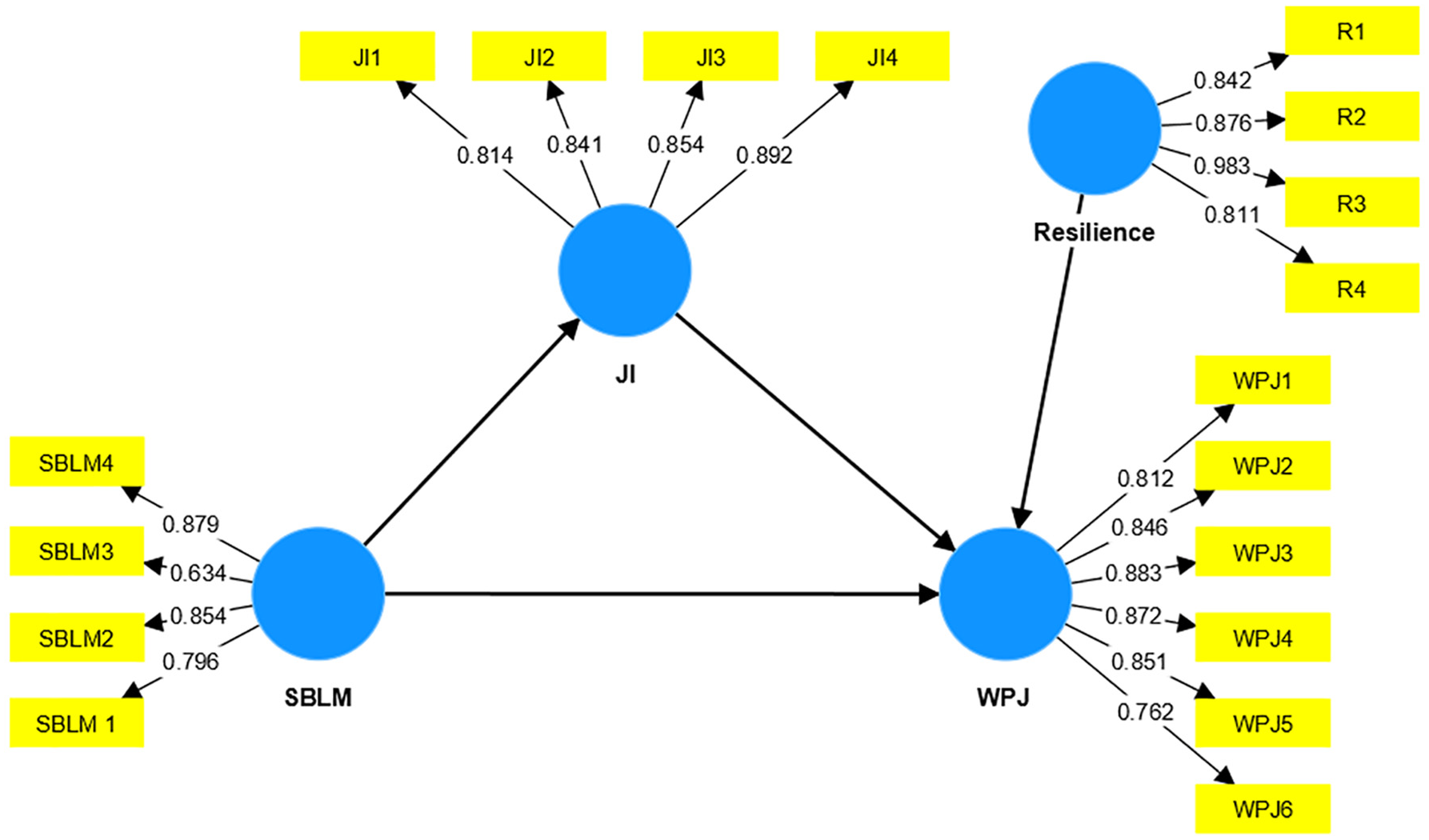
Measurement model.
Assessment of the Measurement Model
The evaluation of the measurement model encompasses several key components, namely factor loading, internal consistency reliability, which is established through composite reliability, and convergent validity, which is determined by average variance extracted (AVE). Researchers have established the threshold values for the criteria. Specifically, the factor loading should be equal to or more than 0.7 (Hair et al., 2021), the composite reliability should likewise be equal to or greater than .7 (Gefen et al., 2000), and the average variance extracted (AVE) should be equal to or greater than 0.5 (Bagozzi et al., 1991). With reference to Table 1, all the values are in accordance with the threshold, thus fulfilling the criteria devised by scholars .
Validity and Reliability.

Note. A ≥ .7; CR ≥ .7; AVE ≥ 0.5. SBLM = supervisor bottom line mentality; WPJ = workplace jealousy.
Table 2 demonstrates the discriminant validity and the HTMT ratio.Hensler et al. (2015) underlined that the HTMT ratio among constructs should be less than 0.90. According to statistical results shown in Table 2 confirms the discriminant validity.
Discriminant Validity: Heterotrait Monotrait Ratio (HTMT).

Note. HTMT < 0.90; SBLM = supervisor bottom line mentality; WPJ = workplace jealousy.
Assessment of Structural Model
The subsequent phase involved the evaluating of the structural model (Figure 3). The researchers evaluated the variance inflation factor (VIF) in order to exclude the potential presence of multicollinearity. Scholars have posited that a value of VIF less than 5 is considered significant, as indicated by Hair et al. (2019). With reference to Table 3, it can be observed that all the constructs exhibit variance inflation factors (VIF) values less than 5. This measure guarantees the absence of multicollinearity.

Structural model.
Variance Inflation Factor (VIF).

Note. VIF < 5.
Furthermore, in accordance with the recommendations of scholars, the bootstrapping methodology was employed, utilizing 10,000 sub-samples, to evaluate the hypotheses as recommended by Becker et al. (2023).
Hypotheses Testing
In the context of hypothesis testing, the analysis initially focused on direct and moderation paths, followed by an evaluation of the mediation paths.
The present study stated three direct hypotheses. The initial hypothesis posited that there exists a positive and statistically significant association between SBLM and job insecurity with (β = .692; p = .000; t = 19.741). Thus, data supported hypothesis 1. The second hypothesis posits that there exists a positive and statistically significant association between SBLM and WPJ, as indicated (β = .331; p = .000; t = 4.313). The statistical findings supported the hypothesis. The third hypothesis posited that there exists a significant and positive link between Job Insecurity and WPJ, with (β = .504; p = .000; t = 8.114), the findings of the study provided support for this hypothesis as well. Referring to Table 4, the direct hypotheses are supported by the results.
Direct and Moderation Paths.

Note. p ≤ .05; t-stats ≥ 1.96. JI = job insecurity; WPJ = workplace jealousy; SBLM = supervisor bottom line mentality..
The moderation hypothesis posited that resilience as a moderator will weaken the relationship between Job Insecurity and WPJ. The results indicated (β = −.116, p = .024, t = 2.250). Therefore, the statistical findings provided support for the moderation hypothesis, referring to Table 4.
Graph 1 demonstrates the moderation effect of resilience. High resilience weakens the positive relationship between JI and WPJ.

Moderation analysis.
The present investigation posits the mediation hypothesis, which suggests that job insecurity serves as a mediator between SBLM and WPJ (β = .349, p = .000, t = 7.258). Hence, the results support the hypothesis regarding the mediation effect. With reference to Table 5, the partial mediation is confirmed.
Mediation Paths.

Note. SBLM = supervisor bottom line mentality; WPJ = workplace jealousy; JI = job insecurity.
Moderated-Mediation (Conditional Mediation)
According to the findings, resilience has a significant index value for moderated mediation effect (index = −0.148, SE = 0.055, 95% CI = −0.237, −0.055). The findings showed that the indirect effect of SBLM on WPJ through job insecurity is reduced at higher levels of resilience (Path = 0.342, t = 5.253, p = .000) compared to lower levels of resilience (Path = 0.549, t = 6.564, p = .000). This illustrates that the indirect impact of SBLM on WPJ through job insecurity is decreased when resilience increases. The moderated-mediation approach is therefore supported. With reference to Table 6 and Graph 2, the conditional mediation, i.e., moderated mediation, is supported by the findings.
Conditional Mediation.

Note. p ≤ .05; t-statistics ≥ 1.96.

Conditional indirect effect for moderator.
The model’s explanatory capacity is represented by R2, whereas Q2 represents its predictive power. According to Hair et al. (2021), researchers in the field of research have emphasized that the R2 value falls between the range of 0 to 1. In the context of primary data, it is recommended that the R2 value exceeds 0.2. According to the data presented in Table 7, the R2 value exceeds 0.2, so satisfying the established criterion. Researchers, such asShmueli et al. (2016), have proposed that in addition to the coefficient of determination (R2), an evaluation of the predictive capability of latent variables should be calculated using Q2. It has been advised that Q2 should have a value greater than zero. Table 7 presents empirical evidence indicating that the value of Q2 is greater than zero.
Goodness of Fit.
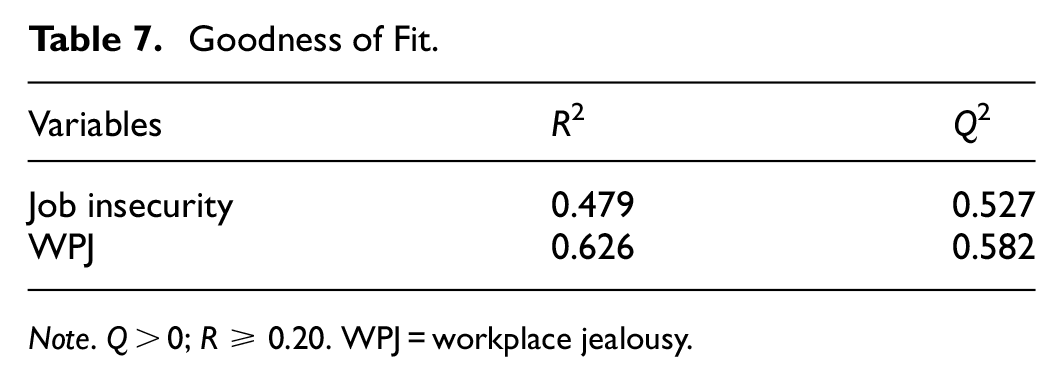
Note. Q > 0; R ≥ 0.20. WPJ = workplace jealousy.
The recommendations for assessing effect size (f2) are provided by research scholars. The effect sizes are categorized into three ranges: small (0.02), medium (0.15), and large (0.35). According toCohen (1988), an effect size below 0.02 indicates the absence of an effect. With reference to Table 8, job insecurity and workplace jealousy indicate a high effect size. SBLM and JI show large effect sizes. Moreover, SBLM and WPJ confirm medium effect size.
Effect Size.
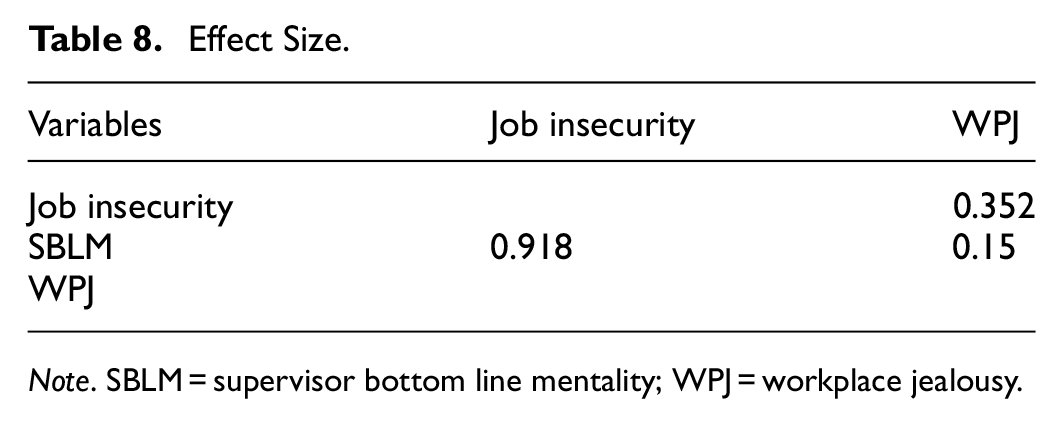
Note. SBLM = supervisor bottom line mentality; WPJ = workplace jealousy.
Discussion
The current research examined the indirect impact of supervisor BLM on workplace jealousy through job insecurity and also whether the hypothesized indirect effect was conditional on employee’s level of resilience. Overall, support was found for the proposed model. Specifically, supervisor BLM was positively associated with job insecurity, which in turn was positively associated with workplace jealousy. Findings suggest a mediated association, in which job insecurity is one mechanism that may explain the association between supervisor BLM and workplace jealousy. Our findings are consistent with previously published research, which has considered supervisor BLM as a negative phenomenon leading to detrimental outcomes (Bonner et al., 2017; Eissa et al., 2020; Greenbaum et al., 2012, 2020; Mesdaghinia et al., 2019).This research also examined resilience as a moderator between job insecurity and workplace jealousy, findings supported this contention and suggested that resilience buffered the positive association between job insecurity and workplace jealousy. Finally, the impact of supervisor BLM on workplace jealousy via job insecurity was found to be conditional on the employee’s level of resilience. Our research makes a number of vital contributions to the literature discussed in the following paragraphs.
Theoretical Implications
In this study, we conceptualized job insecurity as a mechanism that may explain the association between supervisor BLM and workplace jealousy. In line with the S-O-R model, support for indirect effect was found, which adds to the growing body of research in support of this theory (Jacoby, 2002). This study extends these findings to the growing body of literature about supervisor BLM. It provides support for the S-O-R model as an explanatory theory when identifying job insecurity as a key mediator. In conceptualizing resilience as one way to buffer the negative impact of job insecurity on workplace jealousy, we drew on cognitive relational theory, which suggests that appraisal and coping processes is significant in shaping the strain outcomes in an uncertain situation (Lazarus, 1991, 1993) caused by job insecurity (Lee et al., 2018). Our findings provided empirical support for the conceptual model proposed by Shoss et al. (2018). Resilience can mitigate the negative consequences of job insecurity. Our findings support resilience as a moderator of the indirect effect of supervisor BLM on workplace jealousy through job insecurity. Finally, we add to the limited research on workplace jealousy by identifying supervisor BLM and job insecurity as antecedents of workplace jealousy.
Managerial Implications
This research contributes to organizational practices by identifying how supervisor BLM affects the well-being of employee, potentially guiding HR policies to foster a healthier workplace. This study also sheds light on workplace dynamics, highlighting the role of resilience in mitigating negative effects. Certain managerial implications can be gained from this study. To begin with, we demonstrate that supervisor BLM impacts the perception of employees about the security of their existing jobs in the organization, which may give rise to a feeling of uncertainty where every other co-worker will be considered as a rival. In line with previous research about psychological uncertainty (Bani-Melhem et al., 2023) and supervisor BLM (Eissa et al., 2019, 2020; Greenbaum et al., 2012; Mesdaghinia et al., 2019), our findings caution managers that if supervisors operate with BLM and the same is demonstrated to the subordinates, it will give rise to a game-like environment where there will be winners and losers, and coworkers will be considered rivals, which can give rise to more negative outcomes that will be detrimental for the organization. Therefore, organizations should consider ways to overcome the negative impacts of BLM. Also, there is a need to create a more cooperative environment where employees are rewarded for helping and supporting each other. While selecting, promoting, and training supervisors we recommend that organizations emphasize harmony, ethics, and morality as much as they emphasize financial gains (Valentine et al., 2014). Organizations should seek to scale down BLM among the managers by setting goals and performance evaluation standards that emphasize both ethics and financial gains (Ordóñez et al., 2009).
On the basis of the findings that supervisor BLM causes job insecurity, which can lead to workplace jealousy, this study suggests that supervisor BLM is damaging the mental health of the employees and also spoiling the environment of the organization. However, in today’s competitive environment, job insecurity is inevitable. However, there are certain ways to reduce the perception of job insecurity in organizations. Firstly, by reducing the level of uncertainty (Binyamin & Carmeli, 2010) and increasing predictability by setting performance standards and goals and also clarification in policies and procedures for laying off employees (Schreurs et al., 2012). Secondly, keeping in view that social support (Lim, 1997) is helpful in mitigating the negative impacts of job insecurity. Therefore companies should advocate a supportive and cooperative work environment even under the conditions of job insecurity (Teng et al., 2019), which can be one way of reducing the level of workplace jealousy. We also suggest that supervisors should display care toward employees by showing commitment to their subordinates in terms of career goals which is likely going to diminish workplace jealousy among coworkers (Andiappan & Dufour, 2020). Finally, the findings suggest that resilience is necessary to overcome the detrimental outcomes of job insecurity (Shoss et al., 2018). Recent research has suggested that resilience can be developed and promoted within employees (Robertson et al., 2015). Therefore, we recommend that organizations invest in interventions to boost employee resilience. These interventions will help promote positive outcomes and aid employees in coping with the stress of job insecurity.
Limitations and Future Directions
We acknowledge the limitations of our study. For example, we collected data from respondents at different time points to reduce common method bias (Podsakoff et al., 2012), and our data were collected from a single source, that is, employees. Future research can be conducted by collecting the data of supervisor BLM from the managers. Data was collected from twelve real estate organizations operating in four cities in Pakistan. Therefore, the generalizability of our findings to other industries is yet to be established. In future data can be collected from manufacturing companies or other industries operating in different societies. This research has identified supervisor BLM as an antecedent of workplace jealousy, future research can be conducted by examining other factors that might cause workplace jealousy. Finally, BLM research is still in the infancy stage, and this study has examined job insecurity and workplace jealousy as outcomes of supervisor BLM. Future research can be conducted to explore other outcomes of supervisor BLM, for instance, depletion of employee’s mental health, diminished overall well-being, negative work rumination, and lack of psychological detachment from work when at home, which is vital for replenishing depleted resources (Sonnentag, 2018). Finally, in the context of this study, supervisor BLM shows empirical evidence of negative outcomes. However, some contemporary researchers have started exploring the positive outcomes (Babalola et al., 2021). Therefore, it is suggested that future research should examine the positive outcomes of supervisor BLM, particularly in organizations where BLM may be an appropriate strategy depending on each company’s psychological characteristics.
Conclusion
This study examined the indirect effect of supervisor BLM on workplace jealousy via job insecurity and also the moderating effect of resilience between job insecurity and workplace jealousy. Empirical evidence supported our hypothesized model. Our findings support the stance of other researchers considering supervisor BLM as a determinant of negative organizational outcomes. Our findings contribute to the understanding of how supervisor BLM can cause workplace jealousy among co-workers. This study also offers some practical implications, including suggestions for workplace interventions and policies aimed at strengthening the level of resilience in employees and also addressing the issues of BLM in supervisors.
Footnotes

Ethical Considerations
No formal approval from the Ethical Committee is required for the study as it involved a survey of working professionals without collecting any sensitive personal data or employing experimental interventions.
Consent to Participate
Participation was voluntary.
Funding
The author(s) received no financial support for the research, authorship, and/or publication of this article.
Declaration of Conflicting Interests
The author(s) declared no potential conflicts of interest with respect to the research, authorship, and/or publication of this article.
Data Availability Statement
Data sharing not applicable to this article as no datasets were generated or analyzed during the current study.