




Abstract
This study examines the perceived impact of violent videogames from an influence of presumed influence perspective. The role of perceived telepresence and the amount of time spent playing violent videogames in influencing people’s beliefs about the effects of such games were hypothesized and tested. Results of data collected from a random sample of 528 respondents in China showed that playing violent videogames was significantly related to perceived telepresence. Furthermore, perceived telepresence was found to be the strongest predictor of the presumed influence of violent videogames on others. Finally, the presumed influence of violent videogames was positively correlated with the intention to take actions to protect others from the harms of such games.
Goals of Study
Prior research has partially confirmed the likelihood that playing violent videogames prompts angry feelings (Lull & Bushman, 2016), hostile thoughts (Tamborini et al., 2004), greater tolerance of violence and lower emphatic attitudes (Wei, 2007), and even physically aggressive behaviors (Anderson, 2004; Greitemeyer & Mugge, 2014). Despite numerous empirical studies designed to establish the link between playing violent videogames and actual violence and aggression, the evidence remains inconclusive (Kneer et al., 2016; Sherry, 2001; Wei & Borton, 2014). Ferguson (2015) argues that prior research on violent video games measured aggression irrelevant to the domain of real-life aggression, considering that video game consumption increased from 1996 to 2011, while societal youth violence decreased. A recent longitudinal intervention study, by Kühn and colleagues (2019), provides even stronger evidence against the widespread concern of the negative impact of violent video games: 2 months of violent video gameplay leads to no specific changes in aggressions or empathy, either short term or long term.
It seems to us that part of the problem of existing research is the focus on attempts to find some direct effects of violent videogames on players’ actual behavior. Few researchers to date have paid attention to the presumed effects of violent videogames. In this study, we intend to advance the violent videogame research by proposing a theoretical model of media violence from an “influence of presumed influence” perspective. The study focuses on examining the relationships between playing violent videogames, telepresence in videogames, the presumed influence of violent videogames, and behavioral intention prompted by the presumed effects. As Gunther and Story (2003) argued, perceived effects of media are real effects; past research (Cohen & Tsfati, 2009; Hoffner & Buchanan, 2002; Tsfati et al., 2005; Wei et al., 2017) shows that perceived effects of media have various real-life consequences for users’ behavior.
Influence of presumed influence theory, first articulated by Gunther and Storey (2003), proposes that people’s belief in powerful media motivates them to act upon their perceptions of media influence. In others words, believing that others are vulnerable to the media, people tend to project the idea of a powerful media onto others. In the past decade, the theory has been supported by a number of studies (Liao et al., 2016; Park, 2005; Tsfati et al., 2011). Previous research has examined the influence of presumed influence in such contexts as election news (Cohen & Tsfati, 2009), ads featuring thin models (Park, 2005), science and scientists (Tsfati et al., 2011), pro-environmental messages (Liao et al., 2016), and the antagonists in the recent German conflict over aircraft noise (Post, 2017). Given its contribution to various media effects, it appears that the theory is applicable to the understanding of the presumed influence of media violence in general and violent videogames in particular.
Another purpose of the study is to examine the role of telepresence in the process of making presumptions about the influence of violent videogames. Telepresence is a psychological state (Westerman et al., 2009) or a perceptual illusion (Bracken, 2005) whereby an individual perceives a mediated experience as an authentic experience. Although past research has shown that the levels of videogame playing were significantly correlated with third-person perception (Schmierbach et al., 2011), no research has attempted to assess the role that telepresence plays in enhancing the presumed influence of violent videogames. In the present study, we anticipated that playing violent videogames would produce an experience of telepresence, which would in turn make players more likely to associate such games with greater harmful effects on others, because telepresence might cause players to feel that the violent game content was realistic. Thus, this study aims to extend the existing literature by examining the mediation role of telepresence in the relationship between playing violent videogames and the presumed influence of such games.
Finally, the current study aims to contribute to the literature by developing a model that clarifies the theoretical linkages among playing violent videogames, telepresence, the presumed influence of violent videogames, and support for taking restrictive and protective actions. Previous studies have found that those who believed that others were negatively influenced by videogames were more likely to support restrictions on such games (Schmierbach et al., 2011). However, no study has attempted an integrated approach to examining the relationship between the influence of presumed influence and support for taking restrictive and protective actions. In this study, we propose that playing violent videogames will affect individuals’ level of telepresence experienced, which will enhance the presumed influence of such games on others. The presumed influence of violent videogames on others will then affect support for taking restrictive and protective actions for the benefit of the presumably vulnerable others. This proposed model, however, is relational in nature, not causal, because the hypothesized relationships will be tested using data from a one-time survey.
Context of Study: Violent Videogames in China
Videogames players totaled 534 million in China in 2016, which is the world’s largest player population (GPC et al., 2016). A recent Daxue Consulting (2017) report reveals that 17% of Chinese young people list “playing games on a computer console” as their favorite leisure activity. Mobile games (49.50%), PC client games (35.20%), and online games, such as PC browser games (11.30%) account for the biggest segments of the videogame market (GPC et al., 2016).
Past research (Williams et al., 2008) suggests that motivations for playing videogames included achievement, immersion, and sociability, in that order of importance. Recent studies indicate that about half of the 70 most popular videogames in China contain violent content (GPC et al., 2016; Wei, 2007). Similar to their Western peers, Chinese male adults prefer videogames with various levels of violence, or even combat-centric games (Gackenbach et al., 2016). Concern about the negative effects of violent content has pushed the government to send out alerts to parents and players. Therefore, the feared harmful effect of violent videogames is a fitting topic for advancing research on the influence of presumed influence.
Literature Review and Hypotheses
Violent Videogames and Telepresence
A salient construct accompanying the playing of increasingly high-tech violent videogames, as with accessing other communication technology, is telepresence. First coined by Minsky (1980) to emphasize the capability of remote-control systems to make the operators feel as if they were being transplanted to a remote workplace, telepresence now is typically viewed as a subjective experience, defined as “the experience of presence in an environment by means of a communication medium” (Steuer, 1992, p. 76). It is the sense of “being there” (Sheridan, 1992) within the mediated environment, as if it is real. Although telepresence as a construct has multiple definitions (Horvath & Lombard, 2010; Lee, 2004; Steuer, 1992), those definitions share a common central idea, “the perceptual illusion of non-mediation” (Lombard & Ditton, 1997, p. 9).
Past research indicates that telepresence consists of several dimensions, and its measurement involves replies on scales differing in content and format (Kim & Biocca, 1997; Lombard & Ditton, 1997; Nelson et al., 2006). For instance, some scholars have identified spatial presence, involvement, and realness as the three key components (Schubert et al., 2001). Lee (2004) concluded that physical, social, and self-presence are the key components of telepresence. Others (Lessiter et al., 2001) have proposed four aspects, based on factor analysis: sense of physical space, engagement, ecological validity, and negative effects. Lombard and Ditton (1997) suggested a six-factor definition of telepresence that includes social richness, realism, transportation, immersion, social actor, and media as social actor. In the present study, the focus was on the two dimensions proposed by Lombard and Ditton (1997), spatial presence and perceptual realism, because they tap into the most salient aspects of telepresence parsimoniously.
Spatial presence refers to the sensation of being introduced to the environment manipulated by the media content (Lombard & Ditton, 1997). When people fail to accurately distinguish between a mediated virtual location from actual and physical location and environment, telepresence will occur. This is the key dimension of telepresence, because it directly represents the experience of “being there,” the feeling that one is actually present in the virtual environment, instead of the physical one (Felnhofer et al., 2014). Perceptual realism, on the contrary, refers to the degree to which the virtual environment represented by the medium is perceived as real (Lombard & Ditton, 1997). It is the perceived likelihood that an event portrayed in the media could happen in the real world (Lombard & Ditton, 1997; Shapiro et al., 2006).
Telepresence is not necessarily an inherent feature of the media, but rather a psychological state of media content viewers (Westerman et al., 2009). While some have argued that any communication technology can evoke some feeling of telepresence (Nelson et al., 2006; Steuer, 1992), the question is, to what extent will a user experience telepresence? This phenomenon is associated with the individual’s susceptibility to, and the features and attributes of, the mediated environment (Lachlan & Maloney, 2008; Steuer, 1992). According to Steuer (1992), vividness and interactivity of the communication technology are the most important qualities that contribute to telepresence formation. Vividness refers to “the ability of the technology to produce a sensorially rich mediated environment” (Steuer, 1992, p. 80). Compared with television and print media, computerized videogames employ more vividness to simulate real scenarios with technology advancement (Ivory & Kalyanaraman, 2007; Tamborini et al., 2004). In videogames, graphics depicting blood, human figures, colors, and signs, as well as others that imitate a real setting, can all contribute to the vividness. The vivid images of videogames may facilitate the feeling of telepresence. When the game character represents the player himself/herself, the player will likely experience greater presence (Eastin, 2006). This can explain why many games create avatars that resemble human beings; the goal is to make the game imitate a real social environment.
Videogame playing involves substantial interactivity, because the player controls the characters in the games and responds to the change of plot. In such an interactive environment, players exposed to videogame content might sometimes misconceive the virtual game environment as a real setting (Lin, 2013; Tamborini et al., 2004). Unlike passive onlookers, active videogame players are more likely to forget that the players are illusory in the virtual game scenario (Steuer, 1992).
In addition, telepresence is cumulative from prior violent videogames (Tamborini et al., 2004); people exposed to violent content will retain the illusion of the virtual environment. When they play such games again, the illusion will be reactivated, or even intensify. It may be that the videogames create a learning environment in which the players become immersed (Eastin, 2006). When players are immersed in a familiar videogame, they may assess the virtual environment as being more factual than abstract. In other words, the game scenario seems more concrete and they are psychologically close to rather than distant from the virtual scene (Trope & Liberman, 2010). Therefore, the more that people play violent videogames, the more likely they are to allocate attention to the mediated environment, rather than the real one, and they are also more likely to experience difficulties in separating what is real from what is illusion (Kim & Biocca, 1997; Lessiter et al., 2001). Therefore, the more people play violent videogames, the greater spatial presence and perceptual realism they will likely experience. It is anticipated that the frequency of playing violent videogames will be positively associated with the spatial presence and perceptual realism experienced in such games.
Telepresence and the Influence of Presumed Influence
Moreover, we predict that telepresence will be positively related to the presumed influence of such games on others. This expectation is based on previous research indicating that levels of presence may influence audience reactions and make them more vulnerable to media effects (Bracken, 2005; Westerman et al., 2009). By gaming’s very nature, people typically play and “interact” with a videogame, instead of just watching. In such an interactive environment, people exposed to videogame content might come to perceive the depicted events as real (Lin, 2013; Tamborini et al., 2004). Spatial presence, as the key dimension of telepresence (Horvath & Lombard, 2010), is the perceived experience of “being there” without realizing that the environment is created by the media (Lee, 2004; Westerman et al., 2009). People perceive that they are transported by technology to a remote environment and they have a feeling of being in that environment (Lee, 2004). Physically playing the videogames evokes the feeling of naturally experiencing the game scenario. When people view themselves present at a certain place, no matter whether the place actually exists, some of them will fail to realize that the information received is mediated, especially when they are deeply involved in the highly interactive game scenario (Cauberghe et al., 2011).
Spatial presence and perceptual realism can have a major impact on people’s judgment of the impact of the mediated content. When people are immersed in the mediated scenario, they are more likely to ascribe greater reality to the mediated information than if they clearly differentiated between illusion and reality (Westerman et al., 2012). In fact, a prior study has found that people who experience presence when exposed to a news story about a natural disaster will increase their estimate of the event’s severity (Westerman et al., 2009). Within the same theoretical context, people will encounter a similar judgment dilemma regarding other socially undesirable mediated information, such as the content of violent videogames.
When experiencing telepresence, primary appraisal of the situation and the presumed influence of the situation are easier to process. Telepresence leads people to perceive and emotionally respond to mediated environment information similarly, or even identically, to that found in real human–human interaction (Lombard & Ditton, 1997). People with the illusion of real environment and related information thus will process the information as if it were real (Lachlan et al., 2010; Westerman et al., 2009). Telepresence’s influence on user psychology has been confirmed when observing aggression in videogames, although no studies to date directly assess the role that telepresence plays in enhancing the presumed influence of violent videogames. High-level telepresence can prime more hostile thoughts (Tamborini et al., 2004), and result in increased hostility, verbal aggression, and physically aggressive intentions (Nowak et al., 2008). While playing video games increases participants’ feeling of anger, telepresence may amplify the effect (Lull & Bushman, 2016). The rationales addressed above suggests that the presumed effect of violent videogame exposure, when presence is evoked, will equate that effect of information in the games directly on the people, and thus eventually increase existing effects (Westerman et al., 2009). When people mentally experience the environment and social actors as if they are real, they interpret both the current situation and the presumed influence on others quickly, with particular reference to harm, intent, and malice, as well as feelings of anger. The most available schemata influence these interpretations, especially when the situation is ambiguous. In the case of game playing, people directly exposed to the violent content will use the information to evaluate its negative effect on others, while the rising hostility and aggression they experience also contribute to the judgment that the violent videogames will influence others. Thus, it is reasonable to expect that spatial presence and perceptual realism will intensify the presumed influence of violent videogames on others. Accordingly, in examining the presumed influence of violent videogames on others, it is anticipated that respondents who experience a higher level of telepresence will be more likely to perceive such games to be harmful to others:
Presumed Influence and Support for Restrictions of Violent Videogames
According to Gunther and Storey’s (2003) general model of indirect media effects, people not only tend to perceive communication as influential on others, they also will likely change their attitudes or behaviors based on the perception of media’s influence on others. As Gunther and Storey (2003) argued, the individual’s belief that others are influenced by the media is itself influential. Other researchers (Sun et al., 2008) have explained that individuals will take action to address a perceived problem when they believe others will be strongly influenced by the media. In the words of Gunther and Storey (2003), “perceived effects are real media effects” (p. 109).
Empirically, the behavioral consequences of presumed media influence have been explored in a variety of social and political contexts. Scholars such as Cohen and Tsfati (2009) and Tsfati et al. (2005) tested how voters’ perceptions regarding the influence of political media were related to their intention to vote strategically. They found that the belief that others were influenced by media prompted people to change their voting behaviors. Golan and Lim (2016) found a significant relationship between perceptions of ISIS online recruiting’s influence on others and the likelihood of activism by individuals to counter jihadist messages on social media. Wei et al. (2017) reported that Chinese respondents tended to believe the predominantly negative U.S. news about China was influential on Americans’ perceptions of China. Furthermore, the presumed influence of U.S. news about China on Americans was a significant predictor of support for the Chinese government’s global public relations campaigns. To unify the terminology of various behavioral actions, Sun et al. (2008) developed a classification of three types, which include restrictive, corrective, and promotional actions.
The majority of published studies on restrictive actions have focused on support for message restrictions or attitudes toward censorship of undesirable media content, such as pornography (Xu & Gonzenbach, 2008). This study attempts to extend previous research by examining the relationships between presumed influence of violent videogames and support for government restrictions, as well as protective actions for the benefit of videogames players. Restrictive actions refer to any actions that might regulate distribution of violent videogames through censorship or content rating systems; protective actions are defined as involving any behavior that might prevent or stop others from being affected by violent videogames. Drawing on the literature of presumed influence of media influence, the last two hypotheses were advanced:
Finally, to examine the theoretical linkages among playing violent videogames, telepresence, the presumed influence of violent videogames, and support for taking restrictive and protective actions, we developed a causal model. As shown in Figure 1, the model starts with playing violent videogames, which leads to perceptual realism and spatial presence, which next leads to the presumed influence on others, which in turn predicts support for taking restrictive and protective actions. The rationale for the causal model was based on the same literature review referenced to develop the six hypotheses of the study.

The proposed theoretical model.
Method
To test the hypotheses and address other research questions, Sojump, one of the best-known professional online survey company (Mou & Lin, 2014), was contracted to collect data in China. The online panel operated by Sojump comprises 2 million panelists, and only those who had played videogames of varying degrees of violence were invited to participate in the survey. Two waves of invitations were sent to 5,000 respondents during a 1-week period starting from April 2 and ending on May 8, 2015. A total of 528 respondents successfully completed the survey, producing a response rate of 10.6%. The sample size is in line with the range of prior research (Tsfati et al., 2011; Wei et al., 2017). It is not overly large, therefore, the statistical power is not overly strong to produce significant results purely due to sample size (Cohen, 1992).
Of the sample, the gender ratio is about even (57.1% male vs. 42.9% female). The average age was 25.14 years, with most (47.5%) falling between the age brackets of 25 and 44. Among the 528 respondents, 32.8% had finished high school, 51.5% had received some college education, and 3.9% have pursued some graduate studies. In terms of monthly income, 38.8% reported monthly income less than RMB$3,000; 28.2% reported an income between RMB$3,000 and RMB$6,000; 21.6% between RMB$6,001 and RMB$9,000; and 11.4% more than RMB$9,001. Compared with the internet population in China, the respondents in our sample are more likely to be male, older, and have higher levels of education and monthly income; this is based on a newly released 2017 report by CNNIC (China Internet Network Information Center) that shows 52.5% of Chinese netizens are male, 76.9% are below 40 years old, more than 60.2% make a monthly income less than RMB$3,000, and about 20.6% have had some college education.
Measurement
Playing violent videogames
Violence in videogames refers to “any act (e.g., hitting, kicking, shoving, slapping, shooting, stabbing) causing intentional harm, injury or death, including war scenes, torture, rape, strangulation, or assault” (Ferguson, 2015, p. 197). The definition was provided in the introduction section of the questionnaire; examples of videogame episodes that contain violence were shown. In the present study, exposure to violent videogames is defined as the amount of time respondents spent playing videogames with varying degrees of violence. Two questions, which were adapted from previous research (Anderson & Dill, 2000), were used to measure it. First, respondents were asked to self-report the number of times per week that they played videogames containing some forms of violence. Then, they were asked to estimate the average amount of time spent playing such games in each sitting. An index of playing violent videogames was created by multiplying the frequency of playing and the amount of playing time (M = 135.21, SD = 103.26).
Perceptual realism of violence in videogames
Perceptual realism is defined as the extent to which people will estimate that the violence in the episode of the videogames is realistic or would occur in the real world. Three items were adapted from previous research (Lombard et al., 2013) to measure a sense of realism experienced while playing violent videogames. Respondents were asked to indicate their agreement with the following statements: (a) The events I encounter in violent videogames would occur in the real world; (b) the events I experience in violent videogames could occur in the real world; and (c) the events I saw in violent videogames are a lot like the way they occur in the real world. The 5-point Likert-type scale that was employed ranged from 1 (strongly disagree) to 5 (strongly agree). Results of an exploratory factor analysis showed that the three items grouped in a single factor (Eigenvalue = 2.06, accounting for 68.73% of the variance). The three items were averaged to create a composite measure of “perceptual realism of violence in videogames” (M = 3.00, SD = 0.88, α = .77).
Spatial presence in videogame playing
Spatial presence refers to the perception of being located in and of being able to act within the mediated setting (Schubert et al., 2001). It was measured with five items, which were adapted from previous research (Lombard et al., 2013). On a scale ranging from not at all to very much, respondents were asked to answer these questions: (a) How much did it seem as if the objects and people you saw in violent videogames had come to the place you were? (b) How much did it seem as if you could reach out and touch the objects or people you saw in violent videogames? Respondents were further asked to assess the levels of presence experienced while playing violent videogames: (c) To what extent did you experience a sense of being there inside the environment you saw in violent videogames? (d) How often did you want to or try to touch something you saw in violent videogames? (e) Did the experience seem more like looking at the events/people on a movie screen or more like looking at the events/people through a window? Results of a principal components analysis confirmed that the five items were loaded in a single factor. The one factor solution explained 66.07% of the variance (Eigenvalue = 3.00). A composite measure of “spatial presence in videogame playing” was constructed by adding the five items and dividing by five (M = 2.96, SD = 0.86, α = .83).
Presumed influence of violent videogames on others
To measure this construct, three items were adapted from previous research on the effect of media violence (Arriaga et al., 2008; Ivory & Kalyanaraman, 2009). Respondents were asked to indicate whether they agreed that violent videogames could make other people (a) more aggressive, (b) hostile toward people, and (c) worried about violence in society. Results of a principal components analysis showed that the three items were loaded in a single factor. The one factor solution explained 77.079% of the variance (Eigenvalue = 2.31). The three items were added and then divided by three to create a composite measure of “presumed influence of violent videogames on others” (M = 3.25, SD = 0.96, α = .85).
Support for restrictions of violent videogames
Support for restricting violent videogames was measured with the following six items adapted from previous research (Gunther, 1995; Ivory & Kalyanaraman, 2009): (1) Censoring violent videogames is appropriate; (2) establishing a violent videogame rating system is appropriate; (3) restricting access to violent videogames among friends is urgent; (4) restricting access to violent videogames among people you know is urgent; (5) restricting access to violent videogames among youth is urgent; (6) immediate action is needed to educate youth about the harms of violent videogames. Results of a principal components analysis showed that the six items were clearly grouped in two distinct factors. The two-factor solution accounted for 67.39% of the total variance. The first factor, accounting for 44.48% of the variance (Eigenvalue = 3.56), consisted of Items 3, 4, 5, and 6. The four items were added and divided by four to form a composite measure of “support for protective actions” (M = 3.45, SD = 0.86, α = .87). The second factor included Items 1 and 2 (Eigenvalue = 1.83; 22.72% of variance). The two items were added and divided by two to build a measure of “support for restrictive actions” (M = 23.56, SD = 0.80, r = .61).
Results
In exploring the relationships between playing violent videogames and perceived realism of videogames and spatial presence in videogame playing, H1 and H2 predicted that playing violent videogames would be positively related to perceptual realism and spatial presence, respectively. To test them, two hierarchical multiple regression analyses were performed in which gender, age, education, and monthly income were entered first, followed by experience playing violent videogames. The dependent variables were, respectively, perceptual realism and spatial presence. As the results of regression analysis in Table 1 show, playing violent videogames was a significant and positive predictor of perceived realism (B = .16, p < .001) and spatial presence (B = .27, p < .001) after controlling for the influence of gender, age, education, and monthly income. The more the respondents played violent videogames, the greater spatial presence and perceptual realism they experienced. H1 and H2 were supported.
Hierarchical Regression Analysis Predicting Perceptual Realism and Spatial Presence (N = 528).

Note. Cell entries are standardized regression coefficients from the final regression equation with all blocks of variables in the model.
p < .05. **p < .01. ***p < .001.
In examining the effects of perceived realism of videogames and spatial presence in videogames on the presumed influence of violent videogames on others, H3 and H4 predicted that respondents who perceived greater levels of realism and experienced greater spatial presence in violent videogames would presume a greater level of influence of such games on others. As the results of the regression analysis in Table 2 show, both perceived realism (B = .26, p < .01) and spatial presence (B = .35, p < .01) were positively and significantly associated with the presumed influence of violent videogames on others. Respondents who experienced a higher level of perceptual realism and spatial presence would be more likely to perceive greater harmful influence of violent videogames on others. H3 and H4 were supported.
Hierarchical Regression Analysis Predicting Presumed Influence of Violent Video Games (N = 528).

Note. Cell entries are standardized regression coefficients from the final regression equation with all blocks of variables in the model.
p < .05. **p < .01. ***p < .001.
To examine the behavioral effects of the presumed influence of violent videogames on others, H5 and H6 predicted that the presumed influence of such games on others would be a significant predictor of support for taking restrictive and protective actions. Two separate hierarchical multiple regression analyses, similar to the previous procedures, were performed. Table 3 summarizes the results; it shows that the presumed influence of violent videogames on others was the strongest predictor of support for restrictive actions (B = .32, p< .001) and support for protective actions (B = .51, p< .001). Respondents who perceived greater levels of presumed influence of violent videogames on others would be more likely to support actions for protecting others from the harms of such games. H5 and H6 were supported.
Hierarchical Regression Analysis Predicting Support for Restrictive and Protective Actions (N = 528).
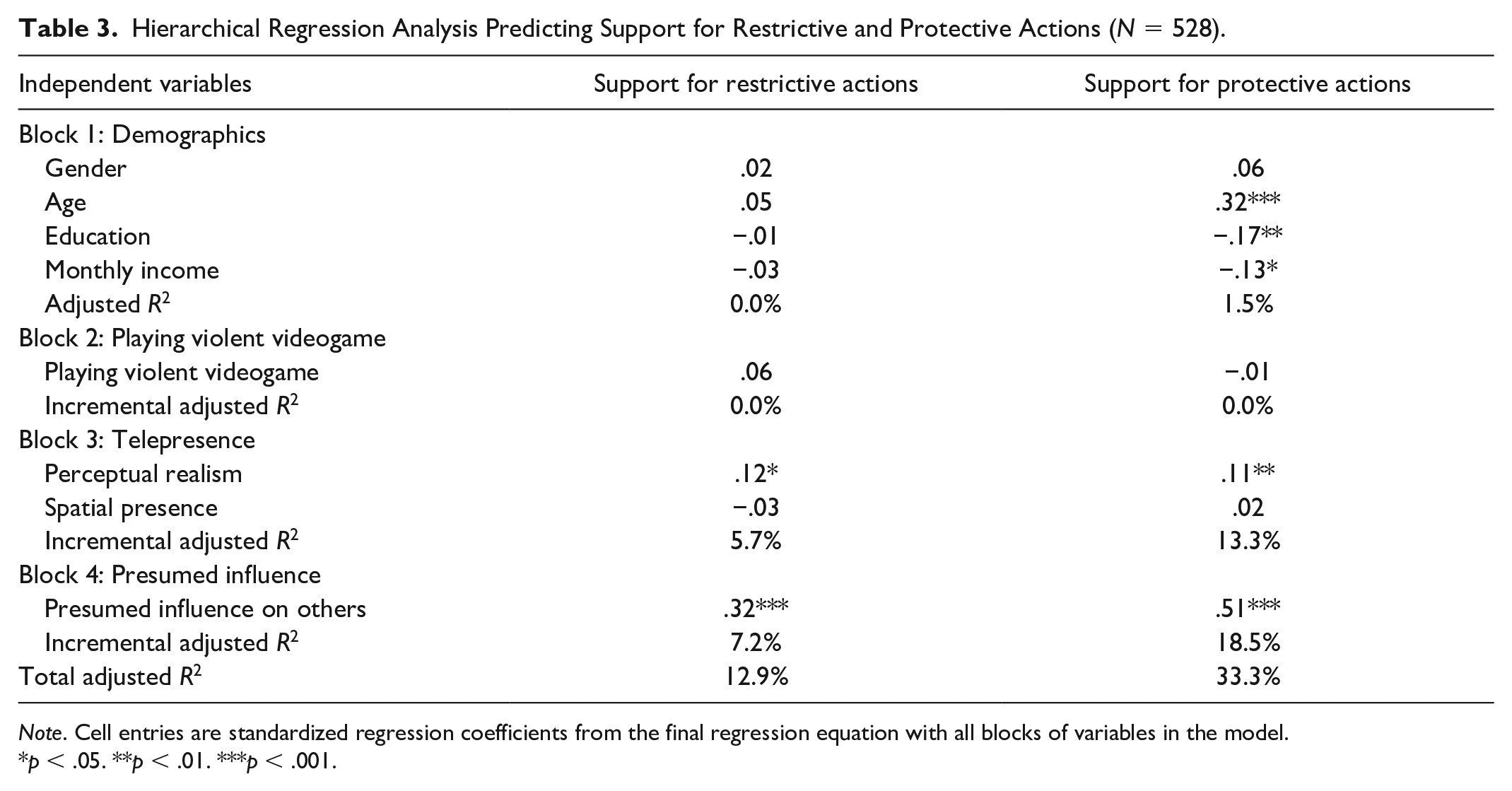
Note. Cell entries are standardized regression coefficients from the final regression equation with all blocks of variables in the model.
p < .05. **p < .01. ***p < .001.
Finally, to test the proposed model, we implemented structural equation modeling (SEM) using Amos 22.0. Results of SEM indicate that, although the chi-square for the model was significant (χ2 = 28.48, df = 7, p< .001), the χ2/df ratio was small, at 4.07. In addition, the comparative fit index (CFI = .97), the Tucker–Lewis index (TLI = .94), the normal fit index (NFI = .96) and the root mean square error of approximation (RMSEA = .076) indicated that the model fit was acceptable. The model explained 3.3% of the variance in perceived realism, 8.2% in spatial presence, 25.3% in presumed influence on others, 12.6% in support for restrictive actions, and 29.4% in support for protective actions.
From a process perspective, as shown in Figure 2, the SEM model shows that playing violent videogames had a direct effect on perceived realism (B = .18, p < .001) and spatial presence (B = .29, p < .001), which in turn had a significant and direct effect on the presumed influence on others. Furthermore, the presumed influence of violent videogames on others had a significant and direct effect on support for restrictive actions (B = .36, p < .001) and support for protective actions (B = .54, p < .001). These results validate the proposed model of presumed influence of violent videogames.

Structural equation model of variables predicting support for restriction of violent videogames.
Discussion and Conclusion
To address the continued concern about the effects of violent videogames on society in a non-Western country, and, more importantly, to advance violent videogame research, the present study departed from the direct effects approach by examining the antecedents and consequences of perceived influence of violent videogames on players.
Using data collected from China, results show that playing videogames containing violent content was not related directly to any behavioral measures. However, the amount of playing time of violent videogames was significantly related to player’s telepresence experience. That is, the more the respondents played videogames of varying degree of violence, the greater spatial presence and the perceptual realism they experienced. This finding is consistent with the literature (e.g., Bracken & Skalski, 2009) of high-tech driven videogames that can produce immersion effects in players and affect their cognitive ability to discern the difference between the virtual and real worlds.
As expected, respondents who experienced a higher level of telepresence in terms of perceptual realism and spatial presence in violent videogames were likely to presume greater influence of violent videogames on others. This particular finding suggests that, similar to perceived omnipresence of media that leads people to presume that others are influenced by the media, telepresence in videogames results in presumed influence of media violence on other players. Thus, in the eyes of beholders, increasingly powerful violent videogames are indeed more socially dangerous.
More important, presumed influence of violent videogames predicted support for taking actions to protect others from the harms of violent videogames, a finding that is consistent with the influence of presumed influence literature (Gunther & Storey, 2003). Individuals will likely change their attitude or behavior in relation to the perception that others are influenced by powerful media. In the context of high-tech violent videogames, when the concern about the harmful influence of violent videogames is defined as a belief that others are more likely to be harmed by the games, the belief leads to support for behavioral responses to address the problem.
Taken together, these findings underscore the important role of presumed influence of violent videogames in establishing the relationship between telepresence in violent videogames and behavior. That is, when players believed the violence in videogames was vivid and life-like, they presumed that other players would be influenced by it. Then, they would act upon the belief. Although the behavioral effects found in the study were not aggression, but rather intention to take action to protect other players, the linkages among playing violent videogames, perceived telepresence, the presumed influence of violent videogames, and behavior were established, and validated by SEM causal modeling. Hence, the findings contribute to research on violent videogames and the influence of presumed influence.
Nevertheless, limitations of the study need to be acknowledged. First, the measure of violence in videogames was general in nature. Also, the relationships reported in the study were based on one-time research data, which are primarily relational, not causal. To ascertain the causal relationships between playing violent videogames and behavior, longitudinal or experimental designs are required. Clearly, this is a direction for future research. Another limitation of this study is that the measures of influence of violent videogames were presumed influence, not actual influence. Future research should include measures of both presumed influence and actual influence of violent videogames on Chinese players. In addition, the two measures of support for restrictions may be subjected to social desirability bias. Cautions are needed in reading the results. Finally, online surveys typically attain a response rate of around 20% or lower (Deutskens et al., 2004; Kaplowitz et al., 2004). The present study had a response rate of 10.6%. Therefore, some caution should be exercised before generalizing the results of this study to the population of violent videogame players in China.
Footnotes
Declaration of Conflicting Interests
The author(s) declared no potential conflicts of interest with respect to the research, authorship, and/or publication of this article.
Funding
The author(s) received no financial support for the research, authorship, and/or publication of this article.
