




Abstract
Women’s entrepreneurship in Pakistan has been booming in recent years, and it has made a significant impact on social and economic expansion. However, it is notable that these businesses are smaller in size and considered less profitable when compared with men’s entrepreneurial efforts. This dilemma encourages the investigation of the success factors that contribute to the performance of women-owned businesses (WOBs) within this understudied region. Factors that may determine the success of WOB in Pakistan are divided into four broad headings: the entrepreneur’s characteristics, internal business environment, external business environments, and supportive factors. This study also explores the direct and moderating role of perceived national culture within the framework. The results demonstrate that the entrepreneur’s characteristics, external business environments, and supportive factors are positively related to the performance of WOB, while the internal business environment is of little significance. Furthermore, while perceived national culture does not influence the performance of WOB, it weakens the relationship between the entrepreneur’s characteristics and performance but strengthens the impact of supportive factors on the performance of the WOB. This study leads to a solid awareness about the critical success factors, the perceived national culture, and their association with the performances of WOB within Pakistan.
Introduction
Women-owned businesses (WOB) boost the economic development (Kelley et al., 2011) and the well-being of societies by creating jobs, wealth, and innovations (Chatterjee et al., 2018). Women entrepreneurs manage their businesses using a well-structured approach (Reed et al., 2012). They are more innovative than men (Zapalska, 1997), which plays a significant role in their success. Recently, many researchers have agreed upon the remarkable growth of the population of women entrepreneurs in the small business sector. 1 Based on their importance in the corporate world and their difference from male entrepreneurs (Renko et al., 2012), this study explores WOB independently and excludes men-owned businesses. On one hand, these women face barriers that prevent them from being successful (Wu et al., 2019), and this study identifies the essential fundamental success factors among WOB. On the other hand, most existing research was conducted in developed economies; there is limited research in emerging economies which have unsatisfactory institutional setup (Kimosop et al., 2016), and unstable political setting with cultural conflicts.
The success of WOB is the most crucial research area from the theoretical and practical perspectives (Kimosop et al., 2016). Such success can either be intrinsic (e.g., customer’s satisfaction and personal achievements) or extrinsic (e.g., sales, profit, and returns of assets) (Masuo et al., 2001; Paige & Littrell, 2002). Financial performance is often used as a proxy for the success of individuals and firms. The success of WOB is still a dilemma because these businesses are smaller in size, have slower development, and operate in a multidimensional and gendered setting. The fundamental view of Zhao et al. (2010) shows that the performance should be measured from different dimensions. This study focuses on the three performance factors for WOB, such as sales growth, market share growth, and net profit after taxes (Zhan & Chen, 2013), which are the most common and useful indicators (Kimosop et al., 2016; Mari et al., 2016).
Furthermore, the specific success factors are not obvious and need to be explored to find the essential factor in every condition. Some factors lead to the failure of a business in one case but lead to the success in other cases; research on the success factors for enterprises is still inconclusive (Ricketts Gaskill et al., 1993). The existing studies have extended the success factors to diverse fundamental factors, such as the entrepreneur’s characteristics, internal and external environments, and supportive factors. The enigma of entrepreneur’s characteristics is highlighted by different studies. Brandstätter (2011) and Gupta and Mirchandani (2018) documented that an individual must have some distinctive characteristics to be an entrepreneur. D. H. B. Welsh et al. (2018) explained the positive relationship between human capital and the performance of WOB, but they show this has no relation to the gender-related issues plaguing the ventures. However, the study uncovered the effect of these women’s entrepreneurial traits, education, managerial skills, and motivation on their performance. Furthermore, the business environment is the aggregate of all conditions and events that affect the success of the ventures. These could be divided into two categories, such as internal and external environment. However, the internal environment is continually subject to the external environment. Unlike in previous studies, this study combines the unique items in the internal (business innovation, strategy development, and maintenance of accurate records) and the external environment (external knowledge source, appropriate market, available opportunities, and technological advantages) and links them to the success of WOB. Various studies have found that the access to resources has a significant impact on success, which could come in the form of the availability of finance or family and government support. Supportive factors are very important for the success of WOB; however, women do not have the same support as their male counterparts. Consequently, this study tries to evaluate the support available to WOB within the understudied region of Pakistan.
It has been documented that culture can influence an individual’s entrepreneurial intentions and eventually even national start-up rates. Culture can influence entrepreneurship by two different means (Davidsson, 1995). Primarily, supportive culture can make entrepreneurial activities valuable and socially acceptable and provide a favorable institutional environment. In such an environment, the number of entrepreneurs will increase regardless of their opinions and approaches (Etzioni, 1987). Studies have also identified many factors that underwrite the success of WOB in different regions along with the national culture effect. Culture sometimes acts as a barrier that discourages women from becoming entrepreneurs. Naidu and Chand (2017) showed culture can be a barrier to the success of small and medium enterprises (SMEs). Ufuk and Özgen (2001) and Godwin et al. (2006) proved that women in male-dominant cultures face discrimination due to society’s perception that women cannot be entrepreneurs.
Pakistani women entrepreneurs are deprived in many aspects, such as financing, family size, and the political and cultural environment. According to the World Bank’s report, less than 25% of women in Pakistan receive microfinance because they are considered less trustworthy than men. Women face gender discrimination at the micro and macro level in Pakistan. Despite these problems, women are 50% of the Pakistani population, and according to the Labor Force Survey, there are 13.3-million women in Pakistan’s labor market. 2 These women play a constructive role in the economic development of the country. In 2017, Pakistan’s GDP (gross domestic product) grew by 5.28% from a year earlier, and women contributed 10.38% of this growth. 3 There are tremendous opportunities for the sector to increase outreach among the economically active female population. Their contributions can grow even more if they are provided with better opportunities and support from the government. The government plays a crucial role in boosting the economic contribution of WOB in Pakistan. Pakistan is understudied region in the WOB literature; this study can provide a response to the call of Gupta and Mirchandani (2018), D. H. B. Welsh et al. (2018), and Huarng et al. (2012) for the extension entrepreneurial success factors to various directions, especially developing countries.
D. H. B. Welsh et al. (2018) clearly stated that it would be more attractive to study a county with a hostile political and sociocultural environment. Pakistani women entrepreneurs face many problems, such as financing, masculine culture, a busy family environment, and the mess implemented Islamic systems. A study named “Behind the Veil” conducted by Roomi and Harrison (2010) explained the problems facing women entrepreneurs in Pakistan. Gupta and Mirchandani (2018) also highlighted that their study could be further extended to different regions. Furthermore, Huarng et al. (2012) opened a window for future research to uncover the human capital of women entrepreneurs, such as their education and managerial skills, and requested information about the environmental effect in other regions. Therefore, this study is the missing link for the aforementioned studies.
This study will contribute to the literature in many ways. This study identifies the critical success factors of WOBs in a developing country, Pakistan. Second, it contributes to the literature about the success factor theory by adding diverse fundamental factors. These insights provided bases for the debates about women entrepreneurship, such as whether the targeted factors can enhance performance. Third, this study also adds to the national culture and entrepreneurship literature by exploring the direct and indirect effect on the performance; these are new insights within the lack of fit theory. Finally, this study will encourage policymakers to inaugurate institutions and develop programs to enhance WOBs in Pakistan.
The first chapter highlights the research problems and their importance in the literature; the rest of the article is organized as follows. The second section provides a theoretical foundation to study. The literature review hypothesis section explains the importance of the related constructs and the relevant scholarship for the development of the hypothesis. This section ends with the research framework, which explains the graphical representation of the model. Next, the research methodology section explains the data and measurement of variables. The results section covers the significant results about the important success factors within the WOB industry. The discussion and implication section provides the theoretical and practical implications of the study. Finally, the last sections provide limitations, future directions, and conclusion.
Theoretical Background
Ahl (2006), Lee et al. (2009), and Verheul et al. (2007) have identified the lack of theoretical grounding, a one-sided empirical focus, the lack of explicit feminist analysis, and the lack of cultural effect as the inadequacies of research on women entrepreneurship. This research attempts to provide theoretical understanding from a success factor theory perspective along with a lack of fit theory perspective, which supports the direct and indirect effect of the national culture of Pakistan.
The term “success factor” was used for the first time by D. Ronald Daniel (1961) in management literature, and he claimed that these factors are associated with all companies within the same industry. Later, Rockart (1979) argued that these success factors are the fundamental factors used by CEOs to access information that needs to be managed carefully. Then, Khandelwal and Ferguson (1999) showed that the initial success factor approach was used just to collect information, but now these factors could be used in all areas of business management. Recently, Wronka (2013) and Manoj et al. (2013) proposed that this term has potential fundamental usage in every kind of venture. Success factors are considered analytical tools used to evaluate the industry’s image (Gierszewska & Romanwaska, 2007). Perato studied the causal effect relationship and identified that 80% of the effects come from 20% of the causes. The primary objective of the success factor theory is to concentrate on the 20% of these causes that contribute 80% of the failure or success of the organization (Wronka, 2013). Success factors theory identified the limited areas that guarantee the success of organizations, but the opposite is also true; if these factors are not managed properly, the results will be worse than desired (Moohebat et al., 2010). Due to the large number of factors, the decision making and management process becomes more complex. Success factors theory reduces such complexities by focusing on the most important factors that are fundamental for the success of a venture (Alzahrani & Emsley, 2013; Bai & Sarkis, 2013; Gudiene et al., 2013). This study extends the success factors theory to WOB in terms of individual characteristics, internal and external environments, and supportive factors specifically in the under-researched region of Pakistan, which has never before been studied.
This study also responds to the cultural insufficiency recognized by Ahl (2006), S. S. Lee et al. (2009), and Verheul et al. (2007) in the WOB sector. Hofstede (1991, 2001) and Hofstede and Minkov (2010) defined “culture” as “the collective programming of the mind that differentiates the people of one group from another.” (p. 5) Collective culture puts men and women on two different poles, masculine and feminine (Hofstede, 1991, 2001), which supports the lack of fit theory (Morris et al., 1994); that is, “there are defined characteristics of both men and women and they will respond accordingly” (Godwin et al., 2006). In this vein, entrepreneurship is considered a masculine activity, while women are expected to manage household activities. The same behavior is expected within society, which leads to discrimination like women are not supposed to adopt men’s behavior (Mitchell et al., 2002, 2004); this becomes exacerbated in the collective culture (Tihanyi et al., 2005; Werbel & Dance, 2010). The effect of collective culture is different on the performance of women entrepreneurs in each geographical background (Werbel & Dance, 2010). This vision attempts to close the gap in the literature by answering an important research question: Does national culture affect, directly and indirectly, the success factors model and the performance of WOB within Pakistan?
Literature Review and Hypothesis Development
Inconclusive results have been found in the literature like some researchers identified that WOBs underperform, some researchers suggested that these businesses could easily succeed, and some researchers proposed that they perform equally to men’s entrepreneurial efforts in some ways. However, it is necessary to inspect the systematic consequence of success factors; accordingly, this study is designed to check the effect of different critical success factors on the performance of WOB. These factors are explained in the following section to strengthen the hypothesis.
Individual Characteristics and the Performance of WOBs
This study adds a new stratum to the existing literature by linking the human capital of women entrepreneurs, embodied here by entrepreneurial trait, education, managerial skills, and motivation, with their business performance.
The entrepreneurial trait is one of the fundamental factor that leads to motivation, internal locus of control, risk propensity (Chell, 2008), innovativeness, self-efficacy, proactivity, and adjustment to inconvenience (Brandstätter, 2011).Therefore, it is important to link this trait with the performance of WOB. Likewise, education is the main factor that focuses women’s attention on entrepreneurship (Siwan & Jennifer, 2013). Uncertain results have been found regarding education and performance such as some studies have found a positive relationship between education and performance (Hampel-Milagrosa et al., 2015). Women entrepreneurs’ formal education is highly associated with their business performance (Kimosop et al., 2016). Aterido and Hallward-Driemeier (2011) suggesting that there is a gender gap in some factors, but both men and women receive the same benefits from their education and management skills. However, Pakistani women entrepreneurs face barriers to development in an entrepreneurial capacity, such as lack of education and training (Roomi & Harrison, 2010). A positive relationship was found between managerial skills and the performance of WOB (Mari et al., 2016). Lerner and Almor (2002) included the strategic capabilities and management skills of women entrepreneurs to the model and empirically concluded that marketing, financial, and managerial skills contribute more to performance. On the contrary, some studies found no such relationship (Kimosop et al., 2016; Rey-Martí et al., 2015).
Women’s motivation is one of the fundamental factors in evaluating their businesses performance. The motivation of the entrepreneurs is based on two theories: the derive and the incentive theories (Fayolle & Liñán, 2014). Derive theory is linked with achievement and autonomy, whereas incentive theory suggests that people are attracted to external rewards. Women’s motivation to become entrepreneurs can be a push or pull factor (Atef & Al-Balushi, 2015). The “push” is a negative situation that compels women to think about independence (Alstete, 2002), whereas the “pull” is the decisive factor that inspired the woman to become an entrepreneur (Orhan & Scott, 2001). The urgency of motivational factors leads to the entrepreneurial drive and the desire for wealth, power, and success. Furthermore, Kallas (2019) suggests that there is a strong link between motivation and entrepreneurship readiness. A hypothesis grounded in the above rationales is posited:
Internal and External Environment and WOBs
The internal business environment is considered an underlying factor; this group also includes business innovation, strategies development, and maintenance of accurate records. Huarng et al. (2012) and Brush and Hisrich (1991) documented that the success of the WOB depends on business innovation, employees’ previous experience, the entrepreneur’s financial skill, and their motivation. Gonzalez-Rodriguez et al. (2018) revealed that strategy development has a direct relationship with performance, such as in acquiring and training capable employees who maintain accurate records and improve the corporate image of the ventures. Robb (2002) documented that some groups (women and men, minority, and nonminority) might face fewer hurdles when starting a successful business. This research also showed that WOBs have lower rates of survival than men-owned businesses despite controlling for some characteristics of the firm, such as organizational structure, location, business age, and legal form. This study elaborates these factors within the WOB industry, which is a considerable contribution to the literature.
External factors have been demonstrated to be an indispensable factor for the success of ventures. These factors are linked to the external knowledge source through professional services. They can provide information on the market along with the available opportunities. The available technological advantages have been considered the most fundamental factor in evaluating the external environment of ventures. Available technological advantages can lead to innovative behavior because they provide new product and services (Nasution & Mavondo, 2008) that ultimately enhance a venture’s performance (Olbrich et al., 2017; Phonthanukitithaworn et al., 2019). Long et al. (2018) studied different kinds of success factors and suggested that continual expansion and progress is important for the sustainability of firms. They also suggest that these factors have a positive impact on the external factors of the firms. To deal with the qualms of the venture’s environment, the entrepreneurs should maintain close ties within and outside of the industry to boost their performance (I. P. Mahmood & Rufin, 2005). On the contrary, some debatable results were found, such as Al-Tit et al.’s (2019), which recommended that business characteristics and business environment have no impact on the success of SMEs; this study integrates the variable’s components within the WOB industry. This produced new insights and helps form the following hypothesis:
Supportive Factors and Performance and WOBs
Financial resources can dramatically affect the performance of ventures (Moreno & Casillas, 2008). Research shows that a firm with strong financial background has better compensations and more robust operations compared with the competitors (C. Lee et al., 2001). These enterprises have a strong financial background; spend more in R&D, manufacturing, and patent activities (Satta et al., 2016); and have competitive advantages (Das & Teng, 2000). Financial support accelerates the innovation process of the entrepreneurial firm (Rothaermel & Deeds, 2004); however, WOBs face greater financing obstacles (Wu et al., 2019) due to the asymmetry of information (Carter et al., 2003), which has a gap in the existing study. Roomi and Harrison (2010) and Mahmood (2013) showed that Pakistani women entrepreneurs have faced barriers such as a lack of financial capital. These studies are linked to the studied supportive factors and the performance of WOB.
Family support is the basic factor for the success of the entrepreneurial firms (Akehurst et al., 2012). Support from families shows companionship (Zaefarian et al., 2016), which leads to the success of entrepreneurial firms (Akehurst et al., 2012). This support can be in the form of emotional backing, understanding, or positive attitude toward their business sphere (Powell & Eddleston, 2013). This increases the entrepreneur’s creativity and leads to the success of the business (Baron, 2008).
Lerner et al. (1997) revealed that social structure (work, family, and social life) can influence the performance of WOB. Lee and Chu (2017) argued that family participation can lead to high performance. Nevertheless, Cho et al. (2018) suggested that intermediate participation can lead to high success. Otherwise, it could affect strategic capabilities, which could influence performance (Gómez-Mejía et al., 2007). Scant literature is found on family support and business performance. Kim and Gao, 2013, such as some other studies, also found a negative relationship between family support and the success of WOB. 4 Family support is considered a potential barrier in some countries, such as Middle East (Tlaiss, 2014). This may be due to the masculine nature of the society, collectivism, or uncertainty avoidance (Hofstede, 2001). The uncertain results provide a gap to be filled by future studies in emerging economies.
Recently, supportive government policies have affected entrepreneurship. Firms can now better handle environmental uncertainties, reduce their external dependencies, and acquire potential resources (He & Baruch, 2010). Furthermore, one researcher claimed that there is a close link between government supports and an organization’s performance (Zhang & Li, 2008). Institutional support reduces operational risk and eradicates the scarcity of the resources used in these ventures. Gupta and Mirchandani (2018) argued that government support significantly contributes to the success of women-owned SMEs. Government support also positively affects an online entrepreneur’s success (Phonthanukitithaworn et al., 2019). Due to the huge contributions of WOB to the overall economic growth and development, the available government support should be evaluated to see how it affects business performance. Based on the substantial literature, it is postulated:
National Culture and the Performance of WOBs
Inclusive literature has been found on the influence of culture on entrepreneurial success. Likewise, Gutcher (2013) found a significant influence of culture on entrepreneurial success. The national culture of Thailand has been shown to have a positive influence on SMEs’ innovation, which leads to high performance (Rujirawanich et al., 2011).
Culture spurs entrepreneurial intentions and eventually national start-up rates. Moreover, a supportive environment expresses supplementary entrepreneurial attitude and values (Liñán et al., 2011), which attract people to become entrepreneurs (Mueller & Thomas, 2001). Liñán, Urbano, and Guerrero (2011) suggested that “if the perceived entrepreneurial value is high in the society, the individual will have a more positive attitude toward entrepreneurship.” (p. 373) Gaganis et al. (2019) agreed that some cultural dimensions have a significant relationship to the performance of European SMEs while some of these dimensions do not. Conversely, Naidu and Chand (2017) found that culture is a barrier to women entrepreneurs, which demotivates women from becoming an entrepreneur. Lack of fit theory also supports the different role of women within society. Furthermore, radical feminism has faith in the success of male businesses over women’s success in society (Morris et al., 2006). In addition, an inverted U-shaped relationship was found between culture and entrepreneurship. As Roomi and Harrison (2010) identified, women entrepreneurs face problems of a more masculine nature because of socio-Islamic problems. However, existing investigations have not studied national culture as a critical factor, especially in the WOB industry. Consistent with the adaptable literature, this study checks the national culture effect on the performance of WOB within Pakistan, which is a missing link in the study of women’s entrepreneurship.
The Moderating Role of National Culture
As previously mentioned, based on the lack of fit theory, many scholars have found a discriminatory nature with which women entrepreneurs are treated in terms of credit facility, family commitments (feminism), and education background, which all cause their failure. The collective culture affects the relationship between gender inequality and the success of WOBs (Amine & Staub, 2009; Naidu & Chand, 2017). However, it is still an unanswered question how culture moderates the relationship between success factors and the performance of WOBs. At the same time, culture shows different effects in different countries due to different geographical settings (Werbel & Danes, 2010), which extends the boundaries of this study to the under-researched region Pakistan.
The entrepreneur’s personality is often described as aggressive, bold, and risk-taking; all of these adjectives are traditionally used to describe men (Ratten & Dana, 2017). The role of an entrepreneur is more typically inclined to be masculine. This categorization may act as a barrier for women in becoming entrepreneurs (Bird & Brush, 2002); it ultimately affects women in the business community. On the contrary, it is recognized that women entrepreneurs are disrespected and have been ignored in many countries (Henry & Kennedy, 2017) due to society’s behavioral demands (Godwin et al., 2006). It has been documented that culture can influence an individual’s entrepreneurial intentions and even eventually the national start-up rates. Brush et al. (2004) provided evidence that women want to overcome the cultural barriers to being an entrepreneur. Wang et al. (2019) recommended that human capital (personnel quality) and culture (power distance) increase the social decision by making constraints at both the individual and the firm level. These obstacles can impede the achievement of entrepreneurial goals. A woman’s choice to be an entrepreneur might be significantly affected by cultural obstructions.
Likewise, the lack of fit theory holds that women will be treated differently, especially when they interact with the internal and external business environments, because these environments are more open to the culture, which ultimately affects firm performance. Naidu and Chand (2017) used culture as a moderator between gender inequality and the success of SMEs, and they show the moderating effect of culture. The lack of fit theory states that society will expect feminine behavior from women, which makes steeple chases for them (Godwin et al., 2006) when they approach family or banks for financial support (Ahl, 2006). Consistent with the culturist approach, this study predicts that
Research Framework
Based on the success factor approach and the adaptable literature, we visualized the conceptual model shown in Figure 1; it illustrates the association between dependent and independent variables. The dependent variables are the amalgam of entrepreneur-oriented factors, the company’s internal and external aspects, a set of supportive factors, and the national culture; the influencing factor is the performance of WOB. Furthermore, the moderating role of national culture is incorporated into the model.

Conceptual model for relationship of success factors and the performance of WOBs.
Research Methodology
We used exploratory factor analysis to check the credibility and validity of the success factors in the WOB industry. This type of analysis is also used to make put factors into specific and related groups. Furthermore, we used structural equation modeling (SEM) to check the envisioned relationship of success factors and the performance of WOBs.
Data and Measurement
The key respondents were CEOs because they are considered the most knowledgeable person in the company (Bergeron et al., 2001). We contacted the country’s autonomous bodies (Chambers of Commerce and Industry of Pakistan, First Women Bank, the Small and Medium Enterprise Development Authority [SMEDA], along with local directories). A pilot study was conducted with 45 women entrepreneurs to determine the validity of the plotted model. After that, a final questionnaire was sent to 250 women entrepreneurs, and a total of 200 questionnaires were returned; 10 polls were dropped because of missing information. A total of 190 questionnaires were used for the analysis. The sample frame of the study was five large cities in Pakistan: Rawalpindi/Islamabad, Lahore, Karachi, Sialkot, and Peshawar.
We designed instruments to scrutinize the constructed model. The first portion of the instrument sought to uncover the nature of the entrepreneurs’ businesses (industry, organization, business experience, number of employees). A complete summary of the sample statistics can be found in Table 1. The other section asked the respondents to evaluate the success factors, national culture, and business performance. We used a 5-point Likert-type scale (1 = very weak to 5 = very strong) to measure the four success factors in the questionnaire. The individual characteristics were measured by evaluating the importance of the entrepreneurial traits, education, managerial skills, and motivation of the women entrepreneurs. The internal business environment was measured by asking the women entrepreneurs to evaluate the importance of business innovation, strategy development, and balance record; the external environment was measured using the knowledge source, appropriate market, and opportunities. Furthermore, supportive factors contain the availability of family, finance, and government support to the women entrepreneurs. Business performance is also evaluated on a 5-point Likert-type scale, where 1 is much worse and 5 is much better for business performance in terms of three items: net profit after taxes, sales growth, and market share gains. National culture was also measured on a 5-point Likert-type scale, from very low (1) to very high (5). Entrepreneurs were asked to evaluate the importance of national culture on the performance of their businesses. The literature sources for each construct are provided in Table 2.
Characteristics of Sampling Distribution.

Number of respondents (n = 190).
Details of the Measure.

Note. WOB = women-owned business.
Furthermore, we apply the quantitative research approach which based on the quantification in the data collection and analysis. This method regularizes human lives by dividing them into variables which could be present numerically, and their relationship could be tested statistically (Payne & Payne, 2004). Rasinger (2013) explains that this method identifies the questions such as how many, how much, and to what extents like the existing study. Creswell (2003) explained that quantitative study identifies strategies for inquiry survey and data collection on predetermined instruments that produce statistically. This study adopted quantitative research approach because the sample size is enough (response rate of more than 30%) to conduct quantitative analysis (Sekaran, 2003). The quantitative approach could be in descriptive, experimental, and causal relationship. This study identifies the cause–effect relationships of social behavior of women entrepreneurs with the performance of their businesses. This study is the extension of entrepreneurship literature that conducted the quantitative research (Gupta & Mirchandani, 2018; D. H. B. Welsh et al., 2018; Phonthanukitithaworn et al., 2019).
Results
The next step is to check the reliability, validity, and correlation analysis among variables. The hypothetical relationship is checked statistically through partial least square and SEM (Smart PLS 3.2.7), which is also known as path analysis with latent variables. Kline (1998) documented that SEM allows the testing of a range of variables simultaneously, and it has been found statistically effective. This was chosen because practitioners and researchers face difficulties in attaining a suitable data set for a covariance-based SEM (CB-SEM), while the sample size of this study is also not sufficient to run CB-SEM (Wolf et al., 2013), which may underestimate sample size. To overcome the sample size problem and non-normal data (Beebe et al., 1998), we used PLS to explain the research objectives, as it shows a higher power of statistical explanation of the variables than CB-SEM (Henseler & Fassott, 2010). It has also previously been used for path analysis (Marcoulides et al., 2009) and theory confirmation (Chin, 1998). On one hand, the PLS-SEM has several advantages over CB-SEM in many situations commonly encountered in social sciences research, and it is a complementary modeling approach to SEM. On the other hand, the use of PLS-SEM among success factors and the performance has a considerable theoretical contribution and extends the results of the given studies. 5
Reliability and Validity
Reliability, validity, and the Cronbach’s alpha coefficient are used to check the consistency of the data, scales, and the hypothesized relationship among the variables. In Table 3, the Cronbach’s alpha coefficient for all the variables was higher than 0.7, which shows the scale is of an acceptable level. Furthermore, we conduct four primary tests: internal consistency reliability, item reliability, convergent validity, and discriminant validity (Hair et al., 2011). The recommended crucial points for internal consistency reliability and composite reliability should be higher than 0.7 (Hair et al., 2011). At the same time, the threshold of item reliability is 0.7; the individual item must exhibit significant standardized loadings above 0.7 (p < .001) (Bagozzi&Youjae, 1988; Hair et al., 2011). Fuentes-Fuentes et al. (2017) and Hair et al. (2011) established that “to confirm convergent validity, the average variance extracted (AVE) of a construct must be greater than 0.5.” For suitable discriminant validity, Fornell and Larcker (1981) theorized that “the square root of each construct’s AVE [should] be greater than its correlation with each of the remaining constructs” given in Table 4. Diagonal elements (bold) are the square root of variance shared between the constructs and their dimensions (AVE). The off-diagonal elements are the correlations among the constructs. For discriminant validity, the diagonal elements should be larger than the off-diagonal elements. Through a comparative look at the defined thresholds for each test in our analysis, we concluded that our data are valid and reliable for analyzing the formulated hypotheses.
Reliability and Validity of Constructs.
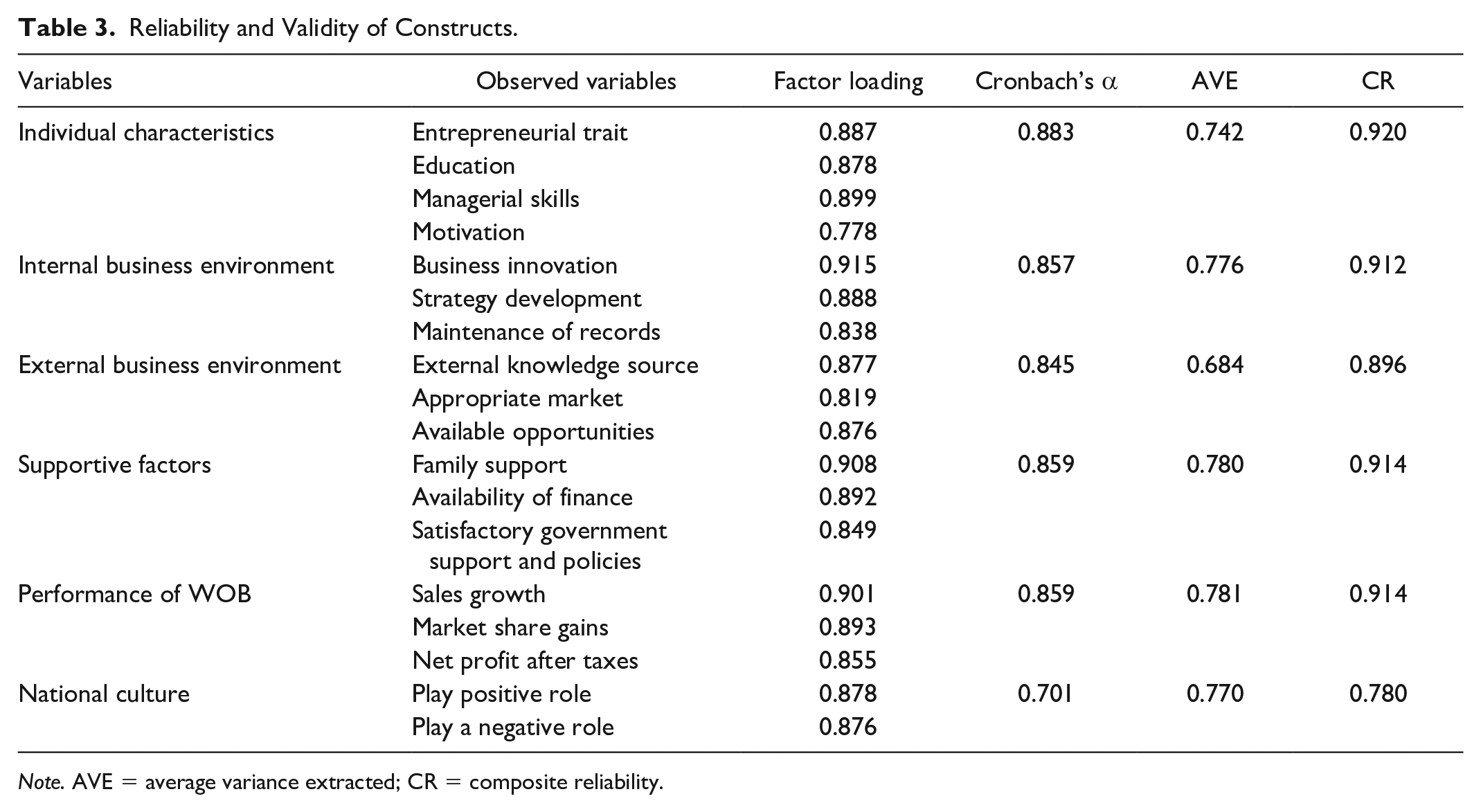
Note. AVE = average variance extracted; CR = composite reliability.
Discriminant Validity.

Note. Diagonal elements (bold) are the square root of variance shared between the constructs and their dimensions (AVE). The off-diagonal elements are the correlations among the constructs. For discriminant validity, the diagonal elements should be larger than the off-diagonal elements. WOB = women-owned business; AVE = average variance extracted.
The Structure Model
To estimate the parameters, the PLS (component-based approach) is used for estimating structural equation models. The PLS path model includes the valuation of both the measurement and the structure model (Henseler et al., 2009). Subsequently, each foundational block in the figures represents a diffident dimension of the primary latent variable. The assessment of the model is based on the review of the outer weights to show the contribution of each construct to the latent variables. The assessment of the structure model is based on the R2 coefficient of the indigenous latent variable (Chwelos et al., 2001). Henseler et al. (2009) documented that the R2 coefficient shows the amount of variation in the indigenous latent variable is explained by its independent latent variable. Hair et al. (2011) defined that the thresholds for the R2 are .75 (substantial), .50 (moderate), and .25 (weak). On the contrary, Chin (1998) suggested that “significant points are 0.67 (substantial), 0.33 (moderate), and 0.19 (weak).” To evaluate the significance of the path coefficient, we calculate the p value by bootstrapping in PLS-SEM. Figure 2 represents the test results along with the path coefficient and the p values for all factors: entrepreneur’s characteristics, internal and external business environment, supportive factors, national culture, and WOB’s performance.
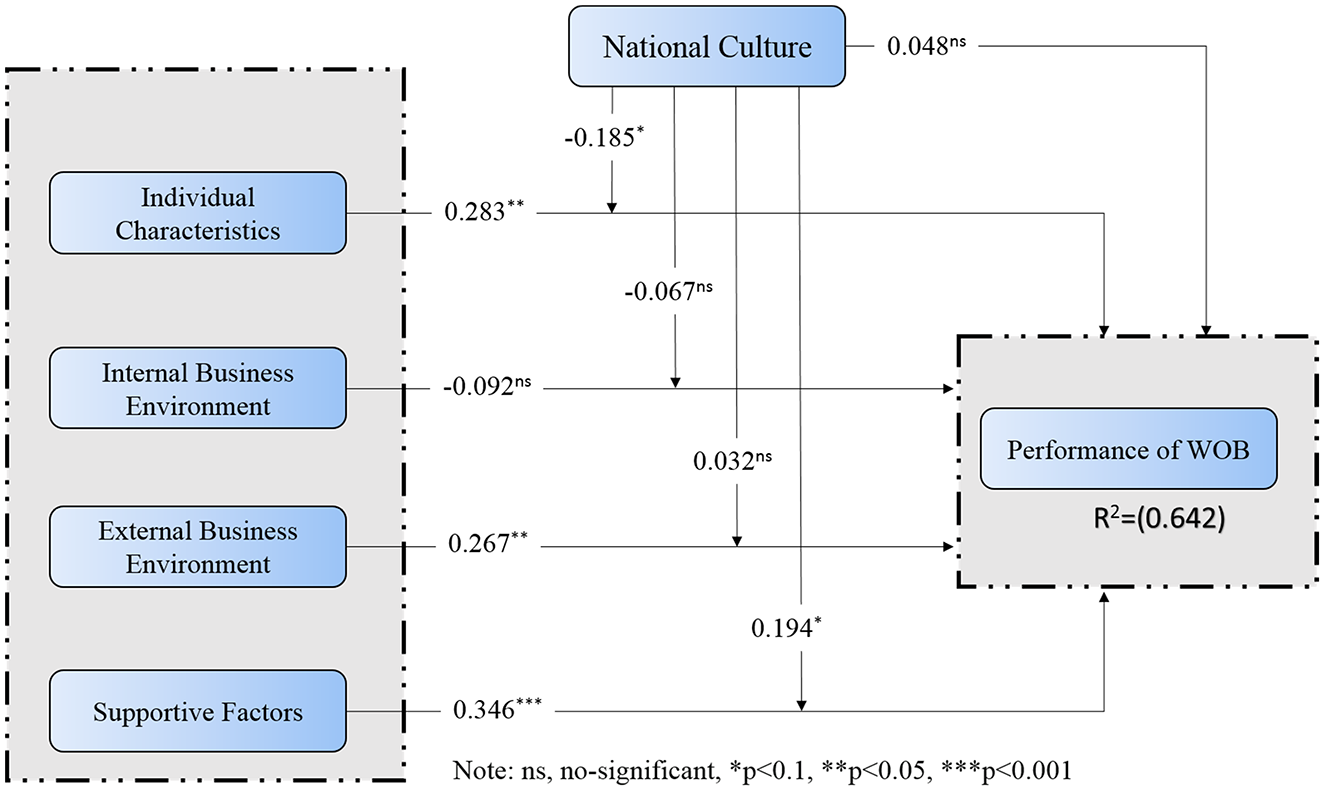
Results of the structural model for success factors and the performance of WOB.
We found that women’s entrepreneurial attributes are significantly positively related to the performance of their businesses (β = .283, p < .01); this result is aligned with Gupta and Mirchandani (2018) and D. H. B. Welsh et al. (2018), and H1 is accepted. H2a demonstrates the effect of the internal environment on the performance of the venture; this was unexpectedly found to be insignificant; the standard beta coefficient between the internal business environment and performance (β = −.092) is less than the threshold (.67, .33, and .19). The results clash with existing studies because the studied facets are not considered crucial for the success of the ventures. On the contrary, H2b—(relationship between the external business environment and the performance of WOBs)—is statistically significant and has a beta value of .267 (p < .01). Furthermore, H3 envisaged the relationship between supportive factors and the performance of ventures. It is statistically substantiated that the supportive factors play a significant role in keeping the women entrepreneurs motivated toward their goals (β = .346, p < .001). The complimentary work also suggests that the family support, availability of finance, and friendly government policies can substantially improve women-owned ventures’ performance (Cho et al., 2018; Gupta & Mirchandani, 2018; T. Lee & Chu, 2017). In addition, H4 checks the direct relationship between national culture and the performance of WOBs. An insignificant relationship was found between these factors (β = .048; p < .001), which rejects H4.
The moderating role of national culture was also checked statistically, and it can influence the relationship between success factors and the performance of WOBs in some respects; this partially accepts the moderating hypothesis. The relation between individual characteristics and performance is significantly negative (β = −.185, p < .05), which accepts H5a highlighted in Figure 3. Meanwhile, H5b and H5c were rejected; that is, the national culture does not show any moderating role for the relationships between internal (β = .032, p = .663) and external (β = −.067, p = .708) environments and the performance. However, the supportive factors lie within the threshold’s limit for H5d (β = .194, p ≤ .05); the culture significantly positively moderates the relationship between supportive factors and the performance of WOBs presented in Figure 4. The contents (family support, access to capital, and government policies) of the supportive factors and individual factors are very open to the national culture, which supports a hidden idea; women are still facing gender discrimination problems at the public and private level (Ahl (2006; Henry & Kennedy, 2017) due to the society’s behavioral demands Godwin et al. (2006).
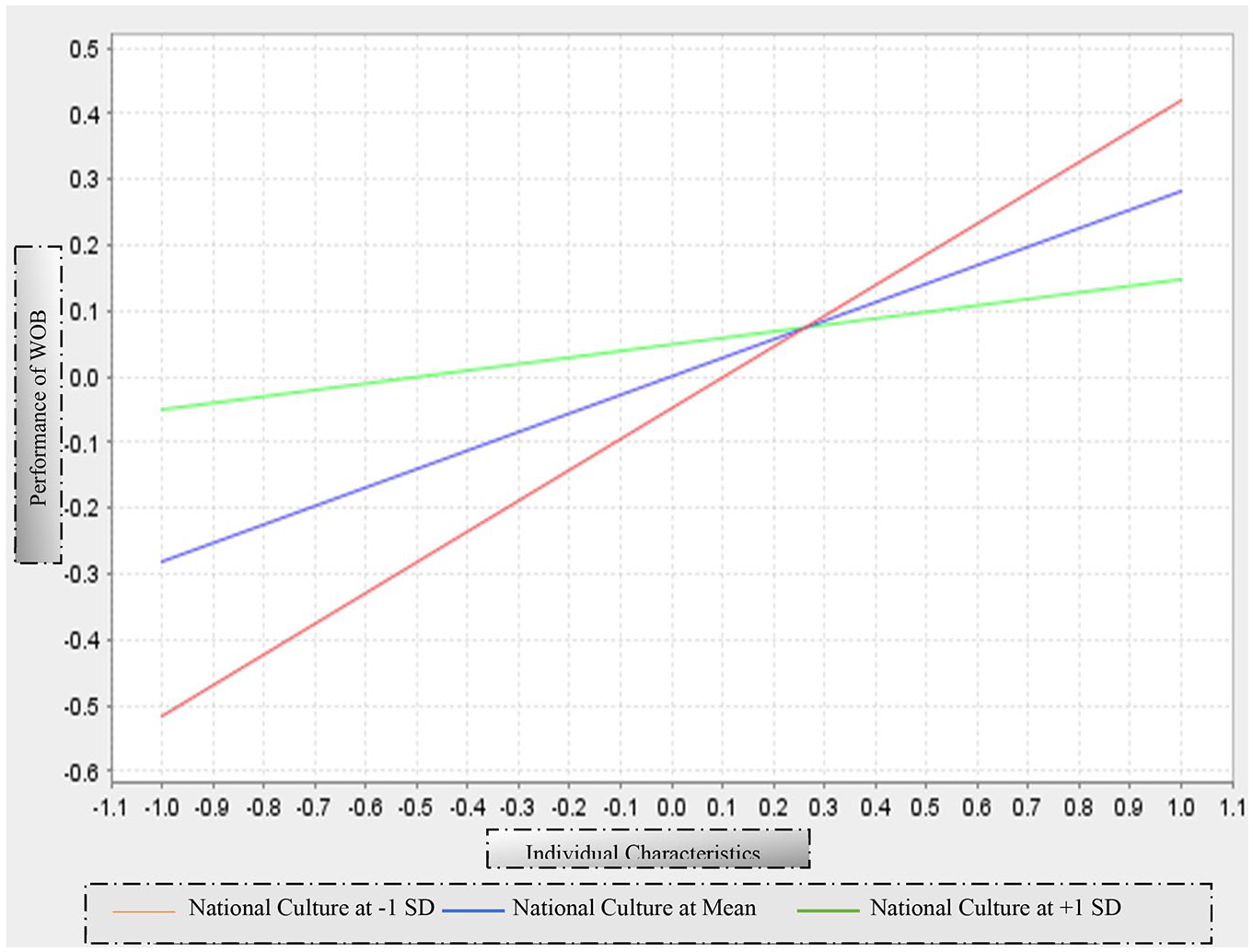
Moderating effect with individual characteristics.

Moderating effect with supporting factors.
The mentioned hypotheses are summarized in Table 5. The R2 value is .642, which lies between the substantial and moderate values; therefore, the drawn model has decent predictive power while the analysis of the control variables fails to reveal any significant path loading. Furthermore, to find the validity of R2, we used the blindfold test, which evaluates the model by using the Q2 predictive relevance of exogenous constructs. This test rechecks the model validity through the selected sample of how well the observed values are replicated and its parameter estimates; this shows the predictive capacity of the model (Chin, 1998). It is a synthesis of cross-validation, fitting, and inspecting the predictive relevance of individual constructs. These could be done by omitting the inner associations and calculating changes in the benchmark estimates (Q2) (Hair et al., 2012). Turning to the results of our test, the Q2 value is greater than zero (Q2 = 0.465); the performance of WOBs have satisfactory predictive relevancy. 6
Hypothesis Summary.

Note. WOB = women-owned business.
Significance level: ***p < .01; *p < .05; ns insignificant.
Discussion and Implications
Overall, this study provides deep insights using the success factors theory (Daniel, 1961; Wronka, 2013) and examining the success factors’ relationship with the performance of WOBs. Principal component analysis is performed by organizing the diverse forms of success factors into meaningful groups: entrepreneur’s characteristics, internal and external business environments, and supportive factors. In this respect, this study contributes to the literature within the WOB industry. Furthermore, this arrangement provides a basis for further statistical analysis to explain the effect of success factors on the performance of women’s ventures.
Hypothesis 1
The results documented in the study can be evaluated in light of the literature. When discussing the performance of ventures, the personal attributes of the owners are considered the primary ingredient. The first hypothesis in Figure 1 explains the relationship between women entrepreneurs’ dedication and the performance of their ventures; this link is supported by the results, such as a significant relationship was found between them. The results have been echoed in different studies, such as Gupta and Mirchandani (2018), Hampel-Milagrosa et al. (2015), Kimosop et al. (2016), and Prasad et al. (2013). Women entrepreneurs in Pakistan are self-confident in terms of their managerial skills and competencies and are less frightened of failure as compare to their counterparts in developed economies; this provides a basis for the findings. In other words, we can say that entrepreneurial traits, education, managerial skills, and motivation levels significantly modify the performance of WOBs. The results of principal component analysis in Table 2 show the intensity level of each factor in the high performance achievement.
Hypothesis 2a and 2b
Regarding the business environment, the internal and external environment are considered the most important factors because they can easily affect the performance of ventures. Therefore, this study proposed H2a, which suggested that the internal business environment has a significant effect on WOBs in Pakistan. Contrary to expectations, this was rejected by the PLS-SEM results. These results are aligned with the previous study of Al-Tit et al. (2019) but contrast with Gonzalez-Rodriguez et al. (2018), Long et al. (2018), and Olbrich et al. (2017). This may be supported by one of two explanations like the studies’ facets are under the control of management, which could not affect their business target. That’s why these studies are not critical in evaluating their success and performance. The other possible explanation is about the unpredictable and hostile environment of the country; entrepreneurs always think about the external potentialities rather than making strategies for business innovation and maintaining records. Concerning the external business environment (H2b), the results of PLS-SEM proved the importance and significance of this environment to the performance of WOBs, which is aligned with previous works (Gonzalez-Rodriguez et al., 2018; Long et al., 2018; Olbrich et al., 2017). External knowledge, appropriate markets, and opportunities can significantly improve the performance of WOBs.
Hypothesis 3
As specified, the three facets of the supportive factors group (family support, availability of finance, and adequate government support) are positively related to the performance of WOBs in Pakistan, as postulated in H3. The results are in line with the literature (Cho et al., 2018; Gupta & Mirchandani, 2018; T. Lee & Chu, 2017; Phonthanukitithawornet al., 2019; Prasad et al., 2013), which underscores the significance of family support, proper finance, and suitable government policies. However, the existing results contrast with the study of Tlaiss (2014) and D. H. B. Welsh et al. (2018) regarding family support. The results demonstrate the strong social commitments and available support to the WOB industry within Pakistan. Based on the principal component analyses, women entrepreneurs first think internally (family support) and then search for outside opportunities (availability of finance and satisfactory government support) for their businesses to get financing and support.
Hypothesis 4
H4 examines the direct role of national culture on the performance of the WOBs. The study rejects the positive effect of national culture and aligns with the previous study of Naidu and Chand (2017). The findings support the lack of fit theory ideology, which suggests that men and women are treated differently in society. The Pakistani culture is broad and inclined to the masculine side, which provides a basis for discrimination. Furthermore, the indirect effect of national culture positively moderates the relationship between supportive factors and the performance of WOBs while negatively moderating the relationship between individual factors and performance. Whenever women entrepreneurs in Pakistan require help, they face hurdles, that is, gender discrimination at both the internal and external level. The findings of this study lead to a solid awareness of the identification of critical success factors and their association with the performance of WOBs.
Theoretical Contributions
Overall, the findings of this study provide a breakthrough in our understanding of how success factors assist women entrepreneurs in achieving success. Regardless of the fascinating results, this study has a series of theoretical contributions. First, this study extends the boundaries of success factors theory (Ronald,1966; Rockart, 1979; Wronka, 2013) to the WOBs, especially in Pakistan. The proposed model can be seen as a key promoter of the women business industry. Second, this study categorizes success factors into four significant clusters: entrepreneur’s attributes, internal and external business environment, and the supportive factors. These are new insights from a success factor and women’s entrepreneurship literature viewpoint. Third, this study examines the direct and indirect effect of national culture from a lack of fit theory perspective and provides new insights from the Pakistani WOB industry.
Practical Implications
This study has important implications for women entrepreneurs both locally and internationally. First, this study is useful for women business owners in providing a rational understanding of the success factors regarding the individual, the internal and external environment, and supportive factors. The woman entrepreneur should have sound knowledge about the studied factors that have already been proven supportive of high business performance. Second, this work also provides cultural understanding to the business community. Overall, the suggested model can be used as a strategic tool to evaluate and select the possible set of success factors to fulfill their interest. Third, this study suggests practical implications for policymakers and deep insights on the women’s entrepreneurship industry. This study will inspire them to make growth-friendly rules and regulations that will provide opportunities for the women entrepreneurs to easily get financing. Last but not least, this study has useful implications for research institutions that wish to conduct more comprehensive cross-border studies in the field of women’s entrepreneurship in terms of economic, technological, cultural, and natural aspects.
Limitations and Future Research
This study offers some significant findings that extend the WOBs literature regarding critical success factor theory and their performance. However, there are some limitations that need to be identified and may lead to future research. First, the success factors approach is a broad phenomenon and can be extended beyond the studied factors to areas such as growth stages and performance measurements (annual sale, registered patents). Second, the sample size of the study should be improved both in terms of size and gender; this study concentrated only on WOBs, so male-owned businesses should be included in a comparative analysis which will strengthen existing knowledge. Third, the social, cultural, traditional, and religious norms in Pakistan make the environment more complicated for women entrepreneurs and restrain them from doing business; future studies could use these factors as moderators or mediators to evaluate their effect on their performance. Finally, contemporary and past studies concentrate on a small group of WOBs limited to specific countries; this may limit generalizability; that is, future research can add other regions beyond Pakistan to the existing model.
Conclusion
The commercial activities of women play an important role in stimulating innovation, employment, and economic development. The growing number of WOB has received the attention of scholars and practitioners worldwide over the past two decades. But most of the existing research was conducted in developed economies while limited in emerging economies like Pakistan. Women entrepreneurs in Pakistan are facing discrimination due to the patriarchal system, lack of financial support, and social barriers. This study investigates the critical success factors and the role of national culture in the success of WOBs. The statistical findings of this study validate our hypothesis that success factors play a significant role in the success of WOBs except H2b and H4. Finally, national culture moderates the relationship between the entrepreneur’s characteristics and supportive factors with the performance of WOBs. This study could enhance the boundaries of success factor theory and lack of fit theory. As women entrepreneurship is global phenomena, the situation in which entrepreneurs work can change dramatically. Therefore, more theories, methodologies, success factors, and cultural aspects should be incorporated in the context for the better understanding of women entrepreneurship and women entrepreneurial behavior.
Footnotes
Declaration of Conflicting Interests
The author(s) declared no potential conflicts of interest with respect to the research, authorship, and/or publication of this article.
Funding
The author(s) disclosed receipt of the following financial support for the research, authorship, and/or publication of this article: The authors thank the National Natural Science Foundation of China for the funding that made this study possible (Award Number: 71272056). The authors also thank the China Scholarship Council (CSC) for their unlimited contributions.
