




Abstract
The purpose of this study is to investigate the role of career adaptability, feedback environment, and goal-self concordance in improving police psychological safety. Questionnaires with integral and regular answers were collected from 295 police officers from four provinces in China. The police officers completed a questionnaire that included items measuring goal-self concordance, supervisor feedback environment, psychological safety, and demographics. In a separate questionnaire, each supervisor rated the subordinate’s career adaptability. Career adaptability indirectly influences psychological safety through the feedback environment. Career adaptability has a greater influence on improving psychological safety for police officers with lower goal-self concordance than for individuals with higher goal-self concordance. Police officers with lower goal-self concordance must care about their future work roles, control their personal professional activities, make education and career choices based on curiosity, and be confident in their own careers to improve their psychological safety.
Keywords
Introduction
Psychological safety is a belief that the workplace is safe for interpersonal risk taking (Frazier et al., 2017). In a psychologically safe workplace, employees feel that their supervisors or coworkers will support an individual who says what they think, respects each other’s competence, has positive intentions toward one another, and is able to engage in constructive conflict or confrontation (Newman et al., 2017). At the macrolevel, the global economic crisis began in 2008, and its effects are still ongoing (Giorgi et al., 2015). Some studies documented that problems related to the economic crisis may improve unemployment and affect the psychological safety of workers (Mucci et al., 2016), especially for police. Police officers’ job duties can be characterized as high stress, high pressure, and high risk, and such characteristics are not observed for ordinary civil servants (Gong & Zhang, 2015). Police face more interpersonal risks than ever before in a highly competitive environment (Perez & Ross, 2008) and still need to contribute to the continued development through individual learning behaviors (Frazier et al., 2017). Although learning behaviors are beneficial to the development of the organization, there are still certain risks to individuals. With regard to safety, research on how to improve the psychological safety of the police is limited (Leroy et al., 2012; Nembhard & Edmondson, 2006; Ortega et al., 2010). Considering the importance of psychological safety to organizations and individuals, it is necessary to examine how to improve police psychological safety.
Prior studies on the antecedents of psychological safety have focused on supportive leadership behavior, relationship networks, and supportive feedback environments (Leroy et al., 2012; Ortega et al., 2010). However, previous researchers have assumed that employees passively accept the environmental impact without looking at their initiative (Dahling & O’Malley, 2011). By ignoring the role of individuals in actively adapting to the environment, an organization may not be aware of its employees’ psychological safety needs (Frazier et al., 2017). Career adaptability is the degree to which individuals are prepared for predictable tasks in their career, the roles in which they are involved, and the changing or unpredictable problems they face (Yang et al., 2019; Yu et al., 2019). It considers professional behavior as internal and external occupational requirements to help individuals become independent in managing their careers (Savickas, 1997; Zikic & Klehe, 2006). Career adaptability represents the typical initiative ability of an employee and thus may result in psychological safety via supervisor feedback environment; however, the relation among such reactions may be complex and contingent upon certain conditions, such as high internal motivation and prosocial motivation (Frazier et al., 2017).
Prior studies on psychological safety from the perspective of individual motivation have confirmed the positive effects of internal motivation and prosocial motivation (Frazier et al., 2017). However, emphasizing only on the role of internal motivation is not consistent with the reality that internal and external motivations combine to produce an invigorative function in management practice (Zhang et al., 2017). The combination of internal and external motivations can reflect the complexity of motivation in real work practice (Deci, 2010). The combination of motivations can fully reflect the impact mechanism of the feedback environment on creative performance (Deci, 2010). Goal-self concordance refers to the degree of integration of goals set by individuals with their own internal interests and values and comprehensively reflects the roles of internal motivation and external motivation and embodies the degree of internalization of work objectives and the similarity between work goals and self-goals (La Guardia et al., 2000). Thus, the present research aims to reveal the complex path from career adaptability to psychological safety by examining the moderating role of goal-self concordance.
Therefore, this study explores the relationship between career adaptability and psychological safety via feedback environment and examines the moderation role of goal-self concordance in this path.
Theory and Hypotheses
Career Adaptability and Psychological Safety
Four tasks need to be performed in relation to career adaptability. With regard to individual future work roles, the tasks include concern for the future, control of individual career activities, decisions on education and career based on curiosity, and confidence in one’s own career decisions. Researchers regard concern, control, curiosity, and confidence as the construct dimensions of individual career adaptability (Savickas & Porfeli, 2012). Career adaptability can affect individuals’ psychological safety for the following reasons.
First, career adaptability can provide resources to cope with stress (Savickas & Porfeli, 2012), thereby contributing to a sense of psychological safety. According to the Conservation of Resources Theory, individuals strive to acquire and maintain resources that they consider valuable, including work control, decision-making power, work autonomy, self-efficacy, and other psychological resources, which can motivate individuals to effectively deal with and respond to problems in working environment (Hobfoll, 1989). When individuals have insufficient psychological resources to meet the requirements and expectations of multiple roles, they feel pressure (Hobfoll, 2011). Career adaptability can enable individuals to adapt to the environment not only to maintain psychological safety but also to supplement psychological resources in the context of a lack of psychological safety (Savickas & Porfeli, 2012), ultimately improving the sense of psychological safety.
Second, studies have shown that some characteristics and dimensions of career adaptability can affect individuals’ psychological safety. For example, individuals’ initiative can act on psychological safety because active individuals can take the initiative to act and develop strategies based on change and discovering and solving problems (Crant, 2000; Seibert et al., 1999). Similar to the curiosity dimension of career adaptability, individuals with open experience tend to be curious and imaginative about new things. Having an open mind and doing things differently can make individuals believe that taking risks is safe in their work environment (Nigel et al., 2005). Therefore, based on the above arguments, this study offered the following hypothesis:
Mediating Role of the Feedback Environment
Steelman et al. (2004) viewed feedback as a multidimensional structure from the perspective of integration, focusing on the informal feedback environment in daily work. In terms of the formation of the supervisor feedback environment, the “causal inversion” described in leadership research (Shamir, 2007) argues that the characteristics and behaviors of employees as followers of leaders can be used as independent variables, and the characteristics and behaviors of leaders are the dependent variable or the adjusting variable. Thus, the characteristics, styles, role orientation, identity, and behaviors of employees shape the leaders’ attitude (Fairhurst & Uhlbien, 2012; Shamir, 2007). If leaders see employees’ career adaptability as positive, then the leaders may provide more supportive, accurate, and credible feedback and encourage more feedback-seeking behaviors. Therefore, ability improvements and leadership feedback environment’s construction are dynamic processes. Career adaptability is both an act and a capability, and the environment can shape it because the leadership feedback environment can provide accurate and useful information and can support feedback seeking; however, it can also in reverse shape the environment because career adaptability increases managers’ enthusiasm to improve the feedback environment.
The leadership feedback environment, as support for psychological resources, can also promote the improvement of psychological safety. The supervisor feedback environment provides usable and high-quality feedback information that serves as a valuable resource for individuals to respond to multifaceted role requirements and expectations (Avey et al., 2009). Previous studies have shown that leaders’ support (May et al., 2004), credibility (Madjar & Ortizwalters, 2009), and openness (Detert & Burris, 2007) can influence employees’ perceptions of mental safety. Researchers believe that by listening to communication and providing clear and consistent feedback to subordinates, leaders can make subordinates feel adventurous and involved in safe feedback communication (Hirak et al., 2012; Liu et al., 2014; Nemanich & Vera, 2009; Walumbwa & Schaubroeck, 2009). In view of the above research, this study offered the following hypothesis:
Moderating Role of Goal-Self Concordance
Goal-self concordance is a new construct for integrating the influences of internal motivation and external motivation to help resolve the differences between the two (Deci & Ryan, 1985). Goal-self concordance represents the autonomy of employees (Sheldon & Elliot, 1999) and expresses employees’ developmental interests and intrinsic values. Individuals can be responsible for and motivated to achieve their goals (Sheldon & Elliot, 1999). Therefore, individuals who constantly pursue goal-self concordance can pay more attention to their goals and expend more effort in this pursuit, which are the two prerequisites for high psychological safety.
According to the Conservation of Resources Theory, a lower level of goal-self concordance indicates a lack of internal resources from the subject and a reduced search for effective resources due to interest or meaning (Singh et al., 2013). Individuals need clear work requirements; therefore, employees with higher career adaptability will be more likely to see the direction needed, target expectations, and reduce their role ambiguity. A lower level of goal-self concordance indicates that the conflicts between internal and external motivations make it difficult to maintain a cognitive focus in work. It is necessary to make up for the lack of resources, due to the diversity of cognition (Carmeli et al., 2009; Carmeli & Gittell, 2009; May et al., 2004). Thus employees with higher career adaptability can gain resources to respond to demands and expectations from multiple roles, reduce role conflict and overload through concern, control, curiosity, and confidence in work. The identity and commitment between the organization and the employees is bidirectional, and organizational support represents the organization’s recognition of and commitment to the employees (Brueller & Carmeli, 2011). According to the principle of reciprocity, when leaders feel that their employees have higher career adaptability, this will enhance the leaders’ recognition of employees, thus providing more available and high-quality feedback and improving psychological safety (Burris et al., 2009). Based on these arguments, this study supposed the following:
Moderated mediation hypotheses were developed, and the research model is depicted in Figure 1 below.

Test model.
Method
Participants and Procedures
This study is based on a sample of police officers from four provinces (Shandong Province, Shanxi Province, Jiangsu Province, and Fujian Province) in China. With the agreement of the supervisor of human resource management of the police bureau, all the questionnaires were completed during work hours. The police officers were investigated by layer cluster sampling, stratified by general police units and police branches units. The questionnaires were sent to police officers in the four provinces, with two provinces in the north and two in the south of China, thereby effectively representing the characteristics of police in different regions.
Before the survey, we obtained the written informed consent signed by the respondents. All police officers were explained the purpose of this study. Participants wrote down their choices voluntarily without any negative consequences.
In total, 330 questionnaires were distributed on the spot and 317 questionnaires were collected for an overall response rate of 96%. Of these, 295 valid questionnaires were involved in the analysis of the results. Of the 295 police officers, 80.3% were male and 19.7% were female. The average age of the participants was 31.2 years (SD = 0.79), 56.2% (n = 166) were 20 to 30 years of age, and 72.1% (n = 191) were younger than 35 years. The average organizational tenure was 8.62 years, 42.8% (n = 126) had worked for less than 5 years, and 43.1% (n = 127) had worked for 6 to 10 years (exclusive). Of these participants, 53.9% held bachelor’s degrees. A total of 22.3% were from special weapons attack teams (SWAT); 29.5% were traffic patrol officers; 9.2% were correctional officers; 13.3% were public safety officers; 20% were criminal investigation police; and 5.7% held other positions, such as foreign affairs police and network safety police.
This study was based on cross-sectional data collected from the 295 valid questionnaires in China. To avoid common method bias, data were collected from two sources: police officers and their supervisors. The police officers completed a questionnaire that included items measuring goal-self concordance, supervisor feedback environment, psychological safety, demographics, the police officer’s name, and the supervisor’s name. In a separate questionnaire, each supervisor rated the subordinates’ career adaptability. The supervisors assigned to complete the rating forms had many opportunities to observe their employees’ career adaptability.
Measures
The instruments used for demographic characteristics and job conditions were an ad hoc questionnaire and previously validated instruments for Chinese populations.
Career Adapt-Abilities Scale (CAAS)
The CAAS was measured with 24 items developed by Li and Tan (2013). This scale was the Chinese version of the CAAS according to the Savicka’s (1997) scale and was validated to Chinese population (Li & Tan, 2013). The CAAS is a 7-point scale that contains four dimensions that have been well demonstrated in 13 countries (Savickas & Porfeli, 2012) and respond to each clause on a scale ranging from 1 (not strong) to 7 (strongest). The Cronbach’s α was .94.
Supervisor feedback environment
The supervisor feedback environment was measured by using the scale of Steelman et al. (2004), which was validated for Chinese samples (Zhang et al., 2017). This Likert-type scale assesses seven feedback environment dimensions. Because the hypotheses in this study operate at the construct level, this study used a composite score of the feedback environment rather than a score based on each facet. Cronbach’s α for the measure of supervisor feedback environment was .86.
Goal-self concordance
Goal-self concordance was measured using Deci and Ryan’s (1985) scale, which was validated for the Chinese population (Zhang et al., 2017). The external and introjected items represent controlled motivation, and each of these checked adjectives was given a value of −1, while the identified and intrinsic items represent autonomous motivation, and each of these checked adjectives was given a value of +1. The values were then summed to calculate goal-self concordance. Cronbach’s α for the measure of goal-self concordance was .88.
Psychological safety
On the variable of psychological safety, seven items were used based on the scale developed by Edmondson (1999) to assess psychological safety, including the following: “On my team, it is safe to take risks and take chances on new ideas” and “When working with members of my team, my competences and talents are valued and used.” This scale was validated for the Chinese population (Huang, 2012). Cronbach’s α for the measure of psychological safety was .91.
Demographic information
A demographic questionnaire was used to gain information related to sex, age, police category, job tenure, and education. All these factors are control variables.
Ethics Statement
This study was carried out in accordance with the recommendations of the ethics committee of Liaocheng University with written informed consent from all participants. The ethics committee of Liaocheng University (2017_7_14) approved the protocol. All participants have given written informed consent in accordance with the Declaration of Helsinki (World Medical Association [WMA], 2009).
Results
Table 1 shows the correlations and descriptive statistics. An inspection of the correlations indicates that career adaptability is positively correlated with the feedback environment and psychological safety. The results also reveal that the feedback environment is positively correlated with psychological safety. The results indicate that career adaptability and goal-self concordance are positively correlated with the feedback environment.
Means, Standard Deviations, and Correlations of All Measures.

Note. n = 295.
p < .05. **p < .01.
This research conducted confirmatory factor analyses (CFAs) on all variables. Hu and Bentler recommend the following standards to determine good model fit: comparative fit index (CFI) and incremental fit index (IFI) above 0.90 and root mean square error of approximation (RMSEA) below 0.08. This study compared a 4-factor model with two 3-factor models (career adaptability and goal-self concordance combined into one factor; goal-self concordance and feedback environment combined into one factor), a 2-factor model (career adaptability, goal-self concordance, and feedback environment combined into one factor), and a 1-factor model (all variables combined into one factor). The results show that the 4-factor model fits the data better than other tested models (χ2/df = 2.25, RMSEA = 0.07; CFI = 0.92; IFI = 0.91). The CFA results suggest that the respondents could clearly distinguish the constructs under study.
The potential no independence of responses was tested by using multilevel analyses and revealed no significant between-group variance in psychological safety, meaning that team-level variance does not explain a significant portion of variance in the psychological safety rank.
Table 2 presents the results of regressions testing the relationships among career adaptability, feedback environment, and psychological safety. Career adaptability is significantly related to the feedback environment (Model 1: β = .09, p < .01) and positively related to psychological safety (Model 3: β = .41, p< .01). H1 is supported, suggesting that career adaptability is positively related to psychological safety. Adding the feedback environment to the model, Model 4 shows the regression of the career adaptability and feedback environment on psychological safety. Model 4 shows that the feedback environment is significantly related to psychological safety (β = .44, p < .01). The interaction between goal-self concordance and career adaptability is significantly related to the feedback environment when considered independently and when entered jointly with the interaction of career adaptability and goal-self concordance (Model 2: β = −.04, p = .04).
Hierarchical Regressions for the Impact of Career Adaptability, Goal-Self Concordance Interactions, and Feedback Environment on Psychological Safety.

Note. n = 295; DV = dependent variable.
p < .05. **p < .01.
To test the mediation hypotheses (H2), this research used a bootstrap mediation method with 5,000 samples with replacement and percentile bootstrap confidence intervals (CIs). Using the bootstrap mediation procedure described above, this research tested whether the mediated effect of career adaptability on psychological safety was conditional upon goal-self concordance. The results of each indirect, direct, and total effect with corresponding CIs are presented in Table 3. Supporting H2, the indirect effect of career adaptability on psychological safety through the feedback environment is significant (effect = 0.04; 95% CI = [0.00, 0.11]) as indicated by the CI excluding zero. The direct effect from career adaptability to psychological safety is also significant (effect = 0.37; 95% CI = [0.25, 0.48]).
Summary of the Indirect Effects and Conditional Indirect Effects.

Supporting H3, Table 3 shows that the indirect effect of career adaptability on psychological safety via the feedback environment is significant for individuals with low goal-self concordance (effect = 0.05; 95% CI = [0.03,0.21]) but not for individuals with high goal-self concordance (effect = −0.01; 95% CI = [−0.09, 0.07]). Following Edwards and Lambert (2007), this research further explored the significance of the difference between the indirect effects of career adaptability on psychological safety for both one standard deviation above and below the mean of goal-self concordance and revealed that it was significantly different at the 95% confidence level (difference = 0 .05; 90% CI = [−0.03, 0.00]).
This research plotted the interaction using parameter estimates of the feedback environment for both one standard deviation above and below the mean of goal-self concordance (see Figure 2) and revealed that the shape of the interaction was as predicted. The simple slopes for the impact of career adaptability on the feedback environment were significant for individuals with low goal-self concordance (β = .26, p < .01) but not for individuals with high goal-self concordance (β = −.03, n.s.), indicating that individuals with low goal-self concordance receive a benefit for career adaptability, but individuals with high goal-self concordance do not. Thus, H3 was supported.
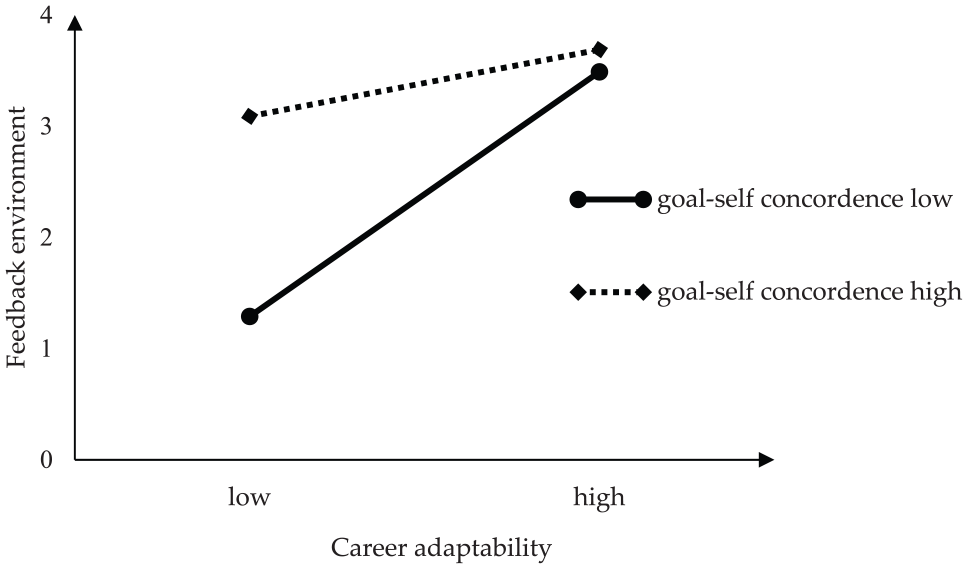
Simple slopes of career adaptability predicting feedback environment at low (1 SD below M) and high (1 SD above M) levels of goal-self concordance.
In sum, all results indicate that career adaptability and goal-self concordance significantly interact to influence psychological safety through the feedback environment. In particular, career adaptability improved psychological safety via the feedback environment only for individuals with low goal-self concordance. All findings indicate that individuals with high goal-self concordance received less benefit from career adaptability in terms of the feedback environment or psychological safety.
Discussion
Previous studies on psychological safety have used theoretical perspectives such as Social Learning Theory and Social Identity Theory (Huang, 2012; Schulte et al., 2012) to explain the formation of psychological safety with external factors such as leadership support, relationship network, and team characteristics (Bienefeld & Grote, 2014; Gu et al., 2013; Huang, 2012; Schulte et al., 2012). Conservation of Resources Theory (Hobfoll, 1989) was used to explain how to generate psychological safety by proactively accessing resources in the work environment. The study found that career adaptability indirectly affects the sense of psychological safety through the feedback environment and that goal-self concordance plays a regulatory role. Compared with individuals with a higher goal-self concordance, individuals with low goal-self concordance have a greater influence on career adaptability. These research results provide certain theoretical and practical contributions to the understanding of psychological safety and career adaptability.
Theoretical Implications
The main contribution of this research is to explore the influence of career adaptability on psychological safety from the perspective of an individual’s initiative and to enrich the understanding of psychological safety. The change in perspective involves seeing the individual’s psychological safety as no longer passively accepting the influences of external environmental factors and becoming a potential path that individuals can grasp (Strauss et al., 2012). Previous antecedents to psychological safety have ignored the role of individuals in actively adapting to the environment and only emphasized the impact of supportive leadership behaviors, relationship networks, and team characteristics (Bresman & Zellmerbruhn, 2013) on psychological safety. Although environmental factors have a great impact on individual psychological safety, are individuals incompetent with regard to controlling their own psychological safety? If an individual can only accept the influences of the environment, how can one explain the differences in individuals’ psychological safety in the same environment? According to Conservation of Resources Theory, individuals can actively seek, acquire, retain, and protect resources and prevent resource loss and use their own efforts, advantages, and means to actively adapt to the environment after a loss of resources (Halbesleben et al., 2014). The results of the study demonstrate that an individual’s active career adaptability can effectively increase psychological safety, which can reduce job uncertainty, increase job safety, and reduce unemployment (Sverke et al., 2002; Sverke & Goslinga, 2003).
Second, this research combined the influence of the feedback environment and career adaptability on psychological safety and explore the psychological mechanism of active behavior affecting psychological safety. This research found that career adaptability affects the sense of psychological safety through the feedback of the environment. This research used the Conservation of Resources Theory (Hobfoll, 1989) to explain this problem. The effective resources obtained by individuals motivate them to effectively address problems in the environment and to demonstrate better external behaviors. As a reward for the effective resources of individuals, external actors tend to share ideas and knowledge and help individuals to have more resources. In turn, improving the sense of psychological safety is consistent with Follower Theory (Martin & Dowson, 2009). Shamir’s (2007) view of “causal inversion” described in leadership research argues that the characteristics and behaviors of employees can influence the characteristics and behaviors of their leaders. Thus, managers will change their behaviors according to their subordinates’ behaviors. The active behaviors of employees help to improve the feedback environment. The more feedback one seeks, the greater the individual’s ability to mine the meaning of feedback and make behaviors consistent with the external environment. As a reward for employees, a better feedback environment will be provided (Steelman & Young, 2014).
Third, this research provides theoretical support to explain the sense of psychological safety on behalf of the individual’s positive motivational state of work. Previous studies have focused on the positive role of internal motivation (Frazier & Tupper, 2016), although it is difficult to form a consensus on external motivations (Zohar et al., 2015). The Conservation of Resources Theory (Hobfoll, 1989) states that complex individual motives play the role of meeting current needs for resource conservation and preventing further deterioration of resource loss (Hobfoll, 2011). The combination of internal and external motivations can reflect the complexity of motivation in real work practice. According to the Theory of Self-determination (Deci, 2010), goal-self concordance reflects the balance of individuals’ internal and external motivations, which can resolve the differences in the influence of internal and external motivations in the formation of psychological safety. This study found that for individuals with low goal-self concordance, the path coefficient of career adaptability through the feedback environment, the effect on psychological safety is higher, and the influence is larger, which is consistent with the Conservation of Resources Theory (Hobfoll, 1989). For employees with low goal-self concordance, there is a lack of internal resources, and the search for effective resources is reduced by interest and meaning (Singh et al., 2013). Conflicts between internal and external motivations make a cognitive focus at work difficult, and it is necessary to compensate for the lack of resources due to the diversity of cognition (Carmeli et al., 2009; Carmeli & Gittell, 2009; May et al., 2004). Therefore, employees with higher career adaptability can capture resources to respond to demands and expectations from multiple roles and reduce role conflicts and overload, thereby enhancing leadership’s recognition of employees and improving psychological safety through their concern, control, curiosity, and self-confidence at work (Burris et al., 2009).
Practical Implications
In addition to the theoretical contribution, the results have practical significance. Common problems in every field are “Who gets a sense of psychological safety, and why?” This article addresses these issues and provides behavioral advice on how individuals can obtain valuable feedback within the organization. The research results show that career adaptability affects a person’s feedback environment at work. To achieve a sense of psychological safety, it is important to adapt to the environment to demonstrate career adaptability, especially for individuals with low goal-self concordance.
In practical work, the behaviors of employees who are influenced by internal motivation are quite limited. Behaviors that are entirely stimulated by external motivation are ubiquitous, and there are greater incentives generated by the combination of internal and external motivations. However, it is particularly difficult to achieve a high degree of goal-self concordance, which requires an externally provided environment for independent support. The results of the study are helpful in solving the problem of individuals with low goal-self concordance and providing suggestions to improve their psychological safety in a fixed environment. Improved career adaptability can support missing resources. For individuals with low goal-self concordance to improve their sense of psychological safety, they must care about their future work roles, control their personal professional activities, make education and career choices based on curiosity, and be confident in performing their own careers. Employees need to have a proactive and exploratory spirit to manage the stress and challenges of career transformation. For internal enterprise positions or post adjustment, employees should actively adapt to the new work environment, work tasks, and work specifications, thus shaping their professional competence. The strategies employees can use for improvement include self-motivation, consulting with experienced workplace seniors, and enhancing their professional knowledge and skills to develop professional competitiveness.
Limitations and Future Research
Although this study and most previous empirical studies of psychological safety rely on the use of cross-sectional quantitative survey methods, limited longitudinal studies have been conducted. Longitudinal studies focusing on the socialization of newcomers in the team and involving multiwave data collection and the application of potential growth models (Duncan & Duncan, 2005) will have the opportunity to systematically study the dynamics of psychological safety, especially the developmental trajectory of individuals and teams in psychological safety and the variability of individuals and teams in their development. Because we know little about the causes and time changes of mental safety in a team and the use of consensus models to measure the level of psychological safety and organizational analysis in a team, to improve this research, a time series test and multilevel analysis could also be adopted to make the relationships among related variables more convincing. Researchers may consider measuring the degree of consensus among team members with regard to their psychological safety in binary relationships and using social networking methods to map these methods to network relationships (Roussin et al., 2014). Thus, we can understand how the psychological safety dynamics within the subteam affect the learning and performance outcomes within the team and address the use of the consensus model by Roussin et al. (2014). Such an understanding will lead researchers to ignore the team’s background and lead members to avoid sharing problems, such as mental health.
A focus on the different psychological safety of different individuals in the environment requires us to pay attention to individuals’ related traits in future research. Future research should incorporate a theoretical perspective of the human situation, such as Trait Activation Theory (Tett & Guterman, 2000), to deepen our understanding of the relationship between psychological safety and work outcomes. According to Tett and Guterman (2000), trait behavior triggers trait-related contextual cues (p. 398). The influence of personality traits may depend on the contextual incentives (situational cues). Thus, providing an organizational atmosphere that involves psychological safety may interact with the personality characteristics of employees and predict employees’ work behaviors and attitudes. Based on this, we believe that psychological safety will expand the positive role of individuals’ tendency behaviors, which are reflected in extroversion and active personality. Such changes will lead individuals to be more likely to participate in relevant work behaviors, such as voicing concerns or sharing information in the environment, with a high level of psychological safety because such environments provide clues and opportunities to express their characteristics.
A question that has not been addressed in the psychological safety literature is “Can psychological safety lead to negative consequences?” As many constructive science constructs have suggested, the positive side may have a “dark side.” For example, organizational citizenship behaviors have long been considered positive acts that help to organize funds (Organ, 1988), although recent research has shown that these performances may be related to these behaviors. Similarly, under certain circumstances, psychological fear can lead to negative results. Pearsall and Ellis (2011) found a high degree of psychological safety and a low awareness of interpersonal risk and created a utilitarian team environment where high utilitarianism favors cheating. Future research should further explore the possibility of how and when psychological safety can reduce the incidence of negative outcomes.
Conclusion
The feedback environment plays a mediating role in the relationship between career adaptability and police officer’s psychological safety, and the relationship between career adaptability and feedback environment is more positive for individual with lower goal-self concordance. This research enriches the antecedent factors of psychological safety in a proactive way and finds that improving one’ s proactive career adaptability can increase the feeling of psychological safety. This study analyses the mediating role of the feedback environment from a follower-centered perspective and reveals that career adaptability can positively influence the supervisor feedback environment and then influence psychological safety. The study also emphasizes that not all people’s effects are equal, and the relationships among career adaptability, feedback environment, and psychological safety are different for people with different levels of goal-self concordance. In addition to raising an important issue, we extend the Conservation of Resources Theory to multiple research areas. The results suggest that although career adaptability is beneficial to the improvement of the feedback environment and the improvement of psychological safety, the benefits associated with career adaptability are more intense for individuals with low goal-self concordance.
Footnotes
Declaration of Conflicting Interests
The author(s) declared no potential conflicts of interest with respect to the research, authorship, and/or publication of this article.
Funding
The author(s) disclosed receipt of the following financial support for the research, authorship, and/or publication of this article: This research was funded by grants from the National Natural Science Foundation of China (71801120, 71802019), the Ministry of Education of Humanities and Social Science Research youth fund project (18YJC630038), the grant from China Scholarship Council (Award ID: 201908370108), Youth Scholar Key Training Plan Research Special Project of Shandong Province (19CQXJ05), and University Outstanding Youth InnovationTeam Project of Shandong Province (S201910447026).
