




Abstract
This study investigated the effects of input flood tasks, as focused tasks, and Jigsaw tasks, as unfocused tasks, on promoting Iranian English as Foreign Language (EFL) learners’ recognition of regular past tense /-ed/ in terms of accuracy and durability. Accordingly, using a quasi-experimental study, two intact university classes including 62 participants were randomly designated to experimental and comparison groups. The participants were homogenized regarding their language and grammar proficiency levels. The experimental group was instructed through input flood tasks and the comparison group through Jigsaw tasks. Analysis of covariance (ANCOVA) analysis showed that although both groups’ mean accuracy scores were improved on the immediate posttest, the experimental group outscored the comparison group. However, the results of the delayed posttest demonstrated that whereas the comparison group maintained their accuracy level over time, the experimental group’s accuracy mean score dropped. It can be postulated that input flood tasks may promote learners’ recognition accuracy of second language forms immediately, but this effect may gradually diminish. Hence, it can be tentatively concluded that Jigsaw tasks result in more durable gains than input flood tasks. The findings imply that when the goal of grammar instruction is to achieve durable effects, unfocused tasks should be integrated with focused tasks in the syllabus.
Introduction
Recent research in task-based instruction (TBI) has witnessed a substantial amount of research to determine the role of input-focused flood tasks and Jigsaw-unfocused tasks in second language acquisition (SLA) processes. As for the input flood tasks, Reinders and Ellis (2009) maintain that there is ample evidence that enriched input in the form of input flood can help learners acquire L2 forms because it provides learners with sufficient exposure to the targeted feature. Another benefit of input flood, according to Nassaji and Fotos (2011), is that due to the frequent occurrence of the focused form in the input, the salience of input is increased, and therefore, in this way input flood can help learners to notice the targeted form.
Van de Guchte et al. (2019) discuss that consciousness-raising activities such as input flood have been effective in making L2 forms salient and noticed.
Regarding Jigsaw tasks, Poupore (2005) argues that the value of Jigsaw tasks is in their specific task feature because Jigsaw tasks are structured in a way that different pieces of information are given to learners, and learners have to exchange different pieces of information to solve the task. Pica (2005) states that information-gap tasks, such as Jigsaw tasks, provide the opportunity for learners to receive feedback, increase their comprehension, and at the same time focus on meaning and form.
However, the extent to which input flood tasks and Jigsaw tasks do promote drawing learners’ attention to linguistic features and in turn help them to learn L2 forms seems to be an enduring pedagogical challenge to second language task practitioners. Therefore, this study tried to find out the effect that input flood tasks and Jigsaw tasks have on the learners’ noticing and recognition of L2 forms. It is further assumed that task types (focused vs. unfocused) have differential effect on the leaners’ recognition of L2 forms.
As for the Jigsaw tasks, de la Colina and García Mayo (2007) have found these tasks to be effective in drawing learners’ attention to L2 forms. As for the input enrichment tasks, Sharwood Smith (1993) discusses input enhancement as one of the means to make second language (L2) forms salient to learners and thereby affect their knowledge and performance in L2. However, as a pedagogical gap, it remains an intriguing question to determine whether input flood tasks, as focused tasks, are more effective than Jigsaw tasks, as unfocused tasks, in enhancing learners’ noticing of L2 forms.
One way of providing an answer to this question is comparing the effects of input flood tasks and Jigsaw tasks on subsequent noticing of English regular past tense /-ed/ on a grammaticality judgment test administered immediately and overtime, respectively, as the measure of accuracy and durability to Iranian English as Foreign Language (EFL) learners. Determining the potential of input enrichment focused tasks and Jigsaw tasks in drawing learners’ attention to L2 forms can greatly contribute to extending our understanding of how attentional resources can be channeled within SLA in general and within task-based instruction in particular.
Review of the Related Literature
According to Nassaji and Fotos (2011), focused tasks are made to have a focus on a grammar form. R. Ellis (2003) proposes three principal ways to design focused tasks: (a) structure-based production tasks, (b) consciousness-raising tasks, and (c) comprehension tasks. In addition, Ellis (1995) describes two procedures for designing comprehension tasks: input processing and input enrichment. Moreover, the same author (Ellis, 2003, 2008) adds that enriched input can further be divided into input flood tasks and enhanced input tasks. Sharwood Smith (1993) refers to input enhancement as an externally induced or teacher-induced activity where certain input features are noticeable to learners so that this input manipulation or enhancement could ideally impact learners’ knowledge and hence their behavior. Input flood is described as the input which contains numerous examples of the targeted feature (Trendak, 2015).
Studies that have used input enrichment abound in the literature. For example, Reinders and Ellis’s (2009) study indicated that input flood instruction was effective in turning input to intake and aided the acquisition of English negative adverbs. However, there are other researchers believing that input flood alone cannot lead to the acquisition of the targeted features, and hence it should be used in conjunction with other sort of instruction. For example, Hernández’s (2008) study showed that input flood combined with explicit instruction was more effective than input flood alone in promoting students’ use of discourse markers.
Proponents of TBI have also been interested in unfocused tasks, especially the role information-gap tasks play in making learners competent in a second language. As far as unfocused tasks are concerned, no effort is required to incorporate some focus on form into the task. As put forward by R. Ellis (2008), unfocused tasks may incline learners to select from a range of forms, but these tasks are not made with the use of a particular form in mind.
The appearance of information-gap tasks, as one type of unfocused tasks (R. Ellis, 1995, 2003), has resulted in a number of proposals to explore the role these tasks play in SLA. Sauro et al. (2005) mention that three types of information-gap tasks (i.e., Jigsaw, grammar communication tasks, and spot the difference) can be used both as research tools and as instructional materials. On this issue, Sauro et al. (2005) conclude that As such, the Jigsaw (e.g., Doughty & Pica 1986; Swain & Lapkin 2001), Spot the Difference (e.g., Long 1980, 1981), and Grammar Communication tasks (e.g., Fotos & Ellis 1991; Loschky & Bley-Vroman 1993) have shown to promote interaction and attentional processes among learners. (p. 5)
Jigsaw, as one type of information-gap tasks (Pica, 2005), has extensively been used in SLA research. Richards (2001) defines Jigsaw tasks as the tasks which involve learners to put different pieces of information to arrive at a whole. Proponents of Jigsaw describe this task as a modern method of cooperative learning which develops learners’ autonomy and their teamwork skills (Baron, 2019; Zuo, 2011). Moreover, Sauro et al. (2005) also showed that Jigsaw tasks are effective for both drawing learners’ attention to form and helping them recall both the form and the function of the targeted form. However, the results of some studies show that Jigsaw tasks may not be always effective as some other tasks in enhancing learners’ noticing of L2 forms. For example, Swain and Lapkin (2001) tried to examine the comparative effect of Dictogloss (a focused task) and Jigsaw task (an unfocused task) on noticing (the degree of attention) of two groups of French learners. They report that although the overall effect of these two tasks on drawing the learners’ attention to forms was the same, Dictogloss was more efficacious in promoting the accuracy of learners’ production. Poupore’s (2005) research compared the effects of problem-solving tasks and Jigsaw tasks in terms of quality interaction and types of negotiation these tasks generate. His study showed that the former led to more effective interaction than the latter.
The durability effects of instruction have been of great concern in SLA studies (R. Ellis, 2008; Pica, 2005). Because of the dearth of research on the potential of focused tasks to increase learners’ accurate and durable recognition of L2 forms with that of unfocused tasks, we tried to investigate the effects of input flood tasks versus Jigsaw tasks in promoting EFL learners’ attention to L2 forms. As for the input flood, Han et al. (2008) propose that research is yet to be carried out to determine the role enrichment tasks play in making learners more cognitively aware of language forms. In this regard, and as far as unfocused tasks, especially Jigsaw tasks, are concerned, Pica (2005) mentions that “although it is widely accepted that information gap tasks can hold their own as high-interest classroom activities, it is still not known whether they can maintain their reliability as research instruments over time” (p. 342). Thus, this inquiry tried to provide an answer to the questions raised by Han et al. (2008) and Pica (2005) concerning the effects of focused and unfocused tasks in promoting learners’ awareness of L2 forms. Specifically, it made an attempt to find out whether such effects, if any, are durable overtime by comparing the effects of Jigsaw tasks with input flood tasks in promoting Iranian EFL learners’ recognition accuracy and durability of English regular past tense /-ed/. R. Ellis, Loewen, and Erlam (2009) describe regular past tense /-ed/ as a feature known to cause difficulty for the learners, especially for Asian learners. To this point, the same authors add that regular past tense /-ed/ is a late-acquired feature which is typically acquired after articles, third person/-s/, and progressive /ing/. Hawkins (2001) highlights that some learners “have difficulty in establishing the regular pattern (for past tense) at all.” Pretesting indicated that it was indeed really the same case in our study as the participants’ pretest scores showed that past tense /-ed/ turns out to be difficult for the groups of this study. Therefore, the aim of this study is to answer the following questions:
Is there any significant difference between the effects of instruction through input flood tasks versus instruction through Jigsaw tasks on Iranian EFL learners’ accurate recognition of regular past tense /-ed/?
Is there any significant difference between the effects of instruction through input flood tasks versus instruction through Jigsaw tasks on Iranian EFL learners’ durable recognition of regular past tense /-ed/?
Method
Design
A quasi-experimental design was used in this inquiry, including a pretest, a posttest, a delayed posttest, one experimental group, and one comparison group. The studies of form-focused instruction (FFI) are typically quasi-experimental in nature (Ellis, 2008; Shabani, & Hosseinzadeh, 2019). Ellis (2008) explicates that FFI studies are best described as quasi-experimental because researchers involved in these studies have to use intact classes.
Participants
In this study, two intact classes from a university in Arak city, Iran, majoring in psychology at BA level were selected and randomly allocated to the experimental and comparison groups. The participants in the groups were adult freshman Persian-speaking university students and were homogeneous with regard to their language and their grammar proficiency levels. Their age range was 19 to 22 years.
Instrumentation
Two instruments were utilized in this study: The Oxford Placement Test (OPT) and the Untimed Grammatically Judgment Test (UGJT). The former was used to make sure that the participants are homogeneous in terms of language proficiency at the onset of the study. The latter was used as the pretest, immediate, and delayed posttests. The purpose of the pretest was to ensure that the participants were also homogeneous regarding their grammar knowledge.
The immediate and delayed posttests were considered as the measure of accuracy and durability for the learners’ recognition of the instructed feature, that is, regular past tense /-ed/. Grammaticality judgment tests have already been utilized in other studies as the measure of accuracy. For instance, White (as cited in R. Ellis, 2008) used a grammaticality judgment test to measure accuracy. The UGJT included 68 recognition items and was developed and validated by R. Ellis, Loewen, Elder, et al. (2009). The UGJT consisted of 68 recognition items. The following sentences represent four items of the test. The participants were required to read the recognition items on the test and decide whether the items were grammatically correct or incorrect:
The car that Bill has rented is a Toyota.
The boat that my father bought it has sunk.
The book that Mary wrote won the prize.
The teacher explained the problem to the students.
The reliability of the UGJT was calculated by running Cronbach’s alpha. The reliability estimation showed that the alpha was above .76, hence demonstrating that the UGJT was a reliable test. Different formats of the UGJT were used as the pretest, the posttest, and the delayed posttest by randomizing the items in the test (Loewen, 2009). Four items on the test measured regular past tense /-ed/. These were Items 5, 19, 48, and 53. Items 5 and 19 were grammatically incorrect, and Items 48 and 53 were grammatically correct. Because instruction was focused only on regular past tense /-ed/ and the aforesaid items measured this instructed feature, for the purposes of this study these items were referred to as the target items, whereas the rest of the items on the test which did not measure the recognition of past tense /-ed/ were referred to as nontarget items. It needs to be mentioned that the participants received no instruction on the features which were tested by the nontarget items. The data analyses were run separately for the performance of groups on the total of the target and the total of the nontarget items. Moreover, regarding the target items, data analyses were separately run for the correct items (Items 48 and 53) and the incorrect items (Items 5 and 19) because according to earlier research (R. Ellis, 2009a), the grammatical sentences on grammatically judgment tests are a measure of implicit knowledge, whereas the ungrammatical sentences are a measure of explicit knowledge. In addition, the participants’ performance on these four items was considered as the measure for the acquisition of regular past tense /-ed/. In this regard, as R. Ellis (2009b) argues, the accurate judgment of two ungrammatical items in an UGJT is considered as the measure of the acquisition of the feature presented to learners in these items.
Procedure
The following procedures were followed to implement the study. First, Skehan’s (1996) task-based instruction framework was adopted as the methodology for the current study. Thus, each session, taking 1-hr 30-min classroom instruction, was split into pretask, task, and posttask phases. The targeted feature was English regular past tense /-ed/.
Then, two intact classes were chosen and were put in the experimental and comparison groups on a random-assignment basis. Following Ary et al. (2010), we tossed a coin, and as a result of this random procedure, the experimental group was instructed through input flood tasks and the comparison group through Jigsaw tasks.
The homogeneity of the participants in respect of their language proficiency levels and grammar knowledge was examined according to their scores on the OPT and the UGJT which were administered at the outset of the study. At this time, the UGJT was used as the pretest.
Next, the treatment was introduced which consisted of four instruction sessions. The teaching sessions for both groups were divided into three periods: (a) a pretask phase (10 min), (b) a task phase (50 min), and a posttask phase (30 min). The same teacher, not informed of the objectives of the research, instructed both groups.
Both groups were provided with the same type of instruction during the pretask and posttask phases. The pretask phase was employed to prepare the learners to the upcoming task (the task phase). To this end, the teacher informed them of how to undertake the upcoming task (i.e., input flood or Jigsaw task) which followed the pretask phase as the main task. That is, the teacher provided them with an opportunity to observe the task before they actually performed the task. In other words, the teacher framed the task for the learners as a whole-class activity. In this way, the participants were prepared to enter into the next stage, which was the main task phase.
The groups differed in terms of the instructional material they received in the task phase. The experimental group was instructed through input flood tasks (Sharwood Smith, 1993; Trendak, 2015). Hirakawa et al. (2019) explain that flooding can be provided through oral or written input provided by the teacher or the materials utilized in the classroom. For the purposes of this study, reading comprehension texts seeded with the targeted feature were used as the input flood tasks.
For the comparison group, instruction in the task phase consisted of Jigsaw tasks. The same procedures as described by Pica (2007) were used for the construction of the tasks. That is to say, two versions of the reading texts were provided to the individuals in each pair. The students in each pair were then required to reorder the sentences to conform with the original passage and then select between them.
The students were divided into pairs and were asked to read the texts of the tasks and answer the questions which followed the tasks. This task phase was proceeded on a pair-work basis where the teacher referred to the pairs and provided more explanations about how to carry out the task, and any new vocabulary items if needed were explained as well.
As was the case for the pretask phase, both groups received the same type of instruction in the posttask phase. The purpose of the posttask phase was to provide opportunities to reinforce what learners had gained during the previous stages. Therefore, in the posttask phase, the instructor used PPP (presentation–practice–production) to present and teach regular past tense /-ed/. Li et al. (2019) explain that the use of PPP is supported by skill acquisition theory which holds that learners must first be equipped with a firm source of declarative knowledge for automatization and proceduralization to happen. This PPP was uniformly presented for both groups as a whole-class activity. The instructor wrote the rule of past tense /-ed/ on the board, explained its usage, presented some more example sentences of this feature on the board, and then asked the students to write some sentences of their own using past tense /-ed/ and then write them on the board. The rest of the participants were required to decide whether the written sentences were correct or incorrect.
As the next activity, the learners were required to assess and evaluate the task activity presented in the task phase. This activity was individually performed by the participants.
Finally, when the instruction sessions terminated, the UGJT was administered as the immediate posttest to gauge the effectiveness of the instruction on the recognition of past tense /-ed/. After 2 weeks, the UGJT was administered once more. The motive, this time, was to see whether the instruction effects were still permanent after the instruction ended.
Results
Homogeneity Check
To answer the questions of the research, the participants were compared to see whether any significant differences existed among them before the inception of the instruction. To this aim, an independent samples t test was run. It should be mentioned that normality assumption was checked by computing skewness and kurtosis ratios for the data. Because all the ratios were within ±1.96, the normality assumption required for performing the t test was met.
The t-test results revealed that the difference between the two groups in terms of their language proficiency was not significant: the experimental group (M = 23.032, SD = 5.7705) and the comparison group (M = 23.096, SD = 6.073), t(60) = 0.043, p= .966 (two-tailed).
Having ensured the homogeneity of the experimental and comparison groups, the groups were further examined in respect of their level of grammar proficiency. Accordingly, there was little difference between the groups in respect of their mean grammar scores on the UGJT administered as the pretest. To check this difference, an independent samples t test was operated. To run the t test, the normality was ensured as explained above. The t-test results revealed that the difference between the groups in terms of their grammar mean scores was not significant: the experimental group (M = 36.35, SD = 7.49) and the comparison group (M = 37, SD = 7.96), t(60) = 0.33, p =.744 (two-tailed).
The First Research Question
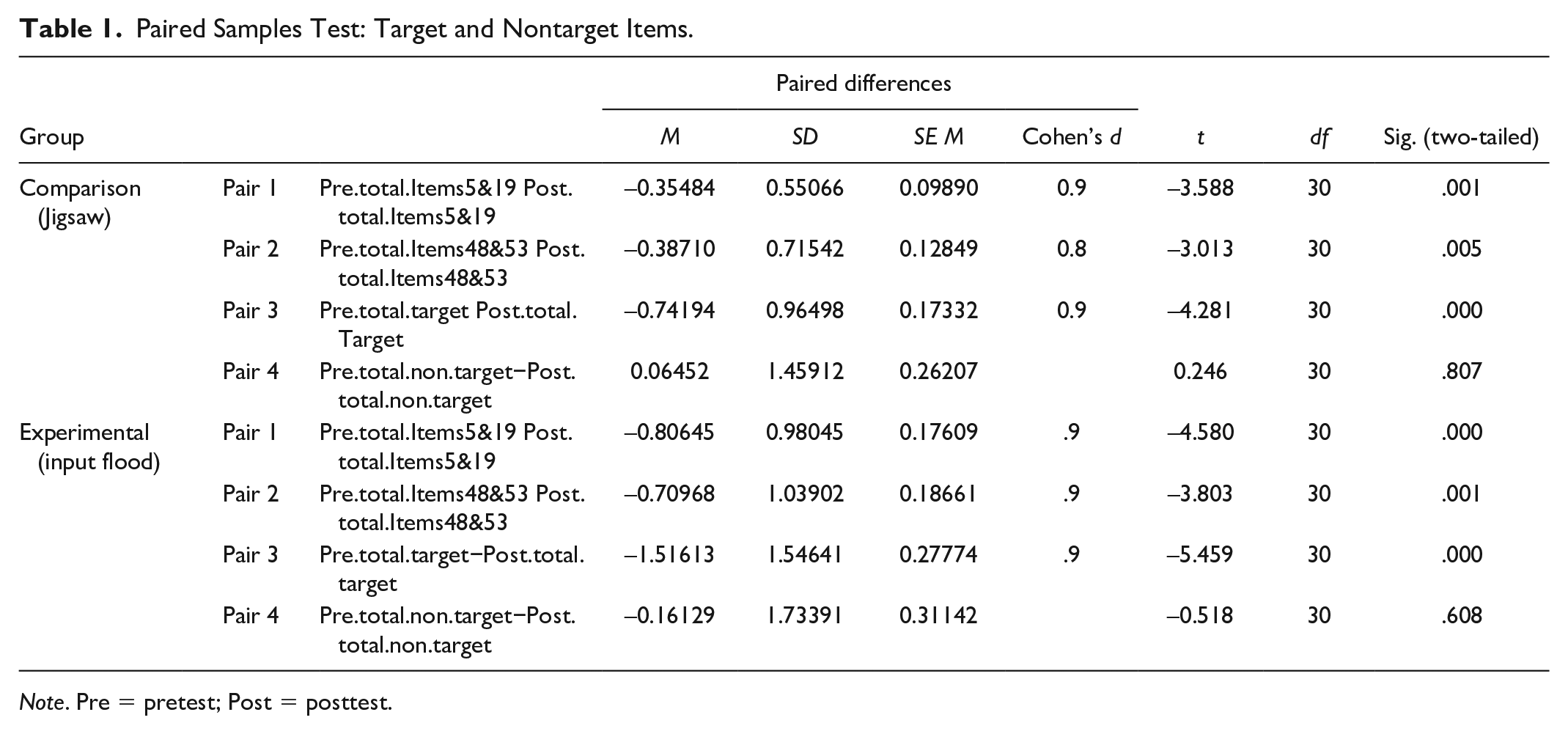
To answer the first question, it was necessary to compare the groups’ mean scores on Target Items 5 and 19, 48 and 53, and the total mean scores of these target items with those of the same items in the posttest to see whether any improvement had happened from the pretest to the posttest in the experimental and comparison groups. Furthermore, the pretest and the immediate posttest means of those grammar test items which were not under focus in the treatment (i.e., the nontarget items) were also calculated to determine whether any improvement in the comparison and experimental groups had happened from the pretest to the posttest so that finally we could compare the participants’ means of the target items and the nontarget items. To do so, paired samples t test was run (Table 1). The normality of the data was checked by computing skewness and kurtosis ratios, which all turned out to be within ±1.96, hence confirming that the normality assumption had been met.
Paired Samples Test: Target and Nontarget Items.
Note. Pre = pretest; Post = posttest.
Table 1 presents the paired samples t-test results, which showed that improvement from the pretest to the posttest in all scores of the target items in both groups (p < .001) was significant. It should be borne in mind that the effect sizes for the comparison and experimental groups were above 0.8, showing very large effect sizes according to Cohen’s (1988) standards for effect size. On the contrary, Table 1 indicates that as regards the nontarget items, no significant improvement had happened from the pretest to the posttest considering their pretest and posttest mean scores (p = .807) and (p = .608) for the comparison and experimental groups, respectively.
These results showed that when the groups were considered separately, both groups, instructed either through input flood tasks or through Jigsaw tasks, demonstrated significant improvement from the pretest to the immediate posttest in terms of accurate recognition of regular past tense /-ed/. However, this was not the case for the groups’ performance on the nontarget items.
To see which group showed more significant increases, multivariate analysis of variance (MANOVA) was run between the mean scores of Items 5 and 19, 48 and 53, and the mean scores of all the target items, as well as the nontarget item mean scores. Furthermore, because data showed that the two groups did not have equal pretest means, the pretest initial differences were all considered as covariate, and hence multivariate analysis of covariance (MANCOVA) was run to take into account the initial difference between the groups’ pretest mean scores and the covariate effect (Table 2).
Multivariate Tests a Between the Pretest and the Posttest Means.

Design: Intercept + Pre.Total.Q5&19 + Pre.Total.Q48&53 + Pre.total.target + Pre.total.non.target + Group.
Exact statistic.
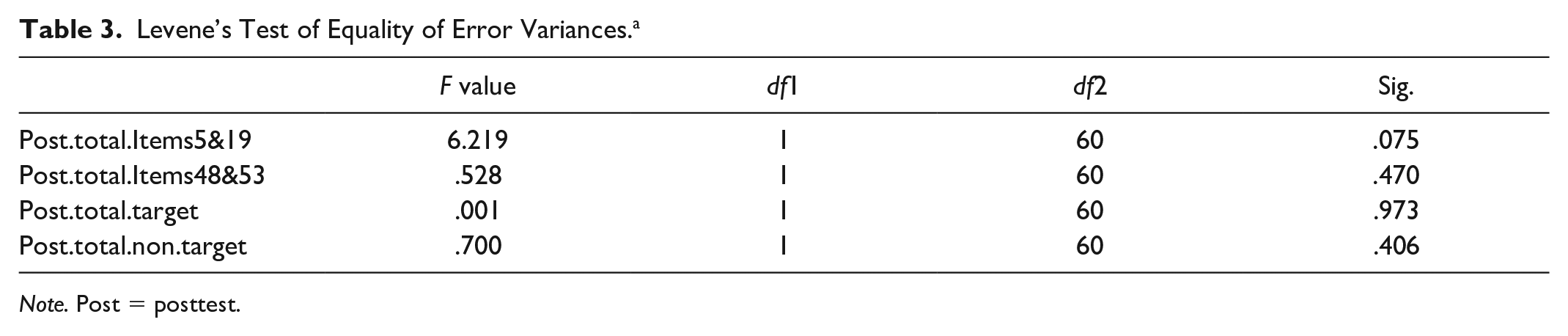
Table 2 presents the multivariate test results on the initial differences of the pretest and posttest mean scores of both groups between the target and the nontarget items. As shown, the results were significant (p = .024) with partial eta squared effect sizes larger than .15 showing medium effect sizes, meaning that a significant difference was observed between the comparison and the experimental groups considering their mean scores of target and nontarget items.To check each set of scores separately (i.e., the mean scores of Items 5 and 19, the mean scores of Items 48 and 53, and the mean scores of all target items, as well as the mean scores of nontarget items), a separate analysis of covariance (ANCOVA) was in order. Before running the ANCOVA, Levene’s test was run to check the quality of groups’ variances in terms of each dependent variable (Table 3).
Levene’s Test of Equality of Error Variances.a
Note. Post = posttest.
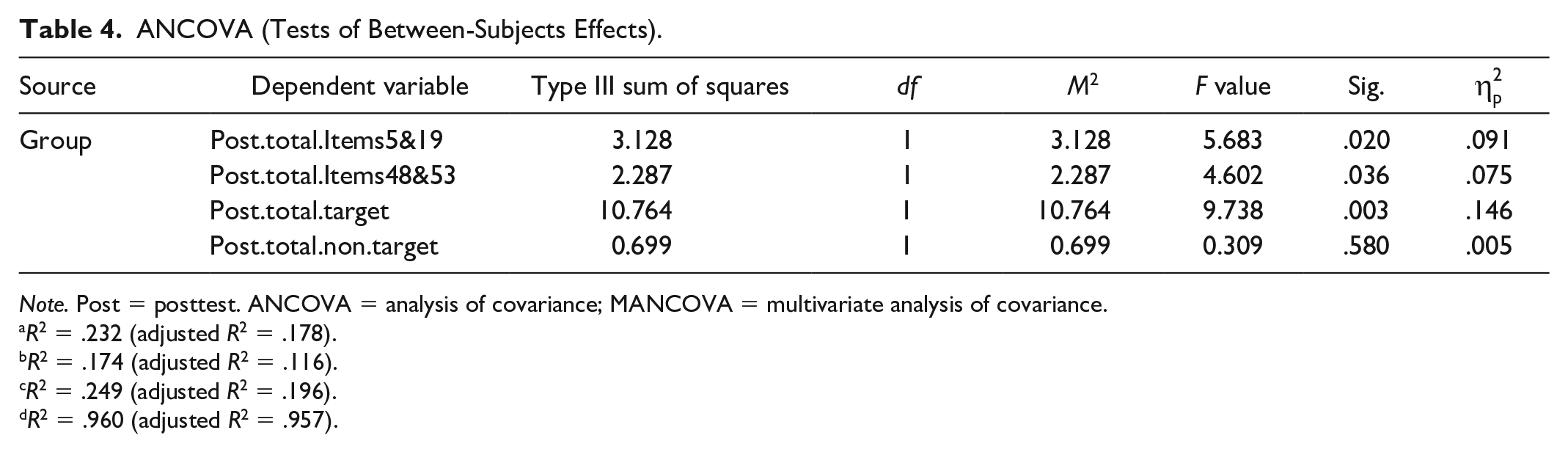
Table 3 represents Levene’s test on the quality of groups’ variances in terms of each set of scores. Accordingly, all these results were not significant (p > .05), hence showing that the assumption of homogeneity of variances had been observed. To find out whether the difference between the groups’ means was significant on the posttest or not, ANCOVA test was run. Table 4 presents the results of the ANCOVA.
ANCOVA (Tests of Between-Subjects Effects).
Note. Post = posttest. ANCOVA = analysis of covariance; MANCOVA = multivariate analysis of covariance.
R2 = .232 (adjusted R2 = .178).
R2 = .174 (adjusted R2 = .116).
R2 = .249 (adjusted R2 = .196).
R2 = .960 (adjusted R2 = .957).
Table 4 shows that the difference between the groups’ means was significant on the posttest with respect to the mean scores on Items 5 and 19
Taken together, the analyses of the data displayed that the learners in the experimental group did better than the learners in the comparison group on the target items of the posttest. Therefore, as for the answer to the first research question, we may say that focused enrichment tasks in the form of input flood tasks more positively affected the learners’ recognition of the instructed feature than the Jigsaw tasks, although the comparison group’s mean accuracy score was also improved in the immediate posttest.
The Second Research Question
As for the second question, it was necessary to juxtapose the immediate posttest mean scores of Items 5 and 19, the immediate posttest mean scores of Items 48 and 53, and the immediate posttest mean scores of all target items with those of the same items in the delayed posttest to see whether any durable recognition had happened from the immediate posttest to the delayed posttest in the groups of this study—that is to say, whether the improvements in grammatical item scores observed on the immediate posttest, as found in the previous question, were retained on the delayed posttest. It should be noted that the same procedure was followed regarding the nontarget item means to make necessary comparisons with the target items’ immediate and delayed posttest means (see Table 5).
Descriptive Statistics for the Immediate Posttests and Delayed Posttests of Target and Nontarget Items.

Note. Post = posttest; Del = delayed.
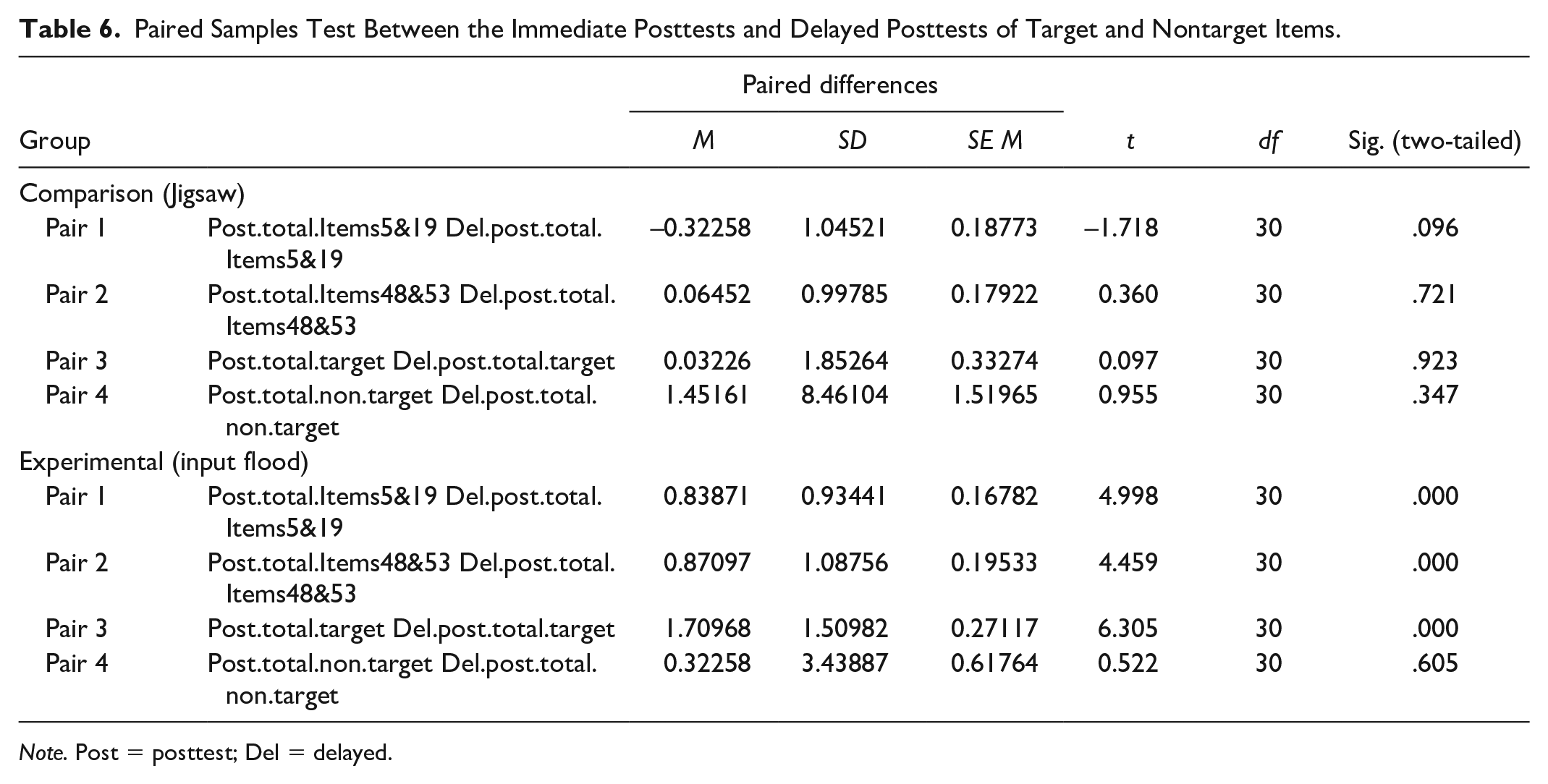
Table 5 presents the descriptives of the immediate posttest and delayed posttest mean scores of Items 5 and 19, the mean scores of Items 48 and 53, and the target item mean scores of both groups, as well as their nontarget item means. As represented, the groups had lower grammar mean scores on the delayed posttests. To determine whether the observed differences were significant in statistical terms or not, paired samples t test was performed (Table 6), before which the normality of the data was checked by computing skewness and kurtosis ratios which all turned out to be within ±1.96, hence meeting normality assumption.
Paired Samples Test Between the Immediate Posttests and Delayed Posttests of Target and Nontarget Items.
Note. Post = posttest; Del = delayed.
Table 6 presents the paired samples t-test results for the performance of the two groups on both the target and the nontarget items, which showed that there was indeed a significant decrease from the immediate posttests to the delayed posttests in all target item scores only in the experimental group (p < .001), but not in the comparison group (p > .05). Considering the nontarget items, evidently in both groups almost the same means as the means observed on the immediate posttest were retained on the delayed posttest. However, this does not mean that durable recognition had happened in terms of the nontarget items without any treatment focusing on them. After all, the same means as the posttest and the delayed posttest were also evident on the pretest of nontarget items too, showing that from the pretest to the delayed posttest no change had happened in the means at all.
In sum, these results show that when both groups were considered separately, EFL learners who were instructed with Jigsaw tasks (i.e., the comparison group) showed better long-term recognition of the instructed feature than the learners of experimental group who were instructed through input flood tasks.
The above analysis only showed the comparison of the immediate posttest and delayed posttest means in each group separately. To compare the long-term recognition of both groups in terms of the target and nontarget items and see which group showed more durable recognition of the targeted feature, MANOVA was run considering the mean scores of Items 5 and 19, the mean scores of Items 48 and 53, and the mean scores of the target items, as well as the mean scores of the nontarget items. Moreover, because Table 6 showed that both groups did not have equal immediate posttest means, MANCOVA was run. In this way, the initial differences between the immediate posttest means of both groups as the covariate effect were taken into account.
Table 7 presents the multivariate test results on the initial differences on the immediate posttests and on the delayed posttests considering the groups’ performance on both the target and the nontarget items. As shown, the results were significant (p = .002) with partial eta squared effect sizes larger than .25 showing large effect sizes, meaning that when all the target and nontarget items were considered together, there was a significant difference between the comparison and the experimental groups in terms of the target and nontarget item mean scores. With a view to examine each set of scores independently (i.e., the mean scores of Items 5 and 19, the mean scores of Items 48 and 53, and the mean scores of all target items, as well as mean scores of nontarget items), a separate ANCOVA was in order. Before running the ANCOVA, the homogeneity of variances was checked by running Levene’s test whose results are presented in Table 8.
Multivariate Test Results Between the Immediate and Delayed Posttest Means.

Design: Intercept + Post.Total.Q5.19 + Post.Total.Q48.53 + Post.total.target + Post.total.non.target + Group.
Exact statistic.
Levene’s Test of Equality of Error Variances.a

Note. Post = posttest; Del =delayed.
As Table 8 indicates, the results of Levene’s test on the quality of groups’ variances are not significant (p > .05), hence indicating that the assumption of homogeneity of variances had been observed. Table 9, of the main ANCOVA univariate test, presents data analyses which were run for each dependent variable separately.
ANCOVA (Tests of Between-Subjects Effects).

Note. ANCOVA = analysis of covariance; Del = delayed; Post = posttest.
R2 = .328 (adjusted R2 = .280).
R2 = .156 (adjusted R2 = .097).
R2 = .149 (adjusted R2 = .089).
R2 = .354 (adjusted R2 = .309).
The main ANCOVA univariate results showed that the groups were significantly different on the delayed posttest in terms of the mean scores of Items 5 and 19
All in all, we may postulate that the answer to the second research question is negative. That is to say, the instruction through input flood tasks did not lead to more durable recognition effect of the targeted feature than the instruction through Jigsaw tasks. In other words, Iranian EFL learners whose instruction consisted of Jigsaw tasks outperformed those Iranian EFL learners whose instruction consisted of input flood tasks in terms of durable recognition of past tense/-ed/ (Table 9).
Discussion and Conclusion
It was the aims of this study to see whether focused enrichment tasks are more effective than unfocused Jigsaw tasks in promoting Iranian EFL learners’ recognition of regular past tense /-ed/ in terms of accuracy and durability. To find the answers to these questions, a quasi-experimental design was used involving two intact university classes which were randomly designed to the experimental and comparison groups.
As for the first research question, we saw that the experimental group performed better than the comparison group. The higher achievement of the former could be interpreted in terms of the kind of instruction that the groups received. In this regard, Doughty (2005) argues that focused tasks are considered as focus on forms option, and thus they constitute a kind of explicit instruction, whereas unfocused ones can be considered as a focus on form strategy, a type of implicit grammar teaching. Hence, raising students’ consciousness through input flood enrichment tasks can lead to larger accuracy effects immediately after the instruction. This fact points to the rapid accuracy effects of explicit instruction provided through focused input flood tasks. On these grounds, Tode’s (2007) study showed that explicit instruction is more effective than implicit instruction “at least in terms of immediate effects” (p. 26). However, the comparison group also showed improvement on the posttest. For this group, the instruction consisted of Jigsaw task, a kind of implicit instruction as per Doughty’s argument. This kind of implicit instruction, according to Pica (2007), could have activated the processes of attention and interaction which are vital for learning features that are cumbersome to notice in the tasks presented to the learners. Thus, this has contributed to the comparison group’s gains on the posttest. However, once we compare the performance of this group with that of the experimental group, we realize that the experimental group outperformed the comparison group on the posttest. Consequently, we may argue that different task types have different effects as far as accuracy is concerned. For the purposes of this study, as the results showed, focused input flood tasks had a more positive effect than the Jigsaw tasks in promoting the learners’ recognition of the targeted feature immediately. The general findings of the immediate posttest, the improvement of both groups’ mean accuracy scores on the posttests, is consistent with previous research findings (R. Ellis, 2008) which have pointed to the beneficial value of FFI.
As for the second research question, the results revealed that the experimental group could not maintain their superiority to the comparison group overtime. The fact that input flood tasks (as a kind of enriched tasks) helped the experimental group improve their accuracy scores on the immediate posttest, but later on their effects disappeared on the delayed posttest can be explained in terms of R. Ellis’s (1995) discussion that interpretation tasks give teachers the opportunity to interfere directly in interlanguage development, but the teachers cannot be confident that such intervention will lead to desired results because intake may not necessarily turn into implicit L2 knowledge. More specifically, research has shown that enhanced input may not be sufficient to induce changes in the learners’ interlanguage systems (Izumi, 2002). Therefore, from the previous discussions, we argue that input enhancement presented in the form of input flood in our study may result in immediate changes in the learners’ recognition ability, but as Radwan (2005) mentions, these changes were insufficient to lead to permanent changes in the learners’ cognitive systems. Thus, we can argue that different kinds of tasks seem to have differential effects on language acquisition. This is consistent with R. Ellis’s (2008) conclusion that “the type of instruction influences learning outcomes” (p. 902). In other words, it is the inherent essence of the task which decides learning outcomes. Consequently, one can argue that the input flood tasks due to the their inherent nature, that is the frequent occurrence of the targeted features, are more robust in helping the participants to notice the targeted form, and this has resulted in the experimental group’s higher recognition accuracy scores on the immediate posttest. Moreover, on the basis of Doughty’s (2005) argument, we may elaborate that explicit instruction imparted to the experimental group through input enrichment tasks may result in higher accuracy gains than the implicit instruction given to the learners in the form of Jigsaw tasks. However, the results of explicit instruction presented in the form of input flood tasks may not persist over time. Following the same line of reasoning, Lee and Huang (2008) have also argued that input enhancement procedures are effective means to increase learners’ noticing of the L2 forms, but these effects can be diminished over time. Similarly, R. Ellis (2016) explains that “Even if learners do notice the target feature, they may not acquire it. Noticing affects intake but not everything that is taken into working memory passes into long-term memory” (p. 417). The results of Tode’s (2007) survey on the effects of explicit and implicit instructions seem to be similar to the results of our research. Her study pointed that although explicit instruction had a positive effect in the short term on the acquisition of the copula “be,” this impact was not permanent on the delayed posttest and after the presentation of the progressive “be.” Moreover, her study showed that implicit instruction did not have any effect on the acquisition of the progressive “be.” This finding is in contrast with the findings of our investigation which displayed that the Jigsaw tasks helped the learners improve their accuracy scores on the immediate posttest. This difference could be interpreted in the light of the kind of implicit instruction the groups received. In her study, the implicit instruction consisted of repeatedly pronouncing the sentences containing the grammar features in pairs or in a chorus and memorizing them. Tode (2007) explicates that “Norris & Ortega’s (2000) conclusion that explicit instruction is more effective than implicit instruction has to be interpreted with caution in terms of durability” (p. 13).
From the preceding discussion, we maintain that durability (Tode, 2007) is one of the central issues which pops up when considering the accuracy effects of instruction. For example, Keck et al.’s (2006) meta-analysis showed that the effects of the treatments in the studies, which were examined, were durable. R. Ellis (2008) concludes that the effects of some types of FFI may not be evident on the immediate posttest and may emerge on the delayed posttest. According to R. Ellis, these studies confirm the weak interface hypothesis. As Ellis (2008) explains, under the weak interface model, “instruction does not enable learners to acquire what is taught when it is taught, but prepares the way for its subsequent acquisition” (p. 846). As for the results of this study, we take the same line of reasoning and maintain that unfocused task instruction (i.e., Jigsaw tasks) effects were not evident on the immediate posttest, but facilitated the way for later attainment of the instructed feature as demonstrated by the subjects’ performance on the delayed posttest.
R. Ellis (2008) expands that the opposite does hold true for some other types of FFI. According to him, some FFI may result in immediate effects, but these effects disappear in delayed posttests. Moreover, he explicates that this phenomenon can be accounted for in respect of the effects of the instruction in that the instruction only developed explicit (declarative) knowledge which then diminished for the reason that the learners were not developmentally “ready” to learn it or because of learners’ no subsequent communicative exposure to the instructed features. Pica (2007) also adds that FFI may result in immediate gains, “even for difficult-to-learn L2 features such as measure words, questions, and articles,” but these sorts of instructions may not lead to a lasting effect on the process of L2 acquisition (p. 167).
Specifically, this study indicated that Jigsaw tasks, as a kind of unfocused tasks, allow students to improve their knowledge of instructed features both immediately and overtime. Compared with the input flood tasks, as a type of focused tasks, it can be argued that both types of tasks may raise the learners’ consciousness on L2 forms; however, the effects of input flood tasks may diminish after the instruction. In other words, the results indicated that both learners’ degree of attention to form once raised as the measure of accuracy and their attainment of grammatical instructed feature as the measure of durability are dependent on the task type. Taking into consideration the arguments of R. Ellis (2008), Doughty (2005),and Pica (2007), it can be discussed that focused enriched input flood tasks as a kind of explicit focus on forms option can result in immediate accuracy gains, but such effects seem to disappear overtime. However, the case is different for Jigsaw tasks which, according to Doughty, are considered as a kind of focus on form option. Hence, the Jigsaw tasks result in long-term effects than the focused enrichment tasks. Hence, the results indicated that the type of tasks determines the learning outcomes.
To explain the durability issue in a different way, we have proposed the “Red Traffic Light Metaphor” (see also Brown’s (2014) presentation of metaphors used to describe SLA factors) to describe the decline of the short-term effects of explicit instruction. The explicit instruction (focused input flood tasks in our study) may result in higher accuracy gains because they are acting like a Red Traffic Sign for the cognitive system of the learners. The frequency of the regular past tense /-ed/ in the input flood tasks may act as an alarm and immediately raise the learners’ consciousness on the instructed feature. This results in higher accuracy gains for the experimental group on the immediate posttest. However, the effects of these focused tasks seem to be temporary and the Red Traffic Sign is immediately switched off after the instruction period. This results in the decline of the accuracy effects on the delayed posttest for the experimental group. The results of the study implicate that the targeted feature may not have been incorporated into the interlanguage of the learners. For the comparison group, who were instructed through unfocused tasks (i.e., Jigsaw), the situation is different. The Traffic Sign seems to be green and switched on in both situations (the immediate and delayed posttests). That is, the instructed features have entered and incorporated into the learners’ interlanguage systems due to the type of instruction they have received (i.e., unfocused Jigsaw tasks). This fact points to the gains of the comparison group on both the immediate and the delayed posttests.
Implications of the Study
The enhanced durability of the comparison group on the delayed posttest may be interpreted as the evidence for the successful integration of the instructed feature into the learners’ interlanguage system (R. Ellis, Loewen, & Erlam, 2009). Therefore, it is suggested that mere use of focused tasks should be abandoned if language teachers aim both at accurate and at durable effects, and this necessitates the integration of unfocused tasks and focused tasks in the syllabus. In this regard, Balcom and Bouffard’s (2015) study showed that the mere use of input flood may not aid acquisition and it should be combined with other sorts of instruction such as textual enhancement.
Moreover, Fotos and Ellis (1991) have maintained that it is necessary for grammar tasks to incorporate information gap so that negotiation of meaning is required for their completion. The results of this study confirm that Jigsaw tasks are a viable means to provide the required information gap. Thus, in general, we recommend that unfocused tasks should accompany focused tasks to achieve the durability effects of grammar instruction. Our recommendation calls for what R. Ellis (2009c) terms a hybrid syllabus, a syllabus which is a blend of focused and unfocused tasks. This integration sounds promising in that it offers a framework to scrutinize the effects of both attention and interaction in the classroom. In the proposed methodology, the function of the focused tasks may be to promote the learners’ attention to L2 forms. The information gap in Jigsaw tasks could activate the interaction that the students need about the target language forms. The proposed methodology involving the integration of both focused and unfocused tasks can ensure that both variety and authenticity are provided in the classroom. This suggestion is in line with R. Ellis’s (2003) modular approach consisting of two separate modules, that is, a communicative module (made up of unfocused tasks) and a code-based module (composed of focused tasks) which to quote R. Ellis’s (2003) terms “is compatible with the process of L2 acquisition” (p. 238). As he explains, during the communicative module, systematic opportunities are provided for the learners to work on accuracy, fluency, and complexity, and during the code-based module, the learners are helped to learn those features of language that are found to be difficult to be learned naturally. This could be interpreted, as what R. Ellis means, by the notion of compatibility with the process of L2 acquisition.
R. Ellis (1995) adds that “a complete language program will include a variety of tasks that invite both a focus on form and a focus on message conveyance” (p. 100). Hence, the implications of our study necessitate a move from “Effect-Oriented Pedagogy,” where specified types of instructions (focused tasks) are manipulated by teachers to explore their effects (accuracy gains), to “Teacher-Oriented Pedagogy,” where teachers’ informed prior knowledge of different kinds of instructions (unfocused tasks and focused tasks) leads them to choose a particular type of instruction to achieve planned specific results (durability plus accuracy effects). As Skehan (1996) has maintained, “the main factor affecting performance during the task is the choice of the task” (p. 55). On the same grounds, others add that Second language pedagogy of tasks will be viable only if it seeks out systematic relations between tasks and language learning (issues of design, learning focus and interaction types), and the ways in which tasks are implemented in the classroom to promote learning (notably the use of planning, feedback and teacher guidance and support). (Samuda & Bygate, 2008, p. 74)
Accordingly, we suggest that the literature on raising learners’ attention to L2 forms should also include unfocused tasks, especially Jigsaw tasks, as a way to draw learners’ attention to L2 forms in the context of TBI. Moreover, language teachers should also consider the fact that the effect of some types of tasks (i.e., Jigsaw tasks) may not be immediately observed after the instruction. This also necessitates the addition of one or more delayed posttests into TBI studies to assess the instruction effects. This suggestion is harmonious with N. Ellis’s (1993) postulation that effects of implicit instruction, in this case Jigsaw tasks, are sometimes slow and thus may require more time than explicit instruction, in this case input flood tasks, to lead to effective gains.
The findings of this study could be more appealing if the study had included a measure of the learners’ production performance, such as through a writing test. It could be intriguing to see whether Jigsaw and input flood tasks would result in the same effects on the writing test as they did in this study on the UGJT. In addition, it could be interesting to see whether these two types of tasks would have the same effect on other grammar features. Replicating this study with participants majoring in other areas of study, especially those majoring in English as a foreign language, would add more strength to the findings of this study. These are the areas for further research.
Footnotes
Declaration of Conflicting Interests
The author(s) declared no potential conflicts of interest with respect to the research, authorship, and/or publication of this article.
Funding
The author(s) received no financial support for the research, authorship, and/or publication of this article.
