




Abstract
This study examines synonymy in Standard Igbo (SI) to empirically determine if absolute synonyms actually exist in SI. By the application of cognitive linguistic theory and by adopting a descriptive survey method, the study tries to ascertain the factual behavior of synonyms in SI. The data used for this research work are gathered from documented materials from authors who have written on Igbo synonymy. Forty-six pairs of Igbo synonyms are subjected to analysis using the interchangeablity/substitution method to determine if members of a pair can always substitute each other in all contexts. The study discovers that there are always subtle but noticeable meaning differences realized between the members of the pairs, which is caused by contextual, collocational, and connotative restrictions. The study concludes that members of synonymous pairs in the SI differ from each other when they are placed in certain contexts. Hence, absolute synonyms do not exist in SI as claimed by some of previous scholars.
Introduction
Meaning is an apparent feature of language. Yet, the concept of meaning has been a vague aspect of linguistics. This could be because we are so used to using language to interact with each other and to effectively relate what we mean to others and also understand what people say, using a language in which we are competent, that we have little or no conscious understanding of the principles that underlie this communicative expertise. Although meaning has been observed to be quite ambiguous and controversial, such a fundamental concept cannot be abandoned. For instance, Ullmann (1981) suggests that “the ambiguity surrounding the concept of meaning can be minimised if we pay attention to word meanings” (p. 54).
Synonymy is one of the basic sense relations that exist between words/lexical items. Other basic sense relations include hyponymy (sense inclusion), meronymy (part/whole sense relation), polysemy (sense variation), and antonymy (oppositeness in sense). Synonymy has to do with sameness in meaning. However, the idea of “sameness of meaning” does not necessarily imply absolute sameness as noted by scholars like Lyons (1968), Palmer (1981), Crystal (1995), Kreidler (2002), Murphy (2003), Stanojević (2009), and Omego (2014).
The concept of absolute synonymy connotes complete meaning identity in all respects and in every context. This level of sameness in meaning is viewed by most scholars as uncommon in a natural language. What is usually common is partial or near synonymy, where, according to Murphy (2003), two words share meaning identity but could not satisfy one or more conditions of being absolute synonyms. In partial synonymy, there is, at least, one meaning which one of the words does not share with the other. Partial synonyms can also differ in their collocational ranges and connotative meanings.
Broadly, synonymy falls into two categories—lexical and sentential synonymy. Lexical synonymy has to do with the sense relations that exist between two or more lexical items that share the same sense in a particular context where they are substitutable. On the contrary, there can also be a sense relation between clauses and sentences. This type of synonymy has to do with paraphrases and propositional contents of expressions. This is known as sentential or propositional synonymy. This study is only interested in lexical synonymy.
The various sense relations that exist between lexical items in languages have been of interest to linguists and grammarians (see Emenanjo, 2015; Obiora, 2010; Okeke, 2015; Omego, 2014; Stanojević, 2009; Ubahakwe, 2002). Sense relation of sameness in meaning is among such studies as can be seen in the “Synonymy: An Overview” section of this study. There is a general assumption by linguists like Lyons (1968), Palmer (1981), Crystal (1995), Kreidler (2002), and Stanojević (2009) that absolute synonyms are not common in natural languages. Omego (2014) is of the same view with the above scholars in her study of the Owerri dialect of Igbo. However, Ubahakwe (2002) and Obiora (2010), who study synonymy in Standard Igbo (SI), claim that there are many SI words that have exactly the same meaning in all contexts. In other words, Ubahakwe and Obiora are of the view that there are many absolute synonymous lexemes in the SI.
This study, therefore, revisits synonymy in SI to ascertain if the claim made by Ubahakwe (2002) and Obiora (2010) is true or false. This study is necessary because SI is enriched from various dialects of Igbo. It is also a serious contradiction and misrepresentation of the Igbo language for some studies, Ubahakwe (2002) and Obiora (2010), to claim that absolute synonymy abounds in SI and another study (Omego, 2014) to claim that there are no absolute synonyms in Igbo dialects. Therefore, the present study engages the above-stated problem to clarify the actual level of sameness in meaning relation shared by Igbo synonyms thereby settling the controversy that has beclouded Igbo synonymy for some years now. Moreover, as Ubahakwe (2002) and Obiora (2010) contradict the general opinion of scholars concerning the presence of absolute synonyms in natural languages, it is important to embark on this research to substantiate Ubahakwe’s (2002) and Obiora’s (2010) claim or refute it.
It is pertinent at this juncture to present a brief overview of the SI dialect. Ogbalu (1974) defines the SI as “. . . the Igbo that every man understands, writes and speaks in all parts of Igbo speaking areas” (p. 24). Ogbalu further points out that no particular Igbo speech community can claim to be the owner of SI; rather, SI is enriched from different dialects of the Igbo language and it serves as a dialect of wider communication in the south-eastern part of Nigeria, especially in official settings. That notwithstanding, other Igbo-speaking communities still use their dialects and preserve them for identification.
The major objective of this study, therefore, is to establish if there are absolute synonyms in SI. Through contextual analysis of synonyms identified in SI, this research work provides an empirical answer to the issue bordering on the presence of absolute synonymy in SI.
Synonymy: An Overview
Synonymy has been defined by scholars as the sense relation that exists between two or more words that have identical, very similar, or closely related meanings (see Nordquist, 2017; Yule, 1996). However, Stanojević (2009) posits that it is vague defining “synonymy as identity of meaning since there are no two terms with completely identical meaning” (p. 193). This can be the basis of Murphy’s (2003) definition of synonyms as two words that are close in meaning. Furthermore, synonymic relationship can exist between words, phrases, and sentences. In this vein, Stanojević (2009) classifies synonyms “either into lexical and propositional synonymy, or into lexical, phrasal and propositional synonymy” (p. 194). He explains that the above classification is the same only that in the first division, which is lexical synonymy, it comprises phrasal synonymy. According to Stanojević, lexical synonymy is a sense relation that exists between two or more lexical units (bound morphemes, lexemes, and phrases) that have the same sense in certain contexts where they are interchangeable. Propositional synonymy, on the contrary, deals with clauses and sentences and can be explained “by means of paraphrase when the propositional contents of sentences are identical” (Stanojević, 2009, p. 194).
When two or more words have total/complete identity of all their meanings in all contexts, they are said to be absolute synonyms (see Cruse, 2000). Cruse argues that it is unnatural for languages to have absolute synonymy because the use or function of one of the words will obviously but gradually become unnecessary or unmotivated and will be abandoned. Cruse (2000) also asserts that all-context interchangeability is always empirically not proven. He states, in conclusion, that the notion of absolute synonymy is used only as a referential point on the scale. In Cruse’s (1986) opinion, absolute synonymy can be possible only in technical domains. He gives example of Bovine Spongiform Encephalopathy (BSE) and Mad Cow Disease, which are two names for the same disease. Cruse’s illustration above is more of diglossia, which according to sociolinguistics involves the same speaker(s) using different concepts for the same thing under different conditions within a community. Therefore, absolute synonyms are completely identical in meaning in all respects and in every context.
According to Murphy (2003), for a pair of words to be regarded as absolute synonyms, they have to fulfill the following conditions:
All their meanings are identical;
They are synonymous in all contexts;
They are identical for all dimensions of meaning.
Anagbogu et al. (2010) align with Murphy’s view when they assert that two words which are synonyms have to share identical meaning, have the same collocational privileges, and must be able to replace each other in all contexts; otherwise, we hold their differences constant whenever we say they are synonyms. But in Palmer’s (1981, pp. 89–91) view, absolute synonyms do not exist because of the following reasons:
(a) The synonyms can be as a result of dialectal variations as in the case of fall (American English) and autumn (British English).
(b) The different words that have the same meaning can be as a result of change in style. In this case, degrees of formality always affect the use of the synonyms as in the case of gentleman, a more formal word than man.
(c) A set of words may share the same conceptual meaning but have different emotive or evaluative meanings as in politician/statesman.
d. A set of words may also share the same conceptual meaning but may differ in their collocational contexts.
So, for one or more of the above-mentioned reasons given by Palmer (1981), lexical items from literature do not have absolute meaning sameness.
Empirical Studies
Ubahakwe (2002) posits that Igbo is rich in absolute synonyms. Ubahakwe claims that his study is based on the data he collected in 1978 from across Igbo land, excluding the Anịọma area, west of the Niger, and the riverine areas. Ubahakwe (2002) used a word list of 42 lexical items to collect 1,660 word variants in Igbo. According to Ubahakwe’s (2002) finding, Igbo is rich in absolute synonyms. He argues that the average number of variants or synonyms recorded per word was 35:49, with words like ísí “head” recording eight variants; ugbu a “now” recording 136 variants, and íkè “buttocks” recording 90 variants However, a look at the examples pulled out from Ubahakwe’s (2002) study shows that they are just word variants, not synonyms. For instance, for nkịta “dog,” he has the following: 1
A look at Ubahakwe’s (2002) instances of synonyms shows that what he classifies as synonyms are phonological variants and euphemisms of SI words, which are actually dialecticisms; hence, they are completely interchangeable and substitutable. But they are not synonyms let alone being absolute synonyms. In other words, all the words in (1) refer to “dog” depending on the dialect of Igbo one speaks. The same explanation goes for the other data used by Ubahakwe (2002).
Furthermore, Obiora (2010) studies synonyms in Igbo using Palmer’s (1981) substitution and oppositeness methods of testing true synonyms. Obiora, however, uses only the substitution method in her analysis. Her study presents a comprehensive list of synonyms in SI. These synonyms are used in contexts to prove that they are true synonyms. Like Ubahakwe (2002), Obiora (2010) concludes that there are numerous absolute synonyms (51 in number) in SI. She consequently claims that the assumption that there are no absolute synonyms in a natural language is an overstatement. However, a look at some of the data in Obiora’s (2010) study shows that the pairs presented are not synonyms but different words with different meanings in the Igbo language. Observe example (2) below.
2a. ìkpè/nkọcha—“satire/lampoon” and b. ọdachi/mberede—“mishap/accident”
Other pairs of words, which Obiora (2010) claims are absolute synonyms are discussed in details in the section entitled “Igbo Synonyms.” Obiora (2010) is related to the present study because both are on synonymy in SI but Obiora (2010) is one sided in her analysis in the sense that it used only those contexts where a set of words share the same meaning to show that they are absolute synonyms, ignoring contexts where the words have different meanings (see section “Igbo Synonyms”). But the present study explores all the contexts where the pairs of words could occur, to actually see if these pairs of words could satisfy the test for absolute synonymy.
Omego (2014) is a study on synonymy in the Owerri dialect of Igbo to ascertain whether absolute synonyms exist in the lexical structure of Owerri-Igbo. She used both questionnaire and interview to collect data from fluent native speakers of the Owerri dialect. The study identifies some pairs of synonyms in the Owerri dialect of Igbo. The researcher, however, subjected the identified synonyms to test, using substitution method, and discovered that these pairs are not absolute synonyms in the Owerri dialect of Igbo. Omego notes that none of the pairs of synonyms studied in the dialect satisfies the condition for absolute synonymy. She finds out that the identified synonyms cannot substitute for each other in all contexts as in sa/ma—“wash.” She observes that while an Owerri speaker can say 3a. O jiri mmiri ahụ sa/ma uwe—“She/he used water to wash cloth” and b. O jere mmiri sa ahụ ya—“She/he went to the stream and washed his/her body (took his/her bath)”;
an Owerri speaker will not say c. *O jere mmiri ma ahụ ya., to mean “She/he went to the stream and washed his/her body.” She also uses connotational differences to test if the identified synonyms are absolute synonyms. She exemplified with d. aparị/nzuzu—“foolishness.”
She observes that “aparị has the connotation of imbecility or utmost stupidity, which nzuzu does not have” (Omego, 2014, p. 188). She also explains that the synonyms e. mèshie/gùshie—“close”
differ in their collocational restriction as one can say mèshie/gùshie ụzọ—“close the door” and mèshie akwụkwọ—“close the book” but not f. *gùshie akwụkwọ to mean “close the book.”
She finally concludes that there are no absolute synonyms in the Owerri dialect of the Igbo language. Omego’s (2014) study is related to the current study because both are studies on Igbo synonymy but the current study is on the SI (which is the literary and formal variety of the Igbo language) while Omego (2014) is on the Owerri dialect of Igbo.
Various studies have also been carried out on synonyms in English. Kreidler (2002) explores the manifestations of synonyms in the English language using truth conditional semantics. Kreidler (2002) presents some sets of synonymous pairs within English contexts such as “Jack is a seaman” versus “Jack is a sailor” observing that assuming that Jack refers to the same subject in the two sentences, then, the second sentence is true only if the first sentence is true and vice versa, and if either of the sentences is false, the other is equally false (pp. 96–99). Kreidler asserts that this is the basis for ascertaining that seaman and sailor are synonyms in English; that is, “when used in predications with the same referring expression, the predications have the same truth value”; hence, synonymy exemplifies mutual entailment. Kreidler also illustrates that synonyms can be found within English word classes such as noun, adjective, adverb, and verb. Kreidler, however, observes that the relationship between English synonyms are not absolute because words that are seen as synonyms of each other do not always share the same range of syntactic occurrence, and they often differ in what they suggest even when their range of syntactic occurrence is the same. He further explains that what are often referred to as synonymous pairs in English could be dialectal variants. He concludes by stating that English seems to have a lot of synonymous pairs and even trios because of its “double-barrelled vocabulary, Germanic and Romance” (Kreidler, 2002, p. 99). The current study is related to Kreidler’s (2002) study because both are studies on synonymy and both studies are attempts to confirm or refute whether absolute synonyms exist in natural languages, but while the current study is on SI, Kreidler’s research work focused on English.
In his own study, Bolshakov (2004) uses the linguistic steganography method aimed at the automatic concealment of digital information in rather long orthographically and semantically correct texts to examine among other things the notion of synonymy to clarify that synonyms can not only be separate words but also multiwords. To achieve the aim of his study, he divides all synonyms into absolute and relative synonyms. Following the steganography method, groups of absolute synonyms were used in a context independent manner, while the groups of relative synonyms were tested beforehand for semantic compatibility with the collocations containing the word to be replaced. A specific replacement was determined by the hidden information. The collocations were syntactically connected and semantically compatible pairs of content words. The steganographic algorithm was also outlined informally, with a rough evaluation of the steganographic bandwidth. The findings according to Bolshakov (2004) show that “series of the synonymy-oriented works render resulting texts syntactically correct, but potentially conspicuous, since semantically they are incoherent, leaving alone their original meaning” (p. 181). The present research work is similar to Bolshakov’s (2004) study because both studies examine synonyms in languages, but they differ in their methods of data collection and procedure for data analysis. Also, the present study focuses on Igbo, while Bolshakov’s steganograpy method does not depend on a particular language per se, but its implementation heavily depends on available language-specific resources. Nevertheless, he uses English examples to illustrate his considerations in all cases, while the specific steganographic examples are in the Russian language.
Samina et al. (2015) examine and compare absolute synonymous pairs on their lexical, syntactical, and stylistic levels. The aim of that study was to prove that corpus-based study interlaces the dictionary meaning of words with real, authentic, and natural language called “real English.” By using quantitative linguistic analysis, corpora from Corpus of Contemporary American English and British National Corpus were used in investigating absolute synonyms along with the different online dictionaries. The findings of their research work are in two sections. The first section of their analysis shows dictionary definitions of synonymous pairs, which could be defined as absolute synonyms based on the findings of previous linguists. But unlike the first section, the second section, which is the main section of their study, shows a significantly different result based on the investigation of the corpora used in the study. Thus, the corpora negate the existence of absolute synonymy in the English language. The words isolated in the corpora were distinguished by different shades of meaning, connotations, and stylistic features. Furthermore, according to Samina et al. (2015, p. 11), even the so-called absolute synonyms observed in the first section of their analysis might persist in the vocabulary because they belong to different dialects. That was the case in pairs of synonyms in British and American English words (lorry/truck, lift/elevator, jail/prison). The prevailing view among linguists of various linguistic provenances, according to Samina et al. (2015), is that “. . . such absolute synonyms are either an extremely rare occurrence or—according to the majority of linguists—their existence is altogether questionable” (p. 11). Samina et al.’s (2015) view is still in line with Kreidler’s (2002) position that the so-called absolute synonyms are dialectal variants. Samina et al.’s study is related to the present study because both are inquiries into the nagging issue of the existence of absolute synonyms in languages, but the languages of investigation differ.
Theoretical Framework
The framework adopted in this study is cognitive semantics and associative dimension approach to meaning. Cognitive semantics is a branch of cognitive linguistics that sees language as an aspect of a more general human cognitive ability. The cognitive semantic view, according to Croft and Cruse (2004), implies that language and speaker’s intuitive knowledge about language can be seen as a window through which the underlying cognitive system can be viewed. Geeraerts (2010) observes the different areas of cognitive semantics to include the prototype model of category structure, the conceptual theory of metaphor and metonymy, idealized cognitive model, and frame theory. This study is concerned with the idealized cognitive models and frames.
According to Geeraerts (2010), idealized cognitive model and frame upholds that the human “knowledge of the world is organised in broader categories, ‘larger chunks of knowledge’ . . . and all of these forms of knowledge far transcend the boundaries of a single lexical item” (p. 223). There is a need, then, to have “a way of representing those larger chunks of knowledge, together with a means of linking all the relevant lexical items to that broader conceptual structure.” (Fillmore & Atkins, 1992, p. 76). The implication of the above assertion is, according to Fillmore and Atkins (1992), that meanings of words are understood by making “reference to a structured background of experience, beliefs or practices, constituting a kind of conceptual prerequisite for understanding meaning” (pp. 76–77). Meanings of words are, therefore, understood by “first understanding the background frames that motivated the concept that the word encodes” (Fillmore & Atkins, 1992, p. 77). Therefore, word and word senses are not related to each other directly, word to word, but . . . by way of the links to common background frames and indications of the manner in which their meanings highlight particular elements of such frames. (Fillmore & Atkins, 1992, p. 77)
It is on this theoretical background that this study is based.
The major aspect of cognitive semantics that this research work wants to emphasize is that lexemes cannot be understood independent of larger knowledge of the structure. Therefore, to actually get the meaning of a lexical item, a native speaker, according to Fillmore and Atkins (1992, p. 77) refers to his or her background experience, beliefs, and practices. In other words, Fillmore and Atkins aver that the meaning of a linguistic unit is matched up with an idea held in the mind of a native speaker, which is established from personal understanding and experience in various contexts. It is on the basis of idealized cognitive model that this research work wants to study synonyms in SI to establish how native speakers could differentiate between synonyms and determine if a particular word is appropriate in a particular context or not. Within this model of cognitive semantics, there is no principled distinction between semantics and pragmatics. This is basically because meaning emanates from context, which is one of the main areas of cognitive semantics.
On the contrary, Mwihaki (2004) observes that associative meaning is a dimension of meaning in semantic studies. He goes on to define the concept of associative meaning as an expression that involves the individual’s mental understanding of the speaker in relation to a concrete or abstract entity as used in context. In line with Mwihaki’s (2004) view, Sabu (2010) says that for one to be understood by people, the lexical items that make up one’s utterance(s) must have meaning, and sometimes words have more than one meaning depending on their associations with other words in different contexts of use. Sabu (2010) identifies the following dimensions of meaning: conceptual, connotative, social, affective, reflected, collocative, and thematic meanings. Mwihaki (2004) reduces these seven dimensions of meaning to two when he avers that apart from conceptual meaning, the other six dimensions of meaning can be classified under the umbrella term associative meaning.
Broadly speaking, therefore, contextual, collocational, and connotational meanings are dimensions of meaning that derive from associative meaning according to Mwihaki (2004). Carter (1998) defines associative meaning as that relationship between lexical items that regularly co-occur in certain contexts. Longman Dictionary of Contemporary English (Pearson Education Limited, 2014) also provides a similar definition and follows the same approach by defining association in relation to language as the way in which some words are often used together, or a particular combination of words used in this way as conceived by the language users. In associative meaning, we derive meanings from words combined, following a particular order, in a manner that the mere mention of one of the words automatically conjures up the meaning of the other based on what the word connotes for the native speakers in a particular cultural domain or context. This study aligns with Okeke and Egbuta’s (2017) view that associative meaning is the permitted and acceptable patterns within the language structural frame of selectional restrictions; having both compositional and derived meanings as conceived by native speakers of a language in different contexts of use. Okeke and Egbuta’s view is adopted in this study because it ties up the idea of cognitive semantic theoretical framework and the associative approach to meaning adopted in this study.
Method
This is a descriptive survey research work that sets out to investigate synonymy in SI. Data used for this study were sourced from both primary and secondary sources. The appraisal tool was used to source for secondary data from published research works of some authors, who have written on the topic, among whom Obiora (2010) is one. The primary data, on the contrary, were gathered from the oral interview of native Igbo speakers in various contexts stored in an audio file and the researchers’ introspection as native speakers of the Igbo language. Following Obiora (2010), the researchers used the substitution method of testing synonyms in this study. By using the tenets of cognitive semantics and associative dimension to meaning, as explained in section “Theoretical Framework,” the data were analyzed and conclusion drawn from the analysis.
Data Presentation and Analysis
This section analyses the data used for this study. The data comprise a number of pairs of words that are observed to be synonyms in the SI. This section is divided into two. The first section analyses some identified synonyms in Igbo to show that they share some meaning relation while the second section further analyses the same set of synonyms to demonstrate whether or not their meaning relatedness is absolute.
Igbo Synonyms
Table 1 comprises some Igbo words that are synonyms, as well as the environments where sameness in meaning is possible.
Synonyms in Igbo.

Table 1 shows that there are synonyms in Igbo. These synonyms are mostly nouns (see Items 1–40 of Table 1). Although the majority of the words presented in Table 1 are nouns, nouns are not the only class of words where one can find synonyms in Igbo. Igbo synonyms can be adverbs as in Items 41 and 42; quantifier (Item 43), and even verbs (Items 44–46). A close observation of Table 1 shows that each set of words presented has the same sense in the contexts where they are used. Therefore, one can rightly say that the lexemes presented in Table 1 are synonyms in the Igbo language.
Test for Absolute Synonymy in Igbo
Having established that the lexemes presented in Table 1 are synonyms by providing some contexts where their meanings are the same, we need to take the demonstration further by substituting one lexeme for another in other contexts to determine if the senses are maintained. If these words can substitute for each other in the same context, then, they are absolute synonyms; otherwise, they are not. As we shall observe in Tables 2 to 4, synonyms in Igbo can be restricted by context and collocation, and can also have different connotative meanings. It is based on these restrictions that the synonyms in Table 1 are sorted and classified under contextual restrictions, different connotative meanings, and collocational restrictions, respectively (see Tables 2–4). It is important to note here that this classification is not a rigid one because some of them can overlap.
Contextually Restricted Synonyms.

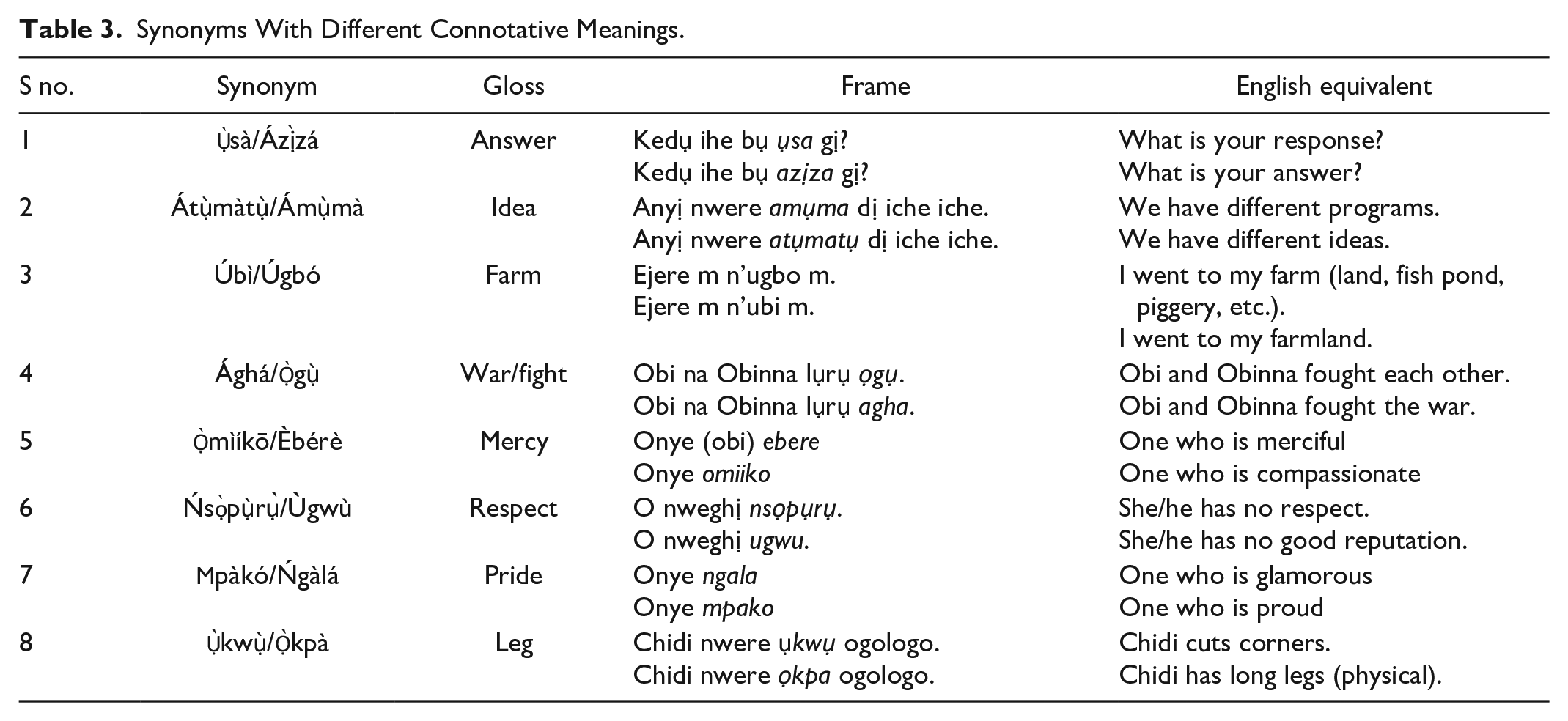
Synonyms With Different Connotative Meanings.
Collocationally Restricted Synonyms.

Contextually restricted synonyms
For a pair of lexemes to be adjudged absolute synonyms, the lexemes must be able to substitute one for another in all contexts. However, Table 2 shows that although the lexemes are synonyms (as is evident in Table 1), they are not synonyms in some contexts. The implication of this is that the senses of these synonyms are derived based on how the Igbo native speakers conceive meanings in various contexts. When synonyms are situated within contexts, it is easier to determine the differences between them. Words that are synonyms are alternative to each other and this is usually called up within contexts. Synonyms are, therefore, context sensitive as a result of the natural conceptualization of the words based on the Igbo worldview.
Data presented in Table 2 show that the synonyms differ in, at least, one context. These lexemes, therefore, cannot substitute one for another in all contexts based on the intuition of the native speaker. Speakers conceptualize meanings within contexts and intuition, and select the contextually appropriate member of a pair in a particular context. Substitution test (as evident in Table 2) has demonstrated that the pairs are not interchangeable in all contexts because there is, at least, one context where each of the pairs cannot be used interchangeably. Hence, we can rightly say that they are not absolute synonyms. For instance, uwe cannot replace ákwà in four contexts as we can see in Table 2 (Item 1). In the above-named contexts, ákwà does not just refer to any cloth but “wrappers” or cloth materials. The metalexical knowledge of an Igbo native speaker views ákwà as encompassing—any form of cloth material, and ùwé as being specific—“dress.” A native speaker’s cognition recognizes every ùwé as ákwà, but not every ákwà as ùwé. This makes it impossible for ùwé to be appropriate in Item 1 of Table 2 as it can mostly be used to refer to “dress.”
Again, to express the act of telling a lie, one can use the verb root ghá for both ụ̀ghá and àsị̀, but the verb root tụ̀ and sị̀ can be used to express the same act only with àsị̀ and not with ụ̀ghá as we can see in Table 2 (Item 2). A look at Item 4 of Table 2 shows that while ùhúrúchī and mgbèdè share the same literal meaning “evening” (observe Item 9 of Table 1), mgbèdè has another nuance of meaning—“older days of one’s life,” which it does not share with ùhúrúchī. In Item 11 of Table 2, ùchíchì (*ùchíchì dị egwu) becomes inappropriate when one wants to metaphorically express “thief” (àbàlị̀ dị egwu) just as mpàkó is inappropriate in expressing “glamur” in Item 16. Item 17 shows that ọ̀bàrà can be metaphorically used to mean “blood relation,” which is not possible with mméē, which has the ordinary meaning of “blood.” The above analysis shows that there are contexts where members of a synonymous pair are appropriate while in other contexts, they are not.
Different connotative meanings
Context of usage can also affect connotative meanings of synonyms. According to Ndimele (1999), semantically, there are denotative and connotative meanings. While a denotative meaning is a logical or ordinary meaning of a lexeme, connotative meanings are other semantic implications of a lexeme that are beyond the ordinary meaning. Therefore, words that have similar denotative meanings may differ in their connotative meanings. This is evident in Table 3. Table 3 shows that the synonymous pairs presented have different nuances of meaning other than their denotative meanings, and by making reference to a structured background of frames; speakers can filter these connotative meanings once these words are contextualized. Igbo speakers isolate the various implications of the lexemes in a construction and link them up with each other to determine if the construction is appropriate or not.
Item 1 in Table 3 shows that ụ̀sà does not just mean “answer” like ázị̀zá. In this context, ụ̀sà connotes “response” or “reaction” which ázị̀zá does not. Ámụ̀mà in Item 2 connotes “programme” and not “idea” as átụ̀màtụ̀. In the same vein, the lexical information that an Igbo native speaker has recognizes úgbō to imply “farm” (in its totality) and úbì to imply only farmland; hence, the different possible meanings of Item 3. In Item 4, the first sentence suggests a reciprocal action, while the second means that Obi and Obinna joined the army to fight a common enemy. Therefore, ọ̀gụ̀ and ághá connote two different things in Item 4. While ọ̀gụ̀ is a partisan fight between two or more individuals, ághá is a more serious combat between parties (villages, towns, or countries). When ùgwù is substituted for ńsọ̀pụ̀rụ̀ as in Item 6, the meaning changes from “respect” to “good reputation” or “dignity,” which implies a completely different thing from the first expression. The same goes for ńgàlá and mpàkó (Item 7). The expression ónyé ńgàlá does not connote “arrogance” or “pride,” which is negative and commonly associated with ónyé mpàkó—an arrogant or proud person. In the Igbo native speaker’s cognition, ónyé ńgàlá is “one who is glamorous.”
The inferences that one can draw from Table 3 is that word meanings are sometimes hinged on emotions. There are emotional connotations that accompany lexical items, no matter how ordinary they may look. Connotative meanings of words are usually arrived at based on the situations in which the words are used. A word may acquire an additional or extended emotive sense based on the circumstance that surrounds its usage. Contrary to denotative meaning, connotative meaning is unstable; it can easily be influenced by social attitude, which is all stored in the linguistic faculty of a native speaker, and she or he applies same whenever she or he makes use of language.
Collocational restriction
Collocational restriction is another factor that makes a lexeme different from its synonym in Igbo. Some words collocate with some words more than the others; hence, a member of a synonymous pair may habitually co-occur with a lexical item whereas, the other members may be restricted. When a member is collocationally restricted, the rule of selectional restriction prevails. The rule of selectional restriction, which operates within the linguistic faculty of a speaker, determines which of the synonyms co-occur with which lexical item in the language.
A look at Table 4 (Item 1) shows that although ngá and mkpọ̀rọ̀ are synonyms in Igbo, it is only ngá that can co-occur with mkpụ̀rụ̀ ọ̀kà “grain of corn” to metaphorically convey the sense of life imprisonment. Therefore, mkpọ̀rọ̀ is collocationally restricted. The implication of collocational restriction is also evident in the way the synonyms nwáànyị̀/ìnyòm̀ are quantified. In Item 11, to pluralise nwáànyị̀, the quantifier ụ̀mụ̀ is used and not ńdị̀, which is used for the same purpose with ìnyòm̀. Each member of the synonyms, therefore, has a specific quantifier it goes with. In addition, the metaphorical sense of “deceptive smile” implied by ọ̀chị̀ ézē is only appropriate with ọ̀chị̀ and not with ámụ̀ in Item 4 just as it is appropriate to imply “epitome of beauty” by using mmā “beauty” to qualify ìgbé (and not ákpàtị̀) in Item 8. It is important to note here that some collocations are quite predictable. For instance, in Item 13, èzí habitually co-occurs with ụ̀lọ̀ “house” to mean “family” and àkọ̀ habitually co-occurs with úchè “mind” to mean “wisdom” (see Item 12 in Table 4). Again, in Christianity, the Holy Communion can be referred to as “àhụ̀ nà ọ̀bàrá Kráị̀st ‘the body and blood of Christ’” but not *àhụ̀ nà mméē . . . as in Item 9. Finally, forming a verbal noun from the verb of “go,” jé/gá is only possible with jé and not with gá as we can see in Item 20.
Summary of the Findings and Conclusion
The data presented and analyzed above have shown that there are synonyms in Igbo. These lexemes are adjudged synonyms because they are found to have the same meaning in some of the contexts where they are used (see Table 1). These lexemes are further subjected to substitution test and it is found that Igbo synonyms do not always have the same meaning in all contexts. There is usually a noticeable meaning difference between the members of a pair of synonyms examined as shown in Tables 2 to 4. These differences in meaning in various cognitive contexts are the fundamental characteristics of synonyms in SI. The substitution test further reveals that there are basically three ways in which Igbo synonyms can be restricted and they are
contextual restriction,
collocational restriction, and
connotative restrictions.
This study, therefore, posits that Igbo synonyms cannot substitute for each other in all contexts. From the wealth of linguistic knowledge possessed by a speaker, he naturally pulls one member of the synonymous pair, which from his linguistic experience, is appropriate in a particular context, while the other (through the same cognitive process) is inappropriate and cannot be used interchangeably with the other. Specifically, the contextual analysis carried out by Obiora (2010) to prove the existence of true synonyms in SI is one sided, because she selected and discussed only the contexts where synonymous pairs substituted each other and was silent on other contexts where they failed the substitution test. Therefore, the sameness in meaning relation between these synonyms is not absolute as claimed by Ubahakwe (2002) and Obiora (2010).
In conclusion, therefore, the question of whether or not absolute synonyms exist in the Igbo language has been a nagging issue in Igbo lexical semantics. There have been various attempts by different scholars arguing for or against this subject matter. This work is pertinent because previous works on synonymy in Igbo could not empirically prove their claims—that absolute synonymy abounds in Igbo. This claim also contradicts some other claims on absolute synonymy in the Igbo language. The present study has examined synonymy in SI to determine the general behavior of synonyms and to find out if these synonyms also have the same sense in every context. This study makes extensive use of the substitution test, and following the cognitive semantic framework and associative meaning approach, it discovers that Igbo synonyms have the same sense in some contexts but not in all the contexts. Therefore, there are no absolute synonyms in SI.
There is always a meaning difference between a pair of synonyms. When the difference is principally denotative, one often finds some kind of meaning overlapping; the words involved may be interchangeable in some contexts but not in others. Hence, in Igbo, ùwé and ákwà are synonymous in some contexts. On the contrary, when the differences in meaning between two words are basically emotive, there is no meaning overlap. In conclusion, this study agrees with Anagbogu et al. (2010) who say: “. . . when we say that two or more words are synonyms, it implies that we hold their differences constant” (p. 224). This study, therefore, posits that two lexemes can share the same meaning in certain contexts in a given language and such meaning relation is known as synonymy. However, like some scholars—Lyons (1968); Stanojević (2009); Anagbogu et al. (2010), and Omego (2014)—have argued, there are no two lexemes with completely the same meaning. Something must differentiate one from another. They could differ in context of usage, collocational selection, connotative or emotive implication, or frequency of use, or may belong to different registers or varieties of a language.
Footnotes
Declaration of Conflicting Interests
The author(s) declared no potential conflicts of interest with respect to the research, authorship, and/or publication of this article.
Funding
The author(s) received no financial support for the research, authorship, and/or publication of this article.
