




Abstract
Interest pertains to an individual’s psychological arousal toward a topic, which is thought to motivate effort allocation and attention. Interest in leadership has been identified as a potential antecedent of leader development; however, supporting empirical evidence has been hindered by the lack of a relevant scale to measure the construct. Study 1 outlines the development of the Interest in Leadership Scale (ILS) using Rasch scale development principles. Study 2 establishes the predictive validity of the ILS with self-rated leadership emergence and transformational leadership behaviors. This measure is likely to prove useful in the future measurement of and research into the topic of interest in leadership.
Keywords
Study 1
Organizations invest substantial resources into leader development despite the lack of empirical research pertaining to what actually develops within individuals and what factors may subsequently facilitate this development (Allen & Hartman, 2008; Avolio & Hannah, 2008; Day, 2000; Day & Sin, 2011). Although topic-specific interest has been linked to learning, training, and developmental outcomes (Hidi & Renninger, 2006), this has not yet been empirically assessed in the leadership domain, specifically in terms of how interest in leadership relates to leader development. Research has been hindered by the lack of an established measure for interest in leadership. This article outlines a process of scale development and validation of a measure of interest in leadership using a Rasch-based measurement approach.
Interest
Interest is a topic-specific, affective, and intrinsic motivation orientation pertaining to an individual’s level of psychological arousal, which directs the individual’s attention and behavior (Hannah & Avolio, 2010; Hannah & Lester, 2009; Hidi, 1990). Arousal requires both situational interest (the topic is interesting) and individual interest (the person finds the topic interesting) (Hidi, 1990). In this way, a topic (e.g., leadership) is not intrinsically interesting but requires individuals to find it interesting (Valsiner, 1992). In this manner, interest is a result of individuals’ interactions with their respective environments (Krapp, 2002). An individual’s interest may be fleeting, or an individual may have an enduring dispositional interest in a topic (Hannah & Avolio, 2010); however, individuals’ preferences toward certain topics tend to be fairly stable over the life span (Hidi & Renninger, 2006; Valsiner, 1992). High levels of interest are typified by positive affect, allocation of attention, persistence in learning, and greater knowledge of the topic of interest (Renninger, 2000; Renninger et al., 1992; Schiefele, 1991).
Interest, and Learning and Development
Research into topic-specific interest has largely been in the education domain, such as looking at the effect of interest on reading comprehension in children (Asher, 1979; Asher et al., 1978). The proposed mechanism underlying these relationships is that greater interest increases the propensity for processing domain-specific information that individuals rate as interesting, and motivating deeper processing of training materials through developing more intra-topic elaborations and inter-topic cross-references between new information and existing schemas (Hidi & Renninger, 2006; Renninger et al., 1992; Schiefele, 1991). The training literature has suggested that individuals place a higher value on the acquisition of knowledge in domains they rate as interesting (Schiefele, 1991). A link has also been proposed between one’s level of interest and one’s efficacy for learning, such that efficacy may be enhanced through increasing one’s positive feelings and psychological arousal to a particular topic (Hannah & Lester, 2009; Hidi & Harackiewicz, 2000). Much of this educational research has rated interest using experimenter ratings of novelty rather than participant ratings of interest. Although it has been argued that some topics are universally interesting, these studies fail to capture individual differences in interest and arousal. Interest has also been linked to learning and development outcomes, including increased developmental program content retention and recall (e.g., Renninger & Wozniak, 1985; Schraw et al., 1995).
Interest in Leadership
Interest in leadership has been proposed to be one component of an individual’s overall readiness for leader development (Hannah & Avolio, 2010; Steele & Day, 2012). Greater readiness to engage in leader development is thought to lead to a greater tendency toward adopting leader roles, as well as proactivity in engaging in self-development activities (Chan & Drasgow, 2001; Hannah & Avolio, 2010; Hidi & Renninger, 2006; Schraw & Dennison, 1994). Interest in leadership is proposed to prepare the individual to benefit optimally from leader development through increasing motivation for engagement and persistence in learning across planned and unplanned leadership learning experiences (Avolio & Hannah, 2009; Hannah & Avolio, 2010; Hannah & Lester, 2009). A leader’s interest in leadership is also proposed to have a flow-on effect for the motivation of followers, such that leaders with a high interest in being a leader may be more likely to allocate greater resources to assist the leader development of subordinates, such as providing increased funding and support for mentoring programs (Deci, 1992; Hannah & Lester, 2009). In this way, interest in leadership is likely to be important for bolstering leader development across organizational levels. Given that it may be necessary for emerging leaders to take proactive steps to engage in leader development, their sustained interest in their own leader development, and in the area of leadership more broadly, is of high importance to the long-term success of their development (Chan & Drasgow, 2001; Deci, 1992; Lord & Hall, 2005; Steele & Day, 2012).
Aims
Despite emerging thought (e.g., Avolio & Hannah, 2008) that interest in leadership is likely an important antecedent of leader development, this relationship has yet to be established empirically and, to date, the most relevant findings of the role of interest in development have been from the training literature relating to the acquisition and processing of training knowledge (e.g., Schiefele, 1991). The leadership domain, more broadly, has suffered from a lack of valid and reliable scales that are able to measure relevant constructs without time-intensive administration procedures (Avolio & Hannah, 2008). Although interest scales have been developed to tap general occupational interest (Occupational Interest Scale; Keddi, 2008) and student interest (Study Interest Questionnaire; Schiefele et al., 1993i), there does not appear to be any measure of interest in leadership in the published literature. The closest approximation is the Motivation to Lead measure of Chan and Drasgow (2001); however, the notion of an affective identity to lead—the most relevant component of that multifaceted measure—is not the same as holding cognitive interest in leadership. The first study of this article seeks to advance the interest literature through the development of the Interest in Leadership Scale (ILS). The Rasch measurement model was employed to guide item development and evaluation, which is argued to be a psychometrically robust approach to scale development. To assist future measurement with the ILS, validity and reliability will be demonstrated. Study 2 will demonstrate the predictive validity of the ILS.
Method
Participants
In total, 544 participants (475 male) took part in this study. Participants were recruited from an Indian information technology company, as part of a wider leader development study. The sample consisted of adult project managers, with all participants reporting a minimum supervisory scope of managing at least one other employee. Job titles varied from “principal consultant” to “senior project manager,” with an average tenure of 7.3 years.
Measures
Rasch modeling was employed for scale development as it arguably provides a more precise measurement approach than item response theory (IRT) and classical test theory (CTT), and to eliminate rater biases, such as systematic severity or leniency in ratings (Barney, 2010; Day & Barney, 2012; Rasch, 1961). Rasch modeling assumes that an individual’s responses on a particular scale are determined by two factors: (a) one’s level of the underlying construct and (b) the difficulty of the item to endorse, and that both of these (person and item estimates) are located along the same continuum (Andrich & Styles, 2004; Green & Frantom, 2002). The likelihood of higher scores increases as participants report having more of the property being measured, and decreases as they have less of the property (Green & Frantom, 2002). Neither CTT nor IRT allow for individuals and items to be modeled on the same scale (Andrich & Styles, 2004). One of the key benefits to using Rasch modeling is that for data shown to fit the model, we can be confident that the item difficulty estimates and person estimates are invariant across similar samples, as well as across any subset of scale items (Andrich & Styles, 2004; Smith & Suh, 2003).
Item development
A panel of three leadership scholars developed a pool of items that were deemed to assess the interest in leadership construct, including reworded items from the Occupational Interest Scale (Keddi, 2008), as well as items developed in line with established interest theory (e, g., Hidi & Renninger, 2006; Krapp, 2002; Renninger, 2000; Renninger et al., 1992; Schiefele, 1991). The Occupational Interest Scale is a nine-item measure of an individual’s current level of specific occupational interest toward different job aspects and is a modified version of Schiefele et al.’s (1993) Study Interest Questionnaire. Keddi’s scale was written in German and was translated into English for the purpose of this study by two native German speakers who were completing either postdoctorate or postgraduate work at an English-speaking university. The resulting items were then reworded from interest in one’s occupation to interest in leadership, as an aspect of one’s job.
Items were added, deleted, edited, and sorted until 100% agreement was reached on the inclusion and wording of all items, and the item pool consisted of items that represented the full spectrum of interest in leadership, ranging from very high to very low levels of the construct. A high level of agreement across all stages of item development suggested that the panel members had a common understanding of the construct. The final item pool consisted of 22 items, with example items, including “I’m more interested in leadership than anyone else I know” (high level of variable) and “I feel somewhat apathetic to my experiences as a leader” (low level of variable). The panel members then judged the perceived difficulty that participants would have in endorsing each item and subsequently ordered items with an entry number from 0 to 10, with “0” representing an item that would be endorsed only by individuals exhibiting the lowest possible level of that construct, and “10” representing an item that would be endorsed only by individuals exhibiting the highest possible level of that construct. As outlined by Green and Frantom (2002), the logic behind ranking each item depends largely on qualitative judgment by the researchers based on their expert understanding of the construct.
Procedure and results
Once the final pool of 22 items was finalized, the order of the items was randomized, and all items administered to participants. Participants assessed items on a “strongly disagree” (1) to “strongly agree” (7) Likert-type scale. The data were screened for deviant response patterns, but no such responses were found. Subsequently, no responses were deleted from the data set.
Rasch modeling
Scale calibration was conducted with the RUMM2030: Rasch Unidimensional Measurement Modeling Software (Andrich et al., 2010). RUMM2030 rescores item responses to start at 0 such that “strongly disagree” was rescored to 0, “disagree” as 1, and so on, and transforms these raw scores into item/person locations (using the Rasch unit—“logits”). If items did not fit the Rasch model, then this was indicative of either a problem with the items or with the sample (Andrich & Styles, 2004). The goal of the scale development procedures was to develop a reliable set of items, whereby each item contributed information to the overall unidimensional interest in leadership construct, contributed information that was unique from other items, and included items that covered the whole spectrum of the construct ranging from extreme low to extreme high levels (see Hibbard et al., 2005; Wright, 1977). The indices used to determine whether items met these criteria are outlined below.
Fit of items and persons to the model
Both the overall chi-square and the chi-square for the individual items were used to evaluate the fit of the items to the Rasch model, and in both cases, a nonsignificant result suggested a good fit. Chi-square tests of fit are based on maximum likelihood (ML) estimation (Van den Wollenberg, 1979). Significance was calculated using the Bonferroni adjustment, adjusting for the number of scale items. Along with the chi-square distributions, the log-residual tests of fit were also examined when assessing fit. No definitive rules exist regarding what is considered acceptable or unacceptable item and person log-residuals of fit; however, good fit is indicated by residuals approaching zero (Andrich & Styles, 2004). For this study, a ±2.5 cutoff was employed as a criterion for fit, which has been employed in other studies using Rasch analyses (e.g., Andrich & Styles, 2004; Bode & Wright, 1999).
The original 22 items demonstrated an overall poor fit to the Rasch model, χ2 = (176) 2,728.46. Table 1 shows the overall scale fit statistics, as well as the individual item fit statistics for both the chi-square tests of fit and the log-residual tests of fit. This table orders the items from best to worst fit, and indicates that five items (1, 2, 12, 13, and 21) are originally showing poor fit to the Rasch model. These indices suggest that the item pool needed to be reduced to develop a group of good fitting items, and that these items may have violated the Rasch requirement for unidimensionality.
Individual Item Fit Statistics for All Items – For the Total Scale (Top) and for Items (Bottom).

Note. PSI = Person Separation Index. χ2 df = 8.
Items from Keddi’s (2008) Occupational Interest Scale.
χ2 probability below the Bonferroni adjustment (Adjustment = .000455).
The Person Separation Index (PSI) was employed as an overall measure of scale reliability, and is conceptually equivalent to Cronbach’s alpha, with a PSI of 1.0 representing perfect reliability (Andrich & Styles, 2004; Bode & Wright, 1999). As shown in the top row of Table 1, although the original 22 items demonstrated a poor fit to the construct, they showed good reliability (PSI = .89). To assess whether there was a difference in how items functioned across participant subgroups, the differential item functioning was examined (see Tennant & Pallant, 2007). Item response residuals showed no items with significant inter-person-group variance for gender or tenure.
Item location
To assess the alignment of item locations to the scale developers’ expectations regarding item difficulty, the obtained item locations were compared with the entry numbers assigned to items prior to scale administration. If the ordering of item locations fails to align to expectations, participants may not be interpreting items as expected (Andrich & Styles, 2004; Wright, 1977). Assessment of the item locations (see Table 1) showed Item 13 (“I never want to be a leader”) to have the lowest logit (–1.12) and Item 14 (“I’m more interested in leadership than anyone else I know”) to have the largest logit (0.77). These locations align with the entry numbers assigned to these items prior to administration, with Item 13 assigned an entry number of 0 and was expected to only be endorsed by participants very low in interest in leadership, and Item 14 assigned an entry number of 9 and was expected to only be endorsed by participants very high in interest in leadership. The order of locations was also aligned with the assigned entry numbers for Items 2, 3, 7, 8, 10, 16, 19, and 22; however, these were not congruent with expectations for Items 1, 4 to 6, 9, 11, 15, 17, 18, 20, and 21.
Inter-item relationships
Inspection of the residual correlations between all item pairs was employed to assess levels of item dependency. Under Rasch modeling, the “noise” associated with one item is modeled such that it should be independent of the noise associated with other items, so we would expect inter-item residual correlations approaching zero (Linacre, 1998). High positive inter-item residual correlations, beyond a set cutoff (e.g., a correlation of greater than r = .3; as previously used by Andrich & Styles, 2004), may indicate item redundancy and may result in an inflated PSI (Andrich & Styles, 2004). Alternatively, significant negative inter-item residual correlations may indicate that items are measuring different constructs. The inter-item residual correlations show a number of correlations to be greater than r = .3, namely, the residuals of Items 2 and 3, 5 and 17, 7 and 12, 7 and 13, 9 and 12, 12 and 13, and 18 and 19. Items 2 and 5, 3 and 6, 5 and 19, and 17 and 19 showed negative residual correlations stronger than r = −.3.
Person-item distribution
The person-item distribution visually places the persons and the items on the same scale as to determine whether the items are appropriate for measuring the given sample (Andrich & Styles, 2004). The graph of the distributions of item thresholds and person locations is presented in Figure 1. This figure indicates that on the whole, items were well matched to the sample. The items fell between approximately –3 and +3 logits, which is considered an adequate spread for capturing the full range of a construct (Andrich & Styles, 2004). The distribution graph identified potential item redundancies with a number of items with logits lower than –1 but with no persons within that range of the distribution.

Person-item threshold distribution – All items (top) and the final item set (bottom).
Item elimination
A qualitative assessment of all aforementioned statistics was conducted, determining the benefit of dropping items to develop a good fitting scale, relative to the cost of potentially reducing the scale reliability or reducing our measurement of the full interest in leadership construct, with a smaller item set (Andrich & Styles, 2004).
Through an iterative process, 15 items (Items 5–10, 12–17, and 20–22) were deleted. This deletion eliminated the potential aforementioned redundancy between items with related residual correlations, except for between Items 2 and 3, and 18 and 19. These items were all retained after individual item analysis showed these contributed to a good fitting scale. Additionally, the overall scale fit statistics were reduced when any of these four items were omitted.
Two of the poor fitting items—Item 14 “I’m more interested in leadership than anyone else I know” and Item 22 “When my career has ended, I hope to be the best leader in history,” although strong positive items that were important for capturing persons with high levels of interest—contained an element of comparison with others and their leadership accomplishments. Conversely, the retained strong positive items that showed good fit (e.g., Item 18 “My greatest life satisfactions come from leadership accomplishments”) assessed how leadership contributes to personal fulfillment, irrespective of the accomplishments/interests of others. These latter items better align with interest theory that interest preferences tend to be intrinsically focused and fairly stable across the life span and need not be tied with transitory social comparisons (Hidi & Renninger, 2006; Valsiner, 1992).
Item characteristic curves (ICCs) are nonlinear graphical representations of a value that an individual is expected to achieve on a given item based on their person location. The ICC for the worst fitting retained item, Item 3, is shown in Figure 2. Although this item had a significant chi-square probability, its fit residual was within the acceptable range and the item otherwise fit the expected ICC sufficiently well. Item 3 also semantically fit with the content of the other retained items, and deleting this item reduced the overall fit of the scale. Although Item 1 had a fit residual of 3.47, its chi-square probability was not significant, and the item was judged to be important for capturing the large number of individuals with person means just below 0.

The item category curve for the worst fitting item of the Interest in Leadership Scale, Item 3: “Being a leader is of high personal importance to me.”
Final scale fit and reliability
The process of item elimination was completed when further elimination resulted in either an unacceptably low level of scale reliability or unacceptably low precision in the measurement of interest in leadership. The overall item-trait test of fit to the Rasch model and PSI for the final set of seven items is shown in Table 2. Although the item-trait test of fit was significant, the items otherwise showed good fit and functioned together as a unidimensional scale. The person-item threshold distribution for the final item set is shown in the bottom figure of Figure 1 and shows the items to be fairly well matched to the sample, with person and item means approaching zero. Of the final items, Items 1, 3, 4, and 11 were those adapted from Keddi’s Scale, with the rest developed for the present study.
Fit Statistics for the Final ILS Item Set – For the Total Scale (Top) and for Items (Bottom).

Note. ILS = Interest in Leadership Scale; PSI = Person Separation Index. χ2 df = 8.
Significant χ2 probability.
Discussion
The reported measures of fit for the ILS suggest that the scale demonstrates unidimensional and acceptable reliability properties for use in the measurement of interest in leadership. The demonstrated psychometric properties of this scale suggest that it would be able to adequately differentiate between individuals with different levels of interest in leadership. The finding of no differential item functioning across gender and tenure suggests that the obtained item and person parameters would likely replicate across samples (see Hendriks et al., 2012).
Limitations
One of the arguments against developing a scale that is designed to measure self-ratings is that it may contribute to rater biases, including common method variance (CMV; Podsakoff et al., 2012). However, an alternative argument to the discussion on the fallibility of self-ratings is that they may be necessary in research looking to understand individual preferences and cognitions. The purpose of this scale is to obtain within- and between-person estimates of interest in leadership, including differences across people and time. Other raters, who may only observe an individual sporadically, are unlikely to be in a position to notice and report such differences, and subsequently, method biases may continue to be inherent in the leader development literature. During calibration of the ILS, all negatively worded items were deleted from the item pool for showing poor fit, which may further inflate rater biases.
Like all new scales, there is a need for ongoing validation of the ILS. This measure should be tested in a variety of contexts, including those where its predictive validity can be assessed.
Study 2
This second study seeks to establish the predictive validity of the ILS by investigating how it relates to measures of leader emergence and effective leader behaviors, and whether these relationships align to theoretical propositions.
Leader Emergence
Leader emergence refers to the processes associated with being perceived as a leader that may help shape the advancement of an individual into a leadership position. Leader emergence has been previously defined as the extent to which an individual is viewed by the self or by others as a leader, and as one’s propensity to undertake leader roles (Judge et al., 2002). Because it has been argued that interest in leadership will enhance motivation and engagement in development as a leader, as well as a greater tendency toward adopting leader roles (e.g., Hannah & Avolio, 2010), we would anticipate that it would positively relate to self-reported leadership emergence, as well as the number of subordinates an individual supervises.
Leadership Behaviors
Full-Range Leadership theorists have argued that leaders differ in the effectiveness of their interactions with their followers and communication of goals (Avolio & Bass, 1991; Bass, 1990). Transformational leadership has been widely accepted in the literature as representing effective leadership behaviors, whereby transformational leaders exhibit proactivity toward energizing followers toward a common goal, with a focus on enhancing the good of the wider group (Antonakis et al., 2003). Conversely, passive/avoidant leadership behaviors are generally considered a passive and ineffective form of leadership, wherein the leader is only active when follower behaviors or performance indicators need to be corrected (Antonakis, 2012; Avolio, 2004). Passive/avoidant leadership behaviors are usually found to negatively relate to leadership outcome criteria, such as group performance indicators and follower job satisfaction, whereas transformational leadership behaviors are generally positively related to these outcomes (Judge & Piccolo, 2004). It is thought that greater interest in leadership will relate to greater ownership of one’s development and roles as a leader (Deci, 1992; Lord & Hall, 2005), and would therefore relate to more positive and active leadership behaviors. It was subsequently anticipated that scores on the ILS would positively predict greater self-rated transformational leadership behaviors and would negatively predict self-rated passive/avoidant leadership behaviors.
Method
Participants
Participants were 90 adults currently employed in various Australian organizations. Both full-time and part-time employees were recruited. Inclusion criterion was such that the participants must supervise at least one other employee in their current job. Two participants did not provide any data and were deleted from the data set. Of the 88 retained participants, the age range was 18 to 54 years (Mage = 25.61 years; SDage = 8.87 years), with the majority of participants being female (n = 70). The average tenure was 3.15 years, with participants supervising an average of 4.41 subordinates employees. Of the 88 participants, 72 identified their nationality as Australian, with the rest from a variety of nations, including Serbia, England, Iraq, Singapore, and New Zealand.
Measures
Interest in leadership
Interest in leadership was measured with the seven-item ILS developed in Study 1.
Self-reported leadership behaviors
Self-reported leadership behaviors were assessed with the Multifactor Leadership Questionnaire (MLQ-Form 5x) developed by Avolio and Bass (2004). Participants were instructed to judge how frequently each statement fits their leadership work behaviors. The 45-item questionnaire consists of nine subscales, which may be combined in such a way to be able to examine a variety of leadership behaviors, including transformational and passive/avoidant leadership (Avolio & Bass, 2004). A measure of transformational leadership was calculated as the mean of the idealized influence (attributes and behaviors), inspirational motivation, intellectual stimulation, and individual consideration subscales, with an example item being, “I talk optimistically about the future.” A measure of passive/avoidant leadership was calculated from the management-by-exception (passive) and laissez-faire subscales, with an example item being, “I avoid making decisions.” Reliability has been previously calculated at α = .92 for transformational leadership and α = .75 for passive/avoidant leadership (Barnes et al., 2013).
Leadership emergence
Respondents’ beliefs regarding their emergence into workplace leadership positions were measured with Reichard et al.’s (2011) five-item Leadership Work Duties Scale, with an example item being, “I have planned/coordinated many special events in my workplace.” Reichard et al. (2011) reported acceptable levels of internal consistency for their scale (α = .85).
Procedure
Participants completed all surveys through an online survey platform. Completion was untimed, with participants taking approximately 20 min to complete all survey items. ILS ratings and leadership emergence were completed on a 5-point Likert-type scale ranging from 1 (strongly disagree) to 5 (strongly agree). Ratings for the MLQ were completed on a 5-point Likert-type scale ranging from 0 (not at all) to 4 (frequently, if not always).
Results
Univariate normality tests indicated that all test assumptions were met other than moderate kurtosis for tenure and number of subordinates. Algebraic transformations were conducted on these variables, with square root transformations bringing the data closer to normality and within acceptable limits. Transformed data were used for hypothesis testing. Multivariate assumption testing indicated that all test assumptions were met. Table 3 presents the means, standard deviations, Cronbach’s alpha estimates, and a correlation matrix of all variables. Significant positive relationships were found between ILS ratings with number of subordinates, leadership emergence, and transformational leadership. A significant negative relationship was found between passive/avoidant leadership and ILS ratings.
Means, Standard Deviations, Alpha Coefficients, and Correlation Matrix for All Variables (N = 88).
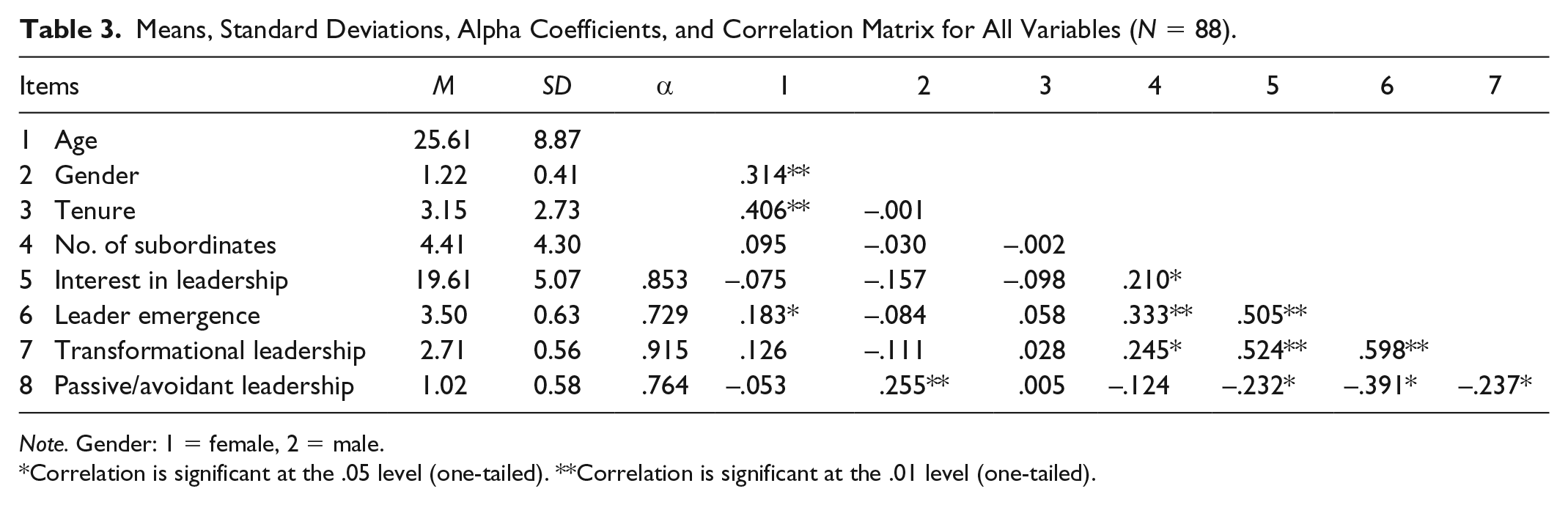
Note. Gender: 1 = female, 2 = male.
Correlation is significant at the .05 level (one-tailed). **Correlation is significant at the .01 level (one-tailed).
Simple linear regression analyses were conducted to estimate the proportion of the variance in self-reported leadership behaviors and leadership emergence accounted for by the ILS.
Leadership emergence
ILS scores significantly and positively predicted self-reported leadership emergence. ILS accounted for a significant 25.5% of the variability in self-reported leadership emergence, R2 = .255, adjusted R2 = .246, F(1, 86) = 29.43, p < .01. ILS accounted for 4.4% of the variability in the number of reported subordinates, R2 = .044, adjusted R2 = .033, F(1, 86) = 3.95, p = .050. This was not significant at p < .05.
Self-reported leadership behaviors
ILS significantly and positively predicted self-reported transformational leadership, accounting for 27% of the variability in transformational leadership, R2 = .274, adjusted R2 = .266, F(1, 86) = 32.50, p < .01. ILS scores were significantly and negatively predicted self-reported passive/avoidant leadership accounting for 5.4% of the variance, R2 = .054, adjusted R2 = .043, F(1, 86) = 4.90, p = .029.
Discussion
Obtained results align with theoretical expectations that the ILS would predict self-reported emergence into leadership roles as well as effective leadership behaviors. This affirms theory that interest in leadership may motivate individuals to seek out leadership roles and better engage with leadership experiences (Hannah & Avolio, 2010). The null relationship between the demographic variables of age, gender, and tenure with ILS ratings suggests that interest may be developed and fostered in employees regardless of these demographic characteristics.
The number of subordinates and the self-reported emergence into leadership roles were both perceived as different ways of measuring leadership emergence, although only the latter was predicted by the ILS. The moderate but significant relationship between these two dependent variables suggests that they were measuring distinct aspects of leadership emergence. Clarification regarding the relationship between objective and subjective measures of leadership emergence is needed.
General Discussion
This article outlined the development of the seven-item ILS, as a short and reliable measure for assessing levels of psychological arousal related to leadership in working adults. This scale may be employed in future research identifying the antecedents of leader development or in predicting leadership outcomes. This scale has been shown to be reliable across two distinct samples, differing across culture, race, and leadership experience. As such, this scale should be reasonably generalizable across cultures. This scale has also been shown to be predictive of self-reported emergence into leadership roles, and of self-reported effective leadership behaviors.
Directions for Future Research
There is a long-standing need for more psychological research examining the antecedents of leader development. The development of the ILS offers a step toward generating empirical research to support theory that interest in leadership is an important antecedent of leader development. It is recommended that the focus of this work be on determining the extent to which interest in leadership relates to trajectories of development over time (see Hannah & Avolio, 2010; Steele & Day, 2012). In addition, the relationship between interest in leadership and other relevant organizational measures, such as job satisfaction, satisfaction with leader roles, career ambition, and career interest, is yet to be established empirically. In all cases, we would expect interest in leadership to be related to, yet distinct from, these other constructs.
More research is required in tracking interest in leadership across the life span to establish construct malleability, and whether interest in leadership is largely inherent or develops across time. Related to this is determining the extent that developmental interventions are able to effectively develop domain-specific interest in individuals.
Future research is also encouraged to explore the inter-play between leader emergence and interest in leadership. This relationship may be bidirectional, such that those with higher interest levels in leadership seek out leadership roles, and also that leadership interest develops in response to the self-perception of one as a leader for those already in leadership positions (see self-perception theory; Bem, 1967).
Finally, the current validation procedures were conducted with employees with at least one subordinate. We would encourage future researchers to ascertain the predictive validity of the ILS predicting later emergence and success in leader roles for groups of more junior employees who are not currently in formal leadership roles.
Applications to Theory and Practice
The ILS may be useful as a diagnostic tool for determining individuals’ current levels of interest in leadership for the purposes of more targeted selection into leadership positions or into leader development interventions. In particular, individuals with higher levels of leadership interest may be better able to effectively engage with developmental experiences and optimize their development (Avolio & Chan, 2008; Avolio & Wernsing, 2007; DeRue & Workman, 2012). Placing individuals into developmental initiatives or promoting them into leadership positions when they do not have the motivation, ability, and, specifically, the interest to develop and perform in such positions may cause frustration, perpetuating negative spirals of development (see Day, 2011).
Conclusion
Although interest in leadership has been proposed to facilitate the extent to which an individual is developmentally ready to engage with leader development, the lack of a psychometrically sound measure has hindered empirical results to test this theoretical perspective. This article outlines the development of the ILS using Rasch modeling procedures—an important step in increasing the rigor of the measurement of the antecedents of leader development. The trend toward flatter organizational hierarchies, an increase in the propensity of geographically dispersed teams, and the impending mass retirement of baby boomers have all contributed to a growing societal need for the early identification of individuals who have the motivation and potential to lead organizations through significant changes (Riggio, 2008). Given these emerging contextual factors, ascertaining the role and importance of interest in leadership in the developmental process is timely. It is hoped that the development of the ILS will advance evidence-based practice in the area of leader development, as well as encourage future research and theory building into the interest in leadership construct.
Footnotes
Acknowledgements
We would like to thank Dr. Matt Barney, Dr. Aarti Shyamsunder, and the Infosys Leadership Institute team for their invaluable assistance across the data collection and development of scales used in this article.
Declaration of Conflicting Interests
The author(s) declared no potential conflicts of interest with respect to the research, authorship, and/or publication of this article.
Funding
The author(s) disclosed receipt of the following financial support for the research, authorship, and/or publication of this article: This research was funded by an Australian Research Council (ARC) Discovery Research Project grant.
