




Abstract
Environmental problems are one of the major concerns in China due to booming industries and large-scale production. Manufacturing industries must change the traditional approaches of production and supply chain management practices to cope with environmental issues. For this purpose, a multidisciplinary and empirical study has been conducted in China. In the manufacturing industries around the world, there is a noticeable transition in human resource management approaches toward green human resource management (GHRM). However, green training could be considered as a critical element of GHRM and could be used as an instrument to trigger emotional intelligence (EI) of the employees, which could make them more responsible toward the external environment and result in improved green supply chain management (GSCM) practices. Similarly, regulatory pressures could also enforce manufacturing industries to contribute positively to GSCM practices. In addition, taking into account the two critical functions of GSCM practices, that is, green purchasing and eco-design, this research study attempted to bring under consideration that GSCM practices could be enhanced through EI as well. For this purpose, data were collected from 250 manufacturing industries of China through a convenient sampling technique, and structural equation modeling was applied through Smart-PLS version 3.2.7 to measure and validate the model of this study. The findings of the study revealed that GSCM practices could be improved through regulatory pressures, and EI could be used as a mediating factor to enhance the relationship between GHRM (green training) and GSCM practices.
Introduction
Sustainability is a global issue in today’s business world, and firms have to be careful about environmental issues, for their better image in today’s competitive environment (Tang et al., 2018). Gotschol et al. (2014) argued that businesses should give more focus to green supply chain management (GSCM) for a better and sustainable environment. Thus, it has become more challenging for firms to deal with several internal and external changes at the same time. Companies cannot be profit-oriented only for their survival and growth in the long run. Meanwhile, they have to consider social, economic, and environmental factors as well (Daily et al., 2008). For the implementation of environmentally friendly strategies, strong leadership and concrete processes are required (Glavas et al., 2010).
To deal with environment-related issues and gain customers’ trust, industries are keen to shift from traditional approaches to modern ways; one such noticeable shift is from supply chain management (SCM) to GSCM. Moving from SCM to GSCM could be productive for industries, but financial barriers and support manufacturing are some of the hurdles to be faced by industries (Sarkis et al., 2011). Firms are still looking for a more sustainable approach in SCM (Brandenburg et al., 2014). Other barriers to GSCM are lack of trust among members who are part of SCM and lack of top management’s commitment (Luthra et al., 2015). As Govindan et al. (2014) argued, GSCM practices still need to be improved vastly, as per the need of the external environment.
After the revolution of SCM in the early 1990s, firms are trying to integrate environmental management practices across all their functional departments for a better image (Gotschol et al., 2014). GSCM could also be called as ecological innovation (Chin et al., 2015). GSCM steps may involve purchasing, training, logistics, packaging, and distribution to be done in such a way that it may not affect the external environment. Therefore, all such processes could be labeled as green when they are not affecting the natural environment and ecosystem in any way. However, the dilemma about the situation that remained is many pieces of research to deal with GSCM have been qualitative (Teixeira et al., 2012). Furthermore, some studies are conceptual, such as extensive literature reviews in this area (Gunasekaran et al., 2014).
According to TBL (triple bottom line) principle, each business must consider social, economic, and environmental dimensions. Environmental concerns are pushing the traditional supply chain to GSCM. In other words, it has become a strategically imperative-based phenomenon; customers are demanding those products and services, which they consider more environmentally friendly. According to Sarkis et al. (2011), there exists a positive relationship between adopting GSCM practices and improvements in economic performance. Furthermore, Mumtaz et al. (2018) also stated that GSCM could impact organizational and industrial performance at any level.
To explain the much-needed shift toward GSCM, this research study attempted to answer the following research questions: How GSCM could be improved through the medium of green human resource management (GHRM) and regulatory pressures, and how emotional intelligence (EI) could mediate the relationship between GHRM and GSCM practices? Manufacturing industries can use GSCM as one of their strategic approaches to gain competitive advantage and to earn more profit, which could enhance their competitive image in the market. Fahimnia et al. (2015) argued that GSCM is one of the least studied areas in the current literature. Furthermore, they also stated that only 2.1% of research is available in this field.
This research also proposed that GSCM could be further improved through GHRM practices, which include green recruitment, green selection, green training (GT), green performance management, green involvement, and green pay and rewards (Tang et al., 2018). GHRM practices are a mix of different tools and techniques to achieve organizational goals; however, one closely linked tool to improve GSCM practices could be GT. GT could contribute to social and financial goals (Mangla et al., 2013). Following the arguments of Mangla et al. (2013), this research study also proposed that GT could be used as a medium to motivate emotionally intelligent employees. EI could result in a positive response toward environmental needs, and employees with high EI could play their role in enhancing GSCM practices.
In addition, this research study proposed that in a dynamic environment, regulatory pressures could be critical to enhance the performance of GSCM, especially in the manufacturing industries. The company’s business strategies are affected by institutional bodies and the environment, which include product consumers, resources, and suppliers (DiMaggio & Powell, 1983). To further improve the state of GSCM, regulatory pressures could be formulated and implemented more efficiently. Improved legislation and regulatory pressure not only improve the state of GSCM practices, but it could also play its role to contribute positively toward environment issues (Kassolis, 2007). In addition, Grewal and Dharwadkar (2002) argued that regulatory pressures and institutional environment could change the dynamics of business performance.
GSCM is one of the front-line issues of many industries. Therefore, this study contributes to the literature of GSCM by taking into account the importance of GSCM in manufacturing industries. GT could enable employees to make green purchases and eco-design products and services, as their sense of responsibility could be triggered through GT. Employees with high EI could understand the issues better than others. Therefore, GT enhances EI, and it could result in green purchases and eco-design products, which are part of GSCM (Shafique et al., 2019). In addition, GHRM and regulatory pressures could play a crucial role in enhancing GSCM practices. Meanwhile, EI could pave the way toward GSCM practices, which has not been considered as a medium to improve GSCM practices in previous studies. Therefore, this research proposed that EI could mediate the relationship between GHRM and GSCM practices, as employees with high EI can be motivated through GT to contribute positively toward GSCM practices. Consequently, this research study is one of its kind, to integrate the vital elements of GHRM (GT) and GSCM (green purchases and eco-design) through the mediation of EI.
Literature Review
Organizational Theory (OT)
There are few areas available for expert insights into the current literature of GSCM. OT could be used as a core basis for GSCM on an academic level, as it refers to the set of interrelated definitions, concepts, and processes that explains the behavior of individuals and groups toward the accomplishment of common goals. In addition, OT is still considered at its early phases to be introduced broadly in SCM and operations management literature (Ketchen & Hult, 2007). Etzion (2007) also used OT as a lens with an argument that environmentally focused researches and sustainability issues could be discussed with the views of OT. In addition, OT’s further implementations are also highlighted by Connelly et al. (2011), outside business disciplines and organizational management. Lai et al. (2010) also investigated OT and SCM relationships in detail. On the notions of OT, this research study explains the conceptual and logical connection between GT, regulatory pressures, and GSCM, with the mediating role of EI on GSCM. The details of each variable and their relationship with GSCM are as follows.
GT
The emerging trend in HRM literature is GHRM, and evident from the research is that it positively affects organizational performance. GHRM may include green recruitment, green selection, GT, green performance management, green involvement, green pay and rewards, and so on (Tang et al., 2018). However, this research study empathizes upon one key element of GHRM, that is, GT, as it could be used as a tool to train and motivate the employees to play their role in the transition toward GSCM. GT could be defined as training or educating employees on the job to achieve desired organizational performance. GT could serve as a tool to improve employees’ thinking toward the environment (Jabbour, 2015). In addition, it could also increase employees’ awareness about greening and to achieve environmental performance (Govindan et al., 2014; Shafique et al., 2019).
GT programs are becoming an essential part of manufacturing industries to deal with the latest issues, customers’ demands, and external environmental changes. GT programs focus on how the employees could be more contributing to the external environmental changes. According to Van Hoof (2014), training can also affect the cleaner production programs. GT denotes a series of activities that can motivate employees to take into account environmental issues and develop ecological protection skills, which are vital for fulfilling ecological objectives (Jose Chiappetta Jabbour, 2011). Moreover, such training can also increase employees’ expertise related to environmental activities, which can increase their knowledge and awareness (Fernández et al., 2003). GT could be defined as the process of educating and training the employees on the job, which could, in turn, contribute to environment-friendly outcomes and corporate targets (Daily & Huang, 2001). Therefore, this study focuses on GT and its effect on GSCM practices. Furthermore, training could be related to environmental concerns by involving all levels of management to integrate ecological issues and the firm’s performance (Paillé et al., 2014).
In addition, recent researches in the current literature of GSCM suggest that GT is positively related to the shift toward green (Sarkis et al., 2011). It may not be wrong to argue that most of the manufacturing industries train their employees that they could contribute more positively toward the external environment through GT. In addition, Gunasekaran et al. (2014) also stated that GT is an evolution for environmental issues. There are other studies as well, which reinforced the importance of GT and GSCM (Jackson et al., 2014).
The pieces of literature mentioned above reveal that there exists a positive relationship between training and desired organizational outcomes. Therefore, this research study proposed that GT is an essential element of GHRM and could be used as a tool to enhance GSCM. Employees of the manufacturing industries could be trained through GT about the importance, processes, and outcomes of greening. Therefore, GT could bring forward the value and significance of GSCM, and employees could be more contributive to buy raw materials and products which are not going to affect the environment adversely (green purchasing) and eco-designed products and services. Thus, in line with the idea of Gosling et al. (2016), trainings can result in sustainable supply chain, and Shafique et al. (2019) stated that GT moderates the process of green supply chain integration; thus, we proposed our first hypothesis:
Regulatory Pressures
Institutional bodies and the environment impact the company’s business strategies, which include product consumers, resources, and suppliers (DiMaggio & Powell, 1983). This is one of the most critical factors for improving GSCM practices in Chinese manufacturing industries, because China not only produces to meet its domestic needs but it is also ranked among the top exporters of the world. To motivate the employees or a firm for GSCM practices, legal and institutional arrangements will be needed by the government (Kassolis, 2007). Grewal and Dharwadkar (2002) have talked in detail about the importance of the institutional environment and regulatory pressures, and their impact on business performance. In addition, regulatory pressures could help to institutionalize manufacturing businesses within legal boundaries and drive the firms toward environmentalism. Similarly, in the context of GHRM practices, it could be put forward as government or statutory bodies should intervene for the betterment of the external environment and society (Grewal & Dharwadkar, 2002).
Regulations from the government can impact GSCM practices positively. By following specific standards, businesses will be bound to follow the laws and regulations of government. They will not be able to make those products and services which could be harmful to the society and the environment. In other words, structured regulatory protections can minimize the potential business risks which are associated with a rapidly changing business environment. Oxley and Yeung (2001) stated that regulatory institutions could increase the trust of stakeholders, reduce uncertainties, build a reputation, and increase faith, which can help in facilitating the exchange process. Credible regulatory institutions can result in positive perceptions and minimize the risks associated (Xin & Pearce, 1994). Furthermore, several types of researches in the same context suggest that government intervention and regulations can improve the situation of GSCM.
In addition, strict governmental policies can result in environmentally friendly ingredients, packaging, and purchasing. Abide by regulatory pressures and laws; a firm may not dare to indulge itself in such activities, which could be harmful to the society by any means. Ecological modernization theory (EMT) also talks about systematic eco-innovation. EMT’s view is about the innovation of industry and environment both at the same time, with the use of new technology (Mol et al., 2009). Therefore, encompassing the notions of EMT, this research study proposed that manufacturing industries must be brought in the circle of law to improve green purchasing and eco-design products. Managing technology and the environment could affect GSCM practices positively. Therefore, governments must play a significant role by promoting legal institutional environment to carefully deal with the issues of the environment, which could enhance the eco-friendly performances of the industries.
In many countries of the world, government, regulatory institutes, environment protection groups, and other state institutes have already set environmental standards and regulations beyond ISO certifications. The Chinese government has also introduced green purchasing regulations. Germany has announced about package waste and proposed law, and the United States and Europe are also very active regarding environment protection by adding environment protection groups (EPGs), which issue certifications related to environmental protection standards. Furthermore, several brands and companies have been active in this regard as well, by claiming their positions in the topmost, when it comes to environment protection or environment-friendly processing throughout the life cycle of a product or service. As Zhu and Sarkis (2007) stated, institutional pressures could be used as a moderator of supply chain and organizational performance.
The standards and regulations which are required for manufacturing industries in China mainly encourage production to refrain from usage of toxic materials, harmful processing, and any other activities which could harm the external environment. Delmas and Toffel (2004) explained that regulatory pressures are a coercive power for the companies to fulfill their duties toward the external environment. Regulatory pressures are thus an exact requirement for environmental protection, which may bound companies to follow the laws and regulations, which could turn them to be proactive and develop an environmental management system (Darnall, 2003). Environmental management systems can increase the knowledge sharing of environment protection among employees, the commitment of employees toward duties, and coordination between departments (Darnall, 2003). In addition, Wu et al. (2012) also investigated the role of regulatory pressures in GSCM practices in Taiwan’s textile and apparel industry and proposed that regulatory pressures positively affect GSCM practices. This research also contributes to the literature of GSCM, by adding a new dimension that regulatory pressures could result in improved GSCM practices in manufacturing industries; thus, we proposed our second hypothesis:
EI as a Mediator
EI is considered as one of the emerging fields in the areas of business management and human resource literature. This concept was introduced earlier in 1990 by Peter Salovey. He defined EI as the ability of an individual to express emotions, appraise, and perceive accurately (Salovey & Mayer, 1990). Later studies highlighted the four dimensions of EI, that is, regulation emotion, others’ emotion appraisal, self-emotion appraisal, and use of emotions (Wong & Law, 2002).
Literature also suggests that EI is linked with other outcomes as well, such as organizational commitment, turnover intention, job satisfaction, and actual job outcomes. Antecedent and response-focused emotions can make employees to be able to have better relationships with their immediate supervisors and co-workers. Positive emotions and mental state of employees could turn employees to be more socially and environmentally responsible compared with others. Wong and Law (2002) also stated that EI affects an employee’s performance in many ways. Therefore, employees with high EI could be more conscious of their external environment and eco-system in which they are living.
The theoretical model in this context was presented by Jordan et al. (2002). EI was taken as a moderator in their study predicting behavioral and emotional responses of employees toward job insecurity. In addition, they also stated that employees with low EI are vulnerable to negative emotions resulting from job insecurity, compared with those which have high EI. In another study conducted by Mohamad and Jais (2016), investigating the relationship between job performance and EI in Malaysian teachers concluded that high EI results in high job performance, commitment, and energy in organizational tasks.
In this research, EI as a mediator also proved as an impacting factor between GHRM practices (GT) and GSCM practices. Furthermore, from the literature of GT, we could propose that GT crafts a required attitude and sense of responsibility in employees of manufacturing industries, toward the environment, which could enhance GSCM practices. In addition, Cote and Miners (2006) stated that EI has a strong influence on organizations and workplace performance. Furthermore, literature also suggested that employees with high EI are more deliberate and open to the issues of the environment, as they are good at understanding others’ feelings (Rosete & Ciarrochi, 2005). Moreover, employees with EI are keen to respond to the external environment, and they will carefully consider their purchases (green) and eco-design products and services. The materials, processes, products, and services which are part of GSCM could be dealt with correctly by the employees with high EI. The relationship between GHRM (GT) and GSCM is discussed in various studies, but this research study is an attempt to explain that EI could mediate this relationship as well.
In addition, Watkin (2000) argued that EI can be critical to organizational success and should be developed and promoted in employees to achieve diversified outcomes. Similarly, in the most recent research of Shafique et al. (2019), the mediating role of EI was brought under consideration on SCM collaboration. To sum up the mediating role of EI between GT and GSCM practices, we proposed the following hypothesis:
After a comprehensive discussion on the proposed hypothesis, the conceptual model of this research study is given in Figure 1.
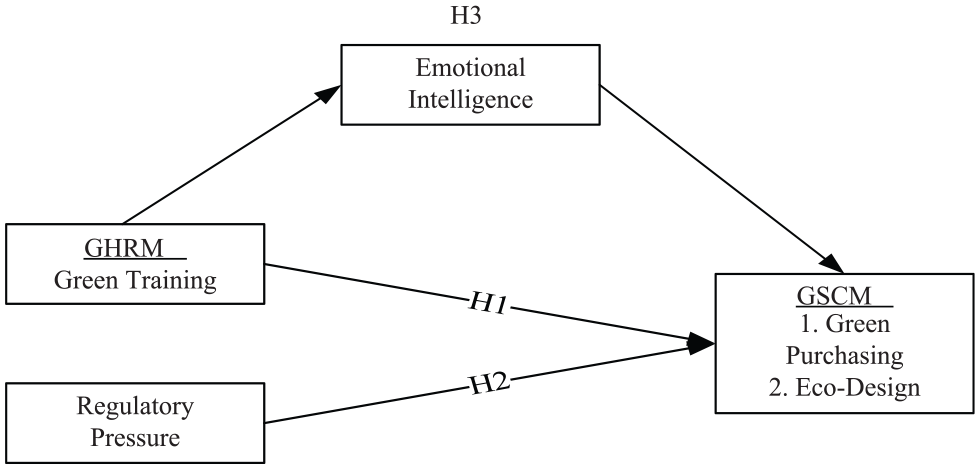
Conceptual model.
Method
Measurement
This empirical research was based on a comprehensive questionnaire adapted from previous literature to investigate the relationship between GHRM and regulatory pressures on green purchasing and eco-design (GSCM) by mediating the role of employee’s EI. Variables were selected after a thorough analysis of the literature available on GHRM, GSCM, and other legal and psychological variables and their interrelationship. Below are the details of each variable and its adopted items and origin.
GT is the way to implement green environment practices and helps to reduce the cost of production and provide work safety to employees. GT items were adapted from Teixeira et al. (2016); these items were designed in such a way that they could tap the responses of managers as well as a supervisor. The GT variable consists of a total of 10 items based on 5-point Likert-type scales from strongly disagree to strongly agree.
GSCM is a complete process that started with green purchasing and ending at reverse logistics. Zhu and Sarkis (2004), for the first time, investigated the GSCM concept and operational performance of the Chinese manufacturers. They developed a survey for GSCM, which was later validated by Zhu et al. (2008) in their work of GSCM model confirmation. This study chooses two dimensions of GSCM: one is green purchasing, and the other is eco-design. The items for these dimensions adapted from Zhu et al. (2008), a total of eight items of GSCM, were included in the survey of this study.
Regulatory pressure is an external enforcement for businesses to protect the environment by using quality material and secure processes while producing. To maintain environmental protection according to global standards, many regulatory authorities set regulatory standards. The questions for regulatory pressures are adapted from Wu et al. (2012) which used a broader construct with the name of institutional pressure with three subdimensions: (a) market pressure, (b) regulatory pressure, and (c) competitive pressure. A total of five items were used for the regulatory pressure dimension.
EI is a significant factor that affects the performance of employees. In this study, EI has been used as the mediating variable between GHRM and GSCM. The EI questionnaire was adopted from Wong and Law (2002), and they developed a comprehensive measurement to investigate the relationship between EI and employee performance. The EI construct consists of a total of four dimensions and 16 items, four items for each dimension. All these constructs and their related items were selected and validated by literature.
Sample and Data Collection
China is considered as a factory of the world. The largest manufacturing plants in the world exist in China. Most of those plants are related to construction, cement production, coal power generation, mining, electronics industry, leather industry, and other related manufacturing units. This manufacturing industry is harming the environment and increasing severe health risks. The efforts to make the environment clean are not restricted to a specific industry; it is the obligation of all manufacturing sectors to green their practices to reduce environmental damage. The data used in this study consist of survey questionnaire responses from managers (middle and lower) in the Chinese manufacturing industry. The manufacturing industries were selected because they are having the most direct and observable impact on the environment, as claimed in Zhu (2004). These industries of China not only involve all the practices of SCM, but they are also the biggest polluter of the environment. Data were collected through a 5-point Likert-type scale; questionnaires were sent through email to employees of different Chinese manufacturing industries. This study chooses middle and lower level employees as respondents because they are directly involved in the production/manufacturing process; therefore, they are suitable respondents to answer the questions related to green practices to ensure environmental safety.
The sample of the study involved simple random sampling as well as snowball sampling; we got only 500 emails of employees working in Chinese manufacturing industries. Therefore, we sent a link of questionnaires through email followed by several soft reminders and also requested them to ask their colleagues to fill this questionnaire. A total of 500 questionnaires were sent to employees of varying manufacturing units. After checking and handling nonresponse bias that could affect the data and, in turn, contaminate the results of this study, only 250 questionnaires were found complete and usable. The respondents included in the final sample were categorized as 30% belonging to electronics firms; 24.5%, textile firms; 21.5%, chemical-producing industries; and 5.3%, paper and printing industries and the remaining respondents belonged to other manufacturing industries.
Sample Sufficiency
The sample size of this study has been calculated through G-Power software. According to the variables of this study, G-Power suggested a sample of 146 respondents. This means that the sample size for this study must be greater than or equal to 146, whereas the sample of this study comprises 250 respondents (Figure 2).

Sample size sufficiency.
Sampling error
According to Fowler (2002), there are two main types of error—sampling and nonresponse bias errors—which can compromise the reliability of the survey. Sampling error was defined by Fowler (2002) “as chance variations that occur due to collecting data based upon a sample of a population.” Therefore, sampling error could be considered as a random result of the sampling procedure. The size of sampling errors is determined by the size and design of a probability sample, along with the distribution of what is being estimated (Fowler, 2002).
The standard error of the mean has been utilized to estimate the sampling error. The standard error of the mean is the standard deviation of the mean of sample distribution for an infinite number of samples of a particular size (Fowler, 2002). It is calculated from the variance and size of the sample. Standard error values for 95% of samples of a given size should fall within a range of plus (+) and minus (−) 1.96, also known as the confidence interval. The 67% sample mean of given size falls within the range of +1 to −1 standard error of population mean values. The standard error of mean values varies across the number of constructs as well as the sample size (Fowler, 2002). This implies that a different number of variables have different values of standard errors. Furthermore, it suggests that the values for sampling errors for the various key variables of this study are likely to differ from each other.
Common Method Bias
The structural equation modeling (SEM) technique was applied through Smart-PLS version 3.2.7 to measure and validate the model of this study. The SEM technique is used when the researcher incorporates the complex constructs and latent variables into the model. SEM based on partial least squares has been used due to the explanatory nature of this study. The standard method may exist in this study because data for dependent and independent variables were collected from the same respondent and at the same point of time. Furthermore, checking the common method bias, there are many measures suggested by the expert statisticians and researchers. The Fornell–Larcker criterion is a well-known and authentic measure among those measures of discriminant validity and common method bias. Average variance extracted (AVE) and Cronbach’s alpha are the main factors in the measurement model that are enough to decide the reliability and validity of constructs and related items. According to the norms, our AVE and Cronbach’s alpha values are surpassing the standards. Moreover, to treat common method bias, we have divided our survey into sections and made sure that dependent and independent variables are not presented in the same section. The standard of the Fornell–Larcker criterion is that the square root of AVE (the diagonal value in Table 1) should be higher than the rest of the values in the same column.
Fornell–Larcker Criterion.

Note. EI = emotional intelligence; GHRM = green human resource management; GSCM = green supply chain management.
Results and Discussion
In this study, first-order constructs have been used to measure GHRM, GSCM, and EI. GHRM consists of one dimension, GSCM consists of two dimensions, and EI consists of four dimensions.
Measurement Model
SEM is based on two models: one is a measurement model that confirms the reliability and validity of data, and the second one is the structural model that measures the path coefficients and the relationship between variables, and tests and validates the hypothesis. According to Barclay et al. (1995), the first step in SEM is to elaborate the measurement model/outer model, which includes an explanation of different reliability and validity measures, such as composite reliability, convergent validity, discriminant validity, and internal consistency. Composite reliability and internal consistency were measured through Cronbach’s alpha, construct validity was confirmed by factor loadings, and convergent validity was measured by AVE. There are two standard measures to check the discriminant validity: one is the Fornell–Larcker criterion, and the other is the heterotrait-monotrait ratio of correlations (HTMT) criterion (Henseler et al., 2015).
Internal consistency
Cronbach’s alpha and composite reliability are the primary measures of internal consistency. Cronbach’s alpha value between .60 and .70 is acceptable; a higher value indicates high composite reliability (Hair et al., 2016). In Table 2, values of Cronbach’s alpha range from .860 to .906, indicating the internal consistency of data.
Reliability and Convergent Validity.

Note. CR = composite reliability; AVE = average variance extracted; GHRM = green human resource management; GSCM = green supply chain management; EI = emotional intelligence.
Indicator reliability
Indicator reliability is the variance of items explained by that particular variable. Values of outer loadings of the items (questions) range from 0 to 1, and the acceptable amount is .6, and higher would be better. According to Hulland (1999), factor loadings below .40 must be removed from the model. Table 2 factor loading values range from .665 to .951, indicating the high indicator reliability.
Convergent and content validity
Convergent validity measures the theoretical relationship between constructs. Convergent validity of the scale depends upon three factors: first, factor loading should be equal to or more than .65; second, composite reliability should be equal to or greater than .80; and third, AVE should be equal to or more than .50 as stated by Fornell and Larcker (1981). In the table mentioned below, all three measures are according to the standards.
Structural Model
The second model of SEM is a structural model that represents the hypothesized relationship among variables. Path coefficients depict the change occurred, and its value ranges from +1 to −1. A coefficient value closer to +1 shows the high positive impact or strong positive relationship, a value closer to −1 shows a strong negative relationship, and a value closer to zero means the weak relationship between dependent and independent variables. The other values that should be described in the structural models are t value and p value. Both values indicate the significance of the relationship or impact between variables. In Table 3, the coefficient for H1 (GHRM positively contributes to GSCM) is 0.446, the t value is 5.779, and the p value is 0.000. H1 is accepted and supported by the results, and the t-statistics and p-value results are significant at 1% level of significance. H2 (regulatory pressure has a positive effect on GSCM) was also confirmed by the given results. The coefficient for regulatory pressures is 0.068, the t statistics is 2.106, and the p value is .035. According to these results, regulatory pressure has just 6.85 impacts on GSCM, and this relationship is significant at a 5% level of significance. The last hypothesis, H3 (specific indirect relationship), is supported by the results, that is, there exists the proposed mediation.
Path Coefficients.

Note. GHRM = green human resource management; GSCM = green supply chain management; EI = emotional intelligence.
Significant at the 5% level. ***Significant at the 1% level.
Direct Effect of Mediator
The direct effect of GHRM on EI is positive and significant, as indicated by the coefficient, t statistics, and p value (β = 0.898, t-statistics = 48.86, p < 0.001). Furthermore, the direct effect of EI on GSCM is also positive and significant, as depicted by the results given in Table 4 (β = 0.455, t statistics = 5.654, p < 0.001).
Total Effect.

Note. EI = emotional intelligence; GSCM = green supply chain management; GHRM = green human resource management.
Specific Indirect Effects
The mediating role of EI between GHRM and GSCM is positive as indicated by the sign of coefficient, and this mediation is significant as well (Table 5).
Specific Indirect Effects.

Note. GHRM = green human resource management; EI = emotional intelligence; GSCM = green supply chain management.

Results of SEM.
Conclusion and Discussion
GT
The findings of this study suggest that Chinese manufacturing industries are in a hasty transition phase toward GSCM practices. Manufacturing industries can vest their employees with skills and awareness through GT such as GT9. In addition, GT could enhance their knowledge and consciousness about the environment, and decisions made by trained employees will be within the scope of environmental concerns. GT could affect employees in terms of purchases, product design, and dealing with suppliers. Finally, GT could also be helpful to bridge suppliers, firms, and customers in the process of greening the supply chain.
Findings of this research study also revealed that GT is relevant to organizational learning and support (Gosling et al., 2016), can align human resource practices (Jackson et al., 2014), and is one of the most crucial elements for greening the firms because it can reduce barriers to GSCM adoption. In addition, some managerial implications could also be drawn from the discussion above. GT must be ranged within the requirements of an industry, for example, green purchasing, eco-designs, green production, and green packaging should be prioritized according to the need of an industry. As the outcome of GT programs, manufacturing industry could achieve their external environment targets (Teixeira et al., 2012). GT programs must be extendable from employees, suppliers, and other stakeholders to complete SCM effectiveness, which could make them achieve their goals of greening.
The outcomes of this study are also supported by the research of Jabbour (2015), who stated that GSCM and GHRM are relevant to attain sustainable HRM practices. In addition, findings of this study also matched with Stone (2000), that cleaner production initiatives could be achieved through diversified skills of the organization. GT is a vital element of GHRM practices and could be used to improve green management skills. Furthermore, GT could be a source of green organizational knowledge and learning and can enhance employees’ skills that they could be able to make their decisions specifically about green purchases and eco-design across the SCM activities. In addition, GT is a way to gain a competitive advantage for firms (Touboulic & Walker, 2015). Finally, a complete GT program should focus on the contents of training, and should identify the sector which needs to be trained and opportunities to be grasped after training employees with such programs. There are some central characteristics of GT, which can reinforce the GSCM. Importantly, GT1 states, “Contents of GT are raised through a systematic analysis of training gaps and needs”; GT9 and GT10 state, “The topics approached during GT are appropriate and current for company activities” and “Employees who receive GT have the opportunity to apply green knowledge in everyday activities,” respectively.
Regulatory Pressures
This research showed that regulatory pressures have a positive effect on GSCM practices. As it is observed, market pressures are a result of the requirement of environment protection and general standards set by the officiating bodies, whereas regulatory pressures are often the result of mandatory environment protection standards that are transparent and deterministic. In addition, any violations from such rules can result in penalties (Delmas & Toffel, 2004). Moreover, it is also evident from the research that regulatory pressures can make an industry bound to align themselves with environment protection standards and regulations; in the Chinese manufacturing industry, regulations are pushing them to be more proactive to the external environment. Regulations are getting tighter as per need, and firms are more conscious about their green purchasing, packaging, and cooperation with suppliers and customers to make a sustainable environment. Chinese government’s involvement is focused to refrain the leading manufacturers from polluting and damaging the external environment.
There is always a need and feel of urgency to reshape regulations about manufacturing industries, as they produce on a large scale to meet the demands of customers; doing so, they are affecting the environment adversely. The data collected from Chinese manufacturing industries revealed that the holistic supply chain of Chinese manufacturing industries appeared to be collaborative toward government regulations and their supply chain partners. Consequently, regulatory pressures are increasing green purchasing, eco-designs, and cooperation and overall greening of Chinese manufacturing industries. As evident in the work of Wu et al. (2012), institutional pressures can result in improved GSCM performances.
EI
It is said that EI can affect a wide range of work behaviors, such as teamwork, quality of service, developing and enhancing talents, innovative ideas, creativeness, and customer loyalty. Cooper et al. (1997) stated that people who have a high level of EI can enjoy more success in their career, can lead in a better way, are good at building personal relationships, and are in better shape and health. Based on the (Goleman, 1998) outcomes of this study, it could be argued that EI is a real, widespread phenomenon for manufacturing industries’ employees. We want to mention the factors most relevant to our research: EI-6, “I am sensitive to the feelings and emotions of others” and EI-5, “I am a good observer of other’s emotions.” Factors high in response mean that an individual can be sensitive enough to indulge himself in environment-friendly activities and greening of his firms. Individuals with high EI can adapt themselves to infuse products with aesthetics and feelings (Sjöberg, 2001).
In addition, it could also be argued that individuals with high EI were more eager to practice GSCM practices (green purchases and eco-design) compared with those who have low EI. GT enhances the EI of employees by reminding them about their responsibility toward the environment. In addition, GT could also educate employees about their duties toward the external environment, which could be better understood by the employees with high EI; in return, it could improve GSCM practices.
Summarizing the outcomes of this research, from the previous literature, it is evident that GHRM practices could improve GSCM practices. However, this research study took into account one key element of GHRM, that is, GT. GT can be used as a medium to urge employees to contribute to the external environment. GT can make an employee think about society and the environment. Employees who are trained about the phenomenon of green tend to be more conscious and socially responsible, compared with those who do not go through GT. Similarly, Employees with high EI will be able to understand their role better toward the environment and contribute to improving GSCM practices. Furthermore, regulatory pressures could also be used to enforce the manufacturing industries to not affect the environment adversely and also positively affect GSCM practices. Conclusively, this research study proposed a novel idea to enhance GSCM practices through EI. Environmental protection is a serious concern nowadays if employees are emotionally involved and provided with GT to protect the environment; in turn, they will help the organization to play their role in the external environment. This study confirmed that not only organizational learning and human resources are vital, but also the EI of employees is crucial to achieving the green goals.
Future Scope and Limitations
This research has taken the manufacturing industries of China only. The impact of GT, regulatory pressure, and EI on GSCM could be measured in other countries as well. It may come up with different and exciting findings because in developed nations of the world, most of these practices could be prevailing already; therefore, to what extent GT and regulatory pressures have been successful would be a worthy idea to explore. In addition, for future researches, it would be an area of interest as well, that is, to what extent can the government intervene regarding GSCM? Moreover, other critical elements of GHRM could also be considered for research, thinking beyond GT, to enhance the process of GSCM. Furthermore, the nature of firms can also have different results in GSCM improvement; other industries may not consider GSCM as a vital element if they are not part of the manufacturing industry. EI does mediate the relationship; still, it could be a better idea to conduct face-to-face interviews with respondents compared with online surveys to judge the EI of employees with real-time emotions.
Footnotes
Declaration of Conflicting Interests
The author(s) declared no potential conflicts of interest with respect to the research, authorship, and/or publication of this article.
Funding
The author(s) received no financial support for the research, authorship, and/or publication of this article.
