




Abstract
China is the only country with more than 200 million people aged 60 years and above. The Chinese government considers seniors’ universities to be an important form of leisure in which older people spend their free time. To explore the benefits of this education-oriented form of serious leisure, this study investigates the concept of successful aging and tests the effect of serious leisure involvement in seniors’ universities on the subjective well-being and successful aging of “young-old” participants in the context of China. In addition, this study examines the influence of family structure on the relationship between the above variables based on third-place theory. Although limitations to the approach are identified and discussed, the survey results show that the involvement of the aging population in education-oriented serious leisure activities is significantly associated with successful aging and that subjective well-being partially mediates the relationship between serious leisure involvement and successful aging. Furthermore, the relationship between serious leisure involvement and successful aging differs significantly among groups with different family structures.
Keywords
Introduction
Many countries are now confronting the challenge of an aging population. When the proportion of a population over 65 years old exceeds 7%, it is considered an aging population (Amiri et al., 2017). In addition to considerable social pressures (Bookman, 2008), for example, negative effects on economic development, as well as on the labor market, capital market, and social support system (Bookman, 2008), population aging also poses challenges to families and aging individuals themselves (Walker et al., 1995). The living status of the old-age population directly affects the allocation of economic, time-related, and other resources of the entire family (Heller et al., 2007; Walker et al., 1995). In this respect, concepts such as “healthy aging” (World Health Organization, 2015) and “successful aging” (Rowe & Kahn, 1987) have begun to be taken seriously. The above concepts emphasize that the quality of one’s lifestyle in old age should reflect the optimal physical, mental, and social states to improve the quality of life of older people.
Third-place theory (Oldenburg, 1989) asserts that there are three spatial domains in people’s daily lives. The first place is the home and family, the second place is work, and the third place is where individuals spend their leisure time, which is of great importance in enhancing the quality of life. This is particularly significant after older people retire; their lives become focused primarily on two places, their homes and places of leisure, and the impact of leisure on their quality of life becomes increasingly important (Bardo, 2017; Yamashita et al., 2016). Many studies on the leisure behavior of older people have shown that participation and involvement in leisure activities affect their subjective well-being and thus promote successful aging (Newman et al., 2014). Scholars have also indicated that well-being is an important characteristic of people who enjoy successful aging (Kahana et al., 2012) and that the level of subjective well-being plays a significant role in successful aging (Compare et al., 2014). The relationship among serious leisure involvement, subjective well-being, and successful aging has been validated by scholars to some extent (Yamashita et al., 2018); however, analysis of the existing literature also shows the following research gaps in this area of study.
First, there is a lack of rigorous research on the young-old group. Although standards for age division are not consistent, the aging population can be divided into different stages. In general, the young-old group consists of individuals aged 64 years and under (Ferraro, 1980). In this period, people are adapting to and preparing for aging and lifestyle transitions (P. B. Baltes & Smith, 2003). People in the young-old group have often recently retired from their jobs and simultaneously face an empty nest in their families. Thus, the first place (family) and second place (work) of the young-old group are undergoing dramatic changes (Becchetti et al., 2012), an obvious characteristic of this group. Previous studies on leisure and successful aging have focused primarily on individuals aged 65 years and over. In recent years, however, an increasing number of retirees are younger (Scherger et al., 2011), and one specific characteristic of the young-old group is that they are recently retired and in a major transition period (Becchetti et al., 2012). Scholars have discovered that the young-old phase of life affects successful aging in old age (Pruchno & Wilson-Genderson, 2014). Hence, although the young-old group has gradually begun to receive research attention (Rowe & Kahn, 2015), further studies must be conducted to understand the relationship between leisure and successful aging in the young-old group.
Second, although Yamashita, Bardo, Liu, and Yoo (2019) pointed out that senior education is an effective public health strategy for an aging society, there is a lack of research on the impact of serious educational leisure on successful aging among older people. Stebbins (2001) noted that serious leisure is the “optimal leisure lifestyle” and discussed a theoretical framework that can classify and explain all leisure activities (Elkington & Stebbins, 2014). This widely recognized and used framework is an important theory in the field of leisure, with far-reaching influence (Shen & Yarnal, 2010). Serious leisure is the opposite of casual leisure (Stebbins, 1997), which generally refers to the systematic participation or pursuit of leisure by participants in amateur, hobbyist, or volunteer activities. Participants in serious leisure can acquire certain skills, knowledge, or experience and obtain greater leisure benefits than other individuals, and they may seek further development in activities through individual leisure careers and pursuits. Indeed, one of the characteristics of serious leisure is its lasting benefits (Stebbins, 2001); in particular, the theory of serious leisure states that participants optimize their lifestyles of leisure by obtaining lasting benefits (Elkington & Stebbins, 2014). Many scholars, such as Jones and Symon (2001) and Johnson (1995), point out that receiving education and lifelong learning also constitutes a kind of serious leisure. In the past, studies of serious leisure among older people have concentrated primarily on sports leisure and recreational activities. Relatively, little research has been conducted on serious educational leisure. In terms of third-place theory, senior centers, seniors’ universities, and other educational institutions typically represent the third place (Jeffres et al., 2009).
Seniors’ universities are also known as universities of the third age (UTAs). The providers of UTAs include organizations that provide leisure opportunities for older people, such as the Elder Hostel in the United States (Long & Zoller-Hodges, 1995). Providers also include organizations and institutions that emphasize education, such as UTAs in Europe (Formosa, 2009). The main function of seniors’ universities in China is to provide leisure services to older individuals by imparting information and related leisure knowledge and skills, such as flower arrangement, calligraphy, photography, choir, ballroom dancing, and tai chi. In terms of functions and objective positioning, seniors’ universities in China are similar to UTAs in the United Kingdom and the Elder Hostel in the United States. The activities at seniors’ universities in China thus constitute educational leisure (Dattilo, 2015). Regular, long-term participation (continuous involvement) and the formation of peer groups provide deep, long-term benefits, and there are requirements to complete certain tasks and other characteristics of serious leisure activities. Hence, these activities are classified as serious leisure (Ahn & Janke, 2011). The relationships among such leisure activities, subjective well-being, and successful aging of young-old individuals are worthy of attention.
Third, as a populous country, China is the only country with more than 200 million people aged 60 years and over, making up 15.5% of the population; the nation also has 138 million retirees. The Chinese government considers seniors’ universities to be an important form of leisure in which older people spend their free time. According to the 2016 Ministry of Civil Affairs Statistical Report on Social Service Development, as of the end of 2016, there were 54,000 seniors’ universities nationwide and approximately 7.12 million older people who participated in various activities and classes at seniors’ universities. In addition, the 13th Five-Year Plan on the Development of Aging in China requires that by 2020, more than 50% of the townships and towns must build seniors’ universities with 20% regular participation by older people. Thus, seniors’ universities are clearly important in the leisure lives of older people in China. However, the existing studies on serious leisure and successful aging are based on Western countries; few studies have focused on the context of China. Thus, it is necessary to verify the relationship between serious leisure and successful aging in China to enrich the theoretical research in this field.
One contribution of this study is to further enrich the theoretical research on the benefits of leisure for older people, especially the benefits of young-old individuals’ participation in serious educational leisure activities in China.
Literature Review and Research Hypothesis
Successful Aging of the Young-Old Group
Successful aging occurs when one successfully manages the developments through life’s phases in the context of lifespan development psychology. The earliest relevant concept was the longevity and life satisfaction of older people (Havighurst, 1961; Palmore, 1979). The concept of successful aging at this stage is relatively simple and vague. Later, theoretical developments tended to focus on the objective evaluation of older people’s physical health and cognitive well-being, mainly from the perspective of physiological medicine (Pruchno & Carr, 2017; Rowe & Kahn, 1987). The most influential model at that time was Rowe and Kahn’s (1987) successful aging, which primarily includes three interacting parts: avoidance of disease and loss of function, maintenance of physical and cognitive function levels, and active participation in activities.
Successful aging theory has drawn widespread attention, transforming aging research from a discipline focused on disease and decline to a discipline that emphasizes health and growth. In the decades that followed the introduction of the concept, numerous studies have explored what successful aging is and how to achieve it (Pruchno & Carr, 2017; Rowe & Kahn, 2015). Although the original theoretical model of successful aging focused on the objective physiological functions of older people (Martinson & Berridge, 2015), in subsequent theoretical development, successful aging has gradually been regarded as important by scholars in the field of social psychology. The theoretical concepts continue to be used and expanded and have been gradually superimposed with concepts such as active aging, healthy aging, and productive aging (Zanjari et al., 2017).
The impact of successful aging theory is so profound that successful aging is recognized as the ideal aging state (Zanjari et al., 2017). However, this theory has also met with different perspectives. First, scholars have doubted whether successful aging theory has guiding significance for older people facing adversity. A large number of studies show that although some characteristics of older people are not consistent with the theory of successful aging, such as physical dysfunction and social and environmental difficulties, they may still achieve successful aging (Hochhalter et al., 2011; Pruchno & Carr, 2017). At this time, lifespan developmental theories associated with successful aging are gradually becoming visible. Lifespan developmental theories posit that human life is an overall process of continuous development, aging is one of the stages, and successful aging is the comprehensive result of the development of all previous life experiences; that is, people need to achieve an effective balance between loss and gain (M. M. Baltes & Carstensen, 1996; Zacher & Rudolph, 2017). The model of selection, optimization, and compensation (SOC) is among the representative theoretical models (P. B. Baltes & Baltes, 1990), proposing that successful aging can be achieved through self-management and resource allocation (Lang et al., 2002). For this reason, Hartley et al. (2018) pointed out that successful aging theory itself cannot be regarded as a theoretical model; it is more suitable as a theory that describes results and evaluation criteria. Rowe and Kahn (2015) agreed with the above view, arguing that successful aging theory places more emphasis on the results of successful aging, while SOC theory and other lifespan developmental theories reveal effective mechanisms and processes to achieve successful aging (Zacher & Rudolph, 2017).
Successful aging is a complex system state. For this reason, the theoretical system of successful aging is still continuously being supplemented and expanded (Zacher & Rudolph, 2017). Recent literature has shown four trends in successful aging–related fields: First, scholars pay increasing attention to the social environment in which older individuals live and the interaction between the environment and older individuals (Hartley et al., 2018). Second, scholars are beginning to realize how to promote positive aspects of an aging society (Rowe & Kahn, 2015), which is also important. Third, scholars have begun to explore the issue of successful aging from multiple perspectives, such as the micro-, meso-, and macro-levels (Zanjari et al., 2017). Fourth, scholars are beginning to realize that successful aging does not occur naturally during old age but is the result of long-term development (Zanjari et al., 2017). Therefore, the state and preparation before entering old age must also be considered (Zanjari et al., 2017).
The study of successful aging from the leisure perspective has also attracted the attention of scholars. Research in this field is often concerned with positive emotions such as happiness. For example, Bardo (2017) pointed out that happiness is the product of the combination of satisfaction in different fields. With increasing age, happiness declines in some areas. For example, the deterioration of health status leads to a decline in health satisfaction, and it is necessary to increase satisfaction in other areas to improve the overall happiness of older people. Leisure satisfaction is an important part of happiness, and lack of leisure can thus lead to a decline in happiness, which in turn affects successful aging (Yamashita et al., 2016). Yamashita et al. (2018) further pointed out that the third age is one of the most ideal stages for improving satisfaction through leisure. The reduction of leisure time that can result from caring for older people and other reasons can cause people at this stage to miss opportunities to increase happiness, reducing the probability of successful aging. Thus, this study explores the successful aging of young-old people from the leisure perspective, in line with the research trend in this field.
Second, the modes and methods for measuring successful aging are also among the subjects of debate among scholars. For example, early disputes mainly lie in whether subjective or objective evaluation should be used for successful aging. Two of the three dimensions of the early theoretical model of successful aging are objective criteria, such as avoiding disease and maintaining good cognitive function. The standards for assessing successful aging in past studies were proposed mainly by clinicians and researchers (Bülow & Söderqvist, 2014). This approach was regarded as overly harsh and ignored the subjective self-evaluation of older people themselves (Bardo et al., 2017; Pruchno et al., 2010). Even older people with chronic diseases and those experiencing serious illness or disability may still have a positive cognitive self-assessment and live happy lives in their later years (Hochhalter et al., 2011; Pruchno & Carr, 2017). At the same time, some studies have found that chronic disease does not affect successful aging and that health perception and health-promoting behaviors (such as diabetes self-management) are more related to successful aging (S. H. Kim et al., 2017). Therefore, scholars have criticized early models for assessing successful aging because of its disadvantages in neglecting the self-awareness of health of older people and the positive aspects of their mental state (Martinson & Berridge, 2015).
The abovementioned controversy has led to a change in measurement methods in research over the past decade. The original focus was on objective criteria, and it gradually shifted to subjective and objective criteria being equally important (Rowe & Kahn, 2015). In the fields of social science and psychology, such as leisure research, subjective criteria are applied more than objective criteria (Bardo & Lynch, 2019; Yamashita et al., 2016), such as the measurement of the subjective well-being and quality of life of older people. A recent study by Bardo and Lynch (2019) found that even older people with poor cognitive abilities and physical health may be able to achieve happiness in their later years. People’s own subjective evaluation of happiness and life satisfaction are positively related to successful aging, and many well-being studies in recent years have used respondents’ own subjective evaluations to measure their well-being (Yamashita et al., 2016). For this reason, in recent years, many scholars have proposed that the concept and criteria for evaluating successful aging should be expanded, revised, and loosened (Hartley et al., 2018; Rowe & Kahn, 2015).
Previous studies focused primarily on individuals over 65 years old, whereas few studies have employed measures of successful aging for the young-old group. Defining the young-old population is a controversial task. According to the previous literature, the young-old age group is defined very differently across different eras and different regions. Generally, as people’s lives have been prolonged, their health status has also improved, and their self-recognition as older people has been constantly changing.
In the young-old age group, the starting age ranges from 50 (Martin et al., 2015) to 60 years (Sabbath et al., 2016), 65 years (von Humboldt & Leal, 2017), or even 70 years (Yoshinaka et al., 2016). In some countries, even people aged 60 or 70 years may recognize themselves as young people (Neugarten, 1975). As this research uses third-place theory as its theoretical basis, young-old people are studied mainly from a social perspective. For this reason, defining the young-old population from the perspective of social age may be more suitable. In terms of social age, an age of 55 years or younger may mark the lower boundary of the older population (Neugarten, 1975), and in the case of social demographics, 50 years and over is often referred to as the third age, which is the young-old stage before the fourth age (P. B. Baltes & Smith, 2003). In China, as a populous country, the retirement age tends to be younger. For example, the legal retirement age is 50 years for Chinese women (Chen & Turner, 2015) and 60 years for Chinese men (Luo et al., 2019). In the China Health and Retirement Longitudinal Study (2011), a survey conducted by the National School of Development of Peking University, the 45-year-old population has become the target of aging research.
Given the above background, this study uses the age of 64 years as the upper limit of the young-old population, as proposed by Ferraro (1980), and the age of 50 years, the earliest legal retirement age of Chinese residents, as the lower limit.
As noted above, the young-old group consists of those who have just retired from their jobs and are in a state of life transition. Hence, this group’s understanding and perception of successful aging may vary from those of the older group. This study measures the perception of successful aging by the young-old group aged 50 to 64 years to define the cognitive characteristics of this group with regard to successful aging.
Serious Leisure Involvement and Successful Aging
Although the theory of serious leisure proposed by Stebbins (2001) has received widespread attention from scholars, serious leisure has been criticized for focusing too much on typological descriptions (K. Lee & Ewert, 2019; Veal, 2017). In recent years, different understandings of serious leisure have emerged. For example, Heo et al. (2010) noted that serious leisure and casual leisure are not different types of leisure activities, but instead treat serious leisure as a kind of experience of leisure activities. In addition, the boundary between serious leisure and casual leisure has been the main controversy regarding the framework of serious leisure in recent years (Shen & Yarnal, 2010; Shinew & Parry, 2005). An increasing number of scholars do not consider serious leisure and casual leisure to be two completely opposite concepts (C. Lee & Payne, 2016; Veal, 2017). For example, Tsaur and Huang (2020) and Shen and Yarnal (2010) observed that the leisure experience is continuous; therefore, serious leisure and casual leisure are states that can occur continuously and be integrated into a continuous system. Scott (2012) put forward the concept of a serious leisure–casual leisure (SL-CL) continuum in which serious leisure and casual leisure are not two forms but represent different degrees and intensity of leisure participation in (Veal, 2017).
Despite some controversy regarding the concept of serious leisure, there is consensus on the characteristics and benefits of serious leisure. For example, Scott and Godbey (1992) and Stebbins (2001) summarized the characteristics of serious leisure into the following six aspects: individual perseverance; intensive efforts such as the pursuit of a career; continuous investment of individual efforts; continuous benefits; subculture of the community; and a strong sense of identity. Previous research on serious leisure for older people also shows that the above six characteristics include the elements required for successful aging. The deeper the involvement of older people, the greater their probability of successful aging (Heo et al., 2013).
The theory of involvement is derived from the self-involvement concept and social judgment theory in psychology, which measures individual attitudes and behavior within the psychology field (Sherif, 1979). Involvement is generally viewed as a state of mind regarding the perception of the importance of certain things and how much they relate to one’s self (Gursoy & Gavcar, 2003). Since the beginning of the 1990s, the field of leisure and related issues involving attitudes and behaviors have become a topic of research (Havitz & Dimanche, 1999; S. S. Kim et al., 1997). Studies have shown that as a type of personal resource, involvement affects the motivation (Havitz et al., 2013), perceived value (Kinard & Capella, 2006), and satisfaction level of participants involved in leisure activities (Y. G. Kim et al., 2010).
The impact of serious leisure involvement on realizing successful aging has been verified in numerous studies (Cheng et al., 2016). Activities such as serious sports leisure involvement have a positive effect on physical health and social participation (Cheng et al., 2016); involvement in serious social leisure can help older people maintain or expand their social relationships (Son et al., 2007); and serious solitary leisure is conducive to improving the mental and spiritual well-being of older people (Lennartsson & Silverstein, 2001). Studies in Eastern cultures have demonstrated that successful aging is positively affected by serious leisure involvement, such as involvement in sports clubs (J. Kim et al., 2014), volunteering activities (Chou et al., 2004), participation in sports (J. Kim et al., 2014), dancing (M. J. Kim & Lee, 2016), strolling in the park, and other daily physical activities (Chou et al., 2004). Based on the above literature, this study proposes the following hypothesis (Figure 1):

Research model.
Serious Leisure Involvement and Subjective Well-Being
Subjective well-being refers to the psychological perception of evaluating individual living conditions (Diener et al., 1999). Studies have shown that despite the various benefits of different serious leisure activities, they have roughly the same role in improving and maintaining the subjective well-being of older people. For example, physical exercise can help alleviate the resource loss that results in the declining well-being of older people (Yamashita, Bardo, & Liu, 2019), and leisure participation with social interaction as its objective has a significant impact on well-being and other positive emotions (Becchetti et al., 2012). Similar conclusions are reflected in studies of educational leisure activities (Formosa, 2009), volunteering activities (Pi et al., 2014) and other serious leisure behaviors.
Scholars have conducted comparative studies of serious and general leisure involvement in terms of their impact on subjective well-being. Excessive participation in general leisure may deplete the energy and physical strength of older people while failing to produce continuous leisure benefits, perhaps even having negative physical and psychological effects (Stebbins, 2001). Intensive involvement in serious leisure, however, may enable leisure to become the center of life for older people and improve their subjective well-being. In addition, a comparative study discovered that older people’s sense of well-being is significantly higher when they incorporate serious leisure involvement into their lives (Liu & Yu, 2015). Although many factors affect subjective well-being, serious leisure involvement is considered by scholars to be one of the most influential factors. The impact of personal characteristics on subjective well-being is far lower than that of serious leisure involvement (K. J. Lee & Hwang, 2018).
For this reason, this study proposes the following hypothesis (Figure 1):
Subjective Well-Being and Successful Aging
Some scholars believe that subjective well-being may be a criterion for successful aging (Freund & Riediger, 2003). There are also scholars who regard subjective well-being as having a direct impact on successful aging. For example, Strawbridge et al. (2002) noted that past studies on successful aging ignored the relationship between successful aging and perceived well-being. Their studies have contended that there is a significant relationship between the self-perception of successful aging and well-being (Strawbridge et al., 2002). Westerhof (2003) further explored the relationship between the positive aspects (social benefits and mental development) and negative aspects (physical and social deterioration) of the aging process of older people and their well-being. The conclusion was that subjective well-being helps to reduce negative impacts while enhancing positive benefits, thereby significantly and positively impacting successful aging (Westerhof, 2003). Regarding the impact of subjective well-being on successful aging, a more challenging serious leisure project can result in greater psychological satisfaction, thereby promoting personal development and successful aging (Green & Jones, 2005). Previous studies have considered subjective well-being to be one of the most influential factors in the self-evaluation of successful aging, and involvement in leisure activities and other factors can indirectly affect successful aging by enhancing subjective well-being.
For this reason, this study proposes the following hypotheses (Figure 1):
Varying Effects of Leisure Involvement on Successful Aging in Different Family Structures
According to third-place theory and considering that members of the young-old group are gradually leaving or have already left their jobs, the primary focus for this group is on the family and leisure. At this point in people’s lives, will the first place (family) influence the third place (leisure)? Older people whose spouses have passed away are more inclined to be dependent on their adult children and attempt to find more ways to compensate for their lost relationship (Ha et al., 2006) by more actively participating in various types of leisure activities (Utz et al., 2004). Older people who are single or have no children are more eager to seek and rely on relationships with new life partners (Silverstein & Giarrusso, 2010). Studies show that the relationship that an older person has with his or her children and spouse affects the quality of family life (Walsh, 2015) and that an older person who has the support of his or her spouse and adult children may enjoy better well-being and successful aging (Walsh, 2011). Numerous studies support the idea that the characteristics of older people’s family affect their behavior in the third place. Because the core of the family is marital relationships and the intergenerational relationship between parents and children (Raschick & Ingersoll-Dayton, 2004), many studies use the completeness of family member relationships for classification. For example, Widmer et al. (2018) and Goldsen et al. (2017) considered whether the spouse and children are living with the older person as a criterion for classification. For this reason, from the perspective of the first place, this study classified the young-old group into two groups based on whether they have complete family relationships: one group has complete marital and intergenerational relationships, and the other group has incomplete marital and intergenerational relationships (lack of a relationship with a spouse or children or both). With the family structure as the control variable, the role of the family structure in the relationship between serious leisure involvement and successful aging was verified using variance analysis of the associations of serious leisure involvement with subjective well-being and successful aging.
To this end, the study proposes the following hypothesis:
This hypothesis can be subdivided into the following hypotheses (Figure 1):
Figure 1 shows the overall research model and hypotheses.
Research Method
Sample of the Study
This study selected young-old individuals aged 50 to 64 years at seniors’ universities as the research sample to explore the benefits of serious educational leisure for this group from the perspective of successful aging.
Measurement
In terms of tools for measuring serious leisure involvement, the main reference is the “Enduring Involvement Profiles” of the three revised dimensions based on consumer involvement profiles (McIntyre & Pigram, 1992). The three dimensions include centrality, attraction, and self-expression. The subject items were selected from the scales of existing studies (Laurent & Kapferer, 1985; McIntyre & Pigram, 1992), and when they were combined with the scales from existing Chinese research results (Wu, 2012; Yuang, 2015), a total of nine questionnaire items were included. An example item is “Participating in the seniors’ university is an important leisure activity for me.”
For the measure of subjective well-being, the four questions on the Subjective Happiness Scale (SHS) (Simons et al., 2018) and the five questions on the Satisfaction with Life Scale (Diener et al., 1985) are widely used and commonly applied in specific fields for questions about well-being (Newman et al., 2014). This study draws on the items on the above subjective well-being scales (Diener et al., 1985; Newman et al., 2014; Simons et al., 2018) and uses three questions from single dimensions, including well-being, life satisfaction, and leisure satisfaction. An example questionnaire item is “I am very satisfied with my life now.”
Because the group being studied comprises young-old individuals in China, the study opted to use H. M. Lee et al.’s (2016) successful aging scale in the Chinese context to measure successful aging. A study in Taiwan showed that the scale performs well in terms of content validity, factor validity, convergent validity, discriminant validity, and the effectiveness of the standards (H. M. Lee et al., 2016). The scale includes four dimensions (physical, mental, spiritual, and social aspects) and contains a total of 20 questionnaire items. The above selected measurement tools are designed for use with a 7-point Likert-type scale. An example questionnaire item is “I can take care of daily living tasks.”
To measure the family structure, the study asks two questions to determine whether older people live with their spouses and children in their daily lives.
Before the formal survey, a pilot test was conducted in June 2017 at the Guangzhou Seniors’ University and the Zhaoqing City Seniors’ University to test the questionnaire’s reliability and validity. The pilot test results showed that only one item within the successful aging scale needed to be deleted due to a low correlation. Each questionnaire subscale has good reliability and validity.
Data Collection and Sampling
Due to time and cost constraints, only six cities in Guangdong and Guangxi Provinces were selected as the sampled objects for official research: Shenzhen, Guangzhou, Zhuhai, Zhaoqing, Nanning, and Wuzhou. These included special economic zone cities, provincial capital cities, coastal cities, inland cities, and cities of different sizes. Table 1 shows that the cities selected in the current research were comprehensive and representative.
Representativeness of the Selected Survey Cities.

For structural equation modeling (SEM) analysis, the sample size should be at least 200. The most appropriate sample size is 5 to 10 times the number of questionnaire items (Thompson, 2000). The research questionnaire had a total of 42 items, and after the validity of the returned data was considered, 550 sets of questionnaires were issued.
In the design of sampling methods, the quota sampling method was first used to plan the number of questionnaires to issue for each city. That is, the quota was based on the ratio of the population of older people in each city to the total population of older people in the six cities. Respondents were selected using a convenience sampling method. The sampling locations were the seniors’ university campuses in the previously named cities, and the onsite sampling times included weekdays and weekends from October to November 2017. A total of 550 questionnaires were distributed; 502 were returned, and 486 were valid. The rate of valid returns was 88.4%. However, collinearity problems were later found in some data, and the data from 72 questionnaires were deleted after inspection. Then, the author conducted a second round of surveys by employing the same sampling method from June to July 2019. A total of 150 additional questionnaires were distributed, and 128 were valid. After the above two-round survey, the total number of valid questionnaires in this study was 542.
In the valid returned data, the number of male (n = 257, 47.4%) and female (n = 285, 52.6%) participants was approximately the same. Respondents aged 55 to 59 years (n = 305, 56.3%) represented the highest proportion, and most respondents lived with their spouses and children (n = 327, 60.33%).
Data Analysis
This study applied SPSS 23 and AMOS 22.0 as tools for data analysis. The data obtained were first checked for overall quality, including skewness, kurtosis (Finney & DiStefano, 2006), and reliability. Then, confirmatory factor analysis (CFA) and composite reliability and convergent validity analysis (Chang et al., 2014) were performed on the measurement model. On this basis, the overall SEM was tested. To explore the influence of family structure on the relationships among the serious leisure involvement, subjective well-being, and successful aging of older people, the study divided the respondents into structurally complete and incomplete groups and performed multigroup analysis (Bagozzi & Yi, 1988). To explore the mediation effect of subjective well-being between serious leisure involvement and successful aging, the bootstrapping method (bootstrap = 2,000) was used.
Research Findings
The Overall Quality of the Data
The skewness and kurtosis results showed that the data for all variables were normally distributed (Finney & DiStefano, 2006). The Cronbach’s α coefficients indicating the reliability of the three dimensions of serious leisure involvement were .876 (centrality), .853 (attraction), and .887 (self-expression). The Cronbach’s α coefficient for subjective well-being was .861, and the Cronbach’s α coefficients for the three subscales of successful aging were .896 (mental well-being), .882 (spiritual well-being), and .891 (social well-being). In the reliability analysis results, the Cronbach’s α coefficients for all variables were higher than .8, and there was no need to remove any items, indicating that the scale exhibited acceptable internal consistency.
CFA
This study first conducted a second-order CFA on serious leisure involvement and successful aging to determine whether there was a more generalized, holistic factor to explain all the covariations between first-order variables. In general, the target coefficient is used to determine whether relationships among the first-order factors can be accounted for in terms of the more restrictive model. The target coefficient has an upper limit of 1. The closer to 1 the coefficient is, the better the second-order model can replace the first-order correlation model (Marsh & Hocevar, 1985). However, serious leisure involvement involves only three first-order variables; that is, the second-order model is an equivalent model. At this time, the second-order CFA has the same degree of compatibility with the first-order correlation CFA (i.e., the target coefficient is 1), so the criterion is mainly used to determine whether the factor loading of the second to first order is greater than 0.7 (Marsh & Hocevar, 1985). In the results of the second-order verification analysis, the attraction, self-expression, and centrality of the first-order variables to the second-order variables of situational involvement were all greater than 0.7, indicating that the second-order CFA model could be used to replace the first-order CFA model. Please refer to the Supplemental appendix for detailed information regarding the second-order CFA for serious leisure involvement. Successful aging consists of four first-order variables: physical health, psychological well-being, spiritual well-being and social well-being. The target coefficient is 0.924 (463.875/502.175 = 0.924). However, since the factor loading of physical health in association with successful aging was only 0.46, which is much lower than the standard of 0.7, the first-order variable of physical health was deleted (please refer to the Supplemental appendix).
The results show that each of the above second-order models has a good fit.
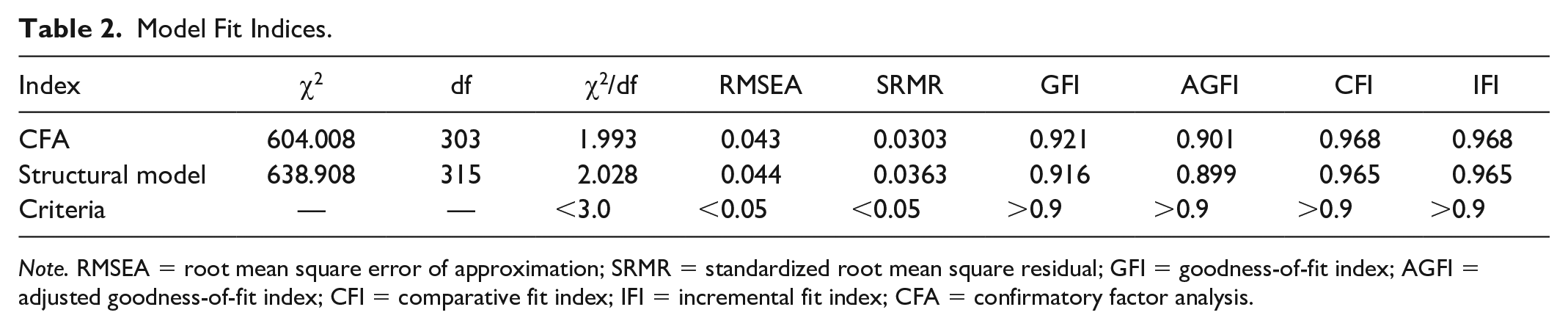
For the CFA of the overall model, the fit indices of the measurement model are as follows: comparative fit index (CFI) = 0.968, goodness-of-fit index (GFI) = 0.921, adjusted goodness of fit index (AGFI) = 0.901, root mean square error approximation (RMSEA) = 0.043, and standardized root mean square residual (SRMR) = 0.0363. The results therefore show that the model has a good fit.
The following three evaluation criteria were used to evaluate the convergence validity of the measurement model: the primary factor loadings are larger than 0.60, and the standardized loadings are significant at the 0.001 level; the average variance extracted (AVE) is larger than 0.50; and the composite reliability (CR) of each variance is larger than 0.7. As shown in the Supplemental appendix, the measurement models of this study met the criteria necessary to demonstrate convergence validity.
To determine the discriminant validity, the square root of the AVE was compared with the Pearson correlation coefficient of each construct. The data in the Supplemental appendix reveal that the square root of the AVE is larger than the correlation coefficient between any pair of constructs and that there is a significant positive correlation between all constructs; therefore, the measurement model has good discriminant validity.
Structural Model Analysis
The hypotheses of the research model were tested with the structural equation path model using AMOS version 22.0. In accordance with the criteria proposed by Hair et al. (2010), the model provided an adequate fit to the data (see Table 2).
Model Fit Indices.
Note. RMSEA = root mean square error of approximation; SRMR = standardized root mean square residual; GFI = goodness-of-fit index; AGFI = adjusted goodness-of-fit index; CFI = comparative fit index; IFI = incremental fit index; CFA = confirmatory factor analysis.
Analysis of the path coefficients of the structural model showed that serious leisure involvement has a significant positive association with subjective well-being and successful aging. Moreover, subjective well-being has a significant and positive association with successful aging (Table 3). Thus, Hypotheses 1, 2, and 3 of this study were verified.
Structural Model Analysis Results (H1, H2, and H3).

Note. SE = standard error; SLI = serious leisure involvement; SA = successful aging; SWB = subjective well-being.
p < 0.05, **p < 0.01, ***p < 0.001.
Mediation Effect Test
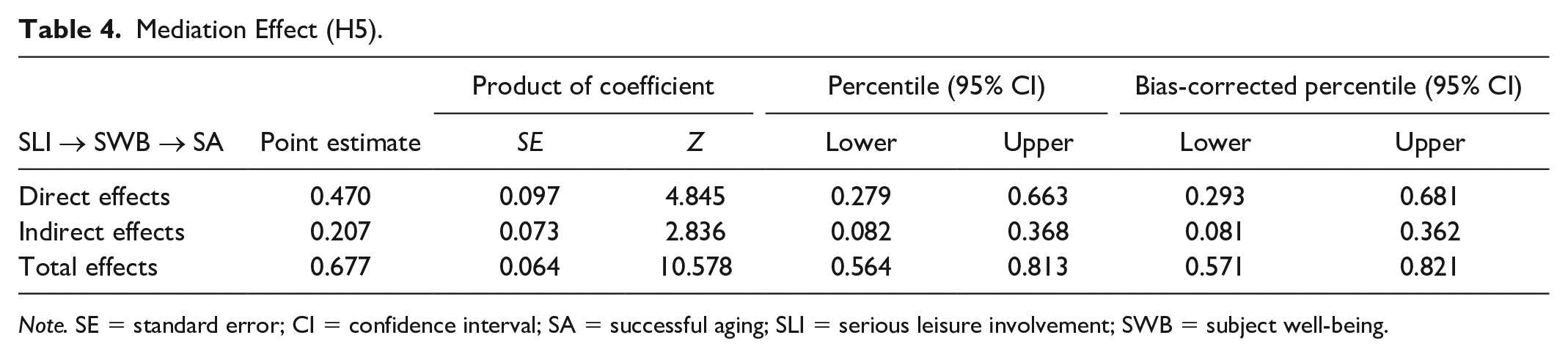
The bootstrap method (Preacher & Hayes, 2008) was used to test whether subjective well-being mediates the effect of serious leisure involvement on successful aging. The current research performed 2,000 bootstrap resamples and estimated the 95% confidence intervals (CIs). The mediation effect was observed with respect to the total effect, indirect effect, and direct effect. In accordance with Mathieu and Taylor’s (2006) suggestion, because all 95% CIs denoted by lower and upper bounds exclude the value of 0, the results indicated that subjective well-being partly mediates the relationship between serious leisure involvement and successful aging. Please refer to Table 4 for detailed information. Thus, Hypothesis 5 was supported.
Mediation Effect (H5).
Note. SE = standard error; CI = confidence interval; SA = successful aging; SLI = serious leisure involvement; SWB = subject well-being.
Moderating Effects of Family Structure
When the moderator is categorical, particularly dichotomous, a multigroup approach can be used to explore whether differences exist in the relations between the independent and outcome variables for multiple groups (Ro, 2012). This study used a multigroup analysis method (Baron & Kenny, 1986) to verify Hypotheses 5a, 5b, and 5c, that is, to verify whether the family structure moderates the relationship among the variables in the structural model. Respondents were first divided into two groups: complete family structure and incomplete family structure. The model fit of the invariance model in multigroup analysis and the verification results of the moderating effect of family structure on the above relationship are shown in Table 5 and the Supplemental appendix. The model for multigroup analysis has a very good fit and is thus suitable for further analysis (Jassey et al., 2013; Reinhold et al., 2018).
The Result of Invariance Measures.

Note. NFI = normed fit index; IFI = incremental fit index; RFI = relative fit index; TLI = Tucker–Lewis index; CFI = comparative fit index; significant at p < 0.001.
However, measurement invariance is critically important when comparing groups. Only when measurement invariance is established can a finding of between-group differences be convincing (Cheung & Rensvold, 2002). Although there are different techniques to assess measurement invariance, the multigroup CFA model is regarded as the most powerful and versatile approach (Steenkamp & Baumgartner, 1998). Thus, a multisample CFA was first carried out (Park & Park, 2018). As the differences in the p-value for Δχ2 = 29.923, Δdf = 20, and χ2 between the unconstrained model and constrained model were 0.071 (p = .071), the model of regression weights by family structure group was considered to be satisfied with respect to the fitness requirement. In the invariance detection of structural weights, structural covariances, structural residuals, measurement residuals, and so on, the p-values were all less than .05, indicating that the family structure has a moderating effect in the model. Please refer to Table 5 for detailed information.
After the grouping by family structure, the path coefficient results showed that the R2 values of the complete family structure for subjective well-being and successful aging were .52 and .65, respectively (Figure 2), and the R2 values of incomplete family structure for subjective well-being and successful aging were .36 and .38, respectively (Figure 3). Thus, compared with an incomplete family structure, a complete family structure is more associated with subjective well-being and successful aging. In other words, people with a complete family structure have stronger subjective well-being than those with incomplete family structures. Furthermore, people with a complete family structure also have a greater advantage in successful aging, highlighting the importance of family structure to the impact of serious leisure involvement on successful aging.

SEM model of complete family structure group.

SEM model of incomplete family structure group.
As shown in Table 6, the two groups do not differ significantly in the relationship between serious leisure involvement and subjective well-being (Z = 0.673<1.96), but they do differ significantly in the relationships between serious leisure involvement and successful aging (Z = 3.006>1.96) and between subjective well-being and successful aging (Z = 2.815>1.96). The above results demonstrate that the family structure has only a moderating effect on the relationships between serious leisure involvement and successful aging and between subjective well-being and successful aging.
Test of the Moderating Effect of Family Structure.

Note. SE = standard error; SLI = serious leisure involvement; SA = successful aging; SWB = subject well-being; significant at Z-value >1.96.
Discussion and Conclusion
Research Results
In this study, the object of research was the young-old group in Chinese seniors’ universities. The study verified that involvement in serious educational leisure had a positive association with successful aging for the young-old group and that the strength of this relationship was affected by family structure. All hypotheses on the relationships between serious leisure involvement, subjective well-being, and successful aging in the model architecture were verified and supported except for Hypothesis 5b: The relationship between serious leisure involvement and subjective well-being differs significantly on the basis of family structure.
Specifically, involvement in serious educational leisure, as represented by seniors’ universities, had a significant positive association with the subjective well-being of the young-old group in China. The path coefficient between serious leisure involvement and subjective well-being was found to be the highest (0.722), indicating that the serious leisure level of the young-old group was clearly positively associated with subjective well-being.
The study results also showed that the serious educational leisure activities of the young-old group were significantly associated with successful aging and that subjective well-being played a mediating role in that process. Data analysis revealed that greater serious leisure involvement is related to more successful aging, indicating that leisure participation is essential for successful aging. The overall model analysis results indicated that subjective well-being partially mediated the relationship between serious leisure involvement and successful aging. This result suggested that, first, leisure involvement is directly associated with successful aging and, second, that the perceived positive benefits (such as subjective well-being) of such involvement played an important role in the relationship between serious leisure participation and successful aging. Therefore, serious educational leisure can assist young-old individuals in maintaining well-being, diminishing emotional stress and compensating for a perception of the emptiness of life and thus improve their ability to achieve successful aging.
In addition, the study validated the significant differences in some of the relationships between the above variables on the basis of different family structures. In particular, the results of the comparative analysis of multiple groups indicated significant differences in the effect of serious leisure involvement on successful aging and the effect of subjective well-being on successful aging between different family structures. However, there was no significant difference in the relationship between serious leisure involvement and subjective well-being.
Discussion
One of the important contributions of this study of the Chinese culture was its verification of the validity of the third place by leveraging the serious leisure activities offered by seniors’ universities. For young-old individuals gradually withdrawing from their jobs, leisure space is significantly associated with their subjective well-being and successful aging, and the strength of this relationship changes according to differing family space structures. This finding may also partially explain the focus of the research area on leisure for older people because such leisure is positively related to their subjective well-being and successful aging.
The research data showed that regardless of whether the family structure was complete or incomplete, serious educational leisure always has a positive association with successful aging; however, for this specific path, there was a significant difference in the path coefficients between the two groups of dissimilar family structures. Specifically, the coefficients for the group with an incomplete family structure regarding the effect of serious leisure involvement on successful aging and the effect of subjective well-being on successful aging were significantly lower than those for the group with a complete family structure. As Stevens and Westerhof (2006) noted, support from spouses and adult children is a key element of successful aging. Older people with support from both spouses and adult children have a higher level of well-being and a greater likelihood of successful aging (Walsh, 2011). If there is a lack of family support, older people tend to compensate for such relationships by participating in leisure activities (Utz et al., 2004). For this reason, regardless of family structure, the serious leisure involvement of young-old individuals is argued to enhance their subjective well-being. However, for individuals with an incomplete family structure, the associations of serious leisure involvement and subjective well-being with successful aging are relatively weaker. This finding clearly demonstrates the crucial effect of the family space on successful aging for the young-old group.
According to the standards of successful aging, the findings of this study differed from those of previous studies. For example, in the second-order analysis on successful aging, the factor loading of physical health was found to be relatively low, resulting in the removal of physical health from the variables of successful aging. Hence, physical health was not an important indicator of successful aging for the respondents in this study. This finding was inconsistent with the related theory of successful aging and its measurement, as previous scholars have regarded physical health as one of the important elements (Rowe & Kahn, 1997; Schaie, 1996). The authors of this study believe that two factors led to this result. First, past standards of successful aging were established by doctors and researchers (Depp & Jeste, 2006), and doctors naturally consider physical health to be an important point of assessment. In addition, this study adopted the self-evaluation model of successful aging for older people. Compared with other measurements of successful aging, this method was more focused on self-perception (Huijg et al., 2016; Strawbridge et al., 1996), and the respondents demonstrated subjective differences in self-perception. Therefore, such differences resulted in outcomes different from past measurements of successful aging. Second, the group under study consisted of young-old people aged 50 to 64 years, an age group with fewer physical restrictions than other older groups. In most cases, these individuals demonstrated no great decline in physical indicators (Huijg et al., 2016; Smith et al., 2002). With regard to successful aging, members of this age group were more concerned about feeling well mentally, spiritually, and socially (Fredriksen-Goldsen et al., 2014; Huijg et al., 2016). In addition, Bardo et al. (2017) pointed out that, in contrast to physical and cognitive health, happiness can continue to increase throughout life, and it only gradually declines until the middle and late 60s. The above patterns also suggest that good physical health and cognitive function may not be necessary components of happiness or successful aging. Thus, in the self-evaluation data on successful aging for the young-old group, few relationships among the physical indicator and other indicators were observed, and it was therefore a reasonable outcome that physical health did not become a dimension of measuring successful aging. This finding also suggests that people’s perceptions of successful aging might indicate different connotations and emphases among different age groups.
Subjective well-being and successful aging in the research model are also areas of interest among researchers and are somewhat controversial. In particular, scholars have different opinions about the relationship between subjective well-being and successful aging. Some scholars consider subjective well-being to be the connotative meaning of successful aging (Freund & Riediger, 2003), whereas other scholars who consider subjective well-being and successful aging to be dissimilar and subjective well-being to be an important factor of successful aging (Strawbridge et al., 2002; Westerhof, 2003). The conclusions of this study are more inclined to support subjective well-being as a crucial factor in realizing successful aging, while serious leisure involvement and successful aging play mediating roles.
The study also further expands the understanding of the temporary and long-term benefits of serious educational leisure participation. Most of the previous scholarly research on serious leisure benefits focused on the positive effect of temporary participation in serious leisure activities. For instance, Stebbins (2006) divided the benefits of serious leisure activities into individual and group benefits—two types and a total of 10 items—of which the individual benefits include self-fulfillment, self-realization, self-expression, self-image, self-satisfaction, personal rebuilding, money acquisition, and subjective well-being. This study explored more expressions of successful aging as a type of mental state that is more stable within the category of long-term benefits. The study results showed that serious leisure involvement would ultimately be positively associated with successful aging through subjective well-being. This finding also suggests that the continuous effects of serious leisure on participants must arise through temporary states that they experience. At the same time, family structure was determined to have a significant impact on the transmission mechanism of the above leisure benefits.
Limitations and Future Research Directions
The study has two main limitations. Although the representation of the city tier levels was considered in the sampling and six cities were selected for the research to ensure the representativeness of the sample, this study did not touch on the differences between respondents from different cities. Given the vast geographic area of China, the concept of family and other aspects in different areas present cultural differences. Hence, the lack of consideration of cultural differences is a limitation of the study sampling. In addition, because successful aging is a relatively stable state and the study was conducted by obtaining sectional data that depended primarily on evaluations based on the respondents’ subjective perceptions, there was some deviation.
Therefore, future studies may focus more on the sampling and, as much as possible, include subcultural differences, especially differences in the concepts of family, work, and leisure, to enhance sample representation. In addition, this study considered only the young-old group. Hence, if circumstances allow, follow-up research may be conducted to determine the influence of leisure activities during the young-old phase on subsequent phases of aging phases. Furthermore, in addition to subjective well-being, future studies may focus on other short-term benefits of serious leisure to improve the research on the mechanism of influence between short-term and long-term leisure benefits.
Supplemental Material
20200121_ok_updated__appendix – Supplemental material for The Effects of Serious Leisure Involvement on Subjective Well-Being and Successful Aging: A Case Study of Young-Old Participants in Chinese Seniors’ Universities
Supplemental material, 20200121_ok_updated__appendix for The Effects of Serious Leisure Involvement on Subjective Well-Being and Successful Aging: A Case Study of Young-Old Participants in Chinese Seniors’ Universities by Jin Wu, Xi Li, Bo Gao and Xinwei Su in SAGE Open
Footnotes
Declaration of Conflicting Interests
The author(s) declared no potential conflicts of interest with respect to the research, authorship, and/or publication of this article.
Funding
The author(s) disclosed receipt of the following financial support for the research, authorship, and/or publication of this article: The author(s) received financial support for the research from Macau Foundation: MF1813.

Supplemental Material
Supplemental material for this article is available online.
References
Supplementary Material
Please find the following supplemental material available below.
For Open Access articles published under a Creative Commons License, all supplemental material carries the same license as the article it is associated with.
For non-Open Access articles published, all supplemental material carries a non-exclusive license, and permission requests for re-use of supplemental material or any part of supplemental material shall be sent directly to the copyright owner as specified in the copyright notice associated with the article.
