




Abstract
Self-efficacy has been considered an essential mediator and predictor of individual counseling performance. As there is no existing scale to measure counseling self-efficacy in the counseling domain, the Sources of Middle School Mathematics Self-Efficacy Scale was modified in this study. The purpose of this study is to examine the psychometric properties of the Sources of Counseling Self-Efficacy Scale, Malaysia (SCSE-M) in a sample of 541 Malaysian secondary school counselors. In addition, it aims to also examine the invariance between registered and non-registered counselors. The results reveal that the SCSE-M four-factor model (social persuasion, mastery experience, vicarious learning, and physiological and affective state) has good fit and is appropriate in the domain-specific counseling profession. In terms of validity and reliability, SCSE-M reported good internal consistency and support for configural, metric, and scalar invariance among registered and non-registered counselors. The generalizability of the results should be considered as tentative and limited to public secondary schools’ counselors who were the sample in this study. More research is needed in the other private, international, primary, and tertiary counseling sectors to determine the appropriateness of the SCSE-M for use in the counseling domain in Malaysia.
Introduction
School counselors have been identified as the main stakeholders in the Malaysian school counseling ecosystem as they are the main sources of advice and guidance for students in need (Low et al., 2013). In Malaysia, school counselors are advised to be registered with the Board of Counselors (Act 580, Commissioner of Law Revision, 2006) as the Board regulates the provision of counseling services in the country. The Board provides training and guidance on counseling and the assumption is that registered counselors would have better access to training, guidance, and counseling skills, thus enhancing their performance and counseling self-efficacy.
Past empirical research has found that self-efficacy is an essential mediator and predictor of individual task performance (Wilson & Narayan, 2016), leading to increased staff performance (Mittal & Dhar, 2015), higher achievement (Larson et al., 2013; Loo & Choy, 2013), greater motivation in learning process (Van Dinther et al., 2011), and more effective counseling and guidance services (Asarli, 2012). To date, research in counseling self-efficacy among school counselor has been limited (Mullen & Lambie, 2016).
Bandura (1986) suggested that the four sources of self-efficacy are namely mastery experience, vicarious learning, social persuasion and the physiological and affective states. Mastery experience refers to the authentic experience an individual gain in learning and, this source has been reported as the strongest predictor of self-efficacy (Loo & Choy, 2013) and the most influential source of efficacy information (Bandura, 1986, 1997; Palmer, 2011, 2006). Past and prior experiences contribute to efficacy beliefs (Martins et al., 2014) and the individual’s own capacity to achieve goals (Bandura, 1997). An individual’s successes are predicated from a higher sense of self-efficacy as compared to his failures, especially if the successes occurred during the early stage of his life (Aliyev & Tunc, 2015).
Social persuasion is derived from the judgments received from other individuals, and it is defined as one’s beliefs in the ability to carry out one’s duties and responsibilities as a result of social comments (Britner & Pajares, 2006). Social persuasion was found to contribute modestly to the prediction of academic performance (Lau et al., 2018; Won et al., 2017) and courses self-efficacy (Usher & Pajares, 2009) but this source is insufficient to increase one’s self-efficacy (Bandura, 1986; Kumkale et al., 2010). In addition, negative assessments or remarks could cause the deterioration of self-beliefs (Gangloff & Mazilescu, 2017).
Vicarious experience refers to learning through observing what others do and it appears more influential as a source of self-efficacy in the absence of mastery experience in that individuals rely more on it when they have only partial, prior experience or knowledge (Usher & Pajares, 2006a, 2006b). Seeing the success or failure of others could influence the self-efficacy appraisal of an individual; witnessing similar people performing well and successfully in tasks or activities could raise a sense of self-efficacy in those who observed (Lunenburg, 2011) and thus created greater beliefs in individual to successfully implement counseling interventions (Springer & Schimmel, 2015).
An individual’s self-efficacy can be influenced by his physiological and affective states. The physiological and affective states are comprised of an individual’s cognitive appraisal of his current level of self-efficacy, the ramification and circumstances of current tasks and any presumptive bias (Bandura, 1986). It refers to the emotional state one experiences (Joët et al., 2011). Individuals tend to expect success when they are not affected by pain, exhaustion, stress, strain, or any perceived negative stimulation that can inhibit successful endings and prohibit positive outcomes (Baron et al., 2016). Bandura (1997) argues that individuals’ interpretation of their internal states differ according to their own past experiences and depending on variables such as the severity and complexity of the tasks, and their judgment of their own abilities and capabilities. Likewise, with the other sources, the physiological and affective states could not operate by themselves to define personal efficacy; instead they have to be in agreement with other sources.
As Bandura (1997) states, self-efficacy refers to one’s confidence level in executing skills, and it should be domain-specific (Maddux, 2002). Although numerous self-efficacy scales have been established using Bandura’s conceptualization, none of them assesses an individual’s self-efficacy in the domain of counseling. Thus, this study aims to fill this gap in the methodological literature by examining the psychometric properties of a modified version of the Sources of Counseling Self-Efficacy Scale among school counselors in Malaysia, and subsequently validating this modified Scale for use in the Malaysian context. This study also tests the hypothesis that registered counselors with the Board of Counselors, Malaysia may have higher self-efficacy that non-registered counselors. Thus, the invariance between registered and non-registered counselors is investigated. The focus was on the invariance between registered and non-registered counselors as professional identity provided a sense of stability that gives meaning to one’s work and life and thus contributed to their own sense of ownership and uniqueness (Alves & Gazzola, 2011; Pistole & Roberts, 2002). A registered counselor status predicted the sense of professional confidence (Chu & Sung, 2013) and thus generated a greater sense of professional identity. In Malaysia, the execution and implementation of having counselors registered under the Act 580 are still new and in progress. Thus, there are two groups of practitioners out there servicing the public and school community. Therefore, our focus is to investigate the differences among these two groups of school counselors.
Sources of Self-Efficacy Studies
Research on sources of counseling self-efficacy have been limited and there have been no studies on the sources of self-efficacy in counseling thus far in the literature. The latest scale, the Psychologist and Counselor Self-Efficacy Scale (PCES) focused on psychologists and counselors’ professional development—clinical competencies, reflective learning and practice and clinical supervision (Watt et al 2019) rather than on the sources of self-efficacy in counseling.
Studies in counseling have investigated counseling self-efficacy and its relations to counselor performance (Iannelli, 2000; Wan Jaafar et al., 2009) but the focus was not on the four sources of self-efficacy respectively but self-efficacy as a whole. Self-efficacy predictive power is reduced when these self-beliefs are measured at broad levels as the sources of self-efficacy functions best at the appropriate domain specificity (Usher & Pajares, 2008). According to Bandura (1997), studies and analysis of the sources of self-efficacy should be made domain-specific as each source of self-efficacy functions best at an appropriate level of particularity and is designed to predict specific outcomes in certain domains (e.g., mathematics, language or counseling).
Studies were predominantly conducted in the disciplines of STEM—science, technology (Huang & Mayer, 2019), engineering, and mathematics (Lent et al., 2017; Papastergiou, 2010; Usher & Pajares, 2009) or writing (Joët et al., 2011). Most studies adapted the Sources of Mathematics Self-Efficacy Scale by Lent et al. (1991). Four theorized sources of mathematics efficacy information with a sample of 178 third-year engineering students was tested and the result was significantly predictive of gender differences (although small differences in magnitude) in mathematics self-efficacy and career interest. An identical research study was conducted by Britner and Pajares (2006) in science among 319 middle school students and it yielded different results, that is, the most important source was mastery experience as it was significantly predictive of science self-efficacy.
Lent et al. (1996) investigated four sources of self-efficacy in college students’ mathematics performance and their findings supported the four-factor latent structure (personal performance accomplishment, vicarious learning, verbal persuasion, and emotional arousal), as compared with the two-factor or three-factor models. The five-factor latent structure consists of the division of vicarious items into the adult model (5 items), peer models (4 items), and 1 item that was omitted from the original questionnaire for different populations (high school students). The recent Career Exploration and Decision Self-Efficacy-Brief Decision (CEDSE-BD) Scale with two additional factors (exploration-based mastery experiences and positive affect to career decidedness) also showed to improved model fit (Lent et al., 2017).
The Sources of Self-Efficacy Scale in Mathematics developed and validated by Usher and Pajares (2009) complemented the shortcomings of other measurements which had failed to reflect sources of self-efficacy information as defined and theorized by Bandura (1997). This scale provided an overview of the sources in the domain of motivation, such as, self-concept, optimism, tasks goal, and achievement as a whole. Usher and Pajares (2009) constructed a measure that was used in a specific domain (mathematics) and with a specific target group (middle school students). The four sources were found to be psychometrically sound with mastery experience reported as a higher predictive indicator of mathematics self-efficacy beliefs. The scale was tested with different analytic techniques, using both qualitative and quantitative methods and this particular scale presented good internal consistency, especially in the mathematics domain (Chen & Usher, 2013; Usher & Pajares, 2009), but it has yet to be tested with other domains such as in counseling. In addition, the correlational approaches, structural models, causal influence, multidimensionality, and the contextual factors were well tested and studied too (Usher & Pajares, 2008). Recent work by Usher et al. (2018) revealed that the sources of self-efficacy remained a strong psychometric property, in the domain of mathematics and science, within studies conducted with the economically disadvantaged population.
The Career Self-Efficacy Sources Scale (CSESS) was also developed and tested in the sports field, and was used to measure career self-efficacy among the Lithuanian adolescent sports players (Brusokas & Malinauskas, 2014). It was found that the older players (cadet group in schools), reported higher levels of career self-efficacy in the four sources (vicarious experience, verbal persuasion, positive emotional arousal, and accomplishment in performance), and specifically, the cadet group displayed better score in vicarious learning compared to the junior group.
There has been limited research that addressed sources of self-efficacy (Usher & Pajares, 2009). To date, there appears to be no consensus as to how measure sources of self-efficacy in counseling could be investigated. It is suggested for the sources to be studied within its’ own context (Bandura, 1986) as well as within its’ integrated context (Steyn & Mynhardt, 2008). Each source played different roles in different weightage, and contributed and resulted in different behavior. These sources also functioned concurrently and it was the cognitive processed and information integrated that determined one’s self-efficacy beliefs (Britner & Pajares, 2006), and subsequent interaction with the environment and motivational factors (Bandura, 1991) to deliver learning and achievement related behavior such as performing successful counseling sessions, activities and tasks. The sources of self-efficacy shall be measured in the context itself. Rather than using a mathematic instrument to measure “counseling self-efficacy,” it is imperative to validate and establish an instrument that is valid and reliable in measuring what it’s supposed to measure.
Thus, this warrants an in-depth study in the context of counseling by means of a questionnaire designed to assess the constructs specifically within the domain of counseling. This research study aims to meet the gap in this context by adapting an instrument (Sources of Counseling Self-Efficacy Scale—Malaysia; SCSE-M) that will measure the sources of self-efficacy among secondary school counselors in Malaysia. Therefore, this study aims to examine the psychometric properties of the SCSE-M among school counselors by investigating (a) the reliability and validity of the SCSE-M and (b) invariance in SCSE-M between registered and non-registered counselors.
Materials and Methods
Participants
A total of 541 Malaysian secondary school counselors participated in this study (77.81% female). Ages ranged from 23 to 60 years (M = 39.34, SD = 8.89). The ethnicity of participants was 348 (64.30%) Malay, 140 (25.90%) Chinese, 40 (7.40%) Indian, and 13 (2.40%) Others. Among these counselors, 422 (19.22%) have an undergraduate degree, 111 (20.51%) have postgraduate degrees, of which 104 (19.22%) had a master’s degree and 7 (1.29%) had doctorates. A small percentage (1.49%) of them possessed other qualifications graduated at the diploma level.
Among the participants, 243 (44.90%) were registered with the Board of Counselors (Malaysia) while 298 (55.10%) were non-registered counselors. The Board of Counselors (Malaysia) acts as an agent that regulates the work of counseling services according to the policies and existing regulations enforced by Counsellor Act 1998 (Act 580). As such, registered counselors have to comply with policies and regulations set by the Board and are also kept to date on counseling trends and information.
Measures
The SCSE was adapted and modified from the Sources of Middle School Mathematics Self-Efficacy Scale designed by Usher and Pajares (2009). Previous studies (Carpenter & Clayton, 2014; Freed, 2013; Gates, 2014; Jackson, 2011; Kontas & Özcan, 2017; Yurt, & Sünbül, 2014; Zelenak, 2011, 2015) had proven the scale to have excellent psychometric properties. Consent was obtained from the authors for adaptation to incorporate the context of Malaysia. The new title of the scale is “Sources of Counselling Self-Efficacy Scale, Malaysia” (SCSE-M) with the word “mathematics” substituted with the word “counseling” and items modified to reflect the counselling setting. For example, in Item 20, the original sentence was “I have always been successful with math” was replaced with “I have always been successful with counselling tasks/work.”
Thereafter, three experts (one with a doctoral degree, two with a master’s degree in counseling) who worked in the field of counseling assessed the content validity of the instrument. All three experts have an average of 10 years of experience in the fields of academia and counseling practice. Overall, the three experts reported the modifications made on the instrument were adequate, satisfactory and appropriate for the use of this study.
The modified scale was further piloted with 10 secondary school counselors from the public schools and respondents were asked to read, assess and answer the survey. No changes were required as participants reported the survey to be clear and direct. These participants were excluded from the subsequent validation study.
The SCSE-M is a 25-item scale that comprises four subscales: Mastery Experience (6 items), Vicarious Learning (7 items), Social Persuasion (6 items), and Physiological and Affective States (6 items). Each source contributed to the prediction of self-efficacy. A 6-point Likert-type scale is used with values ranging from 1 (definitely false) to 6 (definitely true). Item Number 14 requires reverse scoring and each source requires individual interpretation. A higher score represents a higher level of each source.
In addition, the Counseling Self-Estimate Inventory (COSE; Larson et al., 1992) was used to test the concurrent validity of the SCSE-M. The COSE is a 37-item scale that measures the extent of counseling self-efficacy beliefs and comprises five subscales: Microskills, Counseling Process, Dealing with Difficult Client Behaviors, Cultural Competency, and Awareness of Value. The internal consistency (Larson et al., 1992) for the total score and subscales of the COSE were reported as satisfactory (coefficient for the total scale = .93; Microskills = .87, Counseling Process = .87, Dealing with Difficult Client Behaviors = .80, Cultural Competency = .78, and Awareness of Values = .62). A 6-point Likert-type scale, with values ranging from 1 (strongly disagree) to 6 (strongly agree) was used. Nineteen items required reverse scoring (Item 2, 6, 7, 9, 16, 18, 19, 21, 22, 23, 24, 26, 27, 28, 31, 33, 35, 36, and 37). The instrument reported a moderate correlation with counseling performance (Larson et al., 1992) and quality of practice among school mental counselor (Schiele et al., 2015) but there was a no relationship correlation with counselors’ personal counseling experience (Drew et al., 2017).
Procedure
Approval was sought from the Ministry of Education (MoE) Malaysia and individual state Departments of Education to conduct the research with secondary school counselors. The questionnaire was distributed to all 14 states in Malaysia and informed consent were sought from all respondents. The respondents were informed that their participation would be treated with confidentiality, and they were allowed to withdraw their participation at any stage of the research. A total of 541 completed forms were returned, a return rate of 73%.
Data Analysis
All analyses were performed using SPSS (version 23) and AMOS (version 25). Confirmatory factor analysis was computed with the AMOS 25 program to evaluate the psychometric properties of the SCSE-M and its measurement invariance across registered and non-registered counselors. All statistical analyses were set with an alpha level of .05.
Results
The Four-Factor Structure Confirmatory Factor Analysis
Confirmatory Factor Analysis (CFA) was performed to test whether the four-factor structure of the scale adequately matched the counseling context. As there is no consensus among researchers on the best index for accepting or rejecting a model, three fit indexes (comparative fit index [CFI], incremental fit index [IFI], and root mean square error of approximation [RMSEA]) were used. As recommended by Hair et al. (2010), the following fit indexes were employed in this study: the chi-square/df, the CFI, IFI, in which values of .90 or higher indicate a good fit, and the RMSEA, in which values of .08 or less are generally taken to indicate acceptable model fit. The CFA model as seen in Figure 1 met the model fit with the data, χ2(224, N = 541) = 511.053, p = .000, CFI = .971, IFI = .970, and RMSEA = .041. All the items were statistically significant and exceeded the .50 cut off (Kline, 2005). The range in magnitude was from .62 to .86. Hence, the result shows a good overall fit of the model.

Item loadings and factor correlations for the SCSE-M.
Reliability
Internal consistency reliability
Internal consistency was assessed by using the Cronbach’s α coefficient and value >.70 is said to have good internal consistency (Nunnally & Bernstein, 1994). The 25-item SCSE-M yielded an overall coefficient alpha of .86. The coefficient alphas for the SCSE-M subscales were .87 for mastery experience, .88 for social persuasion, .93 for vicarious learning, and .92 for physiological and affective state. The correlated item-total correlation was used to identify items which do not agree with other items in the Scale (Table 1). Item-total correlation for internal consistent reliability should be >.30 (Cristobal et al., 2007) and all items in the SCSE-M were reported as >.30, except for item PH2—“Doing counselling sessions takes all of my energy” which was reported as close to .30. Thus, no item was deleted.
Corrected Item-Total Correlations and Cronbach’s Alpha If Items Were Deleted From the SCSE-M.
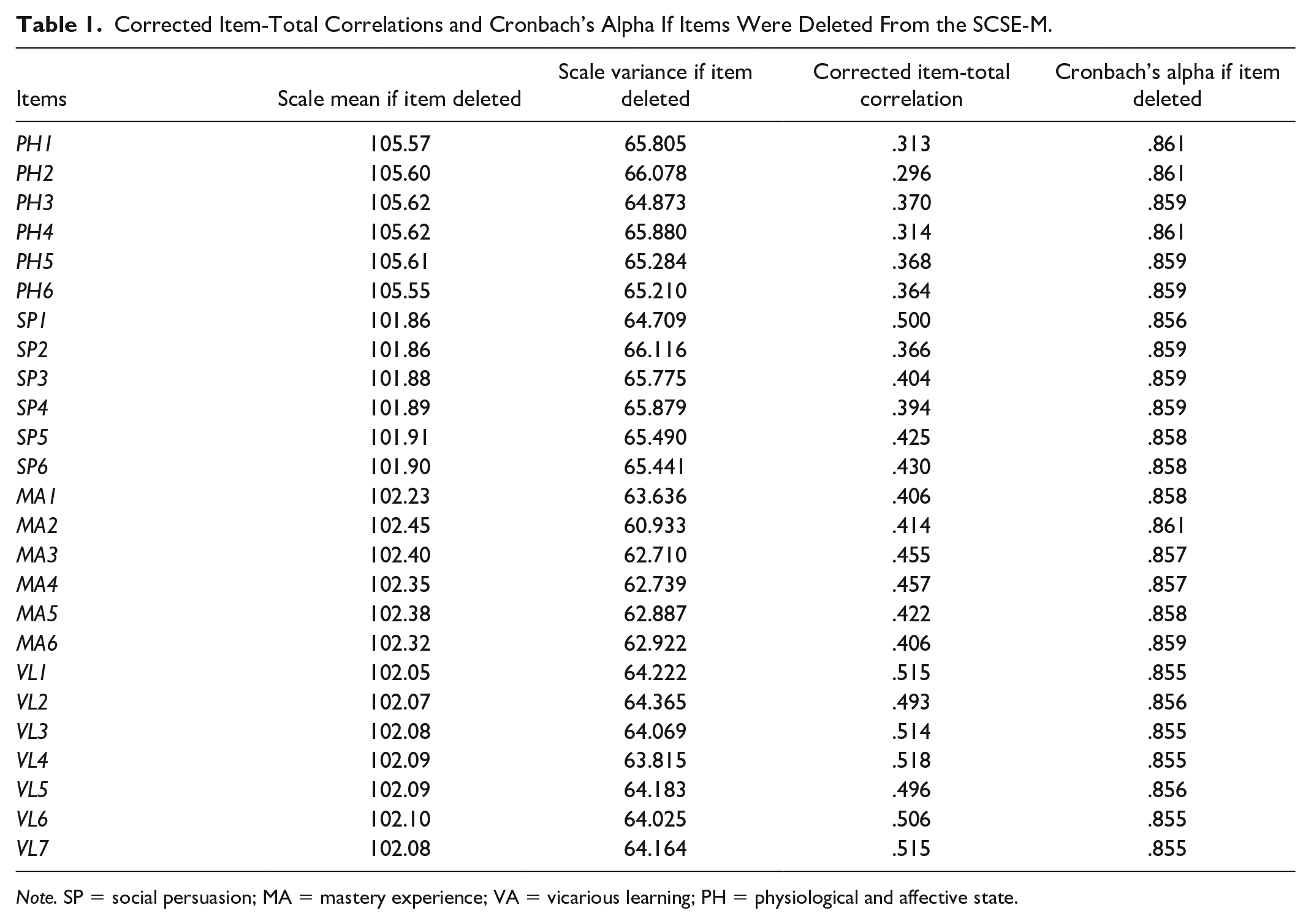
Note. SP = social persuasion; MA = mastery experience; VA = vicarious learning; PH = physiological and affective state.
Concurrent Validity
The concurrent validity of the SCSE-M and its four subscales was examined using Pearson correlations with other common measure of counseling self-efficacy: the COSE and its five subscales. Support for the concurrent validity was demonstrated by significant correlations between SCSE-M and COSE subscales, except for physiological and affective state (see Table 2). The Pearson correlations ranged between .177 ando .262 (p = .000). A significant correlation also existed between the overall SCSE-M and the overall COSE (r = .268, p = .000).
Correlation Matrix Among Variables.

Note. SP = social persuasion; MA = mastery experience; VA = vicarious learning; PH = physiological and affective state; MI = microskill; CP = counselling process; CL = dealing with difficult clients’ behavior; CU = cultural competency; VA = value; COSE = Counseling Self-Efficacy Inventory; SCSE-M = Source of Counseling Self-Efficacy–Malaysia.
* p < .05 ** p < .001.
Assessment of Construct Reliability, Convergent and Discriminative Validity
Construct validity and construct reliability of the SCSE-M were also investigated using the Composite Reliability (CR) and the Average Variance Extracted (AVE). According to Fornell & Larcker (1981), values of more than .70 for CR are considered good construct reliability. In addition, AVE values of greater than .50 would be evidence of convergent validity (Fornell & Larcker, 1981). Discriminative validity is achieved when the correlation between construct pairs is less than the AVE’s square root for any single latent construct. As shown in Table 3, the present study shows a good construct reliability, convergent validity, and discriminant validity for the SCSE-M. All values exceed the recommended cut-off values. These findings demonstrate that items grouped together on their respective subscales have little overlap across subscales.
Composite Reliability (CR), Average Variance Extracted (AVE), and Square Root of AVE Between Constructs.
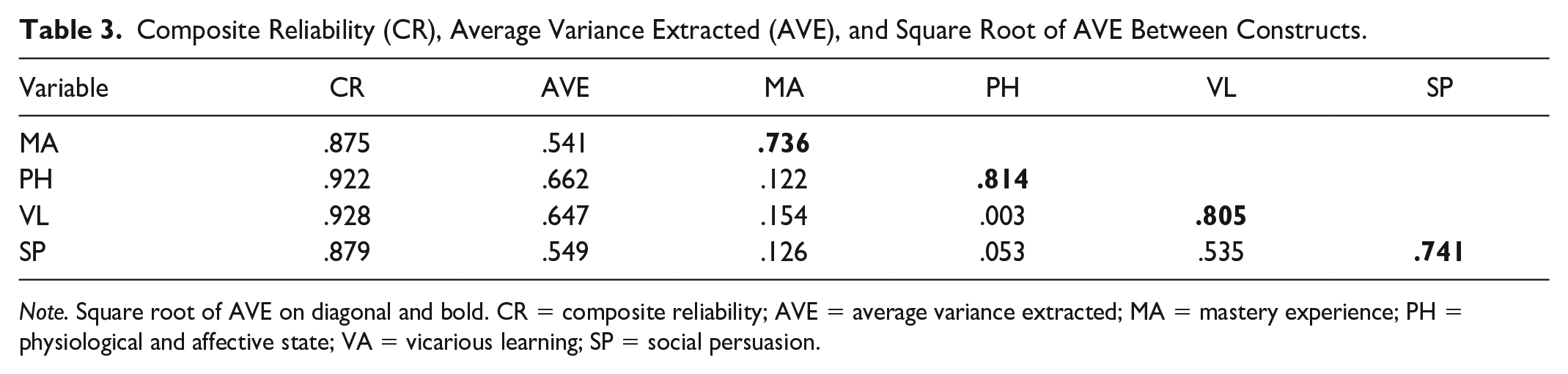
Note. Square root of AVE on diagonal and bold. CR = composite reliability; AVE = average variance extracted; MA = mastery experience; PH = physiological and affective state; VA = vicarious learning; SP = social persuasion.
Testing Invariance Across Groups
Multigroup CFA was further performed to test whether registered and non-registered counselors differ in their conceptualization of counseling self-efficacy. In the context of testing measurement invariance (MI), three levels of invariance were assessed (i.e., configural, metric and scalar invariance) with the stepwise procedure (Vandenberg & Lance, 2000). The configural invariance (Model 1) set the prerequisite for the other tests and the implications are that the same number of factors that appear in each group have the same patterns of fixed and parameters. The metric invariance (Model 2) was utilized to examine the fit of group data with equal factor loading across groups. Finally, the scalar invariance (Model 3) was tested by constraining the factor loadings and intercepts of like items to be equal. In assessing MI, a chi-square difference test was performed to compare the fit between nested models (Bentler & Bonett, 1980). Invariance at each level is established if the chi-square difference is non-significant. However, given that the chi-square difference test is highly affected by non-normality and large sample sizes (Meade et al., 2008), the CFI difference between nested models was calculated as proposed by Cheung and Rensvold (2002). A CFI difference of .01 or less is evidence of invariance. Taken together, the chi-square and CFI difference tests between nested models were estimated to test the scale invariance across groups.
Table 4 displays the fit indices for the models that tested MI. The results indicated a good fit of all models to the research data. Inspection of the changes in chi-square and CFI supported full configural invariance, full metric invariance, and full scalar invariance. Therefore, it is concluded that there is no appreciable difference between the registered and non-registered groups on the factor structure, factor loadings, and intercepts of the SCSE-M.
The SCSE-M Across Registered and Non-Registered Counsellors.

Note. SCSE-M = Source of Counseling Self-Efficacy–Malaysia; X2 = chi-square statistic; df = degree of freedom; CFI = comparative fit index; IFI = incremental fit index; RMSEA (90% CI) = root mean square error of approximation (90% confidence interval); ΔX2 = difference of the Chi-square values; Δdf = difference of the degrees of freedom; ΔCFI = delta comparative fit index.
All items were loaded significantly and factor loadings ranged from .601 to .885 for registered counselors and from .631 to .886 for non-registered counselors (Table 5).
Standardized Factor Loadings for the 25 Items SCSE-M Scale.

Note. CI = confidence interval; SP = social persuasion; MA = mastery experience; VA = vicarious learning; PH = physiological and affective state.
Notwithstanding this, the differences for relative items and scale scores across both registered and non-registered counselors were then compared (see Table 6). Analogously, the independent sample t test revealed no significant difference in mean scores of both the registered counselors (M = 107.5, SD = 8.302) and non-registered counselors (M = 107.0, SD = 8.377), t(539) = –.577, p > .05).
Mean, Standard Deviation for the Scale Items.

Note. SP = social persuasion; MA = mastery experience; VA = vicarious learning; PH = physiological and affective state.
p < .05 (2 tailed).
Discussion
The purpose of this study is to examine the psychometric properties of the SCSE-M in a sample of Malaysian secondary school counselors. In addition, it aims to also examine the invariance between registered and non-registered counselors. In general, a CFA on the SCSE-M suggested that the four-factor model (i.e., social persuasion, mastery experience, vicarious learning, and physiological and affective state) had good fit with the data. The internal consistency of the scale was acceptable. Correlations between the SCSE-M and the COSE were typically significant and modest in size. The convergence and divergence of the SCSE-M were acceptable. Furthermore, analyses of MI supported the SCSE-M as an acceptable description of the data for both registered and non-registered counselors at the configural, metric, and scalar levels. This indicates that the dimensionality of the SCSE-M is the same across the groups.
Although the scale is invariant across registered and non-registered counselors, mean level differences between registered and non-registered counselors on the 25-item scales were examined against counseling self-efficacy. No differences were found between registered and non-registered counselors. This finding suggested that regardless of registration status, the registered and non-registered counselors demonstrated no difference with regard to counseling self-efficacy in performing their core duty as counselors. No difference was reported in their self-beliefs in implementing the counseling sessions and/or performing counseling related tasks. This finding is important as counseling self-efficacy is associated with one’s belief to perform one’s counseling tasks effectively and counseling self-efficacy promotes efficiency in completing the counseling duties (Datu & Mateo, 2016)— at the same time ensuring that it effectively meets client’s needs. The modification made on the Sources of Middle School Mathematics Self-Efficacy Scale into the Source of Counseling Self-Efficacy Scale—Malaysia (SCSE-M) allowed the sources of self-efficacy to function appropriately in the domain-specific counseling profession. This domain-specific measure adds value to the contextualized assessment of counseling self-efficacy, and thus, provides counselor educators with a valuable input and data to make developmental and evaluation decisions and policies in relation to counselors’ education programs.
The quantitative method used through surveys is inadequate to reveal the whole picture and hence, other qualitative measures could be taken. One possible way to overcome this matter is to conduct interviews with the participants, as a follow up (Bong, 2006), within an acceptable time frame, to triangulate the reported sources of counseling self-efficacy scores obtained from supervisor, peer, and client ratings on counselor’s self-efficacy. As such, there would be triangulation of resources and methods used.
The generalizability of the results should be considered as tentative and limited to public secondary schools’ counselors as this study only involved the secondary school counselors from the public schools. The results obtained may not be generalizable to school counselors who work in private, international, primary, or tertiary education institutions. Caution needs to be exercised when interpreting the findings. The scale used only counselors (with or without Board of Counselor registration) to validate the factor structure of the scale. Thus, the adapted scale is only applicable to the counseling context.
As the counseling profession is still relatively young in Malaysia, it is vital to provide a valid and reliable instrument that can generate consistent results in measuring what they are intended to measure (i.e., Self-belief in counselors). The results collected from a valid instrument would subsequently form the foundation of future counselors’ professional and personal development trainings while also help in enhancing counseling services. In summary, despite its limitations, this study marks the first adaptation of a measure of sources of self-efficacy in Malaysia. It is also the first validated sources of counseling self-efficacy instrument that focuses on counseling with a comparison between registered and non-registered counselors. The 25-item SCSE-M provides a statically valid score for the measurement of sources of counseling self-efficacy among Malaysia school counselors.
Footnotes
Acknowledgements
Special appreciation is expressed toward participants who took part in this study and the Malaysian Ministry of Education for granting approval of this project.
Declaration of Conflicting Interests
The author(s) declared no potential conflicts of interest with respect to the research, authorship, and/or publication of this article.
Funding
The author(s) received no financial support for the research, authorship, and/or publication of this article.
