




Abstract
This study identifies factors, which stimulate and develop diversity management competency within Saudi Arabia’s private sector. A quantitative exploratory approach is adopted here, in which 210 interviews were conducted with human resources management teams and employees in private Saudi enterprises across different sectors of activity: health, education, oil, and financial. The data collected was analyzed using AMOS 24. Based on the results, a research model was constructed in which three main determinants of diversity management competency were identified for the success of diversity management: leadership competencies (cognitive and communication); empowerment; and diversity training. The results show that there is complementarity between those factors, but that leadership diversity competencies are the most important, and especially the cognitive aspect. Added to this is diversity training, which affects diversity awareness and inclusiveness. It is concluded that factors related to the internal development of diversity management competency are cultivated and constructed. The research model can help managers in developing diversity management competencies to generate successful diversity management processes. Due to the limited literature on diversity management in general and for Saudi Arabia especially, this research enriches the existing literature. The model developed here can guide directors of multinationals based in Saudi Arabia and facilitate the implementation of diversity management for Saudi-owned companies who intend to adopt diversity management initiatives as a solution for development. This research is important for both theoretical and operational approaches, defining a critical aspect of diversity management through the definition and development of an interesting tool: diversity management competencies. The development of such competencies may be of benefit for organizations in more easily facing and managing diversity.
Keywords
Introduction
This paper looks for the development of research models which can orientate and facilitate knowledge and implementation of the process of managing diversity within enterprises in the Middle East, and especially in Saudi Arabia, through a competency approach. It is accepted that diversity management (DM) is important for the contemporary organization, and this has become an important and determinant issue for the organization’s survival in a dynamic environment (Davis et al., 2016).
According to Foster and Harris (2005), diversity management is crucial because it enhances the development of competitive advantage, through attracting a variety of the best employees, who are able to be productive and creative. The objective of the current article however is not to enumerate DM’s benefits, which are widely discussed in the literature; especially as related to organizational performance (Cox & Blake, 1991; Janssens & Zanoni, 2014; Olsen & Martins, 2012; Zanoni et al., 2010). Rather, the question here is related to demarcating an appropriate way to use the skills of a diverse workforce effectively to guarantee its benefits.
Further, DM research on Middle Eastern and Gulf economies, including Saudi Arabia, remains limited (Abaker et al., 2019). The majority of research cited in the literature review is related to diversity management in the UAE (Forstenlechner, 2009, 2010). Added to this, the study concentrates on the private sector because it plays an important part economically for Saudi Arabia and ensures a variety of job opportunities for a large number of both Saudi and foreign nationals (Abaker et al., 2019).
In regard to successful diversity management, a competency approach is here considered the most appropriate strategy, and this depends on the development of specific diversity management competencies (DMC). Competency means and requires action in a specific domain (Weinert, 2001) and action is required to attend to organizational objectives through the benefits of successful DM. Competency also combines knowledge, aspects of character, skills, attitudinal, and other factors which positively affect performance (Adebukola, 2018, p. 433), and this is what is being examined to optimize the DM process and its outputs.
In other words, it is agreed that the development of diversity management competency is crucial for a successful DM process, but competency is constructed. Raelin (1997) developed a work-based learning approach in which he explains how competencies emerge from knowledge (tacit and explicit) through a specific method of combination. In the same field, Chrobot-Mason (2003) argues the existence of stages for the development of DMC, comprising: multicultural awareness related to the development of an orientation or perception: behavioral and coping skills expressed by an operational approach or application; and action planning, which means the realization of the DM process as clarified.
Schreier et al. (2019) confirm the existence and relative importance of five different competencies for the manager to effectively manage diversity: interpersonal competence, leadership competence, interpersonal, and business management competence, in addition to diversity management competences. This research confirms the diversity of competences for diversity, and focuses on diversity management competences, which seems to be the most pertinent and require additional enquiry.
Some other researchers consider that DM is relevant to personal abilities and approach change through institutional belief (Stringfellow, 2020). DM can be, in this sense, closely related to the context in which it operates. What matters in this view is abilities, not competences. Another important vision of DM holds that this management process is affected by personal perception, and this subjective aspect creates difference regarding how to accept diversity and diversity management and focuses on why this differs from one place to another (Hennekam, 2020).
Jankelová et al. (2020) demonstrate that the attitude towards diversity is more valuable and significant than the index of diversity management implementation. They identify some specific variables which can influence the level of this index: for example, employee satisfaction and size of organization.
Based on this brief analysis of the existent literature, it can be concluded that the diversity management process requires a focus on many aspects: abilities, perceptions, and specific competencies at different organizational levels. This variety of factors will be considered in this study in order to generate, as a final product, a new definition of diversity management competencies which integrates all of these levels and aspects, and will be considered as a performant tool for management diversity.
So, in order to provide a deeper approach to the construct of DMC, it is beneficial to ask about the factors or stimuli which can facilitate this process of transformation to generate competencies. In fact, it is asserted here that DMC is the result of a transformational process in which factors are considered as inputs, and competencies as outputs.
The main objective here will be pursued through an exploratory approach which aims to enumerate and identify factors in and mechanism for the development of DMC in private Saudi enterprises, considering that the research in this field is still limited, in spite of the high level of foreign workers in the majority of Gulf countries (Abaker et al., 2019).
In sum, the study is oriented towards successful DM through the development of some specific competencies issuing from related factors. These factors will generate automatically required competencies such as automatic system action and reaction. To attend to this objective, diversity, and DM are defined with a view to understanding how DM must be managed to be successful. The next step is to focus on identifying factors, determined through literature review, which are related to this emergent process of DM, as well as to the concept of DMC. The second part of this paper reports the methodology adopted to develop the model for research. After this, the results and discussion will be presented.
Literature Review
Diversity Management
According to Risberg and Soderberg (2008), diversity is a composite system concerning the similar and differentiating aspects of individuals, which may sometimes generate tension due to heterogeneity. The majority of research related to the definition of diversity specifies that there is primary diversity (Schwind et al., 2007), represented by the fundamental characteristics of people (age, gender, race, etc.), and secondary diversity (Sweetman, 2004), which includes dimensions related to socio-economic status, education, religion, etc.
One of the most prominent aspects of globalization is the international mobility of the workforce, and diversity has become one of the most important aspects in organizations across the world. In fact, diversity becomes inevitable, and research has started to focus on this concept and its impact on organizational performance, as discussed in Jackson and Joshi (2011) and van Knippenberg et al. (2013).
Differences generated by diversity require from each person the development of a specific profile, competencies, knowledge, and attitude to communicate effectively and efficiently with others (Ostendorp & Steyaert, 2009; Zanoni et al., 2010). This is why research related to diversity management has increased, seeking to maintain performance in teams which are diverse (Armstrong et al., 2010; Olsen & Martins, 2012), and organizations are looking for best practices and measures to assume this diversity (Janssens & Zanoni, 2014).
Hence, diversity management is here defined as encompassing a broad range of policy within human resources which aims to promote tolerance and inclusion within the working environment of those who have not been well-represented in those environments traditionally, including women and ethnic minority groups for example Oberfield (2014, p. 778). This definition confirms that DM is a construct defined through human resources policies: so, successful DM depends on the definition of best practices and policies. Ivancevich and Gilbert (2000) present DM as an organizational drive to commit to recruitment, retention, and promotions for a diverse staff who demonstrate commitment, motivation, and productivity (p. 77). This remains the role of HRM in DM, in which it seems important to operationalize this process in addition to commitment. It can be supposed that DM depends on a specific HRM.
In addition, due to its importance, many researchers have developed practices and policies for the success of DM (Pitts, 2009; Sabharwal, 2014) in order to maximize its positive effect and limit its negative effect through a diversified workforce (Andersen & Moynihan, 2016; Oberfield, 2014).
Based on this analysis, it is concluded that diversity management is a multifaceted concept which integrates managerial activities, based on the definition of workforce diversity, through cultural awareness, to consider diversity as an organizational goal and implement a supporting program for diversity (Sabharwal et al., 2016). In other words, diversity management can be associated with a constructive process which requires both reflection and action; it is learned and constructed, not simply adopted. Thus, what is sought here is adequate competency to manage and understand this process.
Dreachslin et al. (2017) present three key areas within an exhaustive definition of diversity management. For those researchers, to manage diversity, it must first be recognized in the organization, and subsequently be managed to reduce disparities and improve performance. Recognition is a cognitive process which locates and identifies different elements of this diversity, and therefore human effort (in this case the employee’s effort) is wanted. Then, as a management process, there is a need for competencies or activities or practices to manage adequacy. Finally, to reduce disparities, it is necessary to build some shared conceptions and seek the common interest as a motivation. This combination, as presented by Dreachslin et al. (2017), needs five competencies: diversity leadership, cultural organization, cultural competence, diversity culture, and SHRM (strategic human resource management).
It should be borne in mind here that many researchers have looked to define the needed competencies to manage diversity. Weech-Maldonado et al. (2012) insist on community involvement, while Opstrup and Villadsen (2014) present commitment to diversity as the most determinant factor when considering diversity-friendly practices for diversity management. Pitts et al. (2010) consider that the only, crucial competence related to diversity is direct capabilities.
Groeneveld et al. (2012) insist on training and its importance in alleviating disagreement and conflicts between employees; in fact, they consider that training programs can help to develop an adequate communication process to facilitate exchange, and help individuals to understand each other through the development of team performance. So, diversity management here is associated with a collective effort among a heterogeneous group, with the key factor being good communication, which requires a communication competence.
Rühl (2016) defend a new approach to diversity management, which is a systemic approach according to which each member must be aware of and attentive to diversity and this must become a priority for organization.
The focus here is now oriented towards the definition of a practical approach to management diversity based on a specific set of competencies, named in this case diversity management competencies. This interest is due to the importance of successful diversity management for groups, organizations, satisfaction, engagement, stability, competitiveness, and innovation (Ritz & Alfes, 2017; Schaffer, 2018)
Diversity Management Competence (DMC)
Despite its benefits, diversity management presents challenges; related especially to communication problems, which can engender misunderstandings, and tension due to differences between people (Adebukola, 2018).
Akinnusi et al. (2017) assert that for DM to be successful, on the organization must have the to ensure the engagement of all employees. In this case, Reisinger (2009) sets out two main determinants of DM; internal and external, claiming organizations must manage diversity well to satisfy new markets or new customers in the external view, and stimulate creativity and innovation in order to increase performance. Here, the role of the manager seems to be determinant. Adebukola (2018, p. 433) considers that the duties and role of management has evolved to encompass providing inspiration, support, and encouragement to include each member of staff, regardless of their background characteristics, so that the organization can achieve its objectives. Thus, leadership roles should be redefined, and competencies for DM must be developed.
If those specific competencies are to be determined, it must first be understood that a competency is an individual trait which provides for effective and successful action (Weinert, 2001). DMC will be explored through four dimensions, comprising awareness and leveraging of diversity, adapting to diversity, and inclusivity, following Adebukola (2018).
Hansen et al. (2000) describe DMC as: “(a) awareness and knowledge of how age, gender, race, ethnicity, national origin, religion, sexual orientation, disability, language, and socioeconomic status are crucial to an informed professional understanding of human behavior; and (b) clinical skills necessary to work effectively and ethically with culturally diverse individuals, groups, and communities.” (pp. 652, 653) Based on this, DMC is defined on an individual level which affects others. Added to this, awareness seems to be an important factor in the development of DMC. This leads to the supposition that there are individual factors and collective factors at play, as will be detailed below.
Derek and Kecia (2004) present DM competencies as reflecting individual understanding and awareness of the ways in which cultural and different factors within shared identity are vital for professional understandings of human behaviors, both within the workplace and externally, as well as reflecting the people skills which are needed for managing and working with people, groups, and organizations with a wide-ranging demographic. This view of DM competencies evokes the dynamic aspect of DMC, and means that the DMC must be operationalized through behaviors which can improve work and conditions of work.
Based on this analysis, DMC will be considered as an individual dimension related to the personality, translated through actions and benefit on an inter-individual level. Another important aspect here is related to the effects of DMC. In fact, the benefits cited seem to be the same as DM as an emerged phenomenon related to new economic and social features.
Thus, DMC are considered here, and the objective is to identify factors and mechanisms related to their definition. It should be remembered that DMC can be appreciated individually and at firm level. DMC on the individual scale will be examined through three main dimensions: diversity adaptability, which is related to the ability to adapt and reflect the degree of openness in order to reach an adequate solution and avoid conflicts (Pearlman & Barney, 2000); diversity leveraging, expressed by the strategic engagement of diversity to achieve organizational objectives (Davidson, 2011); and inclusiveness related to equality independently of differences (Bell et al., 2011).
Factors for the Development of DMC
Considering that DMC is understood through degree of awareness and knowledge, as earlier discussed, there are therefore two main kinds of factors: one concerned with level of awareness; and one directly concerned with knowledge development.
In the same vein, Cox (1994) concludes that the successful DM process requires an interactional model through a multi-level approach. Gilbert et al. (1999) consider that DM is linked to a change process which is based on an integrative approach.
Drahoslav et al. (2015) define factors related to the perception of DM and to the attitude towards DM, relating to how it is considered on an individual level. In this field, legal form is mentioned as a determinant because it determines the nature of the relationship between employees in different states, added to active support for employees.
Karounos (2009) argues that emotional intelligence can positively affect the effectiveness of leadership in the context of diversity. This idea is supported by Saberi (2012) and Kamps and Engelbrecht (2011).
Drahoslav et al. (2015) demonstrate that there are three specific factors which can influence perceptions of diversity, related here to the adaptability of diversity as one of the DMCs, such as: legal form, because it determines the structure and the nature of relationships between employees; the size of the organization insofar as diversity is more acceptable in the large organization than in the small organization; and foreign capital in the ownership structure.
Other researchers admit that the success of DM is directly related to developing leadership competencies (Dreachslin, 2007). Barrett and Beeson (2002) claim that the development of leadership competencies must be proportional to environmental change based on an integrative leadership style (Mintzberg, 2004). In this area, the definition and nature of these leadership competencies differ from one study to another. Leslie et al. (2002) associate these competencies with five individual characteristics related to skills, facilitating connectivity, and integrity. Chang and Thorenou (2004) suggest a cognitive factor in managing diversity. Meanwhile, Gudykunst (1988) and Lockwood (2005) suggest that communication skills seem to be the most important. For the current study, leadership competencies are divided into cognitive and communication skills.
At this point, it is acknowledged that, notwithstanding the specific skills required, collaboration between employees must be developed for a successful DM process. The literature review points strongly to the importance of the empowerment of diverse groups (Rosado, 2006). This concept constitutes the essence of innovation (Kennedy & Schleifer, 2006) and motivation for individuals within any group (Elbaz et al., 2018; Yang & Konrad, 2011).
As with any competency, DMC must be developed and learned. Hanaysha and Tahir (2016) argue that training programs, in general, affect profitability positively, and the success of DM is sought for profitability and the positive effect of any DM process. Based on this, researchers emphasize the role of diversity training to manage diversity (Yang & Konrad, 2011). In fact, some authors consider that diversity training is critical for a successful DM process.
As a conclusion to this first section, related to the literature review, it has been found that the development of DMC can be separated into three levels: individual with two dimensions (employees and leadership); and firm level. Added to this, factors which are able to generate, stimulate, and develop these competencies are divided into external and internal factors (facts and results).
This study focuses on the internal factors (leadership competencies, empowerment, and diversity training) associated with four main competencies.
Based on this analysis, four main hypotheses are addressed:
H1: The cognitive competencies of leadership positively affect DMC
H2: The communication competencies of leadership positively affect DMC
H3: Empowerment positively affects DMC
H4: Diversity training positively affects DMC
Methodology
Due to the specificities of the variables (endogens) and the existence of different relations and associations between the constructs, the structural equation model seems to be the most appropriate because it considers many effects at the same time. In this case, AMOS is adopted in order to measure and quantify direct effects.
Data and Variables
The questionnaire used here to collect data was administered to 210 respondents. In this section, the sample and research instrument are discussed in order to make results interpretation easier.
The content of the questionnaire was established in line with items identified in the existing literature. As shown in Figure 1, two kinds of variables are used. Independent variables such as leadership competencies are approached through two dimensions: cognitive (cog) and communication (com); and empowerment (emp) and diversity training (dt). These variables were identified and selected from the literature based on the analysis presented earlier, and an attempt was made to maintain the main variables which satisfied the research interest.

Research model.
Leadership competencies are appreciated through items defined in Çitaku’s et al. (2012) Model. Moreover, items were measured as defined in the model through the cognitive and communication dimension: cognitive in order to understand and identify diversity; and communicative to establish a shared conception of diversity and make it into an opportunity and not a difficulty.
Empowerment is measured through five items extracted from the work of Men (2010), while diversity training is measured through six items adopted from Schmidt (2004b).
As the dependant variable, DMC was difficult to measure, due to the lack of research in this field. However, it was possible to identify dimensions and items through which to measure this variable from the diversity management competency framework and questionnaire (DMCQ) defined by Carstens and De Kock (2017).
All selected items were tested and presented an internal coherence and reliability in Cronbach’s alpha with a range higher than .7. To measure the items mentioned below, a 5-point Likert scale was used.
The first version of the questionnaire was pretested in order to evaluate the facial validity of the instrument. In all, 15 questionnaires were distributed to different respondents and some corrections were made in order to simplify the survey and facilitate the data-collecting process. After this, attempts were made to distribute the greatest number of questionnaires in different ways: face to face if it was possible, or via email, in which case it was necessary to track responses because these took significantly more time than was desirable.
Participants
The participants in the study are professionals in private organizations in Saudi Arabia within the health, education, and oil sectors. The sample is composed of both employees and directors, because each group is concerned with diversity. As previously mentioned, the study reports on the private sector, due to its importance and high level of heterogeneity.
Sample Characteristics
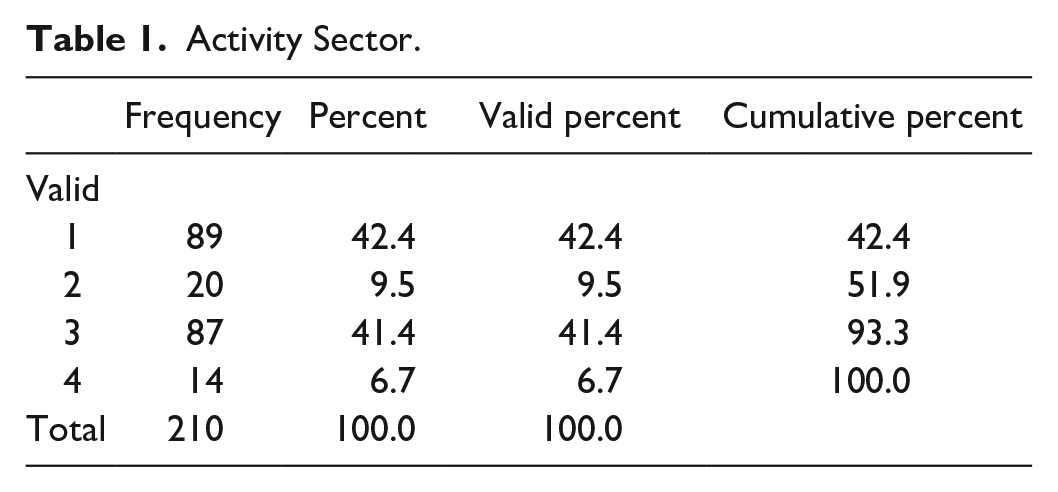
Three items in the questionnaire are related to sample characteristics: activity sector, educational qualifications, and work experience. The tables below summarize the results related to the research sample. In all, 210 diverse respondents participated in the research.
These characteristics were in fact used as a reference, and considered as a controlled variable. In other words, the aim was to make these results as specific as possible to the sample.
The majority of respondents belong to the industrial sector, and this is related to the context in which the research was conducted. However, as seen in Table 1, service sector is also prominent. The objective of this mixed approach is to verify if the nature of diversity management competences developed are variable or if there is a standard approach (Table 2).
Activity Sector.
Qualifications.

In terms of qualifications, the highest proportion of the sample achieved secondary education level. The main aspect investigated here was the ability to understand questions and be able to describe difficulties, or missed items or aspects of the questionnaire. It is noted here that some open questions are included in the data-collecting process. These questions require a degree of reflective capability, and thus it considered that educational level matters here (Table 3).
Experience.

In terms of experience, the sample is composed of the same proportion of high and low levels of experience. The literature review presented below suggests that experience cannot affect the development of diversity competencies because these competencies depend predominantly on ways of thinking and behaving.
Research Instrument
The instrument used in the study contains 16 items related to DMC, assessed through four dimensions: inclusiveness, adaptability to diversity, awareness of diversity, and diversity leveraging (Adebukola, 2018). Leadership competencies were examined through 12 items extracted from a study by Hall and Hawker (1988). To measure empowerment, five items developed by Denison (2000) and Hanaysha and Tahir (2016) were adopted. To consider capability development or diversity training, research by Schmidt (2004a), as well as by Hanaysha and Tahir (2016) is referred to, leading to the admission of five items. The Cronbach’s alpha value is acceptable within the range of .83, .77, and .81 for the independent variables, being respectively leadership competencies, empowerment, and diversity training. For the dependant variable (DMC), Cronbach’s alpha is .79. Each survey item is assessed using a 5-point Likert scale.
Results and Discussion
After tests for construct reliability through Cronbach’s alpha using SPSS 24, all values were judged acceptable, and ranged between .77 and .83.
The second step here was confirmatory factor analysis, which determined the validity of items adopted in this research for every construct. Following Hair et al. (2010), the quality of representativeness of the items used was determined, as assessed through factor loading for each item. In this case, all items seem to be representative, the factor loadings range between 0.47 and 0.69 and the construct validity is verified.
Reliability and validity were accepted and the structural model was generated with use of AMOS 24. So, a model associated with the research model was created, and the acceptability of fit index of the model was tested. Figure 2 presents the results.

Structural model.
All fit indices related to the model are significant and acceptable, as shown in Tables 4 and 5.
Illustrative Summary of Items.

Structural Model’s Goodness of Fit.

As shown, in Figure 2, the hypothesis related to empowerment is rejected, and the results demonstrate that there is a negative effect of empowerment on DMC. This result brings up questions related to emotional intelligence as defined by Karounos (2009). The cognitive competencies of leadership seem to be the most important, and this implies that the role of leadership skills and developing such skills is strongly significant for the success of the DM process. The second dimension seems to be less important, in this case. This result suggest that the direct effect of leadership competencies on DMC as defined by Dreachslin (2007) must be revisited in order to identify mediating factors to ameliorate these interrelationships.
Diversity training affects only two determinants of DMC; diversity awareness and inclusiveness, which refers, as mentioned by Adebukola (2018), to fairness in employment practice such that discriminatory and biased practices are eliminated, and promotion of an environment in which the individual can be open in being themself. The communicational competency of the management is important too for DMC, but only three dimensions associate with inclusiveness. This confirms the relative importance of awareness, as proposed by Drahoslav et al. (2015).
Hypothesis 3 is totally rejected: empowerment does not affect DMC. Hypotheses 1 and 2 are totally accepted, and hypothesis 4 is partially accepted.
In this research, a theoretical model for the development of diversity management competence was developed through specific internal determinants related to leadership competencies, empowerment, and diversity training. These factors were defined based on the combination of the findings of previous research related to management diversity and competences approaches.
The model examined the direct effect between these factors and different dimensions in relation to the dependent variable, which is diversity management competencies. The primary conclusion from the current results effectively confirms that this variable is multidimensional, and this is why it must be adopted as a process and superposition of specific aspects such as awareness, diversity adaptability, diversity leveraging, and inclusiveness.
Returning to the hypothesis and results, it is confirmed here that the achievement of a high competency level depends on leadership competencies (cognitive and communicational). Diversity training is important also, but it cannot affect all dimensions of DMC. Only those aspects related to practices can be improved by training. It is found in this case that the development of DMC is related exclusively to some pre-existent competencies which must reinforced. So, the cognitive approach is predominant, and this confirms that diversity management entails reflection, in that it is necessary to understand its mechanisms and value to practice it. Difference must be accepted in order to communicate. If the cognitive process is blocked, information and reciprocity are blocked too, and understanding each other become far more difficult because it is not understood how this difference can be decrypted, or what this difference stems from, which seems at first glance strange and useless. This explains the complementarity between the cognitive and communicative competence of the leader. It is essential to be able to exchange information, understanding it, and applying it. This is the optimal process which emerges from the model.
A beneficial application of this model could relate to diversity training. The most relevant aspect of the results here is associated with the empowerment process, in that contrary to the general view, these factors do not affect DMC. Thus, it can be considered that if the employee is responsible in their job, they may be comprehensive and flexible but this flexibility does not matter as much as has been supposed. Therefore, it is suggested that discussion of openness to ideas from a cognitive perspective is more important.
To develop these factors, human resource management, as the main function which deals with people, can be considered as a stimulator for some practices related to the reinforcement of cognitive and awareness-based dimensions. In the same vein, direct effects tested here must be reinforced by the introduction of other variables such as human resource management practices. This interdependence between factors identified here and DMC can be, in this sense, indirect, which means that potentially, a mediating or moderating variable may be of more benefit and provide a practical pathway or tools for DMC relevant to human resource management.
Conclusion
Contrary to the findings of existing literature, empowerment does not affect DMC and the development of leadership diversity competencies is the most appropriate aim. In order to implement a successful DM process, leadership competencies must be a focus and be subject to development. In fact, these results can be consolidated by research related to the role of human resource management for DM.
The pathway developed here through the research model seems to be determinant, but needs enrichment, because there is no total effect between the variables and DMC. For example, the controlled variable cited here must be tested and integrated for an exhaustive model related to DMC. Also, the problem of generalization seems to be important too, involving questions such as: does activity sector matter or not? Is there a standard or specific approach to DMC? Also, it is clear that the characteristics of respondents must be integrated into the analysis in order to maximize the possibility of generalizing the results. These characteristics could be studied as control variables in further studies and thus improve on the current research model. Another important aspect of this research, and one which can be considered as a limitation, is the restriction of context, in which data was collected on Saudi Arabia only. A comparative or multi-cultural approach could build upon the results of this study and provide additional insights in this field of research: especially when considering that diversity is a focus here, and thus, diversification is needed for generalization of results.
Independently of this, the question of diversity is becoming more and more central for economic development, due to the integration of foreign direct investment as a fixed pillar of the development plan set out in Vision 2030.
Added to this, the results imply that there is probably an indirect effect between the variables adopted here. Also, it would be interesting to explore associations between the development of some specific competencies and the strategy of the organization, because, as demonstrated here, external factors related to the development of DMC exist and must be detailed in order to provide an exhaustive approach to the DM process.
This study contributes to and enriches the limited literature review related to diversity management competencies and defines a new operational approach to appreciate and measure this concept, which seems to be important in this period. This can enable policymakers to develop required criteria and aspect to integrate these competencies and make the diversity management process clearer and easier. Another important aspect of this research is to demonstrate that diversity management success depends on internal efforts. In fact, this managerial process is constructed much more than adopted or explored. Diversity management has become a necessity not an option and must be operationalized, and the results of this study provide one of the most important tools through which to facilitate and manage diversity management.
Footnotes
Acknowledgements
Authors would like to thank Deanship of Scientific Research at Majmaah University for supporting this work under Project number R-2022-73.
Declaration of Conflicting Interests
The author declared no potential conflicts of interest with respect to the research, authorship, and/or publication of this article.
Funding
The author received no financial support for the research, authorship, and/or publication of this article.
