




Abstract
The logical consistency between generativity and the authoritative parenting style led to the hypothesis that the two behavior patterns or orientations were related. Survey measurements of perceived parenting style (authoritarian, authoritative, and permissive) and generativity in 559 university students and their respective parents were compared. The authoritative parenting style correlated positively with generativity for both students and parents. Both students and mothers scored significantly higher on generativity than fathers, but no significant difference was found between students’ and mothers’ generativity. Hierarchical regression showed that students’ generativity was proximally related to their perceptions of their mothers’ authoritative parenting style, their mothers’ reports of parenting style, and their mothers’ generativity. Father’s generativity or parenting style did not make any additional contributions. The pattern of results suggested that generativity is a learned orientation and more often from mothers than from fathers. The role of maturation might not be as strong as developmental theory would suggest. Several avenues of future research were outlined.
Keywords
Erikson (1963) described generativity as the midlife concern to establish and guide the next generation; the age-related link is supported empirically (McAdams & de St. Aubin, 1992; McAdams, de St. Aubin, & Logan, 1993; Peterson, Smirles, & Wentworth, 1997). Adults express generativity through nurturing, leading, and promoting the next generation through such pursuits as parenting, volunteer work, professional activities, and participation in religious, political, or community organizations. Generativity is also expressed through achievement motivation, technical skill transference, and engagement in the culture (Peterson & Stewart, 1993). Although generativity is a midlife concern, some researchers have reported that it can be activated in younger adulthood (Ackerman, Zuroff, & Moskowitz, 2000; Beaumont & Pratt, 2011; Marks, Koepke, & Bradley, 1994; Peterson et al., 1997; Peterson & Stewart, 1993), although younger and midlife adults appear to have different concerns or motives for generativity (Frensch, Pratt, & Norris, 2007; McAdams et al., 1993; Peterson, 2002, 2006). Because of the close link between the generativity construct and parenting imperatives specifically, the first question addressed in this study, which has not been considered directly previously, is whether parents’ generativity affects the generativity levels of their young adult offspring. The question is important because it could provide valuable information about the extent of any familial influence on generativity. Moreover, if there was such a relationship, it would suggest that the midlife stage of development in which generativity is thought to be prominent might be better understood, in part, as a continuity of influences rather than a discrete stage.
The second question addressed here is whether parenting style affects the generativity of either the parents or the young adult offspring. Baumrind (1968) described the authoritarian parent as one who controls and evaluates the behavior of the child according to an absolute standard set by a higher authority, often himself or herself. The child’s obedience and respect are demanded and punishment is endorsed while verbal give and take is not encouraged. The authoritative parent, by contrast, directs the child’s behavior in a rational and reasoning manner with verbal give and take. The authoritative parent exerts firm control but does not hem the child in with restrictions and recognizes the child’s individual interests along with his or her own parental rights and responsibilities. The permissive parent behaves in a non-punitive and accepting manner toward the child’s impulses, desires, and behavior. Few demands are made as the parent does not regard himself or herself as responsible for shaping future behavior.
Authoritative parenting style correlated with competent, responsible, and independent behavior in preschool girls and boys, and with social responsibility in boys and in girls who were also high in achievement motivation (Baumrind, 1971), altruism, and empathy (Spera, 2005). Among adolescents, authoritative parenting style correlated with higher self-esteem (Buri, Louiselle, Misukanis, & Mueller, 1988), less antisocial behavior, depression or anxiety (Lamborn, Mounts, Steinberg, & Dornbusch, 1991; Smetana, Crean, & Campione-Barr, 2005; Steinberg, 2001), and greater achievement (Lamborn et al., 1991). Greater levels of dysfunction seem to be associated with authoritarian, indulgent, or neglectful households (Lamborn et al., 1991).
In light of the trend between authoritative parenting style and positive outcomes, we hypothesized that the authoritative style would be associated with generativity of both the parents and their offspring. Authoritative style was associated with parents’ generativity on two occasions (Peterson et al., 1997; Pratt, Danso, Arnold, Norris, & Filyer, 2001). In another report, adolescents’ self-report of their parents’ authoritative style was related to their own generativity (Lawford, Pratt, Hunsberger, & Pancer, 2005). The relationships among constructs that are explored in this study are depicted in Figure 1. The connections between parents’ generativity and parenting style and offsprings’ generativity could be direct, as indicated by the black arrows, or indirect such that offsprings’ perceptions of their parents’ parenting style mediate the primary relationships. The impact of the parents’ disposition on young adults’ generativity has not yet been ascertained, however.
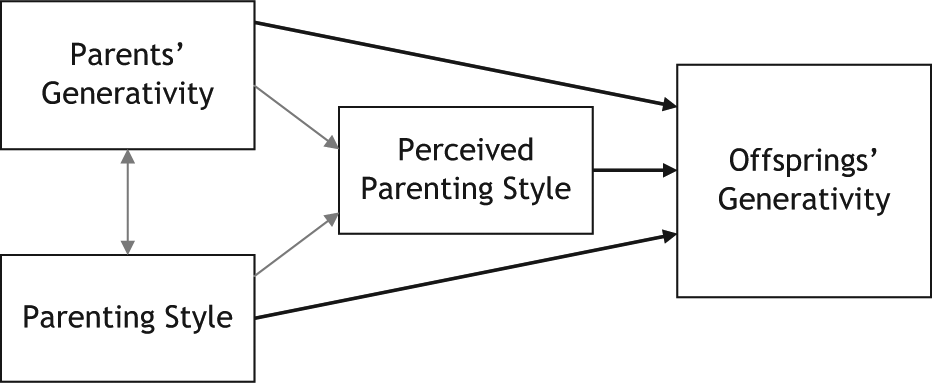
Possible relationships among parenting style and generativity variables.
The third new question is whether parents and their college-age offspring agree on the nature of the parents’ parenting style. This question came to the foreground while formulating hypotheses around the first two questions. If parents’ generativity and parenting styles were correlated with offsprings’ generativity, the relationship could be complicated by whether the offspring actually agreed with the parents’ interpretation of their own styles.
The following three sections of this article expand on the research findings that are most proximally related to the foregoing research questions, which we then proceed to answer with a survey study that correlated parenting styles, parents’ generativity, and the generativity of their college-age offspring.
Generativity and Its Correlates
In Erikson’s (1963) stage model of psychosocial development, generativity versus stagnation is the developmental task associated with midlife in which adults express interest in nurturing the next generation. The first correlate of interest is age, which has been studied incidentally to other hypotheses thus far. Marks et al. (1994) compared generativity scores, as measured by the Loyola Generativity Scale (LGS; McAdams & de St. Aubin, 1992), with attachment to pets for a sample of psychology students aged 18 to 44. Although there was a correlation between pet attachment, which reflected nurturing behavior, there was no correlation with age in that sample. Ackerman et al. (2000) compared LGS score with Satisfaction With Life Scale scores (Diener, Emmons, Larsen, & Griffen, 1985) in groups of adults under age 40 with those aged 40 to 55; although the two variables were correlated, there were no significant age differences in LGS scores between the two age groups.
The lack of an age-dependent relationship in the foregoing studies suggests that generativity is not something that suddenly makes a cold start in midlife, and probably took shape to some extent at an earlier age. On the other hand, other measures of generativity do show the age-dependent trend. McAdams et al. (1993) compared age cohorts of 22 to 27 years, 37 to 42 years, and 67 to 72 years on four types of generativity measures: generative concern (LGS), generative commitment, generative action, and generative narratives on a projective instrument. Here they found no difference on the LGS for the young versus midlife group, but the midlife group scored higher than the older group. There was a multivariate effect by age cohort, however, for the four measures combined such that the midlife group scored higher than the younger group. Also a retest by telephone interview later showed a higher mean for the midlife group on the LGS compared with the younger group.
Peterson and Stewart (1993) noted that Erikson regarded parenting as the primary expression of generativity, but most adults have their children in their twenties and thirties. They found for a sample of young adults (mean age, 28 years) there were notable differences between men and women with regard to how social motivations of achievement, affiliation, and power, and satisfaction with past generativity were correlated with number of children, personal productivity values, parenting involvement, and social concern.
Peterson (2006) reported a comparison of generativity scores for a sample of parents (mean age 47) and their college offspring who were seniors in college 4 years later. Offspring high in generativity reported greater positive affect, self-esteem, future time orientation, involvement in the family religion, and less repudiation of religion. Highly generative parents showed the same pattern of results except for religious involvement and self-esteem, and felt more closely attached to their offspring. The correlation between parents’ and offsprings’ generativity was .39. One conclusion was that generativity was transmitted through the family ties.
Several other correlates of generativity are relevant here as they point in the same direction as the parenting style research. Generative concern and behavior, as meaningful personal strivings, have been related to self-reports of life satisfaction in adults. McAdams et al. (1993) found life satisfaction as measured by the Satisfaction With Life Scale to be correlated with a number of measures of generativity, with the strongest predictor of life satisfaction being generative concern as measured by the LGS (r = .35). The authors noted that generative concern, life satisfaction, and educational level all showed strong positive correlations. Peterson et al. (1997) found generativity in middle-aged parents to be positively correlated with life satisfaction in their young adult children. Using these same measures with a sample of well-educated middle-aged women, Peterson and Duncan (2007) found that generativity scores at 52 years of age was predictive of life satisfaction at 62 years of age. Moreover, the women’s LGS scores were positively correlated with positive attitudes toward their roles as partners and as mothers. Peterson (2002) followed midlife women across 10 years and found that women high in generativity spent more time in their roles as partners and felt more emotional support from their immediate community.
Other researchers have reported associations between generativity and parental behavior. McAdams et al. (1993) found that LGS scores predicted parents’ level of involvement in their children’s education. Pratt et al. (2001) reported that generativity scores and education level were interrelated with mothers’ work choices, parenting beliefs, and parenting practices, especially an authoritative disciplinary style. Moreover, mothers, more so than fathers, reported expressing generativity through parenting, and mothers’ LGS scores were positively correlated with a variety of measures of parental authoritativeness. Peterson et al. (1997) found parental generativity to be correlated with an authoritative parenting style and predictive of less conflict, greater generativity, and greater life satisfaction in their young adult children.
Parenting Styles and Their Correlates
Baumrind (1971) related the three major parenting styles to behaviors of preschool boys and girls and found that the authoritative parenting style, which combines high control and positive encouragement, was correlated with competent, responsible, and independent behavior in girls and to a lesser extent in boys. It correlated with social responsibility among boys, but only among those girls who were also high in achievers. Authoritarian parenting, characterized as high in control but less warm and more detached, was associated with less independence in girls and less social responsibility in boys. Permissive parenting, involving low-to-moderate control with some warmth, was associated with less competence in boys and less assertiveness in girls. Darling and Steinberg (1993) recommended thinking of parenting style as an emotional context that influences the meaning of different parenting practices. More recently, Bornstein (2005) related many of the authoritative parenting behaviors to the concept of “positive parenting,” asserting its importance for the development of prosocial behavior in children, including moral judgment, responsibility, self-regulation, and mastery motivation.
A number of studies have focused on correlate behaviors of older children and adolescents. Buri et al. (1988) found authoritarianism in parents to be inversely related to self-esteem in young adult children, whereas authoritative parents’ children showed high self-esteem, especially daughters. Manuel (2006) also focused on authoritarianism, finding correlations between adolescents’ ratings of their parents’ authoritarianism in parenting style and the parents’ self-described authoritarianism as a personality construct.
Interestingly, Manuel (2006) reported strong similarities between parents in their disciplinary styles, whereas Buri et al. (1988) found more variability, with the mother’s parenting style somewhat mediating the impact of the father’s. Steinberg (2001) suggested that similarity in parental style is less important for adolescents than for children, but that adolescents show clear benefits from having at least one authoritative parent. These benefits include less antisocial behavior, depression, or anxiety, and more self-reliance, self-esteem, and achievement. Smetana et al. (2005) found an authoritative parental style to be associated with less deviance and depression in late adolescence. Spera (2005) noted that the authoritative communication style was positively associated with altruism and empathy in children and adolescent academic achievement. Lamborn et al. (1991) found that adolescents who rated their parents as authoritative showed more psychological competence and less psychological dysfunction than did adolescents from authoritarian, indulgent, or neglectful households. The same subjects, reassessed 1 year later, showed similar and even stronger differences, with authoritative parenting predictive of improved self-reliance, significantly greater gains in academic self-concept, and either diminished or stable rates of problem behaviors. Adolescent women who rated their parents as authoritarian described themselves as indecisive (Ferrari and Olivette, 1993).
Children’s Ratings of Parents’ Style
Surprisingly little research has been published on whether parents and their college-age offspring agree on the nature of their parents’ parenting style. Smetana (1995) found that adolescents in sixth, eighth, and tenth grade were more likely to assess their parents as either permissive or authoritarian, whereas their parents consistently rated themselves as authoritative. However, Pratt et al. (2001) found significant positive correlations between adolescents’ and mothers’ reports of authoritative parenting practices, but no significant associations between the perceptions of the adolescents and their fathers. They also reported a positive correlation between college students’ and mothers’ ratings of mothers’ authoritative parenting style. In light of the foregoing questions regarding generativity and parenting style, we also hypothesized that the college students in our sample would be in substantial agreement with their respective mothers and fathers.
Hypotheses
The hypotheses for the present study are depicted in Figure 1. The simple outcome would be that parents’ style and parents’ generativity would predict offsprings’ generativity as one might detect with multiple regression. If there were sufficient disagreements between parents’ styles and their offsprings’ perception thereof, the offspring’s perception of parenting style would appear as a third significant variable.
The less simple outcome would be that the overlaps between parents’ styles, parents’ generativity, and perceived style would make one or more of these variables redundant with others. The hypotheses were tested using hierarchical regression with the parents’ generativity entered after the other variables. Thus, the hypothesis for the last step in the regression analysis was that parents’ generativity would account for variance in offspring’s generativity over and above parenting styles and perceived parenting styles. This strategy was adopted because the prevailing notion of generativity is that it is primarily a midlife developmental schema, and if it were transmitted through familial influence, it would have less direct impact on the young adult’s experience than other variables because the young adults would not have reached the same developmental stage as their parents. The offspring’s perception of their parents’ style, in contrast, would be most proximal to their direct experience whether or not they were interpreting their parents’ style correctly.
Method
Subjects
A total of 559 college students (429 females and 130 males) from a private university in the upper Midwest along with 811 of their parents: 430 mothers (response rate was 81% of mothers contacted) and 381 fathers (78% of contacts) volunteered to participate. The parents were 73.9% married, 21.5% divorced, 4.6% widowed or single parents. As is customary, students who participated received extra credit points in their classes, with details left up to the instructor’s discretion. Students were also given additional credit if their parents completed the survey. Students whose parents did not return the survey were given the opportunity to do an alternative assignment for comparable credit; none of the students used this option, however.
The students’ mean age was 21.2 years. Of the 559 students, 91.8% identified themselves as Caucasian, 2.0% as African American, 2.0% as Asian, 2.9% as Hispanic, and 1.3% as “Other” racial group. When asked to identify their mother for the study, 91.2% of the students requested that the survey be sent to a biological mother, 1.1% to a step-mother, 2.3% to an adoptive mother, and 5.4% of students did not list a mother. When asked to identify their father for the study, 80.9% requested that the survey be sent to a biological father, 3.9% to a step-father, 2.1% to an adoptive father, and 13.1% listed no father.
The mothers’ mean age was 49.6 years. Of the 430 mothers, 96.3% identified themselves as Caucasian, 0.7% as African American, 0.5% as Asian, 1.4% as Hispanic, and 0.2% as “Other” racial group. One-half percent of responding mothers did not complete high school, 23.6% were high school graduates, 13.2% were vocational or trade school graduates, 23.6% had some college, 22.2% were college graduates, 6.3% had some graduate school, and 9% had a graduate degree. For family size, 7.4% of responding mothers reported 1 child, 44.9% had 2, 31.9% had 3, 10.4% had 4, 3.9% had 5, and 0.9% had 6 or more.
The fathers’ mean age was 51.9 years. Of the 381 fathers, 95.5% identified themselves as Caucasian, 0.8% as African American, 1.0% as Asian, 1.6% as Hispanic, 0.5 as Native American, and 0.3% as “Other” racial group. One and a half percent of responding fathers did not complete high school, 17.6% were high school graduates, 13.6% were vocational or trade school graduates, 23.4% had some college, 21.8% were college graduates, 5.5% had some graduate school, and 13.4% had a graduate degree. For family size, 5.5% of fathers reported 1 child, 45.4% had 2, 32.3% had 3, 11.0% had 4, 4.2% had 5, and 1.1% had 6 or more.
Measures
The student and parent surveys contained three scales and a demographic section. The first scale was the 20-item LGS that was developed by McAdams and de St. Aubin (1992) to assess individual differences in self-reported generativity concern. On a 4-point Likert-type scale where 0 is “never applies to you” and 3 is “applies to you very often,” respondents rate their agreement to statements such as, “I have a responsibility to improve the neighborhood in which I live” and “I feel as though I have done nothing of worth to contribute to others.” The LGS items cover many of the most salient ideas in the theoretical literature on generativity: passing on knowledge, making significant contributions to the betterment of one community, doing things that will have a lasting impact, being creative and productive, and caring for and taking care of others. The LGS has high internal consistency with alpha = .83 for the college sample and alpha = .84 for the adult sample.
The second scale was the Parental Authority Questionnaire that is based on Baumrind’s (1971) classification of parenting styles. Buri (1991) scale consists of two sets of 30 items per parent assessing subjects’ perceptions of their parents’ authority, with 10 each selected for authoritative, authoritarian, and permissive parenting behaviors and attitudes. Thus, each parent receives three scores from their child. “As my child was growing up, I seldom gave him or her expectations and guidelines for his or her behavior” is an example of a permissive statement, whereas “I had clear standards of behavior for my child as he or she was growing up, but I was willing to adjust those standards to the needs of the child” represents the authoritative style, and “As my child was growing up I did not allow him or her to question any decision I had made” is clearly an authoritarian statement. Each statement is rated with a 1 to 5 Likert-type scale where 1 is “strongly disagree” and 5 is “strongly agree.” Test-retest reliabilities were reported ranging from .77 (father’s permissiveness) to .92 (father’s authoritativeness). Cronbach’s coefficient alpha values were strong given the brevity of the scales, with a reported range of .74 (father’s permissiveness) to .87 (father’s authoritarianism; Buri, 1991).
The survey also included demographic questions for sex, age, education, and ethnic group. The student survey also included a front cover page explaining the purpose of the survey, instructions on how to complete it, a statement that each student’s participation was voluntary, and the assurance of anonymity. The cover page also asked students to provide their parents’ names and addresses so that surveys could be mailed to them. We also asked whether the parent(s) indicated on the cover sheet were biological, step, or adoptive. The parent version of the survey included a cover letter explaining the purpose of the study, instructions as to how to complete the survey, the fact that each parent’s participation was voluntary, and the assurance of anonymity.
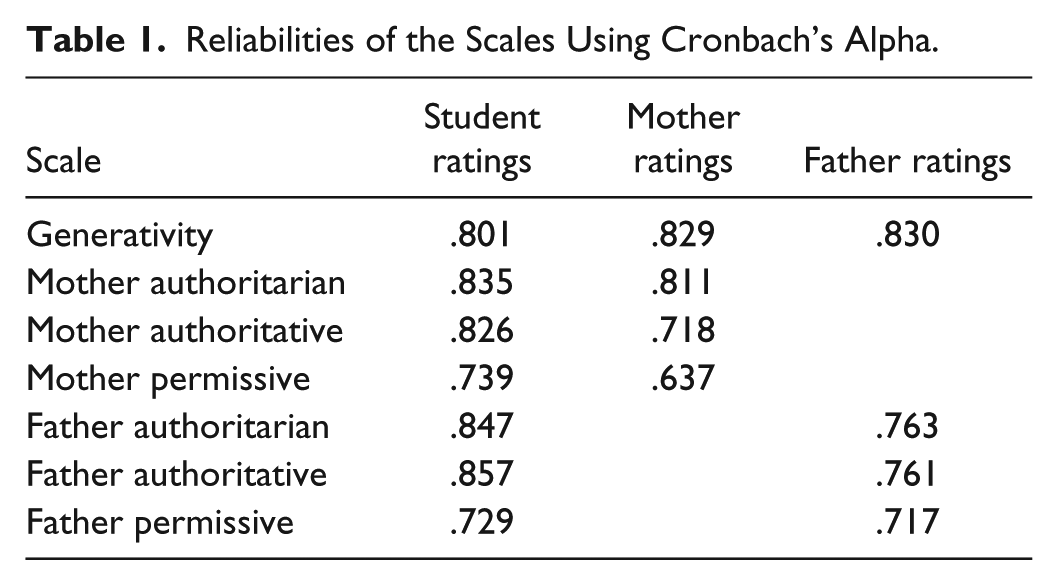
Reliabilities of the scales as used in this research were calculated using Cronbach’s alpha and reported in Table 1. Out of the 15 reliability coefficients presented, 8 were greater than .80, another 6 were greater than .70, and only 1 was less than .70. Reliabilities were thus considered acceptable.
Reliabilities of the Scales Using Cronbach’s Alpha.
Procedure
Student surveys were administered during class time for each group of students. Survey administrators gave students a brief introduction to the study, instructed them to read the cover sheet, sign the consent form if they desired to continue, and complete the survey, and asked if they had any questions. Completing the survey took an average of 20 min. The surveys were turned in by each student as they completed them. We coded the finished student surveys with a number that could be matched with the parents’ surveys.
The same student number was placed on that student’s parent survey(s) before we mailed them to the parent(s). A log sheet for each class was then compiled with each student’s last name, survey number, and whether the students listed a mother or a father or both to be sent a survey. Each parent was supplied with a postage-paid return address envelope. Materials sent to parents included a consent form, a survey, and a cover letter explaining the nature of the study, extra credit provisions for the participating students, confidentiality provisions, and contact information for the principal investigator. Parents were instructed to work independently so as not to influence one another. As parents returned their surveys, the student numbers on the surveys allowed research assistants to keep track of which student’s parents had returned the surveys. A follow-up postcard was sent out to parents who did not return the survey 2 weeks later, and the return rate increased.
Results
Correlational Analysis
Descriptive statistics for the research variables appear in Table 2. Pearson correlation coefficients were calculated on the constructs of parenting style, generativity, and life satisfaction. Significant correlations (p < .001) were found for students’ and mothers’ ratings of the mothers’ authoritative, permissive, and authoritarian parenting style. The same result was found for student and fathers’ ratings of the fathers’ authoritative, permissive, and authoritarian parenting style (Table 3).
Descriptive Statistics.

Correlation Coefficients for Parenting Style.
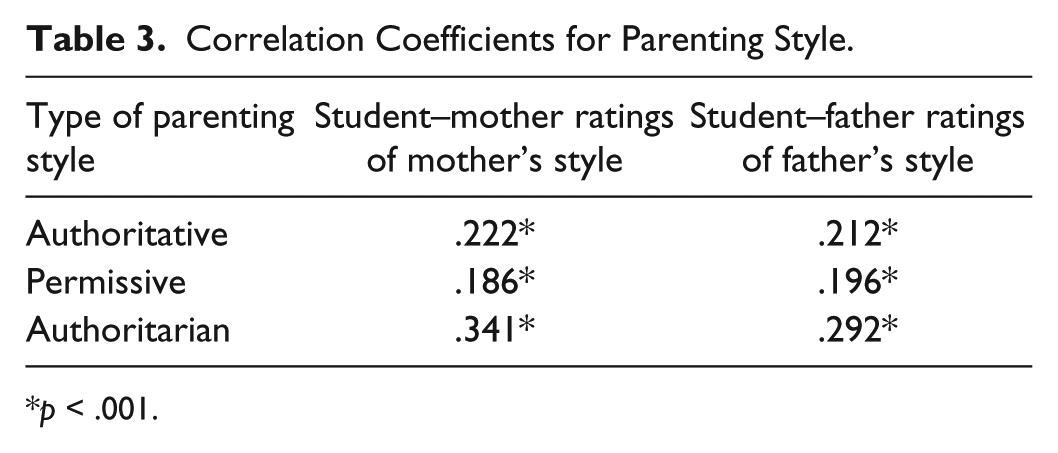
p < .001.
Table 4 includes the correlation coefficients between the mothers’ rating of their parenting style with students’ generativity, mothers’ generativity, and fathers’ generativity. The authoritative parenting style for mothers was significantly correlated with students’ and mothers’ generativity (p < .001) as well as with fathers’ generativity (p < .05). Permissive parenting style for mothers was negatively correlated with mothers’ and fathers’ generativity (p < .01) but not with students’ generativity. Table 4 also includes the correlation coefficients between the fathers’ rating of their parenting style with students’ generativity, mothers’ generativity, and fathers’ generativity. The authoritative parenting style for fathers was significantly correlated with students’ and fathers’ generativity (p < .001) but not with mothers’ generativity. Permissive parenting style for fathers was negatively correlated with mothers’ generativity (p < .05) and father’s generativity (p < .01) but not with students’ generativity.
Correlation Coefficients for Parenting Style With Generativity.
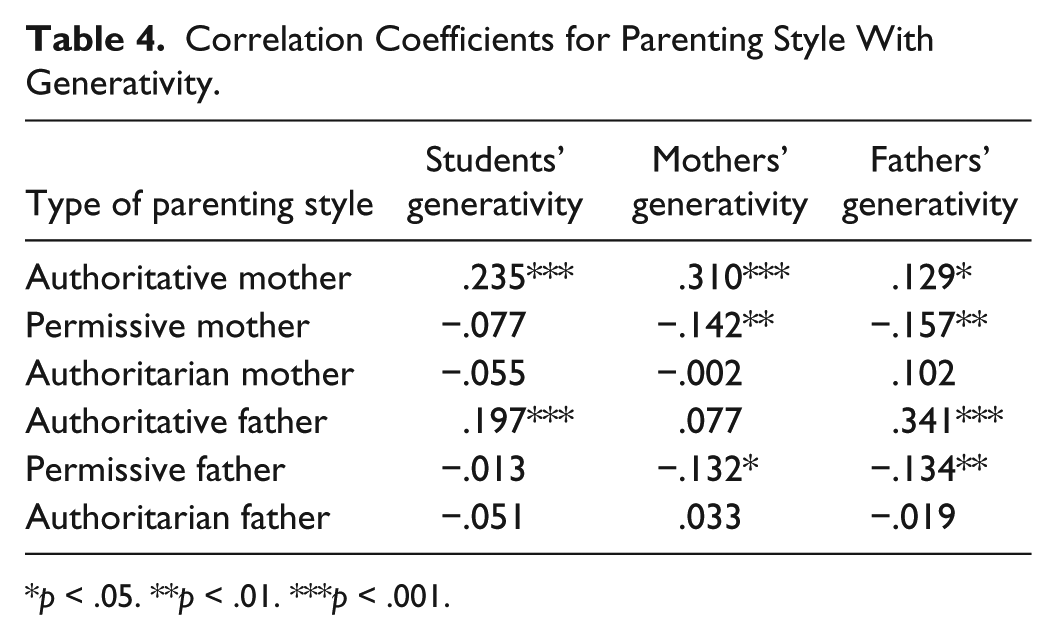
p < .05. **p < .01. ***p < .001.
Significant correlations were found for students’ generativity with mothers’ generativity (r =.194, p < .001). Mothers’ and fathers’ generativity were significantly correlated (r = .178 p < .001) also. Students’ and fathers’ generativity scores were not significantly correlated (r = .054, ns).
ANOVA
A one-way ANOVA with repeated measures was performed on generativity to compare students’ (M = 40.13, SD = 7.16), mothers’ (M = 39.92, SD = 7.80) versus fathers’ (M = 36.30, SD = 8.27) ratings. The score range for generativity was 13 to 60, with a higher number denoting stronger generativity. A significant effect was found, F(2, 678) = 37.80, p < .001. Tukey’s honest significant difference (HSD) procedure revealed that students and mothers scored significantly higher on generativity than fathers (HSD = 1.60, p < .01), but there was no significant difference between students and mothers on this construct.
Hierarchical Regression
The research variables were entered in three steps: (a) the students’ ratings of their parents’ styles, (b) parents’ reports of their parenting styles; (c) parents’ reports of their generativity. Preliminary analyses showed no significant semipartial correlations between any of the fathers’ variables with students’ generativity beyond the influence of the mothers’ variables. Thus, the hierarchical regression problem was reduced to three variables: students’ perception of mothers’ authoritative style, mothers’ reports of authoritative style, and mothers’ generativity. Fathers’ variables were assessed as a parallel process.
Results for the mothers’ influence (Table 5) showed a significant correlation between students’ ratings of their mothers’ authoritative style at Step 1. Mothers’ ratings of their authoritative style accounted for an additional 3% of the variance in students’ generativity at Step 2 (adjusted R2 = .08). When mothers’ generativity was entered at Step 3, it did have a significant impact on the prediction of students’ generativity (ΔR2 = .01), but mothers’ ratings of their style was no longer significant (adjusted R2 = .09). The final set of relationships is depicted in Figure 2.
Hierarchical Regression Results for Students’ Generativity With Mothers’ Variables.

p < .05. ***p < .001
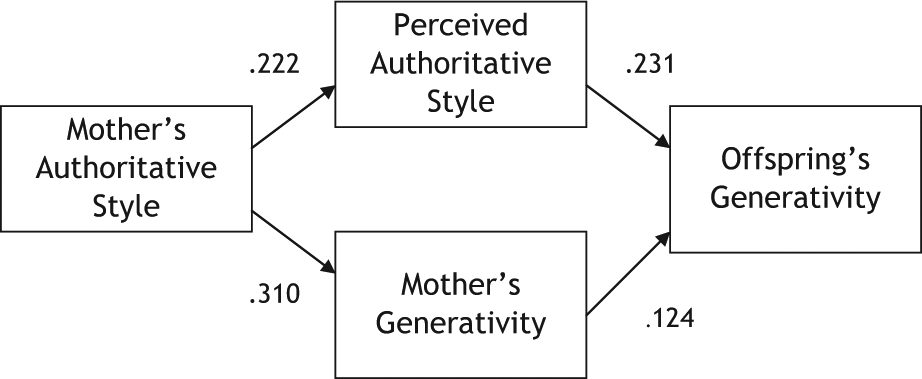
Actual relationships among mother’s generativity, mothers’ parenting style, students’ perception of mother’s style, and students’ generativity.
For comparison, Table 6 contains a comparable hierarchical regression for students’ generativity as a function of their perceptions of their fathers’ authoritative style, the fathers’ ratings of their own authoritative style, and the fathers’ ratings of their own generativity. The results showed that the students’ ratings of their fathers’ authoritative style correlated with the students’ generativity, but not as strongly so as their mothers’ authoritative style. The fathers’ ratings of their own authoritative style and the fathers’ ratings of their own generativity did not add anything to the prediction of the students’ generativity.
Hierarchical Regression Results for Students’ Generativity With Fathers’ Variables.

p < .001.
We also considered the possibility that the fathers’ variables could have a stronger influence on the generativity of male offspring than on both offspring together. The subsample N was 84 for this analysis. The results were not different from those reported in Table 6 and were not investigated further.
Discussion
Our first hypothesis was that parents’ levels of generativity would be positively correlated with students’ levels of generativity. The relationship held true for students and their mothers, although the effect size was small. The relationship did not hold true at all for students and their fathers.
The ANOVA test for generational differences in generativity showed no differences between students and mothers, but there was a significant difference between students and fathers of about 0.5 SD, which is a meaningful effect size. This finding contradicts the expectation from Erikson’s (1963) theory that generativity is a middle-aged preoccupation; it does indeed play a salient role in the experience of younger adults. It is possible that the current generation is maturing more quickly than the previous generation, but there is no further evidence yet that could support that conclusion at this time. It is more likely, however, that generativity among younger adults is more strongly influenced by societal trends than it is by maturational forces. Today’s youth could be applying the concept of guiding the next generation to members of its own generation, to children than they encounter in service settings, or to older age groups. Social issues and giving back to society have been stressed in recent years in college curricula along with the economic upheaval and changing political climate. Why fathers and not mothers scored lower on generativity than the students is curious, however, and warrants further research.
The second hypothesis predicting that the authoritative parenting style would be positively correlated with generativity in students and parents was also supported. Here again the strength of the relationship was stronger among mothers (9.6% of variance accounted for) than it was among fathers (1.7%) with respective to parents’ generativity. The strength of the relationships between students’ generativity and authoritative mothers and fathers was about equal (5.5 and 3.9% respectively). The causal relationship is not clear and is probably reciprocal: Higher generativity in parents facilitates the authoritative style, and the authoritative style supports generativity. Either way, the two constructs are logically consistent: doing something proactive to teach the next generation something meaningful. The results of this study provided further support for a similar connection reported by Frensch et al. (2007) based on interviews, questionnaires, and narrative reports from 35 adolescents and their families.
It is also relevant that the permissive and authoritarian parenting styles did not show the same positive relationship to generativity. Authoritarian parenting style was not correlated with generativity among students or parents. There were significant, although nominal, negative relationships between the permissive parenting style and both parents’ generativity.
The foregoing results are contributing to a theoretical picture that now indicates that individual differences in generativity are primarily learned and that they are more strongly mediated through the mothers than through the fathers. The learning effect is probably more implicit than explicit. A good question for future research is to explain what transpires between the parents the offspring to facilitate it, and to explain the differential impact of mothers and fathers in this regard.
The final question for this research project was to assess the extent to which parents and the college age offspring agreed on the parents’ parenting styles. The correlations were all significant, but relatively small ranging from .19 to .34. It is thus fair to conclude that, although there is some basis of agreement, there are some substantial differences in perception on the matter as well. Further research could explore why. For instance, are some parent−child interactions and life events more salient to the parents than they are to the children? If the parents were very smooth about getting an idea across to the children, would the children notice what happened?
Further investigations in this area should be conducted on a more heterogeneous sample if possible. Ours was predominantly Caucasian parents of students at a private college. An asset of homogeneity, however, is that it provides some relative control over ethnic variables. The sample was not equally representative of males and females, which is a growing difficulty in psychological research. The gender balance of the student sample might be responsible for the differential impact of mothers’ and fathers’ parenting style that was found here; this explanation should be explored further in new research.
The present results, nonetheless, made a substantial contribution to the understanding of generativity and parenting styles. Generativity among college students is proximally related to their perceptions of their parents’ authoritative style, and the next important influence is their mothers’ generativity. The influence of the mothers on generativity is much stronger than the influence of the fathers.
Footnotes
Declaration of Conflicting Interests
The author(s) declared no potential conflicts of interest with respect to the research, authorship, and/or publication of this article.
Funding
The author(s) received no financial support for the research and/or authorship of this article.