




Abstract
Due to the complex structure and stakeholder relationships within a program, the management of conflicts in program therein proves more challenging than with a single project. The internal conflict of a program affects the performance of the program team and the success of the program. The previous researches focus more on the project level rather than program level, and lack a systematic analysis of management mechanism of team conflict. This research contributes to the program conflict literature by investigating the unique nature and solutions of conflict within program team, taking a systematic and innovative view on the organizational structure of a complex construction program. The findings reveal unique program conflict and their causes and impacts, and suggest the principles and alternative resolution strategies for conflict in program. The different roles of stakeholders in program conflict are analyzed by social network method. A program conflict management model is developed for the effective management of program conflicts. The model provides a systematic view of the learning cycle of program conflict management, including conflict identification, resolution, feedback, and prevention, of which many patterns are found distinct from project conflict management. The research results can benefit practitioners and researchers in better understanding and minimizing program conflict.
Introduction
As often being associated with negative impacts, conflict had been treated as a series of episodes (Thomas, 1992), including the stages of latency, feeling, perception, manifestation, and aftermath (Pondy, 1967). The effective management of conflict between stakeholders can significantly reduce these factors relating to project/program. Conflict management skill has currently become one of the key competences for project/program managers (N. Wang, Jiang, & Pretorius, 2016).
Conflicts in project/program can cause cost overrun, project delay, low productivity, profit loss, and damage business relationships (Jaffar et al., 2011). In a society which attaches great importance to Guanxi (relationship) culture, the deterioration of relationships is a threat to program success (N. Wang, 2014). In recent years, there are an increasing number of large construction investments being implemented in the form of program. A program involves a portfolio of projects, which contribute to a common objective. The organizational structure of a program is potentially more complex than a project, and it can cause more internal conflicts between various stakeholders. As a program manager, it is important to investigate inter-team conflicts in order to achieve desirable outcomes for program. For the purpose of better settlement of internal conflicts, it is also important to fully understand the causes and impacts of internal conflicts in programs and to explore the effective way to manage them.
Despite the importance of conflict management to program, the unique features of program conflict and the role of stakeholders involved in conflict have not receive enough attention by researchers. The study on the causes and impacts of conflict for program is rare, and there is a lack of discussion of effective conflict management strategies on the program level, and taking consideration of organizational structure of program. Furthermore, the management process of program conflict attracts less attention in literature, which requires further investigation. This research takes a systematic view on the organizational structure of a complex construction program to explore the effective approach to manage conflict in program. The objectives of the research include (a) examining the involvement of key stakeholders in program conflicts, the types of conflicts in program, and their causes and impacts; (b) exploring the principles and strategies for resolving program conflict; and (c) to model the effective conflict management mechanism for program.
Literature Review
Program Management
With the tendency of “from projectification to programmification” (Maylor et al., 2006), programs become increasingly popular for providing a “missing link” between organizational strategies and projects (Murray-Webster & Thiry, 2000).
As there was a significant definition issue concerning program and that the previous studies failed to distinguish project and program, several researchers contributed to solve these problems. For instance, Murray-Webster and Thiry (2000) proposed an integrated definition “A collection of change actions (projects and operational activities) purposefully grouped together to realise strategic and/or tactical benefits.” Subsequently, Shehu and Akintoye (2009) defined Program Management as “aligning, planning coordination and execution of a group of related projects to realise benefits that is not possible if the projects are managed individually” through literature review and industrial questionnaire survey. Furthermore, with the purpose of distinguishing program and project, Artto et al. (2009) identified similarities and differences between project and program management by conducting a comparative bibliometric study, and elaborated 11 distinct characteristics of program and project management research. With respect to these characters of program, “change” is the consensus of most scholars. For instance, Rijke et al. (2014) analyzed the effectiveness and performance of program management through case studies to conclude that a change program can adapt to the environment much better, and can achieve higher performance. Besides, Miterev et al. (2016) also claimed that “one-size-fits-all” approach to project management is not applicable in program management through identifying various management capabilities required for different types of programs.
Among these definitions and discussions, three critical features of program can be identified, as a program (a) consist of a cluster of projects which have the common objectives, (b) is initiated with the aim at achieving strategic or tactical goals that individual project cannot, (c) concerns changes in contexts and its impact is at organizational level. In addition, there are numerous studies conducted to explore the theory and practice of program management from organizational structure, relationship and leadership perspectives (Guo et al., 2015; Shao, 2018; S. H. Wang, 2016). A four-level organizational management structure of programs was proposed, which consists of strategic decision-making layer, functional layer, project implementation layer, and project assistant layer (Wang, Bai, & Li, 2016). It has been demonstrated that program context positively moderates the relationships between program managers’ leadership with program success through an empirical research (Shao, 2018). The findings of Shao’s (2018) was consistent with contingency theory, and revealed that the programmer manager should be “fit” of the changing program context, further, leading to the success of program management. Overall, the management of program should be paid more attention, because of its complex organizational structure than project. Furthermore, the stakeholders in construction program need support for navigating the improvised and unanticipated reality of program management in the dynamic contexts.
Conflict in Project/Program
Conflict between the different participants is a common issue for a project, regardless of the project’s delivery system (Khanzadi et al., 2017). Owing to its importance, conflict has been widely studied, from a number of different angles. For instance, conflict between the construction project stakeholders involves a series of behaviors concerning the inconsistent interests among different stakeholders in the process of a project operation, such behavior being capable of influencing and affecting each other (Li et al., 2015). Karjalainen and Järvikoski (2010) discussed the influence of the impact assessment process in conflict mediation, through considering hydro-power construction projects. A paradigm model was developed to describe the pattern of the causes and results of conflict in construction project, which contains six parts: project characteristics, conflict factors, conflict events, client’s reaction, main agents’ action, and conflict results (Min et al., 2018). There also researchers emphasized the conflict of project with external stakeholders. Gyan and Ampomah (2016) revealed negative impact of stakeholder conflicts on community development projects, and suggested to pay attention to stakeholder relationships during the whole process of project. Another research discussed the external conflict to the government-funded projects under the changing environment of construction industry (N. Wang et al., 2019).
A number of researchers have explored the general causes of conflict in construction projects. Through a literature review, Jaffar et al. (2011) grouped the causes of conflict in the construction industry in three groups: behavioral, contractual, and technical problems. Evidence shows that unbalanced power and interests of these stakeholders can promote conflicts (Leung et al., 2013). The complex of stakeholders in construction projects could cause poorly prepared and/or executed contract documents, inadequate planning, financial issues, and communication problems, which might lead to arbitration (Harmon, 2003). The unfavorable communication between stakeholders was found to be able to lead to the conflicts in building construction projects (Ussing & Wandahl, 2013). Another case study identified the potential causes of conflict in the Public-Private Partnership (PPP) project, which were differing goals, resource scarcity, and interdependence of tasks (Ruuska & Teigland, 2009). Al-Sedairy (1994), considered conflict as being prevalent in many aspects of projects; nevertheless, its main causes were differences in perception, priorities and goals, rather than differences in the level of technical understanding or the management approach adopted. The competitive procurement procedures can also result in potential conflicts, adversarial relationships, and less desirable project results (Pesämaa et al., 2009). Causes for conflict between the client and contractors of construction industry had also been discussed, from the communication aspect (Mitkus & Mitkus, 2014). Furthermore, Sun and Wang (2015) asserted that conflict tended to be focused on the efforts to obtain potential benefits, resulting from information asymmetry. Through a comprehensive questionnaire survey, Awwad et al. (2016) revealed that contractual causes result in the most common disputes in the Middle East construction industries, which consequently lead to significant delays and additional costs to the project.
Conflict is natural and inevitable in all projects, which may have positive or negative outcomes, depending on how the project manager handles the project (Ogunbayo, 2013). Most of the researchers have drawn their conclusion on the negative impacts of conflicts, for example, causing cost overrun, project delay, low productivity, profit reduction, and damaged business relationships (Iyer & Jha, 2006; Lee et al., 2016; Li et al., 2015). The client and contractors in construction projects has ranked conflict as the most influential factor on project cost (Brockman, 2014). Conflict among project participants can also adversely affect the cost performance and schedule construction of projects (Moza & Paul, 2016). Except for the negative impact, some positive impacts of conflict are also discovered. For example, Leung et al. (2002) argued that, a suitable level of conflict could stimulate a team’s creativities. Vaaland (2004) investigated relationship conflict between client and major contractor, and found the tension between the two parties could be reduced leading to stronger relationship. Yiu and Cheung (2006) also discovered a positive relationship between conflict and the tension level among the project team, which encouraged a moderating impact on the behavioral flexibility of the project team members.
Conflict Resolution
In the researches on resolution of conflict in the construction sector, the focus was also more toward the project rather than program level. There were researchers suggested that the conventional approaches, such as negotiation, arbitration, and litigation were the most accepted conflict resolution methods (Aibinu, 2009; Chong & Zin, 2012; Harmon, 2003; Lu & Liu, 2014; Moza & Paul, 2016). Recently, the effective resolving of project conflicts has been expected to influence project performance, resource management, design optimization, space management, and objectives of projects. For instance, with the aim of improving project performance, Nassar and Abourizk (2016) proposed a framework for conflict resolution strategy, as an algorithmic approach to solve performance contradiction in construction project. In order to solve the multiple objectives issue in a construction project, a Niched Pareto Genetic Algorithm (NPGA), was modified to facilitate the optimization of the schedule (Kim et al., 2016). The increased application of 4D and building information modeling (BIM) technologies, many digital tools have been introduced into workspace- or schedule-related conflict management in construction projects, with the expectation of solving or reducing conflicts in the construction industry (Kassem et al., 2015; Scholtenhuis et al., 2016). Researchers also attempted to employ 4D CAD model to foresee the conflicts on a major railway station renovation project (Trebbe et al., 2015). Elbarkouky and Fayek (2011), proposed a fuzzy preference relations consensus (FPRC) approach that helped the client and contractors to reach consensus on their responsibilities and reduce conflicts in shared tasks. Jang et al. (2018) proposed a three-phase game framework to solve financial conflicts in the PPP projects, and claimed that the framework could reduce the range of negotiation, the time needed to negotiate, and the damage caused by conflicts.
In comparison to project conflict, the program conflict received much less attention from researchers. Abdul-Malak and Hassanein (2001), discussed construction disputes that arose in a major asphalt works subcontract awarded, regarding a large airport construction program. The research by He and Cheng (2009) on the conflict management strategy and management model of the program resource discussed the causes and resolution measures of the resource conflicts in program. Neither of the two researches, however, attempted to model the conflict management mechanism within construction programs from a stakeholder perspective.
From above, it is clear that program management have attracted increasing attention from researchers recently, and conflict management is an important issue in program management. However, the current literature mostly focused on conflict management of single project, lacking an exploration of the nature of conflict in complex program. For the researches relating to project conflict, the causes, impact, and resolution of conflict could not reflect cross-project relationship as in a construction program. Therefore, the conflict types, causes, impacts, and resolution strategies for construction program requires further investigation from a systematic view.
Methodology
In order to achieve research objectives, data were collected from multiple sources in order to achieve triangulation to address construct validity, and richer and more accountable results (Jick, 1979; Yin, 2003). In this research, the case was built by literature review, project document review, interview survey, and case study. Then, the multi-source data were analyzed, using the content analysis and social network analysis to build up theoretical model for program conflict management.
Case Study Design
The main feature of case study is the depth and focus on the research objective, whether it is an individual, group, organization, culture, incident, or situation (Ghauri & Firth, 2009; Yin, 2003). As case study of a single situation or a small number, of such entities, can provide abundant qualitative data, offering insights into the nature of the phenomenon, this concept has been commonly used in project-related researches (Easton, 2010). A single case could be persuasive enough when demonstrating the relationships between factors (Siggelkow, 2007). In this research, a typical government-funded community development program was chosen for case study purpose, to explore the effective conflict management mechanism in construction program. This case program was selected because of its large-scale, multiple construction types, the great number of stakeholders involved, and complex organizational structure. The construction site of the selected program was allocated at the outskirts an average-sized city in Eastern China, which was the appropriately representative to the majority of the government redeveloping areas in China. As one of the largest redevelopment programs of the City Council initiated in 2015, the case program would last for 3 years. There were five projects of four types of construction in this program, which were two housing projects (Projects 1 and 2), one school (Project 3), one road project (Project 4), and one landscaping project (Project 5). The total planned site area of the program was 3,444,905 m2 and the total building floor area was 463,560 m2, with a total investment of 2.1 billion RMB. With the permission and support of the client, the researchers got the full access to program documentation and program team members, which greatly benefited the data collection and validation process.
Due to the large scale of the construction program, the government built a complex program team, whose organizational structure was demonstrated hieratically in Figure 1.
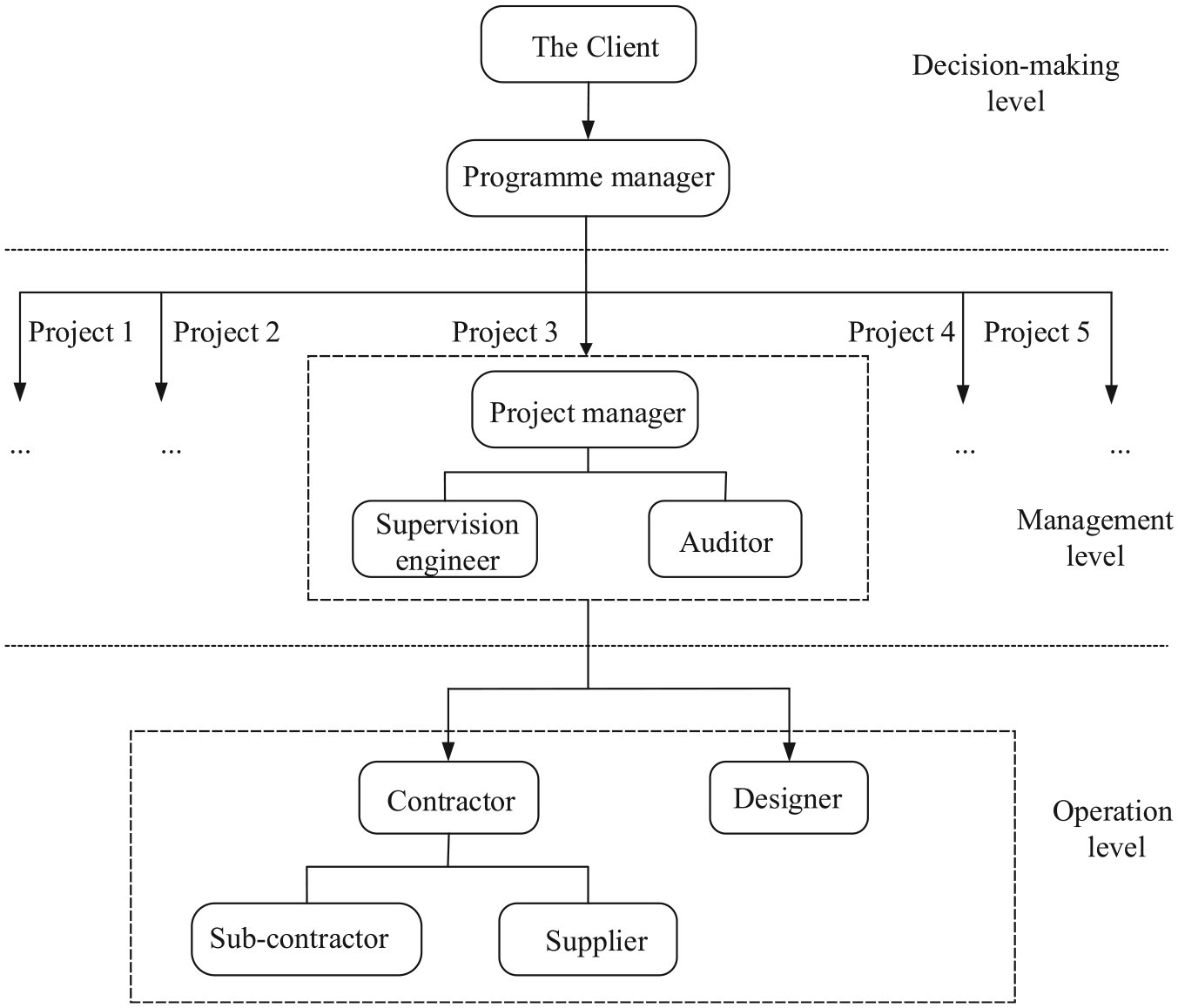
The organizational structure of the program and internal stakeholders.
The upper level was the decision-making level, including client and program managers. These stakeholders formed the program management office (PMO) for managing the program team. The management level, at the middle, included five project managers, five supervision engineers for each of the project, and four auditors, who were appointed by the client. The operational level covered four main stakeholders: contractor, designer, sub-contractor, and supplier. There were, in total, 5 contractors and 15 sub-contractors in this program. Among the sub-contractors and suppliers, there were special types of sub-contractor and suppliers to the program, who were directly appointed by and contracted with the client. These were the client-appointed sub-contractor (CSCA) and the client-appointed supplier (CAS), whose responsibilities were mainly related to the delivery of some specified works.
Document Review
With the authorization of the client, the researchers gained access to the Program Management Information System, which contained program documents including contracts, meeting notes, weekly/monthly reports from project and program managers, contractors’ requests, supervision engineer’s approvals, change log, corresponding letters, and supporting documents. There was, however, no conflict management plan found in the program documents. Through document review, a number of conflicts were discovered and, relevant stakeholders of these conflicts were identified.
Interview Survey
In order to clarify the nature of the conflicts found through document review and identify unrecorded conflicts in the program documents, interview survey was conducted. The snowball sampling method was introduced into the interview process, for more accurate intentional and meaningful sampling, as shown in Figure 2. The method is particularly applicable when the focus of study is on a sensitive issue, possibly concerning a relatively private matter, and thus requires the knowledge of insiders to locate people for study (Biernacki & Waldorf, 1981). Conflict-related issues were often deemed as being negative and were therefore, sensitive by nature, which made snowball sampling particularly suitable.

Interview survey development.
At the initial round of interview survey, the stakeholders involved in the identified conflicts were invited to describe the nature of the conflicts and to suggest other unidentified conflicts with any stakeholders in the program team. The newly discovered conflicts by interview were then added to the subsequent rounds of interview, for further investigation. The interview iteration continued until saturation of each concept was reached and further data collection failed to contribute additional information.
For data validation purpose, the researchers adopted multiple evidence collection method. When collecting data for each single conflict identified, the researchers ensured to interview all the stakeholders involved in it, so as to avoid bias of subjective opinion caused by interviewing only one side of the stakeholders in the conflict.
There were 34 experts from the program joined the interview survey during the period between October 2017 and March 2018. The researchers executed 5 rounds of interviews with these experts, with each individual interview lasting between 30 and 60 min. The interviews have been recorded and converted into text for further analysis. The profile of the interviewees is shown in Table 1.
Interviewees’ Profile.

The interviewees covered all stakeholders in the program, with the focus on the project managers, senior supervising engineers, and contractors. The majority (70.6%) of the interviewees had the working experiences between 5 and 20 years. As most of the personnel on site were male, there were only two females joint the interview survey.
Data Analysis
Content analysis can be used qualitatively or quantitatively for systematic analyzing of written, verbal, or visual documentation (White & Marsh, 2006). Content analysis and was used in this research, for data analysis purposes. Researchers encoded the transcript of the data independently, to identify classifications and themes of conflict linking to each stakeholder in the program. A consensus meeting was held between the researchers to develop a consistent coding system and ensure the appropriateness of categorization of relative concepts, in order to ensure all data being included and overlapping was avoided. All the records of the interview were reviewed more than once and included in texts, by the researchers.
This research adopted two approaches to data validation. Conformability relates to objectivity and is measured in content analysis by assessing researchers’ reliability (White & Marsh, 2006). In this research, there was an independent group of three researchers, who repeated the interpretation process, following the same principles. The reliability test results were over 90% consistent with the initial analysis. In addition, the initial results were sent back to experts in follow-up interviews for validation purposes.
The social network analysis (SNA) method is an effective way to model organizational structure and analyze interactions among different individuals or groups (Moreno, 1960). It has been widely used to solve stakeholder-associated issues in construction project management, by visualizing the complex and abstract inter-relationships among multiple stakeholders, using sociograms (Chinowsky et al., 2008). In order to better describe the conflict relationships between different stakeholders within the program, the social network analysis was employed in this research.
Understanding of Conflict in Program
Identification of Program Conflicts
There were over 100 conflict incidents identified in the case study, being classified into 35 types of conflicts, of which only 10% were discovered through document review. The various types of conflict between the internal stakeholders in different levels of the program organizational structure were clustered into six groups, according to their hierarchical levels in the organizational structure, as shown in Table 2. The detailed explanations of conflict incidents during the program execution were listed in Supplemental Material.
Conflicts between internal stakeholders of the programme.
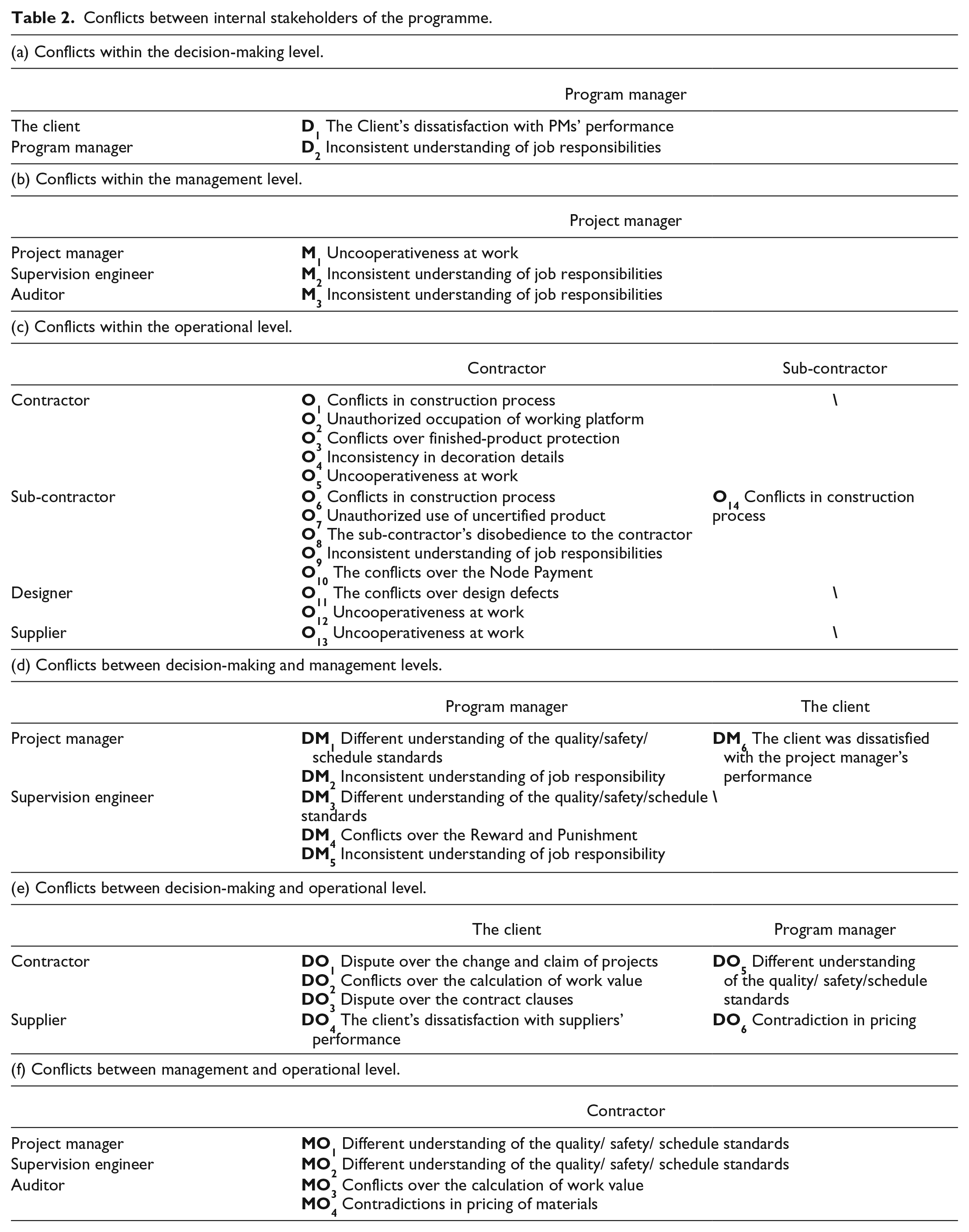
According to the features of conflict types, they were clustered into 4 categories, as shown in Figure 3. Some of the conflict possessed more than one feature, which were assigned into both categories.

Conflict categories in programs.
The Conflict Relationships in the Program
In this research, the program team has been viewed as a well-structured system, each type of stakeholder in this program played different roles in program conflict. In the conflict relationship network in Figure 4, each node represents one type of stakeholder. The edge between any two stakeholders represents their conflict relationships, while the circle indicates the types of conflict within the same type of stakeholder. The figures shown by the edges and circles are the number of types of conflict between stakeholders. The total number of types of conflict for each stakeholder is calculated by the sum of the figures on all the edges and circles linking to this stakeholder.

Conflict relationship between stakeholders.
The SNA analysis shows the allocation of different types of conflicts between various stakeholders, and the most vulnerable stakeholders to conflicts in program team. At the center of the stakeholder network, the contractor experienced 21 types of conflict, accounting for over half of the total conflict types. They were also, in this aspect, the most confrontational stakeholders to conflict in the program. Every other stakeholder in the program has conflict relationship with the contractor in different degrees. Furthermore, there were five types of conflicts identified between the five contractors in this program. According to the conflict allocation showing in Figure 4, we interviewed stakeholders from the most vulnerable (the Contractor) to the least one to further discover the causes, strategies, impact of program conflicts.
The Causes of Conflicts
There were 12 types of causes in four categories identified in this case study, that lead to the program conflict, as shown in Table 3.
Causes for Conflict.

The top four most common causes for conflict in the construction program were (a) difference in objectives, (b) unclear definition of job responsibilities, (c) contract defects, and (d) incompetence. They related to 24 types of conflict in the program. It was found that the client adopted performance review assessment on individual project rather than on overall program, and comparing the results of different projects. The interviewees complained that the leaders of different projects in the program deemed each other as “competitors rather than partners,” although they were in the same program team. They showed “strong reluctance to collaborate or share knowledge on project management” on cost saving and labor management. There was almost no evidence showing the program manager has made efforts on team building for the whole program.
The Principles and Strategies for Conflict Resolution
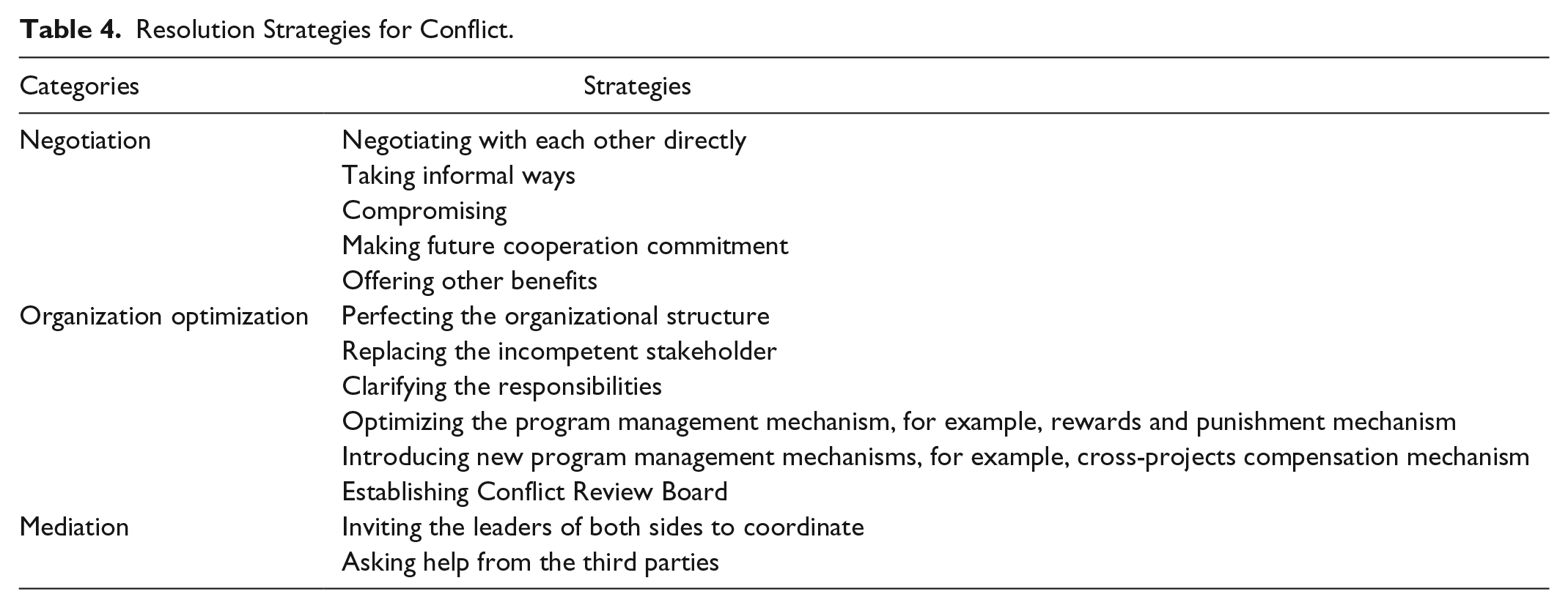
The general principles in resolving program conflict were deducted through interviews, where the solutions must be (a) Prompt, (b) Prioritized, (c) Systematic, and (d) Cooperative. It was agreed by almost all interviewees that avoidance was the worst solution for program team conflict, which could only “worsen the situation.” The conflict resolving strategies were then established following these principles. The resolution strategies for conflicts in this program were summarized into three categories: negotiation, organization optimization, and mediation, as shown in Table 4.
Resolution Strategies for Conflict.
The Impacts of Conflicts on Program
The conflicts between the program stakeholders brought various consequences concerning program cost, time, quality, relationships, safety, as well as on process and regulations. These were grouped into four categories as shown in Table 5.
The Impacts of Conflicts on the Program.

The two most common impacts of conflict were the delay and cost overrun of the program, which linked to 11 and 8 types of conflict respectively. Although some of the consequences were negative impacts, there were notable positive impacts as a consequence of conflict resolving, such as improved relationship and inspiring other parties.
The Prevention of Conflicts
During the interview survey, all experts agreed that many of the conflicts were “preventable and could have been avoided”; therefore, suggested conflict prevention as an important step in conflict management process. They also recommended effective measures for the prevention of conflict, which were summarized into four categories as shown in Table 6. During the follow-up interviews, the combination of the measures was confirmed by the experts to be able to “benefit the conflict prevention in construction programme” and “improve conflict management skills” of the program team.
Measures for Conflict Prevention.

BIM: building information modeling.
Conflict Management Model
During the interview survey, many experts showed their dissatisfaction to the current situation of conflict management in the program team and suggested effective conflict management mechanism. The program managers should have better perceptions and systematic approach to managing conflict in program team. On the basis of primary findings and discussion with experts in follow-up interviews, program conflict management model (PCMM) was developed as an effective approach for program manager to better manage construction program conflict (in Figure 5).

The conflict management model of construction program.
The PCMM described the process of conflict management for construction program as a learning cycle of four fundamental steps. They were (a) conflict identification, (b) conflict resolution, (c) conflict feedback, and (d) conflict prevention. Each of the steps contained the key categories concluded on the basis of the case study.
Discussion
The systematic analysis of program conflict contributed to the body of knowledge on conflict management in construction industry, with the focus on the program level. The findings revealed some unique characteristics of conflict in a construction program, while several other findings were compatible with previous literature relating to project conflict.
The Types of Program Conflict
The conflict types identified in this case study have a certain degree of similarity with previous research, such as the task conflict (Behfar et al., 2011; Vaux & Kirk, 2018), relationship conflict (Behfar et al., 2011), and financial conflict (Jang et al., 2018). However, the interface conflict in this case study was a unique type of conflict for construction program due to the interface between the various projects within the program. Similar conflict has been touched upon in previous research (e.g., Elbarkouky & Fayek, 2011; Guo et al., 2015), nevertheless it has never been discussed as a particular type of conflict. As shown in Figure 3, interface conflict always occurred between stakeholders in the same hierarchical level, for example, between contractors or project managers, rather than cross-level in the program. The underlying reason might be that stakeholders in the same level undertake similar daily works or tasks assigned by upper level. They interact more frequently than other levels, implying more possibility or opportunities to have conflicting objectives or “fighting” for limited resources.
The Allocation of Conflict in Program Team
The different categories of conflicts were not evenly distributed in the program team. The task and relationship types of conflict were widely distributed over the organizational structure, while the financial type of conflict was found to be associated with the client, auditor, contractor, and sub-contractor. The four players in financial conflicts play three critical roles: the payer, the payee, and the independent third party for an official examination of financial records. In comparison to the other three actors who play a single role in the financial activities, the contractor is both the payer and the payee; hence, may confront more with conflict than the other players. The payment conflicts were found to be common in other researches; Rahmanniyay & Yu, 2019; Vahdani & Shams, 2019).
The Causes of Conflict
Part of the causes for conflict in this study were also discovered in literatures relating to project conflict, such as different in objectives (Lim et al., 2015; Ruuska & Teigland, 2009), contract defects (Jaffar et al., 2011), inadequate planning (Harmon, 2003), and insufficient communication (Mitkus & Mitkus, 2014; Ussing & Wandahl, 2013). Notwithstanding, this research revealed unique causes for construction program, such as the organizational structure problem, which was rarely mentioned in previous researches. Considering the numerous stakeholders and dynamics contexts that program faces, a reasonable and flexible organizational structure is the key for practitioners in program management. Furthermore, the complex or unreasonable cross-organizational structure of program led to several conflicts affecting the efficiency of program team.
The Resolution of Program Conflict
The resolution of program conflict also appeared some distinctive features in comparison to project conflict. The principles in resolving program conflict were believed by the experts to be able to “help dynamically generating optimal solutions for conflicts,” as the selection of conflict resolution strategies must fulfill (a) prompt, (b) prioritized, (c) systematic, and (d) cooperative. After conflict occurring, the stakeholders involved should take prompt measure for the purpose of preventing conflict getting worse. In the process of resolving conflict, conflicting parties should prioritize the achievement of program objectives over the objectives of project or individual stakeholders. As the program is an integrated system, the selection of conflict resolution strategies should take the interests of each conflicting party into consideration, and make decision from the viewpoint of the overall program when resolving conflicts. The resolving of conflict should be in accordance with contracts or regulations, and considering mutual benefits. These principles mentioned above were suggested to be taken into consideration together rather than separately, and they will guide the conflicting parties to take appropriate resolution strategies.
The findings also revealed that the stakeholders at different hierarchical levels of the program structure tended to have different preference on conflict resolution strategies, when trying to resolve conflict. For this reason, it was extremely difficult to rank the overall preference of each strategy. For example, the stakeholders at the operational level generally prioritized mediation over other strategies. In resolving cross-level conflict, the stakeholders at the lower level preferred to take informal ways or compromising, as the stakeholders at upper level hold the rights in evaluating their performance or influencing the future collaboration opportunities. On the contrary, the stakeholders at the upper level often chose to commit future collaboration opportunity or offering other benefits as compensation. In managing project conflict, negotiation and mediation were deemed as the most commonly adopted solutions by project managers (Lax & Sebenius, 1986; Rui, 2018).
The Impacts of Program Conflict
The impacts of the conflict on program level appeared both in positive and negative results. Many of the negative impacts, such as project delay, cost overrun, poor quality, safety issues, low productivity, profit loss and damaging business relationships, have been discovered in previous researches associated with project conflict (Jaffar et al., 2011; Lee et al., 2016; Li et al., 2015; Moza & Paul, 2016). In this research, several newly discovered impacts were discovered for construction program, such as bringing negative social influence, reducing future collaboration possibilities and increasing the difficulties involved in construction works. Despite the negative impacts, several positive impacts of conflict were identified in the program. The positive impacts, including improved program regulation, optimized organizational structure and process, improved relationships, and inspiring other parties, were mostly related to interface conflicts.
Another important discovery in this research is the prevention of conflict as an important step in effective management of conflict in program team. Although the importance of adequate project preparation (Duzkale & Lucko, 2016), knowledge management (Hackbarth, 1998), and digital technologies (Kassem et al., 2015; Scholtenhuis et al., 2016; Trebbe et al., 2015; L. Wang & Leite, 2016) have been stressed in previous researches, the prevention of conflict has never been suggested as one of the conflict solutions for effective conflict management. In addition, for such a large construction program with complex cross-organizational structure, “team building was vital in prevent internal conflict.” Unfortunately, the effectiveness of team building in preventing program conflict has not yet been well discussed in literatures.
PCMM
The PCMM provided a learning cycle for managing conflict in program team, which starts from the identification of conflict. The resolution principles will guide the program team to generate conflict resolution strategies. Then, the impact of the conflict should be fed back to and reviewed by the program team. Consequently, the program team could adopt prevention measures to avoid similar conflict from occurring in the future. By using this PCMM tool, the program manager is expected to take a systematic view on conflict management in construction program and eliminate conflict through rotation of the learning cycle. The conflicts identified in this study were based on both inner-project and cross-project conflicts; therefore, the model can also be used for project managers in project conflict management.
The framework of the PCMM was validated by the program managers after its development by follow-up interviews. It was believed by the experts that “the conflict management experiences and skills of the program team can be improved by the repetition of the learning cycle.” Furthermore, the effective management of conflicts within program was believed to be able to improve the efficiency of the program during the implementation stage of the program.
Conclusion and Recommendations
In order to provide a better perception on program conflict, the management process of internal conflict in a community development program was explored from the perspective of its organizational structure. Some unique conflict was revealed, which was caused by the complex organizational structure and relationships between stakeholders in the program, for instance, interface conflict. The conflict allocation was found closely associated with the organizational structure. All internal stakeholders of the program were found to be involved in different types of conflicts, while the contractor was the most vulnerable stakeholder to conflict in the program. The underlying causes, impact, and resolution principles and strategies were discussed, which also showing distinct features from project conflict management, including institutional issue, organization optimization, team building. The results showed that the various stakeholders in the program played different roles in conflict management process and had different preferences on conflict resolving strategies. It was also revealed that conflict in a program could cause both negative and positive impacts on the program. Finally, a conflict management model—PCMM—was developed as an innovative tool for the effective management of conflict in programs.
The research contributed to the project management literature with a systematic approach to the effective conflict management of project and program, which can help researchers and practitioners understand the underline nature of the conflict within complex project and program. The PCMM offered an effective way of managing conflict for project and program managers and improving their conflict management skills by the learning cycle from conflict identification, resolution, and feedback to conflict prevention.
As this qualitative research did not focus on testing the PCMM in real program, future researchers are encouraged to test this model in a wider range of programs and practicing the learning cycle of the model by a larger range of case studies. The organizational structure of the case project may be different from other mega projects or Public Private Partnership projects, the future research may pay attention to those other types of projects with complex organizational structure.
Supplemental Material
Supplementary_material – Supplemental material for A Systematic Approach to Effective Conflict Management for Program
Supplemental material, Supplementary_material for A Systematic Approach to Effective Conflict Management for Program by Nannan Wang and Guobin Wu in SAGE Open
Footnotes
Declaration of Conflicting Interests
The author(s) declared no potential conflicts of interest with respect to the research, authorship, and/or publication of this article.
Funding
The author(s) received no financial support for the research, authorship, and/or publication of this article.

Supplemental Material
Supplemental material for this article is available online.
Author Biographies
References
Supplementary Material
Please find the following supplemental material available below.
For Open Access articles published under a Creative Commons License, all supplemental material carries the same license as the article it is associated with.
For non-Open Access articles published, all supplemental material carries a non-exclusive license, and permission requests for re-use of supplemental material or any part of supplemental material shall be sent directly to the copyright owner as specified in the copyright notice associated with the article.
