




Abstract
A common challenge people encounter in unfamiliar cities is finding their way using static maps. In the present study, we analyzed the relationship of a person’s mental rotation ability, college educational specialization (e.g., Architecture, Fine Arts, Psychology, and Business Studies), and sex with personal orientation when using “you-are-here” maps. We recruited a sample of 547 individuals, undergraduates who were tasked with orientation maps placed in different positions (e.g., 0º, 90º, and 180º). All three variables were related to the number of correct responses in orientation using these “you-are-here” maps. Participants with high mental rotation ability obtained significant higher correct orientations than those with low ability. Men obtained more correct orientations responses than women, and Architecture, Fine Arts, and Psychology undergraduates had more correct responses than Business Studies undergraduates.
Introduction
“You-are-here” maps use the characteristic symbol of “you-are-here” to indicate the user’s location on the map and are designed to help orient the user’s surrounding and plan routes to specific designations (Campos-Juanatey, 2016; Klippel et al., 2006; Levine, 1982; Montello, 2010). For these maps to be effective, they should fulfill the two principles of orientation and structure matching (Levine, 1982; Seoane et al., 1992). The principle of orientation refers to aligning a map with the real physical surroundings. For being oriented, spatial ability is required, but orientation is also possible without the need for mental rotation.
A map is considered to be aligned when it overlaps with the surrounding environment in a “forward-up” and “straight ahead” fashion such that what is at the top of the map is what lies ahead, what is on the right of the map also lies to the right in reality, what is on the left of the map lies to the left in reality, and what is at the bottom of the map is what lies behind the user (Aretz, 1991; Campos-Juanatey, 2016; Klippel et al., 2006; Levine, 1982; Montello, 2010; Tlauka & Nairn, 2004). Nonaligned maps are more difficult to use than aligned ones, as they require more time and effort from the user to find the proper orientation; unaligned maps are associated with more user mistakes, leading to disorientation and confusion (Campos-Juanatey, 2016; Klippel et al., 2006; Levine, 1982). To establish a correspondence between map representation and the real world, there must be a minimum of two clearly recognizable elements, both on the map and in the actual surrounding area (Campos-Juanatey, 2016; Levine, 1982; Seoane et al., 1992).
Misalignment effects do not have the same impact on all users, as several personal variables influence map comprehension, regardless of its misalignment (Levine, 1982; Levine et al., 1984; Montello, 2010). Among personal variables that may influence map comprehension and personal orientation, this study assessed the research participants’ sex, educational specialization, and personal ability to rotate mental images. Studies examining sex differences in spatial orientation have produced inconsistent user results, primarily due to a wide array of different measures used: landmark, route recall, pointing, map drawing, straight-line and route distance estimation, route reversal, route learning, orienteering, and wayfinding. Moreover, past studies used a wide range of navigational tools (e.g., maps and virtual tools) and environments (e.g., real outdoor environments, real indoor environments, and self-report questionnaires) (Coluccia & Louse, 2004; Liu et al., 2011). Past results have also varied significantly in gender effects, largely related to the type of task performed.
Sex
Orientation on “you-are-here” maps may involve either a spatial imagery formation or mental rotation skills. Studies on gender differences in spatial ability have shown inconsistent results. Whereas Campos (2009, 2013) found no sex differences in spatial imagery formation, other studies found that men outperformed women (Blajenkova et al., 2006; Blazhenkova & Kozhevnikov, 2009, 2010; Campos, 2014).
From mental rotation research, there is a broad consensus that men perform better than women (Campos & Campos-Juanatey, 2019a; Campos et al., 2004; Delgado & Prieto, 1996; Hedges & Nowell, 1995; Linn & Petersen, 1985, 1986; Voyer, 2011; Voyer et al., 1995). Most authors agree on the underlying causes for these differences, with certain authors focusing on socialization factors (Campos, 2014; Oosthuizen, 1991), others on hormonal changes (Hooven et al., 2004; Kimura, 1999; Sanders et al., 2002), and other on different image rotation strategies used by women versus men (Linn & Petersen, 1985).
Finally, of relevance to the current study, besides mental rotation ability and sex, another variable of interest, influencing drawing, orientation, and comprehension of maps, has been the navigational tool user’s educational specialization or profession. Several studies concluded that Fine Art undergraduates and other professions related to art normally use imagery, that facilitates the perception of objects’ form and color (Kozhevnikov et al., 2005, 2010; Motes et al., 2008). In contrast, professionals from fields of science (scientists, mathematicians, architects) rely on spatial ability, facilitating image rotation when relating to, comparing, and analyzing map elements or maps (Khine, 2017).
Mental Rotation Abilities
Wai et al. (2009) found a relationship between spatial ability and the choice of educational degree, such that individual differences in spatial ability predicted participants’ pursuits of college degrees and careers in STEM (science, technology, engineering, and mathematics) fields. For a review of the relationship between spatial ability and STEM performance, see Khine (2017). Prior studies showed that early sex differences in spatial ability may also contribute to subsequent differences between men and women in STEM career choices (Ceci et al., 2009; Wai et al., 2009). Spatial abilities are crucial for many professions such as Architecture, and they may be enhanced with training (Hyde & Lindberg, 2007; Mataix et al., 2014, 2015), and thereby improve the professionals’ performance. Thus, several authors have suggested that training in spatial thinking as part of the science curriculum could raise the number of undergraduates pursuing STEM careers (Uttal et al., 2013).
Several studies undertaken by Liben and colleagues (Liben, 2014, 2015; Liben et al., 2010, 2013; Quinn & Liben, 2014) have shown that a person’s orientation differs between map orientation and reality orientation, and that performance on a spatial battery, taken as a whole, can predict performance on mapping tests. Mental rotation tests (e.g., Mental Rotation Test [MRT]) can predict mental rotation for working with computers, but outdoor mapping tasks do not permit directly observable, mental rotation activities (Kozhevnikov et al., 2006; Liben et al., 2010, 2013; Quinn & Liben, 2014). Moreover, in numerous cases, the tests used to assess mental rotation or orientation tasks were quite similar to the tasks, perhaps explaining relationships observed. When the understanding of a map required no rotation, mental rotation skills had no impact on orientation either on a map or in reality (Liben et al., 2010, 2013; Quinn & Liben, 2014). Richardson et al. (1999) have shown that virtual learning environments were highly predictive of learning a real environment, suggesting that similar cognitive mechanism are involved in both. However, object manipulation and spatial orientation abilities are separable (Kozhevnikov & Hegarty, 2001).
Academic Degree
A crucial aspect of understanding maps is what form of spatial products are used in maps and what experience users have with this type of material. Indeed, not all cultures expose users to two-dimensional representations of objects in space (Liben et al., 1981). Intercultural research has revealed that the interpretation and production of two-dimensional representations depend on prior experiences with such representations. Even within the same culture, specific conventions used for representing spaces may vary considerably, and these factors influence map understanding (Liben et al., 1981). Blajenkova et al. (2005) argue that there is evidence against stage/sequential models that attribute differences in environmental representations exclusively to differences in user experience; data suggest that there are separate processing system for spatial and landmark information.
As seen through this review, past studies have analyzed gender differences in either mental orientation or mental rotation, and others have assessed an array of different imagery or orientation skills among map user of different professions. However, to our knowledge, no prior study has examined orientation after image rotation, though this is what normally occurs when we seek a personal orientation in an unfamiliar city.
Academic Degree and Sex
Men obtain higher scores than women in mental rotation tasks, which is probably due to differences in education (Campos, 2014; Oosthuizen, 1991). Thus, it would be reasonable to expect differences in map rotation. Experience in rotation tasks of drawings and maps, as is the case of Architecture and Fine Arts undergraduates, influences the ability of mental rotation tasks of figures (Kozhevnikov et al., 2010, 2005; Motes et al., 2008). In all probability, this experience should influence performance in map rotation. In contrast to Psychology or Business Studies, both Architecture and Fine Arts undergraduates have received training in drawings, plans, and maps during a 2-year period of university education. Furthermore, mental rotation abilities influence the rotation of figures (Hyde & Lindberg, 2007; Mataix et al., 2014, 2015) and are also expected to influence map rotation.
Mental Rotation Abilities and Sex
In all of the orientation tasks requiring map rotation, men obtained higher scores than women (Liben, 2015; Liben et al., 2013; Quinn & Liben, 2014). Men’s seeming superiority on mental rotation tasks appears to be related to the greater number of men studying science, technology, engineering, and mathematics (STEM) at university (Liben, 2015), and further research is needed to determine whether gender difference in educational specialization is related, in turn, to men’s greater access to or cultured greater interest in studying school subjects that can improve mental rotation and prepare them for science careers.
Thus, we aimed to assess the relationship of mental rotation ability, academic specialization (Architecture, Fine Arts, Psychology, and Business Studies), and sex with map users’ proportion of correct responses in their orientation of “you-are-here” maps. First, previous studies, such as Campos and Campos-Juanatey (2019a), Campos et al. (2004), Delgado and Prieto (1996), Hedges and Nowell (1995), Linn and Petersen (1985, 1986), Voyer (2011), and Voyer et al. (1995), support our hypotheses that men would have better orientation than women due to their relative strengths in necessary mental rotation skills. Second, previous studies, such as Kozhevnikov et al. (2006), Liben et al. (2010, 2013), and Quinn and Liben (2014), support our hypotheses that undergraduates in high imagery rotation educational specializations would obtain higher orientation scores than those in low imagery rotation specializations. And, third, studies such as Campos and Campos-Juanatey (2019b), Kozhevnikov et al. (2010, 2005), and Motes et al. (2008) support our hypotheses that Architecture, Fine Arts, and Psychology undergraduates would obtain higher scores than Business Studies undergraduates, owing to Architectural, Fine Arts, and Psychology students’ greater experience in handling drawings.
Method
Participants
Our research participant sample consisted of 547 university undergraduates, 295 women, 252 men; Mage = 20.63 years, SD = 2.28; age range of 18 to 24 years, with the following distribution of educational specializations: (a) 131 Architecture student, 70 women, 61 men; Mage = 20.25 years, SD = 1.69; (b) 119 Fine Arts student, 69 women, 50 men; Mage = 20.90 years, SD = 3.02; (c) 133 Psychology student, 72 women, 61 men; Mage = 20.03 years, SD = 1.99; and (d) 164 Business Studies student, 84 women, 80 men; Mage = 21.39 years, SD = 2.26. The study complied with the ethical principles of the Helsinki Declaration 2013 and was approved by the Ethics Committee of the University of the Santiago de Compostela.
Instruments
Maps
Our experimental task involved 90 pairs of maps. Maps placed on the left of users were those commonly found on information panels in cities, in which the user’s location is identified by a point with the legend “you-are-here.” Maps placed on the right were magnified versions of those on the left, and the user’s location in the city on these maps was signaled by a point mark (see Figure 1). The line before the point indicated the directional position with which to hold map. The maps on the right were rotated 0º, 90º, or 180º in relation to the maps on the left. A total of 30 maps were not rotated (i.e., 0º), 30 were rotated 90º, and 30 were rotated 180º.
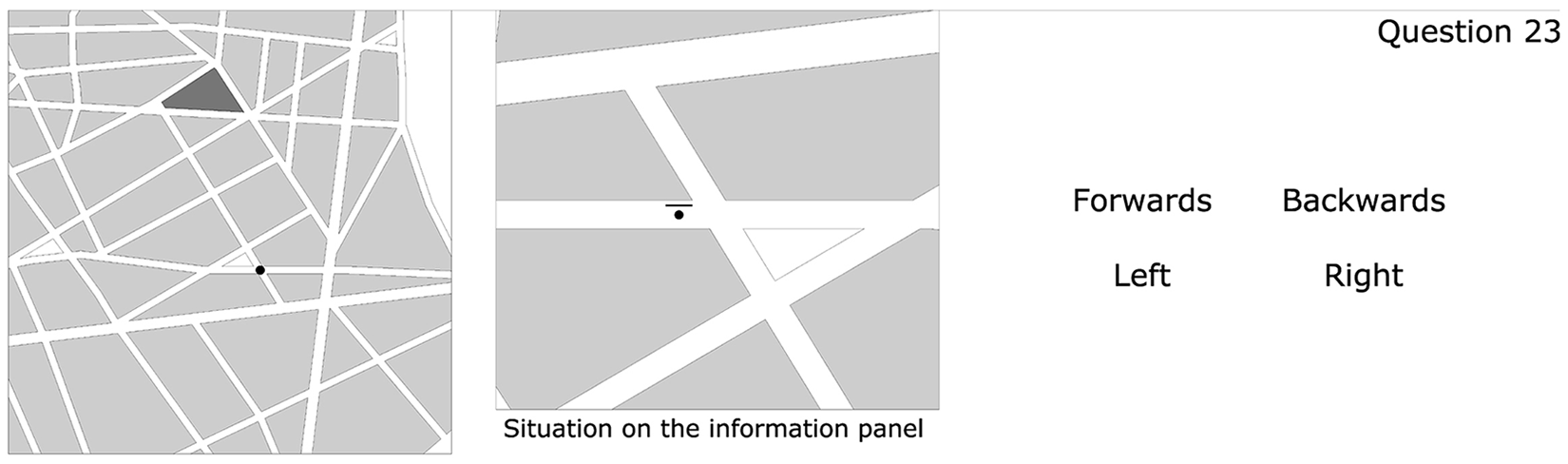
The map on the right is the middle part of the map on the left that has been magnified and rotated 180º.
The split-halves reliability test and the Spearman–Brown prediction formula obtained a correlation of .64, p < .001. The 547 participants were tested in small groups of 20 undergraduates in their habitual classrooms and were allowed 3 min to respond.
MRT
We also used the MRT (Vandenberg & Kuse, 1978) consisting of 10 items measuring the participant’s ability to rotate mental images. Each item on the test has a model and four response alternatives, two are correct and two incorrect. In the MRT, for each item, participants must select two shapes that are the same as the model (rotated versions). The MRT is paper-and-pencil measure to be performed under a 3-min time limit. The scoring of the test, according to Vandenberg and Kuse (1978), is undertaken by awarding 2 points for two correct responses, 0 points for one correct and one incorrect response, 0 points for two incorrect responses, and 1 point for one correct response with no incorrect response. Each subject’s total score may oscillate between 0 and 20. The split-halves reliability test and the Spearman–Brown prediction formula, with a correlation of .67, p < .001, is obtained.
Procedure
Maps
We first designed 90 urban maps, similar in map comprehension difficulty. We then magnified these original 90 maps, and at random, we introduced varying degrees of rotation to both map sets of 30 each, yielding 30 pairs of maps at 0º (not rotated), 30 at 90º rotation, and 30 at 180º rotation. Participants were required to establish the route they would need to take from the departure point to a space marked in black on the left map (see Figure 1). To do so, participants had to indicate, at each turn, whether they had to move forward, backward, left, or right.
Participants were informed that the map on their right was an amplification of the map on their left. They were instructed that the participant is at the point on the right-hand map, and they are viewing a “you-are-here” map. Participants were required to superimpose the map on the right onto the map on the left, but for both to coincide, the map on the right might need rotating 0º, 90º, or 180º. Once the maps had been superimposed on one another, participants were to find their way to the space marked in black by moving forward, backward, or to the left or right. If they indicated the correct route, their response was considered correct, but if their route was incorrect, it would be recorded as an incorrect response. Unanswered items were not considered errors. We explicitly instruct participants to mentally rotate the stimuli without making any movements with the hand or without rotating the head or the sheet itself.
The maps were administered as a paper-and-pencil test. Each item on the test had two response options, that is, correct or incorrect. We calculated proportion correct (this measure will divide the number of correct responses by the number of trial completed).
MRT
Participants were also allowed 3 min to complete the MRT (Vandenberg & Kuse, 1978). Thereafter, each individual was classified as high or low in their mental rotation ability according to whether their own score on the test was above or below the median score for their educational specialization group. This allows us to convert a continuous variable into a categorical variable, which enables us to use it as an independent variable in the analysis of variance (ANOVA). Participants freely volunteered to participate in the study and were not incentivized. The MRT was administered as a paper-and-pencil test.
Data Analysis
We performed data statistical analyses using the SPSS 24 software program. We first, calculate a Spearman–Brown test to assess the internal consistency of the MRT and to assess the internal consistency of 90 urban maps task. To analyze the differences between participants with high and low mental rotation ability, between women and men, and between the different educational specializations (Fine Arts, Architecture, Psychology, and Business Studies), we compared the proportion of correct responses in the choice of the correct pathway, a three-way-ANOVA of 2 (high and low mental rotation ability) × 2 (sex) × 4 (educational specialization) factors. Post hoc test, when needed were conducted with a Bonferroni test.
Results
Differences in the proportion of correct orientations were analyzed between participants with different university studies (Architecture, Business Studies, Psychology, and Fine Arts), between men and women, and between those with high or low mental rotation ability. The means and standard deviations of correct responses in orientation are shown in Table 1. There were significant differences between educational specialization groups, F(3, 537) = 12.51, p < .001,
Means and Standard Deviations of Proportion Correct Responses in Orientation According to Educational Specialization, Sex, and the Mental Rotation Ability.
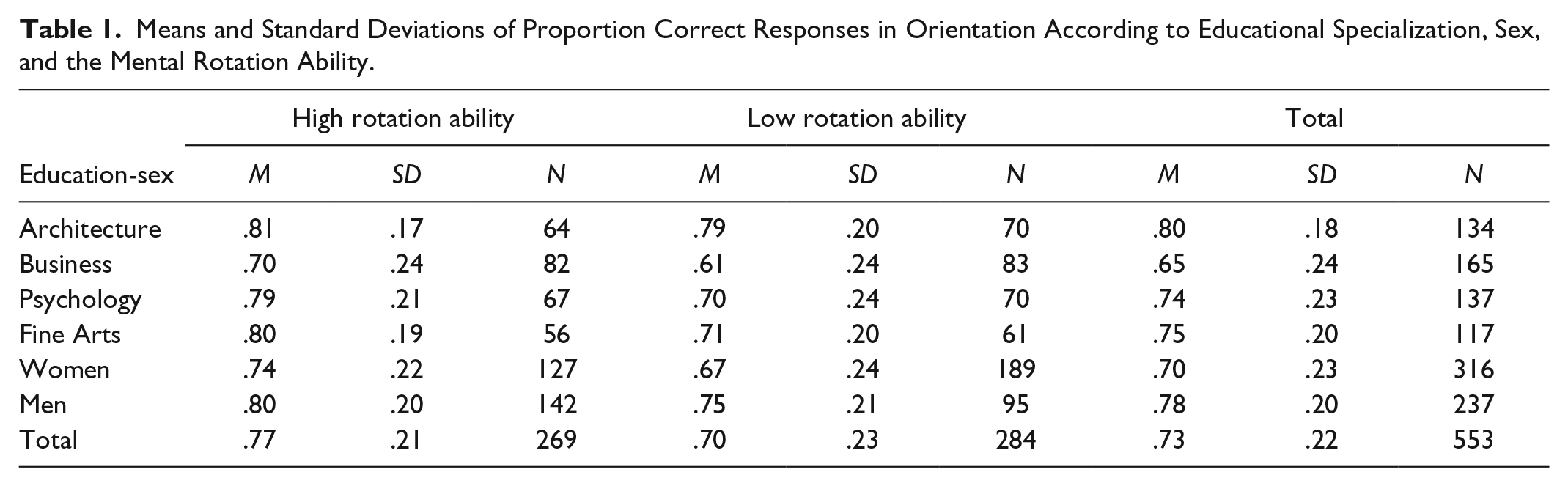
Post hoc analyses with a Bonferroni test showed that Architecture and Fine Arts undergraduates obtained significantly (p < .001) greater proportion of correct orientations than Business Studies. Psychology undergraduates obtained significantly greater proportion of correct orientations responses (p = .002) than Business Studies undergraduates.
The interaction between sex and educational specialization was not significant, F(1, 537) = 1.40, p = .24,
Discussion
In this study, we analyzed the relationship of sex, the educational specialization of participants, and their mental rotation ability with the proportion of correct responses in an orientation task using “you-are-here” maps. We found that men obtained more correct orientation responses than women, which coincides with prior mental rotation studies (Campos et al., 2004; Delgado & Prieto, 1996; Hedges & Nowell, 1995; Liben, 2015; Liben et al., 2013; Linn & Petersen, 1985, 1986; Quinn & Liben, 2014; Voyer, 2011; Voyer et al., 1995).
The participants’ mental rotation ability was also related to the number of correct orientations, consistent with studies analyzing the impact of spatial ability on STEM degrees, and studies related to cognitive tasks (Ceci et al., 2009; Hyde & Lindberg, 2007; Khine, 2017; Liben, 2015; Mataix et al., 2014, 2015; Wai et al., 2009). Educational specialization was related to correct responses in that Architecture, Fine Arts, and Psychology undergraduates had more correct responses than undergraduates in Business Studies, consistent with previous findings that science undergraduates (including Architecture) performed better on spatial ability tasks (Blazhenkova & Kozhevnikov, 2011; Kozhevnikov et al., 2005, 2010; Motes et al., 2008). Our results are consistent with prior studies analyzing the impact of educational specialization on correct orientation (Hyde & Lindberg, 2007; Mataix et al., 2014, 2015).
Generally, we affirmed our hypotheses that men would better comprehend “you-are-here” maps than women, that students high in mental rotation ability would do better than those low in mental rotation ability, and that undergraduates studying Architecture, Fine Arts, and Psychology would perform better than those in Business Studies. Sex differences are probably due to differences in education (Campos, 2014; Oosthuizen, 1991) or can be related to how men and women may rely on very different features during mental rotation, which accounts for some sex differences when features are differently salient or emphasized (Bilge & Taylor, 2017).
A limitation to this study is our failure to have addressed a number of other important variables in using “you-are-here” maps, including their representation method. A further limitation of this study was that we are unaware if the higher number of correct responses of both Architecture, Fine Arts, and Psychology undergraduates was due to their university education, or due to inherent abilities in rotating figures prior to entering university, and if this superiority motivated their desire to undertake studies in Architecture, Fine Arts, or Psychology. Also, we cannot know from these results why men perform better than women, both with respect to “you-are-here” maps and the MRT. Further studies are needed to determine to what degree this may be related to different levels of exposure to spatial tasks for men and women. Further studies are also required to assess both imagery rotation ability and the influence of spatial ability and to examine differences between a wider array of university degrees and professions in orientation tasks associated with “you-are-here” maps.
The present study is significant in indicating how to position “you-are-here” maps in relation to the actual surroundings of a city. Moreover, this study has revealed personal factors influence the understanding of “you-are-here” maps, such as gender, mental rotation ability, and university studies. Finally, this study has shown how training and the correct positioning of maps can improve an individual’s understanding of “you-are-here” maps.
Footnotes
Declaration of Conflicting Interests
The author(s) declared no potential conflicts of interest with respect to the research, authorship, and/or publication of this article.
Funding
The author(s) received no financial support for the research, authorship, and/or publication of this article.
