




Abstract
This paper evaluates the impacts of armed conflict on intimate partner violence against women in Africa. Exploiting both spatial and temporal variations in the number of battles proxying for armed conflict intensity, we find that women residing in conflict-affected areas are prone to suffering intimate partner violence. In particular, a 1SD increase in the number of battles (equivalent to the increase by 4.8 battles) raises the composite indices of less severe violence, more severe violence, emotional abuse, and sexual abuse against women by 8.74%, 10.34%, 10.64%, and 7.14% relative to the sample averages, respectively. Given the long-term consequences of intimate partner violence, our findings call for expanding efforts in the prevention and mitigation of armed conflict.
Introduction
Africa has experienced an increasing trend in the number of armed conflicts in recent decades, highlighted by some of the deadliest ones such as the Congo Wars, the Rwandan genocide, and the Eritrean-Ethiopian War (Ingrid & Siri, 2018). The costs of armed conflict to humanity are substantial, going beyond the immediate loss of life to the hidden casualties and devastation where people may die years after the end of armed conflict (Dunne et al., 2013). Armed conflict further imposes many other dreadful costs besides its mortality risks. At the aggregate level, countries affected by armed conflict may face difficulties for their long-term economic development such as falling into poverty traps (Azariadis & Drazen, 1990; Sachs, 2008) or having capital accumulation depressed (Guidolin & La Ferrara, 2007). At the individual level, armed conflict deteriorates health conditions, shorten educational accumulation, worsen labor market outcomes (Bruck et al., 2019; Bundervoet et al., 2009), among others. The destructiveness of armed conflict obstructs our path to lasting peace and prosperity, making it important for researchers to carefully study its impacts on various socioeconomic aspects and make relevant policy recommendations.
Among those affected by armed conflicts, women are particularly vulnerable and the risk of intimate partner violence is one of the most dreadful (Annan & Brier, 2010; Bendavid et al., 2021). According to the World Health Organization (WHO, 2012), intimate partner violence refers to any behavior within an intimate relationship by an intimate partner that causes physical, psychological, or sexual harm to those in the relationship. Intimate partner violence is one of the most common types of violence experienced by women as approximately 30% of women worldwide and 37% of African women who are ever-partnered report to experience intimate partner violence (WHO, 2012). According to the ecological framework, intimate partner violence can be caused by factors at the individual, relationship, and societal levels (Heise, 2011). At the individual level, witnessing violence and accepting violence as a way to resolve a disagreement are among the most associated with intimate partner violence. At the relationship level, male dominance in the family and economic stresses are the most important factors. At the societal level, weak legal sanctions against intimate partner violence and high levels of general violence in society can raise the risk of both victimization of women and perpetration by men.
Armed conflicts can expose women to intimate partner violence through factors in all three individual, relationship, and societal levels. At the individual level, armed conflicts might alter people’s mindset, thus leading to the acceptance of violence (Waldmann, 2007). At the relationship level, armed conflict can depress job opportunities, especially for men, which generates economic stress and threatens the traditional role of the male breadwinner (Justino, 2018). At the societal level, armed conflicts may lead to the collapse of the social support and security system, which decreases the protection of women against intimate partner violence (Clark et al., 2010; Horn, 2010).
In this paper, we evaluate the impacts of exposure to armed conflict on intimate partner violence against women for 25 African countries in the past three decades (1990–2018). By doing so, we make three contributions to the branch of research on the relationship between armed conflict and development. First, we explore the less discernible impacts of armed conflict while much attention has been placed on the immediate consequences on individuals with urgent humanitarian needs (Bruck et al., 2017). Second, our study complements prior works by rigorously examining various dimensions of intimate partner violence, both physically and psychologically. Third, with the spatial coverage of 25 countries across Africa and the temporal dimension of almost 30 years, the conclusion drawn from our analysis is meaningful to policymakers from many African governments.
In the analysis, we utilize the data from the Demographic and Health Surveys supplemented with GPS datasets (DHS-GPS) for rich information on women and the Uppsala Conflict Data Program Geo-referenced Event Dataset (UCDP-GED) for a comprehensive list of armed conflicts. In terms of identification, we exploit both the variations across districts and within districts in the timing of battles to identify the impacts of armed conflicts on various types of intimate partner violence.
Our findings point to a positive relationship between exposure to armed conflict and women’s experience of various types of intimate partner violence. Quantitatively, a 1SD increase in the number of battles (equivalent to an increase by 4.8 battles) raises the composite indices of less severe violence, more severe violence, emotional abuse, and sexual abuse against women by 8.74%, 10.34%, 10.64%, and 7.14% relative to the sample averages, respectively. We further examine factors contributing to each type of intimate partner violence where we uncover the impacts on the probability of women being pushed/shook, slapped, and punched/hit (less severe violence), the probability of women being kicked/dragged, strangled/burnt, and threatened with knife/gun (more severe violence), the probability of being humiliated and threatened (emotional abuse), and probability of being forced into unwanted sex (sexual abuse).
The paper proceeds as follows. Section 2 reviews related literature. Section 3 describes the data. Section 4 presents the empirical methodology. Section 5 provides the results. Section 6 concludes the paper.
Literature Review
In general, this paper can be related to previous studies on the cost of armed conflicts. Besides the immediate costs such as the destruction of production capacity and loss of lives (Dunne et al., 2013), the less discernible impacts of armed conflicts can also be far-reaching. For example, prior works show that armed conflicts not only lower the level of educational attainment but also worsen the quality of learning (Bruck et al., 2019; Le & Nguyen, 2020a). Le and Nguyen (2020a) further show that exposure to conflicts during school-age years leads to declining earnings in adulthood. Health is another aspect that can be adversely affected by conflict. Specifically, Bundervoet et al. (2009) find that individuals subject to armed conflicts tend to have shorter stature. Akresh et al. (2012) document growth deficit among children experiencing violent conflicts.
Closer to our study is the literature on the impacts of armed conflict on women. Although nobody exposed to conflicts might be immune to their detrimental consequences, women could be particularly vulnerable. Armed conflict can push women into displacement, exposing them to adverse living conditions (Chattoraj, 2017; Malkki, 1995). Moreover, food shortages induced by armed conflicts can lead to starvation, devastating women’s health (Altare & Guha-Sapir, 2014). In addition, weapons used during conflicts may leave physical injuries at the time of intended detonation or after the acute conflict event. Injuries sustained by remnants of armed conflicts are borne mostly by non-combatant civilians, especially women (Frost et al., 2017). Furthermore, the destruction of basic facilities and infrastructure caused by conflicts can facilitate the transmission of infectious diseases, compromising women’s health (Eiset et al., 2017). Besides, the disruption of reproductive health services and widespread sexual violence in conflict settings can further depress women’s well-being (Bendavid et al., 2021). To make matters worse, the damaging repercussions on women might be intergenerational as shown in Quintana-Domeque and Rodenas-Serrano (2017) and Le and Nguyen (2020b) where women exposed to armed conflict during pregnancy are more likely to deliver infants with lower birth weight. We contribute to this strand of literature by evaluating the cost of armed conflict to a different outcome for women, that is, intimate partner violence.
The second line of literature our study also fits into explains how directly and indirectly experiencing violence due to conflicts will increase the incidence of intimate partner violence. Several studies from South Africa, Uganda, and Liberia have shown that conflict elevates the incidences of rape and sexual exploitation for women who are eventually susceptible to more discrimination and intimate partner violence when they are back to their families (Annan & Brier, 2010; Gupta et al., 2012; Saile et al., 2013; Vinck & Pham, 2013). However, much of the focus has been placed on individuals directly suffering from conflict-related violence, for example, being captured to an armed group, leaving the indirect relationship between conflict and violence remains less clear.
Closely related to our work are those investigating how residing in violent environments can condition intimate partner violence, including the works of Adelman (2003), Koenig et al. (2006), and Waldmann (2007). In a recent study, Kelly et al. (2018) show that living in a conflict fatality-affected district substantially raises the risk of intimate partner violence, even for several years after the conflict ended. In general, the assumed foundation is that a sufficient level of witnessing violent acts from armed conflicts can alter people’s mindset, thus leading to acceptance of violence as a means to solve problems, referred to as the culture of violence (Waldmann, 2007). Not only armed conflicts, but this can also apply to violent environments in communities and families (Adelman, 2003; Koenig et al., 2006). Our study complements these works in two ways. First, we rigorously examine various dimensions of intimate partner violence, both physically and psychologically. Second, with the wide coverage across time and space, the conclusion drawn from our analysis is meaningful to policymakers from many African governments.
Data
Our study utilizes the Demographic and Health Survey (DHS) and the Uppsala Conflict Data Program Geo-referenced Event Dataset (UCDP-GED). The DHS provides us with detailed information on women since 1986, and the UCDP-GED gives us a comprehensive dataset on armed conflict since 1989. Each of the two datasets is discussed in detail below.
Data on Women
Data on women’s experience of intimate partner violence are drawn from the Demographic and Health Surveys (DHS) which is operated by the Inner City Fund International and funded by various parties (The United States Agency for International Development, United Nations Population Fund, World Health Organization, and Joint United Nations Program on HIV and AIDS). Since our study focuses on women experience, we mainly rely on the Women File of DHS (WF-DHS), which contains information of women aged 15 to 49 on various topics, such as demographics, education, and employment, among others. More importantly, there are various questions in the dataset that can be used to assess women’s experience of intimate partner violence, making it ideal for the purpose of this study.
Next, in order to match WF-DHS with our armed conflict data, we also need the geographic locations of the women. Therefore, we utilize the WF-DHS surveys where GPS supplements are available (WF-DHS-GPS). In these surveys, the geographic location of the women’s residential cluster is geo-referenced by a pair of latitude and longitude coordinates. Due to confidential issues, the coordinates are only precise up to the district level (administrative level 2). In other words, we can only be certain about the district where the women live, not the village or lower administrations.
Data on Armed Conflicts
Data on armed conflict comes from the latest version of the Uppsala Conflict Data Program Geo-referenced Event Dataset (UCDP-GED, version 19.1). Developed by the Department of Peace and Conflict Research of Uppsala University, the UCDP-GED collects information on incidents of armed conflicts globally since 1989. In this study, armed conflict refers to “an incident where armed force was used by an organized actor against another organized actor, or against civilians, resulting in at least 1 direct death at a specific location and a specific date” (Stina, 2019; Sundberg & Melander, 2013). This is UCDP’s definition of armed conflict that is recorded at the event level in the data. In other words, armed conflict in our study can be any event where armed force is utilized by an “organized actor” against another “organized actor” or against civilians, leading to at least one direct death where “organized actor” can be a government of an independent state, a formally organized group, or an informally organized group. For each incident of armed conflict, UCDP-GED records both the date and geographic location of occurrence. The location of occurrence is identified with a pair of latitude and longitude coordinates, which is precise up to the village level (administrative level 3). In other words, we can be certain about the village where the incidence of armed conflict occurs.
Since we only know the residential district of women in the WF-DHS-GPS, we first aggregate the armed conflict events in the UCDP-GED to the district level. Then, we join UCDP-GED with WF-DHS-GPS at the district level and end up with 25 countries as graphically shown in Figure 1. Next, as we know the survey date and the occurrence date of conflict, we can identify whether the woman’s district experienced any armed conflict in 12 months prior to the survey date.
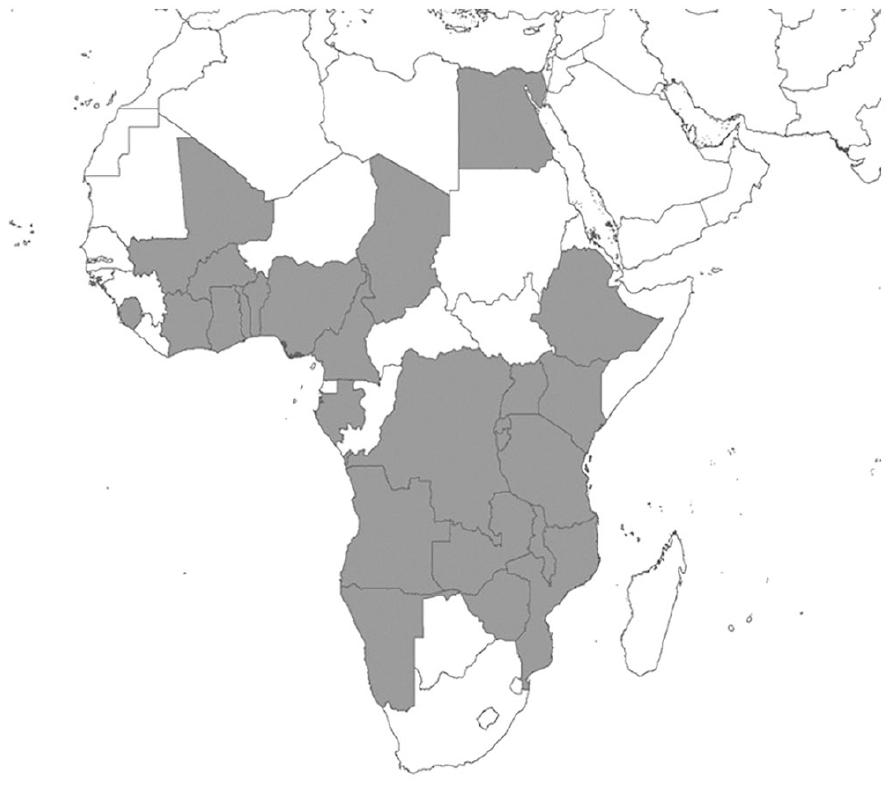
Geographic coverage.
Variable Construction
Outcome variables
To assess women’s experience with intimate partner violence, we draw from the WF-DHS-GPS a series of surveyed items on women’s experience of various types of intimate partner violence in the last 12 months caused by her partner. In particular, the WF-DHS-GPS classifies these items into four main groups. The first group is women’s experience of less severe violence reflected by the incidences of: (i) being pushed, shook, or had something thrown at, (ii) being slapped, and (iii) being punched with fists or something harmful. The second group is women’s experience of more severe violence captured by the incidences of: (i) being kicked or dragged, (ii) being strangled or burned, and (iii) being threatened with a knife or gun. The third group is women’s experience of emotional abuse indicated by the incidences of: (i) being humiliated and (ii) being threatened with harm. The fourth group is women’s experience of sexual abuse reflected by the incidences of: (i) being forced into unwanted sex and (ii) being forced into other sexual acts.
Accordingly, for each item of each group, we assign the value of 1 if the woman experiences the incident in the last 12 months, and 0 otherwise. This exercise gives us 10 indicator variables corresponding to 10 items across the four groups. Next, we respectively compute a composite index by averaging across the underlying items under each group, thus resulting in four composite indices including (i) less severe violence, (ii) more severe violence, (iii) emotional abuse, and (iv) sexual abuse.
Main explanatory variable
Our main explanatory variable is the standardized total number of battles (Battles) that occurred within 12 months before the survey date in the woman’s residential district. To construct the variable, for each woman being surveyed, we first count the number of battles that broke out in her district in the previous 12 months prior to the survey date. For example, let us consider a district that experienced two battles in January 2010 and another three in March 2010 between 2009 and 2011. Then, women living in the district and being surveyed in May 2010, exposed to five battles in the last 12 months, while those surveyed before January 2010 and after March 2011 were exposed to zero battle. To facilitate the interpretation and comparison to other studies, we further normalize this total number of battles using z-score standardization to have a mean of 0 and a standard deviation of 1.
Estimation sample
Our final sample consists of women from 29 African countries between 1990 and 2018. The list of countries is provided in Table A1 in the Appendix. The descriptive statistics of control and outcome variables are presented in Table 1. Regarding control variables (Panel A), on average, there are 0.42 battles. The average ages of women and partners are approximately 30.6 and 38.6, respectively. The fractions of women and partners completing primary education are 39.3% and 51.4%, respectively. Around 84.5% of women are married and 31.2% of women live in urban areas. Women have roughly 3.2 children on average.
Summary Statistics.

Moving to the intimate partner violence outcomes in Panel B, the mean values of the composite indices of less severe violence, more severe violence, emotional abuse, and sexual abuse are 0.10, 0.03, 0.09, and 0.06, respectively. Regarding less severe violence, approximately 8.3%, 16.1%, and 6.6% of our sampled women report being pushed/shook, slapped, and punched/hit by their partners in the last 12 months, respectively. Regarding more severe violence, around 5.7%, 1.5%, and 1.1% of women were kicked/dragged, strangled/burnt, and threatened with knife/gun by their partners in the last 12 months, respectively. As for emotional abuse, the proportions of women being humiliated and threatened by their partners in the last 12 months are 11.8% and 7.0%, respectively. As for sexual abuse, approximately 8.2% and 2.8% of sampled women report being forced into unwanted sex and being forced into other sexual acts in the last 12 months by their partners, respectively.
Empirical Methodology
To evaluate the effects of armed conflict on intimate partner violence against women, we exploit the differential location and timing of battles in the following framework,

where the subscripts i, d, m, and y correspond to woman, residential district, survey month, and survey year, respectively. The outcome variable
We also denote by
The main coefficient of interest is
Results
Overall Composite Indices
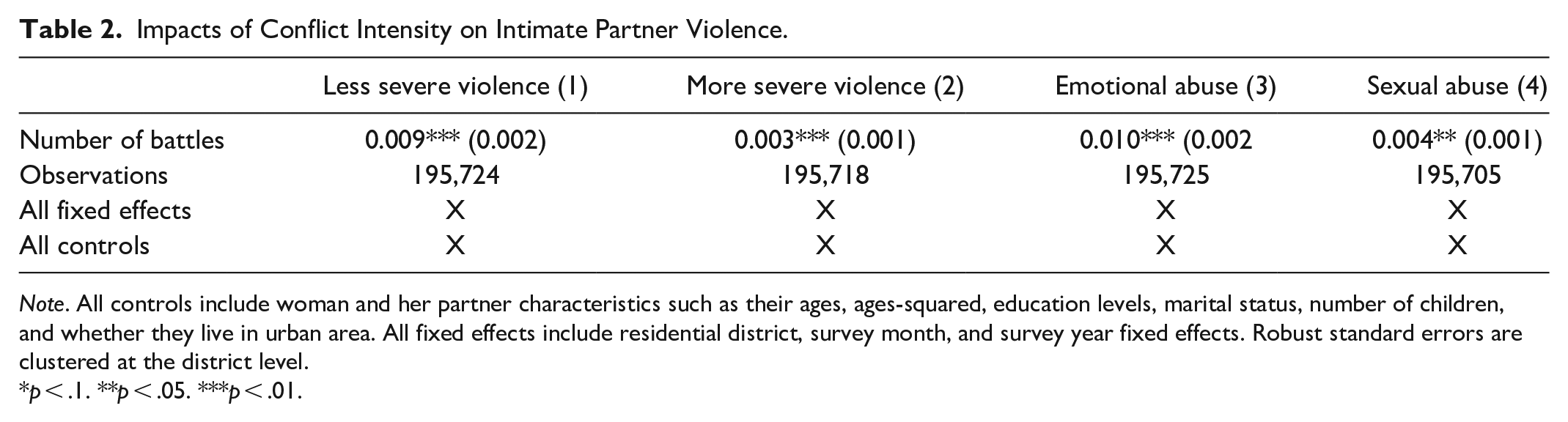
We provide the estimates for the impacts of armed conflict intensity on the four composite indices of intimate partner violence against women in Table 2, including less severe violence, more severe violence, emotional abuse, and sexual abuse in Columns 1 through 4, respectively.
Impacts of Conflict Intensity on Intimate Partner Violence.
Note. All controls include woman and her partner characteristics such as their ages, ages-squared, education levels, marital status, number of children, and whether they live in urban area. All fixed effects include residential district, survey month, and survey year fixed effects. Robust standard errors are clustered at the district level.
p < .1. **p < .05. ***p < .01.
First, as shown in Columns 1 and 2, there is a positive relationship between conflict intensity and the physical violence aspect of intimate partner violence. The estimated effects are statistically significant with p < .01 for both less severe violence and more severe violence indices. Specifically, a 1SD increase in the number of battles (equivalent to the increase by 4.8 battles) raises the composite indices of less severe violence and more severe violence against women by 0.009 and 0.003 points, respectively. Compared to the sample averages presented in Table 1, the estimates represent the increases by 8.74% and 10.34%, respectively. Besides physical violence, armed conflict can also be linked with other aspects of intimate partner violence, namely emotional abuse and sexual abuse. According to Columns 3 and 4 of Table 2, a 1SD increase in the number of battles raises the composite indices of emotional abuse and sexual abuse against women by 0.01, and 0.004 points, which corresponds to the 10.64, and 7.14% increases relative to sample averages, respectively.
Underlying Incidences
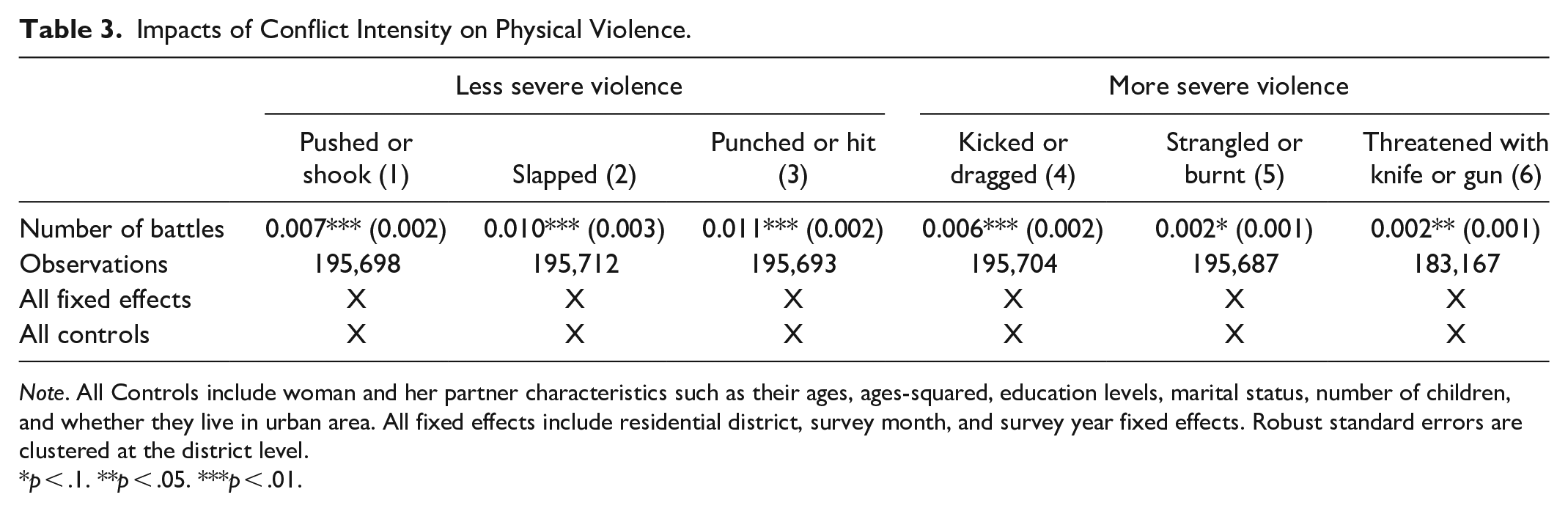
In Tables 3 and 4, we further break down the composite indices by looking at their underlying items, which are dummy variables indicating whether the partner ever uses a particular type of violence against the woman in the last 12 months.
Impacts of Conflict Intensity on Physical Violence.
Note. All Controls include woman and her partner characteristics such as their ages, ages-squared, education levels, marital status, number of children, and whether they live in urban area. All fixed effects include residential district, survey month, and survey year fixed effects. Robust standard errors are clustered at the district level.
p < .1. **p < .05. ***p < .01.
Impacts of Conflict Intensity on Emotional and Sexual Abuse.

Note. All Controls include woman and her partner characteristics such as their ages, ages-squared, education levels, marital status, number of children, and whether they live in urban area. All fixed effects include residential district, survey month, and survey year fixed effects. Robust standard errors are clustered at the district level.
p < .1. **p < .05. ***p < .01.
Physical violence
Columns 1 through 3 of Table 3 present the estimated impacts of armed conflict intensity on the items contributing to the measure of less severe violence, proxied by the pushed or shook, slapped, and punched or hit indicators. Quantitatively, a 1SD increase in the number of battles raises the incidences of the woman being pushed/shook, slapped, and punched/hit by her partner by 0.7, 1.0, and 1.1 percentage points, respectively. The estimates are all statistically significant at 1% level. Taking the fraction of women experiencing each type of physical violence as the benchmark, these estimates represent the increases of 8.43%, 6.21%, and 16.67% in the incidences of being pushed/shook, slapped, and punched/hit by the partners.
In Columns 4 through 6 of Table 3, we report the estimated impacts of armed conflict intensity on the items contributing to the measure of more severe violence, proxied by the kicked or dragged, strangled or burnt, and threatened with knife or gun indicators. We find that a 1SD increase in the number of battles raises the incidences of the woman being kicked/dragged, strangled/burnt, and threatened with knife/gun by her partner by 0.6, 0.2, and 0.2 percentage points, corresponding to the 10.53%, 13.33%, and 18.18% increases relative to the sample averages, respectively. The estimates are all statistically distinguishable from zero.
Other types of violence
In Table 4, we consider the underlying items that contribute to the other aspects of intimate partner violence, including (i) humiliated and threatened with harm indicators contributing to emotional abuse and (ii) forced into unwanted sex and forced into other sexual acts constituting sexual abuse. According to Columns 1 and 2, women residing in conflict-affected areas are more likely to suffer emotional abuse, highlighted by 0.7, and 1.4 percentage point increases in the incidences of being humiliated and threatened, in response to a 1SD increase in the number of battles, respectively. Besides, armed conflicts also raise the probability of women being forced into unwanted sex and other sexual acts, as evident by 0.7 and 0.1 percentage points in response to a 1SD increase in the number of battles. The estimates are all statistically significant, with the exception of being forced into other sexual acts. Compared to the sample averages, the estimates correspond to the 5.93%, 20%, and 8.54% increases in the incidences of being humiliated, threatened, and forced into unwanted sex, respectively.
Discussion
Collectively, we have found that armed conflict intensity is positively associated with the incidences of intimate partner violence in Africa. Women tend to suffer more from all types of violence evidenced by the 8.74%, 10.34%, 10.64%, and 7.14% increases in the indices of less severe violence, more severe violence, emotional abuse, and sexual abuse relative to the sample averages, in response to a 1SD increase in the number of battles (equivalent to an increase by 4.8 battles) in the woman’s district within the last 12 months, respectively. Regarding less severe violence, as the number of battles increases by 1SD, women are 0.7, 1.0, and 1.1 more likely to be pushed/shook, slapped, and punched/hit by their partners, respectively. As for more severe violence, women are 0.006, 0.002, and 0.002 more likely to be kicked/dragged, strangled/burnt, and threatened with knife or gun by their partners, respectively. In terms of emotional abuse, a 1SD increase in the number of battles raises the incidences of humiliation and threat with harm by partners by 0.7 and 1.4 percentage points, respectively. Regarding sexual abuse, the probability of being forced into unwanted sex and the probability of being forced into other sexual acts increase by 0.7 and 0.1 percentage points, respectively. Taking the proportion of each type of violence as the benchmark, our estimates represent: (i) the increases of 8.43%, 6.21%, and 16.67% in the incidences of being pushed/shook, slapped, and punched/hit, (ii) the increases of 10.53%, 13.33%, and 18.18% in the incidences of being kicked/dragged, strangled/burnt, and threatened with knife/gun, (iii) the increases of 5.93% and 20% in the incidences of being humiliated and threatened, and (iv) the increase of 8.54% in the incidence of being forced into unwanted sex, respectively.
There are multiple pathways to the impacts of armed conflict intensity on intimate partner violence. There could be some spillover of violence from events outside the home to disagreement and abuses within the domestic context, which could potentially trigger intimate partner violence (Kiss et al., 2015). Besides, exposure to armed conflicts can lead to the acceptance of violence as a means to solve problems, making intimate partner violence more prevalent (Waldmann, 2007). The collapse of the social support and security system during conflict further exacerbates the situation since it decreases the protection of women against intimate partner violence (Clark et al., 2010; Horn, 2010). Finally, armed conflict can induce stresses related to income loss among men. Particularly, men may find it more difficult than women to secure jobs and incomes (Institute for Women’s Studies, 2008). At the same time, the growing relative importance of women’s financial contribution to the family might threaten masculinity or the traditional role of the male breadwinner, which could ultimately increase the incidences of intimate partner violence (Justino, 2018).
The detrimental consequences of armed conflict on intimate partner violence could have serious implications in the long run. There is evidence that experiencing intimate partner violence can be devastating. Women who are victims of intimate partner violence tend to have physical illnesses, psychological issues, and behavioral problems (Alejo, 2014; Simmons et al., 2018; Temple et al., 2010). In addition, intimate partner violence can also generate harmful effects on children. Witnessing violence in early life interferes with the child’s socio-emotional development, poor health, and mental distress in the long run (Gilbert et al., 2015; Mueller & Tronick, 2019). Given the adverse repercussions of intimate partner violence, the dreadful costs of armed conflict are far-reaching and are probably more severe than previously estimated. Besides impeding our progress toward Sustainable Development Goal 16 (SDG-16, peace, justice, and strong institutions), armed conflict can hinder us from achieving SDG-5 (gender equality) by inducing violence against women. Therefore, our study calls for global efforts in the prevention and reduction of armed conflict. Furthermore, government interventions are important to address intimate partner violence during and after conflict.
Conclusion
This paper contributes to the literature by exploring the less discernible impacts of armed conflict on intimate partner violence for 25 countries across Africa over almost 30 years. Drawing from the Demographic and Health Surveys supplemented with GPS datasets (DHSGPS) for rich information on women and the Uppsala Conflict Data Program Geo-referenced Event Dataset (UCDP-GED) for a comprehensive list of armed conflicts, we exploit both the variations across districts and within districts in the timing of battles to identify the impacts of armed conflict on various types of intimate partner violence.
We find that exposure to armed conflict makes women more likely to experience intimate partner violence. Specifically, a 4.8 battle increase (1SD increase) raises the composite indices of less severe violence, more severe violence, emotional abuse, and sexual abuse against women by 8.74%, 10.34%, 10.64%, and 7.14% relative to the sample averages, respectively. As we closely examine factors contributing to each type of violence, we find that a 1SD increase in the number of battles raises: (i) the probability of women being pushed/shook, slapped, and punched/hit by 8.43%, 6.21%, and 16.67%, regarding less severe violence, (ii) the probability of women being kicked/dragged, strangled/burnt, and threatened with knife/gun by 10.53%, 13.33%, and 18.18%, regarding more severe violence, (iii) the probability of being humiliated and threatened by 5.93% and 20%, regarding emotional abuse, and (iv) the probability of being forced into unwanted sex by 8.54%, regarding sexual abuse, all relative to the sample averages.
As intimate partner violence exerts long-lasting detrimental impacts on the victim women and children who witness the violence, our study suggests that the cost of armed conflicts is larger than previously estimated. Global efforts should be directed to the prevention of armed conflicts. Mitigation strategies in ongoing conflicts are important in shortening the length of conflict so as to reduce suffering. Strengthening economic support for families through the use of transfers or securing jobs during and after conflicts could also help reduce intimate partner violence. Furthermore, in the long run, to minimize the impacts of armed conflicts on intimate partner violence, teaching healthy relationship skills through social-emotional learning programs and healthy relationship programs for couples and youths can be implemented regularly. There should also be reforms in the legislative systems to ensure the safety of women such as being more explicit on how to handle victims and perpetrators or criminalizing psychological as well as sexual abuses, in addition to physical violence, within a domestic context.
Footnotes
Appendix A
List of Countries.

| # | Country code | Country name | Observations | Percentage | Cumulative percentage |
|---|---|---|---|---|---|
| 1 | AO | Angola | 6,647 | 3.31 | 3.31 |
| 2 | BF | Burkina Faso | 9,105 | 4.53 | 7.84 |
| 3 | BJ | Benin | 4,063 | 2.02 | 9.86 |
| 4 | BU | Burundi | 6,380 | 3.17 | 13.03 |
| 5 | CD | Congo Dem Rep | 7,116 | 3.54 | 16.58 |
| 6 | CI | Cote d’ Ivoire | 4,476 | 2.23 | 18.80 |
| 7 | CM | Cameroon | 5,931 | 2.95 | 21.75 |
| 8 | EG | Egypt | 6,235 | 3.1 | 24.86 |
| 9 | ET | Ethiopia | 3,970 | 1.98 | 26.83 |
| 10 | GA | Gabon | 3,528 | 1.76 | 28.59 |
| 11 | GH | Ghana | 1,560 | 0.78 | 29.36 |
| 12 | KE | Kenya | 8,073 | 4.02 | 33.38 |
| 13 | ML | Mali | 14,862 | 7.4 | 40.78 |
| 14 | MW | Malawi | 16,551 | 8.24 | 49.01 |
| 15 | MZ | Mozambique | 4,874 | 2.43 | 51.44 |
| 16 | NG | Nigeria | 38,993 | 19.4 | 70.84 |
| 17 | NM | Namibia | 1,269 | 0.63 | 71.47 |
| 18 | RW | Rwanda | 3,944 | 1.96 | 73.43 |
| 19 | SL | Sierra Leone | 4,029 | 2.00 | 75.44 |
| 20 | TD | Chad | 3,476 | 1.73 | 77.17 |
| 21 | TG | Togo | 4,877 | 2.43 | 79.60 |
| 22 | TZ | Tanzania | 11,222 | 5.58 | 85.18 |
| 23 | UG | Uganda | 9,084 | 4.52 | 89.7 |
| 24 | ZM | Zambia | 11,529 | 5.74 | 95.44 |
| 25 | ZW | Zimbabwe | 9,169 | 4.56 | 100 |
Note. This table provides the list of 25 countries in our sample.
Declaration of Conflicting Interests
The author(s) declared no potential conflicts of interest with respect to the research, authorship, and/or publication of this article.
Funding
The author(s) received no financial support for the research, authorship, and/or publication of this article.
