




Abstract
This article examines the effect of financial liberalization on bank risk-taking, using bank-level data of 169 Chinese banks from 2000-2014. Empirical results show that bank stability increases with the development of financial liberalization. We also provide evidence indicating that banks with larger size, longer operating periods, and state ownership are more salient with the development of financial liberalization. However, such positive effects of financial liberalization on bank stability may be weakened by worse macroenvironment gauged by low economic growth, poor law enforcement, and instable political conditions.
Introduction
Since the 1980s, a large number of emerging markets and developing countries have begun to implement financial liberalization schemes and programs, aiming at optimizing resource allocation, and promoting economic growth through competition and innovation (McKinnon, 1973). However, existing studies have not yet reached a consensus on how financial liberalization affects financial intermediaries. Financial deregulation may benefit banking system by encouraging competition, spurring sophistication of financial regulations, offering new financial instruments and services, and fostering the overall efficiency of banks (Lensink & Hermes, 2004; Levine, 2001). The cautionary views, however, warn that financial liberalization exacerbates macroeconomic cyclical fluctuations and magnifies the fragility of financial institutions, ultimately increasing the probability of financial crisis (Cubillas & González, 2014; Demirgüç-Kunt & Detragiache, 1999; Hamdi, Hakimi, & Djelassi, 2013).
We focus on China to investigate how financial liberalization affects banks’ risk-taking for two reasons. First, China’s unique national conditions determine that financial liberalization has its unique development process. China has maintained an unprecedented economic growth rate since 1978, and financial liberalization has undoubtedly played a vital role in promoting the market-oriented reform. After the 2008 global financial crisis, China’s economic growth slowed down and the government accelerated the reform process of financial liberalization. The Chinese government aims to ease the contradiction of “financing difficulties” of enterprises, improve investment efficiency, and thus maintain economic growth. Financial liberalization plays a key role in every stage of China’s economic development and studying the impact of financial liberalization process will help developing countries in the similar path to design their financial liberalization policy in a better manner.
Second, the adverse impact of excessive bank risk exposure in China, a typical bank-dominated country, may be greater compared with that in the capital-dominated countries. Thus, studying the effect of financial liberalization on China’s bank risk-taking is of great significance to the long-term stability of its banking industry. In addition, the sample period in the present study is roughly in line with China’s financial sector reform, enabling us to better understand the nexus between financial liberalization and bank risk-taking.
Compared with existing works, our article has two innovations. First, by expanding the literature on both economic consequences of financial liberalization and the determinants of bank risk, our findings provide an empirical basis for strengthening the orderly liberalization of China’s financial development. Although many studies are skeptical about the effects of financial liberalization in the developing countries, we find something different. Empirical findings in the present study suggest that benefits of financial liberalization outweigh its adverse effects, at least in China. We argue that this result might be related to the unique developmental context of the Chinese economy. Second, we offer some policy implications by examining the heterogeneity of “financial liberalization–bank risk-taking” relation. Existing literature often lacks further discussions on the heterogeneous influences of the above association. We not only analyze the influences of bank-specific features but also examine the effects of macroeconomic and political environment on such nexus. Identification of both bank characteristics and macroeconomic conditions is useful to derive policy implications for both bank managers and authorities.
We organize the article in the following way. The “Literature Review” section presents an overview of related literature. The “Financial Liberalization in China” section briefly describes the background of financial liberalization in China. Data, variables, and model are outlined in the “Data, Variables, and Model” section. The section “Empirical Results” reports the baseline and robustness results. Heterogeneity analysis is demonstrated in the section “Extended Regressions.” The final section concludes.
Literature Review
Economic consequence of financial liberalization is an important topic that receives extensive attention from both academia and policy makers. Scholars study this issue from different respects, such as examining the impact on economic growth (Quinn & Toyoda, 2008), on capital inflows and investment growth (Levchenko, Ranciere, & Thoenig, 2009), on risk and efficiency of stock market (Bley & Saad, 2011), on capital cost (Gul, Kim, & Qiu, 2010), and on corporate governance (Lskavyan & Spatareanu, 2011). Another group of literature analyzes the influence of financial liberalization on financial sector but the debate is far from conclusive. Some scholars highly advocate financial liberalization policies (Ang & McKibbin, 2007; De Haan & Shehzad, 2009; Ghosh, 2006). Although many researchers have affirmed the positive effects of these programs on not only financial development but also economic growth, there is still literature considering financial liberalization as one of the leading causes of the frequent banking crisis in the past three decades (Claessens, Demirgüç-Kunt, & Huizinga, 2001; Demirgüç-Kunt & Detragiache, 1997; Fecht, Grüner, & Hartmann, 2012; Komulainen & Lukkarila, 2003; Lee, Lin, & Zeng, 2016; Stiglitz, 2000).
Theoretically, how financial liberalization influences bank risk-taking remains uncertain. The supportive view is that bank stability can be enhanced due to the financial liberalization. Financial liberalization generally includes measures such as removing foreign entry barriers. Some believe that leading technologies and rich experiences brought by foreign banks are conducive to the improvement and soundness of the host country banking system (Wu, Chen, Jeon, & Wang, 2017). In addition, presence of foreign banks may stimulate the competition among domestic banks. Domestic banks, therefore, may strengthen their awareness of credit risk prevention and focus on improving their own risk management capabilities, thus reducing risk-taking (Lensink & Hermes, 2004; Levine, 2001).
Financial liberalization is also accompanied by removal of existing regulations imposed to the banks. The new rules may provide banks more flexibility to expand their business, which in turn improves bank stability (Abiad, Detragiache, & Tressel, 2010). Meanwhile, cancelation of credit controls allows commercial banks to lend more independently. In the context of financial liberalization, banks become more free to choose credit items, and thus default rate will be lower (Abiad et al., 2010). Financial liberalization can also be characterized with reduction of state ownership in banks and therefore the participation of private ownership will increase the operational efficiency (Dong, Meng, Firth, & Hou, 2014). Last but not the least, banks’ risk management skill may be improved due to adoption of macroprudential policies, lowering their risk-taking (Aikman, Nelson, & Tanaka, 2015).
On the contrary, the critical view believes that financial liberalization induces excess bank risk-taking. First, interest rate liberalization implies that interest rates are determined by the market rather than the central bank, thus bringing about fierce fluctuations in both deposit and lending rates and increasing banks’ credit risk. Second, as the “competition-fragility” hypothesis proposed by Berger, Klapper, and Turk-Ariss (2009), intense competition comes with a decrease in the bank’s net interest margin. This will eventually erode bank’s profits and induce “search for yield” behavior. Third, with the lack of proper supervision and regulation, banks tend to diversify their business in nontraditional activities and be more prone to speculative operations (Barth, Caprio, & Levine, 2013). Fourth, financial integration exacerbates bank risk-taking as the risk in international market can be transmitted into domestic market through bank funding (Giannetti & Ongena, 2012).
Some studies have applied cross-country data to investigate this issue. For instance, Bourgain, Pieretti, and Zanaj (2012) investigate 258 banks in MENA (Middle East and North Africa) countries over 2005-2008, reporting that financial openness raises the awareness of risk management in banks. Cubillas and González (2014) analyze more than 4,000 banks in around 80 countries and find that the liberalization policies increase risk exposure of banks in both developing and developed countries due to fierce bank competition and diversified business opportunities. While Gruben, Koo, and Moore (2003) believe that not all liberalizations are accompanied by crisis, and the financial systems without market discipline have greater chances to be negatively affected. As the development of each economy is unique, empirical results based on multinational research often lack targeted policy guidance. Examining a country can bypass the limitations of cross-country research by considering the unique characteristics of that country (Rodrik, 2005). Having considered the controversial theoretical scaffolding and ambiguous empirical evidence, this article aims to address the issue by focusing on Chinese banks.
Financial Liberalization in China
In November 1993, the State Council of China issued the decision on financial system reform, officially marking the commencement of China’s financial liberalization. Between 1978 and the early 1990s, although China’s financial system also had reforms on easing government regulation, it was not strictly called financial liberalization as China was in the wave of market economy construction at this stage. China’s financial liberalization process consists of the following three dimensions.
The first dimension is interest rate liberalization. In 1993, two decisions issued by State Council on financial system reforms were among the first to clarify the basic ideas of interest rate marketization reform. From 1996 to 1999, China opened the interbank market interest rate and the bank bond market repo rate. On the contrary, China gradually expanded the floating ranges of financial institutions’ loan interest rates. In 1998, the floating range of financial institutions’ interest rates on small businesses was expanded from 10% to 20%; the loan interest rate of rural credit cooperatives was increased from 40% to 50%. At the same time, the types of loan interest rates were simplified and most of the preferential loan interest rates were eliminated. In 2000, the reform of interest rate of foreign currency control was implemented, and foreign currency loan interest rate was liberalized. Beginning in 2004, China once again expanded the floating range of lending rates of financial institutions and liberalized the interbank lending rate of financial institutions. China’s interest rate liberalization achieved considerable results by 2007. Since 2013, China’s interest rate marketization has been on a rapid pace, including the full liberalization of loan interest rate controls, the establishment of a sound market interest rate pricing mechanism, the establishment of a centralized quotation and release mechanism for loan base interest rates, and the steady advancement of market circulation of interbank deposit certificates. In 2014, the People’s Bank of China lowered the benchmark interest rates for both loans and deposits.
The second dimension is financial business and institutional access liberalization. From the perspective of business liberalization, China’s financial system has experienced a transition from mixed operations to separate operations, and finally to integrated operations. Prior to 1993, commercial banks operated various businesses by establishing trust companies, securities brokerage companies, and futures companies. However, due to lack of strict financial supervision, such mixed business model caused serious damage to China’s financial sector at that time. In 1993, the Chinese government required insurance companies, securities companies, trust institutions, and commercial banks to operate independently. Since 2006, in the context of global integration and integrated management, mixed-field business restrictions have also been gradually released, and some large financial institutions have begun to try integrated operation pilots. From the perspective of institution liberalization, the period 1992-1995 witnessed the establishment of the first joint-stock bank in China, the introduction of the first foreign-invested insurance company, and the first private bank. In 1999, the geographical restrictions on foreign banks’ branches establishment were abandoned. After joining the World Trade Organization (WTO), the number of foreign banks operating in Chinese market was greatly increased. By 2013, foreign banks have had business operations in 69 cities in China. More than 90 foreign banks’ branches and more than 180 representative offices have been established.
The third dimension is capital account liberalization. Since the 1970s, with the deepening of reform and opening up in China, the liberalization of capital accounts had been carried out gradually. The year 1994 saw reforms including unifying exchange rate; implementing a single and managed floating exchange rate based on market supply and demand; establishing an interbank foreign exchange market; improving the exchange rate formation mechanism; and maintaining reasonable and relatively stable RMB exchange rate and so on. In December 1996, China accepted the obligations of the International Monetary Fund (IMF) to realize the free convertibility of RMB regular projects. Since then, despite the nominal strict control of many sub-items in the capital account, in practice, most of the sub-items have been opened to a considerable extent. According to IMF, as of 2011, there were 14 sub-items of China’s basic convertible items, accounting for 35% of total, and they mainly concentrated in credit instrument transactions and direct investment. In 2013, China (Shanghai) Pilot Free Trade Zone was approved for formal establishment; in the same year, the People’s Bank of China issued the “Opinions on Financial Support for China (Shanghai) Pilot Free Trade Zone Construction,” which was established to reduce capital account control.
Presently, the practice of China’s interest rate liberalization reform and the establishment of the Shanghai Pilot Free Trade Zone indicate that the pace of China’s financial liberalization has entered an accelerated phase. Under this circumstance, it is of great significance to study the impact of financial liberalization on the business model of banks.
Data, Variables, and Model
We establish an unbalanced panel, using annual data for 169 Chinese commercial banks from 2000-2014. The data are collected from Bureau van Dijk’s Bankscope database and banks’ annual reports. Our sample consists of 169 major banks, including the “big five” state-owned banks, 11 joint-equity banks, and 153 city commercial banks and rural commercial banks, accounting for more than 90% of total Chinese banking sector assets.
Bank Risk-Taking
The primary indicator of bank risk-taking is Z-score which is the common adoption in literature (Demirgüç-Kunt & Huizinga, 2010; Houston, Lin, Lin, & Ma, 2010; Laeven & Levine, 2009). It is formally expressed as

In this expression, ROAit represents the return on assets of bank i in year t; EAit demotes the ratio of equity over total assets; σ(ROA) it means the standard deviation of return on asset and a three-consecutive-year rolling window is applied to get it. Roy (1952) interprets Z-score as the number of standard deviations of profits must fall below its mean to bankrupt the bank and is viewed as the inverse of the probability of bank failure. Higher Z-score suggests higher overall bank stability, or, a lower exposure to insolvency risk. As Z-score from this calculation is highly skewed, we adopt the natural logarithm form to smooth the values.
However, direct comparison of Z-score values for different years may result in biased results. It’s likely that the risk level of banks in some years is higher (lower) than that in other years. To work it out, a standardization of Z-score for each year is applied as follows (Chen, Wu, Jeon, & Wang, 2017; Wu et al., 2017):

where max(Zt) and min(Zt) represent the maximum and minimum values of Z-score in year t. The result is within 0 to 1, indicating the relative level of riskiness for a bank in its market at a specific year. The higher the value, the greater the stability compared with its peers during a year.
Financial Liberalization
The financial liberalization index was first proposed by Quinn (1997) which applies the level of government control over capital projects to measure financial liberalization. Then scholars constructed several methods to measure the index (Koo & Maeng, 2005; Koo & Shin, 2004; Laeven, 2003). The first method is to divide the sample into two parts according to the implementation date of the financial liberalization policy and then set 0/1 dummy variable to measure it (Koo & Maeng, 2005). The disadvantage of this method is that it cannot distinguish the effects of financial liberalization in different fields. Furthermore, Laeven (2003) believes that financial liberalization generally consisted of many different reform policies. Therefore, he divided financial liberalization into six aspects, collected the implementation dates of different financial reform policies, then adopted the 0/1 dummy variable to measure the financial liberalization in the several aspects, respectively, and finally aggregated these dummies into one index. However, this method ignores the quantitative change and the cumulative process of financial reforms (Koo & Shin, 2004). The third method is to assign different values to each category of financial reforms and then average the values to calculate the financial liberalization index. The fourth method is based on principal components analysis. The advantage of this method over simple average is that all the variables are grouped into a matrix to calculate the principal components, thus eliminating the redundancy caused by the correlation between the variables and making the results much clearer (Bandiera, Caprio, Honohan, & Schiantarelli, 2000).
Based on above methods, we establish the financial liberalization index of China in the following steps. First, we follow Bandiera et al. (2000) to construct annual financial liberalization index with eight dimensions, namely interest rate control, entry barriers, credit control, macroprudential policy, state ownership, security market policy, capital account restrictions, and reserve requirement. Interest rate control measures the degree that the government relaxes or even cancels interest rate restrictions on banks. Entry barriers refer to the reduction or even elimination of market innovation restrictions. Credit control represents the reduction or even disappearance of designated or policy credit. Macroprudential policy aims to strengthen the supervision of financial institutions overall. State ownership refers to the reduction of nationalization rate in financial institutions. Security market policy means the reduction of the securities market by government intervention. Capital account restrictions signify the liberalization of both current and capital accounts. Reserve requirement indicates the decrease of reserve ratio.
Second, following Yi and Dan (2007), we track the year-by-year “Financial events” from the Almanac of China’s Finance and Banking and website of the People’s Bank of China, and assign a certain number that lies between 0 and 2 to each related event, with 0 representing full supervision, 2 expressing full liberalization, with the interval of 0.5. Specifically, the general event on behalf of financial liberalization is assigned 0.5, major event or general policy and regulation is given 1, while major policy or regulation is assigned 2; if the occurrence of the incident or policy is against liberalization, the assignment becomes negative. Admittedly, the definition of an event as general or major is subjective in some degree, but it is still universally applied in literature (Koo & Shin, 2004). In addition, as financial liberalization is a continuous process, we take 1978 as the base year and implement the cumulative valuation method.
Next, principal components analysis method is used to obtain the overall financial liberalization index. From Appendix A, the eigenvalue of the first factor is 7.518 with the characteristics of other factors significantly less than 1, and the degree of interpretation of the total variance reaches 94.761. It can be seen that the first factor can represent most information of the overall data. Therefore, it is reasonable to extract Factor 1 as the main factor as a comprehensive evaluation of financial liberalization reform in different fields. Finally, we get the comprehensive financial index from eight dimensions, denoted as FL_ALL.
Control Variables
We control for several bank characters based on a careful review of extant literature on the potential determinants of bank risk-taking. Size, calculated as a natural logarithm of total assets is expected to influence bank risk-taking but with ambiguous effects (Cubillas & González, 2014). Large banks have more market power, leading risk management techniques, and diversification opportunities, but may exhibit moral hazards if they believe “too big to fail” or “too important to fail” (Afonso, Santos, & Traina, 2015). Liquidity, measured as the ratio of liquid assets over total assets for individual banks, represents banks’ ability to liquidate. Ample liquidity may enhance banks’ capability to withstand unexpected outside shocks and deposit runs; however, when banks expect higher fluctuated return, they may store more liquid assets, which in turn affects the bank’s profitability and further banks’ stability (Alger & Alger, 1999). The third factor controlled for is Capitalization, which is calculated as bank equity as a share of its total assets. Vazquez and Federico (2015) find that banks with low liquidity and high leverage are mainly involved in bankruptcy. However, well-capitalized banks tend to have a high return on assets and thus bank stability (Demirgüç-Kunt & Huizinga, 2010).
We next control for bank efficiency, measured as the ratio of noninterest operating cost to total income. According to the management hypothesis, lower cost efficiency from higher credit monitoring costs and operating expenses result in more problem loans (Berger & DeYoung, 1997; Sturm & Williams, 2004). The cost skimping hypothesis assumes that banks appear to be more cost-efficient as they devote fewer resources to credit screening and monitoring (Fiordelisi, Marques-Ibanez, & Molyneux, 2011). Fifth, banks’ age is also included in our model, which is defined as the length of the operational period since the establishment of banks and computed as the difference between current year and the year of establishment.
We also include a group of variables for macroeconomic conditions in our regressions, namely, real GDP (gross domestic product) growth rate, inflation rate, and monetary policy. The data of these variables are obtained from IMF’s International Financial Statistics Database. The first is the real growth rate of GDP adjusted by using the GDP deflator in 2005, which captures the impact of business cycles on bank performance (Marcucci & Quagliariello, 2009). Inflation rate, calculated as the percentage change in the consumer price index, is also included in our model to capture the business cycle. We also control for monetary policy that is measured as the first order difference of short-term market interest rates, where a higher/lower value is interpreted as a relatively tightened/eased monetary supply. It has been well documented in literature on the topic of “bank risk-taking channel of monetary policy.” Borio and Zhu (2012) and some others find that the expansionary monetary policy may encourage more behaviors of “search for yield,” thus increasing the risk of banks.
Empirical Model
Our benchmark estimation model is as follows:

In this expression, i and t represent bank i in year t. Riskit is the risk-taking measures. FLt reflects the process of financial liberalization in China over years. BankCharit and Macrot indicate the series of bank characteristics and macrovariables. Yeart is year dummies. The variable fi is the time-invariant bank-specific effect. ε it is the idiosyncratic error. To mitigate the endogeneity problem, 1-year lag for each bank characteristic variable is used. Our baseline model is estimated by bank-specific fixed-effects method, and robust standard errors that cluster at the bank level are used.
Descriptive Statistics
Data definitions, sources, and descriptive analysis of main variables are shown in Table 1. For Z-scores and bank-specific eigenvalues, we remove outliers that lie below the first percentile and above the 99th percentile. It can be seen that the Z-score of the sample banks is distributed with the mean value of 3.952, the standard deviation of 0.915, and are ranged between the minimum 0.679 and the maximum 7.766. The fairly high standard deviation and the wide range of Z-scores highlight a substantial variation on the level of risk across banks. For the Zrank, it lies between 0 to 1 with mean of 0.420 and standard deviation of 0.205.
Variable Definition and Summary Statistic.

The table presents the variable notations, definitions, data source, and descriptive statistics. GDP = gross domestic product ; IFS = International Financial Statistics.
With regard to financial liberalization, the mean value is 1.069 and its standard deviation is 0.572 with minimum of 0.13 and maximized of 2.14, indicating a considerable heterogeneity on financial liberalization in years. We also report the pairwise correlations between key variables in Appendix B. The correlations between the bank risk-taking indexes Z-score and Zrank and financial liberalization measures are statistically significant. This fact indicates that with more reforms in financial liberalization, higher stability is achieved by the banks. The bank characteristic variables, and the macroenvironment variables, are found not highly correlated with each other, implying that a joint inclusion of these variables will not cause serious multicollinearity problems.
Figure 1 displays China’s financial liberalization trend from 1990-2014. It is shown that China’s financial liberalization is gradually increasing year by year. In the early 1990s, due to some unstable economic and political factors, China adopted relatively strict controls on credit and interest rate; hence, the process of financial liberalization stagnated. When the Asian financial crisis broke out in 1997, the promotion of financial liberalization reforms slowed down noticeably. In 2005, the Chinese financial system made huge financial changes in banking systems, stock markets, bond markets, exchange rate regimes, and money markets, so the process of financial liberalization accelerated. In 2008, affected by the international financial crisis, the process of financial liberalization stagnated again. During 2011-2014, China restarted the reform of financial liberalization, and the process was significantly accelerated.

China’s financial liberalization trend from 1990-2014.
Empirical Results
Baseline Regressions
This section presents empirical results on how financial liberalization influences bank risk-taking, proxied by absolute value of Z and its relative form, respectively. Table 2 reports the benchmark estimation results. Columns (1) and (2) display results by only including bank characteristic variables and columns (3) and (4) demonstrate results by adding macroeconomic variables.
Effect of Financial Liberalization on Bank Risk-Taking.
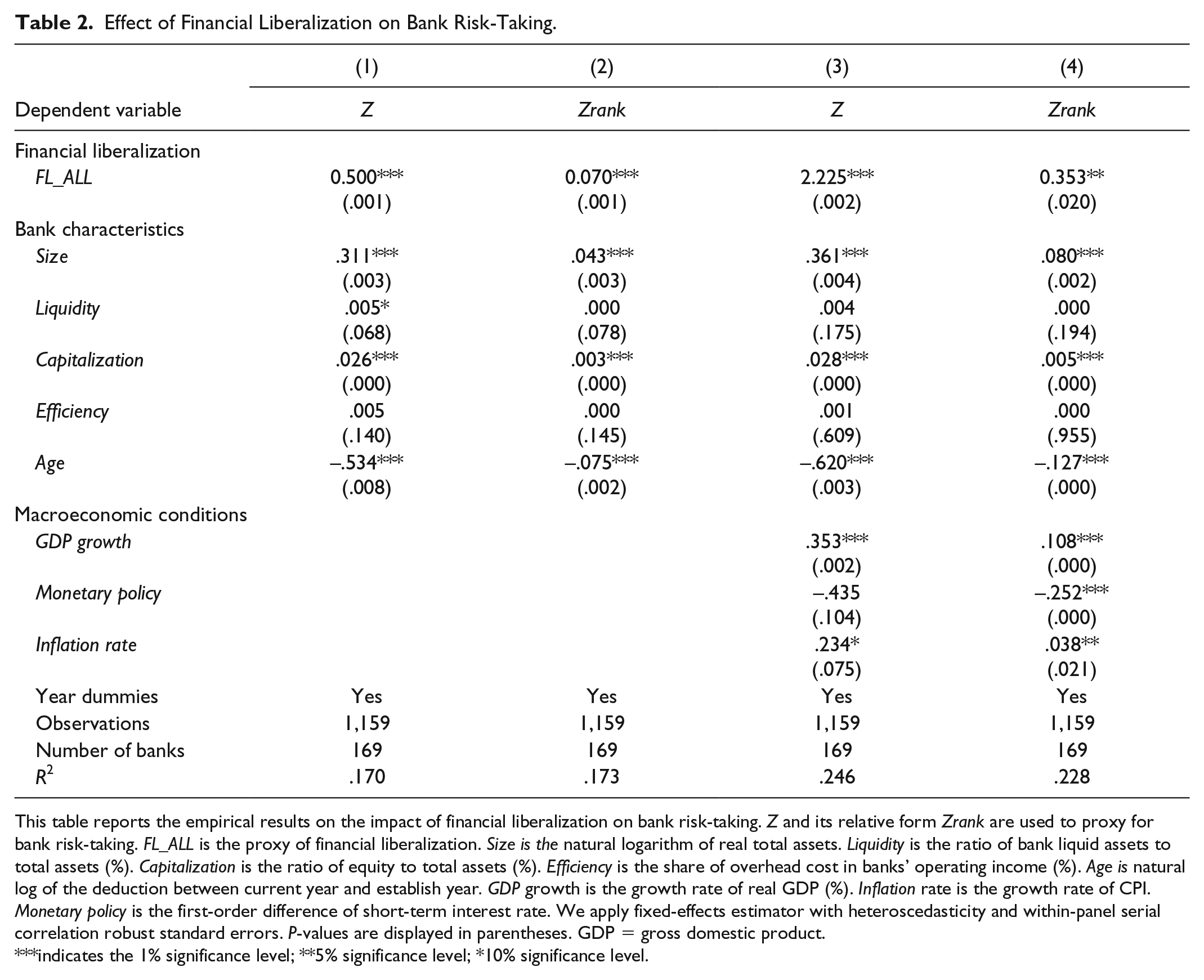
This table reports the empirical results on the impact of financial liberalization on bank risk-taking. Z and its relative form Zrank are used to proxy for bank risk-taking. FL_ALL is the proxy of financial liberalization. Size is the natural logarithm of real total assets. Liquidity is the ratio of bank liquid assets to total assets (%). Capitalization is the ratio of equity to total assets (%). Efficiency is the share of overhead cost in banks’ operating income (%). Age is natural log of the deduction between current year and establish year. GDP growth is the growth rate of real GDP (%). Inflation rate is the growth rate of CPI. Monetary policy is the first-order difference of short-term interest rate. We apply fixed-effects estimator with heteroscedasticity and within-panel serial correlation robust standard errors. P-values are displayed in parentheses. GDP = gross domestic product.
indicates the 1% significance level; **5% significance level; *10% significance level.
We find that financial liberalization is positively related to Z-score-based indicators. The coefficients are positive and statistically significant in all regressions. As a higher Z-score indicates lower bank risk and higher bank stability, this result can be interpreted as that in general the stability of banks increases amid a higher development of financial reforms. Our findings are in line with the hypothesis that, financial deregulation encourages competition, stimulating banks to invest more in human capital and modern technology, thereby increasing their long-term operational efficiency, and thus beneficial to their bank stability. Moreover, elimination of old rules imposed to banks provides banks with more flexibility to diversify their activities. Besides, the cancelation of credit controls allows commercial banks to lend more independently, and banks can judge their consumers based on a comprehensive analysis rather than relationship, thus their credit risk declines. Quantitatively, the impact of financial liberalization is also notable. Taking the estimation result in column (3) as an example, the stability of banks tends to increase by 2.22% for each percentage that oil prices increase. Put another way, if financial liberalization rises by one standard deviation (0.700), the average stability of banks would be increased by nearly 1.544 in response, holding other control variables unchanged at their mean values.
Results for bank-specific variables also confirm the findings of previous studies, suggesting that bank-level variables may affect bank risk-taking separately from macroeconomic trends. First, the significantly positive sign of Size suggests that large banks turn out to be more stable than small banks due to their advanced risk management and diversification opportunities, in contrast with the “too big to fail” hypothesis (Afonso et al., 2015). Second, we find evidence showing that lower leverage or higher capital adequacy may increase bank stability due to the significantly positive Capitalization coefficient, which is consistent with studies that emphasize the role of capital to withstand financial crises (Berger & Bouwman, 2017). Moreover, the coefficient of Liquidity is statistically positive, revealing that holding more liquid assets may decrease bank’s illiquid risk and the probability of default. Finally, it is shown that older banks have lower Z-scores, supporting the assumption that banks with longer years of operation are less stable as they have less incentive for change and innovation. Regarding macroeconomic variables, we find evidences supporting the pro-cyclicality of financial stability. The coefficients on both real GDP growth rate and inflation rate are positive and highly significant in all regressions, consistent with Adrian and Shin (2009) that booming economy and high inflation rate may raise the price of collateral, thus changing banks’ risk perception toward to more risk-tolerant.
Robustness Tests
To examine whether our benchmarks are robust, a variety of tests are conducted. First, we replace our original bank risk-taking variables with alternative indicators that other studies have frequently adopted, including the ratio of nonperforming loans over gross loans (NPL); the volatility of return on asset (σ[ROA]); the volatility of Earnings σ(Earning), which is calculated as the sum of loan loss provision and profit to total asset (Laeven & Levine, 2009); and the volatility of return on equity (σ[ROE]). Specifically, NPL is a widely adopted accounting-based credit risk measure, designated as the ratio of nonperforming loan in total loans (Chen, Jeon, Wang, & Wu, 2015; Chen et al., 2017; Laeven & Levine, 2009). A higher NPL ratio signals a higher credit risk. σ(ROA), σ(Earning), and σ(ROE) are calculated as the standard deviation of return on asset, earnings, and return on equity, respectively, by using 3-year rolling over time window. They are indicators of bank business risk. The higher these ratios, the higher return obtained by the bank per risk, indicating the higher business risk. As shown in Table 3, the coefficients on financial liberalization are statistically negative in all the regressions. This can offer additional evidence for our baseline results that financial liberalization reforms not only decrease the probability of borrower default but also lead to a lower volatility in banks’ return.
Robustness Check: Different Measures of Bank Risk-Taking.

This table reports the results when alternative measures of bank risk-taking are applied. The dependent variables are bank’s credit risk that is nonperforming loans, denoted as NPL (column (4)), and bank’s business risk that are σ(ROA), σ(Earning), and σ(ROE) (columns (2)-(4)). In all regressions, we use a full set of independent variables. For brevity, only the coefficients of financial liberalizations are included, while all other control variables as shown in Table 2 are considered. P-values are in parentheses.
indicates the 1% significance level; **5% significance level; *10% significance level.
Next, we re-estimate our model by employing an alternative measure of financial liberalization that is Economic Freedom Index from the Fraser Institute. Economic Freedom Index is a comprehensive indicator covering government size, legal system, monetary policy soundness, international trade freedom, and supervision level. The higher this index, the higher the degree of economic freedom in a country. The results are presented in Table 4, column (1). The coefficient of Economic Freedom Index is significantly positive, demonstrating that economic reforms and financial liberalization have inner consistency and improve the stability of the banks in China. Then, we apply eight sub-indexes of the synthetic financial liberalization index, namely, interest rate control, barriers to enter the financial sector, credit control, macroprudent management, state ownership, government intervention in securities market, and liberalization of current accounts and capital accounts. Signs of these variables are in line with the sign of FL_ALL, that is, higher value indicates greater degree of financial liberalization in a certain aspect. From Table 4, columns (2) to (9), we find that these sub-indexes are consistent with the baseline model in terms of sign and significance, indicating that higher degree of financial liberalization, whether it is in general or in a certain perspective, has a positive effect on bank stability.
Robustness Check: Alternative Measures of Financial Liberalization.

This table reports the results when alternative measures of financial liberalization are applied. We first apply Economics freedom index (column (1)), and then use the sub-indexes of FL_ALL (columns (2)-(9)). In all regressions, all other control variables as shown in Table 2 are considered. P-values are in parentheses.
indicates the 1% significance level; **5% significance level; *10% significance level.
Alternative methods are also applied to carry out the robustness checks. Results are demonstrated in Table 5. First, we apply the random-effects estimator instead and find the coefficients on financial liberalization are statistically positive, consistent with our baseline model. We then conduct the Prais–Winsten transform regression, which assumes that the error term follows the AR(1) process and is estimated using the generalized least squares method. Similar results with the baseline model are derived. Third, we consider Driscoll–Kraay standard errors in the fixed effects estimation (Driscoll & Kraay, 1998) and find the results remain unchanged quantitatively and statistically.
The Robustness Check: Different Methodologies.

This table reports the results when alternative estimation methodologies are employed. Columns (1) and (2) show the results by using Random effect estimator. Columns (3) and (4) show the results by using Prais–Winsten transformed regression estimator. Columns (5) and (6) use fixed-effect estimator with Driscoll–Kraay standard errors. Columns (7) and (8) apply 2SLS (Two-Stage Least quares) method. In all regressions, we use a full set of independent variables. For brevity, only the coefficients of financial liberalization are included, while all other control variables as shown in Table 2 are considered. P-values are in parentheses.
indicates the 1% significance level; **5% significance level; *10% significance level.
It can be argued that China may push forward financial liberalization when increased financial stability allows for it. Thus, this reverse causality may result in bias in the estimates and 2SLS instrumental variable regression is applied to address the endogeneity problem. Two instrumental variables are selected, namely, the asset penetration of foreign banks in other emerging markets located in Asia and the Economic Freedom Index in these countries. Specifically, we calculate the asset penetration of foreign banks in other emerging countries in Asia over the total bank assets of those countries as Wu et al. (2017) did, and obtain the Economic Freedom Index from the Fraser Institute, and use them as the instrumental variables of financial liberalization. The selected emerging countries are Korea, Malaysia, India, Philippines, Indonesia, Taiwan, Thailand, and Singapore. From one thing, the penetration of foreign banks is positively related to the level of financial liberalization in a country (Cubillas & González, 2014). In addition, foreign bank expansion may be centralized within a region, so the level of foreign penetration of a country can be related with that in the neighbor countries (Wu et al., 2017). Therefore, it can be assumed that the financial liberalization in one country may be positively correlated with the foreign bank penetration in its near countries. From other, the development of financial liberalization is also likely to be affected by neighboring countries, causing the extent of financial liberalization in one country to be positively correlated with that in its neighbor. Nevertheless, it is less likely that these factors would affect the risk-taking of our sample country, suggesting that they are proper instrumental variables for financial liberalization. The IV (Instrumental Variables) regression results, presented at Table 5 (columns (7) and (8)), are robust to our baseline findings.
Extended Regressions
In this section, we examine whether heterogeneous conditions such as banks’ specific features and country’s macroenvironment will influence the impact of financial liberalization on bank risk-taking.
Bank Characteristics
To begin with, the interaction of bank size with financial liberalization indicator is considered and the results are demonstrated in Table 6, Panel A. The effects of financial liberalization on banks’ riskiness might be different across banks with various sizes. The interactive term of bank size with financial liberalization is statistically positive in all scenarios, indicating a positive nexus between the degree of financial liberalization and the stability of large banks. Or, large banks benefit more in terms of stability when financial conditions are more liberal. An explanatory conjecture is that both the hardware facilities such as computer equipment of large banks for risk management and the software facilities such as risk control models are more advanced than those of smaller banks. Moreover, large banks generally have more abundant market information advantages. Financial liberalization implies the relaxation of supervision, the deepening of marketization, and the intensification of competition, hence the advantages of large banks in risk management and funding sources can help them adapt to the impacts of financial liberalization more easily.
Effect of Bank Characteristics on Financial Liberalization–Bank Risk-Taking Relation.

This table reports the heterogeneous effect of financial liberalization on bank risk-taking with different types of banks. In Panel A, bank size is considered. We add the interaction of Size with the indicator of financial liberalization and re-conduct the estimation. In Panel B, bank age is considered. We add the interaction of Age with the indicator of financial liberalization and re-conduct the estimation. In Panels C and D, bank ownership is considered. We add the interaction of State/Foreign with the indicator of financial liberalization and re-conduct the estimations. For brevity, only the coefficients on financial liberalization and the interactive terms are included while all other control variables as shown in Table 2 are considered. P-values are in parentheses.
indicates the 1% significance level; **5% significance level; *10% significance level.
Next, we test whether banks’ age matters for the heterogeneity of the baseline nexus. We interact financial liberalization index with the logarithm of age, and report the results in Table 6, Panel B. We find that the coefficient of our most interested variable, FL_ALL × Age, is negative and highly significant. Although more experienced banks have “well-established retail network and rich information on local markets” (Wu et al., 2017), they are less competitive in innovative financial products, advanced risk management technologies, and fee-and-commission earning activities. Financial liberalization means the removal of restrictions and the intensification of banking competition. With the entry of foreign banks, domestic banks may face the risk of customer shift. In turn, they have incentives to increase the risk-taking to consolidate their position.
Third, we test whether bank ownership matters by including an interactive term of FL_ALL with bank ownership. We use two dummy variables, foreign and state, to describe the ownership. Consistent with the common practice of prior literature (Chen et al., 2017; Claessens, Demirgüç-Kunt, & Huizinga, 2001), if more than 50% of the capital is held by foreign firms, individuals, or organizations, then the bank can be defined as foreign. We also identify domestic government-owned banks as state by defining as banks with 50% or more of government-owned capital. We mainly focus on investigating the risk-taking behaviors of foreign banks and state-owned ones when experiencing financial reforms. Results are displayed in Table 6, Panels C and D. The coefficient of financial liberalization with dummy state is significantly positive while that with dummy foreign turns out to be negative. These findings provide clear evidence that state-owned banks behave more cautious compared with their counterparts when facing relaxed financial environment. State ownership banks are usually those with large scale, hence this finding is consistent with our previous results. Moreover, even though financial liberalization allows free entry of foreign banks, however, new banking market entrants will face an informational disadvantage in the markets, leading to more risk-taking behaviors of foreign counterparts.
Country Macro-Conditions
It is sparse in the literature that how financial liberalization affect riskiness of banks is conditional on countries’ macroenvironment. In this section, we examine how a country’s macro-conditions affect the financial liberalization–bank risk-taking nexus.
We assess first whether business cycle will further influence the benchmark nexus. Marcucci and Quagliariello (2009) and many other works find the cyclicality of bank riskiness. However, whether business cycle would strengthen the baseline relationship receives little attention. We establish a dummy variable, denoted as Dummy (Low GDP), which is equal to 1 (0) if the GDP growth rate for a specific year is below (above) the median of the sample. Then, we interact our financial liberalization indicator with this dummy variable and report the results in Table 7, Panel A.
Effect of Country’s Macro-Conditions on Financial Liberalization–Bank Risk-Taking Relation.
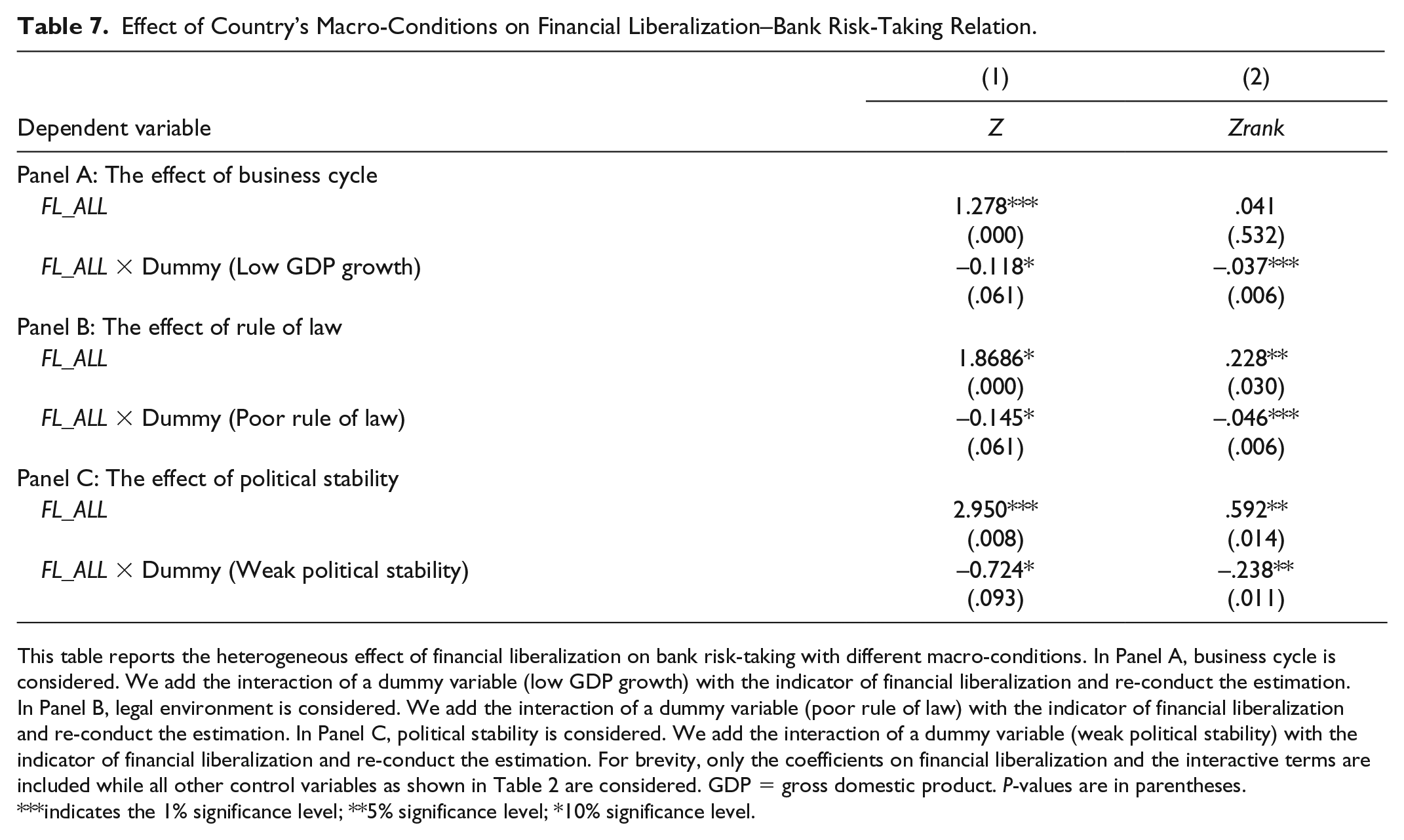
This table reports the heterogeneous effect of financial liberalization on bank risk-taking with different macro-conditions. In Panel A, business cycle is considered. We add the interaction of a dummy variable (low GDP growth) with the indicator of financial liberalization and re-conduct the estimation. In Panel B, legal environment is considered. We add the interaction of a dummy variable (poor rule of law) with the indicator of financial liberalization and re-conduct the estimation. In Panel C, political stability is considered. We add the interaction of a dummy variable (weak political stability) with the indicator of financial liberalization and re-conduct the estimation. For brevity, only the coefficients on financial liberalization and the interactive terms are included while all other control variables as shown in Table 2 are considered. GDP = gross domestic product. P-values are in parentheses.
indicates the 1% significance level; **5% significance level; *10% significance level.
We find that the interactive terms are consistently and statistically negative in both regressions. It implies that the benefits brought by financial reforms on bank stability would be mitigated when economic conditions are worse. A possible explanation may be that studies have found that a prosperous economic environment is conducive to increasing investment and stimulating consumption. The marketization of interest rates implies that interest rates reflect the supply and demand of market funds. Under the prosperous economy, corporate investment and consumer demand are strong, companies will increase investment, and market-based interest rate lending may help reduce corporate default rates, thereby reducing bank risks.
Second, we examine whether the baseline results would be heterogeneous across law environment. Porta, Lopez-de-Silanes, Shleifer, and Vishny (1998) argue that the institutional environment, including the legal protection of creditors and the effectiveness of contract enforcement, can significantly promote financial development. Other studies find better legal institutions may incur bank risk-taking (Houston et al., 2010). However, whether law enforcement would further strengthen the effects of financial liberalization on bank stability is left unaddressed. To test it, we include an interactive term of the financial liberalization and law enforcement dummy, denoted by FL_ALL × Dummy (Poor rule of law) into our econometric model. The “rule of law” index is from World Bank’s Worldwide Governance Indicators (Kaufmann, Kraay, & Mastruzzi, 2010). Dummy (Poor rule of law) is equal to 1 (0) if the rule of law index for a specific year is below (above) the median of the sample. The results are shown in Table 7, Panel B.
It is assumed that poor legal environment will cut back the advantages result from financial liberalization on bank stability. Our results confirm the assumption as the coefficient on FL_ALL × Dummy (Poor rule of law) is consistently and statistically negative for both regressions. The possible reason lies in that a sound legal system is capable of providing fair institutional guarantees for market participants. Financial liberalization means lowering the entry barriers of foreign banks. Therefore, a well-established law environment is beneficial to supervising foreign competitors to improve their internal risk management, and enhance their ability to identify, monitor, prevent, and resolve risks, thereby reducing bank risks.
Finally, we explore whether the nexus will be affected by political stability. In line with previous practice, we construct a dummy, denoted as Dummy (Weak political stability) which equals 1 (0) if the political stability index for a specific year is below (above) the median of the sample and then include FL_ALL × Dummy (Weak political stability) into the model. The data of Political stability are also from the World Bank’s WGI database (Kaufmann et al., 2010). We display the results in Table 7, Panel C.
The coefficients on FL_ALL × Dummy (Weak political stability) are statistically negative for all regressions. It implies that the positive role of financial liberalization on bank stability can be muted by poor political stability. If the geopolitical risk of a country increases, it will absolutely affect the development of a country’s foreign trade, and intensify the volatility of its exchange rate in the international financial market, increasing the difficulty of the openness of capital account. This goes against the expansion of capital openness advocated by financial liberalization. Therefore, the large-scale fluctuation of short-term funds will cause shocks to the local interest rate market and the capital market, which may exacerbate the risk of the banking system.
Conclusion
This article investigates the impacts of financial liberalization on bank risk-taking by using a sample of 169 Chinese banks over the period from 2000 to 2014. Having controlled for other risk-taking determinants, we find that relaxed financial environment is positively associated with bank stability. We also conduct a series of robust checks for the baseline result by adopting alternative measures and methodologies. We examine some relevant factors for the heterogeneity of this nexus, and find that the large banks, older banks, and state-owned banks can enjoy more of the benefits brought by the financial liberalization. Moreover, better political environment gauged by powerful law enforcement and stable politics may reinforce the role of financial liberalization on bank stability. Excessive government power defined by government spending may hinder the positive effect of financial liberalization on banks.
Our results on the detrimental impact of financial liberalization on financial soundness justify the importance of financial liberalization campaigns in developing countries. The finding on the strengthened effect by higher GDP growth and better institutional conditions such as law enforcement and political stability improve banks’ stability as deepening of financial liberalization reminds financial regulators to maintain economic growth and reinforce institutional construction even when implementing financial liberalization policies. Regarding the effect of government power, our finding suggests that the government negative influence to the quality of bank assets will be amplified when employing financial liberalization policies, thus central banks need to take this effect into consideration and reduce government intervention in the economy moderately.
Footnotes
Appendix

| Pairwise Correlation Matrix. | Z | Zrank | FL_ALL | Size | Capital | Liquidity | Efficiency | Age | GDP growth | Inflation rate | Monetary policy |
|---|---|---|---|---|---|---|---|---|---|---|---|
| Z-score | 1.000 | ||||||||||
| Zrank |
|
1.000 | |||||||||
| FL_ALL |
|
|
1.000 | ||||||||
| Size |
|
|
|
1.000 | |||||||
| Capital |
|
|
.015 |
|
1.000 | ||||||
| Liquidity | −.044 |
|
|
|
|
1.000 | |||||
| Efficiency |
|
−.036 |
|
|
|
|
1.000 | ||||
| Age |
|
|
|
|
|
|
|
1.000 | |||
| GDP growth |
|
|
|
|
|
|
−.014 |
|
1.000 | ||
| Inflation rate |
|
|
|
|
|
−.002 |
|
|
|
1.000 | |
| Monetary policy | .029 | −.006 |
|
|
−.031 | −.002 | −.032 | .008 |
|
|
1.000 |
This table reports the pairwise correlation coefficients of main variables. The figures in bold form denote the correlation coefficients with the significance level lower than 10%. GDP = gross domestic product.
Declaration of Conflicting Interests
The author(s) declared no potential conflicts of interest with respect to the research, authorship, and/or publication of this article.
Funding
The author(s) disclosed receipt of the following financial support for the research, authorship, and/or publication of this article: This research is financially supported by Key Scientific Research Fund of Xihua University (Funding No: ZW17136) and National Science Foundation of China (Funding No: 71971174).
