




Abstract
Previous studies showed that a number of factors play roles in influencing Bitcoin penetration and acceptance, both at country and individual level, such as trust, perceived risk, security threat, perceived benefit, perceived ease of use, as well as macro-technological and socioeconomic factors. This present study aimed at finding theoretical models at the macro- and microlevels that are able to explain the penetration and acceptance. Study 1 examined hypotheses on the predictive relationship between national cultural orientation and Bitcoin penetration involving 60 countries. Study 2, using a construal level perspective, tested the predictive strength of psychological distances against Bitcoin acceptance, involving 565 Indonesians (Mage = 28.88 years, SDage = 12.482 years). The results showed that national culture of individualism, uncertainty avoidance, and long-term orientation are able to predict the penetration. Spatial/physical distance, social distance, and hypothetical distance are able to predict the acceptance. This research is pivotal in obtaining the fundamental factors of community vulnerability in accepting and endorsing new e-money, i.e. Bitcoin. Monetary policy is expected to consider cultural and psychological factors in intervening against economic–technological disruptive innovations developing among societies.
Introduction
Digital/virtual currency (Bitcoin, in this present study) does not correspond with fiat/“real” money but increasingly can be used to buy real or virtual items or services. Fiat money can be used to purchase digital/virtual money, but digital/virtual money could not so easily to be converted into fiat money (Iesho, 2018). The features/characteristics of Bitcoin in this present study are as follows (Kim, 2015; Sauer, 2016; Sonderegger, 2015): (a) of limited supply based on algorithm; (b) undergoes evolution in the dimension of legality/jurisdiction, relation with the real world, and in the similarity in function with traditional money (fiat currency); (c) decentralized, that is, having no institution that regulates the currency quality and transactions that use it; (d) despite the equilibrium being irrelevant to be discussed, the existence has the potential to intervene/affect conventional money market and economic indicators; (e) the current system, involving cryptography, is still vulnerable to hacking activity and is associated with crime methods, but the system becoming more vigorous in adapting to security issues; (f) can perform parallel (complementary) with—or even substitute—traditional/nondigital money, but the acceptance is different between countries; (g) consensus between peers has the role in changing the structure of Bitcoin; (h) disruptive toward the authority of conventional money with the connate blockchain (shared public ledger) technology, that is increasingly recognized to be useful for various activities through the Internet (e.g. scientific publishing; Orvium, 2018); as well as (i) self-regulating/self-sustaining in accordance with network attitudes and community adoption.
The outbreak of digital currencies nowadays is contributed by several factors, namely the functions of them (a) as a symbolic instrument of freedom, and resistance/opposition toward authority and monetary policies; (b) as a form of psychological excitement toward innovative transaction methods and the possibilities of new investment speculations, despite the risks; and (c) as the path toward the convergence of everyday life with virtuality (Sauer, 2016).
Based on those facts, Sauer (2016) recommended that “the most important task ahead for central banks is to observe the growing influence of virtual currencies and collect data on their acceptance . . .” (p. 128). It is the urgency of this present study. The attention of this matter would decide the anticipation actions of central banks to regulate inflation and maintain the price stability based on its capabilities that are predicted to be limited to control the money supply. Henry, Huynh, and Nicholls (2017, p. 18) were true when stating, “Understanding the composition of . . . types of users would be important for better understanding of the future of digital currency use.”
A number of sociopsychological studies has been stated by experts in regard to the worldwide Bitcoin phenomenon, such as (a) the emotion of fear, tendency of greed, and various human sentiments are utilized as social engineering tool by Bitcoin marketer and trader to manipulate competitors and investors psychologically; (b) methodologically, ethnographic engagement of group dynamics contributes to our understanding of Bitcoin adoption and circulation; (c) trust is a construct that encompasses various nontechnical variables related to the intention to use Bitcoin; (d) transgression or betrayal of trust can seriously wound the identity and privacy of Bitcoin users and trigger new political coalitions in the Bitcoin network; (e) cognitive bias on the reactivity of Bitcoin (as commodity/trade asset rather than as a currency) toward the positivity of events/news affects Bitcoin adoption; (f) technology acceptance model (covering perceived usefulness, perceived enjoyment, perceived ease of use, etc.) is a framework that has been often used by researchers to predict the receptivity to Bitcoin and blockchain technology; (g) structural support, full or partial, in the form of country regulation in any level and the conformity level of a country to global situations highly affects Bitcoin/blockchain adoption (Azarian, 2017; Dedeo, 2017; Folkinshteyn & Lennon, 2016; Glaser, Zimmermann, Haferkorn, Weber, & Siering, 2014; Maddox, Singh, Horst, & Adamson, 2016). Meanwhile, on the country level, socioeconomic situations consisting of trade policy, Internet penetration, and GDP per capita affects Bitcoin adoption (Parino, Béiro, & Gauvin, 2018).
In the middle of various discourses and empirical studies regarding Bitcoin penetration (country level) and intention of using it (individual level), the cultural factor has been less researched compared to technological and socioeconomic factors. Pakrou and Amir (2016) showed that cultural factor (consisting of user’s education, opinion, consciousness, and confidence) can predict perceived value of Bitcoin and further affect intention to use Bitcoin. Cultural explanation is required because there are differences between cultures in reacting to technological innovations. In this case, cultural factor is viewed to interact with technological factor. If Bitcoin is viewed as a product or commodity that is necessary to be socialized or marketed, then the success relies on a business strategy that considers cultural differences (Wahl, 2016).
Culture in this present study is defined as “the collective programming of the mind that distinguished the members of one group or category of people from others” (Hofstede, Hofstede, & Minkov, 2010, p. 6). According to Hofstede Insights (2018a), there are six dimensions of national culture (cultural value orientation), which are as follows: (a) power distance—this dimension represents the preservation/care of the unbalanced power distribution between individuals and groups in a society; (b) Individualism versus collectivism—collectivism represents a perspective that refers in its ingroup, where self-image is appreciated as “we” instead of “I,” and loyalty toward ingroup is valued highly. Meanwhile, individualism represents matters as the opposite of collectivism; (c) Masculinity versus femininity—masculinity represents societal preference on competition (not cooperation), assertion (not modesty) of achievement, and quality of life (success in material terms); (d) Uncertainty avoidance—this dimension represents the attitude toward ambiguous or even mysterious matters, whether one tries to control it or let it progress naturally; (e) Long-term orientation versus short-term normative orientation—long-term orientation represents caution and the effort in preparing for the future; (f) Indulgence versus restraint—indulgence represents life enjoyment and democratization of gratification.
Following the above thought and literature review, two studies were conducted. In Study 1, the dimensions that were predicted to affect Bitcoin penetration on the country level were power distance, collectivism, uncertainty avoidance, and long-term orientation. The hypothetical explanations are elaborated in the following subheadings (The Role of various National Cultures).
To obtain a more adequate explanation regarding Bitcoin adoption, Study 2 investigated the effect of construal level of individuals. The cultural orientation of a country is indeed related with mental construal, as stated by Minkov and Hofstede (2011, p. 15), that cultural orientation “is not a material object; it is an abstract construct created by subjective human minds.” Therefore, the measurement on a microlevel (construal level) to complement the measurement on the macrolevel (cultural orientation) is very reasonable.
In the process of forming the construct on a particular concept, individuals refer to information they have and psychological distance between the individual and that concept (Trope, Liberman, & Wakslak, 2007). Trope and Liberman (2010) explained that there are four dimensions of psychological distance that affects mental construal (the view whether an incident or object is concrete or abstract), which are as follows: (a) spatial/physical distance—this illustrates to what degree a matter or item or incident is viewed as ambiguous or concrete; (b) Social distance—this illustrates how far a matter is perceived to be close or far, similar or different from what is known by an individual; (c) Temporal distance—this illustrates to what extend a matter is perceived to have time urgency or not going to happen in the near future; (d) Hypothetical distance—this illustrates how a matter is perceived to be real or imagined, possible or impossible, and likely or unlikely. Psychological distance is operationally defined as the amount/weight on the level in the four dimensions. In this study, construal dimensions on the individual level were hypothesized to be related with the intention to use/adopt Bitcoin. Explanation of the hypotheses is elaborated in the following subheading (The Role of Individual’s Construal Level or Psychological Distance).
The Role of Uncertainty Avoidance National Culture
Bitcoin currency is not controlled by any institution, such as a central bank, but has the potential to disrupt economic stability through (a) the high volatility of value/price and (b) the effects on foreign exchange rates (Sauer, 2016). Stability and price determinants are two factors that are still ambiguous at the moment. The incomprehension regarding the nature of Bitcoin also contributes to the dimension of the uncertainty of Bitcoin. A study on a sample of 5,761 American adults (18 years of age and older) showed that (a) 60% of Americans had the general information regarding Bitcoin, but (b) only 5% of Americans owned Bitcoins, and (c) only 21% of them considered to be using Bitcoin as their portfolios (Biggs, 2018).
Several countries that does not ban Bitcoin seems to be able to tolerate the ambiguity that is presented by the evolution of Bitcoin. As an example, Singapore, a country that is considered to have low uncertainty avoidance (Hofstede Insights, 2018b), stated through the Deputy Prime Minister (as cited in Baker, 2018) that (a) it was not the right time to conclude the benefits and harm of cryptocurrency toward the economy of Singapore, (b) experimentations on cryptocurrency was still in motion and Singapore was supporting them, (c) so far the harm and benefits of cryptocurrency on Singapore had not been proved yet, so (d) the vigilance/caution on the risk potentials of cryptocurrency was required, but the banning of cryptocurrency was not reasonable to be conducted yet. Singapore did not respond to Bitcoin emotionally and did not implement aggressive policies toward the innovation of Bitcoin.
Based on the stated propositions, the hypothesis of this research was as follows: “the higher the uncertainty avoidance of a country, the lower the Bitcoin penetration on that country.”
The Role of Power Distance National Culture
On a conventional market system, the authority/power between citizens and the government is not equal. Citizens and their activities depend on the policies issued by the authority of the central bank. On the contrary, Bitcoin is present with an idea that there should be a system where authority/power is divided equally between fellow netizens. This was originated from the criticism of Satoshi Nakamoto (the pseudonym of the founder of Bitcoin) regarding dependency (the necessity to trust) from the parties that perform transactions toward a third party (Sonderegger, 2015). That dependency, aside from being strengthened with the reversibility of transaction, also increases transaction cost.
Irreversibility, cryptographic proof, and public network, which are features of Bitcoin, are the solution that could free the two parties conducting the transaction from the dependency on a third party while also protecting sellers/dealers from fraud. “Each transaction . . . is verified through a distributed consensus system (or proof of work system) called mining” (Sonderegger, 2015, p. 182). In other words, “the Bitcoin network is decentered and flat—with no hierarchy and no single point of authority” (Dodd, 2018, pp. 7-8). The democratic nature (low power distance) of Bitcoin establishes it as the lingua franca of the commercial online transaction, with implications on the creation of a number of economic participation among people without bank accounts (Carmody, 2013). Baldwin (2018, p. 2) further emphasized, “Old hierarchical models of business and culture would be superseded by the wisdom of crowds, user-generated content, and an ethos of transparency and collaboration.”
As mentioned, the implementation of Bitcoin is different between countries. This diversity between implementation is specifically on the difference of control level with regulation, both regulation of Bitcoin as a currency and as a commodity. There are countries with no plans to regulate Bitcoin, countries with regulation, and countries with plans to regulate it in a legal framework. Therefore, the higher the power distance, the higher the passion of the government to regulate Bitcoin, despite Bitcoin having its own philosophy regarding freedom.
Based on the stated propositions, the hypothesis of this research was as follows: “the higher the power distance of a country, the lower the Bitcoin penetration on that country.”
The Role of Collectivism National Culture
There are two statements that shows that Bitcoin and blockchain technology are compatible with collectivism. First, “The Bitcoin payment system relies on a collective network that issues, transacts, processes and verifies all Bitcoin transactions . . . Each time a transaction occurs, users must solve a mathematical puzzle to verify the transaction” (Sonderegger, 2015, p. 180). Second, Those who use [Bitcoin] often express quite a strong sense of collective identity: far stronger, one might say, than one finds in the case of mainstream currencies such as the Euro or pound sterling. Bitcoiners demonstrate quite a strong sense of community, with regular meetings bolstering (and bolstered by) quite intense participation in online forums. (Dodd, 2018, p. 12)
In the first statement, collectivism happens inherently in the Bitcoin internal system. On the philosophical expression of Reijers and Coeckelbergh (2018), collective intentionality is required to answer and admit/recognize the belief and passion in the transactions conducted by individuals using Bitcoin. Even the consensus mechanism must be agreed upon together. This collectivistic action, in reality, is a form of a political (negotiation) and emotional (hope) coalition in the action of interpreting and circulating cryptocurrency such as Bitcoin. Social relations are further supported by the social imagery of the blockchain technology designer. This social imagery continuously undergoes revision based on its interaction with social narratives (aspirations) of Bitcoin stakeholders (individuals, groups, and organizations). In this case, there is a co-creation of social realities between technological processes (involving text, coding, etc.) and human hermeneutics. The challenges to collectivism that is mediated by blockchain technology are (a) how to encourage collective empowerment through blockchain that has inclusive nature and (b) how to identify ethical questions related to power relations that may appear from the Bitcoin system control (that according to several parties, should have existed, even in the context of decentralization) and the potential of the emergence of plural systems.
In the second statement, collectivism happens externally through discussion and sharing through an online forum, mailing list, WhatsApp/Telegram Group, and so on. Even Bitcoiners established a scientific journal, which is Ledger (http://ledgerjournal.org/ojs/index.php/ledger), as reported by Tereshchenko (2015). This showed that the Bitcoiners community cares about the developments of one another, practically and epistemologically.
Based on the stated prepositions, the hypothesis of this research was as follows: “the higher the collectivism (or the lower the individualism) of a country, the higher the Bitcoin penetration on that country.”
The Role of Long-Term Orientation National Culture
Bitcoin and blockchain is not in a static condition, but continuously grows. The study by Tasca, Hayes, and Liu (2018) discovered that until this moment, Bitcoin had undergone three phases (or regimes) of growth, far beyond what was originally designed. The first phase (2009-2012) was the prototype, dominated by mining activity to obtain material. The second phase (2012-2013) was the utilization of Bitcoin’s unique features (pseudonymity, lack of legal control, freedom from tax policies, and borderless transaction). This utilization was shrouded with bad atmosphere, which was the usage of blockchain for online gambling, black market, and so on, making it seem illegitimate. The third phase (end of 2013 until this moment) has been the liberation from the bad atmosphere into legitimate enterprise. The factor that could accelerate the growth, according to Tasca et al. (2018), was technology literacy. In the long term, inclusiveness and volume of Bitcoin and blockchain would rise even further.
The results of the empirical investigation conducted by Kim (2015) predicted that Bitcoin would have a low price volatility prospect after undergoing a long-term maturation process. Kim (2015, p. 2) discovered, “While new game currencies are as volatile as Bitcoin, matured game currencies have one-third of Bitcoin’s volatility, a level similar to that of a small size equity listed on a U.S. public exchange.” Kim also showed that the speculation factor would not be a dominant determinant of the Bitcoin price variation, but the factors of real economy would affect it more. Based on the stated propositions, the hypothesis of this research was as follows: “the higher the long-term orientation of a country, the higher the Bitcoin penetration on that country.”
The Role of Individual’s Construal Level or Psychological Distance
The recent statement by Goldenberg (2018, para. 5), “I delved into Marxism to understand more about what Bitcoin is really about,” could illustrate that Bitcoin is not easy to understand, therefore there is a need for comparison. Goldenberg (2018) stated that Marx and Nakamoto both initiated the idea to fight against status quo—defending inequalities and economic recession that lowered public trust. That status quo situation, according to the analysis of Marx and Nakamoto, endangered general life and could be overcome by removing centralization. Even so, Marx and Nakamoto both also did not anticipate the negative appropriation of their ideas in the coming days, such as Bitcoin that is used more as a commodity and speculation instrument rather than as a payment method. In this case, Marxism is used as a manipulation and exploitation tool, into becoming totalitarianism. Both Marx and Nakamoto’s suggestions were revolutionary ideas born of great minds that were further discussed from generations to generations.
Goldenberg’s statement in his article that there are unanswered questions (even after reading Nakamoto’s original article regarding Bitcoin) is supported by various empirical data. It appears that an abstraction is required, even to the level of philosophical or ideological. The study conducted by Gibbs and Yordchim (2014) showing the incomprehension of society regarding Bitcoin supported Goldenberg’s opinion. Most of Thailand’s citizens did not catch the concept of virtual currency, did not know what Bitcoin was, and did not understand the benefits. According to Gibbs and Yordchim, the problem was on the perceived value, not the actual value, of Bitcoin. The interesting part was Gibbs and Yordchim (2014) also used a comparison, this time in the form of an analogy (p. 2353): Thailand doesn’t involve Bitcoin into everyday business use because of this one analogy. A heater in a car has no use in a desert. Thailand’s cars don’t have a need for a heater because it is never cold, so their perceptions of having a heater in a car are useless or nonexistent. Until the weather changes, we won’t be seeing Bitcoin used anytime soon in Thailand, just like heaters are not installed in cars in Thailand.
Kim (2015) compared Bitcoin with virtual currencies in multiplayer online games. This comparison made sense, based on the similarities of virtual currencies between Bitcoin and games, among it being that players/consumers (non-governmental entities/bodies) being able to supply the currency. The difference is that in a virtual game, currency can be created through activities such as task completion. On Bitcoin, the currency is created through algorithm and mining activity. This activity requires computation power/capacities that can conduct decoding or solving of mathematical questions that can reach a particular rate that has been decided upon before the mining was conducted. Virtual currency on both Bitcoin and the online game can be sold to receive financial benefits in the form of traditional money. This is the factor that impacts on the inflation of the digital currency. Even then, there is also the mechanism of equilibrium on an online game, where the game managers create spending scenarios and stop excessive currency creation activities; also, users voluntarily control the creation industry so it does not bloat/distend. The equilibration feature on Bitcoin system is not as strong as in an online game but has been developing further nowadays. The other similarity between online game currency and Bitcoin is on its anonymity, with the implication in reducing transaction cost (Kim, 2015). Anonymity on Bitcoin is not overly high because of the registration of transaction on the shared public ledger (blockchain). A more precise term would be pseudonym, in the meaning of “the address in the blockchain is not necessarily traceable to a particular individual” (Henry et al., 2017, p. 2).
The use of analogies and comparison of ideologies (such as Marx’s) showed that the effort to understand Bitcoin needs to be supported with innovative languages/speaking methods that can bridge the reality with the abstraction regarding Bitcoin. Direct explanation of Bitcoin is not able to arouse a complete, accurate, and profound understanding. Not only in East or Asian countries, such as Thailand, empirical data from Schuh and Shy (2015) also showed that awareness—that is, ever hearing about Bitcoin—is different from the familiarity of Bitcoin, “[M]any are aware but don’t really understand . . . [M]ost consumers who are aware of virtual currencies report being largely unfamiliar with them, and even those who own them exhibit errors in reporting their holdings” (p. 17, 27). They discovered that in the United States, the education and experience level with PayPal/Google Wallet/Internet banks—but not age—correlated positively with the awareness. Other than that, the level of education, experience, and age (younger) with high technology had a positive correlation with familiarity (i.e., literacy of its basic technology and mechanism). Only 1% adopted Bitcoin, who were individuals that were aware and familiar. In Canada, the awareness level of Bitcoin reached 64%, but only 2.9% adopted it (Henry et al., 2017). Education level, work experience, and household income correlated positively with awareness. Those aged 15 to 14 years had lower awareness than those with more advanced age. In addition, the ignorance of the details of Bitcoin technology and the satisfaction level of existing payment system contributed to the reasons of the 60% of individuals that were aware not to adopt Bitcoin.
The relation between education level and awareness of Bitcoin was discovered, further supporting the importance of abstraction. Education level correlated with abstract mindset, as shown by Alper (2018). Alper discovered that education level associated with abstract construal level, and as a consequence, with political attitude consistency. Abstract construal can support someone to better understand the complexity of political symptoms and take participatory steps that are in line with superordinate meanings or core principles. This proposition is in line with the premise established by Dodd (2018) that Bitcoin contains meaning plurality that contested one another on a political or even a sociological level. Dodd (2018, p. 1) stated, “The new currency is premised on the idea of money as a ‘thing’ that must be abstracted from social life in order for it to be protected from manipulation by bank intermediaries and political authorities.”
Only individuals with abstract mindset can tolerate the paradoxes surrounding Bitcoin. The paradoxical realities (Dodd, 2018) are (a) Bitcoin ideologically has the passion to liberate money production and management from monetary authority and the intervention of country politics. (b) to realize that passion, Bitcoin relies on the technological/mechanical system (blockchain, public keys encryption). However, Bitcoin has attribute similarities with gold (while only having a virtual form), which is naturally limited supply to maintain rarity (built-in finiteness) and value. Limited and fixed quantity (e.g., 21 million Bitcoins) protects the belief system in the Bitcoin users’ community. The paradox is that on one side, Bitcoin users advocate an entity similar to gold, but they narrate themselves as a follower of social constructionism (nonmaterial) when discussing Bitcoin. (c) Bitcoin has its own social space (computing phenomenon did not completely replace social interaction), such as the occurrence of the trust element that is integrated in the computer algorithm, enabling the domination of production by a small number of mining pools (where miners can join, creating new social organizations or communities) that has stronger processing power (establishing new social hierarchies). Dodd (2018, p. 12) illustrated it properly with “What looks like an apolitical technological network from a distance becomes socially nuances and politically loaded once one starts looking at who is mining, where, with whom, and with what.”
Therefore, a complete understanding of Bitcoin requires abstraction that penetrates the technological layer of Bitcoin to the sociological and philosophical layers. The more one reaches the sociological layer, and further into the philosophical layer, individuals who try to understand Bitcoin will encounter myriads of contradictions. An individual’s resilience in understanding Bitcoin would be tested, and this testing was hypothesized to be possessed by individuals with abstract construal level. Individuals with higher abstract construal level would view abstract matters as more concrete.
Based on the previous propositions, this research’s hypotheses were as follows:
“The spatial/physical distance regarding Bitcoin (to what extend an individual view facts regarding Bitcoin as something concrete) can predict the intention to use/adopt Bitcoin on that individual.”
“The higher the social distance regarding Bitcoin (the more an individual view Bitcoin away from their social life), the lower the intention to use/adopt Bitcoin on that individual.”
“The higher the temporal distance regarding Bitcoin (the more an individual view Bitcoin as futuristic, or unimaginable as a contemporary matter), the lower the intention to use/adopt Bitcoin on that individual.”
“The hypothetical distance regarding Bitcoin (to what degree an individual view the potentials related to Bitcoin as possible to occur/realize on their life) can predict the intention to use/adopt Bitcoin on that individual.”
Materials and Methods
Study 1: National Culture
The design of Study 1 was predictive correlational. Endogenous variable was the Bitcoin penetration. Exogenous variables were Hofstede’s cultural value orientations on the country level. Data of exogenous variables were acquired from Hofstede (2015), and data of endogenous variable were acquired from the subscale of the Bitcoin market potential index from Hileman (2015), composited from Global Bitcoin nodes (measured from the indicator of total nodes and nodes-per-capita), Google’s “Bitcoin” search ranking, Bitcoin software client downloads (measured from total client downloads and client downloads-per-capita), and Bitcoin venture capital (VC) investment ($s per country).
Inclusion criteria were the countries identified by the total score of power distance index (pdi), individualism (idv), uncertainty avoidance index (uai), and long-term orientation (ltowvs). Note that the national cultural orientations have been relatively enduring (Abraham, 2019). There were 60 countries that fulfilled the inclusion criteria: Australia, Austria, Belgium, Brazil, Bulgaria, Canada, Chile, China, Colombia, Croatia, Czech Republic, Denmark, El Salvador, Estonia, Finland, France, Germany, Greece, Hong Kong SAR, China, Hungary, India, Indonesia, Iran, Ireland, Italy, Japan, Korea Rep., Latvia, Lithuania, Luxembourg, Malaysia, Malta, Mexico, Morocco, Netherlands, New Zealand, Norway, Pakistan, Peru, Philippines, Poland, Portugal, Romania, Russia, Serbia, Singapore, Slovak Republic, Slovenia, Spain, Sweden, Switzerland, Thailand, Trinidad and Tobago, Turkey, United Kingdom, United States, Uruguay, Venezuela, and Vietnam.
The data were analyzed with multiple linear regression analysis.
Study 2: Psychological Distance
The design of Study 2 was predictive correlational. Criterion variable was the intention to use/adopt Bitcoin. Predictor variables were physical/spatial distance, social distance, temporal distance, and hypothetical distance.
The participants of this study were 565 Indonesians with the age range of 16 to 70 years (273 males, 292 females; Mage = 28.88 years, SDage = 12.482 years) recruited with purposive sampling. The age distribution was as follows: 285 participants aged 16 to 24 years (later adolescence), 156 participants aged 25 to 40 years (adulthood), and 124 participants aged 41 to 70 years (middle and old age). The participants’ work distribution was as follows: university student (337), university lecturer (166), government worker (30), and private company/sector workers (18); the rest (14) consisted of various professions (consultant, lawyer, banker, etc.). The domicile of the participants was Jakarta/the capital city of Indonesia (203), other cities in the island of Java (213), and the rest (149) originating from outside the island of Java.
This instrument consisted of seven parts in Indonesian. Data collection was conducted using Google Form.
Part 1, the introduction, was cited from Darmawan and Rosse (2017, pp. vii-viii). The author of the book, Oscar Darmawan, was the Chief Executive Officer of Bitcoin Indonesia.
In order to get acquainted with New Electronic Currency, read the following introduction first. I am a form of new technology (hereinafter referred as: NEW EMONEY) that simplifies your life journey in doing transactions. When your parents need quick money, you can immediately send it without needing high cost. Or when you want to purchase an item, you can use me as a payment method without having to fear that your credit card number is stolen by someone else. I advise that you fantasize for a while. I am one of the digital currencies. The Internet is my home. I am not a hidden treasure. But I am valuable. You can also trade using me. But I am not a shortcut to make you rich. If you are fond of things that are instant, go to a druid, with a whiff of their breath, they’d pray for you. Who was my founder? Someone or a group of people known with the pseudonym Satoshi Nakamoto in 2009. No one knows of the real identity of Satoshi Nakamoto. But the most important part is the positive value of the discovery in the development of your life. The founder itself does not affect how this technology develops because of its democracy-based nature, where the majority of the users determine where this technology would develop, and not the founder. Your attitude and perspective in accepting me determines our relation hereinafter. Especially if you decide to step in further other than just using me as a payment method, but also becoming a trader that also purchases and sells me. As a digital currency, of course, I have value. Why is my value fluctuating? Because on me there is the law of demand and supply. My supply is limited, while the demand on me is increasing, causing my price to increase. I am like a chunk of gold that is limited in supply, making me have high selling price from time to time. Do not be surprised if you have ever heard bad rumors about me. Because as they say, one can’t love something that they don’t know.
Part 2 to Part 6 measured one criterion variable and five predictor variables (the measures were constructed by the authors based on Darmawan & Rosse, 2017; see Table 1). Note that in the research instrument, the term “NEW EMONEY” was used instead of the word “Bitcoin.” Part 7 inquired about the participants’ demographic data, such as sex, age, domicile, and work.
Blueprint of Study 2’s Instrument.

The data were analyzed with structural equation modeling.
Results
Study 1
The result of the regression analysis shows that the hypothesized regression model is supported by the empirical data, F(4, 59) = 22.983, p = .000 (p < .01). The contribution of all predictor variables to criterion variable (effect size) is R2 = 62.6%. Specifically (see Table 2), individualism (β = −.521, p < .01), uncertainty avoidance (β = .183, p < .05), and long-term orientation (β = −.422, p < .01) can predict the Bitcoin penetration. However, power distance (β = .052, p > .05) cannot predict the penetration. The higher the individualism, the lower the Bitcoin penetration. The higher the uncertainty avoidance, the higher the Bitcoin penetration. The higher the long-term orientation, the lower the Bitcoin penetration.
Multiple Linear Regression Predicting Bitcoin Penetration in Country Level (n = 60).
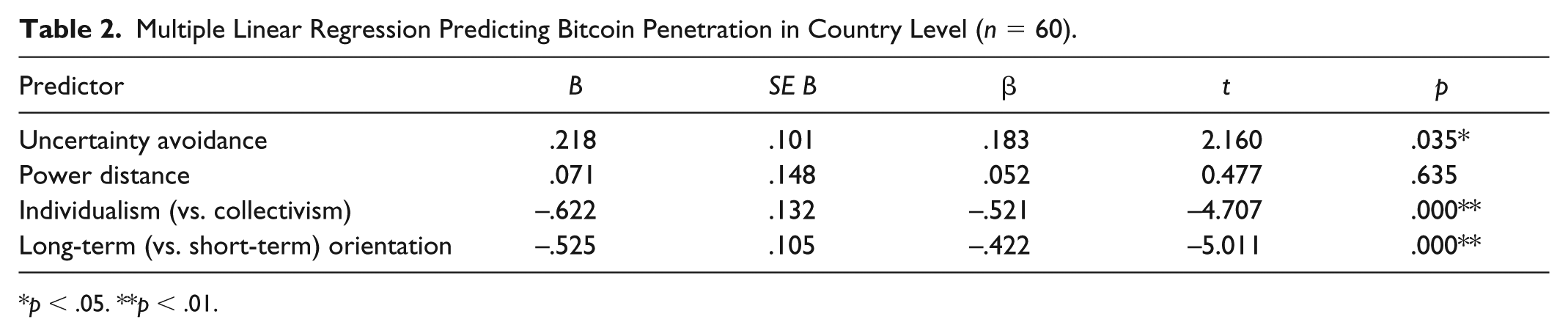
p < .05. **p < .01.
Study 2
The result of structural equation modeling (Figure 1) shows that the hypothetical model is supported by empirical data, with χ2 = 3,864.58, df = 1,634, root mean square error approximation (RMSEA) <0.05, standardized root mean square residual (SRMR) <0.08, and nonnormed fit index (NNFI) >0.95. The contribution of all endogenous variables to the exogenous variable (effect size) is R2 = 35%. Specifically, spatial/physical distance (γ = 0.22, SE = 0.049, t = 4.44, t >|1.96|), social distance (γ = −0.21, SE = 0.051, t = −4.07, t >|1.96|), and hypothetical distance (γ = 0.31, SE = 0.047, t = 6.64, t >|1.96|) are able to predict the intention to adopt Bitcoin; however, temporal distance (γ = −0.049, SE = 0.047, t = −1.03, t <|1.96|) cannot predict the intention. The regression equation is as follows:

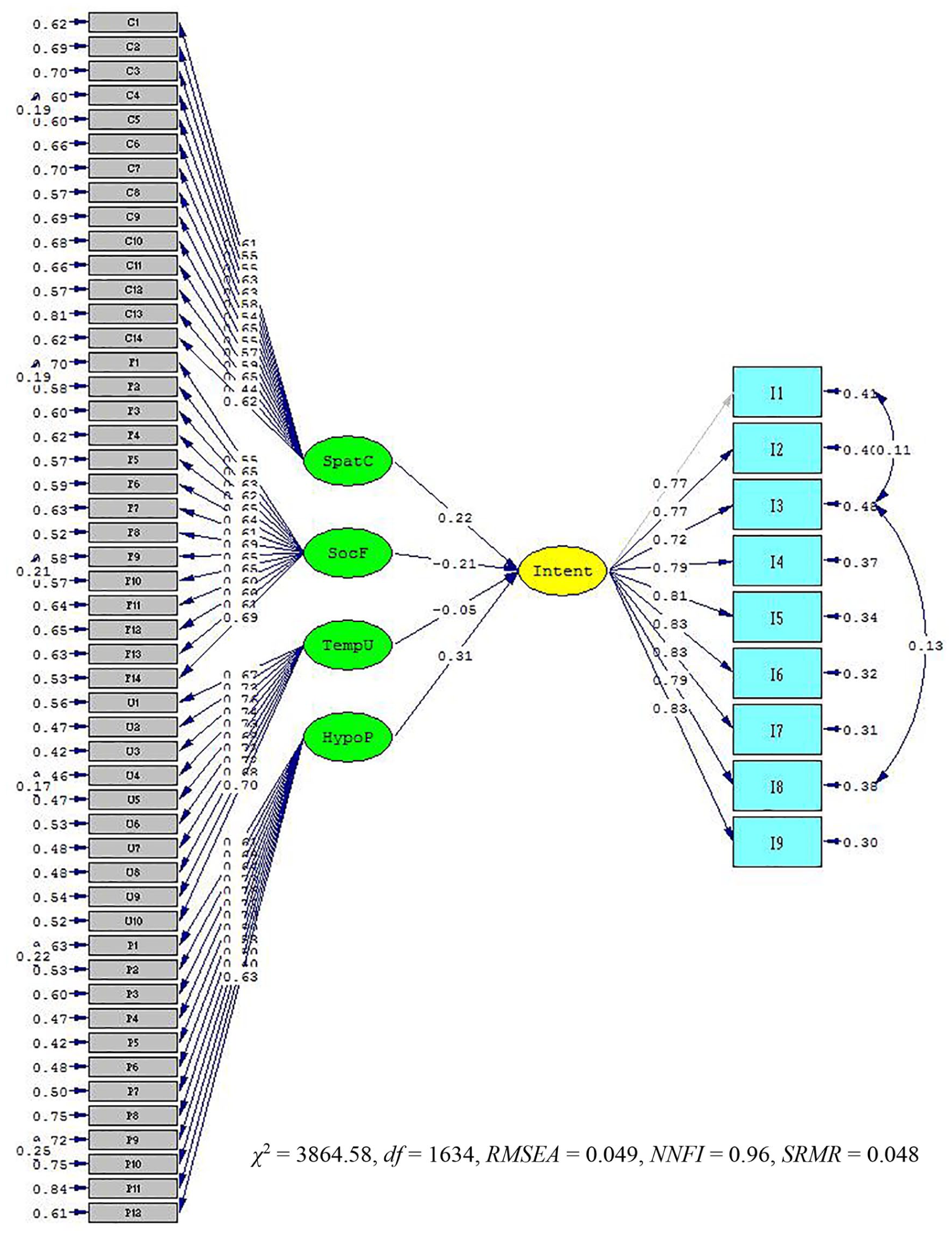
Structural equation modeling predicting intention to use/adopt Bitcoin (n = 565).
Discussion
The Role of Uncertainty Avoidance National Culture
Study 1 discovers that the higher the uncertainty avoidance, the higher the Bitcoin penetration. This is the opposite of the authors’ hypothesis stating that there is a negative predictive relation. The arguments that could explain it are as follows.
The uncertainty of Bitcoin has been understood or tolerated by the stakeholders, as sated, “[Bitcoin] only has value because people in Bitcoin having value. Whether this situation will hold on in the future is totally uncertain . . . [A]ll market participants accept the uncertainty prevalent in the Bitcoin market situation” (Sauer, 2016, pp. 119, 128). This means that there has been habituation toward the development of Bitcoin, including in countries with high uncertainty avoidance, and this lowers the socio-psychological threshold regarding the uncertainty in Bitcoin.
Furthermore, if Bitcoin is viewed to be filled with risks, there is a proposition that uncertainty avoidance is different from risk avoidance (Minkov & Hofstede, 2011). Minkov and Hofstede (2014) further elaborated, Risk is to uncertainty what fear is to anxiety: Risk and fear relate to known acts and objects, whereas uncertainty and anxiety relate to the unknown; they are diffuse feelings. Uncertainty avoiding cultures often support risky behaviors, like driving fast and attacking adversaries. (p. 4)
The risks in Bitcoin-related activities and its impacts are increasingly known and measurable. For example, Moore and Christin (2013) managed to estimate the closure risks in Bitcoin investment model and discovered that survival analysis (by using survival function and hazard function) can predict the probability of the closing time or the stop of Bitcoin exchanges and the things that affected it. They stated that the formula that they proposed could still be developed by integrating other variables, such as exchange reputation, and consideration of the noneconomic variables.
In other words, Bitcoin risk could be a countable risk. Lee (2013) in the article titled “Bitcoin’s Volatility is a Disadvantage, but not a Fatal One” stated one important argument that, in its experimentation phase, at the current time – served as a startup, Bitcoin with its volatility is something reasonable. Besides that, Lee termed the risk contained in Bitcoin as a manageable risk, with proofs that the benefits of Bitcoin surpasses the risk, in where those benefits are absolutely unobtainable from fiat currency, which are answering the need of anonymity, low barriers to entry, and low transaction costs (e.g., for international money transfer). Bustillos (2017) added that the accountancy system of its blockchain is incorruptible (with the feature of cryptography, decentralization, and unlimited commitment from the developers and community in developing the blockchain system), even though Bitcoin is not immune from theft and hacking activities.
The national culture of uncertainty avoidance could alleviate the perceived uncertainty by Bitcoin adoption. By using various econometric analysis (VIX index, wavelet) on 16 countries in 5 years (2011-2016), Bouri, Gupta, Tiwari, and Roubaud (2017) found that at short-horizon investment in Bitcoin empirically was proven to be able to prevent the expansion of global market uncertainty, especially when the uncertainty was at the extreme point, being very low or very high. Previously, various speculations circulated regarding the potential of Bitcoin alleviated uncertainty. This potential is related with its surpassment “of gold parity in its most popular and liquid exchanges” (Quentson, 2017, para. 5). Besides economic uncertainty, blockchain can dismiss political uncertainty and populism. Gas (2017, para. 16) stated that “populism creates the condition for repeatable buzzwords to propagate.” However, blockchain is difficult to be functioned as just buzzwords because each polemic regarding it would lead to critical discussion and change, both the change on the blockchain as well as the social change resulted from it. Gas (2017, para. 16) added, “This could end the populism, false news and half truths. Therefore, blockchain is the technology that can add certainty to society that is already fraught with much uncertainty to dominate.”
The previously stated facts lead to positive predictive correlation between uncertainty avoidance and Bitcoin penetration on a country level.
The Role of Power Distance National Culture
Study 1 does not discover the power distance prediction power on Bitcoin penetration of a country. Reijers, O’Brolcháin, and Haynes (2016) stated a number of matters that could explain the inexistence of the prediction power. One it being that the cryptographical nature of the blockchain technology could affect governance. The central idea of this statement challenges the hypothetical proposition that was submitted at the start of this article, which was that government with their regulatory aspiration could affect Bitcoin penetration. What happens is the opposite. There is a contest of power regarding this matter. Cryptocurrency and blockchain has a transformative effect toward a more democratic governance system. By using the perspective of social contract theory, Reijers et al. (2016) explained the conditions where they influence and shape the governance, that are, (a) there were a justification on the birth of cryptocurrency and blockchain, that was a pre-blockchain society that run corrupt systems, political power centralization, and self-serving bias diverting trust between humans and reducing social interaction; (b) that justification implied the birth of a system that did not accumulate power on a particular institution, also a system where the members (both individuals or community) autonomically circulate roles, managing themselves through trust in code, without the burden of hierarchy of power structure.
Even so, based on the facts, there were other dynamics surrounding blockchain (Reijers et al., 2016), which are (a) the non-hierarchical system seems to not be able to perform perfectly, because despite the pseudonymity feature on blockchain, in reality inequality of power still happens because transactions in blockchain corresponds with digital assets that determine the relationship status between contracted parties; (b) blockchain emphasizes the obedience of parties conducting transactions on the existing rule and transaction clearance of individual’s manipulation. Disobedience causes alienation from the blockchain (further disobedience would cause the individuals’ computer to cease to function). There is a new power entity named general will; (c) there are a plurality of blockchains. There is no single blockchain that rules over all community governances. This means that there are spaces where individuals creates their own authorities. “Participants . . . can . . . by switching between different blockchain technologies . . . The power resides with those who control the nodes. . . [However,] individuals or companies can own multiple nodes in the system” (Reijers et al., 2016, pp. 144, 145, 146). Based on those facts, Bitcoin and its blockchain can still facilitate passions that wished to build or conserve unbalanced power distribution, where there is a more powerful class and a less powerful class based on the digital assets. Moreover, one of the potentials that may appear from the blockchain system is conflict of interest to aggressive conflict between blockchains, or blockchains that rebel from other blockchains (Baldwin, 2018).
The contradictions in cryptocurrency and blockchain regarding autonomy versus power caused the scores linked with the relationship between the power distance and Bitcoin penetration variables to cancel each other, resulting in no significant predictive power.
The Role of Collectivism National Culture
Study 1 discovers that the higher the collectivism of a country, the higher the Bitcoin penetration. This is not surprising because as minority groups in the world, the established communities could easily be very cohesive. Canning (2019) investigated e-conversation between Bitcoiners that was filled with humor, lingo/vocabularies, smileys, punctuations, and so on. Canning discovered that the e-conservation, despite could be interspersed with robots that perform particular functions, could establish collective memory between them. The usage of language in a collectivistic manner further affirms an individual’s membership in a Bitcoin group and their trustworthiness.
It is a fact that there is competition between fellow Bitcoin miners and that it can not be ignored. There is even suspicion that with how often Bitcoin price soars, there are groups of professional miners armies with computer powers that can monopolize the creation of Bitcoin and conduct selfish mining (Solana, 2017). Even so, that possibility was denied by Dimitri (2017), who stated, the mining activity seems to be intrinsically monopoly-proof, in the sense that if only two miners were to be active, their profits would always be positive regardless of the marginal cost of the opponent. For this reason, none of the two could exclude the other by cutting down his own costs, unless activities other than Bitcoin mining would have a higher rate of return. (p. 36)
The meaning is that mining activity could be trapped in the monopolistic games by particular parties, but is more of an all-pay static game, with the assumption that all miners have accessibility to complete/perfect information. This game is characterized with winning probability based on energy/power investment conducted by miners, in spite of their energy/power diminishing when the miners lose, aggregately reaching Nash equilibrium (Dimitri, 2017). Besides that, collectivization of the Internet through blockchain would “liberate us from the tyranny of markets, and begin to place capital and power into public hands” (Baldwin, 2018, p. 7).
The presence of the element of resistance toward monopolistic movement in the Bitcoin mining system as well as power and capital distribution with wider public involvement made Bitcoin penetration favorable on countries with high collectivism.
The Role of Long-Term Orientation National Culture
Study 1 discovers that the higher the long-term orientation, the lower Bitcoin penetration on a country. This is the opposite of the authors’ hypothesis stating that there is a positive predictive relation. The empirical fact showed that at the country level, there are other matters that must be regarded aside from the natural evolution toward Bitcoin legitimation. There is one explanation that is deemed to be the most plausible for the fact that Bitcoin penetration is not supported by a national culture of long-term orientation.
Bitcoin unsustainability is actually related to the potential of objective electricity crisis as a consequence of Bitcoin mining. The energy used for one Bitcoin transaction could be equated with 500,000 transactions using MasterCard or Visa (Maydell, 2018). Digiconomist (2018) and de Vries (2018) both indicated that Bitcoin network processing in the whole world had consumed electricity that aggregately could be equated with the electrical consumption of one country or more, and this thirst for electricity continued to grow exponentially by the year. Until the current time, there has not been any convincing solution to solve the problem in the long term. According to Fantazzini, Nigmatullin, Sukhanovskaya, and Ivliev (2016), “in a competitive commodity market, an agent would undertake mining if the marginal cost per day (electricity consumption) were less than or equal to the marginal product (the number of bitcoin found per day on average multiplied by the dollar price of bitcoin)” (p. 15). Enlarging investment for the increase of computing power of mining is clearly not a wise choice in the long term, based on the rarity potential or even electrical crisis (and at that time electricity would be very expensive) also the impact of excessive use of electricity for the preservation of human ecosystem on this Earth. However, Bitcoin mining with the current time’s electrical price condition would be viewed as beneficial by national culture with short-term orientation.
The Role of Individual’s Construal Level or Psychological Distance
Study 2 discovers that psychological distances represented by spatial distance, hypothetical distance, and social distance can predict the intention to use Bitcoin. The more the Bitcoin facts are construed as real/concrete (lower spatial distance = higher perceived concreteness), the more Bitcoin is perceived to be close with daily life (lower social distance = higher perceived relevance), and the more Bitcoin is construed as not impossible to happen in life (lower hypothetical distance = higher perceived possibility), then the higher the individual’s intention to adopt/use Bitcoin and its blockchain.
The entirety of the finding could be explained with one proposition, which is that individuals with the intention to adopt Bitcoin are individuals that do construe that there are little or no differences between fiat currency and cryptocurrency. The following are a number of argumentations (Baldwin, 2018; Barber, 2015; Bustillos, 2017; Dodd, 2015) that supported the view.
First, both fiat and cryptocurrency are not backed by anything but faith or trust from individuals that accepted it. It is true that fiat currency, at the moment, is much more massive in obtaining faith or trust, by both individuals or institutions. However, in terms of cryptocurrency, the type of trust just changes from the trust in U.S. dollar (after previously being the trust in gold standard) into trust in algorithm. This means that besides being based on faith, there is a governance element in both fiat (governance by the state) and the cryptocurrency (governance by the code), yet behind both are working humans with their interests. There is subculture in this governance that could form new currency or new forked.
Second, the value of all kinds of currencies are actually abstract and unstable. Because of it, security efforts such as the establishment of the exchange rate with various items were conducted. This is in line with the statement by Dodd (2015, p. 438), “Money’s value, indeed its very existence, rests on social relations between its users that are fluid and dynamic.” Third, only 10% of U.S. dollars (an example of fiat money) that exist in tangible form (paper, coin, etc.), while 90% exists as an abstraction (numbers in computers); as well as, fourth, the amount of Bitcoin supply is limited, being 21 million, that could reach its total production in the year 2140 (Baldwin, 2018; Barber, 2015; Bustillos, 2017; Dodd, 2015). The limited amount is indeed a characteristic of fiat currency. Fifth, both crypto money and fiat money could be used as means to conduct corruption or other criminal acts. Sixth, the stability of cryptocurrency and fiat currency could be achieved but not taken for granted, both being required for being strived for at all times by committed stakeholders and shareholders.
Seventh, Bitcoin was a part of the natural evolution of money, which was from gold to paper (guaranteed by the country), and into the phase of money dematerialization (surpassing the country). In this phase, money processes into the form of completely abstract. In this form, inclusiveness of money enlarges, involving wider population, and encourages their participation in economic growth. This scenario is in line with the intention of money according to Simmel’s (2004) philosophy of money, which is uniting human race into oneness (in this situation, at least symbolically and not literally). The assumption behind this scenario is that any country or institution with the role as the third party that mediates the exchange between two parties are in reality distancing people who do transactions from one another (Barber, 2015).
Eighth, both fiat currency and cryptocurrency creates a political emotional paradox, such as “fear and excitement, loathing and desire, disgust and awe, helplessness and potential” (Dodd, 2015). Ninth, both aims to answer the old challenge of finance, which is “how to make sure a transaction between two people located far apart is credible to both” (The Economist, 2017).
The lack of predictive power of temporal distance on intention to adopt/use Bitcoin shows that the time that Bitcoin would be implemented, applied, legalized will not affect the intentions of Indonesians in adopting/using Bitcoin. This also shows that the problem of Bitcoin adoption is not about waiting for the right momentum, waiting for society to be prepared, and such. This finding might indicate the surrender of the society regarding when Bitcoin would be fully implemented.
Conclusion
The contribution of this study is to find cultural and psychological factors that influence economic behavior, namely, Bitcoin penetration and acceptance at the level of nation and individual. The governments can use the results of this study to conduct social campaign in line with their monetary policy. For example, prohibiting the use of Bitcoin on the basis of economic argument (volatility, etc.) and security is inadequate, but it might be necessary to increase the psychological distances of society against Bitcoin when assuming that Bitcoin is unfavorable for the development of society. However, the use of the results of this present study at the individual level might be limited in terms of its generalization because the majority of the participants were from Java (“Javacentric”) and the educated group (those who were active in universities). The cultural compatibility of Bitcoin with the national culture of a country also needs to be a serious consideration. For example, collectivism is an inherent feature of Bitcoin and blockchain technology. Social policy to intervene in its use will be most effective when the stakeholders and decision makers join communities and understand group situations. Sustainability of Bitcoin and its blockchain technology is also influenced by the sensitization of society to uncertainty of Bitcoin. Bitcoin and its blockchain turn out to be unique channelization capable of answering the political uncertainty experienced by society. Governments need to understand socio-psycho-cultural dynamics to recommend empirical testing at various scales to get feedback on their political and economic system policies.
Footnotes
Declaration of Conflicting Interests
The author(s) declared no potential conflicts of interest with respect to the research, authorship, and/or publication of this article.
Funding
The author(s) received no financial support for the research, authorship, and/or publication of this article.