




Abstract
This article examines whether individuals’ higher moral values stemming from higher religiosity lead to higher institutional quality at the country level. Based on the data from World Values Survey (WVS, 1980-2014) with 343,440 respondents, the results indicate that higher religiosity is associated with lower justifiability of corrupt behavior such as cheating on taxes, receiving false government benefits, and taking bribes. However, at the level of 98 countries from which the respondents in the WVS stem, higher religiosity seems to have an adverse effect on institutional quality as measured in corruption control, executive constraints, government effectiveness, regulatory quality, and the rule of law. Therefore, higher religiosity and moral standards at the respondent level may not translate into higher institutional quality at the country level. We discuss possible reasons for this discrepancy.
Introduction
The New Institutional Economics pioneered by North (1981, 1990) defines institutions as a collection of rules based on which individuals and organizations play the economic, social, and political game. North (1981) makes unequivocal reference to culture as a critical part of the institutional structure that affects economic performance. Subsequent research has further underlined the formal–informal categorization of institutions and stressed the close connection of formal rules, laws, and regulations with informal social norms and belief systems (Acemoglu & Robinson, 2012; Galiani & Sened, 2014; Mokyr, 2017). This article uses a specific cultural characteristic, arguably one of the most important informal norms, namely religiosity, to predict country-level institutional quality. We use both the respondent- and the country-level data in our examination and discover inconsistencies between the respondent- and the country-level results.
Our article contributes to the insights provided by Guiso, Sapienza, and Zingales (2003), Licht, Goldschmidt, and Schwartz (2007) and Tabellini (2008). First, in terms of the characteristics of the data set, our study is closer to that of Tabellini (2008) who makes use of both the respondent- and the country-level data. The relevance of the data type lies in the fact that the use of a respondent-level social norm can be linked to country-level, institutional quality–related variables. In fact, Tabellini (2008) uses trust to estimate institutional quality at the country level. However, Guiso et al. (2003) and Licht et al. (2007) use only the respondent- and the country-level data, respectively. Second, with respect to the culture-related explanatory variable, this article is similar to that of Guiso et al. (2003), because they study the effects of religiosity (as measured by religious upbringing and church attendance) on attitudes conducive to economic growth. Licht et al. (2007) and Tabellini (2008), on the contrary, do not use religiosity at all. However, Guiso et al. (2003) remain at the respondent level and examine the effects of religiosity on respondents’ attitudes toward market economy, legal norms, women, and so on. Third, in terms of the effects of social norms on institutional quality, our article is motivated by Guiso et al. (2003) and Tabellini (2008). The results in Guiso et al. (2003) imply that higher religiosity leads to attitudes that are expected to promote economic growth. In other words, highly religious respondents are supportive of market economy and obedient to laws. However, because Guiso et al.’s (2003) examination takes place only at the respondent level, we do not know whether growth-friendly attitudes at the respondent level actually lead to higher institutional quality at the country level. Therefore, Guiso et al. (2003) motivate us to use both the respondent- and country-level data sets to connect respondent-level attitudes to country-level institutional quality. Tabellini (2008), on the contrary, relates respondents’ attitudes to trust to the country-level institutional quality, namely bureaucratic quality, and concludes that higher trust at the respondent level increases bureaucratic quality. Therefore, we want to use a different social norm than Tabellini (2008) which is religiosity and see whether higher religiosity at the respondent level is associated with higher institutional quality at the country level.
To motivate our aim of linking the respondent-level results to those at the country level, we want to highlight the common characteristics of corruption research where corrupt governments and bureaucrats constitute the central focus (Baç, 1998; Ehrlich & Lui, 1999; Shleifer & Vishny, 1993; Svensson, 2005). In theoretical studies, decision toward corruption implies an optimization problem subject to, among other things, the probability of detection. But who detects these corrupt policy makers and bureaucrats? If we consider a largely neglected group in this literature, namely citizens, the answer to this question would be nobody, provided that the average citizen is either as corrupt as the average policy maker or bureaucrat or a large enough proportion of the population tolerates corrupt behavior under their value structure.
Economists generally deal with citizens’ involvement in corruption implicitly. If corruption involves red tape, it is assumed that citizens are willing to pay speed money to receive their passports or the deeds to their house sooner than later. However, corruption involves more than just red tape. Corruption has a significant effect on employment and the distribution of funds via state-owned enterprises and banks, which leads to the inefficient distribution of scarce resources at a large scale and eventually interferes with growth (Mauro, 1995; Shleifer & Vishny, 1993). In fact, many developing countries have received well-meant development assistance from various sources, which emphasized the role of growth-compatible institutions only to witness remarkably limited success (Easterly, 2008; Easterly, Levine, & Roodman, 2004). A number of researchers attribute the less than successful outcome of these efforts to the low depreciation rate of shared values and norms, which would make corruption persistent and swift institutional reforms hard to achieve (Becker, 1996; Blackburn, Bose, & Haque, 2006; Eggertsson, 2013; Guiso et al., 2003; North, 1993; Tabellini, 2008).
Therefore, this article examines the relationship between institutional quality and religiosity and asks whether respondent-level attitudes toward honesty are indicative for institutional quality at the country level. Our empirical analysis utilizes two data sets. First, we make use of six waves of the World Values Survey (WVS) between 1980 and 2014, which produces the largest number of countries (98) involving 343,440 respondents. Using the WVS, we estimate the effects of religiosity as well as religious denominations on the justifiability of tax evasion, claiming false government benefits and taking bribes. Second, we use the country-level averages of religiosity and relate it to the country-level institutional characteristics such as corruption control, executive constraints, government effectiveness, regulatory quality, and the rule of law. The results of the empirical analysis indicate that higher religiosity at the respondent level leads to lower justifiability of tax evasion, claiming false government benefits and taking bribes. At the country level, however, higher average religiosity is associated with lower institutional quality. We provide a discussion as to why high morality at the level of the individual does not translate into higher institutional quality at the country level.
The article is organized as follows. Section “Culture and Institutions” provides a discussion of the culture–institutional quality relationship. Section “Empirical Analysis” presents the empirical analysis that examines the relationship between religiosity and ethical behavior at the respondent level as well as the relationship between religiosity and institutional quality at the country level. Section “Conclusion” concludes the article.
Culture and Institutions
Culture is generally defined as a set of learned beliefs, values, and preferences shared by society or its subset that influence behavior (Mokyr, 2017). This definition implies that culture is not only a concept on peoples’ mind but it also governs social interactions. Influenced by Aristotle, Adam Smith (1759/1971) emphasized the imitative nature of culture. Deviating from the norm or noncompliance with the surrounding belief system is usually associated with significant cost that in turn reinforces the existing value system. A savage, Smith (1759/1971) argues, is brought up amid violence and injustice undergoes a fort of Spartan discipline. Because he is in continuous danger and can expect no sympathy from his countrymen, he cannot afford to be compassionate. In addition, the content of shared values defines the sense of morality for a group of people regarding acceptable and punishable behavior (Alesina & Giuliano, 2015; Fukuyama, 1995; Greif, 1994; Mokyr, 2017; North, Wallis, & Weingast, 2009).
The question is as to how a specific set of norms represented by a subset of society becomes the defining norm for the society in general. The available accounts indicate that the emergence of the “winner norm” is a nonlinear and highly evolutionary process. Mokyr’s (2017) account of the growth of technological innovation and creativity in Europe between 1500 and 1700 demonstrates many dimensions of institutional change being woven across various segments of the European societies. According to his account, even though transnational intellectuals of Europe were a small group in the early 16th century, in time, they carried large segments of the society. The eventual outcome of Europe’s technological leadership was possible due to the complicated interweaving of increased interest in useful knowledge (for military or civil service), European rulers’ patronage of useful knowledge motivated by competition among these rulers and changing attitudes toward work and progress (Mokyr, 2017).
In terms of changing attitudes toward work and progress, Weber (1930/2001) famously stated that the Reformation provided the moral justification for worldly activities such as work, profit and wealth accumulation by making productive activities consistent with religious beliefs. The Protestant Reformation is thought to have provided the habits and norms in England and the Netherlands, which in turn led to heightened work ethics, thrift, and capital accumulation. Hard work became a form of worship; knowledge and prosperity became virtuous among the Puritans (Mokyr, 2017; North & Thomas, 1973).
Such shifts in shared values are viewed as the source of increasing social capabilities in societies not only through formal institutions such as education but also group loyalty and social trust (Putterman, 2013). However, it is also possible that the evolutionary process in identifying acceptable moral guidelines ends up enforcing selective morality. In this case, honest behavior may be expected only in kinship relations, while it may be morally acceptable to be unprincipled in non-kinship relations. Nevertheless, being honest in all relations, especially in non-kinship relations, has a positive effect on institutional quality (Platteau, 2000; Tabellini, 2008).
Because of the apparent lack of a theoretical framework, we cannot predict as to which set of values will be selected in the evolution of shared values and norms in a society. Still, there is empirical evidence as to how values and norms have legitimized and shaped institutions. A well-known result in this area is that a higher share of Protestants in a country is associated with higher institutional quality with less corruption and more emphasis on the rule of law (Inglehart, 1999; Landes, 1998; La Porta, Lopez-de-Silanes, Shleifer, & Vishny, 1997; Licht et al., 2007). Another result indicates that the degree of individualism and tolerance contributes to higher institutional quality (Klasing, 2013). Nevertheless, when it comes to explaining people’s attitudes toward ethical behavior, a given set of demographic and cultural variables may provide contradictory results (Benk, Yüzbaşı, & McGee, 2017). Similarly, the relationship between religious denomination and attitudes toward tax evasion religion sometimes makes a difference in these attitudes; however, the effect of the same religious denomination may change among countries (Benk, McGee, & Yüzbaşı, 2015).
Against this background, we conduct our study about the influence of an important cultural dimension, namely religiosity, on institutional quality. In many religions, God is perceived to be moral, punishing those who engage in opportunistic behavior (Mokyr, 2014; Shariff, Norenzayan, & Henrich, 2010). Therefore, we hypothesize that at the respondent-level higher religiosity should be associated with lower justifiability of corrupt behavior, such as tax evasion, claiming false government benefits, and taking bribes (Hypothesis 1). In turn, higher moral values such as honesty at the level of the individual should translate into higher institutional quality at the country level (Hypothesis 2). Clearly, testing these hypotheses requires a two-step approach. At the first step, we examine whether higher religiosity decreases the justifiability of “bad” behavior. At the second step, we answer the question whether the country-level religiosity contributes to institutional quality.
Regarding our working hypotheses, we provide some cautionary remarks. First, it implies a one-directional relationship between religiosity and institutional quality. When the relationship between culture and institutions is examined, the direction of influence does not always run from culture to institutions (Alesina & Giuliano, 2015; Mokyr, 2017; Tabellini, 2008). The complementary evolution of culture and institutions makes it possible that institutions influence culture as well. Specifically, religiosity has the tendency to weaken with higher income and education. Therefore, in our country-level estimations, we instrument religiosity. Second, when we discuss the existing studies’ approach to corruption in Introduction, we mention the fact that these studies do not pay attention to citizens’ attitudes toward moral behavior. The fact that we want to include citizens’ morality in our study does not mean that citizens’ morality can effectively determine a country’s institutional quality. In fact, following the empirical analysis, we provide a discussion as to how the agency problem may appear in that a country with highly religious people ends up with institutions of lower quality.
Empirical Analysis
The aim of this article is to examine whether there is a relationship between shared values as measured by attitudes toward corrupt behavior and institutional quality in a country. We aim to relate the findings at the level of the individual to those at the level of the country, which necessitates the use of both the respondent- and the country-level data. First, the WVS is used to quantify respondents’ values and examine how religiosity and religious affiliation affect justifiability of corrupt behavior. Second, a cross-sectional data set that includes the same 98 countries is used to examine the effects of country-level religiosity on institutional quality, subject to data availability. Table 1 lists our 98 sample countries. As the table indicates, not all sample countries were included in all six waves of the WVS.
Sample Countries and the WVS Waves.
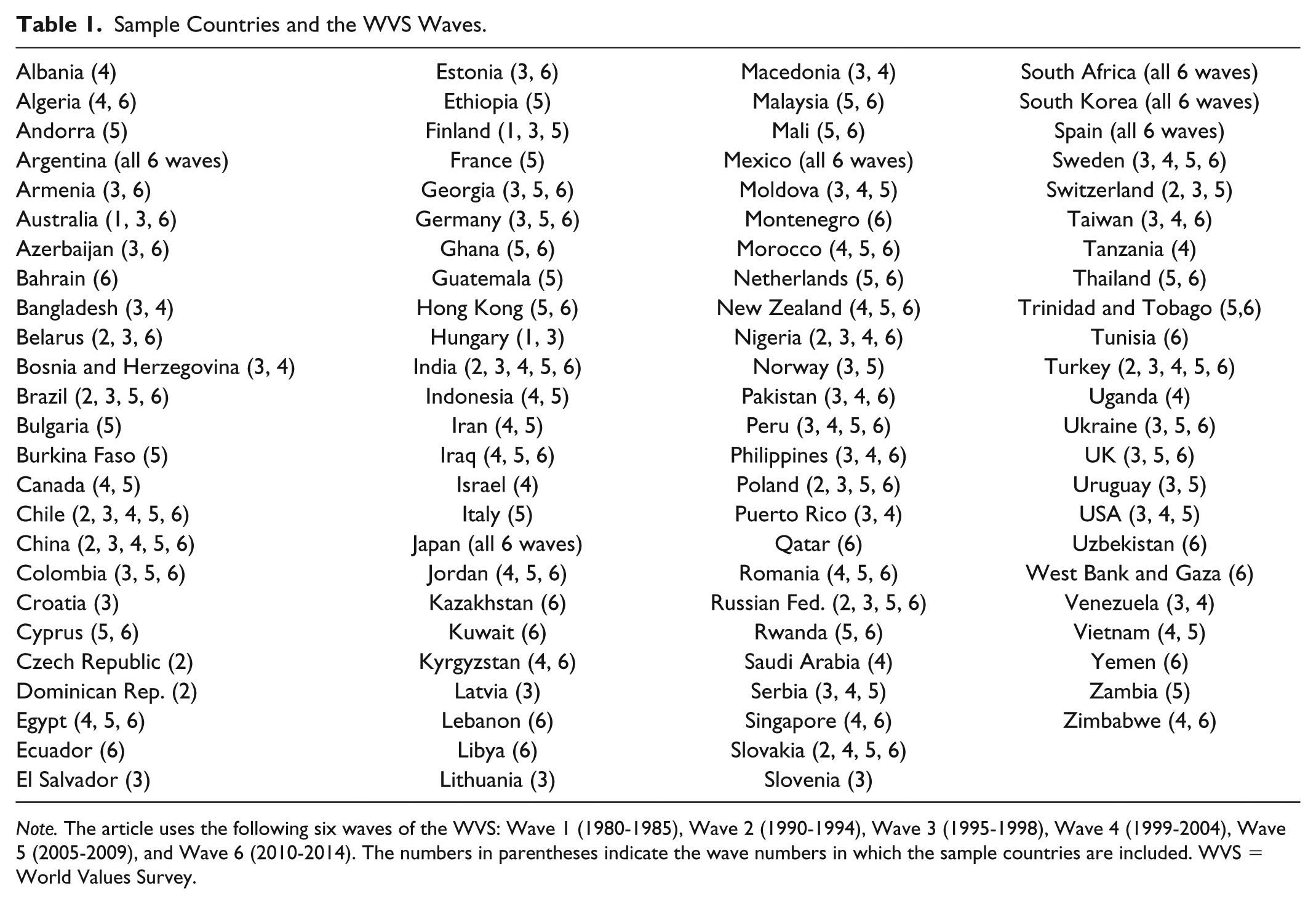
Note. The article uses the following six waves of the WVS: Wave 1 (1980-1985), Wave 2 (1990-1994), Wave 3 (1995-1998), Wave 4 (1999-2004), Wave 5 (2005-2009), and Wave 6 (2010-2014). The numbers in parentheses indicate the wave numbers in which the sample countries are included. WVS = World Values Survey.
Estimations Using the WVS Data
Table 2 lists and defines the WVS variables. In addition to the religiosity-related variables such as religiosity of a person and the relevance of God in life, they also include justifiability of cheating on taxes, claiming false government benefits and accepting bribes as proxies for respondents’ attitude toward honesty. The extent to which these behaviors are justifiable for respondents may be relevant for countries’ institutional quality, because their justifiability may contain information as to how respondents perceive themselves to be behaving in these matters as well as what they expect from policy makers. Control variables such as respondents’ age, gender, and subjective social status are included as well. It is important to include the characteristics of respondents to account for the effect of age, gender, and subjective social status on the justifiability of corrupt behavior, taken religiosity as given. Table 2 indicates that all variables are categorical variables except for age. The higher respond categories indicate the stronger representation of the relevant characteristic.
World Values Survey Variable Description.

Because of the categorical nature of most variables, Table 3 summarizes their frequencies. The results show that about 71% and 51% of all respondents are religious and assign God an important place in their lives, respectively. Muslim respondents score consistently higher percentages in the mentioned areas with over 83% and 78%, respectively. In terms of justifiable behavior and considering all respondents, the “not justifiable” category is the largest in following behavior: cheating on taxes (63%), taking bribes (58%) and claiming government benefits (74%). In terms of the remaining three variables, the mean age of respondents is around 41% and about 47% of the respondents are male. In addition, about 12%, 46%, and 42% of respondents identify their social status as low, middle, and upper class, respectively.
Category Frequencies of the WVS Variables by Respondents’ Religious Affiliation.
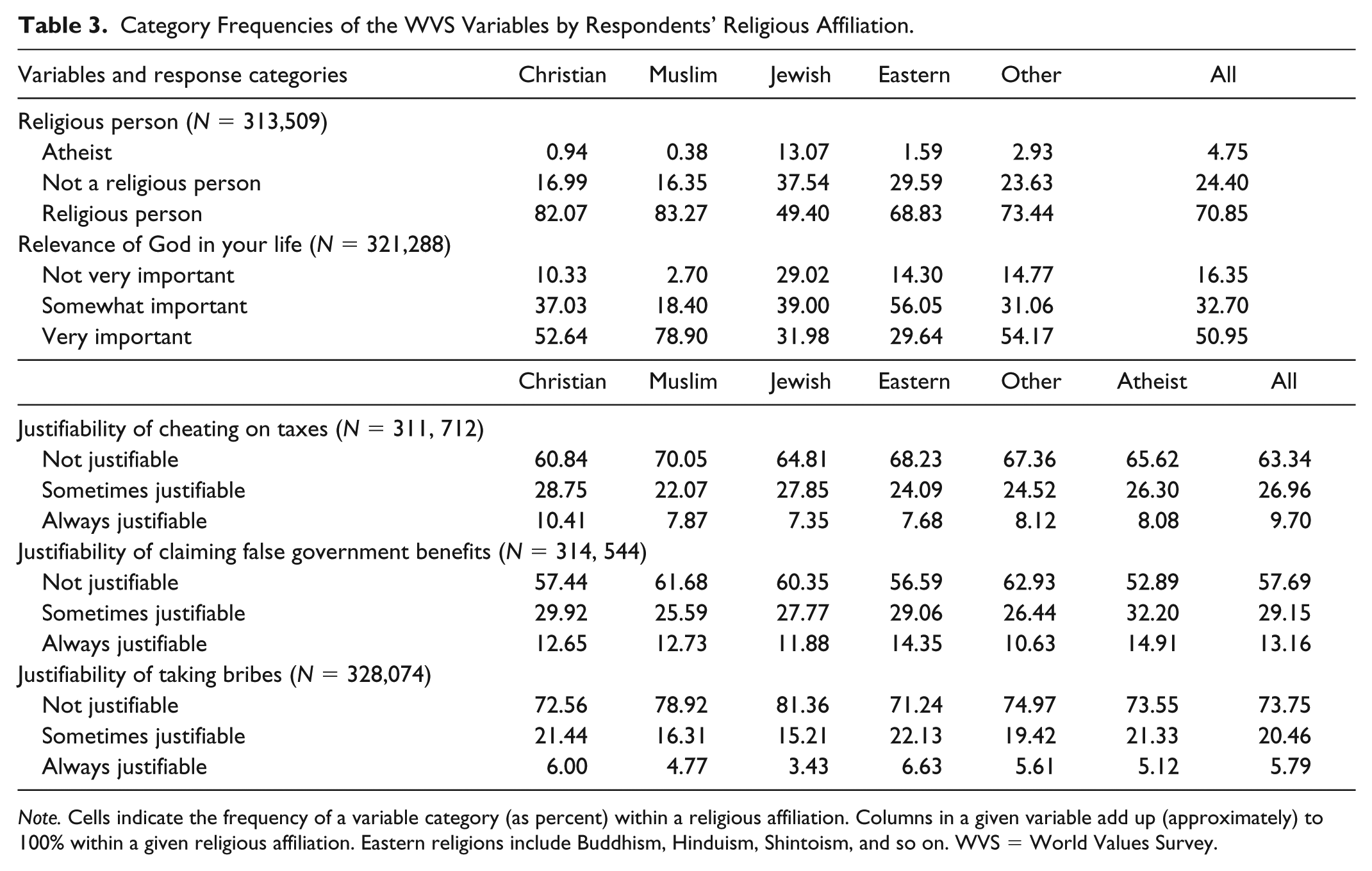
Note. Cells indicate the frequency of a variable category (as percent) within a religious affiliation. Columns in a given variable add up (approximately) to 100% within a given religious affiliation. Eastern religions include Buddhism, Hinduism, Shintoism, and so on. WVS = World Values Survey.
Table 4 shows Spearman correlation coefficients between respondents’ characteristics. Higher social class is associated with lower religiosity but higher relevance of God. The relationship between social class and the justifiability of two types of corrupt behavior (claiming false government benefits and accepting bribes) is negative. The relationship among the two religiosity-related variables (religious person and relevance of God in life) is strongly positive, indicating that they are good substitutes. Similarly, the relationship among the corrupt behavior–related variables is strongly positive, which means that, for example, respondents who find cheating on taxes unjustifiable also think similarly about claiming false government benefits or accepting bribes and vice versa. Most important, there is a negative relationship between religiosity and justifiability of corrupt behavior.
Spearman Correlation Coefficients (N = 176,505).

Note. Variable 1 is social class.
Statistical significance at the 5% level.
Our first set of estimations using the WVS data examine whether respondents’ religiosity and religious denomination have an effect on their views regarding the justifiability of cheating on taxes, claiming false government benefits, and accepting bribes. Our approach to the estimations using the WVS data has the following characteristics. First, to account for the ordinal nature of the dependent variable, where the distances between the categories are unknown, we first ran the ordered logistic regressions. Because the assumption of proportional odds or parallel lines is often violated in ordered logistic regressions, we tested for the validity of this assumption and observed that some of the explanatory variables violate this assumption in all models. It means that instead of having the same coefficient for all response categories of the dependent variable (except for the intercepts), the size and the sign of the coefficients associated with a given explanatory variable change among the response categories. Therefore, the empirical analysis proceeds to generalized ordered logistic regressions (gologit), where the explanatory variables do not have to meet the parallel lines assumption. An additional advantage of the gologit framework is that it is able to identify which explanatory variables meet the assumption of proportional odds and which variables’ effects on the corrupt behavior–related dependent variables are not uniform over the response categories. In the latter case, the estimations also show the different effects of the explanatory variables on the response categories of the dependent variable.
Second, the estimated gologit coefficients are presented in the ordered log-odds format in Table 5. A positive coefficient indicates that for one unit change in the explanatory variable, the level of the response variable changes in the ordered log-odds scale. In other words, a positive coefficient implies an increased chance that a subject with a higher (lower) category in the independent variable will be observed in a higher (lower) category of the dependent variable. A negative coefficient means an increased chance that a subject with a higher (lower) category on the independent variable will be observed in a lower (higher) category of the dependent variable. Third, because it is possible that the corrupt behavior–related dependent variables and the residuals within each country are not independent, countries are identified as clusters, which imply the use of the robust estimator that addresses possible problems stemming from non-normality, heteroskedasticity, and outliers. Finally, in all estimations, we use three control variables: age, gender, and social class.
Effects of Religiosity and Religious Denominations on Justifiable Behavior (Generalized Ordered Logistic Regressions).

Note. The dependent variables are indicated in the first row. Constants are not shown. Religious affiliations are dummy variables. The omitted religious denomination category is other. Eastern religions include Hinduism, Buddhism, Shintoism, and so on. Probability refers to the Wald χ2 test. k – 1 categories refer to the number of response categories minus one. All three dependent variables have three response categories (see Table 2) so that 1 contrasts Category 1 with Categories 2 and 3, whereas 2 contrasts Categories 1 and 2 with Category 3.
, **, and * indicate 1%, 5%, and 10% level of significance based on the z statistic.
Table 5 shows the results associated with nine estimations where alternative religious denomination- and religiosity-related independent variables (religious person and relevance of God in life) are used to predict justifiability of three corrupt behavior–related dependent variables (tax evasion, claiming false government benefits, and accepting bribes). The results indicate that the male dummy is positive and statistically significant in all models, which means that being male increases the chance of finding tax evasion, claiming false government benefits, and accepting bribes more justifiable. The coefficient of age is also statistically significant but negative, indicating that being older decreases the chance of finding these corrupt behaviors justifiable. The coefficients associated with social status are negative and statistically significant in Models 7 through 9, where higher social status decreases the justifiability of accepting bribes. In addition, higher religiosity decreases the chance of finding any of the three corrupt behaviors justifiable (Models 1, 4, and 7).
When relevance of God in life is used to measure religiosity, the proportional odds assumption is violated. The stronger negative effect is observed when the not very important category is contrasted with the somewhat important category in all three types of corrupt behavior (Models 2, 5, and 8). The contrast between the somewhat important and very important category provides negative but smaller coefficients with respect to cheating on taxes and accepting bribes (Models 2 and 8). In terms of religious affiliations, a clear pattern is not visible. While being a Muslim decreases the chance of finding tax evasion justifiable (Model 3), being a Christian increases the chance of claiming false government benefit and accepting bribes justifiable (Models 6 and 9). On the contrary, being an atheist increases the chance of claiming false government benefits justifiable (Model 6). Finally, in terms of diagnostics, p values associated with Wald χ2 test indicate that the null hypothesis of all regression coefficients being zero is rejected in all nine models presented in Table 5.
The results obtained from the respondent-level estimations suggest that being religious and assigning an important place to God makes cheating on taxes, taking bribes, and claiming false government benefits less justifiable, which verifies Hypothesis 1.
Estimations Using the Cross-Sectional Data
In this section, the question is whether respondents’ attitudes toward corrupt behavior translate into institutional quality in the sample countries. Therefore, using a cross-sectional data set with 98 countries, we test the effects of religiosity as well as religious affiliations on these countries’ institutional quality. To create the cross-sectional data set, the WVS data with 343,440 respondents were collapsed by the respondents’ countries, which produced the country means of the relevant WVS variables. We only use the following two WVS variables in the cross-sectional estimations: religiosity and the relevance of God in life. In addition, the cross-sectional data set includes the income- and institutional quality–related variables as well as the representation of major religions as a share of population in 98 sample countries.
The definition and the sources of the institutional quality–related variables in the cross-sectional data set are provided in Table 6. Sample countries’ institutional quality is measured based on corruption control, executive constraints, government effectiveness, regulatory quality, and rule of law. Higher values in the mentioned variables imply higher institutional quality. Legal origins are also added as an explanatory variable as the common (British) law is thought to promote property rights more than the justice systems of French origin because of the former’s substantially lower legal formalism (Acemoglu & Johnson, 2005; Alesina & Giuliano, 2015; La Porta, Lopez-de-Silanes, Shleifer, & Vishny, 1999). In addition, we use latitude to extract information regarding earlier institutional quality in the sample countries. Because lower latitudes are more suitable for cash crops, some of our sample countries may have had a colonial history. To the extent that colonialism disrupted the former colonies’ authentic institution-building process by imposing a resource extraction-based economic and social environment, latitude may be an informative variable indicating the initial institutional quality. Per capita income in constant dollars is also included in the cross-sectional data. 1
Variable Description and Data Sources (Cross-Sectional Data).

Note. WDI stands for the World Development Indicators (World Bank) and is available at http://databank.worldbank.org/data/home.aspx. WGI stands for the Worldwide Governance Indicators and is available at http://info.worldbank.org/governance/wgi/index.aspx#home. Polity IV Project is available at http://www.systemicpeace.org/polity/polity4.htm.
Table 7 shows descriptive statistics associated with the institutional characteristics of the sample countries as well as their average religiosity (country averages obtained from the WVS) and per capita income. The mean executive constraint is 4.15 where the United States, the United Kingdom, New Zealand, and Sweden are among the countries with highest executive constraint. Qatar, Uzbekistan, and Saudi Arabia, on the contrary, are at the lowest end of the spectrum. The average corruption control is 0.13. While Finland, Sweden, and Switzerland are closest to the highest corruption control, Kyrgyzstan, Azerbaijan, and Libya are close to the weakest corruption control. The average government effectiveness is 0.24, where Singapore and Iraq have the highest and lowest values, respectively. Regulatory quality has the mean of 0.26. New Zealand and Zimbabwe have the highest and lowest scores, respectively. With an average of 0.13, New Zealand has the highest rule of law score, whereas Iraq has the lowest. The average religiosity based on religious person is 2.65. While Egypt has the highest average, Hong Kong’s average is the lowest. The relevance of God in life has an average of 2.32, where Jordan and China have the highest and lowest averages, respectively. The average per capita income is US$13,704, where the lowest and highest income countries are Ethiopia and Norway, respectively.
Descriptive Statistics Associated With the Relevant Country-Level Variables.

Note. Religiosity-related variables are country averages based on the WVS data. For the remaining variables, see Table 6 for variable description. WVS = World Values Survey.
Table 8 summarizes the correlation coefficients among the abovementioned variables. All correlation coefficients in the table are statistically significant at the 1% level, except for the one between religiosity as measured by religious person and executive constraints. Correlation coefficients are higher among corruption control, government effectiveness, regulatory quality, and rule of law (ranging between 0.92 and 0.97). Positive and high correlations are also observed between the abovementioned four measures of institutional quality and income per capita (ranging between 0.69 and 0.80). Two measures of religiosity (religious person and relevance of God in life) are positively correlated (0.75). However, all correlation coefficients between religiosity, income per capita, and institutional quality are negative (ranging between –0.37 and –0.61).
Correlation Coefficients Between Country-Level Variables.

Note. Variable 1 is corruption control. GNI = gross national income.
Significant at 1% level.
In terms of estimations, first, we run our baseline estimations using the ordinary least squares (OLS) method, where corruption control, executive constraints, government effectiveness, regulatory quality, and rule of law are the dependent variables. The independent variables are latitude, legal origins, religiosity, and the share of religious denominations in the sample countries. The OLS results are summarized in Table 9. In the following, we mention the statistically significant coefficients in Table 9, unless indicated otherwise. Across the estimations, the contribution of higher latitude to institutional quality is positive no matter how institutional quality is defined. While the British legal origin contributes to higher institutional quality, the French legal origin is not statistically significant in some models (Models 4-7 as well as Models 10 and 13). In most models, higher religiosity leads to lower institutional quality (except for Models 4 and 5 where the coefficients are not statistically significant). In terms of religious denominations, a higher share of Muslims in a country tends to lower institutional quality (except in Model 6). In some of the models, a higher share of Judaism and eastern religions is associated with higher institutional quality. Based on the F statistic, we reject the null hypothesis of all slope coefficients being zero in all models. R2 ranges between 0.37 and 0.49.
Baseline Estimations of Institutional Quality—OLS Results.

Note. Constants are not shown. The numbers in parentheses refer to p values associated with t statistic. Variables referring to religious affiliations imply the percent share of the relevant religion in a country. Other legal origins and other religions are the omitted categories.
In the literature, there are concerns about using OLS estimations in this subject (Klasing, 2013; Licht et al., 2007; Tabellini, 2008). There are three potential problems that would render the estimated OLS coefficients as biased and inconsistent: measurement errors, omitted variables that correlate with errors, and reverse causality. In addition, religiosity may not be an exogenous explanatory variable. The existing evidence suggests that higher income and education decreases religiosity (Hungerman, 2014; Sacerdote & Glaeser, 2008). The two-stage least square estimation (TSLS) provides a solution to the mentioned problems, as long as suitable instruments are used for the endogenous variable, where suitability of the instrument(s) lies in instrument relevance and instrument exogeneity conditions. The TSLS estimations shown in Table 10 imply heteroskedasticity-robust standard errors. Because the correlation coefficient between per capita income and the share of population with tertiary education is 0.71, either one of these variables is a good candidate as an instrument for religiosity. Table 10 shows the results where the religiosity-related variables are instrumented by per capita income.
Determinants of Institutional Quality—TSLS Results.

Note. Constants are not shown. The numbers in parentheses refer to p values associated with t statistic. Omitted categories in legal origins are other legal origins. Instrument for religious person and the relevance of God is log real income per capita. Wooldridge’s (2010) robust score and robust regression–based tests are used to assess endogeneity. TSLS = two-stage least square estimation.
In Table 10, latitude is not statistically significant in most estimations, except for Model 3 where higher latitudes are associated with higher executive constraints. British and French legal origin contributes to higher institutional quality in most models, where the former’s contribution to higher institutional quality is more consistent. Higher religiosity as measured by religious person or relevance of God is associated with lower institutional quality in all models. The TSLS coefficients associated with the religiosity-related variables are larger than those estimated by the OLS method. Table 10 provides the first-stage F statistic as an indication of instrument relevance, which is obtained from regressing the endogenous variable (religiosity) on the instrument and the exogenous explanatory variables. The first-stage F statistic indicates that in all models the instrument (log income per capita) is not weak. In addition, robust score and robust regression–based tests show that the exogeneity of religiosity is rejected in all models, except for Model 4.
Therefore, at the country level, we conclude that higher religiosity tends to lower institutional quality, which rejects Hypothesis 2.
Discrepancy Between Respondent- and Country-Level Results
In Introduction, we state the purpose of this article as bringing citizens’ moral compass into the research of institutional quality, because the majority of existing research views institutional quality in the absence of people. We hypothesized that higher religiosity would motivate people to be less corrupt and stand for higher institutional quality. Our results show that even though higher religiosity makes corrupt behavior less acceptable at the level of the individual, it is associated with lower institutional quality at the country level.
One possible explanation for this discrepancy may be the survey environment itself. The reason for observing strong opposition to corrupt behavior at the respondent level may stem from the fact that in countries with higher religiosity, the socially acceptable way of answering questions about “bad” behavior is to strongly denounce them. In this case, respondents’ true feelings and actions may not be compatible with their answers. The secret adherence to one morality while practicing another in public is explained based on significant benefits one receives from behaving in expected fashion in public (Greif & Tadelis, 2010). Another possibility is that stronger religiosity leads to stronger religious communities, which in turn reduces the resources spent on higher quality, secular institutions. A reason for this outcome may be that religious institutions are perceived to be serving as substitutes for secular institutions. It is also possible that secular institutions may be viewed as a poor fit in highly religious societies where institutional quality runs counter to religious values (Kuran, 2004, 2010). In this case, people may genuinely have high morals and unsuccessfully try to establish better institutions that reflect their religious beliefs. Unfortunately, we are unable to conduct an empirical analysis on these alternative explanations of our results.
Another possibility is that citizens may genuinely have high moral values and would like to see institutions of higher quality in their countries. However, an innate aspect of their culture may represent an impediment to the materialization of their ideas. This innate aspect should preferably precede religion and have very low depreciation rate. The fundamental characteristics of a language, such as the rule regarding the pronoun drop pioneered by Kashima and Kashima (1998), fit the description. The idea implies that whether a language allows the drop of a pronoun (such as “I” or “you”) may imply information of this particular culture’s approach to the autonomy or embeddedness of the individual. While allowing pronoun drop is interpreted as an emphasis on embeddedness of the individual where he or she cannot be distinguished from the general context, not allowing pronoun drop implies an emphasis on the individual. We argue that the emphasis on belonging to a group may shape people to be submissive and decrease their willingness to rebel against a corrupt system.
A related variable to consider is the political system, whose emergence is highly nonlinear and evolutionary (Mokyr, 2017). The evolution of democracy (or the lack thereof) likely interacts with the most fundamental (informal) elements of a culture such as linguistic characteristics. If the language implies that there is no “I” in society, the resulting submissive attitudes would not be conducive for developing strong democratic traditions. Therefore, even though citizens may have higher moral values, citizens cannot control institutional quality in regimes with authoritarian tendencies, which would produce the discrepancy indicated by our respondent- and country-level results. In Table 11, we show the relative frequencies associated with three levels of democracy and religiosity scores (low, medium, and high) as well as the pronoun drop rule (1: pronoun drop allowed; 0: pronoun drop not allowed). The table shows that about 43% of our sample countries are in the medium democracy score category. The low and the high categories of democracy scores make up about 28% and 29% of our sample, respectively. In terms of the interaction of the pronoun drop rule, democracy scores, and religiosity, the probability that a country has a low democracy score, high religiosity, and a language that allows pronoun drop is more than 0.79. On the contrary, the probability that a country has a high democracy score, medium religiosity, and no pronoun drop is about 39%. While this approach does not imply any causality, we conclude that there may be an interaction between the political system–related characteristics of a country and the fundamental elements of its culture, which should be investigated.
Relative Frequencies Associated With Democracy Score, Pronoun Drop, and Religiosity-Related Variables.
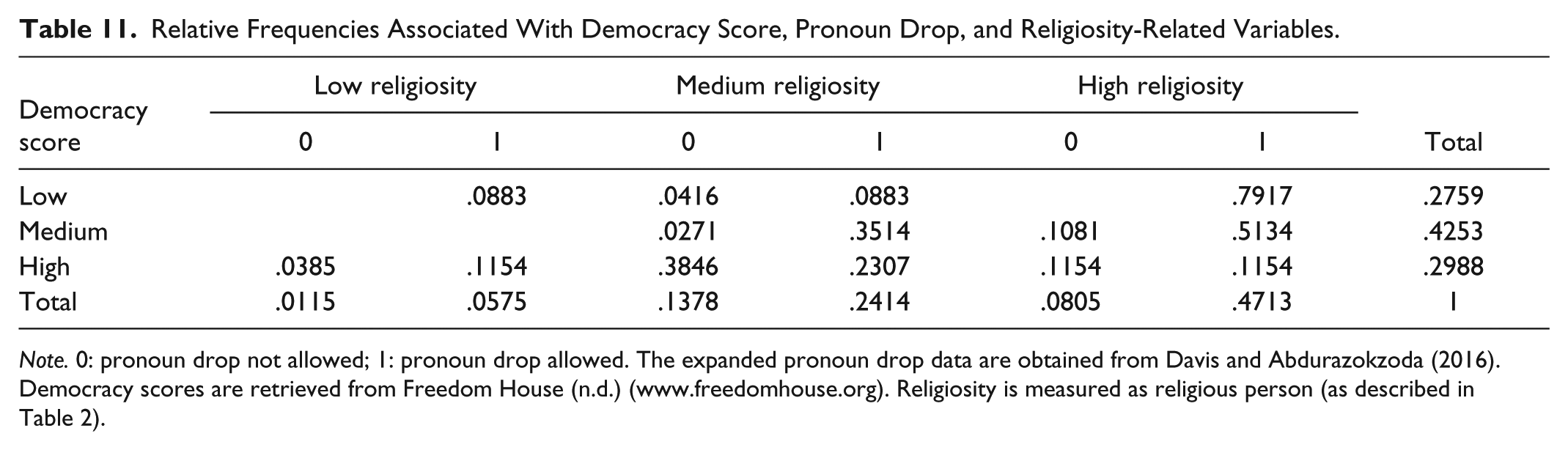
Note. 0: pronoun drop not allowed; 1: pronoun drop allowed. The expanded pronoun drop data are obtained from Davis and Abdurazokzoda (2016). Democracy scores are retrieved from Freedom House (n.d.) (www.freedomhouse.org). Religiosity is measured as religious person (as described in Table 2).
Conclusion
The aim of this article is to determine whether individuals’ higher moral values stemming from higher religiosity lead to higher institutional quality at the country level. The empirical analysis at the respondent and the country level indicates that there is a disconnection between the respondent- and country-level results. At the respondent level, higher religiosity is associated with less justifiability of corrupt behavior as measured by tax evasion, claiming false government benefits and taking bribes. Based on the respondent-level results, one may expect a positive relationship between religiosity and institutional quality at the country level; however, the results at the country level suggest that higher religiosity decreases institutional quality. In other words, higher religiosity at the respondent level does not translate into higher institutional quality at the country level.
The article discusses possible reasons for this discrepancy where people with higher moral values end up with inferior institutional quality. Innate characteristics of a culture that precede religion, such as linguistic characteristics, may shed some light on this issue. Therefore, even if the majority in a country would prefer better institutions, its realization may partly depend upon certain characteristics of people, for example, whether they tend to be submissive or proactive. Therefore, political system and institutional quality as well as religiosity may be a manifestation of innate elements of a culture. Despite the difficulty associated with quantifying various dimensions of culture, the often-experienced failure of top-down attempts to improve countries’ institutional quality should provide motivation to focus on the nexus of culture and institutions.
Footnotes
Declaration of Conflicting Interests
The author(s) declared no potential conflicts of interest with respect to the research, authorship, and/or publication of this article.
Funding
The author(s) received no financial support for the research, authorship, and/or publication of this article.