




Abstract
Wildlife Management Areas (WMAs) are establishments that promote wildlife conservation and rural development in Tanzania. However, through focus group discussions, key informant interviews, a questionnaire survey, and literature review, we found that the participation of local people in both the establishment and management of the WMA was limited and rife with conflict. While benefits have materialized at the communal level, local people saw neither value nor benefit of the WMA to their livelihoods. Specifically, local people’s access to natural resources got worse while private eco-tourism investors and the central government have gained financially. Contrary to the livelihood enhancing WMA rhetoric, top-down institutional choices have sidelined democratically elected Village Governments and successive legislative adjustments disenfranchised and dispossessed them and their constituencies. We conclude that village governments should consistently demand for their legal rights to the resources on their land until the WMA approach to conservation and development is democratized.
Keywords
Introduction
The 1990s surge in various forms of decentralized management of natural resources in Africa sparked scholarly interest in the outcome of Community-Based Natural Resources Management (CBNRM; Nelson & Agrawal, 2008; Ostrom, 1999; Ribot, 2002, 2004; Songorwa, Buhrs, & Hughey, 2000). Some CBNRM programs at some point appeared reasonably successful in their promotion of natural resource conservation and improved rural livelihoods. These include Community Conservancies in Namibia, the Communal Areas Management Program for Indigenous Resources (CAMPFIRE) in Zimbabwe, and the Administrative Management and Design for Game Management Areas (ADMADE) in Zambia (Nelson & Agrawal, 2008; Songorwa, 1999). However, the institutional reforms necessary to realize the potentials of CBNRM remain a pervasive constraint. Specifically, central governments and frontline agents are often reluctant to transfer sufficient powers over resources and associated revenues to local governments and, through an array of technical requirements, central governments have managed to recentralize control over decentralized resources (Nelson, Nshala, & Rodgers, 2007; Ribot, Agrawal, & Larson, 2006). The outcomes include reduced welfare of involved communities, particularly the most vulnerable subgroups rather than development and poverty alleviation as envisioned (Roe & Nelson, 2009). Major weaknesses of this kind are, for instance, observed in ADMADE in Zambia and CAMPFIRE in Zimbabwe (Junge, 2002; Mutandwa & Gadzirayi, 2009; Nelson & Agrawal, 2008; Regional Center for Southern Africa, 1998; Ribot, 2004).
Tanzania’s 1998 Wildlife Policy (Ministry of Natural Resources and Tourism [MNRT], 1998) introduced the concept of Wildlife Management Areas (WMAs). The policy defines WMAs as areas on village land set aside for wildlife conservation. WMAs aim to improve wildlife conservation and rural communities’ livelihoods by giving communities full mandate to manage and benefit from wildlife. Accordingly, the economic rationale for village governments is that business agreements with tourist lodge and safari tour operators would more than compensate the loss associated with restrictions of rights to extract products, graze livestock, and expand cropland and settlements. The concept and objective of WMAs are maintained in the revised 2007 Wildlife policy (MNRT, 2007). Currently, there are about 38 WMAs at different stages of development covering about 13% of Tanzania’s total land area (Bluwstein & Lund, 2018 in Wambura, 2015).
The shift from a centralized toward a decentralized wildlife management policy in Tanzania called for new institutional arrangements. Here, we consider institutions as informal and formal rules (Ostrom, 1990) including the Constitution, policies, legislation, regulations, guidelines, and bylaws. The WMA program and accompanying decentralization policy reforms has faced many challenges, including the mentioned tendency of central governments to recentralize power and benefits (Shilereyo, 2010), and associated local resistance (Benjaminsen, Goldman, Minwary, & Maganga, 2013; Nelson & Makko, 2005). Many WMAs, including Burunge in northwestern Tanzania, have experienced conflicts between the central government, district councils, and villages over the allocation and use of benefits accruing from WMAs. As a result, some participating villages want to pull out of WMAs (Mbunda, 2010; Nelson et al., 2007).
Burunge was one of the first nine pilot WMAs officially launched in 2003 and among the first to gain official status in 2006 (U.S. Agency for International Development [USAID], 2013; World Wide Fund [WWF], 2014). Burunge WMA is of high importance to Tanzania’s protected area network as a wildlife corridor (USAID, 2013) linking Tarangire National Park, Lake Manyara National Park, Manyara Ranch, and the Ngorongoro Conservation Area (WWF, 2014). It is also flaunted as one of the best managed WMAs (African Wildlife Foundation, 2013) and among the most successful because it generates the highest revenues of all WMAs in Tanzania (Veit, 2010). Also, the USAID’s (2013) WMA evaluation report considered it an overall success based on its high income and economic potential due to its accessibility and location between major national parks on the northern tourist circuit. Information on its institutional performance is, however, limited. Furthermore, the fact that two villages—Minjingu and Vilima Vitatu—wish to withdraw from the WMA (Igoe & Croucher, 2007; USAID, 2013) merits a closer look at the institutional choices and associated performance in Burunge.
Accordingly, this study examines the local reality in Burunge WMA compared with the expected and officially intended outcome of decentralized wildlife management in Tanzania. The study addresses the participation of local communities in the process of WMA establishment; local awareness of WMA-related institutions, including contracts with investors; institutionally determined change in resource use before and after WMA establishment; and benefits provided to local households from the WMA. The study aims to facilitate informed decisions about the design of institutions for improved performance of WMAs and other community-based conservation approaches in Tanzania and elsewhere where conditions are comparable.
Method
Description of the Study Area
Fieldwork was carried out over a period of 3 months in 2014 to 2016 in four villages in Burunge WMA (Figure 1). The process of establishing Burunge took place during the period 2003 to 2006 and followed the Wildlife Management Areas Regulation of 2002 (revised in 2005 and 2012). The 2002 and 2005 WMA Regulations referred to the Wildlife Conservation Act No 12 of 1974. The 1974 Wildlife Conservation Act was repealed by the Wildlife Conservation Act No 5 of 2009, which forms the legal basis for subsequent WMA Regulations. At the local level, the legislation stipulates the formation of a new organization, the Community-Based Organization (CBO). The CBO represents the combined interests of participating villages that contribute land to the WMA. This CBO became the Authorized Association (AA) for Burunge WMA in 2006 when the director of the Wildlife Division under the MNRT endowed it with the wildlife user rights.

Map showing Burunge WMA and the surrounding villages.
Burunge WMA covers 283 km2 in Babati district and forms a wildlife corridor between Tarangire and Manyara National Parks (Sulle, Lekaita, & Nelson, 2011). The Great East African Rift Valley Escarpment is visible from all angles within Burunge WMA, which includes land from 10 villages, namely, Mwada, Sangaiwe, Ngoley, Vilima Vitatu, Kakoi, Olasit, Manyara, Magara, Maweni, and Minjingu. Livestock keeping is the main land use supplemented by small-scale farming. The main food crops include maize, beans, bananas, millet, paddy rice, and potatoes. Sesame is the main cash crop primarily because wild animals such as elephants do not eat it. The rainy season begins in November and ends in May, the rainfall ranges between 400 and 500 mm per year, and the temperature ranges between 18 °C and 33 °C (Burunge AA, 2011).
Data Collection Method
A cross-sectional research design was used to collect data from four purposefully selected villages; Mwada, Vilima Vitatu, Minjingu, and Kakoi. Prior information suggested that these villages represented different degrees of participation in and satisfaction with Burunge WMA. Mwada village was happy with the WMA while Minjingu and Vilima Vitatu wanted to withdraw. Kakoi was a relatively new village split out from Minjingu village, which felt cheated into joining the WMA and complained that they could no longer graze their livestock in the WMA area. Primary data collection techniques included focus group discussions, key informant interviews, literature review, participant observation, and a questionnaire survey. Secondary data comprised WMA management documents, academic papers, and official documents (policies, laws, and regulations).
Focus group discussions and key informant interviews served to obtain an overview of relevant issues and to inform the design of the questionnaires. Focus group discussions (six in total) included Village Councils in Mwada, Vilima Vitatu, and Minjingu, and one with youth, one with women, and one with senior men. No focus group discussion was undertaken with the Council in Kakoi due to data saturation. A review of management documents served to cross-check legal questions that came up during focus group discussions and key informant interviews. Similarly, key informant interviews continued until the point of data saturation (Guest, Bunce, & Johnson, 2006). Key informant interviews and focus group discussions inquired about the process of establishing the WMA, its management, and the level of participation of local communities in various WMA activities. Triangulation of information obtained from villagers, village leaders, WMA officials, and the district council officials served to validate information.
Respondents for the questionnaire survey were drawn randomly from the village register of each village (n = 140 households in total). Questions concerned local people’s participation in the WMA initiation process, their awareness of WMA rules, the change of rules, comparing the situation before and after the establishment of the WMA, and benefits accrued at the household level from the WMA. The first author conducted all interviews face-to-face with the respondents in Kiswahili.
Data Analysis
Analytically, we draw on Ostrom’s (1990), Ribot’s (2002), Agrawal and Gupta’s (2005), and Lindsay’s (1999, 2004) theories and analyses of institutions, decentralization, and legislation on the management of common pool resources. It shows how institutional choices and design work against the interests and expectations of local people who seemingly trusted that they would benefit from the WMA. Furthermore, we investigate the nexus between the legal basis for WMAs and socioeconomic outcomes at the village and household level to shed light on reasons why the theoretically promising combination of protection of wildlife and local development including poverty alleviation has gone awry in practice (Igoe & Croucher, 2007).
Moreover, drawing on International Institute for Environment and Development (IIED; 1994) and Arnstein (1969), we characterize villagers’ participation in establishing and running the WMA at six different levels: (a) listened only, (b) listened and gave information, (c) consulted, (d) involved in policy analysis and agenda setting, (e) reaching consensus on the main policy element, and (f) involved in policy strategy development and its components. Furthermore, we use descriptive statistical analysis, including calculation of percentages and cross tabulation, to analyze and compare responses. We applied scoring on questions related to participation and benefits received from the WMA and a Likert-type scale to evaluate responses on respondents’ awareness of operational rules and change of rules before and after the WMA establishment. Hence, each respondent was asked to what extent they agreed with the statement that they (a) listened only in terms of strongly agree, agree, neutral, disagree, and strongly disagree. Likert-type categories were combined in different ways for presentation. After coding and cleaning, Likert-type scale data were analyzed in SPSS, Version 2.0. Qualitative data generated through focus group discussions, participant observation, interviews, and a desk study of official documents (including acts, regulations, and policies) were subjected to content analysis by categorizing groups of words with similar meaning following Stemler (2001). Underlying themes in the categories of words were identified, explained, clarified, and interpreted (Kohlbacher, 2005).
Results
Participation in the WMA Establishment Process
Overall scores for all levels of participation showed that about 84% of the respondents did not participate in the process of WMA establishment. Individual levels of participation show that communities were highly involved at the first level, that is, listening only (Figure 2).

Levels of participation in the process for WMA establishment (n = 140).
Only very few respondents were consulted or involved in reaching a consensus on the main policy document of the 1998 Wildlife Policy introducing WMAs in Tanzania. The very few who felt that they had participated at all levels were either village leaders or people who were more educated and in positions such as Village Council members. For instance, a man of about 68 years stated that he participated fully in the policy process. However, he was a former government employee who had settled in the village after his retirement. Key informant interviews and focus group discussion results further revealed that communities’ acceptance of the WMA during its initiation phase was low.
The communities did not participate in the policy development process, which is not surprising, but they did not participate much in the subsequent making of WMA rules either, which is obviously problematic and clearly against the letter as well as the spirit of the 1998 Wildlife Policy. The WMA rules form part of the legally required management plans that Authorized Associations must prepare and have officially approved, in 2006 by the Director of Wildlife, to acquire authority over the WMA area. Sections 36 and 37, including the associated Seventh and Eighth Schedules of the 2002 and 2005 WMA Regulations, which are identical in this respect, specify the legal requirements. A key feature is that the Authorized Association must divide the WMA area into different zones and specify rules for each zone. Importantly, neither the 2002 nor the 2005 WMA Regulations require that participating Village Councils or General Assemblies approve the rules within WMA zones before the Director of Game can endorse them. Rather, the Seventh Schedule of the Regulations focuses on technical and biological matters and only mentions that consultative workshops should be conducted to analyze problems and present the purpose and objectives of the WMA as well as to undertake technical decisions on zoning and draw up environmental impact statements on proposed actions in each zone. Sections 31 and 32 in the 2012 WMA Regulations are essentially similar to sections 36 and 37 in the 2002 and 2005 WMA Regulations with the exception that it is the minister responsible for wildlife who approves the general WMA Management Plan while approval of the associated Resource Management Zone Plans falls under the Director of Wildlife’s authority. The wording of the Sixth and Seventh Schedules in the 2012 WMA Regulations is identical to that of the 2002 and 2005 Regulations’ Seventh and Eighth schedules, respectively. This is a top-down techno-bureaucratic rather than bottom-up participatory, or democratic, approach to the development of WMA rules. Section 31(4) of the Wildlife Conservation Act (United Republic of Tanzania [URT], 2009) reflects a similar thinking as it directs the minister responsible for WMAs in the MNRT and the local government authorities to prepare model bylaws to be used by the village authorities. Although such model bylaws are yet to materialize, it is evident that subsequent law has converted the participatory and democratic vision of the 1998 Wildlife Policy to techno-bureaucratic procedures that facilitate and promote WMA rulemaking processes, which prevent local people, who are supposed to follow these rules, from influencing them.
Section 77 in the 2002 and 2005 WMA Regulations authorized nongovernmental organizations (NGOs), in collaboration with government agencies, to facilitate the establishment of WMAs right from initiation and planning to rulemaking and enforcement. Section 28(1) in the 2012 WMA Regulations maintains an almost similar wording as section 77 in the 2002 WMA Regulations, but a new subsection 28(2) specifies that an NGO must obtain written approval from the minister before it can engage in the establishment and implementation of WMAs. Such central control of NGOs’ involvement in particular WMAs also formed part of section 77 in the 2002 Regulations, although the wording was more suggestive than prescriptive (the minister may approve an NGO vs. the NGO shall obtain written approval from the Minister). Curiously, the 2005 WMA Regulations were entirely silent on this aspect of central regulation of NGOs. Financially, it makes sense for the Government of Tanzania to specify the legal terms for NGOs’ involvement in establishing WMAs, which is a costly undertaking. To nature conservation-oriented organizations, WMAs obviously presents an opportunity to expand and connect existing protected areas.
The AWF, an international NGO, facilitated the establishment of Burunge WMA and essentially influenced the WMA rules (Igoe & Croucher, 2007; Sachedina, 2010) which may explain why the rules seem to lack legitimacy and acceptance. For instance, people continue to fish in Burunge Lake but do so at night. During fieldwork, people frequently offered the first author to buy fish from the lake, but the trade took place in private homes to hide it. Section 31(6) in the 2009 Wildlife Conservation Act and 51(1) the 2002/5 WMA Regulations (41[1] in the 2012 WMA Regulations is identical) directs that consumptive utilization of resources must comply with the respective legislations, WMA Resource Zone Management Plans, and General Management Plans, and regulations. The Burunge General Management Plan is silent about fishing in Burunge Lake. However, since Burunge Lake is part of the WMA, it is, therefore, the District Fishery Officer who can issue fishing licenses but this does not happen because the District Council has decided to ban fishing in the lake. Here we observe that wildlife and fish fall under different authorities within village land under the WMA, which confuses on the community. Interview results showed that communities would like to manage Burunge Lake as a Beach Management Unit (cf. Fisheries Regulation 104; MNRT, 2003) where communities would have greater access, and a greater say regarding fishing in the Lake than now where the lake falls under the WMA. Furthermore, as a result of not being involved in rulemaking and showing disagreement regarding the existing WMA rules, some people grazed their cattle within the WMA against the rules, especially during the dry season. This has often led to confrontations between local communities and the WMA rule enforcing Village Game Scouts of the Authorized Association as well as the guides of eco-tourism investors. The General Management Plan (Burunge AA, 2011) divides Burunge WMA into six management zones. Among the six zones, local communities are allowed to use only one zone known as the General Use Zone, identified as “an area of low conservation value” (Burunge AA, 2011, p. 37), and it covers 13.6% of the total area of Burunge WMA (283 km2). Access to other zones in the WMA is either strictly prohibited or required a permit from the WMA office. Communities often complained, during focus group discussions and interviews, that the grazing ban, especially in the WMA Hunting Zone (only for tourists, see below), was against promises made during the WMA establishment.
Awareness of Institutions During the WMA Establishment Process
The majority (83%) of the respondents in all four villages were not aware of the 1998 National Wildlife Policy (MNRT, 1998) during the initiation of the WMA establishment process (Figure 3).

Awareness of the 1998 Wildlife Management Area policy document (n = 140).
After experiencing the result of the policy through the WMA rules, about 59% of the respondents strongly disagreed that the wildlife policy had solved key community problems. As one respondent lamented, How can that policy improve peoples’ lives if we are living in mud houses while we are deprived of grasses for roofing, poles for building, firewood for cooking and we have no electricity for lighting. We wonder how the government can care more for the wild animals and forget about us.
Nevertheless, about 31% of the respondents strongly agreed that the policy aimed to solve key community problems—although, according to the focus group discussions, communities felt that the government has directed its focus more toward conservation contrary to promises made and therefore in contradiction to people’s expectations.
The majority (70%) of respondents did not understand what a WMA constitutes before accepting it during the WMA initiation process, and 61% completely disagreed that rules were the result of a participatory approach where they could influence their development.
Sidelining Community Members’ Interests by Law
Section 22 of the 2002/5 Regulations describes the functions of the Authorized Association. It opens by stating, “an Authorized Association shall be accountable to the Village Council[s].” Village Council members in our case did not know about this clause. The Regulations are also entirely silent on how such accountability should be established in practice. Rather, a long list of functions (a-y) that the Authorized Association shall perform, particularly the ones described under subsections (d), (g), (l), (g), (o), (p), (r), and (s), establish Authorized Associations as the extended arm of central government institutions. Subsection 22(h) authorizes Authorized Associations to negotiate and enter into contractual agreements with investors in the WMA. Subsection 22(j) states that the Authorized Association shall, among others, seek (our emphasis) authorization from the Village Assembly, that is, all adults older than the age of 18, and report [about] investment activities to the Assembly. As the legal procedures do not explicitly demand that Authorized Association obtain written consent (which is different from seeking authorization) of the concerned Village Assemblies, it is unclear whether the Authorized Authority in Burunge WMA could enter into legally binding contracts with investors, for example, to establish tourist lodges and run photo and hunting safari activities, without such consent. Section 18 of the 2012 WMA Regulations is almost similar to section 22 in the 2002/5 WMA Regulations, but the changes weaken the authority of the Authorized Association vis á vis the central government and the Village Councils/Assemblies vis á vis the Authorized Association. Moreover, subsection 18(k) directs the Authorized Association to “communicate investment activities to Village Assemblies before signing an investment agreement.” Hence, the legally required level of Village citizens’ participation in signing contracts with external investors is now limited to being informed.
Interview results revealed that issues of investments were hidden from regular community members. In particular, respondents complained that they could not even see the contracts made between the WMA and eco-tourism investors. The WMA Regulations of 2002, 2005, and 2012 (MNRT, 2002, 2005, 2012) all include a part called “Investments and Development in Wildlife Management Areas,” which stipulates the procedures for entering into contracts with investors. These rules are identical in the 2002/5 WMA Regulations and include strong elements of recentralization, which the 2012 WMA Regulations even tighten.
Sections 63 to 66 in the 2002/5 WMA Regulations grant Authorized Associations the right to invite and form joint ventures with external investors. Such rights are maintained but in a modified form under sections 59 to 62 in the 2012 WMA Regulations. However, clause 65(4) in the 2002/5 WMA Regulations states, “No investment agreement or joint venture shall be operative without prior approval of the Director of Game.” Furthermore, clause 66(5) in the 2002/5 WMA Regulations reads; “Subject to the provisions of these Regulations, the Director [of Game] shall have the power to withdraw or revoke any investment agreement.” These blatantly recentralizing clauses are absent in the 2012 WMA Regulations, but clauses 62(1 & 4) read, “An investor shall not enter into an investment agreement or joint venture agreement unless with the consent of the Director [of Wildlife]” and “Subject to the provisions of these Regulations, the Director [of Wildlife] shall have the power to advise the Authorized Authority to withdraw, revoke or amend any investment agreement,” respectively. In respect of investments proposed by a commercial operator, the Authorized Association may (our emphasis) according to the 2002/5 WMA Regulations 63(6) & (7) seek assistance from the District Natural Resource Advisory Body and/or the Director of Game. Under the 2012 WMA Regulations 59(6) & (7), the Authorized Associations shall (our emphasis) obtain advice from the District Natural Resource Advisory Body and shall ensure that a representative of the Director of Wildlife and the District Council are fully involved in the entire process of negotiating and signing an investment and development agreement (our emphasis).
Accordingly, the legal power to effectively control or intervene into the very agreements that should make WMAs economically attractive to villages rests and has always rested firmly with the Director of Wildlife (formerly called the Director of Game). Thus, the law effectively de-authorizes Authorized Associations as it prevents them from independently entering into agreements that should make WMAs economically attractive to village governments and their constituencies.
Section 63(6 & 7) in the 2002/5 Regulations, which are identical, specifies that when negotiating a contract with a prospective investor, an Authorized Association may (our emphasis) seek assistance of the District Natural Resource Advisory Body and that the Director for Wildlife may (our emphasis) consult with the responsible authorities on such investments. Section 59 of the 2012 WMA Regulations substitute these provisions in a direction that effectively de-authorizes concerned Village Councils, by not mentioning them, while explicitly mentioning district and national-level actors, which strengthen their institutional position. The new section 59(2) states that investors shall (our emphasis) be identified through a tendering process where the tender evaluation committee in accordance with section 50 shall comprise of maximum seven members appointed among members of the Authorized Association, the District Natural Resource Advisory Body, and a representative of the Director of Wildlife. Notably, this committee excludes members of Village Councils, but it may co-opt advisors. Hence, the WMA Regulations, especially the 2012 version, appears to contradict section 5(g) in the 2009 Wildlife Conservation Act, the objective of which is to “encourage, promote and facilitate active involvement and participation of local and traditional communities in the sustainable management, use and conservation of wildlife resources in and outside wildlife protected areas network[s].” On the contrary, Section 31 in the same act, which together with section 121 forms the legal foundation of the 2012 Regulations, does not even mention Village Councils; neither as local authorities who must be party to investment agreements, nor as authorities who must at least be informed or have a right to access information about business arrangements between investors and the WMA that they are part of.
The 2002/5 WMA Regulations 63(8) stipulate that any investment agreement must follow the prescriptions of “the Twelfth Schedule to the Regulations.” Section 10 in this Schedule specifies that the investor shall maintain and keep records and books of accounts and that the Authorized Association shall have access to such records and accounts. Furthermore, this section considers noncompliance by the investor a breach of the agreement that would entitle the Authorized Association to revoke the agreement. Under the 2012 WMA Regulations 59(8), a similar reference is made to “the Eleventh Schedule to the Regulations.” However, nothing in this updated Schedule requires that Authorized Associations have access to their investors’ records and books of accounts. Whether the 2012 WMA Regulations’ (75) revocation of the 2005 WMA Regulations extinguishes such pre-2012 rights of Authorized Associations is unclear. It is, however, clear that the exclusive rights of Authorized Associations to negotiate agreements with commercial investors and to monitor the business activities of such investors have been severely curtailed and deliberately transferred to higher levels of governance that are not accountable to Village Governments or village citizens. The underlying motivation for this legislative change remains obscure, but it creates a space for unofficial payments by investors in WMAs to the Director of Wildlife and District Council representatives.
Village Councils in the four case villages stated that they did not have access to contracts between the Authorized Association and investors. This perfectly follows section 63(9) in the 2002/5 WMA Regulations that are identical to section 59(9) in the 2012 WMA Regulations, which states that copies of contracts with investors must be provided to the District Council and the Director of Wildlife. Village Councils are simply not mentioned. Burunge WMA office denied us access to copies of the contracts because these were confidential agreements between the WMA and inventors. Again, this is in perfect agreement with the past and current WMA Regulations, which, transfers the authority of Village Councils, originally the ultimate overseers, managers, and administrators of village affairs (URT, 1982), to the Authorized Associations concerned. In fact, sections 21(a & h) in the 2002/5 Regulations, which are identical to sections 17(a & g) in the 2012 WMA Regulations, reduce the role of Village Councils to be responsible (our emphasis) for (a) providing land for the WMA and (b) promoting a secure and favorable business environment in the WMA. Ironically, section 21(f) in the 2002/5 WMA Regulations, which is identical to section 17(g) in 2012 WMA Regulations requires (our emphasis) that Village Councils monitor the activities of the Authorized Association and report to their constituency and the District Council. Village Council members who participated in the focus group discussions did not know about this responsibility.
Consequently, a lack of awareness among Village Council members about the official rules guiding their limited formal rights to influence the governance of the WMA had left them alienated and vulnerable to proposed changes with negative implications for their constituencies. Notwithstanding the absence of Village Councils’ formal rights to influence and inspect contracts between the Authorized Association and investors, no provision in the WMA Regulations requires the translation into Swahili (the official language of the URT) or any other local language of contracts or agreements before they can take legal effect. As a result, community members complained that Village Council leaders, during the WMA establishment process, signed documents in English—a language they did not understand. Furthermore, our respondents informed that the District Game Officer responsible for introducing the concept deliberately provided legal documents to be signed by community leaders during the WMA initiation process, allegedly with the objective of luring local communities to accept the WMA on never fulfilled verbal promises. Section 81 of the 2002/5 WMA Regulations, which is similar to section 73 of the 2012 WMA Regulations states that the “The Minister shall as soon as may be practical, cause these Regulations to be translated to Kiswahili.” Moreover, the following section in both the 2002/5 and 2012 WMA Regulations, which are similar, states that “Whenever there is a conflict of interpretation between Kiswahili and English versions, the English version shall take precedence.” Notwithstanding these provisions, no regulation has to date been translated into Kiswahili, an omission the ministry, on our enquiry, could neither explain nor justify, which indicates central-level indifference toward villagers’ active and informed participation.
The interviewed community members also complained that the same District Game Officer, after the WMA was legally established, favored investors’ interests over those of the communities using WMA funds, resources, and opportunities for his benefit. However, none of these claims are officially logged as legal complaints except for Minjingu village, which has taken the WMA, the Authorized Association, and an investor to court because the village was included in the WMA through falsified village meeting minutes that supported its inclusion (URT, 2016a).
Curiously, a new section 59(10a & b) in the 2012 WMA Regulations criminalizes people who try to influence villages to leave a WMA or with intent try to “impede, obstruct, prevent or defeat the peaceful existence of a WMA.” We have not been able to trace the underlying reason for this clause, but it appears a deliberate attempt to curtail people’s freedom to express dissatisfaction with the way a WMA functions for their village and thus serves, through intimidation, to bind villages to WMA agreements that they may find unattractive.
Finally, while most of the respondents did not support the WMA and would prefer to withdraw from it, the lack of legal clarity about the fate of village land after a possible withdrawal put a brake on such ideas. Messages delivered by the District Game Officer served to compound this. On several occasions, he had told the villagers that “if you withdraw from the WMA, your land will be converted into a game controlled area or you will be evicted.” Other statements from his side include “Whether you agree or not, you are in the WMA.” Such intimidating claims appear over the top and have no basis in the 2002/5 WMA Regulations, which are silent on the matter of villages wanting to quit a WMA. Interestingly, however, a new and additional subsection 6 to section 34 in the 2012 WMA Regulations, which is otherwise similar to section 39 in the 2002/5 WMA Regulations, states that “Where a village withdraws its membership from the Authorized Association, the user right [to the WMA] shall remain under the Authorized Association.” Whether a village that is part of a pre-2012 Authorized Association can withdraw without losing rights to its part of the WMA area is unclear. In theory, the general norm of prohibiting retroactive law should make this perfectly feasible. However, the mentioned new clause 34(6) in the 2012 WMA Regulations is hardly an unintended effect of some random cause. Surely, it serves a policy objective of making it difficult for villages to pull out of a WMA should they conclude that experienced realities fall short of promises made by proponents of the concept. Accordingly, villages that form part of WMAs established before the 2012 Regulations are likely to think twice before they challenge current policy through prior law.
Awareness of Rules
Approximately, 54% of respondents were not aware of the WMAs operational rules. Based on a number of meetings convened and information flow between the Authorized Association and the communities, about 67% had either low participation or did not participate at all in WMA matters while 17% had an average level of participation, and the remaining 16% had good participation. Mwada village had the highest average level of participation followed by Kakoi, Vilima Vitatu, and Minjingu villages.
In the community setting in Tanzania, locally convened meetings are the most obvious ways to inform community members about local matters (URT, 1982). Section 18(q) in the 2012 WMA Regulations, which is identical to section 22(q) in the 2002/5 WMA Regulations, requires the Authorized Association to provide quarterly and annual reports at Village Assembly meetings. However, focus group discussions revealed that none of the study villages had ever held such meetings. Key informant interviews further revealed that, although the most recent election of WMA leaders and village representatives were more than 3 years ago, the villagers had not received any response from the Authorized Association on several questions. Such questions include the use of the 50% of total WMA revenues that remain with the Authorized Association, information about investors and how much they contribute to the Authorized Association, as well as issues about the general management of the WMA. Also, key informants claimed that the Authorized Association did not share information about important decisions with the respective villages. For instance, when the Central Government, by section 16(3) in the 2016 Wildlife Conservation Regulations (URT, 2016b) decided to take over the task of collecting revenues from WMA investments, the Authorized Association did not inform villages about this. The local informants claimed that they understood they were supposed to make major decisions regarding the WMA but wondered how they were meant to do this without being asked or informed about anything.
The questionnaire survey on communities’ awareness about rules on WMA meetings supports these observations. The majority (94%) of the respondents did not know how often meetings should be conducted while only 6% got it right—that is, once every 3 months. Similarly, 93% of respondents did not know how often WMA meetings were conducted in their respective villages.
Respondents offered various comments about their WMA meeting attendance or lack thereof. For instance, one respondent claimed, “The WMA benefits only leaders who neither want to step down nor want to call for meetings because the Village Councils, WMA leaders, District Game Officer, and the Director of Wildlife are the ones eating up WMA money.” Respondents also complained about the process of making a new Burunge Constitution. For example, one Village Council leader said that WMA meetings are frequently postponed. The ones in power need to step down, and elections for new leaders should be conducted. But the new [WMA] Constitution has provisions that we do not like. The District Game Officer ordered us to sign, but all Village Council leaders have denied as the constitution will not favour our people. For example, the term of office is changed from 3 to 5 years, and the District Game Officer will supervise elections for new members of the Authorized Association. This is not acceptable as the District Game Officer wants to elect and favour certain people that he wants to hold the office for his own benefit.
During key informant interviews and focus group discussions, respondents claimed that candidates who want to become village representatives in the Authorized Association are sometimes willing to pay bribes to the villagers to be selected.
Change of Operational Rules
Before the WMA establishment, the Village Land Act No 5 of 1999 (URT, 1999) gave powers to the Village Council to decide about the use of their land as deemed fit. Hence, village land was under the control of the Village Council and the Village Assembly could devise rules on how to manage and use resources on its land through village bylaws on, for example, agriculture, grazing, settlement, firewood collection, watershed management, extraction of building materials and other nontimber forests products (URT, 1982, 1999). However, hunting and logging on village land required a license obtained from the District Council (URT, 1974). Village Councils could not devise bylaws for hunting as all wildlife, according to the 1974 and the revised 2009 Wildlife Conservation Act, belong to the state, which was responsible for managing it—even on village land. However, Village Councils could request a permit from the District Council to hunt wildlife for village consumption. Upon permission, the District Game officer and Village Council leaders would make all arrangements for hunting and distribution in the village where villagers would buy the meat at low prices. Furthermore, the de jure rules (national laws) on fishing, logging, and hunting were not strictly enforced, and communities could access these resources with minimal risk.
With the introduction of WMAs, villages can manage wildlife on their land by replacing village bylaws with WMA rules in the concerned areas. In Burunge, one of many effects is a complete and efficiently enforced ban on hunting. In general, the Wildlife Conservation Act, in conformity with all other legislation on natural resources (URT, 2009; Section 31(6)), regulates the utilization of resources including timber, nontimber forest products, and fish within WMAs. Accordingly, the Village Council can no longer decide on resource utilization in the WMA areas by referring to the Village Land Act of 1999. As a result, local people must apply to the Authorized Association, instead of their Village Council concerned, for licenses or permits to extract resources from the WMA. This change of rules has led to complaints from local people, both about the bureaucracy involved and the unaffordability of some licenses.
As shown in Figure 4, the WMA has drastically changed the rules on access to and withdrawal of natural resources from village land. The majority of respondents strongly agreed that the pre-WMA rules on access to land for cultivation, wildlife hunting, grazing, fishing, collection of firewood, building poles, roofing grasses, and Doum palm (Hyphaene compressa) were better than the post-WMA rules. Women in the communities earn cash by making mats, baskets, and various decorations from Doum palm and this environmental product is part of many, especially women’s, livelihood strategies.
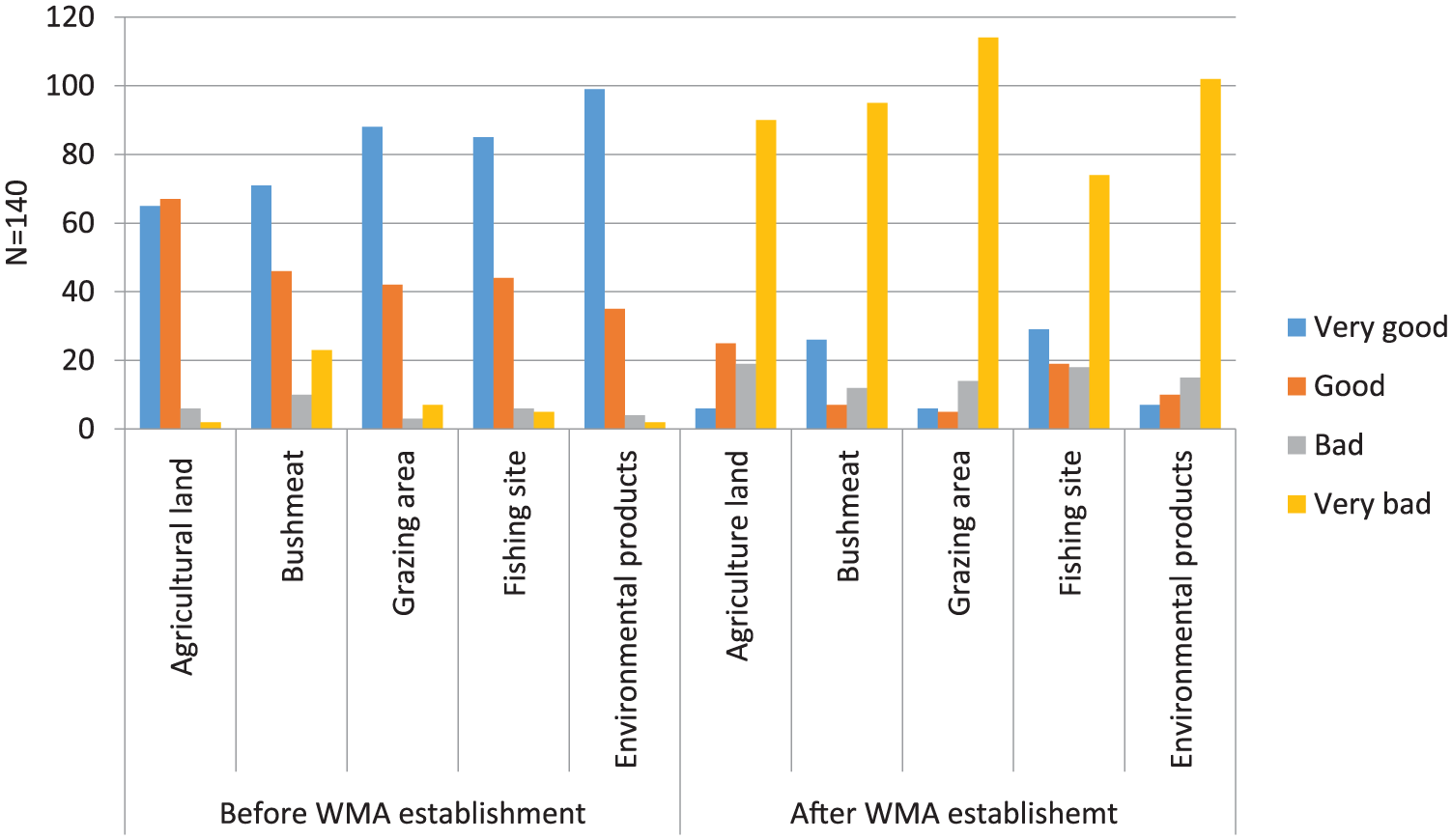
Response on the direction of change of rules on access to resources before and after WMA establishment n = 140.
Respondents complained in particular about the lack of information on these rule changes. As one respondent asserted, “We would like to know what new rules the WMA would lead to and be able to influence them before they took effect.”
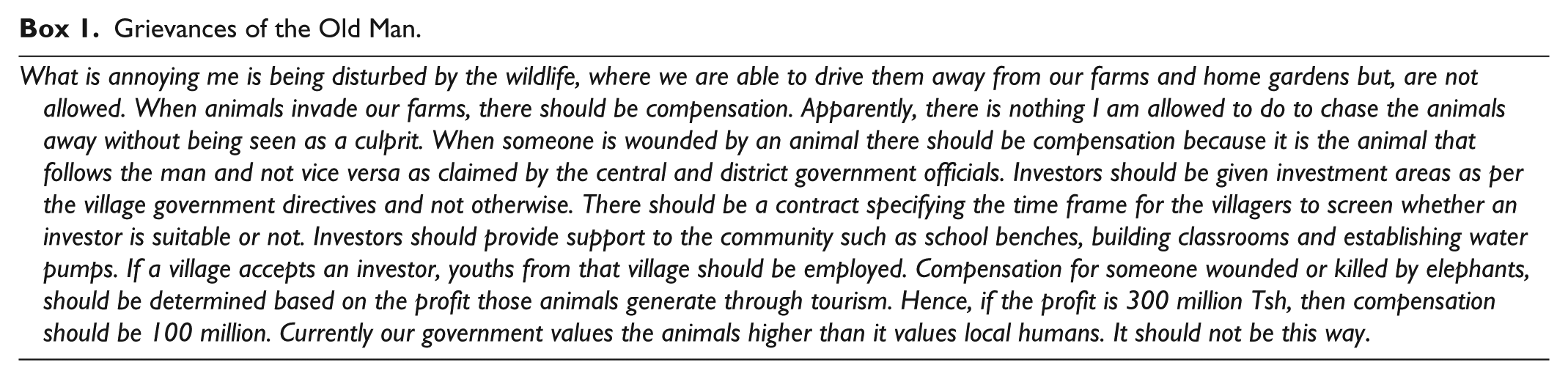
Section 51 of the 2002/5 WMA Regulations, which in its essence is similar to section 41 of the 2012 WMA Regulations, states that hunting for meat in the villages should utilize the offtake quota issued to the Authorized Association under the supervision of the District Game Officer. During focus group discussions and key informant interviews, several people stated that they would like to hunt wildlife for subsistence use. Since establishment, the Authorized Association had never allowed any hunting by villagers. Quoted reasons include that the local hunters do not have proper weapons and to avoid disturbing tourists as local hunters often hunt close to investors’ area. Finally, in 2010, the Authorized Association removed local hunting for meat from the GMP of Burunge WMA (Burunge AA, 2011). One 70-year-old man in Mwada village complained about this by saying, “Astonishingly there are no wild animals in Arusha town, but bushmeat is easily accessible. But we who are living with the animals cannot access the bushmeat.” Expressing his grievances, he provided a list of things he would like to see changed with regard to the WMA and requested the research team to present the list to those concerned (Box 1). The list actually forms a comprehensive alternative to the current state of affairs and is in close accordance with common pool resource management theory, specifically on inclusion, poverty reduction, and decentralization (cf. Ribot, 2002, 2004; Ribot, Lund, & Treue, 2010).
Grievances of the Old Man.
Benefits From the WMA
As a CBO, the Authorized Association should bring local development, providing at least community-level if not household-level benefits (cf. MNRT, 1998). However, contrary to the policy objective, scoring results from our interviews show that the majority (79%) of respondents did not agree that the WMA has brought benefits to their households. Nevertheless, the WMA has financed (a) the construction of Village Government offices in Mwada and Kakoi, (b) eight classrooms in Mwada village, (c) a health center in Vilima Vitatu, (d) school fees for children from poor families, (e) training of 21 Village Game Scouts, and (f) training of Authorized Association members. However, such benefits rarely reached the household level. Only those who held positions in the Authorized Association agreed to have received benefits from the WMA. WMA revenue shares reaching Village Councils were furthermore not always used appropriately or used inefficiently. Villima Vitatu had, for instance, used about 17 million Tsh to construct a health center, which was later discovered to violate construction standards and thus demolished for safety reasons.
Section 73 of the 2002/5 WMA Regulations, which is similar to section 66 of the 2012 Regulations, authorizes the Central Government, through circulars issued from time to time (our emphasis), to regulate the sharing of benefits from WMAs. These sections also specify the following distribution of gross revenues: minimum 15% must be invested in resource development, minimum 50% should go to the participating villages, and minimum 25% must go to the Authorized Association. Section 15(b) of the 2008 Wildlife Conservation (nonconsumptive wildlife utilization) Regulations directly refers to this distribution of benefits. However, sections 16(3), 17(1 & 2), and 19(b) in the 2016 version of the Wildlife Conservation (nonconsumptive wildlife utilization) introduce important changes. First, the right to collect fees, for example, from tourist lodge investors, is shifted from the Authorized Associations to the Director of Wildlife. Second, Authorized Associations may only charge fees as stipulated in the 2016 Wildlife Conservation (nonconsumptive wildlife utilization) Regulations and with written permission from the Director of Wildlife. Third, only 70% of the collected fees shall go to the Authorized Association [and shared as stipulated in the 2012 WMA Regulations; compare above] while the Director of Wildlife retains 25% and 5% goes to the District Council. Accordingly, the central state has recentralized the collection of revenue from decentralized WMAs and captured 25% of such revenues for the Director of Wildlife—all in full accordance with the relevant legislation.
Unsurprisingly, the economic consequences of this legal reality have resulted in discontent among community members. As one respondent stressed, “You take care of a cow, and someone else comes to milk it while you do not know how much he gets after selling your milk.” The fact that equitable benefit sharing is among the objectives of the Wildlife Conservation Act and WMA Regulations (URT, 2009, 2012) was unknown to community members, Village Councils, and WMA officials. Respondents did not know how much revenue the Wildlife Division collected from their WMA and were thus concerned about how this matched the funds disbursed among participating villages. As mentioned, at least 50% of the revenue, which the Director for Wildlife transfers back to the WMA should be distributed between the villages forming the WMA, but frequently, respondents questioned whether the Authorized Association only retained the other half to cover its expenses and to invest in resource conservation activities; compare above. However, the Authorized Association also receive aid from donors and NGOs including the HONEYGUIDE Foundation, the African Wildlife Foundation, the WWF for Nature, National coordination of French NGOs of international solidarity (FISONG), and USAID. Most of our respondents had concerns about how Authorized Association members and the District Council members used WMA revenue. As one put it, “They say their salary is only Tsh 200,000 per month but, WMA leaders are now richer than the village government leaders.” There were also complaints about the fact that all villages get equal shares of the revenues returned from the central government while the area and ecotourism value of land ceded to form the WMA differed considerably between villages.
Discussion
At the local level, we observed little or no participation in the process of WMA policy development, which is not surprising. Professionals who genuinely supported the conservation-through-utilization idea of WMAs might, however, have foreseen many of the WMA Regulations’ problematic and outright adverse consequences at the local level. In the case villages, we observed little participation in, and high levels of frustration with, the way in which WMA policies pan out in practice.
There are many possible explanations for these observations. First, the policy process was top-down/rationalist or incremental/top-down. The former has low input legitimacy and the latter low output legitimacy. Input legitimacy involves political choices that involve community’s participation, or participation of actors who genuinely represent local communities’ interests, while output legitimacy reflects how the choices have addressed collective community problems during the process of policy development (Wodschow et al., 2016). In the case of Burunge WMA, our study strongly suggests that both input and output legitimacy were low. Second, local communities’ representation was mostly tokenish, and they received little or no feedback from their supposed representatives, for example, when rules on utilizing natural resources changed as a result of the WMA. Furthermore, it seems that a hidden objective of the WMA Regulations was to recentralize while (pretending) to decentralize wildlife management (Ribot et al., 2006). This article’s review of the WMA Regulations, including how it has evolved since the 1998 Wildlife Policy, strongly suggests that a central tenet has been to limit village governments’ rights to their land, natural resources, and associated revenue flows, once that land formed part of a WMA. When village governments have signed WMA agreements, they are open to dispossession and disenfranchisement through “rule by law” as opposed to being enfranchised as citizens in a democratic “rule of law” society (e.g., Kelly, 2011). Nelson (2010) and Ribot et al. (2006) among others also observe unwillingness of central governments in other sub-Saharan African countries to devolve decision-making powers to local communities, thereby deliberately limiting their participation in matters relevant to their livelihoods and well-being. Furthermore, Benjaminsen et al. (2013) convincingly explain WMAs as products of, among others, pressure from big international NGOs that, under a neoliberal conservation discourse, work in complex interactions with the neo-patrimonial state of Tanzania. This would explain why central actors, during the establishment of Burunge WMA, did not fully inform and involve village governments like Minjingu, which would stand to lose from the WMA because they were already generating significant revenues through bilateral arrangements with eco-tourism investors (Igoe & Croucher, 2007).
Low levels of participation in the process of WMA establishment also resulted in a low awareness of the WMAs’ operational rules among “ordinary” village members. This appears closely linked to the WMA legislations’ deliberate institutional choice of shifting rulemaking authority away from Village Governments to Authorized Associations that are not directly accountable to village citizens who experience uncompensated restrictions on their livelihoods due to the WMA rules. Bluwstein, Moyo, and Kicheleri (2016) made similar WMA rulemaking observations for Burunge. Section 31(5) in the 2009 Wildlife Conservation Act states that “The Minister shall, in the making of regulations under this section ensure that the local community is properly consulted and informed on how such community shall benefit from the Wildlife Management Areas.” However, we document that the 2012 WMA Regulations do not grant decision-making powers to Village General Assemblies, for example, to vote either for or against a proposed WMA management plan and associated rules. Accordingly, in this respect, the 2012 Regulations undermine rather than specify and bolster the intentions of the 2009 Wildlife Conservation Act. As Lindsay (1999) reports on the legal basis for common pool resource governance, such insecure and inflexible official rights and, we might add, the establishment of downwardly unaccountable institutions put communities in a state of legal uncertainty. The institutional design of Authorized Associations also runs counter to Ostrom’s (1990, 2009) design principles for robust common pool resource governance institutions. Particularly, Principle 3: “Most individuals affected by harvesting and protection rules are included in the group that can modify these rules” and Principle 4: “Monitors, who actively audit biophysical conditions and user behaviour, are at least partially accountable to the users and/or are the users themselves.”
The generation and distribution of financial benefits among participating WMA villages mainly originate from tourist lodge investors and safari tour operators. However, the right to choose, directly negotiate, and collect shares of tourism revenues from these investors first shifted away from the Village Governments toward the Authorized Association and, with the 2016 Wildlife Conservation (nonconsumptive wildlife utilization) Regulations, toward the Director of Wildlife. Furthermore, the 2009 Wildlife Conservation Act eliminates Village Councils’ authority over resources such as environmental products including wildlife for bushmeat. In Burunge, the result has been that, subject to decisions made by the Authorized Authority, local people have lost previous rights to hunt and collect environmental products important for their livelihoods within the WMA. The Authorized Association can get away with making such decisions because the members are not directly accountable to the local citizens. Ironically, the quite effective enforcement of these unpopular rules is economically possible because the Authorized Association can spend WMA revenue, over which Village Councils have lost control, on rule enforcement. From the viewpoint of local citizens, this is truly a lose-lose situation. Accordingly, through a “rule by law” technique of governance, Village Governments have lost authority over their land, resources, and associated revenue flows within WMA areas. This strikes at the heart of the Local Government (District Authorities) Act (URT, 1982) and the Village Land Act (URT, 1999), which vests all executive power in respect of village affairs and responsibilities for managing all village land in the Village Council. Nelson and Blomley (2007) also observed that the creation of Authorized Associations established a new governance institution at the village level rather than building on Village Councils. Hence, the institutional choice of establishing Authorized Associations to govern WMAs undermines established democratic institutions at the village level. We argue that such sidelining of Village Councils in WMAs appears to have been a deliberate agenda from the outset such that rights to land and revenues could be recentralized while decentralized (Ribot et al., 2006). From a political, moral point of view, the WMA Regulations, therefore, appear unconstitutional and in conflict with the Local Government (District Authorities) Act (URT, 1982). Furthermore, issues of contracts and language used in official documents are a significant hindrance for communities to exercise their rights. Igoe and Croucher (2007) also reported that the use of English language, which local people do not understand, led to complaints from communities who felt cheated into signing contracts they did not understand. In fact, to protect their current set of rights to land, resources, and revenues within their jurisdiction, Village Governments’ most important right is the right to abstain from becoming part of a WMA. In the case of Burunge, it does not seem that Village Governments were fully aware of or informed about the implications and risks associated with agreeing to form a WMA. Obviously, this is easier to conclude after than before the act, but the recentralizing and disenfranchising elements of the 2002 and 2005 WMAs Regulations are indisputable, and proponents of local democracy and local people’s rights to control local resources might have warned Village Governments about these dangers to their authority.
In line with expectations of local development financed by revenue from the WMA, community-level benefits, such as the building of classrooms, village offices, and other social services have been realized as also observed by Kaswamila’s (2012) study in Burunge. However, the current setup, which lacks clear mechanisms for making Authorized Associations downwardly accountable, prevents communities from evaluating cost and benefits originating from the WMAs on their lands, which resonate the findings of Nelson et al. (2007). Such lack of transparency may have demoralized communities explaining the low attendance in meetings related to the WMA. Furthermore, WMA benefits have not yet accrued at the individual level except in the form of school fees and jobs to a few people compared with the participating villages’ population. Songorwa (1999, p. 2068) reported that “the basic rule is that one participates if and when the program benefits him or her.” Our results demonstrate that most local citizens would rather not be part of the WMA precisely because they do not benefit. Unfortunately, the institutional setup prevents them from influencing the rules they are unhappy with, and it seems to keep them from leaving the WMA as well.
Conclusion
This article evaluated and assessed the institutional rhetoric and reality during the establishment and management of Burunge WMA. Furthermore, with the point of departure in our field data and observations, we analyzed the official WMA policy and, during the period 2013 to 2016, frequently updated Regulations to explore nexuses between official/original WMA-related policy and law, and between official law and resource governance at the local level. We observed that local people, contrary to the rhetoric livelihood enhancing objectives of the 1998 Wildlife policy, felt disenfranchised and dispossessed because of the WMA. The level of local participation during the establishment phase was low, and the quality of information offered to local people about the implications of establishing a WMA suffered from what appeared to range from intimidation and manipulation to “economising with the truth.” Most importantly, however, the WMA-related legislation, from the very outset, undermined the authority of democratically elected Village Governments over village lands, including wildlife and other renewable natural resources as well as associated revenue. The simple technique was, by law, to invent a new organization, Authorized Association, and transfer most of the authority previously held by Village Governments to them. Authorized Associations are not particularly downwardly accountable because they are not legally obliged to publish or share financial details about their activities. Over time, Authorized Associations have become increasingly upwardly accountable to the central administration, particularly the Director of Wildlife. From 2016, the Director of Wildlife took over the collection of WMA fees, mainly from eco-tourism investors, while keeping 25% of the proceeds—in reality, a new tax on WMA revenues tautologically justified by the costs of collecting fees. Notably, this process of stripping Village Governments of their authority within WMAs has happened in full accordance with the law.
Hence, we document the legislative techniques characterizing a particular case of “re-centralising while decentralizing” where legislation that should put the policy objective of participatory wildlife management into practice appears intentionally designed to undermine local authority over wildlife as a common pool resource. This process might be termed dispossession by law or rule by law (as opposed to the rule of law) and runs entirely counter to Ostrom’s (1990, 2009) principles of decentralized resource governance based on voluntary collaboration on devising, revising, and enforcing resource management rules. Rather, the process resembles Kelly’s (2011) analysis of conservation practice as primitive accumulation. More specifically, we characterize our findings as practices of a neo-patrimonial state that, under a neoliberal conservation discourse and in association with international NGOs, pretends to promote rural livelihoods. In fact, it is rather promoting wildlife habitat enlargement and corridor establishment while appropriating control over WMA land and wildlife resources including a large share of associated tourism revenues. Other scholars reach almost similar conclusions on community-based natural resource conservation efforts in Tanzania, for example, Bluwstein (2017), Moyo, Ijumba, and Lund (2016), Benjaminsen et al. (2013), Benjaminsen and Bryceson (2012), and Igoe and Croucher (2007).
Currently, Village Governments must abstain from joining WMAs if they want to maintain authority over their land and, according to anecdotal information, several have in fact done so. However, common pool governance of wildlife resources that result in net benefits for rural people is still possible if villages are allowed to voluntarily collaborate with each other, with conservation NGOs, eco-tourism investors, and the Central Government. No theory suggests that dispossession of local communities’ rights to local resources is a prerequisite for economically equitable and biologically sustainable management of renewable natural resources—on the contrary. Village Governments, whose combined lands offer eco-tourism as well as conservation potentials that NGOs and investors are willing to invest sufficient funds in, should be able to negotiate an agreement that encompasses all parties’ legitimate interests, which in particular includes local people whose livelihood activities will be affected. Of course, it is hard to estimate just how much money “sufficient funds” is and how eco-tourism revenues should be shared to fulfill the objective of Pareto optimality where nobody gets worse off while somebody (as many as possible) becomes better off. However, if neoliberal nature conservation is ever going to deliver morally justifiable outcomes, then the financial risks must primarily be shouldered by investors and NGOs. It is simply not fair if local communities stand to lose authority over their land and renewable natural resources for the sake of securing profits for investors and income to central government institutions. Precisely for this reason, democratically elected downwardly accountable Village Governments must be central and they, as representatives of their constituencies, should be able to renegotiate terms with investors both on local people’s use of land otherwise set aside for wildlife conservation and the sharing of eco-tourism profits. A basic principle in getting the incentive structure right must be that if an arrangement does not result in sufficient net benefits for villagers, then it should be possible for their governments to opt out. Currently, Village Councils are best advised not to opt in when presented with the opportunity to join a WMA.
Footnotes
Acknowledgements
Thanks go to the District Council of Babati and communities at Mwada, Vilima Vitatu, Minjingu, and Kakoi villages in Babati district.
Declaration of Conflicting Interests
The author(s) declared no potential conflicts of interest with respect to the research, authorship, and/or publication of this article.
Funding
The author(s) disclosed receipt of the following financial support for the research, authorship, and/or publication of this article: This study was funded by the Danish Ministry of Foreign Affairs through the Building Stronger Universities program. Martin R. Nielsen’s work on this article was funded by the European Union’s Horizon 2020 research and innovation program under grant agreement No 641918 through the AfricanBioServices project.