




Abstract
Global health policies are promoting increased vegetable intake across all socioeconomic levels. However, the association between healthy vegetable intake and perception of the food environment has not been well investigated. Consequently, this study aimed to examine the association between vegetable intake and perceptions of neighborhood food environments. Participants were 3,137 Japanese adults (1,580 men, 1,557 women), aged 30 to 59 years, who completed an Internet-based survey. Self-report data were collected: vegetable intake, perceptions of food environment, household income, and demographic variables. We found that positive perceptions of the food environment (e.g., reasonable prices for foods and good social capital of food) predicted healthy vegetable intake in all household income groups. Therefore, supporters should take note of perceptions of the food environments—the findings suggest that the food environment can be altered via changing perceptions surrounding costs.
Japan has one of the highest levels of longevity in the world. Cardiovascular disease risk and obesity are lower than in other countries (Organisation for Economic Co-operation and Development [OECD], 2017). This positive health profile may be due in part to Japan’s unique dietary habits, which are drawing worldwide attention. Nevertheless, individuals with low socioeconomic status (SES) consume very few vegetables per day. In Japan, the National Health and Nutrition Survey (Ministry of Health, Labour and Welfare [MHLW], 2015) reported that low-income households consumed few vegetables per day (i.e., highest income: men = 322 g, women = 314 g; lowest income: men = 254 g, women = 282 g) and had a high rate of obesity (i.e., lowest income: men = 38.8%, women = 26.9%; highest income: men = 25.6%, women = 22.3%). Recently, the evidence indicates that income disparities are affecting various dietary behaviors in Japan (Nakamura et al., 2016), as well as mortality risk (Kondo, 2012). Several studies have shown that appropriate vegetable intake is effective for cancer prevention (Harnack, Nicodemus, Jacobs, & Folsom, 2002; Takachi et al., 2008) while also reducing risks for cardiovascular (Bazzano, Serdula, & Liu, 2003; Gillman et al., 1995), obesity (Mozaffarian, Hao, Rimm, Willet, & Hu, 2011), and other lifestyle-related diseases. Hence, to help alleviate early disease risk and further reduce health disparities, promoting vegetable intake among low-SES individuals is an important worldwide issue.
Japan’s health policy, called Health Japan 21, focuses in part on addressing economic and health disparities (MHLW, 2012a). In Japan, people from many different socioeconomic classes coexist, and to conduct health promotion activities based on income would be discriminatory. Therefore, population-based approaches to health improvement need to be inclusive of socioeconomically disadvantaged groups (MHLW, 2012a). The PRECEDE-PROCEED model has revealed a mutual relationship between health behavior and the environment (Green & Kreuter, 2005). In the case of dietary habits, the neighborhood food environment is a key factor. Previous research has reported that improving not only the physical food environment but also the perception of the food environment plays an important role in creating positive dietary habits (Blitstein, Snider, & Evans, 2012; Larson, Story, & Nelson, 2009; Sharkey, Johnson, & Dean, 2010; Zenk et al., 2005). In fact, in Japan, Yoshiba et al. (2015) reported that healthy eating behavior among elderly adults has a stronger relationship with the perception of the food environment than with the actual environment (Yoshiba et al., 2015). Furthermore, strategies aimed at improving the perceived environment would be much less costly, at least in the short term, when compared with trying to change the physical environment. As environmental perceptions appear to play an important role in the formation of healthy vegetable intake, it is important to understand the factors predicting these perceptions to help devise tailored strategies. Moreover, it is possible that the association between the perceived neighborhood food environment and vegetable intake could differ by household income (Williams, Thornton, Ball, & Crawford, 2012). To provide support for health promotion efforts aimed at enhancing vegetable intake across income groups, we must explore the interrelationships among these factors.
In Japan, efforts to improve food environments are currently underway, including the Dietary Reference Intakes for Japanese, which set habitual target values and dietary guidelines that account for consumer dietary styles. There is also the Japanese Food Guide Spinning Top, which provides idealized eating habits based on dish units. Unfortunately, there are relatively few reports assessing the Japanese food environment, particularly the social capital of food within residential areas. Shimomitsu (2011) showed that when the environment such as nonfixed sales shops and information provision is developed, improved perception of food environment such as “availability of meals,” “nutrition labels at restaurants and grocery store information,” and “daily shopping within walking distance.” However, Shimomitsu investigated only one city, limiting the generalizability of those findings. In addition, prior work has been unable to account for the effect of household income (i.e., SES), and little has been investigated about whether residents (i.e., the receivers of the food environment) perceived the food environment.
This study aimed to examine the association between vegetable intake and perceptions of neighborhood food environments by household income category among Japanese to provide useful knowledge to supporters (i.e., the provider side) of healthy food intake.
Method
Study Sample
We conducted a cross-sectional study, with a multipurpose investigation as to the dietary habits of Japanese adults. In February 2014, an Internet-based survey was administered among individuals aged 30 to 59 years through an online research service company (containing data from approximately 160,000 people). Details of the methodology were published in a previous report (Nakamura et al., 2016). Thus, participants were stratified according to age, gender (Ministry of Internal Affairs and Communications, 2013), and household income (MHLW, 2013), and sampling was conducted to match the socioeconomic distributions in Japan. The survey request was delivered to 8,284 people (aged 30-59 years and matching the gender and age distributions of Japan) extracted from the approximately 160,000 registrants in consideration of the response rate (the response rate is 36% by a Japanese online research service company). A total of 8,284 adults were received an email inviting them to participate in the survey. The invitation email contained a URL for a protected website in which the questionnaire was located. In fact, a total of 3,269 adults completed the survey by the deadline, and survey collection was terminated. These 3,269 participants were aged 30 to 59 years. A sample of adults aged 30 to 59 years (three age groups: 30-39 years, 565 men and 551 women; 40-49 years, 593 men and 567 women; and 50-59 years, 493 men and 500 women). We targeted this age group because the promotion of healthy eating, and a reduction in health disparities, is particularly important within this age range. In addition, students in their 20s were excluded because it is difficult to interpret SES such as household income and education in that group (Nakamura et al., 2016). Respondents who completed the survey and clicked the “send” button after reading the online informed consent form were considered to have consented to participate. The research service company offered reward points, valued at 100 JPY (102 JPY = US$1 in February 2014), for participating. This study was approved by the Ethics Review Committee on Research with Human Subjects of Waseda University, Japan (2013-249).
SES and Sociodemographic Variables
We were unable to accurately determine individual-level equivalent incomes, as the questionnaire contained only categories of household income, as follows: <3,000,000 JPY, 3,000,000-5,000,000 JPY, 5,000,000-7,000,000 JPY, 7,000,000-10,000,000 JPY, 10,000,000-15,000,000 JPY, and >15,000,000 JPY. We therefore analyzed income at category level. Overall, 3 million yen may be used as one index (low-income group) of people with life difficulties, but there is no strict classification of this evaluation point. More specifically, these data were extracted at the same rate as the census distribution. This research was divided into 3 million yen and 7 million yen to better reflect the income division between socioeconomic classes. Individuals who make less than 3 million yen account for 32% of the population, who make 3 million yen and 7 million yen account for 41%, and those who make 7 million yen or more account for 27%. Household income was classified into three equally distributed categories: <3,000,000 JPY (low), 3,000,000-7,000,000 JPY (middle), and >7,000,000 JPY (high; MHLW, 2013). Education level was classified into three categories: junior high/high school, 2-year college, and 4-year college/graduate school. Demographic variables included gender, age group, marital status, residential status, and employment status.
Vegetable Intake
The questionnaire item concerning vegetable intake (MHLW, 2012b) was prefaced by the following: “The following questions are about your normal meals.” Participants were then asked, “Do you eat adequate amounts of vegetables (5 small dishes/day, or about 350 g)?” Responses included (1) always, (2) sometimes, (3) rarely, and (4) never. Those who responded (1) or (2) had sufficient vegetable intake (yes), while those who responded (3) or (4) had insufficient vegetable intake (no).
Perception of Neighborhood Food Environment
We used six items to evaluate perception of neighborhood food environment, including food access, food information access, and food social capital (Shimomitsu, 2011). The instructions to participants for these items were as follows: Here are some questions about the people and where you live in (elementary school and junior high school area boundaries in the municipalities). Please choose the most applicable of the following items: “Nutritionally foods and menus are available at a nearby restaurant, grocery store, or workplace cafeteria” (availability of meals); “Nutritionally foods can be purchased at an reasonable price” (reasonable prices for foods); “Nutrition labels, such as those containing calorie information, are readily available and useful at nearby restaurants and grocery stores” (nutrition labels at restaurants and grocery store information); “Daily shopping can be done within walking distance of the home” (daily shopping within walking distance); “My neighborhood has an atmosphere of cherishing food culture, traditions, and seasonality” (atmosphere of cherishing the food culture in my neighborhood); and “My neighborhood has the atmosphere of feeling free to exchange food with each other, such as bartering for food” (atmosphere of feeling free to exchange food with each other in the neighborhood).
Responses to these items were on the following scale: (1) strongly agree, (2) agree, (3) neutral, (4) disagree, and (5) strongly disagree. Those who responded (1) or (2) had positive perceptions of neighborhood food environment (agree); those who responded (3), (4), or (5) had negative perceptions of neighborhood food environment (disagree).
Statistical Analyses
Data were analyzed from the 3,137 adults who provided complete information for all study variables. Respondents who did not provide information regarding education (other/unknown, n = 52) or employment status (other/unknown, n = 80) were not included in the analyses.
A chi-square test was used to compare various characteristics and vegetable intake levels. Associations between vegetable intake and perceptions of neighborhood food environment were examined using a forced-entry adjusted logistic regression analysis. The dependent variable was vegetable intake, and the independent variables were the perceptions of neighborhood food environment. There were no issues of multicollinearity between our variables. Unadjusted odds ratios, adjusted odds ratios (AORs), and 95% confidence intervals (CIs) were calculated for each variable. Multivariate analyses were adjusted for sex, age, marital status, residence status, employment status, and educational states. All statistical analyses were performed with IBM ® SPSS ® Statistics 21.0, with a p value of .05 taken as the level of significance.
Results
Participant characteristics and food environment perceptions are shown in Table 1. Approximately half of the respondents were women. Individuals who reported sufficient vegetable intake had the following characteristics: 50 to 59 years old, married, living together, not employed, 3,000,000 to 7,000,000 or >7,000,000 yen income, and 4-year college/graduate school. The ratio of perceived positive neighborhood food environment among people with sufficient vegetable intake was higher than that among individuals with insufficient vegetable intake (all items p < .001).
Descriptive Characteristics of 3,137 Participants According to Healthy Vegetable Intake.
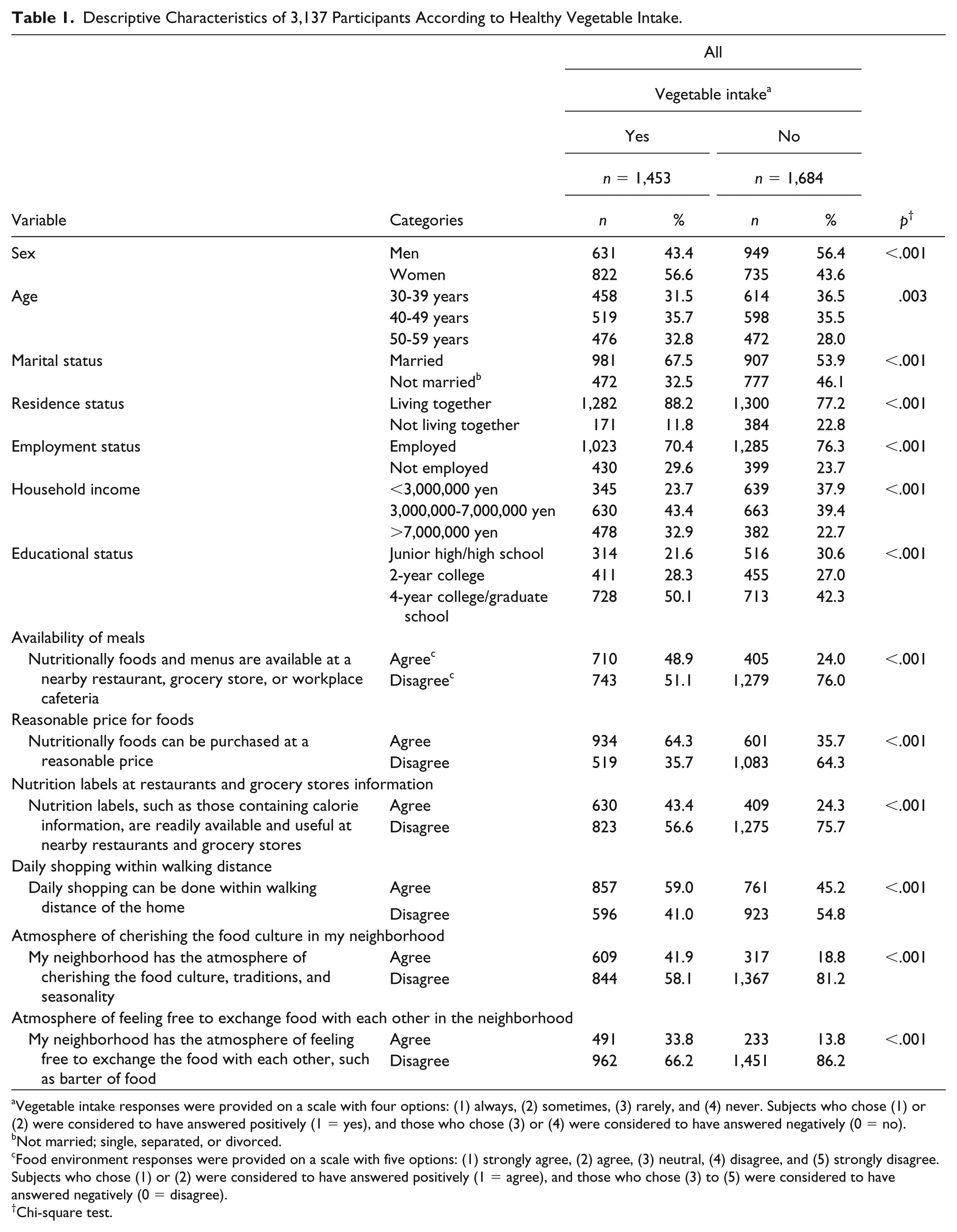
Vegetable intake responses were provided on a scale with four options: (1) always, (2) sometimes, (3) rarely, and (4) never. Subjects who chose (1) or (2) were considered to have answered positively (1 = yes), and those who chose (3) or (4) were considered to have answered negatively (0 = no).
Not married; single, separated, or divorced.
Food environment responses were provided on a scale with five options: (1) strongly agree, (2) agree, (3) neutral, (4) disagree, and (5) strongly disagree. Subjects who chose (1) or (2) were considered to have answered positively (1 = agree), and those who chose (3) to (5) were considered to have answered negatively (0 = disagree).
Chi-square test.
Results of the logistic regression analysis on the association between perceptions of neighborhood food environment and vegetable intake are shown in Table 2. After adjusting for variables, perceptions of neighborhood food environment (e.g., “availability of meals”) were positively associated with sufficient vegetable intake for the middle- and high-income groups (middle: AOR = 1.76, 95% CI = [1.29, 2.40]; high: AOR = 1.46, 95% CI = [1.01, 2.11]). There was no significant association between “availability of meals” and sufficient vegetable intake for the low-income group (low: AOR = 1.31, 95% CI = [0.87, 1.98], p = .192). Next, perceptions of neighborhood food environment (e.g., “reasonable prices for foods”) predicted sufficient vegetable intake for the all of the income groups (low: AOR = 2.09, 95% CI = [1.47, 2.97]; middle: AOR = 1.63, 95% CI = [1.22, 2.19]; high: AOR = 1.85; 95% CI = [1.28, 2.67]). One of the two items relating to perceptions of neighborhood food environment (e.g., social capital of food) was positively associated with sufficient vegetable intake for all income groups. For example, “atmosphere of cherishing the food culture in my neighborhood” (low: AOR = 1.66, 95% CI = [1.11, 2.49]; high: AOR = 1.82, 95% CI = [1.22, 2.72]) or “atmosphere of feeling free to exchange food with each other in the neighborhood” (low: AOR = 2.65, 95% CI = [1.72, 4.08]; middle: AOR = 1.61, 95% CI = [1.14, 2.28]) were notable findings. Thus, in the low-income group, there was a positive association between social capital and sufficient vegetable intake.
Association of Perception of Food Environment and Vegetable Intake in Japanese Adults by Household Income.
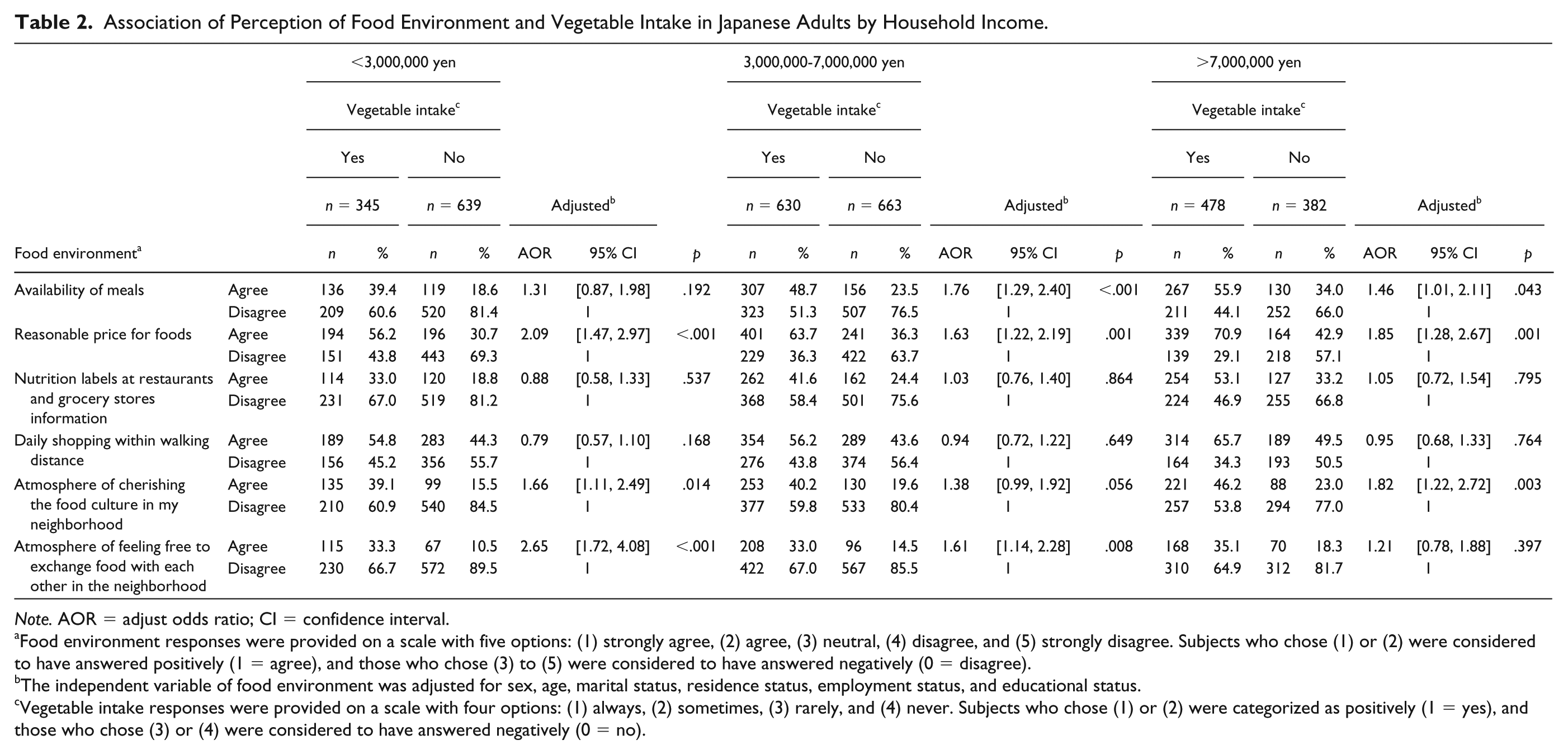
Note. AOR = adjust odds ratio; CI = confidence interval.
Food environment responses were provided on a scale with five options: (1) strongly agree, (2) agree, (3) neutral, (4) disagree, and (5) strongly disagree. Subjects who chose (1) or (2) were considered to have answered positively (1 = agree), and those who chose (3) to (5) were considered to have answered negatively (0 = disagree).
The independent variable of food environment was adjusted for sex, age, marital status, residence status, employment status, and educational status.
Vegetable intake responses were provided on a scale with four options: (1) always, (2) sometimes, (3) rarely, and (4) never. Subjects who chose (1) or (2) were categorized as positively (1 = yes), and those who chose (3) or (4) were considered to have answered negatively (0 = no).
Discussion
To our knowledge, this was the first study to examine the association between vegetable intake and perceptions of neighborhood food environments by household income among Japanese. These perceptions were in part related to differences in household income, which in turn predicted desirable vegetable intake. Our results show that the difference by household income is limited and suggest that it is possible to increase vegetable intake across a wide population by promoting perceptions of neighborhood food environments.
High vegetable intake (regardless of income) was related to the perception of “nutritional foods can be purchased at a reasonable price.” Thus, grocery stores should invest in promotional activities that allow consumers to easily perceive seasonal vegetables through store events and advertisements. Flint, Steven, and Stephen (2013) reported that perceived availability, affordability, and acceptability of one’s neighborhood food environment did not predict fruit and vegetable consumption when targeting low-income individuals. However, Darmon, Lacroix, Muller, and Ruffleux (2002) implemented a food pricing policy that improved dietary quality for adult women in the low- and middle-income groups. Several studies worldwide have focused their assessments on low-income individuals (Williams et al., 2014), with no prior reports examining a wide range of income groups. Furthermore, mechanisms underlying food distribution and vegetable acquisition are different in Japan. Japan has four seasons, allowing for the growing of specific seasonal vegetables with reasonable prices. That is, vegetables are strongly influenced by seasonal elements and the weather, which in turn can lead to price fluctuations; thus, consumers may be affected by temporary price hikes. However, in Japan, a certain amount of vegetables is distributed throughout the year to reduce the impact of price fluctuations (Ministry of Agriculture, Forestry and Fisheries, 2017). A Japanese public opinion survey (Bureau of Citizens and Cultural Affairs, 2016) revealed that approximately 64% of respondents said that “price” was an important element when purchasing perishables. Taken together, it is evident that price has an influence on food accessibility. However, a limitation of this research is that we provide little evidence for a relationship between price and food access, and what information is provided is unique to the Japanese context.
Regardless of SES, the perceived “social capital of food,” which includes “atmosphere of cherishing the food culture in my neighborhood” and “atmosphere of feeling free to exchange food with each other in the neighborhood,” appears to be a predictor of the sufficiency of vegetable intake. Among the lowest income group in Japan, there is an average vegetable intake of about 70 g per day (1 SV) less than highest income group. Furthermore, the low-SES groups experience a higher risk of lifestyle-related diseases (MHLW, 2015). Motohashi, Kaneko, Fujita, Motohashi, and Nakamura (2013) reported that vegetable intake is lower among individuals who perceive an environment with negative community social capital. Social capital (Putnam, Leonardi, & Nanetti, 1994) is defined as a relationship of mutual trust (social network) between individuals. Health Japan 21 (the second term) states that reinforcement of social capital is important for health promotion among the socioeconomically disadvantaged. Also, if the food environment is examined each of food access, information access, and social capital, the principal implementing environmental maintenance can organize the whole what to do. For example, supporters can initiate two major health promotion activities based on region and organization. First, supporters of municipalities and organizations could provide information regarding the local food culture and traditions, as well as outline the importance of sharing foods in the community. This could be accomplished through public service announcements and advertisements spearheaded by local governments. Second, it may be good for local governments, grocery stores, and restaurants to host events where consumers can experience positive social capital in regard to the food culture. Increasing a focus on “social capital” could lead not only to advocating for vegetable intake but also more holistic community health promotion. However, it is necessary to note that our findings were produced using a measure of perception of the food environment developed within Japan, which means that our findings may not generalize well to other geographic areas.
The association between desirable vegetable intake and perceptions of the neighborhood food environment, as it pertains to the availability of meals (e.g., in nearby restaurants, grocery stores, and workplace cafeterias), was only observed among the middle-income and highest income groups. Maintenance of nutritional foods and menus within organizations, local grocery stores, and restaurants is currently underway in Japan (MHLW, 2012a). However, the present results indicate that individuals within the lower income group may not benefit from this association. Thus, it is necessary to devise interventions where these individuals become vigilant toward checking nutritional information on menus and labels. Each municipality in Japan is implementing a system involving the use of a “mark” to highlight dishes that include several vegetables and stores that offer “vegetable supporter” dishes. In addition, we have created an enlightenment tool, referred to as the “Everyday Plus One Dish of Vegetables” (MHLW, 2012c), as a national strategy. This initiative has been implemented at grocery stores since 2016. To plan a health promotion strategy that focuses on lower income individuals, it is necessary to make use of these tools and actively promote food awareness across a variety of organizational levels.
The present study included a few notable limitations. First, we could not investigate any objective indices of the food environment. This prevents us from making any inferences about the relationship between the actual food environment and the perceived environment. Second, our study does not cover all aspects of the perceived food environment. We used only a portion of the items devised in a previous study. We measured perception of the food environment using items from existing research as much as possible (Shimomitsu, 2011). However, the validity of our measure has not been determined. Moreover, the perceptions are Japan centric and may not reflect perceptions in other countries. Third, we were unable to investigate other factors that might influence food purchasing, including the types of stores patronized, food prices, access to and opening hours of food stores, time (acceptability), location of employment (accessibility), or other aspects of the food purchasing environment (e.g., geographic information system, grocer displays; Zenk et al., 2005). Fourth, despite our rather large sample size, we cannot guarantee that our sample is fully representative of the general Japanese population (i.e., we only sampled individuals with access to the Internet). Internet-based survey respondents may be more likely to have certain characteristics, including being younger, have a higher level of education, and a higher income (Eysenbach & Wyatt, 2002; Rhodes, Bowie, & Hergenrather, 2003). The sample size was estimated according to the study design so that various relevant factors could be considered based on the categories of age, gender, and income. The lack of justifiable resources is a limitation of this research. Furthermore, we excluded data that people with incomplete answers from the main analyses because interpretation of the results would have been difficult if other/unknown answers were included in the data. We must interpret this result carefully. However, participants were randomly selected based on Japanese population data according to demographics, which was an advantageous aspect of the present study. Moreover, this strategy helped us avoid issues related to regional characteristics. Thus, a key strength of this Internet-based survey was that we utilized a variety of sampling parameters.
The Japanese government has recently recommended an approach that includes distinct health promotion interventions based on specific income levels (MHLW, 2012a). However, investigating SES is a delicate issue for low-income households. The possibility of implementing a health promotion strategy within segmentation of income groups is quite challenging in reality. In the future, we believe that certain methods (e.g., the nudge theory) to encourage people to make healthier choices should be utilized within their food environments. The nudge theory is the choice that alters people’s behavior in a predictable way without forbidding any options or significantly changing their economic incentives. For example, it is necessary to consider the “nudge” mechanisms that help people perceive prices as reasonable and select healthy food. These mechanisms might include price display patterns, advertisement displays, or the order of line up. In addition, it is necessary to improve overall health literacy (the ability to obtain, understand, evaluate, and utilize health information) and to ensure that residents obtain information on their preferred food environment. Overall, therefore, it is necessary to explore how people perceive the existing food environment to better implement public health promotion.
Conclusion
The study examined the relationship between vegetable intake and perceptions of neighborhood food environments by household income among Japanese individuals residing in Japan. Overall, the results suggest that changes in the food environment may result from changes in perceptions about foods (e.g., the perception that vegetables are economically cheaper). Changes in perceptions may be more important than changes in the physical environment. Charging reasonable prices for food, having healthy food available in stores and restaurants, and changing the social capital of food may promote increased vegetable intake among low-income households. Future research would do well to investigate this work in a longitudinal manner.
Footnotes
Acknowledgements
The authors would like to express their sincere gratitude to the municipal authorities, officials, and residents who participated for their cooperation.
Author Contributions
S.N. designed the study, analyzed the data, and drafted the article. T.I. and T.A. participated in the study design, supervised, and helped draft the article. K.H. participated in the study design and supervised writing the article. All authors read and approved the final article.
Declaration of Conflicting Interests
The author(s) declared no potential conflicts of interest with respect to the research, authorship, and/or publication of this article.
Funding
The author(s) disclosed receipt of the following financial support for the research, authorship, and/or publication of this article: This research was supported by a Grant-in-Aid for Challenging Exploratory Research (JSPS KAKENHI Grant No. JP25560357) from the Ministry of Education, Culture, Sports, Science and Technology, Japan, and Japan Society for the Promotion of Science (JSPS KAKENHI Grant No. JP16J02348).
Ethical Approval and Consent to Participate
This study was conducted according to the guidelines laid down in the Declaration of Helsinki and all procedures involving human participants and was approved by the Ethics Review Committee on Research with Human Subjects of Waseda University, Japan (2013-249). Respondents who completed the questionnaire and clicked the “send” button at the end of the online informed consent form were considered to have consented to survey participation.
