




Abstract
Recurrent food crises and climate change, along with habitat loss and micronutrient deficiencies, are global issues of critical importance that have pushed food security and environmental sustainability to the top of the political agenda. Analyses of the dynamic linkages between food consumption patterns and environmental concerns have recently received considerable attention from the international and scientific community. Using the lens of a broad sustainability approach, this conceptual article aims at developing a multidimensional framework to evaluate the sustainability of food systems and diets, applicable to countries of the Mediterranean region. Derived from natural disaster and sustainability sciences, a vulnerability approach, enhanced by inputs from the resilience literature, has been adapted to analyze the main issues related to food and nutrition security. Through causal factor analysis, the resulting conceptual framework improves the design of information systems or metrics assessing the interrelated environmental, economic, social, and health dynamics of food systems.
Over the past 25 years, the international and scientific community has repeatedly attempted to deal with the issue of sustainability. “Our Common Future” (United Nations [UN], 1987), commonly known as the “Brundtland Report,” argues that sustainable development should meet “the needs of the present without compromising the ability of future generations to meet their own needs.” It stresses the necessity to implement economic, social, environmental, and institutional progress that can be maintained over time. Worldwide concerns about sustainable development are also reflected in the global food security debate, which states that “food security exists when all people, at all times, have physical, social and economic access to sufficient, safe and nutritious food which meets their dietary needs and food preferences for an active and healthy life” (Food and Agriculture Organization [FAO], 1996). The 1996 World Food Summit (WFS) identifies four main determinants of food security: food availability, accessibility to food, food utilization, and the stability over time of the three previous dimensions; depletion in any one of these leads to food insecurity.
The first crucial change from the supply-based food security concept of 1974 (UN, 1975) came with the access-related definition of food security (FAO, 1983; World Bank, 1986) using Sen’s entitlements approach (Sen, 1981). Then, the nutrition approach guided the notion of utilization (Staatz, D’Agostino, & Sundberg, 1990), highlighting the need for quality, including good and culturally accepted feeding practices, food safety, and nutritional value. During the same period, Maxwell and Smith (1992) sustain the theory that household access to sufficient and nutritious food at all times is key to food security. Building on the 1986 World Bank report “Poverty and Hunger,” the stability dimension, related to the temporal dynamics of food insecurity, was explicitly acknowledged.
Associating sustainable agriculture and food security, Speth (1993) suggests orientating development strategies toward the combined socioeconomic−environment goal of sustainable food security.
Sustainable food security is actually the concept underpinning the 1996 definition of the WFS where environmental and social issues were further stressed, especially for climatic risks, water availability, biodiversity losses, and cultural food preferences. The term sustainable food security was already coined in March 1987 in the Brundtland Report. Yet in 1983, Swaminathan (1983) was among the first to point out the need for an ecological foundation to food security “to protect basic life-support systems of land, water, flora, fauna, and the atmosphere” (p. 37). In 1987, Swaminathan reaffirmed the sustainable food security concept, extending it to encompass both nutritional and water issues, while Gussow and Clancy (1986) were the first to use the term sustainable diets to define diets both healthy for the environment and humans.
The multiple interconnected dimensions of these two concerns—sustainable development and food & nutrition security—open new avenues for multidisciplinary research, as demonstrated by the emerging literature on the topic and the more recent related global events. The main conceptual outcome of the 2010 International Scientific Symposium on Biodiversity and Sustainable Diets is the definition of sustainable diets as those diets with low environmental impacts which contribute to food and nutrition security and to a healthy life for present and future generations. Sustainable diets are protective and respectful of biodiversity and ecosystems, culturally acceptable, accessible, economically fair and affordable; nutritionally adequate, safe and healthy while optimizing natural human resources. (FAO & Bioversity International, 2012, p. 7)
It is clear from this definition that the issue of sustainability of diets closely refers to food and nutrition security. The sustainable diets definition establishes four main goals for the governance of a future sustainable food system: human health and nutrition, cultural acceptability, economic viability, and environmental protection (Fanzo, Cogill, & Mattei, 2012). It highlights some crucial elements such as the importance of biodiversity stocks not just for the agriculture and the environment but also for adequacy to nutritional recommendations and cultural acceptability. The multiple conditions of sustainability clearly encompass several dimensions. These conditions refer to different sets of capital that allow flows of services to be maintained over time. Stiglitz, Sen, and Fitoussi (2009) suggest that these welfare-producing services can be sustained over time when stocks of capital (natural, physical, human, and social) are transferred to future generations.
The analysis of the sustainability of food security requires a shift toward a multidimensional vision (Pinstrup-Andersen, 2009), but also a transversal approach across the multiple activities leading to diets. Achieving both sustainability and food security requires more than focusing on agriculture or on markets or on household food baskets, but to look at the overall food system (Ingram, 2011). Sustainable food systems are key for assuring sustainable food security (FAO & Bioversity International, 2012), and they cannot be pursued in the absence of food and nutrition security (Buttriss & Riley, 2013). Food security and food system sustainability are then indispensable prerequisites to each other, and they need to be jointly analyzed.
Policymakers and stakeholders play a key role in the governance of future sustainable food systems, at a different spatial scale. They need evidence-based scientific information to define policy and implement actions (Barrett, 2010). The aim of this article is to develop a conceptual framework, applied to the Mediterranean region, which links concepts, methods, and metrics, for a multidimensional joint analysis of food and nutrition security and food system sustainability. Building on the resilience literature, the vulnerability approach (Turner et al., 2003) provides a systemic causal pathway to analyze the impacts of the main drivers of change on specific food security and nutrition outcomes. It allows understanding and assessing the conditions of sustainability of the food system. This article provides the conceptual background to develop metrics, relying on evidence-based scientific knowledge, to inform all stakeholders, particularly policymakers, on response interventions to major changes at national and regional scale, to maintain the ability of the system to provide food security and good nutrition over time, while taking into account environmental, social, and economic constraints and assets.
We first introduce the Mediterranean context and briefly review the main issues related to food and nutrition security and food system sustainability in the region. Developed from natural disaster and sustainability sciences, the vulnerability conceptual framework is presented as a valid approach to capture and model food system sustainability. We then expose the associated metrics—or information system—to quantify vulnerability that integrates three essential components: exposure, sensitivity, and adaptive capacity (Turner et al., 2003). We finally discuss the utility of this approach with examples of its possible application to Mediterranean countries.
Food Insecurity and Environmental Unsustainability: A Joint Regional Analysis
Changes in Dietary Patterns and Food Insecurity
Globally, more than 2 billion people are food insecure, either undernourished, malnourished, or overnourished (FAO, World Food Programme [WFP], & International Fund for Agricultural Development [IFAD], 2012; Strang, 2009; World Health Organization [WHO], 2013). Concurrently, there is a consensus among the international and scientific community on the non-sustainability of the western agrofood system, in terms of its impacts on natural resources and ecosystems, and on human health with increasing prevalence of non-communicable diet-related diseases. The Mediterranean region has been identified as one of the main critical hotspots of environmental unsustainability due to intense human activity and agricultural exploitation (Capone, Lamaddalena, Lamberti, Elferchichi, & El Bilali, 2012; Salvati, 2014). A large part of its population can also be considered food insecure. Using UN anthropometric and population composition data, 1 out of a total population of about 500 million, it is possible to estimate that at least 215 million adults and children (44% of total population) are “qualitative and quantitative food-insecure” in the Mediterranean region.2,3 The geographical zone represents an interesting testing area of study in which to carry out a multidimensional analysis of the interconnected factors that characterize food insecurity and environmental unsustainability. In this section, we present a joint analysis of the current situation and show how both issues intersect.
On the supply side, all the dietary energy supplies (DES) of the Mediterranean countries 4 largely exceed the average dietary energy requirements. At the same time, the majority of these countries are strongly dependent on imports, especially for cereals (except France and Turkey). Furthermore, the share of DES derived from cereals is still considerably high (Egypt 65%, Morocco 57%, Algeria 55%, Tunisia 51%, Libya 49%, Turkey 48%; Food and Agriculture Organization Corporate Statistical Database [FAOSTAT] 2009, data available in November 2013). 5 This cereal-centered dependency can lead to a regional and national vulnerability. In particular, it occurs at the expense of middle- and low-income groups, and of the national government expenditure. For example, bread subsidies, amounting to US$2.5 billion per year, were introduced in Egypt in 2008 (FAO, WFP, & IFAD, 2012). It is also necessary to consider food price volatility, in particular for cereals, as it affects consumers’ capabilities to access food. Other related socioeconomic factors also determine access to food, such as adult literacy, which is still low in some countries (Libya 89%, Algeria 73%, Egypt 72%, Morocco 56%; United Nations Educational, Scientific and Cultural Organization [UNESCO], data available in November 2013). As for the utilization dimension of food security, nutritional value and food safety remain critical issues. Infant mortality (Morocco 28‰, Algeria 26‰, Egypt 18‰, Tunisia 14‰, Albania 13‰, Turkey 12‰), child stunting (Egypt 31%, Syria 27%, Albania 23%, Morocco 23%, Libya 21%, Algeria 16%, Tunisia 9%), wasting (Morocco 11%, Syria 11%, Albania 9%, Egypt 8%, Libya 6%, Algeria 4%, Tunisia 3%), and underweight (Morocco 10%, Syria 10%, Egypt 7%, Albania 6%, Libya 6%, Algeria 4%, Tunisia 3%) are still considerably high (WHO, data available in November 2013). In addition to this, obesity and overweight are growing problems common to all the Mediterranean countries, both for adults and for children. This double burden of malnutrition is manifest in Egypt with prevalence rates of 33% in adult obesity and 20% for child overweight, against 31% for child stunting. Overweight and obesity are also risk factors in cardiovascular diseases, which contribute to 42% of all deaths in the Mediterranean (Rastoin & Cheriet, 2010).
Obesity is closely linked to dietary behavior and socioeconomic determinants but also to agricultural policies, production systems, and food chain characteristics (Delpeuch, Maire, Monnier, & Holdsworth, 2009). In the Northern Mediterranean countries, these diet-related pathologies are the symptoms of an overconsumption of meat (especially red meat), dairy products, and eggs (Padilla, 2008), with a tendency toward overconsumption of energy-rich and nutrient-poor foods (Darmon & Soler, 2013). In Southern Mediterranean, the double burden phenomenon represents the chronic phase of a nutrition transition. Statistics show a change of diet toward a regime that is richer in animal proteins and fats, at the expense of dietary diversity and food providing important micronutrients (Popkin, 2003). At the same time, supply shortage and struggle for access to food remain persistent for large cohorts of individuals. Another feature of the nutrition transition in the Southern Mediterranean countries is the change in the share of energy sources derived from added sugars, with increased intake of simple carbohydrates and refined sugars (Drewnowski & Popkin, 1997) and, in particular, a sharp increase in levels of simple sugar consumption through processed industrial products (drinks, biscuits, desserts, etc.; Padilla, 2008).
Hence, nutrition transition and malconsumption 6 are the two major food phenomena leading to diet-related diseases in the Mediterranean. Nutrient-poor “pseudo foods” (Winson, 2004) with high levels of vegetable oils, animal fats, sugar, and salt permeate the global food system (Popkin, 2005). Long-established dietary patterns and traditions using local staples are being replaced with western-style highly processed products (Pingali, 2007). This is the case in emerging economies that are experiencing several phenomena simultaneously, such as increased urbanization, household income growth, greater market penetration by foreign brands, global supermarket and food service chains, expansion of advertising and mass media, and highly competitive prices (Sage, 2013). These dynamics lead to qualitative changes in diets and thus new food security issues, together with changes in lifestyle and work environment, with a growing tendency toward sedentary jobs and physical activity increasingly being limited to leisure time (Gil, Gracia, & Pérez, 1995). These changes in diets contribute, as causal factors, to the rising incidence of nutrition-related non-communicable diseases, such as heart disease, cancer, diabetes, and obesity.
The Associated Issue of Environmental Unsustainability
These dietary changes and the increasing incidence of related diseases coincide with major transformations in the agricultural and food systems, which have become more global and complex. These evolutions in food behavior patterns and in industrial production and processing have joint social, economic, and environmental impacts. It is a fact that the nutritional characteristics of diets are directly related to environmental conditions, which are consequences of the production system associated with current food consumption patterns. The question is to understand to which extent. The environmental impact of the current agrofood system is a widely debated question. Darmon and Soler (2013), for instance, observe a positive correlation between calorie intake and greenhouse gas emissions. In any case, it should be noted that the Mediterranean agrofood sector represents 25% of the global Ecological Footprint of the region (Global Footprint Network, 2012).
The current shift from diverse farming systems to ecologically simplified ones, mainly based on cereals, contributes to micronutrient deficiency, poorly diversified diets, and thus malnutrition in developed, as well as in developing countries (Frison, Smith, Johns, Cherfas, & Eyzaguirre, 2006; Graham et al., 2007; Negin, Remans, Karuti, & Fanzo, 2009; Remans et al., 2011; Welch & Graham, 1999). An important negative outcome of intensive production, in addition to environmental damage such as soil depletion and erosion, and pollution of surface and groundwater, is the narrowing of biodiversity base through the use of only the most profitable varieties. Many of the processes and much of the equipment used in the food industry have been developed to transform staple foods with specific characteristics (e.g., size, color group, quality category, etc.). As a consequence, despite an apparent diversity of the final products available on the market for consumers, genetic resources diversity tends to shrink. Current industrial production systems favor limited varieties and monocultures to the disadvantage of biological diversity (Esnouf, Russel, & Bricas, 2013). The issue of biodiversity loss is related both to environmental concerns and to health and nutrition issues, because of its link with insufficient diet diversity, micronutrient deficiency, and unhealthy food habits (Burlingame, Charrondiere, & Mouille, 2009). The importance of food variety and composition, especially in terms of genetic resources, is increasingly acknowledged. Differences in nutrients between varieties have a major impact on nutrient intakes; higher consumption of one variety over another can lead to adequacy or deficiency in certain micronutrients. For this reason, nutrition research looks at both the food composition and consumption dimensions (Burlingame et al., 2009). The alarming rate of biodiversity loss and ecosystem degradation, and the consequent negative impact on food and nutrition security, also provide strong reasons to reconsider the food systems and diet approaches. It is necessary to develop and promote strategies for sustainable food regimes, emphasizing the positive role of biodiversity to reverse or mitigate the phenomena that cogenerate negative effects on human nutrition and health (Burlingame, Charrondiere, Dernini, Stadlmayr, & Mondovì, 2012). However, measuring food and nutritional biodiversity is a difficult task; the International Network of Food Data Systems (INFOODS) network developed metrics that need a large amount of data, which are difficult to collect.
The environment throughout the entire geographic area of the Mediterranean is at risk, threatened by the intensive exploitation of its natural resources, particularly water (Lutter & Schnepf, 2011; Roson & Sartori, 2010; United Nations Environment Programme–Plan Bleu, 2006). Considering the increasing issue of drought in the region, the intensification of water requirements for food is a major concern (Capone et al., 2012). The high water demand of the Mediterranean food system reveals a deficit in terms of virtual water exchange for agrofood products (Mekonnen & Hoekstra, 2011). 7 Water consumption trends are directly related to food consumption patterns as food products bring with them an internal quantity of water that differs by foodstuff origin, quality, and quantity. Water requirements for plant and animal products vary widely. Red meat and dairy products, for example, are considered highly water-consuming compared with crop production. Thus, the quantity and types of food demanded strongly implicate the extent of water allocated and used for agriculture and related production activities (Lundqvist, de Fraiture, & Molden, 2008). Water consumption is therefore also connected to nutritional composition of food consumed and strictly related to life habits and to drivers of change affecting the food system.
The relationship between unhealthy foods and highly environment-impacting foodstuff is tentatively captured by the Barilla Center’s Double Pyramid (Barilla Center for Food and Nutrition, 2010). Some argue that the more frequently recommended healthy food corresponds also to lowest environment-impacting products and vice versa. Consumption of red meat is, for example, often considered the heaviest variable affecting the sustainability of food systems and consumed in excessive amounts in developed countries (FAO, 2006; Lang, Dibb, & Reddy, 2011). However, evidence is mixed with regard to the general alignment of environmental and nutritional recommendations. For instance, Vieux, Darmon, Touazi, and Soler (2012) show that high nutritional quality is not always associated with low greenhouse gas emissions. Certainly no single food can encompass the wide range of both nutritional and environmental recommendations, without even mentioning economic viability and social acceptability constraints. A myriad of factors affecting both actors and activities within the food system explain the nutritional and environmental outcomes of dietary behaviors. Providing a clearer picture of the circular dynamics between environmental, health, economic, and social drivers can help not only to measure impacts or progress but also to understand interactions, and thus aid decision making. We suggest tackling this complex challenge by applying the vulnerability framework to the changes affecting the agrofood system.
Building on Ingram (2011), we defend an approach to metrics, which switches not only from the “what we get” (food security outcome approach) to the “what we do” approach (food systems-activities approach; p. 419), but which also considers the “what happens” side (food system–drivers interactions). The Mediterranean region presents several factors of change affecting food security and environmental sustainability. The multiple issues related to food insecurity and unsustainability that have been exposed above for the Mediterranean region can be analyzed from a multidimensional perspective, as a series of issues or hotspots of vulnerability of the different national agrofood systems, and integrated within a conceptual framework linking concepts, methods, and metrics.
Vulnerability for a Multidimensional and Dynamic System Approach
Mechanics of Change and Sustainability
According to the definition of agro-ecosystem sustainability coined by Conway (1985), “Sustainability is the ability of a system to maintain productivity in spite of a major disturbance, such as caused by intensive stress or a large perturbation” (p. 35). Consistently with the literal English usage of the verb “to sustain,” Hansen (1996) further interprets sustainability as a system’s ability to continue through time. If sustainability is the dynamic ability of a given system to maintain or enhance its essential outcomes over time and space, then the concept of vulnerability can provide the elements to understand the mechanisms affecting the activities of the system (Turner et al., 2003).
The United Nations Development Programme (UNDP–Disaster Management Training Program, 1994) defines vulnerability as the “degree of loss to each element should a hazard of a given severity occur” (p. 49), that is, the extent to which an individual or system or geographic area is damaged in relation to a given change. Downing (1990) states that “vulnerability is the composite of two prospects: risk of exposure and risk (or magnitude) of consequence” (p. 11). The exposure to hazardous events is different from the magnitude of the consequences that result from that exposure. The vulnerability approach further evolves with Turner et al. (2003), who established three main components to vulnerability: exposure, sensitivity, and adaptive capacity. Adaptive—or copying—capacity corresponds to the responses that it is possible to implement. The theoretical basis for this evolution is to be found essentially in the theory of abilities and capabilities (Sen, 1981).
The vulnerability assessment is today widely acknowledged as composed of three dimensions (Adger, 2000, 2006; Adger & Vincent, 2005; Allison et al., 2009; Cinner et al., 2012; Gallopín, 2006; Grafton, 2010; Intergovernmental Panel on Climate Change [IPCC], 2001; Kelly & Adger, 2000; Smit & Wandel, 2006): exposure and sensitivity to single or multiple stressors, and the adaptive capacity to cope with these. Hughes et al. (2012) adopted such a conceptual framework to quantify the anthropic effects on coral reefs and national food security, developing a national-level vulnerability index. In the case of the fresh fruit and vegetable value chains, the vulnerability approach was adopted to assess the strengths and weaknesses of Mediterranean production zones facing an increasing competition from South East Mediterranean countries (Rastoin, Ayadi, & Montigaud, 2007). The aim was to build an interregional diagnostic comparison by means of a Regional Vulnerability Index (RVI).
Vulnerability is a relative measure, and the exposure of individuals/systems/regions is related to their specific conditions. Similarly, the magnitude of the consequences from this exposure is linked to these particular characteristics and their associated sensitivity. Most adaptive capacity analyses tend to be specific to a place and context while linked across scales (Turner et al., 2003), and vulnerability is most frequently assessed at national levels (Allison et al., 2009; Brooks, Adger, & Kelly, 2005; Pelling & Uitto, 2001). The benefits of assessing vulnerability at the national level are that results can influence national-level policy responses and adaptive management strategies (Hughes et al., 2012).
A Causal-Factor Approach
One key conceptual element is a clear distinction between causal events and outcomes (Dilley & Boudreau, 2001). Following the introduction by Sen (1981) of the notion of accessibility beyond availability as a main determinant of famine, the analysis of food security shifted from a study of the sole natural causes to the inclusion of societal causes (Blaikie, Cannon, Davis, & Wisner, 1994). The vulnerability framework was indicated to describe and assess the multifaceted socioeconomic determinants of famine (Borton & Shoham, 1991; Maxwell & Smith, 1992; Middleton & O’Keefe, 1997; Ribot, 1995; Swift, 1989; as cited in Dilley & Boudreau, 2001). The vulnerability approach, based on natural disaster assessment, was then transposed to societal causes for the analysis of food insecurity. In particular, Chambers (1989) and Downing (1990) made considerable efforts in converting Sen’s analysis into assessment methods. The main result was the expression “vulnerability to famine” (p. 233), which became widely popular. It was understood in direct relation to the final outcome. However, Downing (1990) clearly stated that vulnerability is “a relative measure, for a given population or region, of the underlying factors that influence exposure to famine and predisposition to the consequences of famine” (p. 18), aiming at identifying elements for a causal factor analysis.
In the food security context, the FAO specified that vulnerability is the relationship between risks, resulting shocks, and resilience to these (FAO, 2004). The coupled risk–shock component affects population wellbeing and food security, whereas resilience concerns the strategies implemented to mitigate the impact of the shocks. Vulnerability is understood as directly correlated to the impact of shocks and is inversely correlated to resilience (FAO, 2004). While the natural disaster management approach to vulnerability involved the identification of a degree of damage on populations or economic assets, food security specialists applied vulnerability to measure the intensity of the state of food insecurity or famine (Dilley & Boudreau, 2001). Hence, it is possible to define the FAO vulnerability approach to food security analysis as a direct “outcome approach,” while the natural disaster method is rather a “causal factor approach,” describing the interactions leading to the final outcomes.
Given the wide and complex sequence of phenomena involved in food insecurity and environmental unsustainability, the causal factor specification can also help to distinguish several vulnerabilities of specific issues or outcomes. It allows a dynamic analysis of the particular issues of vulnerability, instead of a static identification of vulnerability to a broad and general final outcome. Furthermore, a broad understanding of vulnerability on a wide range of sectors or issues would not be sufficiently focused to implement actions (Eakin & Luers, 2006;Ionescu, Klein, Hinkel, Kumar, & Klein, 2009; Luers, 2005). Regarding the multidimensionality of the concepts of food security and sustainability, assessments based on one element or one dimension are no longer considered sufficient (Aubin, Donnars, Supkova, & Dorin, 2013). There is a rising call for new types of systems analysis and modeling tools (Nicholson et al., 2009). The fragmentation of the broad concept of vulnerability in an integrated general framework is a first response to this need.
Vulnerability has evolved as a term of art and a conceptual framework to implement assessment methods in different research areas, such as climate impact analysis (Timmerman, 1981), disaster management (United Nations Disaster Relief Organization [UNDRO], 1979), food security (Chambers, 1989; Dilley & Boudreau, 2001), and sustainability science (Turner et al., 2003). The analysis of vulnerability can provide a conceptual and methodological approach to the understanding of sustainability. It offers a logical conceptual basis and method upon which to build a modeling causal framework that raises awareness on vulnerable people or entities to shocks, how and where the shocks modified the living conditions, which are the response strategies, the identification of the multiple metrics that assess the phenomena. In addition, Turner et al. (2003) referred to vulnerability assessment as a coupled human-environment system approach and reaffirmed the role of sustainability and global change science in improving the bonds between the science problem and decision-making needs.
Methodological Steps for the Assessment of Vulnerability
A Composite Indicator
A joint assessment of food insecurity and environmental unsustainability is strictly linked to the identification of a methodological framework functioning as an architectural net. In Rastoin et al. (2007), Cinner et al. (2012), Hughes et al. (2012), as in the vulnerability composite index of food insecurity in Manarolla (1989), vulnerability is calculated through multidimensional score systems. The vulnerability causal framework is modeled through three dimensions: exposure, sensitivity, and adaptive capacity.
Exposure
Building on sustainability and natural disaster sciences, exposure is considered as the degree to which a system experiences environmental or sociopolitical stress (Adger, 2006), including frequency, magnitude, duration, and the areal extent of the hazard (Burton, Kates, & White, 1993). It can thus be interpreted as the likelihood of experiencing stress or perturbations (Downing, 1990). For the purpose of this work, we define exposure as the degree to which a system or a country is subjected to changes directly causing or indirectly prompting food insecurity and environmental unsustainability. For instance, in a context of dependency on cereal imports, the share of cereals in total consumption can indicate the degree of exposure to cereal price volatility. Exposure is directly correlated with vulnerability.
Sensitivity
Sensitivity can be defined as the consequence of the exposure to a stress. It is the degree to which a system is modified or affected by the perturbations or the outcome of an unwanted event to which the system is exposed (Adger, 2006). It can be understood as the likelihood of experiencing different magnitudes of consequences of exposure to a stress or perturbation (Downing, 1990). For instance, price elasticities for cereals may represent the sensitivity to fluctuating international cereal prices, as they represent the effective impact of the exposure. Indicators of sensitivity are generally measuring impacts. As for exposure, sensitivity is directly correlated with vulnerability.
Adaptive capacity and resilience
The third component of vulnerability, related to adaptive capacity, was defined as the potential of the system to respond to changes (Adger, Brooks, Bentham, Agnew, & Eriksen, 2004; Burton, Huq, Lim, Pilifosova, & Schipper, 2002; IPCC, 2001). Cinner et al. (2012) and Hughes et al. (2012) propose to disaggregate adaptive capacity into several categories such as assets, flexibility, learning, and social organization. In physics, resilience is the resistance of an object to a given shock. According to Rastoin et al. (2007), the concept of resilience is applicable to biology and human sciences as the resistance of an individual or a community to an external stress. For instance, when coupled, exposure and sensitivity negatively affect people’s welfare and food security status. In the case of food price volatility, resilience contains all the coping strategies that can be implemented or are already implemented to avoid exposure to risks and minimize impact sensitivity to the shock, to overcome detrimental effects. National and global institutions, for instance, by means of food price protection policies, safety nets, and subsidies, can encourage these strategies.
In an institutional context, resilience can represent stakeholders’ reactive capacity to cope with changes. Stakeholders can respond with coping and adapting strategies to rule economic, finance, social institutional changes (North, 1991). Sen (1985) similarly identifies for individuals the capacity to manage opportunities deriving from risk effects, by means of the concept of capabilities. The stakeholders, searching in their natural, human, physical, and social assets, take the opportunity of the environmental changes, transforming these resources in capabilities, which allows overcoming the shocks’ impacts and to be prepared for the next risks. For these characteristics that identify resilience (or adaptive capacity), the concept is often associated with sustainability (Conway, 1985; Strunz, 2012). While vulnerability is directly associated with risks and shocks impacts, resilience is inversely correlated with vulnerability (FAO, 2004). People who overcome negative impacts of changes (and end up in an even better situation) would be resilient; those suffering from the effects of the modifications would be considered as vulnerable (Rastoin et al., 2007).
Calculating a Vulnerability Score
In Rastoin et al. (2007), the estimation method is based on the capabilities approach; vulnerability is then assessed solely on the one component of adaptive capacity/resilience. In a more general framework, this approach could be also associated with the exposure and sensitivity dimensions. Cinner et al. (2012) and Hughes et al. (2012) calculate vulnerability as Exposure + Sensitivity − Adaptive Capacity (Figure 1). Lower levels of the final score indicate lower level of vulnerability. Following the original structure designed by Hughes et al. (2012), keeping the same logical sequence of signs, Figure 1 outlines several n vulnerabilities. This specification of n different vulnerabilities of different issues to different drivers of change aims to capture the multidimensional feature of sustainability.
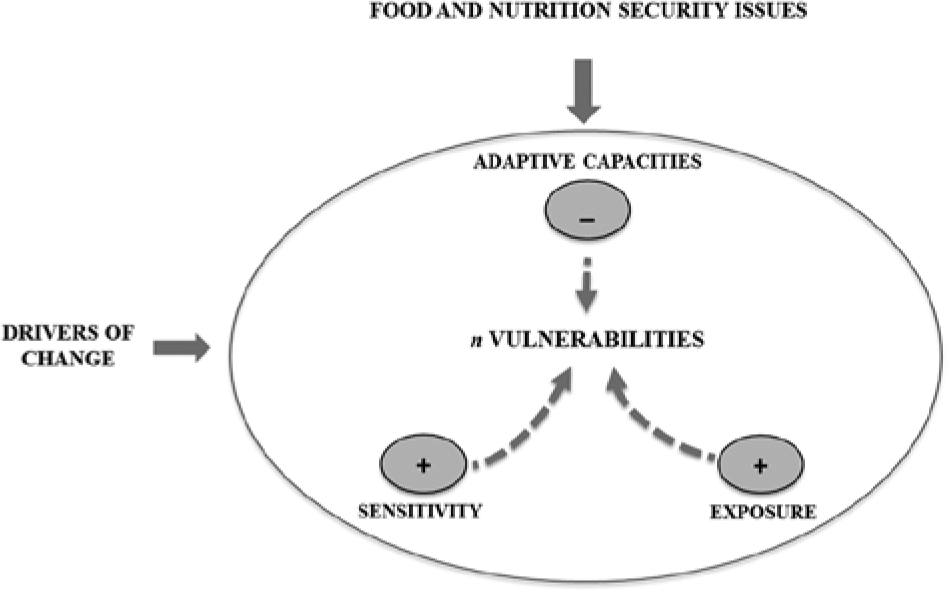
Calculation of vulnerability.
The order and the signs used for the methods of calculation of vulnerability define the relationships between the three components. However, in a metric-identifying approach, the indicators come from different sources and disciplines, and are expressed in different units of measurement. Index values then need to be standardized or normalized. In many cases (Cinner et al., 2012; The Economist Intelligence Unit, 2013; Hughes et al., 2012), data normalization is based on minimum and maximum values in the data set, and places on a scale from 0 to 1 (from 0 to 100 for the Global Food Safety Initiative [GFSI], 2012) using the typical normalization method “min-max” (Adger & Vincent, 2005; Organisation for Economic Co-Operation and Development[OECD], 2008):

In this formula, Xmin and Xmax are, respectively, the lowest and highest values for any given indicator. The normalized value is transformed from a 0 to 1 value to make it directly comparable with other indicators. This means that the indicator with the highest raw data value will score 1, whereas the lowest will score 0.
In the examples referred to, the indicator scores are normalized and then aggregated across categories to enable a comparison of broader concepts across countries. Normalization rebases the raw indicator data to a common unit, so that it can be aggregated.
Finally, in our specific case the n particular vulnerabilities will be calculated following this formula:
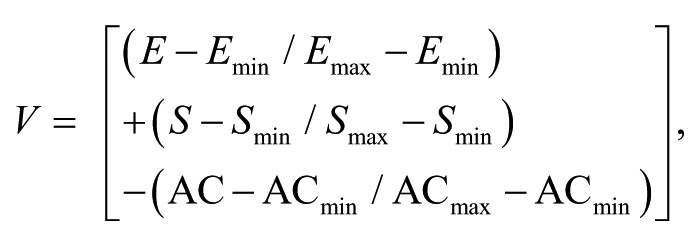
where V = vulnerability, E = exposure, S = sensitivity, and AC = adaptive capacity.
Another issue that has to be considered is the quantitative relevance, or weight, that is associated with the different components. Different metric systems often rely on equal weights, leaving to policymakers, practitioners, and stakeholders the opportunity to apply a goal- or priority-oriented weighting system (The Economist Intelligence Unit, 2013; Hammond, Keeney, & Raiffa, 1999; McClanahan et al., 2008; Saaty, 1986).
Based on this approach, it would be possible to rank the Mediterranean countries in relation to their exposure, sensitivity, and adaptive capacity vis-à-vis changes affecting agrofood systems in their food and nutrition security outcomes.
Discussion of the Approach
Metrics, Analysis, and Prospective
The vulnerability approach stresses the need for methods and metrics that do not just express final results or outcomes, but provides a system of information that can be interpreted in a dynamic framework modeling interactions between different drivers. In particular, the vulnerability framework can be disaggregated in several dimensions according to the different drivers of change considered: vulnerability to climate change, vulnerability to price volatility, vulnerability to demographic transformations, etc. The integrated fragmentation of the broad vulnerability into specific vulnerabilities represents a response to the lack of causal factor analysis.
As mentioned above, each specific vulnerability can be further broken down into exposure, sensitivity, and adaptive capacity. However, both the sensitivity and adaptive capacity dimensions of the system have to be assessed according to specific outcomes or services provided by the food system that need to be maintained over time. For instance, access to food may be jeopardized in the short term by high food price volatility; however, food supply might not be affected in the same way or to the same extent. Thus, problematic issues or hotspots, related to the agrofood system and local context, need to be specified. Three stages of causal factor analysis can be established through the vulnerability framework. In a nutshell, the framework allows organizing evidence-based information and aiding decision-making by clarifying sequential dynamics, while allowing for prospective or forward-looking analysis.
Therefore, it is important to define issues and challenges of food security and sustainability before choosing assessment methods (Aubin et al., 2013). The qualitative identification of the problematic issues, and then of the variables to assess vulnerability, can be obtained through a hierarchical analysis (Rastoin et al., 2007), previous field observations (Cinner et al., 2012; Hughes et al., 2012), a literature review and expert consultation, and using statistical methods such as principal components analysis (Jolliffe, 1986).
The vulnerability framework can lead, for example, through participatory methods, to the identification of a system of indicators and appropriate metrics, offering a method to capture complexity and interconnectedness between phenomena (Dilley & Boudreau, 2001; Turner et al., 2003). Furthermore, as indicators inform action (Barrett, 2010), they are essential to establish the communicative link between science and policymakers. One essential aim of the vulnerability analysis remains in the identification of the response opportunities for decision-making (Dilley & Boudreau, 2001; Rastoin et al., 2007; Turner et al., 2003).
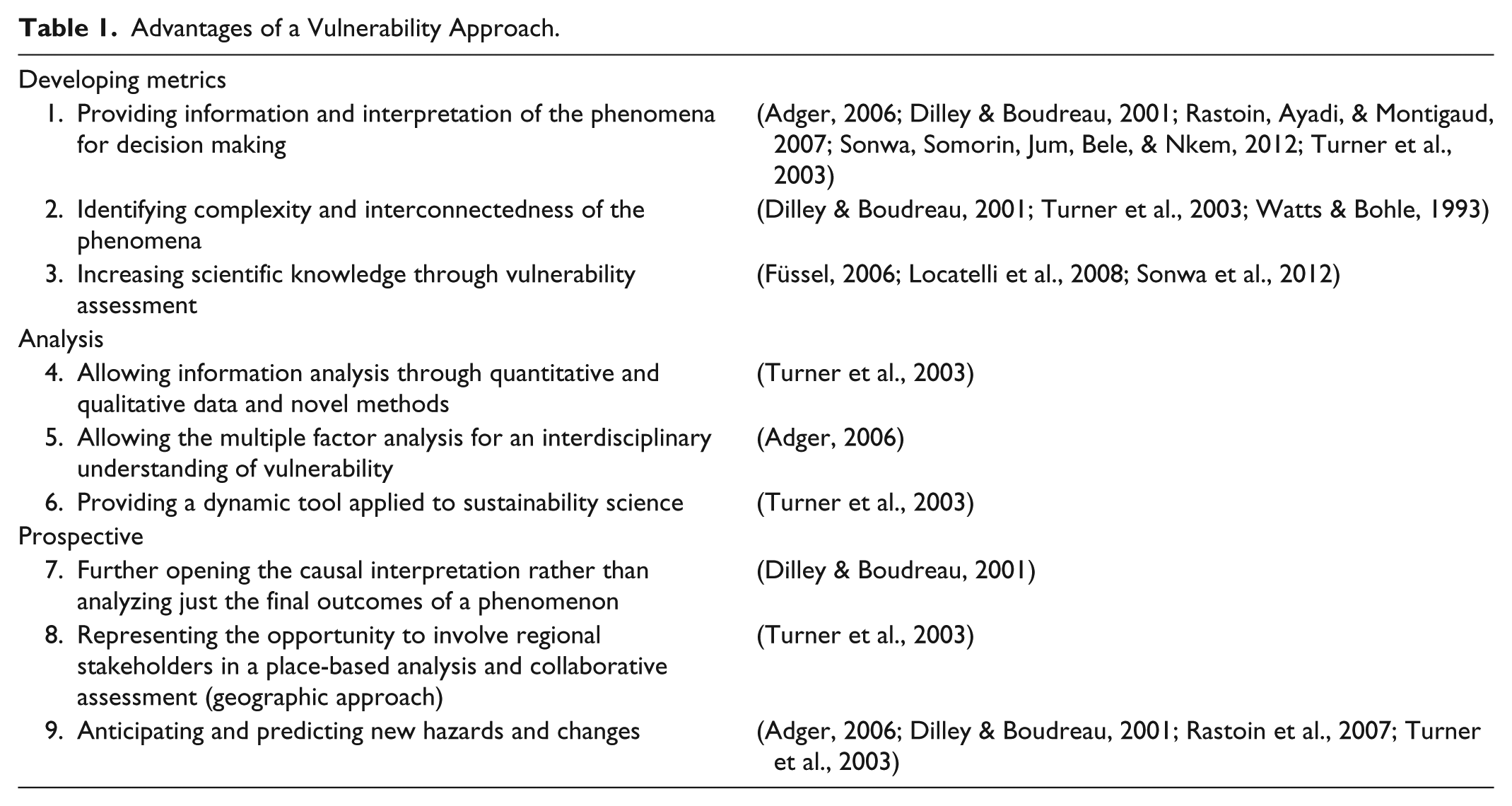
To summarize, several functions can be attributed to the vulnerability approach, such as a holistic and novel assessment framework and a dynamic tool for sustainability sciences; a geographical-based approach involving the participation of local stakeholders; a multiple factor analysis allowing interdisciplinary research on complex and systemic phenomena; a scheme to conceptualize and develop metrics, in a system of information and response opportunities for decision making; a methodology to draw evidence-based knowledge; a predictive framework to anticipate consequences of hazards and changes (Adger, 2006; Dilley & Boudreau, 2001; Füssel, 2006; Locatelli et al., 2008; Rastoin et al., 2007; Sonwa, Somorin, Jum, Bele, & Nkem, 2012; Turner et al., 2003; Watts & Bohle, 1993). The main advantages of a vulnerability approach to the analysis of sustainability of food system activities are summarized in Table 1.
Advantages of a Vulnerability Approach.
Identifying Issues and Dealing With Multidimensionality
Limits to this conceptual approach depend strongly on the level of accuracy of the application. The main risk is the lack of a genuine causal factors analysis that can be avoided by disentangling the multiple vulnerabilities and their components. Thus, one crucial element in the application of the vulnerability approach resides in the level of accuracy in defining the problematic issues that are, in our specific case, driven by nutrition and food security concerns of the agrofood system.
Furthermore, scholars and practitioners highly focused on one specific scientific discipline may be skeptical with regard to the large amount of variables. However, the development of a multidimensional metrics framework can open a stimulating scientific debate involving experiences from several disciplines and feed the scientific knowledge base. Indeed, as observed in sustainability science and resilience thinking, inter- and trans-disciplinary communication is strictly linked to problem solving—instead of puzzle-solving—and related to participative creativity instead of dogmatism (Strunz, 2012). So, the development of the framework aims to create a flexible tool that can be adapted and modeled (as for a weighting system) to different users’ and to different policy purposes related to nutrition and food security concerns. The involvement of the stakeholders is key to building up the framework and to assigning hierarchy to the indicators (Aubin et al., 2013).
In conclusion, this scheme provides a multidimensional vulnerability framework to jointly assess nutrition and food insecurity and unsustainability. Starting from a specific geographical region, it represents a tool for policymakers. The Mediterranean geographical area, as a physical space where several environmental, social and economic and nutrition hotspots of vulnerability persist over time, offers a first case of application. The last subsection presents an analysis of some representative interactions between drivers of change, and food and nutrition security issues, together with the description of the resulting exposure, sensitivity, and adaptive capacity.
Examples of Application
Application of the vulnerability assessment framework requires specifying the context and the issues of concern. These can be identified by literature review or participative expert consultation. The analysis of each specific issue or hotspot of vulnerability (of a given geographical area) allows us to establish from which point of the causal sequence of phenomena, the components of exposure, sensitivity, and adaptive capacity can be applied.
For the sake of illustration, we provide three examples of how to apply the vulnerability model to the specific geographical Mediterranean region. Given the nutrition and food security-driven perspective of this work, three main issues critical to the food system, namely supply, accessibility, and nutritional value, are assessed, considering the three components of vulnerability. Each issue is analyzed against three different landscape drivers of change, respectively, climate change, price volatility and nutritional transition and changing consumption patterns. This selection of driver/issue combinations, restricted to three for the sake of illustration, does not presume that the drivers cannot have impacts on several issues.
Food supply–related vulnerability to climate change
National food supply rests on food production, stocks, and imports (minus exports). It relies also on quantities used from feed, seeds, and transformation. Depending on the agrofood policy strategies and on their financial system conditions, a national food system can be vulnerable because of several factors or drivers affecting food supply. The conceptual model provides an approach that develops a series of questions. A pertinent question can be the following: To which extent are the Mediterranean countries vulnerable to climate change to supply sufficient food commodities?
Given the crucial issue around water supply in the Mediterranean region, geographic indicators of the availability and quality of water can be considered a relevant measure of the exposure of a national (or a subnational) food system to climate change in terms of provisioning of food. Consequently, sensitivity to this exposure can be expressed according to the specific level of consumption of water-demanding commodities by the households or the agroindustry. In response, agrobiodiversity could be an indicator of adaptive capacity to climate change, based on the assumption that biodiversity increases the stocks of crop material to draw upon to select or develop more drought-resistant crops. Ability to import from less exposed agricultural systems to climate change might be another indication of adaptive capacity.
Food accessibility–related vulnerability to international price volatility
Food accessibility involves both physical access and affordability for individuals to adequate resource of food. A research question that emerges can be the following: To which extent are the Mediterranean countries vulnerable, considering their economic constraints, biophysical conditions, and social habits, in their access to adequate food in the face of high price volatility? Given the high cereal import dependency of some Mediterranean countries (for human consumption, industry demand, and animal feeding), exposure could be assessed by considering the caloric share of cereals in a representative household’s food basket: The more cereals consumed, the higher the exposure for import-dependent countries. Price elasticities for cereals might offer a proxy for countries’ sensitivity to fluctuating international cereal prices. Conversely, analyzing food consumption patterns, and households’ capacity to shift toward cheaper or locally available food, while meeting the same caloric and nutritional requirements, may indicate strong adaptive capacities. Cross-price elasticities illustrate substitution possibilities. Countries can enhance this adaptive capacity by implementing food policies that diversify supply sources, by acting directly on food prices (e.g., subsidies), by providing social nets for the population (e.g., food stamps) or promoting diversity in consumption patterns.
Nutritional quality–related vulnerability to nutritional transition and changing consumption patterns
Utilization encompasses all the factors related to how food is consumed and involves quality elements. In a nutrition-driven approach, we consider also nutritional values of foods and adequacy of diets to nutrient recommendations. Therefore, the research question in our specific context can be the following: In which way and to which extent are the Mediterranean countries vulnerable, considering nutritional value and nutrient adequacy, to nutritional transition and changing consumption patterns?
Over the past 50 years, the Mediterranean region has undergone important structural demographic and spatial transformations with an increasing share of its population now located in urban centers. Urbanization trends can be suggested as a proxy for exposure to changing food consumption habits, on the assumption that urban and rural consumption patterns are significantly different. Correlated with urbanization, industry and labor structures can be selected to indicate to which extent Mediterranean countries are exposed to nutritional transition. Subsequently, countries and populations manifest sensitivity to these exposures with critical data on the prevalence of health problems directly related to diet, such as obesity or cardiovascular diseases. Governments, policymakers, and individuals can implement a set of tools to enhance adaptive capacity, such as ensuring an efficient health system, improving education and promoting food and healthy eating and lifestyle habits, guiding consumption patterns, and raising awareness on these issues within institutions and the private sector.
Conclusion
While securing food security is considered a global priority, there is a contemporary widespread consensus about the importance of sustainability as a goal for food systems. This article provides a conceptual hierarchical framework for modeling the complex relationships between food and nutrition security and sustainability. It initially analyzed the internationally acknowledged concepts of sustainable development and food security, describing the interconnectedness between them that recent notions such as sustainable food security or sustainable diets try to capture.
Relying on an approach of the concept of sustainability as a system property allowing a desirable state to be “sustained” over generations, assessment methodologies should reflect the conditions of a system from a holistic and dynamic perspective. Calling on elements from the vulnerability and resilience literature, the proposed framework sequentially disentangles the exposure, sensitivity, and copying/adaptive capacities of a specific food system to identified stressors or drivers of change jeopardizing critical food and nutrition security outcomes.
This approach entails also the assessment of sustainability with regard to a suitable temporal and spatial scale. Drivers affecting the sustainability of the food systems have multiple origins. The proposed framework hierarchically clarifies the different scale at which drivers and issues interact in a circular way with feedback loops. While suitable for expressing the global food-related concerns of a geographical region, it points out the need for assessment tools adapted to context-specific questions. Main data and general insights of the situation of the Mediterranean region help underline the main critical issues related to food and nutrition security facing the agrofood system in the region.
A quantitative method is proposed for assessing sustainability of food and nutrition outcomes by means of a precise correlation between the three components of exposure, sensitivity, and adaptive capacities, which can ultimately be aggregated in a composite index. The joint assessment of food insecurity and unsustainability can be expressed through the language of vulnerability and resilience, as the degree to which a system is exposed and sensitive to dynamic phenomena, while considering its capability to respond and adapt. This approach provides the concepts fundamental to the development of potential indicators or metrics of sustainable diets and food systems, whose primary goal is to ensure food security and good nutrition for a healthy and active life.
Footnotes
Authors’ Note
P.Prosperi and T. Allen are first co-authors.
Declaration of Conflicting Interests
The author(s) declared no potential conflicts of interest with respect to the research, authorship, and/or publication of this article.
Funding
The author(s) disclosed receipt of following financial support for the research and/or authorship of this article: . Paolo Prosperi is a PhD student funded by a University of Catania scholarship and a Franco-Italian University complementary scholarship (Grant number: C2-19). Bruce Cogill and Thomas Allen’s work was supported by The Daniel & Nina Carasso Foundation (Grant number: 00030240) and the Agriculture for Nutrition and Health Research Programme of the CGIAR .