




Abstract
The convenience and pervasiveness of smartphones have created an environment where teacher–parent communication can be easily fostered through mobile apps. The current study aims to explore the role of instant messaging apps in teacher–parent communication. Social capital and the uses and gratifications theory were used to develop a theoretical model. The survey collected 429 valid questionnaires. The findings show that both bonding and bridging capital have a positive influence on constructs including sociability, entertainment, communicatory utility, and emotion. Entertainment, communicatory utility, and emotion have a positive influence on the willingness to use Line as a teacher–parent communication tool. The implications for the extension of communication theory and practice are discussed in the current study.
Introduction
Traditional teacher–parent communication relies on two methods: verbal communication occurs when children are being collected from school, parent–teacher conferences, and phone calls, whereas written communication entails newsletters, communication logs, and notice boards (Knopf & Swick, 2008). Both types suffer from inherent limitations, which result in insufficient communication. The pervasiveness of smartphones paves the way for easing such limitations, nevertheless, close relationships and constant communication between teachers and parents can still change their social relationships in either a positive direction or negative direction. In Taiwan, conventional teacher–parent communication shows some similarities with most other countries, which occurs through either face-to-face or contact books (a written text-based log for teacher–parent communication), and both ways provide little room for gossip or irrelevant information. The use of Line, a smartphone app, facilitates closer integration, because it develops continual and uninterrupted connections between teachers and parents. It is especially significant because the average number of children in a family is lower than before so parents invest much time and effort in their children’s education. Improved teacher–parent communication has been proven effective in boasting children’s academic performance (Topor, Keane, Shelton, & Calkins, 2010), and therefore, anytime and anywhere teacher–parent communication has become a reality. Line is an instant messaging app that has been embraced by Japan, Taiwan, Thailand, and Indonesia, and these four countries contribute 67.3% (169 million) of its total monthly active users (Smith, 2018). In Taiwan, the penetration rate of Line is 94%, or around 18 million weekly active users; intriguingly, more than 90% of people in the age group over 40 are reported to be active users. The most frequent activities on Line are daily conversations (96%) and work discussions (53%) (Nielsen, 2016, 2017) Similar to other instant messaging apps (IM apps) that combine synchronous and asynchronous communication (Avrahami & Hudson, 2006), Line mainly facilitates one-to-one dialogue as well as group discussions or group chats. Meanwhile, the multimedia features in IM apps make it attractive to smartphone users (Ku, Chu, & Tseng, 2013) and Line provides these services as well. The communication on Line is based on written text, and various services, such as emoticon-like stickers, voice messages, notes, and photo and video sharing, are offered for users to enhance their communication experience. Given the high penetration of Line, a social norm has developed whereby Line is used to communicate with friends, family members, and coworkers in Taiwan. Given this situation, teacher–parent communication captured the attention of the researchers, because this kind of relationship is a combination of work relations and casual social relations.
Line facilitates to develop specific social relationships between teachers and parents in Taiwan. Through informal inquiries with teachers, it was established that teachers and parents are required to interact on Line as a semi-compulsory social norm because teachers and parents usually create a group chat for the whole class to make announcements, which are mostly initiated by teachers. Using Line as a teacher–parent communication tool is not limited to dialogue between teachers and parents; it also leads to the formation of online communities. Parents can share their personal photos and feelings on the chats to seek others’ attention. Yet Line chats have also become a channel to circulate misinformation and create misunderstandings. Even though teachers and parents accept some norms and rules in using Line chats, disagreements and quarrels sometimes occur. Furthermore, a small number of parents and teachers can create private chats to develop close relationships. The diversity of patterns of use helps to develop a variety of relationships among parents and teachers and can, therefore, raise issues about the interaction between teachers and parents, conversation among parents, and development of relationships.
Teacher–parent communication has received significant attention from scholars, and most findings emphasize the importance of such communication in fostering student achievement (Michael, Dittus, & Epstein, 2007; Telem & Pinto, 2006; Topor et al., 2010). Although scholars generally agree on the positive influence of frequent communication between teachers and parents, some disadvantages have been identified. For example, Ho, Hung, and Chen (2013) noted that conflicts between teachers and parents can be more complicated than normal social relationships owing to differences in beliefs and incomplete information. With the rapid development of digital technology, the need for changing teacher–parent communication tools has been recognized by parents (Nitza & Roman, 2017). In fact, smartphones are deemed an effective tool to foster mutual information exchanges that go beyond the usual limitations (Kang & Cho, 2014). Studies have attempted to examine the use of smart devices in teacher–parent communication; they focus on intentions to use (Chena & Chena, 2015), attitudes toward use (Ho et al., 2013), the contribution of smart devices (Kang & Cho, 2014), and user preferences (Palts & Kalmus, 2015). Most research expresses approval of the advantages of using smart devices as teacher–parent communication tools; however, the change of social relationships between teachers and parents in the use of new technology has received little attention. Hence, the current study proposes questions “What new social relationship structures between teachers and parents have emerged in using Line as a communication tool?” and “what factors drive teachers and parents to develop online social relationships in using Line as a communication tool?”
To answer this question, the current study attempts to integrate social capital and the uses and gratifications theory (UGT) into the research model. Because the use of IM applications helps to bring real-world relationships to the sphere of the web (McKenna, Green, & Gleason, 2002), social capital, including bridging and bonding forms of capital (Putnam, 2000) that refer to relationships among individuals, can be used to explain the interaction in teacher–parent communication. In addition, UGT is widely adopted to examine the use of the Internet; the current study views the use of Line as an Internet tool. The current study will first introduce social capital and UGT. Constructs from these theories are then used to establish the theoretical model, followed by an explanation of the development of the scale and data collection process in the methods section. The article concludes with a discussion of the findings.
Literature Review
IM apps serve as a channel to maintain and develop personal relationships through intimate and private ways of communication (Karapanos, Teixeira, & Gouveia, 2016; Quan-Haase & Young, 2010). With regard to IM app tools, previous studies focused on WhatsApp (Ahad & Lim, 2014; Aharony & Gazit, 2016; Karapanos et al., 2016; Rosales & Fernández-Ardèvol, 2016; Sánchez-Moya & Cruz-Moya, 2015) and WeChat (Gan & Wang, 2015), whereas Line has rarely received attention from scholars. Moreover, although scholars view smartphones as an effective tool for teacher–parent communication (Kang & Cho, 2014), and understanding these kinds of relationships can be helpful both theoretically and practically, relevant research remains scarce.
IM apps, such as Line, facilitate interactions and the development of social relationships online, which suggests the connection between social capital and IM apps (Lin, 2011). Social capital provides insights into the examination of social relationships, because social capital refers to individuals’ relationships with others that enable them to use various resources to gain benefits (Bourdieu & Wacquant, 1992). Meanwhile, IM apps are usually viewed as a type of social media (boyd & Ellison, 2008). When connecting social media and social capital, scholars usually examine their relationships in political participation (de Zúñiga, Barnidge, & Scherman, 2017; Gil de Zúñiga, Jung, & Valenzuela, 2012; Hwang & Kim, 2015), organizational communication (Bharati, Zhang, & Chaudhury, 2015; Sun & Shang, 2014), community development (Matthews, 2016), customer relationships (Gvili & Levy, 2018), and even communication in a specific profession, for example, physicians (Hanzel et al., 2018). Meanwhile, if the topic is relevant to communication between individuals, social capital is usually linked to well-being (Chen & Li, 2017; Chong, Zhang, Mak, & Pang, 2015; Kim & Kim, 2017) and privacy issues (Chen, 2018). Teacher–parent communication has received little attention from scholars, although social capital between teachers and parents is worthy of exploration. This kind of communication is part of teachers’ job description, and communication with parents is inevitable while parents would presumably like to develop friendly relationships with teachers. Hence, social capital is included in the current study.
Social Capital
Social capital refers to “the sum of the resources, actual or virtual, that accrue to an individual or a group by virtue of possessing a durable network of more or less institutionalized relationships of mutual acquaintance and recognition” (Bourdieu & Wacquant, 1992, p. 14). That is, an individual’s relationships with others are able to use resources that can be used to gain economic and noneconomic benefits (Aharony, 2015). Putnam (2000) further developed social capital with the subcategories: bridging and bonding capital. Bridging capital refers to people’s connections which allow the exchange of information, although the emotional element is scarce (Williams, 2006). This form of capital works to create “weak ties” in the social network and can be found between different ethnic, occupational, or socioeconomic groups (Carter & Maluccio, 2003). Bonding capital refers to the “strong ties” that are usually found between people with close emotionally bonded relationships, such as family and friends (Putnam, 2000). Bonding capital helps individuals to gain social and emotional support, and access scarce resources (Ahn, 2012). In other words, bonding capital reinforces the relationships between people as well as helping to access personal resources.
In using Line for teacher–parent communication, bridging capital plays a role in facilitating information flow between teachers and parents, because individuals may share new information with the network through it (Vitak, Ellison, & Steinfield, 2011). When a teacher–parent Line chat includes multiple members, it forms a sphere where interaction from many-to-many others occurs, and the relationships among members become dynamic. The exchange of information, especially that relevant to their children, holds significance for members. Also, for parents who join a Line chat for teacher–parent communication, this represents a new connection beyond their existing personal relationships network, hence the bridging capital. Meanwhile, the variety of Line chats allows teachers and parents to create chats where one-to-one communication and small groups of teachers and parents exist simultaneously. In other words, intimate conversations not only create a privacy sphere but also help teachers and parents to develop close relationships, which reflects the formation of bonding capital. Social capital helps to explain the social relationships between teachers and parents in using Line as a communication tool, while the use of Line per se can be viewed as people using a medium. In explaining the motivations of users in using a medium, the current study introduces UGT to explain the use of Line in teacher–parent communication.
Uses and Gratifications
From a user-centered perspective, UGT aims to identify the social and psychological motives that drive an individual user to use a certain medium (Leung & Wei, 2000). It aims to explain individuals’ choice of behavior among the various media available to gratify their needs (Katz, Blumler, & Gurevitch, 1973). UGT allows researchers to understand gratifications, including entertainment and relaxation, social interaction and reward, and knowledge enhancement (Ko, Cho, & Roberts, 2005). Media gratifications have been categorized by scholars into three types: content gratification based on media content, process gratification based on the experience of using the medium, and social gratification based on social interactivity through media (Stafford, Stafford, & Schkade, 2004). In addition to traditional mass media, UGT has been used to examine communication via the Internet and social media (Ha, Kim, Libaque-Saenz, Chang, & Park, 2015; Lee & Ma, 2012; Wei, 2008).
Unlike mass media, the provision of content on Line plays a less significant role because IM apps aim to facilitate communication between individuals. People can use Line as a tool to convey news stories, gossip, or information, but from a traditional perspective, teacher–parent communication rarely emphasizes this. Line chats have developed a new form of teacher–parent communication because of their social characteristics. Teachers and parents, but mostly the latter, can share whatever they wish to through chats, which has transformed sole purpose teacher–parent communications into multiple purpose communications. In fact, for parents and teachers, Line is effective in exchanging gossip about their families and schools, because it allows private conversation between individuals. Relevant research shows that these factors comprise types of gratifications, including social interaction and sociability (Ku et al., 2013; Quan-Haase & Young, 2010), entertainment (Ko et al., 2005), communicatory utility (Whiting & Williams, 2013), affection and emotion (Quan-Haase & Young, 2010), pastimes, fashion, sharing problems, and social information (Dolan, Conduit, Fahy, & Goodman, 2016; Lo & Leung, 2009). Based on the situation of using Line in teacher–parent communication in Taiwan, the current study focuses on the factors of sociability, entertainment, communicatory utility, and emotion.
Research Model and Hypothesis Development
Social Capital and UGT
Based on the observation made by researchers, teachers and parents in Taiwan choose Line as one of the most efficient mobile apps with which to communicate, and the patterns of communication can be divided into one-to-one dialogue and many-to-many chats. Parents have the autonomy to create and invite certain parents and even teachers to join their closed chats. That is, many subgroups can be formed, and these relationships among teachers and parents involve bonding and bridging capital. Also, the functionality of Line allows users to link their real-life friends as well as to develop virtual relationships with new people. Ellison, Steinfield, and Lampe (2007) found that social capital plays a significant role in obtaining social gratifications while Syn and Oh (2015) confirmed that gratifications mainly involved social and emotional support from members. The social relations between teachers and parents in using Line involved bonding and bridging capital, which are forms of social capital; as social capital has a positive influence on gratification, Hypothesis 1 was developed.
The positive relationship between users’ gratifications and willingness to use the Internet has been proven in previous studies (C. Xu, Ryan, Prybutok, & Wen, 2012); thus, Hypothesis 2 was developed:
Based on the main hypotheses, the theoretical framework is demonstrated in Figure 1.
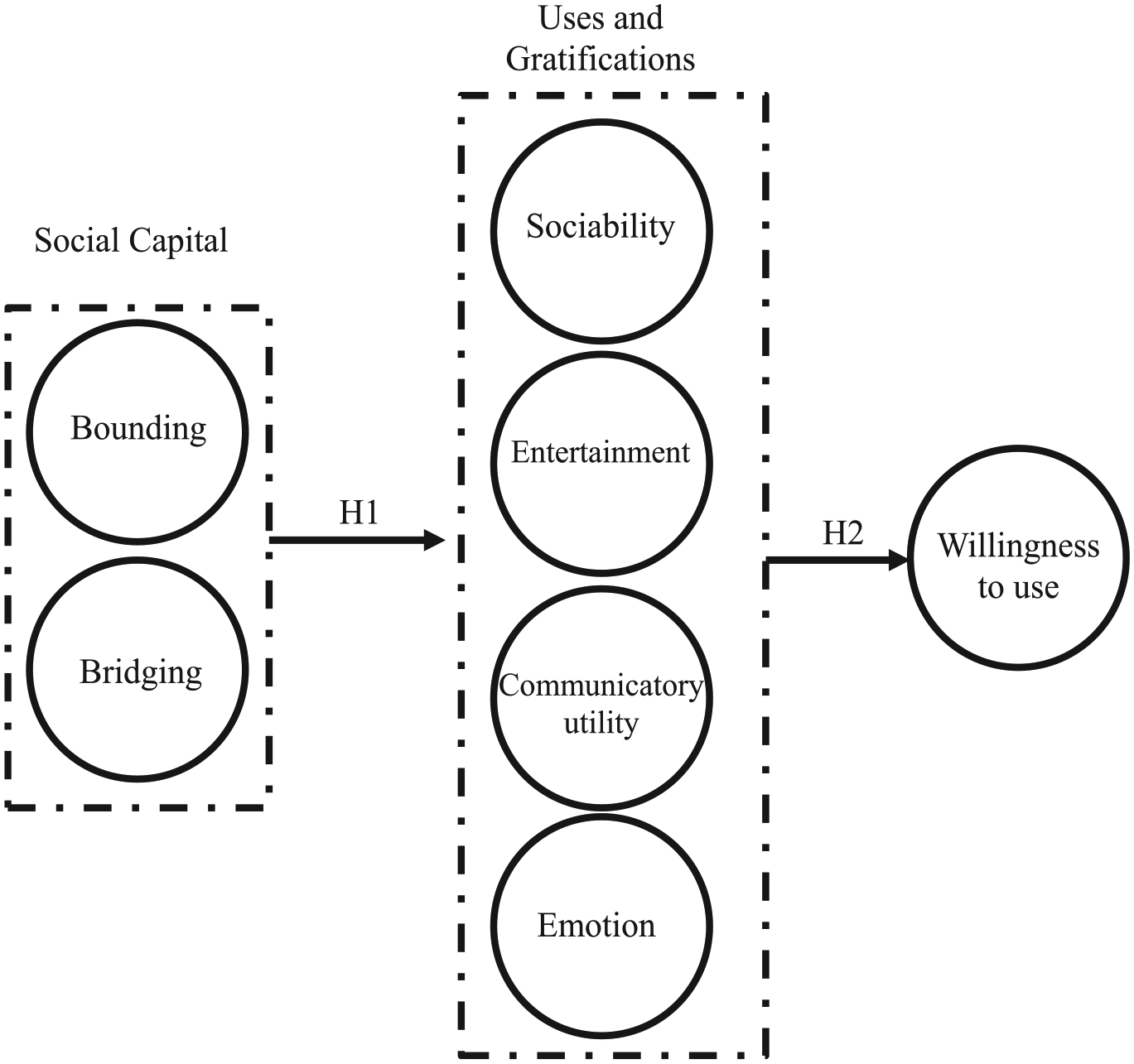
The theoretical framework of the study.
Social capital involves two constructs (bonding and bridging), and gratification contains four constructs: sociability, entertainment, communicatory utility, and emotion. When discussing the use of IM apps, Soliman and Salem (2014) view sociability as an important factor influencing user perception, as people use communication tools to help them feel closer to their friends and family members as well as to care for others (Leung & Wei, 2000; Venkatesh & Davis, 2000). Through using Line, parents actively communicate with teachers and other parents as a means of caring for their children; hence, sociability ought to play a role in this process. Another construct, namely communicatory utility, is similar to sociability, but it is used to examine how the app facilitates communication (Whiting & Williams, 2013). Communicatory utility was used here to examine the gratification induced by social media, but Gan and Wang (2015) use this construct to examine the use of IM apps. Zhao, Tang, Liu, and Liu (2016) found that social capital has a positive influence on socializing, which entails the constructs of sociability and communicatory utility. Meanwhile, F. Xu, Michael, and Chen (2013) found that social capital helps people to disclose aspects of themselves online, a practice that also requires sociability and communicatory utility. Thus, the subhypotheses are divided into H1a and H1b to distinguish between bonding and bridging capital and the hypotheses are as follows:
As for constructs such as entertainment and emotion, these two factors were widely used in UGT. Specifically, Ahn (2012) found that bonding capital leads to emotional support. Although Ahn emphasized bonding capital, the current study views bridging capital as a form of social capital that ought to be examined because links between bridging capital and emotion have been identified (Patulny & Svendsen, 2007). In addition, entertainment leads to gratification in the use of IM apps (Lo & Leung, 2009). Hence, the hypotheses regarding social capital and entertainment as well as emotion are as follows:
Based on the UGT and relevant empirical studies, gratifications ought to positively influence the willingness to use Line (Ha et al., 2015; Ku et al., 2013). In other words, the perception of gratifications by teachers and parents plays an influential role in determining their intention to use Line as a teacher–parent communication tool. Thus, the following hypotheses were formulated.
Research Methods
Measurement
A social capital scale for bonding and bridging capital was adopted from Williams (2006) and modified to fit the teacher–parent communication environment. The uses and gratifications scale includes four constructs: entertainment, emotion, sociability, and communicatory utility. Entertainment refers to enjoyment and relaxation, and was adopted from Papacharissi and Mendelson (2010) and Smock, Ellison, Lampe, and Wohn (2011). Sociability refers to creating and maintaining relationships through communication and was adopted from Quan-Haase and Young (2010). Emotion refers to providing help and showing concern for others, and the concept was adopted from Quan-Haase and Young (2010). Communicatory utility refers to communication facilitation and was adopted from Whiting and Williams (2013) and Quinn (2016). The measurement of uses and gratifications was modified to fit the teacher–parent communication environment. All items (see the appendix) were measured with a 5-point Likert-type scale ranging from “strongly disagree” to “strongly agree.” To comply with the purpose of the current study, the phrasing has been modified and backward translations used to confirm the accuracy of the translation from English to Chinese and then back into English.
Data Collection
The current study aims to explore the behavior and perception of parents in using Line as a teacher–parent communication tool; the demographic characteristics of these potential participants tend to be specific. This study is based on Jensen’s (2002) suggestion to purposively select potential participants because this is an effective means of reaching those who can be helpful. Hence, snowball sampling was used to reach potential participants, and the researchers distributed the questionnaire through Google Forms. The researchers first sought teachers from both elementary and junior high schools to distribute the Google Forms’ link to parents. Second, after the parents finished answering the questionnaire, the teachers asked these parents to share the link with friends who are also parents. The procedure was repeated until a sufficient sample was collected, which means the frequency of using Line as a teacher–parent communication tool should reflect a normal distribution. The time period for distributing the questionnaire was the month of March 2017 and the total number sampled was 713. A filter question was designed to distinguish users from nonusers. After eliminating 284 questionnaires in which parents did not use Line as a teacher–parent communication tool, the valid sample was 429, which consisted of 25.9% males (n = 111) and 74.1% females (n = 318). The gender distribution of participants was regarded as acceptable, because mothers usually play a more active role in teacher–parent communication. In terms of participants’ children, 49.2% (n = 211) had children in elementary school, 23.5% (n = 101) had children in junior high school, and 27.3% (n = 117) had children in both elementary and junior high schools. This fits our understanding that parents spend much time on communicating with teachers when their kids are younger. With regard to using Line to communicate with teachers, 8.6% (n = 37) of parents communicated daily, 26.8% (n =115) several times a week, 35.7% (n = 153) several times a month, and 28.9% (n = 124) once every few months. The frequency of using Line shows that the majority of participants regularly communicated with teachers on Line. With regard to the devices parent used to communicate with teachers, 94.4% (n = 405) used smartphones, 2.1% used desktops (n = 9), 1.4% used laptops (n = 6), and 2.1% used tablets (n = 9).
There are some limitations of data collection here. First, the sampling process basically relies on a snowball sample whereby participants fill in the questionnaire because of an online approach. Nevertheless, a number of participants (284) were excluded, which means they either do not use Line for teacher–parent communication or they chose not to answer the questionnaire. Second, the current study focused solely on Taiwanese parents and teachers. Line has been widely embraced by Taiwanese users, and its functionality distinguishes it from other IM apps; however, a geographical limitation exists. Hence, the current study specifically aims to explain the use of Line between teachers and parents in Taiwan, and seeks to understand the change of their social relationships.
Results
The current study uses partial least square structural equation modeling (PLS-SEM) to test the hypothesized model with the help of SmartPLS 3.2.7 software. The reliability of items was tested through an exploratory factor analysis and, following Fornell and Larcker (1981), the values of average variance extracted (AVE) were higher than 0.50, as were composite reliabilities (CRs); Cronbach’s α values were greater than .70, which indicated that reliability and validity were acceptable. First, the current study performed the factor analysis by using SmartPLS and found that the construct of bonding capital failed to pass the test. Therefore, three items of the construct were removed: BD1, BD3, and BD9. BD3 (“There are no teachers or parents that I feel comfortable talking to about intimate personal problems”) and BD9 (“I do not know teachers or parents well enough to get them to do anything important”) are reversed statements; however, BD1 (“There are several teachers or parents I trust to help solve my problems”) is in the form of a positive statement. After removing these three items, construct reliability and validity achieved the values shown in Table 1. All CRs and Cronbach’s α values were above .80, while the values of AVE were above 0.50, which means that reliability and validity were acceptable. Construct discriminant validity is shown in Table 2 and was used to evaluate whether the constructs were accurately reflected in the statements.
Measures of Construct Reliability and Validity.
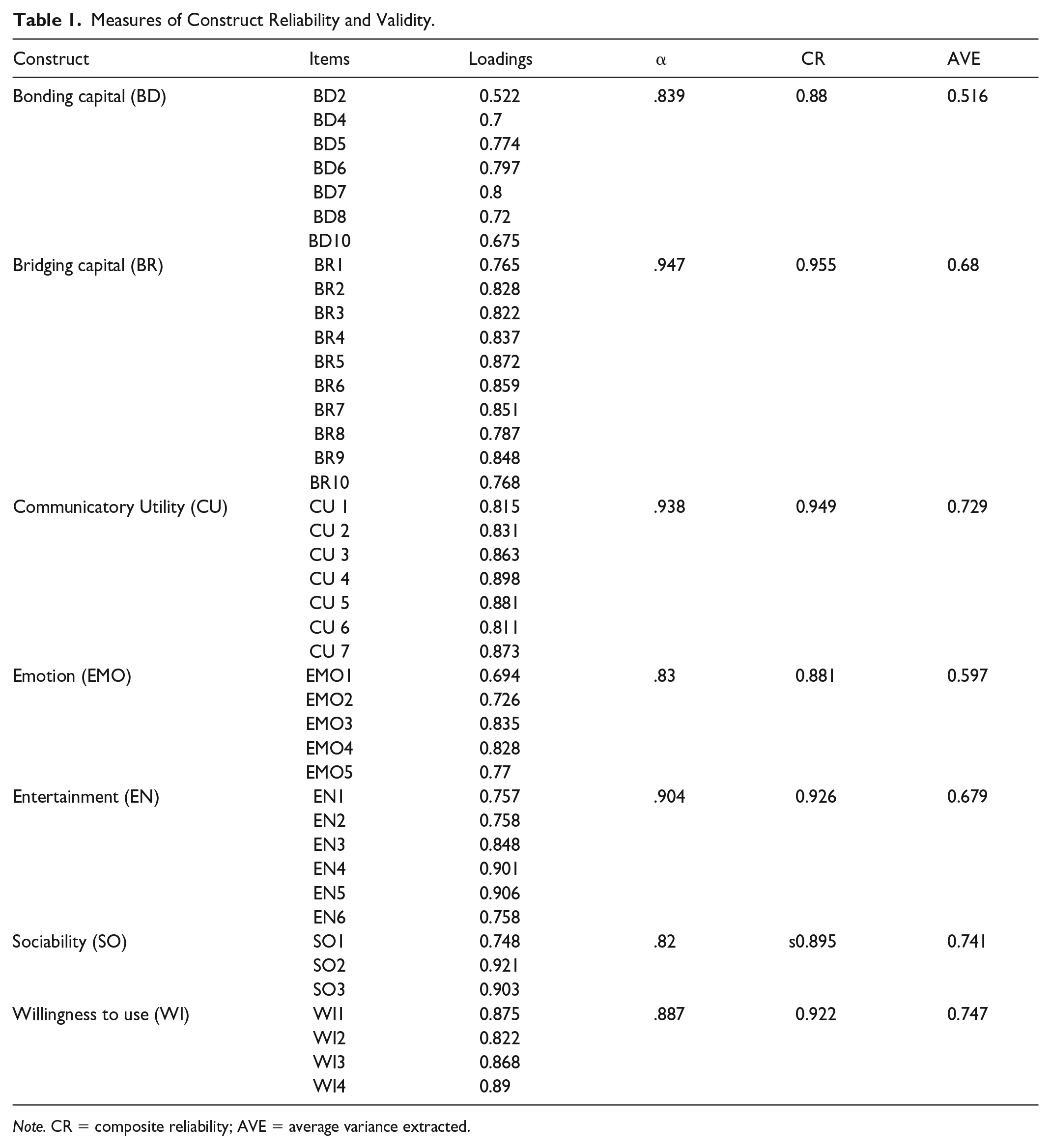
Note. CR = composite reliability; AVE = average variance extracted.
Construct Discriminant Validity.

Note. BD = bonding capital; BR = bridging capital; CU = communicatory utility; EMO = emotion; EN = entertainment; SO = sociability; WI = willingness to use.
The Structural Model
A bootstrapping procedure with 5,000 samples was conducted to test significance, based on the argument that the sample size ought to be at least 500 (Wetzels, Odekerken-Schroder, & van Oppen, 2009). This sample size helps to generate path estimates and t-statistics in determining the hypothesized relationships (Figure 2).

Results of the study.
According to the results, almost all hypotheses were supported by the empirical data, except for H2-1. Regarding the relationships between bonding capital and gratification, the hypotheses were all supported by the results. H1a-1, which refers to a positive relationship between bonding capital and sociability, was confirmed (β = .165, t-stat = 2.952); H1a-2, which refers to the positive influence bonding capital has on entertainment, was confirmed (β = .408, t-stat = 7.459); H1a-3, which states the positive relationship between bonding capital and communicatory utility, was confirmed (β = .179, t-stat = 2.983); and H1a-4, which refers to the positive influence of bonding capital on emotion, was confirmed (β = .179, t-stat = 3.537). For the relationships between bridging capital and gratification, relevant hypotheses were also confirmed. H1b-1, which refers to bridging capital, was confirmed to have a positive impact on sociability (β = .324, t-stat = 5.572); H1b-2, which refers to bridging capital, was confirmed to have positive relationship to entertainment (β = .252, t-stat = 4.602); H1b-3, which refers to bridging capital, was confirmed to have positive influence on communicatory utility (β = .243, t-stat = 3.263); and H1b-4 asserting a positive relationship between bridging capital and emotion was confirmed (β = .398, t-stat = 6.126).
With regard to the relationships between gratification and willingness to use Line as a teacher–parent communication tool, not all hypotheses were supported by the evidence. H2-1, which refers to sociability, did not have a positive influence on willingness to use Line and was rejected (β = .026, t-stat = 0.56) although H2-2, which anticipated entertainment’s positive influence on willingness to use Line, was supported (β = .281, t-stat = 6.411). H2-3, which referred to a positive relationship between communicatory utility and willingness to use Line, was confirmed (β = .491, t-stat = 10.721); and H2-4, which referred to emotion having a positive relationship with willingness to use Line, was supported (β = .160, t-stat = 3.909).
Summary of Path Estimates and Support for Hypotheses.

Note. BD = bonding capital; SO = sociability; EN = entertainment; CU = communicatory utility; EMO = emotion; BR = bridging capital; WI = willingness to use.
t > 1.645. *t > 1.96. **t > 2.58. ***t > 3.29.
p < .1. *p < .05. **p < .01. ***p < .001.
Discussion and Conclusion
Regardless of whether contact books, telephone or face-to-face were used, traditional teacher–parent communication tended to involve one-to-one dialogue; however, the prevalence of this pattern has greatly decreased owing to the introduction of smartphone apps. This change not only refers to the shift in communication media but also the modification of social relationships. In one-to-one dialogues, the social relationships between teachers and parents are linear and the sole focus of conversation is the child. When IM apps, and particularly Line, replace one-to-one dialogue, various types of interaction occur simultaneously.
The set of hypotheses in H1a refers to the relationships between bonding capital and gratification, and the evidence confirms this set of hypotheses. The result reflects the findings of Ellison et al. (2007) and Syn and Oh (2015). As some private Line chats only allow a few parents and teachers access, their topics of discussion are not limited to the children involved but also include other aspects of daily life. Their close relationships represent the bonding capital which drives their gratifications in using Line. The results show bonding capital has a positive influence on entertainment and emotion because of the disclosures concerning their daily life, including gossip about it. Intriguingly, sociability and communicatory utility tend to be influenced more by bridging capital than bonding capital; however, the evidence shows that bonding capital positively influences them as well.
Regarding bridging capital, the set of H1b hypotheses were all supported by the empirical evidence. Sociability and communicatory utility were positively influenced by the bridging capital, as found in previous studies (Zhao et al., 2016). Notably, Patulny and Svendsen (2007) stated that the relationships between bridging capital and emotion and between bridging capital and entertainment were unclear, but the current study has proven the positive relationships. Even though Williams (2006) viewed bridging capital as lacking depth because of its association with acquaintances, the current study found otherwise. Line chats that include all parents and teachers are usually focused on a specific school class, and the feeling of being associated with a class may help parents to generate emotional investment in the chat, regardless of whether they have close relationships with other parents.
In the set of H2 hypotheses, the results were as expected (Ha et al., 2015; Ku et al., 2013), apart from sociability. Sociability refers to users employing communication tools to feel a close relationship with friends and family members; however, in the case of using Line as a teacher–parent communication tool, the results show little relevance. A possible explanation may be that teachers and parents do not regard developing close relationships as a significant factor influencing their use of Line, because it is a necessary channel to communicate with other parents and teachers. However, entertainment, communicatory utility, and emotion can increase their willingness to use Line. Communicatory utility reduces the barriers to using Line, whereas entertainment and emotion help parents and teachers to use it more extensively.
Implications for Communication Theory and Research
The current study viewed social capital and UGT as applicable to the examination of teacher–parent communication, and the empirical data also supports this assumption. Furthermore, social capital as an independent variable in the examination of relationships between social capital and UGT provides insights for academic research. The interaction between social capital and UGT, especially the influence of social capital, helps to extend academic understanding. Because previous studies focused mostly on UGT, social capital was merely a dependent variable (e.g., Kwon, D’Angelo, & McLeod, 2013; Papacharissi & Mendelson, 2011; Phua, Jin, & Kim, 2017). Unlike social networking sites, teacher–parent communication through Line has formed a community in which membership is semi-compulsory. The role of social capital, including bonding and bridging capital, as an independent variable is worth exploring. The previous premises deemed that users gain gratifications and then develop their social capital, yet the findings of the current study suggest that social capital positively influences users’ gratifications. This indicates that social relations play a significant role in determining the use of IM apps. This provides a means by which scholars can reevaluate the causal relationships between social capital and UGT. In the case of teacher–parent communication, bonding capital and bridging capital can be enhanced through both offline and online approaches. Online, teachers and parents are obligated to develop their social capital through the exchange of messages, whereas in an offline mode, they can have physical interactions that also promote social capital. That is, gratifications obtained through using Line do not shape social capital; otherwise, social capital would be an independent variable influencing gratifications. The contribution of the current study is to confirm this causal relationship; it would further help scholars to consider social capital as an independent variable because both online and offline factors influence the use of social media.
Practical Issues Regarding the Results
Some issues arise when people use Line as a teacher–parent communication tool. For example, some parents engage in Line chats more actively than others; this results in a shift from teacher dominating the communication flow to parents dominating it. In fact, this kind of parent domination of teacher–parent communication was identified prior to the use of Line (Shoup, Gonyea, & Kuh, 2009). If the dominating parents misconceive a particular situation, teachers and other parents can easily become frustrated and further demotivated from actively participating in the chats. The findings of the current study provide some practical solutions to these issues.
In a class with 25 to 30 students, parents’ attitudes toward school affairs can be diverse and some parents feel they are compelled to join group chats. This explains why sociability has little influence on willingness to use Line as a teacher–parent communication tool. Intriguingly, constructs such as entertainment, emotion, and communicatory utility play a role in positively shaping their willingness to join. That is, even if some parents are reluctant to participate in group chats, they can be motivated through others increasing the incentives, which entail entertainment, emotion, and elements of communicatory utility. This implication is particularly significant because active parent participation helps in the development of teacher–parent communication.
Furthermore, social capital, including bonding and bridging capital, shapes the social relationships between parents and teachers. From the perspective of bonding capital, teachers and parents can form solid connections that help teachers lead the topics of their group chats without parental challenges because of the effect of strong ties. In addition, parents who are reluctant to become involved in the chats can be encouraged through bonding capital’s positive influence on emotions, entertainment, and communicatory utility; this can further increase their willingness to use Line in such contexts. From the perspective of bridging capital, group Line chats allow parents and teachers to expand their social networks and have easy access to information. In some cases, parents can exhaust teachers by constantly using Line to communicate without considering their boundaries, such as requiring them to respond immediately even at midnight. However, by using bridging capital, parents can shift their focus away from teachers to other parents to access relevant information. This contributes to shaping the perception of emotion, entertainment, and communicatory utility, and means that information exchange increases users’ willingness to use Line across social networks.
When putting the findings into practice, some approaches can be adopted to stimulate parents and teachers’ willingness to use Line chats. As social capital comprises both strong and weak ties, teachers can use weak ties to include parents into the Line chats: this would allow teachers to reduce the burden of one-to-one communication with parents. Meanwhile, strong ties can be used to create a solid connection with parents who are willing to actively participate, so that teachers can retain their control over teacher–parent communication. Based on the stimulation of social capital, parents can be encouraged to actively engage in the Line chats because the perception of entertainment, emotion, and communicatory utility is promoted. The findings of the current study suggest that it is possible to reduce the burden on teachers and to motivate parents toward active participation.
Footnotes
Appendix
Scales for the Current Study.

| Construct | Item | Source |
|---|---|---|
| Bonding capital | BD1. There are several parents or teachers I trust to help solve my problems. | Williams (2006) |
| BD2. There are parents or teachers I can turn to for advice about making very important decisions. | ||
| BD3. There is no parent or teacher that I feel comfortable talking to about intimate personal problems. (reversed) | ||
| BD4. When I feel lonely, there are several parents or teachers I can talk to. | ||
| BD5. If I needed an emergency loan of $500, I know parents or teachers I can turn to. | ||
| BD6. The parents or teachers I interact with would put their reputation on the line for me. | ||
| BD7. The parents or teachers I interact with would be good job references for me. | ||
| BD8. The parents or teachers I interact with would share their last dollar with me. | ||
| BD9. I do not know parents or teachers well enough to get them to do anything important. (reversed) | ||
| BD10. The parents or teachers I interact with would help me fight an injustice. | ||
| Bridging capital | BR1. Interacting with other parents or teachers makes me interested in things that happen outside of my town. | Williams (2006) |
| BR2. Interacting with other parents or teachers makes me want to try new things. | ||
| BR3. Interacting with other parents or teachers makes me interested in what people unlike me are thinking. | ||
| BR4. Talking with other parents or teachers makes me curious about other places in the world. | ||
| BR5. Interacting with other parents or teachers makes me feel like part of a larger community. | ||
| BR6. Interacting with other parents or teachers makes me feel connected to the bigger picture. | ||
| BR7. Interacting with other parents or teachers reminds me that everyone in the world is connected. | ||
| BR8. I am willing to spend time to support parent or teacher community activities. | ||
| BR9. Interacting with other parents or teachers gives me new people to talk to. | ||
| BR10. I come in contact with new parents or teachers all the time. | ||
| Sociability | SO1. I use Line to conduct teacher–parent communication | Leung and Wei (2000); Soliman and Salem (2014) |
| SO2. By using Line for teacher–parent communication, it helps me to meet new acquaintances | ||
| SO3. By using Line for teacher–parent communication, it helps me to meet people with different types of jobs | ||
| Entertainment | EN1. Using Line for teacher–parent communication helps me to kill time | Papacharissi and Mendelson (2010), Smock, Ellison, Lampe, and Wohn (2011) |
| EN2. I use Line for teacher–parent communication because it is entertaining | ||
| EN3. I enjoy using Line for teacher–parent communication | ||
| EN4. It is fun to use Line for teacher–parent communication | ||
| EN5. Using Line for teacher–parent communication is a pleasant rest | ||
| EN6. Using Line for teacher–parent communication relaxes me | ||
| Communicatory utility | CU1. Using Line for teacher–parent communication | Whiting and Williams (2013); Quinn (2016) |
| CU2. Line increases the speed of teacher–parent communication | ||
| CU3. Line increases the quality of teacher–parent communication | ||
| CU4. Line increases the frequency of teacher–parent communication | ||
| CU5. Line makes the teacher–parent communication more efficient | ||
| CU6. Line makes the teacher–parent communication easier | ||
| CU7. Line makes me want to increase the frequency of teacher–parent communication | ||
| Emotion | EMO1. I will be grateful if teachers are willing to use Line as a teacher–parent communication tool | Quan-Haase and Young (2010) |
| EMO2. I encourage teachers in teacher–parent Line chats | ||
| EMO3. I help other parents to propose questions in teacher–parent Line chats | ||
| EMO4. I care for other children in teacher–parent Line chats | ||
| EMO5. I show my care for my children in teacher–parent Line chats | ||
| Willingness to use Line as a teacher–parent communication tool | WI1. I am satisfied in using Line as a teacher–parent communication tool | Walker, Susan K. Kim, Heeran (2015) |
| WI2. I intend to increase the frequency of using Line as a teacher–parent communication tool | ||
| WI3. I intend to continue using Line as a teacher–parent communication tool | ||
| WI4. Even though there are other options, I will continue to use Line as a teacher–parent communication tool |
Note. BD = bonding capital; BR = bridging capital; SO = sociability; EN = entertainment; CU = communicatory utility; EMO = emotion; WI = willingness to use.
Declaration of Conflicting Interests
The author(s) declared no potential conflicts of interest with respect to the research, authorship, and/or publication of this article.
Funding
The author(s) received no financial support for the research, authorship, and/or publication of this article.
