




Abstract
This study aims to identify the challenges faced by special educational needs (SEN) teachers when communicating with the parents of children with disabilities (CWDs). To achieve its objectives, this research employs a descriptive approach founded on the results of 152 electronic surveys completed by male and female SEN teachers from the Makkah region of the Kingdom of Saudi Arabia (KSA). The results indicate an average level of difficulty of 3.20 for all dimensions. The first dimension (challenges related to parents) reported a mean of 3.44; while the second dimension (challenges related to teachers) produced a mean of 3.08; and the final dimension (challenges related to the educational institutions) recorded a mean of 3.06. The research did not identify any statistically significant differences concerning the impact of sex or experience variables across any of the three dimensions. Furthermore, the variable concerning academic qualification demonstrated no significant impact on the challenges related to teachers and educational institutions; however, this variable significantly impacted the challenges related to parents. Correspondingly, although the variable concerning training courses had no significant impact on the challenges related to parents and teachers, it did present challenges to educational institutions. Based on these findings, this study recommends that the parents of CWDs and SEN teachers should receive additional guidance and training concerning the contribution of effective communication to the success of the educational process. Additionally, this research recommends that the parents of CWDs should participate in regular, scheduled meetings with SEN teachers (under the supervision of school administration teams).
Keywords
Introduction
In contemporary times, global interest in people with disabilities and their issues has increased significantly; therefore, the Kingdom of Saudi Arabia (KSA) has introduced several regulations and legislations to enhance the care of people with disabilities and address the challenges they face in a variety of contexts, including education (Authority for the Care of People with Disabilities, 2023). According to the comprehensive guides produced for special education institutes, centres, and programmes in the KSA, teachers should communicate effectively with the parents of CWDs to achieve the maximum educational benefit (Saudi Ministry of Education, 2021a). Additionally, the Saudi Ministry of Education (2024) emphasises the pivotal role played by family participation in supporting the education process, improving the educational outcomes of CWDs, and providing support to educational institutions. However, despite such efforts, communication between SEN teachers and the parents of CWDs in the KSA continues to be ineffective (Al-Hamad et al., 2023) which can negatively impact a student’s needs, educational outcomes, and academic performance (Brandon et al., 2021; McKenzie et al., 2021).
Communication between SEN teachers and the parents of CWDs is a significant aspect of contemporary special education research (Madsen & Madsen, 2022). Currently, there is a shortage of research across both Arabic and non-Arabic libraries and databases and, globally, only a limited number of studies have examined the communication challenges experienced by SEN teachers and the parents of CWDs.
Butler et al. (2019) conducted interviews with 17 parents and seven teachers to determine the communication challenges encountered by the parents of CWDs and teachers in the United States. Their results revealed that the parents of CWDs regularly experienced ineffective communication with teachers and that the teachers expressed frustration with the parents’ lack of communication. In a study based in Ethiopia, Gedfie et al. (2021) conducted interviews with five teachers and five parents to determine the barriers that inhibit parental involvement in the education of their CWDs and identify strategies to improve parental engagement in the educational process. Their findings revealed the existence of several barriers pertaining to parents, school administrators, teachers, and children.
McKenzie et al. (2021) examined the collaborative process between teachers and the parents of CWDs in South Africa by conducting individual interviews with 39 teachers and focus group discussions with 27 parents of CWDs. The results revealed that both teachers and parents of CWDs had experienced both positive and negative communication scenarios.
Madsen and Madsen (2022) employed a qualitative approach to analyse social media posts on Reddit to determine the communication challenges encountered by teachers and parents of CWDs. The results indicate that both sides of this dyadic relationship have varying experiences; however, the overall sentiment tends towards dissatisfaction.
In Queensland (Australia), Mann et al. (2023) examined the perspectives of parents with CWDs concerning communication with their children’s teachers. Via the use of individual interviews and semi-structured focus groups, eighteen parents provided first-hand accounts of communication with their children’s teachers. The study’s findings concluded that teachers successfully employed several strategies for effective communication.
Al-Hamad et al. (2023) conducted a local study in Al-Ahsa City (Saudi Arabia) which was designed to determine the nature of communication between teachers and the parents of students with autism spectrum disorder (ASD) and its correlation with student performance (as described in their Individualised Educational Program). A descriptive correlational approach was applied to a sample of 64 teachers of children with ASD. The results indicated that the level of communication between teachers and parents of students with ASD was low (from the teachers’ perspective); however, there was a positive correlation between parent-teacher communication and student performance.
Alnoaim and Alharbi (2023) examined the experiences of Saudi Arabian SEN teachers concerning parental involvement in the education of CWDs. The research employed a qualitative methodology (consisting of semi-structured interviews with nine SEN teachers) which revealed that successful teacher communication correlated with the teachers’ understanding of the educational level of parents of CWDs.
In Saudi Arabia, Bukhary (2021) conducted a study to identify parental perceptions of collaboration and the barriers encountered by the parents of early childhood students with disabilities when communicating with other stakeholders in the KSA. The research employed a mixed-methods approach consisting of an online survey of 272 parents of CWDs and six interviews. The study concluded that parents possessed a robust understanding of collaborative practices; however, they perceived a lack of communication skills, commitment, respect, and trust from other stakeholders.
The current study seeks to address the gap in the existing literature by identifying the perspectives of SEN teachers concerning the challenges they face when communicating with the parents of CWDs. To achieve its objectives, this research will employ a descriptive methodology (questionnaire) to examine the issue via three dimensions (SEN teachers, parents of CWDs, and educational institutions) in the Makkah region of Saudi Arabia.
Problem Statement
Human communication has been the subject of extended research; however, communication in education has been under-researched, particularly in the field of educating CWDs. Despite significant advancements in SEN education, effective communication between SEN teachers and the parents of CWDs continues to be an issue. To date, no study has examined the challenges encountered by SEN teachers when communicating with the parents of CWDs in the Makkah region of KSA. Little is known about these communication challenges and their potential negative impact on the educational outcomes of CWDs; therefore, this research will address the current knowledge gap and the potential repercussions of this issue.
By addressing these obstacles, this research will enrich the existing educational corpus concerning the field of special education, and provide a modern theoretical framework which addresses the communication challenges encountered by SEN teachers when interacting with the parents of CWDs. Furthermore, the findings of this study will stimulate additional research concerning the barriers to communication in alternative contexts (such as other countries or categories of disability) and the creation of solutions for addressing these challenges. Finally, by highlighting the challenges presented by the communication barriers between SEN teachers and parents of CWDs, this research can inform the decision-making process of Saudi Arabian institutions and government agencies and facilitate the development of policy-driven solutions.
To achieve its objectives, this study aims to address the following research questions:
What are the challenges encountered by SEN teachers when communicating with parents of CWDs (from the teachers’ perspective)?
What differences emerge in SEN teachers’ knowledge of the challenges they face when communicating with parents of CWDs based on socio-demographic characteristics such as sex, academic qualifications, experience, and training courses?
Literature Review
Contemporary research emphasises the significance of cooperation and effective communication between schools and families in improving educational outcomes for children (particularly those with disabilities). Despite efforts to improve the quality of education provided to CWDs, communication challenges between teachers and parents of CWDs remain a major obstacle to achieving the desired educational outcomes (Butler et al., 2019). The communication challenges related to teachers, parents, and educational institutions are numerous and varied, and these barriers are discussed in the following sections.
Challenges Related to Teachers
Although scientific research concerning child education has focused on developing teacher efficiency and improving educational processes, the intensifying global interest concerning individuals with disabilities and their educational needs has resulted in an increased focus on SEN teachers. However, the majority of SEN teachers are prone to encountering additional obstacles that may negatively impact their performance if left unresolved (Al-Tahir, 2012). One of these obstacles concerns the lack of effective communication between teachers and the families of CWDs (Hani, 2022). Developing effective communication between teachers and parents of CWDs is pivotal in reinforcing the success of the educational process (Global Education Monitoring Report Team, 2020).
Bukhary (2021) reported that Saudi Arabian teachers demonstrated a lack of effective communication and collaboration skills when interacting with the parents of CWDs. This aligns with Dahl (2017) who indicated that some teachers fail to set clear and specific expectations, responsibilities, or objectives when communicating with the parents of CWDs. These findings suggest that in cases where teachers lack expertise in the field of disability or possess inadequate communication skills (Collier et al., 2015), parental involvement in the educational process can be impacted (Bani Odeh & Lach, 2024). Therefore, teachers should possess exceptional teaching abilities and engage in professional development to enhance their communication skills (particularly with the parents of CWDs) (Ozmen et al., 2016).
One of the communication barriers that teachers face when presenting their views concerns cultural differences (Colombo, 2004). Social and cultural differences, language barriers, and parental educational levels can all undermine effective communication with teachers (Ozmen et al., 2016). Therefore, by developing their knowledge and understanding of cultural values and differences, teachers can enhance the effectiveness of their communication and interaction with a range of parents (Karadeniz, 2015).
Teachers should forge productive, cooperative, and communicative relationships with the parents of CWDs to facilitate the exchange of opinions and experiences and maximise the benefits of the educational process (Mann et al., 2020). Furthermore, parents should remain fully informed about all aspects of their children’s education (including attainment levels, academic progress, and barriers to learning) as these will inform their decision-making (Jung, 2011; Russo, 2019). It is evident that enhancing communication between essential stakeholders is a key component of the educational process (Misra & Mazelfi, 2021).
Challenges Related to Parents
By providing teachers with detailed information concerning their child’s condition, attributes, and interests, parents can play a pivotal role in the education process (Hallahan et al., 2014); however, parents of CWDs often fail to adopt a proactive role in establishing communication with teachers (Mires et al., 2018). Effective communication with teachers can be hindered by several factors including the low social and educational levels of the parents, their lack of understanding of the importance of communication, and time constraints (Stamatis & Chatzinikola, 2021). Additionally, some parents (particularly those who have had previous negative experiences) deliberately avoid communication and interaction with teachers and the school (Palts & Harro-Loit, 2015).
Other potential barriers to communication include the type and severity of a child’s disability. For example, Zablotsky et al. (2012) reported that some parents of children with ASD do not want teachers and the school to communicate with them about their children’s condition and their role in school. Correspondingly, Alhossyan (2024) stated that the parents of Saudi children with intellectual disabilities deliberately failed to communicate with their children’s teachers regarding the preparation and implementation of individual educational plans. Furthermore, Al-Hamad et al. (2023) noted that in Saudi Arabia, communication between parents of children with ASD and teachers is inadequate. The aforementioned literature emphasises that teachers and parents of CWDs should focus on the development, learning needs, and capabilities of the child, rather than any difficulties they may be experiencing (Latha & Kumar, 2023).
Challenges Related to Educational Institutions
Communication barriers may also occur due to the nature of the educational institution. For example, Ozmen et al. (2016) note that institutions which underestimate the significance of communication will typically experience a lack of parental support, and fail to allocate sufficient time for communication between the primary stakeholders (parents, teachers, and school administrators)
An effective school seeks to establish a participatory relationship with parents; therefore, any school that operates in isolation from its pupils’ families must be considered ineffective (Al-Khateeb & Al-Hadidi, 2011). To address the requirements of CWDs, ensure their well-being, and enhance their academic outcomes, communication must be acknowledged as a collaborative activity involving teachers, parents, and the school (Alatawi, 2023). Therefore, establishing a positive and effective communication relationship between stakeholders can be accomplished by organising periodic meetings, setting clear and specific cooperation goals, promoting collaboration in the decision-making process, solving problems, and creating foundations for cooperation based on trust and mutual respect (Mitchell, 2014). Typically, such forms of communication foster enhanced academic outcomes for pupils while fulfilling the educational institution’s objectives and priorities (Berčnik & Devjak, 2017).
Common Challenges for Teachers, Parents, and Educational Institutions
Teachers and educational institutions encourage parents of CWDs to be involved in the educational process; however, many parents believe that their role lies outside of the school (Butler et al., 2019). This may occur because parents perceive the school to be a closed institution that is only accessible to their children; therefore, they will not enter unless invited (Tveit, 2009).
However, Fardila (2018) posits that communication is a significant element of special needs education due to its correlation with academic success and its contribution to the educational, psychological, and physical development of CWDs. This aligns with Butler et al. (2019) who noted that ineffective communication with the parents of CWDs caused teachers to believe that they had been unsuccessful at addressing the child’s needs. Effective communication between teachers and parents is crucial: it can identify problems, ascertain solutions, and facilitate educational assistance for CWDs (Ozmen et al., 2016).
Madsen and Madsen (2022) report that effective communication between teachers and the parents of CWDs can be impeded by conflict and mistrust. Teachers have a profound understanding of how the education process relates to their pupils, while parents have a detailed knowledge of their children’s history, domestic lifestyle, and interests; therefore, Lasky and Karge (2011) posit that cooperation and knowledge sharing between these two domains are crucial to the ongoing learning and development of CWDs.
Another barrier to communication between teachers, parents, and educational institutions concerns the method employed for the transmission of information between school and home. Typically, Saudi Arabian educational institutions use social media platforms (such as WhatsApp, X, and Instagram) to communicate (Abualrish & Khasawneh, 2024). However, Al-Hamad et al. (2023) noted that communication between teachers and the parents of children with ASD in the KSA is limited to meetings organised by the school, and such communication typically occurs only in emergencies. Additionally, a lack of digital literacy and access among teachers, families, and educational institutions may further inhibit effective communication between stakeholders (Macià Bordalba & Garreta Bochaca, 2017). Effective communication with parents may also be obstructed by teachers’ use of complicated or unfamiliar language (Goodall, 2018); therefore, teachers should endeavour to use terminologies and methods of communication that are consistent with parents’ ability to comprehend the information being presented (Williams & Cartledge, 1997).
Effective communication and collaboration can enhance teachers’ understanding of a child’s characteristics and interests, provide insights into parental attitudes towards their child’s educational opportunities, and clarify parental expectations of their child’s development (Hallahan et al., 2014). Teachers and the parents of CWDs have a shared responsibility to promote cooperation and communication; however, teachers may need to initiate and guide the process (Leenders et al., 2019). Cooperation and joint communication contribute to both parties’ understanding of their mutual roles and can help to surmount the educational challenges faced by CWDs (Azad et al., 2018).
Methodology
To identify obstacles to communication between teachers and the parents of CWDs in the Makkah region of KSA, the current study adopted a descriptive approach based on electronic surveys. Descriptive studies aim to explain phenomena and their characteristics, while surveys are one of the most common methods of collecting data for quantitative research (Johnson et al., 2008).
Study Community and Sample
According to data from the Makkah Education Department, the potential study population consisted of 325 SEN teachers (within the 2024 academic year). An online platform (Survey Monkey) was employed to create the survey, and a link was shared via an email sent by the Makkah Education Department to all of the SEN teachers in the region. The study sample was selected randomly and consisted of 152 SEN teachers (representing 46% of the potential study population) (see Figure 1).
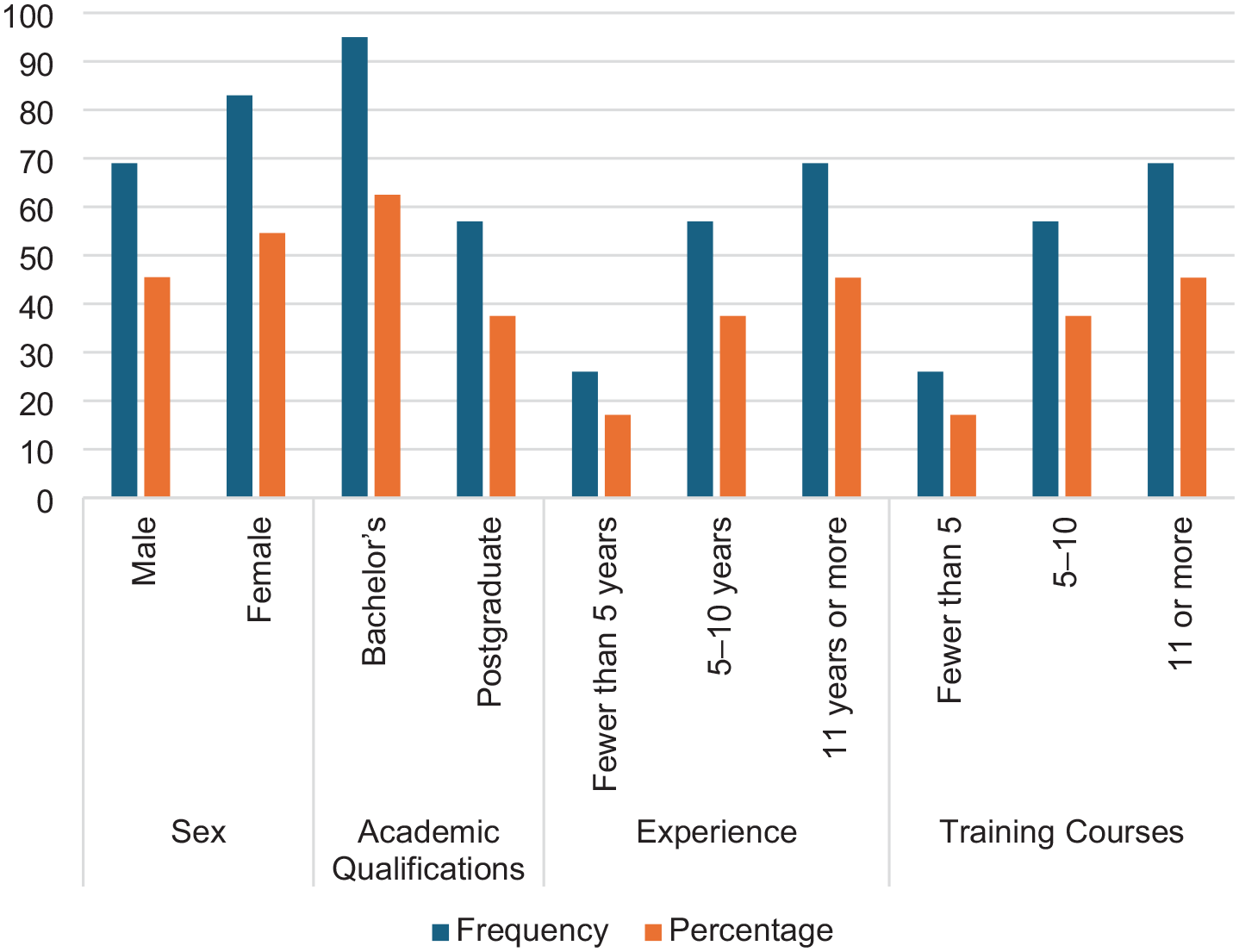
Distribution by socio-demographic characteristics.
Study Instrument
To achieve the study objectives and answer the pre-determined research questionnaires, this research employed a closed questionnaire in which the responses were restricted to specific options (Breakwell et al., 2020). The questionnaire consisted of thirty-four items distributed over three dimensions: challenges related to parents (measured by items 1–12); challenges related to teachers (measured by items 13–23); and challenges related to educational institutions (measured by items 24–34).
Validity and Reliability
Davis et al. (2004) establish that validity and reliability are key aspects of scientific study that are employed to guarantee the accuracy and dependability of results. Validity concerns the ability of an instrument to measure what it is designed to measure, while reliability refers to the measurements exhibiting comparable stability and consistency when applied repeatedly under similar circumstances (Kimberlin & Winterstein, 2008).
Face validity refers to other researchers’ subjective assessments of the elements of the instrument used and their relevance, clarity, and suitability to the research objective (Oluwatayo, 2012). To ensure the instrument’s suitability and capability to achieve the research objectives, the face validity of the questionnaire employed by this study was verified by an expert panel (made up of Saudi university faculty members with SEN expertise). The study questions and objectives were attached to the instrument, and the questionnaire was modified based on the notes and amendments outlined by the arbitrators. This process was conducted to ensure that the instrument was capable of achieving the assessment it was designed to measure. The instrument featured a five-point scale (strongly agree, agree, neutral, disagree, and strongly disagree) for all non-demographic questions to which corresponding numerical scores were assigned as follows: 5, 4, 3, 2, and 1 (respectively).
To confirm the validity of the instrument’s construction, it was applied to a survey sample of 30 participants from a study community outside of the target study population. At a mutually convenient time, face-to-face meetings were held between the researcher and each of the 30 participants, during which the questionnaire was completed electronically via mobile devices. This process was undertaken to calculate Pearson’s correlation coefficients for the relationships between the items and the dimensions to which they belonged (see Table 1).
Correlations Between Items and Dimensions.

Note. **Statistically significant at .01.
Table 1 indicates that the correlation coefficients for challenges related to parents ranged between .570** and .769**. The correlation coefficients for challenges related to teachers ranged between .773** and .543**, while the correlation coefficients for challenges related to educational institutions ranged between .791** and .575**. In all cases, the tests produced statistically significant values.
To ascertain reliability, Cronbach’s alpha internal consistency test was applied to measure the degree of consistency in respondents’ answers to all questions across the scale. The Cronbach’s alpha can be interpreted as the internal consistency coefficient between answers, with high values indicating high stability. Values for Cronbach’s alpha range between 0 and 1 (with values of .70 and above) were deemed to be acceptable. To verify the stability of the instrument, Cronbach’s alpha was employed as an indicator of internal homogeneity (see Table 2).
Internal Consistency Reliability Coefficients: Cronbach’s Alpha.

Note. **Statistically significant at .01.
Table 2 indicates that the internal consistency coefficient – according to Cronbach’s alpha equation for the first dimension (challenges related to parents) – reached .893. For the second dimension (challenges related to teachers), it reached .899, while for the third dimension (challenges related to educational institutions), it reached .902. The reliability coefficient for the instrument as a whole reached .907. Therefore, overall, these high values indicate strong reliability within the instrument.
Survey Approval Procedure
After the Institutional Review Board of the Department of Special Education at the affiliated university approved the study design, the researcher contacted the Makkah Education Department to obtain participant data and send participants the questionnaire via email. All research participants provided informed consent before participating in the study. The email sent to them described the nature and purpose of the research as well as how the data would be handled. It asked whether they wished to take part in the study and assured them that they could withdraw at any time without penalties or repercussions. Appropriate processes were established to protect and maintain the privacy and confidentiality of the participants’ identities through secure data storage. The participants did not provide personally identifiable information, such as names, contact numbers or signatures.
Research significantly benefits researchers, participants and society. From an ethical standpoint, educational research is based on the principle of benevolence, a fundamental ethical principle that requires researchers to engage in actions that benefit others and cause no harm (Sim, 2010). The risk of harm to participants in scientific studies and research is ethically unacceptable unless the potential benefits outweigh that risk (Millum & Garnett, 2019). In designing the current study, the researcher sought to ensure that its benefits to participants and society outweighed the potential risks of harm. One of the more significant benefits of exploring communication barriers between teachers and parents of children with disabilities in Saudi Arabia is the generation of knowledge that may improve those children’s education. Participants in the study also benefited from identifying and overcoming the barriers they faced when communicating with parents of children with disabilities as well as from doing good and experiencing positive feelings by assisting the researcher in exploring these barriers. The findings of this research may contribute to the development and advancement of knowledge within society, particularly as it concerns people with disabilities.
Regarding the risk of harm, the researcher carefully avoided potential harm to the participants by presenting the instrument to a group of faculty members in special education departments at Saudi universities and by obtaining approval for the study’s design from the Institutional Review Board of the Special Education Department at the affiliated university. The researcher took a number of steps to ensure the clarity of the questionnaire and that participants were given sufficient time to complete the questionnaire; the risks to participants were minimal, including only minor psychological stress when answering the questions as observed during the researcher’s direct pilot study with participants.
Statistical Methodology
Based on the nature of the study and its objectives, the data were analysed using IBM SPSS. The results were based on the following statistical calculations: Pearson’s correlation coefficients; Cronbach’s alpha and the reliability coefficient (using the split-half method to calculate the reliability of the study instrument); frequencies and percentages for the distribution of respondents by personal variables; and arithmetic means and standard deviations for the items in the study instrument and the dimensions as a whole.
Results
This chapter presents the results of the current research and their correlation with the research questions. To answer the first research question, arithmetic means and standard deviations were calculated to measure the challenges faced by SEN teachers when communicating with parents of CWDs (from the teachers’ perspectives). These dimensions are listed in descending order according to their arithmetic means (see Table 3).
Arithmetic Means and Standard Deviations of the Dimensions of the Study Instrument.

Table 3 demonstrates that the arithmetic averages of the dimensions of the challenges faced by SEN teachers in communicating with parents of CWDs (from the teachers’ perspectives) ranged from 3.06 to 3.44. Additionally, Table 3 establishes that the first dimension (Challenges related to parents) recorded a mean of 3.44, followed by the second dimension (Challenges related to teachers) which had a mean of 3.08, and the third dimension (Challenges related to educational institutions) which had a mean of 3.06. The mean of the instrument as a whole was 3.20. The subsequent sections detail the results for each of the studied dimensions.
Challenges Related to Parents
Each of the means and standard deviations for the items grouped under challenges related to parents were calculated individually and these are presented in descending order by mean (see Table 4).
Arithmetic Means and Standard Deviations for Items Categorised as Challenges Related to Parents.

Table 4 illustrates that the means for the items under challenges related to parents ranged between 2.73 and 4.09. The highest score was for item 10 (The level of expectations of parents of CWDs regarding the effectiveness of the programmes provided to their children is low) which had a mean of 4.09 and a high degree of influence. The lowest score was for item 7 (Parents mislead teachers by providing incorrect information about their children) with a mean of 2.73 and an average degree of influence.
Challenges Related to Teachers
The means and standard deviations for the items grouped under challenges related to teachers were calculated individually and are presented in descending order by mean (see Table 5).
Arithmetic Means and Standard Deviations for Items Categorised as Challenges Related to Teachers.

Table 5 reveals that the means for the items grouped under challenges related to teachers ranged between 2.07 and 4.22. Item 3 (Teachers suffer from the many tasks assigned to them by the school administration) had the highest mean of 4.22 and a high degree of influence, and the lowest score was recorded by item 8 (Teachers are not committed to attending periodic meetings held by the school) which had a mean of 2.07 and an average degree of influence.
Challenges Related to Educational Institutions
The arithmetic averages and standard deviations for the items grouped under challenges related to educational institutions were calculated individually and are presented in descending order by mean (see Table 6).
Arithmetic Means and Standard Deviations for Items Categorised as Challenges Related to Educational Institutions.

The data represented in Table 6 demonstrates that the mean scores for the items categorised as challenges related to educational institutions ranged between 2.33 and 4.15. Item 1 (Increase in the number of children in the classroom or educational institution) recorded the highest score and the highest mean (4.15) which indicates a high degree of influence. Item 9 (The educational institution’s administration believes that parents of CWDs do not have a major role in the educational process) recorded a mean of 2.33 which signifies a low degree of influence.
To address the second research question, the means and standard deviations of the participants’ responses to the communication difficulties questionnaire were extracted and assessed according to specific variables (sex, experience, academic qualifications, and training courses) (see Table 7).
Arithmetic Means and Deviations of Study Participants’ Responses by Sex, Experience, Educational Qualification, and Training Courses.

A = Arithmetic mean; SD = Standard deviation.
Table 7 details the variations in means and standard deviations of participant responses to the questionnaire items by sex, experience, academic qualifications, and training courses. To assess the significance of any statistical differences between the means, a four-way multiple variance analysis was applied to both the dimensions and the instrument as a whole (see Table 8).
Four-Way Multiple Variance Analysis of the Effects of Sex, Experience, Academic Qualifications, and Training Courses on Study Participants’ Responses.

Note. *indicates statistical significance at p < .05.
The data presented in Table 8 corroborates that no statistically significant differences can be attributed to the variables of sex and experience. This finding remains valid across all three dimensions (challenges related to parents, challenges related to teachers, and challenges related to educational institutions) and the questionnaire as a whole. Additionally, no statistically significant differences can be attributed to the effects of academic qualifications on two dimensions (challenges related to teachers and challenges related to educational institutions) or the total score. However, some statistically significant differences can be attributed to the effects of academic qualifications on the third dimension (challenges related to parents) in favour of postgraduate education.
No statistically significant differences can be attributed to the effects of training courses on two of the dimensions (challenges related to parents and challenges related to teachers). However, statistically significant differences can be attributed to the effects of training courses on the third dimension (challenges related to educational institutions) and on the total score. To determine the precise locations of these differences, the Scheffe method was applied to calculate dimensional comparisons (see Table 9).
Post Hoc Comparison Using the Scheffe Method to Determine the Effect of Training Courses.

Note. *indicates statistical significance at p < .05.
When examining the impact of training courses on challenges related to educational institutions, Table 9 reveals statistically significant differences between fewer than five and between five and ten training courses (in favour of the category between five and ten).
Discussion
The findings of this research corroborate the issue of communication challenges between SEN teachers and the parents of CWDs in the Makah region of the KSA (from the perspective of teachers). Furthermore, the findings identified several barriers to effective communication between the primary stakeholders (parents, teachers, and educational institutions); however (from the teachers’ perspectives), the challenges related to communication with parents are the most significant. This finding is notable because it contradicts all of the previous literature concerning this issue, including Bashir et al. (2023), Butler et al. (2019), Madsen & Madsen (2022), and Oranga et al. (2022). These studies (which sought to ascertain the viewpoints of both parents of CWDs and teachers) concluded that communication challenges arise from both groups. Contrastingly, studies by Smith et al. (2022), Smith et al. (2023), and Mann et al. (2024) which addressed a single voice (i.e., that of parents) concluded that teachers were the most significant barrier to effective communication. However, the results of the current study differ from those of previous studies and this may be explained by contextual differences, contrasting study samples, and its geographical specificity (i.e., its reliance on SEN teachers of CWDs in the Makkah region of KSA), all of which distinguish this study from other research concerning this issue.
Parents of CWDs face several challenges (including time constraints, low social and educational background, insufficient knowledge about advocating for their children’s needs, and negative attitudes and perceptions) that prevent them from communicating effectively with teachers; this can lead to feelings of helplessness, marginalisation, and exclusion (Gedfie et al., 2021; Stamatis & Chatzinikola, 2021).
Furthermore, cultural and social factors can inhibit effective communication between teachers and the parents of CWDs (Choi & Ostendorf, 2015). The findings of several studies indicate that the low educational level of some parents of CWDs is one of the most significant barriers to effective communication (Alnoaim & Alharbi, 2023; Bashir et al., 2023; Gedfie et al., 2021; Oranga et al., 2022). Parents with low levels of education may not understand some of the terminology employed by teachers which diminishes trust and inhibits communication (Sheridan et al., 2010). The findings of Murray et al. (2014) indicated that the parents of CWDs who are engaged in home educational activities are more likely to communicate with teachers. Additionally, the diverse and conflicting parental perceptions of education (such as the importance of certain subjects or teacher roles) can lead to communication challenges (Bashir et al., 2023; Smith et al., 2022; Madsen & Madsen, 2022). Conversely, some teachers’ lack of cultural competence when communicating with parents from diverse cultural and social backgrounds can lead to misunderstandings, conflicts, and mistrust (Barrera-Lansford & Sánchez, 2024; Marku et al., 2022). However, Rossetti et al. (2024) argue that teachers have greater power in the relationship, which leads to a lack of parental communication and involvement in their children’s education. Educational institutions can play a pivotal role in building and promoting effective communication between teachers and the parents of CWDs. To achieve this, Stronach et al. (2019) recommend a dual approach: Firstly, educational institutions should establish programs for parents to enhance their understanding of the education system, improve communication with teachers, and encourage participation in their child’s education; secondly, they should provide professional development programs to enhance teachers’ cultural competence and facilitate their communication with parents from diverse cultural and social backgrounds. The most significant role of educational institutions concerns addressing the societal factors that influence negative perceptions and stigma towards CWDs (Choi & Ostendorf, 2015).
When considering the challenges related to SEN teachers, a considerable number of them raised concerns about the heavy workloads assigned by the administration and a preoccupation with the educational process. Additionally, teachers may be unable to establish effective communication with the parents of CWDs (Butler et al., 2019) without developing the required knowledge and skills (Lawrence-Lightfoot, 2004). The Saudi Ministry of Education (2021b) issued guidance to facilitate teachers’ understanding of effective communication with the parents of CWDs and how a unified home-school approach can maximise support for CWDs. However, some teachers are less committed to establishing lines of communication; therefore, more effective systems (supported by legislation where necessary) must be established to ensure the academic achievement of CWDs.
Finally, the challenges related to educational institutions (such as increases in the number of CWDs in classrooms and the failure to hold periodic meetings with the parents of CWDs) have emerged as prominent issues. In this context, an effective school seeks to establish a participatory relationship with the family, while a school that operates in isolation from the family should be viewed as ineffective (Al-Khateeb & Al-Hadidi, 2011). A positive, cooperative relationship between the school administration, teachers, and parents can be established by organising periodic meetings, setting clear and specific cooperation objectives, and encouraging all parties to participate in decision-making, problem-solving, and creating foundations for cooperation based on trust and mutual respect (Mitchell, 2014). Building positive and effective relationships allows teachers and educational institutions to deliver beneficial results for parents while achieving the shared goal of providing effective education for CWDs (Loudová et al., 2015).
Limitations and Recommendations
This study aimed to identify the challenges facing SEN teachers when attempting to establish effective communication with the parents of CWDs in the Makkah region of KSA. The results suggest that (from the perspective of SEN teachers) the challenges related to the parents of CWDs are the most significant barriers to effective communication; however, it should be noted that this study contains several limitations. The first limitation concerns the lack of prior research on this topic, particularly in the Arab context; therefore, it is recommended that future research should conduct additional investigations in other regions of the KSA and other Arabic countries.
A second limitation of this study concerns the broad range of physical and psychological disabilities which impact children’s educational outcomes; therefore, this study recommends the use of study samples which are specific to each category of disability. Additionally, the voices of parents of CWDs must be amplified, and similar studies must be undertaken to clarify parental perceptions and opinions concerning the barriers they encounter when communicating with their children’s teachers.
The final limitation of this study concerns the data collection process. Although the Makkah Education Department distributed the questionnaire to all SEN teachers in the region, many responses were delayed, and some respondents took more than 6 months to reply. Future studies should consider alternative methods of data collection (such as qualitative designs that rely on interviews and observations) to facilitate a more nuanced and timely exploration of the issues and their relevance to specific populations.
Conclusion
Identifying the communication barriers that SEN teachers encounter when communicating with the parents of CWDs is a crucial step towards providing an effective and equitable education for such individuals. This study highlighted that – from the perspective of SEN teachers – the challenges related to the parents of CWDs are the most significant inhibitors of effective communication. Therefore, the primary recommendation of this study is that parents of CWDs should be made aware of the importance of establishing effective communication with teachers. By adopting this approach, parents will benefit from the advice and guidance provided by teachers in support of their children’s educational status.
Footnotes
Acknowledgements
The author is very thankful to all associated personal in any references that contributed in/for the purpose of this research.

Funding
The author received no financial support for the research, authorship, and/or publication of this article.
Declaration of Conflicting Interests
The author declared no potential conflicts of interest with respect to the research, authorship, and/or publication of this article.
Data Availability Statement
Data sharing not applicable to this article as no datasets were generated or analyzed during the current study.