




Abstract
This article surveys the literature from 1999 to 2013 on teaching qualitative research methods. One hundred thirteen articles fitted the inclusion criteria; 79 of these were by academics in the United States and Canada. Only 39 of the 113 were based on empirical research: from these, seven descriptive themes were distilled, of which the dominant ones are experiential learning and practice-based materials and workshops. The literature portrayed teaching qualitative research as providing experiential and practice-based learning opportunities for students that revealed its desirable pedagogical features. It further reported that when students engaged in learning experiences, they underwent paradigm shifts about qualitative research as well as personal transformations. Our study confirmed that there is a lack of a research-based approach to teaching qualitative methods and we recommend that more be done to contribute to its pedagogical culture particularly concerning methods used to evaluate instruction, innovative instructional methods, and approaches to assessment.
Keywords
Many authors have reported that courses in qualitative research methods are increasingly popular and that a growing proportion of students are using them in their research projects (Biggerstaff & Thompson, 2008; DeLyser, 2008; Forrester & Koutsopoulou, 2008; Harper, 2012; Harper, O’Connor, Self, & Stevens, 2008; Healey-Etten & Sharp, 2010; Morrow, 2007; Shaw, Dyson, & Peel, 2008). Even though the literature about teaching qualitative research methods stretches back at least three decades (see, e.g., Halfpenny, 1981), in 2004 Hein drew attention to a paucity of writing on the topic, and Roulston and her colleagues (2008) pointed to a continuing uncertainty about the best ways of preparing qualitative researchers. Hein (2004) and Richards (2011) found that most of the literature on teaching qualitative research methods dealt with teaching philosophies, activities and assignments, and/or authors’ experiences of their courses; there was little foregrounding of students’ experiences. Rogers (2011) identified two main trends in the literature: self-studies of qualitative research methods courses and studies that examined how students learnt qualitative research methods.
There have been previous reviews of the literature, but they are rather more limited in scope than that reported here. They are also somewhat out of date. Hein (2004) presented a scoping review—“a brief, non-systematic look at the research . . . [that is] often useful to inform the development of a systematic review” (Gough, Oliver, & Thomas, 2013, p. 25). The most recent article Hein commented on was published in 1998. Cooper, Chenail, and Fleming (2012) published a systematic review, the first stage of a meta-study of 30 years of primary research on students’ experiences, including disciplines outside of the social sciences. The aim of the present article is to provide a systematic review of the literature on teaching qualitative research methods that is both more current and comprehensive than the previous studies.
Goussinsky, Reshef, Yanay-Ventura, and Yassour-Borochowitz (2011) maintained that “teaching qualitative research methods is an extremely complex task” (p. 127), which they attributed to a history of dominance of quantitative methods in research methods pedagogy. (This dominance may also underlie students’ conceptions of research; Kawulich, Garner, & Wagner, 2009.) Often learning about qualitative research is a new experience for students, one that they may not initially be comfortable with (Belcher & Hirvela, 2005) because they tend to compare it with their earlier training in quantitative methods (Cooper, Fleischer, & Cotton, 2012). Thus, students have to make a paradigm shift, as qualitative methods require a different understanding of the purpose of research. Although Konecki (2009) considered that “[t]he methods and knowledge about teaching of qualitative research [are] developing very rapidly now” (p. 64), some authors maintained that there was as yet insufficient theoretical guidance for teaching qualitative research methods (Goussinsky et al., 2011; Onwuegbuzie et al., 2012). Authors from certain disciplines, such as psychology (Forrester & Koutsopoulou, 2008) and social work (Drisko, 2008), also noted the lack of consensus on the structure and content of the curriculum of qualitative methods courses. Nonetheless, there is fairly general agreement that experiential learning is one of the most popular approaches to preparing qualitative researchers (Fielding, 2005; Glesne & Webb, 1993; Hein, 2004; Machtmes et al., 2009; Raddon, Nault, & Scott, 2008; Sidell, 2007). Experiential learning can be broadly defined as “a means of enabling learners to blend theoretical frameworks with real-life experiences” (Pietersen, 2002, para. 3).
Examining the various ways of inculcating the knowledge and skills relating to social research is essential both to improving the quality of students’ learning in preparation for their professional careers and to identifying limitations in research methods pedagogy that higher education institutions need to address (Brandão, 2009). There are several implications for departments that teach qualitative research methods. They include the following: employing staff experienced in qualitative research; collaborating with academics in other departments who have the necessary skills; training current staff in qualitative research; and using group supervision where numbers of qualified staff are low (Madill, Gough, Lawton, & Stratton, 2005). Such solutions are not straightforward, however. In the United Kingdom, for example, finding sufficient numbers of competent qualitative teaching staff in psychology is a challenge (Forrester & Koutsopoulou, 2008). Shaw and colleagues (2008) reported that there are “significant . . . discrepancies in levels of training received by those teaching qualitative methods in psychology, which inevitably affects the quality of teaching delivered to students” (p. 180). This is also claimed to be the case in the United States (see, e.g., Ponterotto, 2005).
We have been teaching qualitative research in psychology (first author), education (second author), and applied linguistics (third author) on three continents for between two and four decades. When the three of us met (in 2004), we realized that our pedagogical approaches had much in common. In particular, we all acted as what Denzin and Lincoln (2011, p. xii) called “interpretive bricoleurs . . . adept at using all of the methods of collecting and analyzing empirical materials” associated with qualitative research. Our aim as pedagogues is to expose our students to a broad range of traditions that enables them to explore the terrain and find a position that fits with their personal and/or professional preferences using experiential and practice-based learning where possible. In the words of Denzin and Lincoln (2011, p. xiii), “The open ended nature of the qualitative research project leads to a perpetual resistance against attempts to impose a single, umbrella like paradigm over the entire project.” We discussed whether there is a prevailing pedagogy of qualitative research methods and began to examine the literature relating to how qualitative research, which requires a particular understanding of the purpose of research, was being taught.
This review of the literature on teaching qualitative research methods was guided by the following questions:
What patterns can be discerned in the literature?
What methods are used to study teaching of qualitative research?
Who publishes about teaching qualitative research?
What evidence do we have relating to teaching qualitative research, and what further research is needed?
Method
This study is a systematic review: We undertook “a structured system of inquiry to find and review publications” (Bearman et al., 2012, p. 626). Although systematic reviews are helpful in many ways (e.g., identifying the gaps in current research and providing direction for future projects), Bearman and fellow researchers noted the paucity of the use of this methodology in studies in the higher education sector. There are many methods of systematic review; the particular approach we chose was mixed research synthesis. As the data for this article included both quantitative and qualitative findings, we chose to follow Sandelowski, Voils, and Barraso’s (2006) description of a mixed research synthesis, that is, integrating the findings from both quantitative and qualitative empirical studies. The assumption is that both quantitative and qualitative research can address the same research question and produce findings about the same aspects of a phenomenon. The researcher thus groups selected studies “not by methods (i.e., qualitative and quantitative), but rather by findings viewed as answering the same research questions, or addressing the same aspects of a target phenomenon” (Sandelowski et al., 2006, p. 35). This somewhat recent approach has been driven by evidence-based practice, as evidence needs to be synthesized, and qualitative research, as there have been calls for the inclusion of qualitative findings into evidence-based practice (Drisko, 2008; Sandelowski et al., 2006).
There is an imperative for an evidence base when identifying patterns in the literature, as is reflected in Hein’s (2004) lack of enthusiasm for articles on qualitative research methods teaching that have not “made students’ experiences [the] primary focus or examined these experiences in a comprehensive and systematic way” (p. 23). For this reason, we excluded from our review those articles that described the content and structure of a course or merely used students’ comments to illustrate certain points. We thus use the word “empirical” to refer to evidence-based practice (methods of teaching qualitative research that have been evaluated) as opposed to practice-based evidence (the experiential knowledge of those who teach qualitative research methods) (see Smeijsters, Kil, Kurstjens, Welten, & Willemars, 2011). Although in a postqualitative world, there has been some criticism of evidence-based practice (see Lather, 2013) we felt that it was necessary to review the research into students’ experiences in the literature on teaching qualitative research and also to explore future directions.
Sample
We used Hein’s (2004) scoping review to inform the beginning of the search. As the most recent article he referred to was published in 1998, we began our search from 1999 and ended it in 2013, a period of 15 years. The literature was searched using the databases Academic Onefile, Applied Social Sciences Index and Abstracts, Arts and Humanities Citation Index, EBSCOhost, Google Scholar, ProQuest, PsycINFO, ScienceDirect, Scopus, Social Sciences Citation Index, and the TQR Community Qualitative Research Resource Series (Chenail, 2012). The following keywords were used in different combinations: qualitative, teaching, learning, research, methods, methodology, course, students, ethnography and ethnographic, participant-observation, interpret(at)ive, phenomenology, grounded theory, discourse, experience, social science, class. Although the breadth of qualitative research extends beyond these keywords, we generated these keywords on the basis of our own knowledge of the field and of teaching qualitative research to reflect the focus of our review as teaching qualitative research methods. We also used the reference list of each article identified to search for additional sources that these keywords may not have covered. To be included in the corpus of literature, the research had to be focused on teaching qualitative research methods to university students, published in academic journals, written in English, based in disciplines in the social sciences or humanities, and accessible to the authors through their institutional libraries. Chapters in books, dissertations and theses, and literature in disciplines other than those mentioned were thus excluded. Based on these criteria, the sample consisted of 113 articles. Figure 1 shows the frequencies of articles, and the number of empirical studies published on teaching qualitative research methods by year. Very little was published between 1999 and 2002 and again from 2004 to 2006 and in 2010. Empirical work has emerged slowly since 2002, reaching a peak in 2008 and then declining, despite an increase in the total number of articles about teaching qualitative research methods.

Frequencies of articles on teaching qualitative research methods by year.
Table 1 shows the journals that published, in the time period, articles on teaching qualitative research methods. The 113 articles are spread over 49 journals, listed from those with the highest frequency of articles and then in alphabetical order. The Qualitative Report was the leading publisher of articles on teaching qualitative research methods, followed closely by the Qualitative Research Journal, which had a special issue in 2003 on teaching computer-assisted qualitative data analysis software (CAQDAS).
Journals and Frequencies of Articles Published on Teaching Qualitative Research Methods 1999-2013.

Assessment of Studies
A two-phased approach was used in examining the articles. In Phase 1, we evaluated certain aspects of the articles by summarizing them according to categories that were deemed of interest to the study, which included the country where the author was located, aim of the study, discipline of the author/research, method of data collection, sampling method, sample size, participants, and method of data analysis. The disciplines represented in the study were education (including economic and social development in one case) (n = 26), sociology (n = 18), social work and psychology (n = 17); research, data archives, and research units (n = 5); educational psychology and geography (n = 4); child/human development and family studies, languages/language education and linguistics, and music (n = 3); parks, recreation, and tourism management (n = 2); anthropology, communication studies, conflict analysis and resolution, drama, humanities and social sciences, human services, information science, occupation therapy, philanthropic studies, and school of health in social sciences (n = 1), and not specified (n = 10). The authors were based at universities in the following countries (counted once per article): the United States (n = 72); the United Kingdom (n = 20); Canada (n = 7); Australia, Israel, New Zealand, and Norway (n = 2); China P.R., Colombia, Germany, Hong Kong, Italy, Japan, Poland, and Portugal (n = 1), and not specified (n = 1).
Two findings are pertinent. First, despite observations that qualitative research had only recently begun to form part of the research curriculum in the United States and Canada (Harper et al., 2008; Mitchell, Friesen, Friesen, & Rose, 2007; Poulin, 2007), but had been growing in prevalence (Levitt, Kannan, & Ippolito, 2013; Onwuegbuzie et al., 2012), 79 of the 113 articles were by academics based at universities in those countries. Second, of the 113 articles in the corpus, only 39 (35%) were based on empirical research: The remainder described the content and process of a qualitative research methods course and the writer’s opinion about what works and what does not. We considered the nature of the empirical data reported in those 39 articles that made up the corpus of literature that formed the basis of the thematic synthesis. We present a description of each article contained in our sample in alphabetical order including country, discipline, aim of the study, method of data collection, sampling, sample size, participants, and method of data analysis in Table 2 in the appendix. We envision the reader using this as a summarized reference to access further information for particular studies.
Comparison Table of Articles on Teaching Qualitative Research Methods.
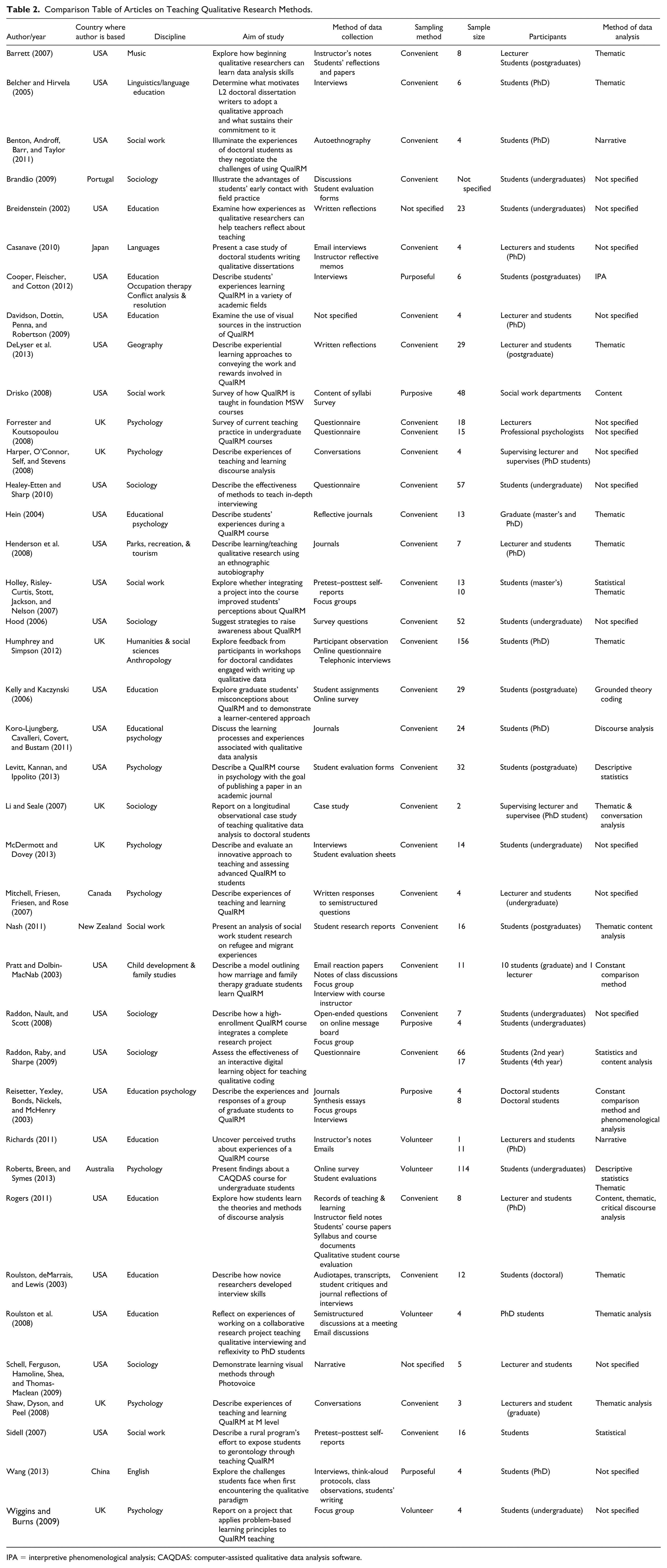
IPA = interpretive phenomenological analysis; CAQDAS: computer-assisted qualitative data analysis software.
In 17 of the 39 empirical articles, more than one method was used to collect data. Qualitative data, with conveniently or purposively selected or volunteer samples, were collected in 33 of the 39 articles. These data included interviews (in-depth, semistructured, and telephonic), reflective journals, case studies, instructors’ notes, course syllabi, discussions with students, notes of class discussions, synthesis essays, written reflections, written responses to semistructured questions, open-ended questions online, autoethnographies, participant observation, focus groups, audiotapes of interviews, think-aloud protocols, and documents, such as student research reports, assignments, critiques, and transcripts of interviews. Six studies conducted surveys using questionnaires; three used student evaluation forms; two studies used a pretest–posttest design in which students self-reported on their knowledge acquisition; and one study did a content analysis of course syllabi as well as a survey about qualitative research methods courses among academic departments. The samples in each study, however, were convenient and small, except for two: one in which n = 114 (Roberts, Breen, & Symes, 2013), and another in which n = 156 (Humphrey & Simpson, 2012); they covered a range of disciplines within the social sciences and both undergraduate and postgraduate students and lecturers and professional practitioners, all of which makes it difficult to draw generalizations. Only 25 of the 39 articles specified (or made it easy to determine) how they analyzed the data they collected, using statistical, narrative, discourse, grounded theory coding, thematic, content analysis, thematic content analysis, thematic and conversation analysis, the constant comparison method, or interpretive phenomenological analysis.
In Phase 2 of our mixed research synthesis, the findings from the 39 articles were integrated, using thematic analysis (or synthesis: Thomas & Harden, 2008), in which patterns of findings from the different studies are summarized under thematic headings (Dixon-Woods, Agarwal, Young, Jones, & Sutton, 2004). This approach identifies commonalities in the data (Barnett-Page & Thomas, 2009). Although thematic synthesis tends to be applied to qualitative evidence, we followed the developers of this approach, Thomas and Harden (2008), and used the sections labeled findings, results, discussion, limitations, or conclusion that were directly related to teaching outcomes as the data. This method also aligns with Sandelowski and colleagues’ (2006) definition of mixed research synthesis.
The three analytical steps outlined by Thomas and Harden (2008) were followed. Step 1: The first author coded each relevant section of an empirical article line-by-line to generate a list of codes that described the content. Step 2: The list of codes was then organized into categories with common patterns of meaning or descriptive themes that are presented in the findings section that follows. Descriptive themes remained close to the primary studies whereas analytical themes (Step 3) “represent a stage of interpretation whereby the reviewers ‘go beyond’ the primary studies and generate new interpretive constructs, explanations or hypotheses” (p. 1). The analytical themes are presented in the discussion that follows after the findings.
Findings
Seven descriptive themes were identified from the 39 studies (presented in descending order of the number of articles that discussed each one, indicated in brackets): experiential learning (20), practice-based materials (18), course structure (14), peer or collaborative work (nine), apprenticeship model (eight), competence of qualitative research trainers (seven), and teaching resources (six). Some of the articles contained codes that were incorporated into different themes and are thus mentioned under more than one theme. The two most frequent themes (experiential learning and practice-based materials) are broken down into the categories within the themes in Tables 3 and 4 for greater accessibility.
Experiential Learning Categories and References.

Practice-Based Materials Categories and References.

Theme 1: Experiential Learning
The most frequent trend in the articles was that of using experiential learning to teach qualitative research. The reported benefits fell into four broad categories. First, inquiry-based projects appear to have brought about a paradigm shift in the way students think about research (and qualitative research specifically) (Belcher & Hirvela, 2005; Benton, Androff, Barr, & Taylor, 2011; Cooper, Fleischer, & Cotton, 2012; DeLyser et al., 2013; Hein, 2004; Wang, 2013). Second, experiential learning encouraged students to make connections between their research and their professional development (Benton et al., 2011; Breidenstein, 2002; Harper et al., 2008; Nash, 2011; Roulston et al., 2008; Wang, 2013). Third, it elicited affective reflections, personal journeys of learning (Belcher & Hirvela, 2005; Breidenstein, 2002; Harper et al., 2008; Hein, 2004; Henderson et al., 2008; Nash, 2011; Roulston, deMarrais, & Lewis, 2003; Roulston et al., 2008; Wang, 2013), and intimate connections with research participants (Cooper, Fleischer, & Cotton, 2012; Nash, 2011). Furthermore, it was a vehicle for learning about qualitative research, developing skills (Benton et al., 2011; Cooper, Fleischer, & Cotton, 2012; Davidson, Dottin, Penna, & Robertson, 2009; DeLyser et al., 2013; Hein, 2004; Levitt et al., 2013; Mitchell et al., 2007; Nash, 2011; Roulston et al., 2003; Roulston et al., 2008; Schell, Ferguson, Hamoline, Shea, & Thomas-Maclean, 2009; Wang, 2013) and increasing self-efficacy (Belcher & Hirvela, 2005) as well as students’ enjoyment of learning (McDermott & Dovey, 2013; Raddon et al., 2008; Roulston et al., 2008). Peer learning could also have led to a positive outcome, if students worked on a group project (Hein, 2004; Roulston et al., 2008; Schell et al., 2009).
Specific challenges relating to experiential learning that were reported were that instructors may have needed a lot of time to prepare a project in advance of the course, communicated the project’s status to team leaders, met with everyone, and helped students to grasp aspects of qualitative research (DeLyser et al., 2013; Hein, 2004; Roulston et al., 2008; Sidell, 2007). Several sources stated that negative experiences in the field needed to be addressed by supervisors who listened to students’ concerns, discussed solutions to their problems, and created a space for all students to share their experiences in a supportive and collaborative peer group (Benton et al., 2011; Cooper, Fleischer, & Cotton, 2012; Levitt et al., 2013; Roulston et al., 2008; Wang, 2013). Containing students’ emotional issues as they grappled with their research (Belcher & Hirvela, 2005) and using their academic and personal histories to build their understanding of reflexivity were also highlighted (Cooper, Fleischer, & Cotton, 2012).
Theme 2: Practice-Based Material
The popularity of using practical materials and/or class simulations to teach qualitative research was reflected in the number of articles that examined this topic. The materials included visual sources like videos (Barrett, 2007), visual texts (photographs and drawings) (Davidson et al., 2009) practical and workshop exercises (Brandão, 2009; Harper et al., 2008; Healey-Etten & Sharp, 2010; Hein, 2004; Humphrey & Simpson, 2012; Roberts et al., 2013), assignments (Drisko, 2008), reflective journals (Hein, 2004; Koro-Ljungberg, Cavalleri, Covert, & Bustam, 2011; Reisetter, Yexley, Bonds, Nickels, & McHenry, 2003; Roulston et al., 2003), web-based instructional modules or learning objects (LOs) (Raddon, Raby, & Sharpe, 2009), using existing or publicly available data sets (Rogers, 2011), and problem-based materials (Wiggins & Burns, 2009). A combination of practical materials has also been found useful (Forrester & Koutsopoulou, 2008; Henderson et al., 2008; Pratt & Dolbin-MacNab, 2003). The authors of the research articles identified numerous advantages of using these methods to teach qualitative research:
Students may have undergone a paradigm shift with regard to qualitative research;
Students learnt to draw on personal knowledge and subjectivity to develop their identity as qualitative researchers and build their confidence about their ability to undertake a qualitative project;
The decisions and challenges that researchers were faced with when conducting research became apparent to students;
Abstract learning material was better comprehended when experienced firsthand;
Students were able to identify their limitations regarding mastering theory and writing skills;
The methods helped students to engage in course content and apply their knowledge, values, and skills, which also enabled instructors to assess their progress;
The methods facilitated students’ professional growth and made them feel that they were more employable;
The methods bridged the gap between theory and practice that could have created uncertainty about the data analysis process;
Students became aware of the role of the researcher in the process regarding his or her expertise, past experiences and personal background, and how reflexivity functions when they try to relate the participant’s perspective;
Practical tools could improve the quality of interviews that students conducted;
Students were given the opportunity to practice research through role-play, an environment in which they felt comfortable making mistakes.
Some of the challenges of using practical materials included the need for intensive support, the pressure of completing practical assessments in time, ensuring that students have the necessary theoretical background before embarking on practical applications, and class assignments not being as authentic as real-life research (Davidson et al., 2009; Hein, 2004; Humphrey & Simpson, 2012; Roberts et al., 2013; Rogers, 2011; Roulston et al., 2003; Wiggins & Burns, 2009). Although students seemed positive about web-based learning, conveying practice-based material via this modality had its own difficulties. For example, Raddon’s research team (2009) found that only a single-page excerpt of one transcript was analyzed by students, the method could not be used for teaching narrative analysis, and the power dynamics between the interviewer and participant could not be demonstrated.
Theme 3: Course Structure
Research on the structure of qualitative research methods courses was also prevalent in the literature. Four of the articles (Harper et al., 2008; Mitchell et al., 2007; Rogers, 2011; Shaw et al., 2008) proposed that students should be exposed to philosophy of science and epistemological debates related to qualitative research. Qualitative research needed to be “taught in a comprehensive manner,” that is, not as a “toolbox of data-collecting methods, thereby reducing the production of constructivist knowledge to technical essentialism” (Mitchell et al., 2007, p. 238). Shaw and fellow researchers (2008) further pointed to the “significant leap in the breadth and depth of content . . . when moving from undergraduate to postgraduate research methods teaching” (p. 190). Mitchell et al. have recommended that paradigms linked to qualitative research be introduced in the first year and sustained throughout a curriculum. Cooper, Fleischer, and Cotton (2012) argued that experiential learning opportunities should be presented early on in a course, as practicing qualitative research generates much enthusiasm. Four articles recommended that qualitative research methods courses be embedded in the curriculum of a substantive discipline, or that the relationship between the discipline’s theory and social research be made explicit (Benton et al., 2011; Brandão, 2009; Mitchell et al., 2007; Raddon et al., 2008). According to Wang (2013), students should read more qualitative research as well as improve their disciplinary knowledge.
Five articles examined students’ beliefs about qualitative research and how they informed the approach that should be taken in the course. Viewpoints depended on the nature of students’ previous experiences with (typically, quantitative) research, what they learnt from textbooks and instructors, personal styles and learning preferences, congruence with the qualitative philosophy, and perceptions of the applicability of the paradigm to their professional lives (Hood, 2006; Kelly & Kaczynski, 2006; Pratt & Dolbin-MacNab, 2003; Reisetter et al., 2003; Wang, 2013). If students entered into courses with highly specific understandings of qualitative research, they needed to be challenged to consider and include other frameworks (Kelly & Kaczynski, 2006; Pratt & Dolbin-MacNab, 2003). Students who struggled to accept qualitative methods could have been exposed to them more gradually (Reisetter et al., 2003). Hood (2006) and Kelly and Kaczynski (2006) suggested strategies for raising awareness of, and challenging myths about, qualitative research.
Institutions such as professional bodies and quality assurance units for higher education also have an influence on how the curriculum is structured. This results, for example, in a nationally agreed-upon approach for the qualitative research methods curriculum in psychology in the United Kingdom, as suggested by Forrester and Koutsopoulou (2008), and in providing networking opportunities and the strengthening of training for those using qualitative methods in social work in the United States (Benton et al., 2011).
Theme 4: Peer or Collaborative Work
Using peer groups or collaborative work to learn qualitative research methods has been reported by a number of researchers to be both helpful and a challenge for students. Students shared their experiences, reviewed one another’s work, for example, by sharing data and their meanings with peers (Belcher & Hirvela, 2005; Benton et al., 2011; Schell et al., 2009) and drew on their peers for support “in ways not possible for those engaged in individual projects, since the topic of the study is shared” (Roulston et al., 2008, p. 239). Small groups provided students with alternative ideas about their analysis schemes; validation and support for their ideas as they emerged; and confirmation of the fact that the process of analysis resulted in the generation of similar themes. For students who were not confident of their own abilities, having been able to watch their peers move through exercises also helped them to model qualitative research skills (Barrett, 2007). Furthermore, having been in a group motivated students to complete a project within the deadline and produce an article (Henderson et al., 2008; Levitt et al., 2013). Harper et al. (2008) suggested forming method-specific peer support groups, so students can provide feedback to each other throughout the process of their research. If logistics allowed, bringing both apprentice and experienced researchers together enabled group supervision and collaboration during analysis.
Sometimes, however, students preferred not to form groups, as they wanted to write on their own, and became anxious if their peers were at different stages of the analysis process. Talking about common challenges has been found to be helpful in these cases (Harper et al., 2008). Another disadvantage of working in groups is the need to reconcile different backgrounds and viewpoints (Henderson et al., 2008). Some students found it difficult to work in a large (such as eight-member) group instead of having the freedom to conduct their own studies and would have preferred smaller teams to enhance group cohesiveness and make it easier to find time for everyone to meet to discuss their progress (Sidell, 2007).
Theme 5: Apprenticeship Model
There is a paucity of published research on the use of apprenticeship models in undergraduate and master’s level qualitative research methods courses. The main focus in the literature relating to this theme was on the relationship between the supervisor and their doctoral student. The role of the supervisor in the writing process was viewed as critical. Supervisors needed to support students who chose to use qualitative research rather than more popular quantitative methods (Benton et al., 2011) and students who wrote in unconventional ways and/or in their second language (Belcher & Hirvela, 2005; Casanave, 2010). Supervisors also needed to involve themselves with students’ writing up of findings and use the analysis of students’ written assignments and supervisors’ written feedback as a valuable data source for understanding how to teach and learn research (Li & Seale, 2007; Wang, 2013). Documenting doctoral students’ stories as they progressed through a qualitative research methods course helped supervisors to understand their needs, for example, that written feedback should have included praise for, and not just commented on, students’ writing (Richards, 2011) and that communication with students should have been gentle and supportive (Li & Seale, 2007). This helped to create a positive learning environment that motivated learners to proceed with their research and display curiosity toward new knowledge. Doctoral students also needed help with formulating research questions and analyses that are consistent with their chosen approach, and supervisors needed to involve themselves with students’ data collection (Harper et al., 2008) and data analysis (Wang, 2013).
Only one article examined a master’s level qualitative research methods course and advocated a more interactive teaching style in which students have the opportunity to develop practical skills in qualitative methods “because of [these methods’] craft-like nature which demands more apprentice-style learning rather than following procedural steps from textbook guidelines” (Shaw et al., 2008, p. 190).
Theme 6: Competence of Qualitative Research Trainers
Some authors expressed concern about the lack of sufficient numbers of trained staff to teach and supervise qualitative research. Some academic staff even actively discouraged qualitative work (Benton et al., 2011). Psychology (Forrester & Koutsopoulou, 2008) and social work (Benton et al., 2011; Drisko, 2008) were highlighted as disciplines that particularly lacked adequately trained staff, although this point may be relevant to other social sciences in which research into research methods pedagogy has not yet been published. The shortage of appropriately skilled instructors has resulted in graduate programs that have little qualitative research content (Drisko, 2008) and students not being permitted to do qualitative research (Harper et al., 2008).
Several remedies for this problem were suggested in the literature. Inexperienced staff could have been encouraged to collaborate with researchers in other departments who were competent in a specific area of qualitative research (Harper et al., 2008). Staffing policy could have focused on hiring staff members who had the ability to teach and supervise qualitative research at all levels of study (Benton et al., 2011; Mitchell et al., 2007). Research methods teachers could have increased their own qualitative research knowledge and skills through support and training (Cooper, Fleischer, & Cotton, 2012; Harper et al., 2008; Roberts et al., 2013). A link to Theme 7 (teaching resources) was also evident: staff needed access to the necessary equipment, such as audio recorders, transcription devices, and qualitative analysis software, to train capable future qualitative researchers (Harper et al., 2008; Mitchell et al., 2007).
Theme 7: Teaching Resources
Visual material, such as videos (and software that allows analysis thereof), was useful in teaching data collection and analysis (Barrett, 2007; Davidson et al., 2009). Teaching, however, was hampered if there was a lack of sufficient high-quality digital cameras and recording equipment, as well as the software that transcribed oral data and licenses for data analysis software (Mitchell et al., 2007; Schell et al., 2009). Students benefited from being taught how to operate recording devices in practice and—importantly—how to deal with situations when the equipment failed (Holley, Risley-Curtis, Stott, Jackson, & Nelson, 2007). Access to CAQDAS and the issue of compatibility of trial programs (home use) versus licensed software (class time) needed to be addressed for CAQDAS learning to succeed (Roberts et al., 2013).
Discussion
Three analytical themes were constructed from the descriptive themes that were presented in the previous section: trends in the literature on teaching qualitative research methods, the subjective nature of learning qualitative research, and the current status of research into teaching qualitative research.
Trends in the Literature on Teaching Qualitative Research
Experiential learning was the most widely reported practice in the literature on teaching qualitative research, followed closely by practice-based material and workshops. Qualitative research was conceptualized in the literature as a craft, that is, learning it was not merely a matter of mastering technical skills or learning from a textbook: What was needed were apprenticeship and co-operation in participating in learning activities (Shaw et al., 2008). Thus, teaching qualitative research was first and foremost portrayed as providing experiential and practice-based learning opportunities to students. Some authors (e.g., Barrett, 2007) have insisted that the experiential approach be used: Even within the limitations of relatively short academic terms, qualitative courses must also introduce students to the processes of conducting [emphasis original] research by directly engaging students in generating, analyzing, and interpreting data in order to gain skills, competence, and most of all, the necessary feel of doing qualitative work. (p. 419)
Experiential learning was reported to lead frequently to some kind of “triggering” experience (Cooper, Fleischer, & Cotton, 2012), an “epiphany” (Mitchell et al., 2007), a “eureka moment” (DeLyser et al., 2013). Although Humphrey and Simpson (2012) questioned that this took place “in a single moment” (p. 743), they also found that practical workshops helped doctoral candidates to cross a threshold from self-doubt to confidence in their own abilities. One caveat arose from the data of our synthesis: prior to students’ conducting their own research, they should have some background in qualitative research and/or the specific technique that they would be using, for example, interviewing. The dilemma with using the experiential method of teaching was that “the production of art requires talent, if not even ‘genius’—and one either has that or one does not” (Breuer & Schreier, 2007, para. 9). These authors’ concern was that this conceptualization of qualitative research opened up the possibility that it cannot be taught and learnt.
Our analysis of the literature found that the teaching of qualitative inquiry is depicted as located in specific moments as a field largely untouched by debates on the postqualitative. Some articles reported on learning qualitative “techniques” and as we are moving toward QUAL4.0 (as Lather, 2013, referred to it) “[t]here is no methodological instrumentality to be unproblematically learned” (p. 635). Lather claimed that qualitative inquiry is becoming a space in which knowledge is both different and produced differently and cannot easily be encapsulated in teaching materials. If that is so, experiential learning has considerable potential. It can assist teachers and students to extend the act of bricolage into unknown terrains in which collaboration, within and beyond the classroom, between the teacher as guide and the student as apprentice gives rise to new methodologies and ways of knowing.
The Subjective Nature of Learning Qualitative Research
The findings from the empirical studies confirmed that, when students engaged in experiential and practice-based learning, they underwent a paradigm shift about qualitative research (Hein, 2004; Pratt & Dolbin-MacNab, 2003; Reisetter et al., 2003); they made personal connections with the stories shared by their interviewees (Cooper, Fleischer, & Cotton, 2012; Hein, 2004; Nash, 2011); and they also learnt to draw on their own knowledge and subjectivity to develop their identity as qualitative researchers (Barrett, 2007). Furthermore, many of the studies (see, e.g., Belcher & Hirvela, 2005; Harper et al., 2008; Hein, 2004; Henderson et al., 2008; Roulston et al., 2003) reported that the lives of students became apparent through the narratives they wrote about their learning experiences as well as the personal transformation they underwent as a result. Students thus learnt more than research skills when doing research. They acquired self-knowledge and social competencies in the process. Some of the instructors also learnt about the processes that their students went through: “through narrative analysis I learnt how my students’ emotions often swerved and changed course [as if] they were on some shaky carnival ride” (Richards, 2011, p. 815). Both containing students’ anxiety as they were exposed to new paradigms and engaged in knowledge and life-changing exercises, and also providing them with a lot of structure, were important instructional components of a qualitative research methods course (Hein, 2004; Roulston et al., 2008; Wang, 2013).
Qualitative research is not a toolbox of essentialist techniques: It requires a different understanding of the purpose of research, a paradigm shift from the dominant quantitative approach. Assumptions must be challenged, and theory, subjectivity, and positionality emphasized. This can give students experiential and practice-based learning opportunities which encourage them to question dominant paradigmatic assumptions. The literature on teaching qualitative research methods reveals that activities which allow students to engage with the human and subjective nature of research enable new understandings of the social world. In other words, it shows “how thinking differently changes being” (Lather & St. Pierre, 2013).
The Current Status of Research Into Teaching Qualitative Methods
The present study confirms Hein’s (2004) assertion that most of the literature on teaching qualitative research remains at the level of descriptions of teaching philosophies, course content, and teachers’ experiences. The lack of empirical research is a manifestation of our contention that there is not yet a pedagogical culture around research methodology (Garner, Wagner, & Kawulich, 2009). There was little evidence of a research-based approach to teaching qualitative research: teachers tended to rely on trying something and seeing if it works (at times persisting even if it does not work). Li and Seale (2007) corroborated this need, when they called for more observational research for learning qualitative research skills through the apprenticeship model in particular, as “there is currently an excessive reliance on secondhand accounts of supervisions derived from interviews” (p. 1452). Until qualitative methods teachers start thinking of the pedagogy itself as an object of study and developing more of an evidence-based approach to the task, progress in advancing knowledge in this field will be limited. That is not to say that descriptions of the way in which we teach qualitative research are of no use: Making our practices explicit by portraying what happens in the classroom provides experiences that can be evaluated, applied in the classroom, and reassessed (see Smeijsters et al., 2011). Integrating practice-based evidence with evidence-based practice could strengthen the pedagogy of qualitative research by bringing together descriptions of teaching practice with evaluations thereof, providing teachers with a knowledge base of successful teaching methods that may also lead to new practices.
Limitations
Some limitations of this review have already been mentioned, and these may have certain implications for our findings. First, including only empirical studies in our sample excludes the valuable contribution of theoretical constructs about teaching qualitative research (Kyndt & Baert, 2013). Second, the sample in the majority of studies was small and conveniently selected, and some of the studies did not report how they analyzed their data. Thus, the findings of these studies are tied to the contexts in which they were conducted and may not apply to other settings. This is in keeping with the emphasis on situated knowledge in qualitative research. Nonetheless, omitting information about how parts of a study were carried out does not provide the transparency required in the field (Tracy, 2010).
A further limitation arises from the type of sources that were included in our search, that is, only articles published in peer-reviewed journals. In agreement with Furtak, Seidel, Iverson, and Briggs (2012, p. 321), “[w]e made this decision to focus on papers that had met the levels of rigor necessitated by the peer review process,” but we are aware that this excludes a body of knowledge that is captured in conference papers, dissertations and theses, unpublished reports, and book chapters.
Recommendations for Future Research
The mostly qualitative research into teaching qualitative research methods has provided some rich contextual data. Nonetheless more work is needed to build up an evidence base using a variety of methods of data collection and (where larger student populations are available) sampling techniques, if findings are to be informative of other settings for different samples. As experiential learning has been the most evaluated (qualitatively) technique in the literature, students who have not been exposed to conducting qualitative research outside of the classroom might offer different perspectives (Cooper, Fleischer, & Cotton, 2012).
Furthermore, more investigations are required into the efficacy of methods of evaluating qualitative research instruction. For example, Richards (2011) underscored the importance of using narrative analysis to truly understand students’ experiences of learning qualitative research methods. Holley and colleagues (2007) recommended conducting focus groups with students, with the caveats that someone other than the course instructor act as facilitator so that participants can speak freely; co-facilitators should be included to probe from multiple perspectives; and one of the co-facilitators should be a student, both to address power issues and to develop the student’s own research skills.
Hein (2004) and Koro-Ljungberg’s research team (2011) both found reflective journals for students very helpful in documenting their journey through a qualitative research methods course. Using journals to capture personal experiences of conducting qualitative research, however, may be met with resistance, if students know that their intimate disclosures are going to be used as data for a project and, thus, may not reveal their real feelings (Hein, 2004; Henderson et al., 2008). Koro-Ljungberg and colleagues (2011) also recommended that (a) students be encouraged to include visual material in their journals; (b) students be made aware from the beginning of the course that their journals could be used for analysis of their learning, and (c) data be collected over a longer period of time (e.g., including the dissertation-writing process) to increase our understanding of how various tensions in learning are resolved. More research using experimental pre-posttest designs is also needed (Roberts et al., 2013).
New methods of delivering qualitative research content and skills using technology need further investigation (Breuer & Schreier, 2007). For example, Davidson and fellow researchers (2009) referred to the use of visual sources as “emerging technology” and “innovative” (p. 2). Raddon’s research team (2009) reported that, at the time of writing, there were only two resources (one being their own article) on teaching qualitative research using LOs. They shared their students’ concern that cost-cutting measures for undergraduate education may result in face-to-face instruction being replaced by LOs, a reality that other academic institutions may also be facing. Additional surveys of current practice in teaching qualitative research, such as the one conducted by Forrester and Koutsopoulou (2008), are needed to provide further insights into the distribution of qualitative research courses, the content of curricula, teaching methods, and related topics.
Of the 113 articles surveyed, nearly half (52) made references to assessment, but only three made a specific evaluation tool the focus of an investigation. In an era of accountability, more research into the assessment of teaching and learning qualitative research methods (a topic about which there is a lack of clarity in itself) is important.
The predominance of publications emanating from the developed world (Chan & Costa, 2005; Sumathipala, Siribaddana, & Patel, 2004), particularly North America and Canada, needs to be addressed. Despite the growth in popularity of qualitative courses in the United Kingdom, for example, only 20 of the 113 articles were by British-based authors. There were six articles by continental European authors and only two by teachers in developing countries (China P.R. and Colombia). Cross-national collaboration can be of great benefit, yet was the source of only three articles (by contributors from the United States and New Zealand, the United States and Canada, and Canada and Hong Kong). Holley et al. (2007) contended that we need to investigate whether “the changes in knowledge of and attitudes toward research occur through participation in . . . qualitative studies . . . when students are more diverse in gender and ethnicity” (p. 112). This may also highlight the different contexts in higher education institutions; for example, the first author of this article teaches at a university in which the undergraduate class on introduction to qualitative research numbers upward of 400 students. It would be difficult to engage in experiential learning in this context. Even practice-based material and workshops that require comprehensive feedback from the master of the apprentice would prove challenging. This context, by contrast, would be ideal for drawing on more diverse samples. We encourage all academics to take up the challenge of contributing a wider discourse on the teaching of qualitative research methods.
So far our observations have reflected literature that seems not to have entered debates on the postqualitative. Lather and St. Pierre (2013) asked, “what comes next for qualitative research?” (p. 629); we could equally ask, “what comes next for teaching qualitative research?” This review did not include the research literature after 2013. Since that date, there may be publications that address some of the gaps identified here. Notwithstanding this possibility, we believe there is considerable scope for more research into the teaching and learning of qualitative research methods. Further studies of large-scale issues such as teachers’ perceptions of qualitative research are needed, as are more narrowly focused studies of pedagogical practices, such as approaches to assessment.
Footnotes
Declaration of Conflicting Interests
The author(s) declared no potential conflicts of interest with respect to the research, authorship, and/or publication of this article.
Funding
The author(s) received no financial support for the research, authorship, and/or publication of this article.
