




Abstract
The aim of this study is to integrate the privacy calculus theory with the Big Five Personality Traits Theory and to investigate the direct and moderating effects of the Big Five personality traits (openness, neuroticism, agreeableness, extraversion, and conscientiousness) on the relationship between the privacy calculus structural factors (Perceived Risk and Perceived Benefits) and disclosure of personal information on social network sites. A survey was conducted to collect data from 379 social network sites users. The sample is composed of 225 females and 154 males. The survey was designed in Qualtrics and distributed on WhatsApp using the snowball sampling technique. The measurements of the research model and the hypotheses related to the direct and moderating effects were tested using SmartPLS software. We found that perceived risk was a strong inhibitor, while perceived benefit was a strong facilitator for the disclosure of personal information. In contrast to our expectation, we found no indication that the Big Five personality traits moderate the disclosure of personal information. However, agreeableness had a positive direct effect on information disclosure. These results have implications for privacy policy makers in organizations in modifying policies and strategies for users based on their unique personality traits.
Plain Language Summary
This study explores how people decide what to share on social media by combining two theories: one about privacy and another about personality traits. They wanted to see how certain personality traits—like being open-minded or outgoing—affect the way people share personal information online. They surveyed 379 users of social media sites like Facebook or Instagram. When people thought there was a high risk in sharing personal info, they were less likely to share. But when they felt there were benefits to sharing, they were more likely to share. Surprisingly, they didn’t find strong evidence that personality traits influenced how much people shared. However, they did discover that being agreeable had a direct link to sharing personal info. These findings can help companies that make rules about privacy online. They suggest that understanding users’ personalities might be important in creating better rules and strategies for keeping personal info safe.
Introduction
Social media platforms such as Facebook, WhatsApp, and Twitter are the most popular social sites (Kim et al., 2013; Parker & Flowerday, 2021). Recent years have highlighted the importance of social media in individuals’ daily lives and public interactions (Robinson, 2018; Xiao & Mou, 2019). Owing to technological advancements and digitalization, the importance of information disclosure has increased tremendously (Bidler et al., 2020; Liu et al., 2022). Therefore, people share their information on social media sites to realize benefits. At the same time, people also feel confused when sharing their data on social media platforms because of the risk involved. Companies obtain data from social media platforms to improve their service/product quality; this process relies on the disclosure of personal information by individuals (C. Zhou et al., 2022). However, such requests for individuals’ data raise concerns among individuals about the possibility that their data being misused (Punj, 2017; C. Zhou et al., 2022). However, people also desire to obtain personalized facilities for which sharing of personal data is required. Individuals must remain vigilant when sharing their information on social media platforms (C. Zhou et al., 2022).
Previous studies have focused on the Big Five personality traits that could predict individuals’ behaviors. For example, Miserandino (2012) highlighted that traits are just facets of human personality that may only capture surface insights about human likes. Furthermore, human behaviors are not only affected by the traits of individuals, but also other personality factors (Diehl, 2020). In recent years, many studies have examined personality traits to predict the variation in attitude toward social networks (e.g., Liu et al. [2022]; Punj [2017]). However, most of these studies have not investigated the moderating role of personality traits. Therefore, the current research aims to integrate the privacy calculus theory with the Big Five Personality Traits Theory and to investigate the direct and moderating effects of the Big Five personality traits (openness, neuroticism, agreeableness, extraversion, and conscientiousness) on the relationship between the privacy calculus structural factors (Perceived Risk and Perceived Benefits) and disclosure of personal information on social network sites.
This study attempts to fill this void and build a research model to investigate how personality traits work as moderators in the association between privacy calculus (i.e., risks and benefits) and personal data disclosure. By integrating personality traits as moderators, this study offers better insight into how people react to privacy-related issues related to data disclosure. In addition, this study also captures the effect of perceived risks and benefits on data disclosure behavior on different social media platforms.
This study makes two main contributions to literature. First, this is the only study that explores the moderating role of the Big Five personality traits in the association between privacy calculus (i.e., risks and benefits) and personal data disclosure, which was omitted in the literature on personality and information science management. Second, this study helps and supports social media platforms to provide a user-centered system that protects the benefits enjoyed by individuals and simultaneously eliminates the potential risks involved in sharing data in online communities.
The remainder of the paper is organized as follows; in the next section, we present a thorough review of the literature, provide arguments, and develop hypotheses. In the following section, we analyze the data and report the results. Finally, we discuss the results and limitations of the study and suggest directions for future research.
Literature Review and Theoretical Background
Perceived Risk and Benefits of Data Disclosure
From the perspective of privacy calculus, people estimate risks and benefits prior to sharing information (Aboulnasr et al., 2022; Mutimukwe et al., 2020). If perceived benefits are greater than perceived risks, they share information, and vice versa (Bazarova & Masur, 2020; Bhatti & Ur Rehman, 2020). In this study, perceived risk refers to privacy risks related to individual data sharing over social networks, whereas perceived benefits refer to prospective individual development related to sharing information on social networks.
Privacy calculus, including perceived benefits and risks, has been extensively studied in the literature. For example, Robinson (2018) investigated factors that influence attitudes toward the disclosure of personal information online and stated that perceived benefit is an important factor that encourages the individual to share personal data over online platforms. Mutimukwe et al. (2020) studied information privacy in the context of e-services, stating that perceived privacy risk discourages individuals from sharing personal information on e-service platforms, including social networks, e-government, and other e-services. Similarly, Bidler et al. (2020) examined the relationship between consumer willingness and intention to disclose data processes, and highlighted that textual relevance arguments (cognitive and affective processing) enable consumers to enter the disclosure process from the retail context. Desimpelaere et al. (2020) studied privacy protection from a strategic knowledge perspective and found that privacy literacy training allows individuals, including children, to form data disclosure intentions online. Liu et al. (2022) studied disclosure decisions and perceived privacy in the context of data concealment and found that perceived privacy shapes individuals’ data disclosure intentions. Similarly, Tran et al. (2022) studied data disclosure from the perspective of the sharing economy and stated that data disclosure by the service provider wins customers’ trust and minimizes their perception of risk. Parker and Flowerday (2021) studied online personal data disclosure and indicated that increased awareness of the value of personal information and previous experience of privacy violation increased information protection and limited disclosure. Consistent with these studies, we postulate the following hypotheses:
Personality Traits (Big Five)
Personality is defined as “those inner psychological characteristics that both determine and reflect how an individual responds to the environment” (Schiffman et al., 2013, p. 110). Personality traits are individual internal dispositions that explain unique human attributes (Agyei et al., 2020; Caci et al., 2019). They consist of relatively stable patterns of thought, emotion, and behavior (Costa Jr. & McCrae, 2008). They are believed to be influenced by environmental and genetic variables, and they play a role in influencing the thoughts, emotions, and behaviors of an individual in a variety of situations.
The Big Five Model of Personality is a five-factor model of personality traits that psychologists have extensively researched: neuroticism, extraversion, openness, agreeableness, and conscientiousness (Costa Jr. & McCrae, 2008). Neuroticism is the propensity to experience negative emotions such as anxiety, anger, and sorrow. Extraversion is the tendency to be social, assertive, and extroverted. Openness is the tendency to be curious, imaginative, and receptive to new experiences. Agreeableness is a disposition to be considerate, cooperative, and trustworthy. Conscientiousness is the trait to be organized, effective, and dependable. The Big Five Model is a widely recognized framework for understanding personality, and it has been utilized in a variety of research contexts, including business and psychology/clinical psychology.
To the best of our knowledge, trait theorists, such as Lucas (2018) and Anglim et al. (2019) have endorsed the Big Five personality traits (including openness, agreeableness, extraversion, neuroticism, and conscientiousness) as current and compatible propositions for the development of human traits (Luo et al., 2023). Owing to the wide acceptance of these personality traits, many scholars have studied their role in predicting personal data disclosure on social media activities (e.g., Luo et al. [2023]; Robinson [2018]). However, we did not find any study that examines the Big Five Personality traits as moderators of the association between privacy calculus (perceived benefits and risks) and personal data disclosure. Furthermore, most studies have produced mixed results and employed outdated methods, generating inconsistencies in the literature (Kim et al., 2013; Robinson, 2018; Watjatrakul, 2020). Previous research did not examine the Big Five personality traits as a boundary condition to predict the disclosure of personal data online. Therefore, to address this negligence and produce research that complements existing studies, we explore whether the Big Five personality traits moderate the association between privacy calculus (risk and benefits) and personal data disclosure.
Agreeableness Trait and Personal Data Disclosure
Agreeableness refers to an individual’s interpersonal behavior that is helpful, cooperative, sympathetic, thoughtful, and kind (Graziano & Eisenberg, 1997). Highly agreeable people show high trust in others in social interactions to build positive interpersonal relationships (Y. Zhou et al., 2017). In addition, highly agreeable individuals tend to trust others and are less suspicious of their environment or other individuals (J. V. Chen et al., 2015), which in turn reduces their level of concern for privacy. On the contrary, less agreeable individuals are considered aggressive, arrogant, and occupied with themselves; they may not actively strive for intimacy or harmony in their interpersonal relationships and are more likely to evaluate others’ actions as potentially harmful (Costa Jr. et al., 1991; Judge et al., 2002). Robinson (2018) found an insignificant direct effect of agreeableness on attitudes toward disclosing personal data online. X. Chen et al. (2015) studied the Big Five personality traits as moderators and discovered an insignificant moderating role of agreeableness in the association between the need for popularity and self-disclosure. Similarly, Y. Zhou et al. (2017) studied the moderating role of agreeableness and found an insignificant association between interparental conflict and adolescent Internet addiction. Watjatrakul (2020) studied the moderating role of personality traits and found an insignificant moderating effect of agreeableness on the link between perceived value and the intention to adopt online learning. We did not find any study that explored the moderating role of agreeableness in the association between privacy calculus and personal data disclosure in the literature on personality and data disclosure. Although past studies have depicted an insignificant moderating role of agreeableness between different constructs, we theorize that agreeableness moderates the association between privacy calculus and personal data disclosure. Thus, we propose the following hypotheses:
Conscientiousness Trait and Personal Data Disclosure
Conscientiousness refers to an individual’s tendency to show self-control, push toward goals, and act responsibly (Costa Jr. & McCrae, 1992). As a personality trait, conscientiousness refers to an individual’s attention to detail of an individual, the adherence to standards, and the orientation toward success, excellence, and efficiency. Conscientious individuals are more goal-oriented with high levels of self-discipline and deliberation (Costa Jr. et al., 1991). People who score lower on this trait are likely to procrastinate and have less determination. By nature, conscientious people may be more easily aware of the threats underlying the disclosure of personal information (Bansal et al., 2010) as they tend to deliberate in their encounters. Consequently, conscientious people may be more likely to have more privacy concerns. However, people may not be aware that everything posted on the Web remains there forever and could be (mis)used. Y. Zhou et al. (2017) studied personality traits and found that conscientiousness is related to adolescent Internet addiction, but it does not moderate the association between interparental conflict and adolescent Internet addiction. Robinson (2018) investigated personal data disclosure attitudes based on personality traits and discovered that conscientiousness is not related to attitudes toward disclosing personal data online. Bojanowska and Urbańska (2021) examined the relationship between individual values and well-being using personality traits as moderators and found that conscientiousness positively moderates the relationship between openness to change and self-transcendence. Taking into account the findings of Bojanowska and Urbańska (2021), we theorize that conscientiousness moderates the association between privacy calculus and personal data disclosure. Thus, we propose the following hypotheses:
Extraversion Trait and Personal Data Disclosure
Extraversion refers to an individual’s social behavior, leadership quality, and willingness to express opinions (Watson & Clark, 1997). Extraverted individuals always look for new opportunities and live active lives. Extraversion is characterized by sociability and engagement with positive emotions in daily life (John & Srivastava, 1999; McCrae & Costa Jr., 2008). Extroverted individuals tend to have more friends, enjoy social gatherings, and are full of energy in such interactions (Judge et al., 2002). They have also been found to be more likely to favor social interactions and be actively involved and interested in opportunities to provide and obtain information (McCrae & Costa, 1987). On the contrary, introverted individuals seem to have a lower tendency to actively interact with their environment. They have been found to be more affected by intrusion of privacy (Stone, 1986) and have a stronger urge for anonymity (Pedersen, 1987). Kim et al. (2013) investigated the relationship between social media use and network heterogeneity and found that the personality trait of “extraversion” moderates the association between network heterogeneity and social media use. They concluded that the positive impact of social media on network heterogeneity is greater for introverted people than for extroverted ones. Y. Zhou et al. (2017) examined the relationship between parental conflict and adolescent Internet addiction in light of personality traits and highlighted that extroverted adolescents moderate the relationship between emotional insecurity and Internet addiction. Xiao and Mou (2019) studied social media fatigue and technological antecedents from a personality perspective and discovered that extraversion moderates the link between social media characteristics (anonymity and presenteeism) and privacy invasion. Similarly, they found that extraversion moderates the connection between presenteeism and invasion of life. Recently, C. Zhou et al. (2022) studied deviant behavior on online platforms and explained that extraversion moderates the effect of defense of necessity on the sharing of information on social network platforms. Consistent with these studies, we propose the following hypotheses:
Neuroticism Trait and Data Disclosure
Neuroticism is a personality trait that is characterized by a tendency to experience emotional instability. People with neuroticism tend to experience negative emotions, such as sadness, anxiety, depression, nervousness, and self-doubt (Wallace et al., 2017) and use inappropriate methods such as illusions to solve problems (Agbaria & Mokh, 2022). It also affects online social behavior: higher levels of neuroticism are associated with increased use of social networks (Blackwell et al., 2017) and online presentation of an unrealistic ideal self (Twomey & O’Reilly, 2017). Although some studies suggest that neuroticism positively moderates the effect of neutralization techniques on self-disclosure (Khattak et al., 2019; C. Zhou et al., 2022), other studies suggest a negative influence of neuroticism on self-disclosure, sharing behaviors, and knowledge acquisition (X. Chen et al., 2016; Esmaeelinezhad & Afrazeh, 2018; Robinson, 2018; Tang et al., 2022). Given that they feel insecure when disclosing personal information online, individuals with highly neurotic personalities are more likely to perceive greater concerns about information privacy because they believe that the disclosure of false information is incorrect; consequently, they are imprudent in their workplace behaviors and online posts (Hollenbaugh & Ferris, 2014). Therefore, we hypothesize as follows:
Openness Trait and Data Disclosure
Openness is a personality trait associated with an individual’s creativity, aesthetics, curiosity, and attitude toward new experiences. People who exhibit the openness trait are found to be unconventional, imaginative, empathic, responsive, and willing to explore alternative methods and approaches (McCrae, 1996). Due to their adventurous mind that values variety and novelty, open individuals are more sensitive, which influences their social interactions at all levels as their sense of awareness is broadened and deepened. As openness is also linked to the desire to connect online with others, it is found that people with high levels of openness to experience use more features of Facebook (Amichai-Hamburger & Vinitzky, 2010), have more friends online (Skues et al., 2012), maintain relatively active relations on social networks, and gain more educational satisfaction (Kircaburun et al., 2020) compared to those with low levels of openness to experience. Although some studies have reported that people who score high on openness are more likely to make risky decisions (Simha & Parboteeah, 2020) and publicly reveal their private information on social media (Caci et al., 2019), other studies have shown a negative association between openness and individuals’ popularity on social media (Horzum, 2016) and their visual interactions with others (Choi et al., 2017). Therefore, we expect openness to moderate the relationship between perceived risks and benefits and personal data disclosure and hypothesize the following:
The conceptual framework presented in Figure 1 illustrates the examination of independent, moderator, and dependent variables within this study. The direct effects between the independent variables (perceived risk and perceived benefit) and the dependent variable (personal data disclosure) are represented by single solid arrow lines. Furthermore, the moderating effects of the big five variables (namely, openness, neuroticism, agreeableness, extraversion, and conscientiousness) on the relationships between the independent and dependent variables are indicated by dotted single arrow lines.

Proposed research model.
Research Methodology
For the purpose of this study, data was collected through an online questionnaire. After designing the questionnaire, it was translated into Arabic and then back into English to ensure that the Arabic version precisely reflected the English meaning, and thus mitigate comprehension problems (Sperber et al., 1994). The final revised version of the questionnaire was uploaded to Qualtrics, a leading global data collection and analysis website, to collect data from various geographical locations in Saudi Arabia. The survey was distributed by WhatsApp using snowball sampling technique to reach people who would be difficult, if not impossible, to recruit. To reduce the risk of sampling bias, we started with large and diversified sample seeds. The survey was open and active for participation from September to December 2022, before closing for the data analysis phase. The questionnaire was designed to have three sections. In the first section, participants provided demographic information (i.e., gender, education level, age, social media usage, habits, etc.) presented on a nominal scale. In the second section, 12 questions were used to assess the attitude regarding personal information on social media and the risks and benefits associated with it. In the third section, participants were asked to answer 18 questions about characteristics of their personalities. All survey questions are listed in Appendix A.
Measures
This study adapted research instruments from previous literature to ensure the content and face validity of the research variables. We measured the variable items on a five-point Likert scale, where 1 represents strongly disagree and 5 represents strongly agree. The details of these items are as follows.
Ethical Consideration
This study adopted the ethical guidelines proposed by Creswell (2014), including the use of informed consent, of the respondents, of the identity protection as well as voluntary participation and the right to withdraw from participation at any time. Therefore, no physical, psychological, legal, or financial harm was caused by this study.
Data Analysis
Respondents’ Profile
In total, 394 responses were collected through the online survey. Of these, 379 responses met all the validity criteria and were found to be appropriate for inclusion in the study. All the questions were mandatory. Table 1 presents sociodemographic statistics for gender, age, marital status, educational level, and occupation. Of the 379 participants, 59.37% (n = 225) were female, and 40.63% (n = 154) were male. The age of the participants ranged from under 18 to above 45 years, with a mean age of 28.8 (SD = 10.75). Age statistics indicated that 80.74% of participants (n = 306) were under 35 or below, which almost in line with user demographics which suggest that in 2021, 72% of adults who used social media sites were under 30 (Auxier & Anderson, 2021). Most of the participants (64.11%, n = 243) reported being single, while 35.89% (n = 136) reported that were or had been in a relationship (i.e., married, divorced, or widowed). Around two-thirds (67.81%) of the participants (n = 257) had a university degree (i.e., diploma, bachelor’s, master’s, or PhD), while 32.19% (n = 122) reported having a high school or lower degree.
Sociodemographic Statistics (n = 379).

From the occupational perspective, 33.25% (n = 126) were full-time employees, while 7.39% (n = 28) were part-time employees, and 7.12% (n = 27) were self-employed. Furthermore, approximately half of the respondents (48.55%, n = 184) did not work because they were students (26.12%; n = 99) or unemployed (22.43%, n = 85). Some respondents reported being retired (0.79%, n = 3) or in other occupations (2.90%, n = 11).
Social Media Usage and Experience
In the survey, we also assessed social media usage and experience from four different perspectives: the duration of social media experience, daily social media usage (in hours), social media applications used, and the purpose of using social media. Table 2 presents the statistics for these four dimensions.
Social Media Usage and Experience (n = 379).

Most participants had a long experience using social media: 50.13% (n = 190) had been using it for more than 10 years, while 28.76% (n = 109) had an experience of 7 to 10 years. Approximately one-fifth (17.68%, n = 67) of the participants had 4 to 6 years of social media experience. A few respondents had a short usage experience: less than 1 year (1.32%; n = 5) or between 1 and 3 years (2.11%; n = 8).
In terms of daily social media usage (measured in hours), many users spent 4 to 6 hr (41.43%; n = 157) daily. The second largest segment comprised those who spent between 1 and 3 hr (27.44%, n = 104). Approximately one-fifth (18.47%, n = 70) used social media for 7 to 10 hr daily. There were also two extremes in social media usage: 9.23% (n = 35) spent more than 10 hr daily, and 3.43% (n = 13) spent less than 1 hr.
Participants used different social media applications (the applications’ usage is not mutually exclusive). The two most widely used applications were Snapchat (71.77%, n = 272) and WhatsApp (69.66%, n = 264). Furthermore, 52.77% (n = 200), 49.60% (n = 188), 48.28% (n = 183), and 41.95% (n = 159) used Instagram, Twitter, YouTube, and TikTok, respectively. In addition, 11.35% (n = 43) used Facebook, and 10.29% (n = 39) used LinkedIn. Some respondents (2.37%, n = 9) reported using other social media such as Telegram. These results are compatible with those of a recent study published in December 2022 (MoC, 2022). The most popular social media applications among the Z-Generation are WhatsApp (87%) and Snapchat (78%) (MoC, 2022, pp. 88–95). In terms of descending popularity, these two applications are followed by Instagram (62%), Twitter (57%), YouTube (53%), TikTok (47%), Facebook (21%), and LinkedIn (4%) (MoC, 2022, pp. 88–95).
The respondents used social media for different purposes (as with the applications, social media usage was not mutually exclusive). The three most common uses of social media were entertainment and leisure (75.73%, n = 287), keeping in touch with family and friends (67.81%, n = 257), and checking news (67.55%, n = 256). More than a quarter of participants (26.91%, n = 102) searched for jobs on social media. Additionally, 21.37% (n = 81) met and made new friends using social media. Additionally, 17.94% (n = 68) of the respondents used social networks to express and exchange opinions. Furthermore, 16.89% (n = 64) used social media to buy and sell goods and services online. Only 4.22% (n = 16) reported other uses.
Common Method Bias
Common method bias (CMB) occurs when the variation in responses is caused by the instrument rather than the respondents’ actual preferences that the instrument attempts to uncover. Harman’s single-factor test method was employed to assess the CMB (Hair et al., 2017), where all the items were loaded with a threshold to attain one factor. Variance lower than 50% indicates that the model is CMB-free. The results showed that the total variance was 14.388%, which was below 50%. This confirms that CMB is not an issue for this model and that advanced data analysis can be performed, as shown in Table 3.
Common Method Bias Analysis.

Note. Extraction Method: Principal Component Analysis.
The Model Measurement Assessment
Validity of a measurement model (construct, convergent, and discriminant) as well as indicator reliability. To validate and test our research model and the relationships among the hypothesized factors, three main analyzes were conducted to assess model measurement: reliability and validity, convergence validity and discriminant validity using SPSS 28.0 and SmartPLS 4.0. To assess the goodness-of-fit of the research model, Amos 28 software was used using various fit indices.
Reliability and Validity
Reliability and validity were analyzed to verify the consistency of the instrument used. To verify the reliability indicator, a composite reliability analysis was undertaken (Cronbach, 1951). The threshold value used as an acceptable measure of composite reliability is greater than .6 (Sarstedt et al., 2017). Therefore, composite reliability and Cronbach’s alpha (with a threshold of .6) were used to examine the reliability of the construct. All constructs, as illustrated in the path analysis in Figure 2, had a composite reliability exceeding the threshold, thereby indicating appropriate construct reliability.

Path Analysis Results.
Convergent Validity
To evaluate and ensure that the scales do not correlate with unrelated constructs in the study, a convergent validity analysis was conducted. Convergent validity was evaluated by examining two factors: factor loadings and average variance extracted (AVE). Although the threshold value for loading is above .7 (Fornell & Larcker, 1981), that for AVE is .5 and above (Götz et al., 2010). Table 4 shows that the factor loading values of the constructs and the AVE are above the thresholds mentioned above, which means that convergent validity was achieved in this study.
Analysis of Convergent Reliability.
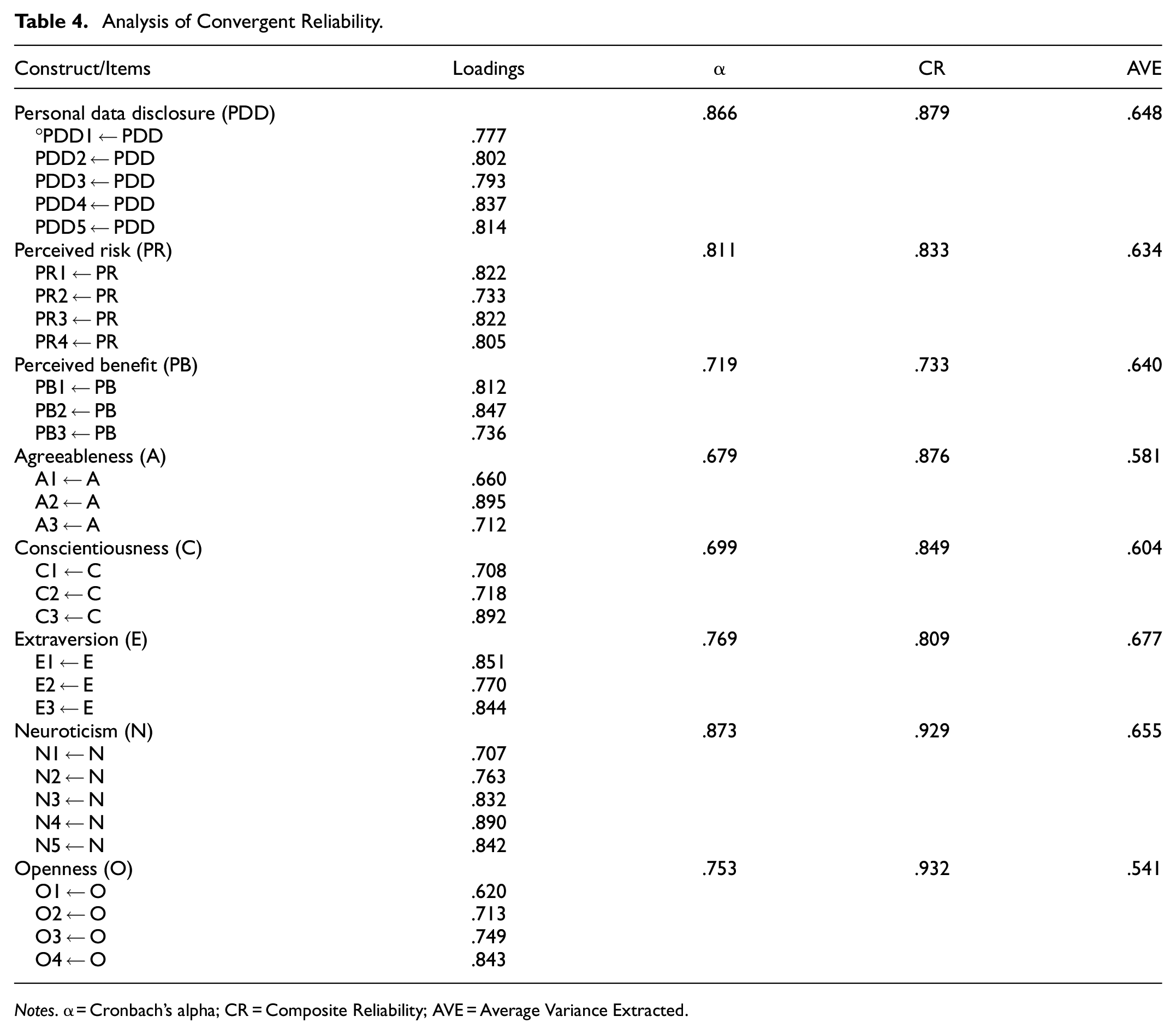
Notes. α = Cronbach’s alpha; CR = Composite Reliability; AVE = Average Variance Extracted.
Discriminant Validity
To measure how unrelated constructs are correlated with each other, discriminant validity analysis is used; correlation between such constructs should not be high. Discriminant validity is measured by comparing the corresponding bivariate correlation with AVE (Fornell & Larcker, 1981; Peng & Lai, 2012). The results shown in Table 5 indicate that the corresponding bivariate correlation is lower than AVE, which means that discriminant validity was achieved in the study.
Fornell-Larcker Criterion.

Note. The diagonal elements (bold) represent the square root of the average variance extracted (AVE). A = Agreeableness, C = Conscientiousness, E = Extraversion, N = Neuroticism, O = Openness, PB = Perceived Benefit, PDD = Personal Data Disclosure, PR = Perceived Risk.
Model Fit Statistics
To assess the goodness-of-fit of our research model, we used the Amos 28 software using various fit indices. Following the established thresholds recommended in the literature (Schreiber et al., 2006), the results indicated a satisfactory level of model fit. The CMIN/DF ratio, which evaluates the discrepancy between the observed and predicted covariance matrices, yielded a value of 2.453, suggesting a relatively acceptable fit. The Goodness-of-Fit Index (GFI) was found to be 0.706, which indicates a moderate level of fit. Similarly, the Adjusted Goodness-of-Fit Index (AGFI) demonstrated a value of 0.759, suggesting a reasonably good fit. The Comparative Fit Index (CFI) yielded a value of 0.8, indicating an acceptable fit. Additionally, the Root Mean Square Error of Approximation (RMSEA) was determined to be 0.06, indicating a close fit. Finally, the Standardized Root Mean Square Residual (SRMR) produced a value of 0.068, further supporting the adequacy of the model. Overall, based on these goodness-of-fit indices, our research model demonstrates a reasonable level of fit, providing support for the validity and reliability of the proposed model in the context of our study.
Structural Model and Hypotheses Testing Results
To assess the structural model, the principles of partial least squares (PLS) structural equation modeling (SEM) were followed when analyzing the data. To validate and test the research model and the relationships among the hypothesized factors, bootstrapping sampling was performed using PLS regression. The path coefficient significance of the inner model was tested by resampling bootstrapping of 5,000 randomly generated subsamples. Moreover, t statistics and beta value (path coefficient) were used to test the relationships between variables (dependent and independent).
Perceived Benefit, Perceived Risk, and Agreeableness had a considerable effect on Personal Data Disclosure (β = .282 for PB, –0.204 for PR, and 0.222 for A). Therefore, Hypotheses 1, 2, and 3 were supported. The remaining hypotheses were found to be insignificant, as illustrated in Table 6.
Structural Model and Research Hypotheses Results.

Note.β = beta coefficient; SDE = standard deviation error; T = t-statistics; p = probability (p) value; A = agreeableness; C = conscientiousness; E = extraversion; N = neuroticism; O = openness; PB = perceived benefit; PDD = personal data disclosure; PR = perceived risk.
Results and Discussion
Based on the past literature on data disclosure and personality traits, the current study objective was to investigate the moderating role of the Big Five personality traits in the association between the two dimensions of privacy calculus (i.e., perceived risks and perceived benefits) and data disclosure. The findings of this study suggest that perceived risks and benefits are directly related to the disclosure of personal data. Moreover, the personality trait of agreeableness is the only trait that is positively related to data disclosure.
This outcome suggests that perceived risks are negatively related to the disclosure of personal data (H1 is supported), which is consistent with the findings of Liu et al. (2022) and Tran et al. (2022). Liu et al. (2022) studied data disclosure decisions in the context of data concealment and mentioned that perceived privacy shapes individual data disclosure intentions. Similarly, Tran et al. (2022) investigated personal data disclosure from the perspective of the sharing economy. They highlight that the disclosure by the service provider’s data builds customer trust and decreases their perception of risk.
The results show that perceived benefits are positively related to personal data disclosure (H2 is supported), which is consistent with the results of previous studies, including Parker and Flowerday (2021), Desimpelaere et al. (2020), and Tran et al. (2022). Parker and Flowerday (2021) studied online personal data disclosure from an individual’s perspective and found that increased awareness of value of personal information increases information protection, enabling individuals to share personal information on social media platforms. Similarly, Robinson (2018) stated that people always looked for benefits when using online platforms, and they only shared information when they felt that perceived benefits exceeded the cost. Furthermore, Desimpelaere et al. (2020) explained the benefits of sharing data on social media platforms and indicated that privacy literacy encourages people to disclose personal information.
The findings suggest that only agreeableness is positively and significantly related to personal data disclosure (H3 supported), which is consistent with Loiacono et al. (2012) and McCarthy et al. (2017). Loiacono et al. (2012) studied social networking sites based on personality traits and found that agreeableness is directly related to self-disclosure behavior on social networking sites. Similarly, McCarthy et al. (2017) mentioned in their study that agreeableness significantly affects emotional disclosure.
The results indicate that there is no direct effect of the other personality traits (conscientiousness, extraversion, neuroticism, and openness) on data disclosure (H4, H5, H6, and H7 are not supported), which is consistent with the findings of Robinson (2018), Watjatrakul (2020), Caci et al. (2019), and Tang et al. (2021). Robinson (2018) investigated attitude toward personal data disclosure based on personality traits and discovered that conscientiousness is not related to attitudes toward disclosing personal data online. Similarly, Watjatrakul (2020) studied the relationship between the intention to adopt online courses and personality traits and found that extraversion did not impact the intention to adopt online courses. Caci et al. (2019) examined self-disclosure on Facebook from the perspective of personality traits and found that neuroticism is not significantly related to self-disclosure on Facebook. Tang et al. (2021) investigated the association between application users’ intention to disclose private information and personality traits and found that openness to experience was not related to application users’ intention to disclose private information.
The findings of the current study indicate that there is no moderating role of any personality trait in the linkage between privacy calculus (i.e., perceived risks and perceived benefits) and data disclosure (H3a, H3b, H4a, H4b, H5a, H5b, H6a, H6b, H7a, and H7b are not supported). This is consistent with Watjatrakul (2020), X. Chen et al. (2016), and Y. Zhou et al. (2017). Watjatrakul (2020) investigated the moderating role of personality traits collectively in predicting students’ intentions to study online courses and found that agreeableness, conscientiousness, and extraversion did not moderate the association between perceived value and intentions to study online. Similarly, X. Chen et al. (2016) investigated the relationship between social capital and SNS users’ self-disclosure behavior using personality traits as a moderator and found that neuroticism did not moderate the association between the dimensions of social capital and self-disclosure behavior over social network sites. Furthermore, Y. Zhou et al. (2017) examined the moderating role of personality traits in the relationship between inter-parental conflict and adolescent Internet addiction using emotional security theory and mentioned that no personality trait moderates the link between inter-parental conflict and adolescent Internet addiction. One reasonable explanation for this is that highly open individuals indicate an open and affirmative attitude (Matzler et al., 2008) while sharing information with others. Such individuals intend to exchange various types of information with others to satisfy their interests and reap benefits, not just related to their interests. Therefore, people who are open to experiences tend not to disclose data on social media platforms.
Similarly, agreeable, and conscientious individuals are inclined to disclose information to serve others and not to express themselves, or for pleasure. Thus, releasing information on social media is generally not linked to agreeable individuals’ aims to support or cooperating with others. Neurotic individuals tend to be dissatisfied with themselves and their lives (Uliaszek et al., 2010), which is why they do not want to disclose information on social media for reaping benefits or satisfying their interests. Additionally, extroverted individuals do not disclose information on social media due to concerns about loss of privacy and fear of rejection. In summary, public disclosure, on social media or face-to-face, has different psychological consequences and is linked with benefits and risks (Aboulnasr et al., 2022). Therefore, people decide when to disclose personal information based on their personality characteristics and the trade-off between benefits and risks.
The result of the study confirms that psychological aspects play an important role in shaping individual behavior, subsequently guiding them toward different actions, including actions related to personal data disclosure. For example, individuals look at the trade-off between risks and benefits, which directly affects their behavior regarding sharing of information over social media. In addition, personality types enable people to act differently in response to the umbrella of risks and benefits associated with the disclosure of personal information on social media platforms. Consistent with this, our study states that individuals with different personality traits feel a loss of privacy and fear of rejection when sharing personal information on social media; therefore, they disregard the risks and benefits of sharing information. The cultural context is an important factor that influences the results of our study. The current research was conducted in the context of Saudi residents, which is why individuals, particularly females, did not share information on social media because of fear of embarrassment (Gangwani et al., 2021). Therefore, cultural openness is needed, and social media platforms should protect women’s personal information on social media.
Implications
This study has several interesting implications. First, the present study is the first to extend the research on personality literature by investigating the moderating role of all personality traits (agreeableness, consciousness, extraversion, neuroticism, and openness to experience) between the two anchors of privacy traits (i.e., benefits and risks) and personal data disclosure. Although, many scholars have investigated the role of personality traits (X. Chen et al., 2016; Y. Zhou et al., 2017), to the best of our knowledge, no study has examined the moderating role of all the personality traits between privacy traits (i.e., benefits and risks) and personal data disclosure.
Finally, this study found that individuals’ personality traits have different moderating effects on the relationships between privacy calculus and self-disclosure of personal information, which creates opportunities for privacy policymakers and infosec professionals in organizations to customize policies and strategies for users based on their unique personality traits. Using artificial intelligence and machine learning techniques, system users and employees can easily be classified into different groups based on their personality traits and, consequently, these groups could be granted different privileges and subjected to different restrictions based on their members’ personality traits and characteristics of their members. Therefore, organizations and institutions seeking to improve the disclosure of personal data should focus on creating and building strong personality characteristics.
Limitations and Future Directions
Our study has some limitations that need to be addressed in future research. First, it focuses only on Saudi Arabia. Future research can be done with the same model in the context of other countries to determine the generalizability of the findings of this study. The cultural context of self-disclosure on social networks is a crucial consideration when researching this phenomenon, particularly in multicultural settings. By understanding how culture affects self-disclosure, we can better understand the factors that motivate people to disclose private data online. Culture is an inherently complex and multifaceted concept that can affect how people interact with social media. Some cultures may emphasize privacy more than others, which may result in varying degrees of self-disclosure on social media. People from cultures that respect privacy may be more likely to share non-personally identifiable information. In contrast, those from cultures that value openness may be more likely to disclose more personal information (Petronio, 2002).
Additionally, collectivism versus individualism is one of the most influential cultural dimensions of self-disclosure on social media (Oyserman & Lee, 2008). Individualistic cultures emphasize individual autonomy and self-expression, whereas collectivist cultures emphasize the significance of group harmony and cooperation. Therefore, people from collectivist cultures may be more inclined to communicate personal information than people from individualistic cultures.
Cultural norms regarding communication and interpersonal relationships (L. E. Chen, 2017; Cushman & Cahn, 1985) can also impact how individuals use social media. In some cultures, it is more respectful to avoid direct communication, whereas in others, it is more appropriate to be direct and assertive. In addition, some cultures value intimate, personal relationships, whereas others value more distant ones. These cultural norms may affect the way people use social networks to communicate with others. Therefore, to ensure the generalizability of this study’s findings, it is necessary to replicate it in diverse cultural contexts.
Second, the present study uses a cross-sectional survey design to collect data from a single informant, which may influence the bias of the common method. Although our assessment of the common method bias issue did not suggest any issue on the participant’s end, future research can be conducted on longitudinal data collection to determine the viability of the current test model at different times. Future studies could also investigate the relationship between other attributes of the privacy calculus to predict data disclosure by social media users. Moreover, future studies should include other moderators (e.g., proactive personality) to test the association between perceived benefits and risks and data disclosure. Researchers can also add mediators (e.g., civic engagement) to the model in the current study to investigate the indirect effect of privacy calculus on data disclosure behavior.
Conclusion
This study examined the role of privacy calculus structural factors, perceived risks and benefits, and the Big Five personality traits in predicting the disclosure of personal information on social media platforms. The findings indicate that perceived benefits are positively related to the disclosure of personal data, whereas perceived risks are negatively related. Furthermore, only agreeableness is positively associated with data disclosure, whereas conscientiousness, extraversion, neuroticism, and openness have no direct effect on data disclosure. Additionally, no personality trait moderates the relationship between privacy calculus (i.e., perceived risks and perceived benefits) and data disclosure.
The study contributes to the body of literature by examining the direct effect of the Big Five personality traits on personal data disclosure and their moderating effects on the relationship between privacy calculus and personal data disclosure. It offers insights into how individuals respond to privacy-related concerns regarding data disclosure and shows the effect of perceived risks and benefits on data disclosure behavior on various social media platforms. Additionally, the study supports the provision of user-centered systems on social media platforms that protect the advantages experienced by individuals and simultaneously reduce the potential risks associated with the sharing of data in online communities. However, the limitations of the study should be taken into account when interpreting the results. For example, the study relied on self-reported data, which is open to response bias. In addition, the study only examined the Big Five personality traits, ignoring other personality factors that may influence disclosure behavior. Future research could investigate additional personality factors and broaden the scope of the study to include other online platforms besides social media sites (e.g., e-commerce websites). Furthermore, future research could examine the effect of situational factors on disclosure behavior and investigate methods to tailor privacy policies to the personality traits.
Finally, this study concludes with important findings on the role of personality traits in the relationship between privacy calculus and the disclosure of personal data on social media platforms. The findings have important implications for privacy policymakers in organizations, who can now personalize policies and strategies for users based on their unique personality traits, thus improving the privacy and security of users on social media platforms.
Footnotes
Appendix A
Acknowledgements
All contributors were listed in the authors’ line.
Declaration of Conflicting Interests
The author(s) declared no potential conflicts of interest with respect to the research, authorship, and/or publication of this article.
Funding
The author(s) disclosed receipt of the following financial support for the research, authorship, and/or publication of this article: This publication is based upon work supported by King Fahd University of Petroleum & Minerals. Authors at KFUPM acknowledge the Interdisciplinary Research Center for Finance & Digital Economy for the support received under Grant No. INFE2114.
Ethical Approval
This study adopted the ethical guidelines proposed by  , including the use of informed consent, respondents’ identity protection as well as voluntary participation and the right to withdraw from participation at any time. Hence, no physical, psychological, legal, or financial harm resulted from this study.
Data Availability Statement
Data sharing not applicable to this article as no datasets were generated or analyzed during the current study.