




Abstract
Although repetitive thought is a risk factor for depression, it can also foster constructive consequences. One factor that determines whether repetitive thought is constructive is the processing mode. The Mini-Cambridge Exeter Repetitive Thought Scale (Mini-CERTS) is the only scale to evaluate such processing modes that relate to the abstractness of thoughts. However, there is no scale to evaluate processing modes in Japan. In this study, the Mini-CERTS was translated into Japanese, and we sought to establish a method of evaluating the processing modes of repetitive thoughts. We conducted exploratory factor analysis of data collected from 222 university students and examined internal consistency and criterion validity. Results showed that the Japanese version of the Mini-CERTS (CERTS-J) had only 12 items. These items loaded upon two factors: abstract analytical thinking (AAT) and concrete experiential thinking (CET). AAT showed sufficient criterion-related validity, but CET did not. Nevertheless, higher AAT predicted higher depression, whereas higher CET predicted lower depression. Thus, the CERTS-J can evaluate processing modes and the functionality of repetitive thoughts. Additional research is needed to assess whether the original English items suit the Japanese culture.
Introduction
Repetitive thoughts are a psychological factor related to depression. They are defined as “the process of thinking attentively, repetitively, or frequently about one’s self and one’s world” (Segerstrom, Stanton, Alden, & Shortridge, 2003, p. 909). Previous studies have revealed that repetitive thoughts amplify negative moods, cause stress events (Connolly & Alloy, 2017; Ruscio et al., 2015), and can predict the occurrence of depressive symptoms within 1 year (Michl, McLaughlin, Shepherd, & Nolen-Hoeksema, 2013). However, other studies have shown that repetitive thoughts occasionally have constructive effects, for example, improving problem solving (Watkins & Moulds, 2005), promoting self-attribution of successful events, and increasing confidence in performance ability (Van Lier, Moulds, & Raes, 2015). Given this difference in the functionality of repetitive thoughts, Watkins (2008) reviewed almost all constructs of repetitive thoughts and concluded that the difference is based on two factors: (a) thought content and, especially, (b) processing mode, which relates to the abstractness of thoughts. Processing mode can be categorized into two: abstract and concrete processing. Abstract processing refers to evaluative thoughts relating to the causes, meanings, implications, and consequences of one’s life experiences; they are high-level and cross-situational (e.g., they address “why”-type questions). In contrast, concrete processing is related to low-level, specific, and contextual thoughts that relate to actual problem solving and identifying the context of a problem, that is, they address “how”-type questions (Watkins, 2008). For example, in stressful events, abstract processing usually focuses on the meaning or implication of the events and evaluates and analyzes them (e.g., “why did I do that?” or “I am not good at all”). In contrast, concrete processing usually describes such situations more concretely by focusing on experiential aspects (e.g., “how did I do that?” or “I forgot to bring important documents to my desk yesterday.”). In summary, the processing mode is an important factor for determining the effects of repetitive thought on psychological health; concrete processing uses more detailed thoughts than abstract processing, and abstract processing uses more evaluative thoughts than concrete processing.
Several experimental investigations of the effects of processing mode have been conducted (Kingston, Watkins, & Nolen-Hoeksema, 2014; Rimes & Watkins, 2005; Watkins & Moulds, 2005). For example, Watkins, Moberly, and Moulds (2008) examined the effect of processing mode on mood after an experience of failure. They subjected their participants to either the abstract processing condition or the concrete processing condition. In the abstract processing condition, participants were told to read and concentrate on hypothetical scenarios and to analyze why events happened, focusing on their meanings, causes, implications, and consequences. In contrast, in the concrete processing condition, participants were asked to imagine as vividly and concretely as possible the details of how events happened. After this manipulation, all participants experienced failure by attempting to solve difficult and insoluble anagrams, after which their mood was assessed. Results showed that the participants in the abstract processing condition had a more negative mood than those in the concrete processing condition.
To our knowledge, the only scale that assesses the processing modes of repetitive thoughts is the Mini-Cambridge Exeter Repetitive Thought Scale (Mini-CERTS; Barnard, Watkins, Mackintosh, & Nimmo-Smith, 2007; Douilliez et al., 2014). The Mini-CERTS consists of two factors: abstract analytical thinking (AAT; that is, abstract processing) and concrete experiential thinking (CET; that is, concrete processing). This scale has been translated into French (Douilliez et al., 2014) and Polish (Kornacka, Buczny, & Layton, 2016), with confirmed reliability and validity. Moreover, several studies have examined the association between AAT and/or CET and maladaptive outcomes. For example, one such study found that AAT is associated with maladaptive perfectionism in depression (Di Schiena, Luminet, Chang, & Philippot, 2013, Study 1). Another study found that AAT is positively correlated with depression, whereas CET is negatively correlated (Di Schiena, Luminet, Philippot, & Douilliez, 2012).
As shown above, it could be argued that the Mini-CERTS is a useful scale to measure the processing mode of repetitive thoughts. However, there is no such scale in Japan. Therefore, the aim of this study was to develop a useful and simple tool that can be used in Japan to assess the processing mode of repetitive thoughts. Thus, we translated the Mini-CERTS into Japanese and confirmed its reliability and validity through exploratory factor analysis (EFA).
In addition, to examine the validity of our Japanese scale, we examined correlations between its scores and those of other scales that assess repetitive thoughts, such as worry and rumination. Worry relates to verbal behavior and abstract thoughts (Stöber, 1998). Indeed, one experimental study showed that induced worry decreased the concreteness of thought content (Goldwin & Behar, 2012). Therefore, we expected that there would be a positive correlation between AAT and the Penn State Worry Questionnaire (PSWQ; Motooka, Tanaka-Matsumi, & Hayashi, 2009) and a negative correlation between CET and PSWQ.
Rumination is defined as “behaviors and thoughts that focus one’s attention on one’s depressive symptoms and on the implications of these symptoms” (Nolen-Hoeksema, 1991, p. 569); it is characterized as an abstract processing mode (Watkins, 2008). Furthermore, rumination consists of two subfactors: brooding and reflection (Treynor, Gonzalez, & Nolen-Hoeksema, 2003). Brooding relates to a tendency to think analytically, defined as “a passive comparison of one’s current situation with some unachieved standard” (Hasegawa, 2013, p. 717; Treynor et al., 2003). Therefore, we also expected that there would be a positive correlation between AAT and brooding, and a negative correlation between CET and brooding. In contrast, reflection relates to a tendency to think when solving problems, defined as “a purposeful turning inward to engage in cognitive problem solving to alleviate one’s depressive symptoms” (Hasegawa, 2013, p. 717; Treynor et al., 2003). Some of the items of reflection in the Ruminative Responses Scale (RRS; Nolen-Hoeksema & Morrow, 1991) address analytical thoughts (e.g., “analyze your personality to try to understand why you are depressed” and “analyze recent events to try to understand why you are depressed”). According to Watkins (2008), reflection is related to analytic thinking, and we expected that there would be a positive correlation between AAT and reflection in the RRS. Moreover, a previous study showed that inducing concrete processing promoted problem solving (Watkins & Moulds, 2005). Therefore, we also predicted that there would be a positive correlation between CET and reflection in the RRS.
Method
Participants
The participants in this study were university students in their introductory psychology course (N = 222; 108 males and 94 females [20 were unknown]; mean age = 20.32; SD = 1.66) who were recruited from a Japanese university.
Measures
Mini-CERTS–Japanese version (CERTS-J)
The CERTS was developed by Barnard et al. (2007); a short form was later created by Douilliez et al. (2014). This scale measures repetitive thoughts in general. It begins with the statement “when thoughts about myself, feelings, situations, or events come to mind . . .” and is followed by a selection of responses for each item. The questionnaire assesses two dimensions: AAT (Items 1, 3, 5, 6, 7, 10, 12, 14, and 15; for example, Item 1: “My thinking tends to get stuck in a rut, involving only a few themes”) and CET (Items 2, 4, 8, 9, 11, 13, and 16; for example, Item 2: “I can grasp and respond to changes in the world around me without having to analyze the details”). This factor structure has been confirmed by several studies (Douilliez et al., 2014; Kornacka et al., 2016). Each item is rated using a 4-point scale (1 = almost never, 4 = always). High scores on AAT and CET subscales suggest a high tendency to engage in each type of thinking. The procedure by which we translated the scale into Japanese is described below.
Beck Depression Inventory–II (BDI-II)
The level of depressive symptoms was assessed using the BDI-II (Beck, Steer, & Brown, 1996). We used the Japanese version of BDI-II, which has demonstrated good reliability and validity (Kojima & Furukawa, 2003). The BDI-II is a standard tool for measuring depressive symptoms. This scale consists of 21 items that assess depressive symptoms over 2 weeks by asking participants to respond to items using a 4-point scale (ranging from 0 to 3). In our sample, the internal consistency of the BDI was good (α = .79).
RRS
The tendency to engage in ruminative thinking was assessed using the RRS (Nolen-Hoeksema & Morrow, 1991). We used the Japanese version of RRS, which has demonstrated acceptable reliability and validity (Hasegawa, 2013; Hasegawa, Kunisato, Morimoto, Nishimura, & Matsuda, 2018). This questionnaire consists of 22 items that assess the frequency of ruminative thoughts relating to feeling depressed or sad. Participants respond to items using a 4-point scale ranging from 1 (almost never) to 4 (almost always). This scale also includes two subscales named “brooding” and “reflection.” Five items assess brooding, which relates to a tendency to think analytically. Reflection relates to a tendency to engage in problem solving; it is assessed via five items (Hasegawa, 2013; Treynor et al., 2003). We used only the 10 items that relate to brooding and reflection. Internal consistency for brooding and reflection in this sample was good (α = .82 and .69, respectively).
PSWQ
The tendency to worry was assessed using the PSWQ (Meyer, Miller, Metzger, & Borkovec, 1990). We used the Japanese version of PSWQ, which has demonstrated acceptable reliability and validity (Motooka et al., 2009). This questionnaire consists of 16 items that assess the frequency of worry-related thoughts. Responses are provided using a 5-point scale ranging from 1 (strongly disagree) to 5 (strongly agree). The internal consistency for this sample was good (α = .75). 1
Procedure
In this study, the translation of the Mini-CERTS from English into Japanese was conducted in compliance with the guidelines for translation of psychological scales (Inada, 2015). First, we received permission to translate the Mini-CERTS from the original English version’s author by email. Then, the first and second authors independently translated the scale from English into Japanese. Next, we compared and merged the two translations and confirmed that the CERTS-J items retained their original meanings. After we completed the translation, the CERTS-J was back-translated into English by a commercial translation service. Native English speakers who were familiar with psychology provided the back translation. The back-translated version was then sent to the author of the original version to check for any discrepancies between the meanings of the new and the original English items. Utilizing the original author’s review, we then modified the Japanese draft and repeated the back translation into English. Finally, we contacted the original author by Skype and discussed the cultural discrepancies between the Mini-CERTS and the CERTS-J to effectively reconcile the CERTS-J items with their original meanings. Following this, 10 graduate students reviewed the scale for any unclear Japanese expressions and discussed them with us. We revised the expressions to receive the students’ agreement on the final version of the items, after which we finalized the CERTS-J.
After providing informed consent, participants completed the questionnaires, including the CERTS-J, using paper and pencil. Questionnaires were distributed to students after a psychology class and were completed and collected at that time. The study was approved by the local research ethics committee.
Analysis
We first examined the distribution of every CERTS-J item using EFA. Following the recommendations of Hori (2005), we confirmed that the CERTS-J factors were consistent with those of the Mini-CERTS (i.e., AAT and CET). To achieve this, we used parallel analysis and minimum average partial correlations. We then conducted EFA using oblique rotation (Promax rotation) to check factor loadings and assessed correlations between factors using the maximum likelihood method. In addition, to confirm the reliability of the CERTS-J, we calculated Cronbach’s alpha, and to investigate the validity of the CERTS-J, we conducted correlation analyses between the CERTS-J scores and the other investigated variables (i.e., depression, reflection, brooding, and worry). Finally, we conducted multiple regression to examine whether AAT predicted increased depression and CET predicted decreased depression, after controlling for other variables. All t tests were two-tailed. All data analyses were conducted using R 3.4.3 (psych package).
Results
EFA of the CERTS-J
Table 1 shows the descriptive statistics of the participants. We checked the distribution of the items in the CERTS-J and sought ceiling and floor effects; almost all of the items had biased distributions and were out of the range of mean ± 1 SD, but CE10 may show a potential ceiling effect.
Descriptive Statistics.
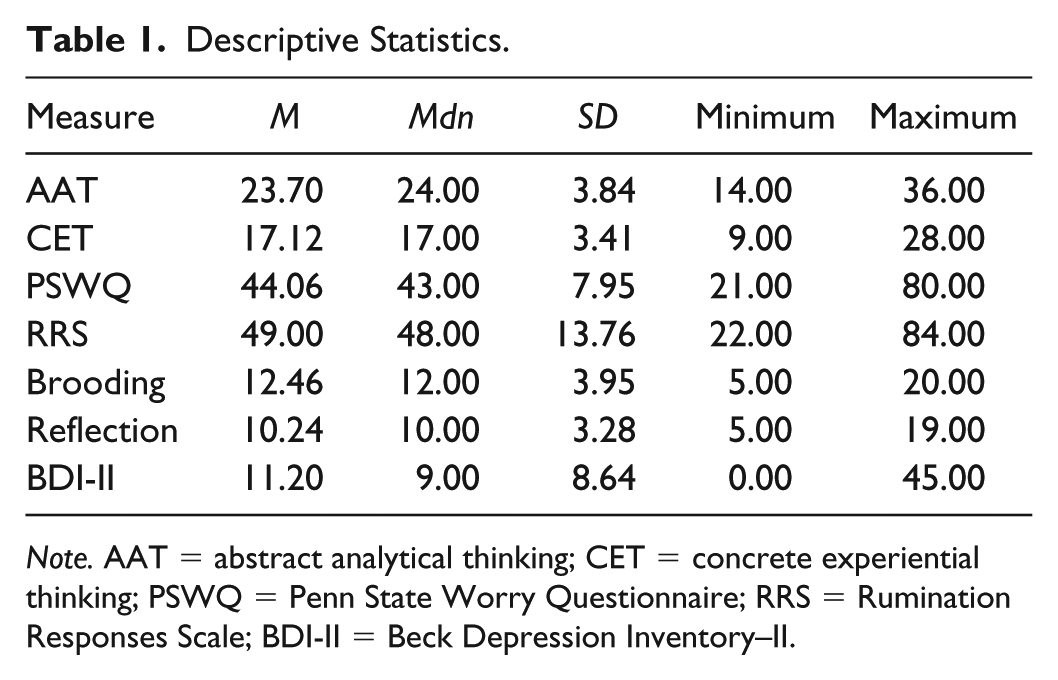
Note. AAT = abstract analytical thinking; CET = concrete experiential thinking; PSWQ = Penn State Worry Questionnaire; RRS = Rumination Responses Scale; BDI-II = Beck Depression Inventory–II.
The parallel analysis indicated that there were two or three factors in the model, and the minimum average partial correlations recommended a two-factor structure. Therefore, we applied a two-factor structure that was consistent with the Mini-CERTS. Next, we conducted an EFA of the two-factor structure. Communalities and factor loading for the CERTS-J items are presented in Table 2. We set a cutoff of 0.3 for the factor loadings. Three items had factor loading values that were below the cutoff: CE5 (“I judge myself against my own standards and beliefs” [F1 = 0.08; F2 = 0.28]), CE6 (“I focus on why things happened the way they did” [F1 = 0.21; F2 = 0.28]), and CE11 (“I’m relaxed about going with the flow of what comes to mind” [F1 = −0.07; F2 = 0.25]). Therefore, we excluded these items and conducted the EFA again. On this second iteration, one item had a factor loading that fell below the cutoff: CE14 (“My thinking tends to spiral out from one specific event to broader, general aspects of my life” [F1 = 0.08; F2 = 0.29]). We also excluded this item and conducted EFA once more. Finally, all remaining items had satisfactory factor loadings (i.e., above the cutoff point); we chose to include these 12 items in the final version of the CERTS-J (see Table 2). F1 was consistent with the items in the Mini-CERTS that addressed AAT. Accordingly, we named it “abstract analytical thinking”; in contrast, F2 consisted of items that corresponded to the original version’s CET items. Therefore, we named it “concrete experiential thinking.”
Exploratory Factor Analysis of the CERTS-J.
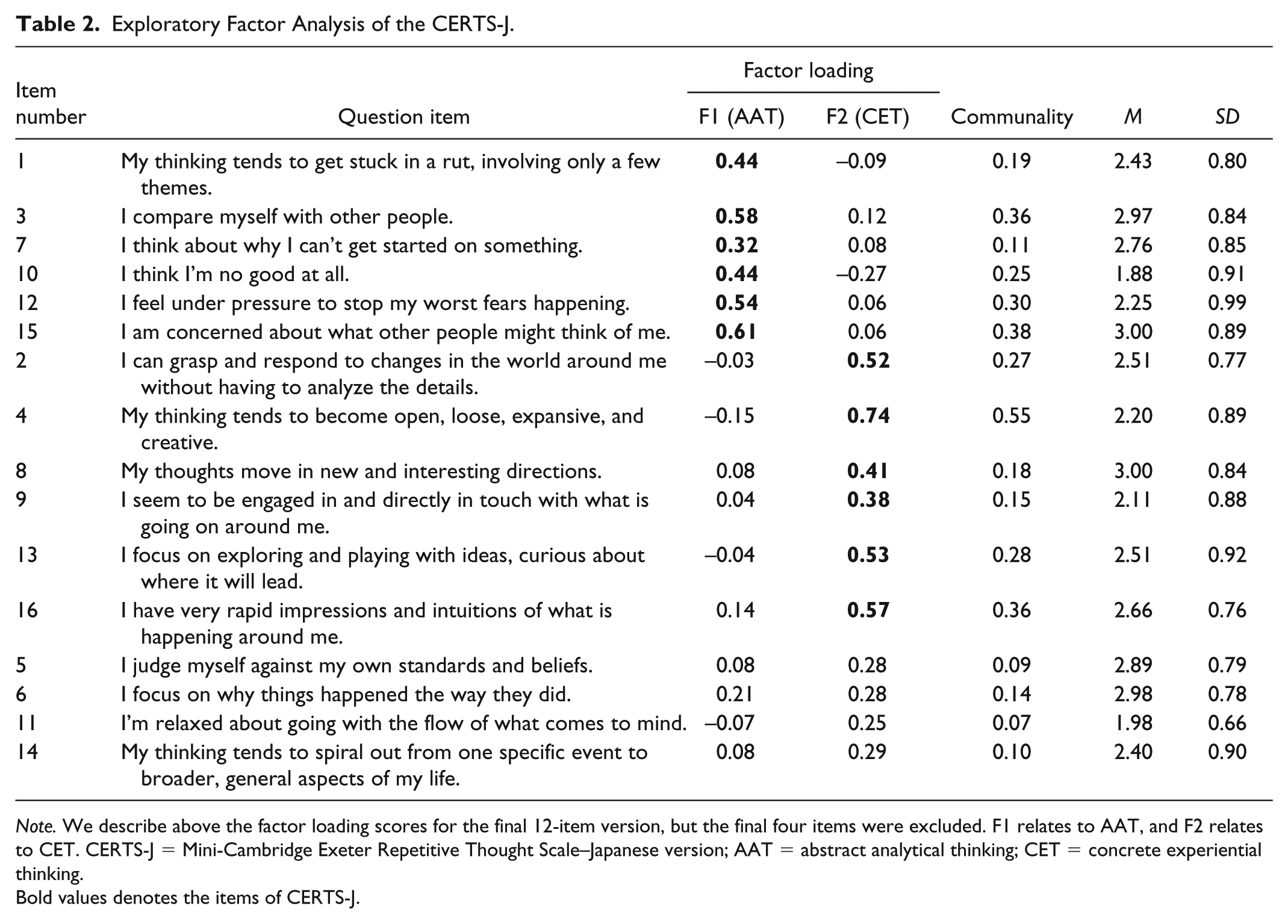
Note. We describe above the factor loading scores for the final 12-item version, but the final four items were excluded. F1 relates to AAT, and F2 relates to CET. CERTS-J = Mini-Cambridge Exeter Repetitive Thought Scale–Japanese version; AAT = abstract analytical thinking; CET = concrete experiential thinking.
Bold values denotes the items of CERTS-J.
The internal consistency (Cronbach’s α) of the CERTS-J was .65 for AAT and .69 for CET. These reliability values are not markedly high (Cortina, 1993), which may be attributed to the low factor loadings. Although these reliability coefficients may be considered insufficient, a previous study determined similar values for the original English scale (.61 for AAT and .69 for CET; Kornacka et al., 2016). The mean (SD) of CERTS-J was 15.26 (3.12) for AAT and 15.10 (3.19) for CET.
Criterion-Related Validity of the CERTS-J
To confirm the criterion-related validity of the CERTS-J, we computed zero-order correlations between AAT scores and those of the other variables for both the CERTS-J (12 items) and the 16-item Japanese version. We performed the same procedure for CET items (see Table 3). However, as we excluded four of the items contained in the 16-item version from the CERTS-J, it is possible that the construct validity of the CERTS-J was compromised. Therefore, we conducted correlation analyses on the factor structure of both the CERTS-J and the 16-item version. These analyses revealed some differences between the two versions; for example, there was not a statistically significant correlation between AAT and CET scores in the CERTS-J (r = .13, p = .265), but there was a significant correlation between these variables in the 16-item version (r = .22, p < .05). However, in both versions, there were significant high positive correlations between AAT and other scales that assess repetitive thoughts, such as RRS and PSWQ. Furthermore, there were no significant differences in the way the CERTS-J and the 16-item version correlated with the above-mentioned scales. Therefore, we suggest that the CERTS-J and the 16-item version are acceptably similar.
Bivariate Correlations Between All Variables (CERTS-J/Original Items).

Note. CERTS-J = Mini-Cambridge Exeter Repetitive Thought Scale–Japanese version; AAT = abstract analytical thinking; CET = concrete experiential thinking; PSWQ = Penn State Worry Questionnaire; RRS = Rumination Responses Scale; BDI-II = Beck Depression Inventory–II.
p < .05. **p < .01.
As predicted, AAT of the CERTS-J was positively correlated with brooding, reflection, and PSWQ. Although there was a positive correlation between CET of CERTS-J and reflection, CET was not correlated with brooding and showed a small positive relationship with PSWQ. This latter result contradicted our predictions. Moreover, AAT of the CERTS-J was not associated with CET; this result was inconsistent with the predictions as well.
CERTS-J’s Ability to Predict Depression
To evaluate the functionality of the CERTS-J, we used multiple regression with the BDI-II as the dependent variable and the CERTS-J, brooding, reflection, and PSWQ as the independent variables (see Table 4). Furthermore, we also conducted a similar analysis on the 16-item version and compared the results. Consequently, we found that there were only slight differences between the CERTS-J and the 16-item version. Regarding the CERTS-J, AAT was significantly associated with depression after adjusting for the other variables (β = .22, p < .05). Moreover, high CET was a significant predictor of low levels of depression (β =. –15, p < .05). These results are consistent with our predictions.
Regression Analysis Concerning Depression.

Note. CERTS-J = Mini-Cambridge Exeter Repetitive Thought Scale–Japanese version; AAT = abstract analytical thinking; CET = concrete experiential thinking; PSWQ = Penn State Worry Questionnaire.
p < .05. **p < .01.
Discussion
The present study translated the Mini-CERTS into Japanese and investigated the validity and reliability of the translated instrument (CERTS-J). Our major finding regarding the CERTS-J is that it can assess processing modes such as abstract processing and concrete processing. However, the reliability of AAT and CET was insufficient. In addition, the CERTS-J had to drop some of the items of the original English version owing to very low factor loadings. Despite these potentially problematic issues with the CERTS-J, we found very little differences in the functioning of the CERTS-J and the 16-item Japanese version. Furthermore, important differences were found in the way the two factors in the CERTS-J predict depression, with AAT predicting an increase and CET predicting a decrease in depression. Given these points, we suggest that the CERTS-J is a useful scale that can identify both AAT and CET, notwithstanding some limitations regarding its reliability and validity.
AAT was found to be positively associated with brooding, reflection, and worry, which is consistent with our predictions. Rumination and worry have been considered as related to abstract processing (Watkins, 2008). Previous studies that investigated the thought content of rumination have revealed that patients with chronic depression usually engage in repeated rumination in abstract processing (Pearson, Brewin, Rhodes, & McCarron, 2008). Furthermore, an experimental study that induced rumination and worry in its participants found that both kinds of repetitive thoughts decreased in concreteness (Goldwin & Behar, 2012). In summary, the AAT can successfully measure abstract processing.
Although the evidence above demonstrates the criterion-related validity of the AAT, it is difficult to conclude that the AAT of CERTS-J is consistent with the 16-item version. This is because the CERTS-J omitted some items of the original English version, including content concerning the structure of processing modes. Hence, we need to confirm the content validity of AAT. The excluded items related to overgeneralizations of abstract processing: CE5 (“I judge myself against my own standards and beliefs”) and CE14 (“My thinking tends to spiral out from one specific event to broader, general aspects of my life”). Fortunately, one item induced in the CERTS-J captures these overgeneralizations, namely CE10 (“I think I’m no good at all”). In contrast, we excluded CE6 (“I focus on why things happened the way they did”), which is the only item that directly enquires how individuals become stuck with repetitive “why” thoughts. Considering the definition of abstract processing, “why-type thoughts” are usually considered “high-level and cross-situational” (Watkins, 2008). In the CERTS-J, we believe that cross-situational thoughts are captured by CE3 (“I compare myself to other people”) or CE10. Therefore, the AAT of CERTS-J may encompass the definition of abstract processing. However, the CERTS-J does not measure directly the extent of an individual’s “why-type” thoughts. Note that a previous EFA of the Mini-CERTS revealed weak factor loadings as well: CE5 <.2 in the French version (Douilliez et al., 2014; N = 252), and CE2, CE5, CE9, CE11, CE13, and CE14 scored <.3 in the Polish version (Kornacka et al., 2016; N = 111). Our analysis led us to exclude items CE5, CE11, and CE14, which is consistent with results of previous studies. That is, the original tool contains items that have unstable factor loadings and that may be affected by cultural differences. In summary, the AAT of CERTS-J did not include all the content of the original instrument; nevertheless, it captured the definition of abstract processing. It is necessary to examine further the validity of this construct.
On the other side, the CET of CERTS-J demonstrated some issues with criterion-related validity. First, CET scores were not negatively correlated with worry (PSWQ) and brooding (RRS), which are repetitive thoughts of the abstract processing mode. These results contradicted our predictions. A previous study that translated the Mini-CERTS found that CET scores were negatively related to brooding (Kornacka et al., 2016). However, the relationship between the CET of CERTS-J and brooding was not significant. This indicates that CET does not measure aspects of an abstract processing mode. Furthermore, CET was positively correlated with reflection. Concrete processing is defined as low-level, specific, and contextual thoughts that relate to actual problem solving and identifying the context of a problem; they address “how”-type questions (Watkins, 2008). That is, concrete processing focuses on present problems in detail. Therefore, the aforementioned evidence indicates that the CET of CERTS-J may capture the problem-solving tendencies that are part of the definition of concrete processing.
Second, the CET of CERTS-J was not associated with AAT, which is contradicting our predictions. A previous study showed the presence of a negative relationship between AAT and CET scales of the Mini-CERTS; this correlation is consistent with processing mode theory (Kornacka et al., 2016). The present study found that CET was not related to AAT. Hence, it should be assumed that CET and AAT relate to different aspects of repetitive thought that do not overlap.
Third, we excluded one CET item (CE11) owing to its low factor loading. This may have led to insufficient content validity. CE11 states, “I’m relaxed about going with the flow of what comes to mind.” Although we excluded CE11, we considered that this item could not assess concrete processing directly, and our results showed a low factor loading for CE11.
In summary, the CERTS-J has validity with respect to AAT but not CET. It is necessary to conduct additional research into the validity of the CERTS-J. However, CET measures aspects of processing mode other than AAT, and the CET of CERTS-J predicted depression scores. Therefore, the CET of CERTS-J may partially capture concrete processing mode.
Despite the caveats noted above, a high AAT score and a low CET score, or vice versa, predicted high or low depression symptoms, respectively; however, brooding did not. These results were consistent with our prediction and indicate that the CERTS-J can detect the functionality of repetitive thoughts, while other scales, such as the RRS and the PSWQ, can only capture the dysfunctional aspects of repetitive thoughts. However, it should be noted that in this multiple regression analysis, RRS did not behave as expected (i.e., brooding did not predict depression, whereas reflection did); thus, this finding raises a note of caution about potential effects of multicollinearity on this result.
Some limitations to our study should be mentioned. First, all our participants were university students; as such, it may be difficult to apply these results in a clinical setting. However, the Mini-CERTS was previously found to be capable of capturing features of psychosis in clinical samples (Maurage et al., 2017). Nevertheless, it is necessary to examine the validity of the CERTS-J using clinical samples. Second, the AAT scale had limited content validity and the CET scale had insufficient criterion-related validity. Therefore, it is necessary to generate a CERTS-J that has sufficient validity. To do so, a larger sample would be needed, and items would need assessment and modification to fit Japanese culture. For example, CE5 (“I judge myself against my own standards and beliefs”), which is in the AAT scale of the Mini-CERTS, showed a higher factor loading on CET than on AAT in the present study. Japanese cognitions and evaluations are characterized by reference to other people (i.e., collectivism), whereas individuals in Western countries usually adopt their own standards and values when evaluating items (i.e., individualism; Oyserman & Lee, 2008). This highlights the need to consider aspects of Japanese culture during scale generation. Finally, as mentioned above, it is important to examine the validity of the CERTS-J, as it excluded some items that are present in the original English version of the scale.
Footnotes
Acknowledgements
The authors thank all of their colleagues in this study. We are grateful to Dr. Philip Barnard for supervising and advising us during the process of translation of the Mini-CERTS into Japanese. In addition, we would also like to thank Mr. Russell Kabir who helped us back-translate the scale from Japanese into English.
Authors’ Note
Kohei Kambara is a Research Fellow of the Japan Society for the Promotion of Science.
Declaration of Conflicting Interests
The author(s) declared no potential conflicts of interest with respect to the research, authorship, and/or publication of this article.
Funding
The author(s) disclosed receipt of the following financial support for the research, authorship, and/or publication of this article: This study was supported by the JSPS KAKENHI Grant Number JP 17J06735.
