




Abstract
It is often challenging to make decisions about how to teach planning within an undergraduate operations management module. This article defines and compares the two standard options available to instructors: (a) the traditional “technical” approach or (b) the “conceptual” or “conversational” approach. Through a reflective action research methodology, this article examines modules taught with both approaches. From a learning theory standpoint, the conclusion is that the technical approach does a good job of staging learning in manageable chunks, but students rarely end up with an insightful understanding of planning systems. The conceptual approach offers more opportunities for learning, but these opportunities can only be taken advantage of if students engage and have enough knowledge prerequisites. To overcome the limitations of these two approaches, this article describes a more robust active learning approach based on using substitute experiences.
Background
There has been a significant increase in researching operations management teaching over the last decade. The European Thematic Network for the Excellence in Operations and Supply Chain Management Education, Research and Practice (THENEXOM; Machuca, Luque, Díaz, & Reiner, 2005) played a significant role in encouraging this type of research. The International Journal of Information and Operations Management Education published its inaugural issue in 2005, whereas INFORMS Transactions on Education has been in print since 2000, although with a more technical focus on management science.
As a discipline, operations management is unusual due to its rich assortment of topics (Machuca & Luque, 2003), leaving instructors with the challenge of deciding which topics should be covered and how. Lutz, Birou, and Kannan (2014) surveyed these choices and point out to gaps between what is taught and what industry experts have identified as important. This article focuses on a central, core topic in operations management: planning. It should not be confused with the well-established field of planning in geography, which has its own specialist journal, the Journal of Planning Education and Research. In contrast, teaching operations management planning (“planning” hereafter in this paper) has received limited research attention. This is surprising as there are many market and institutional forces that are making the teaching of planning increasingly more challenging:
Decreasing students’ numeracy skills (Higher Education Funding Council for England, 2005; LeFevre, Douglas, & Wylie, 2016).
Increasing accountability of instructors to students’ feedback (Lindahl & Unger, 2010). Teaching technical topics can be a risky choice when students’ feedback asks for less emphasis on these. Yingqiang and Yongjian (2016) explain this trend by an increased reliance on quality assurance rather than a genuine quality culture in higher education. This trend results in an imbalance between power and responsibility. This argument is similar to Naudé, Band, Stray, and Wegner (1997) who highlight the dilemma of designing curriculum on the basis of what the students want (power) versus what the students ought to know (responsibility). In their survey, Naudé et al. (1997) show that the quantitative awareness of MBA students is low, and this despite students accepting that mastering quantitative analysis is important.
Evolution away from manufacturing operations and toward service operations. Teaching traditional manufacturing planning techniques is challenged by newer topics, such as supply chain management, lean operations, customer management, and sustainable operations. Textbooks can be expanded to accommodate these new topics, but the numbers of taught sessions cannot. The debate about whether or not manufacturing operations should still be taught is much wider than the focus of this article, but it cannot be dissociated from it as much of what is traditionally taught about planning was discovered in manufacturing contexts. On one hand are proponents of removing manufacturing and calling for a more “updated” operations management discipline. On the other hand, some argue that the difference between manufacturing and service is exaggerated and that there is room for a unified discipline (Goldhar & Berg, 2010).
In summary, and at the risk of stereotyping the context of teaching planning in operations management, instructors are faced with a number of demographic and institutional forces that combine increasing pressures (a) to manage pass rates and to do what the market wants, (b) to reduce technical and numerical content, and (c) to abandon existing (and tested) learning material based on manufacturing operations.
Research Aims
The objective of this article is to compare the effectiveness of the different teaching options that can be used to teach planning within an operations management module. The first option, referred to as the “technical approach” in this article, consists of delivering a lecture explaining how to solve a specific planning problem by applying a specific technique, usually in a manufacturing context. This is followed by a tutorial session where students are asked to complete quantitative exercises. This approach is well suited to the use of textbooks authored in North America. Typically, the topics covered include forecasting, capacity planning, sales operations planning (SOP) or aggregate production planning (APP), scheduling, inventory planning, material requirements planning (MRP), just in time (JIT), and project planning. These topics are covered in separate textbook chapters. Covering all the techniques could require between 4 and 7 distinct class meetings.
The second option, referred to as the “conceptual/managerial” approach in this article, focuses on planning from a more abstract and conceptual perspective. It involves a discussion of actual planning practices across a wider set of business contexts. The delivery of the lecture may be accompanied occasionally, but not necessarily, by a demonstration of quantitative planning techniques. Tutorial sessions are usually based on the use of a case studies inviting students to discuss the practices used in the case. This approach is well suited to the use of textbooks authored in the United Kingdom. Typically, the same topics are discussed than with the technical approach, but they are “compressed” into 2 to 3 class meetings.
The purpose of this article is to examine the effectiveness of each option from a learning theory perspective, that is, the research question is, what have students learned about planning?
It is worth nothing that in this article, the use of innovative teaching technologies is a control variable rather than an independent research variable. Consider, for example, a comparison between two teaching sessions about sales and operations planning. One uses the technical approach, and the other the conceptual approach. The technical session could be based on the “live” spreadsheet technology of Hozak and Sale (2015). Analyzing which approach works best becomes challenging as there are two sources of variance (approach and technology). There is an extensive operations management teaching literature promoting the use of games (e.g., Hans & Nieberg, 2007; Wright, 2015) and technology-supported learning (e.g., Hans & Nieberg, 2007; Hozak & Sale, 2015). The purpose of this article is not to add more evidence to the benefits of using innovative teaching technologies but is instead to focus exclusively on the nature of the intellectual interactions between instructors and students. This is achieved by focusing on learning theory.
Learning Theory
Experiential Learning
Kolb’s (1984) learning cycle combines two key schools of learning theory: the behavioral school and the cognitive school. It argues that individuals learn by completing a cycle which takes them through the stages of planning for an experience, making a concrete experience, reflecting upon it, and then conceptualizing it (Kolb, 1984; Kolb & Kolb, 2005). It is a popular framework which has been used to improve operations management teaching (Arena-Marquez, Machuca, & Medina-Lopez, 2012; Medini, 2018; Wilson, 2018). Kolb and Kolb (2005) argue that higher education institutions should revise their learning environments—called learning space—to facilitate the experiential learning cycle. The specific principles that the authors formulate in this regard are as follows:
Respect for learners and their experience
Begin learning with the learner’s experience of the subject matter
Creating and learning a hospitable space for learning
Making space for conversational learning
Making space for development of expertise
Making space for acting and reflecting
Making space for feeling and thinking
Make space for inside-out learning
Making space for learners to take charge of their own learning
Cognitive Prerequisites
Principles 1, 2, and, 3 in the list above follow a well-know paradigm shift in education. Negative and stereotypical statements about students’ lack of skills have negative impacts on the learning process. Kolb and Kolb (2005) especially insist on the negative impacts that ill-designed educational environments can have on confidence. In this respect, they agree with Bloom’s (1976) suggestion that any learner can learn, given enough time and appropriate instructions. Although Kolb and Kolb’s (2005) principles are consistent with Bloom’s thesis, they ignore Bloom’s most significant contribution to learning theory. Bloom’s research showed that a key determinant of the time and amount of instruction required for learning is a direct function of the students’ cognitive prerequisites, that is, what they already know about a subject. Dochy, de Rijdt, and Dyck (2002) provide an exhaustive review of this argument and report overwhelming evidence in support of it. A teaching strategy can be to capitalize on these cognitive prerequisites. For example, Marques Sosa, Goncalves, Carpes, and Mello-Crapes (2018) describe a successful experiment where students learning was improved by adding a stage of active memory reactivation. The idea to start with learners’ existing knowledge of the subject matter is however problematic if an instructor suspects that cognitive prerequisites are very limited, either in terms of the domain of knowledge (e.g., planning) or skills (e.g., numerical skills).
Experiential Variations
One commonly promoted solution to the problem of limited cognitive prerequisites is Principle 4, that is, to use conversational learning (Baker, Jensen, & Kolb, 2002). The idea is that if one student has limited experience of planning, he or she can benefit from the experience of others that do. The benefit of conversational learning can be explained with a broader theory of learning as experiential variations (Fazey & Martoni, 2002). Learners can learn more by looking at a phenomenon from a variety of perspectives. This can happen through conversation with others but also by forcing oneself to look at an issue differently. The greatest limitation of the technical teaching approach is that it offers little by the way of experiential variations. For example, the ability to solve an aggregate production problem for a manufacturer does not necessarily mean that a student will be able to apply the acquired knowledge to airline planning. If students are exposed to manufacturing planning and airline planning, experiential variations theory suggests that they will learn much more about planning.
Balanced Learning
Principles 5, 6, 7, 8, and 9 are all recommendations that aim to create the right context and to develop the skills for learners to learn in a balanced fashion. Kolb’s theory is often associated with the concept of learning styles. There is considerable empirical evidence showing that different individuals are more or less comfortable with different stages of the learning cycle (see Kolb & Kolb, 2005, for a review). Often, students are found to have activist/participative learning styles, as in Hazici’s (2016) research where operations management students benefit from the use of interactive response systems. However, catering to a specific learning style amount to avoiding a learning challenge. This is because only individuals with a balanced profile can complete the full learning cycle. Thus, ideally, the teaching of planning should provide opportunity for students to apply and develop their ability to plan for experience, to actively test their knowledge, to reflect upon experience, and to conceptualize their experience in theoretical form.
There is however no evidence at all to support that the experiential learning cycle works in practice as depicted by Kolb. The popularity of Kolb’s model is due to the fact that it is intellectually seducing and that it leads to research about learning styles. Holman, Pavlica, and Thorpe (1997) criticize this aspect of Kolb’s model and ask how much is known about learning cycles in practice? Are they well-timed, sequential application of the same cycle? Or a series of microcycles that get interrupted and form a complex pattern of learning cycles, potentially with parallel execution? How do learners decide to move onto the next stage? It is noteworthy that Kolb’s theory is much less prescriptive than it is often reported to be. For example, Kolb and Kolb (2005) indicate that a cycle can be entered at any stage.
The importance of achieving a balanced form of learning is the focus of Gibbs’s (1988) practical recommendations for implementing the experiential learning cycle in teaching settings. Gibbs’s (1988) contribution is to investigate teaching styles by looking at the stages that an instructor completes with the student with reference to the learning cycle. The numbered arrows in Figure 1 show the four teaching methods defined by Gibbs: (1) planning for experience (from conceptualization to experience), (2) increasing awareness of experience (from experimentation to experience), (3) reviewing and reflecting upon experience (from experience to reflection), and (4) providing substitute experiences (full cycle starting and finishing with conceptualization).
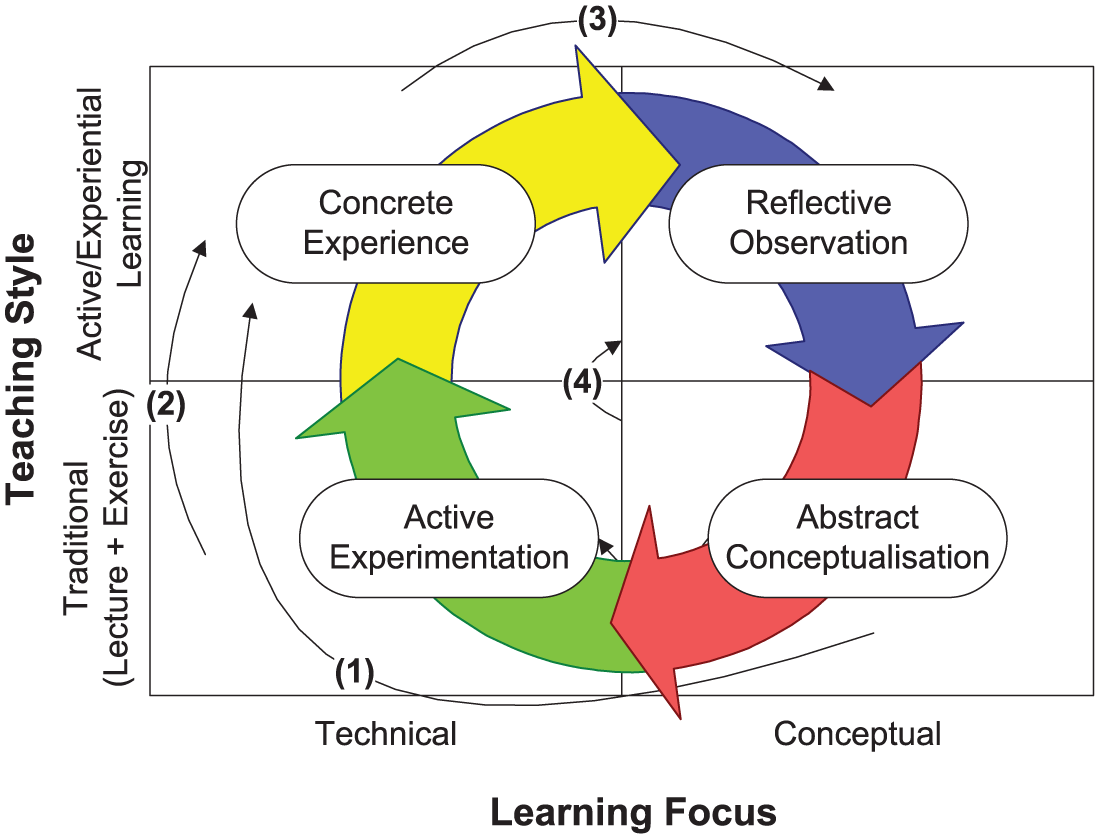
A framework for teaching operations planning.
Only substitute experiences (arrow 4) in Figure 1 implies balanced learning in the classroom. With the other three teaching methods, the instructor is planning to complete part of the learning cycle with the students but then expects the students to complete the rest of the cycle by themselves. Take for example the teaching of APP which is typically based on exercises done in class (active experimentation). These exercises are simplified versions of the so-called HMMS (Holt, Modigliani, Muth, and Simon) problem, which is itself technically too complex for an introductory operations management module. When using the technical teaching approach, the conceptual and historical origins of the HMMS model are not covered, and the discussion of how these techniques are used by industry may not be covered. Thus, all that is done is to show how to complete an exercise and to practice doing so. In the framework of Figure 1, this is a truncated learning approach limited to active experimentation only. In practice, instructors will then observe that students do not relate the exercise to theory and experience. As a matter of fact, even instructors can struggle to do so! For example, Buxey’s (2003) claims that APP is a textbook chimera imagined by academics and that it has no practical value for businesses. This is a difficult position to hold when Singhal and Singhal (2007) describe the development of the HMMS model as having led to a renaissance of operations management by creating the domain of APP. Buxey’s (2003) dismissal of APP is a typical illustration of “unbalanced” learning, that is, some learners will struggle to connect the experimentation stage to real-world experience.
If connecting what is being learned to experience is the problem, the conceptual/managerial approach to teaching has much to offer. The “reviewing and reflecting upon experience” partial cycle (arrow 3 in Figure 1) will clearly work well when teaching professional students, but it will pose problems with inexperienced undergraduates. In this case, we posit that using substitute experiences becomes the only teaching option.
Method
Methodology and Method
An action research methodology (Schön, 1983; Winter, 1987) is used. It is focused on the reflective analysis (Lewis, 1987) of teaching operations planning as a subject. It is common to describe the method of action research through the action research cycle (planning, action, monitoring, and reflection). The scope of this article is to complete two full cycles. As pointed out by McNiff (1988), action research cannot be described as a cycle with a clear start and finish. Instead, it is better described as a potentially messy series of “spirals on spirals” (McNiff, 1988, p. 45). In this article, the method used is as follows:
Planning (Cycle 1). The author abandoned the traditional approach of teaching planning to use the conceptual/managerial approach instead. This decision was reluctant and combined a mix of rationales combining practicality and yielding to institutional pressures. This creates the starting point of the investigation.
Action (Cycle 1). The plan was delivered during Term 1 of a first academic year, and a first module was delivered with the conceptual approach.
Monitoring and Reflection (Cycle 1). Aided with learning theory, the effectiveness of the module taught conceptually was compared with modules previously taught technically.
Planning (Cycle 2). On the basis of what was learnt at the reflection stage, the decision to use a substitute experience approach was made.
Action (Cycle 2). This recommendation was implemented in a second academic year.
Monitoring and reflection (Cycle 2). The performance achieved by the second cohort was compared with that achieved by the previous cohort in the action stage of Cycle 1.
Assessing What Was Learned
To complete the reflection stages, the instructor should be able to compare across a range of taught modules:
The inputs of the teaching process, that is, what was taught about operations planning and how it was taught. This includes the lecture and tutorial content, the mode of delivery, and the mode of assessment.
The outputs of the teaching process, that is, what was learnt about operations planning. Ideally, the marks earned by students should represent the achievement of the learning outcome, and thus, theoretically, they should be the ultimate “output” performance measure. There are many ways to write an operations planning assessment though and whether or not marks will always demonstrate advanced planning knowledge is debatable. As a result, in the spirit of reflective observation, marks assigned are themselves under investigation in this article, that is, do marks assigned represent a competent measurement of what a student knows about planning?
Operations planning is a difficult subject because of the complexity of the systems at stake. Schneeweiss (1998) explains that a key principle of understanding complex systems is to decompose them into subsystems. Operations management textbooks are rich grounds to find the evidence of decomposition at work, although in a rather implicit way. In other words, operations management textbooks do a great job at providing information regarding problem solving at the subsystem level. These subsystems form hierarchical relationships, and the challenge of mastering planning is to understand the nonsymmetric features of these relationships. For example, APP should be preceded by capacity planning and should precede scheduling. Schneeweiss (1998) further argues that planning needs a structural theory of hierarchical integration. Thus, if one wants to assess whether or not students have learned something about planning, one should look at the following:
Students’ ability to visualize/design a structured planning system.
Students’ ability to solve problems at the subsystem level (e.g., solve an MRP problem).
Students’ ability to integrate all solutions with one another.
Datasets and Data Analysis
Table 1 shows the four datasets, which are each made up of different subsets. The first dataset is composed of two sets of results achieved by undergraduate students enrolled in a Year 1 operations management module taught with the technical approach. The second and fourth datasets are two successive cohorts of undergraduate students enrolled in a Year 2 operations management module taught with the conceptual approach.
Description of Datasets.

MRP = material requirements planning.
Dataset 2 corresponds to the initial experiment with the conceptual approach in Cycle 1, whereas Dataset 4 corresponds to the improved approach of teaching with the substitute experience approach in Cycle 2.
The research variables are (a) the length of the cycle completed in the classroom (cf. Figure 1), (b) the levels of cognitive prerequisites, and (c) whether experiential variations were possible/used. The analysis is performed while taking into account differences due to control variables: level of study, size of group, admission standards, mode of assessment, and use of technology.
Datasets 1, 2, and 4 were sufficient to reflect upon most of the research variables at the exception of cognitive prerequisites. For this reason, a third dataset composed of online MBA students was added to provide a benchmark of experienced students.
Data were analyzed by considering the distribution of marks achieved by all students in each dataset. As the datasets represent different levels, approaches, and admission standards, statistical analysis is not possible. Instead, the analysis is qualitative in nature and considers the shape of the distribution of results. The frequency distributions of marks (on 100 points for planning work) for each subdataset are shown in the Appendix. The analysis of these frequency distributions is combined with the qualitative observations of the instructor for each dataset.
Discussion
Reflection: What Has Been Learned About Planning?
Students ability to visualize/design a structured planning system
A limitation of the technical teaching approach is that although instructors can discuss the notion of hierarchical planning, it is difficult, at an introductory operations management level, to assess the students’ understanding of this concept. Dataset 1 did not assess it in any way. One can note the relatively higher percentage of students that achieve a mark of 100% in Dataset 1 when compared with the other datasets. Although these students solved a quantitative planning problem successfully, it could be critically argued that there is no evidence, nor any compelling rationale, to believe that it provides any indication that they understood the hierarchical nature of planning.
Datasets 3, 2b, and 4b assess the students’ understanding of planning structure. In the case of Dataset 3, MBA students were asked whether capacity adjustments were tactical or operational. This question is best answered by discussing different forms of capacity adjustment within a hierarchical structure. Dataset 3 shows a good distribution of results, and although only very few students explicitly discussed the notion of hierarchical planning in their answer, they all managed to produce some meaningful discussion, thanks to relating their answers to their personal work experience. This confirms that when it comes to understanding and discussing the hierarchical nature of planning, cognitive prerequisites play an important role. In datasets 2b and 4b, two successive cohorts of undergraduate students were asked to design a planning and scheduling system. Dataset 2b shows a very poor performance at the undergraduate level (with 56% of students choosing to skip this requirement altogether). Dataset 4b, however, shows that improving the performance of students is not impossible. In the second cycle of this research, the poor results of Dataset 2b were addressed by changing the nature of the planning lecture. Instead of a rather generic and conceptual lecture followed by a conversational tutorial task, the lecture content was replaced by a substitute experience approach. Following a short introduction to planning and to Schneeweiss (1998) theory of hierarchical planning, the instructor provided a live demonstration of designing a planning and scheduling system through an Excel template for one example case study. This was followed by group work asking the students to use the approach for their own case studies. Although many students experienced frustrations when following this process, a comparison of datasets 2b and 4b show that a significant improvement in performance was achieved. The overall results remain marginally below average, confirming that the hierarchical nature of planning remains a difficult concept for inexperienced undergraduate students.
Students ability to solve problems at the subsystem level (e.g., solve an MRP problem)
This ability is assessed in datasets 1, 2a, and 4a. Solving an isolated problem is what the technical approach should excel at as textbooks, practice sets, lectures, and test banks have all been optimized to encourage students to perform well on carefully standardized problems. Dataset 1, however, reveals a different story! The number of students failing or choosing to skip the question altogether is alarmingly high. It is difficult not to invoke the issue of low numerical literacy when looking at these distributions. These results raise questions about the effectiveness of the technical teaching approach. What are we actually assessing in terms of learning?
A critical answer is to argue that what is assessed is only the students’ cognitive prerequisite in mathematics. In other words, although some have achieved a 100% in Dataset 1, one cannot conclude that they have learned much about planning. Instead, they may have used preexisting technical skills to apply Johnson’s rule or to solve an MRP problem (datasets 1a and 1b, respectively). Students who did not possess this prerequisite just avoided the question.
Dataset 2a tells a rather similar story. Students were asked to compute a break-even point and to develop a sensible cost structure model to differentiate fixed and variable costs within their operations plan. Nearly 10% skipped the question and the average mark for this component remains a fail at 34%. To address this very low performance, computing a break-even point was moved from the seventh to the second week of the module in the second research cycle. Improving the break-even model was discussed in Week 3, and formative feedback was provided on homework. An Excel template was provided to students, and this template was the starting point of designing a complete planning and scheduling system later in the module. When compared with Dataset 2a, Dataset 4a shows that these initiatives were successful.
Students ability to integrate all solutions with one another
This dimension is not assessed in datasets 1 and 3. Dataset 2c partially addresses this dimension as it was specifically designed to assess to what extent the students’ presentations demonstrated a logical integration between the different decisions that they made. These included both planning and design decisions. The distribution displayed in Dataset 2c indicates a marginal ability to integrate planning with the rest of their presentations, but a more detailed examination of the dataset reveals that only 12% of the students managed to integrate planning decisions with one another.
Although this issue was addressed in Dataset 4c by organizing an integration workshop, the distribution shows that overall performance decreased. This reinforces the challenges that students face when having to think of linking different aspect of planning together.
Reflection: The Learning Space
The role of cognitive prerequisites
A comparison of the undergraduate with the postgraduate datasets confirms the importance of this variable. A high percentage of undergraduate students choose to avoid technical questions altogether when they have no prior knowledge. Thus, the evidence used in this article strongly supports Dochy et al. (2002) conclusion about the core role of cognitive prerequisites when learning. It confirms that learning about planning is especially challenging to undergraduate students who possess very little experience.
It is concerning that a confusion prevails in higher education, whereby conversational learning is presented as a universal solution to this problem. Using conversational learning was exactly the approach which was used to encourage active learning in Dataset 2b. The results were by far the poorest across all datasets. This itself does not mean that any of the principles mentioned in the learning theory section are flawed. Instead the contention made is that the recourse to conversational learning in contexts where experience is limited may not be the best decision. In comparison, one could argue that the “bitesize” experimentation approach of the technical approach is a better approach to achieving some learning. This is a first step toward the use of “making space for the development of expertise” principle. In the specific context of Dataset 2, it meant distilling planning content in more than one session, designing the lesson plan as a full substitute experience, and strengthening formative feedback specifically provided about planning. This is the approach which was implemented in Dataset 4.
The role of experiential variations
A key feature of datasets 2 and 4 is to assign students to case studies from different sectors. This means that a student assigned to a manufacturing case will learn more because he or she is listening to presentations from other students dealing with retail, hospitality, or other service sectors.
Unfortunately, this design did not translate in high performance level across Dataset 2. This may be because students can become too driven by their assessment and only concentrate on learning about operations in that context. The same outcomes were observed in Dataset 4 where many students failed to customize the analytical templates provided to them to the context of their case studies. This is an issue with taking responsibility for one’s own learning (Principle 9).
The conclusion that can be reached from reflecting upon the evidence is that experiential variation as a form of learning seems to be dismissed by students who do not engage in “inside-out learning” (Kolb & Kolb, 2005). For example, many students assigned to service cases in datasets 2 and 4 asked to be excused from attending the inventory management workshop as they felt that there was no value in doing so as the topic was not directly relevant to their assessments. The frequent dismissal of experiential variations by students is a topic that deserves more research attention as the evidence used in this article is limited in terms of providing a basis for further analysis.
Balanced learning
An interesting pattern in Dataset 1a is helpful to reflect upon whether or not students have performed a full learning cycle. Given the short nature of the question in Dataset 1a (apply Johnson’s rule and prepare a Gannt chart) answers fall into three categories:
Answers are correct or subject to small errors in execution (25% of students).
Answers were attempted although Jonhson’s rule was not known by students (32%).
Blank answers (43%).
Students in the second category came up with a surprising number of initiatives: compute the total processing time on both machines and apply a shortest processing time scheduling rule, use the same rule but only on the first machine, on the second machine, and so on. Although these attempts were marked in the 50% to 75% range (as their answers were incorrect), it could be critically argued that these students may have learned more about planning. They demonstrated the ability to go through more steps of the learning cycle in their answers than students who earned 100% by applying a problem-solving method memorized from the lecture notes and practiced through exercise banks. This example highlights one of the key limitations of the technical teaching approach: Top results can be achieved without learning much about planning theory.
This performance bias is impossible with the conceptual approach as good answers can only be built on experience, which itself relies on experimentation, conceptualization, and reflection. Thus, from an instructor standpoint, the strength of the conceptual approach is the fact that the richer and more flexible assessments associated with it are a more robust evaluation that learning has taken place. For example, one of the best answers in Dataset 2 came from a student whose father had worked in a similar industry. The student submitted draft capacity plans to the instructor 4 times for feedback and consulted his father on every improvement suggested. In the end, the student submitted a fully parameterized Excel model. The quality and depth of the answer went well beyond what had been taught during the term. Such deep learning is unlikely with the technical approach associated with Dataset 1. Instead, the most positive statement that can be made is that students have been taught to solve a problem at the subsystem level but that their ability to understand the relationship of this subsystem to the structure of planning is left to them.
However, Dataset 2 shows that the results achieved by students can be disappointing. In the case of Dataset 2b, most students chose to avoid the core planning question altogether. Comparing Dataset 1 with Dataset 2b suggests that the requirement to learn in Dataset 2b results in a much lower performance (when the performance in Dataset 1 is not that good to begin with). The unique planning session in Dataset 2 was too much of a high-level review of planning for students to initiate a full learning cycle, and group conversation could not remedy that issue. It becomes easier for students to skip learning altogether to avoid the daunting task of completing the full learning cycle at home.
Conclusion
This reflective action research project was initiated to investigate whether or not the author’s reluctance to switch from a technical to a conceptual teaching approach was rational. Initial comparisons of the result achieved by students taught with the two approaches revealed disappointing distributions in both cases, neither disproving nor confirming the author’s initial preference. Both approaches can be based on truncated learning cycles where the onus for learning rests on independent study outside of the classroom. The use of a full learning cycle through substitute experiences resulted in much more compelling evidence of learning about planning. Thus, the conclusion of this article is that using substitute experiences is a robust and effective approach to teach planning at the undergraduate level. The key contribution of this article is to reinforce Gibb’s distinction between different experiential teaching designs. When researching the effectiveness of experiential learning, it is important to define carefully how much of a learning cycle is performed with the instructor and how much is performed independently.
The value and robustness of using substitute experiences should be moderated by contingency considerations. The approach described in this article is used in a university with relatively low entry standards, especially in terms of numeracy. The mode of teaching advocated was implemented with small group teaching exclusively delivered through a workshop format. This mode of teaching also relies extensively on the provision of rich and frequent feedback. This approach may not be scalable and results are very dependent on student engagement.
Furthermore, although many critical points are made about the technical approach to teaching planning, this conclusion should not be interpreted as a rejection of this approach. When students lack any experience of planning, the technical approach provides a useful bite-size approach to learning that will work effectively if students possess the right technical skills.
Footnotes
Appendix
Declaration of Conflicting Interests
The author(s) declared no potential conflicts of interest with respect to the research, authorship, and/or publication of this article.
Funding
The author(s) received no financial support for the research, authorship, and/or publication of this article.

Author Biography
Michel Leseure first graduated with a mechanical engineering degree from France before studying business in the United States (MBA) and operations management in the UK (PhD, University of Sheffield). He has worked for Loughborough University, Al Akhawayn University (Morocco), Aston Business School, Plymouth Business School, the Isle of Man International Business School, and is now a Senior Lecturer in Operations Management at the University of Chichester Business School. His primary research interests are organisations and technology as naturally evolving systems and real options theory. He is currently researching the future uptake of low carbon technologies with a particular focus on the impact of social acceptance and end consumer behaviour as constraints to energy transition.