




Abstract
There has long been a consensus that translation competence is a multi-componential construct, encompassing linguistic, strategic, and extra-linguistic competence. In this digitalized age, when translators are required to work with complex discourses (e.g., multimodal discourses), the cultivation of translation competence also calls for new insights apart from the traditional face-to-face teaching method. To that end, this study applies the blended learning mode to a translation course so as to enhance students’ translation competence. The application of this blended learning mode is detailed in this article. A quasi-experiment is also carried out to assess the influence of this blended course on the development of participants’ translation competence. Participants’ perceptions of this blended learning mode are also examined. Our results suggest that this blended course improves participants’ translation competence, including their knowledge competence, technological competence, and professional competence. On the whole, participants are satisfied with this learning mode, particularly in terms of the appropriateness, sustainability, and multimodality of the blended course.
Plain Language Summary
This study applies the blended learning mode to a translation course so as to enhance students’ translation competence. The application of this blended learning mode is detailed in this article. A quasi-experiment is also carried out to assess the influence of this blended course on the development of participants’ translation competence. Participants’ perceptions of this blended learning mode are also examined. Our results suggest that this blended course improves participants’ translation competence, including their knowledge competence, technological competence, and professional competence. On the whole, participants are satisfied with this learning mode, particularly in terms of the appropriateness, sustainability, and multimodality of the blended course.
Introduction
Translation competence has been discussed actively in academia over the past 30 years, and its scope has been greatly expanded (e.g., Kiraly, 2000; Latorraca & Aiello, 2021; PACTE Group, 2000; Pym, 2004). To date, the definition given by the Process in the Acquisition of Translation Competence and Evaluation (PACTE) group is the best established. According to PACTE, translation competence is a multi-componential construct relating to the professional translator’s competence, with “expert knowledge” as its core and communicative competence excluded (PACTE Group, 2003, p. 45). Being competent in languages alone (e.g., possessing text-analytical abilities in their source language and text-reproductive abilities in their target language) is not sufficient for an ideal translator to meet market demands. In particular, machine translation and computer-aided translation tools have become increasingly prevalent in recent years (Omar et al., 2020). Translators are required to have more comprehensive competence, including not only multilingual and extra-linguistic knowledge but also information literacy and project management skills. These skills are becoming increasingly necessary for translators faced with a need to deal with complex discourses in a more digitalized age (Tao & Wang, 2022). This was especially the case during the COVID-19 pandemic, when online modes dominated translation learning and practice (Kodura, 2022; Su et al., 2021).
This multi-componential expert knowledge cannot be grasped naturally by all bilingual translators, and therefore requires intentional learning (PACTE Group, 2003, 2018). Previous studies on the acquisition and assessment of translation competence have achieved rewarding results (e.g., Biel, 2011; Pym, 2004). For example, PACTE’s latest research (2020) into translation competence acquisition provides useful suggestions for translation competence training based on experiment results, including greater focus on intentionality-related translation problems, L1 writing ability, and stimulation of internal support. Translation competence training can be delivered face to face, as in the traditional teaching mode (Lee, 2016). It can also be carried out online, which offers flexibility, convenience, and cost-effectiveness (advantages that were especially important during the pandemic; Güven, 2014, p. 119; Kodura, 2022). To date, a number of case studies have explored the advantages of online learning in interpreter and translator training contexts (e.g., Mayor et al., 2007; Sandrelli & Jerez, 2007). However, it is still worthwhile to investigate the potential for improving translation competence training with effective teaching methods such as the blended learning mode, which makes use of the latest technological advances and enhances the teaching and learning experience.
In addition, previous research has placed greater emphasis on translation between European languages than on Chinese–English translation, which involves much greater disparities of culture and modes of thought. In other words, the translation activity that requires more cultural sub-competence deserves more attention in translation teaching research. Existing studies on translation between Chinese and English have discussed the employment of effective teaching methods to enhance Chinese students’ translation competence (Li, 2011), or examined translator competence from a sociological perspective, or extended the multimodal translation competence framework proposed by Western researchers, such as PACTE, in localized contexts, such as the MTI program in universities (Feng & Zhang, 2011). However, most of these focus on linguistic sub-competence and transference ability at the syntactic, semantic, and esthetic levels in a traditional teaching mode. Therefore, it is worth focusing in more detail on cultural sub-competence in translation between English and Chinese, and summarizing relevant effective teaching methods used in a blended mode.
Put simply, quantitative studies have been conducted, for example, concerning the design and implementation of a corpus-based module to develop European students’ lexical competence and search strategies in translation (Ramos, 2022) or evaluating the use of translation technologies in translation pedagogy (Omar et al., 2020). However, it appears that there is a lack of in-depth and quantitative studies on the extent to which the blended learning mode can improve the teaching and training of students’ translation competence in the Chinese context. In order to address the limitations of previous studies, this study applies a blended learning mode to translation pedagogy. A quasi-experiment is carried out to investigate the effect of this blended learning mode on students’ translation competence. The specific research questions of this study are as follows: (1) What is the effect of a blended learning mode on students’ translation competence? (2) How satisfied are students with the blended learning mode?
Literature Review
Translation Competence
Translation competence has been defined and operationalized differently in previous studies. For example, Hatim and Mason (1997, pp. 204–206) regarded translation competence as the essential knowledge to translate things successfully. Kiraly (2000, pp. 13–14) divided translation competence into linguistic abilities like a proper translation of word, grammar, and discourse and other abilities like a proper usage of modern tools and information as well as norms in the community. Pym (2004) proposed three research modes of translation competence: competence as a summation of linguistic competencies, competence as multi-componential and a minimalist definition of competence. A more representative model was proposed by PACTE Group (2003, 2005) who considered translation knowledge as expert knowledge and argued that translation competence was “underlying system of knowledge needed to translate” (PACTE Group, 2003, p. 57). It is believed that translation knowledge involves declarative knowledge (knowing what) and procedural knowledge (knowing how). Both types of knowledge are integrated and developed during the dynamic process of translation competence acquisition (PACTE Group, 2003, p. 58). To be more specific, the sub-competencies of translation competence contain “bilingual, extra-linguistic knowledge about translation, instrumental and strategic” (PACTE Group, 2003, p. 58), of which the strategic is the most important and affects all the others. PACTE Group (2005) also suggests a dynamic model of translation competence acquisition and investigated how decision-making functions in the translation process as well as the interaction between internal and external support. To describe performance levels of translation, PACTE Group (2018) proposed a three-level scale and sub-levels with detailed descriptions in a European framework for reference in translator training. The PACTE Group (2020) further explored translation competence acquisition (TCA) and analyzed various indicators, “distributed among six study variables (knowledge of translation; translation project; identification and solution of translation problems; decision-making; efficacy of the translation process; and use of instrumental resources),” confirming the argument that “TCA is a non-linear process, corroborating its TCA model” (PACTE Group 2020, p. 210).
In recent years, apart from PACTE’s translation competence model, some other scholars also probe into translation competence from various perspectives such as a process-oriented approach integrating both translation and editing/revision content in translation training programs (Latorraca & Aiello, 2021), the perspective of higher-order thinking skills (HOTS) and a HOTS-oriented TC model (Tan & Cho, 2021) as well as a collaborative approach to improve the non-professional translator’s translation competence (Beseghi, 2021). Some revise the translation competence model (Zhao, 2018) or depict translation competence as a situation-based construct with interlingual skills at its core (Kumpulainen, 2018).
Undergraduate students who attend the translation course in the following case study have neither received any professional training before nor had any practical experience in the translation market. Thus, this study chooses the PACTE’s model to conceptualize translation competence. To be more specific, this study approaches translation competence in the following aspects: language sub-competence (linguistic ability of words, grammar, discourse), knowledge sub-competence (translation skill and knowledge), technological sub-competence (tool application such as text processing, translation software, information search, and management), professional sub-competence (project management, term management, and as well as communication and cooperation), and strategic and cultural sub-competences, which are the core of the model (see Figure 1).

The operationalization of translation competence in this study.
Blended Learning
The term “blended learning” first gained widespread currency in corporate trading situations to describe the combination of teaching and learning approaches that included coaching, mentoring, online interactions, face-to-face classes, and on-job training (Thorne, 2003; Valiathan, 2002). Blended learning is understood to encompass the use of technologies in face-to-face classroom learning alongside the integration of techniques for enhancing performance support and knowledge management (Bielawski & Metcalf, 2002). In mainstream education, blended learning arose out of a desire for educators to find a middle ground between face-to-face classrooms and distance learning (Welker & Berardino, 2005).
Gradually, higher education tries to incorporate learning management systems, though the overall concept and its weak framing are criticized by Oliver and Trigwell (2005). Therefore, promoting variation is regarded essential as a way to justify blended learning environment. In the midst of controversies and debates about the role of new technologies, Graham (2006) defined blended learning systems as the combination of face-to-face instruction with computer-mediated instruction. They suggested media and instructional methods varied along a continuum in echo of four dimensions: space, time, fidelity, and humanness. In addition to that, they explained that blended learning systems could be categorized in three ways—enabling approaches, enhancing approaches, and transforming approaches. Some studies explore the application of blended learning mode and technology in the teaching of translation and interpreting to create immersive simulated environments (Eser et al., 2020).
Multimodal teaching design combining written materials with sound, image, or other semiotic elements is also discussed and assumed to be helpful to improve the efficiency of teaching and learning when being designed and implemented as a “multimodal assisted scaffolding teaching model” (Meng, 2022). To create a multimodal teaching environment in blended learning, the use of technologies such as artificial intelligence or machine translation have been experimented in translation teaching, which embodies both advantages and some weak points (Liu & Afzaal, 2021). Pilot projects were also conducted in which participant accessed a three-dimensional virtual environment using wearable technology (Eser, et al., 2020).
Blended learning mode has received widespread attention in China since it was introduced. More universities apply blended learning mode in courses via platforms such as Chinese University MOOC (https://www.icourse163.org) or establish SPOC (Small Private Online Course) for separate courses particularly in the online teaching during the pandemic. It is worth noting hereby that, in this study, SPOC is also applied as an online technology in blended learning. It was originally proposed by Fox (2013), which refers to building an online course based on the network platform and authorizing the operation and management of the course to universities, institutions, or companies. SPOC contains online courses tailored for target students on campus, which are more purposeful and offer more opportunities for teacher-student and student-student interactions in the teaching process. It is more feasible to carry out the construction and application of SPOC in the universities and colleges than that of MOOC. SPOC can also be tailored for teaching since teachers can make their own adjustments of the courses based on the capabilities and features of the students in class.
Defined as a combination of online and face-to-face instruction (Graham, 2006), blended learning mode is an innovative method for learners, making learning and teaching process more comfortable and attractive. It is also in accordance with learners’ needs for the 21st century. Blended learning helps to produce a harmonious balance between face-to-face interaction and online technology by considering teachers’ and learners’ attitudes and aptitudes (Sharma, 2010). Blended learning mode can be conducive to a more effective acquisition of translation competence. More specifically, TCA “involves progression from a more static to a more dynamic concept of and approach to translation” (PACTE Group, 2020, p. 212). Since blended learning mode considers the dynamic and flexible needs of learners, it is assumed to be able to enhance learners’ capability of decision-making, critical thinking, problem-solving, and projecting management in the translation process.
Method
This section details the research methods of this study. Firstly, the procedures in terms of the administration of the blended teaching in a translation class is introduced. Then, the participants of this study are presented. Lastly, this section concludes with an overview of the instruments, including the translation task and the questionnaires used to assess the effect of blended mode.
Procedures of the Application of the LearningMode in a Translation Course
The blended teaching mode in the translation class was carried out mainly in the form of a blended task for an intermediate-level translation class of university students with a theme on news translation. In terms of translation competence, this blended task aims to develop students’ bilingual ability (Chinese–English), translation knowledge (methods related to news reports translation), technological ability, including the use of online resources as well as translation software, and professional competence such as project management and communication.
Altogether, the administration of the blended task was composed of 12 separate steps, which were covered in two 100-minute, once-a-week classes, and out-of-class homework. The primary assigned space was an “intelligent” classroom for translation and interpretation with 24 computers and a projector. In addition, an online course titled news translation and a dedicated website were provided for content preview, discussion, resources sharing, assessment, and class management.
In the first week, the students experience a variety of face-to-face and electronic technologies that are blended, from the sample sentence to translate, to a presentation, and comment on translated versions in front of the whole class, and finally a summary of the content in the online video, which has been previewed by students before class. Then the teacher presents the whole passage with terms and conditions highlighted as translation task for students who are divided into four or five groups, each comprised of one project manager, two translators, and one editor.
In the second week, the manager of each group presents their translated versions and analyze their translation process. Students then compare and comment on each group’s translations, which are uploaded to the class website, and analyze the other groups’ texts in terms of accuracy and fluency of the language as well as style.
Finally, the teacher gives comments on all the translated versions and summarizes related key points such as the interpretation of cultural elements or the choice of words and a proper language style in translating news report (20 minutes). After the teacher’s editing and proofreading, the final revised version is uploaded to the university website and open to criticism. The homework includes doing an online quiz in the SPOC and posting results and explanations in the online discussion component.
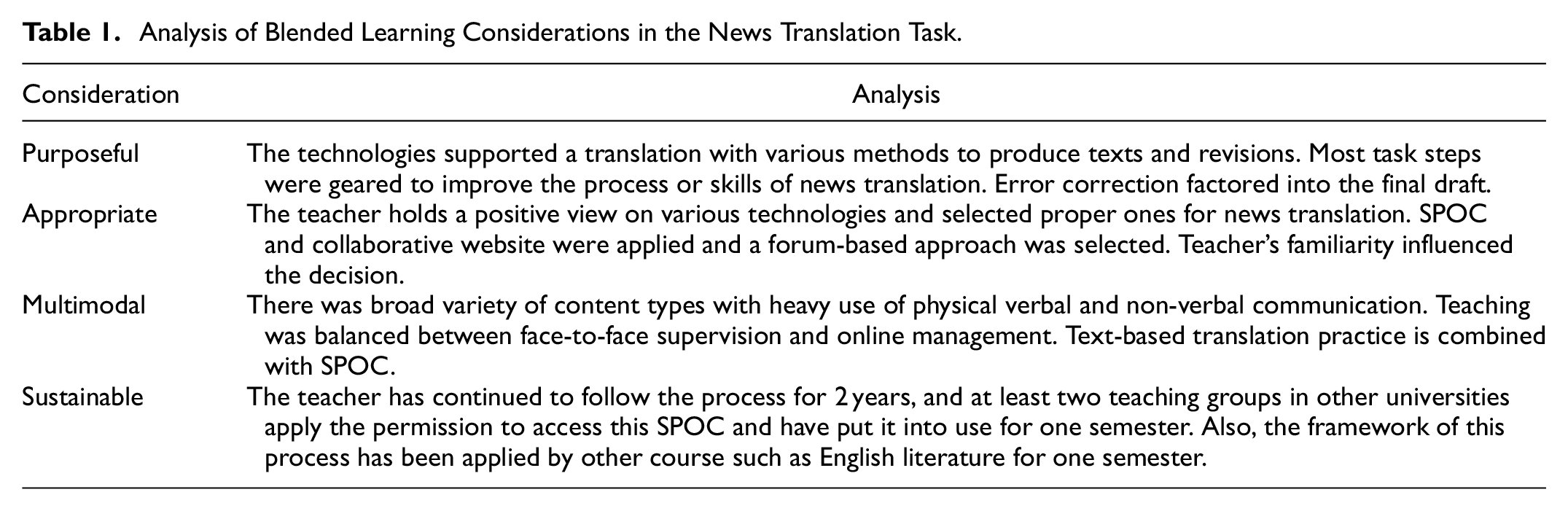
Four considerations in blended approaches to language learning—purpose, appropriateness, multimodality, and sustainability—are set out to justify the blended mode design, the test, and the questionnaire (see Table 1).
Analysis of Blended Learning Considerations in the News Translation Task.
Participants
Two hundred and thirty-nine students participated in this study. They enrolled at the News Translation Course (Traditional Teaching Mode/Blended Learning Mode) in the autumn semester of 2018 and 2019. The students are native Chinese speakers, studying English previously for an average of 10 years and have previously enrolled in a few English learning courses such as reading and writing. The experiment group consists of 112 students in blended learning mode, that is, apart from online courses, students were offered face-to-face classes on campus. The control group consists of 127 students in traditional classroom teaching mode without any use of online platforms; all activities were organized in lecture room with non-movable chairs and via paper handouts. It is worth noting here that the participants for the two teaching modes were very similar in terms of language competence before taking the course, in that they were all in the third year of their undergraduate studies, having taken the same courses previously, and that they were all admitted to the university through national college entrance exams with a stable ranking of scores in each province of China from 2018 to 2019. Put simply, the language ability and translation competence of participants in the two groups are comparable before the experiment starts.
Instruments
Two instruments were employed by this study to investigate the usefulness of blended teaching in enhancing students’ translation competence: the translation test and questionnaires. The translation proficiency test consists of four parts and each corresponds to the translation competence model proposed in the Literature Review (see Figure 1). The first part, Word and Grammar, consists of five sentences with an average length of 12 words to be translated, among which two are Chinese-English and three are English-Chinese. The second part, Translation Skill, specialized for knowledge sub-competence, contains two items, explanation of terms in translation field and sentence translation followed by brief explanations of translation skills applied. The third part, Tool Application, takes the form of question and answer, with five questions related to the latest translation tools and software. The fourth part, Information Management, sets one case for students to decide and complete the translation, including relevant/irrelevant terms and background information from various online sources for students to refer to and make decisions and explain them. The fifth part, Project Management, and the sixth part, Communication and Cooperation, are conducted during the class activities, in which students are assessed twice in the whole course, one placed at the time when the teacher introduced and organized group translations in the first session, and the other in the last session. In blended learning mode, one more parameter is taken into consideration as students are asked to make peer assessment of other group member’s translation and performance.
The questionnaires comprise 16 items to assess students’ perceptions of blended teaching mode in the experiment group. The 16 items are classified into four parts: purposeful (4 items), appropriate (4 items), multimodal (4 items), and sustainable (4 items). This questionnaire was a 5-point Likert scale (5 = strongly agree, 4 = agree, 3 = neutral, 2 = disagree, and 1 = strongly disagree).
Results
Differences in Translation Competence Between the Two Groups
As mentioned previously in the Method section, a translation proficiency test was utilized to probe into the differences in translation competence between students from the experiment group and those from the control group. By so doing, the effect of blended teaching mode in improving students’ translation proficiency would be examined. Table 2 illustrates the differences in the scores of each part of the translation proficiency test between the control group and the experiment group. It could be seen from Table 2 that students from the experiment group, namely the blended teaching group outperformed students from the control group, that is, the traditional teaching group in terms of virtually all the sub-tests of the translation proficiency test excerpt the word and grammar test. With regard to word and grammar test, which target bilingual competence, the score of the control group (M = 81.181) was identical to that of the experiment group (M = 81.875).
Differences in Test Performance Between the Control Group and the Experiment Group.

Apart from descriptive statistics, several independent-samples t-tests were performed to further examine the differences in the test performance between the traditional teaching group and the blended teaching group. In accordance with the descriptive statistics, the results of t-tests also yielded significant differences between the two groups in terms of the following five sub-tests: translation skill (t(237) = −2.361, p = .019, Cohen’s d = .306); tool application (t(237) = −26.488, p = .000, Cohen’s d = 3.522); information management (t(237)= −10.151, p = .000, Cohen’s d = .1.354); project management (t(237) = −24.185, p = .000, Cohen’s d = 3.075); and communication and cooperation (t(237)=−20.985, p = .000, Cohen’s d = 2.666). Among those test scores that revealed significant differences between the two groups, the scores of tool application, information management, project management, and communication and cooperation achieved high effect sizes as shown by the values of Cohen’s d. The effect size of the translation skill test was small. Moreover, the difference in word and grammar test was not statistically significant (t(237) = −1.731, p = .097, Cohen’s d = .220).
In conclusion, compared with students from traditional teaching group, those from blended learning group scored higher in almost all the parts of the translation proficiency tests except the word and grammar test. The above results indicate that with other factors being equal, blended teaching mode could improve university students’ translation competence, including knowledge competence, technological competence, and professional competence. Specifically, as indicated by the statistics of effect sizes, students’ technological competence and professional competence are extensively enhanced under the blended teaching mode. On the contrary, it seems that in comparison with the traditional teaching mode, the blended teaching mode do not facilitate the learning of word and grammar to a large extent.
Students’ Perceptions of the Blended Learning Mode
This section reports on the results of the questionnaire to check students’ perceptions of this blended teaching mode in the following four aspects: purpose, appropriateness, multimodality, and sustainability. Table 3 summarizes the percentage of each choice within each item. In general, students hold positive attitudes toward the appropriateness and sustainability of this teaching mode. They are satisfied with the multimodal nature of this course. To be more specific, of the four items under the appropriateness dimension, the agreement rates of three items are above or close to 60%. However, the agreement rate of the item (“I reflect upon difficulties and solutions in translation when reviewing other students’ versions in class and follow-up discussions on SPOC”) was quite low (21.3%). Three out of the four items with regard to the sustainability dimension demonstrate high agreement rates, except the item (“I present my translation and ideas on SPOC”). Similarly, only one item (“I have lots of interactions with teacher through different electronic means such as discussion board on SPOC, instant message tools, email”) from the multimodality dimension does not show satisfactory agreement rate (37.2%). Different from the above-mentioned three dimensions (i.e., appropriateness, multimodality, and sustainability), the agreement rates of most items from the purpose dimension are quite low. Only one item (“I am aware of the key knowledge points of each class”) shows high agreement rate (58.5%).
Percentages of Learners’ Perceptions and Satisfaction of Blended Teaching Classroom.
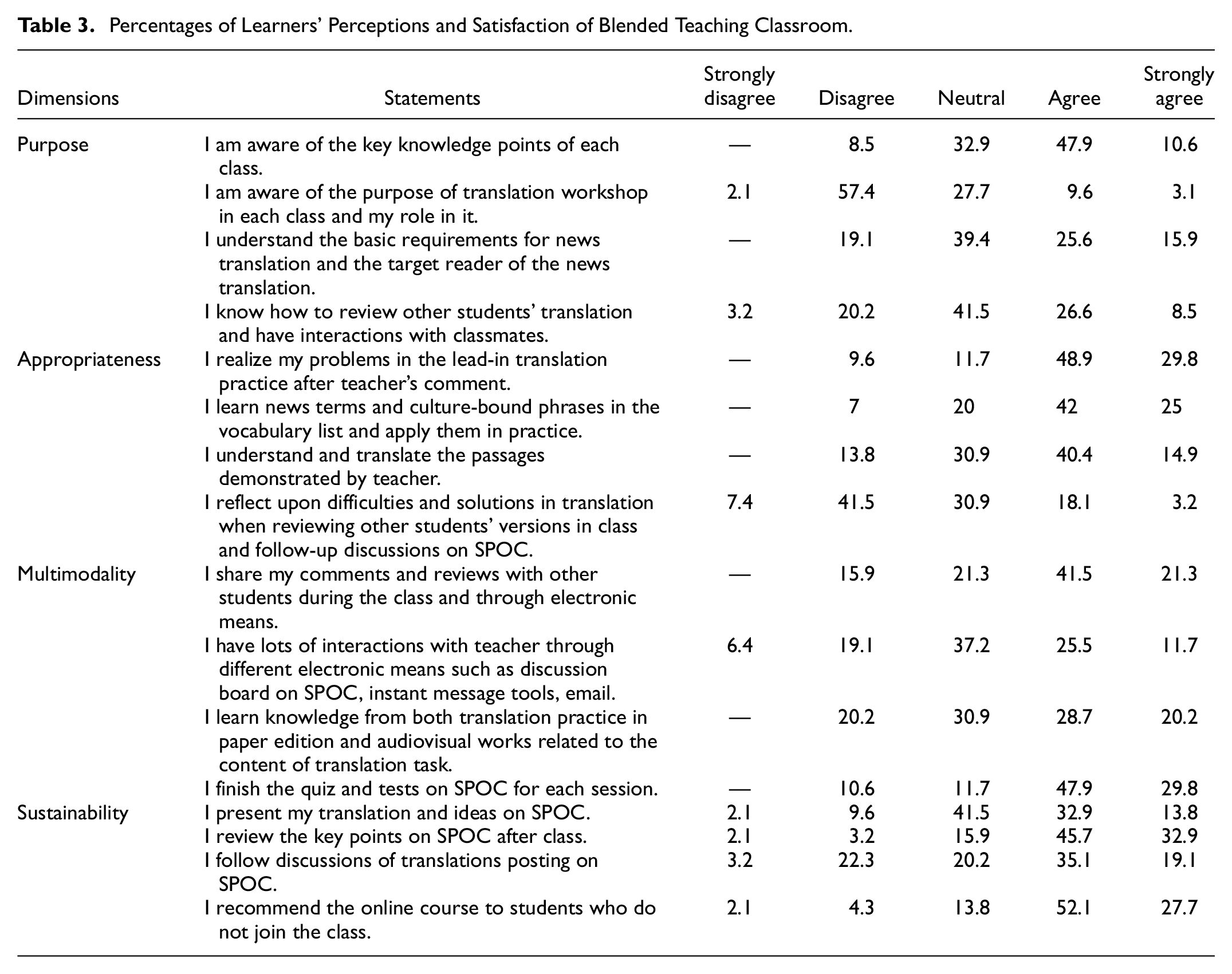
In summary, students have positive perceptions of this blended teaching mode, especially with regard to the appropriateness, multimodality, and sustainability of this teaching mode. However, they are not so aware of this purpose of this learning mode.
Discussion
The results of this study illustrate that blended learning mode can improve students’ translation competence, particularly in the technological and professional sub-competences. Most students had positive attitudes to blended learning mode in terms of applying various teaching options, conducting more tailor-made interactions and improving project management ability. These are in line with the findings of the PACTE Group (2020), which confirms that “TCA is a dynamic, non-linear, spiral process” since TCA involves “combinations of different kinds of evolution, with mixed evolution predominant, highlighting its non-linear nature” (p. 218). Furthermore, the results demonstrate that the blended learning mode does not impose remarkable effect upon students’ language sub-competence yet it does make a difference in improving students’ translation sub-competence. Compared with traditional teaching mode, blended learning mode applies online videos to explain translation knowledge and the methods of tool usage without any constraints of time and space. The transformation from teacher-led mode to student-led mode facilitates students’ acquisition and application of translation skills and technology as students can realize their problems, learn and practice accordingly through online videos, and in-class activities rather than merely listening to lectures in traditional classrooms. As PACTE Group (2020) suggests for further training, “greater emphasis should be placed on intentionality-related translation problems and developing the strategic sub-competence” (p. 223). Particularly for translation technologies such as the computer-aided translation tools and online corpus, the blended learning mode can help teacher follow the progress of students’ learning and application in practice and also motivate students to learn the technologies actively. The questionnaire of students’ satisfaction shows that they prefer this mode to the traditional one due to its more dynamic form and repeatability in practice.
The blended learning mode can also strengthen the role of group translation work in teaching, because it draws students closer to professional translation market via role-playing and project management, making this practice different from ordinary pair work or group work. It was borrowed from the translation workshop discussed by Gentzler (1993, p. 7), who defined it as “a collaborative translation by more than two translators on a translation forum.” In this blended learning mode, translation workshop gathers students to discuss a certain translation task and produce a final version recognized by all the members after rounds of negotiations. In this way, students promote their strategic sub-competence in their discussion, decision-making, and project management, thus more effectively and dynamically applying the translation knowledge and skills in the practice, which can be seen from the test results. Also, the translation workshop organized in blended learning mode draws the students closer to the real professional translation market and allows them to experience the completion of translation project in translation companies or institutions. However, it could be found in the questionnaire that students have not been completely adjusted to the new form of group work and were not fully aware of how to coordinate and cooperate in the team work. In this sense, teacher can show a sample case in the introductory session and apply this in other translation courses as well so that students have more access to this mode.
In terms of the use of resources in the decision-making process, students rely much more on external support such as the terms and information provided in the case analysis and translation part of the test. It is in line with PACTE Group’s (2020, p. 224) findings, which shows that the use of internal support is not enough in their experiments and automatization in solving translation problems appropriately as well as a more effective use of instrumental resources should be promoted. But, given that students of this course are hardly equipped with necessary internal support as the professional translators, effective training is very important for students to develop critical thinking in resource-using, then gradually enrich and manage their internal support. Compared with traditional teaching mode, blended learning mode and its assessment offer a more dynamic and explicit way of training and evaluating students’ proper use of information as well as technology thus being attributed to their strategic sub-competence.
The blended learning mode also diversifies the assessment of students’ professional sub-competence as it involves teacher’s assessment as well as peer assessment. In classroom-based mode, more concentration has been put on formative processes, rather than summative assessments that generate a final judgment devoid of feedback processes (Newton, 2007). While in the blended learning mode, students participate in the review and summary of the translated versions and a key assumption of peer review is that assessments are based on standard of success agreed upon within their groups. Assessments become dynamic in the blended learning mode as students can read all the peer reviews online and communicate on the class website if any disagreement. A blended assessment helps to improve students’ translation knowledge and also project management when teacher’s assessment helps to assure the fairness and objectivity while peer assessment contributes to their application of knowledge and decision-making in project management.
Given the questionnaire of students’ satisfaction with the blended learning mode, we can see that students adjust themselves to the blended learning mode and make use of this “third space,” which is between those who strongly advocate and those who resist technology. Students showed effective interaction with online contents with positive attitude due to its accessibility, novelty, and relevance to their practice, which could also promote their interest in patterns in the real professional market. As a keystone of blended learning is professional development and training, the development of translation competence in blended learning mode can be realized in translation workshops organized in class and online videos of translation knowledge and technology. Active learning is strengthened in the process and a multimodal environment has been built up to improve students’ ability of translation and project management so as to meet the various requirements of the real professional market.
Conclusion
This study has investigated the effect of the blended learning mode on students’ translation competence (research question 1) and students’ perceptions of the blended learning mode (research question 2). There were two major findings. First, learning in blended classes can more comprehensively promote students’ translation competence, particularly their technological sub-competence and professional competence, than face-to-face modes. Secondly, most learners had positive attitudes to blended learning technology and were able to participate in the whole blended learning process. Based on the findings of this study, teachers would be advised to conduct pilot schemes and introductory sessions before organizing related activities to raise students’ awareness of the required translation competences and related translation workshops. Better control and dynamic assessment are also necessary for teachers adopting blended approaches, so as to better motivate students and improve the sustainability of the mode in developing translation competence.
Future studies might explore the contribution of the blended learning mode to a particular translation sub-competence, such as the technological sub-competence, or extend the translation competence in blended learning environment. Moreover, research could be more focused on student satisfaction, self-regulation, autonomy, motivation, and other variables relevant to the study of translation via blended learning. Further research could explore the impact of these variables on developing translation competence in a blended learning environment. Interviews could also be conducted with teachers to explore their views on the application of the blended learning mode to translation teaching, and quantitative analysis of other types of learners, such as graduate students, might also contribute to the discussion. Other studies could examine the impact of different interaction types or teaching designs on developing translation competence through blended approaches.
Footnotes
Declaration of Conflicting Interests
The author(s) declared no potential conflicts of interest with respect to the research, authorship, and/or publication of this article.
Funding
The author(s) disclosed receipt of the following financial support for the research, authorship, and/or publication of this article: This study is supported by Jiangsu Shuangchuang Talent Program, 2021 (Grant No. JSSCBS20210636) and Fundamental Research Program, Soochow University (Grant No. 21XM1007).
Data Availability Statement
Data sharing not applicable to this article as no datasets were generated or analyzed during the current study.
