




Abstract
Existing meta-analyses have shown that active learning strategies are effective in improving students’ learning performance. However, their implementation may vary across school levels. This study investigated differences among elementary, middle, and high school teachers in the use of teaching strategies, including those that promote active learning and pedagogical beliefs. We also explored differences in the relationships between beliefs about teaching and learning, teaching experience, and teaching strategies for active learning across school levels. An online survey was conducted with 550 in-service elementary, middle, and high school teachers. Participants completed a questionnaire that measured their teaching strategies, beliefs about teaching and learning, and teaching experience. The results revealed differences in the frequency of use of six teaching strategies, including those that promoted active learning. Elementary school teachers used teaching strategies that promoted active learning most frequently, followed by middle and high school teachers. There were no differences in teachers’ beliefs about teaching and learning across school levels. Multigroup structural equation modeling indicated no differences in the influence of beliefs about teaching and learning on active learning teaching strategies among school levels, except that the traditional conception was negatively associated with the implementation of active learning in middle school. Constructivist beliefs were positively associated with active learning strategies across all levels, whereas teaching experience was negatively associated with teaching strategies that promoted student output at the higher school level. These findings have implications for the implementation of active learning, particularly at higher school levels.
Plain language summary
Among the various teaching methods, some involve more active student engagement through activities such as explanations and discussions among students, known as active learning. However, previous research has highlighted differences in the frequency of teaching methods that teachers use at different school levels. This study investigated how elementary, middle, and high school teachers apply different teaching methods, and perceive teaching and learning. In-service Japanese teachers (N = 550) participated in the study. The findings indicated that teachers across different school levels employed six teaching methods, encompassing those involving students’ active learning. Among these levels, elementary school teachers most frequently employed teaching methods that encouraged students’ active engagement, followed by middle and high school teachers. When examining the reasons behind the choice of teaching methods, no significant differences were found between school levels, except that their beliefs emphasized that traditional teaching approaches were associated with the reduced use of active learning methods in middle school. On the other hand, beliefs that prioritize student-driven understanding are linked to the use of active learning methods across all school levels. Furthermore, teachers with more experience tended to use these methods less frequently at higher school levels. These findings have significant implications for the effective implementation of active learning, particularly in high school education.
Introduction
Teachers’ instructional practices play a crucial role in their students’ academic performance (Hattie, 2023; Schroeder et al., 2007). According to Hattie (2023), who synthesized over 2,100 meta-analyses of various factors influencing students’ achievement, the effect size of teaching strategies was relatively high (d = 0.51, SD = 0.09) compared to that of other factors beyond teachers’ control, such as student (d = 0.24, SD = 0.06) and home-related factors (d = 0.15, SD = 0.08). While proficient teachers often adapt their teaching strategies to suit the various situations and purposes of their practice (Fitzgerald et al., 2013; McComas et al., 2020), previous studies have indicated that the types of teaching strategies used may be biased depending on the school level (Dogan et al., 2021; Isikoglu et al., 2009; OECD, 2019). However, such biases among school levels, and their underlying factors have not been adequately explored.
This study aimed to investigate the differences in teachers’ use of teaching strategies and pedagogical beliefs at three school levels (elementary, middle, and high schools) in Japan. We also explored how the relationship between teachers’ characteristics (pedagogical beliefs and teaching experience) and use of teaching strategy varied across school levels, with a particular focus on teaching strategies for active learning.
Active Learning: A Student-Centered Approach
Through the synthesis of meta-analyses, Hattie (2023) identified 60 different types of teaching strategies, including teaching techniques such as feedback and questioning, and teaching methods such as direct instruction, inquiry-based learning, and flipped classrooms. These strategies can be categorized and characterized through various theoretical frameworks, such as students’ cognitive engagement (Chi et al., 2018; Fiorella & Mayer, 2016) and motivation (e.g., Hornstra et al., 2023; Mammadov & Schroeder, 2023; Núñez & León, 2015). This study adopted a theoretical perspective that examined teaching strategies within a continuum of agents in the learning process, ranging from a teacher-centered approach, where students passively receive information from teachers, to a student-centered approach, where learners are placed at the center of the learning process (Bereiter & Scardamalia, 1998; Bremner et al., 2022; Elen et al., 2007). Our primary focus within this continuum was a student-centered approach. However, rather than adopting a dichotomous perspective, we explored various aspects of teaching strategies. This exploration encompassed active learning with its emphasis on fostering students’ interactions and discoveries, the use of tasks with multiple solutions, and the utilization of tools, all of which were derived from the dimensions of teaching strategies proposed by Ross et al. (2003). Additionally, we examined teachers’ ingenious instruction and students’ exercises.
Active learning as a teaching method, aligns closely with a student-centered approach. According to Bonwell and Eison (1991, p. 2), active learning “involves students in doing things and thinking about the things they are doing” and promotes higher-order thinking and develops students’ abilities by allowing them to engage in activities such as discussions and writing, instead of merely listening and transmitting information. Previous meta-analyses have generally shown that active learning improves learning outcomes and learning-related variables, such as learning attitudes, across various disciplines and age groups compared to traditional teaching methods (Arik & Yilmaz, 2020; Freeman et al., 2014; K. Kobayashi, 2019; Prince, 2004; Tutal & Yazar, 2022).
Chi and Wylie (2014) emphasized that enhancing cognitive engagement, rather than solely incorporating physical activity, is crucial for active learning. They argued that increased engagement through constructive and interactional activities such as self-explanation, discussion, and peer tutoring is expected to improve learning. Fiorella and Mayer (2016) demonstrated constructive learning strategies through a literature review based on generative learning theory, which views learning as a constructive process in which new experiences are integrated with prior knowledge structures or schemas to create meaning. They identified two types of learning strategies: verbal generative strategies, which involve activities such as summarizing and self-explanation, and spatial generative strategies, which involve activities such as mapping and drawing. Teachers are expected to incorporate strategies that promote these activities into their classes, according to the purpose of their practice.
Effects of Teaching Strategies for Active Learning on Students' Learning
Previous studies have examined the effects of teaching strategies on students’ learning using questionnaires (e.g., Bieg et al., 2017; Han, 2021; Isikoglu et al., 2009). For example, Bieg et al. (2017) investigated the influence of teaching strategies on ninth-grade students’ emotions during mathematics classes. According to student reports on the teaching strategies employed by their teachers, direct instruction and individual work comprised approximately 70% of the total, whereas pair and group activities, presentations, and classroom discussions accounted for only 25%. The results showed that direct instruction tended to decrease positive affect and increase boredom compared to pair and small-group activities. In addition, Han (2021) surveyed elementary school teachers to examine the effects of four teaching strategies—feedback, scaffolding, active learning strategies, and collaboration—on teachers’ perceptions of students’ engagement in learning (e.g., effort and enjoyment). The results showed that only scaffolding was positively associated with student engagement; active learning strategies had no statistically detectable association with it.
Considering such discrepancies in the results, it is crucial to consider the content that students engage in, during pair or small-group activities. Yu and Singh (2018) conducted a survey of high school students’ mathematics learning. Their results indicated that students who perceived their teachers as emphasizing conceptual teaching, such as developing problem-solving skills and connecting concepts, had higher mathematics performance. By contrast, those who perceived the use of procedural teaching, with an emphasis on arithmetic procedures and their accuracy, had lower mathematics performance. This suggests that activities that focus solely on learning procedural content are unlikely to be effective and activities in which students discuss and explain conceptual content to each other may be more beneficial (Bisra et al., 2018; Rittle-Johnson et al., 2017). While some previous studies used questionnaires that lacked specificity regarding the substantive content of the activities (Han, 2021; Isikoglu et al., 2009), simply mentioning phrases such as “involving students in small-group discussions and cooperative learning,” it may be appropriate to use questions that clarify the precise nature and content of these activities when investigating teaching strategies to examine their effectiveness in active learning.
Teachers’ Beliefs About Teaching and Learning
One of the most important factors influencing teaching strategies is teachers’ pedagogical beliefs. Beliefs can be broadly defined as “psychologically-held understandings, premises or propositions about the world that are felt to be true” (Richardson, 1996, p. 103). Chan and Elliott (2004) identified two distinct types of pedagogical beliefs held by teachers: traditional and constructivist. Teachers who adhere to traditional beliefs view teaching as the transmission of knowledge from the teacher to the student, with the student expected to absorb knowledge passively. For example, they hold the belief that “good teachers always encourage students to think for answers themselves.” In contrast, those with constructivist beliefs view learning as an active process of knowledge construction and acquisition based on learners’ inferences and experiences. They believe “learning means remembering what the teacher has taught.”
According to this definition, constructivist beliefs are positively associated with constructive instructional practices (Liu et al., 2023; Wang et al., 2022; Wilkins, 2008; Yang et al., 2020), whereas traditional beliefs are positively related to teacher-centered approaches (Polly et al., 2013; Vieluf & Klieme, 2011). Wang et al. (2022) conducted a survey of fourth-grade teachers and their students and found that transmissive teaching beliefs, which prioritize memorization and obtaining correct answers, were negatively associated with the use of constructive instructional methods. In contrast, constructive teaching beliefs that emphasize students’ problem-solving and thinking processes were positively associated with the use of constructive instructional methods, resulting in better academic achievement. In addition, Shahali and Halim (2024) revealed that constructivist beliefs held by science teachers in secondary schools are positively associated with constructive teaching practices such as inquiry-based and cooperative learning, and mediated by attitudes toward such practices. In summary, previous studies conducted at various school levels such as elementary and middle schools have consistently reported strong associations between teachers’ pedagogical beliefs and instructional practices.
Differences in Teachers’ Teaching Strategies and Pedagogical Beliefs Across School Levels
Despite these positive findings, teaching strategies for active learning are employed less frequently than expected. According to TALIS 2018 (OECD, 2019), an international survey focusing on school learning and teacher work environments, cognitive activation practices such as giving tasks that require critical thinking and having students work in small groups to solve problems or complete tasks are less widespread than practices related to the clarity of instruction. The survey showed that only 50% of the teachers reported frequently or always having students work in small groups to solve problems or complete tasks.
Moreover, there may be differences in the implementation of active learning and teachers’ constructivist beliefs based on the school level. Previous research has suggested that teachers in the lower grades prefer student-centered teaching methods (File & Gullo, 2002; Isikoglu et al., 2009; OECD, 2019). OECD (2019) reported that primary school teachers tend to use cognitive activation techniques more often than lower secondary school teachers. Also, Isikoglu et al. (2009) conducted a questionnaire survey among elementary and secondary school teachers (Grades 6–8) to investigate differences in their pedagogical beliefs and teaching strategies. The study found that elementary school teachers placed greater emphasis on student-centered practices, such as allowing students to ask their own questions, facilitating their discovery and construction of concepts, and encouraging small-group discussions and cooperative learning.
In conclusion, although comparisons have been made at the lower school level, prior research has not adequately conducted comparisons that include high schools. Incorporating active learning strategies may be beneficial, and even critical, in high schools, where learning content becomes more challenging (Guner, 2020; Gunstone et al., 2009; Sumarni, 2020). If active learning strategies are used less frequently in higher schools, this problem must be addressed.
Differences in Relationships Between Teachers’ Teaching Strategies and Pedagogical Beliefs Across School Levels
While there is an overall correlation, previous studies have indicated a divergence between teachers’ pedagogical beliefs and actual practices (Hornstra et al., 2015; Raymond, 1997). Liu et al. (2023) noted that external factors received from society as well as teachers’ internal factors were responsible for such discrepancies. Reeve (2009) identifies three reasons for the prevalence of the teacher-centered approach: pressure from above (e.g., administrators, national standards, and high-stakes tests), pressure from below (students), and pressure from within (teachers). Teachers are responsible for student behavior and outcomes and may face pressure to secure good grades and comply with the curriculum, which can prompt them to adopt motivational strategies that prioritize teacher control over student-centered autonomy support. Hornstra et al. (2015) investigated the pedagogical beliefs and practices of nine elementary school teachers through interviews. They found that most teachers using controlling practices did not believe that “control is good.” Nonetheless, they used these methods because they faced pressure to meet performance standards, generate high scores in high-stakes testing, and follow the methods of textbooks used in their schools. In particular, teachers who were oriented toward autonomous support experienced conflicts between their pedagogical beliefs and pressures from the school administration.
Against this background, constructivist beliefs among elementary school teachers may be less associated with teaching strategies that promote active learning than teachers at higher school levels, as suggested by previous research. Alternatively, high school teachers may prioritize transmitting knowledge to meet performance standards because their students are preparing for college entrance exams. Previous studies have not adequately investigated the differences in pedagogical beliefs and teaching strategies among different school levels, or whether the relationship between pedagogical beliefs and teaching strategies differs among school levels. Identifying the specific school levels where issues in teaching practices need to be addressed, as their backgrounds could have important implications not only for educators, but also for stakeholders who make educational policies. Further investigation is required to gain a comprehensive understanding of these differences and their relationships.
Other Factors Influencing Teaching Strategies
Previous research has shown a relationship between teachers’ teaching experience and practices. Some studies have indicated that more experienced teachers have a more student-centered orientation (Caleon et al., 2018; Isikoglu et al., 2009) than less-experienced ones. On the other hand, Wang et al. (2022) revealed that teachers with more teaching experience tend to hold more traditional beliefs and prioritize knowledge transmission. They argued that this tendency may be attributed to their teaching experience before curriculum revision in China, which shifted toward a more student-centered orientation.
Considering the influence of national curricula and norms, it is important to specify the cultural context of education in the country in which this study was conducted. In this study, an online survey was conducted in Japan, where the government has established curricula for elementary, middle, and high schools to ensure that every student can receive a certain level of education, regardless of their region within the country, by setting goals and educational content for each subject (MEXT, 2011). These curricula are updated every 10 years, taking into account not only subject matter, but also the skills and abilities relevant to current and future societies as well as effective educational methods to cultivate them.
Additionally, the lesson study culture, in which teachers observe and discuss each other’s lessons to improve teaching practices, has been implemented in Japanese school education (Elliott, 2019; Vermunt et al., 2019). If there are differences in the use of teaching strategies at different school levels despite such policies and cultural practices, understanding this background may be crucial for enhancing teacher education.
The Purpose of This Study
This study investigated differences in teaching strategies among elementary, middle, and high school teachers in Japan, including those that promote active learning and pedagogical beliefs. We also explored whether there were differences in the relationships between the use of teaching strategies that promoted active learning and teachers’ characteristics, beliefs about teaching and learning, and teaching experience across school levels.
Based on the previous research, the hypothetical model was developed in this study (Figure 1). The model specifies two main effects. First, it posits direct associations between teaching experience and beliefs about teaching and learning, as well as with teaching strategies. In addition, it proposes that teaching experience is indirectly associated with teaching strategies through pedagogical beliefs. Second, the model suggests associations between pedagogical beliefs and teaching strategies for active learning.

Hypothetical model in this study.
We hypothesized that the higher the school level, the lower teachers’ constructivist beliefs and teaching strategies for active learning. We also hypothesized that the relationship between constructivist beliefs and active learning teaching strategies would be weaker at the higher school level.
Methodology
Participants
A total of 550 in-service Japanese teachers participated in this study (Mage = 40.91, SD = 10.84, and range = 22–60 years; 220 women (40.1%) and 330 men (59.9%)). The participants were recruited through a web-based Japanese research firm. They registered with the firm as survey panel members. All participants provided informed consent prior to participating and received monetary compensation for their participation. Note that to ensure that the participants read the instructions carefully, an Instructional Manipulation Check (IMC; Oppenheimer et al., 2009) was conducted using the item “In this question, please be sure to select ‘Never.’” As a result, 193 participants dropped out of the initial sample (N = 743). Table 1 presents the sample size and biographical information of teachers at each school level. Two teachers from middle schools were excluded from the analysis involving their teaching experience because of incomplete input.
Frequencies and Percentages for Each Category by School Level.

All participants taught arithmetic/mathematics, science, or social studies on a daily basis. As teaching approaches may differ between language subjects (i.e., Japanese and English) and other subjects, we decided to focus our investigation on non-language subjects. There was no statistically detectable difference in teaching experience among school levels (F (2, 545) = 1.78, p = .17, partial η2 = 0.01).
All participants provided informed consent prior to participating. This study was approved by the Research Ethics Review Board of the university to which the corresponding author belongs (approval number: 20200107).
Instruments
We employed an online cross-sectional survey to address our research questions. In addition to providing biographical information, participants were asked to respond to the two scales described in this section.
Teaching Strategies
We used 56 items from the Teaching Strategy Scale (Fukaya & Suzuki, 2020), which was originally developed for mathematics classes because they clarified the content of instructional activities rather than providing general descriptions, such as engaging in small group activities. The scale assessed the teaching methods and activities introduced in the class and included questions such as “I have students explain what they have learned to each other.” and “I explain how the content relates to what they have learned so far.” To make the scale suitable for all arithmetic, mathematics, science, and social studies contexts, items that were specific to elementary school arithmetic were eliminated, and the wording was adjusted. Participants were asked to rate the frequency of using each teaching strategy on a 5-point Likert scale (1 = not at all, 5 = often).
The 56 items were used for exploratory factor analysis (EFA) with maximum likelihood estimation and oblique rotation (Promax). To determine the number of factors, we used parallel analysis (Horn, 1965), which was recommended as a more statistically sophisticated method than the traditional criteria (Fischer & Karl, 2019). The results of the parallel analysis suggested a seven-factor solution, with eigenvalues greater than 1, explaining 53.6% of the variance in the sample. An EFA was conducted with this solution, and three items with high loadings (>0.40) on multiple factors and 12 items with low loadings (<0.40) on any of the factors were excluded. In Appendix A provides the item factor loadings, the commonalities for items loading on each factor, and Cronbach’s alpha and omega (McNeish, 2018).
Beliefs About Teaching and Learning
The Conceptions of Teaching and Learning Scale (Chan & Elliott, 2004) was used to assess the teachers’ beliefs about teaching and learning because it can measure the two beliefs that are the focus of this study. This scale contains two subscales: (a) the constructivist conception and (b) the traditional conception. To minimize the response burden on the participants, we used a short version of the scale developed by Authors (2020), which consists of 20 items. The short version included six items for constructivist conception and 14 items for traditional conception. Authors (2020) confirmed the internal consistency of the short version using Cronbach’s alpha (traditional conceptions: α = .80; constructivist conception: α = .71), and the validity by using the correlations between the short and the full version (Chan & Elliott, 2004; traditional conceptions: r = .93; constructivist conception: r = .95). Participants were asked to rate the extent to which they agreed with each item on a 5-point Likert scale (1 = disagree, 5 = agree).
A confirmatory factor analysis was conducted based on the factor structure of the previous study (Authors, 2020). The goodness of fit statistics was χ2 (169) = 564.21, p < .001, CFI = 0.87, TLI = 0.86, RMSEA = 0.065 (90% CI [0.059, 0.071]), and SRMR = 0.068. As with the teaching strategies, the results suggest the model fit was acceptable. Cronbach’s alpha was .79 for the constructivist conception and .86 for the traditional conception. The omega was 0.79 for the constructivist conception and 0.86 for the traditional conception.
Procedure
The questionnaire was administered online. Questionnaire items included demographic questions, beliefs about teaching and learning, and teaching strategies. The order of the items within the same scale was randomized. To ensure that the participants read the instructions carefully, two items were included as an Instructional Manipulation Check (IMC) based on the method described by Oppenheimer et al. (2009). They responded to all of the items at their own pace.
In the model analysis (Figure 1), four models were compared to determine the constraint setting among the groups: a configural invariance model, in which the factor structure was equal for the three groups; a weak invariance model, in which the factor loadings were equal; a strong invariance model, in which the factor loadings and intercepts were equal; and a strict model, in which the factor loadings, intercepts, and error variances were equal. The final model was selected based on the goodness-of-fit index, and differences at the school level were compared using multigroup structural equation modeling (SEM).
Data Analyses
The analysis was conducted using IBM SPSS Statistics (version 27) for mean comparisons and R (version 4.2.2) for multigroup SEM. First, to examine whether there were differences in the mean scores of teaching strategies and beliefs about teaching and learning across school levels, a one-way multivariate analysis of variance (MANOVA) was conducted for the two variables. The independent variable was school level (elementary, middle, and high school), and the dependent variable was the subscale of each measurement.
Next, to investigate whether the association between teaching experience, pedagogical beliefs, and teaching strategies that promote students’ output activity and thinking (i.e., active learning) differs by school level, multigroup SEM was conducted using the lavaan package in R. All observed variables corresponding to the model (Figure 1) were used in the analysis. To compare the mean differences in the effects of each path coefficient among the three school levels, we used the emmeans package in R.
Results
Difference of Teachers’ Teaching Strategies and Pedagogical Beliefs Across Different School Levels
Teachers’ Teaching Strategies
We performed Box’s M test to assess the homogeneity of the variance-covariance matrices. The results indicated that the assumption of homogeneity was not met (p < .001). Therefore, we used Pillai’s trace, which is less sensitive to violations of the assumption of homogeneity of the variance-covariance matrices (Meyers et al., 2016).
A one-way MANOVA revealed a statistically significant difference between school levels in the seven combined teaching strategies (F(14, 1084) = 8.75, p < .001; Pillai’s Trace = 0.20; partial η2 = 0.10). Follow-up univariate ANOVAs showed that there were statistically detectable differences between school levels for all teaching strategies except the problem-solving exercise, using a Bonferroni adjusted α level of .007 (see Table 2). Students’ output activities and promotion of students’ thinking, which are strategies related to active learning, had a large effect size (Cohen, 2013).
Means, Standard Deviations, F-Ratios, and Effect Sizes of Teaching Strategies by School Level.

Note. Means with different subscripts differ at the p = .05 level by Tamhane T2 test.
p < .05. ***p < .001.
In addition, the assumption of homogeneity of variances was violated, as assessed by using Levene’s Test of Homogeneity of Variance (p < .05). Therefore, we performed the Tamhane T2 test (Gamst et al., 2008) as a post hoc test, which is recommended when group variances are unequal (Meyers et al., 2016). The results showed that for all strategies except the problem-solving exercise, high school teachers used all teaching strategies significantly less frequently than elementary school (or elementary and middle school) teachers. Students’ output activity and the promotion of students’ thinking were highest in elementary school and gradually declined in junior high school and high school. The results support the hypothesis that the higher the school level, the less frequent the use of teaching strategies that promote active learning.
Beliefs About Teaching and Learning
There was no statistically detectable difference in beliefs about teaching and learning among school levels (F(4, 1092) = 1.37, p = .242; Wilks’Λ = 0.99; partial η2 = 0.01; see Table 2). This suggests that teachers’ pedagogical beliefs do not differ across different school levels, which does not support the hypothesis that higher school levels are linked to lower constructivist beliefs.
Relation Between Teaching Experience, Pedagogical Beliefs, and Teaching Strategies
To examine whether the relationship between teachers’ experiences, pedagogical beliefs, and strategies differed at the school level, a multigroup SEM analysis was conducted. Table 3 lists the correlation coefficients between variables.
Correlations Between Variables by School Level.

Note. Correlation coefficients are presented in the order of elementary, middle, and high schools, separated by slashes.
p < .05. **p < .01. ***p < .001.
First, goodness-of-fit indices were calculated for configural, weak, strong, and strict invariance models to determine the constraints among the three school levels. The goodness of fit decreased between strong and strict invariances (see Table 4). Although some of the indices were lower than the Hooper et al. (2008) criterion, most were considered acceptable; thus, a strong invariance model was selected.
Fit indices for Multigroup SEM Analyses.

The results of the multigroup SEM analysis are shown in Figure 2. In elementary school, teaching experience had no statistically detectable association with pedagogical beliefs and teaching strategies (see Figure 2). The constructivist conception was positively associated with both teaching strategies that promote students’ output activities and thinking. By contrast, traditional conception had no statistically detectable association with either teaching strategy.

SEM model for three school levels.
In middle school, teaching experience was positively associated with the traditional conception. As in elementary school, the constructivist conception had statistically detectable positive associations with both teaching strategies that promote students’ output activities and thinking. Moreover, the traditional conception was negatively associated with only the use of teaching strategies that prompt students’ output activities.
In high school, teaching experience had statistically detectable associations with the constructivist conception as in middle school. Moreover, teaching experience was also positively associated with the use of teaching strategies that promote students’ output activity. As in elementary and middle schools, the constructivist conception had a statistically detectable positive association with the use of both teaching strategies that promote students’ output activity and thinking. By contrast, the traditional conception was associated neither with the use of students’ output activity nor that of promoting students’ thinking strategies.
In summary, associations between teaching experience and pedagogical beliefs, as well as the use of teaching strategies that promote students’ output activities, were not observed in elementary schools but only in middle and high schools. A positive relationship between constructivist conception and the two teaching strategies was found at all school stages.
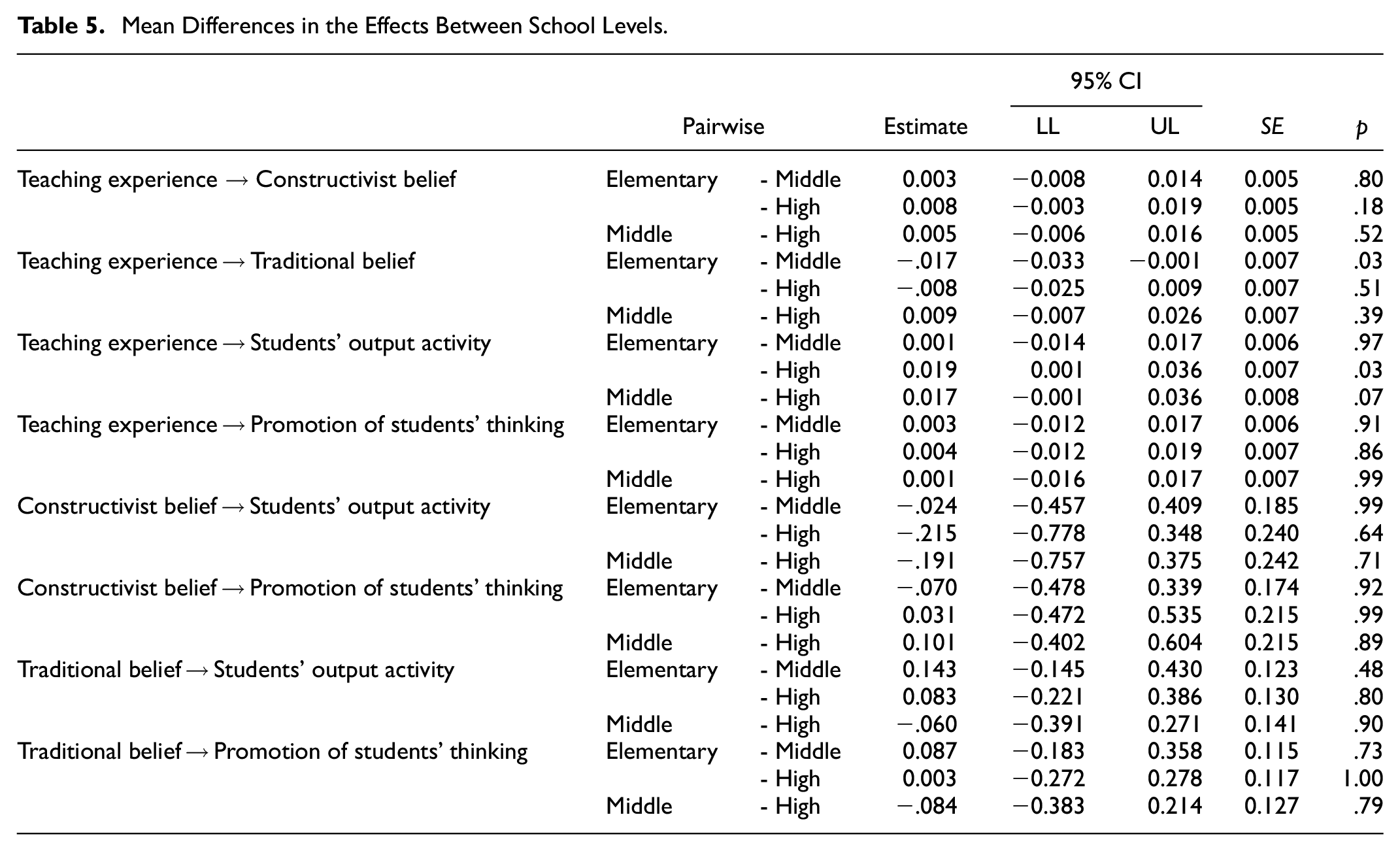
Pairwise comparisons were conducted next, to investigate the differences in the effect sizes of the path coefficients across the three school levels (Figure 2). Appendix B presents the marginal means of the effects at each school level. Pairwise comparisons revealed that the effects of the paths from teaching experience to traditional beliefs were greater in middle school than in elementary school (Table 5). Additionally, regarding the path from teaching experience to students’ output-activity teaching strategies, the effect was greater in high schools than in elementary schools. There were no differences in the effects of the paths from beliefs about teaching and learning, to teaching strategies across school levels. These results do not support the hypothesis that the relationship between constructivist beliefs and teaching strategies for active learning is weaker at higher school levels.
Mean Differences in the Effects Between School Levels.
Discussion
School-Level Differences in Teaching Strategies and Pedagogical Beliefs
Our findings indicate that there are variations in the degree to which teaching strategies were used across different school levels. Specifically, the results demonstrated that elementary school teachers exhibited the most frequent use of six teaching strategies, whereas high school teachers exhibited the lowest frequency, except for problem-solving exercises. It is important to note that the questionnaire employed in this study did not dichotomize teaching into traditional and constructivist approaches but instead measured the preferred teaching strategies for various elements from goal setting to the use of information and communications technology (ICT). Therefore, it is possible that, as the school level decreases, teachers become more oriented toward devising their own teaching strategies. Notably, the mean values for students’ output activity and student thinking, which are associated with promoting active learning and were the focus of this study, were the highest in elementary school, followed by junior high school, and finally high school teachers. The results support the hypothesis that the higher the school level, the lower the teaching strategies for active learning. This finding is consistent with previous research indicating that teachers at lower school levels generally prefer more structured teaching practices (Isikoglu et al., 2009; OECD, 2019). It suggests that this gradual decreasing trend can be observed even when extending the analysis to high school.
In contrast, no differences in beliefs regarding teaching and learning were found across school levels, and there was no evidence that high school teachers, who employed active learning strategies to a lesser extent, held lower levels of constructivist beliefs. The hypothesis that higher school levels indicated lower constructivist beliefs was not supported. At all school levels, there was a consistent trend toward stronger constructivist conceptions (mean score above 4 out of 5), which emphasized students’ own knowledge construction, and weaker traditional conceptions (mean score below 3 out of 5), which emphasized knowledge transfer by teachers. These findings suggest that, as noted by Raymond (1997) and Hornstra et al. (2015), there may be a discrepancy between pedagogical beliefs and practices that increases with the level of schooling. If teachers’ pedagogical beliefs and practices are aligned, constructivist conceptions should decrease as the school level increases as with active learning strategies. The homogeneity in beliefs about teaching and learning across school levels implies that high school teachers may hold constructivist beliefs but face challenges in effectively implementing them in their teaching practices.
School-Level Differences in the Relationship Between Pedagogical Beliefs, Teaching Experience, and Teaching Strategies That Promote Active Learning
The study also examined variations at the school level in the relationship between beliefs about teaching and learning, teaching experience, and the two active learning strategies. (i.e., students’ output activity and promotion of students’ thinking). The findings revealed that stronger constructivist beliefs were associated with more frequent use of active learning-teaching strategies across all school levels. However, there were no differences in the strength of the association between school levels, and the hypotheses that high school students with constructivist beliefs would not use teaching strategies that promote active learning in the classroom, and that the discrepancy between teachers’ beliefs and practice would be greater in high school levels, were not supported. Note that the correlation coefficients between constructivist conceptions and the two teaching strategies promoting active learning were weak. This finding suggests that the observed discrepancy between ideal and actual practices, as indicated in previous studies (Hornstra et al., 2023; Liu et al., 2023), may be consistent across all school levels.
The association between teaching experience, teaching strategies, and pedagogical beliefs was more pronounced in middle and high schools. In elementary school, teaching experience was not associated with any pedagogical beliefs or teaching strategies. However, in middle school, more teaching experience was associated with stronger traditional conceptions, which was also suggested by the mean difference in the effects between school levels. In high school, greater teaching experience was associated with weaker constructivist beliefs and less frequent use of student output activities.
This suggests that at higher school levels, those with more teaching experience are more likely to hold traditional beliefs and may struggle to embrace constructivist beliefs. This, in turn, may result in their limited use of teaching strategies that promote active learning. Wang et al. (2022) suggested that pre- and post-reform teaching experiences influence teaching practices. In Japan, where the study was conducted, the curriculum is updated every 10 years, and the new curriculum places particular emphasis on a constructivist approach (MEXT, 2011). Although the model presented in this study does not indicate a causal relationship, it is plausible that teachers with more teaching experience may retain a stronger emphasis on knowledge transmission from the past curriculum.
Further studies are needed to determine why the negative association between teaching experience and constructivist beliefs, as well as teaching strategies for active learning becomes more pronounced as the school level increases. For example, teacher training is an important factor in developing teachers’ skills and improving their practices (Darling-Hammond, 2000). Previous studies indicated that teacher training is more extensive in terms of both time and budget in elementary schools than it is in junior high schools in Japan (M. Kobayashi et al., 2018). Therefore, improving teacher training at higher school levels is one of the issues to be addressed. In addition, the cultural background of Japan, the country in which the study was conducted, can also be considered a factor behind the low use of teaching strategies that introduce active learning in upper secondary schools. While curriculum reforms have been implemented in Japan to cultivate students’ 21st-century skills, Japanese university entrance examinations have traditionally focused on evaluating the extent of students’ academic knowledge (Yamanaka & Suzuki, 2020). In recent years, these entrance exams have undergone changes, aiming to assess not only knowledge but also competencies such as critical thinking and communication skills. Nevertheless, this ongoing process is in a transitional phase, and the trend has not undergone substantial transformation. Therefore, teachers may try to transfer more knowledge using traditional teaching strategies that they believe are most effective to help students cope with extensive and advanced learning content in these tests. In other words, pressure from above (Reeve, 2009) may be a major factor, along with the traditional belief that students are knowledge absorbers of what teachers teach. Further study is warranted to investigate the influence of these factors.
Limitations of This Study
This study focused on elementary, middle, and high school teachers who teach math, science, and social studies daily. However, this study did not specify the subject domains of the teachers, which may be important to determine if teaching approaches vary by subject. Future research should examine the effects of school level, while considering differences in subject matter.
Although this study focused on the continuum between teacher- and student-centered approaches, it was only one view of teaching strategies. The teaching strategies discussed in this study do not encompass all instructional practices followed by teachers in their classrooms. In addition, teaching methods that appear to differ can be viewed in an integrated manner through a conceptual framework (Li et al., 2023). Therefore, a broad range of teaching behaviors should also be examined, considering other outcome measures, such as learners’ communication skills, without being limited to teaching strategies that can enhance academic performance.
In addition, we measured teachers’ use of teaching strategies through a questionnaire, as in previous studies. While this has the advantage of obtaining a larger sample, there may be a discrepancy between teachers’ perceptions and their actual teaching behaviors. Future studies should combine questionnaires with other methods, such as observations.
In addition, as noted earlier, the influence of factors other than pedagogical beliefs and teaching experiences that determine teacher practice also needs to be clarified, as do differences at the school level. A detailed investigation would provide further insight into teacher education.
Conclusion
The study revealed that teachers at higher school levels are generally less likely to use various teaching strategies than those at lower school levels, with a progressive decline in the use of teaching strategies that promote active learning. High schools serve as an important transition point for both higher education and the workplace. However, the absence of teaching strategies that promote active learning can hinder opportunities to improve learning outcomes through knowledge construction and the development of communication skills.
Focusing on Japanese teachers, this study also highlights the potential gap between the constructivist approaches recommended in the curriculum and their actual implementation in classrooms at higher school levels, especially among teachers with longer teaching experience. Therefore, at higher school levels, where teacher education tends to be inadequate, efforts should be made to enrich pre-service and in-service teacher education, such as providing guidance on incorporating constructivist approaches into classes and encouraging discussions about their practice.
Supplemental Material
sj-docx-1-sgo-10.1177_21582440241281852 – Supplemental material for Differences and Relationships Between Teachers’ Pedagogical Beliefs and Teaching Strategies Used at Different School Levels in Japan
Supplemental material, sj-docx-1-sgo-10.1177_21582440241281852 for Differences and Relationships Between Teachers’ Pedagogical Beliefs and Teaching Strategies Used at Different School Levels in Japan by Mari Fukuda, Tatsushi Fukaya and Takashi Kusumi in SAGE Open
Footnotes
Acknowledgements
The authors would like to thank Emmanuel Manalo and Biljana Jonoska Stojkova for their helpful comments and advice on this research, including the analyses conducted.
Declaration of Conflicting Interests
The author declared no potential conflicts of interest with respect to the research, authorship, and/or publication of this article.
Funding
The author(s) disclosed receipt of the following financial support for the research, authorship, and/or publication of this article: This research was supported by the JSPS KAKENHI (grant number: 20K20516).

Data Availability Statement
The raw data supporting the conclusions of this article will be made available by the authors, without undue reservation.
Supplemental Material
Supplemental material for this article is available online.
References
Supplementary Material
Please find the following supplemental material available below.
For Open Access articles published under a Creative Commons License, all supplemental material carries the same license as the article it is associated with.
For non-Open Access articles published, all supplemental material carries a non-exclusive license, and permission requests for re-use of supplemental material or any part of supplemental material shall be sent directly to the copyright owner as specified in the copyright notice associated with the article.
