




Abstract
Retrocausation describes how an event that happens in the future may affect the present. For example, determining the state of an entangled particle in the future can determine the state of an entangled particle in the present. Recently, this phenomenon has been reported in the psychological literature, with several studies reporting that events which have yet to happen affect performance in various tasks. In this article, two classical manipulations of expectation from the psychological literature, endogenous and exogenous cueing, have been used to explore retrocausal effects on reaction speeds. The findings demonstrate no effect of retrocausation, supported by both frequentist and Bayesian statistical analysis. This is an important finding from two perspectives. First, it may indicate a limiting condition of retrocausal effects. Alternatively, it may contribute to research demonstrating a lack of retrocausation.
Introduction
In Newtonian physics, time is symmetrical. For example, if velocity is equal to distance over time, and we change time from a positive to a negative, then velocity is just reversed; instead of traveling forward, we travel backward. Despite the temporal symmetries in these equations, intuitively we know that the “time” we experience travels in one direction. This is fundamental to how we experience the world. For example, the unidirectionality of time is how we establish cause and effect; things that have yet to happen cannot affect the present. Physicists attribute the arrow of time to the Second Law of Thermodynamics, which states that without an outside force, the entropy of a system will never increase. This is why, for example, you will see a window smash when hit with a rock, but not spontaneously reform into its unbroken state.
A recent idea, albeit not a mainstream one, from some physicists is that of “retrocausation.” The key idea behind retrocausation is that an event in the future can affect the present. Retrocausation was forwarded by Costa de Beauregard (1953) and has since been built on as a possible solution to higher-than-expected correlation between particles. Although beyond the scope of the current article, in brief, the upper limit of correlation between two particles is specified by Bell’s Inequality. Retrocausation posits that correlation beyond the expected level could be caused by the measurement of one particle affecting the state of an entangled second particle via influencing it from the future (see Price & Wharton, 2013, 2015).
Somewhat incredibly, retrocausation has also been claimed to exist in the psychological sciences. Bem (2011) is often credited as initiating a renewed interest in these types of experiments. However, a host of other research has been performed on such “Psi” phenomena. For example, Honorton and Ferrari (1989) provided a meta-analysis of more than 300 precognition experiments from 1935 to 1987. They found a statistically significant effect of future events on current choices by participants. Continuing from where Honorton and Ferrari (1989) left off, Storm, Tressoldi and Di Risio (2012) provided a meta-analysis of a further 72 studies from 1987 to 2010, and again found a weak but statistically significant effect of future events on current choices. Supporting this, Mossbridge, Tressoldi, and Utts (2012) also found a statistically significant effect of upcoming unpredictable stimuli on human physiology, for example, using electroencephalography, heart rate, and pupil dilation. The meta-analysis from which their conclusions were drawn included 26 reports from 1978 to 2010 (see also Duggan & Tressoldi, 2018).
More pertinent to the experiments performed here, Bierman and Bijl (2014) found anomalous retrocausal effects by using two classic cognitive research tasks. First, participants performed a simple reaction time (RT) task, in which they were forced to respond to a set of symbols as quickly as possible. Following this, participants then performed a go/no-go task (Donders, 1969), in which they were required to respond to some symbols and withhold response to other symbols. Bierman and Bijl (2014) found that those symbols associated with a “no-go” in the second task were responded to significantly slower in the first task, compared with those symbols associated with a “go.” This was despite the symbols from the first task only being associated with a go or no-go after the first task was completed. Thus, this was taken as evidence that a no-go association in the second task retrocausally affected RTs in the first task.
In the current set of experiments, we use another classic cognitive research task, the Posner cueing paradigm (Posner, 1980). The basic form of this task is relatively simple, requiring participants to respond to the side which an imperative appears on. If an imperative appears on the left, for example, participants respond with the “left” key. Prior to the response imperative, a cue is given indicating the likely position of the response imperative, and thus the likely response to be performed by the participant. The cues can be either “endogenous” or “exogenous” in nature. In the endogenous cueing version, some stimulus, such as an arrow, indicates where an upcoming imperative will occur a majority of the time. In this case, the allocation of attention to where the arrow points orients participants’ attention via their own volition (e.g., Chica, Lupiáñez, & Bartolomeo, 2006; Mayer, Dorflinger, Rao, & Seidenberg, 2004; Ristic & Kingstone, 2006; Vossel, Thiel, & Fink, 2006). Participants tend to respond quicker when the imperative occurs on the expected side, rather than the unexpected side (e.g., Doricchi, Macci, Silvetti, & Macaluso, 2009; Goldberg, Maurer, & Lewis, 2001; Jongen & Smulders, 2007; Peelen, Heslenfeld, & Theeuwes, 2004; Posner, 2016).
In an exogenous cueing task, a flash, for example, is used to draw attention to a specific area and then shortly after the cueing stimulus, a response imperative is presented. If this gap is short enough, the flash draws attention to the correct area and participants respond quicker to a response imperative on the same side as the flash (e.g., Busse, Katzner, & Treue, 2006; Lupiáñez et al., 2004; Posner, 1980; Posner & Cohen, 1984). However, if the time between the flash and the response imperative is extended, RTs are slower if the imperative and flash are on the same side, an effect termed “inhibition of return” (see Wang & Klein, 2010, for review).
Although many of the articles on retrocausation have used evocative images (e.g., Bem, 2011), Bierman and Bijl (2014) used neutral images, replicating the findings of prior studies. We wish to extend this finding by the addition of another cognitive psychology methodology to the list of experimental paradigms reporting retrocausal influences. The premise of the current report is simple. In the standard cueing task, participants are shown the attentional cue prior to the response imperative. In the current experiments, we reverse this by showing the attentional cue after the response has been made. We then examine RTs for a retrocausal influence of the yet-to-be-shown cue.
Method
Participants
Forty people participated in each experiment. For the endogenous cuing task, the mean age was 22.9 years (SD = 3.3), with 15 males and two left-handed participants. For the exogenous cuing task, the mean age was 25.1 years (SD = 7.6), with 13 males and three left-handed participants.
Experiments were approved by the human ethics committee of Macquarie University, and conducted in accord with the Declaration of Helsinki. Participants provided written consent and were allowed to withdraw at any time. Participants were recruited from the cognitive science register at Macquarie University, and paid AUD5 for their participation.
Equipment
Experimental stimuli were presented on a Samsung SyncMaster SA950 (27 in.) monitor controlled by a Dell Optiplex 9010 PC (8GB RAM, 3.2 GHz Intel i5-3470 CPU) running 64-bit Windows 7. All experiments took place in dimly lit rooms with participants seated in a chair 0.8 m away from the screen. Neurobehavioral System’s Presentation (Version 16.3) was used to present the experiments. Responses were collected from the two middle-top buttons, using the index finger of either hand on a Cedrus-RB840 UST positioned midway between the participants and the monitor. Participants responded with the right button to a stimulus on the right, and a left button to a stimulus on the left.
Experiment Design
Each experiment had two phases: an initial learning phase in which the classic endogenous/exogenous task was presented (i.e., the attentional cue was presented prior to the response imperative) and a retrocausal phase in which the attentional cue was presented after participants responded. The initial learning phase consisted of two blocks of 50 trials in the endogenous task, and one block of 52 trials in the exogenous cuing task. The retrocausal section consisted of four and five blocks of 50/52 trials each, respectively, in the endogenous and exogenous tasks.
For the endogenous cuing task, valid cues were presented 80% of the time. A valid cue in this case was defined as an arrow pointing toward where the response cue would appear. For the exogenous cuing task, valid and invalid cues were equally probable. A valid cue in this case was defined as a white box occurring in the same position as where the response cue would appear. Each block has a set number of each trial condition, which were pseudorandomly presented. In the endogenous task, this consisted of 10 invalid cue trials, and 40 valid cue trials (half of each with arrows pointing to the left/right). In the exogenous cuing task, there were 26 valid and invalid cue trials, split equally between left and right responses.
Experimental Procedure
In both experiments, a trial was initiated with a 500 ms fixation cross, a white “+” presented centrally (120 font). In the learning phase, an attentional cue was then provided. In the endogenous cueing task, this consisted of a white arrow (50 pixel long, 20 pixel wide, 100 pixel wide at head of arrow) pointing to the left or the right, presented centrally for 300 ms. In the exogenous cueing task, the attentional cue consisted of a white box (150 × 150 pixels, solid white) 350 pixels to the left or right of the central fixation cross, presented for 100 ms. In the retrocausal condition, the initial fixation cross was instead extended for an extra 300 ms in the endogenous experiment and 100 ms in the exogenous experiment (i.e., in both the retrocausal and learning conditions, the time from trial initiation to response imperative was the same).
A response imperative was then presented. This consisted of a green square presented for 300 ms, 350 pixels to the left or right of the fixation cross. This could be either congruent or incongruent with the cue (i.e., on the same side as the cue indicated or the opposite side). This was followed by a 500 ms gap. Following this 500 ms gap, in the learning phase a further gap was presented of the same duration as the attentional cue. In the retrocausal condition, the attentional cue was presented for 300 ms (in the endogenous, arrow, case) or 100 ms (in the exogenous, box, case).
At the end of each trial in both experiments, the word “good” or the word “miss” (100 point font) was displayed for 500 ms, depending on if the participants responded appropriately within 100 to 800 ms of the onset of the response imperative. This was followed by a 300 ms gap. The next trial was then initiated by another fixation cross. Figure 1 shows the learning and retrocausal phase in both the exogenous and endogenous cuing task.
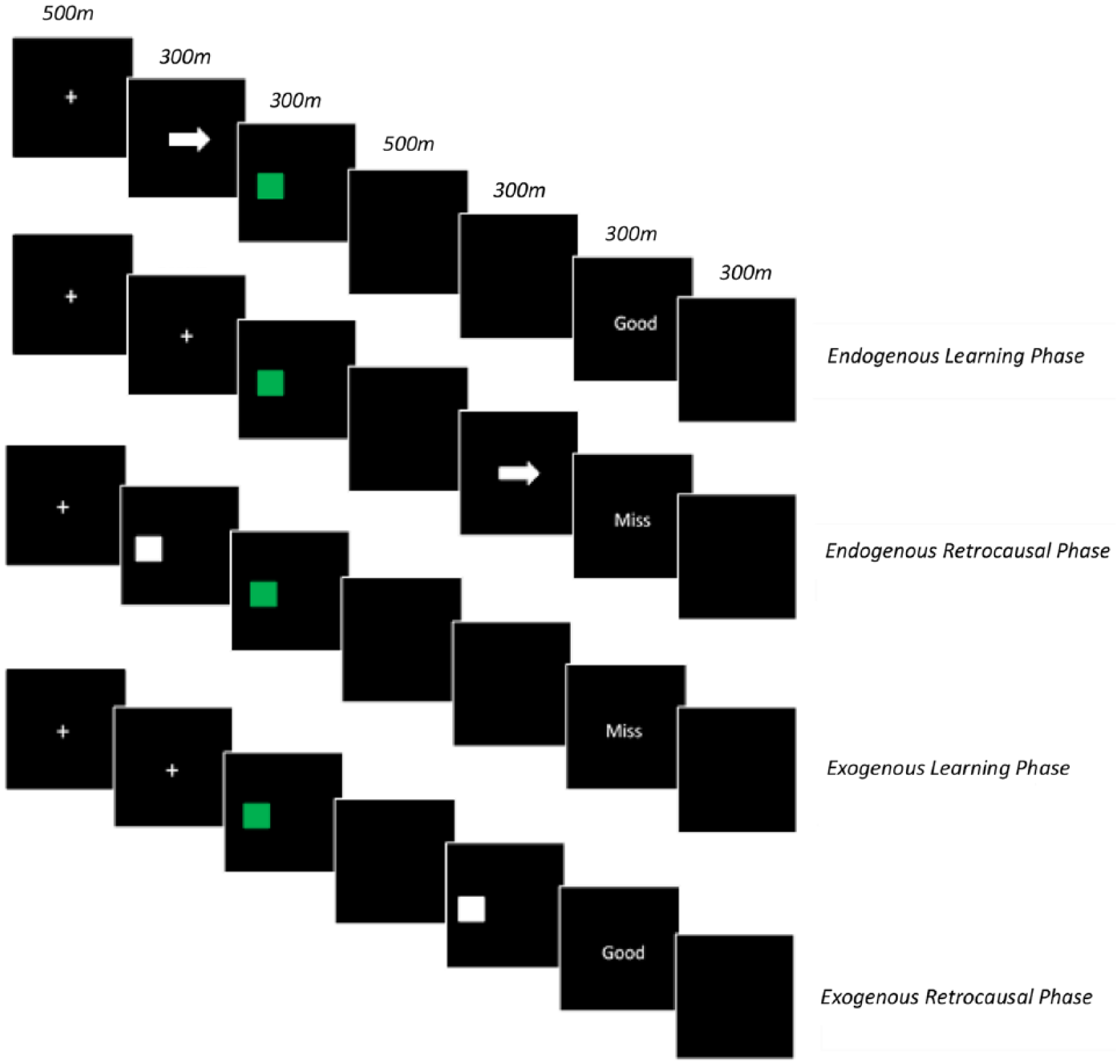
Learning and retrocausal phases of the endogenous (above) and exogenous (below) experiments.
Analysis
A correct response required a response on the side corresponding to the response imperative, within 100 ms 1 to 800 ms of the imperative appearing. Responses outside this time window were discarded. From the trials which were within the RT limit, errors were quantified as responses on the opposite side to that of the response imperative.
In each experiment, we calculated mean RTs based on two factors: whether the current and prior trial response were on the same side or the opposite side (a response imperative on the same side as the prior imperative is known to be responded to faster than if the sides switch and therefore requires controlling for), and whether the cue was congruent or incongruent with the side of the response imperative. Analysis was performed in R (R-Core-Team, 2015). The ezANOVA function from the “ez” package (Lawrence, 2013) was used to perform a repeated measures analysis of variance (ANOVA). The dependent variable were the mean RTs in each condition, and the independent variables were whether the prior and current imperative were on the same side or different side, and whether the cue was congruent or incongruent. A separate analysis was performed on the first (nonretrocausal) and second (retrocausal) data set. Partial eta square (
Results
Endogenous Cueing
In the nonretrocausal task, 2.2% of trials were discarded due to RTs outside of the 100 to 800 ms RT limit. There was a main effect of whether the current and prior trial response were on the same side or opposite side, F(1, 39) = 23.03, p < .001,
In the retrocausal task, 0.04% were discarded due to RTs outside the 100 to 800 ms RT limit. Again, there was a main effect of whether the current and prior trial responses were on the same side or opposite side, F(1, 39) = 49.90, p < .001,
Exogenous Cueing
In the learning phase, 1.1% of trials were discarded due to RTs outside of the 100 to 800 ms RT limit. There was a main effect of cue congruency, F(1, 39) = 14.59, p < .001,
In the retrocausal phase, 0.23% trials were discarded due to RTs outside of the 100 to 800 ms limit. As per Experiment 1, there was a main effect of whether the prior and current trial response imperative occurred on the same or different side, F(1, 39) = 16.56, p < .001,
Discussion
In both experiments presented here, the learning phase results replicated the classical findings of the attentional cuing paradigms (see Posner, 2016, for review). However, we did not find any significant effect of retrocausal cuing in the subsequent task. By using an ANOVA, we were able to control for whether the prior trial presented a response imperative on the same side as in the current trial, a known mediator of RTs (see, for example, Kleinsorge, 1999; Notebaert, Soetens, & Melis, 2001), which could have overshadowed any retrocausal influence of the cue presented. Further supporting our null finding, using BF analysis, we showed moderate support for no effect of retrocausation.
Other studies in the field have used a variety of methods for investigating psi effects such as random number generation (Grote, 2017), stimulus avoidance (Maier et al., 2014), prediction of future events (Graff & Cyrus, 2017), or arousal modulation by future positivity (Tressoldi, 2016). However, to our knowledge, only Bierman and Bijl (2014) have used a “classical” manipulation of psychological parameters. If retrocausation is a legitimate phenomenon, then using such classical manipulations is important as it distills from the variety of factors in most situations to allow better understanding of how an effect arises, under what conditions, and what its limits are.
This experiment, in conjunction with Bierman and Bijl (2014), may present one such limiting factor. As mentioned in the introduction, Bierman and Bijl (2014) used a go/no-go task in which future association of a signal with a response affected the speed with which participants reacted to those stimuli in the past. Participants responded faster to a stimulus which was to be associated with a go signal rather than a no-go signal in the future. In their study, associating a signal with response inhibition in the future slowed RTs in the present. In our study, rather than associating response with a signal, we indicated in the future as to where a signal was likely to appear. Thus, rather than an association between a response and a signal, we used an expectation of a response. It is possible that retrocausation can take place in certain situations in which associations between events are made (i.e., probability of response, or in other studies, arousal caused by events, avoidance of negative stimuli, etc.), while straight prediction based on information in the future is not influential. Alternatively, of course, it is possible that retrocausitive effects are not genuine, in which case, this article can serve as a datapoint to add support for such a null effect.
In summary, the current two experiments did not find evidence of retrocausation. However, to reiterate the sentiment of Cardeña (2018), there is a need for more researchers who are willing to investigate such “extrasensory” phenomena. It is likely that psi phenomena are not genuine; for such a claim to be made, an underlying causative mechanism needs to be established. For example, Mossbridge et al. (2014) presented an analogy of how “feeling the future” may work by means of our consciousness detecting a perturbation in the future, like how an eddy can be seen in the flow of a river preceding a stone. However, how this analogy fits in with the nonquantum reality we live in has yet to be established. It seems implausible that we are breaking the rules of thermodynamics; however, perhaps an in-depth model of our brain as a quantum machine may provide such answers. Furthermore, limiting conditions need to be consistently found and reported, and replication of prior research should be prioritized. As we have attempted to do here, simple statistical analyses should also be prioritized, as the use of some statistical techniques may lend themselves to “star-gazing” in which researchers have a tendency to search for statistical effects. Furthermore, research by a larger group of scientists, involved in varied fields and with different experimental techniques, is required to establish whether these phenomena are real. Although several meta-analyses with regard to psi-type phenomena have been performed (i.e., those mentioned in the introduction, as well as Bem, Tressoldi, Rabeyron, & Duggan, 2015), it seems like a great deal that more research is required on the topic.
Footnotes
Author’s Note
Experiments were approved by the human ethics committee of Macquarie University, and conducted in accord with the Helsinki Declaration. Participants provided written consent and were allowed to withdraw at any time. Participants were recruited from the cognitive science register at Macquarie University, and paid AUD5 for their participation.
Declaration of Conflicting Interests
The author(s) declared no potential conflicts of interest with respect to the research, authorship, and/or publication of this article.
Funding
The author(s) received no financial support for the research, authorship, and/or publication of this article.
