




Abstract
In this article, we define precognition as an atypical perceptual ability that allows the acquisition of non-inferential information arising from a future point in spacetime. The Multiphasic Model of Precognition (MMPC) identifies two distinct phases: The first is the physics domain, which addresses the question of retrocausation and how it is possible for information to traverse from one spacetime point to another. We suggest that the solution might be found within entropic considerations. The second is the neuroscience domain, which addresses the acquisition and interpretation of retrocausal signals. We propose that this occurs across three stages: (a) perception of signals from an information carrier, based on psychophysical variability in a putative signal transducer; (b) cortical processing of the signals, mediated by a cortical hyper-associative mechanism; and (c) cognition, mediated by normal cognitive processes, leading to a response based on retrocausal information. The model is comprehensive, brain-based, and provides a new direction for research requiring multidisciplinary expertise.
Brief Background
Extrasensory perception (ESP) is a panhuman experience observed since antiquity (May, Rubel, & Auerbach, 2014; Zingrone & Alvarado, 2015). The inability to understand the nature of the experience, based on prevailing zeitgeists and a dualistic understanding of mind/consciousness (Marwaha & May, 2015b), has led to ESP being interpreted as a paranormal ability.
Acceptance and increased interest in the applied aspects of ESP were evidenced by the U.S. government’s funding of a 23-year, US$20 million program from 1972 through 1995, with defense contractors Stanford Research Institute (SRI) International and Science Applications International Corporation. The U.S. government established an in-house effort to apply ESP to problems of national interest during the Cold War. This effort is best known by the program’s last nickname, Star Gate. Practical examples showed that, if used properly, ESP garnered limited, but sometimes critical, successes in intelligence gathering during the Cold War (May, Rubel, & Auerbach, 2014). Unlike traditional academic research, the intelligence community was result-oriented: As long as the data, when combined appropriately with other assets, provided useful information, the data were considered valid. For some researchers, this provides evidence enough for the existence of ESP. Although it remains a logical impossibility for many skeptics, for others, it is a logical possibility (Corry, 2015). In the Star Gate program, research was carried out in various aspects of ESP by investigating potential mechanisms such as that contained in physics, neuroscience, psychological factors, and fine tuning research protocols and statistical applications for analysis of data. The results drawn from formerly classified 1 300 technical reports and experimental data can briefly be summarized as follows: (a) There is statistical evidence for an information transfer anomaly that we currently do not understand, (b) the second law of thermodynamics and the gradient of Shannon entropy are among factors that may influence the information transfer, and (c) the phenomenon so far resists training for excellence; rather, it is observed to be an innate ability in some individuals (May & Marwaha, 2014). As the SRI meta-analysis has shown, “At this time, there is no quantitative evidence to support a training hypothesis,” that is, training for remote viewing ability is not effective (May, Utts, et al., 1989, p. 2).
In 1995, May, Utts, and Spottiswoode (1995/2014) coined the term “anomalous cognition” (AC) to refer to ESP phenomena. According to them, the earlier definitions of ESP were not sufficient to either describe the observables or provide a working definition for experimental work. The “anomaly” in AC refers to our insufficient understanding of the process of AC, rather than its validity. ESP/psi/psychic experiences are the most popular terms as understood by the lay community.
AC research, particularly in the last 30 years, has accumulated sufficient evidence to establish the existence of information transfer through processes that we are only now beginning to understand. Although it is beyond the scope of this article to provide a complete analysis of the substantial amount of experimental and theoretical work that has been carried out worldwide since the 1930s, research across laboratories provides statistical evidence for an information transfer anomaly. Table 1 shows the most relevant set of meta-analyses of various experimental AC paradigms.
A Summary of Meta-Analyses of ESP Studies.

Note. ESP = extrasensory perception.
It is not our intention to provide irrefutable evidence of AC; rather, we provide references from which this table was generated, to demonstrate that a substantial experimental database exists that meets the standards of critical scientific methodology. The meta-analyses in Table 1 take into account reasonable “file drawer” estimates (Iyengar & Greenhouse, 1988; Rosenthal, 1979; Scargle, 2000; Schonemann & Scargle, 2008).
Beginning in the 1970s, the research paradigm shifted from forced-choice studies to free-response methodologies. Some of these gave the first laboratory evidence for free-response precognition (PC) under strict laboratory conditions. Researchers examined various internal noise reduction methods such as dreaming (Krippner, Ullman, & Honorton, 1971, 1972) and the ganzfeld (Honorton & Harper, 1974). Puthoff and Targ (1974) further modernized a concept from early in the 20th century (Sinclair, 1930/2001; Warcollier, 1926-1927) of a form of free-response study, which they called remote viewing (RV). The references above are not meant to be exhaustive; rather, they provide a flavor of these types of data.
In traditional remote viewing studies (Puthoff & Targ, 1974), an assistant randomly chooses a site within a 30-min drive from the laboratory and drives to that location and remains there for approximately 15 min. An experimenter then asks a participant to provide a description in words and drawings of a location that they would visit within an hour. The experimenter and participant of course are blind to that location. The assistant then returns to the laboratory and escorts the participant back to the site as a form of feedback. Blind, rank-order quantitative analysis that compares each response to the set of selected targets is carried out to assess the degree to which there is statistical evidence for PC (see May & Marwaha, 2014, for methodological details).
Precognition—The Only Form of ESP
We present a brief rationale for our assertion that PC is the only form of ESP (Marwaha & May, in preparation). First, we offer a formal definition of PC based on the proposed model: Precognition is an atypical perceptual ability that allows the acquisition of non-inferential information arising from a future point in spacetime.
2
For two future points in spacetime, insufficient time has elapsed between them to allow for any causal relationship. Procedurally, in ESP experiments, it means that target stimuli are randomly generated after data collection is complete.
Clearly, PC has been substantially investigated and documented (e.g., Honorton & Ferrari, 1989) and all the prestimulus response and presentiment studies in which the stimuli are randomly generated post response (e.g., Mossbridge, Tressoldi, & Utts, 2012). This list of studies, although not exhaustive, nonetheless, does provide substantial evidence for PC.
However, it might be argued that the substantial database experiments including ganzfeld, remote viewing, and other ESP studies wherein the target stimuli are available at the time of data collection appear to provide a substantial set of data that are not PC by definition. However, in these studies, a participant may still have access to the target stimuli via PC. Feedback—associating a given trial with a given stimulus—regardless of to whom it is given and when, or even stored in a computer, provides a future-oriented possible source for the ESP data (May, Lantz, & Piantineda, 1996/2014). No matter how clever the protocol, it appears at this point that it is difficult or, perhaps, impossible to close the future PC door. Finally, a meta-analysis comparing PC studies with clairvoyant ones from 1935 to 1997 found no significant differences between them. The effect size for the difference was 0.01 (Steinkamp, Milton, & Morris, 1998).
Thus, our assertion that PC is the only form of ESP stands on solid ground so that it can serve as an axiom for the Multiphasic Model of Precognition (MMPC).
The Fundamental Questions in Precognition
PC research examines the subjective experience of acquiring information from a future spacetime point. The fascination with this aspect of human cognition focused early research on the experiencer and the resulting experience. However, as researchers delved further into the problem, it became apparent that the picture was far larger than just human experience. The PC experience was a manifestation of far more fundamental questions—the nature of time, causality, and information. Thus, PC research, in its essence, addresses the fundamental problems of the direction of time, causality, and information flow (Marwaha & May, 2015a; May & Marwaha, 2015b).
The most important and difficult questions in PC research are when, where, and how this information transfer occurs from a distant point in spacetime? Furthermore, what is the information carrier, and what are its properties? Answers to these questions will help determining in which sensory system, if any, the carrier energy is being converted into electrochemical signals. What is the transmission rate (bits/symbol) of the data, and what is its limit? At what point does the apparent stochastic nature of the information occur: Is it at the source, transmission, or at the detection point?
In addition, other questions include the following: Who possesses PC ability and why? Why can we not train for developing a PC ability? Confidence calling is problematic generally; however, a recent statistical approach—figure-of-merit—has shown promise (May, 2007). Why do we not see stable central nervous system (CNS) correlates for PC? Why may personality correlations appear more as a procedural artifact rather than as something fundamental?
These and more questions have emerged in the 150 years of research in this field. Developing a model with so many blank spaces in the data is a challenging task; nevertheless, we have enough to begin that process.
MMPC
As with advances in any field, new developments are based on the historical past and current thinking. We acknowledge the foundations—across disciplines—on which this model is based. Before proceeding with the model, we first introduce and clarify our temporal-based terminology.
Figure 1 divides time into three parts: past, present, and future as viewed from a single reference frame. In this article, we adopt terminology from the future-centered perspective (i.e., top half of Figure 1) because there is considerable interest in physics whether it is possible to influence the present by a future action. The term that is widely used in physics for this concept is retrocausation (RC; Sheehan, 2011). RC is the notion that an event in the future can influence the present, and it is not that the present can influence the past. We thus use the terms RC and RC signals to refer to this temporal, information-centered perspective for putative signals that originated from a future point in spacetime. The bottom half of Figure 1 shows a present-time, person-centered perspective, which is PC. We notice that it is impossible for the present to affect or change the past.

The prefix retro means action or information from the future affecting the present.
Defining the Problem Space
The MMPC is a signal-based, process-oriented model designed to determine the causal mechanisms leading to the experience of PC. As a starting point, we have formally defined the problem space of PC by considering two phases.
Phase I falls exclusively within the physics domain (PD). It addresses the question, “How is it possible that information can go between two spacetime points and be used, especially if the two points are acausally separated?” It is related to how information is carried from an external source, which is distant in time and space, to the percipient.
Phase II falls entirely within the neuroscience domain (ND)—internal to the human percipient. It addresses the experiential part of the problem, that is, how the information is acquired by a putative sensory system, how this information is processed in the brain, and how it is expressed. We define the acquiring mechanism as a transition between the PD and ND.
Using vision as an analogy, Phase I consists of an electromagnetic (EM) carrier providing informational signals at the speed of light. Photons strike the retina (i.e., transition between PD and ND for vision), which converts the EM energy into electrochemical signals that are processed by the brain (Phase II).
These domains divide the problem space within which a solution for the complex problem of PC can be addressed. These further consist of multiple discrete stages that can be examined independently. Intrinsic to this perspective is that different processes are involved in each phase and at different stages, which finally result in a conscious experience of PC.
The MMPC addresses both the PD and the ND by considering the well-established laws of the physical world and what we currently know—and will know—about brain–behavior relationships. Thus, the MMPC is a coherent assimilation of existing concepts that we believe can lead to understanding the process of PC—from the point of information origin to cognition. Although PC researchers have been examining both domains, the importance of formally dividing the process into two domains permits allocation of problems to their respective disciplines. Thus, researchers need not step out of their area of expertise, enabling them to address the questions and formulate experimental hypotheses within their domain of proficiency. As we will see in the details below, each segment of the total PC experience requires a different set of questions and expertise. In doing so, it may be possible to obtain answers to one segment, without knowing the details of another. For instance, we may understand how the brain processes information, but we may not know how information is carried across spacetime until physicists are able to decipher that problem. We now consider the two phases in detail.
Phase I: The Physics Domain
Phase I falls within the PD. As stated, it addresses the question, “How is it possible for information to propagate between two acausally separated points and be acted up on?” It is related to how information is carried from an external source, which is distant in time and space, to the percipient. Although the details are beyond the scope of this article, we present a brief overview of this domain, to indicate to the reader that there are experimental and theoretical bases for the question of how information is carried across spacetime, that is, from there then to here now (for details, see May, 2011a, 2011b/2014, 2014; May & Depp, 2015; May & Lantz, 2010/2014; May & Spottiswoode, 1994/2014; May, Spottiswoode, & Faith, 2000).
The primacy of entropy
As with any model development, we first must consider what data the model must be capable of explaining. Because some experiments show that the quality of PC is significantly correlated with changes of entropy of the target systems (May & Lantz, 2010/2014; May & Spottiswoode, 1994/2014; May et al., 2000), we propose that some aspect of entropy or its gradients will yield an understanding of the PD.
The concept of entropy arose from classical thermodynamics. Although the mathematics of various theories rapidly becomes difficult, the conceptual framework is rather straightforward. One approach is to think of entropy as a measure of chaos or to the related idea of uncertainty. Ice, for example, has much lower entropy than water. Why? Because the molecules of water in liquid form are bouncing around in a chaotic fashion, whereas in ice, these same molecules are all lined in an ordered array we call a crystal. Also, in liquid water, the position of a given molecule is very uncertain, whereas in ice, the position of a molecule is far more certain as it is trapped in a crystal and is not going anywhere (May & Lantz, 2010/2014).
A related concept comes to us as the second law of thermodynamics, which states that for isolated systems, entropy cannot decrease. Suppose you knock a glass (ordered system) to the floor and it shatters (i.e., a transition from low into higher entropy). Now imagine picking up the pieces, placing them on the table, and then knocking them to the floor again as a bunch. What happens? The second law of thermodynamics tells us that the entropy can never decrease, which is what must happen if the shattered pieces are to assemble themselves into a glass when they hit the floor (May & Lantz, 2010/2014).
A closely related term is Shannon entropy. Building on the pioneering work of Leó Szilárd (1929/1972), Shannon and Weaver (1949) developed what is now called the information theory. This concept formalizes the intuitive idea of information that there is more “information” in rare events, such as winning the lottery, than in common ones, such as taking a breath. Shannon and Weaver defined the entropy for a given system as the weighted average of the probability of occurrence of all possible events in the system. Entropy, used in this sense, is defined as a measure of our uncertainty, or lack of information, about a system.
In sensory systems, receptor cells are sensitive to incident energy regardless of “meaning,” which is ascribed as a later cognitive function. Shannon entropy is also devoid of meaning. Pixel analysis in photographs, for example, ignores anything to do with cognitive features. One way to think about this is that each pixel has no information from its neighboring pixels (Tononi, 2012). From this point of view, a photograph of a nuclear blast is, perhaps, no more Shannon-entropic than a photograph of a kitten; it all depends on the pixel intensities, which were used to create the photographs (May & Spottiswoode, 1994/2014).
One important clue for why entropy is so important for PC was provided during the Star Gate program. During that time, the team noticed that there was a class of operational PC missions involving intelligence gathering or simulations thereof, which appeared never to fail. These included underground nuclear tests, stores of radioactive material, EM pulse devices, static and dynamic rocket motor tests, and rocket launchings, to name a few (seeMay & Lantz, 2010/2014, for details). For example, Figure 2 shows the complete AC response to a static rocket motor test.
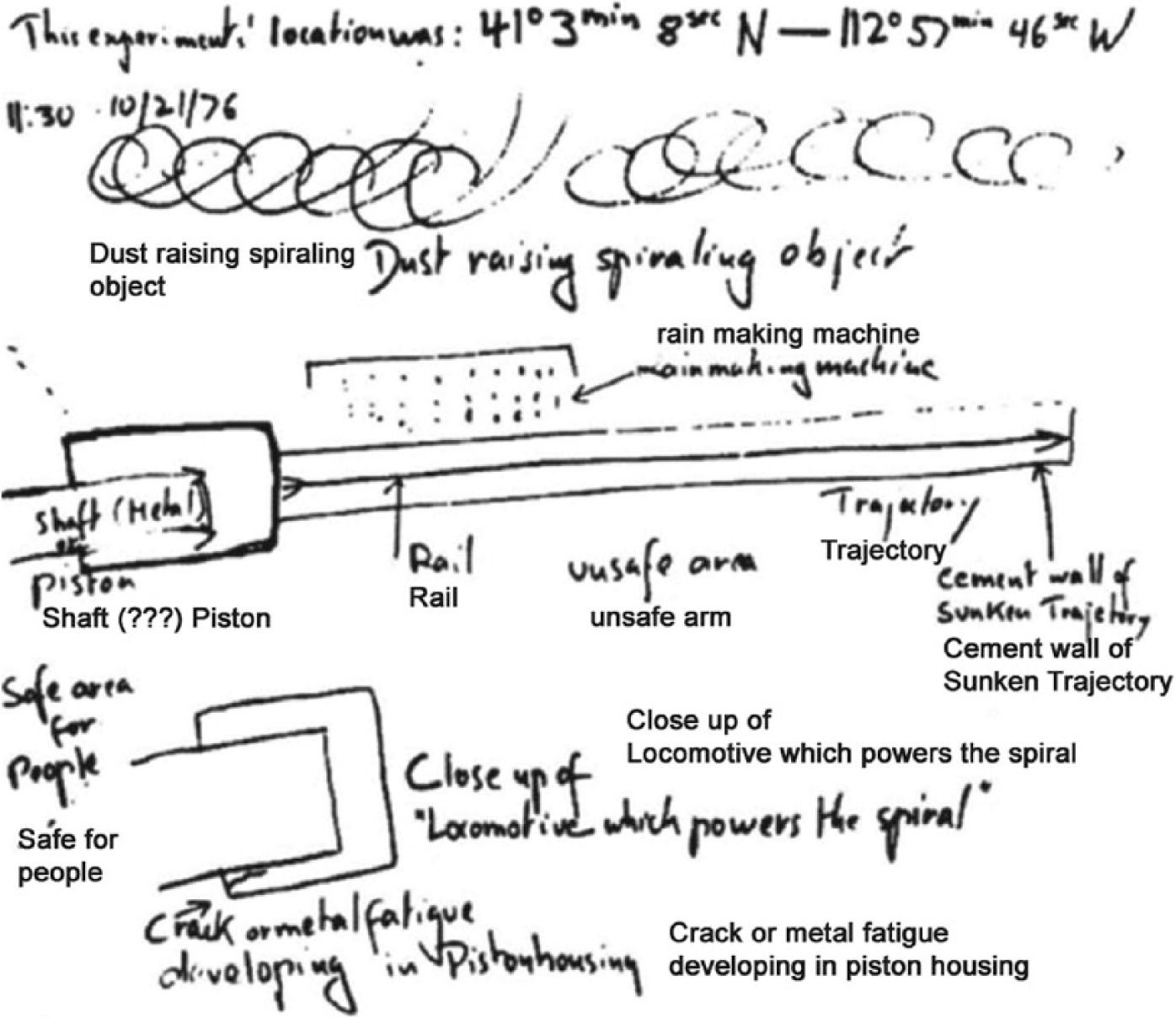
Annotated response to a static rocket motor test in Utah.
Figure 3 shows a schematic drawing of the site and a recent Google Earth photo of the site 35 years later. What the participant labeled a “rain-making” machine is something that is common on such tests. Water is sprayed on the motor during the test to keep it from overheating. Figure 4 shows a modern test firing for comparison. The important point of this example is that the rocket motor was initially in a relatively low entropy state prior to the ignition and a high entropy state during the test.

Schematic drawing of test facility and a current Google Earth photo of the site.

Modern static test with “rain-making machine.”
One possible explanation might be that these target types share a physical attribute; they all involve enormous expenditures of energy in a short period. Of course, the first thing that comes to mind is that somehow these short bursts radiate energy in such a way that the CNS of the participants responds accordingly—a traditional sensory explanation. However, this cannot account for the numerous examples when the remote viewing was carried out precognitively, that is, before the actual event had occurred.
A second observation the model must cover is that there is an apparent entropic limit to the quality of the PC data (May, 2011a, 2011b/2014). Currently, we do not understand whether that limit is imposed at the source, transfer, or detection mechanism, or some combination of them.
The data of RC itself provide support for entropy being the prime candidate for Phase I (seeMay & Marwaha, 2014). These data suggest that at the macroscopic level, it is possible to obtain information from some non-inferential event in the future. This, of course, violates the rules of macroscopic causality and the profound understanding that time moves in one direction only. Yet, at the microscopic level (i.e., atoms, molecules), the equations of motion are all symmetric in time. In other words, time could move forward or backward, and the collisions of molecules stay the same.
This apparent paradox has been resolved now for more than a century. At the macroscopic level, time moves in one direction as a consequence of the second law of thermodynamics. This law has not yet been violated. It is beyond the scope of this article to provide technical support of this statement, but the textbooks of any mid-level collegiate course in physics, thermodynamics, or statistical mechanics will provide the details.
The argument for entropy as a PD candidate can be summarized as follows:
the quality of RC data correlates significantly with entropic gradients of the target stimuli;
the second law of thermodynamics can account for the apparent paradox of time between the microscopic and macroscopic perspectives.
Entropy gradients have also been used extensively to understand two traditional forms of information transfer—visual and acoustic. In the realm of audio, for example, an index of speech intelligibility is the cochlea-scaled entropy (Stilp, Kiefte, Alexander, & Kluender, 2007). In addition, spectral change, as measured by cochlea-scaled entropy, predicts speech intelligibility better than the information carried by vowels or consonants in sentences (Fei & Loizou, 2012). High Shannon entropy of musical phrases affects the uncertainty of determining musical pitch (Hansen & Pearce, 2012). In the visual arena, it appears that neuronal structures in the CNS take advantage of statistical aspects of subareas of the visual scene to enhance visual recognition (Gerhard, Wichmann, & Bethge, 2013); that is, sensory representations are adapted to the statistical regularities in sensory signals and thereby incorporate knowledge about the outside world. In addition, entropy masking of a visual stimulus is related to learnability; that is, high entropic masks make it difficult to understand visual stimuli (Delaigle, Devleeschouwer, Macq, & Langendijk, 2002). These references concerning entropy and the visual and auditory systems are not exhaustive and are presented only as representative samples to illustrate the importance of entropy considerations in the understanding of the signal characteristics to the normal sensory systems.
Norwich (2005) provides a succinct summary of the tight relationship between physical entropy and the sensory systems: With reference to two specific modalities of sensation, the taste of saltiness of chloride salts, and the loudness of steady tones, it is shown that the laws of sensation (logarithmic and power laws) are expressions of the entropy per mole of the stimulus. That is, the laws of sensation are linear functions of molar entropy. In partial verification of this hypothesis, we are able to derive an approximate value for the gas constant, a fundamental physical constant, directly from psychophysical measurements. The significance of our observation lies in the linking of the phenomenon of “sensation” directly to a physical measure. It suggests that if the laws of physics are universal, the laws of sensation and perception are similarly universal. [Emphasis added]. It also connects the sensation of a simple, steady physical signal with the molecular structure of the signal: the greater the number of microstates or complexions of the stimulus signal, the greater the magnitude of the sensation (saltiness or loudness). (Abstract)
Most of the sample articles cited above are based on laboratory experiments. Because the known sensory systems appear to be sensitive to entropic changes at their sensory “front ends,” we feel it is not a surprise to find PC too is sensitive to entropic changes of the stimuli. As further support for proposing that the PD for PC will be understood in terms of entropy, we describe one theoretical article on the fundamental aspect of entropy.
Verlinde (2011) was able to derive the classical dynamic equations of Newton including his famous equation for the gravitational force between two particles from entropic considerations only. These computations were carried out completely within the classical or semi-classical domains; that is, neither quantum mechanics nor general relativity was necessary for the calculations. He did develop the idea of an entropic force. This entropic force is like all other forces in that it is a spatial gradient of some potential. In addition, Verlinde was able to derive, again from first principles and gradients of entropy, the Einstein field equations of general relativity. The important point here is the supremacy of entropy as a physical concept. In fact, Verlinde goes so far to suggest that it is time to retire gravity as one of the four known fundamental forces in that he shows that gravity itself is an emergent property of the more fundamental aspects of entropy and thermodynamics. Verlinde’s work has spawned great interest in the fundamental nature of entropy.
Final considerations for the physics domain
We have noted that there is considerable experimental evidence that suggests entropic gradients may be important in understanding the PD; however, with regard to mechanisms, signal carriers, and transducers, the evidence is circumstantial. Clearly, more work is needed. For example, there is a critical test of these ideas underway in 2013-2015 (May, Hawley, & Marwaha, in preparation). In that study, they treat thermodynamic entropic gradients at physical targets (as opposed to photographic targets) as an independent variable and the quality of the resulting PC as a dependent variable. This experiment will add valuable insights into Phase I.
Phase II: The Neuroscience Domain (ND)
Background
Since the early 1940s, numerous attempts have been made to correlate laboratory-based PC performance with individual differences in participants’ personality and attitudinal characteristics to identify the underlying processes. Researchers have extensively explored various dimensions, such as beliefs and attitudes, moods, states of mind, and personality variables. Extraversion has been one of the most widely explored dimensions of personality in relation to ESP. In a meta-analysis of 60 independent studies examining extraversion–ESP relationship, Honorton, Ferrari, and Bem (1998) found a small correlation (r = .09) that was significant (z = 4.43, n = 2,963) mainly due to the large n. Even that correlation was thought to arise only due to the free-response data, in that extraverted participants did better than introverted participants did. The correlations of ESP with personality variables as reported are unstable in that they have not shown to be effective in identifying people with a PC ability, as they are not systematic, are not easily replicable, and contain a confound in the data collection methodology. In our analysis, the participant pool is biased toward extraverts, as most of the studies use self-selected volunteers as participants. In addition, cognitive processes such as memory and subliminal perception have been examined for their relation to ESP (seeRao, 2011, for overview).
As the Star Gate program was tasked for applications, the need to develop an effective tool to identify people with good PC ability was of paramount interest. In initial studies, the Myers–Briggs Type Inventory, Q-sort (Block, 1961), and the Personality Assessment System (Krauskopf & Saunders, 1994), which uses the Wechsler Adult Intelligence Scale as a behavioral measure of personality, were investigated for their potential use as screening tools (Humphrey, Lantz, & Saunders, 1986; Lantz, 1987; Lantz & Kiernan, 1986; Lantz & May, 1988; May, Luke, & James, 1994; Saunders & May, 1984; Trask, Lantz, Luke, & May, 1989). None of these methods was predictive of PC ability; the general conclusion was that the best technique for identifying people with PC skills is assessing them on PC tasks. This notion is supported in a meta-analysis of 309 forced-choice PC experiments by Honorton and Ferrari (1989) who report “studies using subjects selected on the basis of prior testing performance show significantly larger effects than studies using unselected subjects” (p. 281).
Neurophysiological studies using technologies of the day, including electroencephalography (EEG), magnetoencephalography (MEG; May, Luke, & Frivold, 1988; May et al., 1994; May, Luke, & Lantz, 1993; May, Luke, Trask, & Frivold, 1989; Targ, May, Puthoff, Galin, & Ornstein, 1976; Targ, Puthoff, & May, 1976), and functional magnetic resonance imaging (fMRI; Moulton & Kosslyn, 2009) have been used to investigate the cortical correlates of PC. To summarize the results of May and associates, (a) there were no stable concomitant neural activities that seemed to occur during the point of time when PC was supposed to have occurred. As understanding of the phenomena increased, they realized that this was probably due to the fact that we could not determine when exactly the participant had received the information that he was providing (i.e., before or during the test situation); (b) we were, and are, still not sure about the form of energy carrier for RC signals. This implies that we were, and are, essentially searching for the proverbial needle in the haystack of neural pathways. For starters, Persinger’s (2015) extensive studies with PC-abled participants have implicated the right temporoparietal lobe as instrumental in their abilities.
As in the PD, we first must consider what data the ND of the model must be capable of explaining. We begin, therefore, with the appropriate observables assumed true: Specifically, PC ability is seen in varying levels of proficiency across the population, and no stable CNS and psychological correlates aside from a performance-based measure on a PC task have been observed.
Phase II of the model refers to the processes that occur once the signals from any external source, including RC signals, have reached the percipient’s CNS, and the processes that occur from perception to cognition of that data. This phase is primarily an implicit process. The MMPC deconstructs this domain into three discrete but fluid stages: (a) Stage 1—perception of RC signals from an energy carrier, (b) Stage 2—cortical processing of RC signals, and (c) Stage 3—cognition. One aspect of our model is that Stages 1 and 2 are critically different from normal perception in PC, following which, in Stage 3, normal processing occurs as it does for any other sensory input. Figure 5 illustrates the process of PC.

Phases I and II of precognition.
Stage 1: Perception of retrocausal signals
An important element in the process of PC is the presence of a signal transducer to serve as an interface between the incoming signals and the processing of that data. For example, the visual receptors in the retina are the transducers for signals from the visible EM spectrum. We can keep the nature of a putative PC channel an open question until we have a better understanding of the PD. Nevertheless, we can work under the assumption that PC information is received and processed internally in the same manner as are signals impinging on other sensory systems. As the nature of the putative RC signal is presently unknown, we have to assume that it is different from the normal thresholds perceived by us. This requires us to consider a possible variation in the transducer and the processing mechanisms.
Hypothesis of psychophysical variability in a signal transducer (Hypothesis 1.1).
This hypothesis poses that psychophysical variability both in CNS extent and function can account for variation in the reception of RC signals; that is, some individuals demonstrate a PC ability, whereas others do not. Approximately 1% of the general population possesses a natural remote viewing ability (May, Utts, et al., 1989). As we have seen over 40 years of experimental work, PC ability is seen in varying levels of proficiency across the population, much like the varying levels of music ability for example.
This hypothesis suggests that individuals with PC ability are different from those without it at the level of sensory input as follows: The RC signal is acquired by those with PC ability due to a possible variation in a putative biological transducer, which is the point where external signals are transformed into biochemical/bioelectrical sensory signals and transmitted to the cortical structures where cognition occurs. These signals are connected and processed across multiple cortical areas, which is part of Stage 2 of the MMPC as described in the following section. The question of what the transducer is will be determined by our understanding of the PD. (We note that this is the only part of the ND that is dependent on the PD. From Stage 2 onward, the ND is independent of any PD considerations.)
This hypothesis is based on the fact that individual differences are the sine qua non of biological and psychological development. However, as Kanai and Rees (2011, p. 231) observe, “In the neuroscience of human behavior and cognition, inter-individual differences are often treated as a source of ‘noise’ and therefore discarded through averaging data from a group of participants.” Thus, examining the variations in this “noise” is of utmost relevance for identifying the PC ability in accordance with the MMPC.
Research in individual variations in the visual domain lends theoretical support for this hypothesis. Tahmasebi et al. (2012) report on the variability of functional organization relative to brain anatomy. A two- to threefold inter-individual variation in size of the visual cortex is seen in humans, a variation that could lead to substantial difference in visual ability. Similarly, variations in number of axons in the optic nerve, number of retinal ganglion cells in a single eye, and the density of photoreceptors in the retina are also seen (Hofer, Carroll, Neitz, Neitz, & Williams, 2005; Kee, Koo, Ji, & Kim, 1997; Quigley, Brown, Morrison, & Drance, 1990; Roorda & Williams, 1999; Wesner, Pokorny, Shevell, & Smith, 1991), including the presence of tetrachromacy or even pentachromacy (Neitz, Carroll, Yamauchi, Neitz, & Williams, 2002; Neitz, Neitz, & Jacobs, 1993). Using a battery of tests that included orientation discrimination, wavelength sensitivity, contrast sensitivity, vernier acuity, direction-of-motion detection, and velocity discrimination, Halpern, Andrews, and Purves (1999) found that there was significant inter-individual difference in visual ability, which could be the result of inter-individual variation in the amount of neural circuitry devoted to vision. These variations in the cortical structures and the retina—the visual system transducer—provide a basis for considering the presence of PC ability and the individual differences seen in that ability.
As experimental results and theoretical considerations have shown, the RC-signal carrier cannot be mediated by EM waves (Targ, May, et al., 1976). Nevertheless, we open this door slightly to permit the possibility of variations in the traditional sensory transducers, in that perhaps CNS structures that are adjacent to expanded sensory sensitivity are involved in the detection of RC signals. We emphasize that we are not proposing, therefore, that PC is carried on any EM wave regardless of its frequency.
The final processing of the RC signals thus obtained occurs in the brain, just as the brain is the final frontier for color perception. This leads us to Stage 2 of the ND.
Stage 2: Cortical processing of RC signals
Stage 2 of the model involves the processing of RC signals received as hypothesized in Stage 1.
Hypothesis of cortical hyper-associative mechanism (Hypothesis 2.1).
Considering the possible variation in the nature of an RC signal, we may assume that it has characteristics that are different from known signals, and thus propose that RC signals are processed via a cross-modal mechanism leading to a PC experience. We consider this notion by formulating the hypothesis of cortical hyper-associative mechanism (Hypothesis 2.1).
Cortical hyper-connectivity has recently been associated with atypical perceptual abilities such as synesthesia (Hänggi, Beeli, Oechslin, & Jäncke, 2008; Ramachandran & Hubbard, 2001; Rouw & Scholte, 2007; Simner & Hubbard, 2013) and savant skills in autism (Wallace, Happé, & Giedd, 2009). Hence, we borrow the term hyper-associative mechanism as used by Simner (2012) for describing the possible underlying mechanisms for synesthesia. As Simner states, [there may be] one of any number of [original emphasis] possible neurological processes that might give rise to the “open channel” between different brain regions, which allows sound to be interpreted as colour, taste as touch, touch as smell, and so on. In fact, this neutral term should cover not one of several possible mechanisms, but rather, one or more of these possibilities . . . Whether a functional connection is established by hyper-connectivity, by disinhibited pathways, by other means, or indeed, a combination of these, the outcome is the opening of a communication between regions that would otherwise not directly interact to produce a conscious experience in the average person. (p. 25)
Considering the possibility of a similarity in underlying mechanisms between synesthesia and the proposed internal PC mechanism, in our view, the synesthete population may be a good point to start for examining this hypothesis. However, a crucial distinction between synesthesia and PC experiences is that synesthetic experiences apparently may occur in the absence of an external signal. As Sean Day (personal communication, 3 January, 2014) stated, “Synesthesia does not convey information of any reality; it adds one or more non-real perceptions to an initial inducing perception which may (or may not) be based upon reality.” PC experiences, as we propose here, arise due to the presence of external signals. Others have also claimed that synesthesia may actually underpin ESP experiences (e.g., Alvarado, 1994; Myers, 1903; Simmonds-Moore, 2010, 2014).
Further support for this hypothesis comes from a variety of atypical perceptual abilities. For instance, Loui, Li, Hohmann, and Schlaug (2011) showed that people with the ability to recognize absolute pitch (AP) possess higher white matter connectivity in temporal lobe regions responsible for the perception and association of pitch. These hyper-connected regions include the posterior superior and middle temporal gyri in both left and right hemispheres. AP possessors had significantly higher tract volume than non-AP individuals. Bermudez and Zatorre (2009) suggest that AP performance exists along a continuum. Ashwin, Ashwin, Rhydderch, Howells, and Baron-Cohen (2009) report that significantly enhanced perceptual functioning, about 2.79 times better than the average, and attention to detail, also known as eagle-eyed visual acuity, is seen in some persons with autism spectrum conditions. The mechanism for this may be at the level of neural hyper-excitation and is likely governed by factors that give rise to normal variation in visual acuity in typically developing individuals. They speculate that this may be due to atypically high numbers of foveal cone cells or to dopamine receptors at the retinal or neural level (and perhaps increased levels of dopamine in these areas), which may be caused by hypomethylation.
Such observations provide theoretical and experimental support for the hypothesis in Stage 2 of the ND. As the examples above illustrate, individual variations in cortical structure and functioning give rise to atypical cognitions. By no means are these considered “abnormal”; rather, they arise from a complex mix of genetic, sensory, and cortical architecture, and personal experiences that go into making each individual experience unique. Similarly, PC ability may also be one such atypical experience. Thus, we hypothesize that cortical hyper-associative mechanisms may permit the processing of information acquired from a synesthesia-like coupling to an extended sensory variability through a currently unknown transducer, following which the implicitly acquired data are further processed in the brain. Thus, there may be variability at the point of sensory signal intake (for instance, neurotransmitters at the retinal level; Hypothesis 1.1) and structural variability at the processing level (Hypothesis 2.1). As Sagiv, Ilbeigi, and Ben-Tal (2011) have stated with reference to synesthesia, We speculate that a broad spectrum of human experiences must involve some sort of synaesthesia-like cross activation. After all, non-trivial mental function quite commonly requires the integration of information across different domains of perception, cognition, and action. (p. 88)
Simner (2012, p. 27) informs us that “synaesthetic sensations derive not only from sounds, touch, tastes, words, and so on, but also from more unexpected sources, such as the act of decision making, or very fine-grain motor movements, or navigating social interactions, and so on.”Sagiv et al. (2011) have summarized the features of synesthesia: (a) It is present in 4% of the general population, (b) it is induced automatically, (c) there is permanence and regularity of synesthetic experiences, (d) synesthetes take the experience for granted, (e) the experience shares much in common with ordinary perception, and (f) it may merely represent an augmentation of normal propensities for cross-modal interactions. Pointing to a genetic basis, Eagleman (2012) has found five families with color-sequence synesthesia. Two of the best Star Gate remote viewers have twins with similar abilities, and, on a preliminary analysis, are synesthetes.
In summary of Stages 1 and 2, RC signals may be acquired by an individual with PC ability, due to psychophysical variability in signal transducer (Hypothesis 1.1); these signals are then processed in accordance with Stage 2. The cortical hyper-associative mechanism (Hypothesis 2.1) takes advantage of a possible increase in spectral range of EM and/or the perception of the RC signals that the brain can process.
Further support for the hypotheses put forth for Stages 1 and 2 is found in experimental and applied research. Using neuroprostheses, Thomson, Carra, and Nicolelis (2013) report a study with rats where they augmented the normal perceptual range to include the infrared EM spectrum, which is well outside the rat photoreceptors’ spectral sensitivity. Via intracortical microstimulation, the rats were able to transcend the limitation of perceiving only those stimuli that can activate their bodies’ native sensory transducers. This lends experimental support to the possibility of perceiving an extended EM spectrum as proposed by the MMPC. In addition, sensory substitution devices (SSDs), which aim to compensate for the loss of a sensory modality, typically vision, by converting information from the lost modality into stimuli in a remaining modality, lend support to the possibilities proposed in Stage 2. There is increasing speculation that SSD perception is an artificially induced synesthesia (for example, see Farina, 2013; Ward & Wright, 2014). As Proulx (2010) points out, many forms of expertise depend on cross-modal contingencies.
Stage 3: Cognition
Implicit learning is the normal means of acquiring information. It is characterized by two critical features: (a) It is an unconscious process, and (b) it yields abstract knowledge. As Lewicki, Hill, and Czyzewska (1992) state, “ . . . the ability of the human cognitive system to nonconsciously acquire information is a general meta-theoretical assumption of almost all of contemporary cognitive psychology.” They further state that the “final products of perception (i.e., subjectively encoded meanings of stimuli) is functionally independent from the information-processing algorithms and heuristics responsible for generating those subjective meanings” (pp. 796-797). The role of implicit learning in PC has been well documented (e.g., Bierman, 2005; Carpenter, 2012; Watt, 1998).
Following an extensive review of studies on PC and brain waves, EEG and functional imaging correlates of PC and presentiment, and cerebral lateralization and PC, Williams and Roll (2008) concluded that there is considerable evidence that similar brain processes are used in PC as for normal perception and behavior. Thus, in concurrence with Williams and Roll, Tyrrell (1947), Roll (1966), and Broughton (2006), we hypothesize that in Stage 3, cognition occurs in the same manner as for other sensory inputs. Influence of emotions, memory, thinking, decision making, and so on occurs as it does for other non-PC activity for eliciting a PC response. Thus, we propose that in Stage 3, there is no distinguishing characteristic that differentiates the cognition of RC signals from that of normal sensory signals. RC information is acted on by the regular psychological processes and manifested through unconscious and conscious means such as feelings, dreams, language, art, decisions, and so on.
As stated in the introduction to this article, we strive to keep what is known in physics, psychology, and neuroscience as intact as possible. Therefore, it seems reasonable to assume that the processes involved in cognition of signals from normal sensory modalities will also be involved in the cognition part of RC signals. We have indicated in Stages 1 and 2 of the ND of the model that high variability of sensorial systems connected with a synesthesia-like coupling to other CNS structures may be the pathway of RC signals into the CNS. Once there, the cognitive correlates of RC signals may be indistinguishable from those of normal sensory signals. This would suggest that it might not be possible to observe CNS correlates to PC inputs simply because they would be indistinguishable from other CNS correlates. This is particularly so because we are unable to determine what signals to look for and unsure about when the RC signals were received and processed by a transducer. For instance, the percipient may have received them before being connected to the EEG gear or placed into an fMRI scanner, or, a day before or in the parking lot before entering the laboratory, or perhaps the signals may have such a short duration that they are missed by the hardware.
From our current understanding, RC signals are generally not robust and are difficult to detect. Moreover, they also appear to be statistically non-stationary; that is, statistical properties vary with regard to when they are measured. Where that apparent non-stationary aspect arises is unknown; however, there are only three possibilities—at the source, in the transmission channel, or in the detection mechanism. Therefore, the cognition resulting from PC is unreliable. Normal psychological influences, such as memory formation, emotional overlays, lack of attention or intention, ill health, effects of medications, and so on, will interfere with PC response formation as they do with other forms of cognitive activities (McMoneagle &May, 2004/2014).
Theorists such as Roll (1966) have proposed that PC information comprises the percipient’s own future memory traces and that the effect of the external (ESP) stimulus is to activate memory traces rather than supplying new ideas or images. Irwin (1979), in his information processing model, proposed that the PC-evoked memory information goes through several stages of unconscious or preconscious processing that will determine whether or not it emerges into consciousness in much the same way that sensory information would be processed. However, various aspects of memory in relation to PC have been examined, but there were no significant relations between the two (Blackmore, 1980, 1981).
As PC is an unconscious process, we can assume that a PC-abled person is privy to a wider spectrum of information that he incorporates in his daily life. Thus, in our view, memory may not play a role in the process of PC as outlined in the MMPC, but as a normal cognitive process that enhances or inhibits recall of perceptions. In this sense, memory is as important as it is for normal cognition and does not play an instrumental role in the acquisition of RC signals. Thus, unlike Roll’s analysis, the MMPC states that the most crucial aspect in the PC process is the physics domain, and PC involves Stages 1 and 2 of the ND. The MMPC proposes that once the information (PC stimulus—new information or images) has been implicitly received, it is stored in the memory in the same way as is information to the other sensory systems. It is retrieved when the need for it arises.
Figure 5 illustrates factors such as attention, emotions, beliefs, memory, creativity, uncontrolled random thoughts, intellectual decisions, linguistic influences, and so on (May & Trask, 1988) that may interfere with PC responses as they do for the other senses. In the parlance of PC protocols, they are referred to as “overlays.” Thus, in a normal protocol in a PC session at our laboratory, a participant is asked to first note down/illustrate the thoughts/images that are on the top of the participant’s mind before the session begins. In this manner, the cognitive overlays—the personal memories—are brought to the conscious level, and PC cognitions can be recognized by the percipient as being distinct. In an experimental situation, an experienced PC-abled individual can determine information that is emerging from his own frame of reference as compared with that which is from newly acquired information.
Familiarity with certain varieties of objects is potentially problematic. On one hand, it may make it easier for a participant to identify something for what it actually is; yet, on the other hand, such familiarity invokes responses that arise from that familiarity and not from PC information (i.e., filling in cognitive blanks) from previous experience and not from data. Experienced participants utilize normal meta-cognitive processes to provide further details about the target stimulus. Thus, they may respond with two categories of data from a distant spacetime event: (a) technical details derived from PC and (b) information arising from technical knowledge from the participant’s own database of information. However, a participant who is not familiar with a submarine, for example, and its relevance for the task at hand, may not pay attention to the information that is being received and thus bypass it, much like inattentional blindness. It is also true that participants will describe an unfamiliar scene by referring to similar situations of which they are familiar. For instance, in the examples given in Figures 2 to 4, the participant described a “rain-making machine.” This person had no experience with a rocket motor test or its associated equipment, so she described the site in terms that were familiar to her. These included a rain-making machine, a locomotive, and tracks. What the participant labeled a “rain-making” machine is something that is common on such rocket motor tests. Water is sprayed on the motor during the test to keep it from overheating (see Figure 4).
MMPC and Other Psi Models
Developments in recent years point to continued effort on the part of theorists and experimenters to understand the complex problem of psi. These data have given rise to competing and complementary models such as observational theory (Houtkooper, 1983, 2002) and physics without causality (Shoup, 2006) based in quantum mechanics, the model of pragmatic information (von Lucadou, 1995) based on a quantum metaphor, consciousness-induced restoration of time symmetry (Bierman, 2010), psychological models such as the activational model of psi (Vassy, 2007), and the first-sight model (Carpenter, 2012). Although a detailed discussion of these models in relation to the MMPC is beyond the limited space for this article, a succinct explanation is illustrated in Table 2 wherein various models are placed in the appropriate domains of the MMPC. This brief illustration indicates that different models address specific problems in different domains and stages of the total PC event.
MMPC and Other Models.
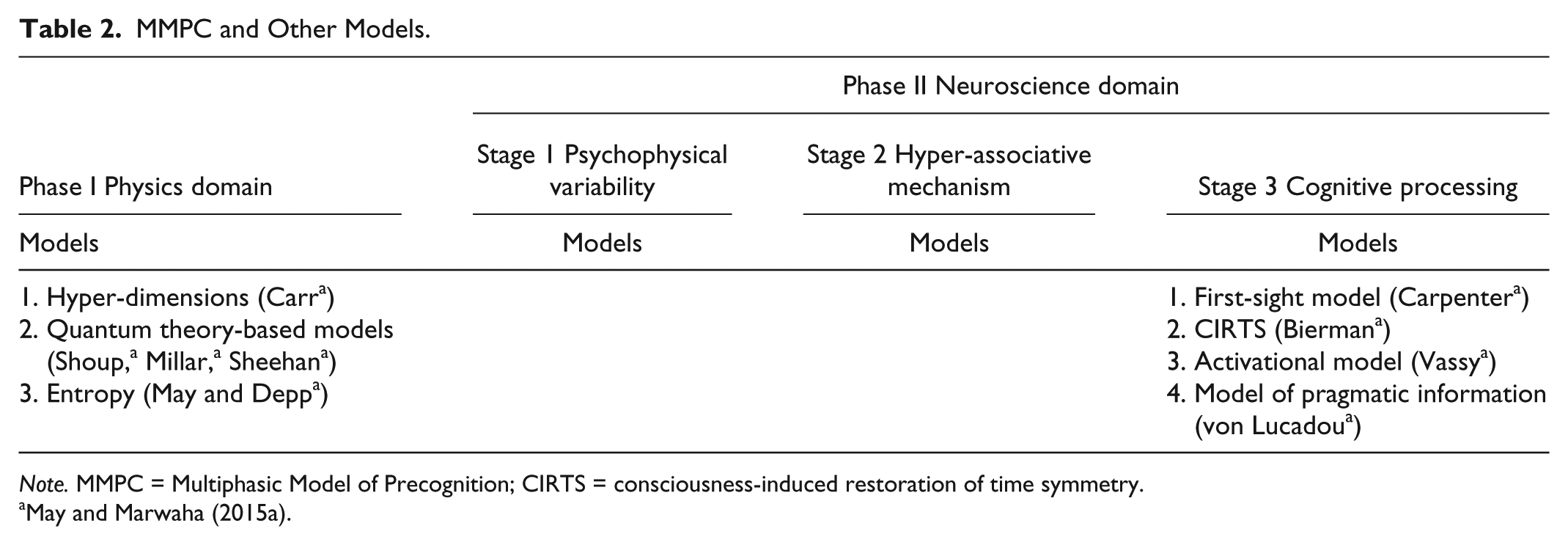
Note. MMPC = Multiphasic Model of Precognition; CIRTS = consciousness-induced restoration of time symmetry.
Challenges Posed by the MMPC
The merit of this model rests in viewing the seemingly unified process of PC into the two distinct domains of physics and neuroscience. We can identify some challenges that each domain poses.
The primary challenges are seen in the PD. Physicists are considering the possibility that the thermodynamic-derived single direction of time’s arrow might be reversed on local or global scales (Sheehan, 2006). Various hypotheses, such as the entropy model and quantum RC, are being investigated (Plaga, 1997; Sheehan, 2006, 2011). The biggest challenge, however, is determining the nature of an RCsignal carrier that propagates backward in time.
Intrinsically dependent on the carrier is the nature of RCsignal transducer that can convert the energy from the carrier into a form that can be processed by the CNS. The nature of the transducer can provide clues to its location, just as the auditory receptors serve as a signal transducer for audio signals that can be subsequently processed by the central auditory system. Identifying the transducer in PC ability may aid in exploring the physics domain for appropriate carriers and vice versa. Recent research has further identified the integration of touch and sound signals at the secondary stage of the auditory cortex (Foxe et al., 2002; Fu et al., 2003; Kayser, Petkov, Augath, & Logothetis, 2005; Macaluso, 2006). This opens the door for considering a variety of possible signals that can be processed and perceived by the human brain. Experimental evidence for EM or acoustic signals as possible carriers for PC has been ruled out (Puthoff, Targ, & May, 1979; Targ, May, et al., 1976). However, the MMPC allows us to consider these channels with regard to their sensory CNS structures that may be optimized for RCsignal detection.
The challenges in the ND are, comparatively, not as onerous as in the PD. Having bifurcated the problem space, ND experimenters need not concern themselves with the challenges posed in the PD. As outlined, the primary problem for the ND is determining the nature of an RCsignal transducer and its cortical connectivity. This, in itself, will lead to a breakthrough in our understanding of the PD as well as the ND.
The basic process outlined in the MMPC opens the door for exploratory research, particularly for Stages 1 and 2 of the ND, which require expertise from a host of specialties. It is our sincere hope that experts from relevant disciplines take up the challenges posed, and take PC research forward. We strongly believe that there is no need for any further evidential studies for PC—a task that has been fulfilled amply and successfully by ESP researchers over more than 150 years.
Predictions Based on the MMPC
The task for the next phase in PC research is well laid out in the structure of the MMPC. The two domains and three stages provide guidelines for further research.
An experiment is currently underway to test the entropy hypothesis put forth in the PD. Because of the supremacy of entropy, the MMPC predicts that this experiment will show better PC when target stimuli are demarked with higher entropic gradients than those that do not (May et al., in preparation). The PD section of the MMPC would predict a successful outcome of this experiment; namely, that a burst of thermodynamic entropy at a future remote site acts like a flashlight in a dark room allowing the participant to have a better understanding of what is at the target stimulus.
In our view, the stages outlined in the ND are stable components of the model. Although we have proposed hypotheses for each stage, there is substantial room for introducing new and fine-tuned hypotheses within each stage.
Stage 1: Hypothesis of psychophysical variability in a signal transducer. This stage is primarily an exploratory one. The crucial test for this hypothesis is that individuals with known and tested PC ability should be examined for possible variations in structure and range in existing sensory transducers. We predict that (1) these individuals will have structural variations in a sensory transducer, for example, as seen in tetra- and pentachromats, and (2) they will be the outliers in the range of sensory input processed. In essence, the focus is on individual data and not on averaged normative data.
Determining the variations observed in PC-abled individuals permits the screening of the general population for similar variations and testing them to see the degree to which they possess PC ability.
Stage 2: Hypothesis of cortical hyper-associative mechanism. Although this stage too is an exploratory one, it has scope for greater predictability. The key issue for this stage, as in the previous one, is mapping the cortical structure of individuals with known PC ability—a relatively straightforward task. Furthermore, we have hypothesized that the nature of the RC signal and Stage-1 considerations may require cross-modal connectivity to process the signal. For this, we have proposed a hyper-associative mechanism as seen in synesthetes. This gives rise to two predictions: (a) PC-abled persons will have some form of synesthesia—the nature and type being a secondary line of investigation—as observed in appropriate diagnostic technologies, and as determined by standard synesthesia inventories, and (b) known synesthetes will have PC ability as measured by standard precognition tests (seeMay, Marwaha, & Chaganti, 2011/2014, for protocol details).
As stated, Stage 3, cognition, is not instrumental to the process of acquiring RC information, although it does influence when, how, and in what form the information is manifested. As this stage is amenable to a wide variety of considerations—from neuropsychological to personality—we discuss just a few predictions:
The MMPC predicts that distinct CNS correlates in functional technologies such as EEGs and fMRIs will not be observed during the process of PC tasking because (a) currently, we do not know what kind of signal to look for, and hence what the concomitant EEG would look like. (b) Due to the very nature of PC, in principle, we cannot determine when/where the RC signal was acquired. For example, as mentioned, the RC signal might be acquired by the participant before he arrives at the laboratory. (c) Once the signal has been acquired, it may be processed in the same way as normal cognitions, thus making it difficult to determine whether a visual image is arising out of an RC signal, or it is information acquired through other sensory channels, or stored RC information that is being expressed in a visual or verbal form.
Although the literature indicates that extraversion correlates with PC ability, the MMPC predicts that there may be no fundamental personality correlates for PC ability. Fundamentally, the existence of the hypothesized PC transducers and the synesthetic ability and possible multisensorial processing are independent of personality type. However, the possibility of a similar biology may contribute to a similar psychology; however, considering personality is also shaped by experience, there may be too many confounding factors to permit a “precognitive-personality type.”
This model predicts that training for acquiring a PC ability would be ineffective, although training to use the ability effectively, as in response style, identifying and ignoring cognitive overlays, and so on may be possible; this is similar to learning how to use an instrument when one has the inherent musical ability. The MMPC model considers the internal processes more analogous to acuity in the visual system; that is, certain aspects of visual perception can be trained, but acuity cannot be improved by training.
The MMPC predicts that individuals with PC ability may exhibit a high score on vividness of visual imagery (Marks, 1973), reflecting their ability to translate a pure RC signal into comprehensible cognitive content. However, this may not be instrumental for the process of PC, as much as a consequence of the underlying structures.
Finally, because there is an obvious variation among individuals in converting implicit information into cognitive awareness, the MMPC would predict that individuals who are inherently better at the process would also be better at PC. Because there are independent measures of implicit learning, it renders this as a testable element of an aspect of the MMPC model.
The ND premise opens the door for genetic evaluation of the PC-abled persons. The search is for the genetic basis of the underlying variations, rather than a gene for PC per se.
In conclusion, according to the MMPC, PC is an atypical perceptual ability that allows the acquisition of non-inferential information arising from a future point in spacetime. The person-centric experience of PC is a manifestation of the fundamental problem of information-centric RC signals.
Examining the ND may yield information on the probable bandwidth on which RC signals may be carried and the sensory modalities that are involved. This may provide data for the PD to explore to determine the nature of a possible RC signal carrier. This opens the door to understanding the fundamental questions that the experience of PC has raised—the nature of time, causality, and information. Indeed, this is an enormous task, for which the MMPC provides the framework for a research program.
Footnotes
Acknowledgements
The authors sincerely thank Dick Bierman, Susan Blackmore, Damien Broderick, Richard Broughton, Sean Day, Joseph Depp, Arthur Hastings, Nevin Lantz, Joseph McMoneagle, Samuel Moulton, Adrian Ryan, Richard Shoup, and the reviewers for their valuable comments and critiques on earlier versions of the article, enabling us to clarify our concepts.
Declaration of Conflicting Interests
The author(s) declared no potential conflicts of interest with respect to the research, authorship, and/or publication of this article.
