




Abstract
This study aims to identify which factors predict psychological distress among international college students attending American universities. International students experience unique stressors, as well as bring with them their own enculturation: culture of origin identity, language, and competence when acculturating. To get a comprehensive picture, we collected survey data on demographics, acculturation, stress, anxiety, depression, and symptomatology from N = 146 college students (n = 51 international students; n = 95 U.S. citizens) from three universities in the southeastern United States. For international students, increased acculturation to the U.S. (English proficiency and culture competence) is related to decreased symptomatology and anxiety. Additionally, international students’ competencies in culture of origin are significantly associated with competencies in U.S. acculturation. Regression analyses indicated that among international students, higher U.S. acculturation and lower stress, significantly predicted less anxiety; lower stress significantly predicted less symptomatology. Implications for higher education and future research are discussed.
Plain language summary
We wanted to identify which among these factors: stress, socio-economic levels, and acculturation are most important in decreasing the psychological distress of international college students attending American universities. We surveyed two groups of college students from three universities in the southeastern United States: those who were born in the U.S. and those who were born internationally and came to the U.S. to study. Both groups of students were asked to respond to questionnaires about their demographic data, their levels of stress, anxiety, depression, and the symptoms they are experiencing. Additionally, their acculturation to both their country of origin and the U.S., including their identity, and cultural and language competencies were surveyed. Among international students, those who have lower levels of stress and who have higher acculturation towards the U.S. (who identity with the U.S., and speak English) are most likely to have less anxiety. Moreover, the international students who are competent in their own culture of origin and culture of origin language are also competent in the U.S. culture and also in the U.S. language. These results inform higher education institutions on services for international students especially those pertaining to lowering levels of stress. Additionally, efforts of universities to support international students in using their own language and identifying with their culture of origin are as important as identifying with the U.S. and speaking English. This research gathered survey data at only one point of time, and only to a limited number of international students.
Keywords
In 2018, the Institute of International Education found that international students alone contributed $44.7 billion to the U.S economy. While making this contribution is easy for some, many struggle to meet their basic needs while attending American universities. A 2018 study from the University of Florida, found that international students had a higher prevalence of food insecurity when compared with domestic students (El Zein et al., 2018). Similarly, a 2018 study of basic needs insecurity across the University of California system found that 15.7% of international students were homeless compared to all students (10.9%) which was largely attributed to higher tuition costs and institutional housing policies during holidays and breaks (Crutchfield & Maguire, 2018). To attend American universities, many international students depend on family support which can be unstable and impacted by divorce, retirement, natural disaster, and currency devaluations. Limited working options also contribute to financial strain as international students are bound to F-1 approved employment options restricted to university employers. Scholarships can help but are limited to the minority of international students (West, 2019). The financial roadblocks of international students are one factor that contributes to international student stress, while language barriers and adjustment to a new culture are another.
Model of Acculturation
Berry et al. (2002) define culture as the “shared way of life of a group of people” and enculturation as the process that connects people to their main cultural context, that which is primary and with which they grew up with, and which in this paper we would refer to as culture of origin. On the other hand, acculturation is the process that people go through when their cultural context changes (Berry et al., 2002), which in this paper we would refer to as the host culture. Acculturation includes integration, which is balancing the engagement between the host and home cultures, which was found to increase levels of adaptation (Park et al., 2023). In the processes of enculturating and acculturating, cultural identity, cultural competence, and language competence are involved. Cultural identity is the attitudes and beliefs about oneself in connection to the cultural group they belong to, which is usually highlighted when the individual is faced with another culture (Phinney, 2000). Additionally, cultural competence is the effectiveness of communicating with people of other cultures through the use of social, cognitive, and affective skills and behaviors (Deardorff, 2009). In terms of language, there is the mother tongue which individuals are enculturated to, and then there is the language of the host culture where international students learn to acculturate to. Language competence is the proficiency of being able to impart ideas and thoughts, and where acculturation is involved, may be referred to as bilingualism or multilingualism (Berry et al., 2002). Language ability is considered one of the most influential academic concerns hindering smooth adjustment for international students (Galloway & Jenkins, 2009). Difficulties with the visiting language have been correlated with impaired academic learning, participation in different events, and cultural understanding (Wu et al., 2015). In an ethnographic study following six international students, findings revealed international students pretend to follow social conversations with peers and are perceived as unprepared for courses by professors (Terui, 2011). It has also been found that students with limited language abilities decrease their capacity to act in the face of a threat which restricts their personal security. By having this limited ability to act as a self-determining agent, international students experience a limit to their personal safety and to their freedom to defend against discrimination as well as abuse (Sawir et al., 2012).
In addition to international student stress associated with financial and language difficulties, adjusting to various cultural changes also presents a challenge. Acculturative stress is defined as any difficulty, problem, strain, or tension that take place in making changes to adjust to a host culture (Berry et al., 2002). Acculturation challenges can involve academic, social, and community changes from that of their culture of origin. Academically, challenges can include communication with professors, classmates and staff, while socially, many students are at risk for social isolation when engaging in different group activities (Wu et al., 2015). When international students come to a host country, they are faced with new challenges concerning daily life circumstances, such as social connectedness and food or dietary acculturation (Jin et al., 2022). Adaptation constitutes the ways of reworking oneself into the new situation, and can be psychological or sociocultural (Berry et al., 2002). International students must adapt their entire way of thinking, studying, and coping in the U.S; many of whom face culture shock (Oberg, 1960) in the process. Because of the necessary adaptation to the host culture and the shock in this process, it is very likely that international students will have greater psychological distress than domestic students.
With the financial, language, and sociocultural acculturation stressors, many international students are at a higher risk of developing distressful psychological responses including anxiety, depression, and higher general symptomatology that go beyond management (Aroian & Norris, 2002). There is a lack of research on what specific stressors are associated with distress. This current study primarily aims to investigate which among these stressors- finances, acculturation, and stress- significantly predict psychological distress, namely anxiety, depression, and general symptomatology among international students. Moreover, we also seek to identify which factors of acculturation are associated with better adjustment and mental health.
Psychological Distress Responses to International Student Acculturative Stressors
A large-scale survey at the national level, involving 129 universities with a diverse sample of 68,085 college students, found that at some point in their lives, 26.9% had diagnosed depression, 34.6% had diagnosed anxiety, 23% had both anxiety and depression (American College Health Association—National College Health Assessment II [ACHA], 2022). Among university students in general, research has found that their psychological distress is significantly higher than the population in general (e.g., Stallman, 2010). Specifically, Stallman reported that the prevalence rate for mental health issues was 19.2% while the prevalence rate for symptoms that are subsyndromal was 67.4% (Stallman, 2010). One predictor of psychological distress found among university students is financial stress (Stallman, 2010).
Psychological distress is well documented among international students (Zhang & Goodson, 2011). Psychological distress is defined as symptoms that are mental and physical, and are usually related to anxiety and depression and mood fluctuations (APA, 2013). Adjustment is adapting to a new situation, while the Diagnostic Statistical Manual defines an Adjustment Disorder as the existence of symptoms that are emotional or behavioral in response to a particular stressor or stressors (APA, 2012). In a systematic review of 64 studies (in 29 journals in a period of close to two decades) that investigated the adjustment of international students in the United States, Zhang and Goodson (2011) identified predictors of psychosocial adjustment as acculturation, stress, and English language proficiency, among others. Psychological distress was found to be directly associated with coping when acculturative stress is high and identification with their heritage culture is low (Wei et al., 2012). Additionally, these researchers found that such relationship to psychological distress and coping does not exist when international students’ identification with their heritage culture is high, regardless of whether acculturative stress is high or low (Wei et al., 2012).
Feelings of anxiety related to acculturation factors are prevalent among international students. Higher rates of anxiety were found more prevalent amongst international students who reported lower levels of social support and lower levels of English proficiency (Sümer et al., 2008). Additionally, international students report anxiety related to the unknown and new experiences in the college or university setting, academic pressures, financial concerns, concerns related to relationships, and feelings of isolation (Bradley, 2000). Increased anxiety is also connected with social difficulties and being apart from family (Fritz et al., 2011).
Depression also has a negative impact on international students’ well-being. Among those students who sought out counseling during their stay in the U.S., Nilsson et al. (2004) found that the most common complaint amongst international students was feeling depressed. In a study by Sümer et al. (2008), Latino/a students had significantly higher levels of depression than did Asian students. With most international students coming from Asian countries (Institute of International Education [IIE], 2019), it is important to note that emotional suppression is a favored coping style of Asian international students when faced with acculturative stressors, which may explain lower reported scores (Wei et al., 2008).
Similarly, lower English fluency, increased acculturative stress and perceived discrimination, correlated with higher levels of depressive symptoms among international students, while social support mitigated depressive symptoms (Shadowen et al., 2019). The stress of acculturation and lower English language fluency can increase anxiety and depression symptoms that negatively impact international student well-being, while increased language skills mediate these symptoms. Due to levels of anxiety and depression being impacted by acculturation to the host country as seen in extant literature (e.g., Fritz et al., 2011; Shadowen et al., 2019; Sümer et al., 2008), we extrapolate that the influence of financial concerns and stress are overshadowed.
International Students’ Acculturation
Acculturation has been defined in terms of state or process changes that occur for individuals entering a new culture (Berry, 1992). A review of studies using Berry’s acculturation model among migrants found that marginalization connected with depressive and anxious symptoms, while integration related to less depressive and anxious symptoms (Choy et al., 2021). In the same vein, if the changes upon entering the host culture are not dissimilar from that of their culture of origin, where they were enculturated, then the acculturation process would produce less stress.
Students from European countries, compared to international students from non-European countries, experienced less acculturative stress when studying in the U.S. (Yeh & Inose, 2003). Similarly, Severiens and Wolff (2008) found that feeling at home and being well-connected among peers and professors predict successful graduation. As a western country and former European colony, many of the traditions and cultural behaviors of the U.S. overlap with European countries which is further emphasized by the struggle many Asian students face while abroad (Akhtar et al., 2015; Poyrazli et al., 2011). The familiar academic environments, social manners, and cultural behaviors of host countries may lessen temporary acculturative stress; however, separation with co-nationals in lieu of integration still increases acculturative stress.
Neri and Ville (2008) found that international students mainly form friendships with individuals from their country of origin, or co-nationals, while abroad. However, Hendrickson et al. (2011) found that international students with a higher friend ratio of individuals from the host country, claimed to be more satisfied, content, socially connected, and less homesick. This may be due in part to language difficulties in the host country. Despite international students seeking comfort from their co-nationals, these findings suggest that creating a balance between country-of-origin familiarity and social integration with the host country, in addition to host language abilities, are key to successful acculturation among international students.
A study measuring the success of international students in Germany, found that being younger, having a high level of self-reported host language proficiency, and prior inter-cultural travelling experiences significantly predicted a low level of acculturative stress (Akhtar et al., 2015). Other studies indicated that English proficiency and social support uniquely contribute to the variance in students’ acculturative stress (Poyrazli et al., 2011; Yeh & Inose, 2003). The integration available with advanced English language proficiency may support the Integration Approach to acculturation which Sullivan and Kashubeck-West (2015) found to decrease acculturative stress among international students by allowing for increased social networks and academic achievement.
Current Study
International students who are more familiar with Western society, and who strive to acculturate into the American setting, and have advanced English language abilities may experience less psychological distress than those missing these qualities. Acknowledging the international students’ stressors and the impact acculturation may have, we hypothesize the following: (1) International students will have higher enculturation with their culture of origin than U.S. acculturation, (2) Compared to domestic students (U.S. American), international students will have greater psychological distress, (3) For international students, high acculturation to the U.S. is associated with less psychological distress, (4) For international students, high enculturation to their culture of origin is associated with low acculturation to the U.S., and (5) Psychological distress will be more significantly predicted by acculturation than by stress and financial difficulties.
Method
Participants
Participants in the study were between the ages of 18 and 54, including 51 international students and 95 U.S. citizens; N total = 146. The international students had moved to the U.S. within the past 9 months. The use of a nine-month timeframe provided a sample with recent relocation experience and conformed to the shortest period in which adjustment may be experienced. International students’ ages were between 18 and 29, with the majority falling between the ages 18 and 25 (82.4%). Of the 95 U.S. citizens, 83 were U.S. born Americans and 12 were naturalized citizens. The majority of the U.S. students were between the ages of 18 and 24 (79.6%). More detailed demographic information for each group can be found in Table 1.
Demographic Data.
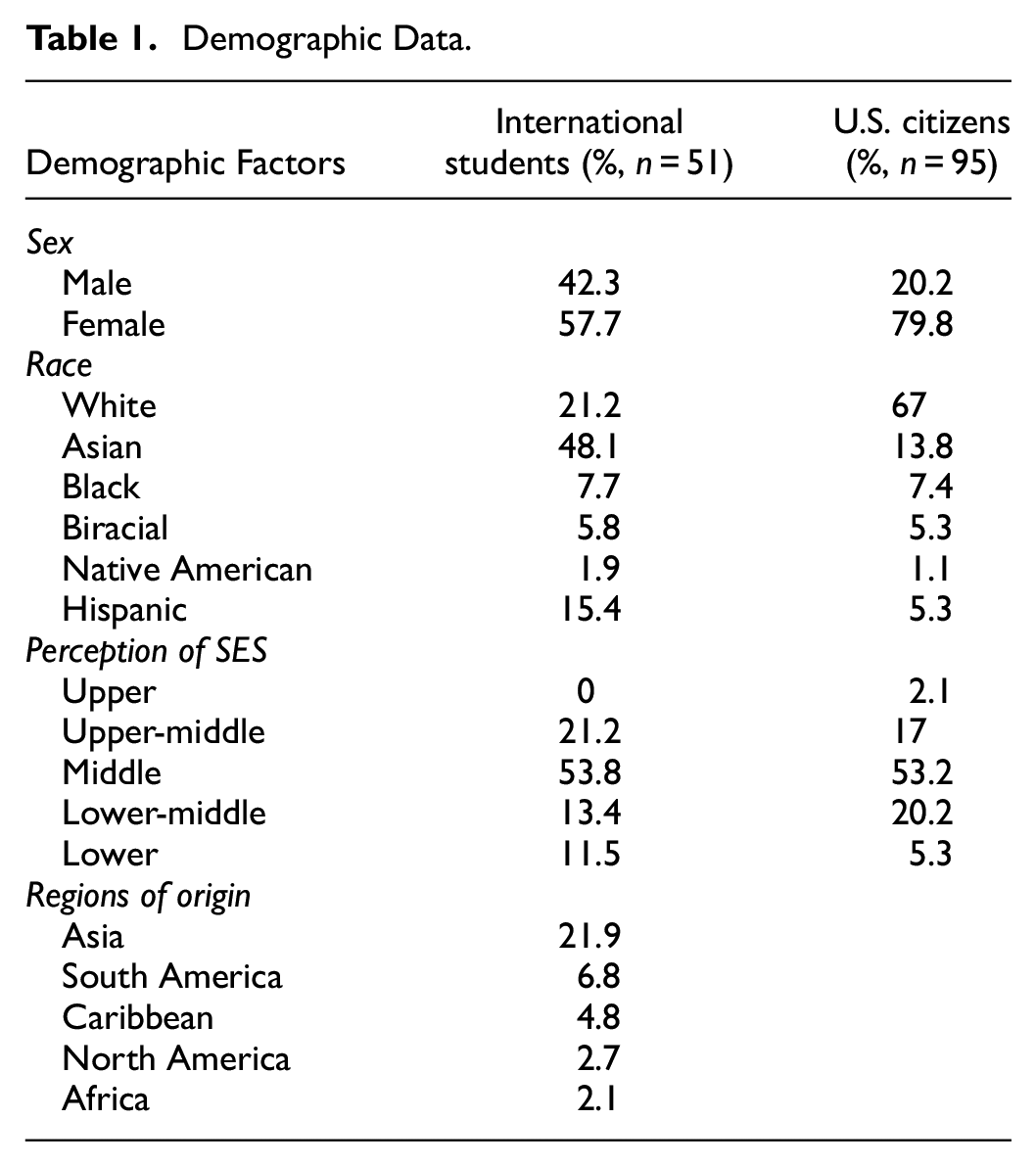
As an entire group, the mean age of respondents was 22.93 years (SD = 5.69). There were 41 males (28.1%) and 105 females (71.9%). The majority of the sample identified as Caucasian (n = 74, 50.7%), the second largest group identified as Asian (n = 38, 26%), then Hispanic (n = 13, 8.9%), Black (n = 11, 7.5%), Biracial (n = 8, 5.5%), and Native American (n = 2, 1.4%). Most participants were single (n = 129, 88.4%). The sample consisted of students from the United States, Asia, North America, South America, the Caribbean, and Africa. The sample was obtained from three college campuses in a southeastern state. Participants were recruited from places on campus where students congregated and were willing to give their time such as the dining area, residential halls, the library, etc. The students’ majors were varied, and for purposes of ease and accessibility, the surveys were conducted by paper and pencil. The study’s eligibility criteria for international students, “to have come to the U.S. within nine months,” so as to study their adjustment, led to a low number of international students who could participate.
Instruments
Demographic Questionnaire
The demographic questionnaire elicited information about participants’ gender, age, race, marital status, city of origin, length of time in the U.S., and subjective indicators of socio-economic status.
Symptom Checklist-90-R
The SCL-90-R is a self-report questionnaire that we used to obtain information from participants on their psychological distress. It is a 90-item, multidimensional, self-administered questionnaire that asks respondents to rate each psychological, behavioral, and somatic complaint during the previous month (Derogatis et al., 1976). For the current study, the 13-item depression subscale, the 10-item anxiety subscale, and the Global Severity Index (GSI), a summary of the test reflecting overall psychological distress, were reported and compared between groups. The SCL-90-R has shown internal consistency coefficients for the nine dimensions from a pool of 209 volunteers with psychological symptoms that ranged from a low of .77 for psychoticism to a high of .90 for depression (Derogatis et al., 1976). The anxiety subscale’s internal consistency was reported as .85 (Derogatis et al., 1976). Test-retest reliability over a 10-week interval was also reported in the same sample, with the anxiety subscale coefficient reported at .80 and depression at .75; the GSI was reported as .84 (Horowitz et al., 1988). In the current sample, Cronbach’s alpha analysis revealed very high to high internal consistency: the GSI had a Cronbach’s alpha of .98, the depression subscale of the SCL-90-R had a Cronbach’s alpha of .90, and the anxiety subscale of the SCL-90-R had a Cronbach’s alpha of .89.
Acculturation
The scale we used to measure acculturation was the Abbreviated Multidimensional Acculturation Scale (Zea et al., 2003), or the AMAS-ZABB. The measure, a 42-item scale with response options in the form of a four-point Likert-scale, includes three dimensions that may be a function of enculturation to their culture of origin and acculturation to the U.S. American culture, which include: cultural identity, cultural competence, and language competence. The instrument was intended to be adaptable for use with international and resident samples. In the current study, the AMAS-ZABB was given to both international and resident samples, using all of the three dimensions of enculturation (to the culture of origin) and acculturation (to the host culture). The AMAS-ZABB displayed an internal consistency reliability of .89; the culture of origin’s Cronbach’s alpha was .95, and the U.S. scale’s Cronbach’s alpha was .96.
Adjustment Disorder Questionnaire
The adjustment questionnaire was developed starting with a conceptual framework that operationalized symptomatology associated with AD according to the DSM-IV-TR criteria. Items on the questionnaire were taken directly from the Structured Clinical Interview for DSM-IV (SCID; First et al., 1997) and the Mini-International Neuropsychiatric Interview (M.I.N.I.; Sheehan et al., 1998). The SCID has been used in previous studies to establish AD diagnosis (Bar et al., 2006). AD was assessed by 11 items covering each criterion outlined in the DSM-IV-TR. The items were about subjective distress as a result of a stressor, the mood and behavioral concerns, initial manifestation of symptoms and the duration of disturbance. The highest score on the AD questionnaire was 20. Any score from 11 to 20 was assigned a diagnosis of AD. The newly created Adjustment Scale, which was adapted from the SCID (First et al., 1997) and the M.I.N.I. (Sheehan et al., 1998), had a Cronbach’s alpha of .45 in the current sample. Because of such low Cronbach’s alpha, this Adjustment Disorder questionnaire was eliminated in further analyses.
Stressful Life Events
For an indication of participants’ stress, we used the Social Readjustment Rating Scale (SRRS; Hobson et al., 1998), a measure of stressful events that has been linked to making people vulnerable to illness (Holmes & Rahe, 1967). Point values have been assigned to events and a stress score is obtained by totaling the point values associated with the events the participant has experienced over the past year. In the current sample, the SRRS also showed good internal consistency, with a Cronbach’s alpha of .79.
Design and Procedure
The current quantitative descriptive study used a correlational research design (Heppner et al., 2016). Data analyses included using SPSS for multiple regression, correlations, and t-test comparisons of collected survey data.
Participants were recruited face to face in three universities in southeastern United States. Because it was very difficult to find large numbers of international college students, participants were recruited from several colleges during class time, at international student dinners, international student dorms, and at an international student association meeting. Participation in the study was voluntary and confidential, and a written informed consent was obtained. The study was approved by the University of North Florida’s Institutional Review Board, with approval number 08-120. To respond to the questionnaires, in a paper and pencil format, U.S. American student participants took from half an hour to an hour, while international students took longer, from one hour to two hours.
Results
A correlation matrix is presented in Table 2, for the entire sample of both international and U.S. students. Correlations between demographic measures (i.e., citizenship and socio-economic status), measures of psychological distress (i.e., depression, anxiety, Global Severity Index, and stress), and measures of acculturation (i.e., U.S. acculturation, identity, English, and competence, as well as culture of origin acculturation, identity, language, and competence) were generated, and are highlighted below.
Correlation Matrix Between Variables.
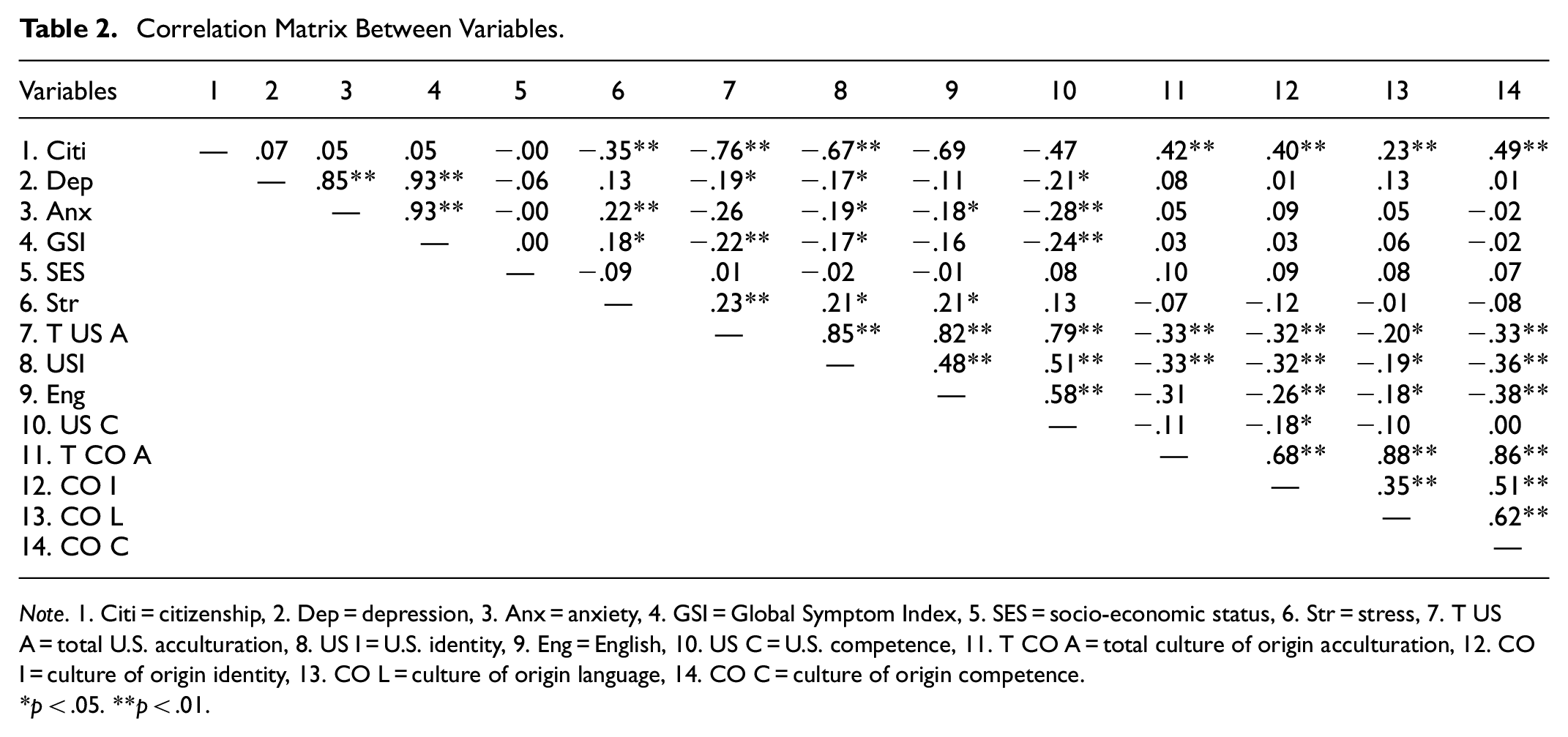
Note. 1. Citi = citizenship, 2. Dep = depression, 3. Anx = anxiety, 4. GSI = Global Symptom Index, 5. SES = socio-economic status, 6. Str = stress, 7. T US A = total U.S. acculturation, 8. US I = U.S. identity, 9. Eng = English, 10. US C = U.S. competence, 11. T CO A = total culture of origin acculturation, 12. CO I = culture of origin identity, 13. CO L = culture of origin language, 14. CO C = culture of origin competence.
p < .05. **p < .01.
Validation of Acculturation Measures in International and U.S. Students
Measures of acculturation show the differences between international students and U.S. students, which further validate the construct of acculturation in these two groups. As expected, international students scored high on the culture of origin subscales and low on the U.S. American subscales. Please refer to correlational values in Table 2. Among international students, citizenship is significantly associated with their overall culture of origin acculturation (r = .42, p < .01), as well as with their culture of origin identity (r = .40, p < .01), with their language of culture of origin (r = .23, p < .01), and with the cultural competence of their culture of origin (r = .49, p < .01).
Conversely, U.S. Americans and naturalized citizens scored high on the U.S. American subscales and low on the culture of origin subscales. As can be gleaned in the correlational values in Table 2, among American students, their citizenship is significantly associated with their overall U.S. acculturation (r = −.76, p < .01), as well as with their U.S. identity (r = −.67, p < .01), not with their English language competence (r = −.69, p > .05), and not with the U.S. American cultural competence (r = −.47, p > .05).
To test hypothesis 1: international students will have a higher culture of origin acculturation than U.S. acculturation, an independent-samples t-test was run to compare overall U.S. acculturation and culture of origin acculturation for international students and U.S. students. This comparison can be found in Table 3. Similar to findings in the correlations, and as hypothesized, international students appear to be more acculturated (M = 75, SD = 10) to their culture of origin than U.S. students [M = 59, SD = 19; t(144) = −5.72, p < .001], with a large effect size, with a Cohen’s d of 1.05; while U.S. students appear to be more acculturated to U.S. culture (M = 74, SD = 8) than international students [M = 54, SD = 8; t(144) = 14.71, p < .001], with a large effect size, with a Cohen’s d of 2.5. Cohen’s d of 0.2 is considered a small effect size, a 0.5 is considered a medium effect size, while a 0.8 is considered a large effect size (Cohen, 1988). A Cohen’s d larger than 1 denotes that the difference between the means is bigger than 1 standard deviation, and a Cohen’s d larger than 2 denotes that the difference between the means is bigger than 2 standard deviations (Cohen, 1988).
U.S. and Culture of Origin Acculturation of International Students and U.S. Born Students.

Stress Levels of International and US Students
In general, American students tended to have higher stress than international students, as seen in the significant correlation between citizenship and stress (r = −.35, p < .01). To test hypothesis 2: compared to domestic students (U.S. American), international students will have greater psychological distress, an independent-samples t-test was conducted to compare total stress level scores for international students and U.S. students. Contrary to what we hypothesized, U.S. students experienced greater stress (M = 250, SD = 227) than international students [M = 119, SD = 106; t(143) = 3.90, p < .001]. The effect size was medium to large, with a Cohen’s d of 0.74. It should be noted that kurtosis for the total stress score was at 10.38, however a cross-tabulation reported that this finding was not in error, with 14% of U.S. students scoring a stress score of 471 or higher, and 33% of international students scoring a stress score of 35 or below.
International Students’ U.S. Acculturation and Competencies
U.S. Acculturation and Psychological Distress
To test hypothesis 3: high acculturation to the U.S. will be associated with less psychological distress among international students, further correlational analyses were conducted, as reported in Table 4. As hypothesized, a negative correlation was found between U.S. acculturation and GSI (r = −.33, p < .05). An international student’s greater acculturation to the U.S. is related to lower symptoms. There was also a negative correlation between U.S. acculturation and anxiety (r = −.42, p < .01). An international student’s greater acculturation to the U.S. is related to lower anxiety. Thus, the less an international student was acculturated the more likely they would develop symptoms of psychological distress.
International Student Correlation Matrix.
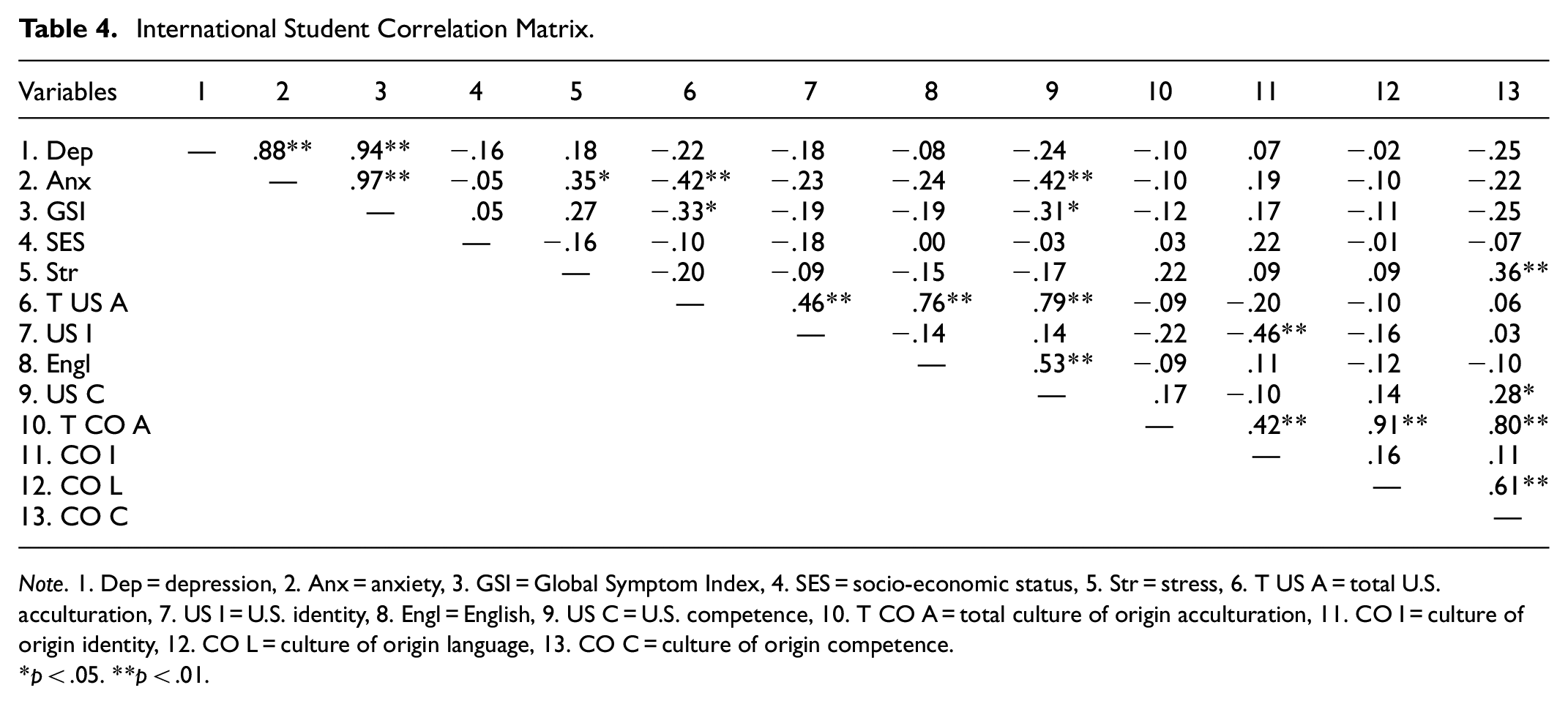
Note. 1. Dep = depression, 2. Anx = anxiety, 3. GSI = Global Symptom Index, 4. SES = socio-economic status, 5. Str = stress, 6. T US A = total U.S. acculturation, 7. US I = U.S. identity, 8. Engl = English, 9. US C = U.S. competence, 10. T CO A = total culture of origin acculturation, 11. CO I = culture of origin identity, 12. CO L = culture of origin language, 13. CO C = culture of origin competence.
p < .05. **p < .01.
Language and Cultural Competencies
To test hypothesis 4: high acculturation to their culture of origin is associated with low acculturation to the U.S. among international students, further correlations with culture of origin language and English language, as well as culture of origin competence and U.S. culture competence were made.
Contrary to our hypothesis, culture of origin competence was very much related to U.S. competence, (r = .28, p < .05), pointing to a level of competence across cultures. Additionally, international students’ competency in English was related to U.S. competence, (r = .53, p < .01), and their competence in their culture of origin language was also related to the culture of origin competence, (r = .61, p < .01), supporting the tenet that competence in a culture is very much related to competence in the language used.
International Students’ Psychological Distress
Regression Analyses
To test hypothesis 5: psychological distress will be more significantly predicted by acculturation than stress and financial difficulties, regression analyses were conducted. Linear multiple regression was carried out to determine the effects of Socio Economic Status (SES), acculturation, and stress on measures of psychological distress, namely, GSI, depression, and anxiety.
Showing our hypothesis partially correct, when psychological distress was measured by anxiety, the regression model was significant (F (4, 42) = 3.78, p < .01); with stress (ß = .34) and U.S. acculturation (ß = −.31) significantly predicting psychological distress, and SES not. When psychological distress was measured by the GSI, the ANOVA table indicates that the model as a whole is significant (F (4, 42) = 2.55, p < .05), and stress (ß = .31) was a significant predictor, with U.S. acculturation and SES not significant predictors. However, when psychological distress was measured by depression, the ANOVA revealed the model was not significant (F (4, 39) = 0.95, p > .05).
Discussion
This research study examined the relationship between international student status, psychological distress, and cultural acculturation in a group of college students in the southeastern U.S. The study’s results lend support to the validation of the acculturation measure, which meaningfully differentiates between the two groups of students, those that are international and those that are not. The U.S. student status is highly associated with U.S. acculturation, including identity, language, and cultural competence, while the international student status is highly associated with culture of origin acculturation, including identity, language, and cultural competence. As expected, U.S. students were more acculturated to the U.S. culture, while international students were more acculturated to their culture of origin.
Contrary to previous research (Poyrazli & Lopez, 2007) that found that international students reported more experiences of discrimination and homesickness when compared to U.S. students, this study indicates that American students reported significantly more stress than international students. The stress of U.S. students in terms of college adjustment, stress, and coping, have been well studied (e.g., Dyson & Renk, 2006). Although developmentally and socio-economically they may be alike, it is probable that the stress of U.S. American students in our sample may be higher than international students’ stress and symptomatology due to their own adjustment stressors. Another plausible explanation for the lower levels of stress of international students compared to domestic students is the notion of sojourners that may lessen the acculturation response to new environments. Previous travel experience by international students before moving to the U.S., for example, led to lower rates of acculturation stress compared to those with no travel experience (Smiljanic, 2017). For many young Americans, moving to college is their first experience being in a new environment (Pedrelli et al., 2015). Compared to American students, international students may have more experience navigating new cultures which lessens their acculturation stress when studying abroad (Akhtar et al., 2015).
Additionally, it is also important to mention here that the international student participants have only been in the U.S. for at least 9 months. The use of a nine-month timeframe provided a sample with recent relocation experience and conformed to the shortest period in which adjustment may be experienced. It is possible that Oberg’s (1960) initial stage which commences with enthusiasm and fascination with a new cultural environment, held true. Oberg found that sojourners typically move through stages of adjusting to a new culture. It is possible that the international students who would have been in the U.S. for at least 9 months, were still going through the initial stage of Oberg’s model. For many international students, studying abroad is a life-long aspiration, leading many students to feel elated when they first arrive or even ready and prepared to tackle the adjustment of fulfilling their dream. This immediate, blissful feeling is defined as the Honeymoon Stage in the Cycle of the Cultural Adjustment (Oberg, 1960). International students may have reported less stress (because they are more prepared and more intentional in moving) from the Honeymoon Stage, which may have extended beyond our nine-month period of adjustment criteria used to define our variables, therefore protecting against stress.
The most important finding of the study is that international students’ psychological distress, particularly their anxiety, is significantly predicted by stressors and U.S. acculturation, not socio-economic status. Specifically, high levels of stress and low U.S. acculturation led to more psychological distress, specifically higher anxiety among international students. The finding that lower U.S. acculturation was associated with higher symptomatology is in line with previous research. For example, Ward and Rana-Deuba (2000) found that mood disturbance is higher among foreigners who lack social contact with host and co-nationals. Studies show that students who found social support, which included host nationals and co-nationals, mitigated the effects of acculturative stress on international students (Sullivan & Kashubeck-West, 2015). Increasing social support among international students is one way to mediate the stress felt during this time; however, future research is needed to investigate these kinds of solutions to acculturation problems. Studies using a bidirectional model show marginalized individuals as exhibiting more negative psychological effects and integrated individuals exhibiting more positive psychological outcomes (Cuellar & Paniagua, 2000; Sands & Berry, 1993). This suggests that instead of asking whether international students have higher rates of psychological distress, it might be better to ask under what circumstances do they have higher rates and under what circumstances do they thrive, which may then help us identify factors by which marginalized, or supposedly stressed, individuals grow into their optimal selves (Frazier et al., 2006).
The second most important finding is that international students who are characterized with less psychological distress have low levels of stress, are highly acculturated to the U.S., are highly competent in English, and are highly knowledgeable about the U.S. culture, while at the same time being highly acculturated to their culture of origin, highly competent in their home language, and highly knowledgeable about their culture of origin.
Interestingly, these results show support for a bidirectional model of acculturation. The AMAS-ZABB is based on a bidirectional model, which recognizes that increasing adaptation does not necessarily lead to the loss of culture of origin (Zea et al., 2003). Specifically for international students, a strength that is identified here is that their competence in the U.S. culture is highly associated with their culture of origin competence. This is in line with what is found in research that maintaining one’s own culture is highly positively associated with adopting another culture (Kunst et al., 2023). Similarly, Cemalcilar and Falbo (2008) found that international students had increased identification with U.S. culture and constant identification with their culture of origin. The current study demonstrated that this competence is also translated in language, such that international students’ culture of origin language is highly associated with culture of origin competence, while their fluency in English is also highly associated with the U.S. competence. International students’ competence across cultures and competence across languages point towards strengths and factors of resilience and coping, which characterizes international students decreased psychological distress. From this study’s results it seems that not only their acculturation to U.S. culture and their competence in English, but also their competence in their own culture and their competence in their own language are what make international students thrive, thus giving us insight into aspects of optimal functioning.
International students with reduced stress, increased familiarity with the U.S. culture, and increased English competency were predicted to have less psychological distress, when they are also characterized with high acculturation to their own culture of origin and culture of origin language. This highlights that for international students to be successful abroad, learning a new culture does not necessarily mean losing the old one. John Berry’s Model of Acculturation (Berry, 2005) finds that rather than assimilate (replacing culture of origin norms with that of the host country), students must integrate (adopting new norms from the host country without losing culture of origin) to experience acculturation success. Universities then need to help international students maintain a sense of self while integrating new cultural norms while on campus. This may relate to the new dynamic approach towards acculturation which accounts for the recent changes in demographics and technology (van der Zee & van Oudenhoven, 2022).
Limitations and Recommendations for Further Research
The current study has a few limitations. One limitation involves whether the measures used fully captured international students’ distress and symptomology. This appears to be the case when findings from this study are compared to previous research on international student psychological adjustment, such as Ward et al.’s (1998) findings on depression and social difficulty. Therefore, the field will benefit from future research such as qualitative studies that may provide valuable insight into the essence of the cultural transition, which may not be clearly captured through quantitative measurement. Qualitative studies on adjustment have offered insight into psychological symptomatology that are culture specific (Barrett, 1997) and stressors specific to an international population (Yeung & Chang, 2002). In addition, we had eligibility criteria of no more than a nine-month window for the international students to have been in the U.S., and thereby this poses a limitation to the experience of stress in our study. As this is a cross-sectional study, and constructs were assessed only one time, further longitudinal studies are needed to draw conclusions regarding the level of distress in this population, which should attempt to capture a more complete picture of the transition experience.
The field may also benefit from a change in perspective in terms of positive health psychology, in which future studies can continue to pursue investigating which factors lead to positive functioning (Frazier et al., 2006). An unexpected finding is that American students, compared to international students, have greater stressors. Although investigating stressors in American students is beyond the purpose of this study, further research could focus on this group comparison and investigate the nature of each group’s stressors, levels of psychological distress, and protective factors. The field will also benefit from specific international population and identify findings depending on their country of origin. The small sample size of international students prohibited us from making further analyses depending on the region of the country of origin.
Another limitation that we note here is the use of survey data. For example, while the SCL-90-R has been translated into various languages and used in a number of countries, studies focusing on the English version within an international sample are not available. It is possible that the scale did not clearly depict concerns experienced by international students, leading international students to underreport symptoms. This may be due to double-barreled items, colloquial phrases, and the use of negatives. This difficulty in understanding the items, or even understanding the English language in general, could also explain the longer time it took international students to complete the questionnaires, 1 to 2 hr completing the questionnaires as opposed to 0.5 to 1 hr for U.S. citizens. Our study was conducted face-to-face, and it is very probable that potential participants who experience greater psychological distress did not participate in our study, thereby increasing bias in our sample.
General Conclusion
This research hopes to contribute to the international psychology field by portraying the unique events that may lead to psychological distress along with the characteristics that lead to less psychological distress. Stress and acculturation to the U.S. culture clearly predict psychological distress, particularly anxiety. For university administrators, international centers, and admission management teams, this study’s results suggest that programs caring for international students will need to include two meaningful resolves: to help decrease stress such as promoting events that help with adjustment to new-ness, housing, academic issues, etc. and to increase U.S. acculturation that integrate international students with U.S. ways of life, English language training, events that promote interaction with host nationals, etc. International students’ relocation to another country may pose less difficulties and struggles when individuals are intentionally helped with decreasing stress and are acculturated to the host culture.
In addition, competence in the U.S. culture, competence in the English language, and competence in one’s culture of origin, and competence in one’s culture of origin language also substantially contribute to decreased psychological distress for international students. Practical recommendations include not just programming with the host culture such as speaking English and integrating with U.S. students (e.g., mentoring and peer advising, buddy structure, focus group discussions, movie events, field trips, doing hobbies and mindfulness activities together), but also renewing ties with their culture of origin and opportunities to speak their culture of origin language such as promoting events that connect them with co-nationals (e.g., food/grocery markets, international celebrations and gatherings, have access to family and friends back home thru technology and wifi access). Both competencies with their culture of origin and with the U.S. culture are important. Those who have competence in language and culture in their culture of origin, may transfer such competence in English and competence in their culture, to embrace the new culture, thrive, grow, and experience personal power.
Footnotes
Acknowledgements
We would like to acknowledge the support received from the University of North Florida Graduate Student Research and the Student Government Scholarship. Our heartfelt gratitude also goes to Shannon McLeish and to Dr. Brian Fisak for their thoughtful comments on earlier versions of this article. Most of all, we extend our appreciation to the international students and American students who have earnestly shared with us the state of their psychological health and well-being.
This publication is Kirsten Calleja Salerno’s Masters’ thesis. She graduated from the University of Malta and went on to get her graduate studies at UNF (MA) and Texas A&M (PhD).
Authors’ Note
This material was presented at the 117th Annual Convention of the American Psychological Association in Toronto, Canada; at the 8th Annual Southeastern Conference on Cross Cultural Issues in Counseling and Education in Savannah, Georgia; at the National Multicultural Conference and Summit in New Orleans, Louisiana; at the Graduate Student Research Symposium at the Showcase of Osprey Advancements in Research and Scholarship (SOARS) and at the Undergraduate-Graduate Learning Inquiry and Distinctive Experimentation (U-GLIDE) in Jacksonville, Florida. No conflict of interest to disclose.
Declaration of Conflicting Interests
The author(s) declared no potential conflicts of interest with respect to the research, authorship, and/or publication of this article.
Funding
The author(s) received no financial support for the research, authorship, and/or publication of this article.

Data Availability Statement
Data of this research can be shared upon request.