




Abstract
Based on the bilingual children’s and adults’ code-switching (CS) dependency treebanks, this paper investigates the syntactic features and pragmatic functions of the Chinese-English bilingual children’s CS and compares them with bilingual adults’. It is mainly found that (1) As to the bilingual children, the mixed sentences present the longest mean sentence length (MSL), followed by those of the dominant language and the weak language. Similarly, Chinese-English adults’ mixed sentences present longer MSL than monolingual Chinese and English; (2) Subjects, objects, adverbials, and attributives are four major syntactic functions. Regarding bilingual children’s CS, objects are the most frequently switched dependency relations and subjects are the least. Differently, as to bilingual adults, attributives are most frequently switched, and subjects are the least. (3) Nouns, pronouns, determiners, adjectives, adverbs, and prepositions are the top word classes involved in four major syntactic relations; (4) The adverbial dependency relations present the longest mean dependency distance (MDD), and the attributives present the shortest for both bilingual children and adults; (5) The major causes that make different MDDs are the CS peripherality, the distributions of top word classes and adjacent dependency relations; (6) Six major pragmatic functions are performed by bilingual children and adults: filling lexical gaps, emphasis or expressing the intense feelings, explaining, giving “orders” or requirements, quotation, reiteration. The results syntactically and pragmatically suggest that there exist great similarities between bilingual children’s and adults’ code-switching.
Introduction
Code-switching (hereafter CS) is one of the important results of language contact and is also widespread in conversations among bilingual individuals. Code-switching has interested researchers in the pragmatic, syntactic and sociolinguistic perspectives or the field of language learning and teaching (e.g., Adriosh & Razı, 2019; Chau & Lee, 2021; Dorota et al., 2021; Song, 2019; Zainil & Arsyad, 2021). As to adults’ CS, the pragmatic perspective asks questions concerning the functions when bilinguals mix languages or language varieties (e.g., Benguedda, 2017; Lavender, 2017); and the syntactic perspective focuses on the structural constraints of code-switching, the elements or units that can be switched, the switched positions or the word order of the mixed sentences (e.g., Wang, 2019; Wang & Liu, 2013; Wang et al, 2016; Backus, 2003; Souag & Kherbache, 2016). Code-switching is also one of the effective language teaching strategies and reveals the pedagogical and affective functions in English as a foreign language (EFL) classrooms (e.g., Ataş & Sağın-şimşek, 2021; Cahyani et al., 2018). Moreover, code-switching not only frequently appears in bilingual adults’ discourses but also can be used by bilingual children as early as 2;0 to 2;6, and they acquire subtler sociolinguistic or pragmatic abilities only later, some as late as age 5;0 or after (Meisel, 1994). Most researchers collect bilingual adults’ code-switching data or built the corpus to analyze, relatively fewer ones concentrate on children’s code-switching, and seldom involve the code-switching of Chinese-English bilingual children. From both syntactic and pragmatic perspectives, this paper, taking two 8-year-old bilingual children as a case, investigates the syntactic and pragmatic functions of children’s Chinese-English code-switching and compares them with bilingual adults’.
Code-switching has been well-studied in bilingual adults and is widely considered a rule-governed system with syntactic and social constraints. As to the classification of code-switching, structurally speaking, CS can be divided into intra-sentential and inter-sentential CS; socially or pragmatically, an important distinction is that between situational or participant-related CS and non-situational or metaphorical CS (Auer, 1984; Gumperz, 1982; Jisa, 2000). From the syntactic perspective, in the last 40 years, the majority of researchers believe that there are some constraints on CS, but some think that CS is so highly variable that there are no grammatical constraints on it (Bokamba, 1989; Clyne, 1987), and others propose neutrally that different language data refer to different CS patterns (Bhatt, 1997; Muysken, 1995). In recent years, scholars are making effort to describe and analyze the syntactic features of code-switching economically. Word Grammar (Hudson, 1990, 2010), developed out of Dependency Grammar (Tesnière, 2015), provides us with such a framework. According to Word Grammar, “language is a part of general cognition” (Hudson, 2010, p. 108). In the dependency tradition, the main unit of the syntax is the word, and all the syntactic relations relate one word to another, and specifically in Word Grammar, a dependency relation is a relation between two interdependent words, the head and the dependent, which is generally the syntactic relation in the traditional grammar. So comparatively speaking, the dependency structures are relatively simpler for our syntactic analysis if other things are equal. In Word Grammar, the dependency distance is both a syntactic and cognitive metric, which can measure the syntactic complexity and language comprehension difficulty (Liu, 2008). By using this metric, this study analyzes and compares the syntactic functions of bilingual children and adults. From the pragmatic perspective, bilingual adults’ code-switching also performs specific functions within speech communities: emphasizing, facilitating comprehension or expression, turn-opening or closing, establishing themselves as members of a particular community group, avoiding miscommunication, or clarifying concepts, etc. (e.g., Hughes et al., 2006; Zentella, 1997).
Code-switching of bilingual children also greatly interests the researchers syntactically and pragmatically. They have involved synchronic, diachronic, and comparative research, that is, the CS structures, the pragmatic functions, the development of bilingual abilities, and the similarities or differences of code-switching between bilingual children and adults. Cantone (2007) investigates the early mixing and code-switching of bilingual children, taking both quantitative and qualitative syntactic analysis on CS between a subject/object/clitic or negator and a verb, CS between a main clause and an embedded clause, etc. The frequency and grammaticality of unbalanced bilingual children are different from those of balanced or fluent bilinguals and may vary depending on the level of proficiency of the child (Iluz-Cohen & Walters, 2012; Meisel, 1994; Vihman, 1998). Researchers take both synchronic and diachronic studies from the syntactic, sociolinguistic, and pragmatic perspectives in which bilingual children of 2-to-6 years old are the major subjects. Some strongly suggest that children’s code-switching indicates that they can possess adequate grammatical knowledge of both languages (e.g., Cantone, 2007; Deuchar & Quay, 1998). As to functions of children’s code-switching, many researches show that they are pragmatically competent to adjust their code-switching behavior appropriately according to the different social situations, their mixed utterances reflect their awareness of social norms and the bilingual children’s code-switching may perform different pragmatic functions in different ages (e.g., Chung, 2006; De Houwer, 2005; Genesee et al., 1996; Vu et al., 2010). There are also similarities and differences between bilingual children’s and adults’ code-switching (e.g., Jisa, 2000; Paradis et al., 2000).
Thus, despite many attempts to discuss bilingual children’s code-switching from the syntactic, pragmatic, and cognitive perspectives, the majority of these studies are involved in two languages that are close in a language family, like English and French, few are to study the mixed discourses made by two distant languages, like Chinese and English. This study aims to fill this gap. From the theoretical perspective, this study compares the mixed discourses of the two Chinese-English unbalanced bilingual children. First, the results can indicate how the two different languages are used in their conversations; second, these results can be compared with those of prior studies to testify to previous findings of bilingual children’s code-switching; and thirdly, these results can compare those of the adults’ code-switching from the syntactic and pragmatic perspectives. Based on two self-built CS corpora of Chinese-English bilingual children and adults, this paper aims to answer the following questions:
What are the distributions of Chinese, English, and mixed sentences in bilingual children’s CS treebank? Are there any similarities and differences with those in the bilingual adults’ treebank?
What are the similarities and differences in the syntactic functions and syntactic complexity between bilingual children and adults in terms of the dependency distance?
What are the major pragmatic functions of bilingual children’s CS? Are there any similarities and differences with those of bilingual adults?
Corpora and Methods
Materials and Corpora
Two self-built treebanks are used in this study: Treebank CH and Treebank AD. Treebank CH is the corpus including the discourses of two bilingual girls (Miya and Alan), Miya’s father, Alan’s mother, and their Chinese adult friend (Aunt W). Treebank AD is the corpus for the syntactic comparison. This study compares the syntactic functions between children’s and adults’ code-switching, and in Treebank CH only almost 20% of discourses are those of the adults, so we only select the Children’s discourse to make the syntactic comparison. Treebank AD built in 2011 is the adults’ CS corpus which is annotated in the same way as Treebank CH (Wang, 2019; Wang & Liu, 2013; Wang et al., 2016).
Treebank CH includes the recorded 10-hr discourses of two Chinese-English bilingual children and three adults. Two bilingual girls, Alan and Miya, are both 8 years old. Alan, coming from China and having learned English in China for about 4 years, has been staying in the UK for 1 year with her parents. Her parents are both Chinese, and her mother is a visiting scholar for 1 year. During this year, Alan attends an English primary school and she speaks Chinese at home, but outside she is immersed in English at school or with friends. Miya is born and grown in the UK, and her parents have emigrated from China and worked in the UK for many years. Alan and Miya are classmates and best friends this year. From their parents, we know that they are in the same class, and after class, they usually play together, especially at weekends, so they can frequently communicate in English and Chinese. Their parents said that Alan’s English and Miya’s Chinese are much improved in this year. According to their parents and two observers who are both linguists and university language teachers, Miya and Alan are unbalanced bilingual children, and Miya is English-dominant unbalanced, while Alan is Chinese-dominant unbalanced.
The conversation was recorded by the author of this paper with an audio-recorder in 2018 during which the author was a visiting scholar in the UK. Before the audio-recording, the researcher got the permission of the children’s parents but not telling the two girls. During the recording, two girls played at home or on the playground, they communicated in English, Chinese, and mixed languages and the researcher held the audio-recorder without interrupting their activities.
The materials in Treebank AD were collected by audio-recording code-mixed Chinese-English discourses on Chinese mainland and Hong Kong TV or broadcasting programs from June to September 2011. About 80% of the material comes from news, social news, and entertainment news, and about 20% of the data comes from interview programs (Wang & Liu, 2013). Table 1 shows the data in the two treebanks.
Data in Treebank CH and Treebank AD.

From Table 1, there are 7,757 tokens in Treebank CH, including Miya’s 3,693 tokens (47.61%), Alan’s 2,578 tokens (33.23%), and adults’ 1,486 tokens (19.16%). In Treebank AD, there are 19,766 tokens, including 16,267 Chinese and 3,499 English tokens.
Procedures for Corpus Building and Data Processing
The building and annotation of Treebank CH and Treebank AD (Wang & Liu, 2013) are similar. The procedures for building Treebank CH and data processing include the following steps: (a) the recordings of two bilingual girls and three adults are transcribed and saved in five different EXCEL files, respectively titled “Miya,”“Alan,”“Miya’s mother,”“Alan’s father,” and “adult friend”; (b) according to Word Grammar, with the annotation rules used in Treebank AD (Wang & Liu, 2013), the part of speech and syntactic relations are annotated manually; (c) calculate the mean dependency distances of the treebank and a specific type of dependency relation using the following formula (1) and (2) proposed by Liu et al. (2009). Figure 1 and Table 2 show the annotation of the syntactic dependency structures. Notation for major dependency relations is also presented in the Appendix (Wang & Liu, 2013).

Dependency structure of example (1).
Annotation of Example 1 in the Treebank.

Ex.1 Ni kandao yi ge lipstick. You see one CL lipstick. ‘You see a lipstick.’
In Figure 1, the dependency relation, the part of speech of each word, and the dependency distance are labeled. The arc from the head to the dependent shows the unequal positions of the head and the dependent with a specific syntactic relation. For example, kandao is a verb; the dependency distance between kandao and lipstick is 3; the arch from kandao to stick indicates that kandao is the head and lipstick is the dependent, and their dependency relation is the object.
Table 2 presents the dependency structure of example (1) in the spreadsheet. Sentence number is the number of each sentence. Order number is the position of each word in this sentence, for example, 2 is the second word. POS is part of speech. R stands for pronoun; V refers to verb; M stands for numeral; Q is classifier; N stands for noun; Ne is an English noun. For example, the English noun lipstick is modified by the Chinese classifier ge. In the Dependency type column, SUBJ is the subject; QC stands for a complement of a classifier; ATRg is attributive with an English head. ATRe/g is attributive with an English head and an English dependent. OBJe refers to an object with an English dependent.
Parameter: Dependency Distance
The syntactic and cognitive metric used in this study is Dependency distance (hereafter DD) in Word Grammar which has been applied in analyzing adults’ monolingual and mixed languages (Wang, 2019; Wang & Liu, 2013; Wang et al., 2016; Eppler, 2005). Dependency distance is the linear distance between the head and its dependent in a sentence, which indicates how far two words are, for example, the dependency distance between yi and ge in example 1 is 4 − 3 = 1. Mean dependency distance (hereafter MDD) of one or more than one sentences not only indicate the sentence complexity (Hsiao & Gibson, 2003; Liu, 2008) but also can measure the processing difficulty “because both words need to be, or be made, active in working memory at the point when the dependency between them is established” (Hudson, 2007, p. 201) and the greater the dependency distance, the harder the processing (Hudson, 2007; Liu et al., 2017). Liu et al. (2017) found that different languages have different MDDs and it is also proved that human languages tend to minimize their dependency distance (Gibson, 1998, 2000; Hawkins, 2010; Jiang & Liu, 2015; Liu, 2008; Liu et al., 2017; Temperley, 2007).
Dependency distance can be applied to measure the syntactic complexity of mixed languages, for example, based on the German-English code-switching corpus, Eppler (2005) proposed the Distance Hypothesis: code-switching appears more likely in the syntactic relations with long dependency distances. Wang & Liu (2013), Wang et al. (2016), and Wang (2019) found that MDDs of Chinese, English and mixed languages are different. However, all of these studies are involved in adults’ mixed language, do children’s mixed languages have similar results?
Liu et al. (2009) proposed formulas (1) and (2) to calculate the MDDs of the whole treebank and the specific dependency type. In formula (1), n is the total number of words in the sample, and s is the total number of sentences in the sample. DDi is the dependency distance of the i-th dependency relation of the sample. In formula (2), n is the number of examples of that relation in the sample. DDi is the dependency distance of the i-th syntactic link in the set of a specific dependency type.


The next section is the results and discussion, first, the distributions and features of two types of CS, inter-clausal and intra-clausal CS, will be presented; second, focusing on the syntactic functions of intra-clausal CS, the comparative study on the syntactic complexity between bilingual children and adults will be presented, and third, further focusing on the major syntactic functions of CS, the involved major pragmatic functions of CS will be discussed.
Results and Discussion
This section answers the three questions posed in the Introduction by presenting the calculated results, providing examples, and making comparisons with the related studies or conclusions.
Distributions of Chinese, English, and CS
Table 3 shows the distributions of Chinese, English, and mixed sentences in Treebank CH.
Sentence distributions from high to low are those of the dominant language, the weak language, and the mixed language. It is found that Miya speaks a little bit more than Alan. There are 6,271 tokens in total, including Miya’s 3,693 (58.89%) and Alan’s 2,578 (41.11%) tokens, which shows that they can communicate naturally and freely in two languages. What is common to two girls is that they produce sentences in their dominant language most, then in their weak language and in the mixed language least. Take Alan, for example, she produces Chinese sentences most, then English and mixed sentences. Similarly, Treffers-Daller (2022) indicated that children’s mixed utterances only account for 1% to 20% of the total ones.
Mixed sentences present the longest mean sentence length (MSL), followed by those of the dominant language and the weak language. From Table 3, for both bilingual girls, the longest MSL is that of the mixed languages, the shortest is that of their weak language, and MSL of their dominant language is in the middle (p < .001), which is interestingly similar to the result of Wang (2013). Wang (2013) found that the MSL of Chinese-English CS in Treebank AD is longer than those of monolingual Chinese and English. Specifically, the MSL of Chinese-English CS is the longest (26.6), the shortest MSL is that of English (20.9), and Chinese is in the middle (22.9). In addition, all the adults’ MSLs are longer than the corresponding MSLs of the two children.
The Distributions of Chinese, English and Mixed Sentences in Treebank CH.

The tokens of Chinese, English, or mixed sentences, for example, “1,262 tokens” is the tokens of Miya’s “pure” Chinese sentences.
Table 4 shows the frequencies of inter-clausal CS and intra-clausal CS. Inter-clausal CS refers to the code-switching happening between the two clauses, and intra-clausal CS is the CS in one clause.
(3) In total, the unbalanced bilingual children produce more intra-clausal CS than inter-clausal ones. Table 3 indicates that there are 115 inter-clausal CS and 141 intra-clausal CS. The English-dominant bilingual child produces more intra-clausal CS than inter-clausal CS, whereas the Chinese-dominant child produces more intra-clausal ones. Miya produces more intra-clausal CS, but Alan is quite different. Other studies on children’s or adults’ CS may have similar or different findings, for example, Yow et al. (2017) find that English-Mandarin unbalanced bilingual children engaged in similar amounts of intra-sentential CS and inter-sentential CS. Comparatively, as to the adults’ CS, some researchers find that intra-sentential CS is produced more frequently by fluent and balanced bilinguals, and those non-fluent bilinguals rely heavily on inter-sentential ones (e.g., Poplack, 1980), but others argue the opposite, that is, the inter-sentential CS is more frequent in the more fluent and balanced bilinguals and the intra-sentential CS is more frequent in non-fluent and unbalanced ones (e.g., Bentahila & Davies, 1992). Even if there are similarities and differences in producing intra-clausal or inter-clausal CS, it can still prove that CS, which is grammatically and socially constrained, is the marker of linguistic competence of bilingual children, and children’s CS indicates that they possess adequate syntactic knowledge of both languages (Cantone, 2007; Deuchar & Quay, 1998; Paradis et al., 2000; Yow et al., 2017). The following example 2 is an inter-clausal CS, and example 3 in the next sub-section is an intra-clausal CS.
Distributions of Inter-clausal CS and Intra-clausal CS in Treebank CH.

Ex.2 Alan: Women bu hui gaosu ni mima de, ni de cai, We not will tell you password Aux you have to guess “We will not tell you the password, you have to guess.” you have to use the password or use fingerprint, otherwise…
Miya and Alan are playing a game and talking about how to open the door. They try to invite Aunt W to join them, who is a friend of Alan’s mother. In example 2, Alan said in Chinese that if somebody wants to open the door, he/she has to use the password, but they will not tell them the password and they have to guess. Following the Chinese clause, Alan switches to English and tells her that she can use a password or fingerprint to open the door.
Dependency Distance of Major CS Syntactic Functions
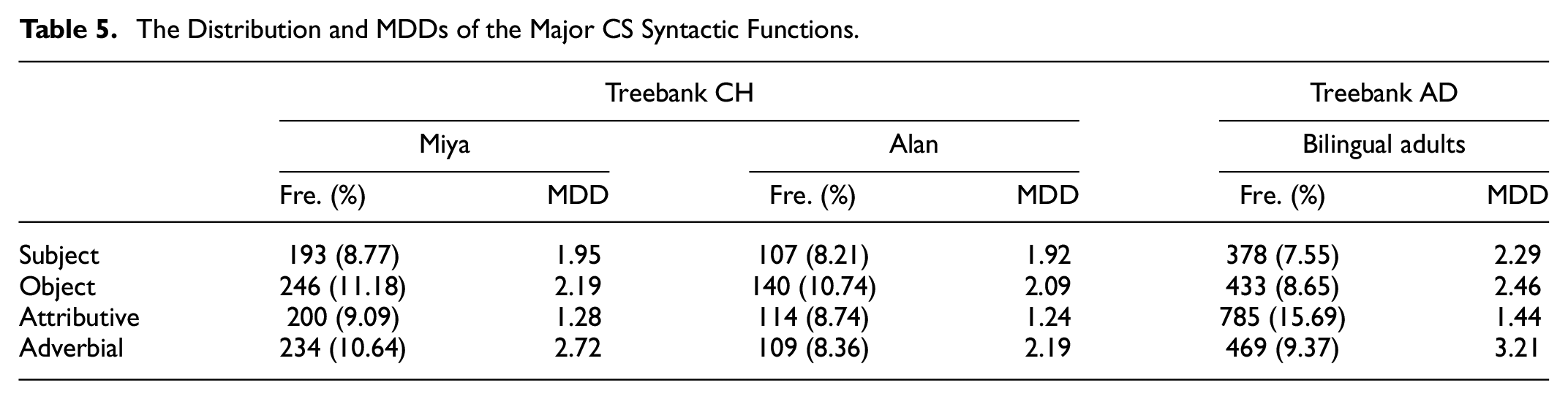
Chinese and English are both SVO word order, and in Word Grammar (Hudson, 2007), every word has a grammatical function that can be classified in terms of a system of general categories such as “head,”“subject,”“object,” and so on. This subsection answers the second question in the first part. Table 5 indicates the distribution and MDDs of the major CS syntactic functions in Treebank CH and Treebank AD.
Subject, object, attributive, and adverbial are four major CS syntactic functions of bilingual children and adults. From Table 5, in terms of the distribution, for both bilingual children and adults, four major syntactic relations, subject, object, attributive, and adverbial, totally take the big share of the switched dependency relations, that is, Miya (39.68%), Alan (36.05%) in Treebank CH, and adults (41.26%) in Treebank AD. For two bilingual children, objects both make the biggest share, respectively 11.18% for Miya and 10.74% for Alan which means that the object is the most frequently switched grammatical function. Comparatively, what is different from the bilingual children is that adults’ attributives (15.69%) constitute the most switched dependences. Another similarity between bilingual children and adults is that subjects are the least switched dependences in four major grammatical functions. Specifically, Miya, the English-dominant bilingual child, switches objects most, followed by adverbials, attributives, and subjects, whereas Alan, the Chinese-dominant bilingual child, switches objects, followed by attributives, adverbials, and subjects. Cantone (2007) found that bilingual children’s switched objects usually are single nouns or clitic pronouns. Wang (2019) investigated the syntactic functions of nouns in Chinese-English code-switching. There are three types of Chinese nouns, person/item nouns, time/place nouns, and direction nouns (Xing, 1993), and English nouns can be divided into three categories: common nouns, proper nouns and adverbial nouns (Hudson, 2002). In Chinese-English code-switching, Chinese person and item nouns mainly function as subjects and objects; Chinese time and space nouns are mainly used as adverbials. Chinese direction nouns can be used as subjects, objects, and adverbials. Subjects, objects, and adverbials are all performed by English common nouns; English proper nouns sometimes function as subjects and objects, but never as adverbials (Wang, 2019). In this study, the two bilinguals usually switch common nouns or noun phrases as objects. Example 3 is Miya’s mixed sentence.
The Distribution and MDDs of the Major CS Syntactic Functions.
Ex. 3 Ranhou women fang yixie bees wax. Then we put some bees wax “Then we put some bees wax.”
Miya and Alan are talking about how to make lipsticks, and in this mixed sentence, the noun phrase bees wax is the intra-clausal CS which functions as the object of the Chinese verb fang. As to bilingual adults, the most frequently switched syntactic relation is attributive, example 4 is a mixed sentence in Treebank AD, in which the attributive adjective modern is switched modifying the noun nvren (“lady”).
Ex. 4 Ta shi yi ge modern nvren. She is one QC modern lady “She is a modern lady.”
Table 6 shows the distributions of top two word classes in two bilingual children’s and adult’s four major CS syntactic functions.
(2) As to subjects, pronouns and nouns are the top two word classes for two bilingual children and adults. Especially, for two girls, pronouns functioning as subjects are much more than nouns, that is, subject pronouns are more easily involved in the switched dependency relations. It can verify that several close-class items are switched (Muysken, 2000). According to Muysken (2000), a lot of pronouns, participles, auxiliaries, and articles are switched in the Ottersum corpus built by Giesbers. Jisa (2000) examined the frequency and the type of language-mixing in two young French-English bilingual sisters (2;3 and 3;6), and found that pronouns are frequently switched compared with nouns, for example, as to Odessa (3;8) switched eight pronoun instances but nouns, verbs, and auxiliaries only three instances. Example 5 is from Jisa (2000) in which the French pronoun tu (“you”) is inserted in her English production. In our corpus, for bilingual girls, the switched pronouns often happen in the adjacent subject and predicate in the clause like examples 6 and 7. Example 8 is the instance of bilingual adults’ CS in which the pronoun is switched as a subject.
Distributions of Top Two Word Classes in Major CS Syntactic Functions.
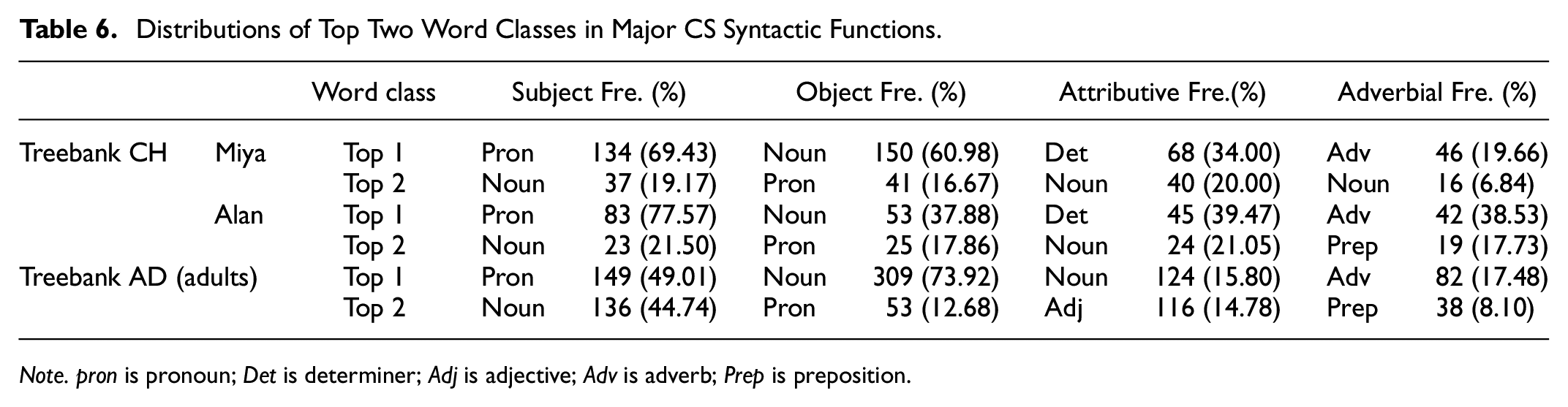
Note. pron is pronoun; Det is determiner; Adj is adjective; Adv is adverb; Prep is preposition.
Ex. 5 What this tu got ? what this you got “What did you get?” Jisa (2000):1374) Ex. 6 Ni bu neng taozou, fouze I will put it on your eyes. You not can escape otherwise I will put it on your eyes “You cannot escape, otherwise I will put it on your eyes.” Ex. 7 Wo gaosu ni you can’t. I tell you you can’t “I tell you (that) you can’t.” Ex. 8 Wo jianyi we together qu guangjie. I advice we together go shopping “I advice that we together go shopping.”
Example 6 and 7 are instances of inter-clausal CS. The difference is that I will put it on your eyes in example 6 is a coordinate clause, but you can’t in example 7 is a subordinate object clause. I and you are switched with their adjacent predicates will put and can’t. In example 8, the pronoun we is switched with together in this objective clause.
(3) As to objects, nouns and pronouns are the top two word classes for bilingual children and adults. Object nouns are much more frequently involved in the switched dependency relations especially for relatively balanced bilingual child Miya (60.98%) and the adults (73.92%). Similarly, in Chinese-English adult CS treebank (Wang, 2017), the most frequent function of nouns is object, which accounts for 34.31% of the total nouns in adults’ treebank. Example 9 is one of Alan’s mixed sentences and example 10 is from Miya.
Ex. 9 Alan: Women yi ren zuo yi ge lipsticks. We one person make one CL lipsticks “We each make a lip stick.” Ex. 10 Miya: Ni kandao henduo lipstick. You see many lipstick(s) “You see many lipsticks.”
In example 9, lipsticks is the switched object noun although lipsticks should be the single form. Interestingly, CS in example 10 is lipstick which is a switched “bare form.” According to Matrix Language Frame Model (Myers-scotton, 2006), the matrix languages of these two mixed sentences are both Chinese, lipsticks is the embedded English word. Myers-scotton (2006) mentions that in CS, many “bare forms” from the Embedded Language do not receive Matrix language inflections and function words, even though they follow Matrix Language word order. So lipsticks in example 9 and lipstick in example 10 are still acceptable in their communication. Similarly, Chirsheva and Korovushkin (2021) found the frequent use of English bare forms in Russian-English mixed sentences.
(4) As to the attributives, determiners and nouns are top two word classes for two bilingual girls, different from which those of bilingual adults are nouns and adjectives. The determiners modifying nouns are frequently switched together in bilingual girls’ mixed sentences like example 11. Example 12 is a mixed sentence in Treebank AD.
Ex. 11 Miya: The very next day, tamen lai le. The very next day, they come Aux. “The very next day they come (here).” Ex. 12 Wo de biggest mengxiang jiushi chengwei yi ming yisheng I AUX biggest dream is become one CL doctor “My biggest dream is to become a doctor.”
In example 11, the modifies day. The very next day is the switched noun phrase functioning as the adverbial, since the matrix language of the sentence is Chinese. In example 12, the switched English adjective biggest is the attributive modifying the Chinese noun mengxiang (“dream”).
As to adverbials, adverbs are the most frequently switched adverbials for both bilingual children and adults. Wang (2019) found that the switched English adverbs accounted for 26.83% of the adverbials headed by Chinese verbs. Ramzan et al. (2021) investigated children’s Punjabi-Urdu code-switching at their early age and the relationship between CS and the education background; they found that adverb insertions stands in the third place in the utterances of children belonging to both educated and uneducated backgrounds. Different from Alan and the bilingual adults, Miya switches adverbs and nouns more frequently. In other words, the English dominant bilingual girl switches adverbs and nouns as adverbials more frequently, and the Chinese dominant bilingual child and adults switch adverbs and prepositions as adverbials more frequently.
Ex. 13 And then, women dou huijia le. And then, we all go home AUX “And then we all went home.” Ex. 14 Women yiqi changge tiaowu at school. We together sing dance at school “We sing and dance together at school.”
In example 13, the matrix language is Chinese and then switched at the begging of the sentence function as the adverbial. In example 14 at school is switched at the end of the sentence functioning as the adverbial.
The distributions of top word classes can help to explain the MDD differences of the syntactic functions and the sentence complexity. In the following subsection, differences in dependency distances are discussed in detail based on Table 4. Dependency distance is defined as the linear distance between two syntactically related words in the sentence, the head and its dependent (Gildea & Temperley, 2010; Hudson, 2010; Liu, 2008; Temperley, 2007). Dependency distance is generally the index of syntactic complexity and the language processing cost. MDD can be held to measure the sentence parsing complexity and the processing difficulty of different languages. There is a universal preference for dependency distance minimization (DDM) for the sake of reducing memory burden (Hsiao & Gibson, 2003; Liu, 2008; Liu et al., 2017; Liu, 2009; Ninio, 2006). Children’s language and adults’ language are both human languages, so there must be some similarities and differences in language complexity or syntactic difficulties.
(5) As to bilingual children, four major syntactic functions present shorter MDDs which support the universal tendency of DDM in human language. DDM is probably a linguistic universal which indicates that language is a complex adaptive system (Liu et al., 2017). First, all the MDDs of bilingual children are shorter than the corresponding MDD of bilingual adults, for example, subject MDDs of bilingual children are 1.95 and 1.92, but that of adults is 2.29 (p < .001). It also indicates that with the result of deep-level psychological and biological constraints, children present a less complex syntactic system than adults. Moreover, dependency distance can be applied to the studies of syntactic development in second language acquisition, that is, to measure second language learners’ interlanguage syntactic complexity (Jiang & Ouyang, 2017a). And based on the self-built second language dependency treebank, Jiang and Ouyang (2017b) found that the mean dependency distance of interlanguage increases significantly across nine consecutive grades and the MDD of high-level learners doesn’t reach the level of English native speakers. Second, all the bilingual children’s and adults’ MDDs of four major dependency relations are shorter than the threshold number 4 reported by Liu (2008). Liu (2008), measuring the dependency distances of 20 languages, found that all the MDDs are less than 4; the MDD of Chinese is 3.66, and the MDD of English is 2.54.
(6) Similarly, as for both bilingual children and adults, MDDs of adverbials are the longest, followed by those of objects and subjects, and MDDs of attributives are the shortest (p < .001). The longest MDD of adverbials means that there are more words between the head and the dependents than the other three syntactic relations. The distributions of major word classes and one of the features of code-switching, peripherality, cause the longer adverbial MDD. From Tables 5 and 6, it is the adverbs that are most frequently involved in CS adverbial relations. Treffers-Daller (1994) and Muysken (2000) found many adverbs are placed at the left-most or right-most side of the sentence and use the term “adverbial modification” to describe the use of an adverb or adverbial phrase for this type of peripheral alternation, and they also claim that peripherality, clause-peripheral code-mixing, is a factor favoring CS. Hebblethwaite (2010), investigating adverb code-switching among Miami’s Haitian Creole-English second generation, found that discourse position, especially the left-periphery, is a significant factor in adverb code-switching. Wang & Liu (2013), Wang et al (2016) also found that in Chinese-English adults’ CS, mixed adverbial dependencies also present longer MDDs, the main reason for which is also the adverbial dislocation or peripherality. In this study, children’s CS also provides many examples, like example 15. Figure 2 is the syntactic dependency structure of example 15.

Dependency structure of example 15.
Ex. 15 And finally women yiqi tiao le yi ge wu. And finally we together dance AUX one CL dance “And finally we dance together.”
In example 15, the switched adverb “finally” is the adverbial modifying the verb tiao in this sentence, and grammatically finally can be placed at the left-most, middle, and right-most of the sentence. Obviously, finally on the peripheral position is more distant from its head than on the middle position. In other words, as Figure 2 shows, MDD between finally and tiao is 3, whereas MDD is 2 when finally is in the middle.
The shortest MDD in four major syntactic functions, MDD of the attributive CS, also needs our discussion. The distributions of major word classes and the adjacent dependencies cause the shortest attributive MDD. Adjacent dependencies refer to the dependencies built between two adjacent words, that is, MDD = 1. First, for bilingual children, determiners account for the biggest share in the dependents of CS attributives. Determiners always precede the modified nouns, and 60.29% of the attributive dependencies with determiner dependents are adjacent ones. Second, in bilingual children’s CS treebank, 75.27% of Miya’s attributive dependencies and 79.13% of Alan’s are adjacent dependencies. As a result, the big share of the adjacent dependencies is the most important reason for the shortest attributive MDD.
Pragmatic Functions
Studies on bilingual children from the age of 2 to 11 show that bilingual children have the pragmatic competence to adjust their CS behaviors to adapt to different situations and perform some conversational functions (Chung, 2006; De Houwer, 2005; Genesee et al., 1996). However, few studies have been involved in the CS of Chinese-English bilingual children from both syntactic and pragmatic perspectives. This subsection shows the major pragmatic functions of bilingual children’s and adults’ inter-clausal or intra-clausal CS, especially those major dependency relations.
(1) Filling in the lexical gaps
In Treebank CH and Treebank AD, the object is the most frequent dependency relation that is involved in CS. Filling in the lexical gaps is the major function of object CS for both bilingual children and adults, especially object nouns in intra-clausal CS. Nouns are the most frequently switched word class in objects, one of the major reasons is that bilingual children or adults do not have the translation equivalents (e.g., Cantone, 2007; Deuchar & Quay, 2000; Lee, 2019; Nishimura, 1995). Several studies also found that bilingual children aged 2 to 6 switch codes to fill in their lexical gaps (e.g., Cantone, 2007; Deuchar & Quay, 2000). Lee (2019) also investigated the phenomenon of code-switching in spoken Mandarin between the younger generation and their parents, and grandparents in Singapore and found that “code-switching takes place mainly due to convenience to fill in the gaps when younger speakers do not know the Mandarin equivalent of the words in certain domains” (Lee, 2019, p. 1). Examples 16 to 19 are instances of bilingual children’s CS, and examples 20 and 21 are those of bilingual adults.
Ex. 16 Ni zai shangdian li kan yi ge dongxi jiao experimake. You in shop inside see one CL something call experimake “You see something in the shop which is called experimake.” Ex. 17 Ni kandao henduo lipstick, haiyou lip gloss. You see many lipstick, and lip gloss “You see many lipstick and lip gloss.” Ex. 18 Yao dao ten millimeters. Need pour ten millimeters “Need pouring ten millimeters (of water).” Ex. 19 We are not making a story about hamigua. We are not making a story about cantaloupe “We are not making a story about cantaloupe” Ex. 20 Tamen xihuan Kipling zhe ge pinpai. They like Kipling this CL brand “They like the brand Kipling.” Ex. 21 Our marriage is luohun. Our marriage is love-and-certificate-only marriage “Our marriage is the love-and-certificate-only marriage.”
In example 16, Miya is talking about their game experience the day before in the shop. Here experimake is the switched English object noun to fill in the lexical gap, because experimake is a brand name and there is no equivalent Chinese name. In example 17, lipstick and lip gloss are the switched English object noun or noun phrase, because the girl is not sure about the Chinese corresponding expressions. In example 18, the modified noun water is omitted and the noun phrase 10 mm is switched functioning as the object of the Chinese verb dao, the reason for which is also that she cannot find the corresponding Chinese classifier at that time. In example 19, the matrix language is English in which Chinese is switched at the end of the sentence because the girl cannot find or does not know the corresponding English word for Hamigua. Examples 20 and 21 are the bilingual adults’ CS. To fill in the lexical gaps, Kipling, the brand name, is switched into English, and luohun has no corresponding English noun, so it is switched into Chinese.
(2) Emphasis or expressing the intense feelings
Emphasis or expressing certain feelings is the strategy that bilingual adults usually adopt in their mixed communication. As for bilingual children, Vu et al. (2010) found that 4.5- to 5.5-year-old Spanish-English bilingual children code-switched in their attempts to draw the interviewer’s attention. Similarly, Klapicová (2017) analyzed social aspects of children’s code-switching and found they often look for some emotive expressions to reveal their feelings and state of mind, for example, Stephanie and Paul, who were immersed in a three language environment including Slovak, English and German and their dominant language was Slovak, reveal their intense feelings in English oh-oh, ouch, ouchie, please, oh, my gosh or in German jé, aua. In this study, two bilingual girls and adults engage in intra-clausal adverbial CS or inter-clausal CS to emphasize something or express their strong feelings.
Ex. 22 Alan’s Mom: Women xianzai huiqu ba. We now go back AUX “We go back now.” Alan: Women bu xiang huiqu now. We not want go back now “We do not want to go back now.” Ex. 23 Yes, every second dui bu hao. Yes, every second treat not well “Yes, every second treat (us) badly.” Ex. 24 Ni weishenme bu chong? Do you know follow the rule? You why not flush Do you know follow the rule? “Why don’t you flush? Do you know follow the rule?” Ex. 25 Zhongyao de shi you must go on with your life… Important AUX is you must go on with your life “What is important is that you must go on with your life…”
The switched adverbials now in example 22 and every second in example 23 work for the emphasis or expressing certain feelings. In example 22, at that time two girls have been playing outside for several hours, and Alan’s mom asks them to go back, but they don’t want, so they answer her with a mixed sentence. The switched word emphasizes that it is not NOW that they go back home. In example 23, two girls are talking about somebody who does not treat them well, so he/she cannot become their good friend. The switched adverbial every second at the beginning of the sentence expresses the girl’s strong dislike. Example 24 is an inter-clausal CS. She switches from Chinese to English rhetorical questions. According to Quirk (1985, p. 825), “The rhetorical question is interrogative in structure but has the force of a strong assertion. It generally does not expect an answer.” The girl switches to an English rhetorical question to arouse the other girl’s attention or criticize her to some extent. Similarly, bilingual adults usually switch codes to emphasize something or express a strong feeling, like example 25. Example 25 is the bilingual adult’s CS, in which you must go on with your life is switched to express the speaker’s strong feeling and emphasize the importance of “going on with one’s life” in that context.
(3) Explaining
In some cases, code-switching serves to explain or define something not familiar to the listeners which usually happens in the subject relations, like examples 26 and 27 for bilingual children’s CS and example 28 for bilingual adults.
Ex.26 Miya: Audience shi kan de ren. Audience are watch AUX people “Audience are the people who are watching.” Ex.27 Miya: Lip gloss jiushi mo zui shang de. Lip gloss is put mouth on AUX “Lip gloss is something put on the mouth.” Ex. 28 30% off shi da qizhe, bu shi da sanzhe. 30% off is give 30% discount not is give 70% discount “30% off is to give (you) a 30% discount, not 70% discount.”
In the above examples 26 and 27, Miya switches codes from English to Chinese to explain those English expressions since the addressees, the adults, do not understand or hear clearly what they are talking about. Interestingly, example 29 is also an adult’s CS between the subject and the verb. Because giving the discount is expressed with different numbers in Chinese and English, the speaker switches from English to Chinese to explain it clearly.
(4) Giving “orders” or requirements
In Treebank CH, bilingual children often switch codes to give some “orders”/requirements or ask for a help; these functions are usually taken by the switched imperative sentences, verb phrases, or noun phrases. This pragmatic function is mainly performed by the inter-clausal CS, like examples 29 to 32. As bilingual adults, they usually switch codes to give orders, for example 33.
Ex. 29 Mama, guolai push me, push me. Mama come here push me, push me “Mum, come here, push me, push me.” Ex.30 Ayi, women xvyao zheli, move back, move back. Aunt we need here move back, move back “Aunt, we need here, move back, move back.” Ex.31 Jinqu, going there, going there. Go in going there going there “Go in, going there, going there.” Ex. 32 Ayi, ni kan, feet in, feet in. Aunt you look, feet in, feet in “Aunt, you look, feet in, feet in.” Ex.33 Dajia zhuyi, stop! Everybody attention stop “Everybody, attention, stop!”
In example 29, the bilingual child asks her mother to push her high when they are swinging by switching to an English verb phrase. In example 30, the two girls are playing a game, and Alan “orders” her aunt to move back and not get in their way by switching to the English verb phrase. Similarly, example 31 is a v-ing phrase CS and example 32 is a noun phrase CS. In example 33, the bilingual speaker arouses the attention of the listeners and then gives the order to stop them by switching to English.
(5) Quotation
A quotation is one of the essential functions of both oral and written CS. Gumperz (1982, pp. 75–76) states that “the code-switched passages are identifiable either as direct quotations or reported speech.” Many switched quotations can be found in the bilingual novel to vividly show the characters’ feelings (Wang, 2022). In the bilingual children’s and adults’ oral CS instances, the code-switched objective clauses are identifiable as direct or indirect speech, like examples 34 to 36. In example 34, the girl directly quotes what her friend said, and in example 35 the switched object clause is the indirect quotation. In example 36, the switched clause is the bilingual adult’s direct quotation.
Ex. 34 Ta shuo “I like you, I like your colour.” She said “I like you, I like your colour.” “She said that ‘I like you, I like your colour.’” Ex. 35 Ta gaosu women shuo we are best friend. She told us said we are best friend “She told us that we are best friends.” Ex. 36 Ta shuo: “You can’t imagine what had happened.” He said You can’t imagine what had happened “He said: ‘You can’t imagine what had happened.’”
(6) Reiteration
Reiteration refers that a message in one code being repeated in the other code, either literally or in the modified form, and in some cases, such repetitions may serve to clarify or amplify a message (Gumperz, 1982). Auer (1995) also proposes different functions of code-switching, for example, reiterations, topic shift, and topicalization. Like bilingual adults, there are some CS cases of reiteration in our bilingual children’s CS.
Ex.37 Miya: Here you go, gei ni ayi. Here you go, give you aunt “Here you go, give you, aunt.” Ex.38 Alan: But it’s too hot. Danshi women hen re. But it’s too hot. But we very hot “But it’s too hot. But we feel very hot.” Ex. 39 He must be joking, ta shi kai wanxiao de, buyao xiangxin. He must be joking, he is make joke AUX don’t believe “He must be joking; he is making a joke; don’t believe him.”
In example 37, Miya asks for a favor. She speaks English when giving her coat to the aunt and immediately shifts to Chinese repeating her intention. This code-switching feels more polite to her aunt, who is an unbalance Chinese-English bilingual. In example 38, Alan and Miya feel hot when playing outside, so they want to take off their coat. But Alan’s mother does not permit it. So Alan says that it is too hot, then uses Chinese to reiterate her words. In example 39, the switched part reiterates the first part of the sentence; the speaker switches to Chinese to repeat what he means and lets the listeners understand him clearly.
Conclusion
Based on the bilingual children’s and adults’ Chinese-English CS treebanks, from both syntactic and pragmatic perspectives, this paper focuses on the distributions of two major types of CS, the syntactic features and major pragmatic functions of bilingual children and find the similarities and differences between bilingual children’s and adults’ CS.
As to the distributions of Chinese, English and mixed sentences, two unbalanced bilingual children produce sentences in their dominant language most, the mixed language least and the weak language in the middle. As to the bilingual children, the mixed sentences present the longest mean sentence length, followed by those of the dominant language and the weak language. Similarly, MSL of Chinese-English adults’ CS is longer than those of monolingual Chinese and English, and English MSL is the shortest. As for the two types of code-switching, inter-clausal and intra-clausal CS, two bilingual children engage in more intra-clausal CS than inter-clausal ones, which verify some researches on adults’ CS.
Four major syntactic functions of bilingual children’s and adults’ CS are subject, object, attributive and adverbial. As to bilingual children’s CS, objects are the most frequently switched dependency relations and subjects are the least. Comparatively, as to bilingual adults, attributives are the most frequently switched dependency relations, and subjects are also the least. The distributions of top two word classes of four major dependency relations are calculated. As to subjects and objects, noun and pronoun are top two word classes involved in CS for both bilingual children and adults. As to attributives, determiners and nouns are the two top word classes in CS for bilingual children, but for bilingual adults they are nouns and adjectives. As to adverbials, the English dominant unbalanced child prefers to switch adverbs and nouns as adverbials, but the Chinese dominant unbalanced girl and the adults prefer adverbs and prepositions. MDD is one of the major criteria in Word Grammar to measure the syntactic complexity and processing difficulty. Similarly, adverbial relations present the longest MDD and the attributives the shortest for both bilingual children and adults. It suggests that the adverbial dependents are farthest and the attributive dependents are closest to their heads in the four dependency relations. The peripherality of CS, the distributions of top word classes and the adjacency relations are the major causes of MDD differences. Like bilingual adults, the bilingual children’s CS serve six major pragmatic or conversational functions, specifically, filling lexical gaps, emphasis or expressing the intense feelings, explaining, giving “orders” or requirements, quotation, reiteration.
The structural approach and the syntactically annotated treebank provide us with the empirical foundation. Both syntactic and pragmatic analysis make us know clearly the functions of CS in real bilingual children’s and adults’ mixed communications. This paper suggests syntactically and pragmatically that there are great similarities and certain differences between bilingual child and adult CS. This paper verifies some previous studies, and the statistical findings on syntactic features and pragmatic functions are helpful for bilingual education, bilingual acquisition and development and bilingual research; for example, certain types of syntactic dependencies can be the next focus.
It is obvious that our bilingual corpora need to be enlarged. More bilingual data should be collected either from Chinese-English children and adults or from other languages, such as English and French, English and Japanese. Moreover, the results also need to be further tested by other studies based on larger bilingual treebanks with the same annotation schemes.
Further researches are necessary to compare child CS of different ages and/or from different language backgrounds, or focus on certain syntactic functions or word classes in child and adult CS, or test the syntactic findings by adopting psychological or neuro-cognitive technology, such as eye-movement or event-related brain potential techniques.
Footnotes
Acknowledgements
We thank Dingrong Wang for his statistical advice on this paper.
Declaration of Conflicting Interests
The author(s) declared no potential conflicts of interest with respect to the research, authorship, and/or publication of this article.
Funding
The author(s) disclosed receipt of the following financial support for the research, authorship, and/or publication of this article: This work is supported by the Program of Zhejiang Gongshang University (No. 2021YLZS01) and the Major Program of the National Social Science Foundation of China (No. 18ZDA290).
