




Abstract
The present study examines the use of English lexical insertions to create humor by Jordanian university students. The data of the study are collected from spontaneous tape-recorded conversations from 62 participants of both males and females, representing different age groups (from 18–23 years old) and belonging to different specializations (e.g., engineering, pharmacy, mathematics, business, and English). The recorded conversations are qualitatively analyzed applying Auer’s sequential approach to code-switching to attain a local interpretation of lexical insertions for humor effect from English into Jordanian Arabic (JA). The findings of the study reveal that Jordanian university students exploit their bilingual repertoire to create humor by playfully and innovatively switching to English. This is shown to take place by unexpected switching points, a switching that flouts Arabic syntactic constraints, a violation of code-switching constraints, incongruity and incompatibility of translating Arabic culture-bound expressions to English, and imposing Arabic word formation templates to English insertions. Specifically, five patterns of code-switching of humor are found, namely, switching around the interrogative, playful affixation, phonological playfulness, haphazard calquing, and the imposition of Arabic morphological rules on English lexical insertions. The study argues that humorous insertions are in fact a marker of solidarity and an in-group membership. Humorous insertions are also shown not to contribute to the content of the message or the pragmatic meaning. Bilingual university students (of Arabic and English) purposefully make use of an additional linguistic resource to mock certain propositions.
Introduction
Humor and its techniques are considered an important, vivid topic in discourse analysis in general and conversation analysis in particular (see Attardo, 2010; Beal & Mullan, 2017; Brock, 2017). 1 This importance comes mainly from the overarching role of humor in delineating the underlying relation between discourse and participants. As Dynel (2011) argues, the structure of humor is an indispensable factor in understanding how discourse is built and perceived. This essentially implies that humor is not a peripheral phenomenon of discourse, where participants’ shared knowledge and culture are deemed important. Rather, it is a true mirror of the significance of verbal communication at either linguistic level or para-linguistic aspects, including body language, facial expressions, gestures, and tone (Beach & Prickett, 2017; Chapman, 1983; Yus, 2016). In addition, humor is linked to other discourse and sociolinguistic aspects, including code-switching (CS). Relevant studies on humor argued that CS is not accidental reflections of one’s own knowledge or skills, but an important source of understanding how discourse is orchestrated (Holmes, 2003; Uys & van Dulm, 2011, among many others). This research explores the role of CS in generating humor among university students. It essentially shows that the humorous aspect of lexical insertions (English words and expressions inserted in the structure of Jordanian Arabic [JA]) is a conscious bilingual practice that arises from novelty, creativity, and unexpectedness of the switch. It also shows that the playful usage of lexical insertions violates the Free Morpheme Constraint by Poplack (1980), which claims that switching is unlikely to take place between a free morpheme and a bound morpheme.
The discussion is structured as follows. First, we introduce the definition of humor and the main theories that have tackled this phenomenon in the related literature. The sequential approach to conversational analysis (CA), which the current study uses as a theoretical tool to analyze the data, is introduced afterward in addition to a general background on the situation where this study is conducted. In addition, a brief overview of the main works that have addressed the relation between CS and humor is mentioned. Furthermore, data collection and analysis are provided, followed directly by study findings and conclusions.
Background: Humor, the Sequential Analysis to Code Switching, and the Setting
This section provides an overview of the definitions of humor and the major theories that have tackled this concept in the related literature. This section also introduces the sequential approach to CS and the contact situation where the current study holds.
Humor: Definition and Theories
Humor is concerned with any act that creates an entertaining effect. Humor is linguistically defined as an activity, an event, or an object encompassing a creative use of language elements that leads to laughter, amusement, or a funny perception (Attardo, 1994, p. 4). The primary function of humor is thus to achieve a playful result by means of the playful use of elements of the language in speech. In this article, we adopt this Attardo’s (1994) definition of humor.
There exist three influential theories that attempted to provide an explanation of the mechanisms of humor: incongruity, hostility/disparagement, and release (Attardo, 1994; Raskin, 1985). From a cognitive–perceptual perspective, incongruity theory views humor as a type of contrast resulting from a mismatch of two unrelated concepts. This theory focuses on the notion of “play” (Attardo, 1994), as well as the language patterns utilized to achieve it. Humor is viewed here as a result of the playful violation of language rules (Goldstein, 1990). Disparagement theory, on the contrary, adopts a social-behavioral explanation of humor. Under this theory, humor is attained through aggressiveness, contempt, and ridicule (Attardo, 1994; Raskin, 1985). As for Release theory, humor is defined from a psychoanalytical point being a matter of a linguistic liberation of language rules (Attardo, 1994; Raskin, 1985). Among the three theories, the concept of “incongruity” has become very popular to account for humor in different contexts as it is based on challenging the normal expectations between interlocutors.
This study is carried out in the light of the sequential approach to CS introduced by Auer (1984) and developed by Li Wei (1998, 2005). This approach seeks a local interpretation of CS based on a turn-by-turn analysis of the sequential organization of the conversation. We introduce this approach in the following subsection.
The Sequential Approach to CS
CS is defined as “the juxtaposition within the same speech exchange of passages of speech belonging to two different grammatical systems or subsystems” (Gumperz, 1982, p. 59). The term is sometimes referred to as code-mixing. However, some scholars (e.g., McCormick, 1995; Muyskin, 2000; Myers-Scotton, 1993) use the term code-mixing to refer to insertional CS, that is, lexical insertion of content words and shorter lexical elements from another language. Auer (1998) distinguishes between two types of CS: insertional and alternational CS. The former describes the insertion of content words from another language, whereas the latter explains the alternate use of two or more linguistic systems.
Based on the sequential organization of CA proposed by Sacks and Schegloff in the 1960s and 1970s (see mainly Schegloff & Sacks, 1973), Auer (1984, 1995, 1998) introduces his sequential approach as an alternative approach to the previous approaches to language choice such as Situational and Metaphorical Code-Switching (Blom & Gumperz, 1972) and The Markedness Model (Myers-Scotton, 1993). He develops this approach in the light of what Gumperz (1982) called “contextualization cues.” A major advantage of the CA approach to CS is that it “limits the possible imposition of the analysts’ interpretations on the meanings of CS” as it provides an interpretive rather than analytic framework of language choice (Wei, 2005, p. 276).
Interpreting CS in Auer’s (1984, 1998) approach is based on considering CS a contextualization cue, that is, the meaning of CS is contextualized and its interpretation requires a sequential analysis of interaction. Under this view, CS indexes communicative and social functions similar to other pragmatic tools such as interjection, prosody, and gesture. Moreover, Auer (1984, 1998) calls for a turn-by-turn analysis of the sequential structure of a conversation. He asserts that preceding and following sequences must be taken into consideration to account for the reason a bilingual speaker switches from one language to another. This implies that a participant’s contribution frames the following contributions of other participants who take part in the same interaction. The “contextual frame” is locally defined; it is outlined from the preceding and succeeding turns of participants (Auer, 1995, p. 116). There are two types of CS under Auer’s approach: participant-related CS and discourse-related CS. The former has to do with the participants’ preference and competence, whereas the latter is concerned with the organization of the conversation or what Auer labels as “conversational moves.”
The Contact Situation
Described as a diglossic situation, there are two varieties of Arabic used side by side in Jordan (Jarrah, 2017; Suleiman, 1985; Zughoul, 1980). The first variety, JA, is informal, and it is used for everyday interactions (the colloquial variety), whereas the second variety, Modern Standard Arabic (MSA), is the standard variety which is considered the language of formal speeches and publications (see also Albirini, 2016). MSA is considered the high variety, whereas JA is the low variety (Al-Jarrah et al., 2015; Salem, 2015). MSA is codified and is officially supported and institutionally taught and learned. On the contrary, JA is a spoken form with some regional variations. The incorporation of many English words into the two varieties has recently become enormous, especially in JA.
Inspired by Loveday’s (1996) framework of contact settings, the contact situation between JA and English can best be characterized as follows:
a. It is limited to borrowing and CS (lexical for the most part).
b. The agents are Jordanian bilinguals and specialist of various types who have access to English through direct channels such as students, businessmen, and travelers and/or indirect channels, including social media.
c. The acquisition of English is supported by governmental and nongovernmental institutions like schools, universities, and learning centers.
Institutionally, English is the medium, partially or completely, of almost all streams of study at Jordanian universities. When it comes to studies related to medicine, technology, engineering, computer, business, accountancy, and economics, English is apparently the mere medium of instruction (Drbseh, 2013). Another example of English power in Jordan is that regardless of the students’ specialization, TOEFL (Test of English as a Foreign Language) is a prerequisite test for higher studies in Jordan. In case a student is unable to attain the required score, he or she has to enroll in additional English language courses prior to his or her enrolment in the concerned higher study program.
The attitude of university students toward English is “unanimously positive” (Bani-Khaled, 2014, p. 400). Based on experimental fieldworks, documentary analyses, observations, and a questionnaire, Drbseh (2013) notes that Jordanians are fully aware of the special significance of English which is sneaking into the educational, sociolinguistic, and political settings of Jordanians, making, however, no threat to the official language, but rather is considered by Jordanians as advantageous for wider communications. For Drbseh (2013), as the attitude toward language is a strong motive for language competence, Jordan can be characterized as a bilingual country where people have varying degrees of bilingualism. This has led to the fact that English vocabulary is rapidly spreading in the spoken domain and, to a lesser extent, in the written domain (Salem, 2015). This can be attributed to the pervasive role of mass and social media alongside the linguistic admiration of English (see Bani-Khaled, 2014; Hamdan & Hatab, 2009; Salem & Al-Salem, 2018; Tahaineh & Daana, 2013). As a consequence of such a type of admiration and symbolic value, the creative use of English elements in playful contexts has arguably become a common linguistic behavior, particularly among university students.
This study explores the insertional CS produced by bilingual university students of spoken JA in humorous contexts.
Approaches to Humor and CS
Although theories of humor are proposed to account for humor in monolingual settings, they, as Siegel (1995) assumes, are relevant to the use of CS for humor in bilingual environments. Siegel proposes that generally humor can be interpreted in light of approaches to CS. For instance, in case CS is used as a contextualization cue (Gumperz, 1982), CS for humor symbolizes that content is not serious. On the contrary, when CS is employed as a marked choice (Myers-Scotton, 1993), CS for humor appears as an unexpected use that mainly serves a sociopragmatic function.
Studies that investigate CS for humorous purposes made a unanimous assumption that switching for humor has not been basically driven by pragmatic reasons (see, for example, Gardner-Chloros & Finnis, 2003; Hofmann & Rodden, 2019; Jaworska, 2014; Lin, 2013; Salem, 2015; Siegel, 1995). These studies, among others, pinpoint that CS is a conscious, purposeful bilingual practice that aims to create a humorous effect. In switching for humorous purposes, speakers are aware of their bilingual behavior (Schmidt, 2014). Humor in language play is mostly achieved through the use of purposeful switching in an unexpected place of an utterance, where the product and rules of this play are understood by the speakers who took part in the interaction (Golovko, 2003).
Other studies have reported instances which show that the language to which a speaker switches is itself the object of humor (e.g., Siegel, 1995; Vizcaino, 2011). In particular, Siegel (1995) clarifies that CS may lead to humor in three different ways: a sign that joking is taking place, the switch itself is humorous, and the language of the switch is regarded funny. However, the unexpected and creative use of the switch constitutes a major generalization of most relevant studies. This type of unexpectedness takes the form of word substitution, phonological games, and word play.
Based on the general findings of several studies in several contexts, Vizcaino (2011) introduces four possibilities that mark the relationship between CS and humor: (a) the switch itself is the object of humor; (b) humor is produced through the creative use of the switch; (c) a switch is only one technique, among others, to create a comic effect; and (d) humor is created by the “unexpected” in a situation. Vizcaino (2011) examines humor in different types of code-mixing occurring in advertising campaigns of the Spanish airline company Vueling. She reports that humor has been created through deviations at the formal level of the language. Such deviations are manifested through the unexpected use of foreign language elements which are inserted into the Spanish structures and sounds. Examining data from TV, radio, and spontaneous conversations, Salem (2015) points out that English words are a rich source for creating humor by Jordanian speakers “based on the contrast between the expected context-selection and the unexpected insertion.”
Woolard (1988) investigates the mixing of Catalan and Castilian in jokes by Catalan comedian Eugenio in the 1980s. This study reports that the humorous effect created by Eugenio is originated from the unusual, creative usages of the inserted elements. Such usages as Woolard explains are lexical, prosodic, phonological, and morphological-based creations. This includes the influence of the Catalan sound system, intonation patterns, lexical elements, and the instances of morpho-syntactic interference when speaking Castilian.
In another study of humor and its interface with CS in Morocco, Caubet (2002) comes up with different unexpected language-based insertions to generate humor. These insertions include phonological games, taking a set of expression and isolating one element and playing with it, calquing, using language in wrong circumstances or unexpected environment, changing elements of expression, and using French suffixes with Arabic words.
Another aspect of switching for humor is achieved through substituting a lexical element in an idiom or an expression by an inserted element from another language. Applying a sequential analysis for CS functions in Chicano plays, a form of writing projected for performance, Jonsson (2010) displays instances of word/language play switches in which Spanish, English, and Chicano words are subject to substitution by each other. In a clue that switching for humor is hard to predict its limitedness, Jonsson cites several examples for switches within fixed expressions like idioms, where switching is normally unlikely to happen.
For other studies, switching for humor is found to connect with marking an in-group membership. In an analysis of a stand-up comedy titled “What’s Next?” in Hong Kong, Tsang and Wong (2004) remark that some insertions of English expressions in Cantonese can be interpreted as solidarity markers, implying that such combinations are used by people of Hong Kong. The same conclusion has already been drawn by Siegel (1995) who proposed that when Fijian people switch to Hindi, they mark informality of the context and, at the same time, solidarity among them.
A final significant note that has been brought by some pertinent studies has to do with the perception of such playful usages as humorous. For example, Siegel (1995) states that Fijian/Hindi humorous switches are exclusively regarded as playful in the Fijian context. In this regard, Vizcaino (2011) states that such humorous usages are locally meaningful. She mentions,
Humor is triggered through different types of deviations produced by inserting foreign elements into mainly local structural and phonetic frames. Most of these frames are expressions and idioms only known to Spaniards. Thus, incongruities in the Vueling case are normally resolved by the specific target audience. For this reason, humor works locally, rather than internationally, despite the use of foreign units. (Vizcaino, 2011, p. 167)
This review of the main research studies that explored the use of CS in humorous contexts reveals that this use is indicative of the certain pragmatic messages the speaker intends to deliver. This implies that CS in humorous contexts is an important tool to generate implicatures. Furthermore, the use of CS in humorous contexts mirrors the factual relation between the speakers, implying that CS is an important sociolinguistic device that reflects, for example, solidarity, informality, and so on. This discussion indicates that the use of CS in humorous contexts is meaningful and manifests important aspects of the relation between interlocutors.
In this study, we focus on the use of English switches in humorous contexts among university students, a rich context with CS and its interface with humor. Other insertions from other languages (such as French, Spanish, or Turkish) are beyond the scope of this study because they are rarely used in the speech of Jordanian university students either in education or for communication. English by all means is the only foreign language that is taught in schools and used in universities systematically and purposefully. It is also the dominant foreign language on social media.
Accordingly, this study raises the following questions:
What is the relationship between humor and CS to English in the speech of Jordanian university students?
What are the strategies/patterns that Jordanian university students apply to create humor when switching to English?
The following section explains the data collection and analysis procedures adopted to achieve the study aims.
Data and Analysis
To achieve the goal of this study, 100 hr of naturally occurring speech were tape-recorded. The length of the recordings ranged from recordings of 15 min long, recordings of 15 to 30 min long, and recordings of more than 30 min long. The recordings took place at Yarmouk University in Jordan. The informants involved in conversations consisted of 62 Jordanian university students of both males and females, representing different age groups (from 18–23 years old) and belonging to different specializations (e.g., engineering, pharmacy, mathematics, business, and English language and literature). The percentage of male participants was roughly 72%, and 28% for female participants. The low percentage of female participants was due to the fact that females were reluctant to take part in recorded conversations, possibly for cultural considerations (see Al-Badayneh, 2012; Almala, 2014).
The respondent participants were undergraduate students of majors that are solely taught in English, as a criterion set forth to ensure that they have good exposure to the English language. The study participants were approached by the researchers themselves in a relatively quiet place where students gather in their free time inside the university campus. The researchers stepped aside during the recording task in order not to have any influence on the spontaneity of the conversations, the topic selected by the informants, and the length of the conversations.
Aiming at getting conversations that are spontaneous as much as possible, participants were not told about the exact topic of the study. Instead, they were told that their conversations will be subject to linguistic analysis. The topics raised by participants included social relationships, teaching, job opportunities, study, technology, memories, examination, work conditions, food, politics, social media, songs, and TV channels.
Data were qualitatively analyzed to investigate the most frequent humorous patterns of lexical insertions in JA spoken discourse. First, the extracts of the selected conversations that contain English insertions for humor were transcribed. Then, an analysis was conducted following Auer’s (1984, 1998) sequential approach of CS to attain a local interpretation of lexical insertions for humor from English into JA. The humorous patterns of lexical insertions were selected on the basis of their representativeness and frequency in the data. Excerpts that illustrated each humorous pattern were also chosen due to their demonstration of the local interpretation of lexical insertion under investigation. Insertions are given in bold, first, to distinguish them from native constituents and, second, to identify the switching point.
Findings and Discussion
The findings indicate that there are three principal considerations that appear to be taken into account when dealing with switching to English for humorous effects. The first is cultural. The Arabic culture itself constitutes the material for switching. There is a cultural message behind the switching practice (see Munoz-Basols et al., 2013). The second consideration is procedural. In bilingual speech, switching for a stylistic effect is achieved by challenging the context-appropriate selection of the bilingual repertoire (Matras, 2009). Thus, humor is achieved by defying rules of the context-bound selection of bilingual repertoire forms. Finally, switching for humorous purposes is a primary strategy used to establish and maintain solidarity among the participants. The acceptance of humor strengthens solidarity among the group members, indicating a case of shared interests. These considerations are well demonstrated in the given examples below where Jordanian university students intentionally switched to English for humorous purposes when discussing Arabic culture-specific terms and ideas that do not make sense in English (cultural) or imposing Arabic grammatical rules in an unexpected manner through challenging their linguistic unmarked selections (procedural) to negotiate and construct solidarity.
Of the 451 instances of English code switches found in the corpus, 74 were identified as instances of humor. These instances were categorized into five patterns, namely, switching around the interrogative, playful affixation, phonological playfulness, morpheme-by-morpheme translation, and playful imposition of Arabic morphological rules. Table 1 shows the frequency and percentage of each pattern:
Frequency and Percentage of Patterns of CS to Create Humor.

Note. CS = code-switching.
In the following discussion, we explain each pattern, supported by examples that occurred in the recordings.
Switching Around the Interrogative
Switching around the interrogative is impermissible in bilingual speech, that is, it is a constraint in the language contact phenomenon (see Matras, 2009). Bilingual Jordanian university students tend to determinedly challenge such a constraint for the benefit of creating humor. Consider the following conversation where two male students (M2 and M3) invited their friend (M1) for lunch. The talk exchange started after M1 had finished his meal 2 :
See the Appendix for transliteration and transcription used in this study.
(1) Example 1.

Asking the guest to eat more after finishing his or her food is in fact a generous invitation within the Arabic culture. As a response to this invitation, the guest normally thanks the host and replies that he or she is not hungry. Based on this cultural shared knowledge, M2 did so when M1 finished his meal. However, to lower the level of seriousness of the topic and shift to a more relaxing atmosphere, M2 switched to English and inserted the question word “where.” Humor is achieved here through the unexpected switching around the interrogative. That is, the violation of the switching norms in M2’s utterance is itself humorous as it defies the rules of the bilingual repertoire’s selection. As a consequence, M2 replied in the same humorous tone to M1’s statement by repeating the same switched element. Maintaining the humorous atmosphere, M3 in Segment 4 laughed and told M1 that it was not the usual amount of food he normally eats (a funny statement that is used by intimate friends to mean just the opposite). M1 agreed by admitting that he had eaten the amount of food that is enough to feed 10 people.
As the violation of a mental expectation is the essence of Incongruity theory of humor, the unexpected switch around functional words (e.g., interrogative words) entails flouting syntactic constraints. This is more clearly exhibited in the following example. Here, the participants, who were talking about whether or not there was a way to retrieve Snapchat messages, flouted a syntactic constraint by switching the English interrogative element “how” with an Arabic noun phrase:
(2) Example 2.
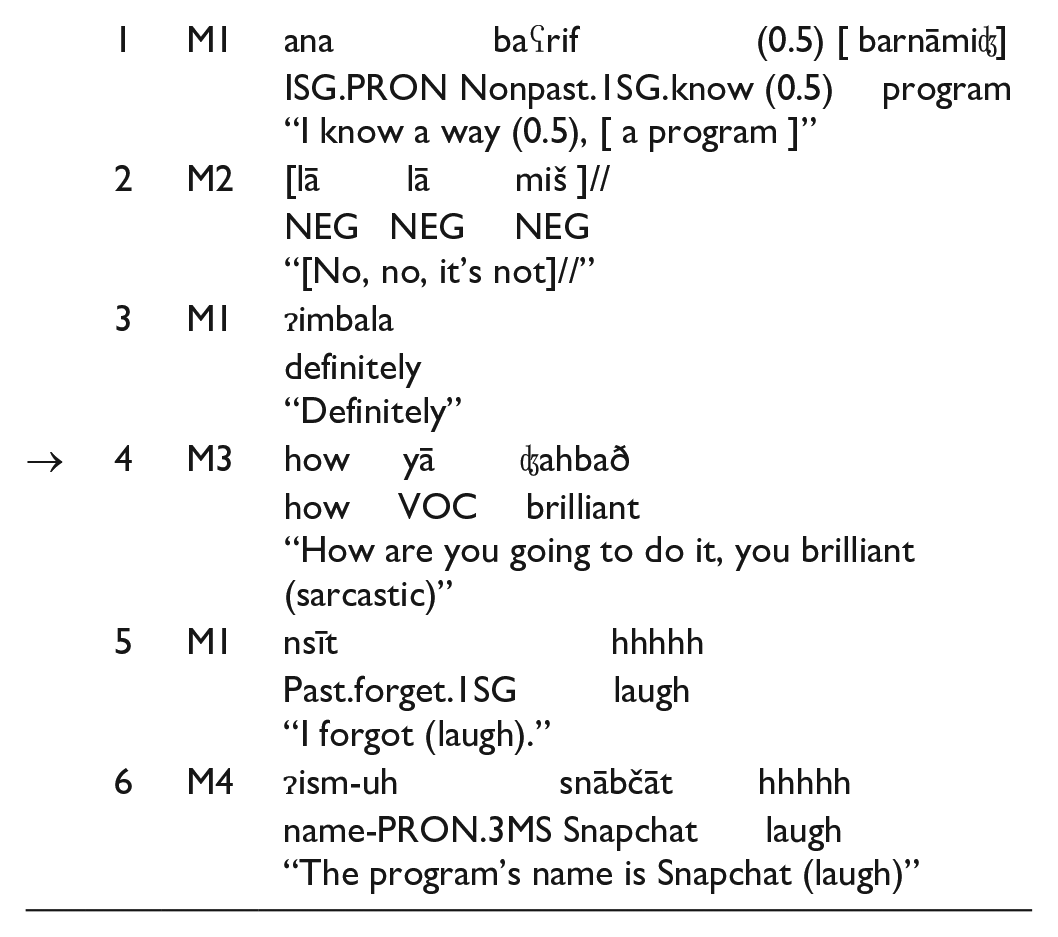
As shown above, when M1 assured that he knew a program that could retrieve Snapchat messages, M2 overlapped his utterance to deny the availability of such a program, as shown in Segment 2. When M1 reassured his point in Segment 3, M3 inquired about the program M1 was talking about in a sarcastic, yet unexpected, way. He switched to English and inserted the interrogative word “how” followed by the Arabic noun phrase you brilliant. Of course, the unexpected switching point itself indexed the humorous tone of M3. M1 replied with a similar tone by adding that he forgot the name of the program, followed by a laugh. Taking part in the entertaining exchange, M4 mocked M1’s inability to recall the program he assumed to be available. He asserted that the name of the program was Snapchat, which is actually the name of the application, to imply that M1 was confused.
Playful Affixation
The playful attachment of English affixes to Arabic stems is another form of humor identified in the speech of Jordanian university students. As mentioned above, switching around function morphemes is not possible, a fact that made switching around affixes a conscious and improvised effort by JA speakers. Below is an example of switching around a prefix:
(3) Example 3.
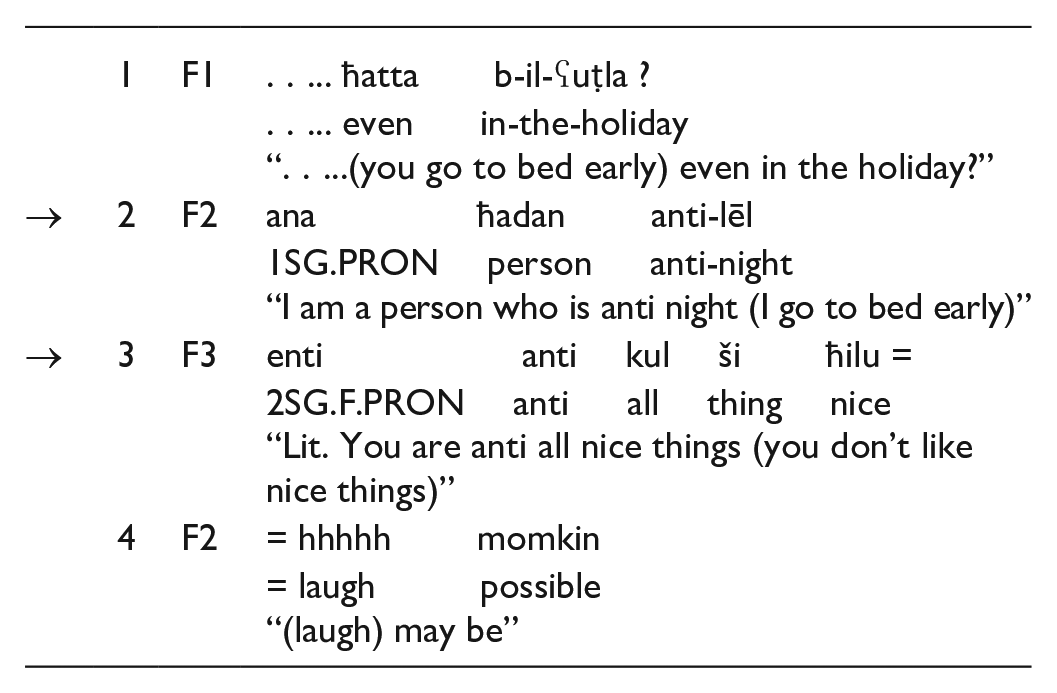
In the dialogue above, the girls were talking about going to bed early. F1 was amazed that F2 also goes to bed early even during holidays. F2 wanted to assert that she hates staying late at night, so she did it humorously by attaching the English prefix “anti” to the Arabic stem, violating the constraint of switching around a function word (the prefix). This linguistic practice appears to be a way of confirming solidarity between participants. Maintaining solidarity, such a humorous usage triggered a similar humorous switching in Segment 3 by F3 who repeated the use of “anti” which in turn triggered a laugh from F2.
Example 4 shows a more creative usage of playful affixation. One of the participants attached the English suffix “~ tion” to an Arabic stem creating a novel instance of switching. In the following example, four males were preparing for a barbecue party:
(4) Example 4.

In Segments 1, 2, and 3, the participants were sharing responsibilities in the barbecue party. When M2 wanted to express his satisfaction with the arrangements, he attached the English suffix “~ tion” to the Arabic stem MOMTAZ “perfect.” As shown in the last utterance (M3’s last utterance), the speaker begins his conversation with a laugh which we propose is resulted because of the use of CS in such contexts. Once more, this conscious and creative combination was playful as it challenged the constraint of switching around bound morphemes.
Prosodic Playfulness
This pattern is concerned with the suprasegmental features of the insertion. JA speakers flavored the mocking tone of their messages by an absurd imitation of the switched element’s prosodic features such as intonation, tone, stress, loudness, pitch, and rhythm. Below is an example of a short extract taken from a long conversation where three males were making fun of a statement initiated by their friend (M1):
(5) Example 5.

In the beginning of the conversation, M1 was criticizing someone’s ethics by stating information, previously known to his friends. That is why they turned the whole situation to a sarcastic one and just mocked what he said about that person. The humorous context was first initiated by M2 in Segment 2 who ironically replied to his friend’s proposal (Are you serious?). M3, who was making fun of the idea as well, took the floor and wanted to express his excitement in a mocking way. In so doing, he switched to English and attempted to imitate the English way of showing interest (e.g., in terms of pitch/intonation, and stress), that is, he inserted the phrase “Oh my god,” in a way that made it sound English context-like, sarcastically followed by “you are kidding.” As a result, M2 laughed at this usage. M1 took the floor again and swore that he was telling the truth (it is highly possible he was not aware that they were making fun of him), which generated the latching utterance of M3 who replied by a cultural statement used to mock a suggestion.
As shown above, the imitation of English phonology in playful contexts can have the functions of expressing excitement, surprise, and exclamation. Another example of such an imitation is taken from a conversation between four male university students. They were making fun of their friend (M4) because he could pass the course at the first time:
(6) Example 6.

In the short exchange above, the mockery of the idea that M4 was proud to pass the course from the first time was set forth right from the beginning by M1. To shift the humorous setting to a more relaxing one, M2 inserted the English phrase “no way” replicating English prosody used to show surprise. This ironic procedure of showing surprise was maintained by M3 in Arabic, followed by a laugh from all interlocutors. Finally, M4, who got the ironic message and appeared bothered by it, responded to their mockery by challenging their ability to do as he did.
Morpheme-By-Morpheme Translation
JA speakers are likely to apply the morpheme by a morpheme translational technique to add a humorous tone to the context of the interaction. The process is also called “loan translation” or calquing. Backus and Dorleijn (2009) define loan translation as “any usage of morphemes in language A that is the result of literal translation of one or more elements in a semantically equivalent expression in language B” (p. 77). These translated constituents are culture-bound terms (e.g., idioms and proverbs). Consequently, the output (the literal translation of the Arabic culture-bound terms) is meaningless in English in that it either does not exist or is differently expressed in English. Humor arises from such a state of incongruity and incompatibility. The following short excerpt between three male students is a representative example:
(7) Example 7.

M1 was complaining to his friends about the possibility of receiving an academic warning. M2 wanted to inform him that he had the same situation. Attempting to mitigate unpleasantness of this situation, he calqued an Arabic colloquial proverb LĀTIŠKĪLI BABKĪLAK (lit. No need to complain to me [about something], I will cry to you for the same thing) which is said when someone has the same harsh situation as another. The morpheme-by-morpheme–translated proverb sounded very comical. It does not exist in English this way. In fact, this creation indexed a case of solidarity between the participants. This is why M3 used the language-specific term WALLAʕT “it fired” (said when something goes crazy) as a reaction to the humorous effect created by the translated proverb, which triggered a laugh from the three of them.
Bilingual speakers of JA also do the same translational techniques with some cultural-bound expressions that have a metaphorical meaning in the Jordanian context. Consider the following example in which five university students were talking about a tough college professor of M1.
(8) Example 8.

M1 was talking about his meeting with the professor to solve a problem. When M2 asked him about the outcome of the meeting and what the professor had said to him, he told him with a sarcastic laugh that he had said pleasant words (implying that he was not nice to him). The colleagues, who got the implied humorous message, perpetuated the entertainment by taking turns to produce similar ironic utterances about how nice the professor was to M1, as shown in Segments 4 and 6 (reciting poems and dinner invitation). In Segment 5, M4 did the same but innovatively. He literally translated the Arabic culture-bound term MIN ʕIYŪNI (which is said in Arabic to express willingness to help). The humorous side of such a morpheme-by-morpheme translation is attributed to the fact that the expression is considered language/culture specific, and sound naive in English, a fact which made all participants laugh at such a usage.
Playful Imposition of Arabic Morphological Rules
Another employment of lexical insertion for humor that bilingual speakers of JA applied was to play with English words in terms of their morphological adaptation to sound Arabic-like. In the literature, there are a number of studies that cite examples of language play and playful adaptation of insertions (Onysko, 2007; Rampton, 1995; Zabrodskaja, 2007). Zabrodskaja (2007) mentions examples of Russian words that are adapted into Estonian in a playful way that does not occur in Estonian.
The novelty of some patterns of playful morphological adaptation of the English lexicon is a sign of the creative use of the Arabic language resources to subject the English lexical constituents to these resources. Below is an example of creating humor through imposing Arabic morphological rules related to the formation of the imperative in Arabic. That is, treating the English word as an Arabic stem to produce an imperative verb:
(9) Example 9.

In the extract above, when M1 told his friends that he would go to see his girlfriend, M2 told him to inform them about the meeting on WhatsApp. Showing solidarity, he did it humorously by applying the morphological rules of the Arabic imperative verbs. As a result, he innovatively generated the imperative verb WATTIS “to send a WhatsApp message.” Hence, the humorous effect is generated by considering the word “WhatsApp” as an Arabic tri-consonantal root /w-t-s/ from which the imperative form WATTIS is produced by mapping the stem /w-t-s/ onto the morphological template CaCCiC used to generate the imperative in Arabic. Hence, the outcome WATTIS is comic as it is an English word that was subjected to Arabic morphological rules, which made M1 laugh at such a usage as shown in Segment 3.
The same scenario was adopted in Example 10 below to form a verbal noun by mapping the English word, which was treated as an Arabic stem, onto an already existing template. The conversation is thus an example of creating humor through imposing Arabic morphological rules in a form of duplication of the English stem:
(10) Example 10.

In the exchange above, F1 initiated the first pair part of a greeting-greeting adjacency pair. Then, she turned to two of her friends who were whispering and laughing and asked about the source of their happiness. Maintaining their good mood, F3 humorously replied that they were talking about love. She treated the word love as an Arabic stem and adapted it in a comic way by duplication of /l-v/ to form a four consonantal root of the Arabic word formation template CoCCoC producing the verbal noun LOVLOVAH (chat about love). This weird adaptation to the Arabic morphological system was not clear to F1 who inquired about the meaning of such a pun.
Conclusion
The study uses Auer’s (1984, 1998) sequential approach of CS to explore the humorous patterns that result from the use of English words in the Arabic discourse. It demonstrated that the use of English for humor by Jordanian university students is a deliberate activity aimed at adding a stylistic dimension to the communicative message. That is, switching for humorous purposes is shown to be an insertion that can be a conscious improvisation of which speakers are aware of its role in communication. The study also revealed that the basis of humor in the use of the English language stems from its use at unexpected points and from subjecting it, in a creative way, to cultural formulations and morphological rules specific to the Arabic language to appear humorously hybrid and unfamiliar. Hence, the comic effect of the switch, resulted from its incongruity, is locally meaningful, that is, the interpretation of such a bilingual activity is localized through the application of CA Framework to CS. CS is found to be playful in cases of switching around the interrogative, playful affixation, phonological playfulness, haphazard calquing, and the imposition of Arabic morphological rules. Furthermore, the study shows that the humorous conversational effects created by the switches in the extracts above represent four main postulates that have been clearly shown through the sequential analysis of university students’ talk exchanges. First, the humorous insertions are a marker of solidarity and in-group membership. Second, the insertions have contributed neither to the content of the message nor to the pragmatic meaning intended. Third, bilingual university students purposefully made use of an additional linguistic resource available for them to mock certain propositions. Fourth, the playful usage of lexical insertions also violates and challenges certain linguistic constraints in the field of CS such as The Free Morpheme Constraint proposed by Poplack (1980).
The findings of this study perfectly match with the previous studies that examine the use of CS to create humor in different contexts. In fact, we can claim that there is a universal base for creating humor among bilingual speakers such that humor is generated through the unexpected (marked) use of the switch that is hard to anticipate (e.g., Caubet, 2002; Golovko, 2003; Jonsson, 2010; Salem, 2015; Siegel, 1995; Vizcaino, 2011; Woolard, 1988). There is also agreement among these studies that switching for humor is locally meaningful to participants involved in interaction due to shared language and cultural knowledge. These studies also show recurrent patterns and strategies that mark the relationship between CS and humor such as phonological games, word substitutions, and morpho-syntactic games. However, the findings of this study reflect unique patterns of switching for humor such as switching around the interrogative, calquing (Caubet’s study has the same finding), and playful affixation. Finally, due to the limitations of this study, further research studies are recommended to examine the use of English for humor in other modes of communication such as TV/radio, newspapers (such as printed advertisements), and online platforms. It is also recommended to explore the role of sociolinguistic variables (such as gender and age) on the use of English elements to create humor.
Footnotes
Appendix
Declaration of Conflicting Interests
The author(s) declared no potential conflicts of interest with respect to the research, authorship, and/or publication of this article.
Funding
The author(s) received no financial support for the research, authorship, and/or publication of this article.
