




Abstract
The study is to depict how migrant workers experienced human rights issues through employment in Malaysia. The descriptive narration of study was used to interpret and analyze migrant workers’ experiences. Thirty-six participants were sampled, based on purposive snowball sampling method, by conducting the in-depth interviews using semi-structured questions based on hybrid mode including face-to-face in locations and using text messages via applications to access individual’s experiences. The study elaborates migrant workers’ rights in Penang, Selangor, and Johor. The findings crucially revealed that migrant worker’s rights could be violated through poor working conditions, the legal gaps, and their fate extremely relied on employers due to documentation regarding their own status. In default of human rights, the situations originated the worsening working conditions for migrant workers. The principal issues are inadequacy of law enforcement and accountability of working conditions. Thus, strengthening the respect for human rights compliance is necessary.
Plain language summary
The purpose of empirical study is to explore how migrant workers experienced human rights issues in their workplaces. The qualitative research approach was used, to collect data from migrant workers, by the in-depth interviews. Meanwhile, semi-structured interviewing, through the open-ended with probing questions, was used to discuss the concerns freely. In particular, to capture various experiences, the purposive snowball sampling technique was manipulated by the criteria of specific populations. The interviews conducted 36 migrant construction workers working for Malaysian employers in Penang, Selangor, and Johor. The narrative analysis approach was applied by the face-to-face and messaging interviews. Subsequently, NVivo 11 software was used to analyze data by the process of qualitative coding. The interviews with migrant workers notably found growing human rights violations remained, such as excessive working hours and minimum wage exemption. Employers utilized ethnicity based on ethnic performances to their benefits. Working conditions for migrant workers must be improved, due to poor quality employment, to protect their rights. Furthermore, as employers confiscated passports, this is not merely restriction of movement freedom for migrant workers but also their difficulties to access healthcare. Besides, confiscating passport is possibly conducive in corruption for public agents. To address human rights violation, stakeholders must respect for human life with the rights of keeping their own identity documents. Importantly, in addition to reviewing relevant laws, law enforcement is necessary to ensure the fundamental rights and rule of law.
Introduction
Linkage Between Malaysia and the Human Rights Standards
In 1948, the Universal Declaration of Human Rights (UDHR) was proclaimed by the United Nations General Assembly (UNGA) based on various cultures, laws, and histories. The UDHR has served as an inspiration source for various binding international human rights instruments including declarations, conventions, treaties, or agreements (Office of the United Nations High Commissioner for Human Rights [OHCHR], 2023). Meanwhile, the UDHR, an authoritative human rights reference, recognizes basic rights and fundamental freedoms as an integration to human beings and equality. Specifically, the margin of appreciation in interpreting rights and protecting practice is essential to justify values of pluralism.
In the 1950s, Malaysia’s labor laws were introduced to govern employment practices. These laws have occasionally amended under pressure from the International Labour Organization (ILO). However, they have been inadequate in aligning employment practices with human values. In particular, the ILO standards emphasize human rights which are necessary to realize economic, political, civil, social, and cultural rights (Politakis, 2007). Accordingly, the Malaysian government has endeavored to enhance the labor standards with agreements to stimulate greater compliance with the ILO Conventions since Malaysia, as a member country, has been bound by policy considerations based on dialog between the ILO and Malaysian stakeholders.
Given explaining why Malaysia still protects human rights, Malaysia adopted the Sustainable Development Agenda (2030 Agenda), in 2015, being a crucial commitment at the UNGA to greater sustainable resilience and inclusive development. To be successful under the Sustainable Development Goals (SDGs), the government more recognized migrant workers’ crucial roles in development and explicitly promotes social protection.
At regional level, the human rights institutions of the Association of Southeast Asian Nations (ASEAN) crucially involve the ASEAN Intergovernmental Commission on Human Rights (AICHR), as the core intergovernmental commission, and the Universal Periodic Review Mechanism. Meanwhile, the AICHR objective is to strengthen the cooperation framework through the ASEAN instruments and to mainstream human rights across sectors (Wahyuningrum, 2021).
The AICHR represents a unique area for the approach meaning as the positive human rights norms relate to moral foundations. The interactions with civil society are involved in the human rights commitments (Stacey, 2023). Given human rights within ASEAN, the governance structure was considered as a decentralized form of governance. The AICHR has no authorities to order the decision implementation. Importantly, mainstreaming in human rights practices depends on the willingness to adhere and bind themselves to the AICHR recommendations (Collins & Bon Tai Soon, 2023).
In 2017, the ASEAN Consensus on human rights for migrant workers was officially adopted by the ASEAN countries. Malaysia, as a top-10 destination for labor migration in Asia, entails the law reform of jurisdiction and securing social protection for migrant workers in law enforcement to be consistent with the ASEAN Consensus. The human rights protection became a crucial challenge in Malaysia due to increasing the costs and potential risks of financial sustainability. The government launched to establish the strong social security administration to play crucial roles in poverty prevention. Importantly, employers were required to provide commitment, known as the Employers’ Undertaking, to be a pledge in paying levy for migrant worker employment (Low, 2021).
Given hiring migrant workers, the core ministries, involving the Ministry of Human Resources (MOHR) and the Ministry of Home Affairs (MOHA) currently play important roles in the governance system and promoting legal awareness to end trafficking cases (Foley, 2023). In particular, to drive a positive direction from criminality to protection, the MOHR initially proposed the institutional arrangement of the comprehensive reforms; consequently, the Employment Injury Scheme (EIS) extended injury treatment coverage to migrant workers for equal dignity. Furthermore, migrant workers are currently allowed to apply for flexible arrangements whether changing working schedules or location with employers to protect migrant workers in terrible situations under the cost saving policies and marketization.
Malaysia, as a compelling country with having a significant number of migrant workers, shed light on mechanisms through allowing wider latitude in decision-making processes, according to dealing with changes since 2018, as the major human rights issues to well-being resources for migrant workers have been emphasized in a robust and comprehensive manner (Anderson, 2021). The additional measures for social protection were systematically formulated by the government to enhance migrant workers’ rights pertaining to labor relations along with shifting coverage and employers’ responsibilities among stakeholders to impact on country development (Lindquist, 2017).
Migrant Workers in Malaysia
In sectors, such as the agriculture, continue to hire children without the personal protective equipment (PPE) during their work; for instance, oil palm plantation in Sabah comprising around least 2070 stateless children, who had neither Indonesian nor Malaysian citizenship (Gottwald, 2018). In particular, workplace precarity, due to capitalism and neoliberal reforms, relates to the short-term employment and limited rights (Sunam, 2023). Migrant workers’ diseases and death have often occurred due to inhabitable living conditions, especially shared and grimed room without ventilation among humidity imbalance, although they have constantly demanded healthy living conditions with equal facilities as local workers; additionally, migrant workers suffered physical torture due to employers, or even noticeable murder cases in the court (Ahmad & Scott, 2021; Arisman & Jaya, 2021; Sarpong & Shahudin, 2022).
On the one hand, citizens have worried about the number of migrant workers in country. They notably have negative attitudes and low promotion for migrant workers’ rights, as attitudes are inherently influenced through social norms and contexts. The concern is more voiced occurring in many urban areas, especially in Kuala Lumpur. Migrant workers are generally viewed as temporary workers making only small benefits to employers but often cause social issues. In addition, the ILO survey indicated that 83% of respondents highly believed the increased criminal rates relate to migrant workers while respondents 73% said equal treatment should not apply to migrant workers (International Labour Organization [ILO], 2020).
In view of social conflict with economic trends, migrant workers, from South Asia and the ASEAN countries, have been often blamed due to limiting employment opportunities for local workers while political significance supports the reproduce of legitimacy structures with encompassing religious and economic domains (Peletz, 2023). Considering a drain on the economy and public resources, migrant workers affect the large remittance outflow, particularly Indonesia. However, among social dilemmas, achieving development of modern societies eventually entails reliance on migrant worker employment.
The rapid influx of migrant workers coming to labor market in Malaysia is currently governed by the dynamic interplay of regulatory agencies, bilateral agreements, legislations, and privatized migration facilities based on certain conditions and assessments (Wahab & Hamidi, 2022). Migrant workers hailing from 15 allowed countries, such as Indonesia and Sri Lanka, would be recruited through differential conditions, according to various sectors. For example, there is a recruitment based on types of manufacturing businesses, such as export-oriented industry and electrical product industry, determining the ratio of local to migrant workers from one-third to two-first, as well as the agriculture determines quota based on hectares, or even the number of seats in the restaurant influences quota in the service sector.
As mentioned above, securing social protection without discrimination is significantly challenges for socioeconomic development in Malaysia. It relates to ensuring fair migration to migrant workers. Additionally, as the legal reform was recently improved to justice, employers could enhance working conditions through enabling work environments reform at nexus of the relevant laws.
Therefore, the study aims to depict how migrant workers experienced human rights issues through employment in Malaysia to answer the following research questions:
1) What are the root causes compelling migrant workers to be vulnerable through working conditions?
2) How do employer-migrant worker relationships currently disrupt in the workplace?
Literature Review
Human Rights: Vulnerability, Race, Ethnicity, and Discrimination
Social exclusion and human rights analysis currently rises to the critical ideas in relation to vulnerability. For a study by Krieg and Toivanen (2021), inequalities significantly affect groups shifting from an individual-based to structural arrangements influencing everyone with linking to resources by social structures and institutions. Furthermore, Timmer et al. (2021) noticed, theory of vulnerability is to serve as extending social protection floors to migrant workers lacking whether legal or social concepts. Meanwhile, vulnerability framework presents a new way in understanding and being hopefully to respond neediness of the entire living order. The vulnerable human subject challenges notions of political subjects with dilemma. It seems that the potential and pitfall of vulnerability theory emphasize formal equality in addressing the constructed hierarchies while the fundamental level shares the contemporary values meaning human being has the same moral worth (Serafim, 2021).
To understand the vulnerability roles in human rights paradigm, vulnerability supports not merely the necessity identification under chameleon situations but also relating to characteristics of human rights in line with the natural universality regarding the recognition process and goodness to be protected (Pariotti, 2023). Considering social and existential resources, Godzimirska et al. (2022) briefly argued that human beings are vulnerable; additionally, vulnerability is constant and inherent while resilience, to revive in facing sustainability difficulties, is fluctuated and accumulated through individuals’ interaction.
Given the ideal law, Halme-Tuomisaari (2020) illustrated that the tension characterizing the performance and monitoring the UN human rights treaty and identified everyone, especially vulnerable, is emphasized to access liberty. The constructive realm faces failure risks and embodies in the insufficient resources to conduct operations. Additionally, human rights could be viewed that ethnicity and poverty are a prohibited basis of discrimination (Mantouvalou, 2022). Obviously, the human rights framework is to learn sustainable development through the focus on human rights and anticorruption implication (Crinis, 2019).
In a critical review of social control, group threat theory causes an assumption as the host society constantly perceives the increased minorities as a crucial threat to their own locations, and the perceived threats potentially influence notions regarding exploitation of resources, including social security (Brotherton et al., 2013; Scheepers et al., 2002). Typically, the theory was established to explain how Black people’s proportion has been in growing population, and the political threat remains further expression in addition to social control efforts. Ethnic difference could be interpreted as an intersectional human condition increasing institutional prejudice with becoming crucial barriers to social equality, and intersectionality has been often considered to combat discrimination among social movement to require equality in countries, such as the United Kingdom (Castro & Holvino, 2016; Vassilopoulou et al., 2019). Furthermore, by China’s social policies, the authoritarian regimes punish the minorities more severely to expand development regarding group threat theory according to the US context (Peng & Cheng, 2022). However, these are argued, the welfare for minorities is possibly enhanced because of the Confucian heritages.
Additionally, Ford (2016) argued, discrimination is subject to social and legal sanction as ethnocentrism results in the decreased willingness to support welfare and important mechanism, although the ethnical sympathies are conditions of emphasizing the support for specific groups. Protection against employment discrimination is essential as further attention needs to be paid to performance while discrimination and exclusion are prohibited under laws, but ethnicity is practically crucial in class-based discrimination (Heymann et al., 2023; Nichols, 2023). Based on empirical evidence, ethnic discrimination significantly influences economic status with well-being, and it could take a violent form as a hate crime motivated through history, for instance, attacking African American community in Tulsa in 1921 and killing 6 million Jews from 1941 to 1945 (Levey & Cheng, 2022).
Given discriminatory behaviors, the instances may be easy, difficult, and interpersonal relating to social dynamics. Racism in several countries, such as the United States, remains in societies. Ethnic inequalities could even be a function of organizational imperatives (Johnson et al., 2023). Among threat and stress, the increased contact across ethnic line could accompany a host on negative consequences (Fibbi et al., 2021; Trawalter et al., 2009). Currently, for the ethnic conflict argument, Zhang (2023) found that Black workers’ disadvantage is significantly the strongest in areas among the ethnic attitudes with workplace discrimination. It is crucial to deepen comprehension regarding human development aspects (Carmo, 2021). Significantly, subtle discrimination exists on developmental way, particularly specific workplaces, and have harmful effects (Jones et al., 2017). For example, there are negative attitudes to the minority both in public and private spheres; or even, individuals express through nonverbal behaviors without friendly attitudes in operations to minority. Contemporary prejudice reflects the conflict between negative implicit attitudes to ethnic minorities and explicit egalitarian values (Murphy et al., 2012).
According to evidence supporting interaction, citizenship status could change or be motivated as a stratification basis due to the same rights and privileges, whereas noncitizens are often stigmatized as criminal origin or a threat to social norms with economic system; namely, being noncitizen could put out the periphery increasing insecurity opportunity (Casey et al., 2023; Light et al., 2014). Additionally, salary difference illustrating migration and language proficiency level reflect the variety of roles at workplace, and gaps of language accommodation become difficulties for stakeholders (Alonso-Villar & del Río, 2022; Premji et al., 2022). Importantly, the ethnic groups significantly influence harms; therefore, consideration for privilege needs to assess human capital concertedly (Al Ariss et al., 2014; Alonso-Villar & del Río, 2022).
International Legal Framework
The UDHR is highly influential to protect the rights of everyone regardless of gender, ethnicity, and status, such as the right to work with fair and transparent remuneration, ensuring human dignity in societies (OHCHR, 2023). The UDHR indicates the rights of social security and entitlement to realization of dignity with free personal development. In other words, the UDHR guarantees migrant workers’ rights to work among positive working conditions and ensures their access to social protection.
The UN Convention on Protection of the Rights of All Migrant Workers and Members of Their Families (ICRMW) recognizes migrant workers and their families by including specific provisions addressing safety and health, according to employment protections. In view of human rights with freedom from slavery, working and living conditions in several areas can actually resemble violence through whether trafficking or abuse (OHCHR, 2005). The ICRMW is to protect migrant workers from exploitation and encompasses extensive right to transfer their savings and earnings while the conventions highly require the governments to ensure appropriate working and living conditions through the promotion of international cooperation and impartiality for strengthening humane, equitable, and lawful conditions.
The ILO initiated human rights through standard-setting and has developed several agreements emphasizing the social protection measures to protect every worker. The principles express the importance of guidance on what should be constituted fundamental integration into comprehensive policy for migrant workers. Standards recognize the measures in regulating the employment conditions with combating human trafficking to prevent harm. Specifically, the conventions cover equality with the elimination of forced labor.
Regional Legal Framework
The ASEAN principles more highlight the significance of social protection for migrant workers, especially adequate standards of living (Association of Southeast Asian Nations [ASEAN], 2013). Social protection extension is associated with accessibility, aspect, quality and fairness, as well as sustainability. Strategies were adopted to enhance quality and coverage of social protection, including national policies, in each ASEAN country. Efforts have pressured to make progress toward fulfilling universal health coverage to every sector. The ASEAN countries commit to promoting policies and fostering cooperation to encourage migrant workers’ full ability with dignity through addressing their human rights issues, such as unfair treatment.
Methods
Study Design
Exploration of the lived experiences is essential to better understand migrant workers’ rights in practice. Qualitative approach was hence applied for this empirical exploration arranging the in-depth interviews with 36 migrant workers, according to participants who were employed legally. By learning from participants, the narrative research approach was applied to consider reflection experience-based employment. Variation sampling strategy was utilized to ensure a variety of human rights experiences, especially the social protection access. Additionally, a wide range of marginalization were examined to recognize working conditions and access to healthcare.
Participant Recruitment
Migrant workers were recruited, to be as a participant, from 18 construction employers in Penang, Selangor, and Johor. In each state, the study arranged the interviews with 12 participants. Meanwhile, two participants would be from the same employer. Notably, the study focused on migrant construction workers, as Malaysia’s economic growth highly has reliance on the construction sector under strong collaboration between the public and private sectors.
In addition, the study used purposive snowball sampling technique. To access information on potential participants, the study launched to contact an NGO supporting migrant workers’ rights in Malaysia. The contact with each participant initially performed by explaining the objective and principal information about exploration. Participants were contacted directly by whether telephone or social media with the appointment at their leisure. Importantly, these participants were recruited through the set criteria, and suitable participants would be confirmed. Several participants would subsequently introduce to other hidden populations who were their networks and had the lived experiences based on the set criteria.
The study limited individual migrant workers who: (1) had minimum 2 years of experience for working of construction sites in Malaysia; (2) were from 23 to 46 years of age at the interview time; (3) stayed in Malaysia from 2019 to 2023; (4) went to the healthcare provider from 2019 to 2023; (5) worked for Malaysian business locating in Penang, Selangor, and Johor; and (6) had been legally employed to work at construction sites. These migrant workers communicated in English and were in Malaysia when interviewing.
Data Collection
The qualitative interviews conducted 20 participants through the face-to-face interview in locations and 16 participants by using text messages on WhatsApp and Facebook applications (Table 1).
Number of Participants in the Face-to-Face and Messaging Interviews.

Considering the text-based interview, a study by Shapka et al. (2016) compared quality of interviewing between the face-to-face setting and online by messaging interview and found no difference in quantity, types, and depth of discussion. Their mentioned examination is therefore beyond this study to use the interview types. In particular, to access hidden population, using these applications was considered to communicate with them. By another important cause, participants required the interview by applications due to saving time and their convenience.
The face-to-face interview in locations took around 90 min in length interviewing in private areas, such as participant’s room. The messaging interviews by WhatsApp and Facebook were conducted according to convenient time for the researcher and participants. Furthermore, the interviews through WhatsApp and Facebook applications completely took within 30 days. The study was conducted to gather data within 4 months. Every participant who completed the interview would be given a monetary reimbursement (MYR20) for their support.
The study interviewed through the open-ended questions with probing to encourage critical thinking and migrant workers’ feeling about the issues including ideas during their interviews with less self-censorship. To reach informative discussion, the interviews had flexibility to explore the unique experiences. The semi-structural interviews were well preplanned for natural conversations. The online interviews could involve texts, slang abbreviation, and emoticons, generally used and acceptable ways, to reduce participant’s pressure. Interview guide was developed in English and had involvement in creating the questions through reflexive and iterative processes to examine participant’s attitudes of human rights under employment. Participant’s common demographics would be collected separately. The questions related to what they experienced among work environment including workplace injuries, and discussions would realize how they operated under those depressions.
Data Analysis
After the interviews and transcription were completed, data analysis initiated through thematic content. Each transcribed interview would be reviewed to analyze data identifying themes of migrant workers’ rights among working conditions. In particular, the what description was found in textual data, and how description was observed in the information structure. Textual descriptions were recognized and explored from various attitudes. Researcher thus read every text thoroughly. Repetitive statements would be removed, as every statement was valued equally.
Researcher provided a concept map to record the initial ideas, insights, and relationships regarding reading and interpretations. Categorizing was used to enhance the result validity when reviewing the entire interview with insights in data. Additionally, a memo would be usefully created to state exploration evolution and checking biases to ensure reliability. The storage was organized by NVivo 11 (for Window) software, as a facilitative tool, handling unstructured information to reduce bias in data analysis.
In analytical process and theme connections, the theme nodes were improved through categories to identify migrant workers’ rights regarding working conditions. In relation to a based theme, the higher nodes meaningfully link to answering the research questions having relations with coding. Nevertheless, several nodes would be merged but left at the top level because they did not link to any concepts. A node relatedly involved three hierarchical levels. Themes might belong to more than one group; for example, lack of salary among health risks related to salary and health, or workplace injury treatment regarding both workplace and treatment. Additionally, queries would be used to gather at multiple nodes regarding in different combinations.
To clarify findings, coding launched to organize texts into broad topic areas for conjunction with annotating, memos, and linking. It would be cumulative regarding structures of the codes and changes. Coding could use queries to test ides and assist in focusing on the research questions. For example, researcher had a notion that language impacts migrant workers’ rights; therefore, query was used to explore the connections. Data would be summarized in the framework matrices showing everything through columns and rows to compare the participants’ different experiences. Eventually, the summary would be sent to participants to confirm the analysis with validity.
Ethical Consideration
To interview participants, researcher used the consent agreement detailing the information expectation and study character, including methods and tools. This agreement was explained in English, and the participants were emphasized to ensure their privacy would be protected by anonymity with using pseudo-identification for confidentiality. The codes were used through abbreviation including MP, MS, and MJ for participants who were in Penang, Selangor and Johor, respectively. More importantly, each participant had the right to decline the question.
Results
Confronting Reality of Workplace Conditions
The employment mechanisms notably have reliance on recruitment and registered under arrangement, by public and private actors, among confusion with strife. Specifically, due to irresponsible performances in manipulation, the private actors significantly caused financial issues and disadvantage for migrant workers as a migrant worker illustrated: “Chaos and mazes for me, and it was complex process” (MS4). Subsequently, he added: “Previously, I needed to borrow money to pay broker for working at here; of course, I must cope with huge debt” (MS4). Similarly, another worker felt distrustful and explained: “I loaned from one in the same village and must owe to pay broker for processes but sometimes felt cheated” (MJ1).
To reduce inequality with the income gap between the highest and lowest paying, the minimum wage was raised to MYR1,100 per month in the entire country in 2019. Next year, the minimum wage rate was additionally proposed to increase at MYR1,200 per month for engaging a worker in 57 major cities, such as Klang, Kulai, and Johor Bahru, and MYR1,100 for other municipalities. In 2022, the MOHR officially gazetted the national minimum wage MYR1,500 per month (Figure 1).
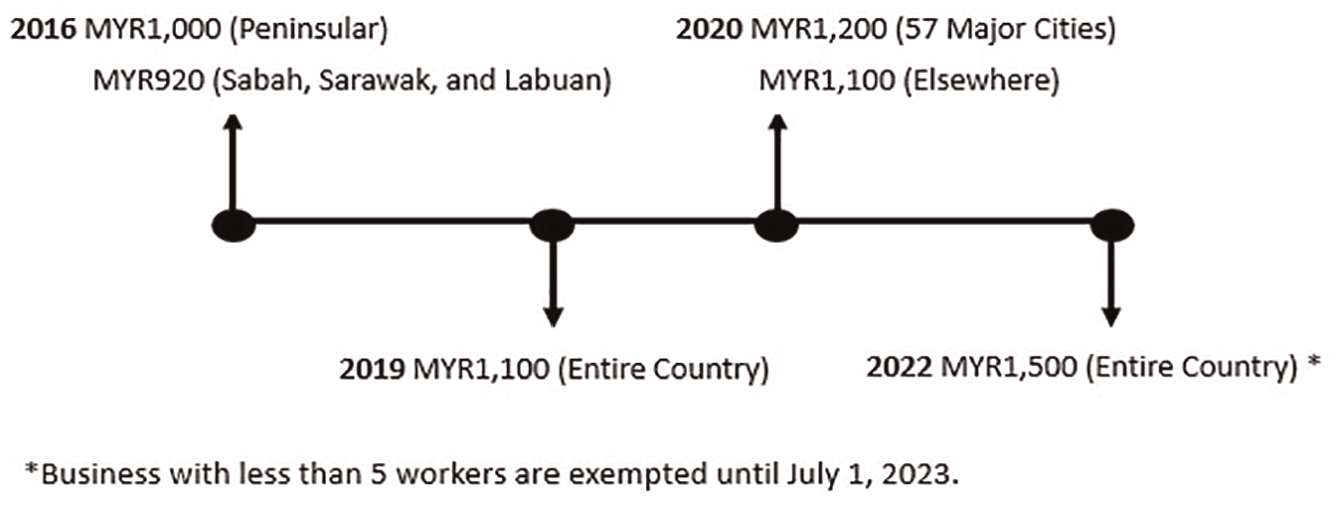
Increasing the minimum wage in Malaysia.
In practice, when the government officially declared minimum wages, migrant workers would remain of working without voice to talk with employers under unfavorable conditions. Meanwhile, they must struggle among the upward pressure and more payment because increasing the minimum wage entailed raising prices of products and services or inflation in the economic system. As a matter of fact, migrant workers’ average salary notably launched to decrease, for the first time, in 2020 due to the global border closure and the movement control measures.
During the COVID-19 crisis, migrant workers who were still employed often had a disinclination to responsibility and must work harder due to productivity with negative economic effects; additionally, income loss influenced financial remittance issues to their families. For instance, a migrant worker must work without salary for 6 months due to freezing new hires: I needed to continue. If I took off, I might be unable to come back. There was lower salary but more purchasing. Nothing supported us. I worked more heavily. We must do all ourselves. My life was difficult. I struggled deeply. Thinking remittance was impossible. (MS1)
When the interviews wanted to know about their concerns and grievances, migrant workers principally identified that their salaries were deducted unfairly. Especially, the study found that migrant workers’ salaries were deducted in advance to purchase PPE including the COVID-19-related equipment, such as medical masks. A migrant worker demonstrated: “I received uncertain salary at that time because of deduction for PPE although we worked for them; finally, we were responsible ourselves” (MP7). In other words, salary deduction to provide equipment was deemed unlawful management.
Among healthcare crisis, migrant workers were bitterly terminated without notices in advance, and meanwhile they did not have much time to seek new employer under the restrict measures. Consequently, they became illegal migrant workers due to losing employment status. Besides, there was no regulatory channel to raise their grievances. For example, a migrant worker reported: “I was immediately taken off when the Movement to Control Order was declared in March 2020. We couldn’t complain. I lost income for many months” (MS3). However, he returned to Malaysia in the next year although he needed to repay a labor broker as he additionally stated: “I paid them two times them for returning to here despite risk, but I am the breadwinner for family, and it was necessary at that time” (MS3).
Under grueling conditions, migrant workers must endure for long hours. They generally worked for 10 to 13 hr exceeding the legal working hours. As a migrant worker said: I work around 10 hours per day. Sometimes, if the site is nearly deadline, we may work 13 hours or 16 hours, but at least, I still have rest day. I receive the income less than the government declaration. It is out of Malaysian system. (MP10)
Malaysia could become the less attractive destination country to migrant workers because the true benefits and salary were lower than the offered agreement and their salary expectation under increasing pressures. A migrant worker informed: “More overtime, fair salary, and good benefits are important for me, as I am expected to remit family money. Actually, I often received less salary. I may consider other countries if employer is unlikely to improve” (MP12).
In employment contract analysis, beneficial provision for migrant workers was often less than an identified contract due to attitudes and cost-cutting by employers. In parallel, a migrant worker compared the employment agreement with this rue wage: The agreement is only Malay language. I saw the digits. A coworker said it referred to the offered salary. Actually, it is more than my true salary at present. I hope my true salary will be like those digits in next month. (MJ7)
The cash payment is typically allowed to provide for other types of remuneration in line with work done. Frequently, migrant workers were given in cash although they had their own cell phones: “Paying by phone would be easier if they weren’t convenient to transfer by the bank, but finally, I often received salary in cash” (MJ2).
In addition to financial issues, migrant workers were scared to be seen by public officers although they legally completed the relevant documentation. This is because employers often confiscate migrant workers’ passports to keep them from running away despite the fact that passport confiscation is prohibited in accordance with the Federal Constitution. As a result, migrant workers could be arrested due to checking valid documents, or they would be exiled immediately because employers could either cancel or refuse for work permit extension. In addition, they would be prohibited to work at other workplaces. Passport confiscation, by their employers, contributed to threatened feeling in societies. Typically, it implies restriction of movement freedom, as they must hold the work permit with them all the time. Unfortunately, several cases were weak-willed actions to pay money corruptly: I don’t want to go outside. If a police found me, I must pay them to continue in Malaysia. If not, I may be arrested. No one can help me when facing them. If I contact company, they may cancel my job suddenly like a coworker’s experience. Sometimes, I must pay all, perhaps MYR300 as they asked at that time. (MS8)
In particular, due to conditional implementation by the Ministry of Health, individuals who were undocumented workers must be reported to the Immigration Department. These conditional situations resulted in the mistrust climate among migrant, because employers confiscated their passports, during their access to health service. As a migrant worker detailed his frustrated experiences with fearfulness when he was hospitalized although his document was legally valid: Nurses sometimes threated to call for checking document. I was always afraid. Actually, I had it, but it wasn’t with me. I don’t know why our position opposes police. I wasn’t okay, and today either. It is like a trigger. (MS6)
Ethnic Harassment in Workplaces
Based on contextual background, migrant workers confronted racism in the workplaces. A migrant worker narrated the irritated situation with emotion when he communicated with other workers and has been often called by the humiliation because it is not proper salutation: Calling Indon, it merges my name for them. They shout or speak loudly. Actually, I should hit them but don’t want have a conflict. I still work here. It was used in the past, not present. It was actually as Educated Indonesians take to stigma us. (MS11)
Similarly, another migrant worker reported ethnic persecution in workplace: “They call me dirty despite the fact that it is due to my dark skin and working; besides, they often put slur Jakun in conversation, although I don’t like but can’t speak anything” (MS10). Specifically, in Johor, Indonesian workers are currently viewed as aggravation of fragile ethnic relations, whereas the government strives to promote projects in this state to be creative and cultural hubs.
When all declarations were only Malay language although information regarded migrant workers with working, it seems that migrant workers were overlooked due to ethnic differences as a migrant worker was unhappily due to discriminative organization: “We worked among the COVID-19 pandemic and were left behind all because notices and all were only Malay language, whereas we aren’t Malaysian” (MS5). Similarly, a migrant worker mentioned his workplace: “Everything is only Malaysian whether forms or announcements; perhaps, they may think that we aren’t their workers, but we must use to their measures” (MS2).
Given knowledge about rights with legislative information channels both Working for Workers and Just Good Work applications, several migrant workers did not understand the relevant mechanisms. For example, a migrant worker notably raised: “No one guides and listens us; I knew about my right, but most was informed by word-of-mouth in our groups. We have rarely met with their team” (MJ9). Additionally, encouragement of talking with employers under unfavorable conditions, the questions would be forwarded to the others, or there could be no answer. Another migrant worker said: “Nothing happened among quiet climate; if not, my questions became a ball to send to the others” (MJ10).
As mentioned above, harassment reflects prejudice by demeaning and excluding migrant workers on the basis of ethnicity. By exploratory analyses, Malaysia face ethnic harassment occurrence as follows (Table 2):
Migrant Workers’ Experiences of Ethnic Harassment.

Exposure to ethnic harassment can potentially cause negative effects. To protect well-being, employers should prioritize clear policies designed to keep potential harassment, such as clear expectations for workers and civility.
Ethnic Disparities in Health Service
In relationships between healthcare and social determinants, health justice demands that social justice needs to be adopted as a core value and requires to address the social exclusion, particularly healthcare access, existing upstream. For example, as employers are currently required to register their migrant workers with SOCSO, migrant workers are currently entitled to make workers’ compensation claims.
In fact, among social attitudes to migrant workers, cultural differences could result in unfair discrimination, especially prejudicial treatment; for example, many cases were not treated immediately, or they needed to return without treatment although both the Malaysia governments had the cooperative agreements with the sending countries to decrease workers’ formidable issues and death. Migrant workers still experience difficult process due to their own vulnerabilities, and meanwhile ethnic discrimination directly impacts the increased pressure in seeking healthcare and high rates of self-treatment; for example, citizens pay only MYR3 per day for public hospital admission, whereas migrant workers must pay MYR160 or 53 times of citizens’ payment.
Due to workplace injuries, a migrant worker explained how he experienced ethnic, inequality during his rehabilitation: “I was hospitalized and got tools to practice, but for the more practices or plans, they would provide for Malaysians only” (MS2). Correspondingly, another migrant worker detailed rehabilitation and their status: If you couldn’t return to your working, you would be decided to return to home country, by hospital and authorities. Or another way, employer may send you to your country because consideration depends on your employer. We didn’t have special program. It is only Malaysians. (MP3)
In addition, physicians, under pressures and limited time, could behave improperly in their patients. Probably, migrant workers would interpret that those behaviors meant negative attitudes to them according to their discriminative perceptions; consequently, they could be resentful and avoid to access treatment by healthcare provider, and eventually, those migrant workers would practice self-medication in their health. For example, a migrant worker mentioned: “If you don’t speak Malay language, they will look down, based on showing dissatisfaction, and only prescribe medicines, because from my experience, they might have a sight bias; for example, they treated without examination” (MS12). He additionally argued: “I can buy medicines in pharmacy or other ways, but we shouldn’t hope hospital” (MS12).
On the one hand, a migrant worker got to know Fatah dan Farah comic, which was the interesting conversations to terminate religious bigotry and beliefs, during his hospitalization. He presented his opinions how he experienced among the government promotion to access treatment with equality: Often, I saw Fatah dan Farah advertisement and heard this campaign in general. Malaysia attempted to undertake our issues, especially when the COVID-19 crisis. The government wanted to build solidarity to access treatment for all people. It was unresolved but slightly better. (MJ8)
Discussion
Malaysia’s economic development currently increases through creating urbanization with rising education attainment and contributes to rising demand for migrant workers in labor market to drive business growth with efficiency. Migration infrastructures was established by commercial and regulatory actors. In addition, the government currently proceeds immigration management based on the Singapore model to limit the number of migrant workers through the levy system despite the unclear rationale with ambiguity on several grounds. The entire system for migrant workers is associated with socioeconomic status and development. Specifically, migration under the enabled quota requirements through recruitment becomes a challenge to transparent performances. The government currently strives to shift relevant documentation to maintain the limited ratio between local and migrant workers in small and medium-sized businesses. Employers are accordingly affected due to higher employment cost while migrant workers are an essential to drive for productivity.
Though the documentation system is backbone allowing employers to manage their businesses, but in regard to the legal gaps, migrant workers still need to have reliance on employers, especially documentation leading to a factor of corruption by public agents. We can see that migrant workers often launch to work as a documented worker but end up as an illegal migrant with more debt bondage. Consistently, as Crinis (2019) stated, demanding the new work permit principally contributes to pushing migrant workers into coercion cycle with illegal status.
It entails that the Employment Act (EA), as a statutory floor, provides the minimum employment standards with acceptable conditions to protect social standards relating to economic and social implications, but there is no requirement for language expressions in the employment contract. The law could theoretically bring about migrant workers’ well-being with good health, including decreasing the maximum weekly working hours for decent work. Furthermore, the minimum wage was formally established through enhancement based on economic expectation of the government, as raising the minimum wage would favorably affect the economy due to purchasing power.
In fact, there are currently dynamic risks exacerbating local conflicts and impeding sustainable development in country. Employers often overlook the contract language, particularly wording and terms, and this is a starting point of distrust in relationship in the work environment (Krieg & Toivanen, 2021; Zhang, 2023). In addition to contract breach occurrence as a result of gaps in law, legal rights could be violated by methods including workplace injuries and unfair dismiss among big challenges, especially economic competition. The government enacted the economic development policies regardless of migrant workers’ rights. The effects result in the race to the bottom and social dumping, especially in small and medium-sized businesses. The structural barriers perpetuate inequalities and gradually undermine efforts to enhance detail baseline for effective management, according to labor standards. Furthermore, their migration potentially contributes to social dumping in the sense with the extent to the view of impeding the entire social protection system in country. In a hidden reality of forced labor for economic benefits, the salary exploitation in Malaysia is unlikely to stop because the laws, whether international or national standards, have been unenforced becoming a lot worse in the intervening years. Thus, working conditions and social protection should be comprised in living, rather than being only functions according to capitalist market and economic efficiency.
The conditionality structures continue among repressive climate criminalizing migrant worker collectivization. The minimum wage and other remunerations for migrant workers are associated with the basis of the no work, no pay doctrine embedding in a principle of employment relationships. It seems that migrant workers have no entitlement of workplace leave despite the fact that the mentioned principles should not apply to cases in which migrant workers need to keep away from work, due to being ineligible, by employer’s actions or statutory leave. In particular, considering the effects of migrant workers’ economic vulnerabilities, income fluctuation is a crucial factor in being unable to plan private life and to pay the basic needs. Meanwhile, exploitation is based on the notion of antagonistic interests occurring when an actor gains them and has exclusion of gaining the same advantage. This is difficult to enter negotiation for migrant workers. The unpredictability effects impact on migrant workers’ quality of life among economic situations and expectations, including the debt bondage. In other words, the nonstandard working arrangement results in human rights violation regarding exploitation structures, and meanwhile the entire structure causes being more vulnerable to migrant workers (Mantouvalou, 2022).
In light of cash payment for migrant workers, paying in cash does not solve the structural issues although it promotes honest to migrant workers, but it is conducive to negative situations in societies, such as the crime stimulation with decreasing employment in the legal parts. Due to difficult track, paying in cash possibly causes the tax issues under the complicated processes of the accurate amount of payroll taxes, social security, and serious issues, such as distortion of production structure, and it could be eventually viewed as the tax evasion method.
However, we can notice that social inequalities remain in Malaysia with specific experiences, including class. For migrant workers, inequalities play a part of their weak bargaining power, and at micro-level, their power position is much lower than brokers and employers based on social structure affecting migration and livelihood. Notably, the lower position could be noticed in term of socioeconomic and cultural capital inequalities. In other words, the unequal structure of power relations is a phenomenon and implies migrant workers’ the painful struggle without other choices. In addition, the relationship is generally established between the outset social inequality and possibilities of upward social mobility. Establishing the social mobility mechanism seems fundamental for societies and economies to facilitate accessing social protection with increasing intergenerational and social justice (Carmo, 2021). Ensuring equitable distribution efficiency is therefore important to enable lower income people to improve their living conditions.
Besides, ethnic disparities in the work environment, including cultural norms, occur through giving different working conditions in the same employer (Wahab & Hamidi, 2022). Notably, due to employers’ willingness with taste provoking a suboptimal allocation of resources, they often employ migrant workers under whether the ethnic prejudice or excluding the inadvertent practices. Ethnic inequalities are entrenched through the charging trajectory in justice (Johnson et al., 2023; Nichols, 2023). Frequently, the discriminatory practices become the indirect pressure of judicial enforcement of antidiscrimination legislation. For example, sanctions contribute to the indirect pressure through the legal environment in line with ethnic equality promotion resulting in the sanction measures (Fibbi et al., 2021; Heymann et al., 2023). The reform is considerably needed in public services and policy development to improve social determinant along with vulnerabilities, and tackling ethnic inequalities should therefore be rationale both for policies and practices.
Malaysia has a long history of promoting official national languages and suppressing other foreign languages. In health services, ethnicity is currently contemplated to be source of prejudice between patient and healthcare provider. For example, the disapproving view of medical translation and refusing treatment for migrant workers, and the mentioned occurrence could be judged as a factor in the death of several cases. It is consistent that the implication of language barriers, including misinformation and process complexity of access to treatment, potentially cause the negative impacts both in social and economic areas (Premji et al., 2022). Nevertheless, improving only language ability remains insufficient to support migrant workers facing current barriers, but more importantly, substantial efforts must constantly tackle the practices motivating processes to be beneficial to migrant workers and physicians. On the one hand, we may compare access to medical treatment by migrant workers with several countries, such as Japan and the United Arab Emirates, having formal rights of using an interpreter service. The factors leading to unintentional prejudice with shifting medical ethics should be accordingly reviewed through multiple dimensions to reduce barriers to healthcare access for migrant workers.
In addition, migrant workers are unqualified to be entitled the certain benefits including dialysis treatment and return to work program in accordance with SOCSO. It reflects that the prescribed act conflicts with human rights principles and international standards. Its legal discrimination is a causal factor to ethnic health disparities through persistent disadvantages and causes disparities. It undermines the meritocratic system. Importantly, discrimination in healthcare could result in diplomatic tensions originating temporary deployment bans; for instance, the Myanmar government freezed sending workers to Malaysia in the past. In other words, the sending countries could suspend migration having impacts on Malaysia.
Conclusion
Malaysia is a signatory to international and regional instruments of human rights in combating forced labor and human trafficking, whereas human rights violations, as an atrocity risk, are currently grown to be common situations in work environments due to low morale, jurisdictional conflicts, discrimination, and seeds of distrust. These violations can provoke conflicts and movement into withdrawal from labor market affecting social costs and poverty. More importantly, human rights violations are not merely negative implications for businesses but also the entire society, especially facing social exclusion through institutions. Thus, protecting migrant workers’ rights is currently more important through whether norms, standards, or accountability mechanisms being relevant tools to achieve social justice.
Human rights influencing construction of employment status contribute to expansion in the protective scope. Aside from interviews, ethnic stereotypes could be harmful as migrant workers often face inequality among social norms and attitudes affecting law enforcement, as migrant workers are looked as a disposable workforce. Considering migrant workers’ experiences, vulnerability risks in micro-level processes are associated with labor brokerage, work environments, legal obstacles, law enforcement failures, and unaccountability permeates of public agencies. Furthermore, migrant workers’ rights of keeping their own documents need to be really respected because passport is not only rights of access to social protection but also their legal status. These issues are inherently in the heart of social concerns as a result of the gaps in workforce protection for vulnerable workers. To enforce transparency from bottom-up, both trade unions and NGOs should be encompassed in monitoring the relevant laws as regards migrant workers, and the laws need to more clarify and enforce labor standards equally. Furthermore, to ensure fairness and honest, the laws should express the salary structure dealing violation resolution with and jurisdiction.
In particular, on human rights-based approach with driving to be high-income country, the government needs to substantially promote legal compliance, system establishment, and transparent development based on the action plans being the government commitment to combat serious human rights abuses. Additionally, much more work is important to comprehend how diversity, policies, and laws operate in limiting prejudice and improving transparency because the current economic policies, such as free trade, often relate to labor laws and forward uncertain situations, whereas integration policies are still insufficient to address persistence of discrimination. Importantly, both employers and migrant workers need to take responsibilities to enhance working condition meaning rigorous adherence to regulations. Employers should build and strengthen their relationships with stakeholders assisting to enable more significant engagement to be supported through the compliance culture and effective of human rights due diligence for good judgment and human rights fulfilment.
Limitation
The study used qualitative analysis having several limitations. Firstly, a limitation of the sample size was set under the specific categories, by purposive sampling, and restricted to the geographical locations including Penang, Selangor, and Johor in Malaysia. The study could not be used generalization. Secondly, it was limitation of data interpretation depending on participants’ lived experiences with the researcher’s understanding of the situations.
Footnotes
Acknowledgements
The author would like to thank all participants.

Funding
The author received no financial support for the research, authorship, and/or publication of this article.
Declaration of Conflicting Interests
The author declared no potential conflicts of interest with respect to the research, authorship, and/or publication of this article.
Data Availability Statement
Data sharing not applicable to this article as no datasets were generated or analyzed during the current study.