



Abstract
This study explored the effects of being bullied from a dual-factor lens, specifically examining the relation between victimization and constructs that contribute to social-emotional well-being. Prior to carrying out the main analyses, the factor structure of self-report items related to experiencing bullying and harassment from the California Healthy Kids Survey, which was administered to more than 14,000 high school students, was examined to establish that these items represent an overall factor: students’ experience of victimization. This factor was then used as an independent variable in a series of planned comparisons with a dependent variable represented by constructs addressed by the Social Emotional Health Survey–Secondary: belief-in-self, emotional competence, belief-in-others, and engaged living. With increased frequency of victimization, suicidality increased and belief-in-others decreased. For other constructs, belief-in-self, engaged living, and depression, there were significant differences found between individuals who had experienced frequencies of bullying as low as less than once a month and those who did not experience bullying at all but no further detrimental impacts were seen with even higher frequencies of victimization, indicating that being victimized at all is significantly worse than not being victimized for these variables. Implications and future directions for research are explored.
Traditionally, the mental health field has focused on the presence and effects of mental health problems, but recent years have seen an increased interest in expanding upon this perspective to include positive psychological constructs. This dual-factor approach was explored early on by Greenspoon and Saklofske (2001), who found that psychopathology and subjective well-being “are not simply opposite poles of a single continuum” (p. 81). That is, in addition to the previously postulated groups of individuals with low subjective well-being with high pathology and high subjective well-being with low pathology, as is consistent with the traditional unidimensional model of mental health, individuals can also exhibit high subjective well-being with high psychopathology and low subjective well-being with low psychopathology. Even the World Health Organization (2006) acknowledged the dual-factor approach by defining health as “a state of complete physical, mental and social well-being and not merely the absence of disease or infirmity” (p. 1).
Consistent with traditional models of mental health, much is known about the negative impacts of bullying and victimization. Cross-sectional and longitudinal research shows that victims of bullying have a variety of poor mental health, academic, and life outcomes compared with youth who have not been involved in bullying. For example, Ttofi, Farrington, and Lösel (2012), in a meta-analysis of 28 longitudinal studies, found that experiencing victimization in school predicted increased likelihood of engaging in aggressive and violent acts later in life by about one-third. There are associations with internalizing behaviors as well, including depression and suicidal ideation (Bradshaw, Waasdorp, & Johnson, 2015; Pranjić & Bajraktarević, 2010). Swearer, Grills, Haye, and Cary’s (2004) research literature review found that students who are victims of bullying were at increased risk of depression. Highlighting the need to address depression as it relates to being bullied, among the school shootings for the past three decades prior to 2002, 79% of the attackers had histories of suicide attempts or thoughts, 61% had serious depression, and two-thirds were victims of bullying (Vossekuil, Fein, Reddy, Borum, & Modzeleski, 2002).
Academic outcomes for bullied youth are also below normative expectations. Frequent victimization by peers is associated with lower grade point averages and achievement test scores (Schwartz, Gorman, Nakamoto, & Toblin, 2005) as well as lower teacher-rated academic engagement (Juvonen, Wang, & Espinoza, 2011). McDougall and Vaillancourt (2015), in an analysis of prospective studies, found that academics were negatively impacted for youth across all grade levels who had experienced victimization. It seems that victimization results in poor academic achievement because of increased psychological distress and decreased student engagement (Totura, Karver, & Gesten, 2014). The prevalence of bullying on the schoolwide level is correlated with increased high school dropout rates (Cornell, Gregory, Huang, & Fan, 2013) as well as decreased schoolwide academic performance (Lacey & Cornell, 2013).
Victims of bullying experience difficulties with social-emotional functioning and adjustment as well. In particular, they tend to have greater difficulty making friends, have poorer relationships with classmates, and experience loneliness (Nansel et al., 2001). In addition to the aforementioned negative outcomes related to psychological health, academic outcomes, and social-emotional skills, experiencing bullying can result in poor physical health outcomes both at the time of bullying and longitudinally (Bogart et al., 2014; McDougall & Vaillancourt, 2015). Furthermore, these negative effects are far from transient. In a recent 50-year longitudinal study, it was found that those who had been bullied in childhood between the ages of 7 and 11 experienced a variety of diminished quality-of-life outcomes well into adulthood up to the age of 50, including suicidality, depression, anxiety disorders, alcohol dependence, psychological distress, poorer general health, decreased cognitive functioning, lower socioeconomic circumstances, fewer social relationships, and diminished well-being (Takizawa, Maughan, & Arseneault, 2014).
However, existing literature on the relation between victimization experiences as they are associated with positive psychological conditions appears to be more limited. For example, a handful of studies have examined the impacts of bullying/victimization on life satisfaction, a self-evaluation of one’s life (as compared with quality of life, which often refers to indicators that are external, quantifiable, and often deficit-focused), with results indicating a consistent negative correlation between levels of life satisfaction and being a victim of bullying (Flaspohler, Elfstrom, Vanderzee, Sink, & Birchmeier, 2009; Moore, Huebner, & Hills, 2012; Velderman et al., 2008). One qualitative study was done to examine quality-of-life impacts of bullying on children as well as how these children would envision a day in which their quality of life was high (Kvarme, Helseth, Sæteren, & Natvig, 2010).
The development of a valid measure of youth’s positive psychological functioning, the Social Emotional Health Survey–Secondary (SEHS-S; Furlong, You, Renshaw, Smith, & O’Malley, 2014), provides a resource for furthering research and examination of youth’s mental health from a dual-factor lens. The SEHS-S examines several positive psychological constructs as they contribute to overall well-being. These constructs include belief-in-self (self-awareness, persistence, self-efficacy), belief-in-others (family coherence, peer support, school support), emotional competence (self-control, empathy, emotional regulation), and engaged living (gratitude, zest, and optimism). A search of the literature revealed a handful of studies that examined being bullied as it relates to some of the specified SEHS-S positive psychological constructs. The findings from these studies suggest unique profiles on these positive psychological constructs for bullying victims when compared with normative samples of children.
Belief-in-Self
Compared with students who are not involved in bullying, victims tend to have lower self-efficacy for assertion, higher self-efficacy for aggression, and lower self-efficacy for learning and performance (Andreou, 2004; Andreou, Vlachou, & Didaskalou, 2005).
Belief-in-Others
Bullying victims tend to generally have less cohesive family structures (Berdondini & Smith, 1996; Bowers, Smith, & Binney, 1992). Social support outside the family has also been researched—Flaspohler et al. (2009) found that peer and teacher support moderate quality of life for victims of bullying. Research on peer support intervention programs has provided mixed results, with the greatest benefits gained from those who are supporters; there is no consistent evidence that increasing peer support results in decreases in students’ experiences of bullying (Cowie & Smith, 2010). Furthermore, the research of You and authors (2008) revealed distinct relations between victim status, school connectedness, and life satisfaction for victims versus nonvictims. It appeared that students who were exposed to bullying had lower levels of hope and, therefore, life satisfaction but that school connectedness did not mediate this relation, even though there was a mediation effect for nonvictims, indicating that the construct of school connectedness has different implications for differing groups of students.
Emotional Competence
Much of the literature on emotional competence has focused on emotion regulation and empathy. Findings suggest that victims display higher rates of emotion dysregulation (Myers et al., 2013; Shields & Cicchetti, 2001; Toblin, Schwartz, Gorman, & Abouezzeddine, 2005) and less self-control than normative youth (Haynie et al., 2001; Unnever & Cornell, 2003). In addition, it appears that victims of bullying tend to display an impaired ability to correctly interpret others’ emotions (Garner & Hinton, 2010), potentially reflecting deficits in affect recognition and perspective taking, necessary components of empathy. Other studies have indicated that victims of bullying have lower levels of affective empathy (Kokkinos & Kipritsi, 2012), which suggests that the victimization experience could diminish psychological dispositions that are known to foster well-being.
Engaged Living
Only a few studies have examined constructs related to engaged living, such as gratitude, zest, and optimism. One study by Cassidy and Taylor (2005) found that optimism levels were lower and emotional distress higher for victims than nonbullied students. Otherwise, a review of the literature yielded only one more study on optimism by Navarro, Ruiz-Oliva, Larrañaga, and Yubero (2015) who found lower rates of optimism and global happiness among perpetrators of cyberbullying.
Other Positive Psychological Constructs
There are a few studies that focus on psychosocial strengths of victims of bullying. One article examined character virtues of bullies, victims, and a normative population. This study found that, compared with bullies and bully victims, victims did not show deficits in character virtues (Hilliard et al., 2014). Furthermore, only four articles were identified in a PsycINFO search using the terms “bullying victimization AND happiness.” Outside of this, though, the remaining aforementioned studies only addressed a small number of positive psychological constructs, and most often the positive psychological constructs addressed were still examined from the perspective of a deficit model that focused on the extent to which the construct was lacking in victims. Ttofi and Farrington (2012) discussed protective factors for school bullying, but, rather than considering them as positive internal assets, they viewed them as discrete skills, such as developing friendships, or external resources, such as parental supervision.
The present study aimed to add to this body of evidence, but, uniquely, this study examined how different frequencies of victimization are related to these positive psychological factors.
Research Topic
It is incomplete to consider only the negative psychosocial consequences for youth who are victims of bullying because they may very well have diminished positive development, even if they do not suffer significant psychological distress. When compared with the extent of the bullying literature on negative psychological constructs and outcomes, related research has recently been directed to examine youth’s complete mental health via a holistic dual-factor model (e.g., Greenspoon & Saklofske, 2001; Suldo & Shaffer, 2008). The dual-factor model offers an expanded and more complete perspective to evaluate the psychosocial effects of involvement in bullying behavior. One of the factors that might be an obstacle in the study of bullying victimization from a positive psychology perspective is the relative newness of this area of research and, therefore, the lack of well-tested measurements. The current study, however, uses a measure of social-emotional strengths that has evidence supporting its reliability and validity (Furlong et al., 2014). The strength of this measure, along with the size of our data set, let us juxtapose indicators of positive outcomes with those of more negative outcomes, which in turn allowed consideration of not only the more obvious or extreme quality-of-life indicators pertaining to bullying but also the associated diminished personal assets.
The current study attempts to make a contribution to research by taking a first step toward exploring whether indicators of diminished positive processes among bullied victims might be associated with diminished internal assets. That is, looking only at the psychopathological effects of victimization is limiting because many youth are resilient and are able to access protective factors that prevent the negative effects of bullying from fully manifesting (Ttofi, Bowes, Farrington, & Lösel, 2014). However, knowledge is limited about those victimized youth who do not exhibit extreme psychological distress but experience decreased well-being. From a resilience research perspective, such youth do not fully succumb to the bullying victimization, but they do not return to pre-victimization levels of well-being. It is predicted that youth who experience bullying and the resultant diminished well-being should first show their effects via youth reports of internal psychological dispositions that are known to be associated with more global indicators of life satisfaction, such as measures of subjective well-being. Yet, examination of such indicators is understudied in the literature. This article aims to examine these heretofore underemphasized aspects of bullying research. In particular, we address the following research questions:
Method
Participants
Participants were students enrolled during the 2012-2013 academic school year in one of 17 secondary schools (Grades 9-12) in eight urban and suburban school districts located in communities near San Diego and San Francisco, California. Seven of these schools were comprehensive schools, allowing for enrollment of students regardless of academic achievement, with at least 1,500 students, three had between 1,000 and 1,499 students enrolled, and seven had enrollments of less than 1,000 students. All enrolled students (22,703) were invited to participate, and 14,171 (62%) of students provided usable responses. The sample population was evenly distributed across grades: 28% were in ninth grade, 25% in 10th grade, 24% in 11th grade, and 23% in 12th grade. The sample was also balanced across gender: 51% were female and 49% were male. Students ranged in age between 14 and 18 years (M = 16.0 years, SD = 1.2 years). Students identified themselves along the following racial/ethnic backgrounds categories: Latino/a 58%, White 17%, 8% two or more groups, 8% Black, 6% Asian, 2% Native Hawaiian/Pacific Islander, <1% Alaskan/Native American, and <1% did not answer. These demographics are generally representative of California secondary schools, although our sample had a slight overrepresentation of Latino/a students, who make up 51% of California’s student population and a slight underrepresentation of White students, who make up 27% of the state’s student population (California Department of Education [CDE], 2013).
Measures
California Healthy Kids Survey (CHKS)
The CHKS was developed by WestEd, a nonprofit research and development organization for the CDE. WestEd (2014) described the CHKS as “the largest statewide survey of resiliency, protective factors, and risk behaviors” in the United States. Policy makers and media commonly cite it to inform the development of programs for youth. Participants were administered the CHKS Core A module (2013 version), which consisted of 112 items that cover demographic background data; resilience; alcohol, drug, and tobacco use; violence; and school safety (http://chks.wested.org/resources/chks-hs-core-1314.pdf). For this study, six items asking about victimization experiences were selected. These items asked students to rate their frequency of experiencing harassment or bullying in the past 12 months on school property. A definition of bullying was given: You were bullied if you were shoved, hit, threatened, called mean names, teased, or had other unpleasant physical or verbal things done to you repeatedly or in a severe way. It is not bullying when two students of about the same strength quarrel or fight.
The items specifically asked about bullying or harassment based on race/ethnicity/nationality, religion, gender, sexual orientation, physical or mental disability, or any other reason with the following response choices: 1 = 0 times, 2 = 1 time, 3 = 2 or 3 times, and 4 = 4 or more times. Prior to carrying out the main analyses for this study we also addressed this research question: Do the CHKS items related to being bullied represent a latent construct that can be utilized in further research regarding bullying victimization? The analyses addressing this question are presented in the “Results” section of this article.
Youth Risk Behavior Surveillance System (YRBS) items
Items from the YRBS (a national risk survey administered in the United States since 1992) were included in the CHKS Core Module A. The first item, which assessed depression, asked students, “During the past 12 months, did you ever feel so sad or hopeless almost every day for 2 weeks or more that you stopped doing some usual activities?” The second item, assessing suicidality, asked students, “During the past 12 months, did you ever seriously consider attempting suicide?” The response options to both items were 1 = no and 2 = yes. These two items have been widely used as indicators of youth psychological distress (Bauman, Toomey, & Walker, 2013; May & Klonsky, 2011).
SEHS-S
The SEHS-S is part of the Social Emotional Health Module of the CHKS (http://chks.wested.org/administer/supplemental2#seh; see also Furlong, Ritchey, & O’Brennan, 2009; Hanson & Kim, 2007) and consists of 12 subscales, with three items per subscale, that assess four latent traits: belief-in-self (self-awareness, persistence, self-efficacy), belief-in-others (school support, family coherence, peer support), emotional competence (empathy, self-control, emotion regulation), and engaged living (gratitude, zest, optimism). These four first-order factors have been shown to load onto a single higher order latent trait, called covitality, replicated across independent samples (Furlong et al., 2014). The response options for the 12 subscales, except for gratitude and zest, are 1 = not at all true of me, 2 = a little true of me, 3 = pretty much true of me, and 4 = very much true of me. The gratitude and zest subscales use the following response options for frequency of experience: 1 = not at all, 2 = very little, 3 = somewhat, 4 = quite a lot, 5 = extremely. The reliabilities for all latent traits examined in this study were all acceptable: covitality (all 36 items), α = .95; belief-in-self, α = .89; belief-in-others, α = .86; emotional competence, α = .90; engaged living, α = .92.
Procedure
The data collection procedures and the data set for the present article are the same as those reported in a previous article by Furlong et al. (2014). Seventeen of the 60 schools participating in a school climate project administered the CHKS Core A and School Climate Modules and also volunteered to administer the SEHS-S after administering the other modules. Standard procedures related to administering the CHKS were used to obtain informed consent and to administer the survey (see http://chks.wested.org/administer/instructions). Passive parental consent was obtained, in accordance with CDE policies and procedures. The survey was proctored by school personnel, who had prior experience administering the CHKS, during regular school hours to students in a group format. Proctors followed a script prepared specifically for the CHKS that included asking the students not to discuss answers with each other, informing them that the survey was anonymous and that participation was voluntary. Six schools used paper surveys and an accompanying Scantron response sheet; 11 schools administered the SEHS online through an anonymous survey portal created by WestEd. Student participation rates were comparable for these two methods of data collection—60.3% for paper surveys and 64.7% for online administration. Student responses were compiled by WestEd into an SPSS file and shared with researchers after completion of a CDE required data sharing agreement that provided assurances regarding confidentiality and data security. Due to the length of the surveys, some students did not complete the SEHS-S within the time period allotted by their schools. In addition, completed CHKS forms were evaluated against seven checks for consistency of responses and for extreme response patterns (Furlong, Ritchey, & O’Brennan, 2009). We considered failing three or more of these checks as evidence that a student’s responses were of questionable validity. Using this criterion, 225 students were excluded from the data analyses.
Data Analysis Plan
First, exploratory factor analyses (EFAs) and confirmatory factor analyses (CFAs) were conducted on the six items from the CHKS victimization items to evaluate whether they represented a latent construct measuring victim’s bullying experiences. The sample was randomly split in half using the SPSS random case selection utility. The first half subsample (n = 7,102) was used for the EFA and the second (n = 7,064) for the CFA and to examine structural invariance for gender.
Second, based on the answers to the victimization items on the CHKS, students were categorized into three groups. The first group represented those with No Victimization and whose responses on the CHKS items indicated zero experiences of bullying or harassment in the past 12 months. The second group, those with Some Victimization, consisted of students who experienced, on average, less than one incident of bullying or victimization per month. And, finally, the third group experienced Frequent Victimization, as defined by an average of two or more self-reported experiences of bullying or harassment each month. These categories were based on the work of Solberg and Olweus (2003) who stated that negative outcomes related to victimization become especially prevalent when victimization occurred at a frequency of 2 to 3 times monthly.
Third, the two YRBS items were used to examine whether there were differences in psychological distress among the three victimization groups. Specifically, this analysis examined whether psychological distress was more apparent at higher frequencies of victimization, as has been found in previous research.
Fourth, after preliminary data screening, a MANOVA was performed on the entire sample with four dependent variables consisting of the four constructs that make up covitality: belief-in-self, belief-in-others, emotional competence, and engaged living. The independent variable was the degree of victimization, which consisted of the three victim statuses mentioned previously. A corrected alpha level was used to account for the four comparisons. Follow-up planned ANOVAs using a corrected alpha level were conducted to further examine which victim status groups—none, some, or frequent victimization—had differences among the SEHS-S covitality constructs.
Results
Factor Analysis of Victimization Items
An EFA using maximum likelihood (ML) estimation was conducted on a subsample of 7,102 students using Mplus version 7.1 (Muthen & Muthen, 2012). Both one- and two-factor models were explored. The p values were significant for both models, which is common when using large samples (Gatignon, 2003); hence, other fit statistics were examined. Both models yielded good fit statistics (Table 1) using the standard of .95 for the Tucker-Lewis Index (TLI) and Comparitive Fit Index (CFI), .08 for the standardized root mean square residual (SRMR), and .06 for the root mean square error approximation (RMSEA) given by Hu and Bentler (1999).
Exploratory Factor Analysis With One- and Two-Factor Models.

Note. RMSEA = root mean square error approximation; CI = confidence interval; CFI = comparative fit index; TLI = Tucker-Lewis Index; SRMR = standardized root mean square residual.
p < .001.
The two-factor structure returned one factor that was the single item of being victimized because of racial group and a second factor that contained the remaining items. Because neither having a one-item factor nor discarding race were acceptable corrections to the model, and because the one-factor structure was more parsimonious, we posited that the six items contributed to a single construct of bullying victimization; we chose to do a CFA with ML with a one-factor model using a separate subsample of 7,064 students. Again, fit statistics using the aforementioned criteria indicated that a one-factor structure was adequate, χ2(9) = 229.015, RMSEA = .059, 90% CI = [.052, .066], CFI = .976, TLI = .960, SRMR = .022. The factor loadings (all ps < .001) for the reasons being harassed or bullied were as follows: race (.59), religion (.62), gender (.70), sexual orientation (.59), disability (.59), and other reason (.58).
The extent to which this model structure exhibited measurement and structural invariance between boys and girls was also examined. Boys served as the reference group for all invariance models. A configural invariance model was initially tested in which the single-factor model was estimated separately for both groups as well as for both groups simultaneously. The resultant good fit statistics (Table 2) indicated that it was appropriate to proceed with a series of model constraints to assess for decreases in fit resulting from measurement or structural noninvariance.
Fit Statistics of CFAs of Bullying and Items for Males and Females Separately and Simultaneously.
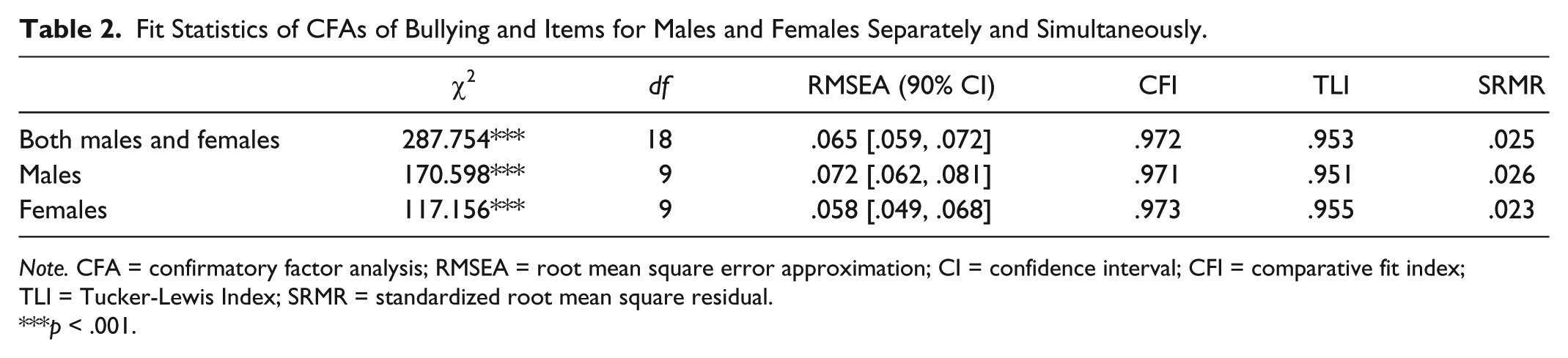
Note. CFA = confirmatory factor analysis; RMSEA = root mean square error approximation; CI = confidence interval; CFI = comparative fit index; TLI = Tucker-Lewis Index; SRMR = standardized root mean square residual.
p < .001.
The first constraint that was applied set the factor loadings equal to zero while freely estimating intercepts and all other parameters to examine metric invariance. This model fit well (χ2 = 431.813, df = 23, RMSEA = .071, 90% CI = [.065, .077], SRMR = .046, CFI = .957, TLI = .944, p < .001) but resulted in a significant deterioration of fit relative to the configural model, Δχ2 = 144.059, p < .001. Examination of the configural invariance model indicated that the factor mean for boys was greater than for girls. This is consistent with the literature indicating that in general, boys seem to experience more victimization and bullying than girls, up to an effect size of 0.50 (Nansel et al., 2001; Pellegrini & Long, 2002). Scalar invariance was then examined by constraining both factor and parameter means to zero to determine whether individual parameters differed significantly between the two groups and contributed to the decrease in fit in the metric invariance model. The model not only fit well (χ2 = 528.026, df = 29, RMSEA = .070 90% CI = [.065, .075], SRMR = .046, CFI = .948, TLI = .946, p < .001) but also showed a significant deterioration in fit from the previous metric invariance model, Δχ2 = 96.213, p < .001. Therefore, a series of additional models, each fixing a different parameter mean in both groups, were fitted and corresponding χ2-difference tests were examined to determine which parameter(s) contributed to the noninvariance. It was found that constraining bullying or harassment due to gender as well as due to other reasons significantly deteriorated the models. Indicator means from the configural invariance model indicated that girls tended to report more bullying or harassment based on gender as well as based on other reasons. The increased rate of bullying/harassment experienced by girls based on gender is also consistent with previous studies (Lipson, 2001; Pellegrini, 2001; Schnoll, Connolly, Josephson, Pepler, & Simkins-Strong, 2015; Shute, Owens, & Slee, 2008).
These results allowed us to establish that the one-factor model exhibits partial measurement invariance between boys and girls (Vandenberg & Lance, 2000), contributing to the items’ criterion validity. The fact that the factor means confirmed the prior-established pattern in the literature of increased victimization experiences for boys than for girls (Nansel et al., 2001; Pellegrini & Long, 2002) and that the indicator means matched a pattern established in the literature of increased victimization experiences related to gender for girls than the boys (Lipson, 2001; Pellegrini, 2001; Schnoll et al., 2015; Shute et al., 2008), allowed us to conclude that continued analysis using this one-factor structure was appropriate.
MANOVA
The assumption of multivariate normality was met given univariate normality and the large sample size. The assumption of homogeneity of covariance matrices was also met due to the large sample size despite results of Box’s M test, Box’s M = 189.17; F = 9.20 (20, 17,718.64), p < .001. There were no multicollinearity issues. Therefore, the MANOVA was conducted. Wilk’s criterion indicated that the combined dependent variables significantly affected the difference between at least two groups within the independent variables of victim status, F(8, 17728) = 30.19, p < .001. Three of the constructs made a unique contribution to the linear combination of dependent variables: belief-in-self, F(2, 8870) = 63.47, p < .001; belief-in-others, F(2, 8870) = 30.56, p < .001; and engaged living, F(2, 8870) = 52.94, p < .001; whereas emotional competence did not make a significant contribution, F(2, 8870) = 3.56, p = .021. A corrected alpha level of .05 / 4 = .0125 was used.
Post Hoc ANOVAs
Because of the significance of the MANOVA, follow-up ANOVAs were conducted to further examine which victim status groups—none, some, or frequent victimization—had significant differences among these three significant SEHS-S constructs (Table 3). An adjusted alpha level of .05 / 9 = .006 was used. For all three constructs, significant differences were found between No Victimization and Some Victimization groups (p < .001), with No Victimization groups scoring higher on all constructs. No significant differences were found between the Some Victimization group and the Frequent Victimization group, except for belief-in-others.
Post Hoc ANOVAs.

Note. CI = confidence interval.
We can conclude that belief-in-others decreased as frequency of victimization increased. Belief-in-self and engaged living also decreased as victimization increased but only between those with none and some victimization experiences; that is, more frequent victimization was not associated with any further deterioration of belief-in-self or engaged living. There were no significant differences found between victimization groups in regard to the emotional competence construct. Plots of the scores on the various covitality constructs by victim status are displayed in Figure 1.

Profile plots for the SEHS-S subscales (belief-in-self, belief-in-others, emotional competence, and engaged living) by victimization groups (N = no victimization, S = some victimization, and F = frequent victimization).
ANOVAs for Psychological Distress Indicators
Significant differences were found in the responses to the self-reported depression items between the No Victimization and Some Victimization groups. The difference in depression item responses between the Some Victimization and Frequent Victimization groups was nonsignificant. For suicidality, significant differences were seen between all three groups. However, the difference between the Some and Frequent Victimization groups was almost double that between the No and Some Victimization group. That is, there was disproportionately more prevalence of suicidality at higher rates of victimization (see Table 4), although as shown in Figure 2, regardless of victimization status, most students were not excessively sad or suicidal during the previous 12 months.
Planned Comparisons of Psychological Distress Indicators for Victimization Group.

Note. CI = confidence interval.

Profile plots of responses to the YRBS suicidality and sadness items by victimization groups.
Discussion
Research in the past decade or so has acknowledged the need to view mental health from a holistic dual-factor lens that assesses deficits as well strengths, and this study offers another perspective with which to consider the effects of victimization on youth’s social-emotional functioning from a complete mental health perspective. Although the association between victimization of psychosocial distress is well-established, less is known about how bullying is related to constructs that support overall well-being, such as those measured by the SEHS-S. This provided an opportunity to explore positive psychological constructs in this study.
Our analyses indicated that certain aspects of positive psychosocial health begin to deteriorate at bullying rates below the frequency of victimization that has been previously associated in the literature with symptoms of psychological distress (Solberg & Olweus, 2003) and that some of these deteriorations are significant only at lower frequencies and not for higher frequencies of victimization. In particular, belief-in-self, belief-in-others, and engaged living all showed significant deterioration at levels of bullying that occurred at once a month or less frequently. Belief-in-self showed a larger decrease at lower levels of victimization than at higher levels; effect sizes were small and significant between groups with none and some victimization, whereas the effect size between the groups with some and frequent victimization was negligible and nonsignificant. Specifically, for belief-in-self and engaged living, any amount of bullying, even at low frequencies, is worse than not experiencing bullying at all, and further bullying at higher frequencies does not seem to significantly exacerbate these diminishments. That is, even at lower levels of victimization, we see diminishment in certain aspects of well-being with more frequentvictimization only resulting in further diminishment for belief-in-others.
Prior studies have only looked at self-efficacy for aggression and assertion in bullies and victims (Andreou, 2004; Andreou et al., 2005) but not at general self-efficacy and not at other aspects of belief-in-self, such as self-awareness and persistence. The diminishment in belief-in-others for victims of bullying is corroborated by prior research indicating that such youth generally have less cohesive family structures (Berdondini & Smith, 1996; Bowers et al., 1992) and experience less teacher and peer support (Flaspohler et al., 2009; You et al., 2008). The construct of engaged living has been minimally researched as it relates to bullying—only one study examined and found decreased optimism for victims of bullying (Cassidy & Taylor, 2005)—and, hence, this finding is a contribution to the literature.
Belief-in-others seemed to have the largest effect overall, short of suicidality and depression. A plausible explanation for this is that perhaps bullying might not lead directly to mental health problems but, rather, that it undermines important internal and external assets that support personal coping. That is, it might be the case that youth who succumb the most to mental health problems related to bullying victimization are those who see their personal and social support system compromised first. However, absent longitudinal and/or mediational studies, no definitive causal pathway can be concluded.
It is important to note that although the differences in these various positive psychology constructs were significant, the effect sizes were mostly negligible or small. Perhaps this shows that many youth tend to be resilient and are able to adapt and cope in the face of victimization experiences. There is some support for this in resilience research (Masten, 2001) but, again, longitudinal and/or mediational studies are needed to further examine this hypothesis.
Limitations and Future Directions
This study used six items on the CHKS that asked students about specific experiences related to victimization. Although we took steps to ensure that this measure addresses aspects of bullying, future research should use more well-established bullying measures. In addition, the CHKS victimization items might have captured individuals who are both bullies and victims. Future studies should use a more complete measure of bullying in addition to teasing apart the various victim and bully categories. Furthermore, examination of negative mental health outcomes utilized only two items on the YRBS, neither of which was developed specifically as screener for depression or suicidality. Hence, using more comprehensive measures of negative mental health outcomes would enhance future studies.
The sample used in this study included schools that were interested and motivated to have their students take the SEHS-S. Within these schools, the SEHS-S was given to students after two other lengthy surveys. This may have decreased the response rates for the SEHS-S, which in turn limits generalizability. As a result, there may have been unrecognized bias introduced into the study. The sample was predominantly Latino/a and undersampled other minority groups. Future studies should consider using samples that are representative of these other sociocultural groups.
Future analyses might also consider using Greenspoon and Saklofske’s (2001) framework, later replicated by Suldo and Shaffer (2008), to examine the particular pattern of strengths and weaknesses in victims of bullying compared with a normative sample. That is, it may be of interest to look at categories of individuals with high strengths and low deficits, low strengths and high deficits, high strengths and high deficits, and low strengths and low deficits. In addition, longitudinal studies and/or those that involve mediational analyses should examine whether the diminishment of positive strengths is a precursor to more obvious signs of deficit. Such examination might also contribute to the literature on promoting resilience and the maintenance of positive psychological strengths in victims of bullying. In line with this purpose, it would also be useful to examine which measures are most sensitive to early changes in well-being and can best predict changes in other constructs that may occur with sustained and/or more frequent experiences of victimization.
Conclusion
Our examination of positive psychology constructs that contribute to overall social-emotional health in the context of bullying provides a holistic view of bullying that might potentially lead to changes in how researchers and practitioners assess for mental health issues in schools. In the present study, rates of victimization even less than 2 to 3 times per month were associated with detrimental effects on many of the constructs that contribute to overall subjective well-being, including diminishments in zest, optimism, and gratitude, which previous researchers (Froh et al., 2014; Froh, Sefick, & Emmons, 2008; Peterson, Ruch, Beermann, Park, & Seligman, 2007; Seligman, 2011) have demonstrated are associated with subjective well-being and happiness. One implication of this finding is that the SEHS-S could be used to identify students who are exhibiting early indications of diminished life quality indicators (Furlong et al., 2014). For example, when a youth is bullied, it is not a neutral experience because he or she must somehow consider what has happened to them, what it means for him or her as a human being, and how he or she will manage, cope, and respond to it (Renshaw et al., 2014). Knowing that bullying is associated with decreases in the very assets and resources that support positive adaptive responses to bullying provides motivation for educators to be mindful of and recognize that the prevention of more serious long-term mental health problems might be enhanced by implementing programs and strategies that cultivate the development of social-emotional strengths such as belief-in-self, belief-in-others, and engaged living for victims of bullying.
Footnotes
Declaration of Conflicting Interests
The author(s) declared no potential conflicts of interest with respect to the research, authorship, and/or publication of this article.
Funding
The author(s) received no financial support for the research and/or authorship of this article.