




Abstract
What, in the 21st century, is our vision of the “good society,” and what are the obstacles to its realization? What is the ideal mix of equality and tradition, individual initiative and social welfare, economic prosperity and environmental responsibility, national unity and respect for diversity? Research suggests that liberals and conservatives differ considerably in the prioritization of these values, but nearly all of this research makes use of closed-ended responses to questionnaire items. To examine ideological similarities and dissimilarities in value expression and social representation when it comes to relatively open-ended communication in online social media networks, we used quantitative text-analytic methods to analyze more than 3.8 million messages sent by over 1 million Twitter users about what constitutes a good (vs. bad) society. Results revealed a fairly high degree of ideological divergence: Liberals were more likely to raise themes of social justice, global inequality, women’s rights, racism, criminal justice, health care, poverty, progress, social change, personal growth, and environmental sustainability, whereas conservatives were more likely to mention religion, social order, business, capitalism, national symbols, immigration, and terrorism, as well as individual authorities and news organizations. There were also some areas of convergence: Liberals, moderates, and conservatives were equally likely to prioritize economic prosperity, family, community, and the pursuit of health, happiness, and freedom.
Keywords
What is the good life? What is the good man? The good woman? What is the good society and what is my relation to it? What are my obligations to society? What is best for my children? What is justice? Truth? Virtue? What is my relation to nature, to death, to aging, to pain, to illness? How can I live a zestful, enjoyable, meaningful life? What is my responsibility to my brothers? Who are my brothers? What shall I be loyal to? What must I be ready to die for?
At the most abstract level, politics is—at least in principle—a mechanism for bringing into fruition the elements of a “good society” and avoiding the elements of a “bad society.” For this reason, a litany of philosophers and social scientists over the last century have addressed fundamental questions about what constitutes a good (or great) society and how to achieve such a society (e.g., Bellah, Madsen, Sullivan, Swidler, & Tipton, 1991; Galbraith, 1996; Lippmann, 1937; Murdoch, 1970; Rustin, 1991; Shiller, 2012; Wallas, 1914; Wright, 2010). Given what we know about the role of political ideology, it stands to reason that liberals and leftists would gravitate toward somewhat divergent—as well as potentially convergent—conceptions of the good (and bad) society, in comparison with conservatives and rightists, respectively (e.g., Bobbio, 1996; Jost, 2006; Laponce, 1981). Those on the left and right may also possess rather different ideas about how to approach the good society and avoid the bad society.
Most, but not all, contemporary social scientists agree that, by historical standards, politics today in the United States and many other Western democracies is especially divided along ideological lines (e.g., Abramowitz, 2010; Groskopf, 2016; Grossmann & Hopkins, 2016; Levendusky, 2009; McCarty, Poole, & Rosenthal, 2006; Pew Research Center, 2014; Schier & Eberly, 2016). We submit that at least some ideological conflict and polarization in politics is attributable to divergent conceptions of the good (and bad) society. If it were possible to identify significant areas of convergence and divergence with respect to these conceptions, it may suggest ways—at least in theory—of attenuating, if not overcoming, ideological conflict and polarization by (a) working together on shared goals and (b) ideological log-rolling, that is, exchanging trade-offs on unshared goals (see Krochik & Jost, 2011).
A Few Illustrative Examples on the Left and Right
A few examples may help to illuminate some of the most likely areas of ideological divergence when it comes to representations of the good (and bad) society. On the liberal-left, for instance, the American philosopher of education, John Dewey, declared that The good society was, like the good self, a diverse yet harmonious, growing yet unified whole, a fully participatory democracy in which the powers and capacities of the individuals that comprised it were harmonized by their cooperative activities into a community that permitted the full and free expression of individuality.
1
Dewey’s emphasis on diversity, harmony, participatory democracy, cooperation, community, and individual expression contrasts fairly sharply with the vision articulated by the conservative intellectual Russell Kirk, who argued that The good society is marked by a high degree of order, justice, and freedom. Among these, order has primacy: for justice cannot be enforced until a tolerable civil social order is attained, nor can freedom be anything better than violence until order gives us laws.
The French feminist theorist Simone de Beauvoir hardly shared this reverence for social order, but she cared deeply for justice and freedom. She avowed, “If you are truly on the left, if you reject ideas of power and hierarchy, what you want is equality. Otherwise, it won’t work at all.”
On the right, J. Edgar Hoover, who served an astonishing 48 years as the Director of the U.S. Federal Bureau of Investigation, cared very little for equality. In his youth, he opposed women’s suffrage and defended capital punishment. Once in a position of power and authority, Hoover used his office to spy on (and blackmail) suspected Communists and Communist sympathizers, homosexuals, and African American civil rights leaders, among many others. He sternly warned, “When morals decline and good men do nothing, evil flourishes. A society unwilling to learn from its past is doomed. We must never forget our history.” Edmund Burke made the veneration of history and tradition one of the cornerstones of his spirited resistance to the French Revolution and the Enlightenment ideals that drove it, inspiring conservatives to resist progressive forms of social change for over 200 years. Burke also emphasized the role of religion in a good society, writing that “Religion is the basis of civil society, and the source of all good and of all comfort.” In strong contrast, the liberal–left writer–provocateur Gore Vidal dismissed the importance of religion: “The idea of a good society is something you do not need a religion and eternal punishment to buttress; you need a religion if you are terrified of death.”
Although these quotations were hardly chosen at random, they do illustrate, at least anecdotally, some of the key ideological differences when it comes to conceptions of the good society. Specifically, they highlight the ways in which leftists profess a commitment to diversity, equality, harmony, cooperation, community, and personal expression, whereas rightists profess a commitment to social order, morality, history, tradition, religion, and freedom. These differences, in turn, are broadly consistent with several decades of social psychological theory and research on liberal–conservative differences in the prioritization of terminal values, that is, ends or outcomes that are seen as desirable in their own right (see also Jost, Basevich, Dickson, & Noorbaloochi, 2016).
Social Psychological Theory and Research Value Priorities
Milton Rokeach (1973), who pioneered the study of individual and group differences in value priorities, proposed a taxonomical understanding of political systems (and ideologies). Specifically, he argued that liberal–socialists valued both equality and freedom highly, whereas conservative–capitalists valued freedom but not equality, Communists valued equality but not freedom, and fascists valued neither freedom nor equality. To explore these ideas, Cochrane, Billig, and Hogg (1979) went door-to-door in British neighborhoods that were known to support various political parties and, in the course of their interviews, found some support for Rokeach’s (1973) ideas. They confirmed that socialists (Labor supporters) and Communists did value equality very highly—as well as “a world at peace.” Conservatives and fascists did not place nearly as high a premium on equality; instead, they favored personal happiness and family security. Somewhat surprisingly, all of these groups professed a commitment to freedom, although they presumably held rather different notions about what freedom meant.
In the Australian context, Braithwaite (1994) discovered that liberals and leftists greatly valued harmony, understood in terms of equality, peace, humanism, personal growth, and individual expression. Conservatives and rightists, on the other hand, greatly valued security, understood in terms of social order, national strength, propriety in dress and manners, and desire for social standing. Consistent with the foregoing observations, work by Tetlock (1984, 1986) in the United States and United Kingdom suggested that liberals and conservatives differed in value priorities pertaining to equality, freedom, national security, economic prosperity, personal privacy, and environmental protection. Research by Graham et al. (2009) showed that liberals and leftists in the U.S. valued fairness and harm avoidance more than conservatives and rightists, whereas conservatives and rightists valued in-group loyalty, obedience to authority, and purity (or sanctity) more than liberals and leftists.
By far the most comprehensive theory of left–right differences in personal values is Shalom Schwartz’s (1992) Value Circumplex Model. Remarkably, consistent evidence of ideological divergence in value prioritization comes from very large-scale studies (often based on nationally representative samples) carried out in Austria, Belgium, Denmark, Finland, France, Germany, Greece, Ireland, Israel, Italy, Netherlands, Portugal, Spain, Switzerland, United Kingdom, and United States. Leftists generally place more value than rightists on universalism, benevolence, self-direction, and “openness to change.” Rightists, on the other hand, place more value than leftists on conformity, tradition, security, and (sometimes) power and achievement (Caprara, Schwartz, Capanna, Vecchione, & Barbaranelli, 2006; Devos, Spini, & Schwartz, 2002; Jost et al., 2016; Piurko, Schwartz, & Davidov, 2011; Schwartz, Caprara, & Vecchione, 2010; Vecchione, Caprara, Dentale, & Schwartz, 2013).
According to a theory of political ideology as motivated social cognition proposed by Jost, Glaser, Kruglanski, and Sulloway (2003), leftists—since the time of the French Revolution—have been motivated to attain greater social, economic, and political equality, and this leads them to embrace social change (and, if necessary, to challenge tradition). Rightists, by contrast, have been motivated to maintain tradition (and social order), and this leads them to defend and justify existing social, economic, and political hierarchies (or inequalities). These motivational tendencies to advocate versus resist social change and to accept versus reject inequality, in turn, are linked to underlying differences in epistemic, existential, and relational needs to reduce uncertainty, threat, and social discord (Jost, Ledgerwood, & Hardin, 2008). That is, liberals are not only more open to social change and social, economic, and political equality in comparison with conservatives, they are also more tolerant of uncertainty, ambiguity, threat, vulnerability, personal deviance, and social dissent (e.g., Jost, 2006, 2017; Kandler, Bleidorn, & Riemann, 2012). As a result, they tend to be more critical of the societal status quo; that is, in the United States, liberals generally express less favorable attitudes about American society, in comparison with conservatives (Jost et al., 2017).
A Study of Social Media Usage
Our review thus far suggests that there are likely to be competing conceptions of the good society on the political left and right. Anecdotal observations and questionnaire-based research in social psychology suggest that at least in terms of self-reported values, liberals and leftists are more likely than conservatives and rightists to prioritize: equality, fairness, social justice, and participatory democracy; progress, hope, and social change; harmony, cooperation, and world peace; personal growth and expression (including an appreciation for art and culture); self-direction, personal uniqueness, and deviance; universalism, benevolence, and harm avoidance; environmental sustainability; and a prominent role for science, evidence, and reason in society. Conservatives and rightists, on the other hand, are more likely than liberals and leftists to state their commitments to hierarchy, authority, power, and dominance; tradition, social order, and stability; strength, competition, and national security; personal happiness and family values; conformity, consensus, and conventionalism; in-group loyalty and favoritism; economic enterprise, efficiency, and profit; and religious faith and devotion (Jost et al., 2016).
It does not follow from any of this, however, that there are no meaningful areas of ideological overlap when it comes to images of the good society. It may well be that at least in the context of Western-style democracies, many on the left and right share values related to community, solidarity, economic prosperity (in terms of jobs, wages, and productivity), freedom, and individual rights and liberties. Martin Luther King, Jr., for instance, insisted that “Good and just society is neither the thesis of capitalism nor the antithesis of communism, but a socially conscious democracy which reconciles the truths of individualism and collectivism.” It is an empirical question, however, as to whether (and to what extent) ordinary citizens today appreciate aspects of individualism and collectivism, equality and freedom, progress and tradition, liberalism and conservatism, when it comes to their conceptions of the ideal society. This is the question we seek to address in the present study.
More specifically, we set out to identify areas of ideological convergence and divergence with respect to conceptions of the good (and bad) society in a semantic analysis of the contents of informal social media messages sent by ordinary citizens (rather than political or cultural elites). This approach enabled us to sample very large numbers of individuals and to take a relatively unobtrusive (or nonreactive) approach to understanding their value priorities and social representations (e.g., Moscovici, 2001). That is, unlike standard self-report measures, individuals studied in this fashion need not be consciously (or introspectively) aware of the ways in which their own values differ from those of others—or how those values relate to their political beliefs and opinions in order for our text-based methods to detect them. Our method also presumably mitigates, at least to some degree, concerns about experimenter effects, which are often considerable when it comes to studies that are reliant upon the method of verbal self-report (see, for example, Webb, Campbell, Schwartz, & Sechrest, 1969). Because we were also able to estimate individual users’ ideological positions in an unobtrusive manner, we are in a position to assess areas of liberal–conservative convergence and divergence with respect to representations of the good (and bad) society.
Method of Data Collection, Classification, and Processing
On the assumption that these representations would be reflected in (and disseminated through) social media messages, we collected tweets sent over a 9-month period (between September 8, 2015 and June 7, 2016) containing (a) society, world, and/or system, and (b) at least one of the following evaluative words: good, great, wonderful, ideal, evil, bad, terrible, awful, horrible, fair, unfair, better, worse, best, worst, just, and unjust. We also collected tweets during this time period that included either utopia[n] or dystopia[n]. After excluding 1.2 million non-English language tweets, we retained a sample of 28,260,567 tweets for further analysis. We then implemented a follower-based method in an attempt to generate point estimates of the ideological position of every Twitter user in this sample (for a description of this method, see Barberá, 2015; Barberá, Jost, Nagler, Tucker, & Bonneau, 2015). Users who did not follow three or more U.S. political elites (the minimum required to use this estimation method) were excluded from analysis. Clearly, this means that our sample is not statistically representative of the general public; it is intended only to be representative of English-speaking social media users who are politically active on Twitter.
The final sample consisted of 3,874,924 tweets sent by 1,066,915 individual users. Because the ideological estimation method is based on users’ decisions to follow the Twitter accounts of U.S. elites, the final sample presumably retains a higher proportion of U.S. (vs. non-U.S.) respondents, compared with the initial sample, although we were unable to determine the location or residency of most users. (English language speakers from other countries were not excluded.) To compare representations of the good (and bad) society among liberals and conservatives, we classified as “liberal” those Twitter users in our final sample who were at least half a standard deviation below the ideological mean (N = 473,246 users; 1,692,430 tweets) and as “conservative” those who were at least half a standard deviation above the mean (N = 223,943 users; 981,144 tweets). 2
All of the tweets retained were processed to accommodate the requirements of structural topic modeling. First, tweets were collapsed by day (separately for liberals and conservatives), so that each day’s set of tweets constituted either a liberal or conservative “document.” Next, we stripped whitespace; stemmed words using a snowball method; converted words to lowercase; and removed numbers, punctuation, weblinks, English stop-words, and sparse terms (appearing in <5% of documents) using the STM R package (Roberts, Stewart, & Tingley, 2014). Finally, we removed the keywords used to collect the data along with case-specific stop-words (rt, amp, http, https, will, make, can).
Analysis of Textual Data
For our primary analysis, we estimated two structural topic models (STM; Roberts, Stewart, & Tingley, 2014). These methods provide a quantitative summary of the language used to evaluate society while taking into account the influence of a key covariate, namely political ideology. We can then isolate the effect of ideology on an individual’s likelihood of mentioning specific themes (or topics) to assess whether there are or not systematic differences between liberals and conservatives when it comes to mentioning these topics. Moderates (or centrists) were excluded from most analyses, because the methods we used require a binary group classification to determine which words or topics are most predictive of category membership. These methods are most effective when the two contrasting categories reflect text generated by members of clearly separated groups.
We used the STM R package to compute STM based on (a) all messages sent by liberals and conservatives that originally included positively valenced evaluative words (e.g., good, fair) on the assumption that these were likely to capture conceptions of the good society; and (b) all messages sent by liberals and conservatives that originally included negatively valenced evaluative words (e.g., bad, unfair) on the assumption that these were likely to capture conceptions of the bad society. Examples of positively and negatively valenced tweets are provided in Table 1. The most frequently used evaluative terms in our sample were better (n = 537,338), good (527,772), best (171,742), bad (169,962), and just (167,289). The most frequently used societal-level terms were world (n = 962,837), system (298,609), and society (126,531).
Selected Examples of Positively and Negatively Valenced Tweets.

Note. Some tweets have been edited for brevity or clarity (or both).
The number of topics (K) was determined by generating models in increments of five based on potential Ks ranging from 10 to 100. We selected the K with the highest external validity and with the most semantically coherent and distinctive topics (Grimmer & Stewart, 2013; Wallach, Murray, Salakhutdinov, & Mimno, 2009). There were diminishing returns for Ks above 30 for both models; topic contents became redundant in larger K data sets.
After the STM were estimated, three independent coders read through the top 20 words in each topic and independently generated a topic label. The coders were members of the NYU Social Media and Political Participation (SMaPP) Laboratory, but they were unaware of the purpose of the study and the ideological orientations of social media users. They received the following instructions from the lead author: I have attached [several] .txt documents. These documents have either 30 or 50 groups of words or topics. What you are to [do is to] consider all the words in each topic (e.g., Topic one, look at Highest prob, FREX, Lift, and Score line; descriptions in the 50 file, but these are less important) and try to figure out what topic people who use these words are likely to be discussing. Topics can be very narrow: Paris attacks or very broad: US politics. Try to make as specific of a judgment as you can given the words provided. For instance (and none of the examples attached will be this clear), if you see the words park, lease, food, bark, scratch, jump, run, cage, you would guess that the topic is about dogs. Make your best guess, it will be difficult to determine sometimes. If you have some guesses, include them all separated by a “/”. If you really have no idea, just put two question marks “??”.
Thus, all labels were generated by members of our research team in the absence of any knowledge of the effect of ideology on the use of that topic. After labels were generated, coders read the five most representative documents per topic (according to the findThoughts function) to assess the substantive meaning of the topics and to validate topic labels. The final topic labels, which are listed in the Supplemental Online Appendix, were determined by majority rule (i.e., preferred by at least two of the three independent coders). Topics for which no agreed upon label could be generated were excluded from our primary analyses; they are represented in some figures as “Indeterminate.”
In addition to the STM, we conducted a parallel set of comparison word cloud analyses, which enabled us to compare the most distinctive words used when discussing the “good” versus “bad” society by (a) liberals versus conservatives when discussing the “bad society,” (b) liberals versus conservatives when discussing the “good society,” and (c) the entire sample. Word clouds were generated using the contrast cloud function in the quanteda R package (Benoit, 2018). Although retweets were included in the STM described above, we present the results of word clouds with and without retweets included. The latter summaries were generated as part of a sensitivity analysis to insure that our effects were robust to the influence of extremely popular messages that were highly retweeted.
Results
With respect to representations of the “bad society,” we observed that there was a statistically significant effect of ideology on the likelihood of discussing 24 of the 30 topics, suggesting a potentially high level of divergence (see Figure 1). Consistent with our theoretical expectations, liberals were more likely than conservatives to mention themes of global inequality, women’s rights, racism, criminal justice, “broken system,” and health care. They were also more likely to mention the Democratic primary, Bernie Sanders, negative politics, and (somewhat surprisingly) terror attacks. 3 Conservatives were more likely to mention themes of Islamic terrorism, the Republican primary, Fox News, Donald Trump, Presidential leadership, economy and trade, and cultural conservatism. They were also more likely to criticize President Obama, Black Lives Matter, and policy failures. In this analysis, there were no differences between liberals and conservatives in mentions of education, taxes, gun control, the election, or the Republican Party.

Parameters estimate of the effect of political ideology on the 30 topics estimated from language related to a “bad society.”
Comparison word clouds are shown in Figure 2a (including retweets) and 2b (excluding retweets). An inspection of these figures suggests that in writing about the “bad society,” liberals were more likely than conservatives to use words and phrases such as inequality, justice, injustice, poor, poverty, food (insecurity), and go without, as well as corruption, change, reform, reason, think, read, and pesticide. Conservatives, on the other hand, were more likely than liberals to use words and phrases such as Muslim, Islam(ic), terror(ist), ISIS, moral, order, control, religion, pray, Jesus, Christian, God, hell, devil, Satan, Jew, Israel, Iran, security, immigrant/immigration, left, Socialist, enemy, destroy, disastrous, loss, kill, murder, gun, and crime. Conservatives were also more likely to cite individual authorities (such as Obama, Clinton, Trump, and Cruz) and news organizations (Fox News, CNN).

Comparison word clouds displaying ideologically divergent representations of the “bad society”: (a) includes all tweets collected and (b) excludes retweets.
With respect to representations of the “good society,” there was a statistically significant effect of ideology on the likelihood of discussing 25 of the 30 topics, suggesting a potentially high level of divergence (see Figure 3). Liberals were more likely than conservatives to discuss themes such as education funding, climate change, climate future, clean energy, political mobilization, political reform, diversity and equality, economy and trade, Hillary Clinton, Bernie Sanders, and “standing together.” They were also more likely to mention holiday celebrations (and the death of David Bowie) and to criticize the far-right. Conservatives were more likely to discuss themes associated with the far-right, religion, the refugee crisis, immigration debate, politics and corruption, the Republican and Democratic primaries, civil liberties, death and violence, and (surprisingly) economic inequality (as reflected in the use of words such as rich, champion, photo, watch, hope, free, belief, care, less, ELS, innocent). For this model, no ideological differences emerged with respect to mentions of the Paris attacks, President Obama and world peace, fighting racism, or news in general.
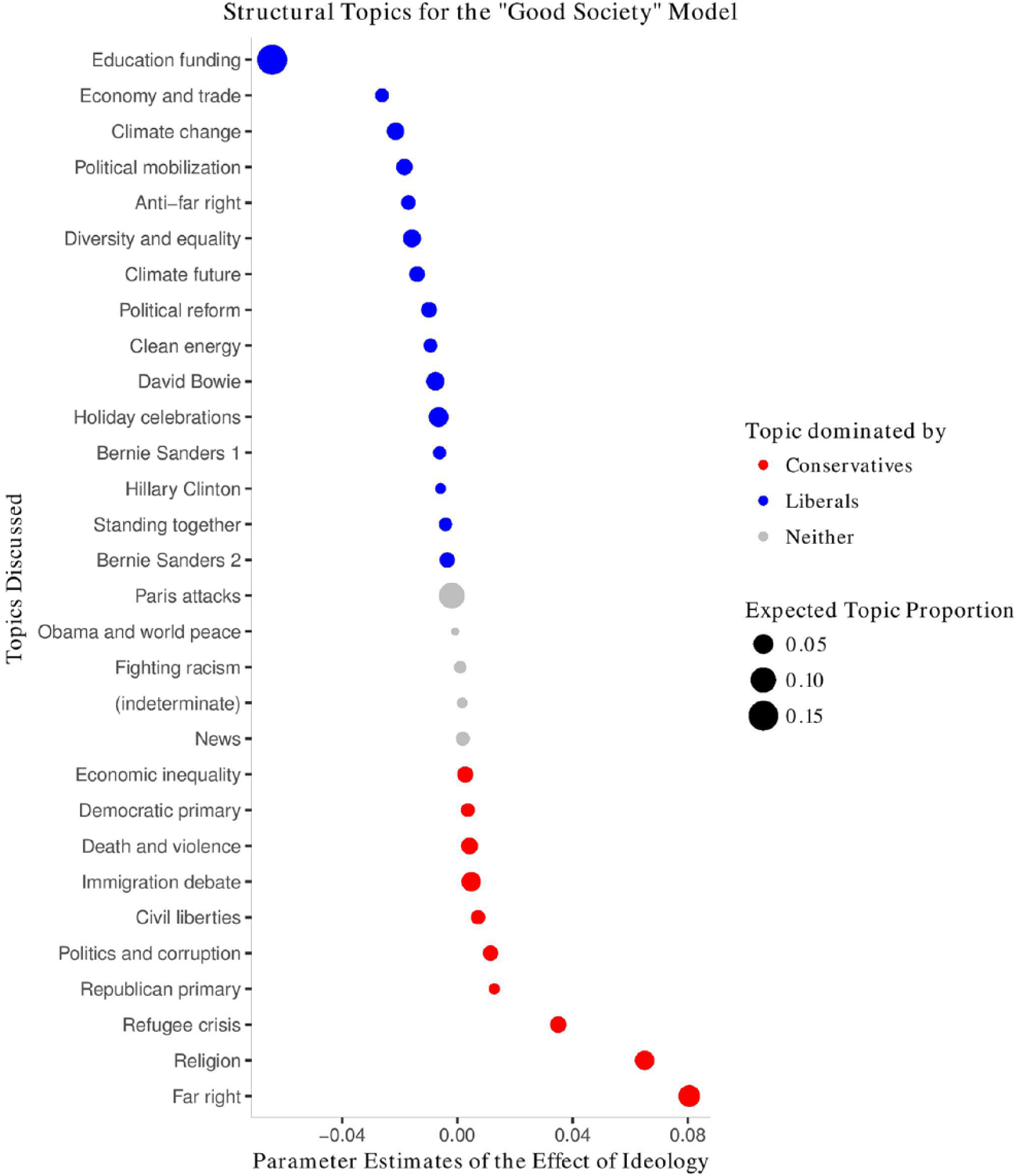
Parameter estimates of the effect of political ideology on the 30 topics estimated from language related to a “good society.”
An inspection of word clouds shown in Figure 4a and 4b suggests that in writing about the “good society,” liberals were more likely than conservatives to use words and phrases associated with change, economics, 4 work, trade, education, justice, need, food, help, deserving(ness), climate change, future, clean energy, human, women, share, together, community, love, peace, hope, happiness, vision, and inspiration. Conservatives were more likely than liberals to use a very different set of words and phrases, such as America, USA, country, nation, order, control, Fox News, Trump, Cruz, God, Jesus, Christian, Jew, Muslim, Islam, immigration, border, terrorist, leftist, socialist, Communist, wealth, business, capitalism, free(dom), and liberty. Taken in conjunction, the differences we observed resonated rather strongly with some of the differences in values and motives suggested by the research literature in social psychology, including the observations that (a) liberals are especially likely to prioritize social justice and global equality; peace, hope, progress, and change; personal growth, creative inspiration, and expression; and environmental sustainability; and (b) conservatives are especially likely to prioritize religious tradition, social order, control, capitalism, nativism, and symbols of system justification such as America and the USA. To provide some concrete examples, several instances of liberal tweets expressing support for social change and/or the rejection of inequality and conservative tweets expressing support for tradition and/or hierarchy are listed in Table 2.

Comparison word clouds displaying ideologically divergent representations of the “good society”: (a) includes all tweets collected and (b) excludes retweets
Selected Examples of Tweets Sent by Liberals Expressing Support for Social Change and/or the Rejection of Inequality and Conservatives Expressing Support for Tradition and Hierarchy.

Note. Some tweets have been edited for brevity or clarity (or both).
Finally, we turn to areas of convergence with respect to elements of the good and bad society. In Figure 5a and 5b, we show comparison word clouds based on messages sent by everyone in the sample (regardless of political orientation) when discussing the “good” versus “bad” society. This enables to identify the potential for agreement with respect to positive and negative conceptions of society. We see that irrespective of ideological differences, social media users in general highlighted a number of themes concerning economic prosperity (including buy, sell, trade, work, business, tax, wealth generation, and U.K. disability insurance, namely PIP), community and solidarity (including everyone, together, build, hope), harm reduction (death, violence, terrorism), the pursuit of health, happiness, freedom, family (love, children, play), and a number of values that are typically associated with liberal as opposed to conservative priorities, such as need, change, progress, vision, and dream. This last observation, at least, may be consistent with the notion that ordinary citizens are often “operational” liberals (when it comes to specific issues and priorities), even when they identify as “symbolic” conservatives, who gravitate toward conservative, patriotic, and nationalistic labels (Ellis & Stimson, 2012).

Comparison word clouds displaying ideologically convergent representations of the “good” and “bad” society: (a) includes all tweets collected and (b) excludes retweets.
General Discussion
In a book entitled The Good Society, the economist John Kenneth Galbraith (1996) noted that “Among the great nations of the world none is more given to introspection than the United States. No day passes without reflective comment . . . on what is wrong in society and what could be improved” (p. 1). Our study of social media usage suggests that such comments are indeed frequently exchanged on Twitter (and, presumably, other communication platforms as well). Furthermore, the themes that we found to be most discussed by ordinary citizens closely resemble the table of contents that Galbraith himself came up with when spelling out the elements of “a compassionate and fiscally sound nation,” namely economic productivity and prosperity, poverty and inequality within and between nations, education, health care, environmental sustainability, peace, diplomacy, and sound immigration policies. For the most part, these are priorities that nearly everyone recognizes as worthwhile.
At the same time, most social scientists agree that we are living through ideologically polarized times, and there are many things on which liberals and conservatives seem to disagree. Overall, we observed fairly high levels of ideological divergence with respect to conceptions of the “good” and “bad” society; with respect to 60 topics (total), we found that 49 topics received significantly more attention from one side than the other. According to the theory of political ideology as motivated social cognition, liberals are driven more by concerns for equality, social justice, progress, and social change, whereas conservatives are driven more by concerns for social stability, order, tradition, and hierarchy (Jost, 2006; Jost et al., 2003). Conservatives also tend to be more protective of the legitimacy of existing social, economic, and political institutions and arrangements, in comparison with liberals (Jost et al., 2017). We found considerable evidence of ideological divergence along these fault lines when we analyzed nearly 1.7 million tweets sent by liberal social media users and nearly 1 million tweets sent by conservative social media users.
Specifically, we observed that liberals were more likely than conservatives to raise themes of fairness, equality and inequality, poverty, social justice, women’s rights, racism, criminal justice, and participatory democracy; progress, hope, protest, and social change; harmony, cooperation, and world peace; and environmental stability. Conservatives, on the other hand, were more likely than liberals to mention religion (including Islam, Christianity, and Judaism), business, capitalism, national symbols (America, USA), immigration, terrorism, crime, violence, social order and control, and death, as well as individual authorities and news organizations.
Our analyses also turned up a few surprises. We saw no evidence that liberals and conservatives differed in terms of preferences for “small” versus “large” government, uniqueness versus conformity, or scientific versus intuitive forms of knowledge. Unexpectedly, liberals were more likely than conservatives to cite economic themes when discussing the “good society,” at least according to word-level contrast analyses, which suggested that liberals were especially likely to use financial terms such as trade, eurusd, and forex (foreign exchange). Conversely, conservatives were more likely than liberals to discuss socialism and Communism, presumably in a critical manner.
At the same time, our analysis identified several areas of convergence. Liberals and conservatives alike lamented the Paris attacks and criticized taxation policy and the electoral system. Word-level analyses revealed that themes of economic prosperity, family, community, harm reduction, health, happiness, and freedom were prevalent in conceptions of the “good society” among all social media users. Other areas of convergence may be more surprising. Liberals and conservatives appeared to use similar language when discussing President Obama, the Republican Party, and gun control, as well as a number of referents that typically connote liberal-democratic ideals, such as change, progress, vision, and dream. A useful question for future research would have to do with the extent to which liberals and conservatives agree (and disagree) on the means of approaching elements of the good society and avoiding elements of the bad, independent of the ends themselves.
There are some clear limitations associated with our methodological approach. Although we are assuming, given methods of sample selection and retention, that the overwhelming majority of the sample came from the United States, we have no easy way of confirming this assumption or restricting our analyses to U.S. residents. Furthermore, to create documents that were long enough to analyze using structural topic modeling, we concatenated all tweets sent by liberals and conservatives, respectively, on a given day. The resulting documents were, unsurprisingly, very heterogeneous, which must have added considerable noise to post-estimation interpretations of the topic models.
It is also important to keep in mind that Twitter is a communication platform that promotes the public discussion of current affairs as they unfold in real time. Thus, our analyses are confined to the expression of values and social representations that social media users chose to broadcast during the period of our data collection. An anonymous survey in which respondents are asked about a comprehensive list of values and opinions might well yield different results than we have obtained using the methods of automated textual analysis of public discourse on Twitter. We also suspect that the language we analyzed pertaining to the elements of a “good” and “bad” society was heavily influenced by contemporaneous factors, including issues that were raised during the early stages of the 2016 U.S. Presidential campaign. It seems quite likely that the degree of ideological polarization revealed by analyses of public discourse would wax and wane in relation to major societal events, such as highly contested general election campaigns—when we would expect to see evidence of heightened partisan and ideological divergence—and periods of war or other sources of external conflict—when we would expect to see evidence of heightened convergence within the same country.
Concluding Remarks
One of the very first political psychologists and a co-founder of the London School of Economics, Graham Wallas (1914) declared in The Great Society that “We must let our minds play freely over all the conditions of life till we can either justify our civilization or change it” (p. 15). The forum in which citizens today “let their minds play freely over the conditions of life” is undoubtedly the sphere of social media, for better or worse. In our research, we have observed that along with everything else, abstract questions about how society and civilization ought to proceed are indeed raised and debated in online communication platforms. Citizens of divergent ideological orientations, no doubt, differ when it comes to their beliefs about which aspects of society are justifiable, and which require change (Bobbio, 1996; Jost, 2006; Laponce, 1981). The resolution of these differences is, in many ways, the business of politics in a democratic society (Jost et al., 2016).
Before political leaders can even hope to resolve these differences—through compromise and negotiation, bargaining and trade-offs—they must be willing and able to comprehend and appreciate the areas of convergence and divergence (Krochik & Jost, 2011). It is the hope, however seemingly misplaced at the present historical moment, to nudge the conversation (even slightly) in this direction that has led us to carry out the present investigation, using the methods of quantitative textual analysis to explore liberal and conservative conceptions and representations of the good society. If the members of even a highly divisive society can agree on terminal values such as economic prosperity, family strength, community and solidarity, and the pursuit of health, happiness, and freedom, then perhaps it is possible to think more seriously about how to work together to foster the social conditions that bring them about.
Supplemental Material
Sterling-Jost-Hardin-Appendix – Supplemental material for Liberal and Conservative Representations of the Good Society: A (Social) Structural Topic Modeling Approach
Supplemental material, Sterling-Jost-Hardin-Appendix for Liberal and Conservative Representations of the Good Society: A (Social) Structural Topic Modeling Approach by Joanna Sterling, John T. Jost and Curtis D. Hardin in SAGE Open
Footnotes
Acknowledgements
The authors thank Pablo Barberá, Dean Eckles, Patrick Egan, Philip Haber, Jennifer Pan, Jamie Pennebaker, Molly Roberts, Arthur Spirling, Joshua Tucker, and two anonymous reviewers for extremely helpful comments on the presentation and/or article.
Declaration of Conflicting Interests
The author(s) declared no potential conflicts of interest with respect to the research, authorship, and/or publication of this article.
Funding
The author(s) disclosed receipt of the following financial support for the research, authorship, and/or publication of this article: This research was supported by the INSPIRE program of the National Science Foundation (Awards SES-1248077 and SES-1248077-001) as well as the Global Institute for Advanced Study (GIAS) and Social Media and Political Participation (SMaPP) Laboratory at New York University (NYU). This work was presented by the second and third authors on the campus of NYU-Shanghai.
Notes
Supplemental Material
Supplemental material for this article is available online.

Author Biographies
References
Supplementary Material
Please find the following supplemental material available below.
For Open Access articles published under a Creative Commons License, all supplemental material carries the same license as the article it is associated with.
For non-Open Access articles published, all supplemental material carries a non-exclusive license, and permission requests for re-use of supplemental material or any part of supplemental material shall be sent directly to the copyright owner as specified in the copyright notice associated with the article.
