




Abstract
The Second Congo War in the Democratic Republic of the Congo (The Congo) has been the largest humanitarian crisis in the last decade. Over five million people have died, and millions more have been displaced. During the conflict, the ostensibly neutral United States subtly sided with Rwanda and Uganda at the expense of the Congolese President Laurent Kabila. I test whether the media indexed their coverage to Washington policy. However, I expand my analysis to compare coverage leading in British and French newspapers as well. After careful examination, I discover that there is no significant difference in reporting. However, the real question of bias and framing includes issues of neutrality, the prominence of linking the Second Congo War with the 1994 Rwandan genocide, and the persistent underreporting of economic exploitation that underpinned the violence.
Keywords
Introduction
The Second Congo War in the Democratic Republic of the Congo (The Congo) has been the largest humanitarian crisis in the last two decades. Over five million people have died and millions more have been displaced in what some commentators have called “Africa’s First World War” (see Cook, 2010). The war began in August 1998 as a combined Rwandan and Ugandan attempt to oust their former pupil the Congolese President Laurent Kabila, whom they brought to power in 1996. However, that alliance ended in acrimony and bitterness, and eventually war. What complicated international attempts to end the Congolese conflict were the competing narratives of why the war started. Washington backed Rwandan and Ugandan claims of border security, and that the Congo was experiencing an internal civil war. Kabila, on the other hand claimed, and this was backed up by France that the war was a clear Rwandan and Ugandan violation of Congolese sovereignty. By 1999, the international community got everyone to sit down in Lusaka, Zambia, to create an underfunded and undermanned United Nations (UN) Organization Mission in the Democratic Republic of the Congo (MONUC). The war eventually came to a sputtering end after the assassination of Kabila by one of his bodyguards in January of 2001. 1
The Second Congo War provides us with a case study for testing theories of media framing. Most American scholarly studies of media and foreign policy have focused on places where the United States actively put boots on the ground (e.g., Bosnia, Kosovo, and Iraq) or should have (Rwanda). Second, it has often been argued that American media (and in effect all media) indexes their reporting to support Washington’s foreign policy. The old adage that politics stops at the water’s edge applied to the press as well. Robert Entman (2004) argues that the end of the Cold War weakened the “journalists’ habit of deference” (i.e., indexing), and they became critical of President Clinton’s humanitarian missions because they could (p. 107). This article hopes to add to the literature of the connections between media and American foreign policy after the Cold War in four ways. First, a large component of U.S. participation in UN peacekeeping is not providing military, but critical humanitarian and logistical aid. This article hopes to fill that gap in the literature in how the media covers these events. Second, the Congo provides us an opportunity to test whether Entman’s theories of the post–Cold War American media are correct. Third, it is important to provide a comparative perspective to a study of the American press and the Congo War. The American press is often seen as parochial and unconcerned with African conflicts. So there is much insight to be gained by comparing coverage of the Congo in the New York Times and the Washington Post with two major French newspapers (Le Figaro and Le Monde) and two major British dailies (Guardian and London Times). Putting the Congo War in a comparative press perspective challenges our global understanding of indexing. Finally, this paper hopes to make a small contribution to how Africa is examined in the Western media. Andrew Breslau (1987) argues that media coverage of African conflicts has often lacked context, sophistication and exposition (p. 6). Stories on Africa are full of poverty, political unrest, primitive war, “ancient tribal hatreds,” terrorism, and crime (see Livingstone & Eachus 1999).
To accomplish these goals, this paper is broken up into several sections. First, I will briefly examine the Second Congo War and the competing narratives of Rwanda, Uganda, and Kabila’s Congo. I will then explore the subtle yet real anti-Kabila bias in Washington. Second, this paper will look at the present literature of media effects of framing and indexing. It is in this section that we start to define and explore how to measure media bias in the Congo. If we could pinpoint possible “frames”: first, coverage of the roles Rwanda and Uganda played in the war; second, the reporting of genocide and massacres, and whether there was a discussion of a counter genocide perpetuated by Rwanda; and third, the exploitation of natural resources by all parties. These three variables will serve as functional proxies of whether a paper was biased. We will then look at the methodology of selecting articles and stories and the coding criteria for the six newspapers selected. By examining coverage from January of 1998 (8 months before the war began) to Kabila’s untimely death 25 months later, we should be able to compare and contrast the quality and quantity of reporting, and how different nations framed the same international event. Finally, we will explore our empirical findings and our theoretical conclusions.
Part I: American Policy in the Congo: Accepting the Rwandan Frame
Before we turn to the literature of politics and media studies, it is important that we provide a brief case study of the war and examination of American policy (also see Cook, 2010). Even though it is an arbitrary date, it might be informative to start the discussion of the Congo with the Rwandan genocide in April 1994. That genocide had consequences felt across the African Great Lakes region. The Hutu perpetuators fled to neighboring Congo (at the time still called Zaire) alongside Rwandan Hutus civilians fearing Tutsi retribution. The Interahamwe and the genocidaires used the bustling and hectic refugee camps to launch border raids on the new Tutsi-led government. The government of Zaire, led by Mobutu Sese Seko looked the other way.
Rwanda now had a security issue with its Western neighbor. Kigali’s concern with its Zairian-based borders was also shared by Uganda who were fighting their own cross-border rebels. Both realized that the situation was not going to change with Mobutu in power. By 1996 Kampala and Kigali hammered together an umbrella coalition of various militia and Congolese rebel groups who were supplemented by their own armed forces to overthrow Kinshasa. The rebel movement was led by Laurent Kabila, a long-time revolutionary with socialist, nationalist, and Maoist tendencies (Lumumba-Kasongo, 2001; McCalpin, 2002). Instead of the American indifference toward the Rwandan genocide in 1994, Washington helped train and supply the Rwandan Army and rebel forces as they advanced on the capital (Duke, 1998).
The Mobutu regime quickly disintegrated. By May 1997, the rebels captured Kinshasa. The triumphant Kabila renamed Zaire, the Democratic Republic of the Congo. Kabila quickly moved to consolidate his power: outlawed political parties, declared martial law and filled key security positions with Rwandan Tutsi or those loyal to him. This included James Kabarebe, a Rwandan Army officer who became Kabila’s Chief of Staff. He had originally promised free elections which were then postponed indefinitely (Afoaku, 2002, p. 112). By 1998, Laurent Kabila found himself in a difficult domestic situation. Rene Lemarchand (1999) notes that many Congolese felt that the war of liberation had turned into a Rwandan occupation. Meanwhile, his authoritarian and economic policies were unpopular domestically and abroad. Furthermore, and ominously, Rwanda and Uganda (and joined by Burundi) now felt Kabila was not doing enough to help them fight the Interahamwe and other rebel groups still operating in the Congolese territory.
Something had to give, and to salvage his crumbling regime, Kabila decided to remove the foreign influence from the government first. In July 1998, Kabila asked Rwanda and Uganda to leave the Congolese territory and fired officers like Kabarebe. Kampala and Kigali were caught off-guard, but they quickly improvized a new strategy—They would just replace Kabila with the Congolese sympathetic to their needs just as they replaced Mobutu. The Second Congo War broke out 6 days later. The Rwandan–Ugandan alliance brought together a coalition of indigenous anti-Kabila groups, but there was no doubt that the Rwandan Patriotic Army (RPA) and the Ugandan Army pulled the strings and formed the military back bone (Rosenblum, 2002). According to Rwandan and Ugandan narratives, the war was an internal civil war.
The bid to remove Kabila in a lightening campaign was thwarted when the governments of Angola, Namibia, and Zimbabwe came to his rescue. Besides his foreign help Kabila realized the greatest strength he had with the Congolese people was not the love of him but the hatred of the Rwandans. Kabila’s narrative of the conflict, which was accepted by many Congolese and his allies, revolved around the idea of an external invasion and a violation of Congolese sovereignty. His regime whipped up anti-Tutsi sentiments that bordered (but did not cross) on incitement to genocide. The strategy worked, and by the spring of 1999 the war had turned into an uncomfortable and deadly stalemate—but Kabila was still in power. The UN was able to hold cease fire talks in Lusaka, Zambia, which hammered out an underfunded and undermanned UN peacekeeping mission (MONUC), which none of the parties fully accepted.
But a careful analysis of American policy reveals a subtle but real anti-Kabila bias. The Clinton Administration accepted the Rwandan–Ugandan frame and treated this conflict as an internal civil war and not one of foreign invasion. Clinton may have inadvertently led Kigali to believe that such an invasion would have his blessing (Prunier, 2009, p. 195). When it came to interpreting Rwandan actions, Washington always viewed them through the lens of border security and the guilt of the genocide they ignored. Rwandan leader Paul Kagame also worked hard to make sure the West never forgot their indifference to the events of April 1994. Washington never cut Laurent Kabila slack. Georges Nzongola-Ntalaja (2004b) notes that the United States thought Kabila was erratic and incompetent. In the words of Gerard Prunier (2009), Kabila was an unrepentant leftist with a strong distrust of the West. They claimed he was responsible for 95% of the cases of obstruction in the UN Mission. His behavior has been an example of the “worst case behavior . . . an obstacle to deployment” (International Crisis Group, 2000, p. 78). However, no matter how inept, corrupt, or disliked Kabila was, many Congolese saw the new Kigali-backed rebel group (Rally for Congolese Democracy) as nothing more than a front for a Rwandan invasion and occupation.
The American bias against Kabila manifests itself in two areas: First, Kabila was increasingly coming under international attack for the human rights violations that occurred during the First Congo War, including the massacres of Hutu refugees in 1996 and 1997. The massacres, which the 2010 UN Mapping Report has stated bordered on genocidal, were actually carried out by Rwandan forces—but Kabila bore the brunt of the global anger. At first, Kabila stonewalled the UN to protect his Rwandan allies. But Congolese international aid and debt relief servicing were threatened over his refusal to participate in the investigation. So even though the RPF initiated revenge killings, Rwanda had to never answer for it. Whereas Congolese aid was tied to Kabila’s human rights record, it was not the case for Rwanda. Kigali continued to receive a flow of monies from the world community as long as it gave lip service to good governance and that the money would not go to the military. In fact Rwandan brutality continued into the Second War, which further alienated them from the Congolese population, reinforced them as agents of an occupation, and delegitimized their own rebel groups.
The second issue of bias concerned the question of natural resource exploitation. Washington argued that Kabila and his cronies were selling strategic minerals for personal gain—which they were. The UN report on exploitation in the Congo (UN, 2002), for example, was critical of Kabila’s role in “the continuation of the war” in connection to financial incentives. But the same condemnation was not held by the Clinton Administration for their allies, Rwanda and Uganda. Because for all the talk of securing borders (which were real enough), both Rwanda and Uganda were directly benefitting from Congolese resources as well. In fact, Prunier notes that economic exploitation of an occupied Congo was always a factor for Kigali. Rwanda’s embrace of a second war would resolve the border problem, serve to fix internal dissent, but just as importantly share the spoils of war among the elite (Prunier, 2009, p. 195). In the first quarter of 2000, Uganda and Rwanda became the number one exporters of diamond and copper in the world market (Lumumba-Kasongo, 2001). The UN (2002) report suggests that between 1998 and 2000, about 1,800 trucks carrying logs, timber, coffee, and so on have been brought out of the Congo to Uganda for re-exportation by Ugandan firms. Rwanda was not much better. The report also reveals the underlying dynamic within the conflict: “because of its lucrative nature, [the Second Congo War] created a ‘win–win’ situation for all belligerents.” Among this backdrop of resource extraction, the Rwandan–Ugandan alliance actually broke down as they fought each over diamonds. It would be difficult to argue that the war was just about border protection when the two sides were indiscriminately killing Congolese civilians in the city of Kisangani over natural resources.
The Second Congo War was complicated, but even if we posit—and there is good reason to believe so—that the Clinton Administration legitimately wanted to end the suffering in the name of humanitarianism, they still framed the conflict through a prism of anti-Kabila bias and Rwandan and Ugandan security needs. Ending the war meant doing so on terms favorable to Kampala and Kigali. Washington outright rejected Kabila’s claims about Congolese sovereignty and instead favored the narrative of the 1994 genocide and cross-border rebels. They did not question the Rwanda’s role in genocidal reprisal killings after 1994 or economic logic of Rwanda and Uganda’s intervention.
France on the other hand followed a different foreign policy path. To show you the importance of Africa to Paris: the French have intervened 43 times in Francophone sub-Saharan Africa “between 1960 and 2008, making France the most militarily active external power in Africa in the nearly 50 years since decolonization” (Griffin, 2007). Suffice to it say, the crux of the French foreign policy was probably more anti-Rwandan than pro-Kabila. After all, the French tried to salvage the Mobutu regime against Kabila’s forces in the First War. Paris, if anything, was consistently pro-Hutu in the Great Lakes region and considered the Tutsi-led RPF, and its alliance with Uganda as the real threat to Francophone hegemony in Africa. Fault lines with the United States started to show up in both strategic and economic realms across Central Africa. Washington and Paris had issues, whether it was Congo–Brazzaville’s attempt to deny the French ELF company its oil concessions and give them to American companies, or the increasing suspicion of Clinton’s new African leaders as a ploy to strengthen Anglophone Africa. When Kabila turned on the Rwandan–Ugandans, it was only natural for Paris to gravitate toward him. Instead of seeing it as a civil war like Washington, Paris and several other European capitals like Brussels saw the conflict as foreign aggression.
Part II: Literature Review of Media Effects: Indexing and Sourcing
There has been an ongoing debate about the media’s power to influence foreign policy (see Robinson, 2002). When it comes to understanding African conflicts, the media becomes a crucial window to understanding the issues involved. To test how the media shaped our understanding of the Congo conflict and its relation to policy in Paris or Washington it is important that we examine the existing literature of media effects and its impact on reporting foreign policy.
It has been argued that the media coverage can play an independent agenda-setting role (Shaw, 1993). This phenomenon of media power has been called the “CNN-effect” (Williams, 1993). This theory has been tested in various forms including whether the media can cause nations to launch humanitarian interventions (see Livingston & Eachus, 1995; Robinson, 2002; Strobel, 1997). But the literature has consistently shown that the “CNN-effect” is at best weak or all together non-existent. Zaller and Chiu (1996) argue that reporters will regard an event newsworthy if legitimate government sources say it is. Leon V. Sigal (1973) succinctly states,
Even when the journalist is in a position to observe an event directly, he remains reluctant to offer interpretations of his own, preferring instead to rely on his news sources. For the reporter, in short, most news is not what has happened, but what someone says has happened. (as cited in Zaller & Chiu, 1996, p. 386)
Jonathan Mermin (1999) argues that the spectrum of debate in Washington has “determined the spectrum of debate in the news” (p. 143). Mermin argues that there are also fiscal incentives to “base their stories on the statements of official sources” (p. 9). For example, budgetary cutbacks over the last decade have hit investigative journalism the hardest. While these moves are cost effective, it has forced the media to seek out and rely on government sources and ultimately print the government position.
Robert Entman (2003) notes that the debate within media studies is not about the “CNN-effect,” but two competing schools of thought. The first is what he calls the hegemonic school, and it is best articulated by the work of Herman and Chomsky (1988) in Manufacturing Consent. They argue that the American media is subservient to powerful vested economic and political interests. Corporate media will rarely question policy, and in fact will actively filter out stories that question the official government line. Hermann and Chomsky contend that elite control helps manufacture consent (borrowing a phrase from Walter Lippmann, 1922). Similarly, Augelli and Murphy (1988) argue that the Anglo-American media industry is a compliant partner in a Gramscian model of empire building and the new world order with the political elite.
The second school of thought is indexing and is best articulated by W. Lance Bennett (1990) in his seminal article on government and press relations. Bennett states, “Mass media news professionals, from the boardroom to the beat, tend to ‘index’ the range of voices and viewpoints in both news and editorials according to the range of views expressed in mainstream government debate about a given topic” (p 106). Herring and Robinson (2003) in their exhaustive review of the media and agenda-setting literature argue that most scholars of media effects believe in some form of indexing even if they do not call it so.
But for those that are afraid that indexing would lead to Washington’s ability to manufacture consent, the U.S. government does not speak with one voice. Warren Strobel (1997) notes that politicians sometimes use the media to push their preferred narrative at the expense of other officials. When journalists discover a policy or communication vacuum within elite opinion they are free to report the debate within Washington. The possibility for government control is further dampened by the drive for journalistic ethics, and the fact that it is as a profit-driven organization. When these two variables are combined, it creates an imperative to present viewers and readers with compelling narratives (Bennett, 1990). Instead of relying on selling the government policy, the media searches for stories with rich characters and a sellable plot. Bennett (1996) states that “increasingly sensationalistic narratives and dramatic production values both bridge and reflect the tensions among the various norms and practical rules that guide journalists . . .” (p. 373).
But some recent research has suggested that the media can still be controlled. Bennett, Lawrence, and Livingston (2007) discuss the Washington zeitgeist that often keeps the media in line. Journalists and government officials not only work together, but travel in the same social circles, live in the same neighborhoods, and attend the same schools. These interlocking personal connections create a set of rules or expectations about what is acceptable to cover in the media. To challenge those rules (like the official narrative) is to find yourself “out of step with 95% of your colleagues” (Bennett et al., 2007, p. 149). So, not only will renegade journalists find themselves ostracized socially, but challenging the status quo can also damage their relationships with professional sources. Media outlets that publish critical portrayals will find Washington’s doors closed. Access becomes a powerful carrot to media outlets and withholding it a stick for the government to wield, manipulate, and manage the news.
Second, what happens to the indexing model when there is no dissent in Washington or no breakdown in the elite consensus (see Althaus, 2003)? Bennett et al. (2007) argue that based on their study of the Bush Administration and its management of the news, the press failed the American people when it came to reporting the Iraq War and the abuses of the Abu Ghraib prison. They argue that The Bush Administration manipulated the Washington zeitgeist and the weakness of the Democratic Party to the point that “reality could be bent to the will of power, and power was exercised by active news management” (p. 163). Though Karl Rove and the Bush White House may not have reached the structural depths of “manufacturing consent,” Bennett et al. paint a disturbing picture.
Part III: Contesting Frames of the Second Congo War and Methodology
Building on the existing literature Robert Entman (1993, 2003) expands the indexing model by exploring the importance of framing issues and elite discord in what he calls cascading activation. He argues this can provide a robust understanding of when the media deviates from the government line. Entman notes that politicians are actively trying to frame issues. “Framing entails selecting and highlighting some facets of events or issues, and making connections among them so as to promote a particular interpretation, evaluation, and/or solution” (Entman, 2003, 417). However, the government does not have control over how issues get framed. It is in fact a game between various political and media actors across different levels of access points in a decentralized political system and media structure. Scott Althaus (2003) points out that “when journalists have reason to believe the scope of conflict has extended to include non-official groups or ordinary citizens, they feel less obliged to follow the index set by U.S. officials” (p. 385). The narrative frame can run “along a continuum from total dominance by the government . . . to a completely evenhanded standoff between competing frames.” To win the framing game, actors in the system need motivation, power, and strategy (deployed by the administration and other elites), and cultural congruence (the measure of cultural resonance and magnitude of the issue) to establish the dominating frame (Entman, 2003).
So what are the possible narratives or frames that the media can accept for the Second Congo War? Based on Entman’s work, the first is how the Rwandans sell their participation in the Congolese War to the world. For Kigali, military action was necessary to end the cross-border raids and destroy a genocidal enemy hiding in the Congo. This frame is persuasive to an American audience. Because of the 1994 genocide, the Tutsi-led government was seen as the underdogs, and the Congolese war was a question of justice for an unspeakable crime. One State Department official even commented that Rwanda’s situation was similar to that of Israel and Palestine. State Department official Leonard Hawley argues,
I don’t know that we necessarily took sides with the Rwandans or not. But in light of the Hutu Interahamwe it was pretty clear that had we needed to pick a side and Kagame was the right guy to pick. Once you do that you have to take some of the issues that Kagame has on the table and because he was getting beat up all of the time by people who were crossing the border from the Congo. (Cook, 2010)
However, the pro-Rwandan frame was not the only one available to the Western press. President Laurent Kabila presents a counter frame to the crisis based on the importance of Congolese sovereignty. He argues that Rwanda and Uganda illegally invaded his nation. The war was one of aggression and not self defense. Kabila claimed that Kigali and Kampala were less concerned with border security than “mass scale looting” and the “illegal exploitation of the mineral and forest resources of the Democratic Republic of the Congo” (UN, 2002).
But we can also present an alternate hypothesis that challenges the prevalent model of indexing altogether. The Second Congo War takes place after the collapse of communism. Throughout most of the Cold War, the media accepted at face value the idea that communism was aggressive, internationally oriented, and monolithically led by Moscow. In the 1960s, Congolese conflicts like the Katangan secession, the rise of Mobutu, and the removal and assassination of Prime Minister Patrice Lumumba, as well as conflicts in Angola, Ethiopia, and Mozambique were indexed to the struggle against communism. The media was a compliant partner in the dissemination of the government’s policies [or frames] at home and abroad. Entman (2004) argues that the collapse of communism weakened the “journalists’ habit of deference,” and they became critical of President Clinton’s foreign policy (p. 107). The White House was no longer able to dominate the framing debate as it once had during the height of the Cold War. Not only were elites divided about the priorities of the post–Cold War world but the media were now free to produce their own counter narratives to events.
One could also hypothesize that coverage of third-world conflicts in the post–Cold War world are no longer indexed to Washington’s strategic interests. Althaus argues that official indexing of government positions should be the exception not the rule in the post–Cold War paradigm. The Congolese conflict might be a good example where “authoritative sources are largely silent and no governmental process is involved, the storytelling imperative can predominate” (Cook, 1996, p. 478). Thus, one could postulate that the media might come up with its own story telling narrative. For example, instead of communism, the media could rely on the tropes of “ancient tribal hatreds.” So, this article will also examine the use ethnicity and terms like Hutu and Tutsi in the reporting of the war. By looking at the Second Congo War through these variables, we should hopefully paint a picture how these newspapers covered the story, where they differed, and where they might in fact be similar.
Method
To test these competing frames, we need to examine and code coverage of the Second Congo War in the pages of the New York Times and the Washington Post to assess whether the American press was biased against Laurent Kabila’s framing. However, I have also included in this study the leading French dailies—Le Monde and Le Figaro—and the United Kingdom’s The Guardian and London Times; also included in this study are the Guardian’s sister Sunday (only) paper the Observer, and the Times sister paper, the Sunday Times. For this study, I rolled the Observer into the data for the Guardian and the Sunday Times into the regular Times.
I have selected these six news papers because they are in some form or another considered official “newspapers of record” for their respective nations. When it comes to reporting of American foreign policy and international events, there is no other daily paper that can compete with the New York Times and Washington Post. Hillel Nossek (2004) argues that foreign news in the United States is mediated by a few gatekeepers. These two papers have the power to drive the national media agenda in the way they choose to frame stories (Handley, 2008). The same gatekeeper status can be said for the press in every nation. The two newspapers of record in France are Le Monde and Le Figaro. However, French media operates differently from that of the United States. First, both papers are truly national, whereas the Times and Post are read nationally, but they are still the local papers for the New York and Washington metro areas. Second, editorially, Le Monde is clearly a left of center newspaper and Le Figaro is conservative. 2 This idea of being so open about editorial bias is anathema in the United States. As for the British newspapers, I chose what had been the historically left wing Manchester Guardian (though it is no longer Manchester) and the more conservative London Times. The UK Daily Telegraph is usually considered by more a “paper of record,” but the Guardian provides us with another right/left perspective that may be interesting to examine. These papers are all certain to capture the elite opinion of their respective nations.
I then selected the articles from these papers using the Lexis–Nexis databases. I examined the conflict from January 1, 1998 (about 8 months before the outbreak of the war) until several days after Kabila’s death—January 18, 2001. The reason I arbitrarily chose January 18th as the end date was a belief that coverage toward Kabila would be qualitatively different after his assassination. I further narrowed the search by using the words “Congo” and “Kabila” for all newspapers. These key words are the same in French as well. If I was just to look up the word “Congo,” the search would capture Congo–Brazzaville, or any other nonpolitical references. These two words guaranteed that every story was about Laurent Kabila and the Democratic Republic of the Congo. Altogether, I found a population of 496 stories in the American papers: 269 in the Times and 227 in the Washington Post. For the six newspapers, there were 1,615 articles all together. I will explore these numbers more in depth in the section on findings. These stories and articles become my units of analysis.
When one examines the kind of articles and stories in the surveyed population, it is important to note that 44% of the stories in the Washington Post were news briefs (the “World In Brief” section), which provided short and basic synopses of daily global events. Only 37 articles in the New York Times were in the equivalent “World Briefings.” Overall, the Times had better-quality coverage of the conflict. Three main Times journalists (stationed in Africa as bureau chiefs) and the UN beat writer accounted for 48% of the all stories found in the paper (Ian Fisher, Howard French, Norimitsu Onishi, and in New York, Barbara Crossette). The two main African reporters for the Post were Lynne Duke, Karl Vick, and to a lesser extent James Rupert and Jon Jeter (7 stories apiece); together, they accounted for 33% of all media coverage of the Congo. These Post journalists combined with the “World in Brief” section amounted to 77% of Washington Post coverage. Editorials only amounted to 6% of the entire sample: 14 in the Times and 13 in the Post. These kinds of numbers are consistent across nations.
When it comes to the actual methodology of how to study these articles, there are two methods. First, was the readings of articles and manual coding article by article. Though this process is time consuming, it guarantees that framing and bias is placed within the proper context. However, I also utilized the NVivo software program for content analysis as well. The full text of each article was downloaded as a Microsoft Word document into the NVivo program. This allowed me to search for key words, and examine word counts quickly and efficiently, often within seconds. Furthermore, there is a higher rate of coding reliability to this data. I utilize word counts as a measurement of how important key words are to each paper across time. The raw data yielded in such a search has some utility in measuring coverage of foreign affairs. The more important the word or concept, person, or place, the more the word gets used. Thus, a word like “Washington” is used far more in the New York Times than in Le Monde, a natural reflection of the priorities of the American newspaper.
However, there are problems with this methodological approach. First, raw word counts do not necessarily give us an “apples to apples” examination across newspapers. So the NVivo program also allows the user to measure the “percentage of coverage,” meaning the volume of data in each source categorized by that particular word search. For example, take the nation Angola, a crucial ally of Laurent Kabila. The New York Times actually led all newspapers with 278 references, and London Times had 82. But with closer examination, we discover that the New York Times used the word Angola 0.20%, while the London Times used it 0.27%. So even though the New York paper was clearly the leader on Angolan coverage—when the London Times did write about the Congo War, its coverage was focused more on Angola’s role in the conflict than the Times. Though such a methodological approach is not perfect, it does allow a better “apples to apples” look at the kind of coverage these papers gave to this event.
Part IV: Findings
When it came to American, British, and French coverage of the Second Congo War from January 1998 through January 2001, one fact stands out: the French daily Le Monde led the coverage with 641 articles. This is twice the coverage of the New York Times, which came in second with 269, and the Washington Post third with 227, fourth was the Guardian with 191, Le Figaro was next with 181, and finally, the British London Times with 106 stories over the 37-month period examined (see Figure 1 below). It is clear that the readers of Le Monde were well versed in the conflict, but American newspapers held their own in total coverage. Fears that the American press ignores African conflicts are unfounded—at least when it came to the Congo.
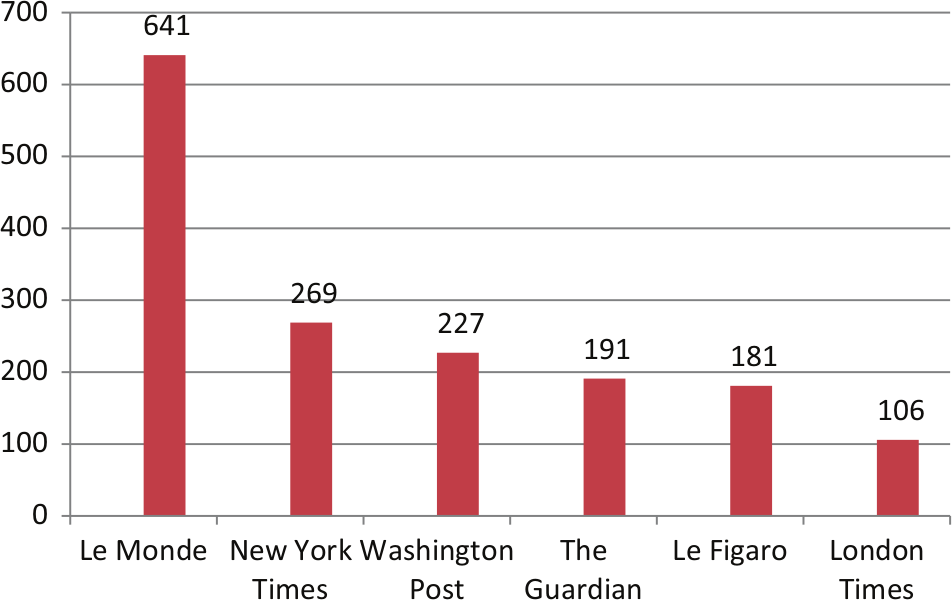
Coverage of the second Congo war, January 1998 to January 2001.
If we disaggregate the data further, we find the newspapers for the most part followed the same reporting trends (see Figure 2). In the first 7 months of 1998, the total stories for all six papers were 224, or an average of 32.1 a month. However, during the August 1998 invasion 264 appeared in just that month alone, and 125 the following month. From August to December, the monthly average was 110, but coverage soon slipped across the board. In 1999, the average monthly stories dropped to 36.2, and fell even further in 2000 to 23.9 a month. This was true of all newspapers covered: so, for example, in 2000, the average monthly total for Le Monde was 9 and the New York Times was 5. All papers had the same rough valleys and peaks of coverage in the time period examined. The initial August invasion caused an immediate media stir in the Western world, but it soon dissipated.

Month-to-month coverage, January 1998 to January 2001.
Coverage of Rwanda and Uganda
If there should be one key difference between American and French newspaper coverage, it would be on the role Rwanda and Uganda played in the war. As mentioned, diplomatically, the United States was sympathetic to outright supportive of the Rwandan and Ugandan invasions. However, can we find evidence of this in Americans newspapers? Did the American press index their coverage to policies set in Washington? Would French newspapers, index their stories to Paris?
To answer this question, I discovered that the manual coding of these articles and stories proved difficult. My initial round of coding found that out of the American population sampled (n = 496): 2% of the reporting would be considered pro-Kabila, 8% anti-Kabila, 2% might be characterized as pro-Rwanda, 0.007% was specifically anti-Ugandan, and the overwhelming majority (87%) would best be seen as a version of journalistic neutrality. Simply put, the American press did not use a “Rwandan frame.” If anything, the press emphasized a storytelling narrative of how the Congo War unfolded. In the second round of coding, I used the NVivo program to analyze the differences between the press in different nations.
When it came to overall coverage of Rwanda, the American newspapers devoted more space. The Post had 0.61% of its coverage dedicated and the New York Times had 0.60%, The Times (U.K.), 0.49%, the Guardian 0.43%, and the Le Monde had 0.46%, and Figaro was 0.32%. Those American numbers show that Rwanda was mentioned consistently more than in any other national coverage of the Congo War. However, those numbers do not hold up when we look at the data more deeply (see Table 1). For example, we find that mentions of Paul Kagame, the future President of Rwanda, and the real force behind the invasion was mentioned 62 times in the Washington Post, and considering how many articles the French newspaper had about the war only 60 times in Le Monde. In fact, the Post led all newspapers with coverage of Kagame with 0.05%, but the French daily Le Figaro was second with 0.03%. If you prefer mentions of the Rwandan capital city of Kigali (and thus capture more of the diplomatic side of the story) to be a better proxy, then we find Le Monde leads coverage with 0.14%, Le Figaro second, and the Post third. Clearly, when Le Monde did cover Rwanda, their reporting was substantively more in depth than the New York Times.
Mention of Rwanda in Congo, January 1998 to January 2001.

Note. Word count/Percentage used in stories.
When it comes to overall coverage of Uganda (see Table 2 below), once again an American newspaper led coverage: The New York Times had 0.40%, with the London Times at 0.39%, the Guardian and the Post at 0.31% and 0.30%, respectively. Once again, French news coverage were slightly lower with the Le Figaro with 0.19% and Le Monde with 0.21%. But something interesting happens when we disaggregate the data further: we find that mention of Ugandan President Museveni is almost identical in five newspapers at 0.06/0.07%, but Le Monde is slightly higher at 0.09%. Also mention of Kampala, the capital city is highest in the London Times and Le Monde, but not significant in the other papers. The U.S. papers may have had more coverage of Uganda overall but once again Le Monde, had more specific coverage.
Mention of Uganda in the Congo, January 1998 to January 2001.

Note. Overall word count/Percentage of word coverage.
Considering the bias of American official policy it is difficult to say, based on these numbers, that the press was substantially different across nations. However, if you wanted to compare American newspapers with those of the French, you will see that the New York Times and the Washington Post has a slight bias toward reporting on Rwanda and Uganda than Le Monde. However, in both cases it is clear that Le Monde may have had deeper coverage of the diplomacy if we use the capital cities as proxies.
Genocides, Massacres, and the Ethnicity
But if we really wanted to spot a Rwandan frame in American reporting, one should find it in the coverage of the gross human rights abuses that occurred during the Congolese wars. As noted, many of these massacres were blamed on Laurent Kabila. However, as a 2010 Christian Science Monitor headline announced, “Bombshell UN report leaked: ‘Crimes of genocide’ against Hutus in Congo” was actually conducted by the Rwandan Army (Stearns). The Rwandan Army coordinated the killings but Kabila got the blame. The UN Mapping Report stated that over 600 separate acts of violence, some reaching genocidal proportions were committed over a 10-year time span. Some of this happened during the First Congo War, but massacres and violence continued into the Second, which is our time frame examined. If U.S. policy was “pro-Rwandan,” we should see significant differences in how the American and French newspapers treated the issue. Indexing would hold that American coverage of Rwanda would be positive compared with that of the French newspapers, and critical of Kabila.
During the time Laurent Kabila was stonewalling the UN examination of his human rights record, about 6% of the New York Times and Washington Post coverage reflected that. French reporting of the “investigation” was minor (holding that other words could be used). There was no wider substantive Western narrative of a “counter genocide committed by the Rwandans in any of the papers examined.” If we specifically look at the word “genocide,” it is mentioned only in the context of the 1994 genocide inside Rwanda and never to the current events (see Table 3 below). This linkage of the Rwandan genocide with the Congolese coverage was consistent across newspapers and nations. So for example, The Guardian led coverage with 0.16% mentions, the London Times has 0.11%, and the Washington Post had 0.10%, the New York Times and Le Figaro are tied with 0.06%. Le Monde used two spellings: genocide (0.04%) and génocide (0.07%), both of which are included here. Overall, about 1/4 (24%) of the entire American media coverage of the Congo was actually related to the 1994 genocide.
Mention of Genocide and Massacres in Congo, January 1998 to January 2001.

Note. Overall word count/Percentage of word coverage.
However, I also searched for the word “massacres” as a proxy for genocide (which is a politically loaded term) to possibly describe the killings. Here, we find Le Monde with the most with 219 mentions and 0.09% coverage; Figaro with 0.05%, and The Post and Times were tied with 0.04%. There really is no significant difference. I also explored the phrase, “human rights abuses” (in French as well), and this yields some interesting results in a trans-national study. American newspapers use the term more consistently, the Post has 0.28%, and the Times 0.25%, and that is definitively more than Le Monde, which is only at 0.15%, and Figaro with 0.06%. Of course, it is possible that the phrase is more common in the United States than in France. The British newspapers did not significantly use the term.
When it came to human rights atrocities, it would seem that the overall tone and content of reporting was similar across newspapers. Rwanda’s role in committing a counter genocide was obscured, watered down, or lost among the narrative of a war. However, this narrative of brutality becomes problematic in trying to understand reporting on foreign conflicts. The Congo War was a brutal, complicated and messy war. Under these circumstances it was difficult for the press to assess blame for the violence as it was happening in the “moment” with incomplete information. Thus, based on the evidence, I would suggest that American elite coverage of the Congo conflict, in regard to the Rwandan counter genocide was not implicitly tied to indexing of government policy toward Kabila.
What might explain this? A possible framing hypothesis could be the fact that a Western audience a priori
The only context provided was that of the Rwandan genocide, this is not necessarily biased, wrong, or misleading. The Interahamwe weighed heavily into Rwandan strategic calculations. The conflict between Hutus and Tutsi was a driving force in the shifting loyalties of the Congolese actors involved. In the Second Congo War, the Hutu were Kabila’s allies, but in the First War, they were his enemies. But the focus on Rwanda and African ethnicity has its own set of problems. Steven Livingstone and Todd Eachus (1999) point out in their work on the Rwanda genocide that the media accepted and advanced the framework of “ancient tribal hatreds” while the atrocities of the Serbs in Bosnia were compared with 20th century Nazi Germany. Gary Streiker of CNN noted, “this story is probably the worst tribal hostility in all of Africa . . . hostility that goes back centuries long before European colonization” (Power, 2002, p. 253).
How did the Western press understand ethnicity in the Congo? The answer revolved around Rwanda. The Washington Post led newspapers with the use of the word (ethnic) at 0.22%, and Le Figaro the least at 0.04%. The New York Times was 0.11% and grouped near The Times and Le Monde (0.07%). So it is interesting to note that the Post used the word twice as much as the New York Times. But I also disaggregated the data further and looked at the words Hutu and Tutsi. Not only are there Hutus and Tutsi in Rwanda, but in neighboring Burundi and inside the Congo. In fact, the Congolese Tutsi (Banyamulenge) were part of a long-term Congolese discussion of whether they were “Congolese” or Rwandans, and violence toward them predates, sometimes trumps, and sometimes works in conjunction with the 1994 genocide.
When “Hutu” and “Tutsi” were examined (see Table 4), we found that The New York Times led coverage of the word Hutu 0.22%, and the Guardian had the least with 0.08%. The London Times led with Tutsi with 0.31%. In fact, the London Times (in conjunction with the word genocide) spent considerable coverage discussing the 1994 Rwandan genocide as the context to the war. But the Guardian had the least mentions of Tutsi with 0.13%. The British newspapers had the fewest mentions of Hutu and Tutsi overall—but significant differences between the two with how they reported the Tutsi. The data also revealed something else: In every instance, Tutsi was used
Coverage of Hutu and Tutsi in Congo Crisis.

Note. Overall word count/Percentage of word coverage.
But the focus on the 1994 genocide also blinds or obscures coverage of modern events NPR had an interesting exchange with scholar Georges Nzongola-Ntalaja about the modern elements of genocide. Nzongola-Ntalaja argued that
ethnic groups do have prejudices . . . But it’s not enough to make a person pick up a knife or gun and kill somebody else. That occurs when politicians come and excite passion and try to threaten people-make people believe that they are being threatened by other groups that are going to be extinguished.
NPR’s Daniel Zwerdling responded, “Of course, in most of these battlegrounds . . . there is ancient ethnic hatred and something that surprises me actually is that your blaming modern, contemporary African politicians for this divide and conquer, playing one tribe against another.” Zwerdling seemed surprised that Nzongola-Ntalaja could put this event into such an understandable and modern light (All Things Considered, 1994). But Nzongola-Ntalaja logic of modern politics brings up an interesting question: What did Rwanda do once it got inside the Congo?
The War of Diamonds and Raw Materials
If the focus of the war was Rwanda and Uganda’s external security Laurent Kabila argued that it was really a question of Congolese internal sovereignty and control over its natural resources. The Congo is rich in gold, diamonds, coltan, cassiterite, copper, cobalt, wolfram, zinc, oil, as well as timber, coffee, and palm oil (Amnesty International, 2003). The fighting eventually revolved around the control of these resources and not the rebel factions. The UN Panel of Experts (UN, 2002) was clear: Rwanda and Uganda (and everyone else for that matter) was vigorously participating in a campaign of enrichment. Eventually, Rwanda and Uganda turned on each other to fight over diamonds. The UN added that there were concerns “about gross human rights abuses that are linked with the extraction of these commodities.” In the end, the war in the Congo was more about money than border security. In fact, the idea that some African leaders are corrupt and use the apparatus of the state to enrich themselves is neither shocking nor new. The reality of the Second Congo War is how the process of globalization has changed the game of exploitation. Sovereign leaders, foreign nations, and rebels could enrich themselves in this new world, not by seizing the capital city (which will still occur) but the diamond fields.
But if economic motivations were central to the conflict why was it only a
As in the case of human rights violations there should be a difference of reporting between the American and French newspapers. If the American papers were biased would they cover the stories of looted diamonds? If we take the word “diamond,” the New York Times led coverage with 0.10%, and the London Times came in second with 0.09% (see Table 5 below). The two French newspapers were tied with 0.04%. Strangely enough, the Washington Post did not spend any significant time with the word. During the period examined, there were only 18 total references in the Post, the New York Times had 134.
Coverage of Diamonds in the Congo, January 1998 to January 2001.

Note. Overall word count/Percentage of word coverage.
But what if we expand the list beyond diamonds? I then searched for a basket of items, “gold, diamonds, coltan, cassiterite, copper, cobalt, wolfram, zinc, oil, timber, coffee and palm oil” (including French translations). Once again the newspapers were quite similar across nations (see Figure 3 below). In the 1st year of the war, Le Monde led coverage with 0.09% and 67 distinct references to these words. The New York Times, had 73 coming out to 0.07% of its coverage, Le Figaro and Washington Post were 0.02%. Over 3 years, Le Monde led with 338 references to the New York Times’ 318, which is really not much of a difference. When we examined the rest of the list: The Washington Post had 131, the Guardian was 116, the London Times 88, and Le Figaro with 35. (There is a significant difference between Le Monde and Le Figaro.)

Basket list of natural resources.
Honestly, considering the leftist slant of Le Monde and the Guardian, I was surprised that there was not more coverage of economic exploitation. Economic incentive to war was covered minimally in all papers. However, there was no significant difference between nations when it came to reporting. But if the lack of economic exploitation coverage was not intentional, then what best explains the findings? W. Lance Bennett et al. (2007) provide a possible answer. Nation-state and Sub-state economic exploitation is not in the zeitgeist or the underlying normative assumptions of what is a compelling story, not just in the United States but Western Europe as well. Instead, the overriding “conflict narrative” of two sides fighting for political power is.
Part V: Theoretical Implications and Conclusions
Throughout this paper, we have used the Second Congo War as a case study to examine whether the elite press indexes its coverage of foreign events to government policy. The Congo War is a good test case for several reasons. First, it was one of the largest conflicts in the world during the late 1990s. But to the American public, it was an unknown war in a distant part of the world with no national interests at stake. But Washington did have a clear agenda for the Congo, and throughout the conflict they passively supported Rwanda and Uganda and its claims of border security. One could argue that to support a new ally in the region (Clinton’s New African Leaders Initiative) the Administration may have turned a blind eye to gross human rights abuses and economic exploitation committed by its favored states. Clearly, with a set American policy and no public interest, this would be an excellent example of media indexing.
However, I argue that the two major American newspapers did not index their coverage. Furthermore, and this is important, I argue that other leading dailies in Britain and France did not index their coverage to their own governmental policies as well. Coverage of the Second Congo War in the Western world was remarkably more similar than it was different. But we should add a word of caution about our findings—correlation is not causation. There are limits to this kind of media analysis.
This paper also raises other questions that are still worth examining and some hark back to Bennett’s zeitgeist. For one, what is neutrality in reporting a war? For example, if an article truthfully notes the attempts of Laurent Kabila to stifle democracy and his rampant corruption—is this neutral or biased? Should the newspaper be obliged to provide more context about Congolese history, the troubles of creating a viable nation state in the wreck of what had been the personal fiefdom of President Mobutu? Second, when the papers featured longer detailed articles, Kabila’s framing of the war as an invasion and a loss Congolese sovereignty was usually balanced with Rwanda’s frame of the genocidal Interahamwe and its need for national security. Should it have been balanced in the first place? To some, the very idea that Rwanda, Uganda, and their rebel movement were given equal and nonjudgmental coverage to compete with Kabila’s claims of a foreign invasion might seem like bias enough.
If there was a bias, it was clear to Western audiences that the Second Congo War was fought in the shadow of the 1994 Rwandan genocide (especially The London Times). By framing, the Congo around the genocide does two things: First, it makes the Western audience automatically sympathetic to Rwanda’s claims of border security. The idea that the Congo was hiding, known perpetuators of genocide shuts down the conversation about Rwanda looting the Congolese countryside. To go back to an Israeli analogy—the capture of Adolf Eichmann in Argentina was not a discussion of international law on kidnapping foreign nationals—it is a story of the capture of the man who helped plan the Holocaust receive justice. Second, and indirectly, it reinforces the narrative of ancient tribal hatred and makes the Second Congo War about ethnicity. It would reinforce the work of Steven Livingstone and Todd Eachus (1999). The genocide frame stops critical thinking about the causes of the war because for average Americans, the violence is ancient; there is nothing that can be done. However, it does not provide the readership with important context. Tribal hatred is fanned on by modern problems not ancient ones.
Second is the Western bias of reporting conflicts and war. The overwhelming reporting from all six newspapers was the narrative of battles, massacres, and diplomacy. Traditional reporting of conflict resembles a version of capture the flag. The focus is always on the elites. This “Washington Consensus” is the zeitgeist that holds political and media elite together. Althaus, Edy, Entman, and Phalen (1996) argue, “When there is no policy debate in Washington, reporters offer critical analysis inside the terms of the Washington consensus.” Western interlopers of a conflict, including the media coverage confer legitimacy to actors who control land and access to natural resources. Simply, reporters and editors prioritize power at the expense of a broader discussion of democracy and in this case Congolese civil society.
Finally is the zeitgeist of economic exploitation. While the looting of Congolese resources were reported in the Western press, it was not a major theme of reporting. Yet, the looting is what probably prolonged the conflict. The opening up of the African economy to the free markets has in some places privatized profits but socialized the violence. When the Cold War ended the aid stopped. The African leaders who traditionally used external security aid in complex internal patronage systems were now forced to scramble and innovate. Trade not only flourished in resource extraction, but in illicit drugs, money laundering, and diamonds. Wars had little to do with political ideologies, but the control over the nation’s natural resources.
In the end, I argue that the media must broaden its conceptual framework of how it reports African conflicts. We have noted that the war was not necessarily indexed to policy. Sometimes the press might rely on older more familiar tropes, so in the Congo we see the obsession with genocide. However, the media is still ill equipped to explain these new kinds of conflicts because they do not have the proper vocabulary in their rhetorical toolkits. Paraphrasing the words of Bennett, sub-state economic exploitation is not in the underlying normative assumptions of what is a compelling story. Instead, the overriding conflict narrative of two sides fighting for political power is. While that may be neutral, in a sense, the selection of reporting the actions of elite actors at the expense of civil society is the bias, and this is what connects all Western papers.
Footnotes
Declaration of Conflicting Interests
The author(s) declared no potential conflicts of interest with respect to the research, authorship, and/or publication of this article.
Funding
The author(s) received no financial support for the research and/or authorship of this article.