




Abstract
The study investigated the impact of scenario-based instruction on language learners’ awareness and use of self-regulated language learning (SRL) strategies to provide an instructional design to successfully promote them. The scenario-based SRL strategy instruction design developed in the study was based on Oxford’s Strategic, Self-Regulation (S2R) Model. Following an experimental design, the data were gathered from foreign language learners (N = 125) at a state university through three instruments: the Strategy Inventory for Language Learning, whole-class discussions, and semistructured interviews. Although the quantitative data from the inventory helped determine the level of reported strategy use by learners, the additional qualitative data were gathered to elicit learners’ reflections to determine SRL awareness during and following the training experience. Analyzing pre- and posttraining results from the control and the experimental groups indicated significant differences with an increased awareness and a higher reported use of strategies for the experimental group. The results are meant to help guide future directions in strategy instruction for foreign language learning.
Keywords
Introduction
Today’s enhanced technological devices allow almost limitless exposure to information on a global scale, with ever-increasing opportunities for nearly anyone to access it. Consequently, to be most efficient at processing this information, that is, at learning, regulating this learning is a crucial skill for denizens of the modern world. Studies have indicated that when individuals learn within a context that allows both the opportunity and the assistance to set individual learning goals, select among learning tasks themselves, and monitor and evaluate their own learning, they are more likely to develop self-regulatory skills (Boekaerts, 1997; Vansteenkiste et al., 2012). As Beishuizen and Steffens (2011) state, self-regulated learners know how to autonomously manage their own learning and can
set better learning goals, implement more effective learning strategies, monitor and assess their goal progress better, establish a more productive environment for learning, seek assistance more often when it is needed, expand effort and persist better, adjust strategies better, and set more effective new goals when present ones are completed. (p. 1)
Recent theoretical discussions on self-regulated language learning (SRL) strategies in foreign language learning have yielded valuable insights for the field while also reporting various positive impacts on second or foreign language learning (e.g., Andrade & Bunker, 2009; Andrade & Evans, 2013; Beishuizen & Steffens, 2011; Gunning & Oxford, 2014; Ma & Oxford, 2014; Oxford, 2011; Pintrich, 2004). A majority of the studies on the topic provide valuable theoretical and instructional discussions, emphasizing the need to plan and implement instructional designs that guide and scaffold learners in forming effective language learning strategies.
Nonetheless, there continues to be a need for instructional designs and practical suggestions for such implementations. Recent studies have frequently reported the need to develop SRL instruction methods and practical tools (e.g., Lam, 2015; Lear, Li, & Prentice, 2016; Tjalla & Sofiah, 2015). In an attempt to contribute to SRL implementation, the present study aims to develop such an instructional design to raise awareness of SRL strategies among language learners by using scenario-based instruction based on Oxford’s (2011) Strategic, Self-Regulation (S2R) Model. As the concept of self-regulating one’s own learning is rooted in the situated theory for learning, scenario-based learning design developed in this study is proposed to provide intentional use of authentic situations to exemplify context-specific themes (Errington, 2005). The study specifically seeks answers to the following research questions:
Literature Review
Self-Regulation in Foreign Language Learning
Self-regulated language learning (SRL) strategies refer to the strategies that help language learners take active roles in their learning and assist them to becoming autonomous learners (Dörnyei, 2003). They are defined as “. . . deliberate, goal-oriented attempts to manage and control efforts to learn the L2 [i.e. the second or foreign language] . . .” (Oxford, 2011, p. 12). Despite variations in the terminology used in different studies, a significant number of empirical findings on SRL have reported positive effects on foreign language improvement (Andrade & Bunker, 2009; Andrade & Evans, 2013; Gunning & Oxford, 2014; Ma & Oxford, 2014; Masui & De Corte, 2005; Oxford, 2011; Pintrich, 2004; Zimmerman & Schunk, 2008). Studies have demonstrated how such SRL strategies enable learners to become better decision makers when planning their learning; set realistic goals; maintain motivation; participate actively in their own learning, emotionally and socially; manage necessary cognitive processes; and monitor and evaluate their learning (Andrade & Bunker, 2009; Ehrman, 1996; Ma & Oxford, 2014; Nicol, 2009; Oxford, 2003, 2011; Zimmerman & Schunk, 2008). The end result has been learners who are competent in their language skills (Andrade & Evans, 2013; Beishuizen & Steffens, 2011; Nami, Enayati, & Ashouri, 2012; Rasekh & Ranjbary, 2003; Wang, Spencer, & Xing, 2009).
The Scope of Self-Regulated Language Learning Strategies
Although the scope of SRL strategies varies in the literature, four main categories seem to be common in most of the models: cognitive, affective, social, and metacognitive (e.g., Boekaerts, 1997; Bonney, Cortina, Smith-Darden, & Fiori, 2008; O’Malley & Chamot, 1990; Oxford, 2011; Paris, Byrnes, & Paris, 2001; Winne, 2005; Ziegler, Hofmann, & Astleitner, 2003; Zimmerman, 2000). Cognitive strategies manage cognitive processes via (a) elaboration, for example, paraphrasing, summarizing, and relating new information to existing knowledge; (b) rehearsal, for example, underlining text, taking notes, and saying a word aloud to transfer the information to working memory; and (c) organization, for example, outlining, selecting main ideas, organizing the learning material, and constructing patterns from among the learned items in working memory. Affective strategies manage emotional and motivational requirements such as developing self-confidence and perseverance to counter interfering feelings during learning (Bown & White, 2010; Oxford, 2011). Social strategies deal with the sociocultural context of the target language—Examples can include interacting with native speakers despite insufficient knowledge about target cultural and social norms, or facilitating collaboration with other learners during the learning process (Bonney et al., 2008; Patrick & Middleton, 2002; Winne, 2005). Metacognitive strategies, on the contrary, regulate all of the cognitive, affective, and social ones. They involve planning, monitoring, and evaluating, as well as self-management of the learning process (Bown & White, 2010; Oxford, 2011; Wang et al., 2009), ultimately enhancing learner autonomy (Beishuizen & Steffens, 2011; Rasekh & Ranjbary, 2003; Shen, 2005).
In S2R, Oxford (2011) classifies the strategies into four different categories: cognitive, affective, sociocultural-interactional, and metastrategies (i.e., beyond the other three strategies; Oxford, 2011). Cognitive includes strategies that help learners process and apply foreign language knowledge (such as reasoning), activate prior knowledge, and conceptualize new information. Affective contains those strategies used to manage feelings, beliefs, and attitudes to generate a positive emotional state for effective language learning. This dimension equips a learner to maintain motivation, activate supportive feelings, and manage anxiety levels. Sociocultural-interactional strategies help learners handle challenges in interpersonal communication such as overcoming communication gaps or dealing with new identities.
Oxford (2011) presents “metastrategies” as an overarching category that interacts with the other three, controlling and orchestrating cognitive, affective, and sociocultural-interactive language learning strategies. According to Oxford (2011), reducing the scope of metastrategies to metacognitive strategies oversimplifies the classification because it not only helps operate cognitive strategies but also controls affective and sociocultural-interactional ones. Thus, the study introduces metastrategies as a broader category, which “. . . [is] beyond the cognitive and includes strategies that provide general management (control) of cognitive strategies as well as metacognitive, meta-affective, and meta-sociocultural interactive strategies” (Oxford, 2011, p. 17) and has compensation strategies implanted in it.
Scenario-Based Learning in Higher Education
Previous studies have highlighted the advantages of using scenarios in higher education because they provide situated learning driven from the relevant problems to the context of learners (Brock, 2003; Naidu, 2010; Parrish, 2004). As opposed to explicit transmission of knowledge, the situated learning theory emphasizes context-based learning as critical for deep-level learning (Lave & Wenger, 1991). It is frequently reported that placing learners in authentic situations replicating real life can help them empathize with various individuals in the scenarios, consider multiple perspectives on the given issue(s), and become motivated to engage in learning (Pernice, 2003). In fact, learners have been observed to be interested and get involved with scenario-based learning activities instinctively, as “. . . people are natural scenario planners; it is how we make sense of the world and how we decide upon which source of action to take in everyday life” (Van der Heijden, 2002, p. 117).
The use of situated scenarios has been reported to facilitate problem-solving strategies (Steeves, 2012), to encourage learners to apply theoretical knowledge to real-life problems (Oh & Jonassen, 2007), and to acquire strategies for managing learning difficulties (Dahlgren, Fenwick, & Hopwood, 2016). Therefore, teachers are advised to introduce scenario-based methods and to facilitate asynchronous discussions with learners to increase the quality of learning (Dieckmann & Krage, 2013; Oh & Jonassen, 2007). However, studies also indicate that there is still a need to develop stronger theoretical base and a wider range of practical tools to enrich scenario-based teaching pedagogy (Berragan, 2011; Crosby & McKenzie, 2016).
Method
The study has an experimental design in which two groups (control and experimental) were formed and given pre- and posttests to identify any potential impacts of the scenario-based instruction on the students’ SRL awareness and reported use (see Norris, 2015; Norris, Plonsky, Ross, & Schoonen, 2015).
Participants and Context
The present study was carried out with English language learners in preparatory classes at a state university. The school’s curriculum and exams are prepared in adherence to the Common European Framework of Reference for Languages (CEFR; Council of Europe, 2001). The school’s centralized education system requires all language classes to have the same schedule, use the same teaching materials, and take the standard exams prepared by the testing unit. Teachers are required to deliver weekly and annual syllabi that distribute the teaching of language items over set time periods and list periodic assignments. Neither the curriculum nor the syllabi accommodate strategy instruction in terms of time, task, or instructional suggestions.
Upon obtaining all required permissions from administration and individuals, the present study followed the “purposive sampling method” (Patton, 2002) to engage participants, gathering a sample of undergraduate English language learners (N = 125) at A2 (pre-intermediate) English proficiency level (as determined by the school’s CEFR-based placement test). To form the groups, two classes (n = 61) were chosen to be the experimental group and other two classes were selected to be the control group (n = 64). These four classes were taught by two English Language teachers, each of whom had one class from the experimental group and one from the control group. The reason of including these two teachers’ one class in the experimental and the other to the control group is to minimize any potential instructional factors that would affect the implementation process. The learners were between 18 and 21 years old, with a gender split of 42% female to 58% male; 38% reported engineering majors with the remaining 62% in science. The language learners in the experimental group received 5 weeks of SRL instruction, whereas the ones in the control group did not.
Measures
The data for the study were collected via employing three distinct tools: Strategy Inventory for Language Learning (SILL), whole-class discussions, and semistructured interviews. Although SILL was conducted to determine both groups’ level of reported strategy use, additional data were gathered from the experimental group by using (a) discussions with the entire class to elicit learners’ reflections during the training (reflection in-action as termed by Schon, 1991) and (b) semistructured interviews to gather overall evaluations on the training experience (reflection on-action as termed by Schon, 1991).
SILL
Developed based on extensive literature review, the inventory groups strategies into two main categories: direct strategies and indirect strategies. “Direct strategies” include memory, cognitive, and compensation strategies that directly interact with language learning. Cognitive are further subdivided into two groups: memory strategies for rehearsal, and cognitive for elaboration and organization. Metacognitive, affective, and social strategies, on the contrary, fall under the “indirect strategies” category; they indirectly support language learning assisting learners to enhance, manage, and reflect on direct strategies. In total, the questionnaire includes 50 items under six strategy categories: cognitive (14 items), memory (nine items), compensation (six items), metacognitive (nine items), affective (six items), and social (six items). The items are presented in a Likert-type scale rated from 1 = never or almost never true for me to 5 = always or almost always true for me.
Class discussions
Two weeks after collecting learners’ initial responses, learners in the experimental group began receiving scenarios. Participants were allotted 2 days to reflect on each group of scenarios that related to a specific phase. Learners then took part in a 60-min classroom discussion, in which they shared their opinions on the scenarios as well as the related questions assigned that week. As the discussions were organized to collect reflections on the continuing training experience, participants were encouraged to comment on the strategies mentioned in the scenarios by stating (a) which ones they thought would be helpful, (b) which ones they had already applied, and (c) which ones they would consider using in the future. For strategies they reported they had used, participants were asked to give detailed examples of their experiences. The discussions were audio-recorded, transcribed verbatim, and analyzed using systematic content analysis (see Neuendorf, 2002) to capture learners’ reflections on the ongoing training and make valid inferences.
Semistructured interviews
In the eighth week, following the 5-week SRL, semistructured interviews were held with participants in the experimental group to elicit reflections on the overall training experience. Interview questions were about (a) the strategies learners had become aware of, (b) the strategies they had started to apply, (c) the strategies they had not applied and the reasons why not, (d) the strategies they planned to use, and (e) their opinions on the overall SRL training experience (see Appendix A for interview protocol). Each interview lasted between 10 and 15 min and was audio-recorded, transcribed, and analyzed adopting the grounded theory method (see Charmaz, 2003; Stern, 1995). The grounded method requires first eliciting participants’ opinions and then grouping the emergent themes to form categories based on the data collected. As such, the strategies mentioned by participants for each question were elicited, analyzed, and reported descriptively.
Procedure
Prior to scenario-based SRL instruction, participants both in the control group (n = 64) and the experimental group (n = 61) completed SILL (Time 1). During the 8-week period, both groups continued to have their regular English lessons at the same school while the learners in the experimental group received scenario-based language strategy instruction in addition to their regular lessons. SILL was completed again by both groups 8 weeks later (Time 2).
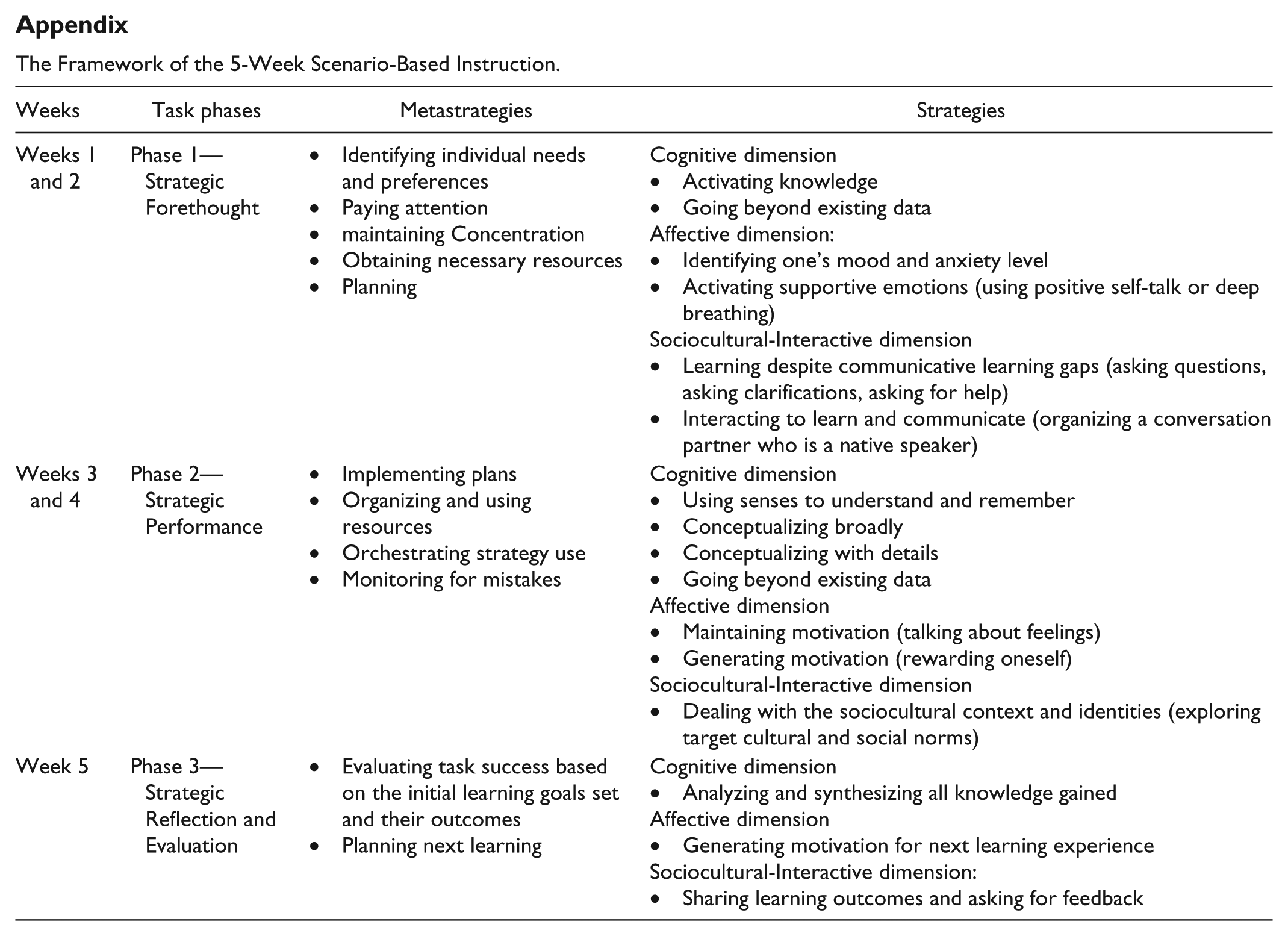
Participant learners in the experimental group received SRL instruction via a scenario-based learning design. The scenarios were designed based on the three task phases that Oxford (2011) covers in the S2R Model: strategic forethought, strategic performance (or implementation, monitoring, and control), and strategic reflection and evaluation. Treating these three phases as a framework, strategies and metastrategies included in the S2R Model were embedded and distributed over a 5-week training schedule.
Each week, the learners were given scenarios involving language learning difficulties, such as obstacles in vocabulary retention, reading comprehension, concentration during listening and pronunciation, or motivation in revising for exams. The strategies within the three domains (cognitive, affective, and sociocultural-interactive) and metastrategies related to one of the three task phases were presented by the characters as alternative solutions to the learning difficulties stated in situations.
In Weeks 1 and 2, the strategic forethought phase was completed. The learners were given three scenarios directed toward raising awareness about strategies such as setting goals, analyzing the task, developing learning plans, maintaining concentration, and activating existing data with the support of affective strategies such as identifying one’s mood and anxiety level and activating supportive emotions. The third and fourth weeks covered the strategic performance phase. Learners reflected on four scenarios that highlighted strategies for implementing plans, monitoring the learning process, generating and maintaining motivation, and interacting to communicate and learn. The third task phase, the strategic reflection and evaluation phase, was completed in Week 5 and featured two scenarios regarding strategies to evaluate outcomes, decide on the effectiveness of the strategies applied, and evaluate the outcomes.
The scenarios engaged learners from the first week of instruction with authentic language learning situations narrated by four characters. They had personal characteristics resembling learners in terms of age, nationality, ethnicity, academic field, and language learning contexts (for instance, type of school, lesson hours, and exams). Each week, scripts were distributed containing the scenarios in which the characters shared their experiences in foreign language learning while also highlighting their difficulties. Learners were asked to brainstorm alternative strategies they would apply if they were in the same situation. The characters would then share their strategies (the ones from S2R Model). In covering the six groups of strategies (memory, compensation, cognitive, metacognitive, affective, sociocultural-interactive), participants ended up being introduced to nine scenarios in total
Findings
From the nomenclature classifying SRL strategies, SILL (Oxford, 1990) is one of the most widely acknowledged and utilized research tools in empirical foreign language studies today with high reliability results (Cronbach’s α reported between .93 and .95; Oxford & Burry-Stock, 1995). In addition, a significant number of studies have confirmed the factor analysis of the items in the SILL (e.g., Ellis, 1994; Hsiao & Oxford, 2002; Oxford & Burry-Stock, 1995). The quantitative data gathered from SILL were analyzed with SPSS 17.0. The responses were coded from 1 = never true for me to 5 = always true for me. None of the items in the inventory were negatively worded so no reverse coding was required. The Cronbach’s alpha test confirmed the internal reliability of the questionnaire for this specific sample (.91).
As the sample had various characteristics that could not be controlled (e.g., socioeconomic background, ethnicity, and gender), the distribution of the data was skewed. To decrease the effect of outliers in identifying the overall level of reported strategy use, median scores were calculated instead of mean scores (Bryman & Cramer, 2003). To determine the differences between the control and the experimental groups, the present study applied the Friedman test, which compared the mean scores of the two data sets. The Friedman test is the nonparametric alternative to one-way ANOVA utilized when the data do not show a normal distribution (Larson-Hall, 2009). As for determining differences between groups, the study used the Wilcoxon’s signed-rank test, the nonparametric alternative to paired-samples t test (Larson-Hall, 2009). The results of the analysis are presented in two sections: pretraining results (Time 1) and posttraining results (Time 2).
Results Previous to Scenario-Based Instruction: Time 1
As the descriptive results reveal, median results for both the control and experimental groups suggest that all categories of strategies were used moderately (based on median split score: 2.7).
Metacognitive strategies for both the control group and the experimental group had the highest scores whereas affective strategies revealed the lowest for both groups. The scores for memory, cognitive, compensation, and social strategies were also at moderate levels. When the scores of the groups for each category were compared utilizing Friedman test, the results indicated no significant differences between the two groups for memory (p = .43 > .05, df = 1, χ2 = 0.60), cognitive (p = .15 > .05, df = 1, χ2 = 1.98), compensation (p = .05 = .05, df = 1, χ2 = 3.63), metacognitive (p = 1.00 > .05, df = 1, χ2 = 0.00), affective (p = .59 > .05, df = 1, χ2 = 0.28), and social (p = .43 > .05, df = 1, χ2 = 0.60) strategies (see Table 1). The results of the pretest indicate that, overall, participants in both groups moderately used SRL strategies with no significant differences between them.
Pretest Results for Control and Experimental Groups.

Significant at p < .05
During the class discussions held with the experimental group over the course of the next 5 weeks, learners’ reflections on the scenarios and their language learning experiences differed. Although some learners harbored doubt that using strategies would help (Mehmet and Orkun, Week 4), some expressed that they already started to use them and were happy with the results (Mert, Week 5). Throughout the class discussions, learners frequently questioned the effectiveness of using strategies in language learning, particularly in the first 2 weeks. Nevertheless, they started to suggest the use of strategies to overcome the difficulties in the scenarios more frequently. There were also instances where learners realized that they had already been using some of the strategies presented to them (Ufuk, Week 3).
Results Following Scenario-Based Instruction: Time 2
The results of the Friedman test for the posttest analyses indicate significant differences between the control and the experimental groups across all categories.
Although participants from both groups reported using SRL at relatively higher levels compared with Time 1 results, the groups differed in the level of reported use of all categories with higher ratings in the experimental group for memory (χ2 = 14.0, df = 1, p = .00 < .05), cognitive (χ2 = 10.9, df = 1, p = .001 < .05), compensation (χ2 = 16.6, df = 1, p = .00 < .05), metacognitive (χ2 = 4.09, df = 1, p = .043 < .05), affective (χ2 = 18.6, df = 1, p = .00 < .05), and social strategy (χ2 = 12.2, df = 1, p = .00 < .05) categories (see Table 2). The results also indicate that the increase was at higher degrees in the experimental group for affective and social strategies, at moderate degrees in memory and compensation strategies, and at relatively lower degrees in cognitive and metacognitive strategies. To have a more reliable identification of the effect size, the post hoc analysis using the Wilcoxon’s signed-rank test was conducted for pre- and posttest results for both groups.
Posttest Results for Control and Experimental Groups.
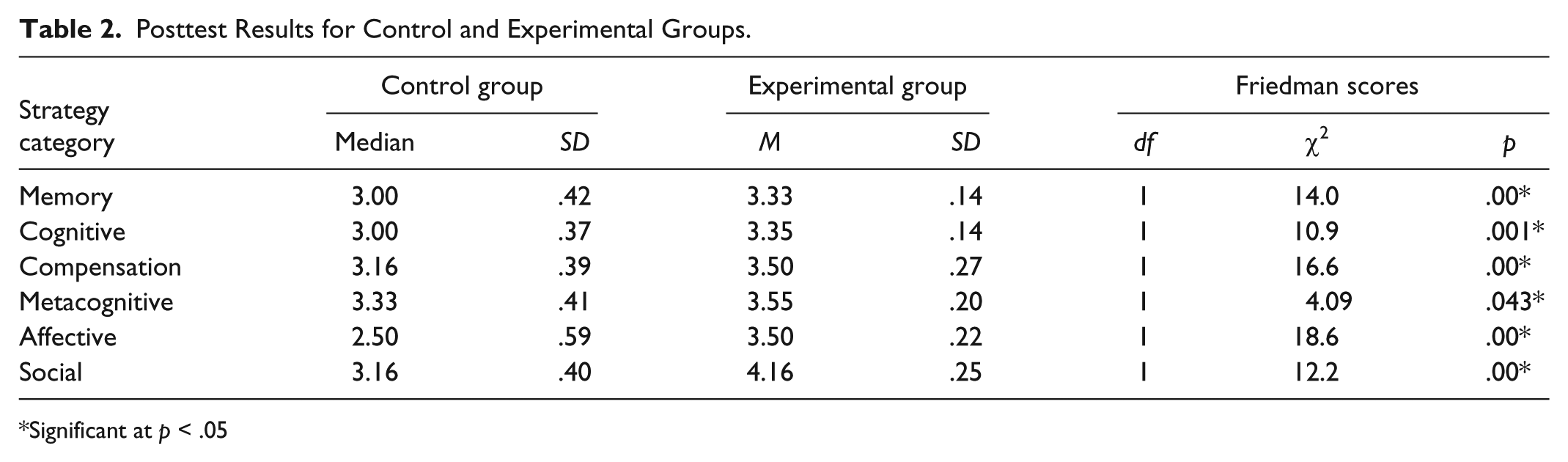
Significant at p < .05
The analysis indicated significant differences for all categories (p = .00 < .05) for the control group. However, as this analysis involved multiple comparisons, the Bonferroni adjustment score was calculated manually to avoid Type I error. Accordingly, p = .05 was divided into number of tests run (in this case, it is two), and the Bonferroni-adjusted significance level was calculated (p = .05 / 2 = .025). When the results were evaluated based on the adjusted significance level (p = .025), significant differences were observed in compensation (Z = 13.5, p = .01 < .025) and social (Z = 14.0, p = .00 < .025) categories. There were no significant differences for the memory (p = .03 > .025), cognitive (p = .04 > .025), metacognitive (p = .03 > .025), and affective (p = .04 > .025) categories for the control group (see Table 3).
Pre- and Posttest Results for Control Group.

Significant at p < .025 (Bonferroni-adjusted score).
Once again, the results of the Wilcoxon’s test showed significant differences (adjusted significance level at p = .025) between the experimental group’s Time 1 and Time 2 ratings of memory (Z = 6.8, p = .00 < .025), cognitive (Z = −6.7, p = .00 < .025), compensation (Z = 6.8, p = .00 < .025), metacognitive (Z = 6.7, p = .01 < .025), affective (Z = 6.8, p = .00 < .025), and social strategy (Z = 6.8, p = .00 < .025) categories (see Table 4).
Pre- and Posttest Results for Experimental Group.

Significant at p < .025 (Bonferroni-adjusted score).
Findings From Interviews With Learners
The interviews conducted with the participants in the experimental group aimed at finding out the learners’ evaluations of the strategies delivered to them via scenarios. The qualitative data gathered from the interviews with learners were coded to determine the presence of the strategies in the participants’ responses (see Gu, 2014). The data were first coded separately by two different researchers, and then the emerging codes were double-checked so as to reduce data reduction or misinterpretations. The themes obtained from this set of data were then descriptively analyzed. The frequencies of the elicited strategies are displayed separately for each category (i.e., cognitive strategies, metacognitive strategies, affective strategies, and sociocultural-interactive strategies).
Among cognitive strategies, seven were mentioned by the participants. The results indicate that the most important strategies were activating knowledge and reasoning, and the least important ones were conceptualizing with details and going beyond the existing data. Among all the other cognitive strategies, participants claimed they started to use and aimed to apply reasoning the most. Participants also stated that they aimed to apply activating knowledge and conceptualizing with details; whereas conceptualizing broadly, note-taking, and going beyond the existing data were not mentioned among the targeted strategies to be applied. Overall findings suggest that participant learners reported to be using cognitive strategies at relatively low levels (see Table 5).
Emergent Strategies for Cognitive Category.

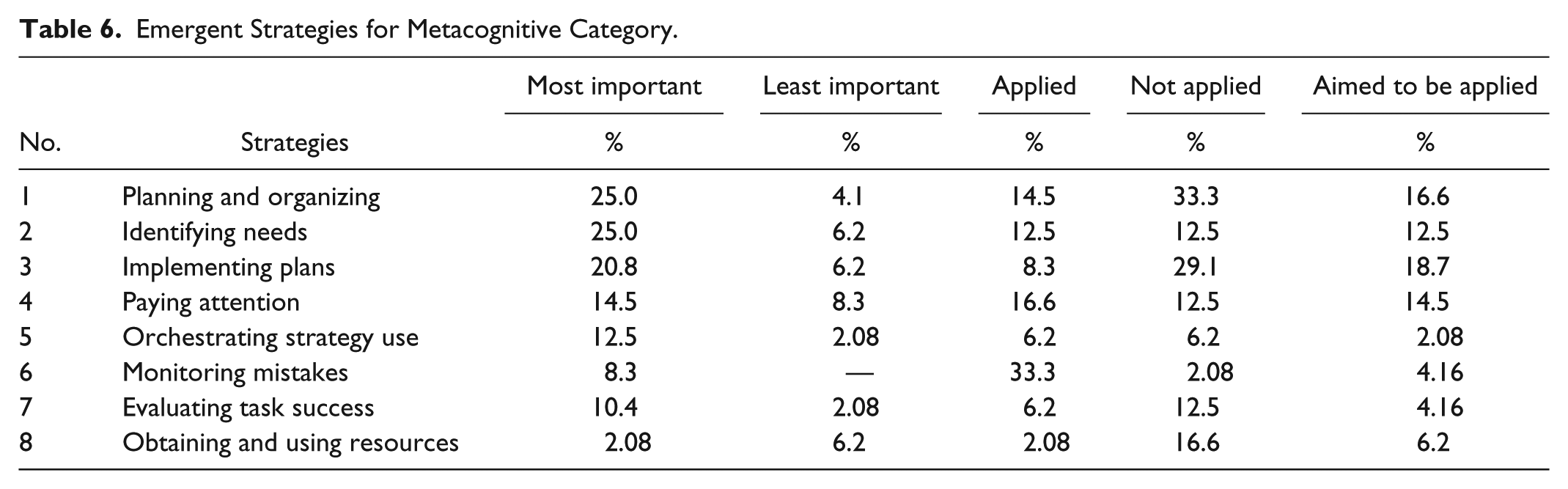
As shown in Table 6, metacognitive strategies had varying rates of reported use by participants, who claimed planning and organizing, identifying needs, and implementing the plans as most important. These strategies were also ones participants aimed most at applying in the future. Monitoring mistakes was not listed among the least important strategies by any learner but instead one of the most frequently applied. Only a few participants chose some of the metacognitive strategies to be least important. Participants reported implementing plans as the first targeted strategy followed by planning and paying attention. These metacognitive strategies showed relatively low levels and are similar to the findings for cognitive strategies. Affective strategies had high scores of mention, particularly those used for maintaining motivation.
Emergent Strategies for Metacognitive Category.
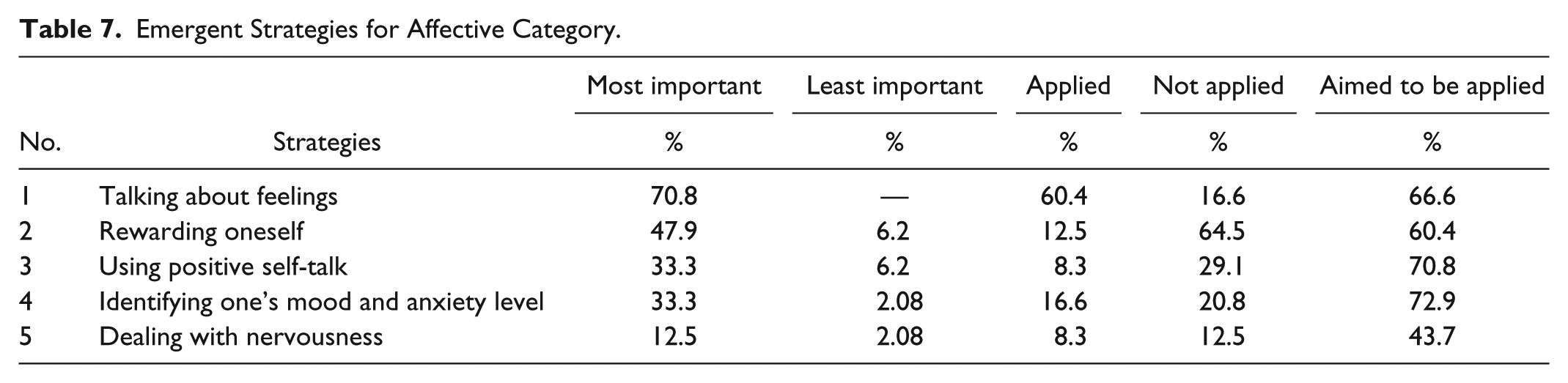
Among the most frequently listed as most important, talking about feelings and identifying one’s mood and anxiety level ranked highly. Furthermore, a very high percentage of participants marked these as “aimed to be applied.” On the contrary, rewarding oneself, a motivational strategy, scored high under “not applied” even though almost half of the participants marked it down as “one of the most important.” Nevertheless, more than half indicated their aim to use rewarding oneself as a strategy “to generate motivation in the future.” Dealing with nervousness also scored high for future utilization albeit ranking lower as being among the most important strategies. The findings from the interviews indicate learners considered affective strategies to be very important, save for a few who considered them to be among the less important strategies. Furthermore, participants mentioned affective strategies more frequently as the strategies to aim for in language learning compared with those in cognitive or metacognitive categories (see Table 7).
Emergent Strategies for Affective Category.
Despite the fewer sociocultural-interactive themes that emerged, the percentages were the highest across all categories (see Table 8). Such strategies, aimed at communicative knowledge gaps, were ranked as very important, and participants selected them in high numbers, topping the charts with asking questions, asking for help, and asking for clarification. A significant number of students reported that they started to use these strategies during the training, though the percentages for each were lower. Talking with a native speaker was also listed among the most important strategies. Although very few students started to apply this strategy during the training, a very high number claimed that they aimed to interact with native speakers. The participants did not indicate any sociocultural-interactive strategies as being least important.
Emergent Strategies for Sociocultural-Interactive Category.

Discussion and Conclusion
The present study sought to investigate the effect of scenario-based strategy instruction on language learners specifically on their SRL awareness and reported level of use. To answer the first research question, both groups were asked to complete the SILL (Time 1) to determine initial awareness and reported use of SRL. The results revealed that both groups reported applying SRL strategies at low to moderate levels with no statistically significant difference between them. In addition, the findings (Time 1) revealed that in both groups, metacognitive strategy category had the highest scores while that of affective had the lowest.
The second research question aimed to identify the domains that the scenario-based instruction influenced learners’ reported use of SRL strategies in their language learning, Time 2 analysis revealed a statistically significant difference between the two groups’ overall ratings following the 5-week instruction for the experimental group. The experimental group reported significantly higher use of SRL among the cognitive, compensation, metacognitive, affective, and social strategy categories compared with Time 2 results of the control group. The biggest differences in the rates between groups were in the social and affective categories. Although the experimental group’s metacognitive and cognitive ratings had significantly higher frequencies, the difference was relatively small compared with Time 1 results. This may indicate that the scenario-based instruction was more effective to increase awareness of the strategies in the sociocultural-interactive and affective categories and less so in the cognitive and metacognitive ones.
In addition, the results for both the control and the experimental groups in Time 2 indicated significant differences from Time 1 scores. At the end of the 2-month English language learning experience, participants from both groups reported greater use of strategies in the compensation and sociocultural-interactive categories, signifying that the high scores in Time 2 experimental group should not be entirely attributed to scenario-based instruction as the entire language learning experience could also be a strong factor influencing the reported use of SRL strategies. This finding is in line with previous research that reported the role of scenarios in increasing learners’ awareness of strategies (e.g., Crosby & McKenzie, 2016; Dahlgren et al., 2016).
To be able to answer the third research question that aimed to find out whether scenario-based strategy instruction affected learners’ awareness, qualitative data were gathered from class discussions and semistructured interviews with the experimental group who had received the instruction on SRL strategies. The results for this group indicated significant awareness across the four categories. Affective and sociocultural-interactive strategies were far more frequently reported as important, and many more learners claimed to have started applying them as a result of the training. Furthermore, when analyzing the emergent strategies that participants aimed to apply in their future language learning, affective and sociocultural-interactive strategies ranked much higher than either cognitive or metacognitive ones. The higher frequency of scores for affective and sociocultural-interactive was also consistent with the findings of SILL.
The overall findings may suggest that although scenario-based SRL instruction seemed to have a significant influence on the reported use of affective and social strategies, it did not seem to have a high impact on cognitive and metacognitive strategies. However, studies have frequently reported that developing self-regulatory skills, especially at cognitive and metacognitive levels, is a rather complicated process affected by multiple factors; as such, it requires long-term determination with continuous guided assistance and encouragement from instructors (Boekaerts, 2002; Vermunt, 2000; Winne & Perry, 2000). Therefore, it could be stated that a 5-week scenario-based SRL instruction program was particularly beneficial in increasing awareness of affective and sociocultural-interactive strategies.
The results and their implications, as discussed in the present study, are limited to learners’ self-reporting on the frequency of strategy use. It would be oversimplification to conclude that learners became more efficient in SRL strategy use following the scenario-based instruction. As emphasized by educators, larger reported rates of strategy use do not necessarily indicate more effective learning, and as such cannot serve as sole, reliable indices that capture learners’ capacity and frequency of strategy use (Tseng, Dörnyei, & Schmitt, 2006; Yamamori, Isoda, Hiromori, & Oxford, 2003). Therefore, future studies that rely on data from multiple observable variables could bring more in-depth understanding of the impacts of scenario-based language strategy instructions. In addition, the training program designed and implemented in the study had a relatively short time span, which could account for the partial increase in the reported use of SRL strategies. Further studies could implement similar scenario-based designs for longer time periods to search for extended impacts on language learning process supported by experimental designs with delayed posttesting to look into the longevity of potential effects (see Plonsky & Gonulal, 2015).
In conclusion, although the importance of assisting learners to develop efficient self-regulated learning skills and strategies has been frequently reported in recent research, methods and teaching tools for such a training remain scarce (Berragan, 2011; Crosby & McKenzie, 2016).
In this respect, the scenario-based SRL instruction design proposed in this study could be considered as an alternative tool in higher education to equip learners with necessary autonomous learning strategies and skills. The instruction design proposed in the present study was effective in increasing awareness of affective and sociocultural-interactive strategies while it remained less effective in raising awareness of cognitive and metacognitive studies. This may indicate that special focus should be given to introduce cognitive and metacognitive strategies to learners and help them internalize the use of these strategies. In addition, the findings suggest the need to implement scenario-based instruction for a longer duration and thus to find out to what extent learners are able to use the strategies they have become aware of. Such implementations could also regard cooperating more frequent class discussions and one-to-one discussion sessions with learners. Because using self-regulated strategies and becoming an autonomous learner are of high importance in modern education systems, integrating SRL strategy instruction to foreign language teaching needs to be considered in a wider perspective so as to assist learners throughout their higher education.
Footnotes
Appendix
The Framework of the 5-Week Scenario-Based Instruction.
| Weeks | Task phases | Metastrategies | Strategies |
|---|---|---|---|
| Weeks 1 and 2 | Phase 1—Strategic Forethought | • Identifying individual needs and preferences • Paying attention • maintaining Concentration • Obtaining necessary resources • Planning |
Cognitive dimension • Activating knowledge • Going beyond existing data Affective dimension: • Identifying one’s mood and anxiety level • Activating supportive emotions (using positive self-talk or deep breathing) Sociocultural-Interactive dimension • Learning despite communicative learning gaps (asking questions, asking clarifications, asking for help) • Interacting to learn and communicate (organizing a conversation partner who is a native speaker) |
| Weeks 3 and 4 | Phase 2—Strategic Performance | • Implementing plans • Organizing and using resources • Orchestrating strategy use • Monitoring for mistakes |
Cognitive dimension • Using senses to understand and remember • Conceptualizing broadly • Conceptualizing with details • Going beyond existing data Affective dimension • Maintaining motivation (talking about feelings) • Generating motivation (rewarding oneself) Sociocultural-Interactive dimension • Dealing with the sociocultural context and identities (exploring target cultural and social norms) |
| Week 5 | Phase 3—Strategic Reflection and Evaluation | • Evaluating task success based on the initial learning goals set and their outcomes • Planning next learning |
Cognitive dimension • Analyzing and synthesizing all knowledge gained Affective dimension • Generating motivation for next learning experience Sociocultural-Interactive dimension: • Sharing learning outcomes and asking for feedback |
Declaration of Conflicting Interests
The author(s) declared no potential conflicts of interest with respect to the research, authorship, and/or publication of this article.
Funding
The author(s) disclosed receipt of the following financial support for the research, authorship, and/or publication of this article: This study has been funded by Cukurova University, Scientific Research Projects Unit (BAP), SBA 2014-3003.
Author Biography
References
Supplementary Material
Please find the following supplemental material available below.
For Open Access articles published under a Creative Commons License, all supplemental material carries the same license as the article it is associated with.
For non-Open Access articles published, all supplemental material carries a non-exclusive license, and permission requests for re-use of supplemental material or any part of supplemental material shall be sent directly to the copyright owner as specified in the copyright notice associated with the article.
