




Abstract
In this paper, we adopt optimality theory to describe some important properties of postpositions. First, they follow the complement in their own projections. Second, they select either an NP or a PrepP as the complement, but they do not select another PostP as the complement to avoid the adjacency of two postpositions. Third, when occurring in a VP, they precede the head verb if they are complements of verbs and follow the verb if they are adjuncts. Fourth, the insertion of de between a postposition and its complement is prohibited. Fifth, postpositional stranding is disallowed. As will be shown in this paper, by using OT as the theoretical framework, we establish a theoretical model that is able to account for the syntactic properties, configurations, and restrictions involving the category of postpositions. Finally, this paper provided a brief cross-linguistic generalization of syntactic properties related to postposition between Mandarin Chinese and English from the perspective of OT.
Introduction
Whether the word category “postposition” exists in Mandarin Chinese is controversial (Paul, 2015, pp. 93–94). Postpositions are grammatical morphemes that theoretically have the same functions as prepositions but that actually mirror their relative position in relation to the NP complement; namely, prepositions precede their complements, while postpositions follow their complements. A few examples of each from Mandarin are given below in (1) and (2), respectively. Note that this paper uses the following abbreviations in the gloss: CL “classifier,” MOD “modifier,” NEG “negative particle,” PART “particle,” and PERF “perfective marker”: (1) a. Wo [ I from Taipei come “I come from Taipei.” b. Ta [ he for student cry PART “He has cried for students.” c. Didi [ brother toward south walk far “(My) brother walked far away toward the south.” (2) a. Xiaogou zai [fangjian dog at room inside “The dog is inside the room.” b. Ta [jintian she today from. . .on quit “She quits from today on.” c. [Lilun theory on he NEG wrong “In theory, he didn’t do anything wrong.”
In this paper, we discuss issues and arguments encompassing this controversial category and then show the evidence in support of those proposals that treat these postnominal grammatical morphemes as postpositions, a subcategory of the general adposition (i.e., a general category that covers prepositions, postpositions, and circumpositions). This paper provides an OT-based approach to analyze the data and explain our discussion, which proposes linguistic constraints and permutes their rankings to theoretically describe the syntactic properties of postpositions and the structures involving this particular grammatical category of words.
The purpose of this paper is not to provide new claims about the properties of postpositions, but this paper attempts to demonstrate that all these well-known properties of postpositions can be well-explained with this constraint based optimality theory. The reasons for choosing OT as the theoretical model are as follows. First, OT has a strong descriptive power that practices explanation by proposing linguistic constraints that are concrete and transparent to linguistic phenomena. Second, OT possesses the potential to incorporate language-specific grammar in cross-linguistic generalizations. Even though the focus of this paper lies in the descriptive part, at the end of this paper, a brief discussion is provided to compare some of the syntactic properties related to adpositions between Mandarin and English.
Postpositions: A Subcategory of Adposition
C.-R. Huang et al. (2017) provided a rather comprehensive list of postpositions that contains most items under this category; however, this paper shows a concise version of list provided by Paul (2015, pp. 95–97) as illustrated below in (3):
(3) Postpositions in Mandarin Chinese

Even though the collection provided by C.-R. Huang et al. (2017) is more abundant, this paper casts a question of overgeneralization to their word category classification based on the idea that adpositions and complementizers should take different phrasal complements, and they both can appear before or after their complement. The criteria adopted in this paper for word categorization are different from the categorization of localizers suggested by C.-R. Huang et al. (2017), who claimed that localizers may be preceded by a clausal constituent, and in that case, the meaning becomes more versatile beyond a restricted locational or temporal sense. Examples are given in (4): (4) a. [[faling zhiduhua] decree institutionalize before “before the decree was institutionalized” b. [[zhengce gonggao] policy announce from. . .on “since the policy was announced”
In addition to C.-R. Huang et al. (2017), many linguists identify localizers as enclitics finding the preceding phrase as the host (Chao, 1968; F.-H. Liu, 1998; Zhang, 2002), and the host is allowed to be a phrase or a clause. In contrast to their proposals, this paper made the following claims. First, these particles function as the head that s(emantically)-selects and c(ategorically)-selects the semantic and syntactic type of their complement. S-selection refers to the concept that predicates select their co-occurring arguments based on the semantic content of the arguments. C-selection refers to the concept that predicates select constituents of a certain syntactic category as their complements. Besides, there is no “circumpositions (D.-Q. Liu, 2003)” in Mandarin. The example (5a) is not analyzed as a circumpositional construction wherein cong. . .qi is identified as a circumposition. Instead, the head preposition cong s-selects time information and c-selects a PostP. Inside this PostP, the postposition qi s-selects time and c-selects an NP. The fact that (5b) is grammatical while (5c) is not explains that qi and mingtian formed a closer syntactic constituent than cong and mingtian did: (5) a. [cong [mingtian qi]] from tomorrow on “from tomorrow on” b. Ta [mingtian qi] quexi. he tomorrow on absent “He will be absent since tomorrow.” c. he from tomorrow absent “He will be absent since tomorrow.”
Even though the two time indicators are both immediately adjacent to the noun, they hold different syntactic relation with the noun. Second, we argue that grammatical morphemes such as yiqian and qi in (4) are complementizers that occur in the post-clausal position. In other words, these grammatical particles are polysemous in nature whose categorization depends on their argument selection. In this paper, the distinction between complementizers and adpositions is straightforward. Adpositions subcategorize for a nominal or an adpositional complement. Contrastively, complementizers subcategorize for a clausal complement, forming a constituent that functions either as a complement or an adjunct for the lexical head.
Postpositions are often called localizers (Chao, 1968; C.-R. Huang et al., 2017; Y.-H. A. Li, 1990; Zhang, 2017) or, according to other linguists, locative particles (C. N. Li & Thompson, 1981). These grammatical morphemes are claimed to serve the functions to specify spatial, temporal, and abstract information. These functional morphemes are often polysemous, that is, the same linguistic form may be used to mark different kinds of information. According to C.-R. Huang et al. (2017), the assignment of semantic roles is determined by both the sense of the head grammatical morpheme and the property of their complement. For example, fangjian li “in the room” and zhuozi qian “before the table” denote spatial location; yi fenzhong li “in one minute” and liang tian qian “two days ago” denote temporal information; and huangyan li “in the lie” and falü qian “under the law” denote abstract relations.
There are disagreements on the classification of syntactic category that best describes the syntactic properties of these postnominal particles. Some proposals treat these particles as nouns. The main arguments for doing so are as follows: First, the nominal analysis of the postnominal particles adheres to the head-final property of NP and ensures the head-initial property for PP. Second, the “noun-particle” combination occupies the positions that are normally filled by an NP, but the same positions often reject the “preposition-noun” combination. For example, Y.-H. A. Li (1990, p. 33) argued that both NP and the “noun-particle” sequence are allowed to occur in the complement position following the head preposition, but the same position is prohibited for the prepositional phrase; in other words, a prepositional phrase cannot be the complement of another head preposition. Detailed discussions can be found in C.-T. J. Huang et al. (2009), Y.-H. A. Li (1990), and McCawley (1992).
However, some linguists have argued against the nominal analysis of these particles such as Ernst (1988), Paul (2015), and many others. In this paper, we also claim that these particles are not nouns but postpositions. We discuss the main arguments in support of the proposal that these functional particles indeed belong to the adpositional category. As shown in the following discussions, these particles resemble prepositions in many ways; each will be illustrated and then accounted for by adopting an optimality theoretic approach.
Optimality theory (OT: Prince & Smolensky, 1993) is a constraint-based linguistic theory proposing that the observed linguistic forms and phenomena arise from the interaction between conflicting and violable constraints. In this paper, we use the OT approach to illustrate the syntactic properties of postpositions that have been introduced in each of the following sections. As will be shown, the theoretical scope of OT extends to different aspects of grammar to constrain the patterns of lexical subcategorization, syntactic configuration, and syntactic process in forming linguistic constructions.
Co-Occurrence Restrictions
I. Phenomenon
Both prepositions and postpositions normally co-occur with an NP. Examples (6a) and (6b) present constructions that consist of the head preposition and their following NP complement; examples (6c) and (6d) are constructions composed of the head postposition and their preceding NP complement. The two kinds of constructions mirror one another in their branching directions: (6) a. Ta [ she at two o’clock leave “She left at two o’clock.” b. Women [ we with he MOD friend fight “We fought with his friends.” c. Ta [[liang dian] she two o’clock when leave “She left when it was two o’clock.” d. [[Ta de pengyou] he MOD friend among have bad person “There are evil persons among his friends.”
As mentioned earlier, proposals favor the nominal analysis (against the postpositional analysis) argued that these postnominal particles take either an NP or a PP as their complement, but they never take another “noun-particle” combination as the complement, which differs from the subcategorization of prepositions. As illustrated in (7) and (8): (7) a. Ta [[ban xiaoshi] he half hour before come PART “He has come half hour ago.” b. Ta [[ he about half hour before come PART “He has come about half hour ago.” c. he three o’clock when from. . .on fall asleep “He has fallen asleep since the time when it was three o’clock.” d. he thirty age after since always NEG work “He hasn’t had any job since he passed thirty years old.” (8) a. Ta [ he from room clean “He is cleaning in the room.” b. Ta [ he at thirty age after will retire “He will retire after thirty years old.” c. Ta [ he at house in clean “He is cleaning inside the house.” d. Ta [ he since thirty age after always NEG work “He hasn’t had a job since after thirty years old. ”
This paper argues that a “noun-particle” combination is not allowed to be the complement of a postnominal particle because the linguistic constraint that prohibits the direct sequence of two consecutive functional words of the same grammatical category is in effect. The prohibition is also effective in ruling out prepositional constructions that contain two successive prepositions. As demonstrated in (9), the immediate adjacency of two prepositions results in equally ungrammatical constructions. The identity restriction mentioned here excludes the constructions that show the phenomenon of identity adjacency due to the process of morphological reduplication, including verb, adjective, and classifier redulplication: (9) a. Xiaoniao [ bird toward window outside fly away PART “The bird flew away toward outside the window. ” b. he at since last year always NEG work “He hasn’t had a job since last year.” c. bird in the direction of toward window fly “The bird is flying toward facing the window. ”
We can find other instances showing very similar phenomenon, in which the same linguistic constraint prohibits two functional morphemes of the same kind from being adjacent, as illustrated in (10). The English sentence (10a) ungrammatically contains two degree adverbs in a row; the Mandarin sentence (10b) juxtaposes two sentential particles at the end of the sentence and that causes an ill-formed construction: (10) a. b. he say NEG come PART PART “Did he say that probably (he) didn’t come?”
Therefore, the fact that a prenominal and a postnominal grammatical morpheme takes different kinds of syntactic category as their complement doesn’t support the argument that they should be identified in different grammatical categories. This paper argues that the phenomenon is triggered by linguistic constraints rather than by the classification of word category; that is, the different subcategorization is triggered by the tendency to avoid producing a direct sequence of two functional morphemes that share similar grammatical functions. This phenomenon of identity avoidance is well-known as the Obligatory Contour Principle (OCP) effect (Goldsmith, 1976; Leben, 1973; McCarthy, 1981, 1986; Tseng, 2008), which describes the situation that languages sometimes disfavor two of the same linguistic elements ending in adjacent positions. More discussions about the OCP will be given in the following part.
II. Theoretical account
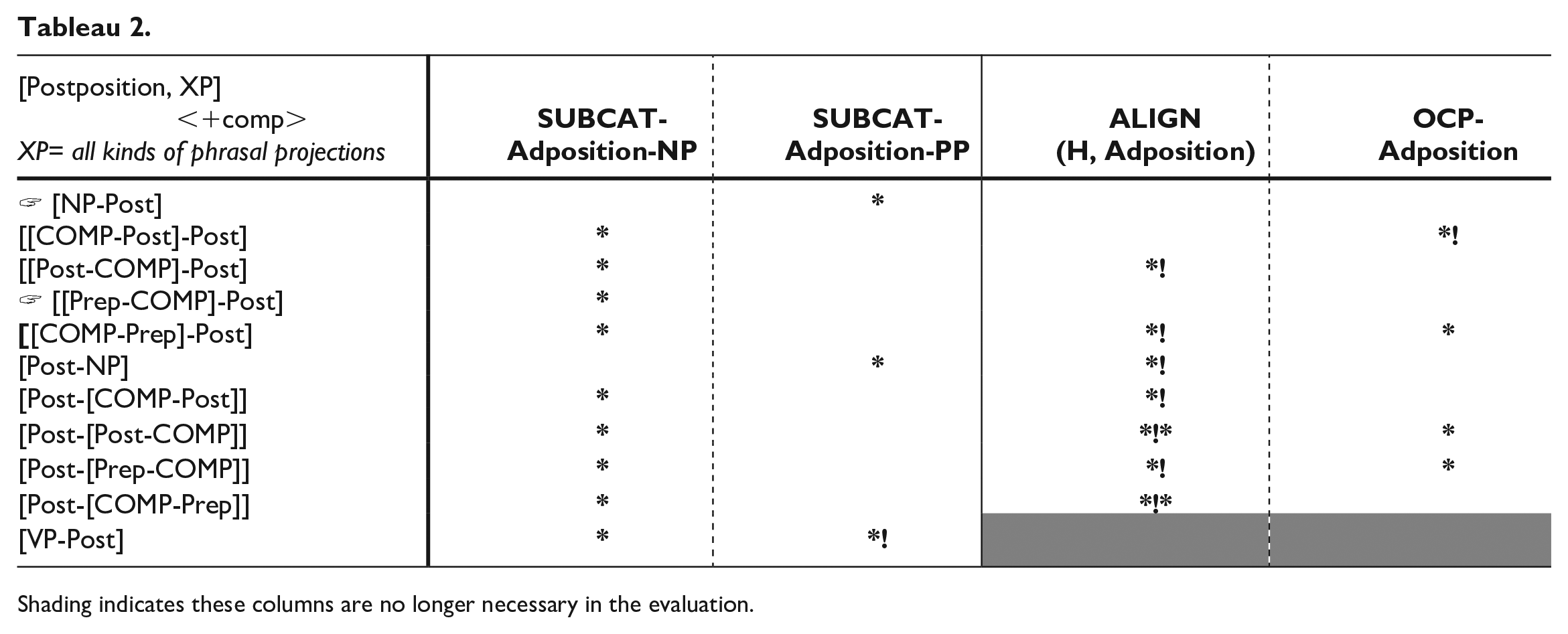
Now we adopt OT to account for the co-occurrence restriction discussed in the first part of this section. As will be shown in the following, the prohibition against two consecutive adpositions can be accounted for by imposing restrictions on the categorical selection of complements for the head. Therefore, we propose OT constraints to regulate the types of syntactic arguments to be included in the subcategorization frame of the predicate.
A verb and an adposition are lexical items that commonly subcategorize for their complements, that is, they adopt the framework of subcategorization (Chomsky, 1965) to denote the obligatory/possible presence and the type of syntactic constituents in their structural framework. In this case, we propose the following set of constraints in (11) to regulate the types of syntactic constituents that function as the complement to be noted in the subcategorization frame of an adposition:
(11) Subcategorization Constraints
In addition, we propose the following generalized alignment constraint (McCarthy & Prince, 1993a, 1993b) to align adpositions to the designated edge in accord with the categorial information specified in each lexical entry. In this case prepositions are aligned to the left edge and postpositions are to the right edge in their maximal projection. Grimshaw (1997, 2006) has proposed similar constraints HEAD LEFT and HEAD RIGHT to align the head of a phrase to the leftmost or the rightmost position of its projection. Here, we unify the two constraints into one ALIGN (H, Adposition) to account for the situation of Mandarin, where both prepositions and postpositions are found in the linguistic system. The alignment is in accord with their lexical specification; specifically, prepositions are aligned to the left edge while postpositions are to the right edge of their phrase.
(12) Positional Constraints
Finally, a markedness OCP constraint (Goldsmith, 1976; Leben, 1973; McCarthy, 1981, 1986; Tseng, 2008) is effective for ruling out constructions that contain two adjacent functional adpositions, as defined in (13). The original idea of OCP is argued to be a linguistic constraint derived from Universal Grammar, functioning to prohibit the direct sequence of two identical linguistic elements (McCarthy, 1981, 1986). The element could be a lexical item, a sound, a tone, a function, or even a feature. The OCP is later developed into a constraint against multiple occurrence (Holton, 1995; Suzuki, 1998; M. Yip, 1995, 1998, and so on), prohibiting against the repeated occurrence of a certain lingusitic element.
(13) Markedness Constraints
The interaction of the constraints involved is illustrated in Tableaux 1 and 2.

Shading indicates these columns are no longer necessary in the evaluation.
Shading indicates these columns are no longer necessary in the evaluation.
In Tableau 1, the two subcategorizational constraints helped select either an NP or a PP as the complement to be denoted in the subcategorization statement of prepositions. The other kinds of phrasal complements are eliminated because they violate both of the subcategorizational constraints and collect more violations than the NP and PP complement does. Inside the PP construction, all candidates that contain a preposition following their complements or a postposition preceding their complements fatally violate the alignment constraint. This table also shows that even though a candidate fulfills the alignment constraint, the construction is equally bad if two prepositions end in the immediately adjacent position. The OCP constraint prohibits a preposition from taking another PrepP as the complement.
Tableau 2 selected either an NP or a PrepP as the complement to be denoted in the subcategorization statement of postpositions. In this case, a postposition does not subcategorize for a PostP to avoid the derivation of a sequence of two postpositions, which again incurs a fatal violation of the OCP.
One point to be noted here is that the OCP constraint is not inviolable in Mandarin. We do find grammatical sentences in this language that contain two consecutive functional morphemes coded with the same grammatical function. Some examples are given in (14) below: (14) a. Ta she should will join competition “She should be joining the competition.” b. Ta chi he eat ASP ASP rice PART “He has eaten the meal.”
In (14a), two auxiliaries are allowed to be adjacent; in (14b), two aspectual markers are standing next to one another, and both sentences are well-formed. To account for the possible identity violation shown in (14), we can propose different manifestations of the OCP constraint and rank them along with the faithfulness constraint that requires the input features to be faithfully presented in the output. In this case, the constraint OCP-Auxiliary is proposed to prohibit the adjancency of two auxiliaires, while the constraint OCP-Aspectual Marker is proposed to prohibit the adjacency of two aspecual markers. The ranking is illustrated in (15).
(15) OCP-Adposition >> Faith-IO >> OCP-Auxiliary, OCP-Aspectual Marker
The constraint hierarchy in (15) states that the OCP manifestation on adposition outranks the faithfulness constraint, and violations on the markedness OCP is worse than violations on the IO-faithfulness. Therefore, two adpositions are not allowed to appear adjacent and remedial strategy should perform to avoid identity violation. In contrast, since the faithfulness constraint outranks the other two OCP manifestations, the faithfulness requirement must be satisfied in the cost of the identity violation. Therefore, auxiliaries and aspectual markers are allowed to appear adjacent.
Syntactic Position
I. Phenomenon
Both prepositions and postpositions recruit dependents to form a linguistic unit, that is, an adpositional phrase, which contains elements that jointly share a certain syntactic function. The two kinds of adpositions follow the word order generalization of Chinese languages, according to which adjunct PPs are preverbal, while complement PPs are postverbal (Mulder & Sybesma 1992; Feng, 2003; Paul, 2015). Therefore, an adpositional phrase follows the verb if it functions as the complement. By contrast, an adpositional phrase precedes the verb if it serves the syntactic function as the adjunct. Examples are shown in the following (16): (16) a. Ta she according to promise walk toward terminal “She walked toward the terminal point according to the promise.” b. she toward terminal walk according to promise “She walked toward the terminal point according to the promise.” c. Ta she tomorrow from. . .on live town outside “From tomorrow on, she starts to live outside the town.” d. she town outside live tomorrow from. . .on “From tomorrow on, she starts to live outside the town.”
Examples (16a) and (16c) put the adjunct AdpP in the preverbal position and the complement AdpP in the postverbal position, and the constructions are well formed. By contrast, in each of their counterpart examples (16b) and (16d), the structure becomes ungrammatical if the two kinds of PP switch their position in the sentence.
Even though prepositions and postpositions diverge in their branching directions, they are alike in having the same capacity to play the syntactic function as complements or adjuncts of verbs and in occurring in the same syntactic position when associated with each particular function.
II. Theoretical account
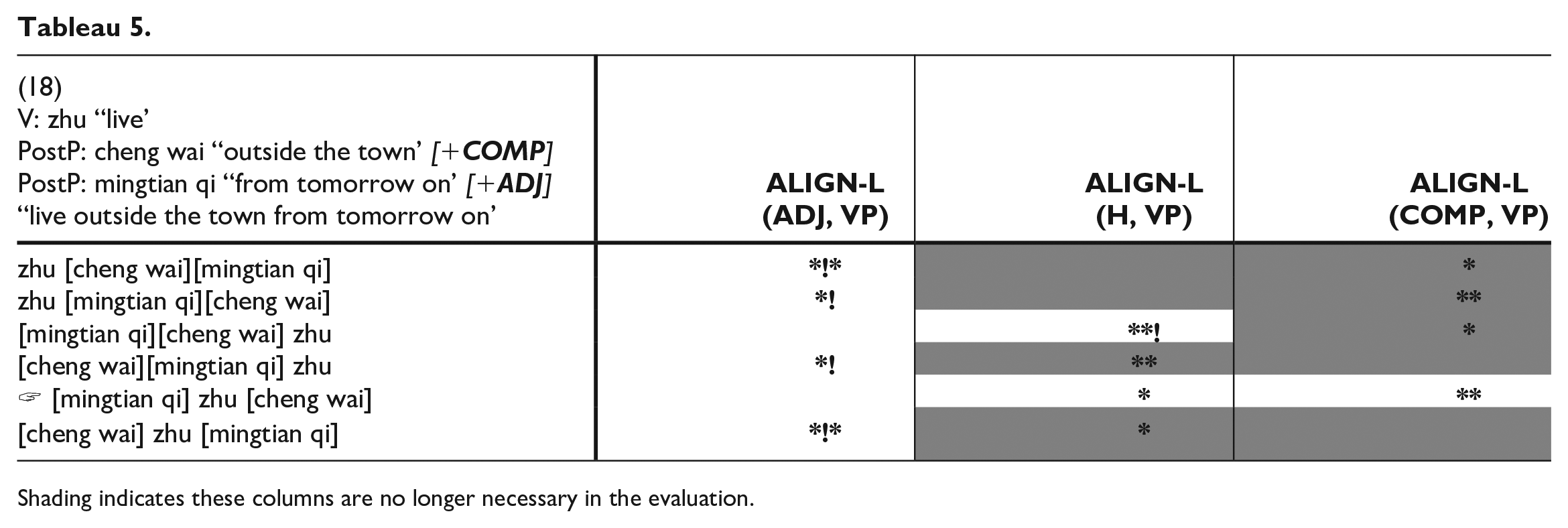
As demonstrated in the previous section, adpositional complement phrases follow the head verb, while adpositional adjunct phrases precede the verb. Their different distribution can be accounted for by proposing a set of generalized alignment constraints, which are defined in the following (17). Linguists including Grimshaw (1997) and Zepter (2000) have proposed similar alignment constraints such as HEAD LEFT, HEAD RIGHT, and SPECIFIER LEFT to pursue typological differences in the branching direction of phrasal constructions. Details can be found in their original notes and drafts in the Rutgers Optimality Archive (ROA).
(17) Generalized Alignment Constraints
The following f-structure (18) represents the argument structures of each head and the grammatical relations among the component constituents inside the VP of (16c). The idea of f-structure (feature/function structure) comes from lexical functional grammar (LFG). F-structure is a syntactic representation of grammatical functions. It represents one of the structural dimensions of rules, concepts, and forms for language systems. The f-structure (18) indicates that the head “live” of a VP contains a complement PP associated with a semantic function to indicate locative information. The complement is represented by a PostP headed by the postposition “outside” which takes an NP complement. An adjunct PostP is also presented in this VP in which the head “from. . .on” takes an NP object.
(18) F-structure of Example (16c)

First, in Tableaux 3 and 4, we see that both postpositions wai and qi are allowed to subcategorize an NP complement in their preceding position:


Next, Tableau 5 shows the constraint interaction that accounts for the ordering of the constituents enclosed in the f-structure of (18):
Shading indicates these columns are no longer necessary in the evaluation.
According to the theoretical evaluation shown by Tableau 5, the adjunctive PostP stands at the left edge of VP to avoid violating the highest-ranking constraint
Syntactic Properties
I. Phenomenon
Prepositions and postpositions are alike in many ways. The first two structural similarities were mentioned by Paul (2015), triggered by the restriction that they cannot be separated from their complement; therefore, syntactic processes such as movement and insertion do not take place if they were to separate the functional adposition and its object.
The first similarity regards the ban against adposition stranding in Mandarin Chinese. As shown in (19) below, the topic information occurs at the sentence initial position in Mandarin; however, we should not separate the complement from its head adposition simply by topicalizing the NP alone: (19) a. school he at lose PERF money “School, he lost some money at.” b. at school he lose PERF money “At school, he lost some money.” c. tomorrow he before will come.back “Tomorrow, he will come backby.” d. tomorrow before he will come.back “By tomorrow, he will come back.”
Each pair of examples—first (19a) and (19b) and then (19c) and (19d)—forms a structural contrast. The two examples (19b) and (19d) position the entire preverbal adpositional phrase at the sentence-initial position, and the resulting constructions are grammatical. By contrast, the examples (19a) and (19c) separate the adpositions from their complement and place only the NP sentence-initially, which triggers ungrammatical results.
The second similarity is relevant to the modifying construction involving the functional morpheme de. Both prepositions and postpositions differ from nouns in that the grammatical morpheme de is allowed to be inserted between two nouns in many cases, as in (20a) and (20b), but the morpheme de does not intervene between an adposition and its complement, as illustrated in (20c) to (20f): (20) a. jiaoshi classroom MOD front “at the front of the class” b. damen main door MOD side “by the side of the main door” c. zai at MOD classroom “at the classroom” d. wang toward MOD main door “toward the main door ” e. jiaoshi classroom MOD in front of “at the front of the class” f. damen main door MOD beside “beside the main door”
According to Paul (2015), the contrast of grammaticality between (20a-b) and (20c-f) provides another convincing argument that strengthens our viewpoint against identifying postpositions and nouns in the same grammatical category. If postpositional phrases were considered NPs, the examples (20e) and (20f) should be well-formed with the intervention of a functional morpheme de, as those grammatical NP constructions of (20a) and (20b). However, the insertion results in the same ungrammatical results as the prepositional phrases (20c) and (20d) in which de appears. We therefore argue that prepositions and postpositions belong to the same category apart from nouns because they exhibit quite similar syntactic behavior, and nouns are different from them.
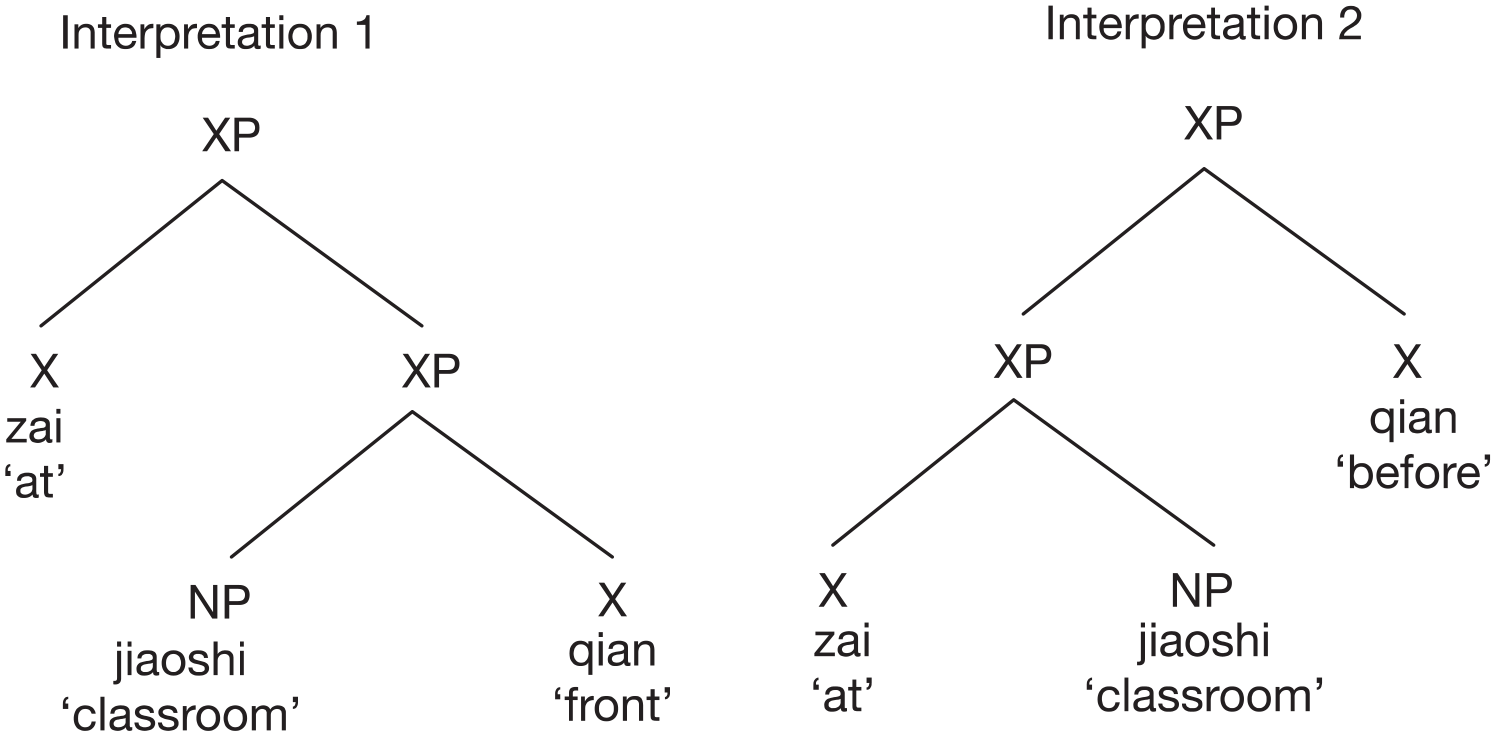
The third similarity is on their similar syntactic position, which is substantiated by the following ambiguous construction (21). This adpositional phrase has two different interpretations if the prenominal and postnominal morphemes switch their syntactic functions, that is, which adposition is the head projecting an adpositional phrase as the complement: (21) a. at classroom front/before Interpretation 1: “at the front of the classroom” Interpretation 2: “before (somebody) was in the classroom”
The morpheme zai often co-occurs with locative information (P.-C. Yip & Rimmington, 2015), while qian may take a complement with either locative or temporal information. Therefore, if jiaoshi qian (“the front of the classroom”) forms a postpositional phrase, functioning as the complement of the locative indicator zai (“at”), interpretation 1 is achieved. By contrast, if zai jiaoshi (“at the classroom”) forms a prepositional phrase, functioning as the complement of the temporal indicator qian (“before”), interpretation 2 is achieved. Illustration is provided in (22): (22) a. Shei zhan who stand at classroom front “Who is standing in front of the classroom?” b. Ta he at classroom before stay at where “Where did he stay before he was in the classroom?”
The syntactic structure corresponding to each interpretation is shown in (23). The categorization of the two grammatical morphemes is identical, but their branching directions are different; they are subcategories under the same word category:
(23) Syntactic Structures for (21)
Other similar examples are shown in (24).
(24) a. except for main door outside/beyond/besides Interpretation 1: except for the outside of the main door Interpretation 2: besides the main door b. toward court beside Interpretation 1: toward the side of the court Interpretation 2: beside the area leading toward the court
Illustration is given in (25).
(25) a. Wo I except main door outside inside dou sao le. all clean PART “I’ve cleaned all the (indoor) areas except the area out of the main door.” b. except main door besides I all very satisfied “I am very satisfied with everything except for the main door.” c. Ta she toward court beside walk go “She is walking toward the side of the court.” d. toward court side have CL dog “There is a dog beside the area leading toward the court.”
II. Theoretical account
The optimality theoretical analysis accounts for the prohibition against de-insertion with the evaluation process requiring that the two subcategorization constraints

Shading indicates these columns are no longer necessary in the evaluation.
From evaluation of the tableau, we see that the morpheme de cannot be inserted between an adposition and its complement because the modificational phrase projected by the head de should not be selected as the syntactic argument being denoted in the subcategorization frame of adpositions. The construction is eliminated due to the double violations on the two constraints
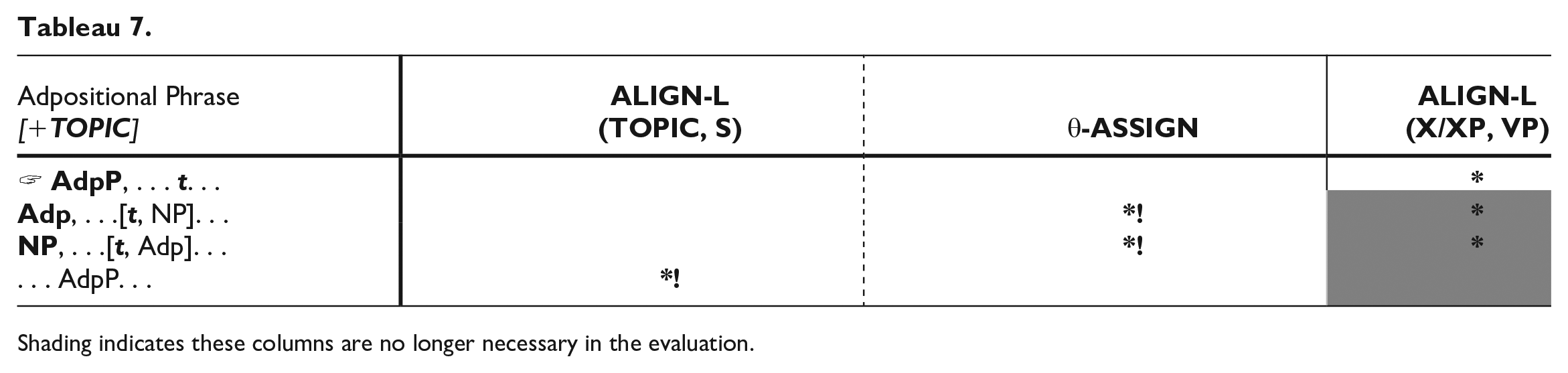
As to the case of adpositional stranding, once we assign topicalized prominence to part of a sentence, we have to place the topicalized constituent at the initial position to receive special attention. OT captures this phenomenon by proposing a generalized alignment constraint that triggers the leftmost placement of the topicalized constituent. In addition, to avoid adpositional stranding, a markedness constraint is proposed which requires the argument of an adposition to be c-commanded by its head (Müller, 2009).
(26) Constraints against Stranding
The constraint that triggers leftward placement and the constraint that disfavors stranding both outrank the other alignment constraints proposed earlier in (17) for the ordering of head, complements, and adjuncts. Therefore, the topicalized constituent is placed to the leftmost position of the sentence no matter it occurs to be a complement or an adjunct of the head verb. However, the placement is subject to one condition. The markedness constraint against adpositional stranding requires that the head adposition and its complement bind in the same constituent.
The evaluation presented in Tableau 7 shows that the second and third candidates lose because they violate
Shading indicates these columns are no longer necessary in the evaluation.
Theoretical Recapitulation
We conclude this section by recapitulating the characteristics of postpositions along with the constraint interactions that we propose in this section to account for each of these characteristics.
The first characteristic is that postpositions follow their complement. This characteristic can be accounted for by proposing the constraint
The second characteristic is the relative position between the head verb and the PostP that functions as either the complement or adjunct of the verb. Specifically, when a postposition projects a complement PostP, the PostP follows the verb; when it projects an adjunct PostP, the PostP precedes the verb. To illustrate this order of precedence, the constraint ranking
The third characteristic of postpositions is that they select an NP or an AdpP as their complements. That is, whenever a postposition appears, it must co-occur with a nominal or an adpositional phrase. The two constraints
The fourth characteristic is the avoidance of two consecutive postpositions in direct sequence. In this case, the proposed ranking
The fifth characteristic poses a restriction on the insertion of the functional morpheme de between the postposition and its complement. The functional de projects a modificational phrase for nouns; therefore, ruled out by the constraints
The sixth characteristic bans postposition stranding. When the topicalized prominence is marked on a postpositional construction, the construction as a whole should be placed in the first position, but we are not allowed to separate the complement phrase with its head postposition and place part of the AdpP to the left. The ranking
Some Theoretical Notions
This section provides a tentative discussion on how the OT analysis established in this paper has potential to be developed into a cross-linguistic typological model. Three major points are made here based on a preliminary structural contrast between Mandarin and English.
I. The Relative Order Among the Head, Complements, and Adjuncts
As shown in this paper, the ranking between the three alignment constraints

Shading indicates these columns are no longer necessary in the evaluation.
In Tableau 8, the two constraints (27) a. Adjunct[happily] head[play] complement[soccor] b. head[play] complement[soccor] adjunct[happily] d.
II. The Possibility to Stack Two Adpositions Next to One Another
In this paper, we show that the two constraints (28) a. appear [ b. walk [
To account for the examples given in (28), the ranking between the alignment and the markedness OCP constraint becomes significant. Tableau 9 takes (28a) as an example for the evaluation. As shown here, the alignment constraint ranks above the markedness OCP, so violations on directionality is more serious than violations on adjacency. In this case, the OCP violation is tolerated even though the two left-headed adpositional phrases result in the immediate adjacency of two prepositions.

Shading indicates these columns are no longer necessary in the evaluation.
III. The Possibility of a Stranding Adposition
In this paper, we argue that the ranking (29) a. CP
b. CP
Tableau 10 shows how the constraint ranking should be modified to account for the fact that some languages allow stranding prepositions. Here, we adopt the alignment constraint SPECLFT proposed by Grimshaw (2006, p. 2) as the constraint that triggers topicalization within a relative CP construction, which requires that the specifier appeared at the leftmost position of the modifier CP.
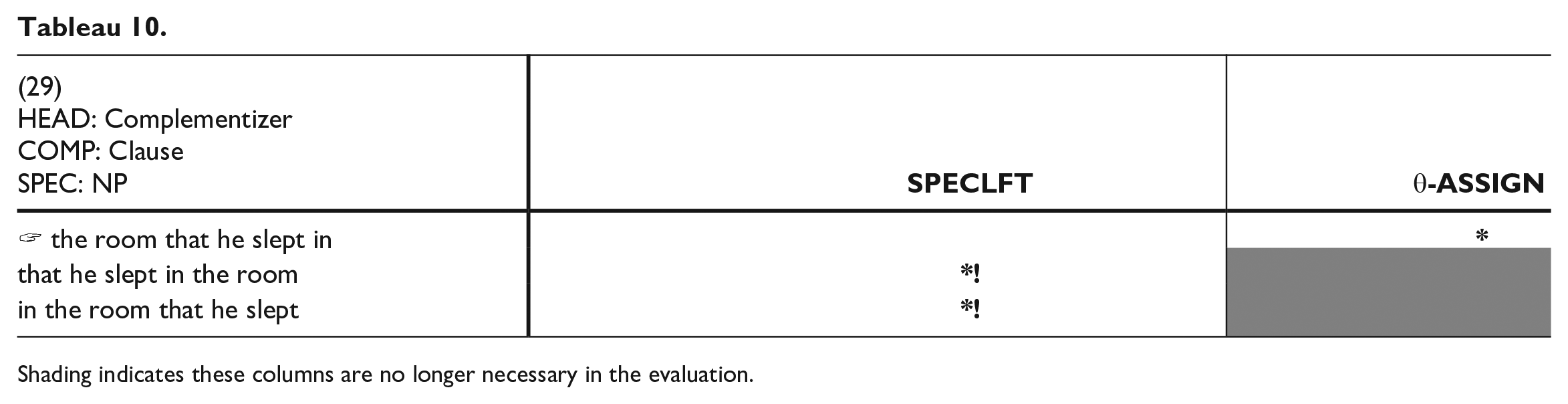
Shading indicates these columns are no longer necessary in the evaluation.
The alignment constraint eliminates candidates that place constituents other than an NP to the left edge of CP; therefore, the evaluation process selects the first candidate as the optimal output which moves only the NP complement to the left edge of CP and leaves the head preposition stranding in the final position, at the expense of violating the constraint prohibiting against adposition stranding.
Conclusion
In this paper, we have shown that Mandarin Chinese has a grammatical category that is very similar to prepositions in their syntactic properties and behavior. They are categorized as postpositions, which belong to a subcategory of the general adposition. In addition, we adopt optimality theory to illustrate how the properties of postpositions can be formally accounted for under the framework of modern linguistic theory, including their syntactic position, their subcategorizational structure, and some linguistic constraints that are relevant when constructing sentences involving this particular category. Finally, this paper shows that the OT model developed in this paper has potential to account for cross-linguistic variations.
Footnotes
Declaration of Conflicting Interests
The author(s) declared no potential conflicts of interest with respect to the research, authorship, and/or publication of this article.
Funding
The author(s) disclosed receipt of the following financial support for the research, authorship, and/or publication of this article: This paper is financially supported by the Ministry of Science and Technology in Taiwan under the grant number #106-2410-H-032-043-.
