



Abstract
The active participation of rural residents is crucial to the effectiveness of rural human settlement environmental governance. However, existing studies have rarely explored the connections between rural residents’ livelihood capital, policy perception, and their participation behavior. This study aims to reveal the relationship between rural residents’ livelihood capital and their participation in human settlement environmental governance, and clarify the mediating role of policy perception in this relationship. This study adopted the random sampling method. Using questionnaires as the data collection tool, we conducted a cross-sectional survey on rural residents’ participation in rural human settlement environmental governance among 2,460 rural residents from 25 provinces in Chinese mainland, with 2,362 questionnaires validly returned. Data were analyzed through a binary logistic regression model to explore the direct impact of livelihood capital on participation behavior, while the mediating effect of policy perception was evaluated through a mediation effect test. The results show that livelihood capital has a significant positive impact on rural residents’ participation in human settlement environmental governance, and policy perception partially mediates the relationship between livelihood capital and participation. The study indicates that improving rural residents’ livelihood capital and policy perception can effectively promote their participation in human settlement environmental governance. Accordingly, participation efficiency can be enhanced by optimizing livelihood capital and strengthening the perception of environmental policies. In the future, the research area can be further expanded to verify the universality of the conclusions, and panel data can be used to explore the dynamic evolutionary relationship among the three factors.
Keywords
Introduction
Rural human settlement environmental governance holds significant importance for advancing both the rural revitalization strategy and broader goals of sustainable rural development. China has experienced rapid economic expansion over the past four decades; however, resistant challenges remain in governing the rural environment (G. He et al., 2012). In contrast to the centralized nature of urban pollution, rural environmental pollution presents unique difficulties due to its diffuse sources, unpredictable spread, and the complexities of monitoring. Therefore, it directly affects the living conditions of rural residents. In December 2021, the Chinese government introduced the Five-year Action Plan to Improve the Rural Living Environment, and the effort is focused on strengthening rural environmental governance. This initiative has involved a significant allocation of human resources, financial capital, and technological advancements. In addition, rigorous oversight and evaluation procedures have been established to guarantee the effectiveness of these governance efforts (Chen & He, 2023). Despite these efforts, rural resident participation in human settlement environmental governance remains a challenge, hampered by persistent challenges such as limited public participation and reliance on administrative interventions (D. Liu & Gong, 2022). As those most directly affected by the state of the rural environment, rural residents play a decisive role in the success of rural human settlement environmental governance through their active participation. Thus, how to promote their effective engagement has become a key topic of common concern to academic circles and practical departments.
Existing research has explored rural resident participation in human settlement environmental governance and produced several theoretical viewpoints: (a) individual characteristics, such as age and political standing, have been demonstrated to be influencing factors (Hao et al., 2023). Cognitive resources play a vital role, as they include environmental consciousness, fundamental environmental aptitudes, and baseline environmental understanding, which also contribute to rural resident participation in human settlement environmental governance (J. Wang et al., 2022); (b) Granovetter’s social network theory holds that individuals are embedded in social networks, with two types of relational practices: strong ties and weak ties (Granovetter, 1983). In human settlement environmental governance, such embeddedness means that residents’ participation behaviors will be affected by network relationships, and these characteristics include the cost, goals, frequency, and scope of rural residents’ social networks (Ruan, Chen et al., 2022); (c) technological capital also exerts an effect, particularly in less developed areas (Q. He et al., 2021); (d) informal capital has been demonstrated to support pro-environmental behaviors among residents and consists of community connection and regional identification (Buta et al., 2014);and (e) Ostrom’s collective action theory holds that human settlements have the attribute of public resources, and the formation of local rules, trust, and mutual assistance can promote the achievement of autonomous governance (Ostrom, 2000). Correspondingly, Pretty points out that collective resource management projects aimed at building trust, cultivating new norms, and assisting in group formation have been proven effective in various fields such as river basins, forests, and the environment. Since the early 1990s, numerous local groups have achieved favorable ecological and economic results through such projects (Pretty, 2003). Existing studies have focused on the impact of personal capital on rural residents’ environmental behaviors, but there has been little discussion on the overall capital and the differentiated impacts of various types of capital. Livelihood capital, however, provides a tool for systematically evaluating the capital level of rural residents (Bhandari, 2013). Its application in assessing rural residents’ participation in human settlement environmental governance is limited, which also leaves room for the research of this paper.
Moreover, the widespread effects of environmental policies on rural resident participation in human settlement environmental governance are well-documented. From the perspective of policy-resident interactions, the policy environment and relevant institutional structures influence rural resident participation in human settlement environmental governance (Atari et al., 2009). Where formal environmental regulations are weak or lacking, village rules can function as a beneficial complement, and they can also encourage rural resident participation (Y. Wang & Zhu, 2023). Besides, a synergistic relationship exists between formal institutions, such as incentive-based and restrictive regulations, and informal institutions, and these informal institutions are guided by values, which can strengthen rural resident participation in human settlement environmental governance (J. Xie et al., 2022). Prior research on the effect of environmental policies has largely concentrated on policy tools (Shen et al., 2020), available policy options (Gregory, 2000), and policy combinations (Jordan & Lenschow, 2010). Irrespective of policy design and implementation, the effectiveness of policies is determined by how their perception. In practice, rural residents’ environmental perceptions significantly affect their willingness to participate, and this effect occurs when these perceptions are combined with their prevailing norms, attitudes, and sense of agency (Cheng et al., 2022). Moreover, policies alone are insufficient to drive rural resident participation in human settlement environmental governance; this is also influenced by policy perception (B. Wang et al., 2021). Existing studies rarely appraise how rural residents’ environmental policy perception mediates their rural resident participation in human settlement environmental governance. Accordingly, this study seeks to appraise how environmental policy perception affects rural resident participation in human settlement environmental governance.
Although a considerable body of research has been accumulated on rural residents’ participation in human settlement environmental governance, existing studies mostly focus on explicit factors such as individual capital and policy incentives. Systematic analysis of how livelihood capital and policy perception affect environmental participation remains insufficient, with three main research gaps. First, from the perspective of individual rural residents, rural resident participation in human settlement environmental governance is influenced by various forms of individual capital. However, a comprehensive identification and analysis of these influences is still needed. Moreover, a cohesive analytical framework for assessing capital remains a significant gap in the literature. Second, from an environmental policy standpoint, existing research has primarily concentrated on top-down policy implementation, and researchers have given limited attention to the micro-level perspectives of rural residents’ policy perceptions. Third, crucially, both policy arrangements and individual differences are key determinants of rural resident participation in human settlement environmental governance. Therefore, an in-depth analysis of the interaction between policies and the public is essential, and this interaction has an influence on rural resident participation in human settlement environmental governance. Generally, existing research has seldom drawn a connection between livelihood capital, policy perception, and rural resident participation in human settlement environmental governance. Thus, how livelihood capital and policy perception affect rural residents’ participation in human settlement environmental governance has become the key focus of this study.
Accordingly, the aim of this study is two-fold: (a) to appraise the effect of rural residents’ livelihood capital on their participation in human settlement environmental governance; and (b) explore the mediating effect of policy perception, systematically analyze the impact of the interaction between livelihood capital and policy perception on rural residents’ participation in human settlement environmental governance, and put forward policy recommendations based on relevant influencing factors and operational mechanisms.
This study explores the relationship between livelihood capital, policy perception, and rural resident participation in human settlement environmental governance utilizing data collected from 2,362 respondents in China during February 2021. Focusing on how individual capital affects rural residents’ participation in this governance, the study hypothesizes policy perception as a mediating factor. The findings indicate a positive correlation between livelihood capital and rural resident participation in human settlement environmental governance, mediated by policy perception. By connecting rural resident participation in human settlement environmental governance to livelihood capital, this research contributes to existing theoretical discussions and offers insights into promoting such participation through the perspective of policy perception.
The structure of this study is as follows: First, research hypotheses are developed based on a review of the literature. Second, the data sources, variables, and models employed are described. Third, the regression results from the baseline model are presented. Fourth, the mediating role of policy perception is presented, and the specific mediation pathways are analyzed. Finally, the study concludes by presenting research findings and offering policy recommendations.
Research Hypotheses
Rural human settlement environmental governance addresses the development, utilization, and management through various stakeholders such as governmental bodies, private institutions, and the community, designed to attain sustainable rural human settlements (Yu & Tang, 2012). The quality of rural human settlements is interrelated with the welfare of the rural populace, which involves having an impact on their production and living conditions. The Chinese government has implemented environmental policies aimed at enhancing rural living conditions. This study defines rural human settlement environmental governance as a joint effort between the government and the rural populace to improve living conditions in the rural living environments. China’s environmental governance policy is implemented through a unique “top-down and bottom-up” approach due to the vertical transmission of the environmental policies and rural resident participation (L. Xie, 2016). Therefore, rural residents act as principal stakeholders, whose participation is subject to their individual capitals. Moreover, environmental policies influence this participation, and policy perception determines the success of governance (Brown et al., 2021). Therefore, it is crucial to study rural resident participation in human settlement environmental governance in relation to individual capital and policy perception.
Livelihood Capital
The Department for International Development in the UK (DFID) designed the framework termed Sustainable Livelihood Approach (SLA) to study poverty governance and sustainable development in vulnerable regions in 2000. The DFID compartmentalized rural livelihood development into four components: vulnerability context, livelihood capital, livelihood strategies, and livelihood development (DFID, 1999). Among all the components, livelihood capital represents an effective tool for the assessment of rural residents’ individual capital, which has been widely applied in various fields including environmental protection (Cui et al., 2022), rural tourism development (Huang et al., 2022), climate change (Tanner et al., 2015), and land transfer (Yang et al., 2021). Livelihood capital is defined as the total resources utilized by the rural population to maintain their livelihoods and cultivate development (Fang et al., 2014). Scoones (2009) specifies these types of capital to be human, social, material, financial, and natural capital. Moreover, psychological capital is also considered in the analysis (Chipfupa & Wale, 2018). The livelihood capital theory follows a “capital-behavior” analytical framework given that it establishes a connection between rural residents’ capital endowments and their behavioral logic. Varying participation behaviors in human settlement environmental governance originate from the differences in individuals’ livelihood capital (M. Liu et al., 2018). Therefore, a detailed analysis of the effect of livelihood capital on rural resident participation in human settlement environmental governance can deepen the understanding of their environmental behaviors and offer implications for how to enhance rural resident participation in rural human settlement environmental governance. This study categorizes rural residents’ livelihood capital into the following six types:
(i) Human capital primarily includes knowledge, skill set, cultural and technical proficiency along with the health status of laborers (Graff Zivin & Neidell, 2013). Human capital is directly related to rural residents’ cognitive ability and action capacity regarding environmental governance. Sufficient labor force and good health status provide the basic conditions for participating in environmental governance, while a higher level of education and relevant skills help residents understand environmental issues, master governance methods, and enhance their willingness to participate. The larger the rural household workforce, the more likely they are to participate in human settlement environmental governance. Similarly, whereby residents with higher educational attainment result in a greater possibility of environmental knowledge acquisition. Agricultural training participation also increases awareness of the environment, further encouraging participation in human settlement environmental governance;
(ii) Natural capital refers to natural resources that sustain rural households, which are directly related to rural residents’ production activities and daily life, and their quality and quantity will affect residents’ participation in environmental governance (Astrid et al., 2017). The higher the level of natural capital, the more dependent rural residents are on natural resources and the environment for their production activities, therefore motivating them to participate in human settlement environmental governance;
(iii) Financial capital reflects the financial status of rural residents (Wang et al., 2015). This is embodied not only in the balance between income and debt but also in the economic reserve capacity to cope with risks. A stable financial foundation can provide rural residents with basic economic security and confidence to participate in environmental governance;
(iv) Social capital consists of trust, norms, and inter-organizational networks that are structured for cooperation, enabling the growth of individual or organizational efficiency. Social capital is represented as the relationship between people and groups (Adler & Kwon, 2002). Mutual assistance among rural residents, the establishment of public consultation organizations, and the costs of social interactions are examples of social capital. If there is strong social capital, this results in a higher level of social networking integration among the residents. This interconnectedness, however, imposes limitations and may discourage participation in human settlement environmental governance.
(v) Material capital is defined as the physical facilities and resources required for rural residents’ production and daily lives (Xu et al., 2019). As an important asset for sustaining their livelihood, material capital determines the residents’ dependency on the environment of their village. If the material capital is more adequate and of better quality, the less people’s daily lives are impacted by the surrounding village environment, thus reducing participation in human settlement environmental governance.
(vi) Psychological capital represents the status of positive psychological development (Suksod et al., 2019). Psychological capital is not only reflected in individuals’ positive psychological states at the individual level, which indicates their behavioral motivation, but also includes their positive cognition of the collective, which can reflect their willingness to participate in collective actions (Bamberg et al., 2018). This comprises belief in village development and perceptions of personal life stress. In general, resilience is strengthened with psychological capital, which reduces the motivation to participate in human settlement environmental governance.
(vii) Livelihood capital determines the production and lifestyle of the rural population and represents a foundation for participation in human settlement environmental governance.
On this basis, the study proposes the following research hypotheses:
The Mediating Effect of Policy Perception
Perception describes an individual’s subjective feelings and psychological understanding. Cognitive psychology defines “perception” as the process through which individuals receive and interpret information from their surroundings (Solso et al., 2005). Policy perception, therefore, refers to the public’s understanding and assessment of policies relevant to their interests. It is a necessary condition for effective participation. Research on policy perception has approached the topic from both policy and public viewpoints. From a policy standpoint, studies exhibit that residents understand incentive-based and punitive environmental policies differently, leading to varied environmental behaviors (Bopp et al., 2019). From the public standpoint, policy perception is often multidimensional, including aspects such as perceived policy usefulness and ease of application (Caffaro et al., 2020). Irrespective of perspective, research consistently suggests that policy perception bridges environmental policies and public participation.
Environmental policies represent the government’s dedication to environmental governance and are expected by the public to effectively resolve environmental problems (Eden, 1996); whereas, the public must react effectively to such policies, as residents’ perceptions of them directly affect their success (Pan et al., 2020). Since policy perception arises from the interaction and response between environmental policies and the intended recipients of those policies, analyzing policy perception requires considering the policy process. Recognizing that policy perceptions may shift during different policy stages, this study classifies policy perception into three dimensions: policy content perception, policy implementation perception, and policy effectiveness perception. The aim is to comprehensively appraise the mediating role of policy perception on the relationship between livelihood capital and rural resident participation in human settlement environmental governance.
Policy content perception refers to public understanding and recognition of policy texts (Niles et al., 2013). Ongoing dialogue between government and citizens regarding policy ensures that sound policies accurately and comprehensively convey information. This enables correct public understanding of policy content. Citizen behavior is predicated on policy perception, and successful communication of policy cultivates public trust. Policy implementation perception refers to the public perception of the policy execution process. Because of the hierarchical structure of China’s public policy system, citizens evaluate government commitment to policy based on the administrative rank of policy actors (Ran, 2013). Clear communication of policy signals promotes public participation. Moreover, equitable and responsive policy implementation cultivates citizens’ confidence in their participation in policy efforts as well as greater participation. Public evaluation of policy efficiency and outcomes constitutes the policy effectiveness perception, and this evaluation is crucial for future policy adjustments (Zube, 1984). Public policies must achieve an equilibrium between equity and efficiency. At the same time, public policy effectiveness perception directly affects the alignment of public and private interests. Rural residents are the most direct participants in and observers of rural human settlement environmental governance policies. Therefore, the evaluation of policy performance should consider their subjective perceptions (Song et al., 2022).
Based on the above analysis, this study proposes the following hypotheses:
The research framework is demonstrated in Figure 1.
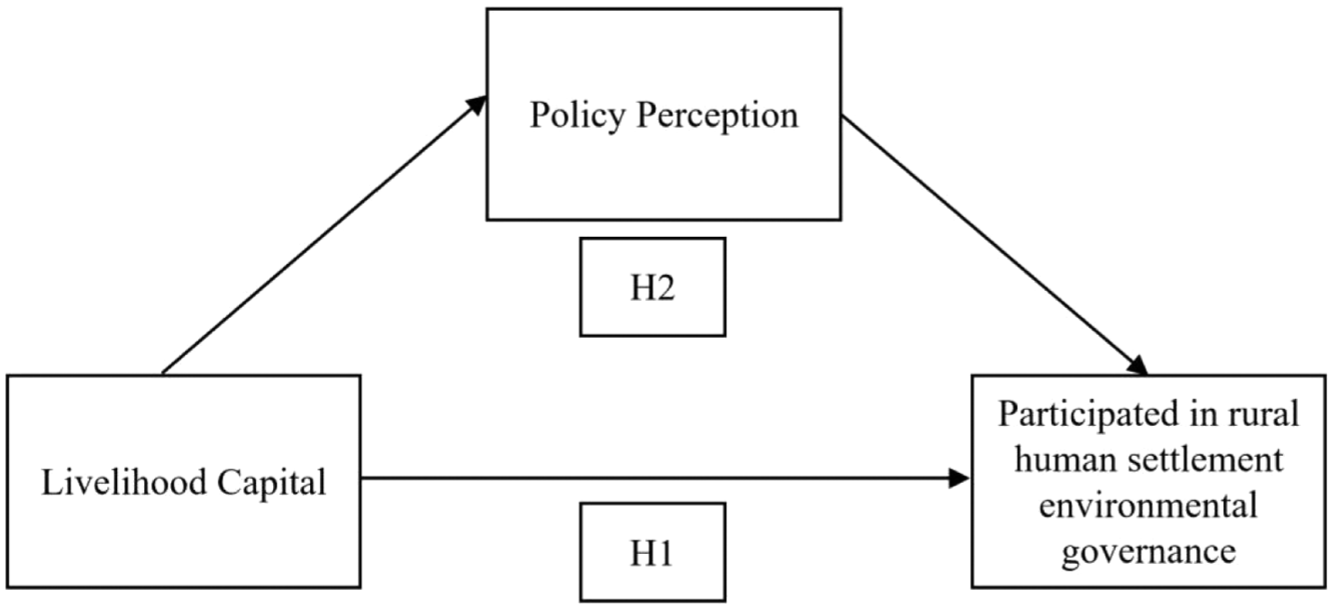
Conceptual model of the entire research hypothesis.
Methodology
Data Sources
This study analyzes rural resident participation in rural human settlement environmental governance utilizing questionnaire surveys and semi-structured interviews. The study was conducted between January and February 2021 and covered demographic characteristics, household livelihoods, and policy perceptions. The study employed a random sampling method and comprised 25 major provinces nationwide through in-person, and offline surveys. Among the 2,460 questionnaires distributed, 2,362 produced valid responses, achieving a response rate of 96.02%, which surpasses the 90% threshold for questionnaire validity. To guarantee data reliability, the research team conducted follow-up verification with a randomly selected 10% of participants. Semi-structured interviews were a supplementary approach and were particularly valuable for respondents who could not read or write, thus facilitating questionnaire completion through guided interviews. Prior to each survey administration, researchers clarified the study’s aims and content to ensure informed consent. Each survey took approximately 13–16 min to complete, and all participants received compensation. Following data collection, 2,362 valid samples were retained for analysis.
Variable Definition and Description
Dependent Variable
The dependent variable in this research is rural resident participation in human settlement environmental governance. This variable is measured in the questionnaire through the question: “Have you participated in rural human settlement environmental governance?” Responses are treated as a binary variable.
“No” (0): Indicates non-participation.
“Yes” (1): Indicates participation.
Table 1 presents the coding scheme for this variable.
Measurement Values of Livelihood Capital of Rural Residents.

Independent Variable
The explanatory variable is the composite measure of rural residents’ livelihood capital. The study draws upon livelihood capital theory and incorporates six dimensions: Human Capital, Natural Capital, Financial Capital, Social Capital, Material Capital, and Psychological Capital. This study is based on existing literature and regional particularities and uses 15 indicators to measure livelihood capital. The entropy weight method (Zhu et al., 2020) is employed to construct a holistic evaluation of rural residents’ livelihood capital. Table 1 presents the measurement of the six dimensions of livelihood capital and the operationalization methods of specific indicators.
For n rural residents and m evaluation indicators, let Xij represent the j-th indicator value of the i-th rural resident: where i = 1, 2 …n, j = 1,2 …m.
Step 1: Construct the original data matrix

Step 2: Considering the difference in units and scales across the evaluation indicators, direct comparison is not feasible. To establish uniformity, a dimensionless transformation is employed to convert the original data into a standardized matrix before further analysis. For indicators where larger values are preferred, the positive transformation outlined in Equation 2 is utilized.

For indicators where lower values are better, the positive transformation is applied using Equation 3.

Following this dimensionless processing, certain data points may assume negative or zero values. Therefore, a standardization procedure is necessary to convert these data points into non-negative values. This specific translation formula ensures the data’s compatibility with further calculations.

Through the above processing,
After this processing, the standardized matrix is obtained.

Step 3: Calculate the weight of the j-th evaluation index for the i-th rural resident

Step 4: Compute the information entropy value of the j-th indicator, which reflects its uncertainty, based on Equation 7:

Where
Step 5: Compute the differentiation coefficient of the j-th indicator

Step 6: Compute the weight

Finally, calculate the comprehensive livelihood capital score Si for the i-th evaluated sample

Mediating Variable
The mediating variable, policy perception, comprises three dimensions: perceived policy content, perceived policy implementation, and perceived policy effectiveness. Perceived policy content is measured by the item, “Are you aware of the rural human settlement environmental governance policy?” Responses are recorded on a five-point Likert scale (1 = Completely unaware; 2 = Slightly unaware; 3 = Neutral; 4 = Somewhat aware; 5 = Fully aware).
Perceived policy implementation is evaluated with the question, “How do you evaluate the government’s investment and enforcement in rural human settlement environmental governance?”. Responses are categorized as follows: 1 = Very low; 2 = Low; 3 = Neutral; 4 = High; 5 = Very high.
Perceived policy effectiveness is measured by the question, “To what extent has rural human settlement environmental governance policy improved the village’s appearance?”. A 5-point Likert scale is employed (1 = Very little; 2 = Slight improvement; 3 = Neutral; 4 = Considerable improvement; 5 = Significant improvement).
Higher scores on these items indicate stronger policy content perception, policy implementation perception, and policy effectiveness perception among rural residents.
Control Variables
Several control variables are incorporated to account for other factors potentially influencing rural resident participation in human settlement environmental governance. These controls cover respondent demographics and socioeconomic characteristics, including gender, age, marital status, ethnicity, and regional distribution. These variables ensure a robust analysis. The relevant definition and descriptive analysis of variables are shown in Table 2.
Definition and Descriptive Analysis of Variables.

Model Setup
Considering the binary nature of the dependent variable and the inclusion of both categorical and continuous independent variables, this study applies binary logistic regression to analyze the effect of livelihood capital and policy perception on rural resident participation in human settlement environmental governance (Harrell et al., 2015).

Applying a logistic transformation to Equation 11 derives a linear regression model that relates the probability function to the independent variable:

In Equations 11 and 12, pi represents the probability of rural residents’ participation in environmental governance; y is the dependent variable, representing whether rural residents participate in environmental governance (y = 1 for participation, y = 0 for non-participation); χi represents the ith influencing factor (independent variable); and β i is the regression coefficient of the independent variable.
To explore the mediating role of policy perception in the relationship between livelihood capital and rural resident participation in human settlement environmental governance, this study adopts a stepwise mediation model (Wen & Ye, 2014). This model involves three steps: (a) we regress the dependent variable on the independent variable; (b) we regress the mediator variable on the independent variable; and (c) we regress the dependent variable simultaneously on both the independent and mediator variables.
The relationships between these three variables can be expressed with the following linear regression equations:

where c represents the effect of the independent variable X (livelihood capital) on the dependent variable Y (participation in human settlement environmental governance);

where a represents the effect of the independent variable X (livelihood capital) on the mediator variable M (policy perception);

where c′ represents the direct effect of the independent variable X (livelihood capital) on the dependent variable Y (participation in human settlement environmental governance), and b denotes the effect of the mediator variable M (policy perception) on the dependent variable Y (participation in human settlement environmental governance). e1, e2, and e3 express the error terms.
Results
Binary Logistic Regression Analysis
Prior to regression analysis, we assessed multicollinearity among variables utilizing the Variance Inflation Factor (VIF) method. The results demonstrate that all VIF values are below 2, and they are in the acceptable range of 0 < VIF < 10, indicating no multicollinearity. Due to the binary nature of the dependent variable, we utilized a binary logistic regression model for estimation. The following section evaluates the mediating effect further, and we employ both Sobel and bootstrap tests to ensure robust results.
Table 3 offers the results of the binary logistic regression analysis. The findings presented in Column (1) exhibit a significant positive correlation between livelihood capital and rural resident participation in human settlement environmental governance, thus supporting H1. This suggests that as rural residents’ livelihood capital increases, their participation in human settlement environmental governance also increases.
Regression Results of Livelihood Capital on Rural Resident Participation in Human Settlement Environmental Governance.

Standard errors in parentheses ***p ≤ .001, **p ≤ 0.01, *p ≤ 0.05.
Tables 3(2) and 3(3) present the regression results analyzing the effects of livelihood capital dimensions on rural resident participation in human settlement environmental governance. Human capital exhibits a significant positive effect (p < .01), confirming hypothesis H1a. A one-unit increase in human capital corresponds to a 0.359 increase in the predicted probability of rural resident participation in human settlement environmental governance. Specifically, while participation in agricultural training demonstrates a significant positive effect on resident participation in human settlement environmental governance, labor size and educational attainment exhibit no significant effects. This suggests a potentially direct influence of training on participation. Natural capital also demonstrates a significant positive correlation (p < .10), supporting hypothesis H1b. A one-unit increase in natural capital corresponds to a 0.772 increase in the predicted probability of rural resident participation in human settlement environmental governance. While contracted land area and cultivated land quality individually produce insignificant results, the composite measure of natural capital, including both land quantity and quality, indicates a significant positive effect. Financial capital demonstrates no significant association with resident participation in human settlement environmental governance, failing to support hypothesis H1c. Social capital yields a significant effect (p < .01), supporting hypothesis H1d. A one-unit increase in social capital, however, is associated with a 0.241 decrease in the predicted probability of resident participation in human settlement environmental governance. The effect of mutual assistance is not significant, suggesting that it may not affect resident participation in human settlement environmental governance. The presence of village consultation organizations presents a significant negative correlation with participation, indicating that this organized approach may substitute for individual resident involvement. Meanwhile, social relationship costs demonstrate a significant positive correlation with resident participation in human settlement environmental governance, suggesting that interpersonal dynamics, potentially including social pressure, could motivate participation. Material capital exhibits no significant correlation with resident participation, thus not supporting hypothesis H1e. Psychological capital displays a significant effect (p < .01), confirming hypothesis H1f. A one-unit increase in psychological capital is associated with a 0.062 decrease in the predicted probability of resident participation in human settlement environmental governance. More specifically, greater confidence in village development predicts higher participation, highlighting the positive motivational influence of such confidence. Finally, the regression coefficient for life stress is positive, indicating that greater pressure is associated with a higher likelihood of resident participation in human settlement environmental governance.
Robustness Check
To verify the robustness of the preceding findings, this study employed a series of robustness checks, including the following four methods: (1) Regression Model Modification: In addition to the binary logistic model utilized in the baseline regression, a probit model was employed to verify the stability of the results. The findings, presented in Table 4(1), demonstrate that the regression coefficients remain significantly positive, consistent with the baseline results. (2) Livelihood Capital Recalculation: To address potential variable selection bias, the livelihood capital values were recalculated utilizing a modified set of indicators. Specifically, six of the fifteen measurement indicators across all six dimensions of livelihood capital were partially replaced. For instance, in the social capital dimension, the life stress indicator was substituted with the frequency of going outside to better measure the extent of rural residents’ social interactions. The corresponding regression results, presented in Table 4(2), indicate that the coefficients for livelihood capital remain significantly positive and consistent with the primary analysis. (3) Dependent Variable Substitution: “Rural resident participation in human settlement environmental governance” was replaced with “satisfaction with human settlement environmental governance” as the dependent variable. Existing literature suggests a positive correlation between satisfaction with human settlement environmental governance and the likelihood of participation (Yan, 2023). Therefore, “satisfaction with human settlement environmental governance” was the dependent variable in this robustness check. Satisfaction was measured utilizing the following question: “Are you satisfied with the human settlement environmental governance in your village?” with responses rated from 1 (very dissatisfied) to 5 (very satisfied). Table 4(3) demonstrates that the results, following the substitution of the dependent variable, remain consistent with the baseline regression findings. (4) Sample Optimization: Non-rural household samples were excluded from the analysis. Rural residents with urban household registrations, while residing in rural areas, may exhibit unique characteristics in their participation in human settlement environmental governance, potentially influencing the regression results. Household registration types were identified utilizing the following question: “What is your household registration type? 1 = Rural household registration, 2 = Non-rural household registration.” As presented in Table 4(4), after excluding non-rural household registrations, the coefficients remained positive, further confirming the robustness of the baseline regression results.
Robustness Results.
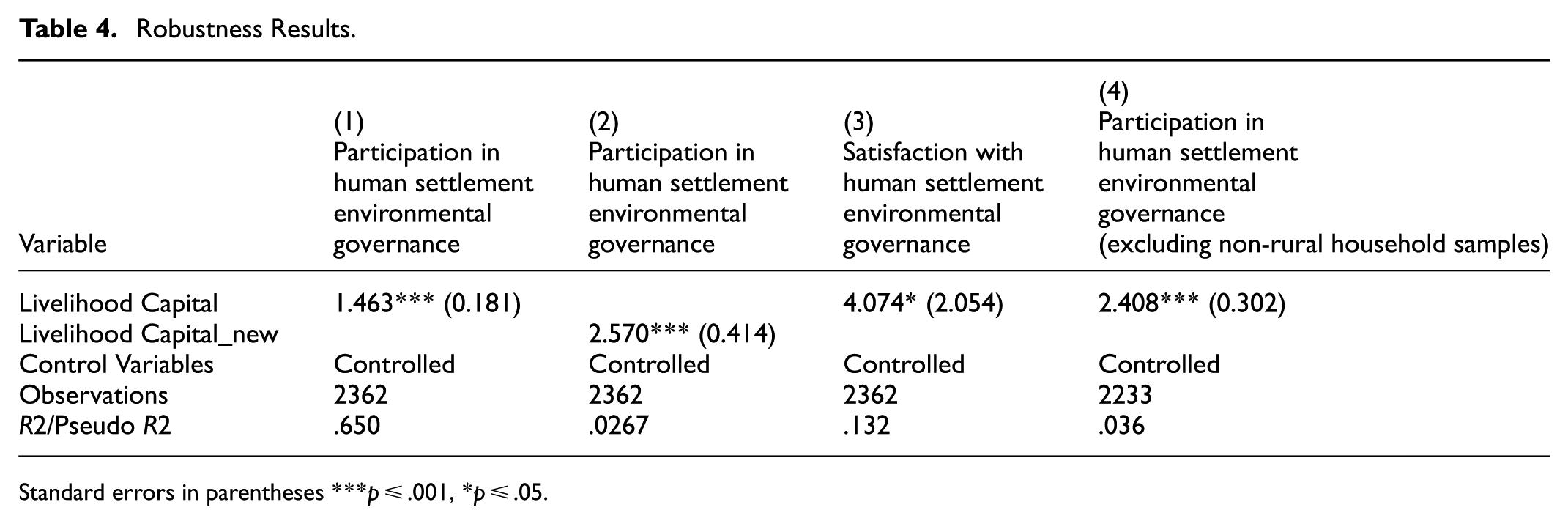
Standard errors in parentheses ***p ≤ .001, *p ≤ .05.
Mediation Effect Analysis
To verify the mediating role of policy perception in the association between livelihood capital and rural resident participation in human settlement environmental governance, we performed a mediation analysis employing a three-step method. Tables 5 (1), (2), and (3) indicate that livelihood capital significantly and positively affects policy content perception, policy implementation perception, and policy effectiveness perception, respectively. This suggests that higher levels of livelihood capital among rural residents correspond with more favorable policy perceptions. Table 5 (4) illustrates a positive relationship between policy perception and rural resident participation in human settlement environmental governance. In particular, policy content perception and policy effectiveness perception significantly contribute to increased participation. The findings presented in Table 5 (5) further confirm that policy perception plays a positive mediator in the relationship between livelihood capital and rural resident participation in human settlement environmental governance.
Mediation Effect Test of Policy Perception.

Standard errors in parentheses ***p ≤ .001.
Robustness Test
To account for potential shortcomings of the conventional three-step mediation test and to optimize the identification of the mediating pathway, we conducted a robustness analysis utilizing the Sobel test and the Bootstrap sampling method. As presented in Table 5, the Sobel test yielded Z-statistics of 3.92, 3.97, and 3.35 for policy content perception, policy implementation perception, and policy effectiveness perception, respectively, all reaching statistical significance at the 5% level. The results of the Bootstrap test are displayed in Table 6. Following 500 resampling iterations, the mediation effect coefficients remained significant at the 5% level, with 95% confidence intervals that did not include zero. This verifies a significant partial mediation effect, thus supporting hypotheses H2a, H2b, and H2c. The mediating mechanism can be described as follows: Increase in livelihood capital → Enhancement of policy perception → Greater rural resident participation in human settlement environmental governance.
Bootstrap Test Results.

The analysis of policy perception through various dimensions indicates mediating effects. Specifically, the mediating effect through perceived policy content demonstrates a direct effect of 0.487 and an indirect effect of 0.045. The pathway through perceived policy implementation demonstrates a direct effect of 0.506 and an indirect effect of 0.039. Finally, the pathway through policy effectiveness perception presents a direct effect of 0.495 and an indirect effect of 0.038. These results support Hypothesis H2, indicating that policy perception acts as a mediator in the relationship between livelihood capital and rural resident participation in human settlement environmental governance. This suggests a positive correlation: the greater the policy perception, the higher the participation.
Pathway Analysis
To determine the relationships between the dimensions of livelihood capital and policy perception, a three-step method was employed. This method was utilized to analyze the mediating pathways among perceived policy content, perceived policy implementation, perceived policy effectiveness, and the dimensions of livelihood capital. The results of this analysis are detailed in Tables 7 to 9.
Mediation Effect Test of Policy Content Perception.

Standard errors in parentheses ***p ≤ .001, **p ≤ .01, *p ≤ .05.
Mediation Effect Test of Policy Implementation Perception.

Standard errors in parentheses ***p ≤ .001, **p ≤ .01.
Mediation Effect Test of Policy Effectiveness Perception.
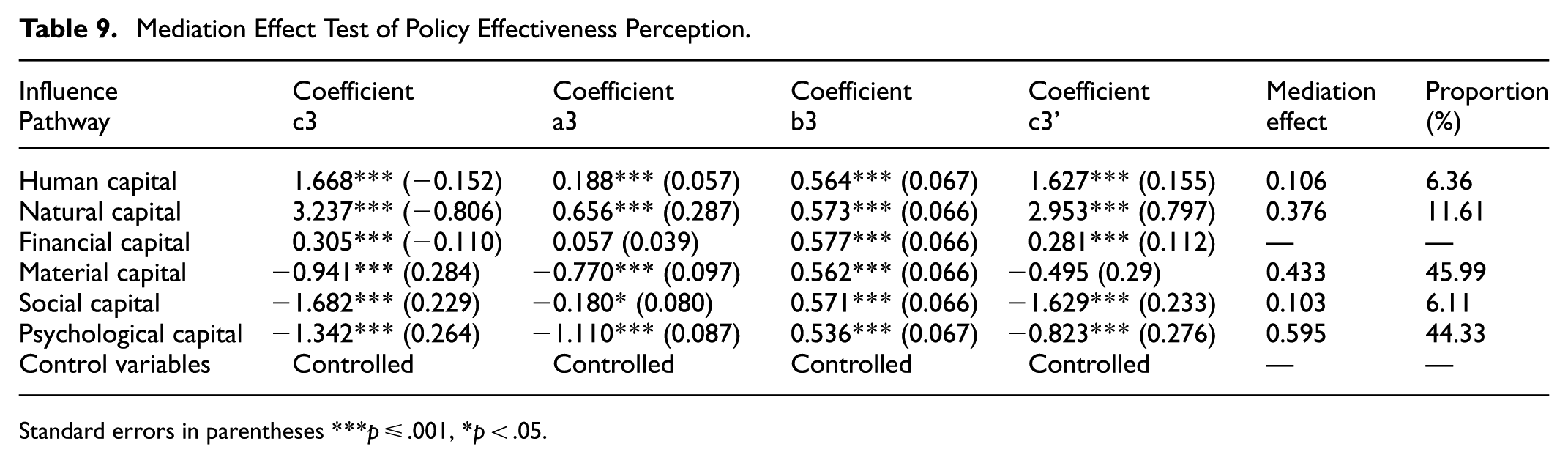
Standard errors in parentheses ***p ≤ .001, *p < .05.
Table 7 displays the mediation effect test results for perceived policy content. Across the various dimensions of livelihood capital, psychological capital demonstrates the strongest mediating effect, representing 48.61% of the total effect. Human, natural, physical, and social capital exhibit mediating proportions of 11.84%, 11.54%, 12.35%, and 14.59%, respectively. Specifically, the mediating effect of perceived policy content on financial capital is non-significant, suggesting that perceived policy content does not mediate the relationship between financial capital and rural resident participation in human settlement environmental governance.
Table 8 presents the mediating role of policy implementation perception. The findings indicate a significant mediating effect of policy implementation perception on human, natural, financial, material, and psychological capital, and they account for 5.30%, 13.56%, 13.59%, and 30.89%, respectively. However, policy implementation perception does not mediate social capital. This suggests a potential disconnect between current policy implementation and the integration of rural resident participation in human settlement environmental governance through social networks. It is possible that environmental policy implementation frequently relies on hierarchical administrative networks and does not suffice in effectively engaging rural social networks.
Table 9 displays the mediating role of policy effectiveness perception. Results indicate that policy effectiveness perception significantly mediates human, natural, material, social, and psychological capital, with mediating effects comprising 6.36%, 11.61%, 45.99%, 6.11%, and 44.33%, respectively. It is worth noting that the mediating effect of policy effectiveness perception on material capital (45.99%) is significantly larger than that observed for both policy content perception and policy implementation perception. This implies that policy effectiveness perception is closely associated with the material capital of rural residents. Similar to the findings for policy content perception, policy implementation perception does not demonstrate a mediating effect on financial capital.
This study has clarified the mediating role of a three-stage process of policy perception by assessing how policy perception mediates the relationship between livelihood capital and rural resident participation in human settlement environmental governance. This analysis clarifies the theoretical connections among livelihood capital, policy perception, and rural resident participation in human settlement environmental governance. There exist three distinct mediating path mechanisms of policy perception, each playing a different role. These findings contribute a novel understanding of such participation, particularly as viewed through the perspectives of livelihood capital and policy perception and offer practical guidance for strengthening rural resident participation in human settlement environmental governance.
Discussion
This study analyzes how livelihood capital and policy perception affect rural resident participation in human settlement environmental governance, as it uses survey data from 2,362 rural residents and further explores the mechanisms underpinning these relationships.
This study confirms Hypothesis 1 (H1) and discovers that livelihood capital significantly affects rural resident participation in human settlement environmental governance. As this participation increases, livelihood capital rises as well. Moreover, this study demonstrates that different dimensions of livelihood capital exhibited through different channels affect this participation.
This study verifies Hypothesis H1a and determines a significant positive correlation between human capital and rural resident participation in human settlement environmental governance. This result concurs with existing research, while it hypothesizes that the relationship between urbanization and human capital lessens environmental damage, as advancements in human capital increase this participation (Graff & Neidell, 2013). Since the initiation of China’s reform and opening-up policy, the consistent allocation of resources to rural education has produced improvements in educational attainment. Therefore, rural residents have developed a strong understanding of environmental challenges, and they have a motivation to actively champion sustainable rural environmental progress (Zafar et al., 2019). Besides, the government’s growing investments in environmental knowledge training, technological dissemination, and public awareness campaigns in rural communities have considerably raised residents’ environmental consciousness (Zhou, 2020). This has cultivated stronger aspirations for enhanced living standards and environmental quality. This provides a reference for us to further understand the impact of human capital elements such as rural residents’ knowledge level, skill reserves, and health status on environmental participation.
This study substantiates Hypothesis H1b and identifies a significant positive correlation between natural capital and rural resident participation in human settlement environmental governance. Land, a vital constituent of natural capital, is intrinsically related to daily life and productive activities. The widespread adoption of modern agricultural methods has facilitated the consistent growth of natural capital and has lessened reliance on singular livelihood approaches and associated vulnerabilities, thereby strengthening resistance to environmental risks (Guo et al., 2019). As agricultural production transitions from individual seeks to more intensive, collaborative structures, the production-related and environmental perspectives of rural residents experience similar shifts. Since natural capital represents an essential resource for industrial advancement, its condition becomes critical for intensified production and resource replenishment (Long et al., 2019). This, in certain measures, encourages environmentally responsible actions among rural residents. As their capacity to develop and leverage natural capital grows, they become more likely to participate in environmental conservation. This suggests that the natural capital owned by rural residents is not only the material basis for their production and daily life, but also directly affects their attention to the surrounding environment and their willingness to devote energy to it.
This study supports Hypothesis H1d, and demonstrates a significant negative effect of social capital on rural resident participation in human settlement environmental governance. This result aligns with prior research (Qiu et al., 2020). According to Granovetter, strong ties and weak ties may have opposite impacts on participation (Granovetter, 1983). Strong ties may contribute to the formation of participation limitations, making residents focus their attention on maintaining private relationships and lack the motivation to participate in human settlement environment-related affairs in villages, such as garbage collection and transportation in public spaces and sewage treatment. On this basis, insufficient weak ties with village committees, village Party committees, and environmental protection organizations will weaken the ability to obtain information such as environmental governance policies and technical guidance, further reducing the possibility of their participation. Community environmental norms disseminate through social networks, and they significantly affect individual environmental behaviors (Y. Wang & Zhang, 2022). Maintaining and broadening these networks incurs costs; however, excessive expenditures can weaken the strength and variety of social ties, thus reducing the regulatory influence of environmental norms. As urbanization accelerates, rural residents’ social networks reach beyond their villages, and they offer diverse avenues for acquiring environmental knowledge. Their reliance on local community interactions decreases as they access environmental information through television, radio, and other mass media outlets (Zhang et al., 2021). Crucially, externally obtained environmental knowledge requires integration with localized social capital to create shared community knowledge. Only then can it effectively promote the participation of rural residents and the collective realization of environmental benefits (Ishihara & Pascual, 2009).
This study confirms Hypothesis H1f and indicates a significant inverse relationship between psychological capital and rural resident participation in human settlement environmental governance. According to positive psychology, rural residents with higher psychological capital tend to exhibit greater motivation and tolerance (Datu et al., 2018). From a motivational standpoint, greater psychological capital strengthens the desire for environmental participation; whereas, greater psychological capital also suggests increased psychological hardiness, and that can lead to a greater acceptance of environmental pollution. Individuals with more developed psychological capital are more willing to adopt an optimistic, self-assured, and proactive approach to self-reliance. To clarify, considering the same degree of environmental pollution, individuals with higher psychological capital are better able to manage the anxiety, stress, and frustration that arise from pollution (Chipfupa & Wale, 2018). Accordingly, they often display greater acceptance of existing environmental circumstances, and this may, counterintuitively, decrease their willingness to participate in human settlement environmental governance. This result prompts us to re-examine the impact of psychological capital on environmental participation. It reveals that psychological states such as rural residents’ self-efficacy and optimism do not necessarily translate into participation motivation; instead, they may also reduce the willingness to participate in environmental affairs by adjusting their perception of environmental issues.
This study indicates how policy perception influences rural resident participation in human settlement environmental governance and establishes its mediating function in the relationship between livelihood capital and such participation, thus confirming Hypothesis H2. Specifically, the study confirms Hypothesis H2a and demonstrates that the policy content perception mediates the relationship between livelihood capital and rural resident participation in human settlement environmental governance. Targeted rural human settlement environmental governance policies—akin to agricultural subsidies, environmental technology subsidies, and poverty alleviation policies—can offer particularized benefits to specific recipients, and these policies align with prior research (Wong, 2010). Accordingly, this approach effectively promotes participation among those who directly benefit from the policies. The common-pool resource theory hypothesizes that the environment is a unique public good represented by both non-excludability and rivalry, and this makes it susceptible to problems such as under-provision, over-extraction, and free-riding (Agrawal, 2014). Rural human settlement environmental governance policies primarily involve environmental infrastructure development and general environmental enhancements, and they offer advantages to a wide spectrum of individuals and groups. When rural residents observe sufficient policy support, their willingness to participate in human settlement environmental governance increases and this enables them to surmount challenges related to collaborative environmental action (Kostka & Mol, 2017). This suggests that the clear communication and effective interpretation of policy content are key links in transforming the advantages of livelihood capital into actions of environmental participation.
This study confirms Hypothesis H2b and demonstrates that the policy implementation perception mediates the relationship between livelihood capital and rural resident participation in human settlement environmental governance. This result is consistent with existing research (Tian et al., 2022). China’s rural environmental governance policies have channeled substantial human, financial, and material resources into rural areas. While these policies are enacted in villages through hierarchical administrative structures (Li et al., 2019), robust policy implementation amplifies policy signals and cultivates greater participation among rural residents. This contrasts with the administrative substitution of autonomy theory, which suggests that administrative policy implementation in villages discourages resident participation. Accordingly, residents depend on village cadres as "state agents" for policy attainment (Hao et al., 2023). This study, however, offers a different viewpoint: rural residents’ positive policy implementation perception can significantly enhance their participation in human settlement environmental governance. This reveals how the status of policy implementation connects individual capital with public participation, and enhancing the standardization and perceptibility of policy implementation can promote environmental participation.
This study also confirms Hypothesis H2c, indicating the mediating role of perceived policy effectiveness perception in the relationship between livelihood capital and rural resident participation in human settlement environmental governance. This contrasts with prior research (Liao, 2018). How rural residents view policy effectiveness relates directly to their past experiences (Pradhan et al., 2017). Their assessment of environmental governance outcomes depends not only on measurable environmental progress but also on their subjective understanding (Ruan, Qiu et al., 2022). When applying a rational actor perspective, rural residents decide whether to adhere to policies based on a "cost-benefit" analysis. However, policies for rural human settlement environmental governance generate significantly positive externalities, so widespread resident participation necessitates addressing the free-rider problem (Meng et al., 2022). Policy effectiveness perception bridges the gap between environmental policies and leads to actual improvements in the rural human settlement environment. Favorable environmental shifts motivate residents’ environmental actions. Stronger policy effectiveness perception cultivates a shared sense of responsibility for environmental governance. Accordingly, they lessen passive attitudes, reduce the free-rider problem, and finally enhance rural resident participation in human settlement environmental governance. This finding makes us realize that the manifestation and communication of the actual effectiveness of policies are conducive to promoting and creating a cycle of environmental participation.
The study draws upon both the mediation effect model and the path-specific mediation effect model and indicates a complex mediating role of policy perception in the relationship between different dimensions of livelihood capital and rural resident participation in human settlement environmental governance. First, policy content perception, policy implementation perception, and policy effectiveness perception all mediate the effect of human, natural, and psychological capital on such participation. This finding suggests that across the policy process—about the content formulation, implementation stages, and resultant results—human, natural, and psychological capital all influence rural resident participation in human settlement environmental governance. Second, the study finds that social capital plays a role, and while policy content perception and policy effectiveness perception demonstrate considerable mediating effects, this is not the case for policy implementation perception. This indicates that residents’ social networks facilitate their understanding of environmental policies and their results; however, these networks do not effectively support policy implementation. There is a critical disconnect between social networks and rural residents’ perceptions regarding policy execution. This disconnect highlights the importance of enhancing their involvement in this stage. Structural hole theory holds that information transmission in social networks depends on core nodes and interaction patterns. If external policy information fails to connect with these nodes and rules, information transmission disruptions will occur (Burt, 2004). When human settlement environment policies are implemented, if they cannot be effectively embedded into the social networks of rural residents, the effects of policy implementation will not be transmitted, and thus cannot motivate residents to participate in environmental governance. This suggests that we should design policy implementation paths in combination with the interaction rules of social networks. Third, while material capital demonstrates no significance in the baseline regression model, mediating effects are observed across all three policy perception pathways. This suggests that the mediating effect of policy perception on material capital becomes weaker when considered in conjunction with other forms of livelihood capital. Increasing material capital in isolation will not enhance policy perception, nor will solely improving policy perception effectively promote rural resident participation in human settlement environmental governance. A comprehensive assessment of their overall livelihood capital is necessary. Finally, while financial capital lacks significance in the baseline model, it becomes significant in the pathway "financial capital → policy implementation perception → participation in human settlement environmental governance." This implies that financial capital primarily affects residents’ perceptions concerning the use and distribution of funds during policy implementation and has a comparatively weaker influence on their policy content perception and policy effectiveness perception.
Overall, through the discussion on the sub-dimensions of livelihood capital and the analysis of the mediating paths of policy perception, we have effectively identified and tested the causal path of “livelihood capital—policy perception—environmental participation,” revealed the interaction mechanism among the three, and thus provided a new perspective for understanding rural residents’ participation in human settlement environmental governance. Policy perception can promote rural residents’ participation in human settlement environmental governance, an aspect that has not been explored previously. Additionally, the analysis of the correlation between livelihood capital and policy perception offers unique insights for encouraging rural residents to participate in human settlement environmental governance.
Conclusion
Based on survey data from 2,362 rural residents, this study focuses on the impact of livelihood capital on rural residents’ participation behavior in human settlement environmental governance. It constructs a mediating model of “livelihood capital—policy perception—environmental participation” and reveals the mechanism of action among the three. The paper clarifies the differentiated impact paths of different types of livelihood capital and empirically verifies the mediating role of policy perception. This work provides empirical insights and a new theoretical framework for rural residents’ participation in human settlement environmental governance, deepens the understanding of micro-participation mechanisms in grassroots governance in developing countries, and holds important policy significance and practical implications.
This study has achieved three advances. First, it systematically explains the differentiated impacts of each dimension of livelihood capital on rural residents’ participation behavior in human settlement environmental governance. Among them, the negative effects presented by social capital and psychological capital have broken through the academic community’s traditional cognition of their roles, providing a new analytical perspective for discussions in related research. Second, it clarifies the mediating role of policy perception between livelihood capital and participation in environmental governance, and decomposes policy perception into three specific paths: perception of policy content, perception of policy implementation, and perception of policy effects. This decomposition not only refines the understanding of the mediating mechanism but also provides a more operable analytical dimension for research in the field of policy perception. Third, it constructs an environmental participation theoretical model of “Capital—Policy—Participation.” By integrating the core elements of two existing models, namely “Capital-Participation” and “Policy-Participation,” it expands the research limitations of single-variable impact paths and provides an directly referable operational framework for related studies.
This study provides research implications at both theoretical and practical levels. At the theoretical level, when exploring the relationship between livelihood capital and rural residents’ participation behavior in human settlement environmental governance, it is necessary to effectively distinguish the impacts of different types of capital, as capital of different dimensions may exert differentiated effects. Meanwhile, as a mediating variable, policy perception involves distinct perceptual paths such as perception of policy content, policy implementation, and policy effects, and their roles need to be examined separately. At the practical level, to effectively promote rural residents’ participation in human settlement environmental governance, attention should be paid to the differentiated role of livelihood capital, and efforts should be made to enhance rural residents’ policy perception. This provides a useful direction for formulating and optimizing relevant environmental policies.
The research findings offer the following recommendations: (i) Enhancing the overall level of livelihood capital and facilitating structural optimization is essential for shifting rural residents’ focus from livelihood concerns toward environmental sustainability. This transition can increase rural resident participation in human settlement environmental governance and can lessen dependence on governmental environmental management; (ii) Optimizing the full-cycle management of rural environmental policies is necessary. In addition, significant work is necessitated to strengthen engagement with rural residents throughout the policy process. This includes policy awareness, implementation, and assessment. Amplifying the positive incentive effects of different policy stages is advised and is meant to enhance rural residents’ perception of environmental policies while cultivating greater participation; and (iii) Enhancing participation mechanisms for rural human settlement environmental governance is recommended. To this end, the government should broaden participation channels through digital platforms such as the Internet, social media, and WeChat and should complement this with offline mechanisms such as village assemblies and representatives’ meetings. A multi-channel strategy can promote rural resident participation in human settlement environmental governance.
This study, however, is subject to limitations: (i) This study primarily employs cross-sectional survey data and lacks long-term follow-up analyses to monitor temporal changes. Therefore, future research could employ a longitudinal design, which would allow for the observation of the development of rural resident participation in human settlement environmental governance; (ii) While this participation is affected by multiple factors, this study concentrates mainly on livelihood capital and policy perception. Accordingly, future research could consider additional variables to increase explanatory power; and (iii) Considering this reliance on data from China, the generalizability of the findings to other countries requires further exploration.
Footnotes

Ethical Considerations
The study was conducted in strict compliance with Sage’s Guidelines for studies involving humans to ensure that the research process was legal, transparent, and the rights and interests of participants were protected. All the respondents of this questionnaire survey were adults. We provided the participants with an informed consent form, which was concise and clear in content, allowing the respondents to fully understand the research content and voluntarily participate in the research. Participants can refuse and withdraw from the interview at any time, fully respecting the interviewee’s wishes. The data of the respondents is anonymous. All identifiable information is deleted from the dataset, accessible only to team members, and encrypted to minimize the risks. The researchers provided the respondents with contact information in case they had any further questions or concerns. The study can provide a basis for optimizing policies related to rural human settlements environment governance, helping to improve the living environment of villagers. Participants can feedback their appeals related to governance, and some villages will receive suggestions for governance optimization. The benefits significantly outweigh the minor impact of the small amount of time consumed. The study was approved by the Research Ethics Committee of the Civil Aviation Flight University of China on March 18, 2025 (Ethical approval number: 2025NO.4).
Consent to Participate
Written informed consent was obtained from all participants prior to their participation in the study. A paper-based informed consent form was used, which clearly informed all participants of the study’s purpose and procedures, fully stated that their right to anonymity would be guaranteed, the collected data would be used exclusively for academic research, and the study would not cause any harm to them. It also specified confidentiality measures and the voluntary nature of participation. The above content was read out to villagers by resident staff, and after confirming their understanding, the participants signed the form themselves.
Funding
The authors disclosed receipt of the following financial support for the research, authorship, and/or publication of this article: This work was funded by the Social Science Fund Project of Jiangsu Normal University (Grant numbers 24XFRS014), research project of Humanities and Social Sciences of Guizhou University in 2025: “Research on the Coupling Mechanism between Household Demand and National Food Security” (Grant numbers 600547253301) and Research on the Multi-Subject Collaborative Mechanism in the Modernization of Community Governance in Guizhou Province, funded by the Humanities and Social Sciences Research Project of Guizhou Higher Education Institutions (Grant numbers 2025RW051).
Declaration of Conflicting Interests
The authors declared no potential conflicts of interest with respect to the research, authorship, and/or publication of this article.
Data Availability Statement
The data of this study are currently not public due to ongoing research but are available from the corresponding author on reasonable request.