




Abstract
The recent movement of social-investment state encouraged national educational initiatives taken by the policy makers of developed countries to enhance individual’s social inclusion for national economic gains. Benefiting from human capital theory, the author has reexamined the indirect effect of nation expenditure of technical and vocational education and training (TVET) on economic growth through social inclusion by isolating the effective key social inclusion dimensions (employment, earnings, and multidimensional poverty) from each other. A 15-year data set, ranging from 2000 to 2014, collected from Organisation for Economic Co-operation and Development (OECD) database of 21 OECD member European countries was used for hypotheses testing. The statistical results obtained through the quadratic indirect effects demonstrate clear support for the entire hypotheses. However, the results demonstrate that the indirect effects decrease as the values of TVET expenditure increases, particularly, when the indirect effect is investigated through the wages or when the overall index value of social inclusion indicators is introduced as a mediator. The study offers some implications for the researchers and the policy makers who are interested in determining the overall effectiveness of human capital development initiatives in the welfare-state/social-investment states.
Keywords
Introduction
The global economies have been facing the issue of aging population and labor shortages for a long time, but the recent financial crisis hampered further economic growth due to increasing unemployment, inequality, poverty, low job creation, and restricted immigration policies to protect local jobs (Cerna, 2018). The Organisation for Economic Co-operation and Development (OECD) statistics indicate an increasing gap in the wages and rising inequality in the household income in majority of OECD countries for past three decades (OECD, December 2014; Maclean, 2017). In addition, the recent migration and refugee crisis in Europe, resulting from the war and insecurity in the Middle East, Africa, and Southern Asia (Allen et al., 2018; Niemann & Zaun, 2018) boosted inequality and poverty across immigrant and refugee class (Eugster, 2018). Eugster (2018) found that regulatory institutions are more successful in reducing the poverty of the immigrants in countries where the immigrants have a greater access to the employment and social benefits. A recent blog on world economic forum highlighted that policies to reform education for youth are not sufficient from the human capital development rather there is a continuous need for up-skilling the current workforce as well. 1
These increasingly serious challenges led the researchers to revisit the impact of education on national human capital (Leuven & Oosterbeek, 2011; Quintini, 2011) for helping the governments to find the remedies of rising unemployment at the lowest cost (Pilz, 2012). To cope with these challenges, an increasing association between the rising unemployment and the technical and vocational education and training (TVET; López-Fogués, 2012; McGrath & Lugg, 2012) has been observed in OECD countries (López-Fogués, 2018). Particularly, there was an increase in national spending on TVET due to increasing emphasis of international governing bodies including UNESCO and World Bank, for alleviating the poverty, inequality, and overall economic prosperity (Comyn & Barnaart, 2010). Unfortunately, the national TVET reforms remained limitedly effective for resolving issues of skill development and social inclusion (Fleckenstein & Lee, 2018) as a significant proportion of population, particularly, the youth is still experiencing social exclusion in relation to education (Vandekinderen, Roets, Van Keer, & Roose, 2018). Thus, there is a need for TVET sector that facilitates the economies in fulfilling their skill gaps, enhancing community cohesion, and productivity (Hadawi & Crabbe, 2018). Hadawi et al. stressed the need for a measure that demonstrates the social value of TVET. One of such measure that can effectively demonstrate the social value of TVET investments is social inclusion. The question arises about the extent to which the government spending on vocational education and training (VET), in OECD member states of European Union, has been effective in overcoming the issue of social exclusion resulting from the increasing unemployment, income inequality, and poverty and the overall economic prosperity. The study aims at addressing this research question by examining the mediating role of key social inclusion dimensions (earning, employment, and poverty) between national TVET spending and economic growth in OECD member states of European Union.
This study has offered some theoretical contribution to the existing stream of literature on TVET investment and economic growth in certain ways. First, the debates about the conventional view of the significance of human capital in economic growth have augmented due to the limited and controversial empirical evidence (Sunde & Vischer, 2015). The existing literature on economic growth provides some explanation about the contribution of human capital in economic growth (by complimenting the factors of production; Lucas, 1988a, 1988b; Solow, 1956), adopting new technologies (Nelson & Phelps, 1966) and augmenting innovation (Aghion & Howitt, 2006; Hanushek & Woessmann, 2008; Romer, 1990). However, there is still a need for the mechanisms, which may explain the effect of human capital on economic growth (Sunde & Vischer, 2015). The recent movement of welfare state (Garritzmann, Busemeyer, & Neimanns, 2018) or the social-investment state (Busemeyer, de la Porte, Garritzmann, & Pavolini, 2018) reforms has attracted the attention of researchers toward the concept of social investment policies, which emphasize developing and efficiently utilizing human capital to enhance their social inclusion (Morel, Palier, & Palme, 2012). Particularly, the researchers are attracted to empirically test the assumption of educational policy reformists that education can serve as a crucial driver for overall economic development by reducing poverty reduction and promoting social inclusion (Mercer, 2014). Hence, considering social inclusion as a key target of social-state policies, this study has introduced social inclusion as a channel to empirically test how national investment in TVET has contributed to the overall economic development of some social-welfare OECD economies. Here, we assimilate national TVET expenditure as a mechanism of developing human capabilities, social inclusion as a source of enhancing social capabilities of the individuals, while economic growth as a source of enhancing overall national economic capacity. While testing these assumptions, the current study has explained the power of educational investment in developing human capabilities to enhance overall economic capacity of a nation through their social capabilities including employability, earnings, and poverty elimination.
Second, this study has contributed to the existing stream of literature on TVET by investigating the distinct mediating role of each social inclusion indicators that is, employment, earnings, and multidimensional poverty index of a country between national TVET expenditure and economic growth. The empirical testing of these mediating mechanisms using social indicators as separate explanatory account between TVET and economic growth provides an empirical explanation about the effectiveness of “Education Strategy 2020” (Cobo, Zucchetti, & Rivas, 2011) of World Bank for its partner countries pursuing social-welfare state policy. According to this strategy, World Bank envisioned to set its priorities to strengthen the education systems of its member countries. The hypothesized relationships tested in the current study provide an explanation about the extent to which the OECD member countries have been able to achieve the learning goal (target of becoming socially inclusive economies) by following the vision of World Bank through TVET investment initiatives to achieve economic growth. Third, the existing research on TVET has not provided sufficient empirical evidence about the mediating role of each social inclusion indicators separately between TVET and economic growth. This is important for an important reason. Among the social inclusion indicators used in the current study, poverty may have a different explanatory role as compared with employment and earnings. For instance, the increase in employment may ignite the TVET and economic growth relationship, whereas poverty may have opposite effect. Thus, extending our previous work (Asadullah & Zafar, 2018) in which we used aggregate scores to measure the social inclusion, a separate mediating analysis provided more robust explanation for each indicator separately. Thus, the current study has demonstrated an empirical evidence related to the role of TVET expenditure in economic growth through employment, earnings, and poverty reduction (Figure 1) in 21 different OECD economies based on 15 years.

Hypothetical framework.
Theoretical Framework
The government, which is responsible for developing human resources at the national level, devises national educational policies for workforce development to ensure coordination of national resources for a strong economic system (Wedchayanon & Chorkaew, 2014). This requires the governments to treat people as a strategic asset, a strategy of national human resource development, to sustain competitive advantage of an economy. The governments take investment decisions to satisfy this responsibility for developing the skills of individuals, ensuring their employability to avoid their disengagement/exclusion of population. An effective national training system guarantees the national human capital development by improving the skills, knowledge, trust and cooperation, motivation, employability, and productive industrial relations (Docherty, Forslin, & Shani, 2002). Among the national investment decisions for developing human resources, TVET has remained one of the most prominent national training systems for developing national human resources. TVET has a significant potential to facilitate governments in overcoming the social and economic issues through various means.
The OECD countries developed a wide range of policies to enhance the opportunities for both learning and gaining work experiences (Vanhove, 2017), yet, skill development through TVET still remained a proven way to enhance the access of youth to the labor market (CEPAL, 2013). However, mere skill development does not guarantee the economic growth, rather, it requires policy makers to emphasize more on job creation. Particularly, high-income OECD countries, which are facing more of the issue of overeducation, need to create employment opportunities for their overeducated and highly skilled workers (Handel, Valerio, & Sánchez Puerta, 2016; McGuinness, Pouliakas, & Redmond, 2017).
This is challenging for policy makers to demonstrate the value of national investment in TVET at the societal level for their claim of building and upgrading the market-required competencies, employability, financial benefits (wages), and reducing inequality. Hadawi and Crabbe (2018) stressed the need for a measure that demonstrates the social value of TVET. One of such measure that can effectively demonstrate the social value of TVET investments is social inclusion. TVET facilitates the economies in fulfilling their skill gaps, enhancing community cohesion and productivity (Hadawi & Crabbe, 2018). The individuals of a society are highly likely to experience economic and social disengagement, if the education system does not facilitate in building the market-based skill set of the individuals (Angel-Urdinola & Mayer Gukovas, 2018). Particularly, the population not acquiring any skill with education is more likely to experience disengagement and exclusion. The term disengagement, which is described by Angel-Urdinola & Mayer Gukovas as NEET (neither in education, employment, or training) also brings our attention toward the concept of social exclusion of individuals. This represents that the individuals are highly likely to withdraw from the education if they do not find expected benefits. Moreover, the individuals also stop working if their wages are low, and hence the return on investment diminishes (Angel-Urdinola & Mayer Gukovas, 2018). Thus, a timely investment in human capital formation is always critical for social inclusion of the citizens to reap the benefits TVET at the social level over a long period. One of the key hypothesis of the current study is to demonstrate the effectiveness of national investment in TVET for social inclusion of the individuals in a society using the human capital theory for theoretical support of national human resource development perspective.
The national educational reforms, which emphasize on empowering TVET to develop the learning, competencies, and qualifications of the citizens for addressing the changing labor market requirements have strengthened the strategic value of TVET. A greater financial investment in TVET at national level enables the government to take such diverse initiatives to improve and monitor the quality of TVET initiatives. A higher investment in TVET facilitates governments in diversifying the investment in human resource development by introducing diverse type of TVet alternatives (like dual system of apprenticeships, competency-based training, green initiatives) training and allows for a higher involvement of stakeholders in the process of identifying market required and competency-based training programs to inject quality in TVET initiatives.
Human capital theory offers an economic justification to the policy makers for promoting the participation of individuals in the education (Gale & Molla, 2015). Human capital theory (Becker, 1962; Schultz, 1960, 1961) posits that developing the skills, knowledge, and attitude of the human capital facilitates them to find and retain appropriate jobs. This prevents social exclusion and promotes the inclusion of the educationally deprived individuals in the society by providing the opportunity to integrate themselves into the labor market (Dean, 2003; Vandekinderen et al., 2018). According to the human capital theory, the learner, as a human capital, is processed through vocational education and training to actively shape the work and the society (Bohne, Eicker, & Haseloff, 2017). The TVET systems provide the learner an opportunity to practice and learn, which enhances their skills. Particularly, the recent forms of competence-based VET provide the learners an opportunity to practice at different places (Bohne et al., 2017), which enhances their market-based competencies. TVET is a key source of social inclusion for its capacity of building the individuals’ market-relevant skills to enhance the opportunity for the unemployed to access the labor market (Nilsson, 2010).
A high rate of unemployment represents a higher social exclusion of the individuals as unemployed are unable to contribute to the society because of their low level of productivity and income. This represents their social disengagement, which is linked to negative performance or lower productivity (Mirick, 2016; Simmons & Thompson, 2013). However, investing in TVET at national level provides a skill-building and employability opportunity to a wide proportion of the national population. The employability is an indicator of social status and achievement (Lawy & Biesta, 2006; Lister, 2000) representing the individuals’ productivity and their social inclusion (Vandekinderen et al., 2018).
Due to its significant contribution to skill and employability, TVet also has a potential to reduce poverty. Poverty is a multidimensional reality consisting of deprivations, unmet needs, and limited participation in social affairs rather than being restricted to the financial condition or an inadequate income (Alcock, 1997). The researchers (Hagenaars, 2017; Ringen, Seegal, & England, 1995; Sen, 1999) attribute poverty to the deprivation of education, material resources, and the social exclusion. Poverty keeps the individuals in the consistent need of maintaining their moral state and material necessities, which deter their autonomy. Consequently, the poor remain excluded from social practices (Papa, 2018). This can be argued that the poor are more likely to remain NEET due to their higher material dependence as compared with the rich. On the contrary, the research has also shown that unemployment rate is lower in more-educated people (Cairo & Cajner, 2017). However, a higher national investment in TVET initiatives is more likely to provide the poor and uneducated people to have a skill-building opportunity based on the government expenditure. Thus, the individuals living in economies with high investment in TVET are more likely to secure greater education and reeducation opportunities to develop their market-required skills. Thus, a national investment in TVET is also more likely to reduce the poverty of the individuals. There is empirical evidence available about the significant contribution of TVET in enhancing individual’s skill (Jothilakshmi, Krishnaraj, & Sudeepkumar, 2009), productivity (Kijima, Ito, & Otsuka, 2012; Rosholm, Nielsen, & Dabalen, 2007), income (Mahmud, Parvez, Hilton, Kabir, & Wahid, 2014), and economic well-being (Mahmud, Mohamed, Ismail, Shamsudin, & Hilton, 2007).
Based on previous arguments discussed in the light of human capital theory, this study has hypothesized that a higher national TVET expenditure is more likely to enhance employment and earnings, while reducing poverty. Thus, the economies with a high TVET expenditure experience a high social inclusion. Similarly, the economies, which experience a reduction in poverty, experience an increase in their rating on multidimensional poverty index.
TVET and Economic Growth
The human capital approach is a key economic rationale for the policy makers to enhance the national investment in education to widen individuals’ participation in the education (Gale & Molla, 2015). The human capital theory explains that national investment in education and training for developing competent citizens is positively associated with economic growth (Dean, 2003; Regmi et al., 2015). The “education” as a strategy of economic revival attracted the significant attention of policy makers after the 2008 Global Financial Crisis (Antolin & Stewart, 2009). The human capital theory provides a perspective of the education as a capital good for developing human resources to cope with socioeconomic changes (Olaniyan & Okemakinde, 2008; Regmi et al., 2015). The human capital outcomes resulting from the imperative role of educational institutions (Biesta, 2006) as the engine for economic growth (Gowlett, 2012) are driving the recent educational policies (Walker, 2012). Hence, “the human capital approach provides policymakers with an economic rationale for widening participation in education” (Gale & Molla, 2015, p. 819).
Based on human capital theory, this study explains how a higher level of social inclusion may contribute to the growth of an economy. Social inclusion enhances sociocultural development (Comyn & Barnaart, 2010), which can enhance social expenditure made by individuals and hence, the overall economic activity. The high productivity of the individuals and the organizations in a high socially inclusive economy enhances its gross domestic product (GDP; Dearden et al., 2005). The individuals of a socially inclusive economy are more likely to secure jobs in the international labor market and contribute to the economy through remittances (Asadullah & Zafar, 2018). The individuals of a socially inclusive economy are more likely to consumer national products and services, hence, increasing circulation of wealth and the overall economic activity. The increased circulation of money reduces inequality and the equitable social environment contributes positively to the economic situation (Ali, Egbetokun, & Memon, 2018) because the social inclusion enhances social activities (Rose, Daiches, & Potier, 2012).
The social investment, which has received a recent attention of policy makers in the welfare-state policies (Garritzmann et al., 2018), emphasizes on developing human capital and their efficient utilization (Morel et al., 2012). However, the development and utilization of human capital may be less effective if most of the population are poor. Poverty is a multidimensional reality and according to the perspective of imperfect credit market (Stiglitz, 1969), the poor are highly unlikely to repay their loans because of their inability to invest their loans for some productivity gains. On the contrary, the people are more likely to utilize their loans and more capable to reimburse if there is a higher opportunity for employment and earnings in an economy. Similarly, the economies with low poverty ratio are also highly likely to reduce crime rate, which can facilitate them in avoiding a significant loss of GDP, for example, 7.5% in Latin America (Bennett, 2002). Thus, an economy, which has a higher rating on multidimensional poverty index, is more likely to experience economic growth as compared with the economies, which are low in multidimensional poverty index. Thus, we hypothesized the following:
Indirect Effect of TVET Expenditure on Economic Growth
The human capital theory explains the mechanism through which national investment on TVET contributes to the economic growth of a country through the elements of social inclusion, that is, employment, wages, and the overall poverty ranking of a country. The human capital theory is a widespread notion for justifying the association between education and economic growth (Marginson, 2019; Tanaka, 2018). Human capital theory justifies the contribution of national educational investment, as a part of social-welfare state policy, in the national economic growth through different social inclusion indicators including employability, earning (Nilsson, 2010), and poverty reduction. Human capital theory advocates maximum utilization of human capital to enhance economic growth because economic growth is more likely to increase in the socially inclusive national environments, which ensure equal chances for the individuals to benefit from economic opportunities (Ali et al., 2018). National TVET expenditure conveys a message of higher state-level interest in developing national human capital. According to the perspective of neoclassical economists, the human capital refers to the national stock of knowledge and skills that enable the people to perform work that creates economic value (Nahapiet, 2011).
A higher national TVET expenditure represents a greater supply of human resources in the labor market for the organizations. Particularly, TVet also facilitates a supply of human resources to the small and medium enterprises, hence, contributing to the economic growth of a country. There is a recent empirical evidence about the significant contribution of small and medium businesses in economic growth and poverty reduction, in Ethiopia, through TVET, which enhances their creativity and innovation (Mihret Dessie & Shumetie Ademe, 2017). The skilled individuals may secure minimum wages and overtime pay through their employability to sufficiently meet their basic necessities (Jayasinghe, 2016). As the acquisition of skills and knowledge enhances the productivity and earnings (Becker, 1962; Kwon & Kim, 2009), a higher TVET expenditure should enhance overall national productivity and earnings. By combining the micro- and macroperspectives of human capital theory, it can be argued that higher TVET expenditure enhances the education level of the citizens, collectively, which enhances their employability and achievement as dictated (microperspective, Almendarez, 2013) and productivity, which further strengthens the growth of an economy (Almendarez, 2013; Blaug, 1976). In other sense, the growth of an economy resulting from a higher TVET expenditure can also be as an externality effect of education as stated by Canton (2007), because the whole society benefits from this investment by acquiring those skills and knowledge, which enhance their employability and earnings. Based on the previous arguments provided in the light of human capital theory, it can be derived that the economies with high employability, higher wages, and high poverty index (the rating of a country on multidimensional poverty index represents that the poverty ratio is low in an economy) are more likely to achieve economic growth through an increased TVET expenditure. Thus, based on the human capital theory, this study hypothesized that social inclusion indicators strengthen the effect of national expenditure on TVET on economic growth of a country.
Method and Measures
This is a longitudinal study–based panel data obtained through secondary sources. This study used standardized OECD statistics to measure the independent, mediator, dependent variables, and the control variables. The data are collected for 21 OECD member states of European Union over a period of 15 years ranging from 2000 to 2014. The statistics for the remaining OECD member states of European Union was not available for the complete 15-year period, therefore, the remaining OECD member states of European Union are omitted. TVET is measured through the percentage of public spending on short-term tertiary education in a country. We used change in real GDP to measure economic growth of a country. The social inclusion is measured using an index based on employment (Lister, 2000), wage rate (income per capita), poverty, and inequality. Poverty is measured using multidimensional poverty index and inequality is measured using the most commonly used measure, that is, Gini-coefficient. The key macroeconomic variables such as national saving, international trade, inflation and foreign direct investment were introduced as control variables due to their potential on economic growth (Lucas, 1988a, 1988b; Zarsky & Gallagher, 2012).
Analytical Procedure
The mediation or indirect effect is commonly used to quantify an indirect effect of an independent variable on a dependent variable through a mediating variable (Hayes & Preacher, 2010). The majority of existing literature on mediation methods assumes that the direct and indirect paths between independent, mediator, and dependent variables are linear. However, the phenomena under investigation are less linear in nature. This study aimed at investigating the mediation mechanism through which national investment in TVET determines the economic growth through social inclusion. The current study used a panel data for 21 countries over a time period of 15 years ranging from 2000 to 2014. The data set contains 315 total observations (21 countries
The index of social inclusion was created using the standardized estimates of employment, wage, and poverty. Similarly, the variables were transformed on the same scale using their standardized estimates prior to estimating the mediation curve. This technique also provides another advantage of using bootstrapping option for calculating indirect estimates. This study used 2,000 bootstrapping samples at 95% bias-corrected confidence interval. There are several advantages of using bootstrapping technique over the parametric procedures for testing indirect effects. The researcher can avoid the assumptions of distribution normally required for parametric procedures. The bootstrapping is more robust than parametric procedures with respect to their statistical power and Type-I error rates (Fritz & MacKinnon, 2007; MacKinnon, Lockwood, & Williams, 2004). Third, bootstrap confidence intervals tend to be more asymmetric and closer to the true sampling distribution (Hayes & Preacher, 2010).
Results
The first hypothesis of the study demonstrated that national investment in TVET is positively linked to the social inclusion of the individuals in an economy such that a higher national investment in TVET is positively related to the social inclusion (H1). The statistical output of instantaneous indirect effect obtained through SPSS mediation curve estimation macro using quadratic direct and indirect paths demonstrated that national investment in TVET was positively and significantly associated with employment (β = .243; p < .001). This provided statistical support for H1. Furthermore, the statistical results demonstrated positive and significant association between social inclusion and economic growth (β = .986; p < .001). This result also demonstrated statistical support for H2. The Table 1, given below, contains the values of beta coefficients and the standard errors for different paths (i.e., independent to mediating variable [Path a], mediating to the dependent variable [Path b] and the independent to the dependent variable [Path c]) of each mediation model investigated in the study.
Descriptive Statistics for Standardized Values of the Variables.
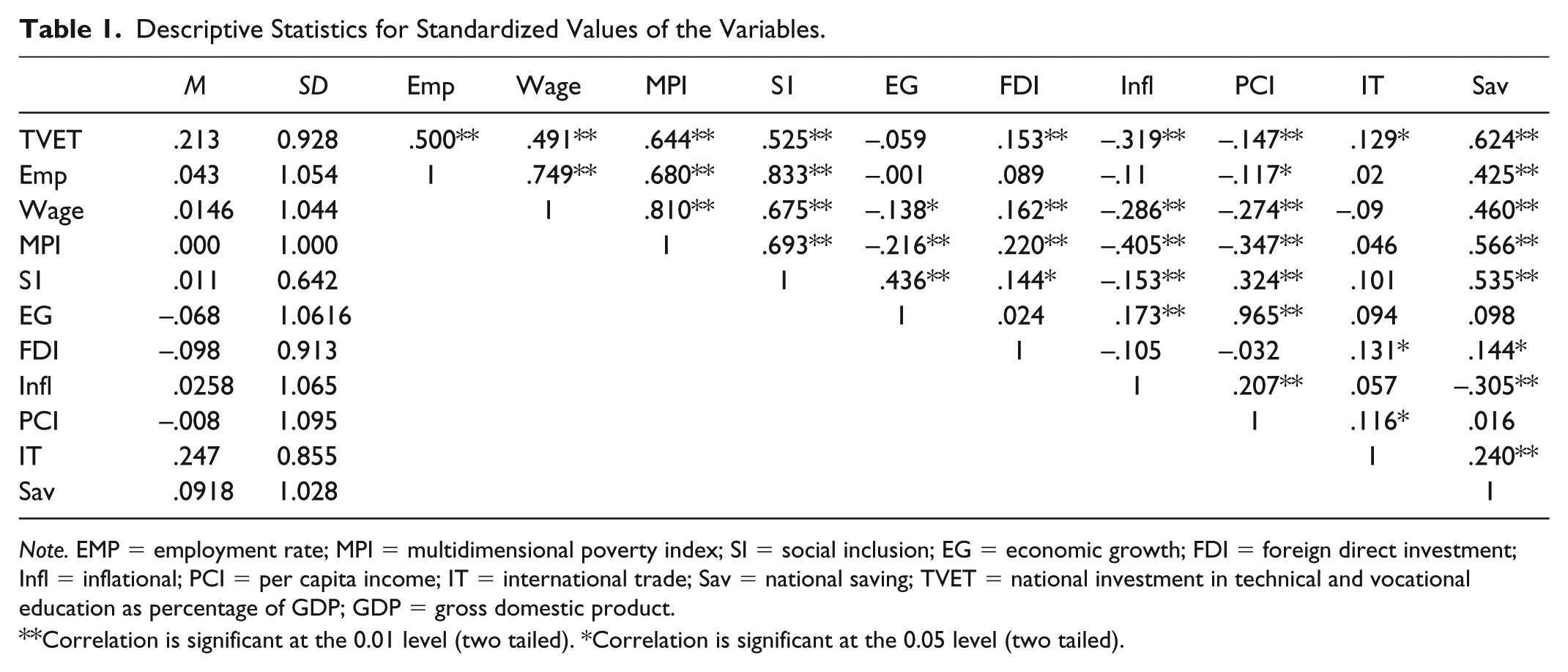
Note. EMP = employment rate; MPI = multidimensional poverty index; SI = social inclusion; EG = economic growth; FDI = foreign direct investment; Infl = inflational; PCI = per capita income; IT = international trade; Sav = national saving; TVET = national investment in technical and vocational education as percentage of GDP; GDP = gross domestic product.
Correlation is significant at the 0.01 level (two tailed). *Correlation is significant at the 0.05 level (two tailed).
Finally, the statistical output also demonstrated that the instantaneous indirect effect of TVET on economic growth through social inclusion was significant across different values of TVET (i.e., mean, high [one standard deviation above the mean], and low [one standard deviation below the mean]). The estimates for instantaneous indirect effects of TVET on economic growth through social inclusion across low (–0.7268), medium (0.2110), and high (1.1488) are given in Table 3. These values provide evidence that among the countries with the low, medium, or high level of national investment in TVET, increasing national investment in TVET may function to increase economic growth through social inclusion. Table 3 provides the values of instantaneous indirect effects of the quadratic mediation models investigated in the study along with the information about the effect size of indirect effect at different values (mean/medium; low, that is, one standard deviation above the mean; and high, that is, one standard deviation below the mean) of TVET (theta in third column), the upper bound and lower bound values (at 95% confidence intervals with 1,000 boot strapping samples) obtained (column 4 and 5) and the simple interpretation of the results (column 6).
Post Hoc Analysis
We performed post hoc analysis to further probe the indirect effect of each of the mediating variables used to create the index of social inclusion (employment, wage, and poverty). The first hypothesis stated that national investment in TVET is positively related to the social inclusion such that a higher national investment in TVET is positively associated with employment rate (H1a) and wages (H1b) but negatively associated with poverty (H1c). We tested instantaneous indirect effect through employment by constraining the Path b as quadratic.
The statistical output of instantaneous indirect effect obtained through SPSS mediation curve estimation macro using quadratic direct and indirect paths (Table 2) demonstrated that national investment in TVET was positively and significantly associated with employment at 90% confidence interval (β = .117; p < .10). This provided partial statistical support for H1a. But, national investment in TVET is also positively associated with wages (β = .347; p < .001) and multidimensional poverty index (β = .529; p < .001). This demonstrated statistical support for H1b and H1c. Thus, overall H1 was supported.
The Statistical Results for the Quadratic Effects of Path a, Path b, and Path c’s Relationships Hypothesized in the Study.
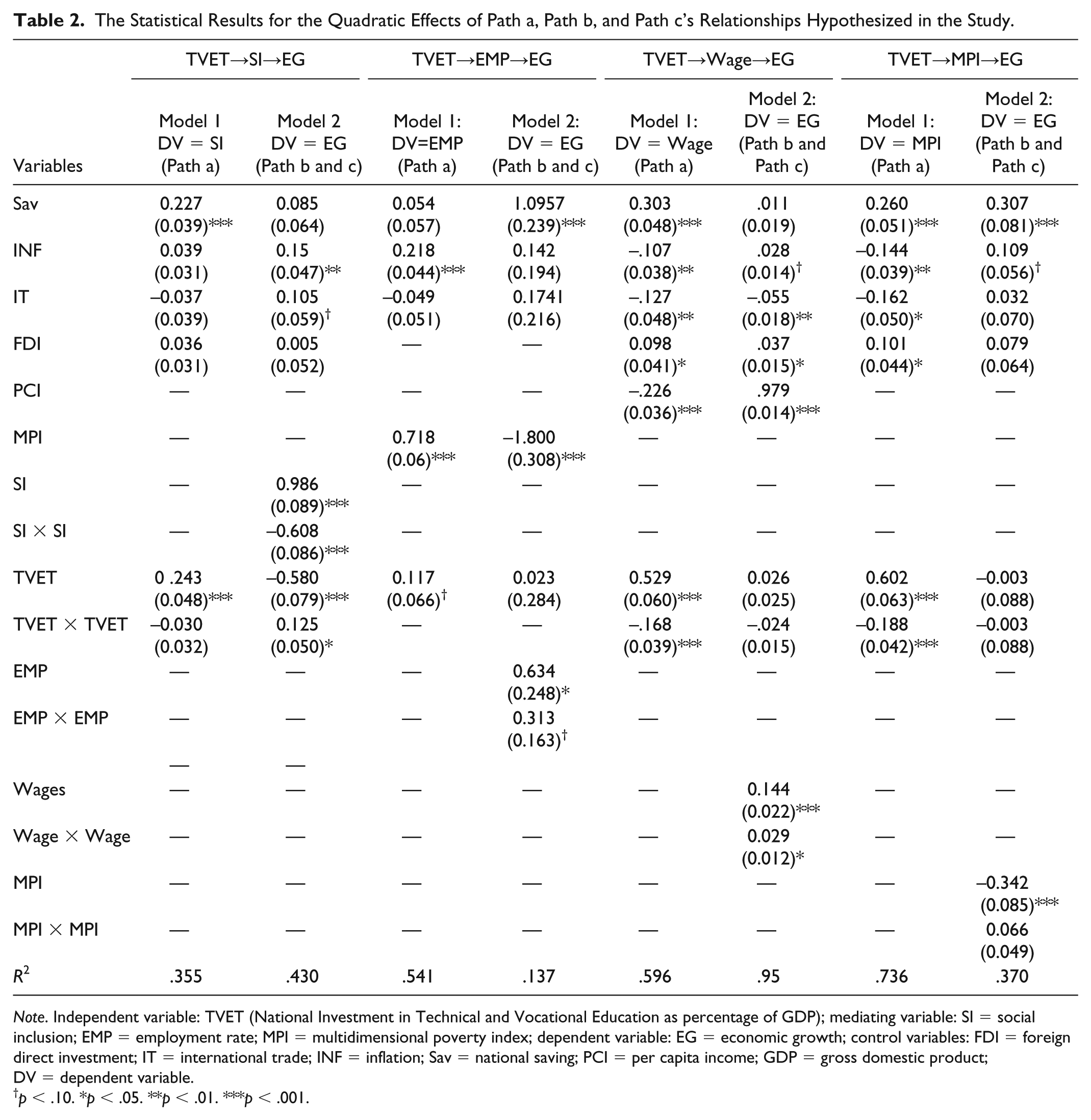
Note. Independent variable: TVET (National Investment in Technical and Vocational Education as percentage of GDP); mediating variable: SI = social inclusion; EMP = employment rate; MPI = multidimensional poverty index; dependent variable: EG = economic growth; control variables: FDI = foreign direct investment; IT = international trade; INF = inflation; Sav = national saving; PCI = per capita income; GDP = gross domestic product; DV = dependent variable.
p < .10. *p < .05. **p < .01. ***p < .001.
The second hypothesis was delineated to examine the positive association of employment rate (H2a) and wages (H2b) with economic growth, while negative association of poverty to the economic growth (H2c). The statistical results supported the positive and significant association between employment rate and economic growth (β = .634; p > .05), while controlling for the effect of per capita income, inflation, saving, international trade, and foreign direct. This statistical result demonstrates statistical support for H2a. The statistical results also demonstrated that MPI (multidimensional poverty index) is positively and significantly associated with the economic growth (β = .144; p > .001). This also demonstrates statistical support for H2c because of negative coefficients. Similarly, the results provided statistical support for H2b describing that wages increase is positively associated with economic growth (β = .134; p < .01), while controlling for the effect of inflation, savings, per capita income, foreign direct investment, and international trade.
The third hypothesis was defined to examine a significant indirect effect of TVET on economic growth through social inclusion (H3). We also probed individual-level instantaneous indirect effect of three subdimensions of social inclusion, that is, employment, wages, and poverty using the mediation curve micro in SPSS. The statistical results revealed that the instantaneous indirect effect of TVET on economic growth through employment was insignificant across different values of TVET (i.e., medium, low, and high). Hence, H3a was not supported. The interval estimates for instantaneous indirect effects of TVET on economic growth through employment across low (–0.7268), medium (0.2110), and high (1.1488) are provided in Table 3. There is evidence that among the countries with the low, medium, or high level of national investment in TVET, increasing national investment in TVET may function to increase economic growth through employment.
Bootstrapping Results for Instantaneous Indirect Effects of TVET on EG Through Social Inclusion (EMP, Wage, and Poverty) Using Quadratic Paths Across Different Values of TVET Spending.

Note. TVET = national investment in technical and vocational education as percentage of GDP; EG = economic growth; EMP = employment rate; SI = social inclusion; MPI = multidimensional poverty index; GDP = gross domestic product.
However, the statistical results revealed that the instantaneous indirect effect of TVET on economic growth through wages was significant across different values of TVET (i.e., medium [mean], high [one standard deviation above the mean], and low [one standard deviation below the mean]). Hence, H3b was supported. The interval estimates for instantaneous indirect effects of TVET on economic growth through wages across low (–0.7268), medium (0.2110), and high (1.1488) are given in Table 3. This indicates that among the countries with the low, medium, or high level of national investment in TVET, increasing national investment in TVET may function to increase economic growth through the wages.
Similarly, the statistical results revealed that the instantaneous indirect effect of TVET on economic growth through multidimensional poverty index was significant across different values of TVET (i.e., medium [mean], high [one standard deviation above the mean], and low [one standard deviation below the mean]). Hence, H3c was also supported. The interval estimates for instantaneous indirect effects of TVET on economic growth through multidimensional poverty index across low (–0.7268), medium (0.2110), and high (1.1488) are given in Table 3. There is evidence that among the countries with the low, medium, or high level of national investment in TVET, increasing national investment in TVET may function to increase economic growth through multidimensional poverty index.
Discussion
This study has analyzed a socioeconomic mechanism to explain how the national investment TVET has contributed to the economic growth of 21 European economies. The author has provided an empirical evidence for the embedded assumption of the literature in human capital regarding national investment in technical and vocation education, social inclusion and economic growth. The author developed a competing set of theoretically rooted hypotheses in the literature of human capital that has highlighted the role of TVET in social and economic gains of a nation. In brief, our analysis of the sample derived from 21 European states provided empirical support for the hypotheses theoretically based in human capital theory.
The governments tend to convey a public message of their concern for social and economic responsibility by taking decisions of developing national human resources through educational investment. There is a prevailing perception that a higher national spending on education may have significant and higher direct effects on national-level economic outcomes. However, this might not be a necessary case. This requires the policy makers to identify the mechanisms through which higher economic outcomes of higher education spending may be guaranteed. This study has shown empirical support for a possible social mechanism through which the economic effects of national educational investment can be obtained. Particularly, utilizing the notion of human capital theory, this study has provided clear empirical evidence for the social inclusion as a mechanism through which the national investment in TVET is linked to the economic growth in 21 Schengen states.
According to the statistical analysis, 23% increase in social inclusion was observed as a result of increase in national TVET expenditure. Whereas, individually, 12% increase in employment, 53% increase in wages, and 60% increase in poverty ratings of a country was found to be a function of an increase in national spending in TVET. Thus, this study demonstrates that by increasing national spending on TVET, the countries are capable of achieving an increase in the employment, wages, and their poverty ratings. Particularly, these findings are consistent with the existing empirical studies, which demonstrate the positive association between vocational qualifications and employment in different European economies including England (McIntosh & Garrett, 2009), Portugal (Budría & Telhado-Pereira, 2009), and Germany (European Centre for the Development of Vocational Training (Cedefop), 2009). A recent empirical evidence from Senegal also pointed toward increased employment as a decrease in the gap between the demand and supply of high-skilled labor resulting from educational reforms (Boccanfuso, Larouche, & Trandafir, 2015). These findings are consistent with the notion of human capital theory that developing skills of people through education and training enhances their employability (Docherty et al., 2002; Handel et al., 2016; McGuinness et al., 2017), which represents their social status and achievement (Lawy & Biesta, 2006; Lister, 1997) and their social inclusion (Vandekinderen et al., 2018). The positive association found between TVET expenditure and wages is also consistent with existing empirical studies, which reported the significant contribution of TVET in enhancing individual’s skill (Jothilakshmi et al., 2009), income (Benhabib & Spiegel, 1994; Mahmud et al., 2014; Mankiw, Romer, & Weil, 1992), and economic well-being (Mahmud et al., 2007).
Second, 13% increase in the economic growth of a country accounted for an increase in social inclusion. This finding represents a significant economic gain for the countries, which ensure a high level of social inclusion as compared with the countries with less social inclusion. This finding is consistent with the view that an equitable social environment contributes positively to the economic situation (Ali et al., 2018). While isolating the effects of social inclusion index variables, the study found that 63% increase in economic growth was resulting from employment and 14% increase was resulting from the wage increase. This represents that countries with employment level and wage rate have the advantage of higher economic growth over the countries with lower employment and wages. Similarly, the economies with good indexing of in multiple poverty dimension experience a 14% increase in their economic growth. Thus, overall, the social inclusion index and its individual dimensions demonstrate an increase in economic growth of the economies. Thus, the economic gains of the countries addressing basic economic reforms, which allow them for a socially inclusive economy based on employment opportunities, higher wages, and low poverty ratio may be higher than the countries paying less attention to the social inclusion reforms. This also represents that the countries, which do not emphasize social inclusion policies may not bypass economic advantage. In the absence of social inclusion policies with less employment and fewer wage opportunities and high poverty, the people may perceive the investment in TVET as a mean of exploitation on behalf of the policy makers and may react negatively to such national-level expenditures.
The significant indirect effect of the national TVET expenditure in economic growth through social inclusion indicators (employment wage and multidimensional poverty ratings) found in the current study offers theoretical contribution to the existing literature on economic growth. This finding has introduced social inclusion as a mediating mechanism through which human capital contributes to the economic growth. This finding supports the recent movement of social investment/welfare-state (Busemeyer et al., 2018; Garritzmann et al., 2018) reforms in different OECD economies to develop and efficiently utilizing human capital to achieve economic growth through social inclusion (Morel, Palier, & Palme, 2013). This finding also supports the notion of human capital theory to gain economic excellence through key social inclusion indicators including employability, earning (Nilsson, 2010), and poverty elimination. Particularly, this finding supports the view that rather than relying on a sole perspective, the combined micro and macro perspectives is more appropriate to use the notion of human capital theory for explaining the mechanism through which human capital development initiatives contribute to the national economic gains.
This study found that the indirect effects of TVET on economic growth through social inclusion are positive and significant at low, medium, and high values of TVET, yet, the values are decreasing from low to high, as highlighted in Table 3. A further examination of the indirect effects through each indicator of the social inclusion, separately, demonstrated that this downward trend in the indirect effects across different values of TVET existed due to the wages. This finding was surprising for the researchers, which calls for the future research to investigate the rationale behind such a negative trend in indirect effects of the wages. In a recent study, Gehrke and Hartwig (2018) found that public welfare programs are only preferable if the wages are low. Should this finding offer similar conclusion that TVET expenditure is preferable only if the wages are below minimum? Another possible explanation may be provided regarding this declining mediating effect of wages between TVET expenditure and economic growth. As TVET expenditure is primarily emphasized on developing the skills and knowledge of the people to find some employment opportunity while wage increase may be the second priority of the states because the states are more likely to invest in TVET in the time of higher unemployment. Thus, a higher TVET expenditure may represent a higher unemployment and vice versa. The future research may also develop an understanding of the factors underlying the weaker indirect effect at higher TVET expenditure.
This study used data set related to 21 OECD member countries for 15 years (2000-2014). Unfortunately, the statistics for some of the variables used in the current study for the years 2015-2018 were unavailable or partially available, which can be incorporated in future studies to replicate the findings. Similarly, this study used SPSS macro for investigating quadratic indirect effects, which relies on OLS regression. However, the future research can replicate the findings using other estimation techniques such as Quantile regression or Proc quantreg using statistical software other than SPSS.
Conclusion
TVET seems to be an effective national investment decision for the European economies following the paradigm of welfare-state/social-state due to various reasons. First, investing in TVET enhances social inclusion of the individuals due to its potential for enhancing employment, earnings, and the multidimensional poverty rating of an economy. Second, the social inclusion indicators positively contribute to the economic growth of an economy. TVET expenditure allows the states to obtain economic growth through social inclusion, particularly, the employment, earnings, and poverty elimination. The existing research on human capital development does not discuss the indirect effect of TVET expenditure on economic growth through social inclusion. The researchers and the policy makers may benefit from the empirical evidence about the improved understanding of the effectiveness of the human capital initiatives in the OECD member states of European Union. Particularly, the human capital theory may be contextualized, and the scope of human capital development initiatives in the OECD countries may be reconceptualized to encompass national human capital development decisions including TVET and social inclusion.
Footnotes
Declaration of Conflicting Interests
The author(s) declared no potential conflicts of interest with respect to the research, authorship, and/or publication of this article.
Funding
The author(s) received no financial support for the research, authorship, and/or publication of this article.