




Abstract
This study investigates the extent to which environmental hazards affect the life expectancy in Africa using Nigeria time series data spanning from 1960 to 2017. The study adopted generalized autoregressive conditional heteroscedasticity (GARCH) model in estimating the total number of 58 (years) observations to ensure robustness in the estimation results. The estimation results show that environmental hazards in terms of carbon dioxide (CO2) emission from solid fuel consumption reduce life expectancy (LEX) by 1 month and 3 weeks with a statistically significant result. Also, income, as proxied by GDP, extends LEX by 1 year 6 months with statistically insignificant result, while population growth (POPG) equally extends LEX by 5 years 5 months due to increase in human resource/manpower which enhances agricultural productivity in Africa. Based on the empirical findings, there is a need for the African Union (AU) to adopt a policy regulating the excessive CO2 emission from solid fuel consumption to ameliorate the negative consequences it exerts on the lifespan of the African population. Also among other policy recommendations, the economies in Africa should increase budgetary allocations to science and technology sector to drift the economies from solid fuel consumption to more robust electricity/digital driven technology and hybrid-energy efficient mechanisms.
Introduction
The global rate of the decline in life expectancy is alarming, of which Africa is not excluded from the phenomenon. Many argued that life expectancy is multidimensional as what affects one continent might not affect others which can be attributable to environmental and socioeconomic factors (Balani, 2016).
Life expectancy at birth shows the number of years a newborn infant would live if prevailing patterns of mortality at the time of its birth were constant throughout its life (Issaoui, Toumi, & Touili, 2015). Life expectancy is the estimated average years a person is projected or likely to live before death. However, some studies are of the opinion that life expectancy in Africa is relatively high in comparison with other continents as a result of uncontaminated natural environments due to the low level of industrialization, quality of natural food intakes and nutritional values, geographical and thus overall weather advantages. Conversely, some also argued that life expectancy in Africa is quite low viz-à-viz other continents due to a high level of environmental hazards such as carbon dioxide (CO2) emissions, inadequate attention to hygiene, low nutritional knowledge, poor health care facilities, low level of income, and so on.
Figure 1 shows that life expectancy in Africa using Nigerian data is increasing at an increasing rate from approximately 37 years in 1960 to 40 years in 1970 and thus hits 50 years in 2009. In 2010, life expectancy continued adding a year as the year progresses from 51 years of age to about 53 years in 2017.

Total life expectancy at birth in Nigeria between 1960 and 2017.
Nevertheless, environmental hazards within the context of this study can be seen as an atmospheric waste which poses threats to the health and well-being of the population within a geographical location or entity. Therefore, this study perceives environmental hazards basically as CO2 emissions which can be further disaggregated into CO2 emissions from solid fuel consumption and CO2 emissions from liquid fuel consumption. However, CO2 emissions are those stemming from the burning of fossil fuels and the manufacture of cement which include CO2 produced during consumption of solid, liquid, and gas fuels and gas flaring. CO2 emissions from liquid fuel consumption refer mainly to emissions from the use of natural gas as an energy source (World Bank, 2017).
In Figure 2, the CO2 emissions from liquid fuel consumption in 1960 stood at about 42.5 parts per million (ppm) and decreased to about 0.11 ppm in 1968. Also from Figure 2, the CO2 emissions from liquid fuel consumption hover between 7.04 ppm and 2.07 ppm in 1969 and 2017. On the contrary, the CO2 emissions from solid fuel consumption as indicated in Figure 2 are higher in comparison with the CO2 emissions from liquid fuel consumption, but experience more variabilities.

Interactions between CO2 emissions from solid fuel and liquid fuel consumptions in Nigeria from 1960 to 2017.
The motivation for this study is drawn from the persistent increase in life expectancy in Africa in the presence of a rise in environmental hazards in the recent time vis-a-vice some decades ago. For instance in Nigeria, the average life expectancy at birth in 1960 was about 37 years, 41 years in 1970, 45 years in 1980, 46 years in 1990, 47 years in 2000, and 51 years in 2010 which also rose up to about 52 years in 2017 (WDI, 2017). Consequently, this study tends to answer the broad research question as to what extent do environmental hazards affect the life expectancy in Africa. However, the corresponding objective of this study is to examine the effect of environmental hazards on life expectancy in Africa while adopting Nigeria as a case study while utilizing a generalized autoregressive conditional heteroscedasticity (GARCH) model.
The justifications for adopting Nigeria as a case study in the analysis of environmental hazards and life expectancy at birth are borne out of many factors such as the growing urban and rural population, the position in environmental performance index (EPI), and global competitive index. In 2018, Nigeria is ranked 100 out of 180 countries in Environmental Performance Index (EPI) with Switzerland taking the lead position, while Burundi is ranked 180 (EPI, 2018). Relatedly, the choice for GARCH model against other competing econometric modeling is due to the substantial level of variance as characterized by the environmental hazards data such as CO2 emissions (Teräsvirta, 2006).
Review of Related Literature
There exist tremendous literature in the area of environmental hazards, but some studies on the area of CO2 effects on life expectancy in the recent decades are quite rare. The most recent is the study carried out by Issaoui et al. (2015) studied the effects of CO2 emission on economic growth, urbanization, energy consumption, life expectancy and welfare of Middle East and North African (MENA) countries which includes Algeria, Bahrain, Egypt, Emirates Arabs, Jordan, Saudi Arabs, Morocco, Qatar, Tunisia, and Yemen between 1999 and 2010. The study adopted the fully modified ordinary least squares (FMOLS) and dynamic ordinary least squares (DOLS) in investigating both the short and long effects of the study objectives. However, the result shows that life expectancy is influenced negatively by the CO2 emissions in both the short and long run of all the MENA countries. The result equally reveals that CO2 emissions are positively influenced by energy consumption per capita and statistically significant. The result also noted that income per capita affects CO2 emission negatively in the long run as a result of the activities of the nonpolluting sector and economic strategies of the MENA countries.
In a related study, Balani (2016) investigated the causal nexus between environmental quality as proxied by CO2 emissions, and the human health among 25 European Union (EU) member states which includes Austria, Belgium, Bulgaria, Czech Republic, Denmark, Estonia, Finland, France, Germany, Greece, Hungary, Ireland, Italy, Latvia, Lithuania, Luxembourg, the Netherlands, Poland, Portugal, Romania, Slovenia, Slovakia, Spain, Sweden and United Kingdom with data generated from the Organization for Economic Co-Operation and Development (OECD). The study viewed the quality of population health in terms of life expectancy at birth, and CO2 emissions in terms of consumption of natural gas, petroleum and coal, and covers the period from 1995 to 2013. The study result reveals a causal relationship between environmental quality, education, and health (life expectancy) for EU countries. The result equally pointed out that environmental quality can inhibit the rate of economic growth in the EU member countries.
Employing multiple regression technique, Chen and Ching (2000) studied the effect of some social and economic variables on life expectancy at birth in 146 countries. The result from the multiple regression shows that life expectancy at birth is statistically significant and positively correlated to the gross national product (GNP) per capita, access to safe water, education enrollment, and fertility population growth and negatively correlated to the rate of deforestation, forest and woodland percentage, AIDS, and tuberculosis. Similarly to Assadzadeh, Faranak, and Amir (2014) in examining the role of environmental quality and life expectancy in determining per capita health expenditures of the Organization for Petroleum Exporting Countries (OPEC) for the period covering 2000 to 2010. The result reveals that an increase in CO2 emissions increases health expenditures, whereas a rise in life expectancy at birth decreases health expenditures in short-run.
Furthermore, Mariani, Pérez-Barahona, and Raffin (2009) carried a study on life expectancy and the environmental quality dynamics in Germany using the OLG model. The study reveals a positive correlation between life expectancy or longevity and environmental quality in both the transition path and long run. Similar to this findings is Bayati, Akbarian, and Kavosi (2013) which investigated the determinants of health status proxied by life expectancy in East Mediterranean Region (EMR) using panel data econometrics technique with fixed effects after pre-evaluating the parameters using Hausman test. The study covers a time period between 1995 and 2007, and estimated output shows that life expectancy is influenced positively by the level of urbanization, food availability, income per capita, education index, and employment. The study concluded that life expectancy can be improved in the EMR if policymakers can concentrate on those factors exogenous to the health care system such as reduction in unemployment, increase in productivity, and economic growth.
In Pakistan, Amjad and Khalil (2014) examined the impact of socioeconomic factors on life expectancy in Sultanate of Oman using autoregressive distributed lag (ARDL) model on a time series data ranging from 1970 to 2012. The result shows that school enrolment and food production exert a positive and significant effect on life expectancy in Sultanate of Oman. On the contrary, the result indicated that income per capita and population growth are insignificant and negatively related to life expectancy in Oman Sultanate. Also, CO2 is negatively and significantly associated with life expectancy in the short run but positive and insignificant in the long run.
Rogers and Wofford (1989) examined the determinants of life expectancy in 95 developing countries using cross-sectional data. The study found that agriculture-related population, urbanization, access to drinking water, illiteracy rate, average number of doctors per population, and average calories per person play significant roles in determining life expectancy at birth in the 95 developing nations.
Applying panel causality test with different panel cointegration approaches, Kasman and Duman (2015) examined the causal relationship between energy consumption, CO2 emissions, trade openness, economic growth, and urbanization in 15 new EU members over a period ranging from 1992 to 2010. The result from the panel regression output shows a unidirectional panel causality in a short run channeled from energy consumption, trade openness, and urbanization to CO2 emission. Al-mulali, Tang, and Ozturk (2015) equally investigated the effect of economic growth, renewable energy consumption, and financial development on CO2 emissions in 18 Caribbean and Latin America countries between 1980 and 2010. The estimation result from the FMOLS model shows an inverted U-shaped nexus between CO2 emissions and GDP.
In a related study, Al-Mulali and Ozturk (2015) examined the factors exacerbating environmental issues (degradation) in the MENA area between 1996 and 2012 while employing panel data from 14 MENA states as rooted in the FMOLS. As evidenced in the Pedroni cointegration test as well as the FMOLS, the result indicated a strong cointegration among energy consumption, political stability, industrial development energy consumption, urbanization, and ecological footprint with weak cointegration in the long run. Equally, the Granger causality test presented both short-run and long-run causal relationship between the ecological footprint and other indicated variables.
Similar to the work of Al-Mulali and Ozturk (2015) is the study carried out in Tunisia by Farhani and Ozturk (2015). The study centered on the causal relationship between CO2 emission, real gross domestic product, energy consumption, financial development, trade openness, and urbanization between 1971 and 2012 while employing the ARDL bounds approach with error correction method (ECM). The study result validated the environmental Kuznets curve (EKC) in Tunisia by revealing a monotonic causal relationship between economic growth (GDP) and environmental degradation as proxied by the CO2 emissions. This study corroborated the findings of Al-Mulali, Ozturk, and Lean (2015) who utilized panel data between 1990 and 2013 in a related study on disaggregated renewable electricity production and CO2 emission in selected 23 European countries. Findings of the study reveal cointegration among growth in GDP, financial development, production of renewable electricity and urbanization. Also, evidence from the vector error correction model (VECM) Granger causality showed that growth in GDP has causal effects on CO2 emissions.
Using panel vector autoregression (VAR) model with data spanning from 1971 to 2011 Antonakakis, Chatziantoniou, and Filis (2017) empirically considered the nexus between energy consumption per capita growth, CO2 emission per capita growth, and real GDP of 106 income classified countries. The result reveals a heterogeneity in the result of various groups’ economies, with bidirectional causality between total economic growth and energy consumption. Mbarek, Saidi, and Amamri (2017) employed dynamic panel data ranging from 1990 to 2013 in studying the causal relationship between nuclear energy, CO2 emissions, GDP, and renewable energy in 18 developed and developing countries. The result from the panel VECM with cointegration test shows a unidirectional nexus from GDP per capita to CO2 for the developed and developing economies.
In a more recent study, Egbichi, Abuh, Okafor, Godwin, and Adedoyin (2018) utilized symmetrical ARDL model in determining the impact of energy consumption on the growth in Nigeria from 1986 to 2016. The result from the symmetrical ARDL highlighted that due to constant fluctuations in the electricity supply, growth in Nigeria has not recorded any significant improvement. The findings of the study equally pointed out that gas consumption in Nigeria has not impacted positively on the economy due to activates of gas flaring and other environmental pollutants in some major oil-producing states in the Niger-Delta region. On the contrary, the result indicated that petroleum consumption contributes positively to the growth of the Nigerian economy contrary to gas consumption.
Also in Nigeria, Matthew, Osabohien, Fagbeminiyi, and Fasina (2018) employed time series data ranging from 1985 to 2016 in estimating the long-run effect of emissions of greenhouse gas (GHG) on health outcomes while using autoregressive distribution lag (ARDL) approach. The study identified CO2 and fossil fuels combustion as the major causes of GHG emissions (GHGE) with human activities escalating the GHG to the atmosphere. The study result showed that a relative increase in GHGE leads to a decline in health outcome which invariably causes a significant increase in mortality rate to about 146.6%.
Therefore, following the extensive review of related literature on the key indicators of environmental hazards and life expectancy, and with reference to the research question and study objective, this study adopts a corresponding null hypothesis (H0) as thus: Environmental hazards has no significant effect on life expectancy in Africa.
Method
The methodological framework of this study will be drawn from the GARCH model. Developed by economist Robert F. Engle in 1982, GARCH model systematically describes the approach of estimating time series data with high frequency or volatility especially in financial or stock market modeling though can be applied in some aspect of data analyses with error variance. Therefore, GARCH (p, q) model (where p is the order of the GARCH terms σ2 and q is the order of the ARCH terms ε2) is given by

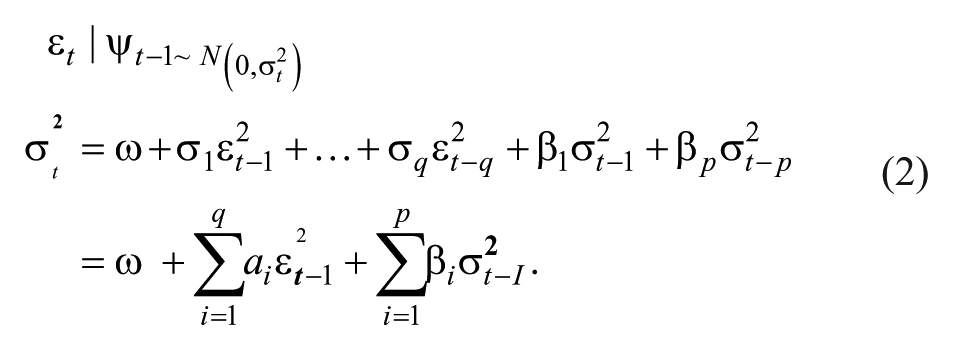
On a general note, the white test is the best test for heteroscedasticity in econometric models. However, ARCH and GARCH errors tests will be conducted when dealing with time series data. Therefore, the time series data for this study are sourced from the World Bank’s WDI (2017) covering from 1960 to 2017 for effective and more robust results. The empirical investigation of the study objectives will be captured with the following mathematical expression:

Equation 3 simply states that life expectancy (LEX) is a function of CO2 emission from solid fuel consumption (CO2SF), CO2 emission from liquid fuel consumption (CO2LF), income per capita proxied by gross domestic product (GDP), and population growth (POPG) percentage per annum.
The econometric expression of the mathematical Equation 3 is as follows:

where LEX is life expectancy, CO2SF is carbon dioxide emission from solid fuel consumption, CO2LF is the carbon dioxide emission from liquid fuel consumption, GDP is the gross domestic income as a proxy of income per capita, and POPG is the population growth annual percentage. β0,β1,β2,β3,β4 measure parameters, while mt is stochastic error term.
Result and Discussions
As the title implies, Table 1 shows descriptive statistics or information on the individual variables in the model. To be concise, let us simply concentrate in explaining the core variables of interest which are carbon dioxide emission from liquid fuel consumption (CO2LF), carbon dioxide emission from solid fuel consumption (CO2SF), and life expectancy at birth (LEX).
Descriptive Statistics.

Source. Authors’ Computation using EViews 8.
However, the mean value of the CO2LF, that is, carbon dioxide emission from liquid fuel consumption, is approximately 44.0 ppm with the median value of 41.1 ppm; maximum and minimum values are approximately 16 ppm and 77 ppm, respectively. The standard deviation (SD) and the probability values are about 17.4 ppm and 0.3 ppm, respectively, with 58 observations.
The CO2SF variable, that is, carbon dioxide emission from solid fuel consumption, has its mean and median values approximately 3.5 ppm and 0.3 ppm, respectively, with 42.5 ppm maximum and −7.0 ppm minimum values. The variable also records about 10.0 ppm as standard deviation and 0.00 ppm probability value in 58 observations.
It is also recorded in Table 1 above that the mean and median values of life expectancy (LEX) are approximately 45 year 4 months, and 45 years 9 months, respectively. The maximum years of life expectancy are about 53 year, and 37 years for the minimum life expectancy. The standard deviation is about 4 years and a month with a probability of about 6 months. Therefore, given the descriptive statistics above on the variables in the model, the study shall proceed to test the stationarity of the variables for consequent estimation.
Table 2 above presents the stationarity tests of the variables in the model using both the Augmented Dickey–Fuller (ADF) and Phillips–Perron (PP) tests. The ADF and PP tests were conducted simultaneously to ensure the certainty in stationarity results. The life expectancy (LEX) variable is stationary at level in ADF test and stationary at first difference in PP test. CO2SF is stationary at level in both ADF and PP test. On the contrary, CO2LF and POPG are both stationary at first difference in ADF and PP test. Furthermore, the GDP variable is stationary at level in ADF test and became stationary at first difference in PP test. Johansen cointegration test conducted equally shows that the variables are cointegrated at 5% level of significance. Having tested for the robustness of the variables in the model and their suitability in policy formulation, the study shall proceed to estimate the model and thus derive the recommendations thereof.
Results of the Stationarity (Unit Root) Tests.
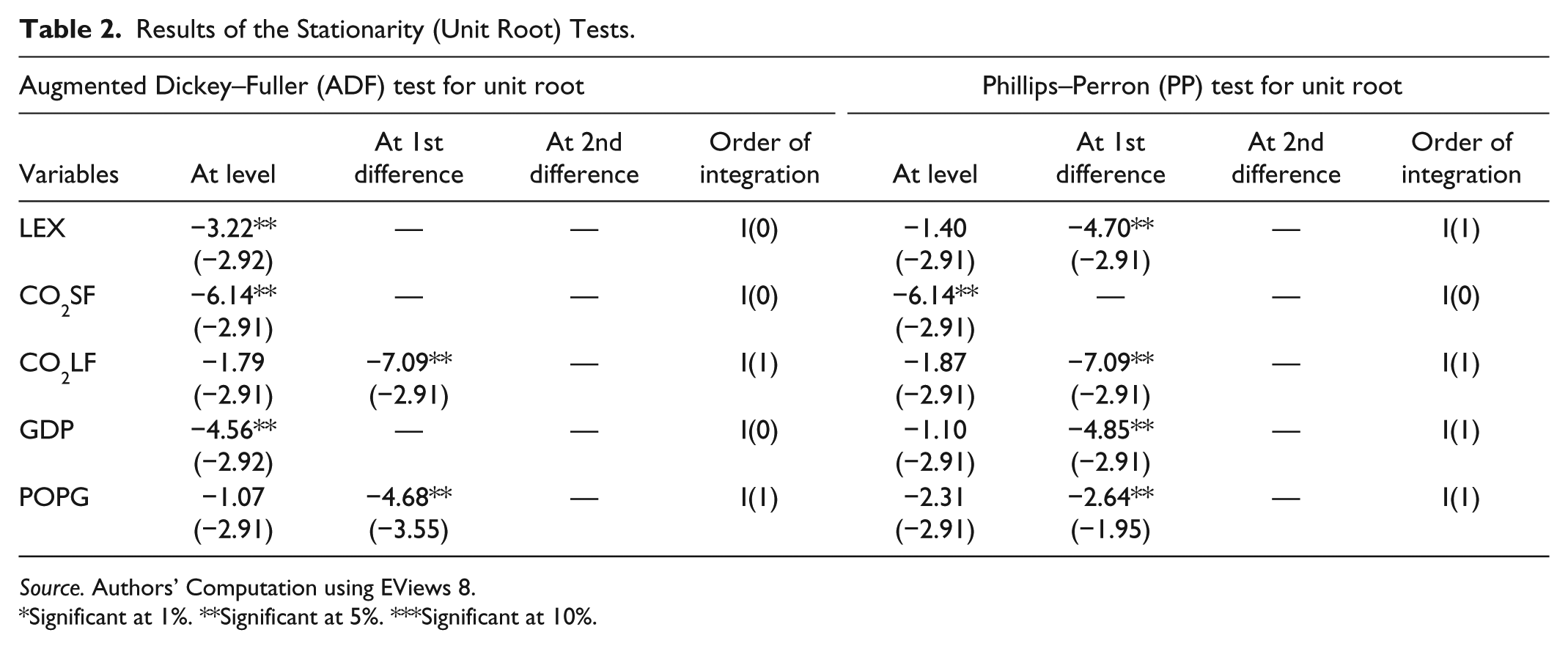
Source. Authors’ Computation using EViews 8.
Significant at 1%. **Significant at 5%. ***Significant at 10%.
Table 3 presents the estimation output/results of the regression. The life expectancy (LEX) variable is the dependent variable against the independent variables—carbon dioxide emission from liquid fuel consumption (CO2LF), carbon dioxide emission from solid fuel consumption (CO2SF), income (GDP), and population growth (POPG). The R2 shows the degree of goodness of fit of the regression line which is about 90% with about 89% adjustment in the R2 with 58 observations.
The Estimation Results/Output (Dependent Variable: Life Expectancy [LEX]).

Source. Estimation results/output from EViews 8.
“C” means Constant.
The result shows that population growth (POPG) extends life expectancy (LEX) positively to about 5 years 5 months with a statistically significant result. This means that an increase in population is likely to increase the life expectancy as a result of an increase in manpower and human resource capital which invariably improves productivity in Africa as agriculture dominant continent. This result is in disagreement with Amjad and Khalil (2014) whose result revealed in a related study that population growth is insignificant and negatively related to life expectancy in Oman Sultanate, Pakistan. This could be as a result of the growing number of the age dependency ratio (people younger than 15 or older than 64) in Oman Sultanate, Pakistan, contrary to the working age population (people aged 15 to 64) in Africa (see OECD, 2018).
Also, income, as proxied by GDP, extends life expectancy (LEX) to about 1 year 6 months with the statistically insignificant result. This goes a long way in explaining how income can improve on the quality of health outcome in the continent of Africa in terms of general maintenance of a healthy lifestyle through income and financial capabilities. This result is in agreement with Balani (2016) as regards an increase in income influencing significantly the improved life quality and expectancy. Moreover, increase in income (GDP) goes to a large extent in acquiring the needed modern technologies or facilities in health and related sectors which can be utilized in tacking some health issues in the continent of Africa and even beyond. Equally, this result is in line with the work of Chen and Ching (2000); Bayati et al. (2013); Kasman and Duman (2015); and Antonakakis et al. (2017) who found the same compelling evidence of positive and significant effect of income on longevity in their independent studies.
The result equally reveals that CO2SF reduces life expectancy to about 1 month 3 weeks with statistically significant result, while CO2LF remains insignificant pointing out that the continent of Africa is less industrialized in comparison to developed nations/continents. All the results generated from the regression output relatively complied with a priori expectations which distinct significance. Based on the generated results above with their respective interpretations, the study shall proceed to a conclusion and recommend some policies to the respective authorities. This result is in tandem with the independent studies carried out by Assadzadeh et al. (2014); Amjad and Khalil (2014); Al-Mulali and Ozturk (2015); Issaoui et al. (2015); Al-Mulali et al. (2015); and Matthew et al. (2018) that showed significant and negative effect of CO2 emissions on life expectancy or health outcome.
Conclusion and Policy Recommendations
The study literally looked at the effects of environmental hazards which include CO2 emissions on the life expectancy in Africa using Nigeria data available from World Development Indicators (WDI) between 1960 and 2017. The results from the GARCH model relatively and uniquely complied with a priori expectations. However, it is evidenced in the estimation results that CO2 emission from solid fuel consumption reduces life expectancy, while population growth and income extend life expectancy in their varying degrees and magnitudes. Based on the estimated results, the following policy recommendations can be filed to the respective and appropriate authorities:
There is a need for the African Union (AU) to adopt a policy regulating the excessive CO2 emission from solid fuel consumption to ameliorate the negative consequences it exerts on the lifespan of the African population.
The economies in Africa should increase the budgetary allocation to the health sector to tackle any health-related challenges emanating from environmental hazards such as CO2 emissions and other environmental pollutants which can cause serious health-related issues on human well-being to control the persistent rise in mortality rate or disease-causing ailment and/or death.
Most importantly, the economies in Africa should increase the budgetary allocation to science and technology to improve on their technological capabilities geared toward moving away from consumption of solid fuel which generates CO2 emissions to electricity automotive engines or robust electricity/digital-driven technology and hybrid-energy efficient mechanisms.
In most economies in Africa, a well-functioning environmental agency such as the environmental protection agency, unit, or department that is charged with a singular responsibility of controlling environmental hazards with a view of ensuring environmental quality is seriously inadequate or grossly insufficient. On this note, a state of emergency should be declared on the establishment of such environmental protection agency, unit, or department in the countries of Africa to ensure quality control of the environment and its related hazards.
Finally, as shown in the estimation output that income extends life expectancy by 1 year 6 months with statistically insignificant result, the study recommends radical diversifications of income generation among countries in Africa so as to open more viable channels/streams of income to further span the quality longevity of lives in the African continent.
Footnotes
Declaration of Conflicting Interests
The author(s) declared no potential conflicts of interest with respect to the research, authorship, and/or publication of this article.
Funding
The author(s) received no financial support for the research, authorship, and/or publication of this article.