




Abstract
Yoruba festivals are numerous and multifarious. For this reason, some are of the view that the Yorubas are deeply spiritual. In addition to the generally celebrated festivals among the Yorubas, each Yoruba tribe has its own festivals. A series of these festivals called the Ojude Oba festival is celebrated by the Ijebus who are renowned for both their enterprise and affluence. This article examines the cultural and spiritual significance of the Ojude Oba festival. It analyzes the early beginnings of the festival while providing insights into the epoch of the Ijebus. The festival constitutes a major commercial activity that brings about economic integration and development of the Ijebu community. This article argues that the Ojude Oba festival should not be seen simply for its entertainment value, but as a manifestation of Yoruba cultural, socio-economic, and spiritual values.
Introduction
Yoruba is the name given to represent the ethnic group and language of those living in South-West Nigeria. The Yorubas have a very rich culture with a strong spiritual background. These cultural wealth and spiritual beliefs are exhibited during their festive periods. Although there are festivals celebrated in all the Yoruba communities, some are peculiar to certain Yoruba communities. These festivals are often staged on an annual basis. One of the most popular festivals peculiar to the Ijebu-speaking community, a subgroup of the Yoruba ethnic group, is the Ojude Oba (the frontage of the king) festival, which is an annual event. The festival celebrates some of the unique features of the community such as their aesthetic taste in clothes, music, costumes, food, and so on.
People of all cultures celebrate festivals unique to their culture and customs. Festivals serve as a means of community assembly and unity. They are also a way of placing the people at the heart of their culture and social environment. Owusu-Frempong (2005) in one of his articles noted that African festivals are “medium of cultural education and intergenerational communication and play an important role in the preservation of our cultural heritage, transmitting knowledge and our experiences as a people to future generations” (p. 730). The Ojude Oba serves all these functions, and in addition, it plays a religious role in the life of the people of the community.
The Ijebu Kingdom
The Ijebus are located in the south-central part of Southwestern Nigeria, regarded as Yorubaland. Ijebuland is bordered in the north by Ibadan, in the east by Ondo and Okitipupa, and the west by Egbaland (Sote, 2003). The southern border is close to the sea with the coastlines of Epe, Ibeju-Lekki, and Ikorodu. Although the people have always regarded themselves as one, modern Nigeria political division has placed three Ijebu-speaking local government council areas (Epe, Ibeju-Lekki, and Ikorodu) in Lagos State, whereas the larger part of Ijebuland is in Ogun State (Abimbola, 2011; Oladiti, 2009).
There are legends that link the Ijebus to biblical Jebusites and Noah (Ijebu Kingdom, 2012). For this reason, the Ijebus call themselves “Omoluwabi”—omoti Noah bi—“the children of Noah,” but this is a claim quite difficult to prove. The term Omoluwabi is also said to have come from omo-olu-iwa-bi (“the child or children born of Olu-Iwa”). The reference to Olu-Iwa can be found in the document given to the local British official in 1937 by Ijebu Ode community leaders. The document states that the king of Ile-Ife gave his daughter Gborowo as wife to Olu-Iwa. The marriage resulted in the birth of Ogborogan, which was the nickname (a disused term for addressing the king) of Obanta (the progenitor of Ijebu Kingdom; Oduwọbi, 2006). 1 A British officer in 1906 quoted local sources who mentioned that the word Ijebu was coined from the name of two of three brothers Ajebu and Olode (the third was Osi who became the first king of Ijebu, but he later abdicated for Obanta—eldest son of the king of Ife—on his arrival). The three brothers were reported to have come from Ile-Ife (National Archives, 1906).
Another legendary story of the Ijebu claims that they migrated to their present place from a province in Sudan called “Owodaiye,” corrupted to “Wadai.” This opinion is supported by the present king Oba Sikiru Adetona and preferred by the traditional historians (Hashimi, 2005-2006). Some evidences given in support of the claim that the Ijebus migrated to Nigeria from Sudan are as follows: the Sudanese tribal marks that are similar to the Ijebus three tribal vertical marks to show a true indigene of the region; the closeness of the original Arabic dialect spoken in the border of South Sudan and Ethiopia to the Ijebu dialect; names such as Esiwu, Saba, and Meleki (Menelik) found among the Ijebus and the Southern Sudanese people; and the musical flute that was used in the previous coronation of the Awujales, which is still in vogue among the Ethiopian and Southern Sudanese people (see Figures 1 and 2; Ijebu Kingdom, 2012). 2

The Awujale of Ijebuland, Oba (Dr.) Sikiru Kayode Adetona, the present king of the Ijebus.

A Yoruba Art head depicting the tribal mark of the Ijebu people.
In the 18th and 19th centuries, Yorubaland witnessed several political power struggles in the form of the Owu war (1821), the Gbedeke war (1831), the Apomu war (1879), the Kiriji war (1879), and the Ekiti Parapo war (1894). One of the reasons for these wars was that most towns wanted to get slaves to sell to the British. The war also caused people from different cultural backgrounds to leave their homes and settle in new places. What is interesting is that the Ijebu kingdom was the only kingdom that survived the political chaos and anarchy that devastated most towns and villages in the region (Hashimi, 2005-2006).
The Ijebus are known for their business acumen and apprenticeship that can be connected to their long-time relation with the European world since the early 19th century (see also Abayomi & Dedeke, 2006; Mabogunje & Kates, 2004). By 1900, Ijebu Ode had become the capital of Ijebuland with a population of about 20,000, 10% of the entire Ijebuland population (Ayandele, 1992). Ijebu Ode is located on latitude 60 49′ N and longitude 30 55′ E, more or less in the center of the most densely settled districts of the Ijebu province, which occupy south-central Western Nigeria. It is the headquarters of the Ijebu and is surrounded by a ring of smaller towns having between 2,000 and 5,000 residents each (Abdul, 1967).
The Ijebus have their own dialect, and cultural and institutional identity. The Agemo 3 and Osugbo 4 play important political and judicial roles. The most prominent institution is the Awujaleship. The Awujale is the office of the king of Ijebuland. The Awujale’s role is to provide spiritual lordship in its relationship with various districts. The main city or the capital of Ijebuland is Ijebu Ode. The people of Ijebu Ode sometimes regard themselves as the “super Ijebus” and see other areas as rural inhabitants. It is in Ijebu Ode that the Ojude Oba (the frontage of the king) festival is held.
Islam in Ijebuland
Islam came to Ijebuland around 1879 during the reign of Awujale Afidipote (d. 1885), through an Ilorin slave servant of Tubogun, a merchant from the Porogun ward of Ijebu Ode. The slave servant’s name was ’Ali. Tubogun gave ’Ali the freedom to worship in any manner his religion dictated to him. He later took his master’s name and became ’Ali Tubogun (Botu, 1937). According to another account, Islam entered Ijebuland through Epe. This was as a result of Epe’s contact with Islam during the 1851 exile of Oba Kosoko and his staunch supporter, Salu, who was then Imam of the Lagos Muslims. While in Epe, Salu and his followers continued the proselytization of their faith, which later reached the Ijebu Epe areas, a hitherto secluded coastal town with link to Ijebuland (Abdul, 1967). 5
In another historical account, a trader from Gbogunja in Isale Iwade, with the name ’Ali Akayinode came in contact with some Ilorin Muslims during his many travels outside Ijebu Ode. He learnt from them about the religion and kept it private to himself, but on hearing about ’Ali Tubogun and his strange religion, he decided to befriend him to learn more. The friendship also emboldened Akayinode to discuss the message of his new faith among his friends in his community. The coming together of the freeborn and slave servant changed the people’s perception of the religion; soon friends of ’Ali Akayinode joined him and the congregational prayers were held in his house. Later, a suggestion came from one of the new members that the Muslim call to prayer (Azān) be made. The call drew the attention of the king’s traditional priests (Odis). 6 The Odis protested and most protest from the Odis often led to grave consequences. Akayinode had to leave the town as soon as he received the message that the Odis were coming for him. He returned to Ijebuland 6 years later after receiving the news that the reigning Awujale had a free disposition to the religion (Abdul, 1967). As time went by, the number of the Muslims in the community increased with some of the closest allies of the reigning king, Awujale Atunwase (1886-1895), converting to the religion. While Akayinode was away, Sanni Oboromboro filled the vacuum, and also bought an Ilorin slave with the name Ilyas to teach the faith to the new Muslims. On Akayinode’s return, Oboromboro abdicated the seat of Imam for Akayinode. Oboromboro’s reason for taking such action was that Akayinode was more knowledgeable and older than him.
Later on, the need arose for an Eid prayer ground and a request was made to the Awujale. He granted the request and directed that a piece of land around the eastern outskirt of the town be given to the Muslims. The first Eid was said to have been celebrated with great pomp and pageantry, as members of Imam Akayinode’s age group rode on horses to and fro the Eid prayer ground (Botu, 1937). As the number of Muslims increased, a request was again sent to Awujale Atunwase for a central piece of land that would be dedicated for the Friday congregational prayer. The king granted the request, and the Etitalẹ central mosque currently stands on the land. Few days later, representatives from the Muslim community were sent to the Awujale to express the Muslims’ gratitude for the king’s support and kindness. It was at this occasion that one of the eminent personalities of the community (Chief Kuku Oduyingbo and later Balogun Kuku), impressed by the Muslim gestures, donated five shillings toward the building of the proposed masjid. He also decided to join the religion. Balogun Kuku embracing the faith marked an important turning point in the history of Islam in Ijebuland, as multitude followed suit (Abdul, 1967). 7
Historical Background of Ojude Oba
Ojude Oba which means, “the king’s fore-court or frontage,” could also be translated as “majestic outing.” The Ojude Oba festival in Ijebu Ode is known to the Ijebus as a major festival that brings them together. The native age groups (regberegbe), indigenes, their friends, and associates from far and near throng the palace of the Awujale of Ijebuland for the carnival-like celebration. The festival is celebrated on the third day after Id-El-Kabir. Ojude Oba is one of the most glamorous cultural and spiritual festivals in Ijebuland and in Ogun State in general. This is a celebration that has traditional, cultural, religious, social, and military significance. It has been celebrated for more than 100 years.
According to oral historical accounts, the festival began when Balogun Kuku, one of the leading personalities in the community, accepted Islam. He decided to gather his friends, families, and well-wishers to pay homage to the king for giving them the opportunity to practice their religion peacefully (Balogun Kuku, n.d.). In another account, the festival was said to have started when Imam Tunwatoba led his friends and family members to pay homage to his friend, who was also the Awujale of Ijebuland, Oba Fidipote during the eid-l-adha festival. Imam Tunwatoba thanked the king for being instrumental to the freedom enjoyed by the Muslims in the community to practice their faith in a peaceful atmosphere (Babatunde, 2007). They prayed for the monarch to enjoy a long life, good health, and for the progress and prosperity of Ijebuland. Since then, what began as a visit has grown in leaps and bounds to assume the status of a flagship cultural festival.
The Festival
The glitz and colors associated with the festival rank among the most celebrated cultural festivals in Nigeria. Ijebu sons and daughters, Muslim and non-Muslim, always look forward to this event. It is an agelong tradition. The ceremony takes place every year on the third day of eid-l-adha, when Muslims and non-Muslims go to the Awujale palace, singing and dancing with the principal chiefs of the town and riding on horses to pay homage to the Awujale, no matter his religious affiliation. What is important is that he sits on the throne throughout the length of the ceremony to receive his people (Danmole, 2008). Different age groups in specially tailored dresses dance around the town (Oladipupo, 1967). Although the festival began as purely a Muslim affair, it has over the years acquired new meaning as it now embraces features of local traditions (Danmole, 2008).
The Ojude Oba festival normally begins with prayers by the Imam of Ijebuland, followed by the National Anthem, Ogun state Anthem, and the Awujale Anthem, and finally the lineage praise of the Ijebus. The Awujale anthem goes thus:
Kaabiyesi o (2ce)
Alaiye Oba wa,
K’adepel’ori o
kibatape lese,
k’adepel’ori.
K’odigbapel’orun, Ki Oba petiti, Ki ijobatuwalara,
kaabiyesi o.
Oba waoninu re.
Kaabiyesi o (2ce).
8
After the anthems and lineage praise, the parade of different ages in the community known as Regberegbe begins. The age grade societies were established in the 18th century. Wompari is the general name given to all the age grade societies. Some of the age grades are Egbe Gbobaniyi male and female (1962-1964), Egbe Bobagunte male and female (1956-1958), Akile of Ijebu (1959-1961), Mafowoku, Egbe Arobayo male and female, Egbe Jagunmolu (1965-1967), Egbe Bobakeye, and Egbe Bobagbimo. All the age grades present their special gift to the king as they parade (see Figures 3 and 4).

One of the age grades paying their homage to the king of Ijebuland.

Fadeyi Oloro (Fadeyi, the venomous one) about to start the mock war. The mock war is one of the programs by the warlord families in the Ojude Oba festival.
The Wompari is a unique and agelong institution, designed to wield the society into age groups, male and female, and for bringing development and progress to the community. Most of these groups comprise heads of industries, top managers, and chief executive officers. They dance before the king one after the other. Each group is expected to clad in the latest fashion. They file past in turn with their drummers to pay homage to the king.
During the 1-day event are the glowing tributes of a festival that is responsive to social trends, while retaining the tradition of having different age groups to entertain and renew their allegiance to the traditional ruler. It is usually a dance, but more importantly, a dance with meaning. Each age group displays at the expansive lawn that separates the king and his guests from the crowd. That makes the festival an inspiring experience.
The Ojude Oba festival has always had enough visual pleasantries for every visitor. Some of the attractions are the beauty of a group of people in the same age group coming together in service of their motherland. Many of the groups’ names are related to the king such as Obafuwaji, Bobakeye, Gbobayo, Gbobaniyi, and Gbobalaye (see Figure 5).

The ex-governor of Ogun State (Otunba Gbenga Daniel), the Awujale of Ijebuland, and other dignitaries at the 2009 Ojude Oba festival.
Each of these groups has its uniqueness, either in the manner of appearance, style of dressing, or dance pattern. The Gbobaniyi comprises young middle-age men, and has Governor Gbenga Daniel as its patron (2004-). They make their appearance known by dressing in rich traditional Aso-Oke clothes. They all hold walking sticks and dance like conquerors. The Bobagbimo, true to the group’s name, always appear in learned and cerebral attire. The group has little of dance and pleasantries but more of grins, nods, and prayers. Gaiety and dance are the hallmarks of the all-female Gbobaleye, which has the Waka Music Superstar, Queen Salawa Abeni, as one of its prominent members. The parade of the Baloguns and Eleshins is usually the most colorful and breathtaking event of the festival.
A Balogun or an Eleshin is a direct descendant of the war heroes who gained notable victories for the Ijebu during the inter-ethnic Yoruba wars in the pre-colonial history of Nigeria. It is commonly believed that it was at Ojude Oba that the families of the war heroes led by the reigning Balogun and deputies exhibited their equestrian prowess by simulating mock battle shows and displays (see Figures 6 and 7).

The Eleshin age grade entering the parade ground.

One of the heads of the Balogun family on his way to the Ojude Oba festival.
It is always a performance to behold when each Balogun and Eleshin family takes its turn to pay homage to the king amid martial music, jubilation, and hilarity of an estimated crowd of over one million both at the palace square and through the town including participants, visitors, and tourists. This was what made Oba Sikiru Kayode Adetona to describe the Ojude Oba day as the Ijebus’ national day. “Ojude Oba is now maturing into a world class event. It has all the ingredients of uniqueness and greatness” (Okoli, 2005). 9
Artistic Beauty of the Ojude Oba Festival
Art plays a significant role in the Ojude Oba festival. It is one of the reasons people from completely different cultural settings find the festival very interesting. While looking at the artistic beauty of Ojude Oba, we would take into consideration the manner of dressing of the different age groups, music and musical instruments, the design on the horses of the Balogun families, the pattern of the banners and fans used in the ceremony, and so on.
Dressing
In many Yoruba societies, dresses or the traditional robes play important roles in ceremonies. It is one of the ways to display one’s economic status within the society. In Ojude Oba, the age grades try to beat one another through the kind of dress they wear. Therefore, it is not surprising when we see different age grades dressed in the most expensive kinds of cloth known to the people of the community.
In the age grade that comprises men and women, all are supposed to dress in the same pattern of cloth. The sheer impact of bulk and color and stripes created by an assemblage of individuals in close proximity, each person robed in identical pattern and hue, is indeed considerable. The attire worn in the previous festival would not be repeated in the next festival. This is to show their economic status and wealth and make a statement that they are doing fine in their age grade. Most often, it is an entirely different dress that would be worn in the next Ojude Oba. The difference would not only be in color but also in style.
Traditionally, the favorite colors of the Yoruba are tan, the rich natural tone of the silk known as sanyan, and blue, ranging from the palest to the deepest blue black obtainable from the indigo dye pots. Reds and an occasional yellow are also traditional preferences. More recently, however, innovations in pattern and hue have come to be prized, so that there is a more varied palette and an increased reliance on commercially manufactured yarns rather than dependence on hand-spun and locally dyed weaves. This is why today, some age grades would wear agbada (big overall cloth for men), laced with green damask.
In one of the previous Ojude Oba festivals, all the age grades wore the same pattern of cloth; the only difference was the color of caps for men and the headgear of the ladies. The reason for this was that that year’s festival was used to campaign for the creation of an Ijebu state for the Ijebu people. On the cloth worn by the age grades, the Ijebu state was written all over it (see Figures 8-10).
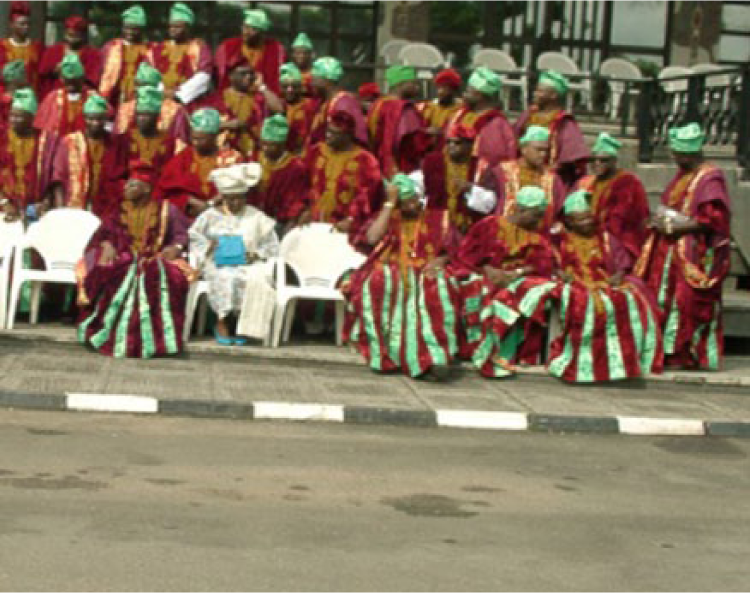
People of the same age grade often chose same pattern of cloth.

Giwa & Obas in Bobakeye.

Same pattern of cloth, away of addingcolour to the festival.
Music and Musical Instruments
Music is an important part of the Ojude Oba festival and among the Yorubas, traditional music can to a certain degree be described as music drama. The dramatic aspect of this music is given its highest expression in situations of a ceremonial nature in which music, dance, speech, physical movement, costume, and art objects all combine to constitute a complete performance (Euba, 1970). In Ojude Oba, all these are combined to the fullest and are part of what makes the festival memorable. Popular musicians within the country as well as those who are from Ijebuland, such as Salawa Abeni and Wasiu Ayinde Marshal among others, are also invited to the festival (see Figures 11 and 12).

Musician Wasiu Ayinde Marshal, popularly called KWAM 1, with friends at the Ojude Oba festival.

At the background is a drummer with the Bata drum.
Musical instruments used during the festival are another aesthetic part of the celebration. There are various types of drums such as Agere, Aran/Ipese, Igbin, Bata, Dundun. Also, there is the sèkèrè (a netted bottle gourd that rattles), which is often used in a wide range of traditional Yoruba praise songs and social dance styles (Waterman, 1990). A newly introduced instrument however is the trumpet (see Figures 13 and 14).
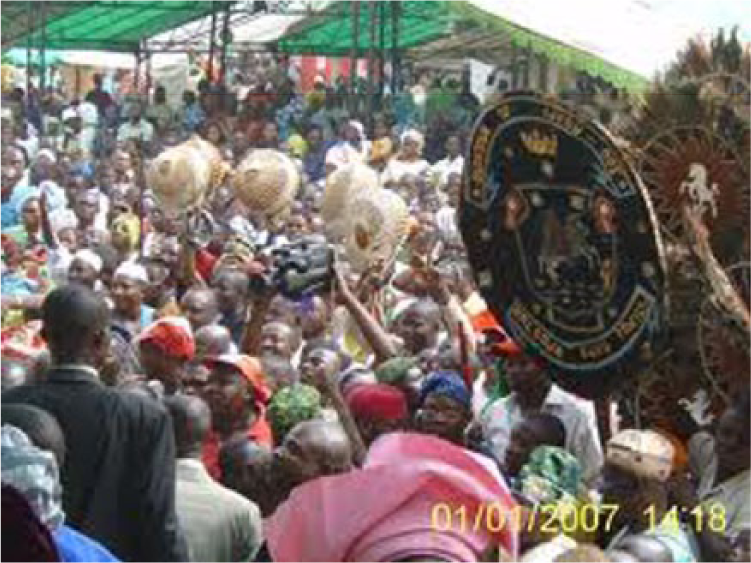
Three Sèkèrè can be seen in the figure.

Three trumpets can be seen in the figure. Sometimes the trumpets are used to get the attention of the people if one of the Eleshin families arrives.
Banners/Emblems
Another interesting aspect of the festival is the various banners and emblems that signify those who are present to honor the king depending on what is written on the banner. The banners/emblems come in various colors and sizes. The popular colors are black and brown, but there are also pink, purple, red, and yellow. The Balogun Kuku family uses brown, whereas the Alausa uses black. Some of the banners/emblems are decorated with wool whereas others are decorated with feathers. Most of the banners have the name of the family written on them, with images of horses and the crown in some of them (see Figures 15-17).
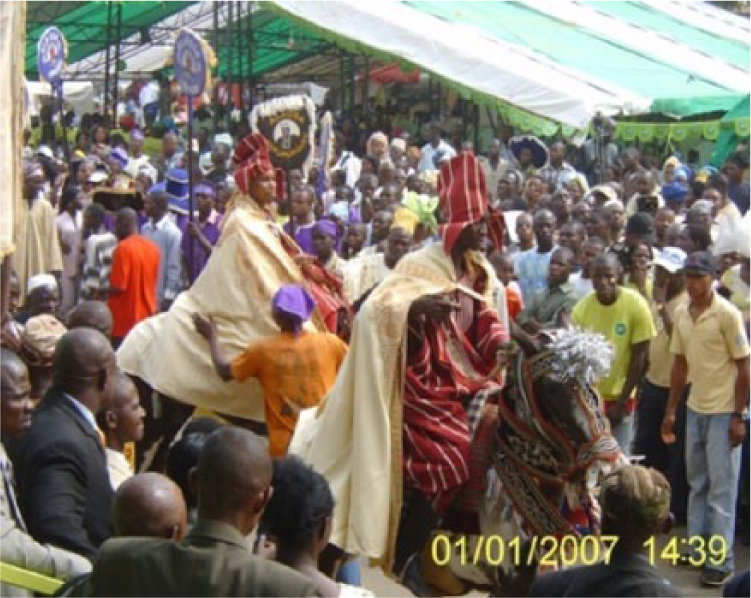
The horse parade and display.

The symbol of the Baloguns.
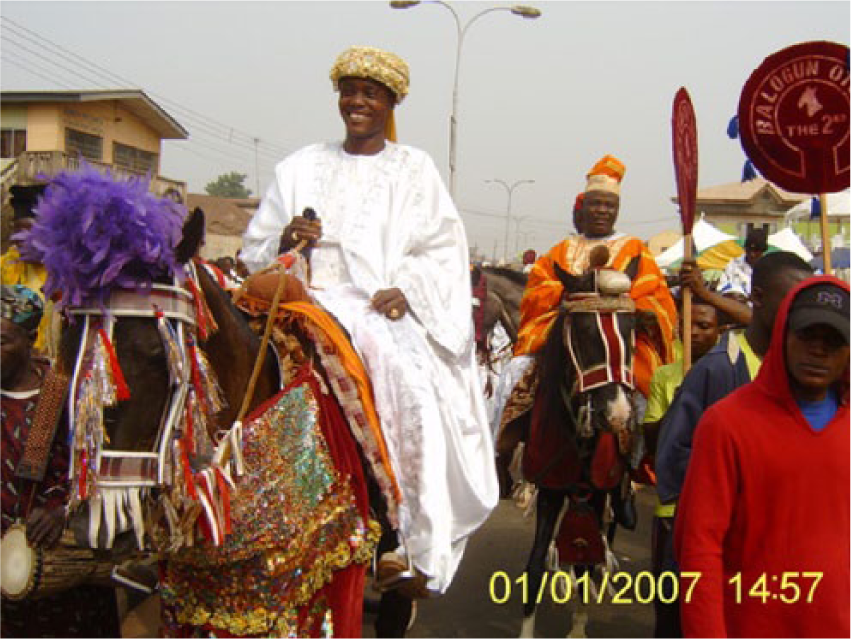
One of the beautifully decorated horses of the Baloguns.
The Horses
The excessive decoration of the stallion horses is another interesting thing about the festival. Everything about the horse is decorated, from the head to its hoof. After all the decorations on the horses are done, one finds it difficult to call them horses, but rather moving artwork. Almost all colors can be found in the decoration of the horses. They also use cloths that have beads on them to create a glittering effect. This is why for most people, the parade of the Baloguns (warlord) is the most interesting part of the festival (see Figures 18 and 19).
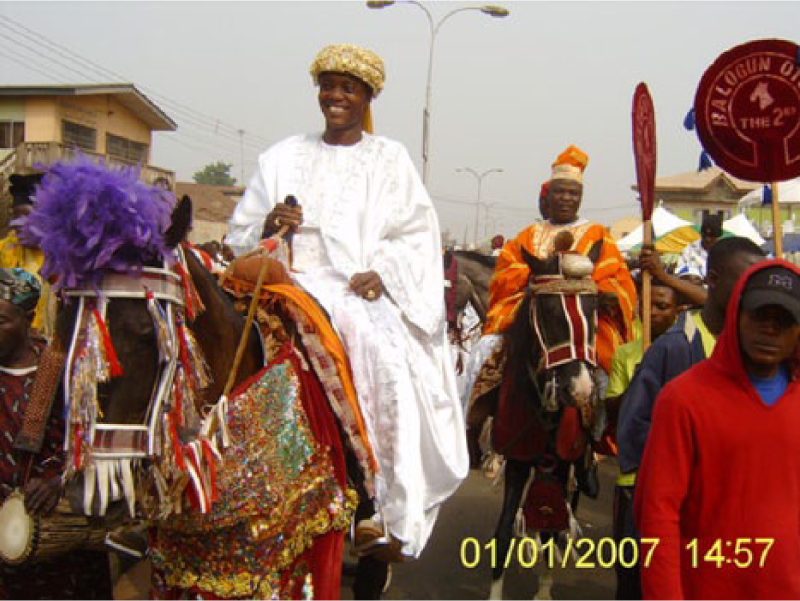
The Baloguns on their way to the festival.

The decoration on the horses.
The Mock War
Looking at the life of the Yorubas, one will quickly notice how entertainment is injected into almost every facet of their life. From the naming ceremony to burial ceremony, from conferment of chieftaincy title to festivals, just name it and one will find entertainment and drama. The mock war is a significant part of the festival. All the Baloguns/Eleshins take part in this show. In fact, movie actors sometimes not from Ijebuland are invited to take part. The sound of Dane guns and various kinds of hunters’ guns are heard by all the spectators. Furthermore, to show their skills in riding horses, the horses are made to dance and perform various kinds of tricks like standing on their hind legs and so on. In the mock war, there are no winners or losers; the focus is on participation (see Figures 20 and 21).

A charging horse in Ojude Oba festival is one of the dramatic events during the mock war.

Fadeyi Oloro (Fadeyi, the venomous one) is one of the movie actors invited to the festival for the mock war show.
Cultural Significance of the Festival
Culture has been defined in different ways by different scholars. Ilesanmi (2004) quoted Menamparampil (1996, p. 9) to have defined culture as . . . the total manner in which a human society responds to an environment. It includes customs characterizing a social group; social heredity of a particular community; meaning, values, norms, their actions and relationships; beliefs, laws, traditions and institutions; religions, ritual, language, song dance, feast, living habits, crafts, equipment. (p. 7)
Going by the above definition, culture entails all facets of human endeavor. It is a long-term process that is transferred from one generation to another. Culture varies from one society to another. It is life in all its totality, it is not static; it changes from time to time. A Yoruba festival like Ojude Oba has a socio-cultural importance. The festival has been used as a means of projecting the image of the Yoruba in general and the Ijebus in particular.
The Ojude Oba gives the Ijebus an opportunity to renew their allegiance to their king every year they return home from different places within and outside Nigeria. During the festival, they express their support for the king and wish him a peaceful tenure.
Another cultural significance is that the festival serves as an avenue for people to serve their motherland. The king in one of his speeches after the festival acknowledged the contributions of the age grades to his domain when he said, We are pleased to observe the positive contributions that our unique regberegbe institution continues to make to the development of Ijebuland. We are pleased to see a healthy rivalry among them in their efforts to do something tangible for our society so as to immortalise their names in the annals of Ijebu history. (Ijebu Kingdom, 2012)
The festival also promotes cultural contact. The festival is usually graced by people from all works of life. Other ethnic groups in Nigeria also participate in the festival whereas people from neighboring countries are not left out. This has promoted peace, tranquility, and harmony, which contribute to socio-economic development and integration.
The festival also signifies Yoruba flair for traditional attire. A typical Yoruba man wears gbariye, agbada, and dansiki for social activities whereas the women tie their iro, buba, iborun, and ipele. These clothes show the beauty of the Yoruba culture. More so, music, dance, and drums are an integral part of the Yoruba culture. There is no occasion in Yorubaland that is not accompanied by music; each festival has its peculiar music, be it religious or social. Music brings life and meaning to cultures and traditions (Jekayinfa, 2002). Music, dress, chieftaincy titles, and respect for the monarch are carried over from the African culture, which the Ojude Oba festival depicts.
Spiritual Significance of the Festival
Islam is a religion brought to Yorubaland through the efforts of Hausa-Fulani jihadist (Gbadamosi, 1978). Since the advent of the new faith, it has had a great impact on the norms, customs, and traditions of our society. Part of Islam influence on Africa is that, there emerged a number of festivals which have gained prominence over the traditional ones.
Mujahid (2001) also opined, In the history of Islam, as Islam began to spread far and wide into various foreign lands, strange and new ideas began to appear amongst the new Muslims. These ideas were foreign to the Muslims of Arabia who had received their Islamic education through the pure teachings of the prophet’s companions. Many of those who had accepted would often maintain certain beliefs and superstitions that were present in their societies and culture before their conversions to Islam. (p. 4)
A festival like Ojude Oba is an aspect of African culture imported to Islam. Primarily, the spiritual significance is derived from the origin and aim of the festival. It was started by Muslims during their eid-l-adha, which is considered one of the important events for Muslims.
Furthermore, the festival is seen as a continuation of the eid-l-adha celebration by the Muslims in the community, as it is held on the third day of Eid. The festival is not only celebrated by Muslims; Christians as well as people from other faiths join the Muslims in this celebration. The Ojude Oba festival encourages peaceful co-existence of people of different faiths. More so, the festival always begins with an opening prayer by the Imam of Ijebuland. As such, the festival serves as an avenue to pray for the king, his members of cabinet, the people, and community as a whole.
Conclusion
In this article, we have attempted to expound, albeit briefly, the guiding beliefs of the Ijebu people with regard to the celebration of the Ojude Oba festival. The festival, it should be noted, finds its basis in the people’s belief in honoring the paramount ruler of Ijebuland. It is also a time for the people to display their aesthetic taste in fashion. The artistic and creative talents of the people in terms of dressing, drama, music, and oral communication are also put into great use.
However, beneath the hustle and bustle, and sparked display of colors of this traditional festival, one can discern its attendant religiocultural significance. Through this festival, the people are not just entertained but the religious and cultural values find an outlet too. In addition, it is also the time most Ijebu people come home to celebrate and reconnect to their roots, reflecting the religious, social, and cultural responsiveness on the part of the people.
Footnotes
Declaration of Conflicting Interests
The author(s) declared no potential conflicts of interest with respect to the research, authorship, and/or publication of this article.
Funding
The author(s) received no financial support for the research and/or authorship of this article.