




Abstract
The effectiveness of the various measures put in place by government for the promotion of public accountability in Africa using Nigeria as a case study was examined using a 12-item questionnaire. The aim was to find the importance of these measures in the promotion of public accountability in Nigeria. A total of 240 respondents, comprising 140 males (65.6%) and 100 females (34.4%), answered the questionnaire. The mean age of the respondents was 24.89 years. The result disclosed that these measures were partially implemented in the discharge of duties and this led to the achievement of very limited successes. The chi-square was also used to test the relationship between implementation of these measures and effectiveness of public accountability. The result revealed a significant relationship. Suggestions were therefore made on how to improve the use of these measures which included recognition of the importance of these measures, adequate monitoring, removal of the immunity clause, strict adherence to sanctions irrespective of whoever is involved, and compulsory accountability by leaders.
Introduction
Nigeria is one of the countries in Africa endowed with immense human and material resources. She is called the “giant” of Africa. Her crude oil production stood at 2,059 million pound sterling by September 2010 (Okoli, 2010). Nigeria has been involved in many economic, political, and social restructurings, yet, ranked very low in the Corruption Perception Index (CPI) in 2010. She scored 2.4 on October 28, 2010, against 3.5 in 2009. Similarly, she dropped from 130th position in 2009 to 134th in 2010.
This performance is certainly not limited to Nigeria. Some other African countries have similar low ranking. According to the CPI ranking in 2010, many African countries scored below 3.5. For instance, Gambia scored 3.2 and took 91st position; Burkina Faso 3.1, 98th position; Egypt 3.1; Zambia 3.0; Senegal 2.9; Gabon 2.9; Nigeria 2.4; Mauritania 2.3; Cameroon 2.2; Cote d’ivoire 2.2; Republic of Congo 2.1; and so on. These low levels of the perception of corruption consequently affect public accountability and tend to impact negatively on academic, social, and cultural rights including the foundation of governance. Obasanjo (2003) and Osagiede (2007) noted that in all levels of governance in African countries, corruption was seemingly institutionalized as the foundation of governance. In the execution of duties, political and administrative officials have not adhered to the existing rules and regulations, and this has led to the loss of available resources by the bureaucrats in their various work places. As a result, this has greatly undermined accountability and performance in government. Olu (2002) noted that the legitimacy and stability of governance became compromised as citizens began to devise extra legal and informal ways to survive. The corruption quagmire in most African countries was rooted in the failure and virtual collapse of governance, disregard for procedures and accountability, and the continued presence of bad leadership (Obasanjo, 2003).
However, the African Union (AU) concerned about the negative effects of corruption and impunity on the political, economic, social, and cultural stability of African states considered ways and means of removing such obstacles to the enjoyment of economic, social, and cultural rights (African Union Convention on Preventing and Combating Corruption, 2003). Consequently, Article 2(5) of the AU clearly states that African states should establish the necessary conditions to foster transparency and accountability in the management of public affairs. Member states were encouraged to fashion modalities or measures, among other initiatives, for the promotion of public accountability and effective eradication of corruption. This stimulated various African Heads of State to come up with an improved and more transparent process of government spending which is based on accountability and transparency (Obiajulu, 2005). Obasanjo, past president of Nigeria, instituted the Budget Monitoring and Price Intelligence Unit (BMPIU) which commenced a process of contract award review oversight and certification, the African Peer Review Mechanism (APRM), and the anti-corruption agencies—Economic and Financial Crime Commission (EFCC) and Independent Commission and other Related Practices (ICPC)—to fight corruption and restore accountability because of the belief that lack of accountability promotes corruption.
Public accountability refers to answerability to one’s action or behavior (Adamolekun, 2002; Obi, 1996). Formally, public accountability involves the development of objective; standards of evaluation to assist the owners of an organization to evaluate the performance of individual duties within the organization (Adamolekun, 2002). Public accountability also involves subordinate–superior relationships, strict compliance with legal requirements, and organizational policies (Obi, 1996). Public accountability has three crucial components: a clear definition of responsibility, reporting mechanisms, and a system of review, reward, and sanctions. A growing literatures (for example, Amoke & Asogwa, 2000; Ogban, 2000) sees public accountability as indispensable for good governance; the greater the quality of public accountability, the greater the quality of good governance. The purpose of this article is, therefore, to examine the effectiveness of measures of public accountability in Nigeria and to find out if these measures were observed in the discharge of duties and the subsequent effect on public accountability.
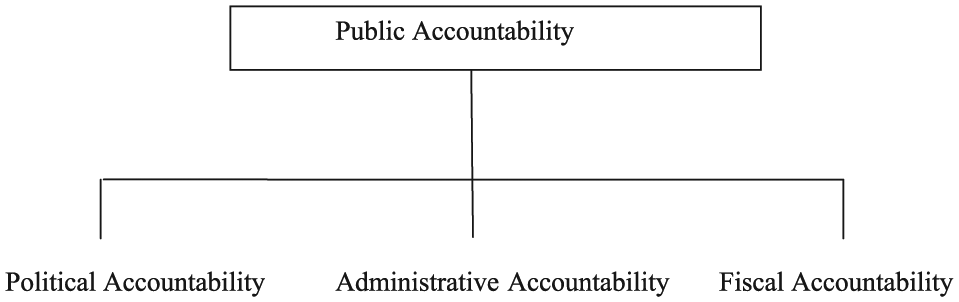
There are different manifestations of accountability—public and private—but this work is interested in public accountability, which again manifests itself in many forms such as political, administrative, and fiscal accountability (Amoke & Asogwa, 2000; Bayene & Otobo, 1994). The focus of this article is on administrative accountability, the extent to which administrators internalize and implement the measures of public accountability in the day-to-day operations. Administrative accountability revolves on virtually every worker in an organization especially those at the upper echelon. Political accountability assumes that occupants of political offices would meet the expectations of the electorate by fulfilling the promises made in the manifestoes of their parties. Fiscal accountability, on the other hand, is directed toward ensuring that funds are utilized by governments in accordance with established regulations and guidelines for purposes for which they are intended.
The aim of these basic groups of accountability is to ensure that organizations achieve their established objectives. Below is a sketch of types of public accountability.
Source. Adapted from Amoke and Asogwa (2000).
It is the duty of government officials/functionaries who are entrusted with the rules and regulations that guide the operations of accountability measures to implement these rules and regulations in their day-to-day operations and also account to the people they serve, who conversely depend on them. The efficient operation of these rules and regulations will, to a great extent, improve the performance of public enterprises and thus enhance accountability. This article therefore is significant because before the introduction of these measures, the use of primordial consideration and “God Fatherism” (a form of corruption) abounded in almost all public organizations in Nigeria. Unfortunately, there were inadequate investigations of the effectiveness of the implemented measures on public accountability. On the other hand, the findings of this article can assist public servants to revamp/improve their attitude to the discharge of their duties to implement these measures of public accountability. Furthermore, other African countries will benefit from the study as it will help them unravel the implications of previous failure to comply with public accountability guidelines, and reveal the effectiveness of these measures of public accountability.
The Issue of Corruption Seen From the African Perspective
Corruption is defined as the abuse of public power for private or personal gains and is of growing international and regional concern (Enweremadu & Okafor, 2009; Vian et al., 2012). The dictionary definition of corruption is the impairment of integrity, virtue, or moral principle; depravity, decay, and an inducement to wrong by improper or unlawful means. Corruption is a universal and historic issue, which occurs in both developed and developing countries, and public and private sectors. Corruption from petty bribery, nepotism, to large-scale larceny can have a devastating impact—undermining development, destroying public trust, and burdening many sectors of society, in particular the poor (Onor, 2002). The effect of corruption is destructive and its reach is insidious, yet many African countries have deemed it unwise to discontinue their corrupt tendencies. While many anti-corruption measures have been instituted over the years in many African countries, they have achieved little or no fruitful results (Soma, 2004). Transparency International (TI) releases annually their CPI which measures the perceived level of public sector corruption in a country. Below is the CPI of African Countries from 2002 to 2010.
The ranking in Table 1 shows how countries compare to others. The CPI score indicates the perceived level of public sector corruption in a country. The CPI has been widely criticized ever since it was introduced. The third-party survey data that the index uses has also been criticized but, considering the level of perceived corruption in many countries, the index still serves as a reliable document (Transparency International Corruption Perception/Index, 1999-2007). I adopted the index in the ranking of countries as it pertains to corruption in the Worldwide Corruption Perception Index (2010). Countries like Denmark, New Zealand, Singapore, Finland, Netherlands, Sweden, Canada, Switzerland, Australia, Norway, Iceland, Luxembourg, Austria, Germany, Japan, Qatar, United Kingdom, China, Belgium, and United States scored between 7 and 9.3 points in the 2010 ranking, with Denmark topping the list. Analysis of the figures reveals that these assessments were realistic. African countries scored well below 5 points despite various official resolutions made over the years, such as for example in the 34th Ordinary Session of the Heads of States and Governments of Africa in 1998 in Ouagadougou, Burkina Faso, to fight against corruption.
Corruption Perception Index by Transparency International for Some African Countries From 2002-2010.

Source. Extracted from Worldwide Corruption Perception Index (2010).
If the authorities and institutions were accountable, effective, efficient, transparent, responsive, and equitable in the discharge of their duties, then the issue of good governance and capacity-building, which we believe are desired by all Africans, would be achieved. African governments have affirmed their commitment to advancing good governance in the Victoria Falls Declaration of 1999 and reaffirmed the vision of Kigali Declaration of 2005.
Improving governance implies the strengthening of the measures of public accountability, implementing development initiatives, and delivering basic services among a variety of local participating institutions including local governments and others. Corruption notably results in absence of transparency and accountability. From the available records of TI in Table 1, African countries have not fared well.
Equally significant is the fact that some countries across east, south, central, and north Africa had a CPI score lower than 3.0 in the 2010 ranking. On the other hand, CPI comparative data also show improvement in the ranking of some countries in Table 1; the main changes were as follows:
Ghana’s score rose from 3.9 in 2009 to 4.1 in 2010.
Rwanda’s score rose from 3.3 in 2009 to 4.0 in 2010.
Tunisia’s score rose from 4.2 in 2009 to 4.3 in 2010.
Lesotho’s score increased from 3.3 in 2009 to 3.5 in 2010.
Malawi’s score increased from 3.3 in 2009 to 3.4 in 2010.
Liberia’s score rose from 3.3 in 2009 to 3.5 in 2010.
Other countries had CPI scores lower than 3.0 in the 2010 CPI. These countries included Mozambique, Uganda, Nigeria, Togo, Zimbabwe, Mauritania, Cameroon, Libya, Cote d’ivoire, Namibia, Kenya, Central African Republic, Republic of Congo, Guinea Bissau, Democratic Republic of Congo, Guinea, Angola, Equatorial Guinea, Burundi, Chad, and Liberia. Zambia remained at 3.0 since 2009. Agreements concluded at Assembly of Heads of States and Governments of the AU held in Lusaka, Zambia, in July 2001 and the first session of the Assembly of the AU held in Durban, South Africa, in July 2002 helped to establish the necessary conditions to foster transparency and accountability in the management of public affairs.
However, with this agreement, one would have expected the various African countries to institute measures that would promote accountability and transparency and ensure strict implementation of these measures. However, a close analysis of the literature does not reveal any significant change despite the measures instituted to promote accountability and curb corruption (see Table 1).
Measures Adopted By Some African Countries to Promote Accountability
Almost all African countries have introduced measures to promote accountability in their various public sector management domains. South Africa enacted the Public Finance Management Act No. 1 of 1999 assented on 2nd March, 1999. The Act is to regulate financial management in the national and provincial governments, to ensure that all revenues, expenditures, assets, and liabilities of these governments are managed efficiently and effectively; to provide for the responsibilities of persons entrusted with financial management in these governments; and to provide for matters connected therewith.
The object of this Act is to secure transparency, accountability, and sound management of the revenues, expenditure, assets, and liabilities of the institutions to which this Act applies. Section 6(9) stipulates that the act promotes and enforces transparency in the management of revenue, expenditures, assets, and liabilities of departments, public entities, and constitutional institutions, and performs other functions assigned to the national treasury.
Similarly, Act 663 of the parliament of the Federal Republic of Ghana, the Public Procurement Act 2003, establishes public procurement board, makes administrative and institutional arrangements for procurement, stipulates tendering procedures, and provides for purposes connected with these. Part 1(2) of the act stipulates that the objective of the board is to include harmonization of the process of public procurement in the public service, to secure a judicious and efficient use of state resources in public procurement, and to ensure that public procurement is carried out in a fair, transparent, and non-discriminatory manner. Part 3 stipulates the functions of the board. One of the important functions of the board is embedded in part 3(g) which is to publish a monthly Public Procurement Bulletin which shall contain information germane to public procurement, including proposed procurement notices, notices of information to tender, and contract award information. Other important sections that pertain to enhancing accountability in the system are the “whistle blower” Act 2006. Ghana was the first country to be peer reviewed by AU in January 2006, and was praised by observers as a model for the APRM process across Africa and for the steady progress it has made in becoming a strong democracy over the previous decade. Ghana’s success in the process is attributed to the structure, composition, and autonomy given to the Governing Council, the body steering the reviewed exercise.
Furthermore, conflict resolution helped this process. The Lome Peace Accord of 1998 and its subsequent corollaries of Abuja I and II in 2000 finally ended the war in Sierra Leone and ushered in peace in that country, made provisions for key reforms in governance; the responsible use of minerals and resources; proceeds and fiscal accountability. The reform introduced in the public sector was aimed at strengthening states institutions, public financial management, and modernization of the economy (Ibrahim, 2010; Staffen & Heywood, 2009).
In addition, some African countries, notably Algeria, Liberia, Mauritania, Rwanda, and Ghana, have adopted the use of the International Public Sector Accounting Standard (IPSAS) if only on cash basis. IPSAS is a set of Accounting Standards issued by the IPSAS Board of the International Federation of Accountants (IFAC) for use by public sector entities around the world in the preparation of financial statements. IPSAS is a major step in enthronement of accountability standards. Conversely, in some African countries such as Uganda, South Africa, Nigeria, and The Gambia, arrangements are underway to commence a transition from a modified cash basis of accounting to adoption of full accrual IPSAS. A phased implementation approach is planned (see http://www.icasrilanka.com). South Africa and Algeria have also completed the process of APRM and have been reviewed at the July AU Summit. Kenya, Rwanda, Mozambique, and Uganda have been judged APRM compliants, all in a bid to promote accountability. However, despite all these measures, the Nigeria Head of Service at the Africa forum on fighting corruption lamented the limited functioning of the established mechanisms within African countries as well as the weakening of governance by globalization. He asserted that African traditional values were critical to sustainable good governance including anti-corruption and integrity promotion crusade.
Nigeria’s Experience in the Promotion of Public Accountability
It is apposite for us to throw some light on the standing of Nigeria with regard to the implementation of these measures. Before the birth of the Nigeria Fourth Republic, corruption had been practically institutionalized as an instrument of governance in Nigeria with attendant destructive consequences (Osagiede, 2007).
Following the resolution adopted by the Assembly of African Heads of States in June 1998, the government of Olusegun Obasanjo instituted a number of anti-corruption and integrity promotion initiatives. Some of the measures included the Independent Corrupt Practices and Other Related Offences Commission in 2000 (ICPC) and the EFCC in December 2002. The government also came up with an improved and more transparent process of government spending based on accountability and transparency (Obiajulu, 2005). Historically, it is in the award of contracts by various ministries in Nigeria that the poor transparency image of the country is mostly ascribed. The government of Obasanjo therefore set up the BMPIU in 2002, which commenced a process of contract award review oversight and Certification commonly called the “Due Process.” This unit was a clearing house for government procurement of goods and services and was established to minimize waste in government expenditure as a result of corruption, lack of accountability, and transparency in Public Sectors (National Economic Empowerment and Development Strategy [NEEDS], 2005). This was instituted after analyzing the different concerns and problems identified as they affect the Federal Service, the public sectors, and governance in general. These and several other measures, including the APRM that seeks, inter alia, to promote anti-corruption and integrity did not yield results because of their limited application
Theoretical Framework
The agency theory was first formulated in the academic economic literature in the early 1970s (Jensen & Meckling, 1976; Ross, 1973; Shapiro, 2005) that diffused into the business schools. In the agency relationship, one party acts on behalf of another. Government is the principal that creates the different anti-corruption agencies to ensure the effective implementation of measures of public accountability. Those selected to work in the agencies may have been employed based on certain criteria. In the selection process, government may have faced a classical agency problem of asymmetric information. Those selected/employed may exaggerate their talents. Government may have found better persons but did not know enough or may not have provided adequate incentives to attract them. The theory assumes that the agents may take advantage of the appointment for their own benefit or that of the government. Government may want the highest quality job to be done, whereas the agents may want to exploit all the information asymmetries to ensure that they maximize their own interests at the expense of the principal. Agency theory dictates that the principal tries to bridge the information asymmetries by installing information systems and monitoring the agent. All the activities carried out will be monitored. The government may also offer some incentives in an effort to align organizational interest with that of the agent. And as part of this incentive, the government compensates the workers for an outcome-oriented contract. The employees of these organizations can work better if there are incentive and proper supervision.
Materials and Methods
Government functionaries (those employed by government to work in these agencies) are entrusted with the responsibilities to ensure the success of EFCC, ICPC, and BMPIU. The establishment of these agencies was to placate growing, domestic, and international measures. Section 6(9-8) of the ICPC Act stipulates that ICPC will receive and investigate complaints from members of the public on allegation of corrupt practices, and in appropriate cases, prosecute the offenders, and examine the practices, systems, and procedure of public bodies. The EFCC Act however contained far more draconian powers than those of the ICPC. It was enjoined to take all necessary measures to prevent and eradicate economic and financial crimes in Nigeria. Section 6 of the Act stipulates the identifying, monitoring, and freezing or confiscating of proceeds from criminal activities such as terrorism, financial and economic crimes, and so on. The EFCC has about 1,246 officials on the pay roll but the commission also has 700 police who earn a stipend; BMPIU has about 1,800 staff and ICPC about 1,754, giving a total of 4,800 staff. On these numbers, I used the quota sampling technique which is a type of non-probability sample in which the researcher selects people according to some fixed quota. The specific characteristics on which I based my quota were by gender. I chose 240 of the entire relevant population using the quota sampling technique. This is because I insisted on including a certain number of males and females. I therefore chose those that are most accessible considering the gender bias (Obasi, 1999). Population sample comprised 140 men (65.6%) and 100 women (34.4%). Majority of the staff were males, 72.58% were married, and 27.42% were single. A total of 27% obtained the West African school certificate, 33% obtained the Ordinary National Diploma, and 40% were first degree and master’s degree students. A total of 79.16% were Christians whereas 20.84% were Moslems. The mean age was 24.89. I also considered those who had been in the service for more than 5 years. The researcher distributed 240 questionnaires.
Some of the questionnaires were open ended whereas others were closed-ended. A total of 186 relevant responses were received.
Independent Measure
To capture respondents’ views on measures of public accountability in Africa using Nigeria as a case study, respondents were asked to agree, strongly agree, strongly disagree, or disagree (Questions 8, 10, 11, 12) and to answer yes, no, or no idea (Questions 1, 5, and 6) and fully implemented, partially implemented, and implemented to Questions 3 and 4.
Questions asked by the researcher were as follows:
Are you aware of the several measures put in place by the government of Obasanjo to enthrone accountability and combat corruption?
What are these measures?
Do you think that these measures are implemented in the discharge of duties in the Nigerian public services?
If yes, to what extent has the Nigeria public service implemented these measures in the discharge of duties?
Are some of these measures better implemented than others?
Are hindrances encountered in the implementation of these measures?
If yes, what are these hindrances?
Are these measures applicable to all the parastatals in the Nigeria public service?.
Lack of implementation of these measures attracts sanctions irrespective of whoever is involved.
Implementation of these measures has contributed to the effectiveness of public accountability in the Nigeria public service.
The emplacements of these measures have actually curbed corruption
What is the position of Nigeria in the Transparency International Index before and after the emplacements of these measures?
Table 2 shows that 122 males and 64 females filled the questionnaires and returned them while the age distribution of respondents reveals that 140 were between the ages of 20 and 30, 22 between 31 and 40, and 24 were aged 41 and above (see Table 3). The questions were answered by these age groups.
Results and Findings.

Source. Fieldwork by the author (2013).
Age Distribution of Respondents.

Source. Fieldwork by the author (2013).
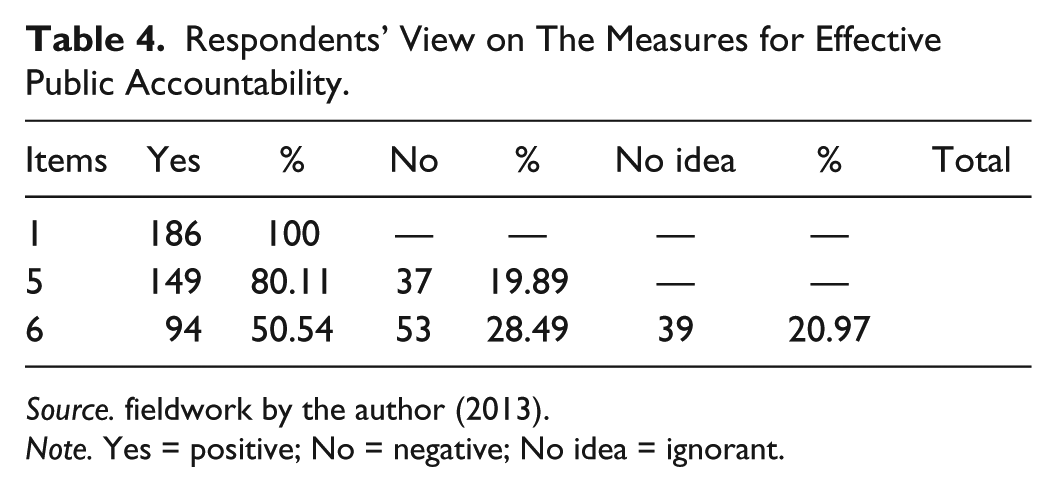
Findings pertaining to the first research question (see Table 4, Item 1) revealed that all the workers knew about the several measures put in place in the Nigeria public service to promote accountability (100%). When asked what these measures were, respondents ticked ICPC, EFCC, BMPIU, Extractive Industry Transparency Initiative (EITI), monetization of public officers, fringe benefits, Servicom Charters and creating Servicom, Modal Units in Ministries/Departments/Agencies (MDAs). The EITI, according to respondents, was aimed at encouraging the Nigerian National Petroleum Corporation (NNPC) and other oil and gas companies to fully disclose revenues and cost of operations. MDAs were designed to break the twin evils of corruption and inefficiency in public service delivery, improve budget discipline through efforts to establish annual budget framework, and provide guidelines to be followed by all the three tiers of government.
Respondents’ View on The Measures for Effective Public Accountability.
Source. fieldwork by the author (2013).
Note. Yes = positive; No = negative; No idea = ignorant.
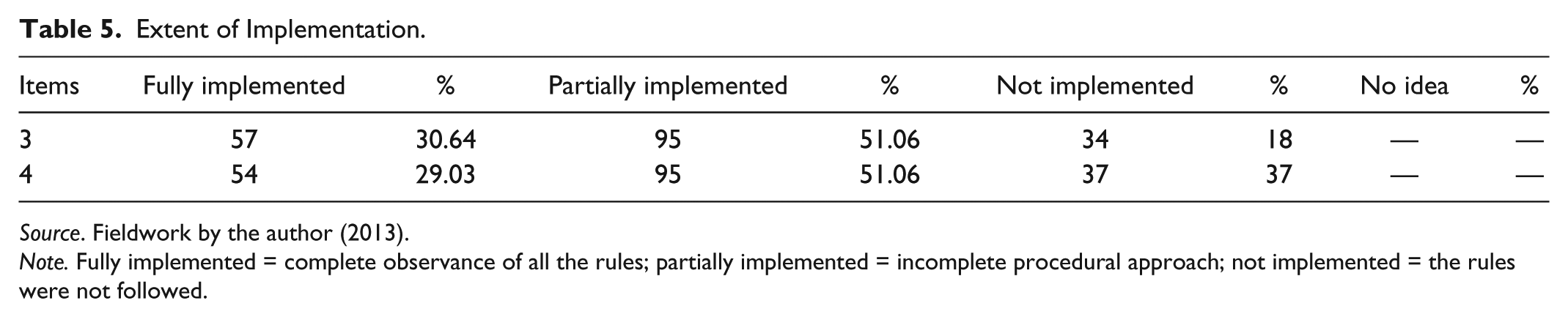
Results showed that about 30.4% believed that these measures were fully implemented, 51.06% believed they were partially implemented, and 18% believed that these measures were not implemented at all (see Table 5, Item 3). Although 51.06% was not an overwhelming majority, it was more than half the number who answered the questionnaire. It then follows that these measures were not fully implemented in the discharge of duties in the Nigeria public service. This also shows that the activities of the agencies were not properly supervised according to agency theory to achieve results. The question on the extent to which these measures were implemented recorded very poor results (see Table 5, Item 4). The agency theory states that agents may take advantage of appointment for their own benefit or that of the government, and this may account for the poor results obtained. If government had played its role of bridging the information asymmetries and monitored workers, a better result would have been achieved. We should note that partial fulfillment of any measure does not attract full reward.
Extent of Implementation.
Source. Fieldwork by the author (2013).
Note. Fully implemented = complete observance of all the rules; partially implemented = incomplete procedural approach; not implemented = the rules were not followed.
This could explain the reason for the insignificant change in the CPI ranking. For Research Questions 4, 5, and 6, respondents indicated that these measures were not fully implemented. The extent to which these measures were implemented recorded very poor results. The majority of the respondents opined that corruption was structurally engraved in the system of public administration and this could be one of the main reasons for non-implementation of these measures. Many advanced phrases like “If you are in the good book of government, you can turn the rules upside down and go scot free,” “Does anything good work in Nigeria,” and so on. However, a good number, about 80.11%, responded that some of these measures were better implemented than others (see Table 4, Item 5). Some mentioned that the BMPIU is working better than some anti-corruption commissions and has saved the country millions of naira. The BMPIU recorded significant results because of the intense monitoring by government and due to the fact that the agency was headed by an honest person. We also discovered that government negative intervention was minimal in the award of contracts which led to effective implementation of due process mechanism. According to the theory, government created these agencies to ensure effective implementation of these measures. Other respondents were of the opinion that the Budget Discipline was not working properly as it was usually violated by those in authority especially at local government levels. Monetization of employee fringe benefits worked only in the federal parastatals and that does not mean that workers had not devised means of defrauding parastatals. The majority of the respondents mentioned that EFCC and ICPC were effective only with regard to victims who were not in the good books of government. Respondents criticized the activities of the new chairperson of EFCC and said that he brought to book some culprits, but not all. The article went further to find out if hindrances were encountered in the implementation of these measures. An impressive result was obtained; those who answered strongly agreed and agreed comprised 82.5%, and they believed that hindrances were encountered in the implementation of these measures (see Table 4). When asked about some of these hindrances encountered, members stated categorically that rules were violated to protect the interest of government, the workers, and those in authority. “You don’t crucify your employers” do you? was one response.
It does appear that the rules set by government were also violated by the same body. Most of the respondents opined that God Fatherism clogged to the implementation of measures. Respondents advanced typical comments of officials such as “If you don’t obey what I say, you’ll be fired”; “This is my relative; if you value your job; just do what I said.” Furthermore, 37.63% “agreed,” whereas 44.9% “strongly agreed” that these measures were applicable to all public enterprises in public service, except the monetization of fringe benefits which they purported as applicable only to federal government workers (see Table 6, Item 8).
Respondents’ View on Measures of Public Accountability.

Source. Fieldwork by the author (2013).
Note. SA = strongly agree; A = agree; SDA = strongly disagree; DA = disagree.
However, 43.01% and 38.48% “strongly disagreed” and “disagreed” respectively that lack of implementation of these measures attracts sanctions irrespective of whoever is involved. Respondents believed that the law in that case is a “respecter of persons.” They said that the position one holds matters a lot. They cited the case of one-time speaker of the House of Representatives and some state governors who were protected by the immunity clause. According to them, these persons deserved to be fired but were not. When asked about the former Minister of Education, they said that the sledge hammer fell on him because he was not in the good book of the government. However, a good number of the respondents believed that implementation of these mechanisms in some areas had contributed to the effectiveness of public accountability (see Table 6, Item 10). Finally, a chi-square was performed to find out the relationship between the implementation of these measures emplaced and public accountability. The result revealed that there is a significant relationship between the implementation of these measures and public accountability. The level of significance is .05. The degree of freedom of = (R − 1) (C − 1) = (5 − 1) (2 − 1) = 4 From the X2, significant level of .05, the critical value is 9.48.
Decision Rule: Reject critical value if greater than statistical value at level of significance .05 and accountability in the Nigeria public service. A typical example was the case of one-time speaker of the House of Representatives, Federal Republic of Nigeria. She assigned N628 million for the renovation of her official residence and official car. When confronted by the House, she claimed that she had followed due process rules and regulations. She went further to make use of ghost companies to execute the projects. A Newswatch (Daminabo, 2007) investigation revealed that the procedure for the award of the contract was substantially at variance with the prescribed process. The summary of the case was that she did not follow the due process mechanism installed in the system and the budget discipline was not followed. Her crime was detected, but she was merely demoted instead of being recalled by her constituency. Another example was the Abuja National Stadium contract awarded in 2000 before the enactment of the Due Process Guideline which requires that any project with federal government funding must be backed by a Due Process Certificate. Therefore, in this case, the BMPIU had to do a retroactive compliance review on the procurement process. This was to ascertain the true cost of the project. The process for awarding the contract would not have passed the due process test had the policy been in place when the contract was awarded. However, the best outcome that government could secure was to compare the contract cost to international, regional, or national pricing. It is worth noting that contrary to the wrong costing quoted before the stadium, the BMPIU achieved a post procurement cost saving of N7.9 billion (Ezekwesili, 2004).
Again, in December 2005, the BMPIU had saved Nigeria about N960 billion from a single contract within 4 years of its implementation (Ezekwesili, 2006). These efforts by the agencies are reflected in the scores of TI. However, despite the establishment of these institutions to enhance the effectiveness of public accountability, the level of corruption is still serious and remains one of the greatest challenges in Nigeria. The former chairman of Due Process, Dr. Oby Ezekwesili, stated that the Due Process saved Nigeria N672.4 million from a single project of supplying equipment to tertiary institutions by the Ministry of Health. According to Wahab (2005), the success of this aspect of the reform, no doubt, contributed to the realization of debt relief granted to Nigeria in 2005. It is also important to note that Due Process is the best development mechanism that countries like South Korea, Malaysia, South Africa, Singapore, Ghana, Botswana, Uganda, United Kingdom, and United States of Africa have utilized effectively in instituting and achieving high relief in public expenditure, efficiency, and value for money in the delivery of social goods, works, and services to communities.
The researcher also performed a chi-square test to see if partial implementation of these measures will promote accountability. The level of significance is .05, df = (R − 1) (C − 1) = (5 − 1) (2 − 1) = 4. The level of significance is .05, the critical value is 9.48. As critical value 9.48 is less than statistical value which is 10.98, I therefore concluded that partial implementation of these measures will not promote accountability and transparency. The report of the ICPC and EFCC on several cases investigated as well as those successfully prosecuted indicated that poor accountability had led to loss of revenues. One of Nigeria’s former heads of state and commander in chief was discovered to have stolen more than $3.0 billion, which was found in foreign accounts. A one-time inspector general of police was found guilty of siphoning off N17.0 billion by the EFCC. However, some state governors accused of looting state treasuries were still under prosecution. In June 2007, EFCC and ICPC recovered N613 billion from 225 convictions (this day; March 11, 2008). This amount, according to Ogunlaya, represented 4% of federal and state budgetary provisions for the period 2002-2006. In addition, the Punch Newspaper on May 26, 2010, reported that three top officials of Oyo State Government as well as a consultant were detained by the EFCC over alleged involvement in N8.3 billion road contract scam. A concerned individual in that state wrote a petition and this was what actually led to the arrest of the culprits. If these measures installed in the system were fully implemented, these crimes would have been averted. Though they were later discovered, prevention is better than cure. Conversely, it is estimated that up to 40% of government budgets at various levels were lost to corrupt government officials. Those who made the law were the ones who violated it. Similarly, Nigeria would have performed better if the activities of those in the corridors of power had been transparent. If government officials had been fully accountable and open, the remaining 60% would have produced quality projects or services. Unfortunately, this is highly compromised as a result of corrupt practices of government (Agu, 2008). According to TI, Nigeria improved on the world’s most corrupt countries profile from third position in 2005 to 32 in 2007. The improvement was however attributed to the zeal with which the anti-corruption agencies performed in prosecuting corrupt officials which served as a deterrent. Timely intervention of these anti-corruption bodies is of immense value. For instance, South Africa has the Public Finance Management Act which contains measures to promote accountability and transparency. From all indications, the country has to some extent adopt the provisions of this act as it was among the African countries that scored above 4.00 from 2002 to 2010. For example, the South African government cancelled 152.7 million contract following serious allegations of tender irregularities.
The ICPC, which focuses on curbing bribery and corruption in the Nigeria public service, stipulates in the ICPC Act punishments to be meted out to offenders, but these provisions were not implemented when those in the good books of government were involved.
Conclusion and Recommendations
This article assessed the various anti-corruption measures installed in some African countries for the effectiveness of public accountability. We discovered that the key functionaries in the Nigerian public sector do not adhere strictly to these measures in the discharge of their duties. Their lack of commitment manifested as nepotism, favoritism, and gender bias. Furthermore, those in the corridors of power also contributed significantly to poor implementation of these measures as rules were violated for their sake. The Nigeria State should consider very seriously the implementation of the measures instituted and ensure that all offenders receive punishment as stipulated. This would in no small measure promote accountability. It would also save wastage of resources: The efforts, however small, made by the various chairpersons of these bodies (BMPIU, ICPC, and EFCC) saved so much money for the country. Agency theory advocates strict supervision to ensure compliance, but this was relegated to the background. This lack of effective supervision led to undermining of public accountability and promotion of corruption. The relationship between an increasing rate of poor accountability, transparency, and corruption seems to enjoy strong support. Conversely, there appears to be lack of cohesion demonstrated by the absence of full implementation of these measures in the Nigeria public sectors. According to Oronsaye (2007), corruption thrives in the face of the breakdown of moral and ethical values in the society. All the sectors of the economy and society are bedeviled by the cancer of corruption in almost equal measure as none is an island of itself. Evidence also showed that these cluster of anti-corruption measures recorded very limited success because of the poor wage and incentive structures that should normally support productivity in the public sectors.
Agency theory advocates for increased salaries to motivate workers to give their best, and on this basis government should increase salaries and incentives of workers to achieve a better result. In addition, the “immunity syndrome” bestowed on those in government also contributed to merely a partial implementation of these measures. Arising from the foregoing, I advance the following recommendations. The Nigeria public sector should devise a better method of how to implement measures for the effectiveness of public accountability and transparency. These measures recorded very limited success because they were not properly implemented. The empirical evidence reflected the lack of commitment on the part of government officials who failed fully to apply laws and regulations of these rules through their refinement, using best-practice-tested approaches (Oronsaye, 2007).
With regard to recognition of the importance of these measures for the good of the country, there is a need to recognize the importance and role these measures would play if implemented. For instance, Due Process or the Public Procurement Tender is the best development-boosting mechanism utilized by countries such as South Korea, Malaysia, South Africa, Singapore, Ghana, Uganda, and even the United Kingdom and the United States to effectively institute and achieve a high rate of public expenditure, efficiency, and value for money in the delivery of social goods, works, and services.
This has practical implication; it suggests that if these mechanisms were adhered to, it would lead to promotion of accountability and transparency, and curb corruption drastically. It would also encourage investors. We therefore appeal for strong recognition and implementation of the importance of these measures.
There is need for a change of mindset about the implementation of these measures by those in authority and the functionaries in the different ministries. Strict adherence to these measures would improve service delivery, efficiency, competition, and effectiveness, and curtail corruption. This would also facilitate Nigeria to be enlisted among the developed nations of the world. Those in the corridors of power should be the first to implement these measures. Obama was the first to publicly declare his tax return in 2010 in America to show the citizens the importance of paying tax. In Nigeria, “big men” do not pay taxes but public servants do. According to Oguonu (2004), there is need for institutionalizing, internalizing, and building ownership for the multitude of reforms within the public sectors so as to ensure its sustenance in the anti-corruption campaign. It is vital for our leaders to enthrone the principle of openness, transparency, mobility, and accountability in their day-to-day operations.
Moreover, a system of internal checks has to be built into the system to ensure that measures are fully enforced. This is a very important step toward achieving the set goals. Qualified, honest, and sincere personnel with good records are perhaps the best internal check. However, on February 17, 2011, the Zero Corruption Coalition and the many Nigerian citizens wrote to the President concerning the appointment of Justice Pius Aderemi, a retired justice, as the next chairman of the ICPC. The Coalition referred the President to Section 3(4) of the ICPC 2000 Act and Section 5(6) of the constitution. This section according to them nullifies the appointment of the retired Judge. They stated categorically that the appointment of the leadership of anti-corruption agency in Nigeria should be driven by a desire to effect fundamental and radical change in Nigeria, not by parochial and self- service interest. His antecedents does not qualify him for the position given to him . Again, they lamented on the ineffectiveness of these commissions particularly under the previous leadership of retired justice of Supreme Court and police officers. With regard to adequate monitoring of corruption, ad hoc task force committees need to be set up in all public enterprises to monitor the implementation of the various instruments put in place to fight corruption which undermined accountability. Proper monitoring would lead to full implementation of these measures installed to promote accountability. Government should show commitment and make these agencies autonomous to enable them to execute their duties effectively and efficiently. There should be increase in salary of workers and incentives to motivate them: According to Oronsaye (2007), anti-corruption measures recorded very limited success because of poor wages and incentive structures in the Nigeria Civil Service. There is, therefore, a clear need to articulate and harmonize new salary packages for workers with a view to motivating them when the need arises. Poor welfare and working conditions, which do not provide for decent living, often encourage non-implementation of such measures. A senator receives 260,000.00 merely as a yearly constituency allowance, whereas a full-time state civil servant receives about 300,000.00 per annum and federal workers 1,400,000.00. In November 2012, civil servants in Nigeria went on strike because of non-implementation of a 18,000.00 minimum wage package for workers. The attendant social insecurity affects the perception of public servants. More so, the attitude of both federal and state governments toward the payment of retirement benefits and pensions also influences workers’ attitudes to the application of these measures put in place to guide against fraudulent activities.
The introduction of the new pension scheme in the Nigeria Federal Service is a step in the right direction, but of equal importance is the fact that state civil servants should be included in this arrangement. Young school leavers constitute 40% of the Nigerian population, and they are dependent on their parents who are in the public service. How can their needs be met with their parents’ meager salaries? Again, the immunity clause should be expunged. The withdrawal of this clause would give the administration an opportunity to truly express, in practical terms, a commitment to promote accountability and transparency, and curb corruption.
Footnotes
Acknowledgements
I express my profound gratitude to Prof. Peter Limb of Michigan State University for carefully reading through the manuscript and affecting the necessary editing work.
Declaration of Conflicting Interests
The author(s) declared no potential conflicts of interest with respect to the research, authorship, and/or publication of this article.
Funding
The author(s) received no financial support for the research and/or authorship of this article.